Tuesday, 24 November 2026 · IST · National & International · 9 items · 2 MCQs
The COP31 climate talks at Antalya collapsed without consensus on fossil fuels and finance, while India announced a ₹15,000 crore package and 8 agreements during Nepal PM Balendra Shah's visit. The first SCO Civilisational Dialogue Forum closed with the Indraprastha Communique, and the Monsoon Session stayed un-prorogued for a record 100 days.
Today at a glance — things to remember
COP31 (Antalya, Türkiye) ended on 22 Nov without a deal; COP32 goes to Addis Ababa (2027).
The COP31 UN climate conference at Antalya, Türkiye closed on 22 November 2026, two days past schedule, without a final agreement, as countries split over the pace of moving away from fossil fuels and over new climate-finance commitments.
Key facts
Held from 9 November 2026 (scheduled close 20 November); COP President: Türkiye's Murat Kurum; Australia's Chris Bowen was President of Negotiations.
Described as the first collapse of UN climate talks since 2000 (The Hague).
India, speaking for the Like-Minded Developing Countries (LMDC), said the draft did not adequately reflect equity and CBDR-RC.
Minister Bhupender Yadav regretted the lack of consensus, cited India's 170+ GW solar capacity and backed consensus-based multilateralism.
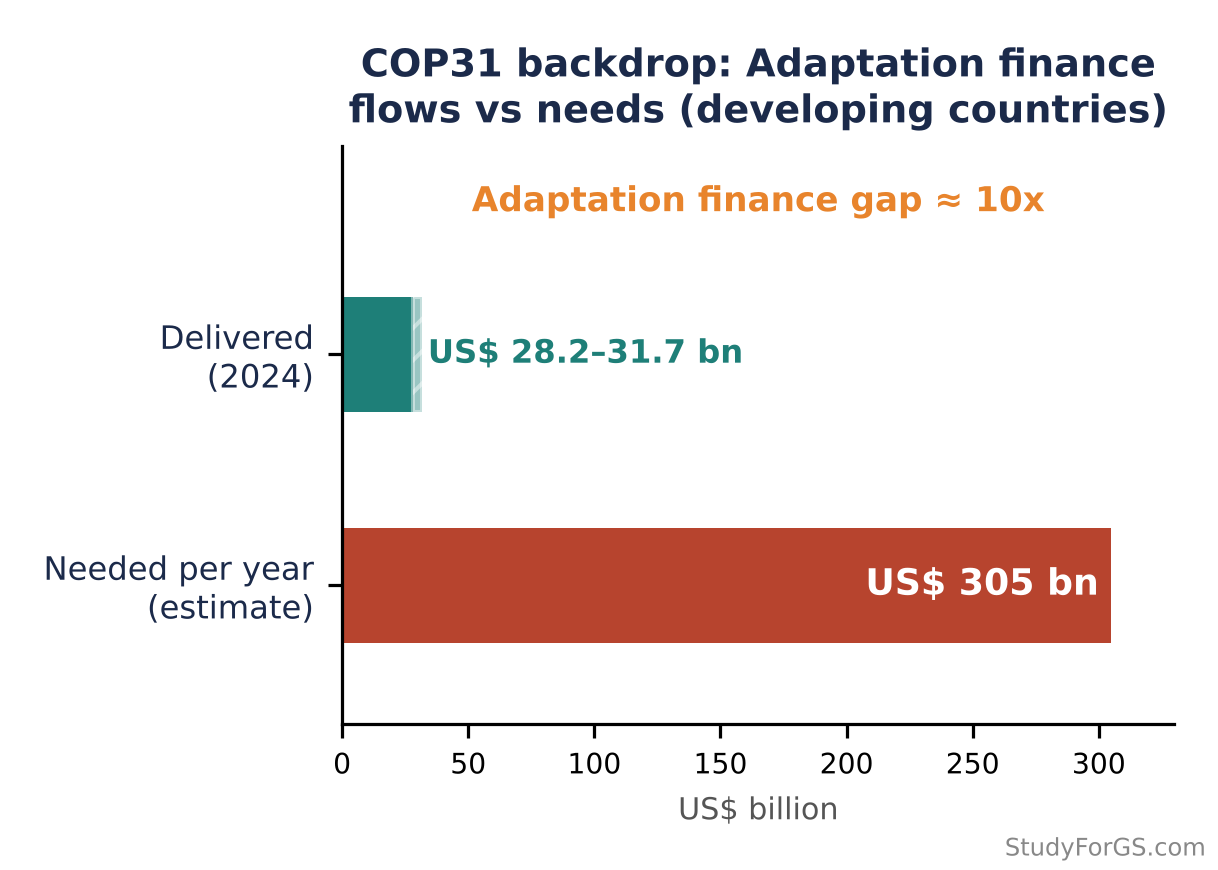
UNEP Adaptation Gap Report 2026: adaptation finance to developing countries was US$ 28.2–31.7 bn (2024) against estimated needs of about US$ 305 bn a year.
Way forward
Rebuild North–South trust with a credible finance roadmap, a clear baseline for adaptation finance and early consultations so that COP32 (Addis Ababa, 2027) avoids a repeat deadlock.
Concept
UNFCCC (1992, Rio Earth Summit) – the COP is its supreme body and decides by consensus. CBDR-RC = Common But Differentiated Responsibilities and Respective Capabilities. NCQG (COP29, Baku): developed countries to take the lead in mobilising US$ 300 bn a year by 2035.
Horizontal bar chart comparing adaptation finance delivered to developing countries in 2024 (US$ 28.2–31.7 billion) with estimated annual needs of about US$ 305 billion, a gap of about ten times. — StudyForGS
2. Small Hydro Power: only a quarter of 21 GW potential harnessed
An official backgrounder on Small Hydro Power (SHP) (22 November 2026) shows India has tapped only about one-fourth of its assessed potential; the SHP Development Scheme (2026-27 to 2030-31) aims to speed up capacity in hilly, North-Eastern and border areas.
Key facts
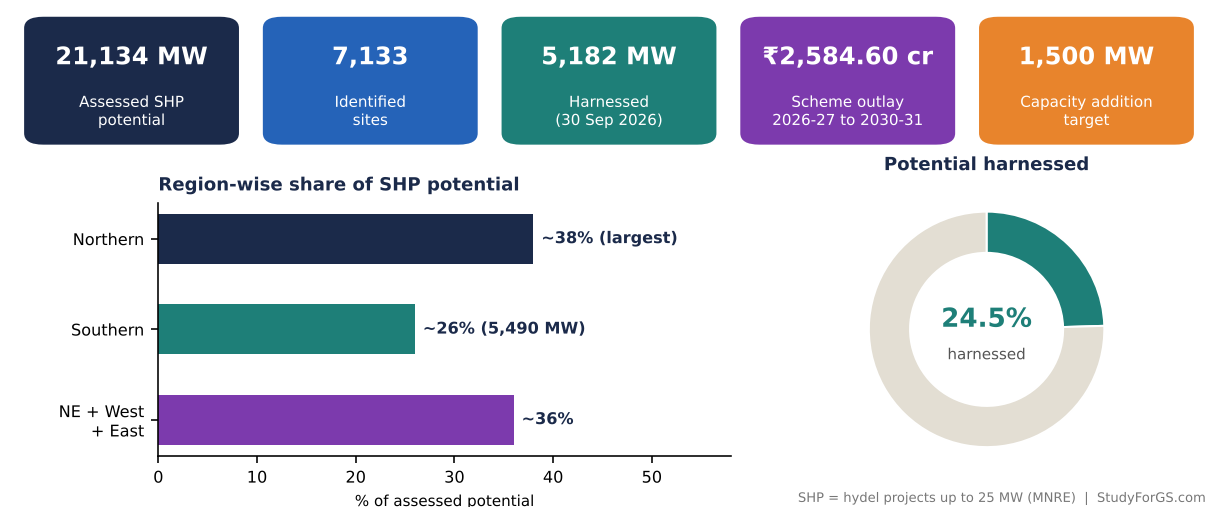
Assessed potential 21,134 MW at 7,133 sites; installed about 5,182 MW (≈ 25%) as on 30 September 2026.
Scheme outlay ₹2,584.60 crore; target about 1,500 MW new capacity; ₹30 crore for DPRs of at least 200 projects.
North-East and international border districts: ₹3.6 crore per MW or 30% of project cost (whichever is lower), capped at ₹30 crore per project.
Region-wise: the Northern region has the largest share (about 38% of potential), followed by the Southern region (5,490 MW).
Way forward
Fast-track clearances and grid links for remote sites, and pair SHP with local mini-grids to cut diesel use in hill and border villages.
Concept
SHP = hydel projects up to 25 MW, handled by MNRE; bigger hydro is under the Ministry of Power. Sub-classes: micro (up to 100 kW), mini (101 kW–2 MW), small (2–25 MW). Since 2019, large hydro (above 25 MW) is also counted as renewable energy.
Infographic on small hydro power: tiles for 21,134 MW potential, 7,133 sites, 5,182 MW harnessed, ₹2,584.60 crore outlay and 1,500 MW target; bar chart of region-wise share of potential (Northern about 38%, Southern about 26%, rest about 36%); donut showing 24.5% harnessed. — StudyForGS
3. Africa leads India's regional export growth in H1 2026-27
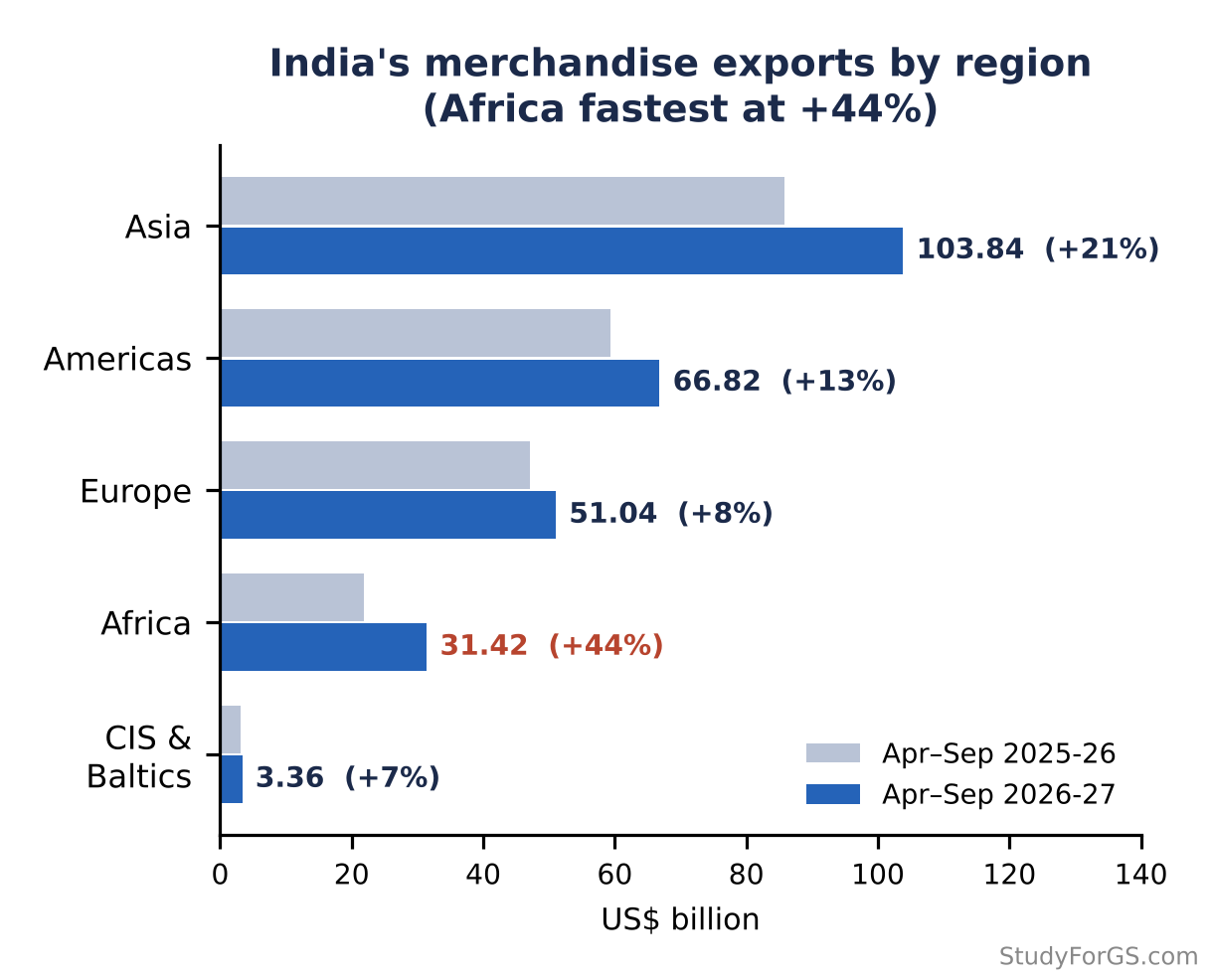
Commerce Ministry data released on 21 November 2026 show India's merchandise exports grew across all major regions in April–September 2026-27, with Africa posting the fastest growth.
Key facts
Africa: +44% to US$ 31.42 bn (from US$ 21.87 bn), led by petroleum products (US$ 11.85 bn, +137%).
Asia is still the largest market: US$ 103.84 bn (+21%); exports to Singapore grew 103%.
Americas: US$ 66.82 bn (+13%); the US alone US$ 50.80 bn (+11%) is the largest single destination.
Top African markets: South Africa US$ 5.69 bn (+52%), Tanzania US$ 4.77 bn (+121%), Kenya and Egypt.
Way forward
Use the momentum to diversify beyond petroleum into pharma, engineering and electronics, and deepen trade agreements and local-currency settlement with African partners.
Concept
Merchandise exports = trade in goods (services counted separately). Market diversification lowers concentration risk. India–Africa Forum Summit – first held in 2008, New Delhi. AfCFTA (African Continental Free Trade Area) – trading began on 1 January 2021.
Grouped bar chart of India's merchandise exports by region for April–September 2025-26 versus 2026-27: Asia US$ 103.84 bn (+21%), Americas 66.82 (+13%), Europe 51.04 (+8%), Africa 31.42 (+44%), CIS and Baltics 3.36 (+7%). — StudyForGS
4. GRSE delivers anti-submarine shallow water craft 'Ashank' to Navy
Kolkata-based Garden Reach Shipbuilders & Engineers (GRSE) delivered Ashank, an Anti-Submarine Warfare Shallow Water Craft (ASW-SWC), to the Indian Navy on 23 November 2026, 18 days after delivering Amini (5 November).
About 88% indigenous content; armed with a 30 mm Naval Surface Gun made by GRSE.
Ashank is GRSE's sixth ASW-SWC (Amini was the fifth) and the 120th warship built by GRSE.
Navy ordered 16 ASW-SWCs: 8 Arnala-class (GRSE) + 8 Mahe-class (Cochin Shipyard); lead ship Arnala was delivered on 8 May 2025.
Way forward
Timely delivery of the remaining craft and integration of indigenous sonars to close the coastal anti-submarine gap in the Indian Ocean littoral.
Concept
ASW-SWC – shallow-draught ships for coastal anti-submarine operations, low-intensity maritime operations and mine-laying; they replace the Abhay-class corvettes. Eastern Naval Command HQ: Visakhapatnam. GRSE is a Defence PSU under the Ministry of Defence.
5. India–Nepal: ₹15,000-crore package during PM Balendra Shah's visit
IRCOMMON: Prelims + Mains GS2
Syllabus linkage
GS2 – India and its neighbourhood; bilateral agreements. Prelims: border points, ports, hydro projects, treaties.
Context
Nepal PM Balendra Shah, on his first bilateral visit to India since taking office, held talks with PM Narendra Modi on 23 November 2026; the two sides adopted the Joint Vision 'Viksit Bharat and Samunnat Nepal: Re-imagining the Partnership'.
Key facts
India announced ₹15,000 crore: ₹3,500 crore grants for post-disaster reconstruction and infrastructure + ₹11,500 crore Line of Credit for energy.
8 agreements exchanged: forensic sciences, police training, civil-service capacity building, traditional medicine, satellite communication, urban development, healthcare, livestock and fisheries.
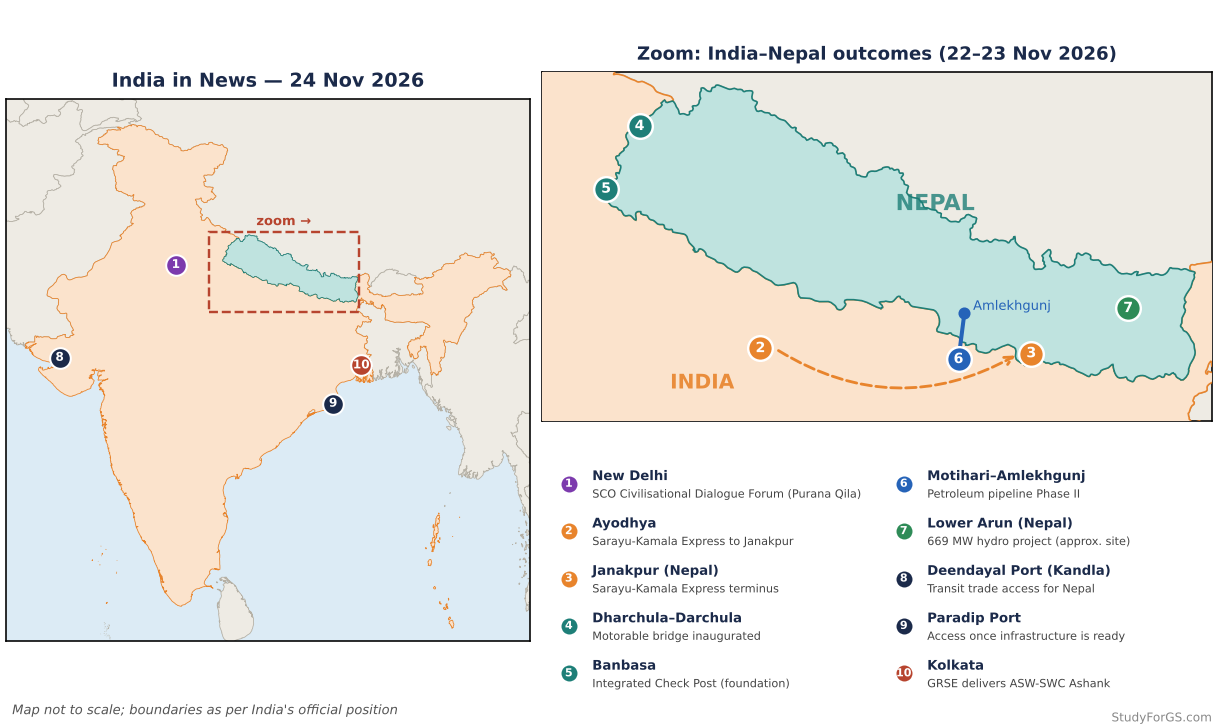
Sarayu-Kamala Express (Ayodhya–Janakpur) flagged off; Dharchula–Darchula bridge inaugurated; foundation stones for the 669 MW Lower Arun project and ICP Banbasa; Motihari–Amlekhgunj pipeline Phase II dedicated.
Transit trade via Deendayal Port (Kandla, Gujarat), and Paradip (Odisha) once infrastructure is ready; an offshore IIT campus in Nepal announced.
Both sides agreed to review the 1950 Treaty of Peace and Friendship and other agreements by mutual consent.
Way forward
Time-bound execution of projects, transparent disbursal of the credit line, and quiet diplomacy on Kalapani–Lipulekh–Limpiyadhura so that boundary sensitivities do not derail development ties.
Concept
1950 Treaty of Peace and Friendship – open border and national treatment for each other's citizens. Neighbourhood First policy. The Kali (Mahakali) river forms the western India–Nepal boundary under the Treaty of Sugauli (1815-16). Nepal borders 5 Indian states: Uttarakhand, Uttar Pradesh, Bihar, West Bengal, Sikkim.
Map of India with Nepal highlighted and a zoomed inset of the India–Nepal border, with numbered pins: New Delhi, Ayodhya, Janakpur, Dharchula–Darchula bridge, Banbasa, Motihari–Amlekhgunj pipeline, Lower Arun project, Deendayal Port (Kandla), Paradip Port and Kolkata. Boundaries as per India's official position. — StudyForGS
6. SCO Civilisational Dialogue Forum ends with 'Indraprastha Communique'
IRCOMMON: Prelims + Mains GS2
Syllabus linkage
GS2 – Regional groupings (SCO); GS1 – Indian culture and heritage. Prelims: SCO facts, Purana Qila.
Context
The first SCO Civilisational Dialogue Forum (20–22 November 2026), inaugurated by PM Modi at Purana Qila, New Delhi, concluded on 22 November with the Indraprastha Communique, read out by Culture Secretary Vivek Aggarwal.
Key facts
Hosted by the Ministry of Culture and MEA; IGNCA was the knowledge partner.
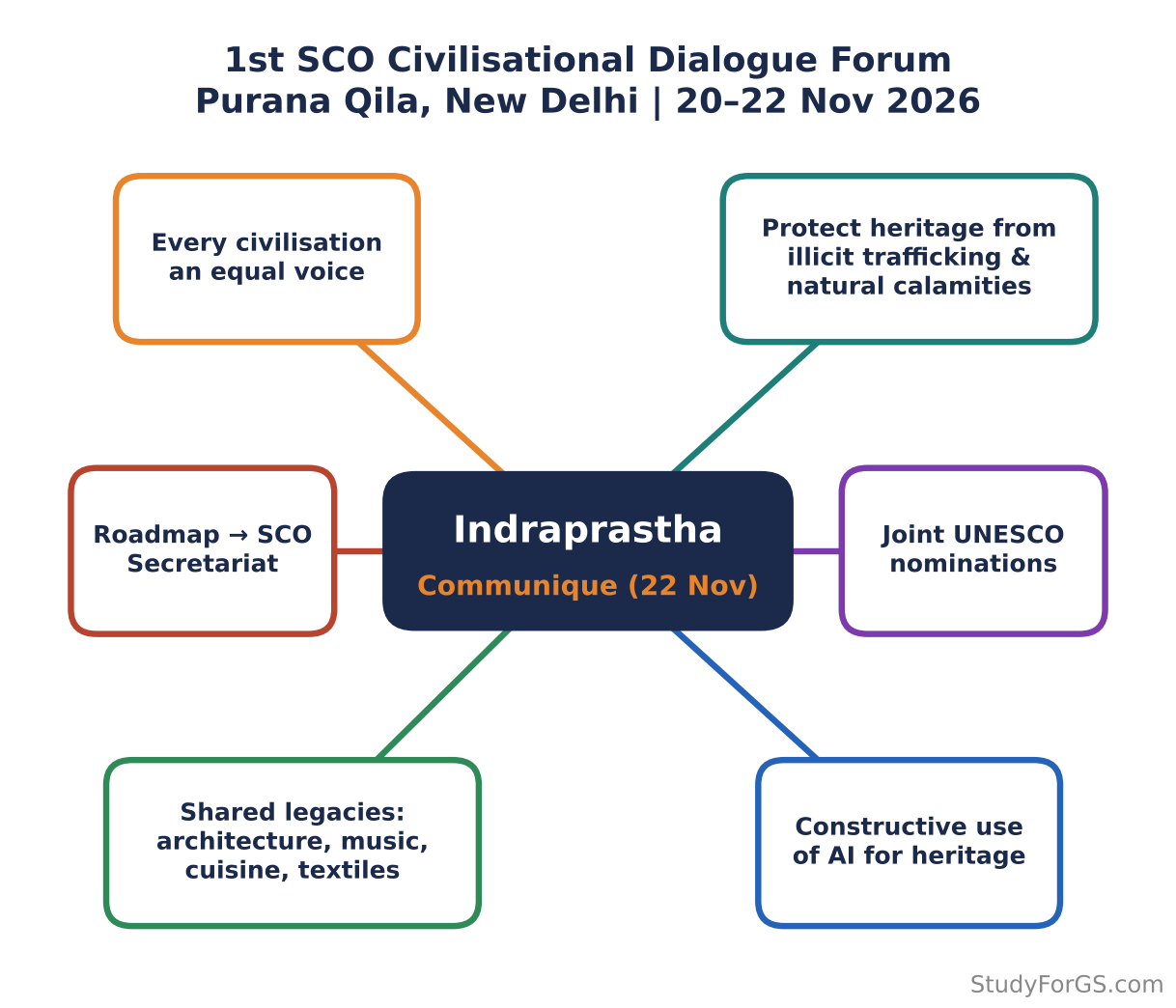
Communique: every civilisation an equal voice; protect heritage from illicit trafficking and natural calamities; joint UNESCO nominations; constructive use of AI.
Heritage defined broadly – monuments, manuscripts, literature, art, living traditions and knowledge systems; roadmap to be shared with the SCO Permanent Secretariat.
Forum stems from India's proposal at the 2025 SCO Summit in Tianjin (China), later welcomed in the Bishkek Declaration.
Exhibitions: 'ASTITVA' (Delhi's history, 1200 BCE–1200 CE) and an 18th-century illustrated Mahabharata scroll.
Way forward
Institutionalise the forum with a regular cycle, a shared digital manuscript repository and joint heritage-protection protocols to give the SCO a people-centric track beyond security.
Concept
SCO – founded 15 June 2001, Shanghai; 10 members (India and Pakistan joined in 2017, Iran 2023, Belarus 2024); Secretariat in Beijing, RATS in Tashkent; official languages Russian and Chinese. Purana Qila is traditionally linked with the Mahabharata-era city of Indraprastha.
Mind-map of the Indraprastha Communique of the first SCO Civilisational Dialogue Forum (Purana Qila, 20–22 Nov 2026): equal voice for every civilisation, heritage protection from illicit trafficking and calamities, joint UNESCO nominations, constructive use of AI, shared legacies, and a roadmap to the SCO Secretariat. — StudyForGS
7. Monsoon Session stays un-prorogued for a record 100 days
POLITYCOMMON: Prelims + Mains GS2
Syllabus linkage
GS2 – Parliament: sessions and conduct of business. Prelims: Article 85, sine die vs prorogation.
Context
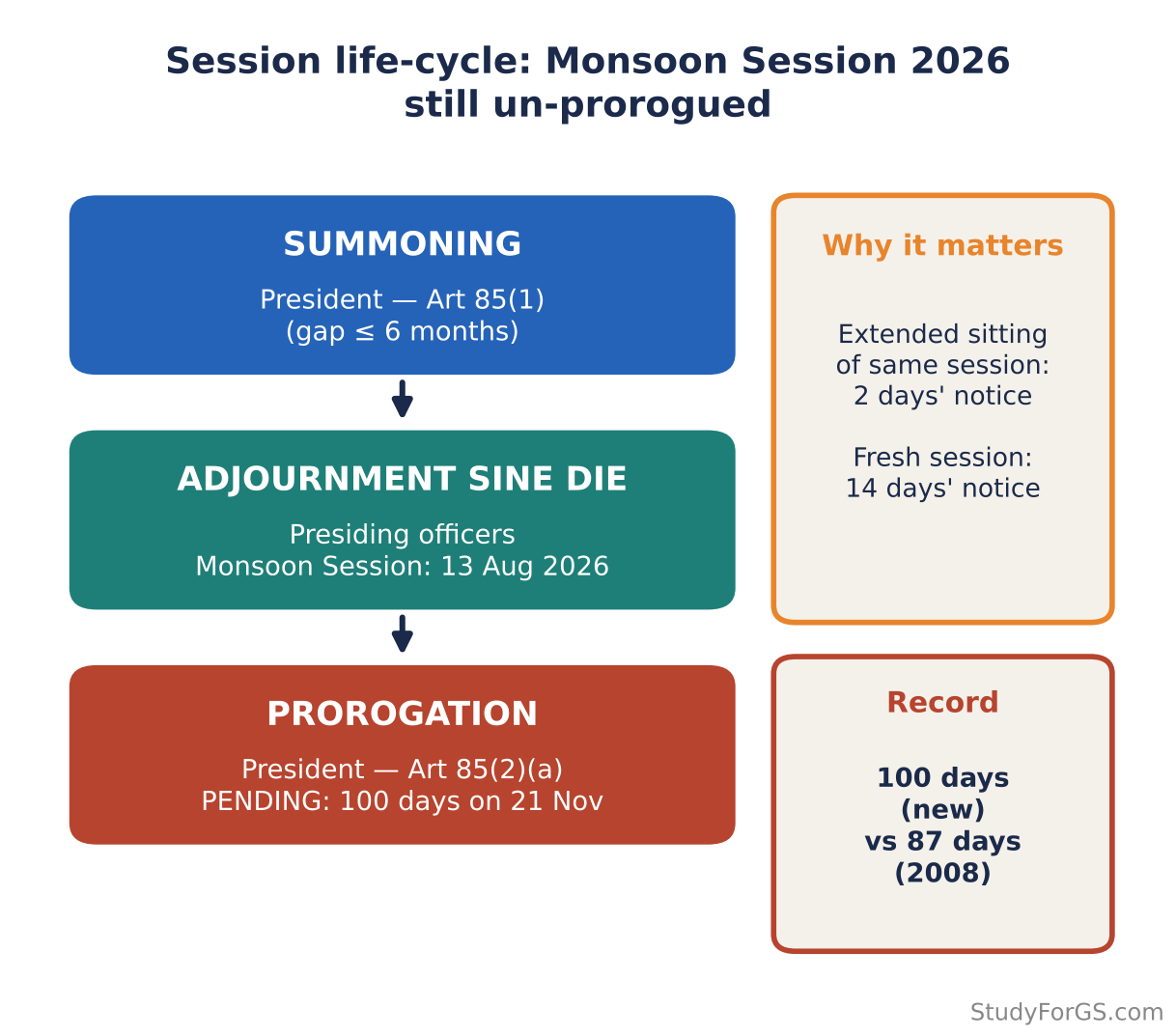
Both Houses were adjourned sine die on 13 August 2026, but as of 21 November (the 100th day) they had not been prorogued, breaking the earlier record of 87 days (2008).
Key facts
An un-prorogued session lets the government recall the Houses for an extended sitting on 2 days' notice; a fresh session needs 14 days' notice.
Linked to a proposed Constitution amendment to raise Lok Sabha strength from 543 to up to 850 via delimitation, enabling 33% women's reservation before the 2029 elections.
The Constitution sets no time limit for prorogation after a sine die adjournment.
Way forward
Adopt a fixed parliamentary calendar and clear conventions on prorogation to balance executive flexibility with legislative predictability.
Concept
Article 85(1): President summons each House; gap between two sessions not more than 6 months. Article 85(2): President may prorogue the Houses and dissolve the Lok Sabha. Adjournment sine die is by the presiding officer. Prorogation ends a session, but pending bills do not lapse. Article 174 gives the same powers to Governors.
Flowchart of a parliamentary session: summoning by the President (Article 85(1)), adjournment sine die by presiding officers (13 Aug 2026), and prorogation by the President (Article 85(2)(a)) still pending after a record 100 days versus 87 days in 2008; side note on 2 days' notice for an extended sitting and 14 days for a fresh session. — StudyForGS
📜 Asked before in the exam — previous-year question on this topic
UPSC Prelims 2024With reference to the Indian Parliament, consider the following statements: 1. A bill pending in the Lok Sabha lapses on its dissolution. 2. A bill passed by the Lok Sabha and pending in the Rajya Sabha lapses on the dissolution of the Lok Sabha. 3. A bill in regard to which the President of India notified his/her intention to summon the Houses to a joint sitting lapses on the dissolution of the Lok Sabha. Which of the statements given above is/are correct?
1 only
1 and 2
2 and 3
3 only
Show answer
Answer: (b) 1 and 2 Statements 1 and 2 are correct. When the Lok Sabha is dissolved, a bill pending in the Lok Sabha lapses, whether it started there or came from the Rajya Sabha, and so does a bill passed by the Lok Sabha but pending in the Rajya Sabha. A bill pending in the Rajya Sabha that the Lok Sabha has not passed does not lapse. Under Article 108(5), a bill for which the President has notified a joint sitting before dissolution also does not lapse. Practise all UPSC Prelims 2024 paper (free) →
Linked because this news is about the same topic. The answer is as per the official key of that year.
8. SC: 'How can we restrain political parties from raising their agenda?'
POLITYCOMMON: Prelims + Mains GS2
Syllabus linkage
GS2 – Judiciary; contempt of court; Fundamental Rights (Article 19). Prelims: Article 129, Contempt of Courts Act, 1971.
Context
On 23 November 2026, a Supreme Court bench of Justices Vikram Nath and Aparesh Kumar Singh, hearing a plea against politicians' remarks on the judiciary, asked how the court could restrain parties from raising their agenda and suggested the concern be taken to Parliament.
Key facts
Petitioners argued that such remarks, including on social media, obstruct the administration of justice; respondents included the Centre and the Election Commission.
As a related contempt matter is pending before another bench, the plea was placed before the Chief Justice of India for directions.
On 18 November, a bench headed by Justice Dipankar Datta issued notice on an SCBA plea for contempt action over remarks against CJI Surya Kant.
Way forward
Balance free speech under Article 19(1)(a) with institutional dignity: use contempt powers sparingly and prefer ethical codes and legislative solutions for public figures.
Concept
Article 129 – Supreme Court is a court of record with power to punish for its contempt (Article 215 for High Courts). Contempt of Courts Act, 1971 – civil and criminal contempt; truth as a defence added in 2006. Article 19(2) lists contempt of court as a reasonable restriction.
📜 Asked before in the exam — previous-year question on this topic
UPSC Prelims 2022Consider the following statements: 1. Pursuant to the report of H.N. Sanyal Committee, the Contempt of Courts Act, 1971 was passed. 2. The Constitution of India empowers the Supreme Court and the High Courts to punish for contempt of themselves. 3. The Constitution of India defines Civil Contempt and Criminal Contempt. 4. In India, the Parliament is vested with the powers to make laws on Contempt of Court. Which of the statements given above is/are correct?
1 and 2 only
1, 2 and 4
3 and 4 only
3 only
Show answer
Answer: (b) 1, 2 and 4 The Contempt of Courts Act, 1971 was passed on the recommendations of the H.N. Sanyal Committee set up in 1961, so statement 1 is correct. Articles 129 and 215 make the Supreme Court and High Courts courts of record with power to punish for contempt of themselves, so statement 2 is correct. Civil and criminal contempt are defined in the 1971 Act, not in the Constitution, so statement 3 is wrong. Parliament can legislate on contempt of court under the Union and Concurrent Lists, so statement 4 is correct. Practise all UPSC Prelims 2022 paper (free) →
Linked because this news is about the same topic. The answer is as per the official key of that year.
9. Asia Power Index 2026: India retains third rank
REPORTCOMMON: Prelims + Mains GS2
Syllabus linkage
GS2 – International relations; India's global standing. Prelims: reports and indices.
Context
The Lowy Institute's Asia Power Index 2026, reported on 23 November 2026, ranks India the third most powerful country in Asia, behind the US and China.
Key facts
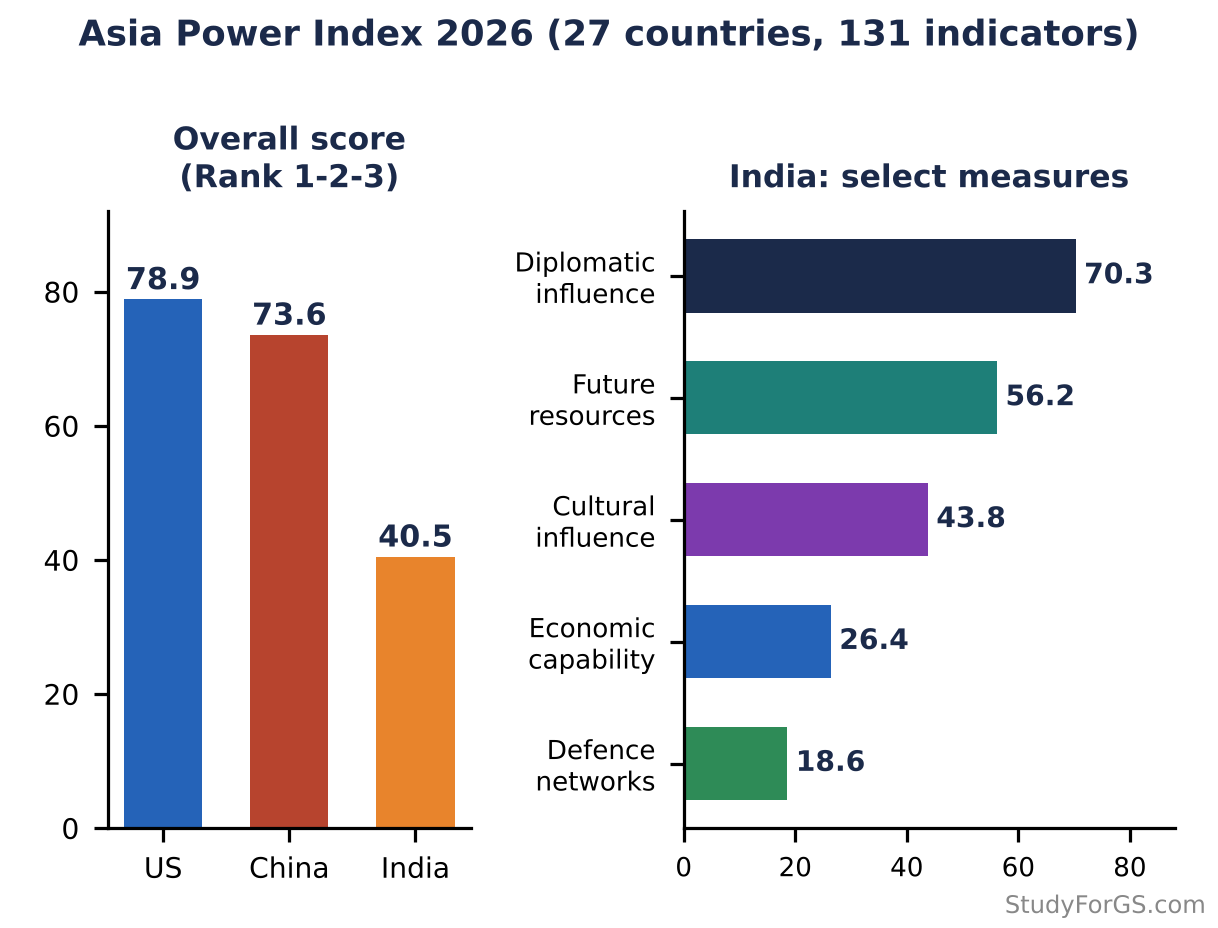
India's score 40.5 (up 0.5); US 78.9, China 73.6 (US–China gap 5.3 points).
Covers 27 countries/territories on 131 indicators across 8 measures of power.
India's strongest measure: Diplomatic influence 70.3; biggest gain in Cultural influence (+2.3, to 43.8); Economic capability fell 0.7 to 26.4.
India's gap with China is the smallest since the index began in 2018; PM Modi ranked the 2nd most effective regional leader, after Xi Jinping.
Way forward
Convert diplomatic weight into economic capability through manufacturing depth, deeper regional trade integration and stronger defence partnerships.
Concept
Lowy Institute – independent think tank based in Sydney, Australia; Asia Power Index launched in 2018. Its 8 measures: economic capability, military capability, resilience, future resources, economic relationships, defence networks, diplomatic influence, cultural influence.
Two-panel bar chart from the Asia Power Index 2026: overall scores US 78.9, China 73.6, India 40.5; India's select measures – diplomatic influence 70.3, future resources 56.2, cultural influence 43.8, economic capability 26.4, defence networks 18.6. — StudyForGS
Data point of the day
56.3
HSBC Flash India Composite PMI – November 2026 Up from 56.2 in October; manufacturing 56.0 – a nine-month high (from 54.7), while services growth eased. A reading above 50 signals expansion.
Prelims rapid-fire
World Chess Championship 2026: D. Gukesh (defending champion) vs Javokhir Sindarov (Uzbekistan) in Geneva – 14 classical games from 24 Nov; prize fund US$ 2.5 million.
COP31 President: Murat Kurum (Türkiye); President of Negotiations: Chris Bowen (Australia); COP32: Addis Ababa, Ethiopia (2027).
The Dharchula–Darchula bridge spans the Mahakali (Kali) river on the India–Nepal border in Uttarakhand.
Q1. Consider the following statements regarding sessions of Parliament: 1. The President prorogues the Houses of Parliament under Article 85. 2. Adjournment sine die is done by the presiding officer of the House. 3. The Constitution prescribes a maximum period within which a House must be prorogued after its adjournment sine die. Which of the statements given above is/are correct?
1 only
1 and 2 only
2 and 3 only
1, 2 and 3
Show answer
Answer: B Prorogation is by the President under Article 85(2)(a), and adjournment sine die is by the presiding officer. The Constitution sets no time limit for prorogation after sine die – which is why the Monsoon Session could stay un-prorogued for 100 days.
Q2. With reference to Small Hydro Power (SHP) in India, consider the following statements: 1. Hydel projects of up to 25 MW capacity are classified as SHP and are handled by the Ministry of New and Renewable Energy. 2. The Southern region has the largest assessed SHP potential. 3. Less than one-third of the assessed SHP potential has been harnessed so far. Which of the statements given above is/are correct?
1 only
1 and 3 only
2 and 3 only
1, 2 and 3
Show answer
Answer: B SHP covers projects up to 25 MW under MNRE (statement 1 correct). The Northern region (about 38% of potential) – not the Southern (5,490 MW) – has the largest potential (statement 2 wrong). Only 5,182 MW of 21,134 MW (≈25%) is harnessed (statement 3 correct).
Mains practice question
Q. The collapse of the COP31 climate talks at Antalya reflects a deepening trust deficit between developed and developing countries. Examine in the light of the principle of CBDR-RC and suggest a way forward for India ahead of COP32. (15 marks, 250 words)
Hint / approach
Intro: COP31 ended on 22 Nov 2026 with no consensus. Body: adaptation-finance gap (US$ 28.2–31.7 bn vs about US$ 305 bn/yr needed), fossil-fuel language, NCQG delivery, LMDC stand on equity and CBDR-RC; India's own action (170+ GW solar). Way forward: finance roadmap, technology transfer, Global South coalitions, credible domestic targets for COP32.
📌 One-line revision: COP31 → no deal (COP32: Addis Ababa) | Nepal → ₹15,000 cr + Sarayu-Kamala Express | SCO → Indraprastha Communique | Parliament → 100 days un-prorogued (Art 85) | Asia Power Index → India 3rd (40.5)