Monday, 23 November 2026 · IST · National & International · 9 items · 2 MCQs
The COP31 climate summit at Antalya closed on 22 November without adopting its cover decision as members split over fossil-fuel language. Nepal PM Balendra Shah is on his first bilateral visit abroad, holding talks in New Delhi today, while a government study flags a 13.2% inclusion error in free foodgrain distribution under PMGKAY.
Today at a glance — things to remember
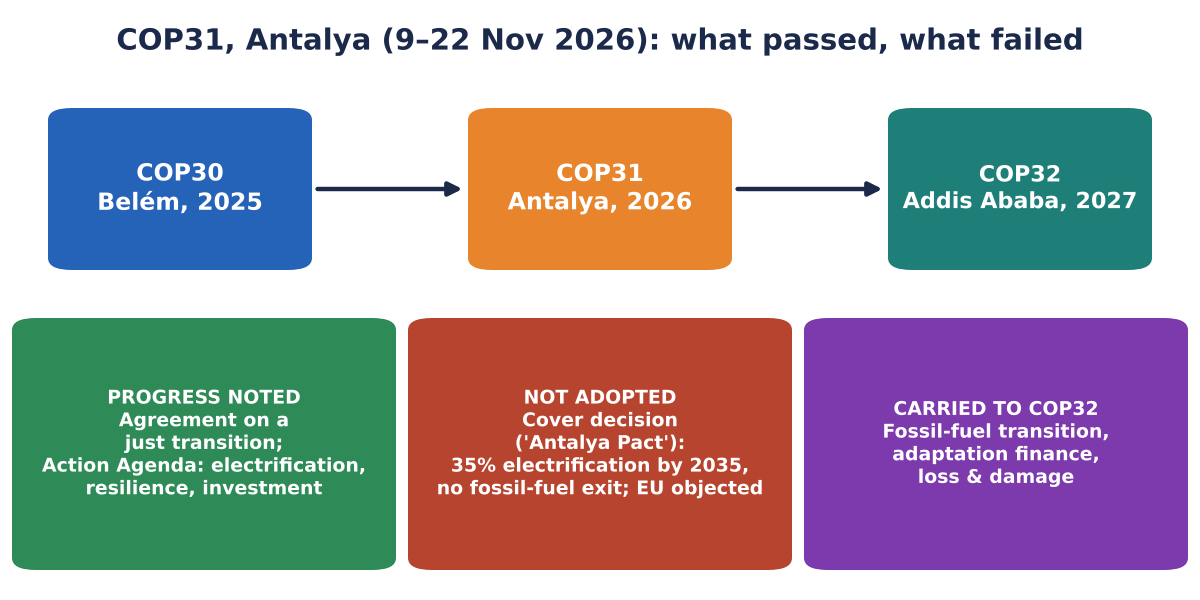
COP31 (Antalya, Türkiye) closed on 22 Nov without adopting a cover decision; COP32 goes to Addis Ababa.
Draft Antalya Pact named 35% electrification by 2035 but dropped explicit fossil-fuel transition language.
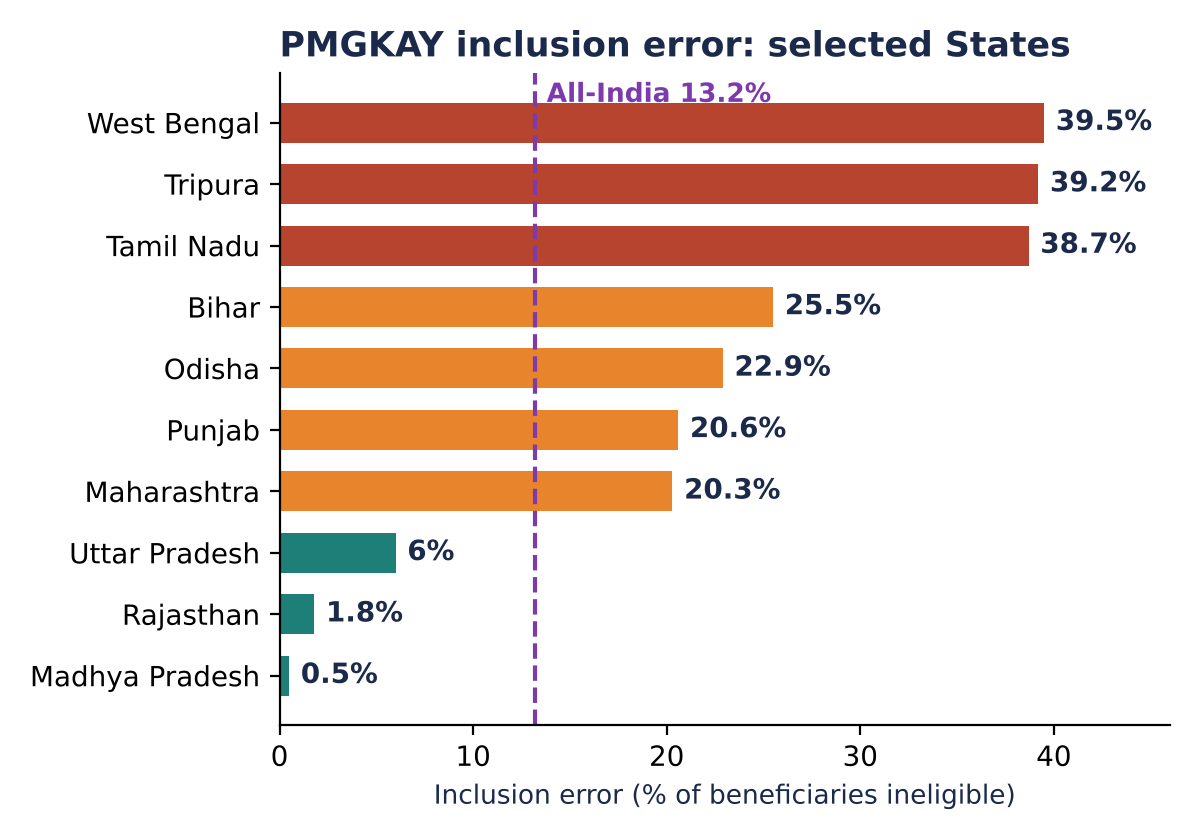
Government survey of 51,303 households: 13.2% of PMGKAY beneficiaries ineligible.
Highest inclusion error: West Bengal 39.5%, Tripura 39.2%, Tamil Nadu 38.7%.
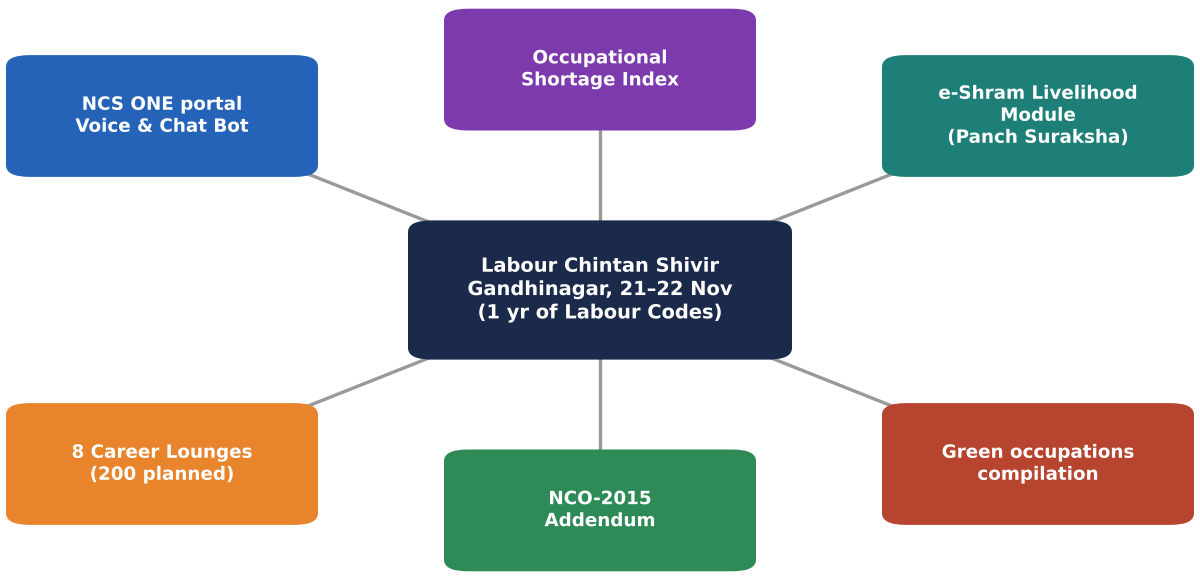
NCS ONE portal + Occupational Shortage Index launched at Labour Chintan Shivir, Gandhinagar.
Labour Codes completed one year of implementation (in force since 21 Nov 2025).
India–China second round of Corps Commander talks on Arunachal frontier began 8 Nov, lasted nearly 10 days.
Shah: reverse migration in 40 villages on China border under Vibrant Villages Programme.
Nepal PM Balendra Shah in Delhi on first bilateral visit; Saryu-Kamala Express (Ayodhya–Janakpur) on agenda.
First SCO Civilisational Dialogue Forum at Purana Qila adopted the Indraprastha Communiqué.
The 31st Conference of Parties (COP31) of the UNFCCC at Antalya, Türkiye, scheduled for 9–20 November, ran two extra days and closed on 22 November 2026 without adopting its cover decision, as members split over language on fossil fuels.
Key facts
Presided by Türkiye's minister Murat Kurum; Australia's Chris Bowen led negotiations — a host-sharing compromise.
Draft cover decision (Antalya Pact) set 35% share of electricity in final energy by 2035 but had no explicit call to transition away from fossil fuels.
The EU formally objected; the UN said Antalya became the longest-running UN climate summit on record.
Progress noted by the UN: agreement on a just transition and Action Agenda initiatives on electrification, resilience and investment.
India stressed equity, historical responsibility and support from developed countries; COP32 will be at Addis Ababa, Ethiopia.
Way forward
Unresolved issues — fossil-fuel transition, adaptation finance, loss and damage — move to COP32; India should push finance and technology transfer alongside clean-energy partnerships.
Concept
UNFCCC adopted 1992 (Rio), in force 1994; COP is its supreme body and decides by consensus. Paris Agreement (2015) aims to keep warming well below 2°C, pursuing 1.5°C. COP28 (Dubai, 2023) first called for transitioning away from fossil fuels.
Flow diagram of COP31 Antalya: what progressed (just transition agreement, Action Agenda on electrification, resilience and investment) versus what failed (cover decision, fossil-fuel language), with the path from COP30 Belem to COP32 Addis Ababa. — StudyForGS
2. Study flags 13.2% inclusion error in PM Garib Kalyan Anna Yojana
ECONOMYCOMMON: Prelims + Mains GS2/GS3
Syllabus linkage
GS3 – Public Distribution System, food security, subsidies; GS2 – welfare schemes and targeting.
Context
A study by the Department of Food and Public Distribution (DFPD) for FY 2025-26 found that 13.2% of households getting free foodgrains under PMGKAY do not meet eligibility criteria — including car or AC owners and families with government employees.
Key facts
Sample: 51,303 households across all 36 States/UTs, rural and urban.
Highest error: West Bengal 39.5%, Tripura 39.2%, Tamil Nadu 38.7%; lowest among listed: Madhya Pradesh 0.5%, Rajasthan 1.8%.
Error higher in urban (15.6%) than rural (12.5%) areas; PHH 13.4% vs AAY 12.2%.
Food subsidy stood at ₹2.28 lakh crore in 2025-26 (Revised Estimate).
Report recommends periodic database validation, better verification and Aadhaar seeding.
Way forward
Uniform, periodically updated eligibility criteria, linking ration databases with asset and tax records, while guarding against exclusion of genuinely poor households.
Concept
Inclusion error = ineligible people get benefits; exclusion error = eligible people left out. NFSA 2013 covers up to 75% rural and 50% urban population; AAY gets 35 kg per household per month, PHH 5 kg per person. Free grain under PMGKAY since 1 January 2023.
Horizontal bar chart of PMGKAY inclusion error by state: West Bengal 39.5%, Tripura 39.2%, Tamil Nadu 38.7%, Bihar 25.5%, Odisha 22.9%, Punjab 20.6%, Maharashtra 20.3%, Uttar Pradesh 6%, Rajasthan 1.8%, Madhya Pradesh 0.5%, against the national 13.2%. — StudyForGS
3. NCS ONE portal and Occupational Shortage Index launched
ECONOMYCOMMON: Prelims + Mains GS3
Syllabus linkage
GS3 – employment, labour reforms; GS2 – e-governance; Prelims – NCS, e-Shram, Labour Codes.
Context
At the two-day Chintan Shivir of State and UT labour ministers in Gandhinagar (21–22 Nov), Union Labour Minister Mansukh Mandaviya launched the NCS ONE portal and other tools; the conclave marked one year of the Labour Codes.
Key facts
NCS ONE = National Career Service Open Network for Employment, with Voice Bot and Chat Bot, linking jobseekers, employers, State portals, private job platforms and campuses.
Occupational Shortage Index (OSI) measures gaps between labour demand and supply to guide careers, skilling and policy.
e-Shram Livelihood Profile Module tracks five protections (Panch Suraksha): food, health, life insurance, accident/disability and pension.
8 Career Lounges launched (incl. Kanpur, Varanasi, Guwahati); 200 planned, mainly in Tier-II/III cities.
Released an Addendum to NCO-2015 and a compilation of green occupations.
Way forward
Make OSI data district-level and public, integrate it with Skill India curricula, and ensure gig and unorganised workers actually receive the Panch Suraksha benefits.
Concept
NCS portal launched in 2015 by the Ministry of Labour and Employment. The four Labour Codes (Wages 2019; Industrial Relations, Social Security, OSH 2020) came into force on 21 November 2025. Labour is in the Concurrent List.
Mind-map of labour initiatives launched at the Gandhinagar Chintan Shivir: NCS ONE portal, Occupational Shortage Index, e-Shram Livelihood Profile Module with Panch Suraksha, 8 Career Lounges, NCO-2015 addendum and green occupations compilation. — StudyForGS
4. India–China hold nearly 10-day Corps Commander talks on Arunachal frontier
DEFENCECOMMON: Prelims + Mains GS2/GS3
Syllabus linkage
GS3 – security challenges in border areas; GS2 – India–China relations; Prelims – LAC sectors, places in Arunachal.
Context
India and China concluded the second round of Corps Commander-level talks on tensions along the Arunachal Pradesh frontier. The talks began on 8 November and ran for nearly 10 days with a short break, ahead of winter.
Key facts
Indian side led by Lt Gen Girish Kalia, GOC III Corps (Spear Corps), with an MEA official present.
Focus: rules of engagement, open communication channels and preventing friction between troops.
First round was held on 6–7 September at Wacha–Damai meeting point in the Kibithoo sector.
It followed reported tensions in the Taksing area of Upper Subansiri district.
Earlier, NSA Ajit Doval met Chinese FM Wang Yi in Beijing in August as Special Representatives on the boundary.
Way forward
Lock in patrolling protocols before winter, keep the Special Representatives and WMCC channels active, and speed up border infrastructure on the Indian side.
Concept
The LAC (about 3,488 km) has Western (Ladakh), Middle (HP–Uttarakhand) and Eastern (Sikkim–Arunachal) sectors. In the east, India follows the McMahon Line (Simla, 1914), which China does not accept. The SR mechanism dates to 2003.
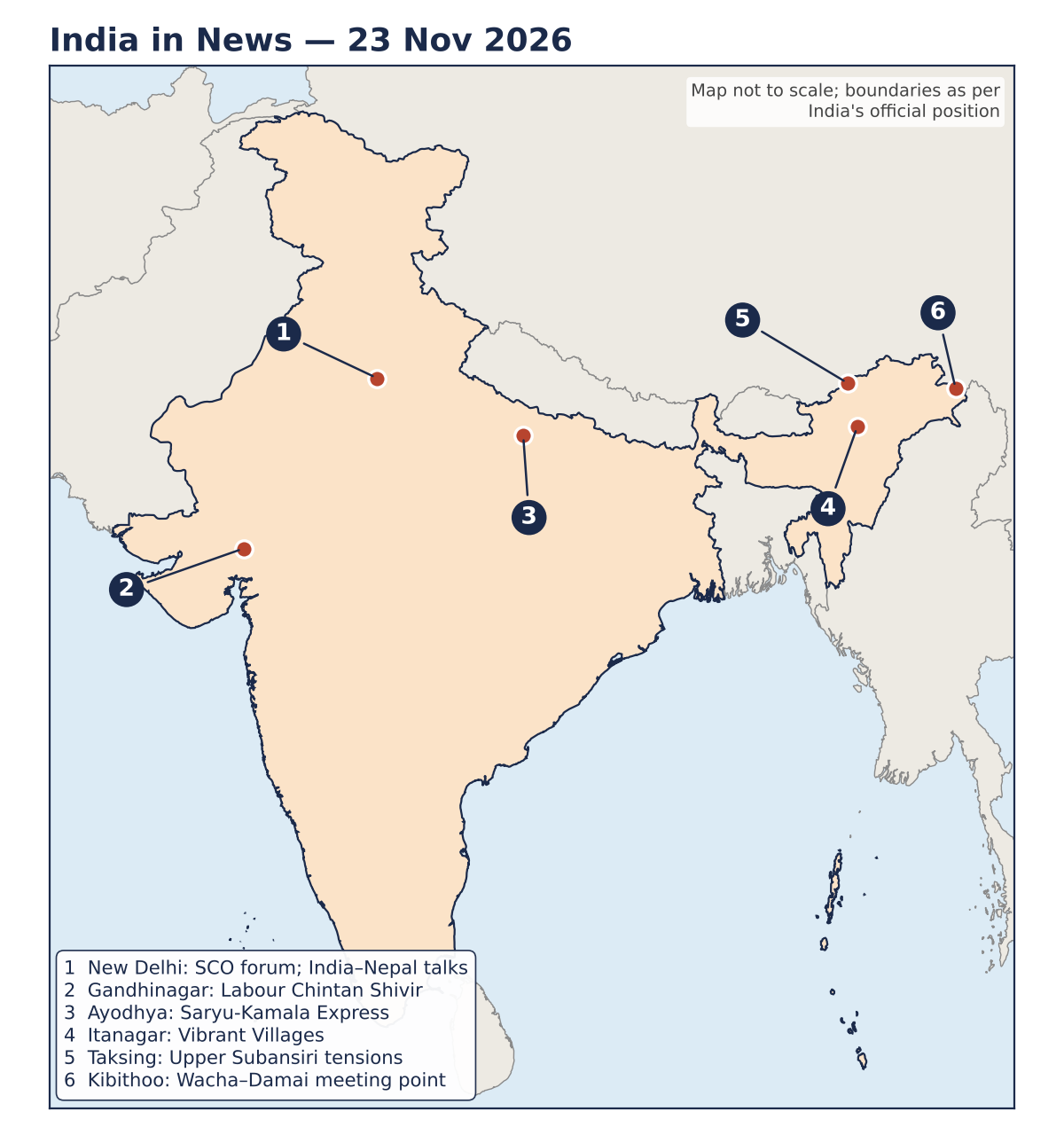
India in News locator map with India's full official boundary, numbered pins: 1 New Delhi (SCO forum, India–Nepal talks), 2 Gandhinagar (labour Chintan Shivir), 3 Ayodhya (Saryu-Kamala Express), 4 Itanagar (Vibrant Villages), 5 Taksing, Upper Subansiri, 6 Kibithoo (Wacha–Damai meeting point). — StudyForGS
5. Vibrant Villages: reverse migration in 40 Arunachal border villages, says Shah
DEFENCECOMMON: Prelims + Mains GS3
Syllabus linkage
GS3 – border area management, internal security; GS2 – government schemes; Prelims – Vibrant Villages Programme.
Context
Speaking at a cooperative conference in Itanagar on 22 November, Union Home and Cooperation Minister Amit Shah said migration has stopped and population has risen in 40 villages along the China border, crediting the Vibrant Villages Programme (VVP).
Key facts
MHA has directed the ITBP and Army to buy provisions from border villages via local cooperatives, instead of from Tezpur or Guwahati.
Women's cooperatives supply dairy, eggs, vegetables, millets and flour.
Mobile medical units deployed for villages in 11 border districts of Arunachal.
Amenities credited: power, schools, health care, drinking water, solar panels and jobs.
Way forward
Independent population and livelihood surveys to verify reverse migration; linking VVP with tourism, connectivity and cooperatives to make border villages self-sustaining.
Concept
VVP-I (approved 2023, launched at Kibithoo) is a Centrally Sponsored Scheme for villages on the northern border (Arunachal, Sikkim, Uttarakhand, HP, Ladakh). VVP-II (approved 2025) covers villages on other international land borders.
6. AI-assisted proof of the Riemann hypothesis claimed; verification pending
SCI-TECHCOMMON: Prelims + Mains GS3
Syllabus linkage
GS3 – developments in AI and their applications; Prelims – famous mathematical problems, proof assistants.
Context
Mathematician Levent Alpöge, a researcher at the AI firm Anthropic, has claimed that work with its AI model Claude produced a proof of the Riemann hypothesis and its generalised form. Mathematicians say it has not yet been independently verified.
Key facts
The proof materials were released in Lean, a language that lets computers check mathematical proofs.
The AI-assisted output reportedly runs to more than 2,50,000 pages.
The hypothesis was proposed by Bernhard Riemann in 1859; 2026 marks his 200th birth anniversary.
It is one of the seven Millennium Prize Problems (2000) of the Clay Mathematics Institute, each carrying $1 million.
Way forward
Rigorous peer review and checking of the formal proof; for India, investment in AI-for-science and formal-verification skills under the IndiaAI Mission.
Concept
The Riemann hypothesis states that all non-trivial zeros of the Riemann zeta function have real part 1/2; it governs the distribution of prime numbers. Of the seven Millennium problems, only the Poincaré conjecture is solved (Grigori Perelman).
7. Nepal PM Balendra Shah on first bilateral visit; talks with PM Modi
IRCOMMON: Prelims + Mains GS2
Syllabus linkage
GS2 – India and its neighbourhood, bilateral relations; Prelims – India–Nepal border states, connectivity projects.
Context
Nepal PM Balendra (Balen) Shah, in office since March 2026, arrived on 22 November for a two-day State visit — his first bilateral visit abroad — and holds delegation-level talks with PM Narendra Modi at Hyderabad House today.
Key facts
Agenda: energy (hydropower), trade, investment, rail-road-air connectivity, and post-flood reconstruction support.
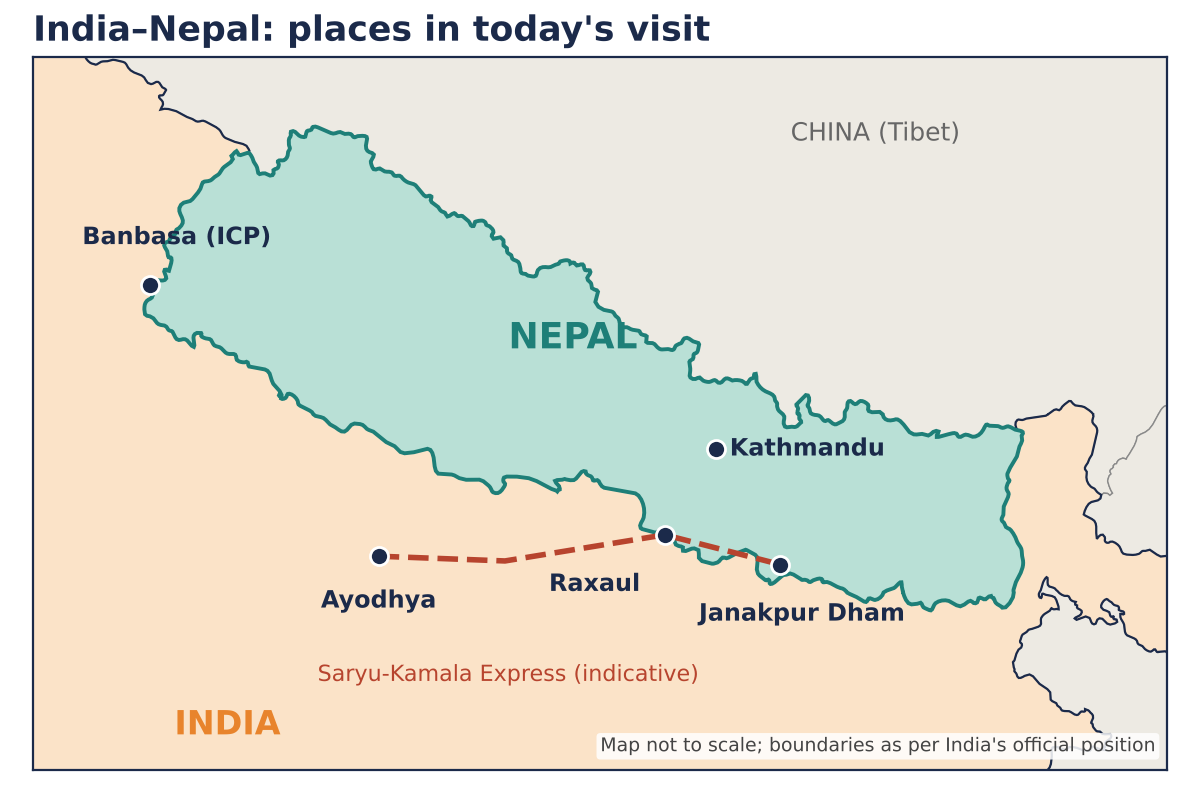
Virtual flag-off of the weekly Saryu-Kamala Express linking Ayodhya (UP) with Janakpur Dham (Nepal) is on the schedule.
Other items: proposed Raxaul–Kathmandu rail line and an integrated check post at Banbasa (Uttarakhand).
Shah is accompanied by a 52-member business delegation; he also calls on President Droupadi Murmu.
Way forward
Fast-track cross-border transmission and hydropower trade, time-bound completion of rail links, and resolve pending issues through dialogue under Neighbourhood First.
Concept
1950 Treaty of Peace and Friendship allows an open border; Nepal borders 5 Indian states — Uttarakhand, UP, Bihar, West Bengal, Sikkim. Under a 2024 long-term agreement, India is to import 10,000 MW from Nepal over ten years. Janakpur lies in Nepal's Madhesh Province.
Regional map of Nepal and adjoining Indian states with India's official boundary, marking Kathmandu, Janakpur Dham, Ayodhya, Raxaul and Banbasa, and an indicative line for the Ayodhya–Janakpur Saryu-Kamala Express. — StudyForGS
8. First SCO Civilisational Dialogue Forum adopts Indraprastha Communiqué
IRCOMMON: Prelims + Mains GS2 & GS1
Syllabus linkage
GS2 – regional groupings, soft power; GS1 – Indian culture and heritage; Prelims – SCO members and bodies.
Context
The first SCO Civilisational Dialogue Forum, organised by the Ministry of Culture at Purana Qila, New Delhi (20–22 Nov) and inaugurated by PM Narendra Modi, closed with the Indraprastha Communiqué.
Key facts
Communiqué: every civilisation an equal voice, in the spirit of Vasudhaiva Kutumbakam.
Proposes joint UNESCO nominations of shared heritage and a digital repository for manuscripts and oral traditions.
Backs responsible use of AI in heritage, and action against illicit trafficking of cultural property.
India proposed holding the Dialogue every two years; attended by SCO Secretary-General Nurlan Yermekbayev.
Way forward
Use the forum to build people-to-people trust and repatriate trafficked artefacts, while keeping cultural cooperation separate from security disputes within SCO.
Concept
SCO founded 2001 (Shanghai); Charter signed 2002. 10 members: China, Russia, India, Pakistan, Kazakhstan, Kyrgyzstan, Tajikistan, Uzbekistan, Iran (2023), Belarus (2024). India full member since 2017; Secretariat in Beijing, RATS in Tashkent.
9. Monsoon Session left unprorogued for a record 100+ days
POLITYCOMMON: Prelims + Mains GS2
Syllabus linkage
GS2 – Parliament: functioning, sessions, powers of the President; Prelims – Articles 85 and 123.
Context
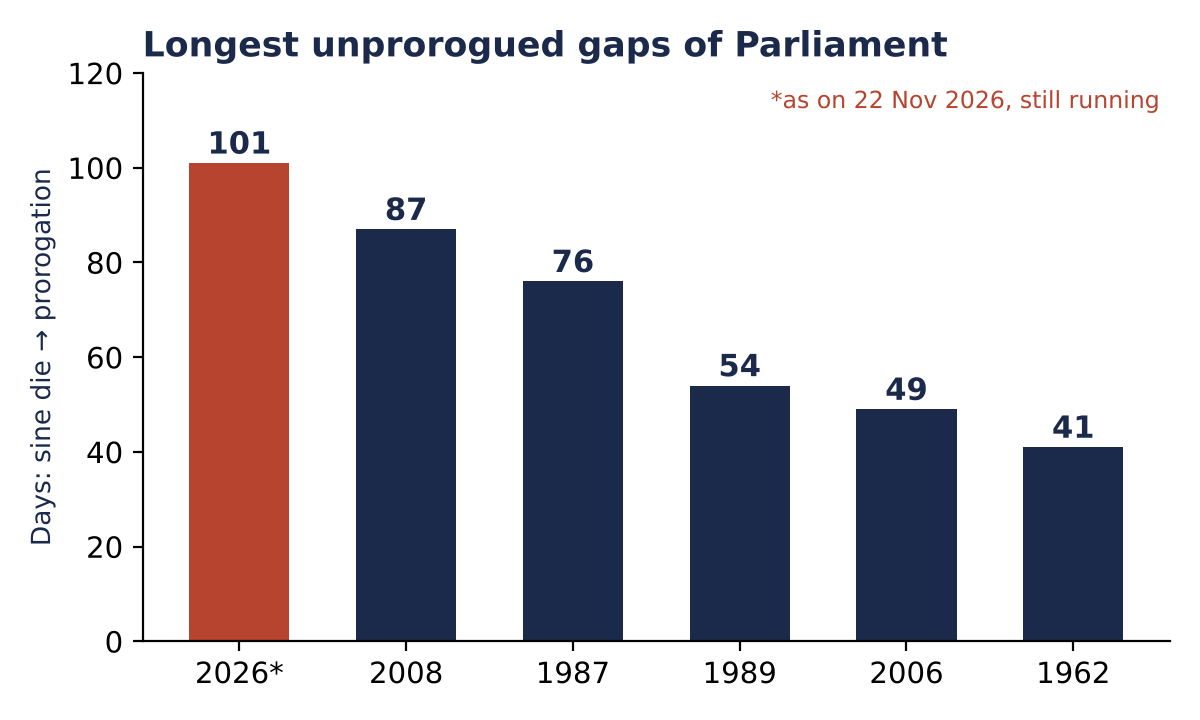
Both Houses were adjourned sine die on 13 August 2026, but the Monsoon Session has not been prorogued; the gap crossed 100 days on 21 November — beyond the previous longest gap of 87 days (2008) — as the Winter Session date awaits.
Key facts
Monsoon Session ended with 12 Bills passed before sine die adjournment.
Without prorogation, the Speaker/Chairman can reconvene the House on short notice; a fresh session needs a new presidential summons.
No constitutional deadline exists for proroguing after sine die adjournment.
Earlier long gaps: 87 days (2008), 76 days (1987), 54 days (1989).
Way forward
A fixed parliamentary calendar and minimum sitting days would add predictability; prompt prorogation or summons avoids doubts on ordinance and question procedures.
Concept
Article 85: the President summons and prorogues the Houses; gap between two sessions cannot exceed six months. Adjournment sine die (by Presiding Officer) ends a sitting; prorogation ends the session. Pending Bills do not lapse on prorogation. Article 123 ordinances can be issued only when at least one House is not in session.
Bar chart of longest gaps between sine die adjournment and prorogation of Parliament: 2026 Monsoon Session over 100 days (still running), 2008 87 days, 1987 76 days, 1989 54 days, 2006 49 days, 1962 41 days. — StudyForGS
Data point of the day
13.2%
PMGKAY inclusion error (DFPD survey, FY 2025-26) Survey of 51,303 households in 36 States/UTs: error 15.6% urban vs 12.5% rural; PHH 13.4%, AAY 12.2%.
Prelims rapid-fire
Saryu-Kamala Express: weekly train between Ayodhya (UP) and Janakpur Dham (Nepal).
COP32 host city: Addis Ababa, Ethiopia.
SCO Secretary-General: Nurlan Yermekbayev.
III Corps (Spear Corps) is headquartered at Rangapahar, near Dimapur (Nagaland).
Wacha–Damai border meeting point lies in the Kibithoo sector, Arunachal Pradesh.
Lean: a computer language used to formally verify mathematical proofs.
Practice MCQs — UPSC Prelims pattern
Q1. With reference to the Parliament of India, consider the following statements: 1. The President prorogues the Houses of Parliament under Article 85. 2. Bills pending in the Lok Sabha lapse when the House is prorogued. 3. An ordinance under Article 123 can be promulgated only when both Houses are not in session. Which of the statements given above are correct?
1 only
1 and 3 only
2 and 3 only
1, 2 and 3
Show answer
Answer: A Statement 1 is correct (Article 85(2)(a)). Statement 2 is wrong: pending Bills do not lapse on prorogation; Bills pending in the Lok Sabha lapse only on its dissolution. Statement 3 is wrong: Article 123 allows an ordinance except when both Houses are in session, so it can be issued even when only one House is not in session.
Q2. Which of the following countries are full members of the Shanghai Cooperation Organisation (SCO)? 1. Iran 2. Belarus 3. Türkiye 4. Mongolia. Select the correct answer using the code given below.
1 and 2 only
1, 2 and 3 only
2 and 4 only
1, 2, 3 and 4
Show answer
Answer: A Iran joined the SCO as a full member in 2023 and Belarus in 2024. Türkiye is a dialogue partner and Mongolia an observer, so only 1 and 2 are full members.
Mains practice question
Q. The failure of COP31 at Antalya to adopt a cover decision exposes the limits of consensus-based climate multilateralism. Critically examine, and suggest how India should position itself ahead of COP32. (250 words, 15 marks)
Hint / approach
Explain UNFCCC consensus rule and the fossil-fuel split (EU vs exporters); note partial gains (just transition agreement, Action Agenda initiatives); India's stand on equity and CBDR-RC; suggest finance, technology transfer, clean-energy partnerships and coalition-building with the Global South.
📌 One-line revision: COP31 ended without a pact (COP32 – Addis Ababa); PMGKAY inclusion error 13.2%; NCS ONE launched; India–China Corps Commander talks on Arunachal; Nepal PM Balendra Shah in Delhi; SCO's Indraprastha Communiqué; Parliament unprorogued 100+ days (Art. 85).