Thursday, 12 November 2026 · IST · National & International · 28 items
Today's digest has 28 detailed stories. In polity, the Supreme Court explained how its OBC creamy-layer ruling will apply, while the transgender law and Karnataka's quota hike are in court. In the economy, the black-mass export ban, extension of Stand-Up India and CGFMU, and a Rs 62,370 crore rabi subsidy lead; internationally, the Russia-Ukraine POW swap, the India-France economic security dialogue and COP31 at Antalya are in focus.
Today at a glance — things to remember
SC: OBC selections made before 11 March 2026 will not be reopened; new decisions must follow the creamy-layer ruling.
Plea in SC seeks review of Section 7 of the Transgender Act 2019 and NALSA (2014).
Karnataka files SLP against HC verdict quashing its SC/ST quota hike (total 56%).
Visa categories cut from 13 to 9, sub-categories 49 to 23; forms 65-70% leaner.
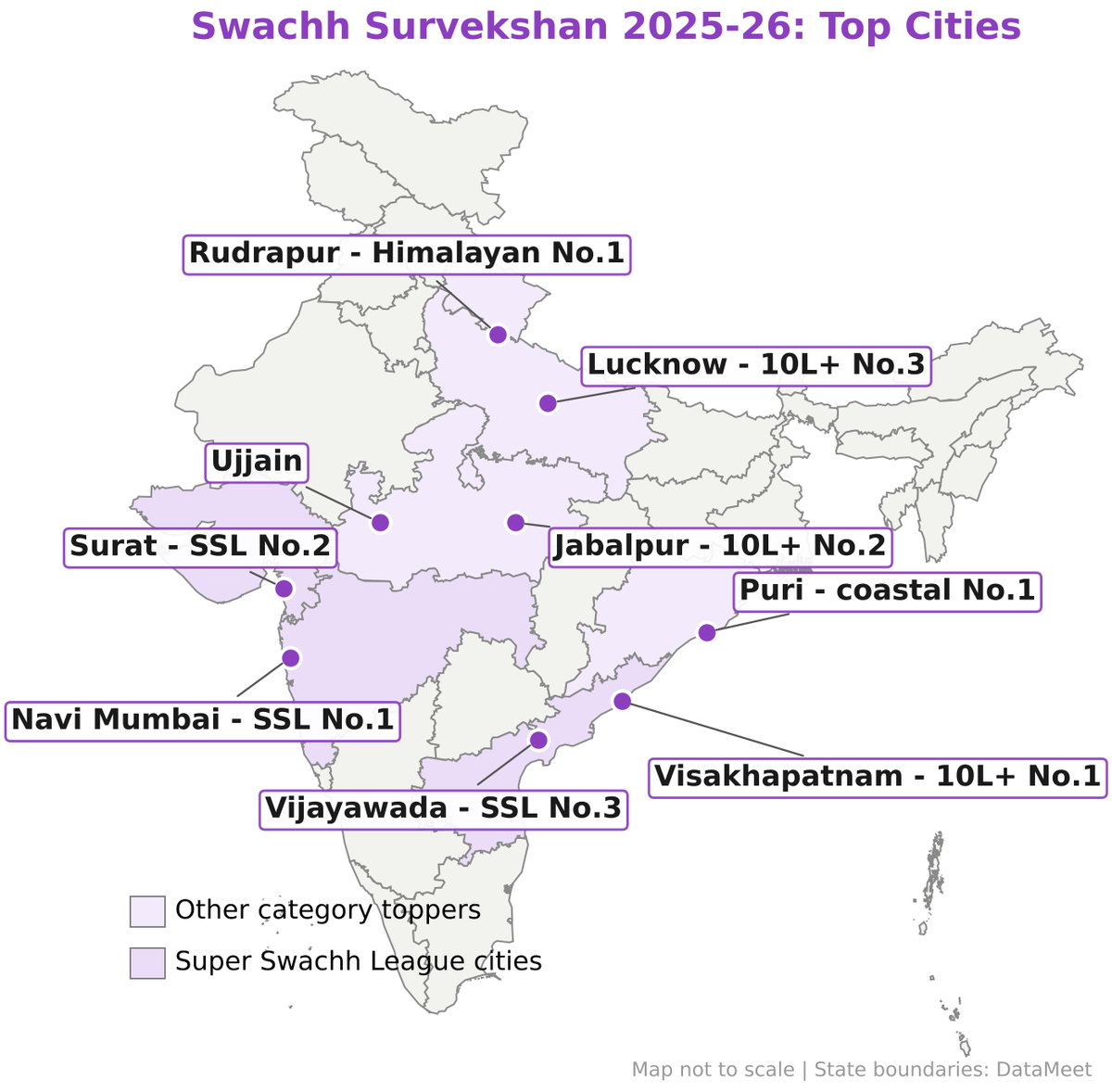
Swachh Survekshan 2025-26: Navi Mumbai tops Super Swachh League; Visakhapatnam first among 10 lakh+ cities.
DGFT makes export of lithium-ion battery black mass 'Prohibited'.
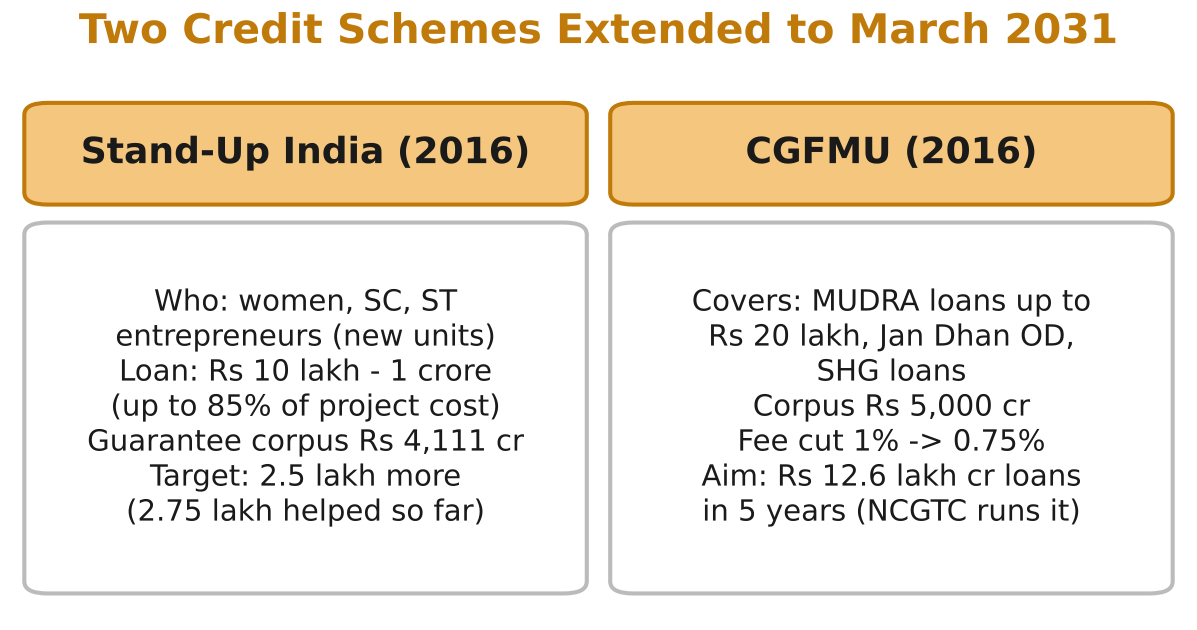
Stand-Up India and CGFMU extended to 31 March 2031; CGFMU fee cut from 1% to 0.75%.
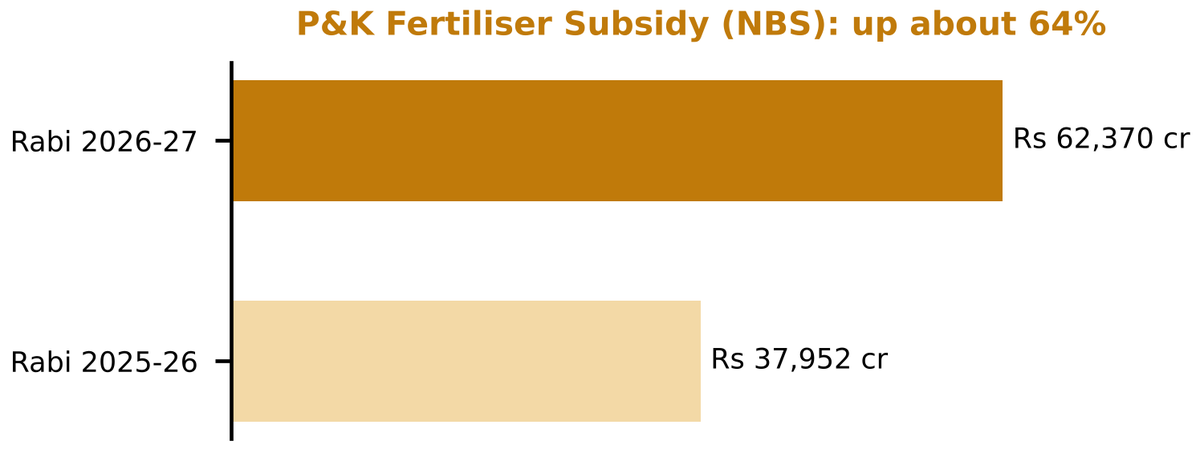
NBS subsidy for Rabi 2026-27 about Rs 62,370 crore (up about 64%).
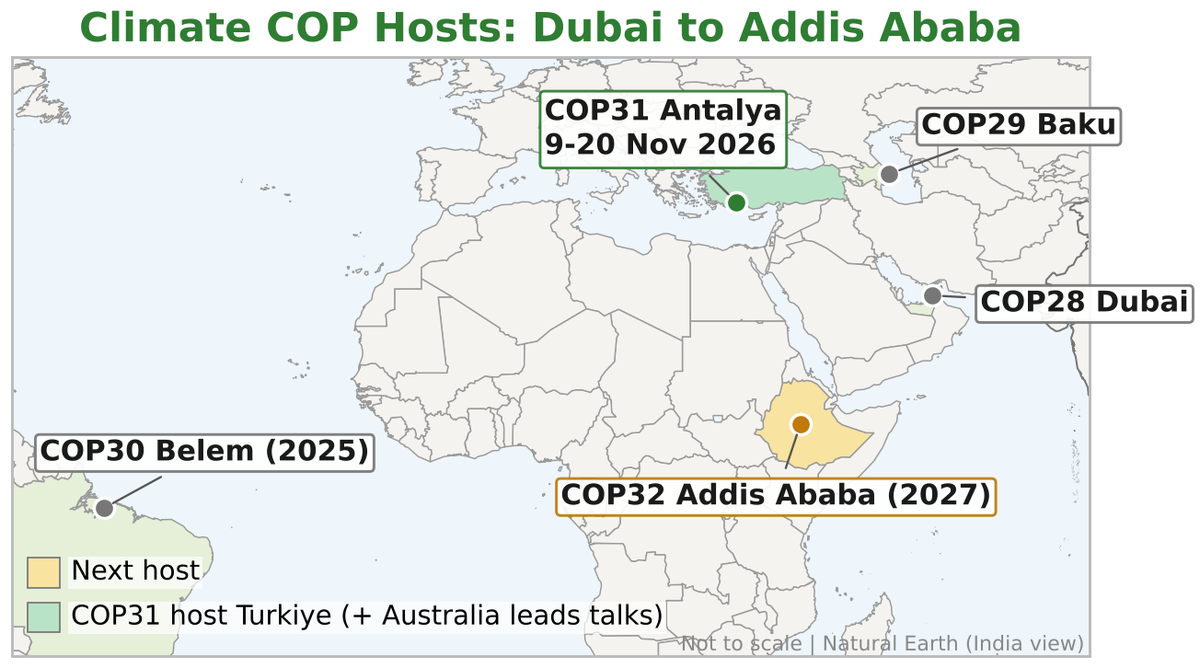
COP31 at Antalya (9-20 Nov) - leaders urge faster climate action; COP32 in Addis Ababa.
On Deepavali, 375 of 551 monitoring stations logged PM2.5 peaks of 250+ ug/m3.
Detailed notes
1. SC Clarifies OBC Creamy-Layer Ruling
POLITYUPSC: Prelims + Mains GS2
Syllabus linkage
GS2 - Polity: reservation, Articles 15(4) and 16(4), role of judiciary. Prelims: income limit, 1993 OM, Indra Sawhney. Mains: social justice vs administrative stability.
Context
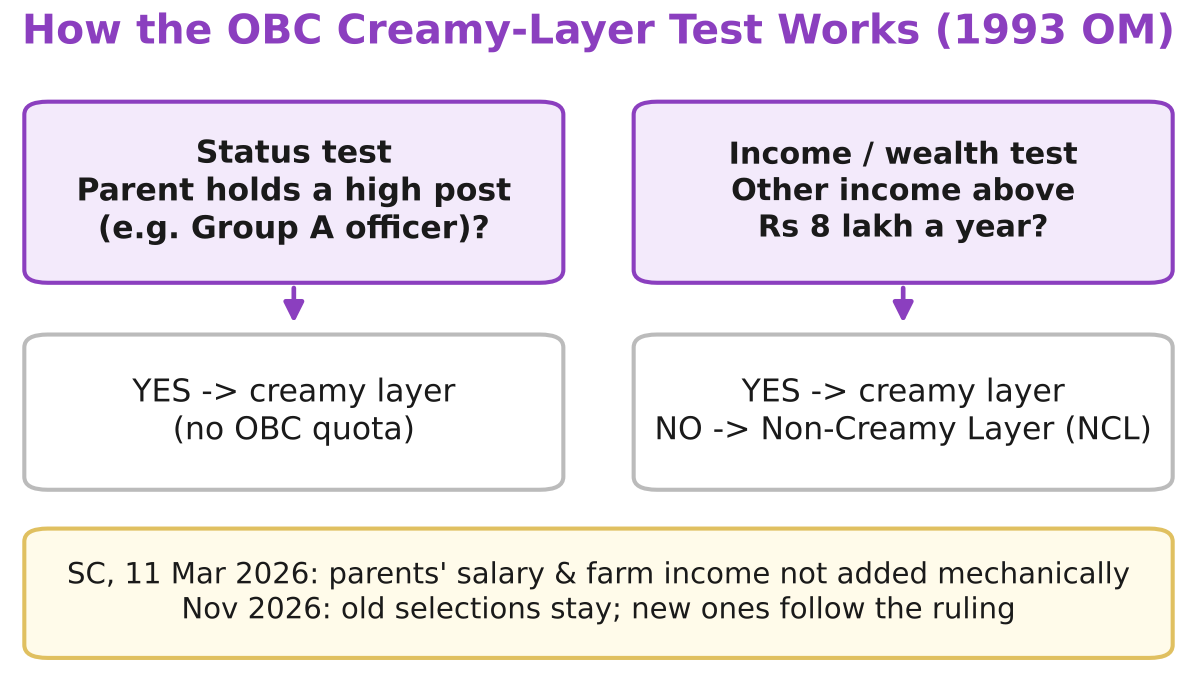
The Supreme Court has explained how its March 2026 judgment on the OBC 'creamy layer' (the better-off OBCs who cannot get reservation) will be applied. Old selections will not be reopened, but all new decisions must follow the ruling. On 11 March 2026 the Supreme Court held that the salary of a candidate's parents (for example in a PSU) cannot be counted mechanically to declare the candidate 'creamy layer'. The status and category of the parent's post must be checked. In its new clarification the Court said selections, promotions and cadre allocations finalised before 11 March 2026 will not be reopened. Candidates with pending claims can apply individually, and decisions after 11 March must follow the 1993 Office Memorandum (OM) as the Court read it. The Court refused the Centre's request for two years to work out equivalence between PSU and government posts, and gave two more months to comply.
Key facts
Creamy-layer income limit: Rs 8 lakh a year (since 2017).
Parents' salary and agricultural income are NOT added in the income/wealth test.
The 2004 DoPT clarification cannot add conditions missing from the 1993 OM.
CSE 2025 results came on 6 March 2026; service allocation will follow the March ruling.
Govt had told the Court it can create supernumerary (extra) posts if needed.
Way forward
DoPT should publish a clear, time-bound framework for equivalence between PSU/private and government posts, and settle pending claims quickly.
Concept
Creamy layer: richer, socially advanced OBC families kept out of the 27% OBC quota so benefits reach the needy. Idea came from Indra Sawhney v Union of India (1992). 1993 Office Memorandum (DoPT): lists two tests - a status test (e.g. parent is a Group A officer = excluded) and an income/wealth test. Articles 15(4) and 16(4) allow special provisions and job reservation for backward classes; NCBC got constitutional status under Article 338B (102nd Amendment, 2018). Exam angle: Prelims: current income limit, year of Indra Sawhney, which Articles allow OBC reservation, what is excluded from the income test. Mains: is a pure income test fair? Balance between substantive equality and finality of past selections.
Flowchart of the OBC creamy-layer test: status test and income/wealth test, with the Supreme Court's March and November 2026 directions — StudyForGS
2. Plea Seeks to Reopen Transgender Law
POLITYUPSC: Prelims + Mains GS2
Syllabus linkage
GS2 - Polity & social justice: rights of vulnerable sections, Articles 14, 15, 16, 21. Prelims: NALSA (2014), 2019 Act. Mains: gender identity vs biological sex debate.
Context
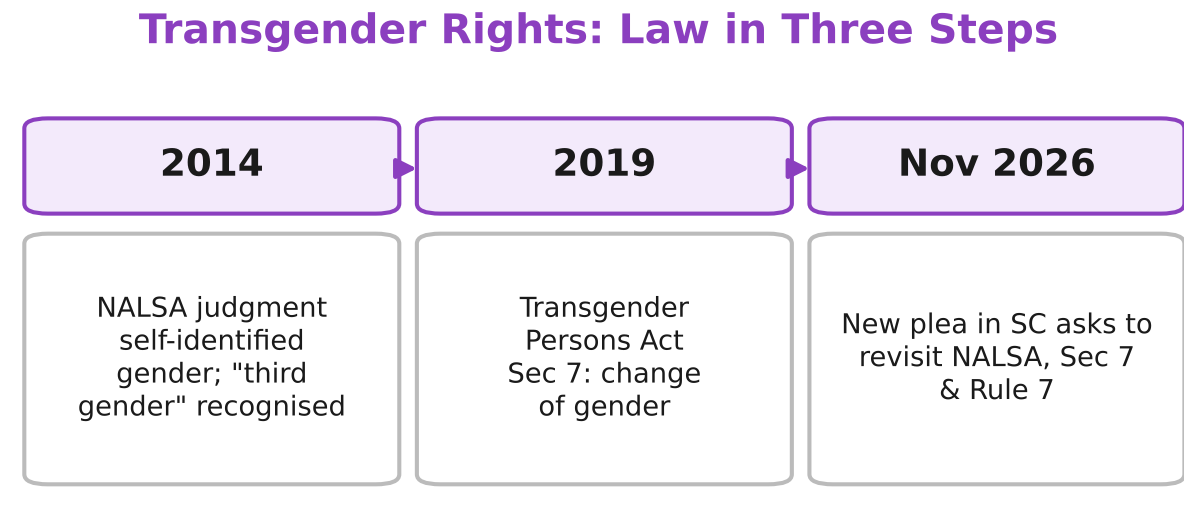
A new petition in the Supreme Court wants the Court to look again at whether a person can legally change gender by self-identification. Critics fear it could weaken the rights given to transgender persons since 2014. The India chapter of Women's Declaration International (WDI), a UK-based group that campaigns for sex-based rights of women, has filed the plea. It challenges Section 7 of the Transgender Persons (Protection of Rights) Act, 2019 and Rule 7 of the Transgender Rules, which allow a person to get a certificate showing a change of gender. It also asks the Court to reconsider the 2014 NALSA judgment. WDI argues that legal gender change can dilute protections meant for women, such as women's sports categories.
Key facts
NALSA v Union of India (2014) recognised 'third gender' and the right to self-identify gender.
NALSA: no one can be forced to undergo surgery, sterilisation or hormone therapy for legal recognition.
Gender identity discrimination falls under the bar on sex discrimination (Articles 15 and 16).
Self-determination of gender is rooted in dignity and liberty under Article 21.
Community groups fear poor, rural and Adivasi transgender persons will be hit hardest.
Way forward
The Court should hear all sides with evidence, while ensuring that any outcome does not roll back dignity and equal protection already recognised.
Concept
Biological sex vs gender identity: sex = body features (genitals, chromosomes); gender identity = how a person sees themself. NALSA treated both as parts of 'sex'. Transgender Persons (Protection of Rights) Act, 2019: bans discrimination in jobs, education, health; provides identity certificates via the District Magistrate; set up a National Council for Transgender Persons. SMILE scheme (Ministry of Social Justice): support for livelihood and shelter (Garima Greh) for transgender persons. Exam angle: Prelims: year and name of the landmark case, Articles involved, what Section 7 deals with. Mains: should rights be based on self-identified gender or biological sex? Discuss with fairness to both women and transgender persons.
Timeline of transgender rights: 2014 NALSA judgment, 2019 Act Section 7, and the November 2026 plea — StudyForGS
3. Karnataka Moves SC on Quota Hike
POLITYUPSC: Prelims + Mains GS2
Syllabus linkage
GS2 - Polity: reservation, 50% ceiling, Ninth Schedule, National Commissions for SC/ST (Articles 338, 338A). Mains: federalism and social justice.
Context
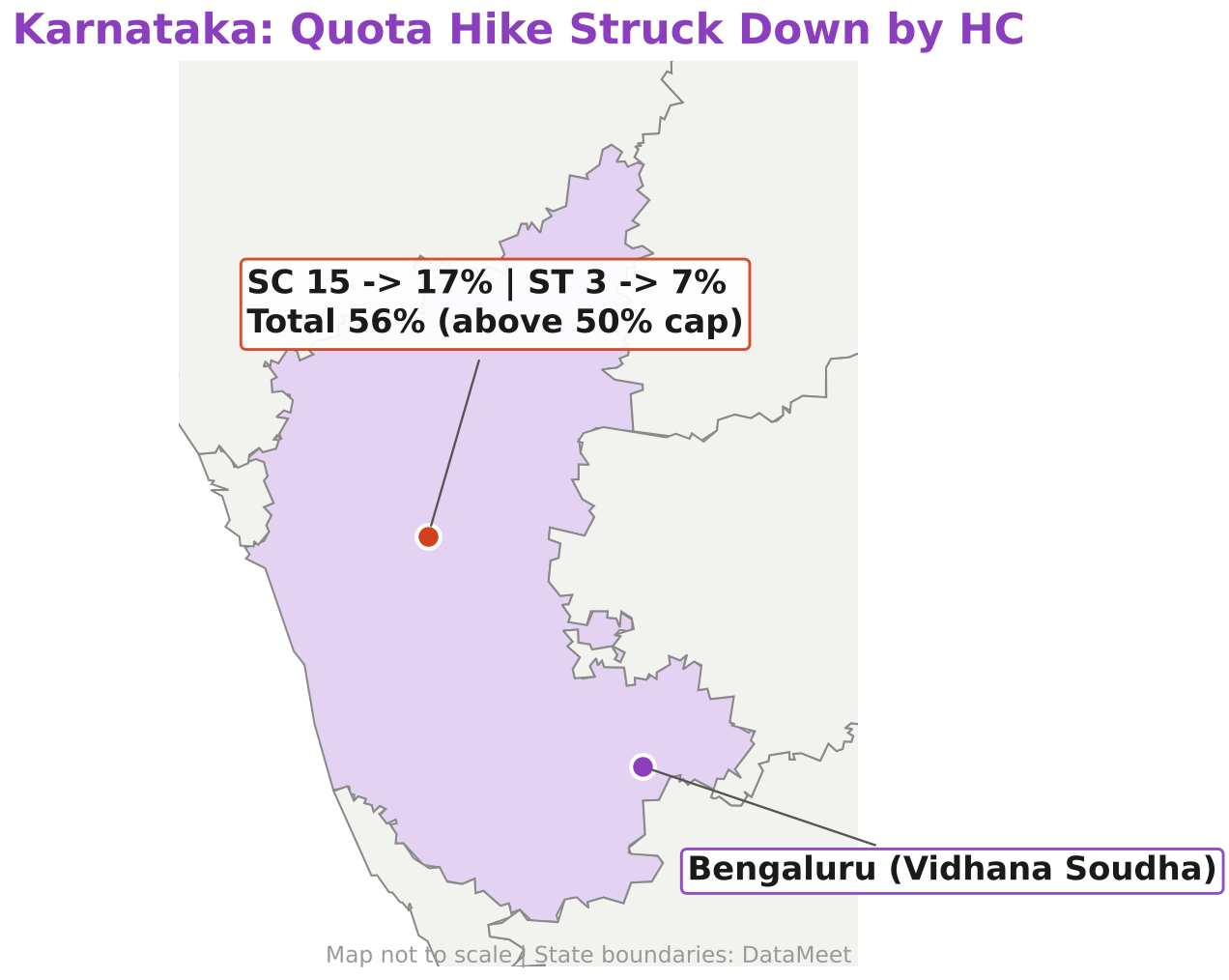
Karnataka had raised reservation for Scheduled Castes and Scheduled Tribes, taking total reservation to 56%. The High Court struck the law down, and the State has now appealed to the Supreme Court. Karnataka's 2022 law raised SC reservation from 15% to 17% and ST reservation from 3% to 7%. The Karnataka High Court quashed it, saying consultation with the National Commissions for SCs and STs was mandatory before the law, and letters sent after it was passed were not enough. The State Cabinet decided to appeal on 15 October 2026 and a Special Leave Petition (SLP) was filed on 28 October 2026. The hike was based on the Justice H.N. Nagamohan Das Commission report (July 2020).
Key facts
SC quota 15% -> 17%; ST quota 3% -> 7%; total 56% (with 32% OBC).
Karnataka Assembly (18 Dec 2025) asked the Centre to put the 56% quota in the Ninth Schedule.
Centre told Parliament (25 July 2026) the request was deferred as the case was pending in HC.
HC ground: no prior consultation with National Commissions for SC and ST.
SLP = appeal route to the Supreme Court under Article 136.
Way forward
States should follow due process (consultation, data on backwardness) before changing quotas, so that welfare laws survive judicial review.
Concept
50% ceiling: Indra Sawhney (1992) said total reservation should normally not cross 50% except in extraordinary situations. EWS 10% was upheld beyond it in Janhit Abhiyan (2022). Ninth Schedule (Article 31B, 1st Amendment 1951): laws placed here were shielded from challenge, but I.R. Coelho (2007) said laws added after 24 April 1973 can still be tested for basic-structure violation. Tamil Nadu's 69% law is in it. NCSC (Article 338) and NCST (Article 338A): the Union and States must consult them on all major policy matters affecting SCs/STs. Exam angle: Prelims: Articles for NCSC/NCST, Ninth Schedule article and amendment, the 50% rule case. Mains: is the 50% cap still relevant? Role of consultation with constitutional bodies.
Map of Karnataka showing SC quota raised from 15 to 17 percent, ST from 3 to 7 percent, total 56 percent — StudyForGS
4. Visa Categories Cut from 13 to 9
POLITYUPSC: Prelims + Mains GS2
Syllabus linkage
GS2 - Governance: e-governance, ease of travel; GS3 - tourism and medical value travel. Prelims: visa categories, AYUSH visa. Mains: soft power and service exports.
Context
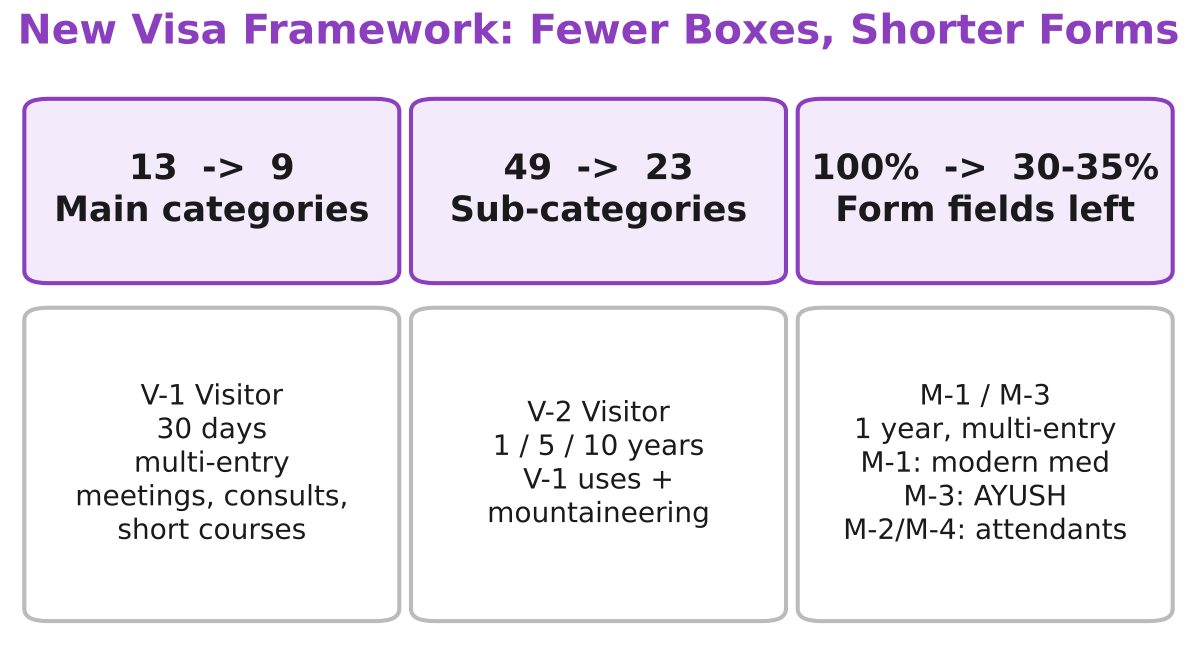
The Home Ministry has made India's visa system simpler: fewer visa types and much shorter forms, to attract more tourists, patients and students. The Union Home Ministry (MHA) has cut main visa categories from 13 to 9 and sub-categories from 49 to 23. The number of fields in visa forms has been cut by 65-70% across all 23 sub-categories. The tourist visa, renamed 'visitor visa' in August, now has V-1 (30 days, multiple entry) for business meetings, medical consultation, wellness and short courses, and V-2 (1, 5 or 10 years) which adds mountaineering. Medical visas M-1 (modern medicine) and M-3 (AYUSH treatment) default to one year with multiple entries; M-2 and M-4 are for attendants.
Key facts
Main categories 13 -> 9; sub-categories 49 -> 23.
Application forms 65-70% leaner.
Earlier reform (Oct 2025) had cut categories from 22 to 13.
A Production Investment Business Visa covers foreign engineers who install or commission machinery (e.g. semiconductor plants).
Aim: more foreign tourists, medical travel and international students.
Way forward
Keep identity checks strong, make digital forms multilingual and reliable, and track processing times at missions abroad.
Concept
Immigration and Foreigners Act, 2025: single new law (in force from 1 September 2025) that replaced older laws like the Foreigners Act 1946 and Passport (Entry into India) Act 1920. e-Visa: India's online visa, started as e-Tourist Visa in 2014; now available to nationals of most countries. Medical Value Travel: patients coming to India for cheaper, quality treatment; AYUSH visa promotes traditional systems (Ayurveda, Yoga, Unani, Siddha, Sowa-Rigpa, Homoeopathy). Exam angle: Prelims: which ministry issues visa policy, AYUSH visa category, new law on immigration. Mains: how simpler visas help tourism, education hub ambitions and soft power, while keeping security checks.
Diagram of the new visa framework: categories 13 to 9, sub-categories 49 to 23, and details of V-1, V-2, M-1 and M-3 visas — StudyForGS
5. Swachh Survekshan 2025-26 Results
POLITYUPSC: Prelims + Mains GS2
Syllabus linkage
GS2 - Governance: urban local bodies, government schemes (Swachh Bharat Mission-Urban). GS3 - waste management. Prelims: winners, theme, edition.
Context
India's yearly cleanliness survey of cities has been announced. Navi Mumbai topped the top league of always-clean cities, and Visakhapatnam led the big cities with over 10 lakh people. President Droupadi Murmu gave the 10th Swachh Survekshan awards at Vigyan Bhawan, New Delhi on 11 November 2026. The survey is run by the Ministry of Housing and Urban Affairs (MoHUA). In the Super Swachh League, Navi Mumbai came first, Surat second and Vijayawada third. Among million-plus cities, Greater Visakhapatnam was first, Jabalpur second and Lucknow third. Puri won among coastal towns and Rudrapur among Himalayan cities.
Shift focus from rankings to steady services - source segregation, processing of all waste, and clearing old dumpsites on time.
Concept
Swachh Survekshan: annual cleanliness ranking started in 2016 (73 cities in first round) under Swachh Bharat Mission-Urban; uses field checks, documents and citizen feedback. Swachh Bharat Mission-Urban was launched on 2 October 2014; SBM-U 2.0 (October 2021) aims at 'Garbage Free Cities' and clearing legacy dumpsites. Super Swachh League: a separate league for cities that have been top performers in recent years, so that other cities also get a chance to win. Exam angle: Prelims: implementing ministry, edition, toppers in different categories, year of launch. Mains: role of citizen participation and competition (competitive federalism among cities) in improving urban sanitation.
India map marking Swachh Survekshan 2025-26 top cities - Navi Mumbai, Surat, Vijayawada, Visakhapatnam, Jabalpur, Lucknow, Ujjain, Puri and Rudrapur — StudyForGS
6. Russia-Ukraine Agree on POW Swap
IRUPSC: Prelims + Mains GS2
Syllabus linkage
GS2 - International relations: conflicts, India's interests, West Asia/Gulf as mediators. Prelims: places and people in news. Mains: India's 'dialogue and diplomacy' stand.
Context
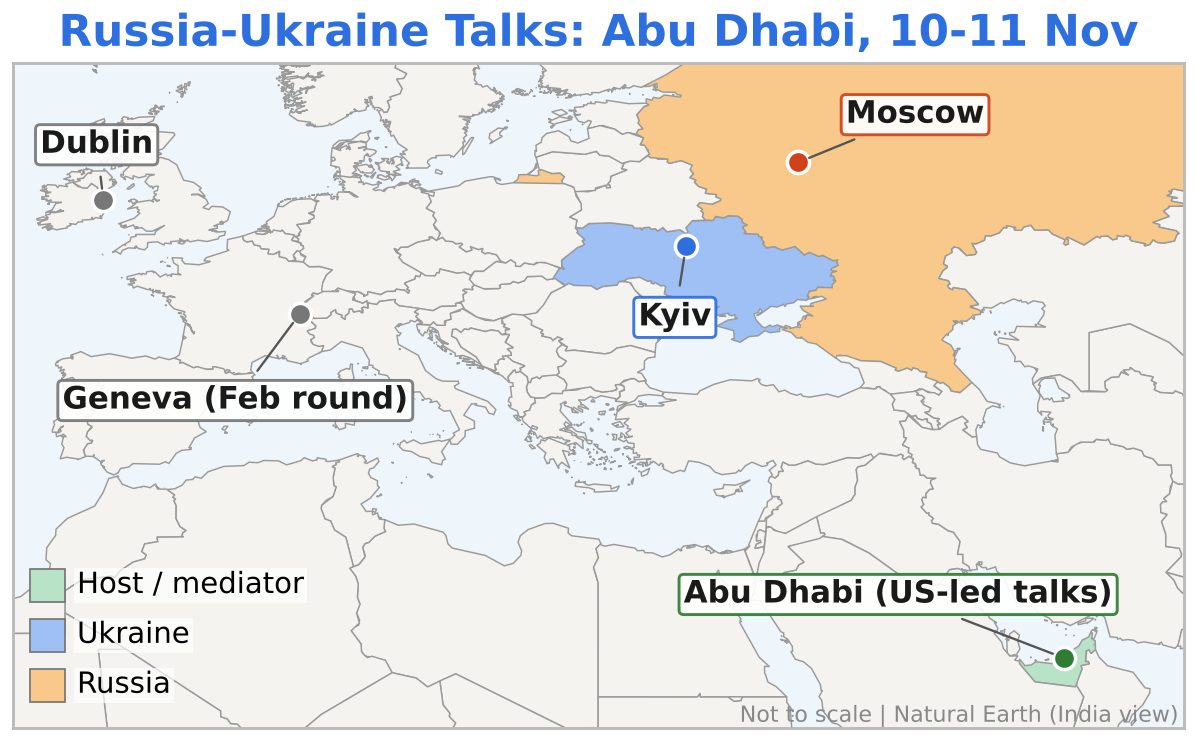
Russia and Ukraine held peace talks in Abu Dhabi with the US as mediator. They agreed to a large exchange of prisoners of war, but there was no breakthrough on ending the war. The US-led trilateral talks were held in Abu Dhabi, UAE on 10-11 November 2026, the first meeting of the two delegations in nine months (last in Geneva, February). Vladimir Medinsky led Russia and Rustem Umerov led Ukraine. Both sides agreed 'in principle' to a large prisoner-of-war (POW) exchange, which Russia said could happen in two to three weeks. Key issues - security guarantees, occupied territory and Europe's role - remain unresolved.
Key facts
Venue: Abu Dhabi (UAE); mediator: United States.
Swap may be among the biggest since the 1,000-for-1,000 exchange of 2025.
Ukraine says it will not give up occupied land in exchange for peace.
Russia opposes European participation in direct talks.
US envoys Jared Kushner and Steve Witkoff planned to meet Putin in Moscow and Zelenskyy in Dublin.
Way forward
Humanitarian steps like POW swaps can build trust; a lasting deal needs credible security guarantees acceptable to both sides.
Concept
Prisoner of war (POW): a soldier captured by the enemy; their treatment is governed by the Third Geneva Convention (1949) - humane treatment and release after hostilities. Ceasefire vs peace treaty: a ceasefire only stops fighting; a peace treaty settles issues like borders and security. India's stand: 'this is not an era of war'; supports dialogue and diplomacy, keeps ties with both Russia (energy, defence) and the West. Exam angle: Prelims: venue and mediator of talks, Geneva Conventions on POWs. Mains: impact of the war on India (oil prices, fertiliser, defence supplies) and India's balancing role.
Map of Europe and West Asia showing Russia, Ukraine, the Abu Dhabi talks venue, Geneva, Dublin and Moscow — StudyForGS
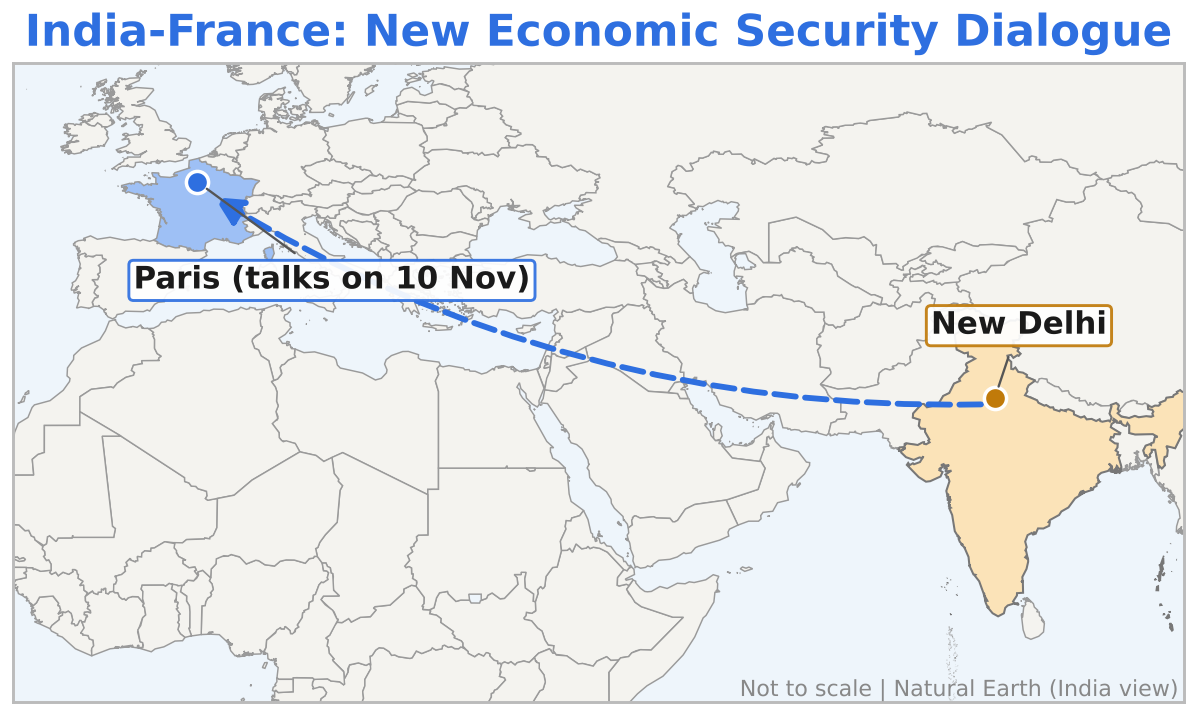
India and France held three sets of talks in Paris - on space, on a new 'economic security and critical technologies' track, and on overall ties - to make supply chains safer and build technology together. Foreign Secretary Vikram Misri and Martin Briens, Secretary General of the French foreign ministry, met in Paris on 10 November 2026. They co-chaired the 3rd India-France Strategic Space Dialogue, held the first meeting of a new India-France Economic Security and Critical Technologies Dialogue, and held broad bilateral consultations. Topics included ISRO-CNES cooperation, commercial space links, supply-chain resilience and joint work in emerging technologies.
Key facts
New mechanism: India-France Economic Security and Critical Technologies Dialogue (1st meeting).
3rd Strategic Space Dialogue co-chaired by Misri and Briens.
Focus: resilient supply chains and joint development in emerging domains.
2026 is being marked as the India-France Year of Innovation.
ISRO and CNES (French space agency) have long-running joint projects.
Way forward
Turn dialogues into projects - joint production of critical components, shared satellite data, and co-investment in clean tech.
Concept
India-France Strategic Partnership (1998): France was India's first strategic partner; 'Horizon 2047' roadmap (2023) sets goals for the next 25 years. Economic security: protecting a country's economy from shocks and pressure - e.g. not depending on a single country for critical minerals, chips or medicines. ISRO-CNES missions: Megha-Tropiques (2011) and SARAL (2013) are flown; TRISHNA (thermal infrared Earth-observation satellite) is under joint development. Exam angle: Prelims: India's first strategic partner, ISRO-CNES missions, name of the new dialogue. Mains: why middle powers like India and France cooperate on 'de-risking' supply chains.
Map showing India and France with a route from New Delhi to Paris, where talks were held on 10 November — StudyForGS
8. APEC Summit in Shenzhen Next Week
IRUPSC: Prelims + Mains GS2
Syllabus linkage
GS2 - Regional groupings and their impact on India. Prelims: APEC members, founding year, secretariat. Mains: India's place in Asia-Pacific trade architecture.
Context
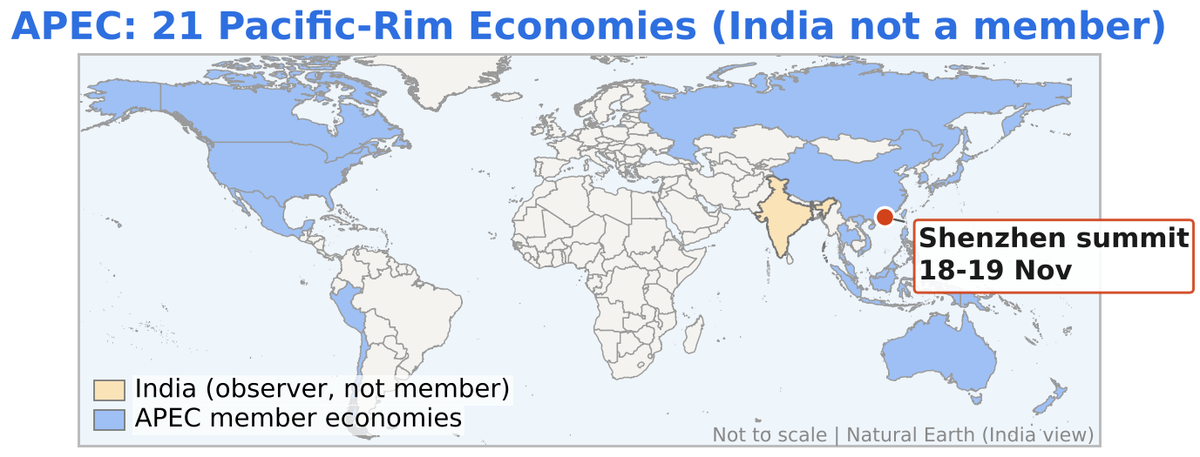
Leaders of the 21 Asia-Pacific economies will meet in Shenzhen, China on 18-19 November. China says a possible meeting of the US, China and Russia leaders is being discussed. India is not an APEC member. China is hosting APEC for the third time (after 2001 and 2014), with the Economic Leaders' Meeting in Shenzhen on 18-19 November 2026. The motto is 'Building an Asia-Pacific Community to Prosper Together'. US President Donald Trump has said he expects to meet Chinese President Xi Jinping and Russian President Vladimir Putin there, and Beijing said it is in communication with the parties.
Founded 1989 (Canberra); Secretariat in Singapore.
Members include the US, China, Russia, Japan, Australia; Taiwan joins as 'Chinese Taipei', Hong Kong as 'Hong Kong, China'.
Shenzhen: China's first Special Economic Zone (1980), in Guangdong province.
India is not a member; it has sought membership for years.
Way forward
India can deepen ties with APEC economies through bilateral FTAs and supply-chain partnerships while keeping its APEC bid alive.
Concept
APEC works by consensus and non-binding commitments - it promotes free trade and investment but does not sign binding trade deals. Member 'economies', not 'countries': this lets Taiwan and Hong Kong take part. Related Indo-Pacific groupings: RCEP (India stayed out in 2019), IPEF (India is in three of four pillars, not the trade pillar). Exam angle: Prelims: number of APEC members, founding year, secretariat, whether India is a member. Mains: should India seek APEC membership? Link to its trade strategy after leaving RCEP.
World map with the 21 APEC member economies in blue, India in a different colour and the Shenzhen summit venue marked — StudyForGS
9. Amnesty Faults UN Mission in South Sudan
IRUPSC: Prelims + Mains GS2
Syllabus linkage
GS2 - International institutions: UN peacekeeping, India's contribution; humanitarian law. Prelims: UNMISS, Abyei. Mains: limits of peacekeeping.
Context
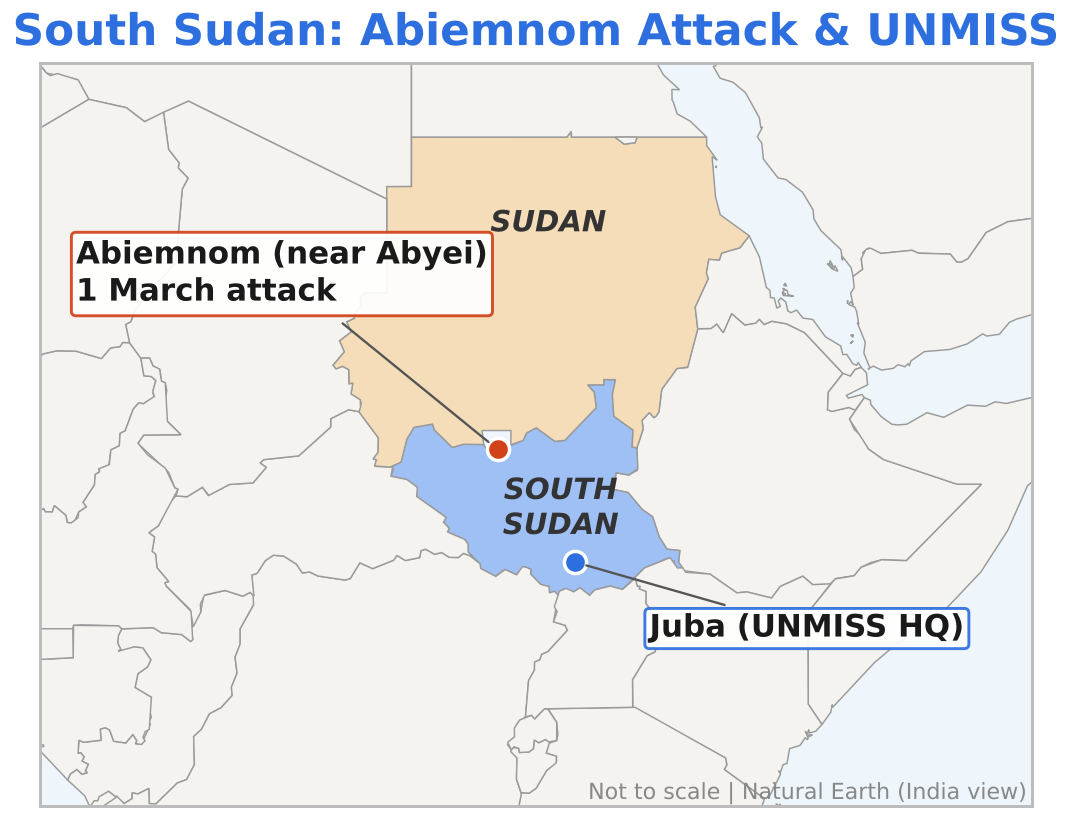
Amnesty International says South Sudan's authorities and the UN peacekeeping mission (UNMISS) had warnings before a deadly March attack on Abiemnom town but did not do enough to protect people. Amnesty's report (12 November) concerns the 1 March 2026 attack on Abiemnom, near the disputed Abyei area on the Sudan-South Sudan border. South Sudanese authorities recorded at least 213 deaths, including security personnel. Amnesty used survivor accounts, satellite images and verified pictures, and asked for an inquiry into the killings and a separate review of the response. UNMISS said it sought help from the national army and protected and treated about 2,500 people who took shelter; it cited budget cuts and fewer staff.
Key facts
Attack date: 1 March 2026; at least 213 killed.
UNMISS sheltered about 2,500 people.
UN peacekeeping is facing budget and staff cuts.
Abyei: oil-rich area claimed by both Sudan and South Sudan.
India is among the largest troop contributors to UNMISS.
Way forward
Stable funding, early-warning systems and clear mandates are needed so that peacekeepers can act before attacks, not after.
Concept
South Sudan became independent from Sudan on 9 July 2011 - the world's youngest country; UNMISS was set up by the UN Security Council the same year. UN peacekeeping principles: consent of parties, impartiality, and use of force only in self-defence or to protect civilians (mandate). Protection of Civilians (PoC) sites: UN bases where civilians take shelter during violence. Exam angle: Prelims: world's newest country, location of Abyei, UN mission names. Mains: challenges of UN peacekeeping (funding, mandates) and India's role as a top troop contributor.
Map of Sudan and South Sudan marking the Abiemnom attack site near Abyei and UNMISS headquarters in Juba — StudyForGS
10. Draft Rules to Register Allied Health Workers
HEALTHUPSC: Prelims + Mains GS2
Syllabus linkage
GS2 - Health: human resources for health, regulatory bodies. Prelims: NCAHP Act 2021. Mains: quality and regulation of the health workforce.
Context
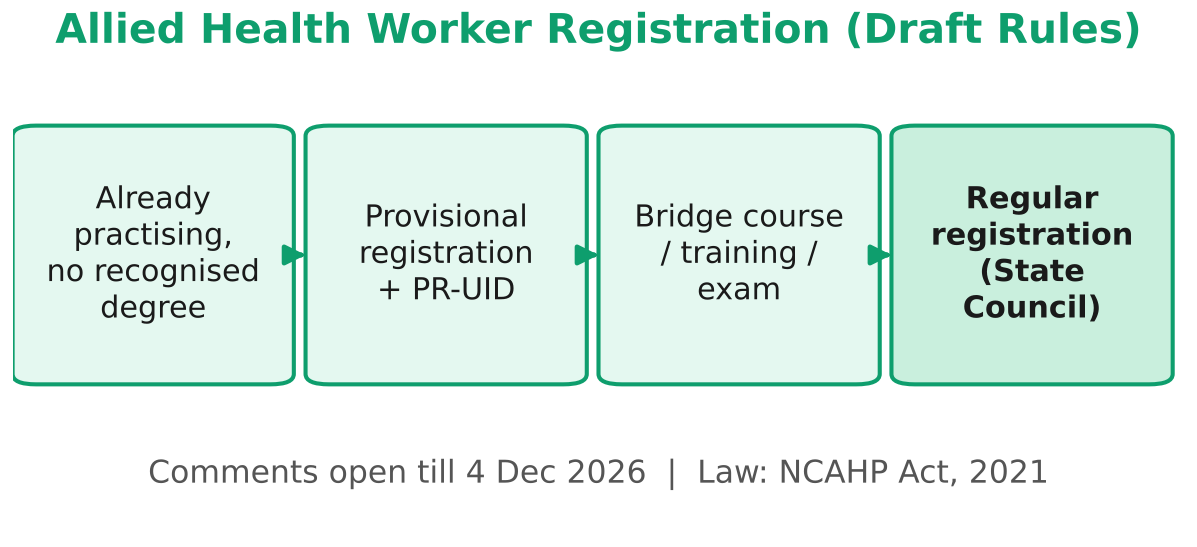
The national body for allied health workers (like lab technicians, physiotherapists, optometrists) has proposed rules so that people already working without a recognised degree can register provisionally and later upgrade. The National Commission for Allied and Healthcare Professions (NCAHP) invited public comments on 11 November on draft registration rules under the NCAHP Act, 2021; comments close on 4 December 2026. Eligible practitioners who were working before the Act may get provisional registration, a certificate and a Provisional Registration Unique ID (PR-UID). To get regular registration they must meet conditions such as a bridge course, supervised clinical training or a qualifying exam. The draft also covers validity, extension, termination and appeals.
Key facts
Body: National Commission for Allied and Healthcare Professions (NCAHP).
Law: NCAHP Act, 2021.
Provisional registration with PR-UID for existing workers.
Regular registration after bridge course / training / exam.
Public comments till 4 December 2026.
Way forward
Offer affordable, online bridge courses and clear timelines so that workers are upgraded, not pushed out.
Concept
Allied and healthcare professionals: trained workers other than doctors, nurses and dentists - e.g. lab, radiology, physiotherapy, optometry, nutrition, OT technicians. The Act lists 56 professions in 10 categories. Structure under the Act: a national commission plus State Allied and Healthcare Councils that maintain registers. Why it matters: India has a shortage of skilled health workers; registration ensures minimum quality and patient safety. Exam angle: Prelims: year of NCAHP Act, what is PR-UID, who maintains registers. Mains: balancing quality control with livelihoods of existing untrained workers.
Flow of allied health worker registration: existing worker, provisional registration with PR-UID, bridge course or exam, then regular registration — StudyForGS
11. First BIMSTEC Health Ministers' Meeting
HEALTHUPSC: Prelims + Mains GS2
Syllabus linkage
GS2 - Regional groupings (BIMSTEC), health diplomacy, Neighbourhood First. Prelims: members, HQ, Charter. Mains: regional health security.
Context
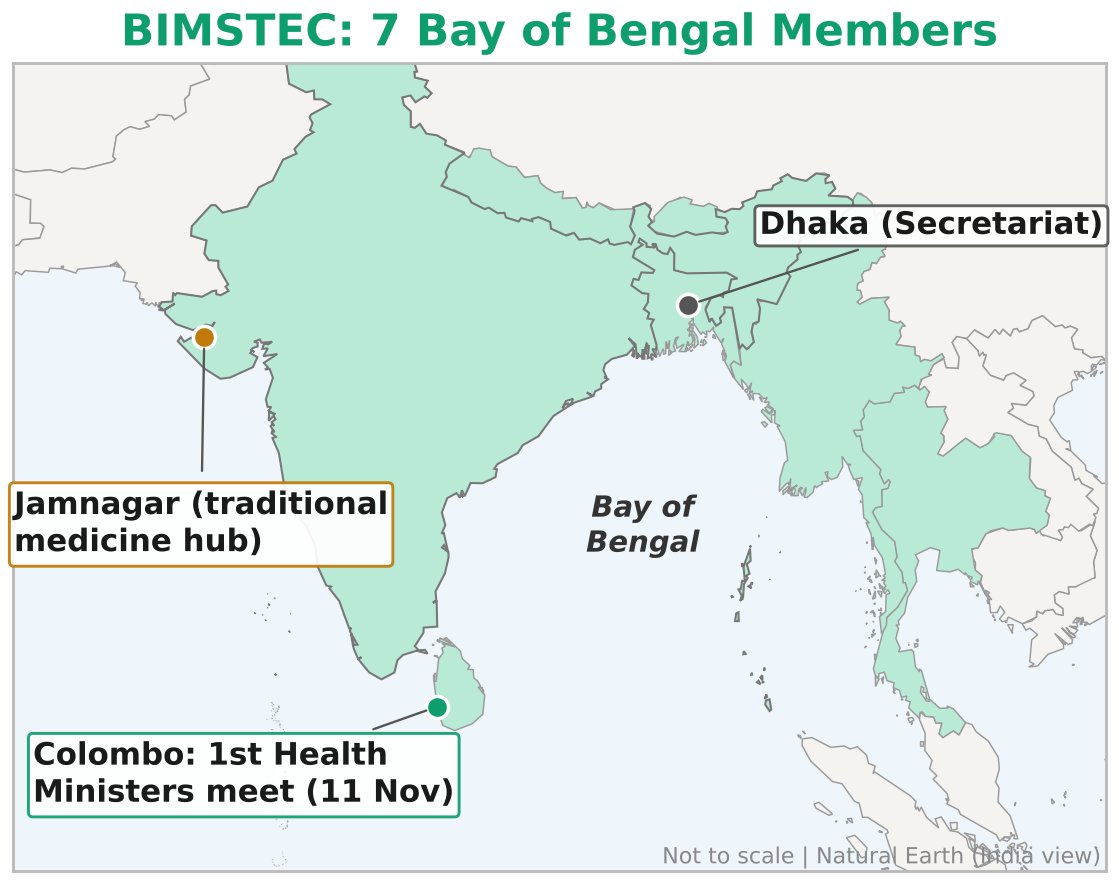
Health ministers of the seven BIMSTEC countries met for the first time in Colombo and agreed on a regional public-health plan for 2026-2030. India offered a traditional-medicine centre at Jamnagar. The first BIMSTEC Health Ministers' Meeting was held in Colombo, Sri Lanka on 11 November 2026. It adopted a revised Plan of Action on Public Health for 2026-2030 and a Joint Ministerial Statement. Priorities include disease surveillance, preparedness, health workforce, digital health (shared records, telemedicine), traditional medicine and universal health coverage. Bangladesh proposed a regional zoonotic disease observatory and early-warning system, and India offered a centre of excellence in traditional medicine at Jamnagar.
Key facts
Venue: Colombo; date: 11 November 2026.
Plan of Action on Public Health 2026-2030 adopted.
Ministers will meet every two years.
The April 2025 Bangkok summit had called for this ministers' mechanism.
India and Sri Lanka also exchanged an agreement on extra ambulances.
Way forward
Set up the surveillance network with funding and data-sharing rules, so the plan moves from paper to practice.
Concept
BIMSTEC: Bay of Bengal Initiative for Multi-Sectoral Technical and Economic Cooperation; formed 1997 (Bangkok Declaration); 7 members - Bangladesh, Bhutan, India, Nepal, Sri Lanka (South Asia) and Myanmar, Thailand (South-East Asia); Secretariat in Dhaka; Charter in force since 2024. Zoonotic diseases: infections that jump from animals to humans (e.g. Nipah, avian flu, COVID-19) - a regional observatory helps catch outbreaks early. Jamnagar hosts the WHO Global Centre for Traditional Medicine (GCTM) and the Institute of Teaching and Research in Ayurveda. Exam angle: Prelims: BIMSTEC members, secretariat, founding year; WHO GCTM location. Mains: BIMSTEC as a bridge between South and South-East Asia; health as a tool of regional diplomacy.
Bay of Bengal region map showing the seven BIMSTEC members, Colombo meeting venue, Jamnagar and the Dhaka secretariat — StudyForGS
📜 Asked before in the exam — previous-year question on this topic
UPSC Prelims 2025Consider the following statements in respect of BIMSTEC: I. It is a regional organization consisting of seven member States till January 2025. II. It came into existence with the signing of the Dhaka Declaration, 1999. III. Bangladesh, India, Sri Lanka, Thailand and Nepal are founding member States of BIMSTEC. IV. In BIMSTEC, the subsector of 'tourism' is being led by India. Which of the statements given above is/are correct?
I and II
II and III
I and IV
I only
Show answer
Answer: (d) I only BIMSTEC has seven members: Bangladesh, Bhutan, India, Myanmar, Nepal, Sri Lanka and Thailand, so statement I is correct. It was created by the Bangkok Declaration of 1997, not Dhaka 1999. Its founders were Bangladesh, India, Sri Lanka and Thailand; Nepal joined in 2004. After the 2022 restructuring into seven sectors India leads security, while tourism falls under people-to-people contact led by Nepal. So only statement I. Practise all UPSC Prelims 2025 paper (free) →
Linked because this news is about the same topic. The answer is as per the official key of that year.
12. Nasha Mukt Bharat Abhiyaan at Six
HEALTHUPSC: Prelims + Mains GS2
Syllabus linkage
GS2 - Health and vulnerable sections, government schemes; GS3 - drug trafficking and internal security. Prelims: launch year, ministry, helpline. Mains: demand vs supply reduction.
Context
India's nationwide campaign against drug abuse has completed six years. It has reached over 35 crore people with awareness drives in schools, colleges and communities. The Nasha Mukt Bharat Abhiyaan (NMBA) was launched on 15 August 2020 by the Ministry of Social Justice and Empowerment. It started in 272 most-vulnerable districts and later covered the whole country. It has reached over 35 crore people, including about 13.94 crore youth and 10.86 crore women, and over 32 lakh educational institutions. Volunteers called 'Nasha Mukt Mitras' carry the message to campuses, and Union Home Minister Amit Shah has set 31 December 2029 as the target to end the drug trade in India.
Key facts
Launched: 15 August 2020; ministry: Social Justice and Empowerment.
Started in 272 vulnerable districts; now nationwide.
Reach: 35 crore+ people; 32 lakh+ institutions.
National De-addiction Helpline: 14446.
Works under the National Action Plan for Drug Demand Reduction (NAPDDR).
Way forward
Add more de-addiction and counselling centres and publish treatment and relapse data, not just reach figures.
Concept
Demand reduction vs supply reduction: NMBA reduces demand (awareness, treatment, rehabilitation); NCB and police reduce supply (seizures, arrests) under the NDPS Act, 1985. Article 47 (Directive Principle): the State shall try to prohibit intoxicating drinks and drugs harmful to health. Reach is not the same as recovery: counting people who heard a message does not show how many were treated or stayed drug-free. Exam angle: Prelims: launch date, nodal ministry, helpline number, relevant DPSP. Mains: why drug abuse is both a health and a security issue (Golden Crescent/Golden Triangle routes).
13. India Bans Export of Battery Black Mass
ECONOMYUPSC: Prelims + Mains GS3
Syllabus linkage
GS3 - Economy: trade policy, critical minerals, circular economy; Environment: e-waste. Prelims: black mass, DGFT, EPR. Mains: mineral security and EV supply chain.
Context
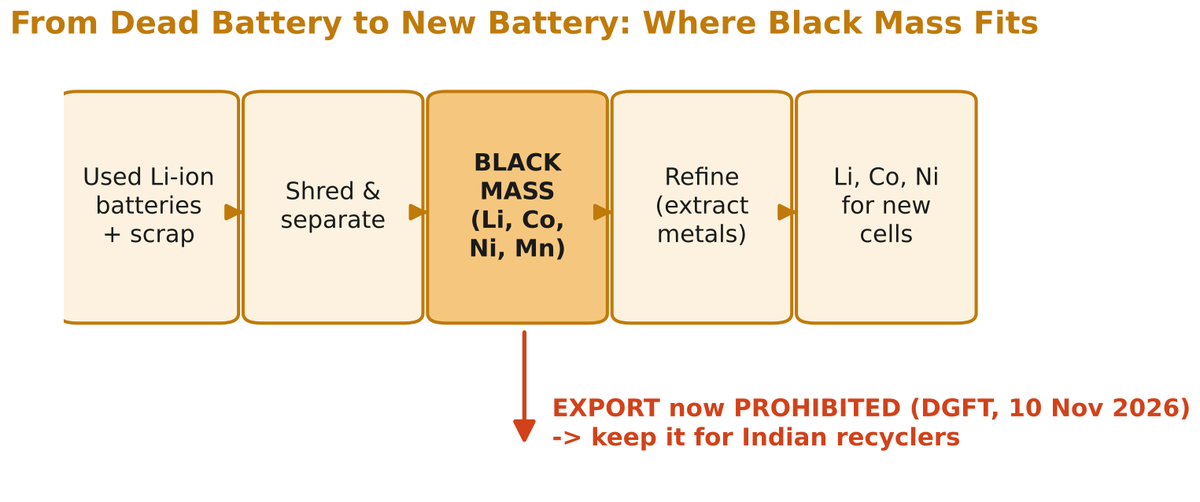
India has stopped the export of 'black mass' - a powder made from crushed used lithium-ion batteries that contains valuable metals - so that these metals are recovered inside India. The Directorate General of Foreign Trade (DGFT), under the Commerce Ministry, issued a notification dated 10 November 2026 changing the export policy for lithium-ion battery black mass from 'Free' to 'Prohibited' with immediate effect. The government said some Indian recyclers were importing feedstock while black mass made in India was being exported. Black mass contains lithium, nickel, cobalt, manganese and graphite. 57 lithium-ion recyclers are registered on the CPCB's battery EPR portal with a capacity of 5.17 lakh tonnes a year, but black-mass processing capacity is only about 75,500 tonnes.
India meets its lithium needs fully through imports.
A Rs 2,814 crore Critical Mineral Processing Scheme supports lithium and nickel processing.
Way forward
Pair the ban with investment in refining technology, skilled manpower and battery-cell manufacturing so that India builds a full battery circular economy.
Concept
Black mass: a dark powder left after shredding used batteries; it is an 'urban mine' of critical minerals. Extended Producer Responsibility (EPR): makers must collect and recycle the waste from their products - for batteries under the Battery Waste Management Rules, 2022. National Critical Mineral Mission (2025): to secure supplies of lithium, cobalt, rare earths etc. by exploration, overseas assets and recycling. Exam angle: Prelims: what black mass contains, who issues export notifications, what EPR means. Mains: export bans as industrial policy - benefits (domestic value addition) and risks (low prices for collectors, need for technology).
Battery recycling flow: used lithium-ion batteries, shredding, black mass, refining and metals for new cells, with an export-ban arrow — StudyForGS
14. Stand-Up India Extended Till 2031
ECONOMYUPSC: Prelims + Mains GS3
Syllabus linkage
GS3 - Inclusive growth, financial inclusion; GS2 - welfare of SCs, STs and women. Prelims: loan size, beneficiaries, launch year.
Context
The Union Cabinet has continued the Stand-Up India scheme for five more years. It gives bank loans of Rs 10 lakh to Rs 1 crore to women, SC and ST entrepreneurs starting new businesses. On 11 November 2026 the Cabinet approved continuing Stand-Up India up to 31 March 2031. It aims to help an additional 2.5 lakh entrepreneurs over five years; so far more than 2.75 lakh women, SC and ST entrepreneurs have got loans since its launch in April 2016. Loans are for new (greenfield) units in manufacturing, services, trading and agri-allied activities. A Credit Guarantee Corpus of Rs 4,111 crore was approved.
Key facts
Loan: above Rs 10 lakh up to Rs 1 crore, up to 85% of project cost.
Credit guarantee: 85% of loan; standard fee 0.50%.
Beneficiaries: women, SC and ST entrepreneurs (greenfield units).
Valid up to 31 March 2031.
Target: 2.5 lakh more entrepreneurs.
Way forward
Add hand-holding (mentoring, market links) along with credit, since many first-time entrepreneurs fail for lack of skills, not money.
Concept
Greenfield enterprise: a first-time, brand-new business (not expansion of an old one). Original design (2016): every bank branch to give at least one such loan to an SC/ST borrower and one to a woman borrower. Credit guarantee: a government-backed fund promises to repay most of the loan if the borrower defaults, so banks lend without collateral. Exam angle: Prelims: loan range, target groups, guarantee coverage, launch year. Mains: role of credit guarantees in promoting entrepreneurship among marginalised groups.
Comparison of Stand-Up India and CGFMU schemes - beneficiaries, loan size, corpus and guarantee fee — StudyForGS
The Cabinet has extended the guarantee fund that protects banks when small MUDRA, Jan Dhan overdraft and self-help group loans go bad. The fee has also been cut, so lending should become cheaper. The Cabinet approved continuation of the Credit Guarantee Fund for Micro Units (CGFMU) up to 31 March 2031, covering the 16th Finance Commission cycle (FY 2026-27 to FY 2030-31), with a corpus of Rs 5,000 crore. The annual guarantee fee for non-SHG loans falls from 1% to 0.75%; SHG fees stay at 0.25% in the first year and 0.50% later. The extension is expected to support about Rs 12.6 lakh crore of MUDRA loans in five years.
Key facts
CGFMU launched January 2016; run by NCGTC.
Covers PMMY loans up to Rs 20 lakh, PMJDY overdrafts up to Rs 10,000, SHG loans (portfolio Rs 10-20 lakh).
Fee cut: 1% -> 0.75% a year (non-SHG).
Borrowers stay liable - the guarantee protects lenders, it is not a loan waiver.
Since 2015, over 60 crore MUDRA loans worth about Rs 43 lakh crore sanctioned (Sept 2026).
Way forward
Watch loan quality (NPAs) and ensure guarantees reach first-time borrowers, not just existing ones.
Concept
PM MUDRA Yojana (2015): collateral-free loans to non-farm micro enterprises in categories Shishu, Kishore, Tarun and Tarun Plus (up to Rs 20 lakh). NCGTC (National Credit Guarantee Trustee Company): a company under the Department of Financial Services that runs government credit guarantee funds. Why guarantees matter: they lower banks' risk, so banks lend more to small firms without property to pledge. Exam angle: Prelims: who runs CGFMU, MUDRA loan limit, new fee rate. Mains: credit guarantees as a cheap tool to expand formal credit to micro units.
The government will spend about Rs 62,370 crore this rabi season to keep phosphate and potash fertilisers like DAP affordable for farmers, about 64% more than last year, because world prices have risen. On 11 November 2026 the Cabinet approved Nutrient Based Subsidy (NBS) rates for phosphatic and potassic (P&K) fertilisers for Rabi 2026-27 (1 October 2026 to 31 March 2027). The tentative budget is about Rs 62,370.02 crore, compared with Rs 37,952.29 crore in Rabi 2025-26 - roughly Rs 24,418 crore more. The rise reflects higher international prices of fertilisers and raw materials, partly linked to the conflict in West Asia. 28 grades of P&K fertilisers, including DAP, are covered.
Key facts
Rabi 2026-27 NBS: about Rs 62,370 crore (up about 64%).
Period: 1 Oct 2026 - 31 Mar 2027.
28 grades of P&K fertilisers incl. DAP and NPK complexes.
Subsidy is paid to companies based on nutrient content; farmers gain via lower prices.
Urea is NOT under NBS - it has a fixed statutory price.
Way forward
Promote balanced nutrient use, nano and bio-fertilisers, and long-term supply deals abroad to cut import risk.
Concept
Nutrient Based Subsidy (NBS), since April 2010: a fixed subsidy per kg of nutrient (N, P, K, S) for decontrolled P&K fertilisers; companies set MRP. N-P-K imbalance: cheap urea leads to overuse of nitrogen; the ideal ratio is about 4:2:1 - imbalance harms soil health. India depends heavily on imports for DAP, potash and raw materials like rock phosphate, so global prices hit the subsidy bill. Exam angle: Prelims: fertilisers under NBS vs urea, nodal department (Department of Fertilizers). Mains: rising subsidy burden, import dependence and need for balanced fertiliser use.
Bar chart comparing P&K fertiliser subsidy of Rs 37,952 crore in Rabi 2025-26 and Rs 62,370 crore in Rabi 2026-27 — StudyForGS
17. NPCI: No UPI Fee Announcement Yet
ECONOMYUPSC: Prelims + Mains GS3
Syllabus linkage
GS3 - Banking and digital payments. Prelims: MDR, NPCI, Payment and Settlement Systems Act. Mains: sustainability of free digital payments.
Context
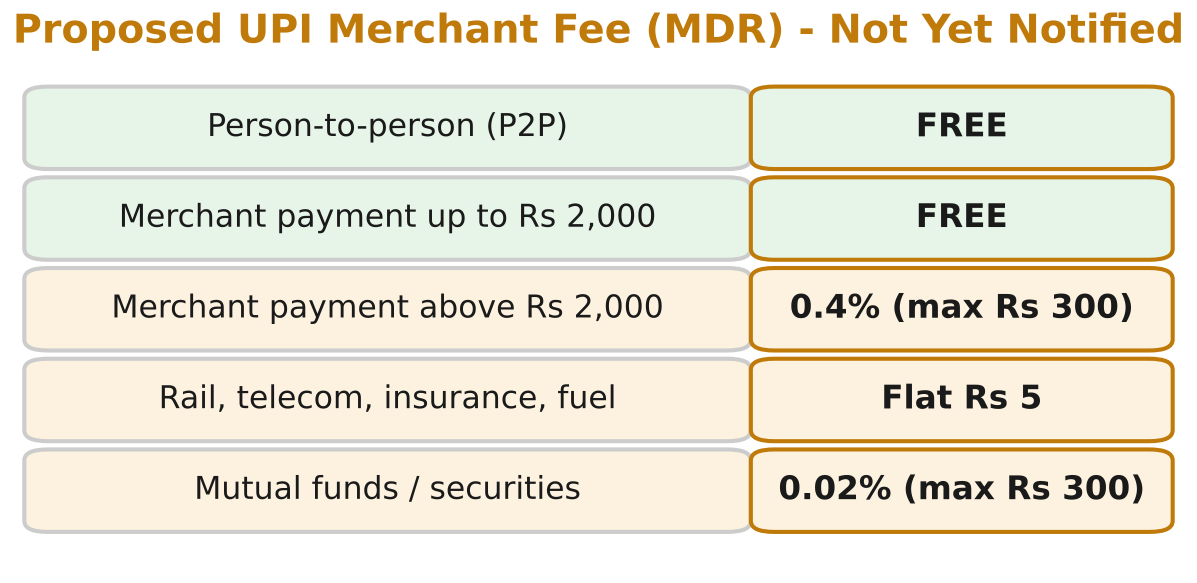
NPCI, which runs UPI, says there is no announcement 'at the moment' on starting the planned merchant fee (MDR) on large UPI payments. Ordinary person-to-person UPI transfers stay free. NPCI had planned a Merchant Discount Rate (MDR) of 0.4% on person-to-merchant (P2M) UPI payments above Rs 2,000, capped at Rs 300 per payment, from 15 October; it was deferred till after Diwali. On 11 November NPCI said there was no announcement on the levy 'at the moment'. The plan is also being challenged in a PIL in the Supreme Court, where NPCI said MDR is a commercial charge that merchants cannot pass on to customers.
Free: P2P transfers and merchant payments up to Rs 2,000 (about 96% of P2M payments).
Govt's Rs 2,000 crore incentive covers only a small part of industry costs.
NPCI says it is not 'State' under Article 12.
Way forward
Any fee should be small, transparent and shield small merchants, so that digital payment growth continues.
Concept
MDR (Merchant Discount Rate): fee a merchant pays the bank/payment network for accepting digital payments. Zero-MDR: Section 10A of the Payment and Settlement Systems Act, 2007 (added 2019) barred charges on RuPay debit and UPI from January 2020. NPCI: not-for-profit company set up in 2008 by RBI and Indian Banks' Association; runs UPI, RuPay, IMPS, FASTag (NETC). Exam angle: Prelims: meaning of MDR, who runs UPI, which law bars charges. Mains: who should bear the cost of running a public digital payment system - state, banks or users?
Table of proposed UPI merchant fees: free for P2P and up to Rs 2,000, 0.4 percent capped at Rs 300 above that, concessional rates for some sectors — StudyForGS
📜 Asked before in the exam — previous-year question on this topic
UPSC Prelims 2018Which one of the following best describes the term "Merchant Discount Rate" sometimes seen in news?
The incentive given by a bank to a merchant for accepting payments through debit cards pertaining to that bank.
The amount paid back by banks to their customers when they use debit cards for financial transactions for purchasing goods or services.
The charge to a merchant by a bank for accepting payments from his customers through the bank's debit cards.
The incentive given by the Government to merchants for promoting digital payments by their customers through Point of Sale (PoS) machines and debit cards.
Show answer
Answer: (c) The charge to a merchant by a bank for accepting payments from his customers through the bank's debit cards. The Merchant Discount Rate is the fee that a bank charges a merchant for providing the facility of accepting payments from customers through debit or credit cards and, later, other digital modes. It is usually a percentage of each transaction and is shared among the acquiring bank, the card-issuing bank and the card network. It is not an incentive paid to the merchant or a refund to customers. The RBI and government have at times capped or waived MDR to promote digital payments. Practise all UPSC Prelims 2018 paper (free) →
Linked because this news is about the same topic. The answer is as per the official key of that year.
18. COP31 Leaders Urge Faster Climate Action
ENVIRONMENTUPSC: Prelims + Mains GS3
Syllabus linkage
GS3 - Environment: climate change, international agreements; GS2 - global groupings. Prelims: COP hosts, Paris goals. Mains: climate finance and equity.
Context
At the UN climate summit COP31 in Antalya, Turkiye, world leaders said the world is moving too slowly to stop global warming. Leaders of the US, China and India did not attend the leaders' segment. COP31 opened on 9 November 2026 in Antalya, Turkiye and runs till 20 November; the leaders' summit was held on 11-12 November. Turkiye hosts the conference (COP President Murat Kurum) while Australia's minister Chris Bowen leads the negotiations - a compromise between the two bidders. UN Secretary-General Antonio Guterres called for phasing out reliance on fossil fuels, more adaptation, more finance from rich nations and a 'new Climate Justice Compact'. Scientists warn warming will likely cross 1.5 deg C.
Key facts
Venue: Antalya Expo Center, Turkiye; dates 9-20 Nov 2026.
COP32 will be held in Addis Ababa, Ethiopia (2027).
Over 70 leaders spoke; US absent for the second year in a row.
Germanwatch index ranks both Turkiye and Australia among poor performers on emission cuts.
War in West Asia has raised oil and fertiliser prices, affecting energy plans.
Way forward
Countries must turn pledges into plans, with rich nations delivering promised finance so developing countries can adapt and shift to clean energy.
Concept
COP = Conference of the Parties to the UNFCCC (1992 Rio Earth Summit); meets every year. Paris Agreement (2015): keep warming well below 2 deg C, try for 1.5 deg C; countries submit Nationally Determined Contributions (NDCs) every five years. CBDR-RC (common but differentiated responsibilities and respective capabilities): rich countries that polluted more should do more and pay more - India's key principle. Exam angle: Prelims: COP31 and COP32 venues, COP President, 1.5 deg C target source. Mains: why climate action is slowing (wars, inflation) and how India can push for finance and technology transfer.
Map of recent COP hosts - Dubai, Baku, Belem, Antalya (COP31) - and next host Addis Ababa — StudyForGS
19. 70% Stations Saw Severe PM2.5 on Deepavali
ENVIRONMENTUPSC: Prelims + Mains GS3
Syllabus linkage
GS3 - Environment: air pollution, monitoring, laws. Prelims: PM2.5, NCAP, GRAP, CAAQMS. Mains: governance gaps in air-quality monitoring.
Context
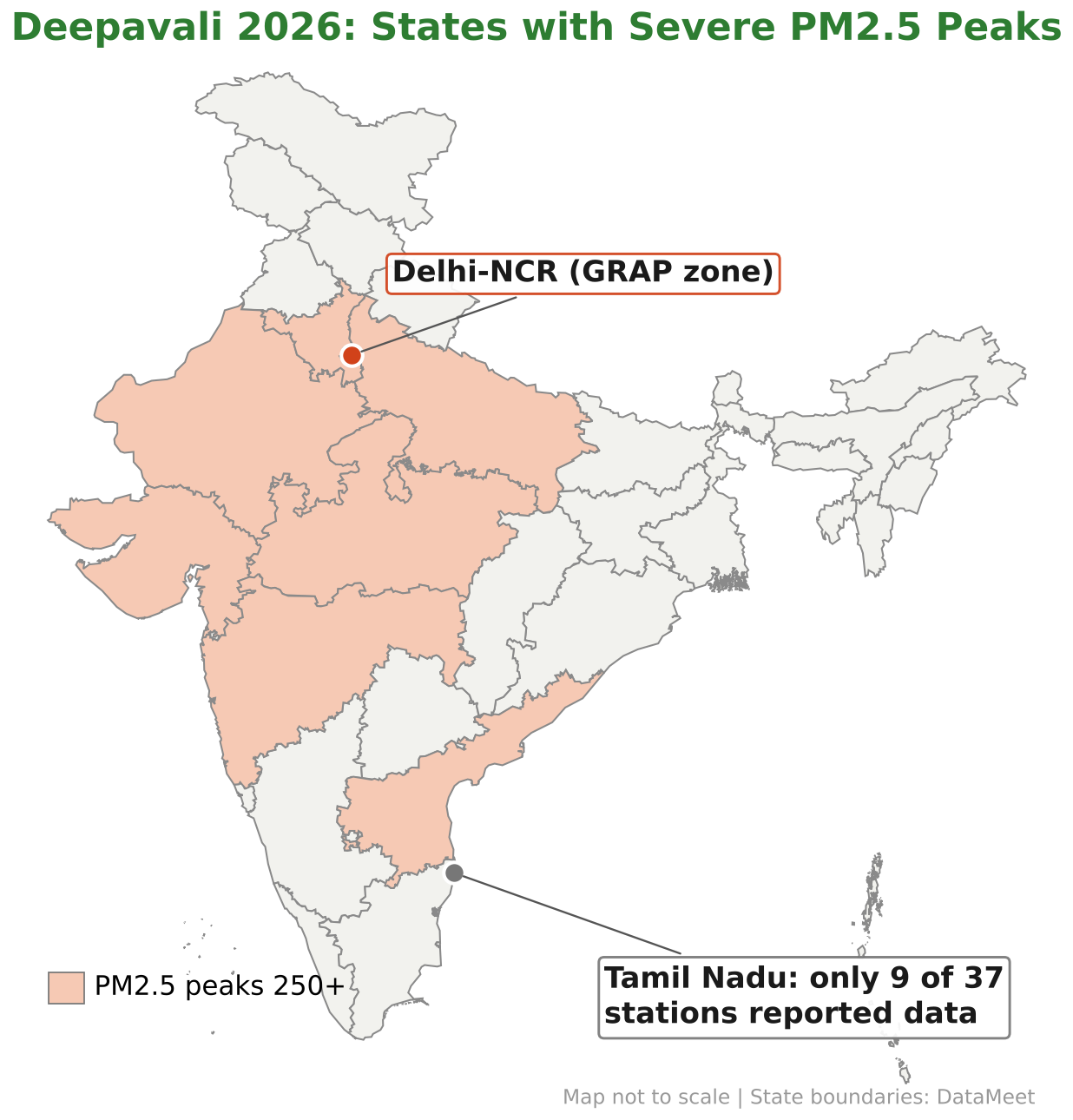
An analysis of pollution-board data shows that about 70% of air-quality stations across India recorded very high peaks of fine dust (PM2.5) during Deepavali, and many stations stopped reporting when pollution was worst. Of 551 reporting stations of the Central Pollution Control Board (CPCB), 375 recorded hourly PM2.5 peaks of 250 microgram per cubic metre (ug/m3) or more during Deepavali, against 96 before the festival. Affected states included Delhi, Maharashtra, Uttar Pradesh, Rajasthan, Haryana, Madhya Pradesh, Gujarat and Andhra Pradesh. Only 571 of CPCB's 634 stations were working, and in Tamil Nadu only 9 of 37 stations reported. CPCB said some analysers max out at 1,000 ug/m3, but some stations stopped even below that.
WHO 24-hour guideline for PM2.5: 15 ug/m3; India's standard: 60 ug/m3.
250 ug/m3 here is an hourly peak, not the official daily AQI category.
Causes: firecrackers, still winds, temperature inversion, vehicles, industry, biomass burning.
Way forward
Upgrade sensors, explain data gaps publicly, enforce green-cracker standards and coordinate action across state borders.
Concept
PM2.5: particles 2.5 micrometres or smaller - small enough to enter deep into lungs and blood, raising heart and lung disease risk. Temperature inversion: in winter a warm air layer sits over cold ground air like a lid, trapping smoke near the surface. Laws/programmes: Air (Prevention and Control of Pollution) Act 1981; National Clean Air Programme (NCAP, 2019); Graded Response Action Plan (GRAP) for Delhi-NCR; CAAQMS = continuous monitoring stations. Exam angle: Prelims: meaning of PM2.5, WHO vs Indian standard, NCAP launch year, what GRAP is. Mains: 'you cannot fix what you cannot measure' - reliability of monitoring networks.
India map of states with severe PM2.5 peaks during Deepavali 2026 and low reporting in Tamil Nadu — StudyForGS
20. Eco-Sensitive Zone for Assam Gibbon Sanctuary
ENVIRONMENTUPSC: Prelims + Mains GS3
Syllabus linkage
GS3 - Conservation, protected areas. Prelims: location, species (hoolock gibbon), ESZ rules. Mains: development vs conservation around protected areas.
Context
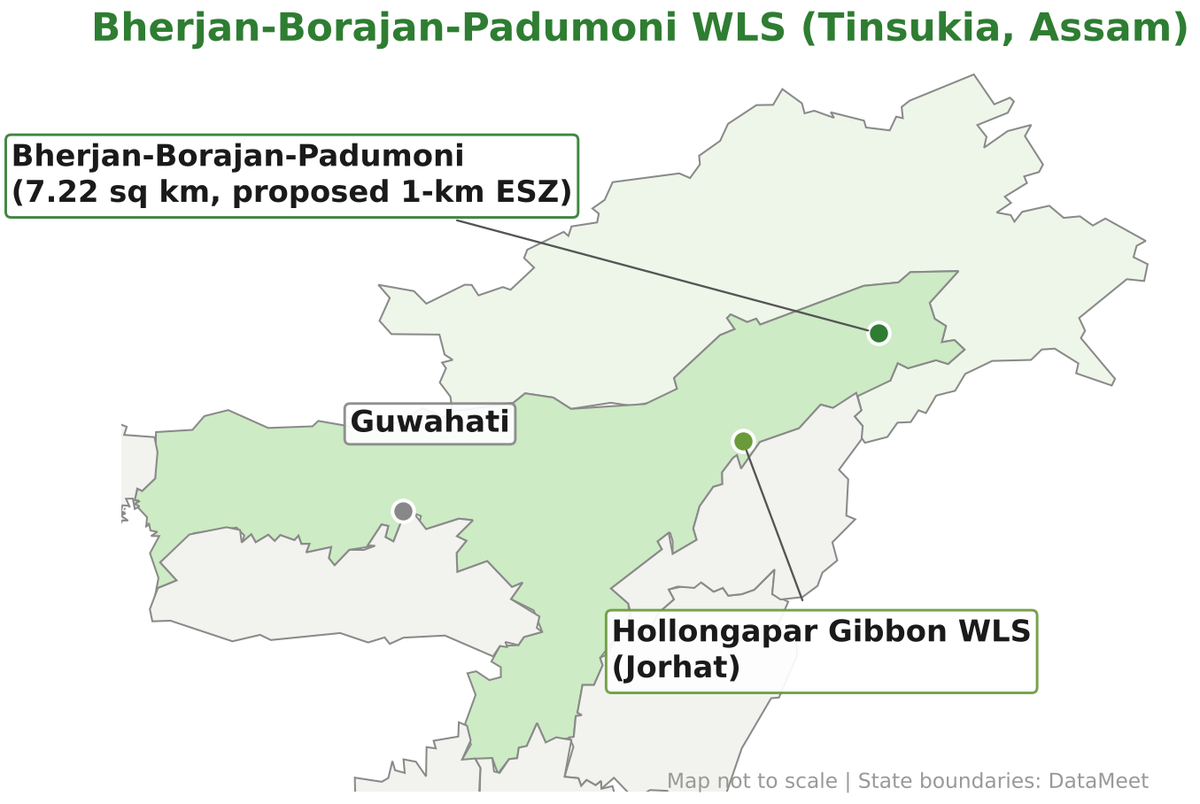
The Centre has proposed a 1-km buffer area called an Eco-Sensitive Zone around the small Bherjan-Borajan-Padumoni Wildlife Sanctuary in Assam, which has India's highest concentration of primates. The Bherjan-Borajan-Padumoni Wildlife Sanctuary lies in Tinsukia district of eastern Assam. It covers just 7.22 sq km, was set up in 1999 and has three separate forest blocks divided by tea gardens and villages. It is mostly tropical wet evergreen forest on the Brahmaputra valley plains. The Centre has proposed a uniform 1-km Eco-Sensitive Zone (ESZ) around it.
Key facts
District: Tinsukia, Assam; area 7.22 sq km; set up 1999.
Highest concentration of primates in the Indian subcontinent.
Home to hoolock gibbon - India's only ape.
Other animals: langurs, macaques, leopards, giant flying squirrels; 84+ bird species incl. Osprey and Indian Pied Hornbill.
Three blocks: Bherjan, Borajan and Padumoni.
Way forward
Create forest corridors (canopy bridges) between the three blocks and involve tea estates and villages in protection.
Concept
Eco-Sensitive Zone (ESZ): a buffer around a protected area where harmful activities (mining, polluting industries) are banned or regulated; notified under the Environment (Protection) Act, 1986. Supreme Court (2022) asked for a minimum 1-km ESZ around protected areas; it relaxed this in 2023 for some cases. Western hoolock gibbon: listed as Endangered (IUCN) and in Schedule I of the Wild Life (Protection) Act, 1972; Hollongapar Gibbon Sanctuary (Jorhat) is another gibbon habitat. Exam angle: Prelims: India's only ape, sanctuary's district, law under which ESZs are notified. Mains: protecting fragmented habitats surrounded by tea gardens and villages.
Map of Assam and the Northeast marking Bherjan-Borajan-Padumoni sanctuary in Tinsukia, Hollongapar Gibbon sanctuary in Jorhat and Guwahati — StudyForGS
21. SC Panel Presses on Chambal Sand Mining
ENVIRONMENTUPSC: Prelims + Mains GS3
Syllabus linkage
GS3 - Environment: river ecosystems, mining, biodiversity. Prelims: National Chambal Sanctuary, gharial, CEC. Mains: sustainable sand mining.
Context
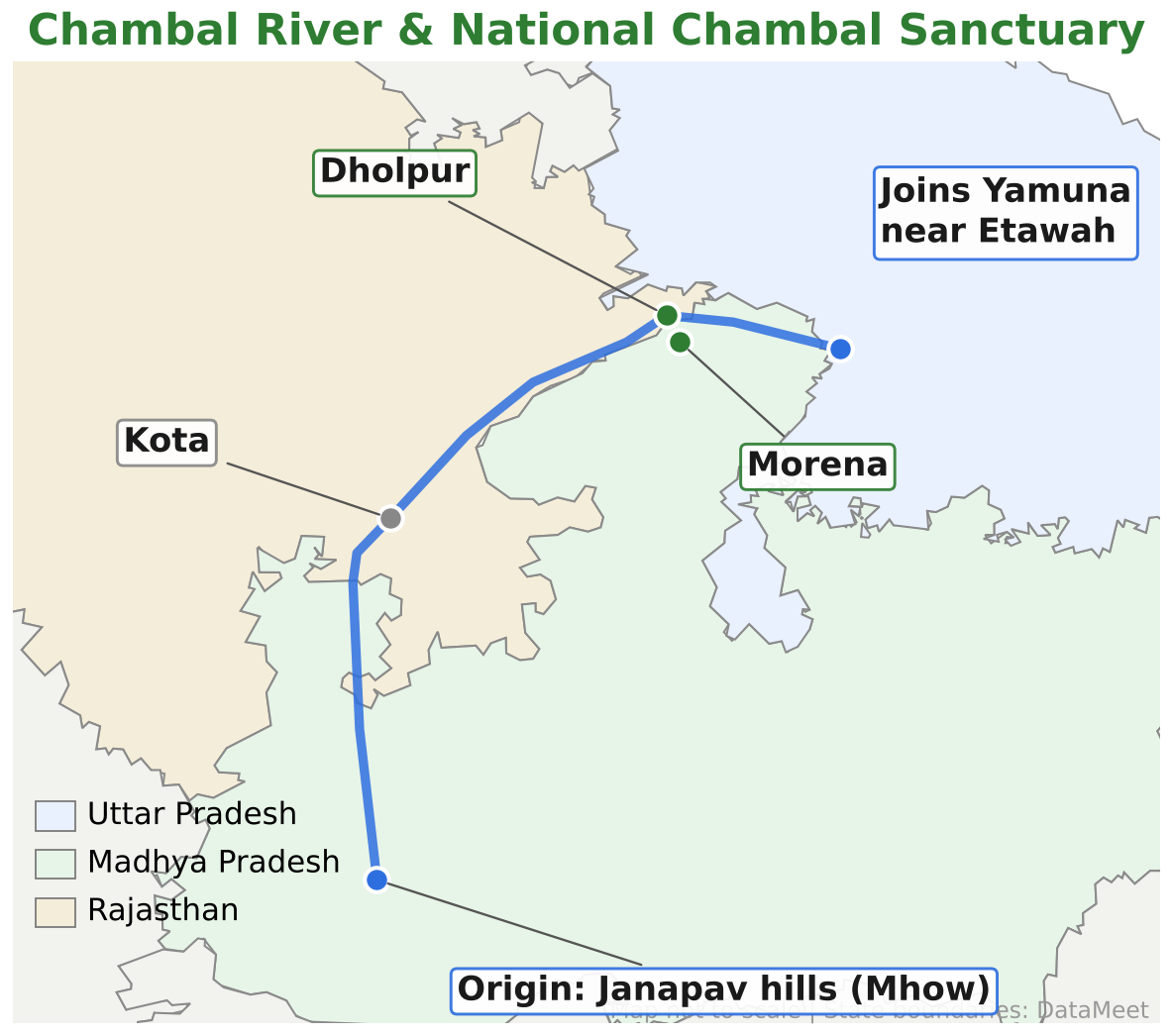
The Supreme Court's green watchdog, the Central Empowered Committee (CEC), has asked for proof of actual action against illegal sand mining in the Chambal river, home of the endangered gharial. The CEC has sought evidence of enforcement actions against illegal sand mining in the Chambal river. The case began as a suo motu (on its own) Supreme Court matter on illegal mining in the National Chambal Sanctuary and was later widened to river sand mining across India. In its Report No. 36 of 2026 (submitted 2 November), the CEC proposed phasing out unsustainable extraction from active river channels over three years, and using reservoir silt, manufactured sand (M-sand) and recycled construction waste instead.
Key facts
CEC Report No. 36 of 2026: 3-year roadmap away from river-bed mining.
Desilting of dams older than 15 years; about one-tenth of suitable reservoirs each year.
439 reservoirs assessed have lost on average 19.24% storage to silt.
Digital tracking: e-permits with QR codes/RFID.
Sand is a 'minor mineral' - regulated by States.
Way forward
Combine strict digital tracking with cheaper alternatives like M-sand and dam silt, so that legal supply meets demand.
Concept
National Chambal Sanctuary (1979): a tri-state sanctuary along the Chambal in Rajasthan, Madhya Pradesh and Uttar Pradesh; key habitat of the gharial (Critically Endangered), Ganges river dolphin and freshwater turtles. Central Empowered Committee: set up by the Supreme Court in 2002 to monitor forest and wildlife orders; made a permanent body under the Environment (Protection) Act in 2023. Minor minerals: defined under the MMDR Act, 1957; States make rules. Central guidelines - Sustainable Sand Mining Management Guidelines 2016 and Enforcement & Monitoring Guidelines 2020. Exam angle: Prelims: states covered by the Chambal sanctuary, gharial status, who regulates minor minerals. Mains: impacts of illegal sand mining (river-bed lowering, habitat loss, 'sand mafia') and alternatives.
Map of the Chambal river from Janapav hills near Mhow via Kota, Dholpur and Morena to its confluence with the Yamuna near Etawah, across Rajasthan, Madhya Pradesh and Uttar Pradesh — StudyForGS
22. Yuge Yugeen Bharat Museum Approved
ART & CULTUREUPSC: Prelims + Mains GS1
Syllabus linkage
GS1 - Art & Culture: museums, heritage conservation. Prelims: location, galleries, ASI. Mains: culture as soft power and economy.
Context
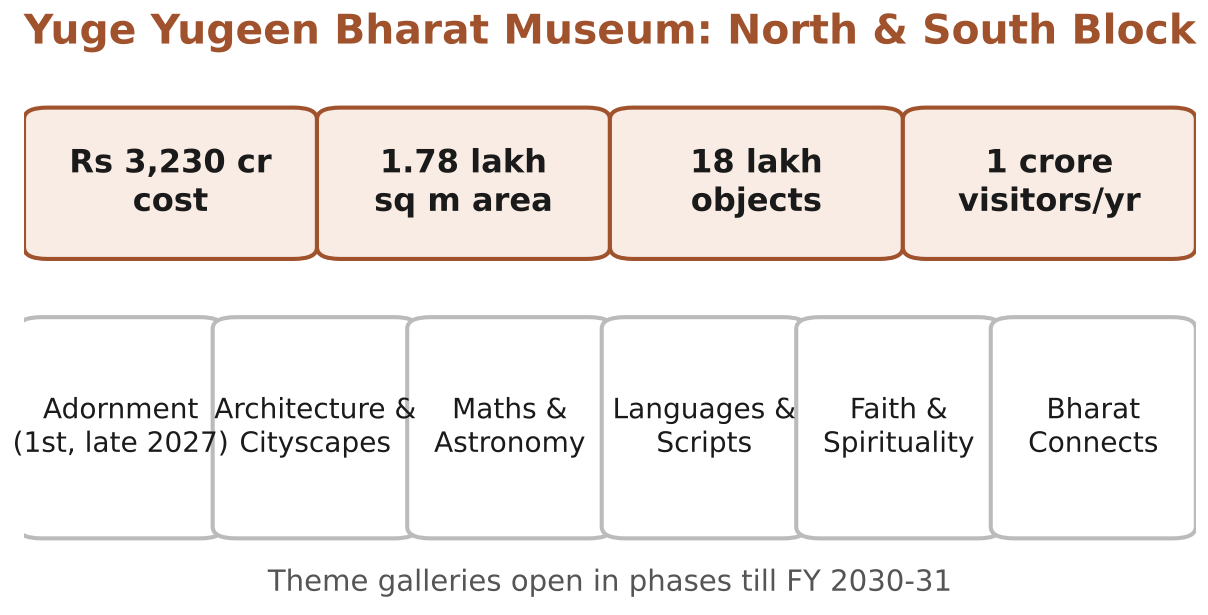
The Cabinet has approved Rs 3,230 crore to turn the historic North and South Block buildings in New Delhi into a huge national museum showing India's civilisation through the ages. The Cabinet Committee on Economic Affairs approved the Yuge Yugeen Bharat Museum on 11 November 2026 at an estimated cost of Rs 3,230 crore. It will reuse the North and South Block complex (vacated by government offices) with a built-up area of about 1,78,509 sq m, keeping their heritage character. The first gallery, on 'Adornment', is to open in North Block in late 2027, with more galleries added in phases till FY 2030-31. About 18 lakh objects have been identified from the National Museum, Culture Ministry museums, 52 ASI site museums, state museums and private collections.
Key facts
Cost: Rs 3,230 crore; approved by CCEA on 11 Nov 2026.
Planned as the largest museum display area in the world.
Announced by the PM on 18 May 2023 (International Museum Expo).
Way forward
Ensure strong conservation standards, digital access and ethical sourcing of objects.
Concept
'Yuge Yugeen' means 'through the ages' - the museum will show India's history and knowledge systems from ancient times. Adaptive reuse: giving a new use to an old heritage building while keeping its look - cheaper and greener than demolition. North and South Blocks were designed by Herbert Baker as part of Lutyens' New Delhi (completed early 1930s); they housed key ministries like PMO, Home and Finance. Exam angle: Prelims: location, architect of North/South Block, first gallery theme. Mains: museums as tools of cultural diplomacy, tourism and research.
Key numbers of the Yuge Yugeen Bharat Museum - cost, area, objects, visitors - and its six theme galleries — StudyForGS
23. Janjatiya Gaurav Pakhwada Ends 15 Nov
ART & CULTUREUPSC: Prelims + Mains GS1
Syllabus linkage
GS1 - Modern Indian history: tribal movements; GS2 - welfare of STs. Prelims: Birsa Munda, Ulgulan, Janjatiya Gaurav Divas. Mains: tribal contribution to the freedom struggle.
Context
A fortnight of events honouring tribal communities is under way and will end on 15 November, the birth anniversary of tribal hero Birsa Munda, observed as Janjatiya Gaurav Divas. The Ministry of Tribal Affairs is observing Janjatiya Gaurav Pakhwada from 1 to 15 November 2026 with over 300 projects (228 inaugurations, 74 foundation stones). About 200 Eklavya Model Residential School (EMRS) students interact with the President on 12 November, a National Tribal Literary Festival is being held in New Delhi on 12-13 November, and a Rani Durgavati Adivasi Mahila Sammelan of 500 tribal women entrepreneurs is on 14 November. Programmes are being held across the country to mark Birsa Munda's birth anniversary.
Key facts
Janjatiya Gaurav Divas: 15 November (declared in 2021).
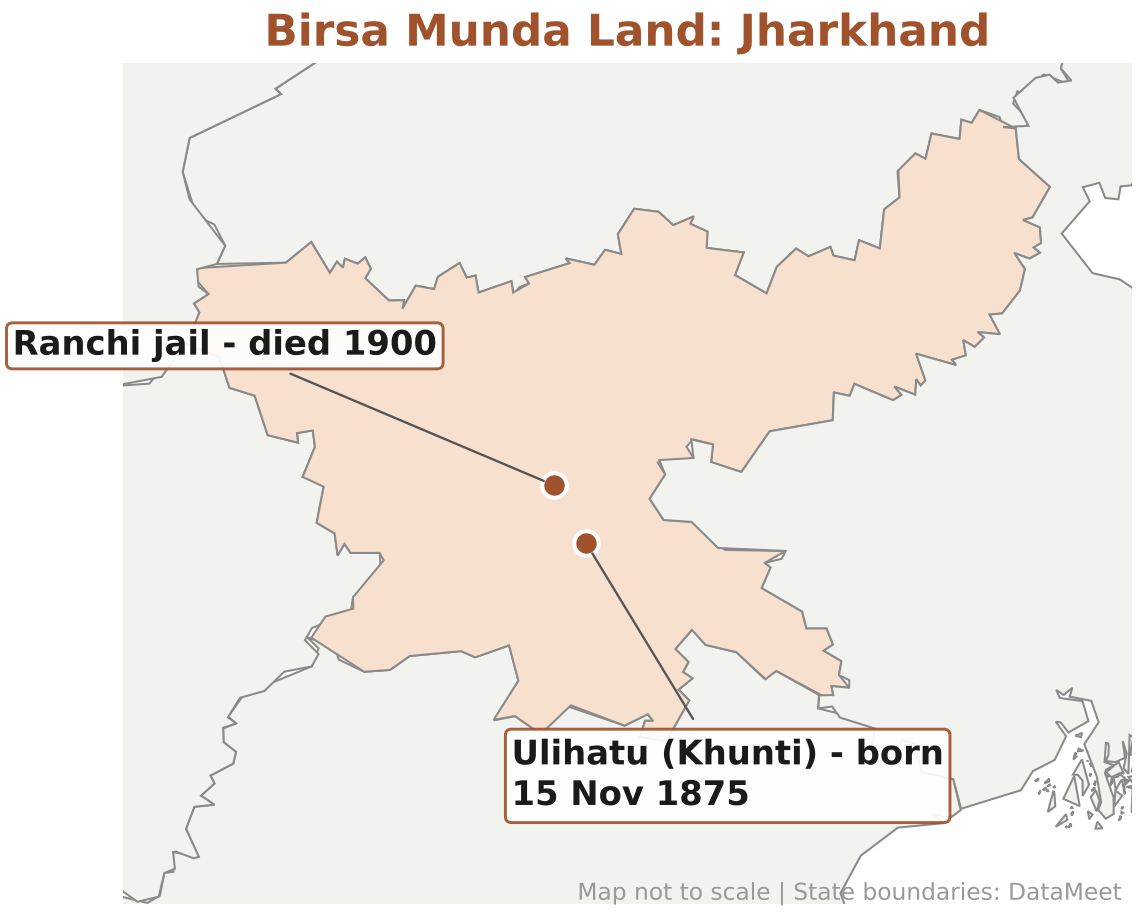
Birsa Munda born 15 November 1875 at Ulihatu (now Khunti district, Jharkhand).
Led the Ulgulan ('great tumult') of 1899-1900; called 'Dharti Aaba' (Father of the Earth).
Died in Ranchi jail on 9 June 1900.
New platforms: Jan-HIT portal (tribal health data) and National FRA Digital Platform.
Way forward
Celebrations should go with on-ground delivery - land rights under FRA, quality EMRS schools and tribal health services.
Concept
Ulgulan: Munda revolt against British rule, landlords (dikus) and moneylenders who destroyed the 'khuntkatti' (joint land ownership) system; it led to the Chotanagpur Tenancy Act, 1908. Jharkhand state was formed on 15 November 2000 - Birsa Munda's birth anniversary. Constitutional protection: Article 342 (notifying STs), Fifth Schedule (Scheduled Areas), Forest Rights Act 2006. Exam angle: Prelims: Birsa Munda's birthplace, movement name, law that followed (CNT Act 1908), Janjatiya Gaurav Divas year. Mains: role of tribal revolts (Santhal, Munda, Bhil) in the freedom struggle.
Map of Jharkhand marking Birsa Munda's birthplace Ulihatu (Khunti) and Ranchi jail — StudyForGS
📜 Asked before in the exam — previous-year question on this topic
UPSC Prelims 2020With reference to the history of India, "Ulgulan" or the Great Tumult is the description of which of the following events?
The Revolt of 1857
The Mappila Rebellion of 1921
The Indigo Revolt of 1859 – 60
Birsa Munda's Revolt of 1899 – 1900
Show answer
Answer: (d) Birsa Munda's Revolt of 1899 – 1900 Ulgulan, meaning the 'Great Tumult', is the name for the Munda uprising led by Birsa Munda in 1899-1900 in the Chotanagpur region of present-day Jharkhand. The Mundas rose against outsiders (dikus), moneylenders, zamindars, missionaries and British rule, which had destroyed their khuntkatti land system. Birsa died in Ranchi jail in 1900. The revolt led to the Chotanagpur Tenancy Act of 1908. Practise all UPSC Prelims 2020 paper (free) →
Linked because this news is about the same topic. The answer is as per the official key of that year.
24. Siddi Teen Wins Youth Olympics Silver
ART & CULTUREUPSC: Prelims + Mains GS1
Syllabus linkage
GS1 - Indian society: diversity, communities; GS2 - STs and PVTGs. Prelims: Siddi distribution, Jambur. Mains: inclusion of marginalised groups through sport.
Context
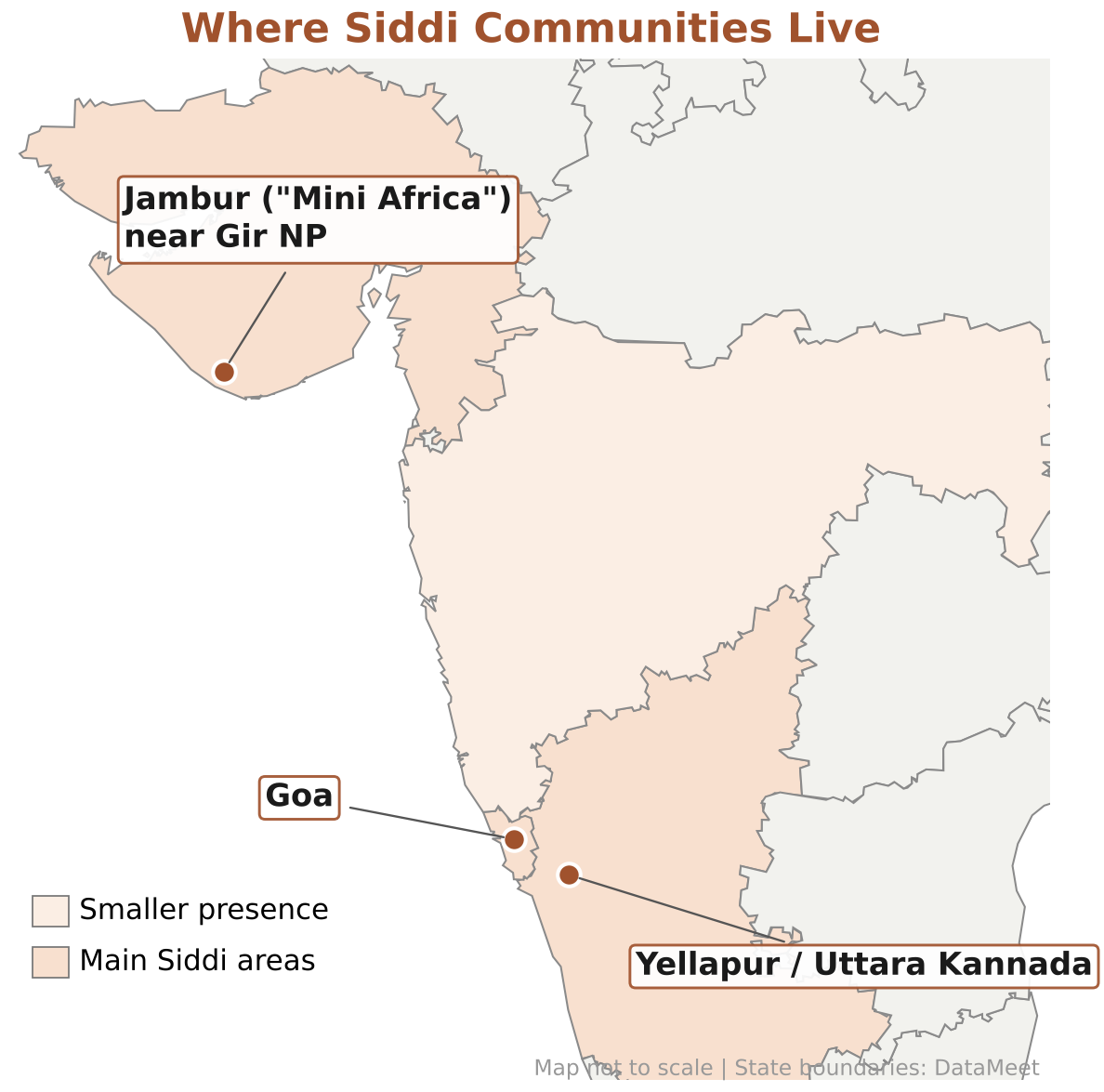
Khushbu Rajakbhai Darjada, a 15-year-old judoka from Gujarat's Siddi community (people of African origin), won silver at the Youth Olympic Games in Dakar, drawing attention to this little-known community. Khushbu won a judo silver at the Dakar 2026 Youth Olympic Games in Senegal. Siddis trace their ancestry to East Africa; their ancestors came to India over centuries as traders, sailors, soldiers and enslaved people, and some served the Nawabs of Junagadh. Siddis live mainly in Gujarat, Karnataka, Maharashtra and Goa; Jambur village near Gir National Park is called 'Mini Africa'. They follow Islam, Hinduism or Christianity depending on the region.
Dakar 2026 is the first Olympic event ever held in Africa.
Siddi culture: Dhamal dance; reverence for Sufi saint Baba Gor.
Siddis in certain areas are Scheduled Tribes; Gujarat's Siddis are a PVTG.
Famous Siddis in history: Malik Ambar (Ahmadnagar) and the Siddis of Janjira fort.
Way forward
Expand scholarships, sports academies and skill programmes in Siddi areas so talent like Khushbu is not an exception.
Concept
Particularly Vulnerable Tribal Groups (PVTGs): 75 most backward tribal groups (pre-agricultural, low literacy, declining/stagnant population); PM-JANMAN (2023) targets them. Article 342: the President notifies Scheduled Tribes for each State; Parliament can add or remove groups by law. Indian Ocean links: Africa-India contact through the monsoon trade winds explains Siddi presence on India's west coast. Exam angle: Prelims: states with Siddi population, 'Mini Africa' village, PVTG criteria. Mains: how sport and targeted welfare can lift marginalised communities.
Map of western India showing Siddi areas in Gujarat, Karnataka, Goa and Maharashtra, with Jambur near Gir and Yellapur — StudyForGS
📜 Asked before in the exam — previous-year question on this topic
UPSC Prelims 2019Consider the following statements about Particularly Vulnerable Tribal Groups (PVTGs) in India: 1. PVTGs reside in 18 States and one Union Territory. 2. A stagnant or declining population is one of the criteria for determining PVTG status. 3. There are 95 PVTGs officially notified in the country so far. 4. Irular and Konda Reddi tribes are included in the list of PVTGs. Which of the statements given above are correct?
1, 2 and 3
2, 3 and 4
1, 2 and 4
1, 3 and 4
Show answer
Answer: (c) 1, 2 and 4 Statements 1, 2 and 4 are correct. Particularly Vulnerable Tribal Groups live in 18 States and one Union Territory, the Andaman and Nicobar Islands. The criteria include pre-agricultural technology, a stagnant or declining population, extremely low literacy and a subsistence economy. There are 75 PVTGs, not 95, so statement 3 is wrong. The Irular of Tamil Nadu and the Konda Reddi of Andhra Pradesh and Telangana are among the notified PVTGs. Practise all UPSC Prelims 2019 paper (free) →
Linked because this news is about the same topic. The answer is as per the official key of that year.
25. Gravitational-Wave Science Goes Statistical
SCI-TECHUPSC: Prelims + Mains GS3
Syllabus linkage
GS3 - Science & Technology: space and physics, Indian mega-science projects. Prelims: LIGO, LIGO-India location, first detection. Mains: India in big-science collaborations.
Context
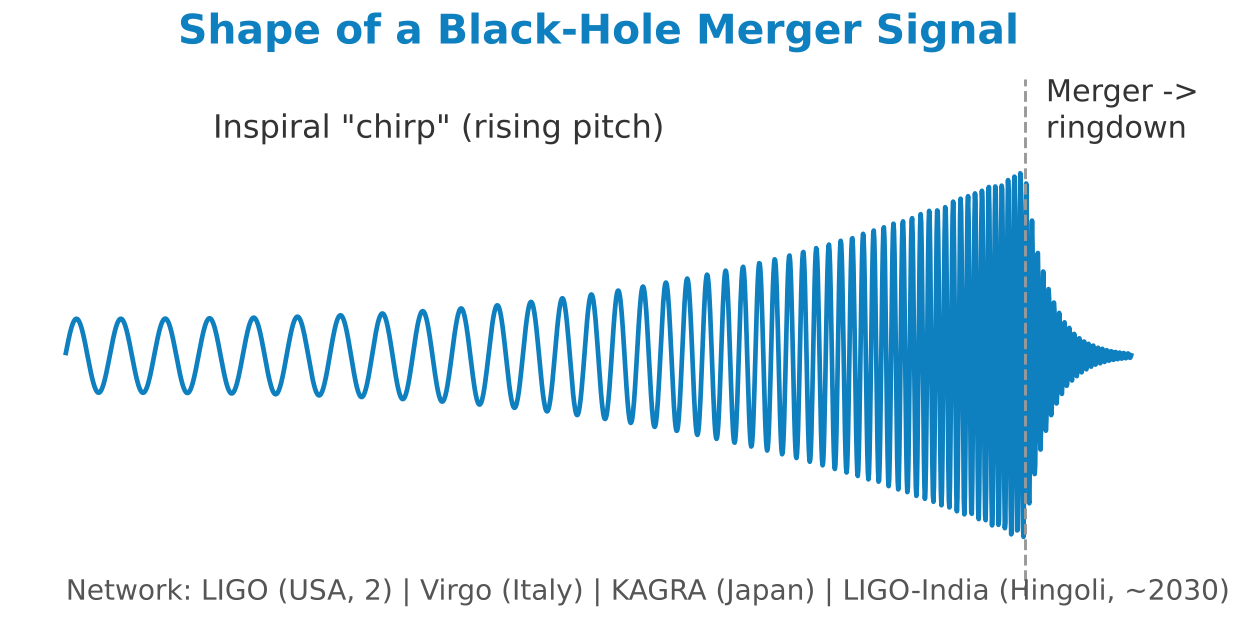
Scientists now have a list of about 390 possible gravitational-wave events - ripples in space-time from crashing black holes and neutron stars. With so many, they can study patterns, not just single events. The LIGO-Virgo-KAGRA collaboration has released an expanded catalogue of 390 candidate gravitational-wave events. Gravitational waves were predicted by Einstein's General Theory of Relativity (1915) and travel at the speed of light. With hundreds of signals, scientists can now study the masses and spins of black holes as a group, test relativity, and estimate how fast the universe is expanding. LIGO-India in Hingoli district, Maharashtra is expected to start around 2030 and will help pinpoint where signals come from.
Key facts
Catalogue: 390 candidate events.
First detection: 2015 by LIGO (two merging black holes); Nobel Prize in Physics 2017.
Detectors: LIGO (two in USA), Virgo (Italy), KAGRA (Japan).
Signal shape: 'chirp' (rising pitch as objects spiral in) then 'ringdown'.
LIGO-India: Hingoli, Maharashtra; approved in 2023; expected around 2030.
Way forward
Keep LIGO-India on schedule and train Indian scientists and industry in precision optics and vacuum technology.
Concept
Gravitational waves: tiny stretching and squeezing of space-time caused by massive objects accelerating, like ripples from a stone in a pond. Laser interferometer: an L-shaped instrument with km-long arms; a passing wave changes arm lengths by less than a proton's width, which lasers detect. Triangulation: more detectors spread across the globe help locate the source in the sky - the key value of an Indian detector. Exam angle: Prelims: who predicted gravitational waves, first detection year, LIGO-India district, partner detectors. Mains: benefits of mega-science projects for Indian industry and research.
Waveform of a black-hole merger signal showing chirp, merger and ringdown, with the detector network — StudyForGS
26. Rs 498-Crore Refit Deal for INS Betwa
DEFENCEUPSC: Prelims + Mains GS3
Syllabus linkage
GS3 - Defence: indigenisation, shipbuilding and repair. Prelims: ship class, shipyard. Mains: life-extension of platforms vs new builds.
Context
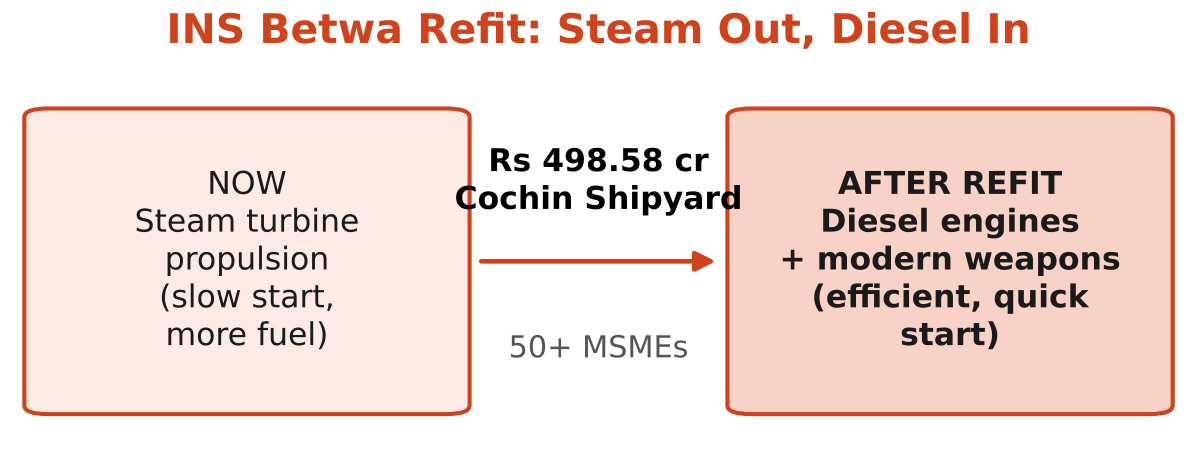
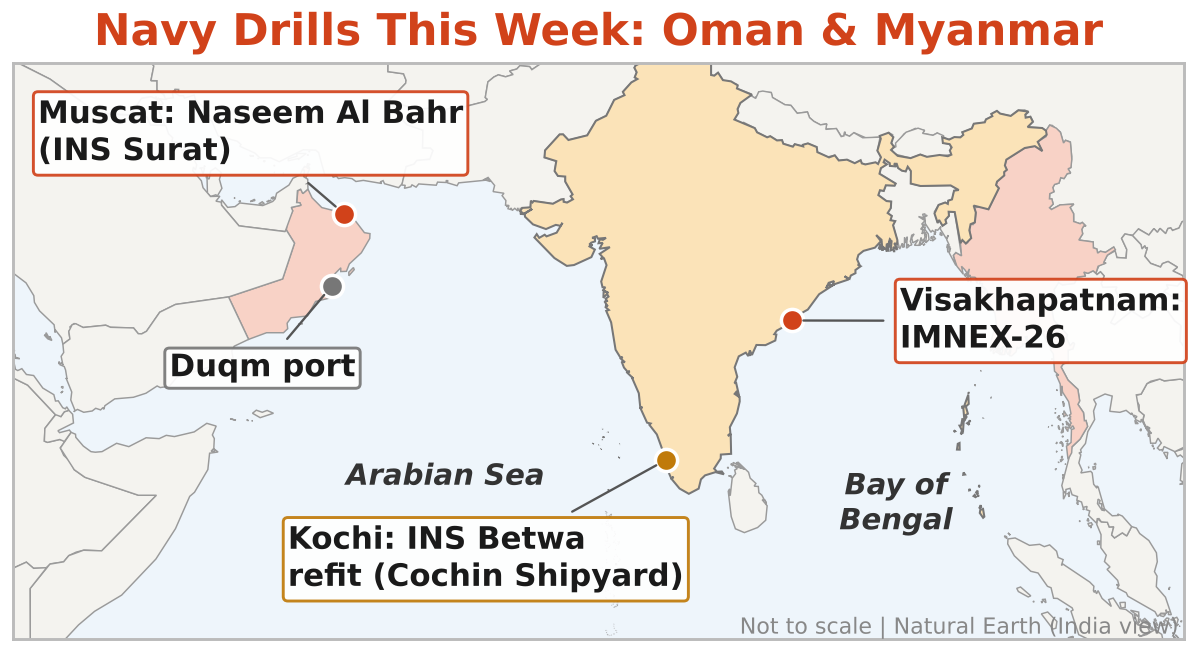
The Defence Ministry has signed a Rs 498.58 crore deal with Cochin Shipyard to refit the frigate INS Betwa, replacing its old steam engines with diesel engines and modernising its weapons. The Ministry of Defence signed the contract for the 'Normal Refit and Re-powering of INS Betwa' with Cochin Shipyard Limited in New Delhi, in the presence of Defence Secretary Rajesh Kumar Singh. The steam-based propulsion will be replaced with a diesel-engine system, which gives higher thermal efficiency, lower fuel use and quicker start-up. The weapon suite will also be modernised. More than 50 MSMEs are expected to take part.
Key facts
Contract value: Rs 498.58 crore.
Shipyard: Cochin Shipyard Limited (Kochi).
INS Betwa: Brahmaputra-class guided-missile frigate, commissioned 2004.
Upgrade: steam -> diesel propulsion + modern weapons.
50+ MSMEs to be involved; boosts domestic ship-repair capability.
Way forward
Finish refits on time to keep fleet availability high while new frigates are being built.
Concept
Refit / mid-life upgrade: major overhaul that extends a warship's life and improves its systems - cheaper and faster than building a new ship. Brahmaputra class (Project 16A): Indian-designed frigates built by GRSE, Kolkata; sister ships INS Brahmaputra and INS Beas (Beas is also being re-powered by Cochin Shipyard). Steam vs diesel propulsion: steam plants need long warm-up and more fuel; diesel engines are simpler to maintain and start quickly. Exam angle: Prelims: class and builder of INS Betwa, shipyard for refit. Mains: role of refits, MSMEs and Atmanirbhar Bharat in maintaining naval strength.
INS Betwa refit diagram: steam turbine propulsion replaced by diesel engines and modern weapons, Rs 498.58 crore, Cochin Shipyard — StudyForGS
27. IMNEX-26 Begins at Visakhapatnam
DEFENCEUPSC: Prelims + Mains GS3
Syllabus linkage
GS2/GS3 - India-Myanmar relations, Act East, maritime security in the Bay of Bengal. Prelims: exercise names and partners.
Context
The 8th India-Myanmar Naval Exercise (IMNEX-26) is being held at Visakhapatnam from 10 to 14 November to help the two navies work together better. IMNEX-26 began with an opening ceremony on board INS Rana on 10 November 2026. India is represented by INS Rana and INS Sumedha, and Myanmar by the ship UMS King Sin Phyu Shin. The harbour phase includes professional talks, subject-matter expert exchanges, cross-deck visits and sports. The sea phase covers coordinated operations and tactical manoeuvres to improve interoperability.
Key facts
8th edition; 10-14 November 2026; Visakhapatnam.
Indian ships: INS Rana (destroyer) and INS Sumedha (offshore patrol vessel).
Myanmar ship: UMS King Sin Phyu Shin.
Two phases: harbour and sea.
Visakhapatnam is home of the Eastern Naval Command.
Way forward
Regular naval engagement should go with progress on connectivity projects and border stability.
Concept
India-Myanmar: about 1,643 km land border with Arunachal Pradesh, Nagaland, Manipur and Mizoram; Myanmar is India's land gateway to South-East Asia (Act East). Kaladan Multi-Modal Transit Transport Project: links Kolkata to Sittwe port (Myanmar) by sea and then to Mizoram by river and road. Interoperability: the ability of forces from different countries to operate together using common procedures and communication. Exam angle: Prelims: exercise names with partner countries (IMNEX - Myanmar, SLINEX - Sri Lanka, Naseem Al Bahr - Oman). Mains: importance of Myanmar for Act East and countering China in the Bay of Bengal.
Map of the Arabian Sea and Bay of Bengal marking Naseem Al Bahr at Muscat, IMNEX-26 at Visakhapatnam and INS Betwa refit at Kochi — StudyForGS
📜 Asked before in the exam — previous-year question on this topic
BPSC Prelims 2023 (68th CCE)Which States of India have common border with Myanmar?
Linked because this news is about the same topic. The answer is as per the official key of that year.
28. Naseem Al Bahr with Oman's Navy
DEFENCEUPSC: Prelims + Mains GS3
Syllabus linkage
GS2 - India-Gulf relations; GS3 - maritime security in the Arabian Sea. Prelims: exercise names, Duqm port. Mains: Oman's strategic value.
Context
The Indian Navy and the Royal Navy of Oman are holding the 15th edition of their exercise 'Naseem Al Bahr' (Sea Breeze), with India's new destroyer INS Surat taking part near Muscat. INS Surat reached Muscat, Oman on 8 November 2026 for the 15th edition of Naseem Al Bahr. The exercise has a harbour phase (cross-deck visits, operational talks, sports) and a sea phase, followed by a Coordinated Patrol (CORPAT). Earlier, the 13th India-Oman Joint Military Cooperation Committee met on 24 November 2025.
Key facts
15th edition; Indian Navy + Royal Navy of Oman.
Indian ship: INS Surat (Visakhapatnam-class guided-missile destroyer, Project 15B).
Phases: harbour, sea, then CORPAT.
'Naseem Al Bahr' means 'Sea Breeze'.
Other India-Oman exercises: Al Najah (Army), Eastern Bridge (Air Force).
Way forward
Use the partnership for joint anti-piracy work and secure shipping lanes in the Arabian Sea.
Concept
Oman: India's closest defence partner in the Gulf; it gave Indian Navy access to Duqm port (2018) for logistics and maintenance. Strait of Hormuz: Oman's Musandam peninsula lies on this chokepoint (narrow sea route many oil tankers must use) - vital for India's energy imports. CORPAT (coordinated patrol): navies patrol their sides of a maritime boundary together to stop piracy, smuggling and illegal fishing. Exam angle: Prelims: match exercises with countries, location of Duqm, meaning of CORPAT. Mains: Oman's place in India's West Asia and Indian Ocean strategy.
Data point of the day
Rs 62,370 crore
Rabi 2026-27 P&K fertiliser subsidy About 64% higher than Rabi 2025-26 (Rs 37,952 crore) because of costlier global fertiliser and raw-material prices.
Prelims rapid-fire
Dakar 2026 YOG: Swimmer Dhinidhi Desinghu won bronze - India's first-ever swimming medal at the Youth Olympic Games; Taniya won silver in women's 75 kg beach wrestling.
Greenjoules (Pune): Agri-waste-to-fuels company got Rs 250 crore - Rs 150 crore equity plus a Rs 100 crore loan from the Technology Development Board (TDB, under DST) - for a plant near Pune.
Legacy landfills: The deadline to clean up (remediate) all legacy dumpsites in cities under Swachh Bharat Mission-Urban 2.0 has been pushed to December 2027.
Tribal Literary Festival: National Tribal Literary Festival in New Delhi on 12-13 November 2026, part of Janjatiya Gaurav Pakhwada.
One Nation One Ration Card: Portability under the National Food Security Act, 2013 lets beneficiaries take subsidised grain from any fair price shop in the country; now in all States/UTs.
World Pneumonia Day: 12 November - awareness on pneumonia, a leading infectious killer of young children.
Public Service Broadcasting Day: 12 November - marks Mahatma Gandhi's only visit to All India Radio's Delhi studio (1947), when he addressed refugees.
14 November: Children's Day (Jawaharlal Nehru's birth anniversary) and World Diabetes Day (birthday of insulin co-discoverer Frederick Banting).
Helplines: National De-addiction Helpline 14446; MANAS 1933 (NCB) to report drug trafficking; Tele-MANAS 14416 for mental health.
Mains practice question
Q. The creamy-layer principle is meant to ensure that reservation benefits reach the truly backward. In the light of the Supreme Court's 2026 rulings on the OBC creamy layer, examine whether India's current method of identifying the creamy layer is fair and workable. (250 words)
Hint / approach
Explain the creamy-layer idea (Indra Sawhney 1992) and the 1993 OM's status and income tests; summarise the March and November 2026 rulings (no mechanical counting of parental salary, no reopening of old selections); discuss issues - equivalence of PSU and private posts, outdated Rs 8 lakh limit, delays; suggest a transparent equivalence framework and periodic revision.
📌 One-line revision: Remember: creamy layer Rs 8 lakh (salary and farm income not added), black-mass export 'Prohibited' (DGFT), NBS rabi Rs 62,370 crore, COP31 Antalya, COP32 Addis Ababa, IMNEX - Myanmar, Naseem Al Bahr - Oman.