Friday, 13 November 2026 · IST · National & International · 30 items
Retail inflation hit 6.09% in October, breaching the RBI's upper limit, while the WHO TB report shows India's TB deaths fell faster than the world average even as India still has 25% of global cases. At COP31 in Antalya, climate finance is disputed and India slipped to 28th in CCPI 2027. Also: visa reform, the PM's ASEAN visit to Manila, the Dhoot bankruptcy case and Maharashtra's first Blue Flag beaches.
Today at a glance — things to remember
October CPI inflation 6.09% - above the RBI's 6% upper limit; food inflation 8.94%.
WHO TB report: India's TB deaths fell 38% in 2015-2025; but India has 25% of world cases.
COP31 (Antalya, 9-20 Nov): 67% of climate finance is loans; India wants US$1 trillion a year.
CCPI 2027: India at 28th; Denmark tops at 4th, ranks 1-3 left empty.
MHA cuts main visa categories from 13 to 9; Tourist Visa is now Visitor Visa.
PM in Manila on 16-18 Nov for 23rd ASEAN-India Summit and 21st EAS.
NCLT declares Videocon's Venugopal Dhoot bankrupt as personal guarantor.
NITI Aayog: only 18.51% of PLI outlay paid till March 2026.
Swachh Survekshan 2025-26: Navi Mumbai tops the Super Swachh League.
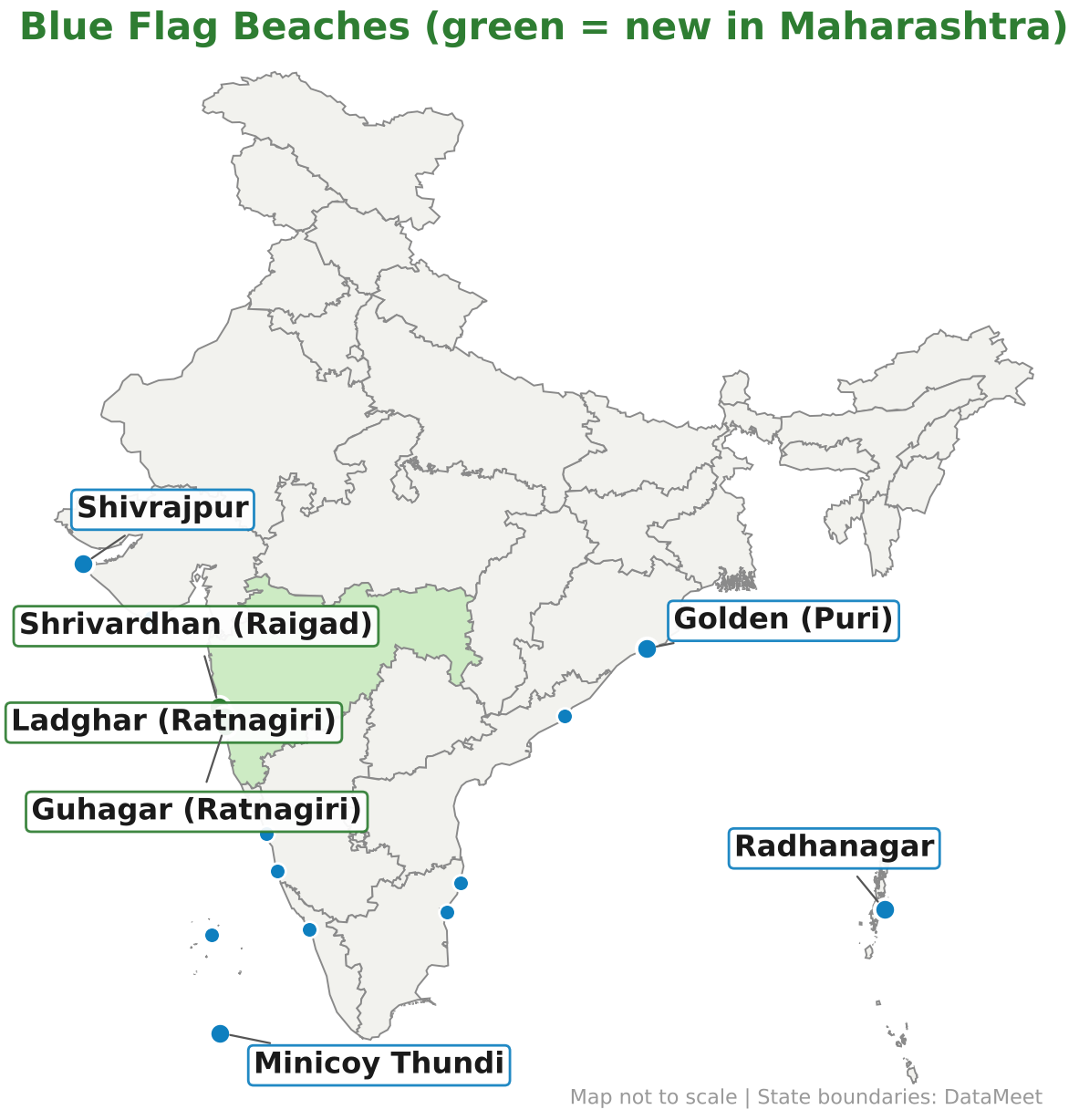
Maharashtra's first Blue Flag beaches: Ladghar, Guhagar and Shrivardhan.
Detailed notes
1. Visa Categories Cut from 13 to 9
POLITYUPSC: Prelims + Mains GS2
Syllabus linkage
GS2 - Government policies and interventions; Indian diaspora and soft power. Prelims: visa types, e-Visa; Mains: ease of travel, tourism and security balance.
Context
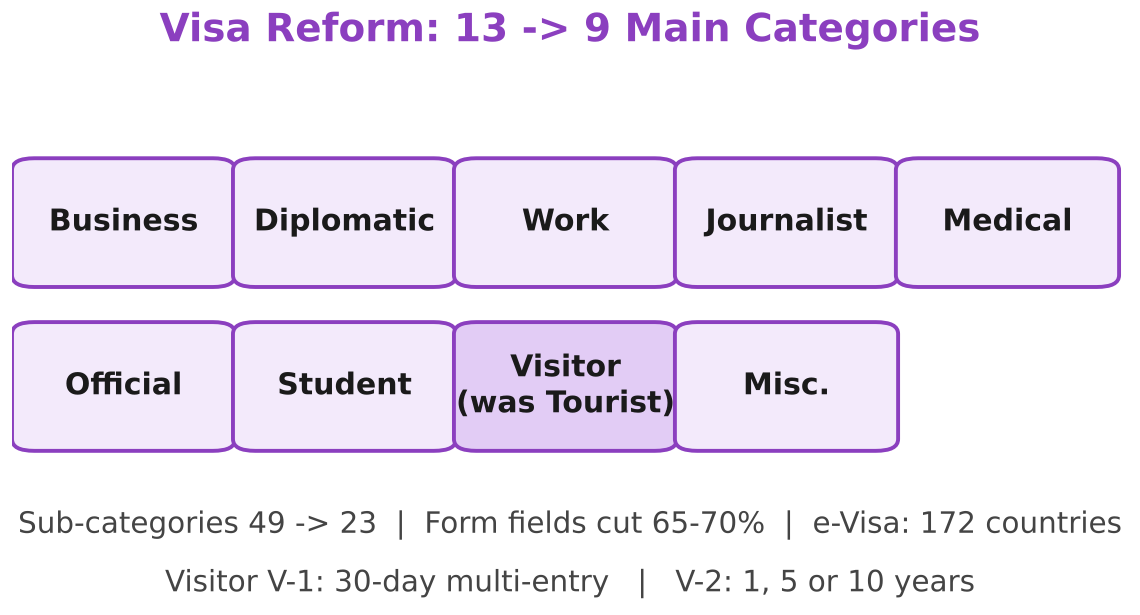
India has made its visa system simpler. There are now fewer types of visa and shorter forms, so foreigners can choose and apply more easily. The Ministry of Home Affairs (MHA) announced on 11 November 2026 a rationalisation (simplification) of India's visa regime, decided on 27 August 2026. Main visa categories have been cut from 13 to 9 and sub-categories from 49 to 23. The old Tourist Visa is now called the Visitor Visa. Visa form fields have been reduced by 65-70%.
Visitor Visa: V-1 = 30-day multiple-entry; V-2 = valid for 1, 5 or 10 years.
Students can get an e-S1 (electronic student) visa for up to five years.
e-Visa facility now covers 172 countries.
Earlier cut (October 2025): 22 main categories reduced to 13.
Way forward
Quick processing, multilingual help and strong background checks must go together so that easier entry does not weaken security.
Concept
Immigration and Foreigners Act, 2025: the new single law on entry, stay and exit of foreigners; it replaced four old laws including the Foreigners Act, 1946 and the Passport (Entry into India) Act, 1920. Visa vs Passport: a passport is your own country's identity document for travel; a visa is the host country's permission to enter. Visas for India are issued by MHA policy and given through Indian missions abroad. e-Visa: an online visa (no embassy visit needed) launched in 2014 as e-Tourist Visa; it is a key 'ease of travel' reform for tourism and medical tourism. Exam angle: Prelims can test the number of categories (9), the renaming to Visitor Visa, or which law governs foreigners now. Mains: simpler visas as a tool of tourism, education hub ambitions ('Study in India') and soft power, balanced with national security checks.
Diagram of India's 9 new main visa categories with Visitor Visa (formerly Tourist) highlighted — StudyForGS
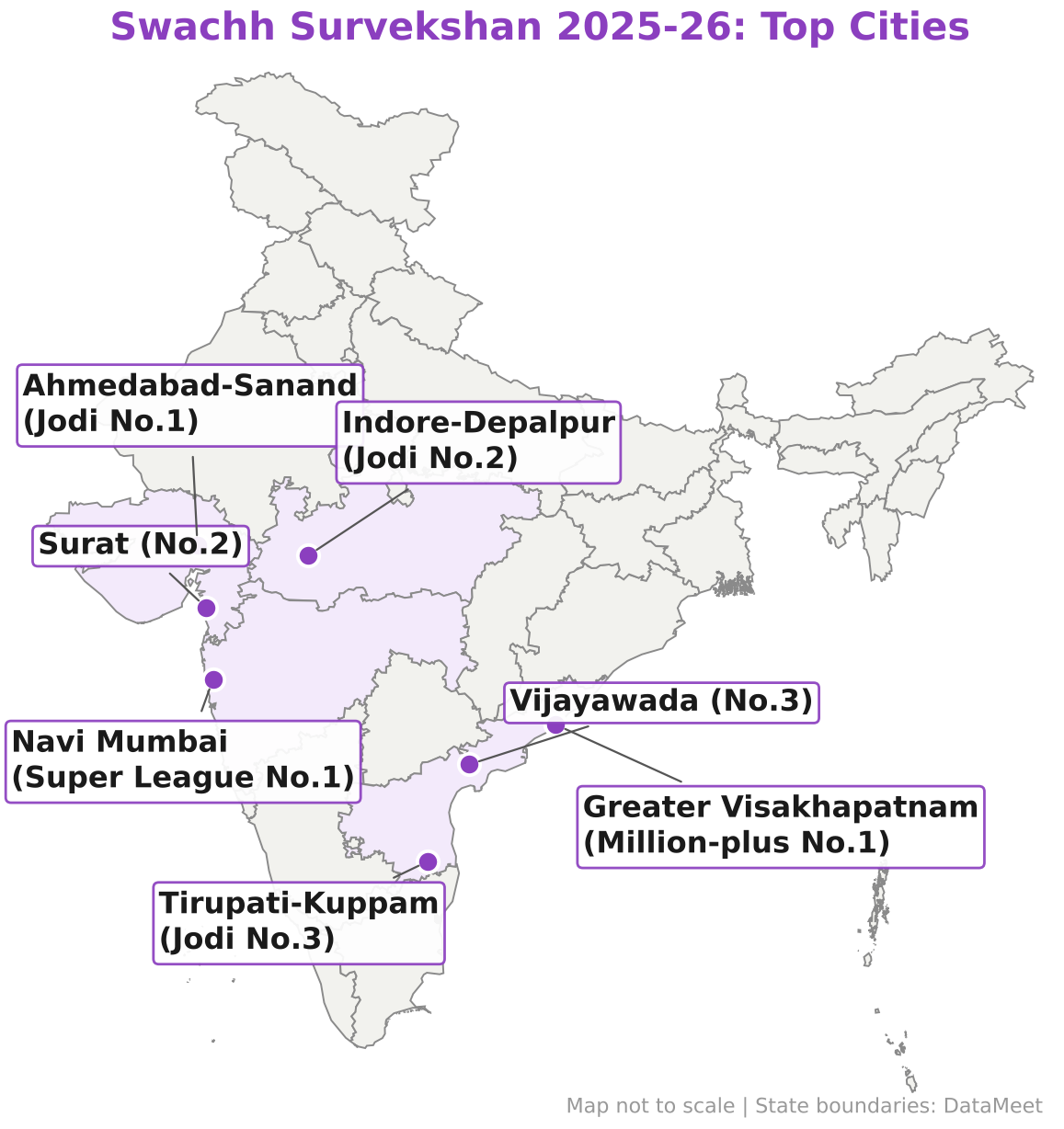
The yearly cleanliness ranking of Indian cities is out. Navi Mumbai leads the special league of always-clean cities, and Indore, the long-time No. 1, is not among the toppers this year. President Droupadi Murmu presented the Swachh Survekshan 2025-26 awards at Vigyan Bhawan, New Delhi. This is the 10th edition, run by the Ministry of Housing and Urban Affairs (MoHUA) under the Swachh Bharat Mission-Urban (SBM-U). Over 4,751 cities took part and 60 national awards were given. New award categories include River Front Town, Coastal Town, Clean Himalayan City and Swachh Shehar Jodi.
Key facts
Super Swachh League: 1. Navi Mumbai, 2. Surat, 3. Vijayawada.
Million-plus cities category: Greater Visakhapatnam came first.
Indore (cleanest city for 8 years in a row) is not in the toppers' list; it came 2nd in Swachh Shehar Jodi with partner town Depalpur.
Survey began in 2016; called the world's largest urban cleanliness survey.
Way forward
Ranking should push permanent systems - segregation at source, user fees and processing plants - not just one-time drives before the survey.
Concept
Super Swachh League: a separate league for cities that topped earlier years, so that new cities also get a fair chance to win. Swachh Shehar Jodi (SSJ): a 'pairing' idea - a top city (mentor) is paired with a weak nearby town (mentee) for 100 days of hand-holding on waste management. SBM-Urban 2.0 (2021-2026): aims at 'Garbage Free Cities' - source segregation, scientific processing and clearing of old dumpsites (legacy waste). Exam angle: Prelims: which ministry runs the survey, Super Swachh League toppers, new categories. Mains: role of competitive federalism and peer learning (city pairing) in urban governance; capacity of urban local bodies under the 74th Amendment.
India map marking Swachh Survekshan 2025-26 top cities - Navi Mumbai, Surat, Vijayawada, Visakhapatnam and Jodi winners — StudyForGS
3. One Nation One Ration Card Status
POLITYUPSC: Prelims + Mains GS2
Syllabus linkage
GS2 - Welfare schemes, Public Distribution System (PDS), food security; GS3 - Food management. Prelims: launch year, coverage; Mains: portability and migrants.
Context
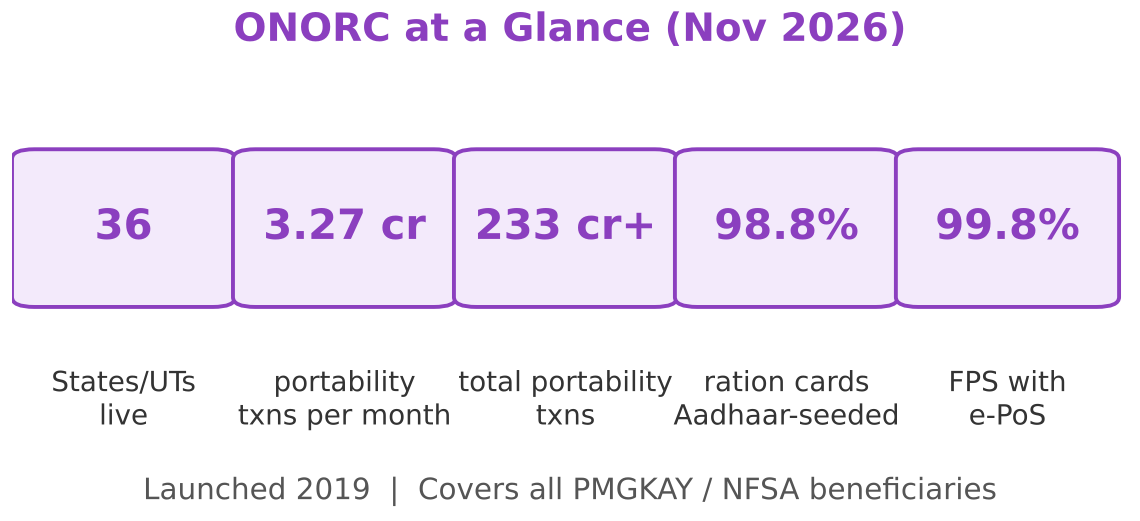
A government update shows that ration card holders can now take their free/cheap grain from any ration shop in India. This helps migrant workers who move from state to state. A government backgrounder released on 12 November 2026 gave the latest figures for One Nation One Ration Card (ONORC). The scheme was launched in 2019 by the Department of Food and Public Distribution. It is now live in all 36 States and UTs and covers all beneficiaries of PM Garib Kalyan Anna Yojana (PMGKAY). About 3.27 crore portability transactions happen every month.
Key facts
Cumulative portability transactions: over 233 crore.
98.8% of 20.51 crore ration cards are Aadhaar-seeded (linked).
99.8% of 5.51 lakh Fair Price Shops use e-PoS (electronic point of sale) machines.
78.65 crore beneficiaries digitised; over 614 lakh MT foodgrains distributed via portability.
'Mera Ration' mobile app is available in 13 languages.
Way forward
Offline backup for biometric failure and better grain stock planning in states with many incoming migrants are needed.
Concept
National Food Security Act (NFSA), 2013: legal right to subsidised grain for up to 75% rural and 50% urban population; covers Antyodaya (AAY) and Priority Households. Portability: you can draw your ration from any Fair Price Shop, not only from your home village shop. Identity is checked with Aadhaar biometric on the e-PoS machine. PMGKAY: since 1 January 2024 free foodgrain is given to NFSA beneficiaries; extended for five years. Exam angle: Prelims: ONORC launch year (2019), ministry, number of States/UTs covered. Mains: technology in PDS - gains (less leakage, migrant support) and issues (biometric failure, exclusion, network problems).
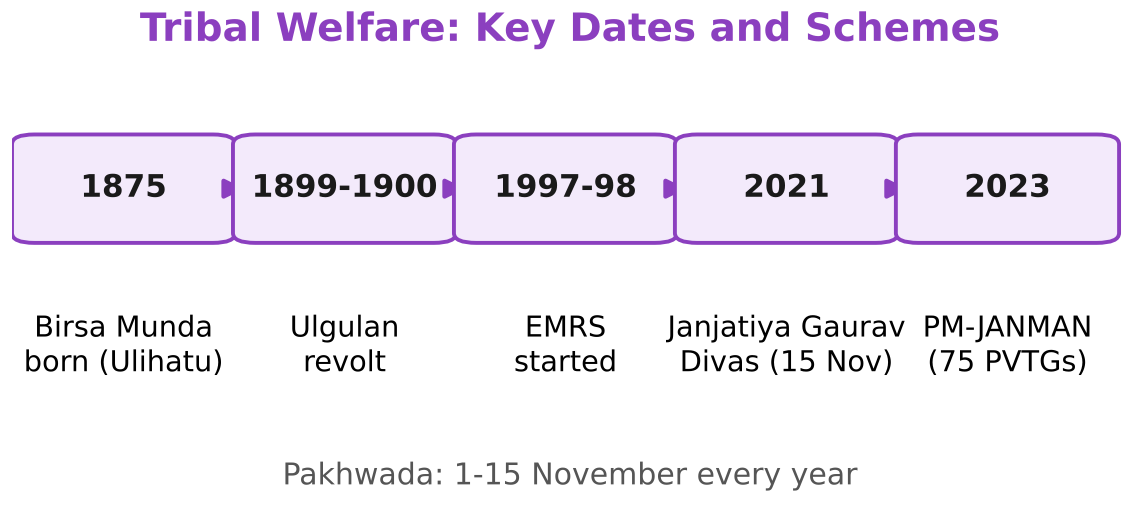
The fortnight from 1 to 15 November honours India's tribal communities. On 12 November the President met top students of Eklavya schools, which are special residential schools for tribal children. Janjatiya Gaurav Pakhwada (tribal pride fortnight) is being observed from 1 to 15 November 2026 by the Ministry of Tribal Affairs. It ends with Janjatiya Gaurav Divas on 15 November, the birth anniversary of Birsa Munda. President Droupadi Murmu met meritorious Eklavya Model Residential School (EMRS) students at Rashtrapati Bhavan on 12 November and urged them to become job creators. A National Tribal Literary Festival is also being held in New Delhi on 12-13 November.
Key facts
Janjatiya Gaurav Divas was declared in 2021; observed on 15 November.
President noted equal boy-girl ratio among EMRS achievers.
Janjatiya Gaurav Varsh 2024-25 had 2+ lakh activities and 3.8+ crore participants.
Past national-level events: Ranchi, Khunti, Jamui, Dediapada.
Good teachers, mother-tongue support in early classes and links to higher education and jobs will make EMRS truly change lives.
Concept
Birsa Munda (1875-1900): led the Ulgulan ('great tumult') of the Mundas in Chotanagpur against British land policies and forced labour; called 'Dharti Aaba' (Father of the Earth). EMRS: residential schools (Class 6-12) for ST children, started 1997-98; revamped in 2018-19 to have one EMRS in every block with over 50% ST population and at least 20,000 tribal people. PM-JANMAN (2023): a mission for the 75 PVTGs (Particularly Vulnerable Tribal Groups) giving houses, roads, water and health services. Exam angle: Prelims: date and person linked to Janjatiya Gaurav Divas, Ulgulan, EMRS criteria, PVTG count (75). Mains: education as a route to tribal empowerment; Fifth Schedule and PESA context.
GS2 - India and its neighbourhood; regional groupings (ASEAN, EAS). Prelims: ASEAN members, EAS; Mains: Act East Policy, Indo-Pacific.
Context
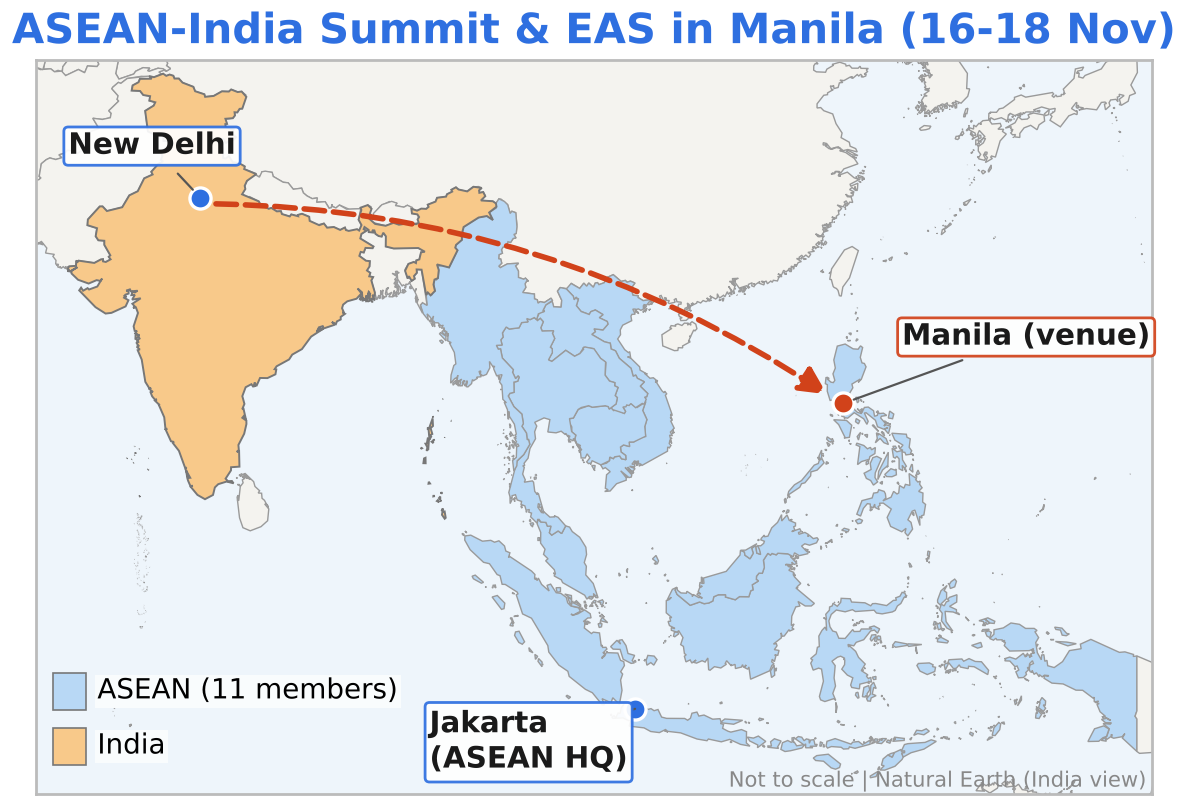
PM Modi will go to Manila (Philippines) on 16-18 November for the yearly meeting with the ASEAN countries and the East Asia Summit. These meetings are the heart of India's 'Act East' policy. The Ministry of External Affairs announced on 12 November 2026 that PM Narendra Modi will visit Manila, Philippines, from 16 to 18 November. He will attend the 23rd ASEAN-India Summit and the 21st East Asia Summit (EAS). The Philippines is the ASEAN chair for 2026. India-ASEAN trade is about US$122 billion.
Key facts
23rd ASEAN-India Summit + 21st East Asia Summit, Manila.
India has ties with all 11 ASEAN members (Timor-Leste joined as the 11th member in October 2025).
India-ASEAN trade: about US$122 billion.
Briefing given by Secretary (East), MEA, Rudrendra Tandon.
ASEAN-India relationship is a Comprehensive Strategic Partnership (since 2022).
Way forward
India should push for a quick, balanced review of AITIGA and faster delivery of connectivity projects to stay a credible partner.
Concept
ASEAN (Association of Southeast Asian Nations): formed in 1967 by the Bangkok Declaration; Secretariat in Jakarta. Now 11 members. East Asia Summit (EAS): started 2005; 18 members - the ASEAN countries plus India, China, Japan, South Korea, Australia, New Zealand, the US and Russia. It is a leaders' forum on strategic issues. Act East Policy (2014): upgraded 'Look East' (1991) - focuses on connectivity (e.g. Kaladan project, India-Myanmar-Thailand Trilateral Highway), trade and security in the Indo-Pacific. Exam angle: Prelims: ASEAN founding year/HQ, newest member, EAS membership, which country chairs ASEAN in 2026. Mains: ASEAN centrality in India's Indo-Pacific vision; review of the ASEAN-India Trade in Goods Agreement (AITIGA) and trade deficit.
Map of Asia showing the 11 ASEAN countries, India and the summit venue Manila — StudyForGS
6. Pravasi Bharatiya Divas 2027 in Kolkata
IRUPSC: Prelims + Mains GS2
Syllabus linkage
GS2 - Indian diaspora. Prelims: PBD date and its history; Mains: diaspora as a strategic asset.
Context
The big meeting of the Indian diaspora (Indians living abroad) will be held in Kolkata in January 2027. Its website was launched on 12 November. External Affairs Minister S. Jaishankar launched the website for the 19th Pravasi Bharatiya Divas (PBD) Convention in New Delhi. It will be held in Kolkata from 7 to 9 January 2027 with the West Bengal government. The theme is 'From roots to return: Reigniting diaspora connect with Bharat'. A 'Bharat Ko Janiye' quiz will also run; winners get a 10-day India tour.
Key facts
19th PBD: Kolkata, 7-9 January 2027.
Theme: 'From roots to return: Reigniting diaspora connect with Bharat'.
9 January marks Mahatma Gandhi's return from South Africa (1915).
Theme focuses on younger generation of overseas Indians.
18th PBD was held in Bhubaneswar (January 2025).
Way forward
Simpler OCI rules, better protection for migrant workers in the Gulf and youth programmes can deepen diaspora ties.
Concept
PBD: first held in 2003 (on the recommendation of the L.M. Singhvi High Level Committee on the diaspora); held every two years since 2015, with smaller theme meetings in between. Pravasi Bharatiya Samman Award: the highest honour for overseas Indians, given by the President at the PBD. Diaspora terms: NRI = Indian citizen living abroad; PIO/OCI = foreign citizen of Indian origin; OCI card gives lifelong visa-free entry but no voting right. Exam angle: Prelims: why 9 January, venue of 19th PBD, OCI vs NRI. Mains: role of the diaspora in remittances (India is the world's top remittance receiver), lobbying and soft power.
7. India-South Africa Foreign Office Consultations
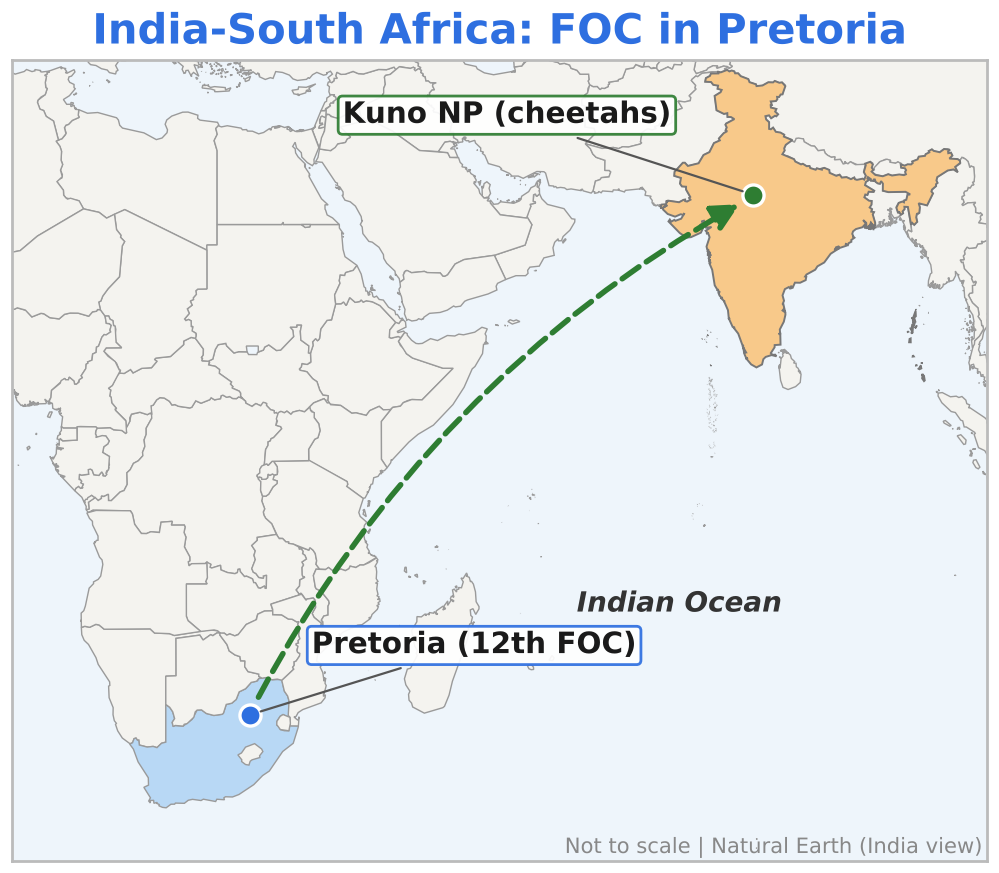
Senior diplomats of India and South Africa met in Pretoria to review their partnership, from trade and defence to cheetah conservation. The 12th round of India-South Africa Foreign Office Consultations (FOC) was held in Pretoria on 11 November 2026. It was co-chaired by Janesh Kain (Joint Secretary, MEA) and David Malcomson (Acting DDG, DIRCO - South Africa's foreign ministry). They discussed trade, defence, science and technology, counter-terrorism and cheetah conservation. The next round will be in India.
Key facts
12th round, Pretoria, 11 November 2026.
2027 marks 30 years of the India-South Africa Strategic Partnership (1997).
Cheetah cooperation: South Africa sent cheetahs to Kuno National Park (Madhya Pradesh) under Project Cheetah.
Both are members of BRICS, IBSA and G20.
Next FOC round to be held in India.
Way forward
Use the 30-year mark in 2027 to sign deals on critical minerals, defence production and digital payments.
Concept
Foreign Office Consultations: regular meetings of senior foreign ministry officials to review all parts of a relationship and prepare for leaders' visits. IBSA (India-Brazil-South Africa) Dialogue Forum: formed by the Brasilia Declaration, 2003; three big democracies of three continents; runs the IBSA Fund for poor countries. Gandhi link: Gandhi's 21 years in South Africa (1893-1914) shaped his Satyagraha method - the Phoenix Settlement and Tolstoy Farm. Exam angle: Prelims: IBSA formation, Project Cheetah source countries, Strategic Partnership year. Mains: India's Africa policy - trade, maritime security in the western Indian Ocean, Global South voice.
Map of India and South Africa with Pretoria (12th FOC) and the cheetah route to Kuno National Park — StudyForGS
8. India at ITU Plenipotentiary, Doha
IRUPSC: Prelims + Mains GS2/GS3
Syllabus linkage
GS2 - Important international institutions; GS3 - Communication networks, cyber security. Prelims: ITU facts; Mains: digital divide.
Context
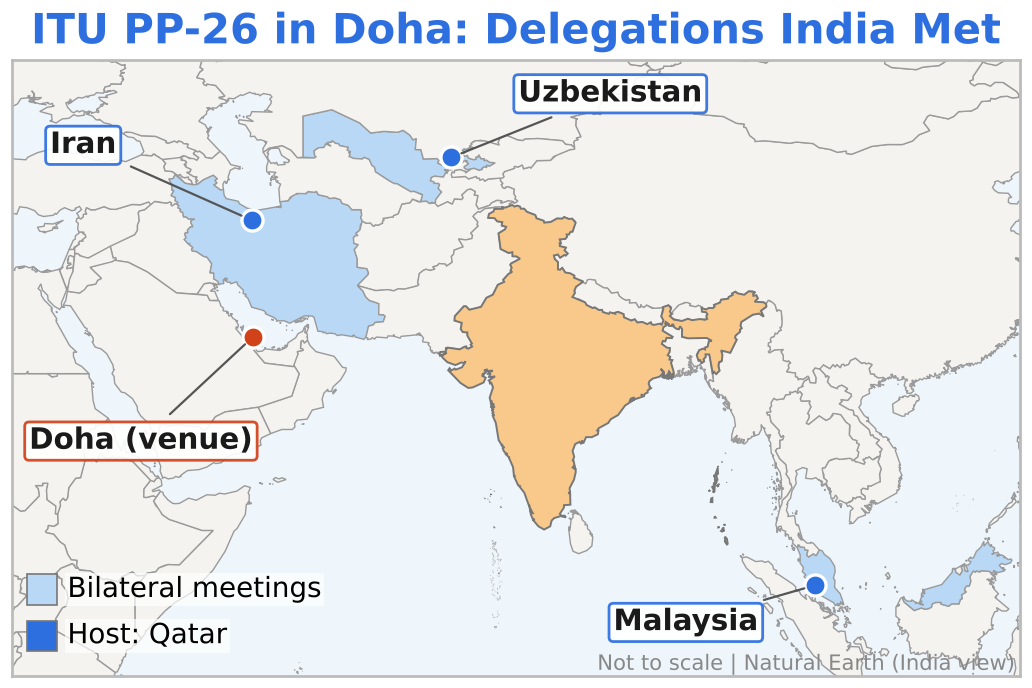
At a top meeting of the UN body for telecom in Doha, India showed how it is taking internet to villages and keeping networks safe from cyber attacks. Minister of State for Communications Chandra Sekhar Pemmasani presented India's approach to digital connectivity and cyber security at the ITU Plenipotentiary Conference 2026 (PP-26) in Doha, Qatar, on 11 November 2026. He said 2.2 billion people worldwide are still offline. He cited BharatNet (about US$15 billion), Samriddh Gram Centres and 100 5G use-case labs. He also met delegations of Malaysia, Iran and Uzbekistan.
Key facts
PP-26 venue: Doha, Qatar.
2.2 billion people in the world remain offline (digital divide).
BharatNet investment: about US$15 billion (optical fibre to gram panchayats).
Samriddh Gram Centres won a WSIS (World Summit on the Information Society) Prize.
India has set up 100 5G use-case labs in colleges.
Way forward
India can offer its DPI model to the Global South while working for fair spectrum rules and global cyber norms.
Concept
ITU (International Telecommunication Union): UN specialised agency for ICT; founded 1865 (as Telegraph Union); HQ Geneva. It allots radio spectrum and satellite orbits and sets telecom standards. Plenipotentiary Conference: ITU's top policy body, meets every four years; elects Secretary-General and Council members. BharatNet: started 2011 as National Optical Fibre Network; aims to connect all 2.5 lakh gram panchayats with broadband; funded by Digital Bharat Nidhi (earlier USOF). Exam angle: Prelims: ITU HQ and year, meeting frequency, BharatNet funding body. Mains: closing the rural digital divide; India's push for global standards and Digital Public Infrastructure (DPI).
Map of West and South Asia showing host Qatar (Doha) and countries India met - Iran, Uzbekistan, Malaysia — StudyForGS
9. INSA Backs G20 Science Academies' Statement
IRUPSC: Prelims + Mains GS2/GS3
Syllabus linkage
GS2 - G20; GS3 - Disaster management, science and technology. Prelims: INSA facts, S20; Mains: technology for disaster resilience.
Context
India's top science academy has signed a joint statement of G20 science academies on using technology to protect people from disasters. The Indian National Science Academy (INSA) took part in the S20 2026 process and endorsed the Joint S20 Statement released on 10 November 2026. The process was led by the US National Academy of Sciences, as the US holds the G20 presidency. The statement is on technology for disaster resilience and lists five action areas. It says technology should add to, not replace, human expertise. It will be sent to the G20 Summit in Miami in December 2026.
Key facts
S20 = Science-20, the engagement group of G20 science academies.
2026 theme: technology for disaster resilience; five action areas.
Key message: technology should enhance, not replace, human expertise.
G20 Summit: Miami, USA, December 2026.
INSA founded in 1935 (Calcutta) as National Institute of Sciences of India; moved to Delhi in 1951.
Way forward
India should share low-cost early warning tools (like cyclone warnings) with other developing countries through G20 and CDRI.
Concept
G20 engagement groups: non-government groups (business B20, youth Y20, think tanks T20, science S20, etc.) that give ideas to the G20 leaders. INSA: India's national science academy; elects Fellows; India's adhering body to the International Science Council (earlier ICSU) since 1968. Disaster resilience: the ability to absorb a disaster and bounce back fast; India leads the Coalition for Disaster Resilient Infrastructure (CDRI, 2019). Exam angle: Prelims: S20, INSA founding year/city, CDRI. Mains: role of early warning, AI and satellite data in disaster risk reduction (Sendai Framework 2015-2030).
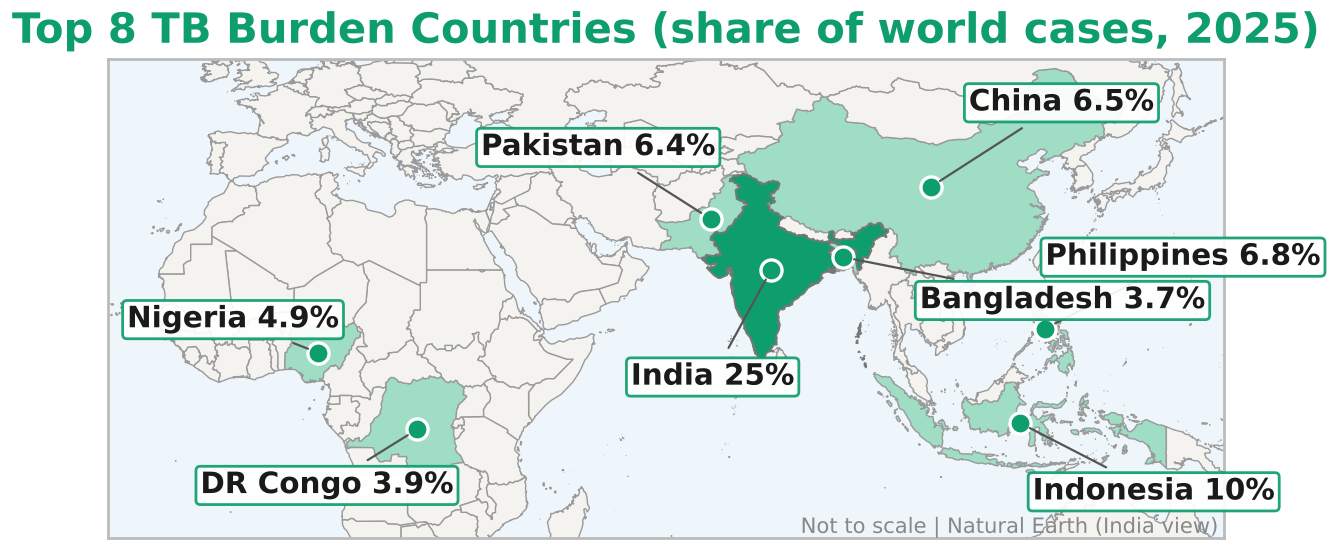
TB deaths in India fell faster than the world average over ten years. But India still has the most TB patients in the world - one in every four cases. The World Health Organization's Global Tuberculosis Report 2026 says India cut TB deaths by 38% between 2015 and 2025, more than the global fall of 35%. India's TB death rate fell from 28 to 18 per lakh people. Still, India had 25% of all global TB cases in 2025. About 10.6 million people fell ill with TB worldwide in 2025.
Key facts
Top 8 countries (share of world cases): India 25%, Indonesia 10%, Philippines 6.8%, China 6.5%, Pakistan 6.4%, Nigeria 4.9%, DR Congo 3.9%, Bangladesh 3.7%.
Global incidence fell only 14% (2015-2025) vs the End TB target of 50% by 2025.
India: treatment success 94%; about 96% of the programme is funded domestically.
TB Mukt Bharat Abhiyaan (from 7 December 2024): 11 crore+ chest X-rays, 48.64 lakh cases found incl. 14.97 lakh without symptoms.
India's figures may be revised using the ICMR-NIRT national TB prevalence survey (2025).
Way forward
Screen high-risk groups actively, give preventive treatment to contacts and link TB care with nutrition and diabetes care.
Concept
TB: caused by the bacterium Mycobacterium tuberculosis; spreads through the air; mainly affects lungs. It is the top killer among single infectious agents. MDR-TB (multi-drug resistant): TB that does not respond to the two main drugs (isoniazid and rifampicin); needs longer, costlier treatment. NTEP and Ni-kshay: National TB Elimination Programme (renamed from RNTCP in 2020); Ni-kshay Poshan Yojana gives Rs 1,000 per month for nutrition; Ni-kshay Mitras are community donors who adopt patients. Exam angle: Prelims: India's share of TB cases, End TB targets, MDR-TB meaning, NAAT test. Mains: why incidence falls slowly - undernutrition, poverty, missed asymptomatic cases; India's 2025 target vs SDG 2030 target.
World map of the 8 highest TB burden countries with their share of world cases, India leading at 25% — StudyForGS
11. 9th National Naturopathy Day on 18 November
HEALTHUPSC: Prelims + Mains GS2
Syllabus linkage
GS2 - Health, AYUSH systems. Prelims: why 18 November, AYUSH bodies; Mains: traditional medicine and lifestyle diseases.
Context
India will mark Naturopathy Day on 18 November, focusing on preventing obesity and lifestyle diseases through natural healing like diet, yoga and water therapy. The Ministry of AYUSH will hold the 9th National Naturopathy Day on 18 November 2026 at the Central Research Institute of Yoga and Naturopathy (CRIYN), Nagamangala, Karnataka. The theme is 'Prakrutik Chikitsa, Swasth Bharat'. The focus is on preventing obesity and lifestyle disorders. MoS (Independent Charge) AYUSH Prataprao Jadhav addressed the curtain-raiser.
CCRYN (Central Council for Research in Yoga and Naturopathy) has 22 units.
200-bed hospitals at Jhajjar (Haryana) and Nagamangala.
National Institute of Naturopathy (NIN), Pune runs the first central BNYS college.
Way forward
More clinical research and integration with primary health centres can make naturopathy a useful partner of modern medicine.
Concept
Why 18 November: in 1945 Mahatma Gandhi became life-long chairman of the All India Nature Cure Foundation Trust (Pune); the Day was first observed in 2018. Naturopathy: a drug-free system using natural elements - diet, fasting, water, mud, sunlight, air and yoga - to help the body heal itself. AYUSH = Ayurveda, Yoga and Naturopathy, Unani, Siddha, Sowa-Rigpa and Homoeopathy; separate Ministry since 2014. Exam angle: Prelims: date and Gandhi link, AYUSH expansion, National Institute of Naturopathy location (Pune). Mains: role of traditional systems in tackling non-communicable diseases; need for evidence-based research.
12. Retail Inflation Crosses 6% in October
ECONOMYUPSC: Prelims + Mains GS3
Syllabus linkage
GS3 - Inflation, monetary policy. Prelims: CPI, base year, RBI target band; Mains: food inflation and policy response.
Context
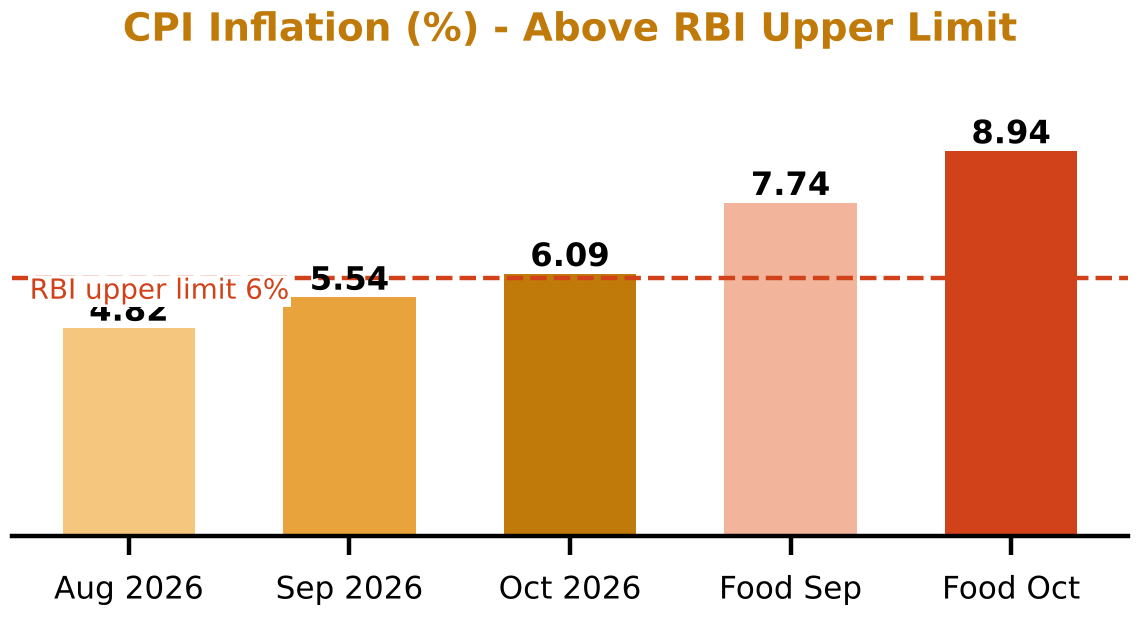
Prices of daily goods rose faster in October, mainly vegetables like onion. At 6.09%, inflation is now above the RBI's comfort limit of 6%. Retail inflation measured by the Consumer Price Index (CPI, base 2024=100) rose to 6.09% in October 2026 from 5.54% in September, data released on 12 November show. Rural inflation was 6.63% and urban 5.41%. Food inflation (CFPI) jumped to 8.94% from 7.74%. The rise breaks the RBI's upper tolerance limit of 6%.
Key facts
Onion prices up 116.22% year-on-year; garlic 60.74%; ginger 48.32%.
Silver jewellery up 52.39%; potato prices fell 14.24%.
Trend: August 4.82% -> September 5.54% -> October 6.09%.
Rural (6.63%) inflation higher than urban (5.41%).
November CPI data due on 14 December 2026.
Way forward
Build onion and pulse buffers, cold storage and better market information so that price spikes are short.
Concept
CPI: measures change in retail prices of a basket of goods and services bought by households; released monthly by NSO (MoSPI). New series uses base year 2024. Flexible Inflation Targeting (2016): under Section 45ZA of the RBI Act, the target is 4% CPI inflation with a band of +/-2% (2% to 6%). If inflation stays outside the band for three straight quarters, the RBI must explain to the government in writing. Monetary Policy Committee (MPC): 6 members (3 from RBI, 3 appointed by government) decide the repo rate; the Governor has a casting vote. Exam angle: Prelims: who releases CPI, target band, MPC composition, what counts as 'failure'. Mains: supply-side food inflation (onion, vegetables) vs demand-side inflation - why interest rates alone cannot fix it; role of buffer stocks and storage.
Bar chart of CPI inflation: Aug 4.82%, Sep 5.54%, Oct 6.09%, food inflation 7.74% to 8.94%, with the RBI 6% upper limit line — StudyForGS
13. Direct Tax Collections Up 11.76%
ECONOMYUPSC: Prelims + Mains GS3
Syllabus linkage
GS3 - Government budgeting, mobilisation of resources. Prelims: direct vs indirect tax, STT; Mains: tax buoyancy.
Context
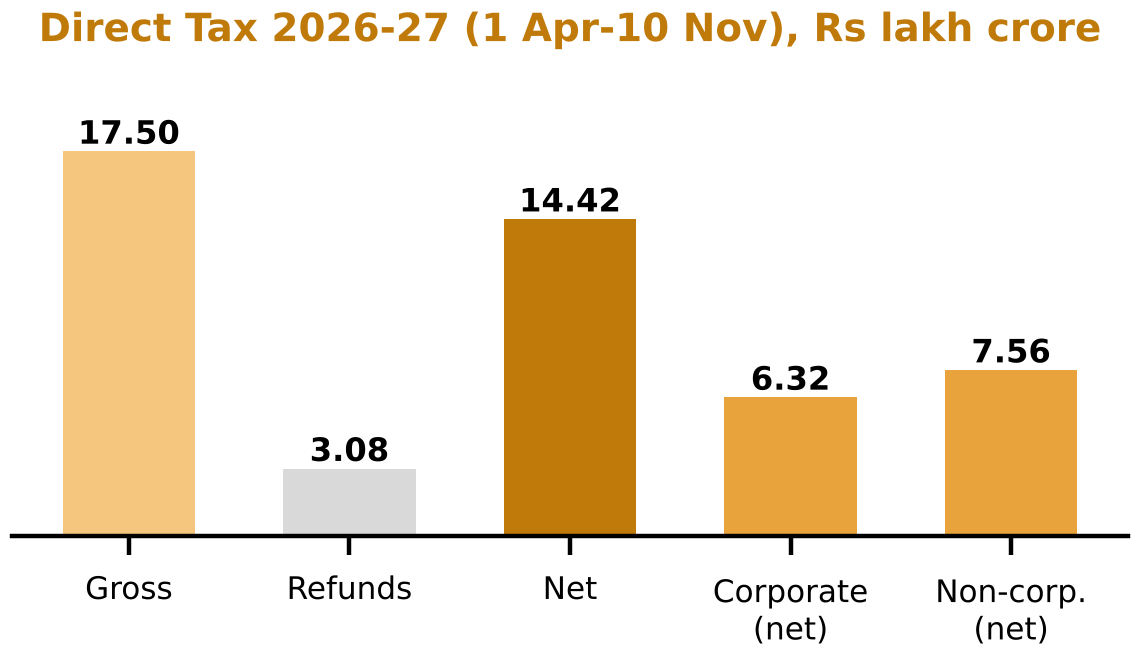
The government has collected more income tax and company tax this year than last year. Net collections are up nearly 12% till 10 November. Net direct tax collections for 2026-27 (1 April to 10 November) rose 11.76% to about Rs 14.42 lakh crore. Net corporate tax was about Rs 6.32 lakh crore (up 18%) and net non-corporate tax (mostly personal income tax) about Rs 7.56 lakh crore (up 5.3%). Refunds rose 26% to Rs 3.08 lakh crore. This is about 53% of the budget target of Rs 26.97 lakh crore.
Use data analytics to widen the tax base rather than raising rates.
Concept
Direct tax: paid directly by the person/company who earns (income tax, corporate tax). Indirect tax: passed on to consumers (GST, customs). Gross vs net: net = gross collections minus refunds paid back to taxpayers. Income-tax Act, 2025: the new simplified law replacing the Income-tax Act, 1961, in force from 1 April 2026; the CBDT (Central Board of Direct Taxes) administers direct taxes. Exam angle: Prelims: STT is a direct tax; CBDT vs CBIC; difference between gross and net. Mains: tax buoyancy, widening the tax base, faster refunds as ease of doing business.
Bar chart of direct tax 2026-27 (1 Apr-10 Nov): gross 17.50, refunds 3.08, net 14.42, corporate 6.32, non-corporate 7.56 lakh crore rupees — StudyForGS
14. PLI Schemes: NITI Aayog Assessment
ECONOMYUPSC: Prelims + Mains GS3
Syllabus linkage
GS3 - Industrial policy, Make in India, growth and employment. Prelims: PLI sectors, outlay; Mains: effectiveness of incentive-led manufacturing.
Context
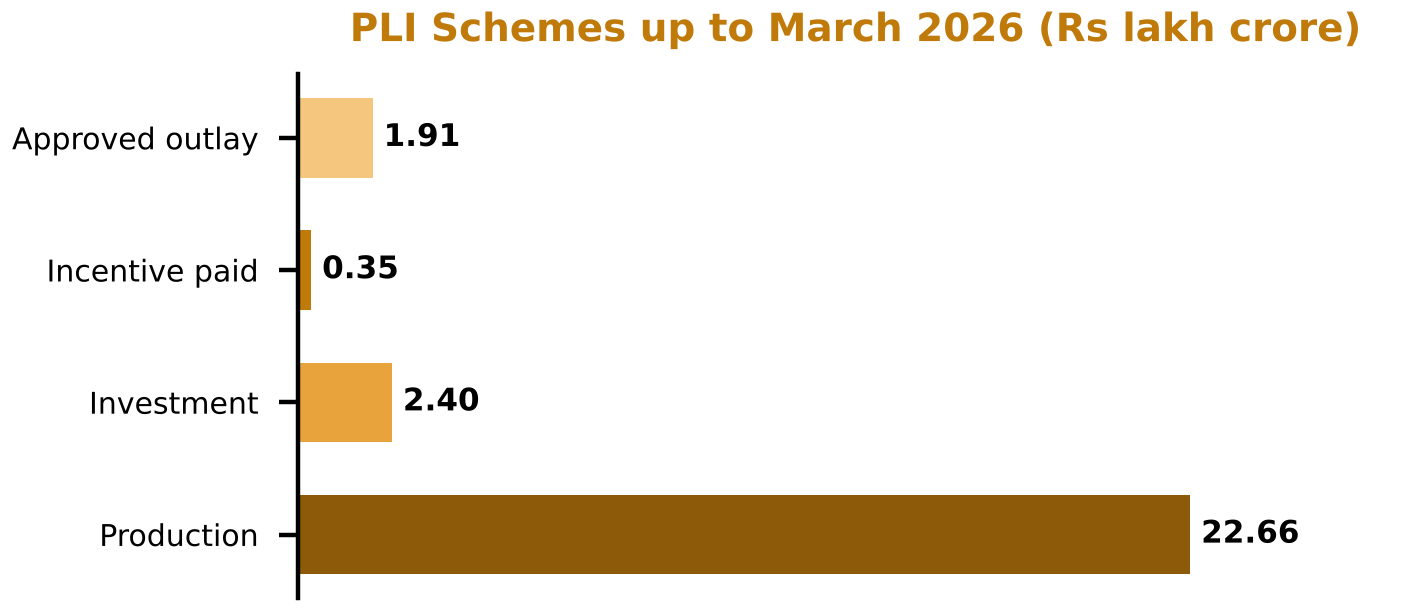
A study of the government's factory incentive schemes found they brought big investment and production, but only about 18% of the promised money has been paid out so far. A joint assessment by NITI Aayog and IIM Ahmedabad studied Production-Linked Incentive (PLI) schemes. These were started in 2020 for 14 sectors with an outlay of Rs 1.91 lakh crore. By March 2026, only 18.51% (Rs 35,351 crore) had been paid. The schemes attracted Rs 2.40 lakh crore of investment and Rs 22.66 lakh crore of production, and created over 8.49 lakh jobs.
Key facts
Strong results: electronics, telecom and pharma drugs.
Nine schemes (e.g. bulk drugs, autos, textiles) paid below 10% of outlay; drones, large electronics, food products paid 25-77%.
Nearly 70% of targeted segments broadly on track.
Concerns: imports rose in some electronics; mobile phone assembly gave limited jobs.
Related: PLI for ACC batteries got 22 bids for 10 GWh of grid-scale storage cells (bids opened 11 November).
Way forward
Design sector-specific schemes, add demand-side support and create a standard data system to track output, exports and jobs.
Concept
PLI: the government pays a percentage of extra (incremental) sales made in India over a base year - money comes only after output, not upfront. So low payout can mean firms have not yet met targets. Supply-side vs demand-side incentives: PLI boosts supply (capacity); NITI suggests adding demand-pull measures (e.g. public procurement of local goods). Domestic value addition: how much of the product's value is actually created in India; assembly with imported parts gives low value addition. Exam angle: Prelims: PLI year (2020), number of sectors (14), ACC PLI target (50 GWh, Rs 18,100 crore). Mains: is PLI building deep manufacturing or only assembly? Jobs vs capital intensity; WTO compatibility of subsidies.
Horizontal bar chart of PLI schemes: approved outlay 1.91, incentive paid 0.35, investment 2.40, production 22.66 lakh crore rupees — StudyForGS
📜 Asked before in the exam — previous-year question on this topic
BPSC Prelims 2023 (69th CCE)Consider the following statements about the Production-Linked Incentive (PLI) scheme: 1. The scheme offers a production-linked incentive to boost domestic manufacturing and attract large investments in mobile phone manufacturing and specified electronic components. 2. The scheme has two categories of applicants, namely, global companies and domestic companies. 3. The scheme shall extend an average incentive of around 8% on net incremental sales (over base year) of goods manufactured in India and covered under the target segment, to eligible companies, for a period of six years. 4. The target segment under PLI shall include (i) laptops, (ii) tablets, (iii) all- in-one PCs, (iv) servers and (v) Ultra-Small Form Factor (USFF). Which of the above statements are incorrect?
Linked because this news is about the same topic. The answer is as per the official key of that year.
15. Videocon's Dhoot Declared Bankrupt
ECONOMYUPSC: Prelims + Mains GS3
Syllabus linkage
GS3 - Banking, NPAs, Insolvency and Bankruptcy Code. Prelims: CIRP, PIRP, NCLT/NCLAT; Mains: effectiveness of IBC.
Context
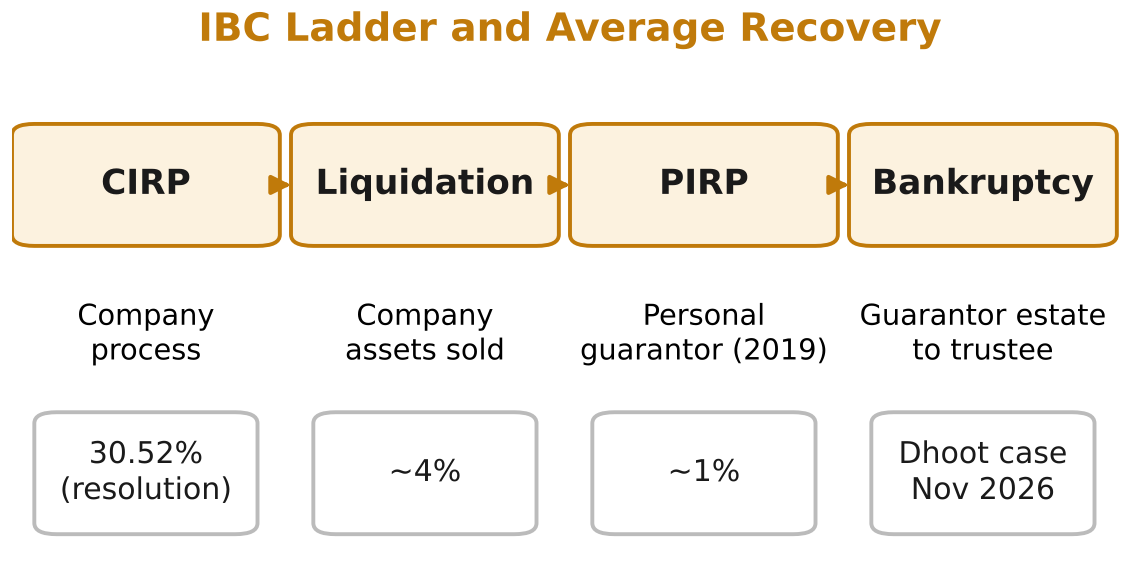
A tribunal has declared the former Videocon owner personally bankrupt because he gave his personal guarantee for huge bank loans that were not repaid. Such cases are rare in India. The National Company Law Tribunal (NCLT) declared Venugopal Dhoot, former promoter of Videocon Industries, bankrupt. He was held personally liable as guarantor for loans of Rs 12,668 crore from SBI. His personal insolvency process (PIRP) began in April 2026 but ended in July 2026 without a repayment plan, leading to bankruptcy in November. His assets will now go to a bankruptcy trustee.
NCLAT (January 2022) set aside Twin Star's Rs 2,962 crore plan - a haircut (loss) of over 95%.
A bankrupt person cannot be a company director.
Personal insolvency: 5,186 PIRP applications, only 64 repayment plans approved; creditors got about 1% of claims.
Corporate recovery: resolution about 30.52%; liquidation about 4%.
Way forward
More NCLT benches, strict timelines and better asset tracing can make personal guarantees meaningful.
Concept
Insolvency vs bankruptcy: insolvency = cannot pay debts on time; bankruptcy = the legal stage where a person's assets are sold to pay creditors. IBC 2016 stages: CIRP (company process) -> PIRP for personal guarantors (in force since 1 December 2019) -> bankruptcy if both fail. Total claim cannot exceed actual debt. Institutions: NCLT = adjudicating authority; NCLAT = appeal; IBBI = regulator; appeals finally go to the Supreme Court. Exam angle: Prelims: who is adjudicating authority for personal guarantors (NCLT), IBBI's role, Section 12A withdrawal. Mains: low recovery rates, delays, and why personal guarantees must work as a real deterrent to wilful default.
📜 Asked before in the exam — previous-year question on this topic
BPSC Prelims 2023 (69th CCE)Consider the following statements regarding insolvency and bankruptcy: 1. Bankruptcy refers to a financial state in which an individual or entity is unable to pay off their debts as they become due. 2. Insolvency refers to a legal process, where the assets of the debtor are liquidated or reorganized for the benefit of creditors. 3. Bankruptcy is a state whereas insolvency is the conclusion. 4. The Insolvency and Bankruptcy Board of India (IBBI) is the regulatory body responsible for overseeing insolvency and bankruptcy proceedings. Which of the above statements is/are correct?
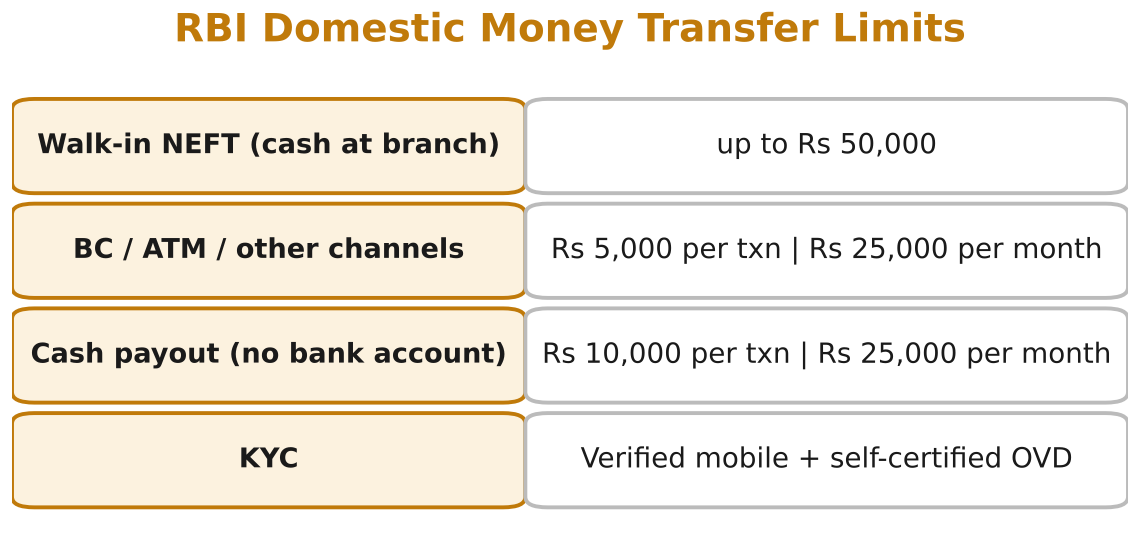
The RBI has put all its rules on sending money within India (for people without bank accounts too) into one set, with the same limits but more safety checks against fraud. The Reserve Bank of India (RBI) issued consolidated (combined into one) directions on domestic money transfer on 12 November 2026. Existing limits are kept but safeguards for cash-based remittances are made stronger. A person without a bank account can send up to Rs 50,000 to a bank account through NEFT at a bank branch. Banks must add remitter details in IMPS and NEFT messages and report suspicious patterns.
Key facts
Walk-in NEFT (cash at branch): up to Rs 50,000.
Via business correspondents, ATMs etc.: Rs 5,000 per transaction, Rs 25,000 per remitter per month.
Cash payout to beneficiary without account: Rs 10,000 per transaction, Rs 25,000 per month.
Remitter must register with verified mobile number and a self-certified officially valid document (KYC).
Card-to-card transfers are excluded; complaints go to the RBI Integrated Ombudsman Scheme.
Way forward
Push migrants towards low-cost bank accounts and UPI while keeping a safe cash channel for the unbanked.
Concept
NEFT vs IMPS vs RTGS: NEFT = half-hourly batches, 24x7; IMPS = instant, 24x7 (run by NPCI); RTGS = real-time for Rs 2 lakh and above. Business Correspondent (BC): a local agent (shopkeeper etc.) who provides basic banking services for a bank in villages - key for financial inclusion. Payment and Settlement Systems Act, 2007: gives the RBI power to regulate payment systems in India. Exam angle: Prelims: transfer limits, which body runs IMPS (NPCI), RTGS threshold. Mains: protecting migrant workers' remittances from fraud and mule accounts while keeping access easy.
Table of RBI domestic money transfer limits: branch NEFT Rs 50,000, BC/ATM Rs 5,000 per txn and Rs 25,000 per month, cash payout Rs 10,000 per txn, KYC needs — StudyForGS
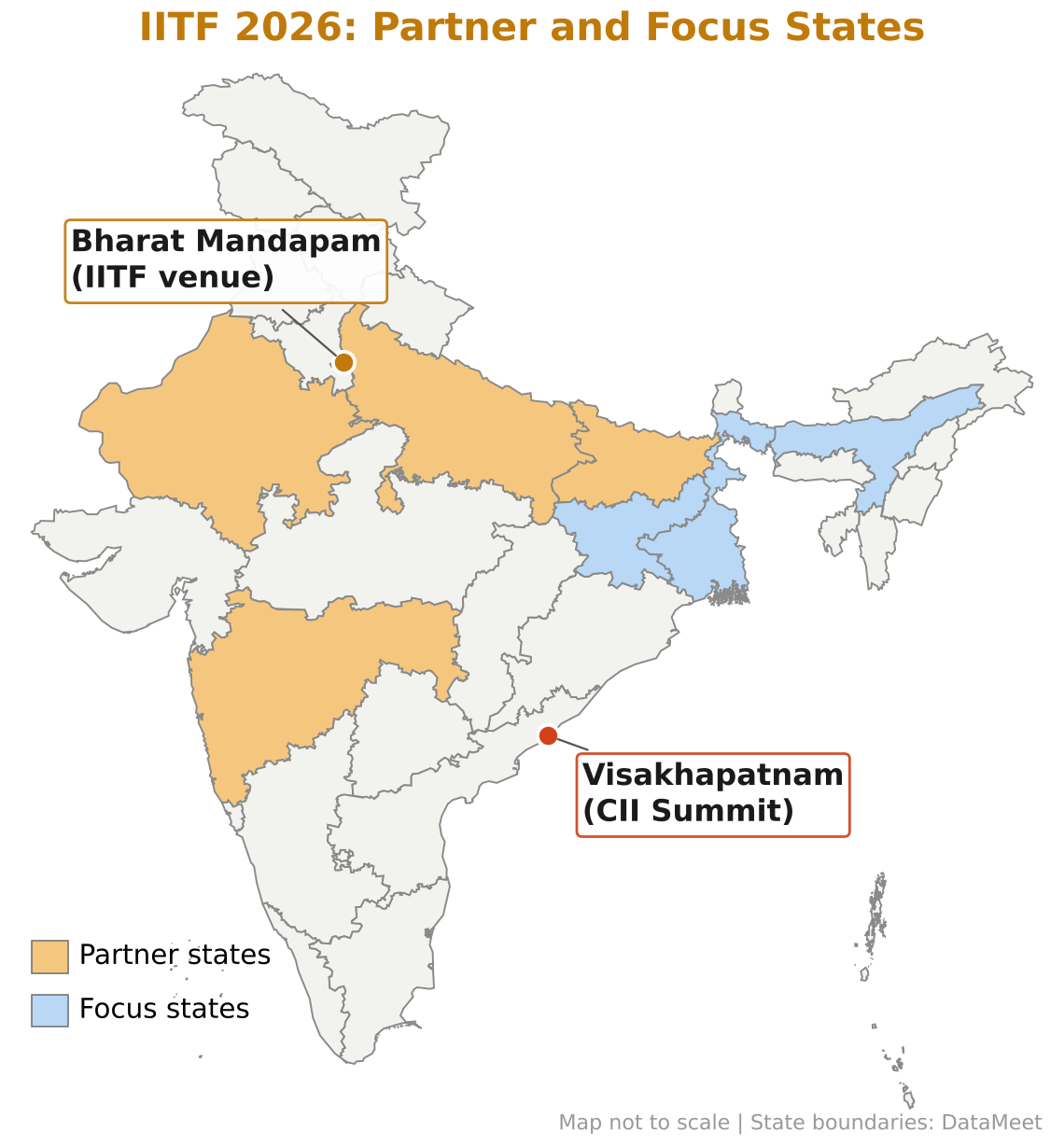
India's biggest trade fair opens at Bharat Mandapam, Delhi, on 14 November, and an investment summit in Visakhapatnam saw Andhra Pradesh sign hundreds of investment deals. The 45th India International Trade Fair (IITF) will run from 14 to 27 November 2026 at Bharat Mandapam, New Delhi, with the theme 'Vikas aur Virasat'. It has over 3,500 exhibitors, 32 States/UTs and 11 countries. Separately, the 31st CII Partnership Summit was held in Visakhapatnam on 12 November with the theme 'Navigating the New World Order'; Andhra Pradesh is to sign 303 MoUs worth Rs 9.89 lakh crore.
IITF focus states: Assam, Delhi, Jharkhand, West Bengal.
Public entry from 19 November; 17 halls, over 1 lakh sq m.
Commerce Minister: India concluded nine FTAs/PTAs in about four and a half years.
Visakhapatnam Port handled a record 91.17 million tonnes in 2025-26.
Way forward
States should track MoU-to-ground conversion openly and fix land and approval delays.
Concept
ITPO (India Trade Promotion Organisation): under the Commerce Ministry; organises IITF since 1980; runs Bharat Mandapam (Pragati Maidan). FTA vs PTA: an FTA removes tariffs on most goods; a PTA cuts tariffs only on a limited list of goods. Landlord port model: the port authority owns land and basic infrastructure and leases terminals to private operators. Exam angle: Prelims: IITF venue, organiser and theme; FTA vs PTA. Mains: states competing for investment - benefits and the gap between MoUs signed and actual investment.
India map of IITF 2026 partner states (Bihar, Maharashtra, Rajasthan, UP) and focus states (Assam, Delhi, Jharkhand, West Bengal) with Bharat Mandapam and Visakhapatnam — StudyForGS
18. COP31 Antalya: Climate Finance Dispute
ENVIRONMENTUPSC: Prelims + Mains GS3
Syllabus linkage
GS3 - Environment, international climate negotiations; GS2 - international agreements. Prelims: COP31 facts, NCQG; Mains: climate justice, CBDR.
Context
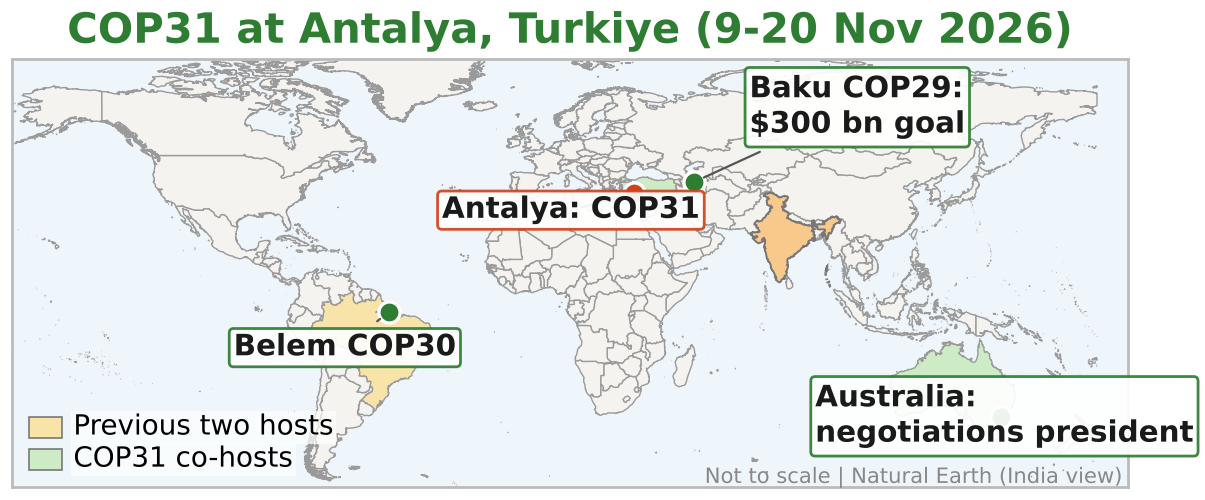
At the UN climate summit in Türkiye, poor and rich countries again disagree on money: how much is really given, how much is loan, and how fast it reaches poor countries. COP31 is being held in Antalya, Türkiye, from 9 to 20 November 2026 with nearly 190 countries. Türkiye's minister Murat Kurum is COP31 President and Australia's Chris Bowen is President of negotiations. Developing countries say headline climate finance numbers are misleading because about 67% is loans. The US sent no official delegation after leaving the Paris Agreement in early 2026.
Key facts
Copenhagen (2009) pledge: US$100 billion a year by 2020 - first met only in 2022; OECD says US$136.7 billion in 2024.
2024 mix: loans US$68.5 billion (67%), grants US$29.7 billion (29%); Oxfam's 'real value' estimate is only US$32.7-44.7 billion.
Adaptation need: about US$305 billion a year by 2035 (UNEP Adaptation Gap Report 2026) vs US$28.2-31.7 billion provided in 2024.
New goal (Baku, COP29): at least US$300 billion a year by 2035; wider aim US$1.3 trillion a year.
India's demand: at least US$1 trillion a year, mainly as grants and cheap loans.
Way forward
Agree on a common accounting rule that counts only the grant value of loans, and set a separate target for adaptation grants.
Concept
CBDR-RC (Common But Differentiated Responsibilities and Respective Capabilities): all countries must act, but rich countries that polluted more historically must do more and pay. Found in UNFCCC (1992). NCQG (New Collective Quantified Goal): the post-2025 climate finance target agreed at COP29, Baku. Mitigation vs adaptation: mitigation = cutting emissions (solar, wind); adaptation = coping with impacts (sea walls, heat plans). Private money flows to mitigation (profitable) but rarely to adaptation. Exam angle: Prelims: COP31 host city, co-hosting arrangement, NCQG amount, $100 billion pledge year. Mains: why grant-based, predictable finance matters for India and LDCs; debt trap from climate loans.
World map showing COP31 venue Antalya (Turkiye), co-host Australia and previous hosts Baku (COP29) and Belem (COP30) — StudyForGS
19. Climate Change Performance Index 2027
ENVIRONMENTUPSC: Prelims + Mains GS3
Syllabus linkage
GS3 - Environment, indices and reports. Prelims: publisher, India's rank, parameters; Mains: India's energy transition.
Context
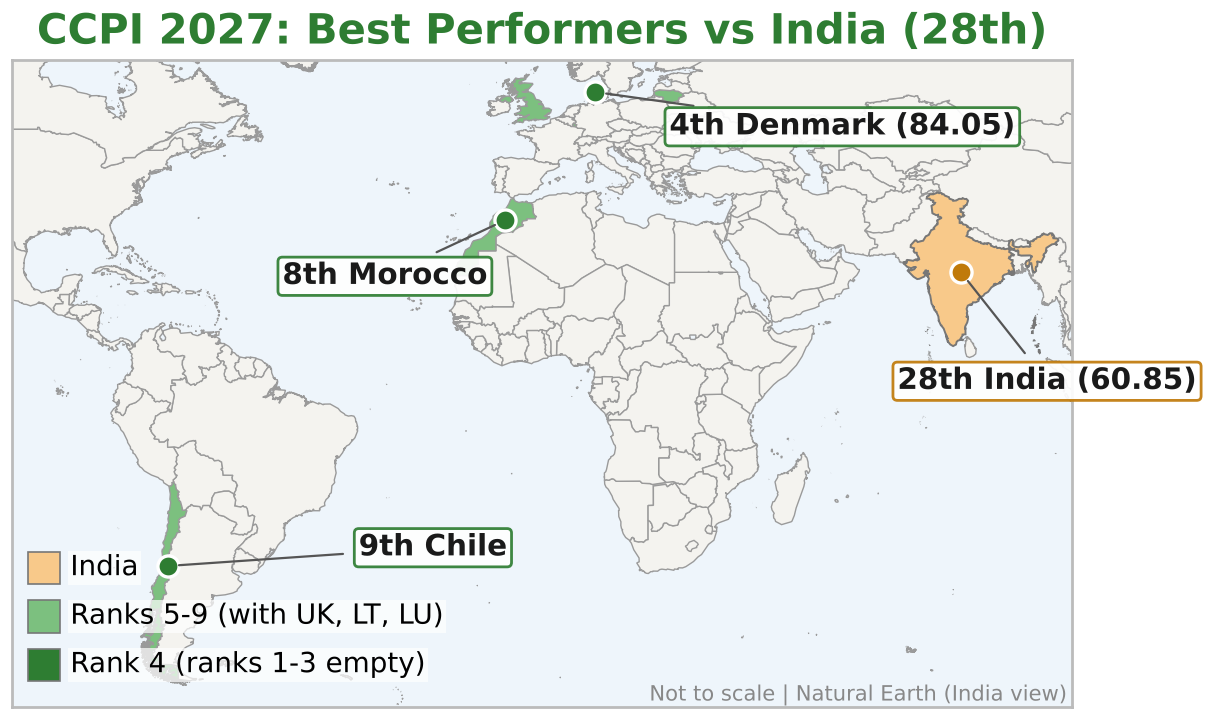
In a global ranking of how well countries fight climate change, India slipped to 28th place. Its clean-energy growth is strong, but renewable share in total energy is still low. The Climate Change Performance Index (CCPI) 2027 was released at COP31 in Antalya by Germanwatch and NewClimate Institute with Climate Action Network International. It covers 64 countries plus the EU (over 90% of global emissions). India ranked 28th with 60.85 points and a 'Medium' rating, down from 23rd last year and 10th two years ago. The top three ranks are left empty because no country did well enough.
Key facts
Denmark is 4th (84.05 points) - top country for the 6th straight year; then Lithuania, Luxembourg, UK, Morocco, Chile.
UK is the only G20 country rated 'High'.
India: Medium in GHG Emissions, Energy Use and Climate Policy; Low in Renewable Energy but its trend is High.
Non-fossil sources reached 50% of installed power capacity in June 2025 - five years ahead of the 2030 target.
Way forward
Faster battery and pumped storage, green transmission corridors and a clear coal phase-down path can raise India's rating.
Concept
CCPI weights: GHG Emissions 40%, Renewable Energy 20%, Energy Use 20%, Climate Policy 20%. Installed capacity vs generation: 50% of capacity is non-fossil, but actual electricity generated from them is lower because solar/wind run only part of the day. India's NDC (updated 2022): cut emission intensity of GDP by 45% (from 2005 level) and get 50% of power capacity from non-fossil sources by 2030; net zero by 2070. Exam angle: Prelims: who publishes CCPI, why ranks 1-3 are empty, India's NDC targets. Mains: grid storage, transmission and coal dependence as bottlenecks in India's energy transition.
World map of CCPI 2027 best performers (Denmark 4th, ranks 5-9) and India at 28th — StudyForGS
20. Maharashtra Gets First Blue Flag Beaches
ENVIRONMENTUPSC: Prelims + Mains GS3
Syllabus linkage
GS3 - Coastal ecology, eco-tourism; GS1 - geography of coasts. Prelims: Blue Flag criteria, awarding body, beaches; Mains: sustainable coastal tourism.
Context
Three beaches in Maharashtra have won the 'Blue Flag' - a world label for very clean, safe and eco-friendly beaches. It is the first time for the state. Ladghar and Guhagar beaches in Ratnagiri district and Shrivardhan beach in Raigad district of Maharashtra received Blue Flag certification for 2026-27. This is the first time Maharashtra has got the label. The award is given by the Foundation for Environmental Education (FEE), Denmark. The beach season starts on 15 November 2026.
Key facts
New Blue Flag beaches: Ladghar, Guhagar (Ratnagiri), Shrivardhan (Raigad).
Awarding body: Foundation for Environmental Education (FEE), Copenhagen, Denmark.
33 criteria in four groups: water quality, environmental management, environmental education, safety.
Programme started in France in 1985; outside Europe since 2001.
Earlier Indian Blue Flag beaches include Shivrajpur (Gujarat), Radhanagar (Andaman), Kappad (Kerala), Rushikonda (Andhra Pradesh), Golden (Odisha), Minicoy Thundi and Kadmat (Lakshadweep).
Way forward
Keep standards round the year with local community and fisherfolk participation, not only during the inspection season.
Concept
Blue Flag: a voluntary eco-label for beaches, marinas and tourism boats; it must be renewed every year. BEAMS (Beach Environment and Aesthetics Management Services): India's programme under the Environment Ministry's ICZM project to prepare beaches for Blue Flag. CRZ (Coastal Regulation Zone) Notification 2019: rules that limit construction near the coast to protect beaches and coastal ecosystems. Exam angle: Prelims: FEE headquarters, number of criteria, state-wise Blue Flag beaches. Mains: balancing beach tourism with coastal ecology and fishermen's livelihoods.
India map of Maharashtra's new Blue Flag beaches (Shrivardhan, Ladghar, Guhagar) and earlier Blue Flag beaches — StudyForGS
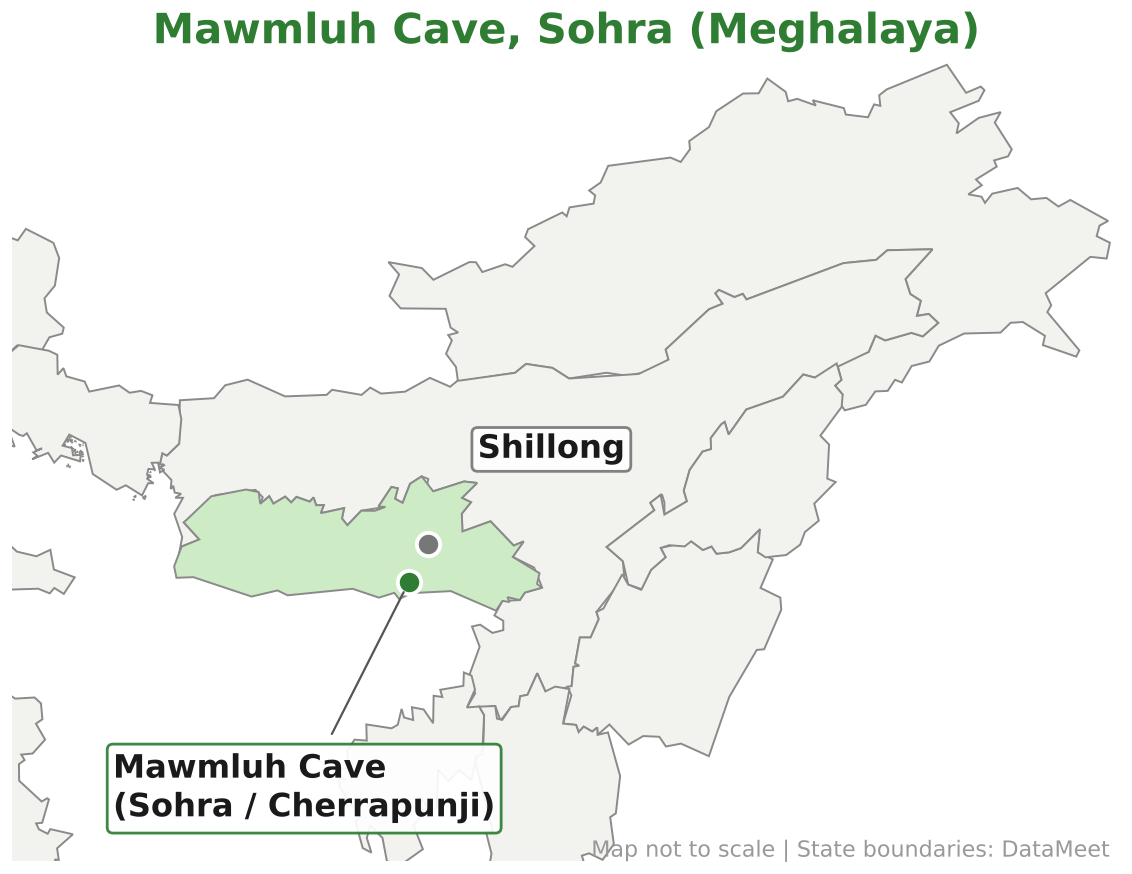
A famous limestone cave in Meghalaya, which gave its name to the current period of Earth's history (the Meghalayan Age), is being harmed by mining and climate change. Mawmluh Cave (Krem Mawmluh) at Sohra, East Khasi Hills, Meghalaya, is facing threats from mining and climate change. These are changing rainfall and groundwater patterns and damaging rock formations and underground life. The cave is 7.2 km long - the fourth longest in the Indian subcontinent. It was first explored by a British officer, Lieutenant Yule, in 1844.
Key facts
Location: Sohra (Cherrapunji), East Khasi Hills district, Meghalaya.
Formed where early Eocene dolomite meets sandstone; has several entrances.
A stalagmite from this cave marks the start of the Meghalayan Age (about 4,200 years ago - present).
In 2022 IUGS listed it among the first 100 Geological Heritage Sites of the world.
Nearby limestone mining for cement is a major threat.
Way forward
Declare a protective buffer around the cave, regulate mining and pass a national geo-heritage protection law.
Concept
Speleothems: rock shapes formed by dripping water in caves - stalactites hang from the roof; stalagmites rise from the floor; when they join they make a column. (Trick: stalaCtite = Ceiling, stalaGmite = Ground.) Meghalayan Age: the latest of three stages of the Holocene epoch - Greenlandian, Northgrippian and Meghalayan; ratified in 2018. It began with a mega-drought about 4,200 years ago. Karst topography: landforms made when rainwater (weak carbonic acid) dissolves limestone - caves, sinkholes, underground streams. Exam angle: Prelims: Meghalayan Age start date, three Holocene stages, stalactite vs stalagmite, IUGS site. Mains: need for a geo-heritage law in India to protect such sites.
Northeast India map showing Mawmluh Cave at Sohra and Shillong in Meghalaya — StudyForGS
22. New Plant and Nematode Species Found
ENVIRONMENTUPSC: Prelims + Mains GS3
Syllabus linkage
GS3 - Biodiversity, conservation. Prelims: species names, locations, nematode facts; Mains: importance of mangroves and taxonomy.
Context
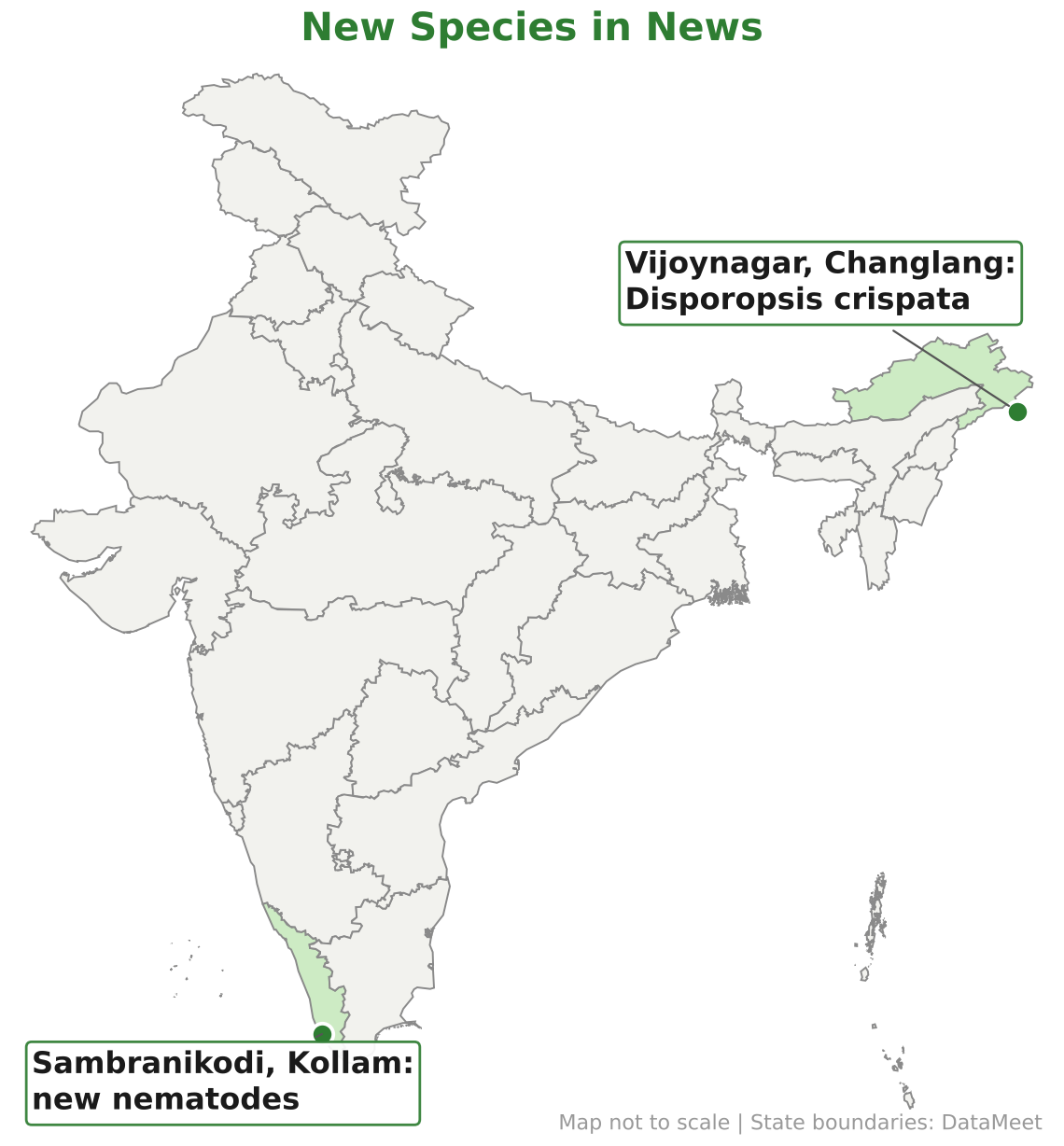
Scientists found a new flowering plant in Arunachal Pradesh and five new tiny worms (nematodes) in Kerala's mangrove mud - showing how rich India's biodiversity is. A new plant, Disporopsis crispata, has been found in the Vijoynagar area of Changlang district, Arunachal Pradesh. It is the first record of the genus Disporopsis in India. Separately, researchers of the University of Kerala found five new species of free-living marine nematodes of the genus Pseudochromadora in mangrove sediments, including at Sambranikodi in Kollam.
Grows on damp slopes in temperate rhododendron-bamboo forest at 2,500-2,800 m.
The genus has about 12 species, mostly in Myanmar, China, Taiwan and the Philippines.
New nematodes include Pseudochromadora kairali (named after Kerala) from Sambranikodi, Kollam.
Marine nematodes are a few millimetres long and are not parasites.
Way forward
More funding for taxonomists and protection of mangroves and high-altitude forests from roads and dumping.
Concept
Nematodes (roundworms, phylum Nematoda): long thin worms tapered at both ends; some are parasites of plants and animals, many are free-living in soil and water; found on every continent including Antarctica. Bio-indicators: living things whose presence or health shows the condition of the environment - nematodes in sediments show pollution and nutrient levels. Mangroves: salt-tolerant coastal forests; India's largest is the Sundarbans; they protect coasts from storms and store 'blue carbon'. Exam angle: Prelims: match species with state; nematode features; Changlang district location (bordering Myanmar). Mains: Northeast as a biodiversity hotspot (Indo-Burma); value of taxonomy in conservation.
India map marking the new plant at Vijoynagar, Changlang (Arunachal Pradesh) and new nematodes at Sambranikodi, Kollam (Kerala) — StudyForGS
23. 25 Years of the PPV&FR Act
ENVIRONMENTUPSC: Prelims + Mains GS3
Syllabus linkage
GS3 - Agriculture, IPR in agriculture, biodiversity. Prelims: PPV&FR Act, GIAHS; Mains: farmers' rights vs breeders' rights.
Context
The authority that protects farmers' rights over seeds and plant varieties marked its 22nd Foundation Day. Almost half of the varieties it has registered belong to farmers. The Protection of Plant Varieties and Farmers' Rights Authority (PPVFRA) held its 22nd Foundation Day in New Delhi on 12 November 2026, addressed by Dr P.K. Mishra, Principal Secretary to the PM. The year also marks 25 years of the PPV&FR Act, 2001. Nearly half of all registered plant varieties are farmers' varieties.
Key facts
India has 22 agro-biodiversity hotspots.
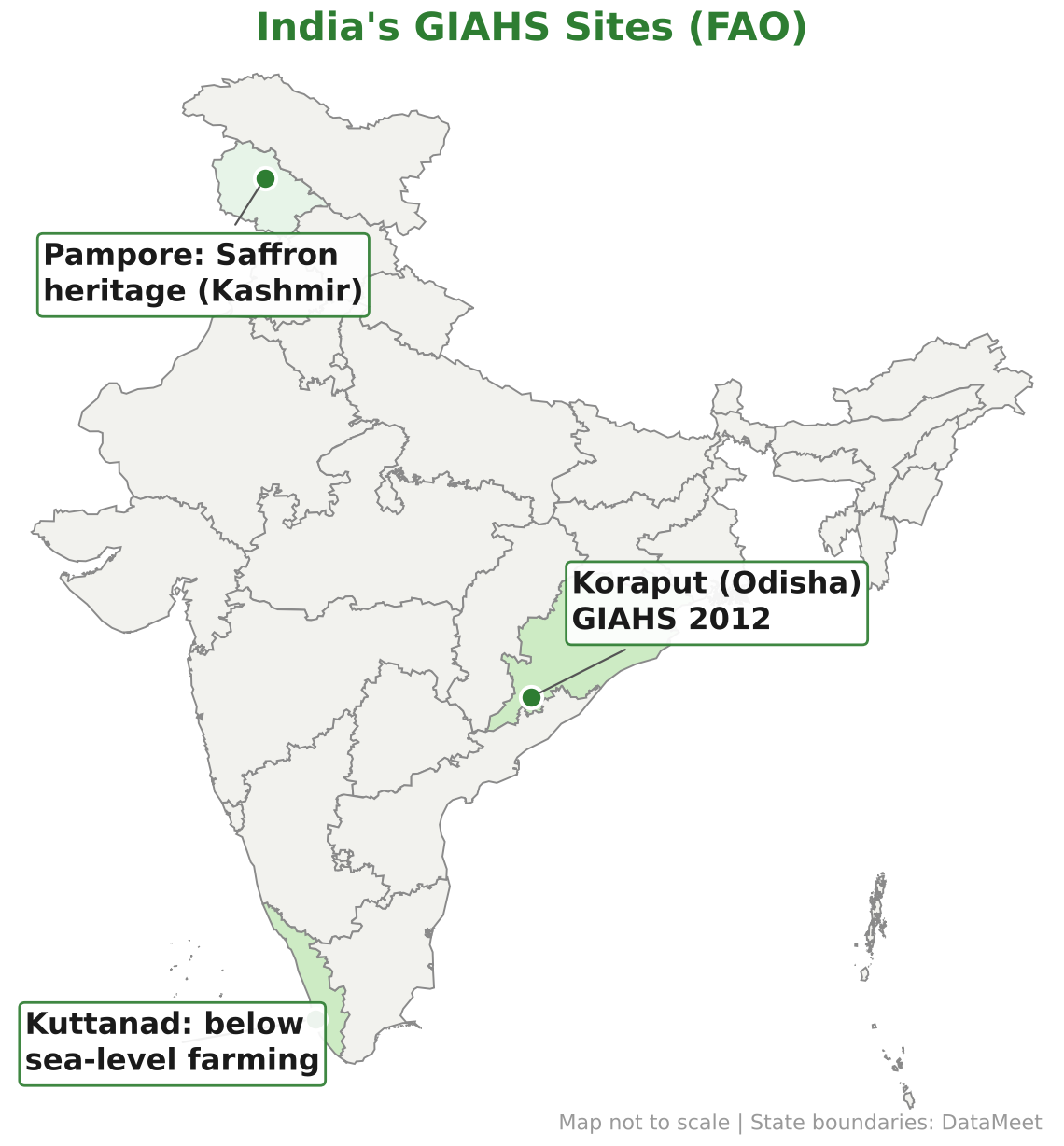
Koraput (Odisha) was recognised by FAO in 2012 as a GIAHS.
National Genebank (ICAR-NBPGR, New Delhi) is the world's second largest.
About 3,000 climate-resilient crop varieties have been developed.
Act passed in 2001 to meet TRIPS obligations in India's own way.
Way forward
Help more farmer groups register their traditional varieties and share benefits fairly when companies use them.
Concept
PPV&FR Act, 2001: protects breeders' rights and, uniquely, farmers' rights - farmers can save, use, exchange and sell farm-saved seed (but not branded seed of a protected variety). TRIPS Article 27.3(b): WTO members must protect plant varieties by patents or an effective 'sui generis' (own special) system - India chose the sui generis PPV&FR Act. GIAHS (Globally Important Agricultural Heritage Systems): FAO's tag for traditional farming systems; India's three: Koraput (Odisha), Kuttanad below-sea-level farming (Kerala), Saffron heritage of Pampore (Kashmir). Exam angle: Prelims: India's three GIAHS sites, sui generis meaning, farmers' rights under the Act. Mains: protecting farmers' traditional varieties from biopiracy (e.g. PepsiCo potato case, 2019).
India map of the three GIAHS sites - Pampore saffron (Kashmir), Koraput (Odisha) and Kuttanad (Kerala) — StudyForGS
24. Yuge Yugeen Bharat Museum in North-South Block
ART & CULTUREUPSC: Prelims + Mains GS1
Syllabus linkage
GS1 - Indian art and culture, heritage conservation. Prelims: location, budget, galleries; Mains: adaptive reuse of heritage buildings.
Context
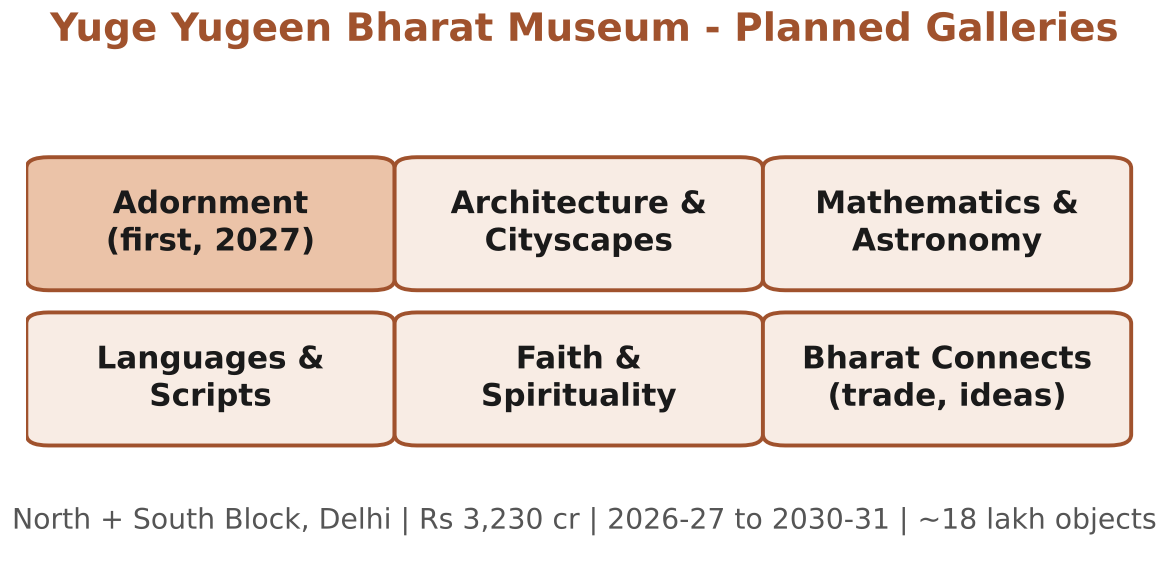
The old government buildings of North Block and South Block in Delhi will become a huge national museum showing India's history and culture over thousands of years. The Cabinet Committee on Economic Affairs approved Rs 3,230 crore for the Yuge Yugeen Bharat National Museum in the North Block and South Block buildings, New Delhi, as part of the Central Vista project. The Ministry of Culture will reuse the historic buildings. Work will be done in phases from 2026-27 to 2030-31. The first gallery, on 'Adornment', is expected to open in North Block in the latter part of 2027.
Key facts
Budget: Rs 3,230 crore; built-up area about 1,78,509 sq m.
Described as having the world's largest museum display area.
Planned galleries: Adornment, Architecture and Cityscapes, Mathematics and Astronomy, Languages and Scripts, Faith and Spirituality, Bharat Connects (trade and ideas).
About 18 lakh (1.8 million) objects identified from National Museum, 52 ASI site museums, state museums and private collections.
Inspired by France's 'Grands Projets' that turned government buildings (e.g. the Louvre wing) into cultural spaces.
Way forward
Careful conservation and transparent display of artefacts, with digital access for students across India.
Concept
North and South Block: designed by Herbert Baker (with Edwin Lutyens planning New Delhi); built in the 1920s-1931; housed key ministries like PMO, Defence, Finance, External Affairs. Adaptive reuse: giving an old building a new use while keeping its heritage character - cheaper and greener than demolition. 'Yuge Yugeen': means 'through the ages'; the museum was first showcased at the International Museum Expo, May 2023. Exam angle: Prelims: architects of North/South Block, museum location and first gallery theme. Mains: heritage-led cultural diplomacy and the challenge of conserving colonial-era buildings.
Diagram of the six planned galleries of the Yuge Yugeen Bharat Museum, with Adornment (2027) highlighted — StudyForGS
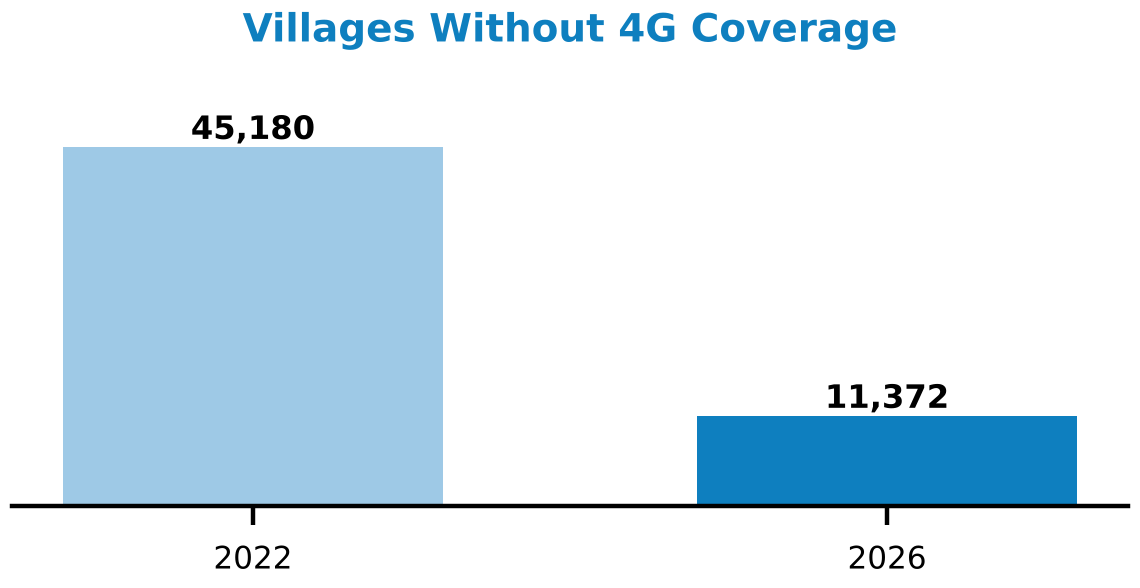
Mobile 4G internet is reaching remote villages fast. Villages without 4G have come down from about 45,000 in 2022 to about 11,000 now. The Department of Telecommunications (DoT) said on 11 November 2026 that villages without 4G fell from 45,180 in 2022 to 11,372 in 2026, a drop of nearly 75%. The 4G Saturation Project targets 24,680 uncovered villages. BSNL has commissioned 18,291 sites with up to 10,21,048 daily active users in October 2026. Another 26,000 sites are sanctioned.
BSNL sites commissioned: 18,291; up to 10.2 lakh users a day.
26,000 more sites sanctioned.
Sites use BSNL's indigenous 4G technology stack (developed with TCS and C-DOT).
Funded through Digital Bharat Nidhi.
Way forward
Quick upgrade of these sites to 5G and reliable power backup (solar) in remote areas.
Concept
4G Saturation Project: approved in 2022 to give 4G to all uncovered villages, many in tribal, border and Left Wing Extremism areas. Digital Bharat Nidhi: the new name (under the Telecommunications Act, 2023) of the Universal Service Obligation Fund, which pays for telecom in areas not profitable for private operators. Indigenous telecom stack: India is among a few countries (with Sweden, Finland, South Korea, China) that have their own 4G core and radio technology. Exam angle: Prelims: Digital Bharat Nidhi, C-DOT, Telecommunications Act 2023. Mains: connectivity in LWE and border areas for security and services delivery.
Bar chart: villages without 4G fell from 45,180 in 2022 to 11,372 in 2026 — StudyForGS
26. AI-Powered ELINT Satellites by Astrome
SCI-TECHUPSC: Prelims + Mains GS3
Syllabus linkage
GS3 - Space technology, defence technology, start-up ecosystem. Prelims: ELINT, TRL, TDB, RDI Fund; Mains: private sector in space and defence.
Context
The government will help a Bengaluru start-up build a group of small satellites that use AI to catch and study enemy radar and radio signals from space. The Technology Development Board (TDB) under the Department of Science and Technology signed an agreement with Astrome Technologies, Bengaluru, for Rs 64.05 crore under the Research Development and Innovation (RDI) Fund. The total project cost is Rs 128.11 crore. The aim is a sovereign (India-owned) AI-enabled ELINT constellation using 50 kg-class microsatellites. Support is given as Optionally Convertible Debt.
Key facts
TDB support: Rs 64.05 crore of a Rs 128.11 crore project.
Constellation of 50 kg-class microsatellites.
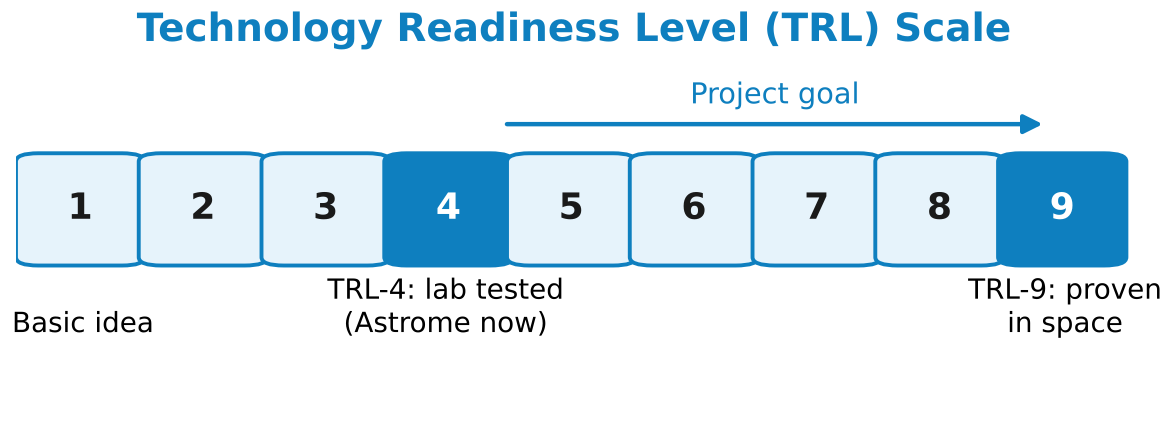
Technology to be taken from TRL-4 (lab tested) to TRL-9 (proven in space).
Funding form: Optionally Convertible Debt (loan that may become equity).
Gives India its own space-based signal intelligence capability.
Way forward
Secure data handling and close coordination with the Defence Space Agency will be needed.
Concept
ELINT (Electronic Intelligence): collecting and analysing non-communication signals, mainly radars, to find their location and type - vital for air defence and military planning. TRL (Technology Readiness Level): a 1-9 scale - 1 = basic idea, 4 = tested in lab, 9 = proven in actual use. RDI Fund: the Rs 1 lakh crore Research, Development and Innovation scheme (approved 2025) giving long-term low-cost funding to private R&D in sunrise sectors. Exam angle: Prelims: ELINT vs SIGINT vs COMINT, TRL scale, TDB's parent department. Mains: role of private start-ups in building strategic space capabilities after the 2020 space reforms (IN-SPACe).
Technology Readiness Level scale 1 to 9 showing the Astrome project goal from TRL-4 to TRL-9 — StudyForGS
27. Vitamin B12 Used in a Rechargeable Battery
SCI-TECHUPSC: Prelims + Mains GS3
Syllabus linkage
GS3 - Science in everyday life, new energy storage technologies; GS2 - Health (nutrition). Prelims: B12 facts; Mains: alternatives in battery chemistry.
Context
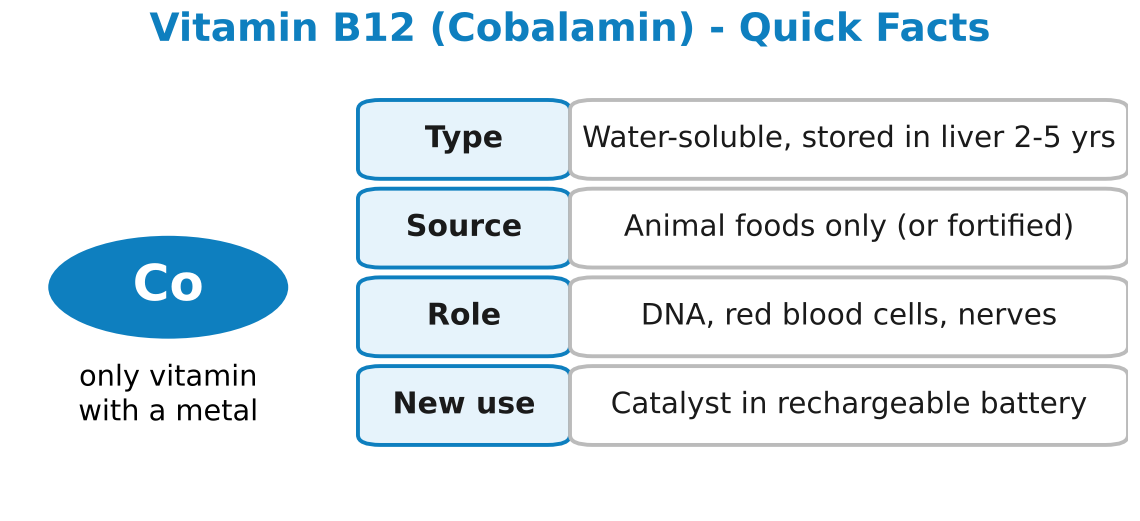
Scientists in Spain have used vitamin B12 as a helper (catalyst) inside a rechargeable battery. B12 is special because it is the only vitamin with a metal - cobalt - in it. Researchers in Spain have developed a rechargeable battery that uses vitamin B12 as a catalyst (a substance that speeds up a chemical reaction without being used up). Vitamin B12, also called cobalamin, has the largest and most complex structure of all vitamins. It is the only vitamin that contains a metal ion - cobalt. Such bio-inspired catalysts may cut the need for costly metals in batteries.
Key facts
B12 = cobalamin; contains cobalt.
Water-soluble; excess removed in urine, but the liver stores it for 2-5 years.
Found naturally only in animal foods (fish, meat, eggs, milk); plant foods lack it unless fortified.
Needed to make DNA and red blood cells and for the nervous system.
Deficiency: anaemia, numbness and tingling, weakness, memory problems; higher risk in vegetarians and people over 50.
Way forward
Fortified foods and testing in high-risk groups; for batteries, scale-up research to see if the idea works commercially.
Concept
Catalyst: speeds up a reaction and stays unchanged; enzymes are biological catalysts. Pernicious anaemia: an autoimmune condition where the stomach cannot absorb B12 (lack of 'intrinsic factor'). Fat-soluble vs water-soluble vitamins: A, D, E, K are fat-soluble (stored in body fat); B-group and C are water-soluble (B12 is the exception that is stored long in the liver). Exam angle: Prelims: which vitamin contains cobalt; water-soluble vitamins; sources of B12. Mains: high B12 deficiency in vegetarian-heavy India and food fortification.
Vitamin B12 (cobalamin) facts diagram: cobalt at centre, type, source, role and new battery use — StudyForGS
28. Air Force Commanders' Conference 2026
DEFENCEUPSC: Prelims + Mains GS3
Syllabus linkage
GS3 - Security challenges, emerging technologies in defence. Prelims: theme, AI initiatives; Mains: multi-domain warfare and jointness.
Context
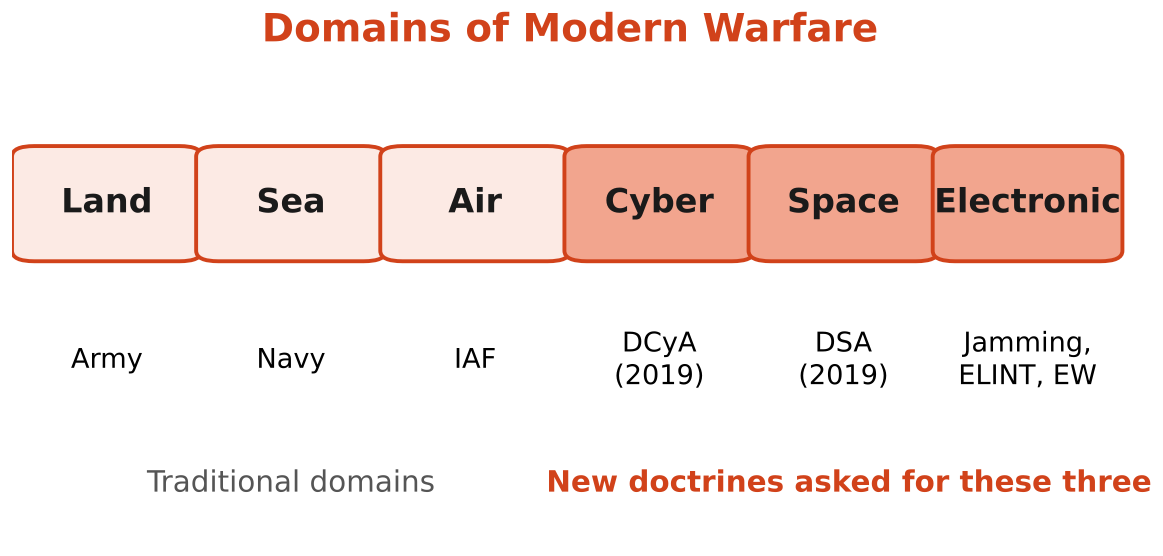
The Defence Minister told top Air Force commanders to prepare for new kinds of war - in cyberspace, space and the electronic world - and to use surprise and better surveillance. Defence Minister Rajnath Singh addressed the Air Force Commanders' Conference in New Delhi on 12 November 2026. The theme is 'The Year of Empowerment: Maximising Efficiency Through Decentralisation'. He asked the IAF to build dedicated doctrines for electronic, cyber and space warfare and to strengthen intelligence and surveillance. He also launched in-house IAF AI applications from its AI Centre of Excellence under project UDAAN.
Key facts
Theme: 'The Year of Empowerment: Maximising Efficiency Through Decentralisation'.
Modern wars are 'non-contact' - missiles, drones and long-range weapons.
He praised IAF's doctrines during and after Operation Sindoor.
Second Tour of Duty for Agniveers was based on feedback from the Services.
AI apps launched from IAF's AI Centre of Excellence (UDAAN).
Way forward
Write joint doctrines for cyber and space, invest in indigenous sensors and drones, and train people in AI.
Concept
Non-contact warfare: fighting without troops meeting face-to-face - through missiles, drones, cyber attacks and electronic jamming. Multi-domain operations: combining land, sea, air, cyber and space forces together; India has the Defence Cyber Agency and Defence Space Agency (both 2019) for the new domains. Agnipath scheme (2022): short-term (4-year) recruitment of 'Agniveers'; 25% retained in regular service. Exam angle: Prelims: Defence Space Agency/Defence Cyber Agency, Agnipath basics. Mains: why integrated theatre commands and new-domain doctrines are needed; lessons from Operation Sindoor.
Diagram of six warfare domains: land, sea, air (traditional) and cyber, space, electronic (new doctrines) — StudyForGS
29. INS Betwa Refit at Cochin Shipyard
DEFENCEUPSC: Prelims + Mains GS3
Syllabus linkage
GS3 - Defence modernisation, indigenisation, shipbuilding. Prelims: Project 16A, shipyards; Mains: life extension vs new ships.
Context
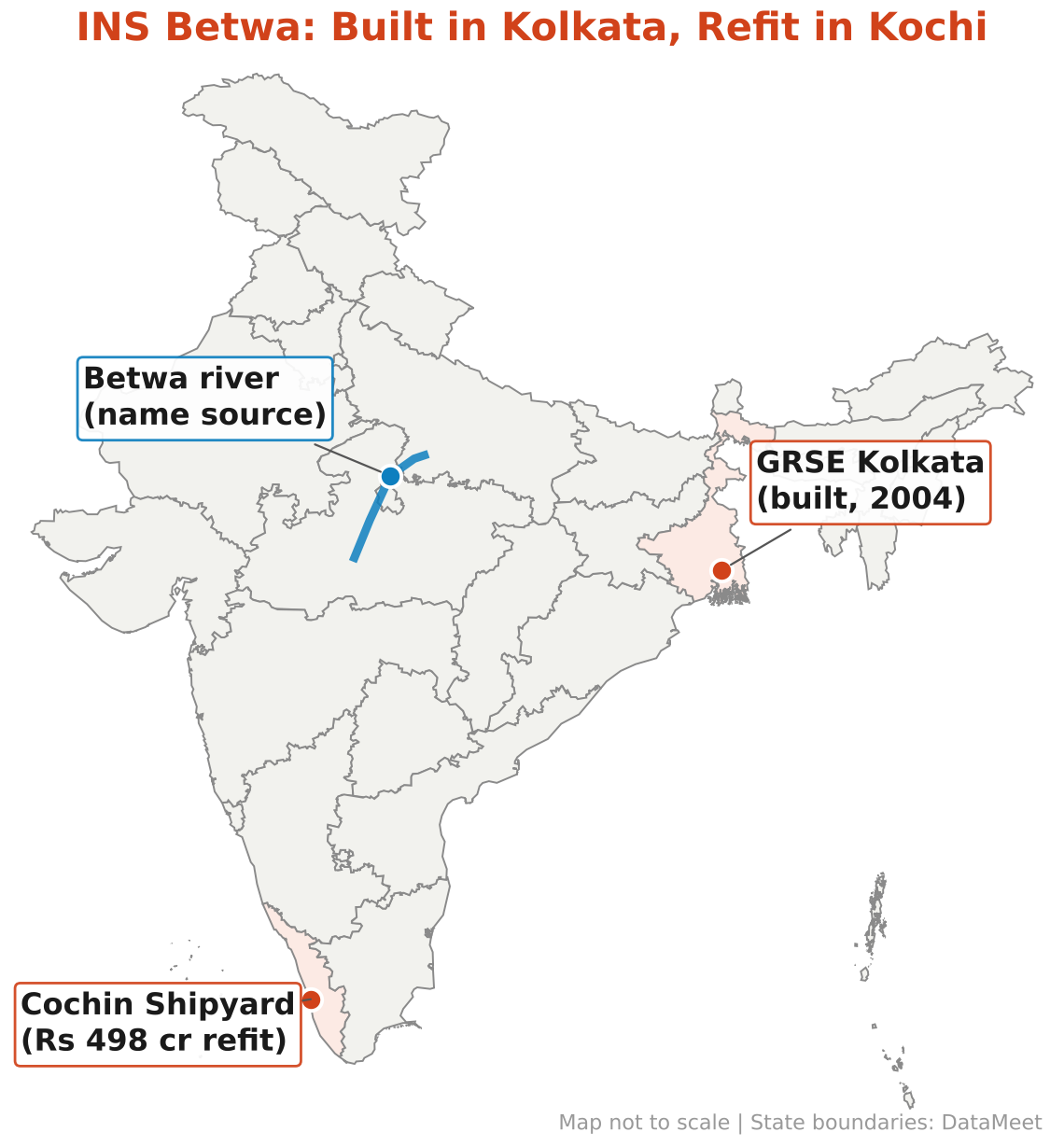
The Navy's frigate INS Betwa will get a new heart - its old steam engines will be replaced with diesel engines - under a Rs 498 crore deal with Cochin Shipyard. The Defence Ministry signed a Rs 498 crore contract with Cochin Shipyard Ltd for the 'refit and re-powering' of INS Betwa (F39). Its steam propulsion will be replaced with a diesel engine system. INS Betwa is an indigenously built guided-missile frigate of the Brahmaputra class (Project 16A), built by Garden Reach Shipbuilders and Engineers (GRSE), Kolkata. It was commissioned on 7 July 2004.
Key facts
Project 16A ships: INS Brahmaputra, INS Betwa, INS Beas.
Displacement 3,600 tonnes; length 125 m; speed over 30 knots.
First Indian warship with an indigenously designed Combat Management System (EMCCA).
Roles: anti-air, anti-surface and anti-submarine warfare; can carry helicopters.
Named after the Betwa river (a tributary of the Yamuna).
Way forward
Use such refits to also add modern sensors and weapons, and build indigenous marine engines.
Concept
Refit: a major repair and upgrade that extends a ship's life; re-powering = changing the propulsion system. Frigate vs Destroyer vs Corvette: destroyers are the biggest of these and most heavily armed; frigates are medium escort ships; corvettes are the smallest. Defence PSU shipyards: Mazagon Dock (Mumbai), GRSE (Kolkata), Goa Shipyard, Hindustan Shipyard (Visakhapatnam); Cochin Shipyard built INS Vikrant, the first indigenous aircraft carrier. Exam angle: Prelims: Project 16A class name, builder, Cochin Shipyard's notable ship. Mains: cost-effective life extension of ships vs new building; self-reliance in naval engines.
India map showing GRSE Kolkata (builder), Cochin Shipyard (refit) and the Betwa river — StudyForGS
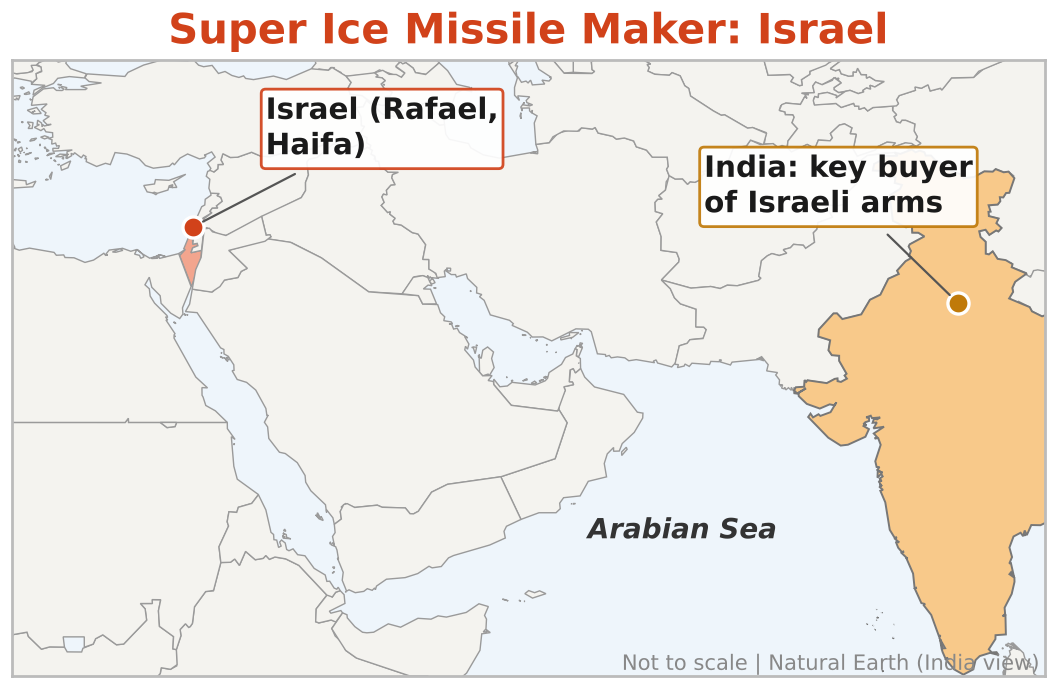
An Israeli company has shown a new long-range cruise missile that can hit far targets accurately even when GPS signals are jammed. Israel's Rafael Advanced Defense Systems has unveiled the 'Super Ice' long-range cruise missile. It belongs to Rafael's new cruise missile family with Sea Breaker (2021) and Ice Breaker (2023). It can be launched from aircraft, ground systems and ships. It carries a 454 kg warhead - about four times Ice Breaker's - and is compatible with the US-made MK83 bomb.
Key facts
Maker: Rafael Advanced Defense Systems (Israel).
Warhead: 454 kg; range not disclosed but more than Ice Breaker's 300 km.
Flies low, following the terrain (to avoid radar).
Electro-optical image-matching guidance: compares camera images with stored maps, so it works without satellite navigation.
Targets: air-defence systems, military bases, high-value strategic sites.
Way forward
India should speed up its own long-range cruise missiles and electronic warfare to counter such weapons.
Concept
Cruise vs ballistic missile: a cruise missile flies like a plane with jet engine inside the atmosphere at low height (e.g. BrahMos); a ballistic missile goes high on a rocket arc and falls on target (e.g. Agni). Stand-off weapon: fired from a long distance so the launching aircraft stays safe outside enemy air defence. GPS-denied navigation: methods like terrain matching (TERCOM), scene matching and inertial navigation used when satellite signals are jammed or spoofed. Exam angle: Prelims: cruise vs ballistic examples, scene-matching guidance. Mains: India-Israel defence ties and lessons for India's long-range strike and air-defence planning.
Map of West Asia and India showing Israel, maker of the Super Ice missile, and India — StudyForGS
Data point of the day
6.09%
Retail (CPI) inflation, October 2026 Up from 5.54% in September and above the RBI's 6% upper tolerance limit; food inflation 8.94%, onion up 116% year-on-year.
Prelims rapid-fire
U-19 Asia Cup: India beat Afghanistan by 8 wickets in the semi-final in Oman; final vs Pakistan on 14 November.
Shooting: Vivaan Kapoor won silver in men's trap at the ISSF World Championships, Doha, earning an LA 2028 Olympic quota (3rd Indian quota after Jaypal Malviya and Niraj Kumar).
Youth Olympics: Boxers Gunjan (48 kg) and Lairenlakpam Ambekar Meetei (50 kg) reached finals at the Youth Olympic Games, Dakar (Senegal).
SAFF Championship: India topped Group B after a 1-0 win over Maldives in Dhaka; semi-final vs Bhutan on 14 November.
12 November: Public Service Broadcasting Day - marks Gandhiji's only visit to AIR's Broadcasting House (1947), when he spoke to Partition refugees at Kurukshetra.
Gallantry portal: gallantryawards.gov.in relaunched with Warpedia and Gallantrypedia sections; Veer Gatha 5th edition reached 1.92 crore+ students.
Sea Vigil-26: 5th edition of the pan-India coastal defence exercise (11-19 November), coordinated by the Navy; started in 2018 after the 26/11 attacks.
IMNEX-26: India-Myanmar Naval Exercise at Visakhapatnam (10-14 November) with INS Rana and INS Sumedha.
KVS digital: Kendriya Vidyalaya Sangathan launched the AI-based Vidya Samiksha Kendra, KVS-Samvaad parent app and Alumni Connect portal.
Bharat Parv 2026: Held at Ekta Nagar, Gujarat (till 15 November) with the theme 'Ek Bharat Shreshtha Bharat'.
Mains practice question
Q. The recent rationalisation of India's visa regime is a tool to promote tourism, education and soft power. Discuss how it balances these aims with national security concerns. (150 words)
Hint / approach
9 categories, Visitor Visa, e-Visa for 172 countries, Immigration and Foreigners Act 2025; gains - tourism, 'Study in India', medical tourism; concerns - overstay, security checks; fixes - digital tracking, fast but strict checks.
📌 One-line revision: CPI 6.09% (band 2-6%), TB deaths down 38% but India has 25% of world cases, COP31 Antalya finance fight (NCQG US$300 bn), India 28th in CCPI, visa categories now 9, ASEAN-India Summit Manila 16-18 Nov.