Wednesday, 11 November 2026 · IST · National & International · 31 items
The Supreme Court asked WhatsApp and other platforms to explain how they will stop digital arrest scams, and separately ruled that the 24-hour production clock starts from the moment of detention. Abroad, the US, Russia and Ukraine met in Abu Dhabi while India offered a practical truce plan, and at COP31 in Antalya India pressed for equity and public climate finance. New jobs data, cheaper cancer drugs and a big blue-economy push for the islands round off the day.
Today at a glance — things to remember
SC: WhatsApp, other platforms to outline steps against digital arrest scams; next hearing 23 Nov.
SC (Sujit Das case): 24-hour clock under Article 22(2) starts at actual detention.
ECI: Model Code restrictions now cover retired and re-hired staff in 5 poll-bound States.
PLFS Jul-Sep 2026: unemployment falls to 5.1%; female LFPR rises to 34.7%.
Revised MRPs of about 1,364 cancer formulations in force; savings about Rs 3,540 crore a year.
US-Russia-Ukraine talks in Abu Dhabi; India proposes 3-step truce on Black Sea, energy and frontline.
COP31 (Antalya, Turkiye): India stresses equity, CBDR-RC and Article 9.1 climate finance.
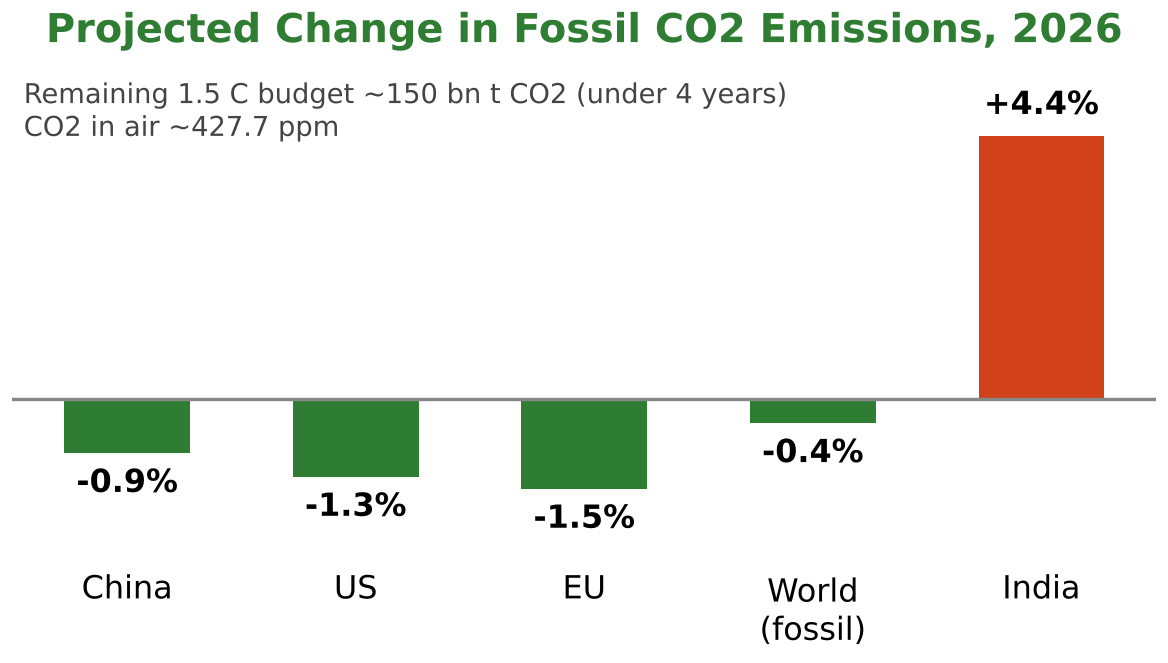
Global Carbon Budget 2026: fossil CO2 to dip 0.4%; India's to rise 4.4%; 1.5 C budget under 4 years.
SC-appointed CEC: phase out river-bed sand mining in 3 years; use dam silt, M-sand, recycled debris.
India-Saudi Haj 2027 pact: quota of 1,75,025 pilgrims.
Detailed notes
1. SC Tightens Net on Digital Arrest Scams
POLITYUPSC: Prelims + Mains GS2 / GS3
Syllabus linkage
GS2: Judiciary, Government policies; GS3: Cyber security. Prelims: I4C, helpline 1930, suo motu; Mains: platform and bank accountability for cyber fraud.
Context
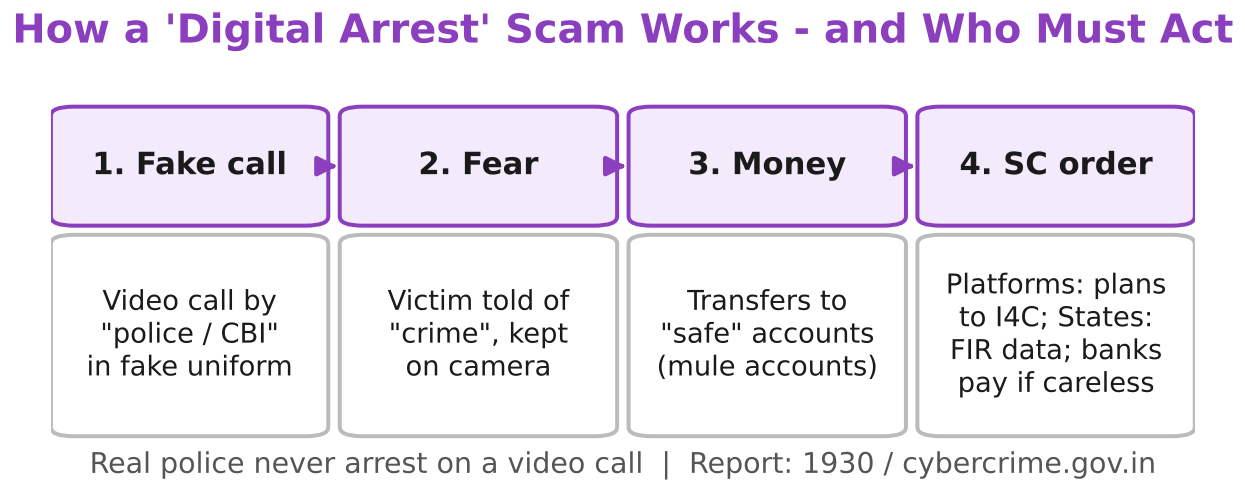
Fraudsters pose as police or CBI officers on video calls, 'arrest' people online and scare them into paying money. The Supreme Court now wants WhatsApp and other platforms to explain how they will stop this. A bench led by Chief Justice of India Surya Kant is hearing a suo motu case (a case the court starts on its own) titled 'Victims of Digital Arrest Related to Forged Documents'. It asked WhatsApp and other intermediaries (online platforms that carry other people's messages) to tell the court what steps they will take to prevent digital arrest scams and related cybercrimes. They must send these proposals to the Indian Cybercrime Coordination Centre (I4C) at the same time. Police of all States and UTs must report FIRs registered in such cases and the progress of investigations. WhatsApp said it has acted against 9,400 accounts and will file an affidavit.
Key facts
Bench: CJI Surya Kant, Justices Joymalya Bagchi and V. Mohana.
WhatsApp told the court it has taken action against 9,400 accounts.
On 29 October the court said banks should compensate victims where a probe shows the fraud happened because the bank failed in due diligence (proper care).
Proposals of platforms to be shared with I4C; States/UTs to report FIRs and probes.
Next hearing listed for 23 November 2026.
Way forward
Build a common fraud-alert system linking banks, telecom operators and platforms, and run mass awareness that a 'digital arrest' is always fake.
Concept
'Digital arrest' is not a legal procedure at all - no police or agency in India arrests anyone over a video call. It is purely a fraud method based on fear. I4C (Indian Cybercrime Coordination Centre) works under the Ministry of Home Affairs (inaugurated January 2020). Citizens report cyber fraud on cybercrime.gov.in or the helpline 1930. Intermediary: defined in the IT Act, 2000; it must follow 'due diligence' duties under the IT Rules, 2021 to keep its legal protection. Exam angle: Prelims: I4C and its ministry, helpline 1930, meaning of suo motu, who is an intermediary. Mains: cyber fraud as a threat to citizens and the economy; shared responsibility of platforms, banks, telecom firms and police; role of courts in filling governance gaps.
Four-step flow of a digital arrest scam - fake call, fear, money transfer - and the Supreme Court's directions to platforms, States and banks — StudyForGS
2. Census 2027: Trainers Get Ready
POLITYUPSC: Prelims + Mains GS2 / GS1
Syllabus linkage
GS1: Population; GS2: Government policies and governance. Prelims: Census timeline, reference date, Census Act; Mains: importance of Census data for policy.
Context
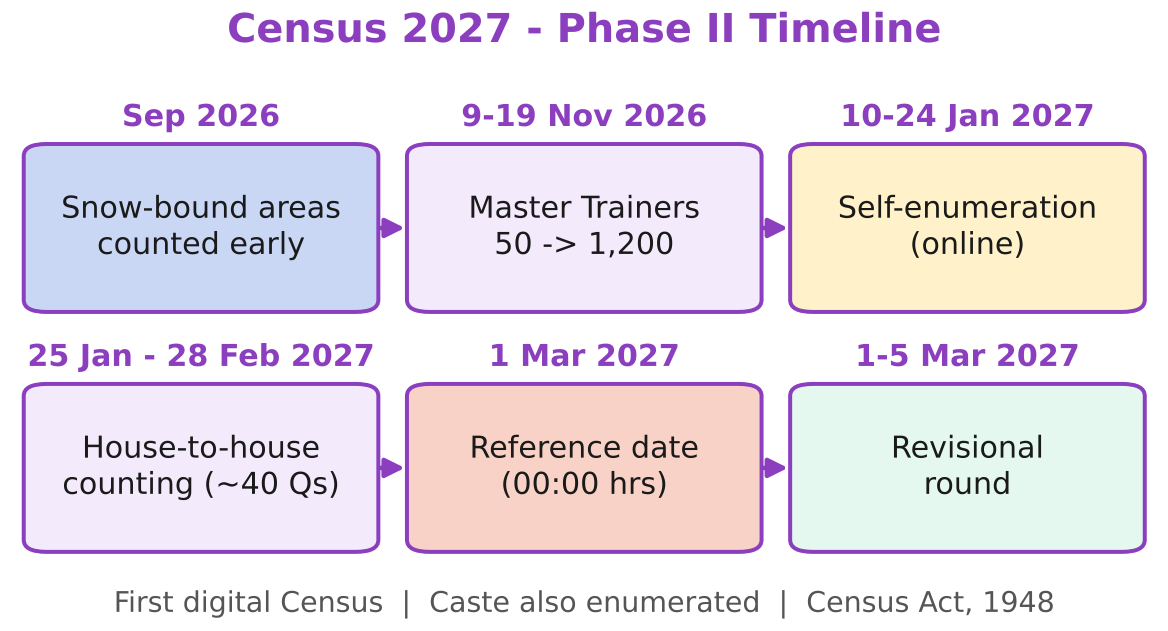
India's next Census is close. Training of the top trainers for Phase II (counting of people) has started, and the counting will run in February 2027. Training of Master Trainers for Phase II of Census 2027 (Population Enumeration, i.e. counting people) began on 9 November at the Institute of Management in Government (IMG), Kerala. 50 trainers (36 from States, 14 from Directorates of Census Operations) are being trained in two four-day batches (9-12 and 16-19 November). They will in turn train about 1,200 Field Trainers. The enumeration will cover about 40 questions.
Key facts
Self-enumeration window (citizens fill details online): 10-24 January 2027.
Main enumeration: 25 January - 28 February 2027; revisional round 1-5 March 2027.
Reference date: 1 March 2027 (00:00 hours).
Snow-bound areas (Ladakh, J&K, Himachal, Uttarakhand) were counted earlier, in September 2026.
50 Master Trainers -> 1,200 Field Trainers -> lakhs of enumerators (a training 'pyramid').
Way forward
Strong training, clear questions and data protection will decide the quality of Census 2027 data.
Concept
Census is in the Union List (Entry 69, Seventh Schedule) and is conducted under the Census Act, 1948 by the Registrar General and Census Commissioner (Ministry of Home Affairs). Census 2027 is India's first digital Census (mobile apps) and will also record caste, for the first time since 1931 in a full Census. Reference date = the moment for which the population is counted, so that everyone is counted once. Exam angle: Prelims: reference dates, self-enumeration, Census Act, constitutional entry. Mains: delimitation and women's reservation are linked to Census data; data privacy in a digital Census.
Timeline of Census 2027 Phase II from snow-bound area counting in September 2026 to the revisional round in March 2027 — StudyForGS
3. Poll Code Now Covers Retired Staff Too
POLITYUPSC: Prelims + Mains GS2
Syllabus linkage
GS2: Elections, Election Commission, Model Code of Conduct. Prelims: Article 324, MCC basics; Mains: neutrality of administration during polls.
Context
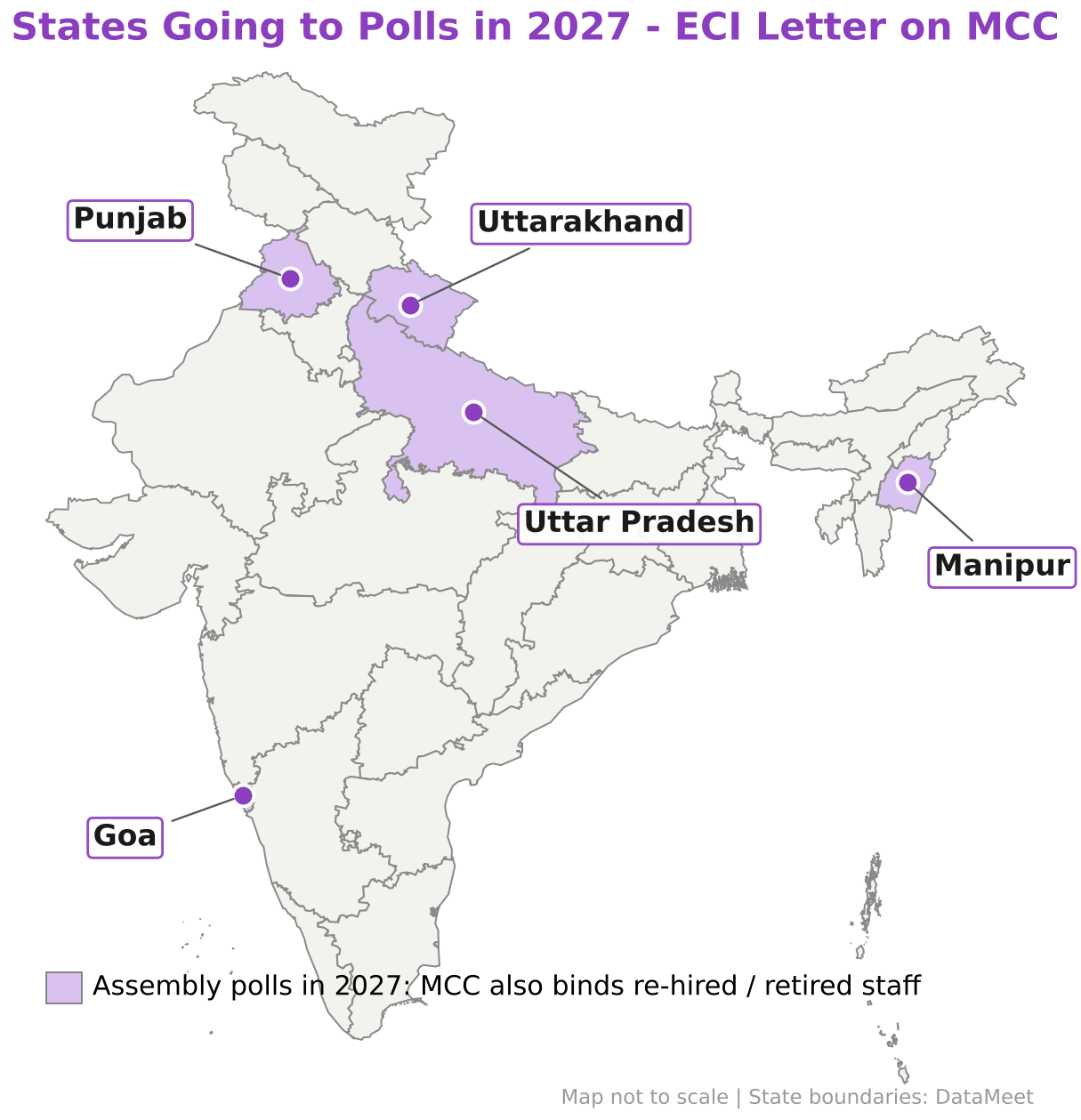
During elections, government employees must stay neutral. The Election Commission has said the same rule now applies to retired officials and other people hired by State governments. The Election Commission of India (ECI) has said that restrictions under the Model Code of Conduct (MCC) for serving employees will also apply to retired officials and other persons engaged (hired) by State/UT governments. It wrote to the Chief Secretaries and Chief Electoral Officers of Goa, Manipur, Punjab, Uttar Pradesh and Uttarakhand, which go to the polls next year. Such persons must stay politically neutral, cannot campaign and cannot call poll officers for meetings. The code also covers bodies wholly or partly funded by the government.
Key facts
Five States with Assembly polls in 2027 written to: Goa, Manipur, Punjab, Uttar Pradesh, Uttarakhand.
Covers retired officials, consultants and contract persons engaged by governments.
No campaigning, no political work, no summoning of poll officials.
Applies to bodies wholly or partly government-funded.
Way forward
States should list all re-engaged officials before polls so that the order can be enforced quickly.
Concept
Model Code of Conduct: a set of guidelines for parties, candidates and governments during elections. It has no direct statute behind it; it grew from consensus (first used in Kerala in 1960) and comes into force when ECI announces the poll schedule. Article 324 gives ECI 'superintendence, direction and control' of elections - the source of its power to enforce the MCC. Some MCC-type wrongs (bribery, undue influence) are also offences under the Representation of the People Act, 1951 and the BNS. Exam angle: Prelims: Article 324, when MCC starts, legal status of MCC. Mains: Should MCC be made statutory? How to keep the bureaucracy neutral when governments re-hire retired officers.
India map highlighting Goa, Manipur, Punjab, Uttar Pradesh and Uttarakhand, the States with Assembly polls in 2027 — StudyForGS
4. Safe Harbour for Platforms Under Review
POLITYUPSC: Prelims + Mains GS2
Syllabus linkage
GS2: Government policies, Regulation of digital media; GS3: Internal security and social media. Prelims: Section 79 IT Act, IT Rules 2021; Mains: free speech vs platform accountability.
Context
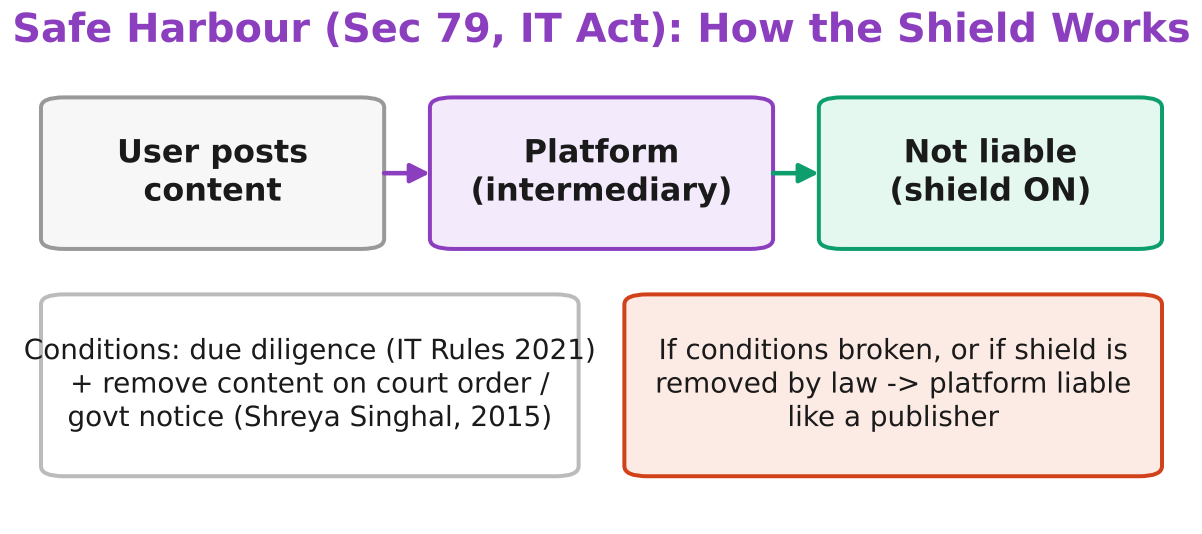
Today social media companies are not punished for what their users post, as long as they follow government rules. Reports say the government is thinking of removing this shield for social media platforms. The government is reportedly weighing an end to 'safe harbour' protection for social media platforms. Safe harbour means a legal shield: an intermediary is not held liable for third-party content if it meets certain conditions. If the shield is removed, platforms could be held answerable, like publishers, for posts by users. This would be a major change in how India regulates online speech.
Key facts
Safe harbour is given by Section 79 of the IT Act, 2000.
Conditions: follow due diligence under the IT Act and IT Rules 2021, and remove unlawful content when told by a court order or government notification.
Shreya Singhal case (2015): Supreme Court said 'actual knowledge' means a court order or government notice - not just any private complaint.
The same judgment struck down Section 66A of the IT Act (vague offence of 'offensive' messages).
Non-compliance leads to loss of protection.
Way forward
Any change should be made through a clear law after public consultation, with graded liability instead of a blanket removal of protection.
Concept
Intermediary: a platform that transmits, stores or hosts content made by others - e.g. social media, messaging apps, search engines, ISPs. IT Rules 2021: grievance officers, faster takedowns and extra duties for 'significant social media intermediaries' (50 lakh or more registered users in India). Article 19(1)(a) guarantees free speech; Article 19(2) allows only 'reasonable restrictions' on listed grounds such as public order and sovereignty. Exam angle: Prelims: Section 79, Section 66A, Shreya Singhal, SSMI threshold. Mains: Should platforms be treated as publishers? Balance between fighting fake news and deepfakes on one hand and free speech and innovation on the other.
Diagram of how safe harbour under Section 79 of the IT Act shields a platform, its conditions and what happens if they are broken — StudyForGS
India runs a yearly cleanliness survey of its towns and cities. The President gives away the awards for its 10th edition today. President Droupadi Murmu confers the 10th edition of the Swachh Survekshan 2025-26 awards at Vigyan Bhawan, New Delhi, on 11 November. The survey is run by the Ministry of Housing and Urban Affairs (MoHUA). The theme is 'Swachhata Ki Nayi Pehel - Badhayein Haath, Karein Safai Saath'. The latest edition covers more than 4,700 cities, and awards also go to top performers of the 'Swachh Shehar Jodi' (mentor-mentee city) initiative.
Key facts
Survey began in 2016 with only 73 urban local bodies (ULBs).
Cities assessed on 43 indicators in about 10 areas: segregation, collection, processing of waste, visible cleanliness, toilets, desludging, used water, worker welfare, citizen feedback.
Swachh Shehar Jodi: 70 mentor cities paired with 191 mentee cities in 33 States/UTs.
Ministry: MoHUA (Minister Manohar Lal).
Way forward
Rankings should reward lasting systems (waste processing, used-water treatment) and not only visible cleanliness on survey days.
Concept
Swachh Bharat Mission-Urban started on 2 October 2014; SBM-U 2.0 (from October 2021) aims at 'Garbage Free Cities'. ULBs (municipal bodies) get constitutional status from the 74th Amendment, 1992 (Part IXA); sanitation is in the Twelfth Schedule. Swachh Survekshan is a competitive ranking - it uses competition among cities to push better service delivery. Exam angle: Prelims: launch year of survey, ministry, SBM-U 2.0 goal, 74th Amendment. Mains: role of ranking and competition in urban governance; sanitation worker welfare.
6. 24-Hour Clock Starts at Detention
POLITYUPSC: Prelims + Mains GS2
Syllabus linkage
GS2: Fundamental Rights (Article 22), Criminal justice, Judiciary. Prelims: Article 22, BNSS Section 58; Mains: personal liberty vs police powers.
Context
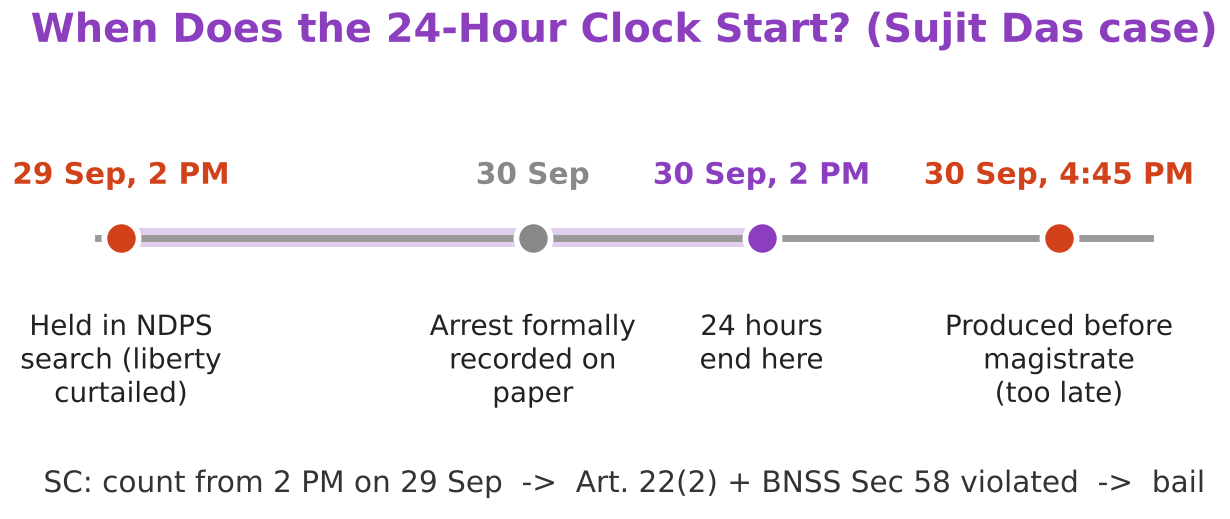
When police hold a person, they must take him or her to a magistrate within 24 hours. The Supreme Court has said this clock starts the moment the person's freedom is actually taken away, not when police write 'arrested' on paper. In Sujit Das v. Union of India (decided 5 November 2026), a bench of Justices Ujjal Bhuyan and Atul S. Chandurkar ruled that the 24-hour limit runs from the time a person's liberty is curtailed (restricted). In the case, four persons were held during an NDPS (drugs law) search in Tripura at about 2 PM on 29 September 2025. Their arrest was formally recorded only on 30 September and they reached a magistrate at 4:45 PM that day - more than 24 hours after being held. The court set aside the Tripura High Court's order and directed their release on bail with conditions. The judgment is being discussed widely in today's editorials as a big win for personal liberty.
Key facts
Article 22(2): produce an arrested person before the nearest magistrate within 24 hours, excluding only travel time.
BNSS Section 58 (old CrPC Section 57) carries the same 24-hour rule for arrest without warrant.
Calling custody 'inquiry', 'interrogation' or 'search' cannot hide it - holding = custody.
Magistrates must record the actual time liberty was curtailed; remand (further custody) is not automatic.
If 24 hours are crossed without production, the person must be released.
Way forward
Police stations should log the exact time of first detention digitally, and magistrates should check it in every remand hearing.
Concept
Article 22: protection against arrest and detention - right to know the grounds of arrest, right to consult a lawyer and 24-hour production. Clauses (1) and (2) do not apply to enemy aliens and to preventive detention. BNSS 2023 (Bharatiya Nagarik Suraksha Sanhita) replaced the CrPC from 1 July 2024; BNS replaced IPC and BSA replaced the Evidence Act. Article 21 (life and personal liberty) is read with Article 22; illegal detention can be challenged through a writ of Habeas Corpus. Exam angle: Prelims: Article 22 clauses, exclusions, BNSS section numbers, Habeas Corpus. Mains: custodial safeguards, misuse of 'informal detention', role of magistrates as a check on police.
Timeline of the Sujit Das case showing detention at 2 PM on 29 September, formal arrest on 30 September and late production before the magistrate — StudyForGS
7. Vayo SAATHI: Youth Volunteers for Elders
POLITYUPSC: Prelims + Mains GS2
Syllabus linkage
GS2: Welfare of vulnerable sections (senior citizens), Government schemes; GS1: Population ageing. Prelims: AVYAY, scheme names; Mains: care economy for the elderly.
Context
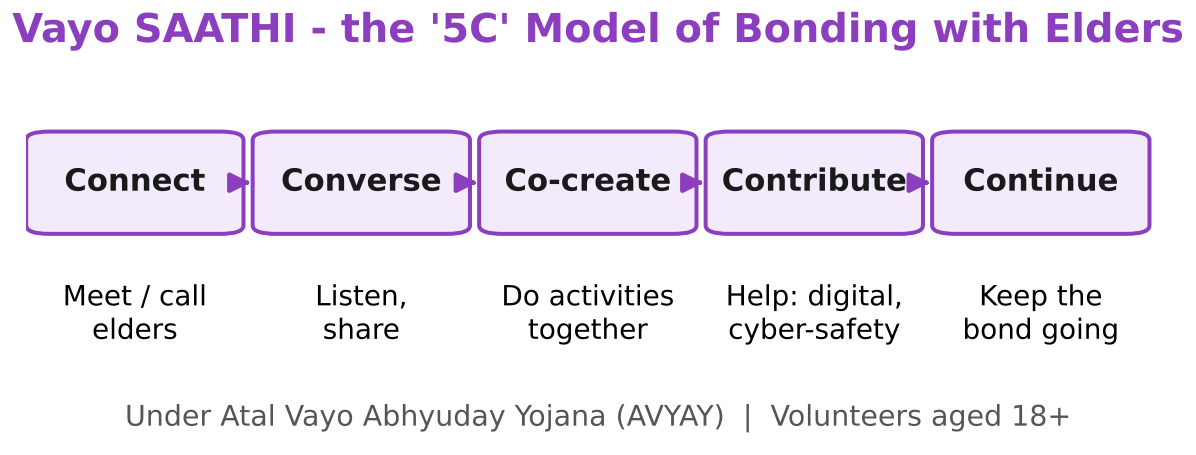
The government wants young people to spend time with and help older citizens - for example with phones, online services and avoiding cyber fraud. Citizens aged 18+ can now register as 'Vayo SAATHI' volunteers. The Ministry of Social Justice and Empowerment has invited citizens aged 18 and above to register as Vayo SAATHI volunteers under the Vayo Samman Rashtriya Abhiyan, a national campaign to build bonds between generations. SAATHI stands for Support, Awareness, Assistance, Training, Health and Inclusion. Volunteers will help senior citizens with digital services, welfare information, cyber-fraud awareness and health. Registration is through the SCW SAMAVESH portal or the JEEVAN mobile app, and volunteers get a certificate.
Key facts
Campaign comes under the Atal Vayo Abhyuday Yojana (AVYAY).
12 theme areas, e.g. '30 Minutes Together', 'Digital Dada-Dadi', 'Silver Skills - Seniors as Mentors'.
Panchayats, schools, universities, NGOs, RWAs and CSR partners asked to mobilise volunteers.
Way forward
Link the volunteer network with local health workers and the Elderline helpline so that help reaches lonely elders quickly.
Concept
AVYAY: umbrella scheme of MoSJE for senior citizens (old-age homes, care, livelihood, awareness). Maintenance and Welfare of Parents and Senior Citizens Act, 2007 makes children/relatives legally bound to maintain elders; Article 41 (DPSP) asks the State to give public help in old age. India is ageing: the share of people aged 60+ is projected to cross about 20% by 2050, so elder care is a growing policy need. Exam angle: Prelims: AVYAY, 2007 Act, Article 41, Elderline 14567 (national helpline for senior citizens). Mains: loneliness and digital exclusion of the elderly; inter-generational solidarity.
The 5C model of the Vayo SAATHI campaign - Connect, Converse, Co-create, Contribute, Continue — StudyForGS
8. Ukraine Talks in Abu Dhabi; India's Plan
IRUPSC: Prelims + Mains GS2
Syllabus linkage
GS2: India and its neighbourhood/major powers, Effect of policies of other countries on India. Prelims: Black Sea geography, ports; Mains: India's strategic autonomy and peace diplomacy.
Context
The US, Russia and Ukraine are holding a third round of peace talks in Abu Dhabi. India is not at the table but has given a practical three-step truce idea and is talking to both sides. Delegations from the US, Russia and Ukraine met in Abu Dhabi (UAE) on 10-11 November for the third round of US-mediated peace talks on a war that is nearly five years old. Earlier rounds were held in Istanbul (2025) and Geneva (February 2026). A day before the talks, PM Modi spoke to President Zelenskyy and EAM Jaishankar spoke to Russian FM Lavrov. India's spokesperson said 'endless war must give way to end of war' and that the conflict can end only through dialogue and diplomacy.
Key facts
India's 3-part truce idea: (1) fewer attacks around the Black Sea so farm exports can move, (2) stop attacks on energy infrastructure, (3) Ukraine to hold fire along the line of contact.
Ukraine's FM called India's proposal the most comprehensive among those received; Zelenskyy welcomed India's offer to help set up 'food corridors'.
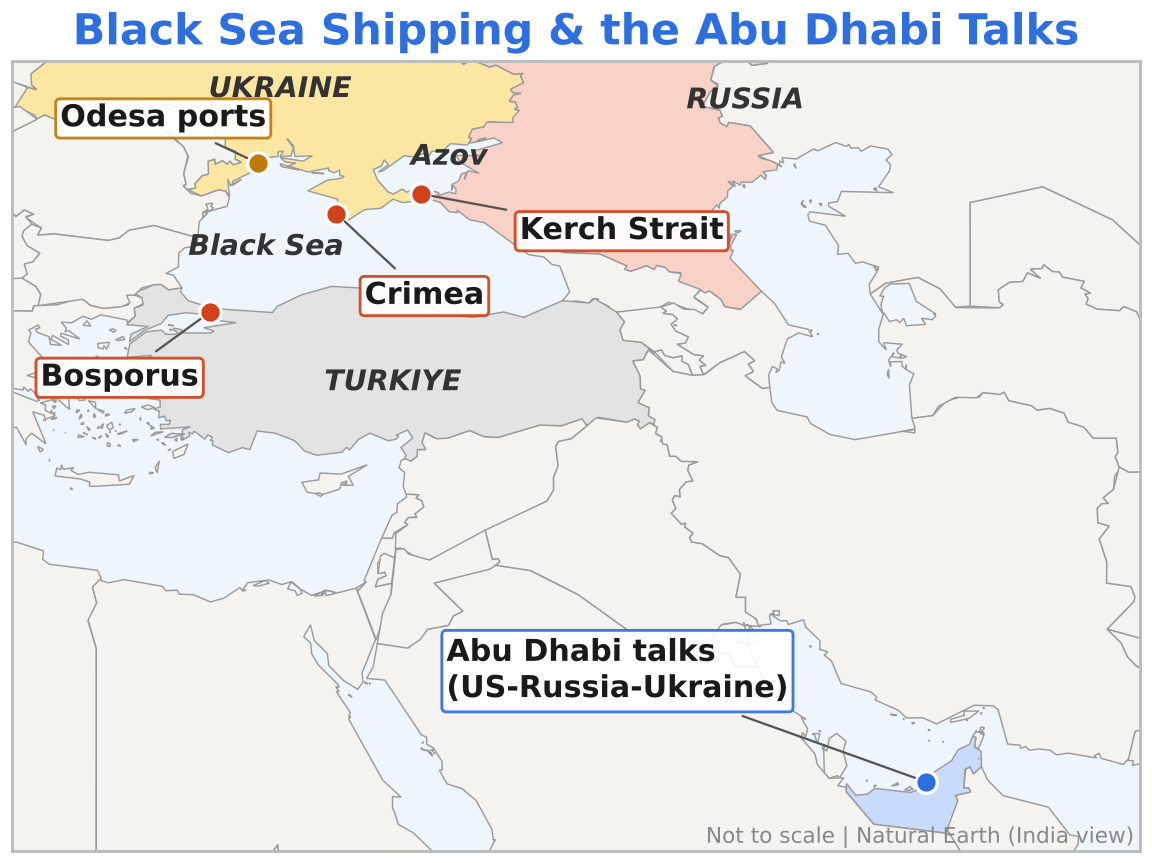
Odesa, Chornomorsk and Pivdennyi ports handle about 90% of Ukraine's farm exports.
Five Indian seafarers have been killed and two are missing in Black Sea attacks.
India imports about 1.97 million barrels/day of Russian crude (about 35% of its oil imports).
Way forward
India can push humanitarian steps - grain corridors, prisoner exchanges and shipping safety - that build trust for a wider settlement.
Concept
Black Sea: inland sea linked to the Mediterranean through the Bosporus and Dardanelles (Turkiye); bordering countries - Ukraine, Russia, Georgia, Turkiye, Bulgaria, Romania. The Sea of Azov lies to its north-east, joined by the Kerch Strait. Strategic autonomy: India keeps ties with all sides and decides its position on its own interests rather than joining blocs. Crimea was annexed by Russia in 2014; Russia also claims Donetsk, Luhansk, Zaporizhzhia and Kherson. Exam angle: Prelims: Black Sea neighbours, straits, Ukrainian ports, Kerch Strait. Mains: Can India be a peace-maker? Food and energy security impact of the war on the Global South.
Map of the Black Sea region showing Ukraine, Russia, Odesa ports, Crimea, the Kerch Strait, the Bosporus and Abu Dhabi where talks are held — StudyForGS
9. India-Saudi Haj 2027 Agreement
IRUPSC: Prelims + Mains GS2
Syllabus linkage
GS2: India and West Asia, Bilateral agreements; GS1: Religion/culture. Prelims: Haj Committee, nodal ministry; Mains: India-Saudi strategic ties.
Context
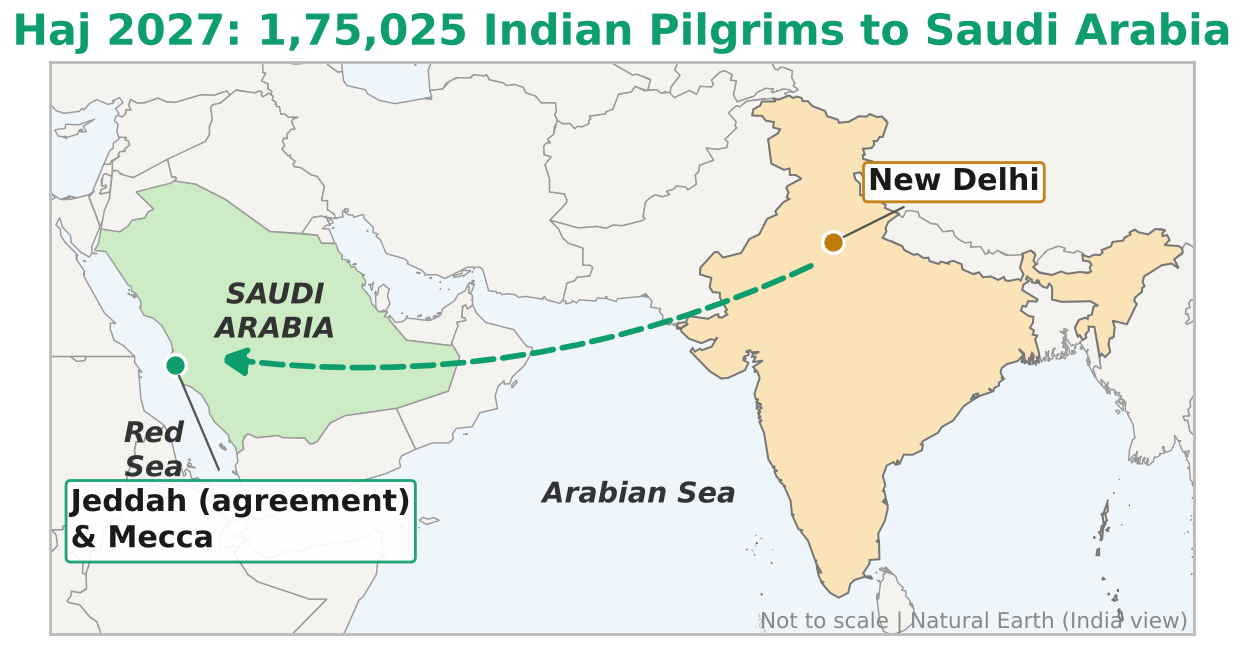
Every year India and Saudi Arabia sign a deal on how many Indian Muslims can go for Haj. For 2027, India has got a quota of 1,75,025 pilgrims. Union Minority Affairs Minister Kiren Rijiju and Saudi Minister of Hajj and Umrah Tawfiq bin Fawzan Al-Rabiah signed the Bilateral Haj Agreement for 2027 in Jeddah on 9 November, during Rijiju's 6-9 November visit. India's quota is 1,75,025 pilgrims. Rijiju also attended the 6th Hajj Conference and Exhibition and reviewed arrangements for a safe and smooth pilgrimage.
Key facts
Haj 2027 quota for India: 1,75,025 pilgrims (among the largest in the world).
Signed at Jeddah; Ministry of Minority Affairs is the nodal ministry for Haj.
Pilgrims go through the Haj Committee of India and private tour operators.
Haj subsidy was ended in 2018.
Way forward
Better digital services and health support for elderly pilgrims will make the large quota safer.
Concept
Haj: annual pilgrimage to Mecca, one of the five pillars of Islam; Saudi Arabia fixes country quotas (broadly about 1,000 pilgrims per million Muslims, an OIC formula of 1987). Haj Committee of India works under the Haj Committee Act, 2002; Haj work moved from MEA to the Ministry of Minority Affairs in 2016. India-Saudi Strategic Partnership Council (2019) guides wider ties - energy, investment, defence and diaspora. Exam angle: Prelims: nodal ministry, Haj Committee Act year, subsidy ended year, Jeddah/Mecca location (Red Sea coast). Mains: soft power and diaspora in India's West Asia policy.
Map showing the route from New Delhi to Jeddah and Mecca in Saudi Arabia for Haj 2027 — StudyForGS
10. Israel: Eisenkot Gets Mandate to Rule
IRUPSC: Prelims + Mains GS2
Syllabus linkage
GS2: Developments in West Asia, Effect on India's interests. Prelims: Knesset basics; Mains: West Asia stability and India.
Context
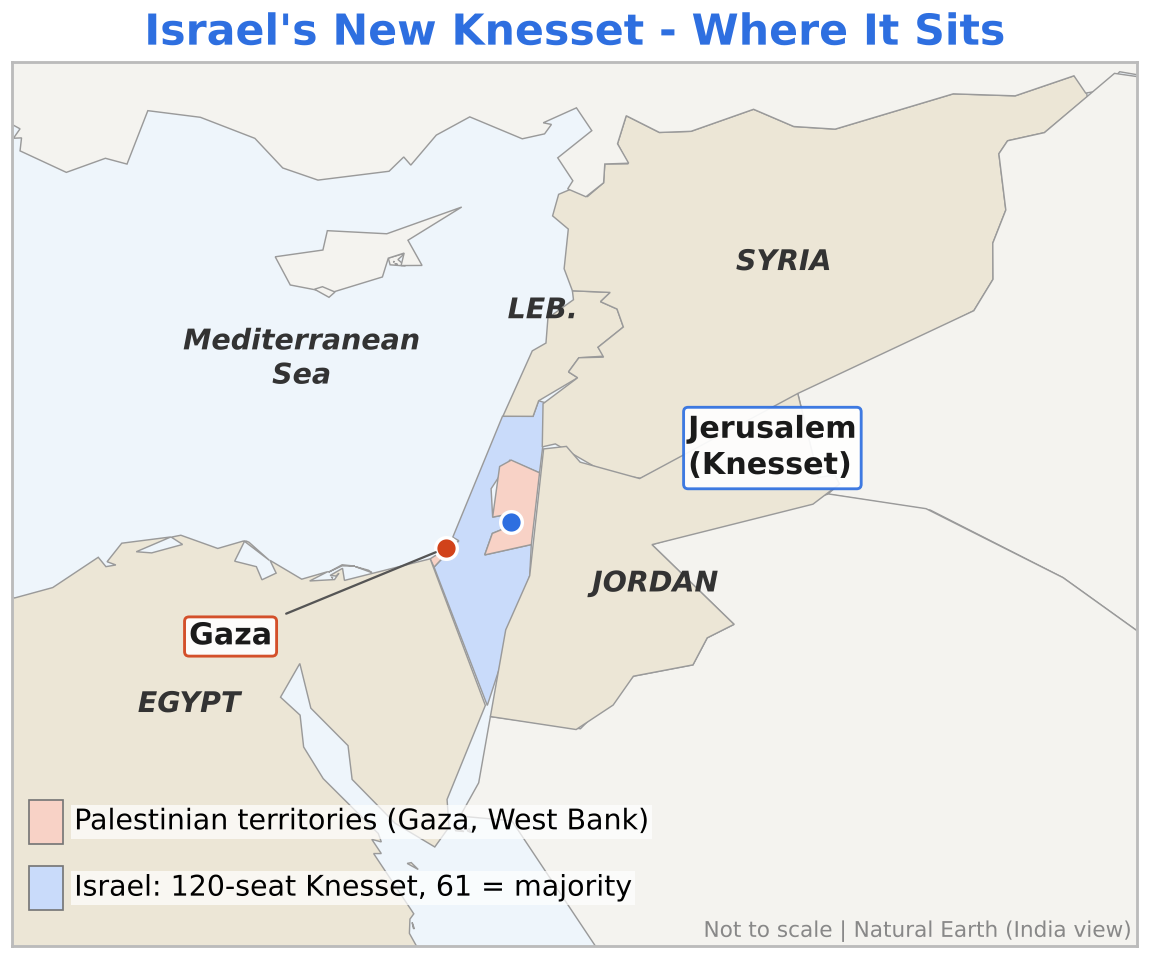
Israel's election gave no side a majority. The President has asked opposition leader Gadi Eisenkot, not Benjamin Netanyahu, to try to form the next government, and the new parliament met this week. Israel voted on 27 October 2026. In the 120-seat Knesset (parliament), 61 seats are needed for a majority. Eisenkot's four-party alliance won 48 seats, Netanyahu's right-wing and religious bloc 53, and Arab-led parties a record 19. President Isaac Herzog chose Eisenkot (leader of the Yashar party) after 67 lawmakers backed him, against 46 for Netanyahu. The new Knesset convened on 10 November and opposition parties moved bills for an inquiry into the 7 October 2023 attack and for term limits for prime ministers.
Key facts
Knesset: 120 members; majority mark 61.
Eisenkot has 28 days to form a government, with a possible 14-day extension.
Eisenkot has ruled out Arab-led parties; ultra-Orthodox parties could take him to 61.
Netanyahu remains interim prime minister and has called for a national unity government.
Way forward
India should keep its balanced policy - strong ties with Israel and support for a two-state solution for Palestine.
Concept
Israel is a parliamentary democracy with proportional representation - the whole country is one constituency and parties need 3.25% of votes to enter the Knesset. The President of Israel is the ceremonial head who asks the leader most likely to command 61 seats to form a government. India-Israel: diplomatic ties since 1992, Strategic Partnership since 2017; both are part of I2U2 and the IMEC corridor plan. Exam angle: Prelims: Knesset size, threshold, role of President, map of Israel's neighbours. Mains: political change in Israel and its effect on Gaza peace, IMEC and India's West Asia balance.
Map of Israel and its neighbours showing Jerusalem, the seat of the Knesset, and the Palestinian territories — StudyForGS
11. VAJRA-SAT: Drill Against New FMD Strain
HEALTHUPSC: Prelims + Mains GS3
Syllabus linkage
GS3: Animal husbandry, Disaster preparedness; GS2: Health (One Health). Prelims: FMD serotypes, NADCP; Mains: livestock economy and transboundary diseases.
Context
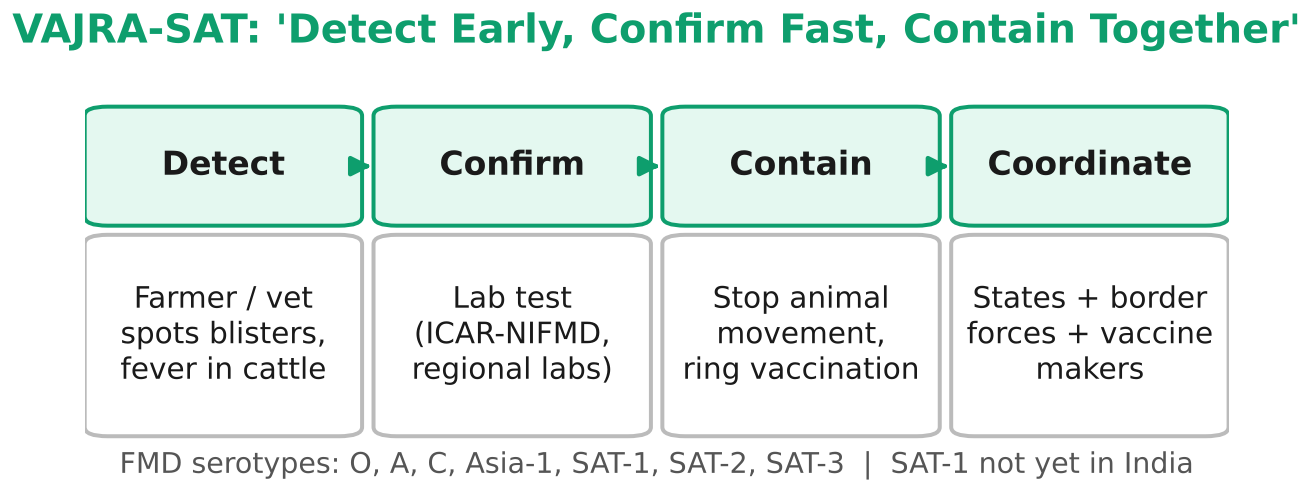
A dangerous type of foot-and-mouth disease called SAT-1 has spread from Africa to West Asia. India has never had it, so it held a practice drill to be ready if it ever arrives. The Department of Animal Husbandry and Dairying (DAHD), with ICAR-NIVEDI, Bengaluru, held a two-day national tabletop exercise (a discussion-based drill on a simulated outbreak) called VAJRA-SAT on 4-5 November. The theme was 'Detect Early, Confirm Fast, Contain Together'. 83 participants from 25 States, 3 UTs and national bodies - including labs, vaccine makers and border guarding agencies - practised early detection, lab confirmation, movement control and emergency vaccination.
Key facts
Serotype SAT-1 has NOT been reported in India; it has reached parts of West Asia.
Organisers: DAHD + ICAR-NIVEDI (Bengaluru); lab support from ICAR-NIFMD.
83 participants from 25 States and 3 UTs.
A separate meeting discussed FMD-free 'compartments' for semen stations to protect livestock genetics and enable safe trade.
Way forward
Regular drills, stronger border checks on animal movement and stockpiles of matching vaccines should be maintained.
Concept
Foot-and-mouth disease (FMD): a highly contagious viral disease of cloven-hoofed animals (cattle, buffalo, sheep, goat, pig); 7 serotypes - O, A, C, Asia-1, SAT-1, SAT-2, SAT-3. In India O, A and Asia-1 are common. National Animal Disease Control Programme (NADCP, 2019) aims to control FMD and brucellosis by vaccination and eradicate them by 2030. One Health: human, animal and environmental health are linked, so surveillance must be joint. Exam angle: Prelims: FMD serotypes, animals affected, NADCP target year, ICAR-NIFMD. Mains: preparedness for transboundary animal diseases and their impact on dairy farmers and exports.
Four-step response chain of the VAJRA-SAT drill - detect, confirm, contain and coordinate — StudyForGS
12. One Register Path for Allied Health Workers
HEALTHUPSC: Prelims + Mains GS2
Syllabus linkage
GS2: Health, Regulatory bodies, Human resources. Prelims: NCAHP Act 2021; Mains: quality and regulation of the health workforce.
Context
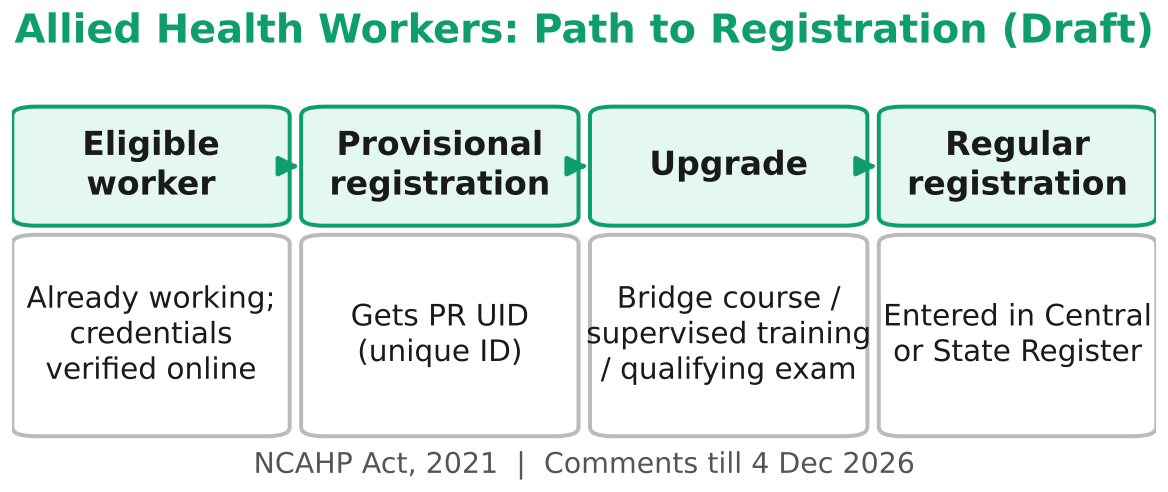
Lab technicians, physiotherapists, radiographers and many other health workers who are not doctors or nurses will soon need registration. A draft rule offers a 'provisional registration' route for those already working. The National Commission for Allied and Healthcare Professions (NCAHP), under the Health Ministry, has proposed draft regulations for provisional registration of allied and healthcare professionals. Eligible persons will get a Provisional Registration Unique Identification Number (PR UID). They can then do bridge courses, supervised clinical training and qualifying exams to move to regular registration in a Central or State Register. All of this will be handled through one online system, and comments are invited till 4 December 2026.
Key facts
Framed under the NCAHP Act, 2021.
Provisional Registration UID (PR UID) for each eligible professional.
Public comments till 4 December 2026 (draft on ncahp.abdm.gov.in).
Way forward
Bridge courses should be affordable and available in local languages so that experienced workers are not excluded.
Concept
NCAHP Act, 2021 created a national commission and State councils to regulate education and practice of allied and healthcare professions - like the NMC does for doctors. Allied health professionals: trained workers who support diagnosis, treatment and rehabilitation - e.g. lab, imaging, physiotherapy, optometry, operation theatre technology. Registration protects patients by ensuring only qualified people practise, and helps plan the health workforce. Exam angle: Prelims: NCAHP Act year, ministry, comparison with NMC and Nursing Commission. Mains: India's shortage of skilled health workers; regulating a huge informal workforce without pushing it out.
Flow chart of the draft registration path for allied health workers from provisional registration to regular registration — StudyForGS
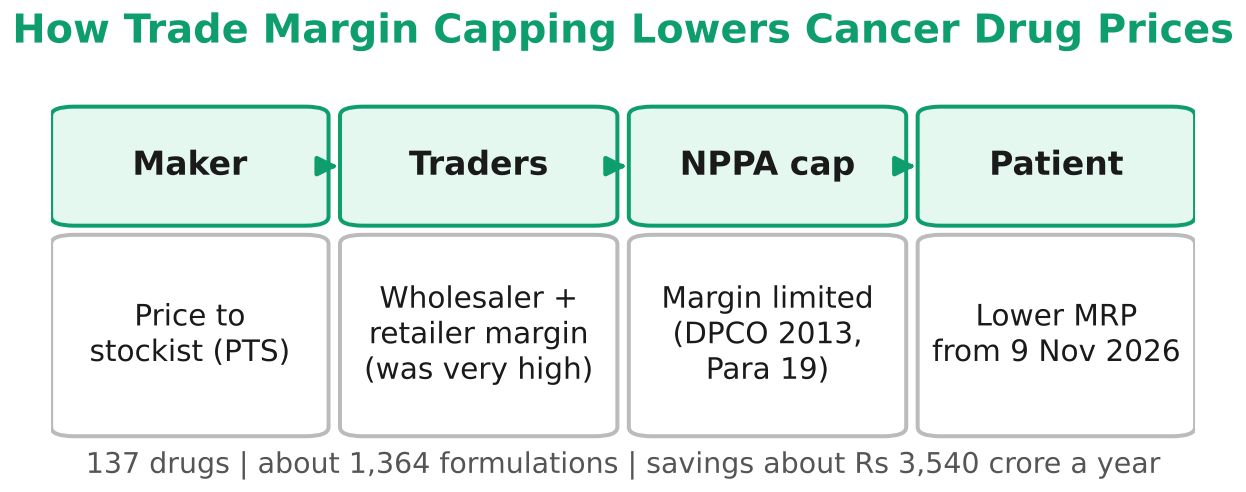
Many cancer medicines were costly because traders kept large profit margins. The drug price regulator capped these margins, and new lower prices are now in force. Revised maximum retail prices (MRPs) of anti-cancer medicines came into force on 9 November 2026. They follow the National Pharmaceutical Pricing Authority (NPPA) order of 17 October, which covers 137 non-scheduled cancer drugs, including patented ones, by capping trade margins. In all, revised MRPs for about 1,364 anti-cancer formulations are now in effect, and patients are expected to save about Rs 3,540 crore a year.
Key facts
NPPA order dated 17 October 2026; new MRPs effective 9 November 2026.
Covers 137 non-scheduled cancer drugs (including patented medicines).
About 1,364 formulations re-priced; expected savings about Rs 3,540 crore per year.
Method: Trade Margin Rationalisation (TMR) - limiting the gap between the price to the trader and the MRP.
Way forward
Strict monitoring of shelves and online pharmacies is needed so that the lower MRPs actually reach patients.
Concept
NPPA (set up 1997) under the Department of Pharmaceuticals fixes and monitors medicine prices under the Drugs (Prices Control) Order, 2013. Scheduled drugs = medicines in the National List of Essential Medicines whose ceiling prices are fixed; non-scheduled drugs are normally free-priced, but Para 19 of DPCO lets NPPA act in public interest. Trade margin = profit kept by wholesalers and retailers. In 2019 NPPA had capped margins on 42 cancer drugs - today's step is a much larger version. Exam angle: Prelims: NPPA parent department, DPCO 2013, scheduled vs non-scheduled, Para 19. Mains: out-of-pocket health spending, price control vs innovation in pharma.
Flow from manufacturer to patient showing how capping trade margins lowers the MRP of cancer drugs — StudyForGS
14. Nasha Mukt Bharat Abhiyaan Turns Six
HEALTHUPSC: Prelims + Mains GS2
Syllabus linkage
GS2: Vulnerable sections, Health, Government schemes; GS3: Internal security (drug trade). Prelims: NMBA, NAPDDR, helplines; Mains: drug abuse as a social and security issue.
Context
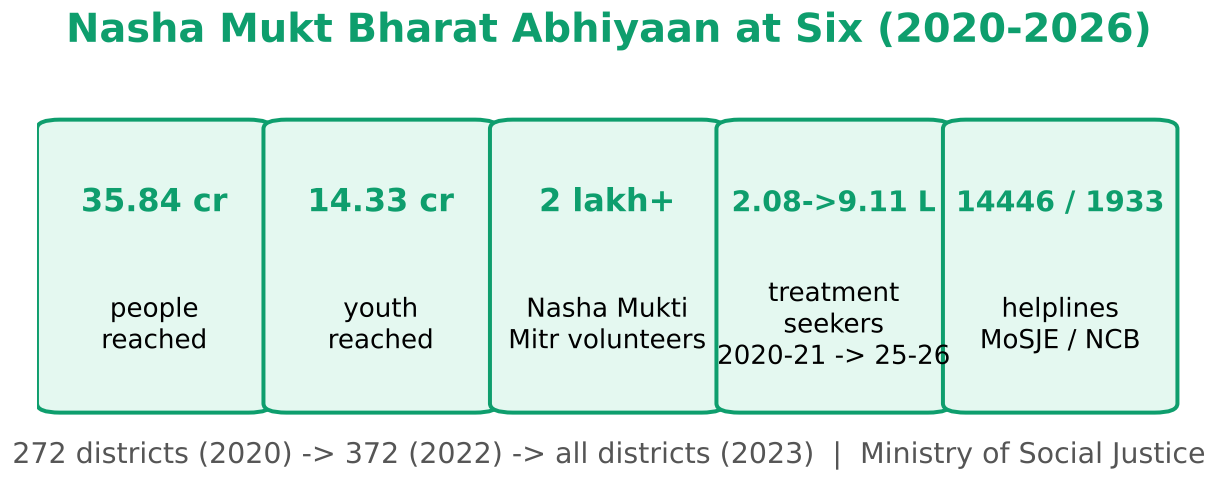
This is India's big campaign against drug abuse. In six years it has reached over 35 crore people with awareness, and treatment seekers have grown more than four times. The Nasha Mukt Bharat Abhiyaan (NMBA) was launched on 15 August 2020 by the Ministry of Social Justice and Empowerment in 272 most-vulnerable districts, expanded to 372 in 2022 and to all districts from 15 August 2023. As of 10 November 2026 it has reached over 35.84 crore people, including 14.33 crore youth and 11.32 crore women. People seeking treatment rose from 2.08 lakh (2020-21) to over 9.11 lakh (2025-26).
Key facts
NMBA is the flagship awareness arm of the National Action Plan for Drug Demand Reduction (NAPDDR).
Over 2 lakh citizen volunteers (Nasha Mukti Mitr) enrolled.
39.91 lakh persons treated and rehabilitated so far.
NAPDDR budget: Rs 333 crore for 2026-27.
Way forward
The second national survey (expected in 2027) with district-level data should be used to target the worst-hit districts.
Concept
NAPDDR: Centrally Sponsored Scheme for prevention, treatment and rehabilitation; it treats drug users as people needing help, and aims to reduce stigma. NDPS Act, 1985 is the main law against narcotics; the Narcotics Control Bureau (NCB) works under the Ministry of Home Affairs. India lies between the 'Golden Crescent' (Afghanistan-Iran-Pakistan) and 'Golden Triangle' (Myanmar-Laos-Thailand) drug zones - a key security risk. Exam angle: Prelims: launch date, ministry, helpline numbers, Golden Crescent/Triangle countries. Mains: demand reduction vs supply control; role of community and faith groups.
Key numbers of the Nasha Mukt Bharat Abhiyaan after six years - people reached, volunteers, treatment seekers and helplines — StudyForGS
15. New AIIMS Cross 6 Crore OPD Visits
HEALTHUPSC: Prelims + Mains GS2
Syllabus linkage
GS2: Health infrastructure, Government schemes. Prelims: PMSSY; Mains: regional balance in tertiary care.
Context
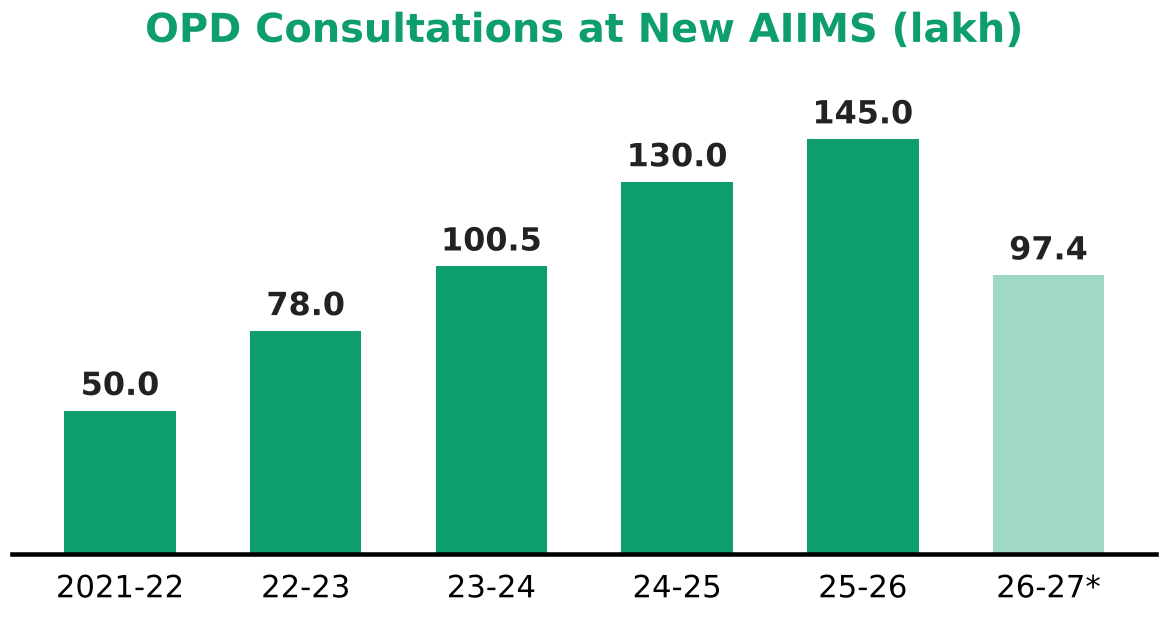
The government built new AIIMS hospitals in many States so that people do not have to travel to Delhi. These new AIIMS have now treated over 6 crore outpatients since 2021-22. The 18 fully functional new AIIMS recorded about 6.01 crore OPD (outpatient) consultations from 2021-22 till 31 October 2026. Yearly numbers have risen steadily, from 50 lakh in 2021-22 to about 1.45 crore in 2025-26. In all, 22 new AIIMS have been approved under the Pradhan Mantri Swasthya Suraksha Yojana (PMSSY).
Key facts
Total OPD consultations: about 6.01 crore (2021-22 to Oct 2026).
Services: OPD, inpatient care, emergency and trauma, diagnostics, education and research.
Way forward
Filling faculty posts and linking new AIIMS with district hospitals through referral and telemedicine will raise their impact.
Concept
PMSSY (launched 2003) aims to remove regional imbalance in affordable tertiary (super-speciality) care and improve medical education - by building AIIMS and upgrading government medical colleges. Tertiary care = advanced specialist care (e.g. cancer, cardiac surgery), above primary (PHC) and secondary (district hospital) levels. AIIMS New Delhi was set up in 1956 under the AIIMS Act; new AIIMS are autonomous Institutes of National Importance. Exam angle: Prelims: PMSSY launch year, number of AIIMS, levels of care. Mains: Does building more AIIMS solve regional health gaps without enough faculty and primary care?
Bar chart of yearly OPD consultations at the new AIIMS from 2021-22 to 2026-27 — StudyForGS
16. Coal Gasification Scheme: Round 3 Opens
ECONOMYUPSC: Prelims + Mains GS3
Syllabus linkage
GS3: Energy, Infrastructure, Mineral resources. Prelims: coal gasification, syngas products, scheme outlay; Mains: energy security vs climate goals.
Context
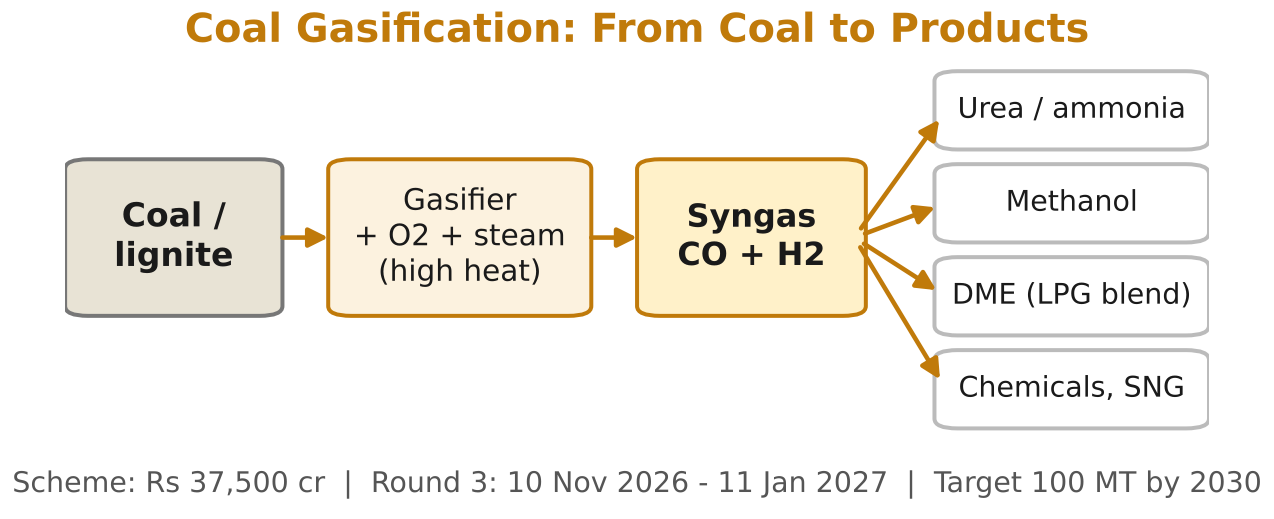
Coal can be turned into gas and then into fertiliser, methanol and chemicals that India now imports. A Rs 37,500 crore scheme supports such projects, and its third round of bids is now open. The Ministry of Coal said Round 2 of the Scheme for Promotion of Surface Coal/Lignite Gasification Projects closed with two applications, both from NTPC Ltd - one for urea and one for methanol and dimethyl ether (DME). Round 3 opened on 10 November 2026, and applications can be submitted till 11 January 2027. The Union Cabinet approved the Rs 37,500 crore scheme on 13 May 2026.
Key facts
Total outlay: Rs 37,500 crore (Cabinet approval 13 May 2026).
Round 2: two NTPC proposals - urea; methanol + DME.
Round 3 window: 10 November 2026 - 11 January 2027.
Target: 100 million tonnes (MT) of coal gasification capacity by 2030.
Way forward
Projects need low-cost technology, assured buyers and carbon capture plans to be viable and climate-friendly.
Concept
Coal gasification: coal reacts with oxygen and steam at high temperature to make syngas (mainly carbon monoxide + hydrogen), which is used to make urea, ammonia, methanol, DME and chemicals. Benefits: uses domestic coal (India has huge reserves), cuts imports of LNG, ammonia, methanol and coking coal; can be combined with carbon capture to lower emissions. DME (dimethyl ether) can be blended with LPG; methanol can be blended with petrol. Exam angle: Prelims: syngas composition, products, 100 MT target year, scheme outlay. Mains: role of coal in a just energy transition; import substitution in fertilisers.
Flow diagram of coal gasification from coal to syngas and products such as urea, methanol and DME — StudyForGS
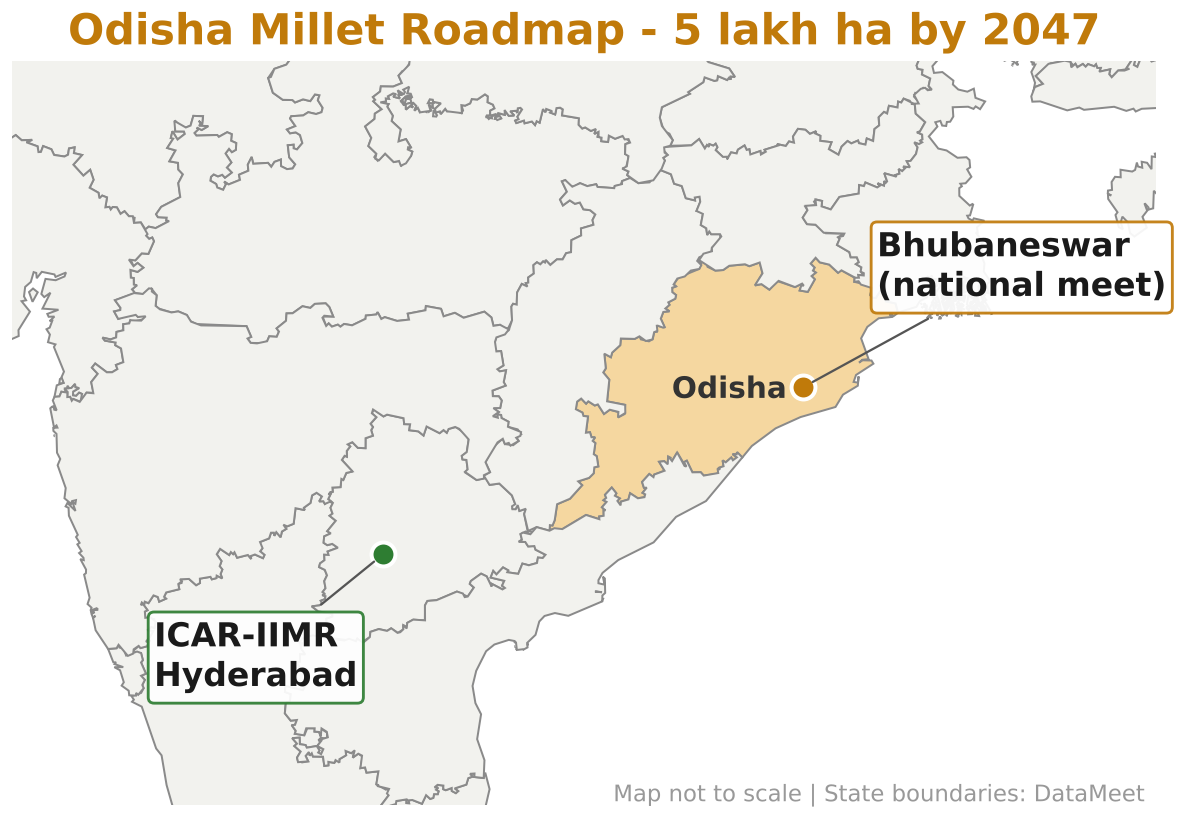
Odisha has done well in growing and buying millets like ragi. At a national meet in Bhubaneswar, it set a target to almost triple the area under millets by 2047. A two-day national event on agro-biodiversity, climate-resilient farming and sustainable food systems began in Bhubaneswar on 10 November. ICAR Director General M.L. Jat called the Odisha Shree Anna Abhiyan a possible national model. The roadmap aims to expand millet area from 1.79 lakh hectares to 5 lakh hectares by 2047, with production of 8 lakh tonnes, and to set up a Centre of Excellence on Millets at OUAT.
Key facts
Millet area target: 1.79 lakh ha -> 5 lakh ha by 2047; production target 8 lakh tonnes.
Ragi procurement: 7.5 lakh quintals in KMS 2024-25; target 8 lakh quintals for 2025-26.
163 finger millet (ragi) landraces documented; minor millets like suan and kangu to be promoted.
Partner: ICAR-Indian Institute of Millets Research (IIMR), Hyderabad.
Focus on FPOs, women's SHGs and low-cost processing machines.
Way forward
Assured procurement, processing units and demand creation in cities are needed to make millet farming profitable.
Concept
Millets ('Shree Anna') are hardy grains (ragi, jowar, bajra, kodo, kutki etc.) that need little water and are rich in fibre, iron and calcium; the UN marked 2023 as the International Year of Millets on India's proposal. Landrace: a traditional local crop variety developed by farmers over generations - valuable genetic wealth. Procurement at MSP and inclusion in PDS/ICDS give farmers an assured market for millets. Exam angle: Prelims: millet names, IYM 2023, IIMR location. Mains: millets for nutrition security and climate-resilient agriculture; lessons from Odisha's model.
Map of Odisha with Bhubaneswar, venue of the national millet meet, and ICAR-IIMR Hyderabad — StudyForGS
18. Islands at Centre of Blue Economy Push
ECONOMYUPSC: Prelims + Mains GS3
Syllabus linkage
GS3: Blue economy, Fisheries, Food processing; GS1: Geography of islands. Prelims: EEZ, PMMSY, tuna species; Mains: sustainable use of ocean resources.
Context
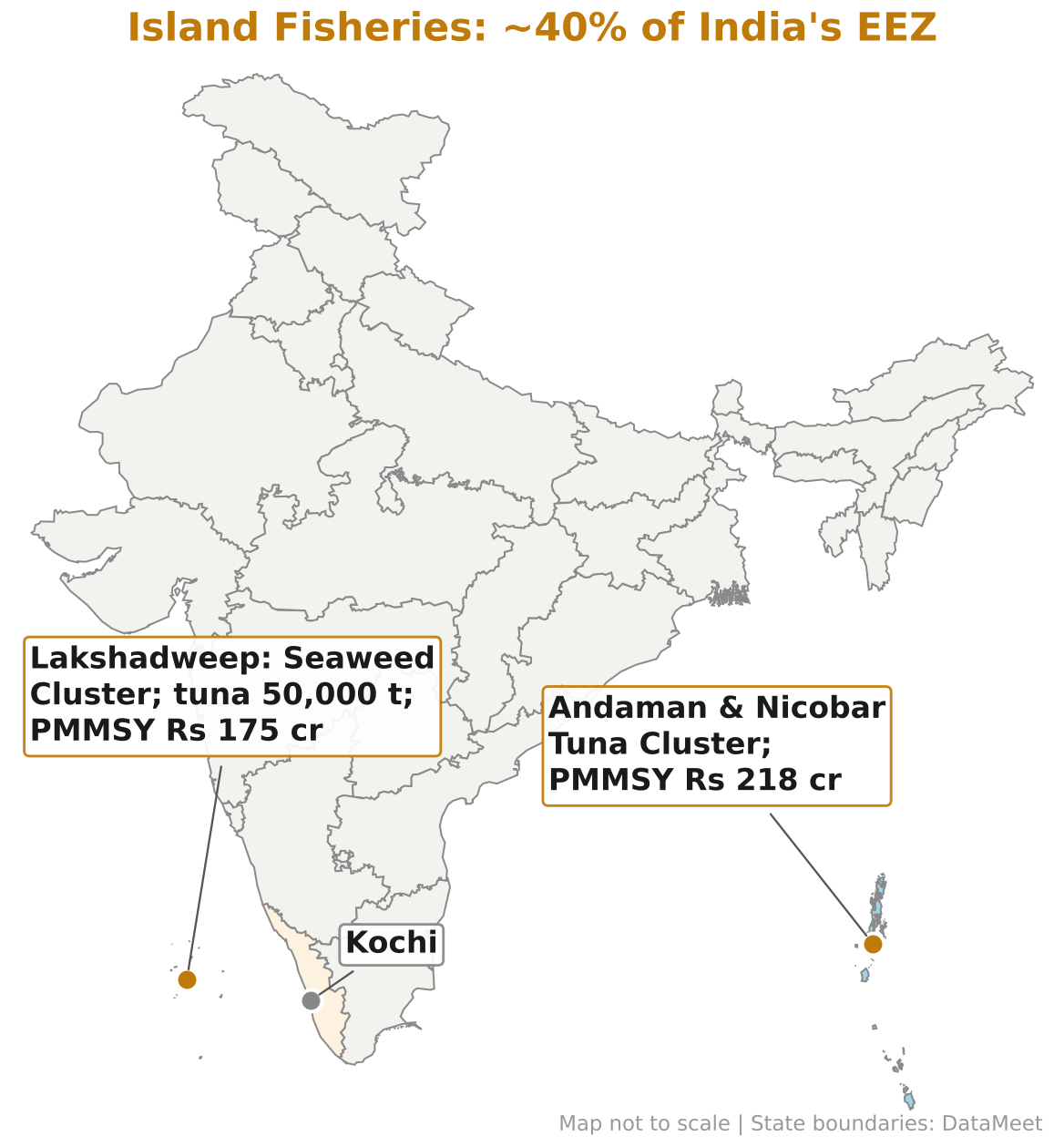
Lakshadweep and Andaman & Nicobar give India almost 40% of its sea zone. The government wants to use these islands for tuna fishing, seaweed farming and aquarium-fish trade. The Fisheries Ministry said island fisheries are central to India's blue economy plans. Lakshadweep and the Andaman and Nicobar Islands together hold nearly 40% of India's Exclusive Economic Zone (EEZ) and lie on rich tuna migration routes. Under PMMSY, Rs 218 crore has been set for A&N and Rs 175 crore for Lakshadweep. A five-year plan aims to double Lakshadweep's tuna catch to 50,000 tonnes.
Key facts
India: coastline about 11,099 km; EEZ nearly 24 lakh sq km; marine fish potential 58.6 lakh tonnes.
Under-used stocks: yellowfin, skipjack and bigeye tuna.
Lakshadweep notified as a Seaweed Cluster; A&N has a Tuna Cluster under PMMSY.
Lakshadweep has over 300 reef-linked ornamental fish species.
Seafood exports: about Rs 73,890 crore in 2025-26.
Way forward
Expand deep-sea fishing and cold chains while protecting coral reefs and giving priority to local island fishers.
Concept
EEZ (Exclusive Economic Zone): sea area up to 200 nautical miles from the coast where a country has sole rights over fish, oil and minerals (UNCLOS, 1982). PMMSY (Pradhan Mantri Matsya Sampada Yojana), launched 2020, is the main fisheries scheme to raise output, cut post-harvest loss and improve fishers' welfare. Pole-and-line and hook-and-line fishing catch tuna one by one - sustainable methods with little bycatch, traditional in Lakshadweep. Exam angle: Prelims: EEZ width, UNCLOS, tuna species, PMMSY launch, island locations on the map. Mains: blue economy potential vs fragile coral ecosystems and island communities.
India map marking Lakshadweep and the Andaman and Nicobar Islands with their seaweed and tuna clusters and PMMSY allocations — StudyForGS
19. PLI for Medical Devices Extended to 2036
ECONOMYUPSC: Prelims + Mains GS3
Syllabus linkage
GS3: Industrial policy, Make in India, Health manufacturing. Prelims: PLI design, segments; Mains: import dependence in medical devices.
Context
India imports many costly medical machines like MRI and CT scanners. A scheme that pays companies a bonus for making them in India has been extended up to 2035-36, with easier rules. The Department of Pharmaceuticals has extended the Production Linked Incentive (PLI) Scheme for medical devices up to 2035-36 with about Rs 2,700 crore for the new phase, and invited fresh applications. So far the scheme has helped make over 60 high-end devices and parts in India - such as X-ray tubes, 1.5T MRI, LINAC, CT scanners, Cathlab systems and implants - with production worth over Rs 16,000 crore.
Key facts
Launched 2020-21; now extended to 2035-36; outlay about Rs 2,700 crore for the new phase.
Minimum sales threshold removed; minimum investment reduced; 3 years to set up plants.
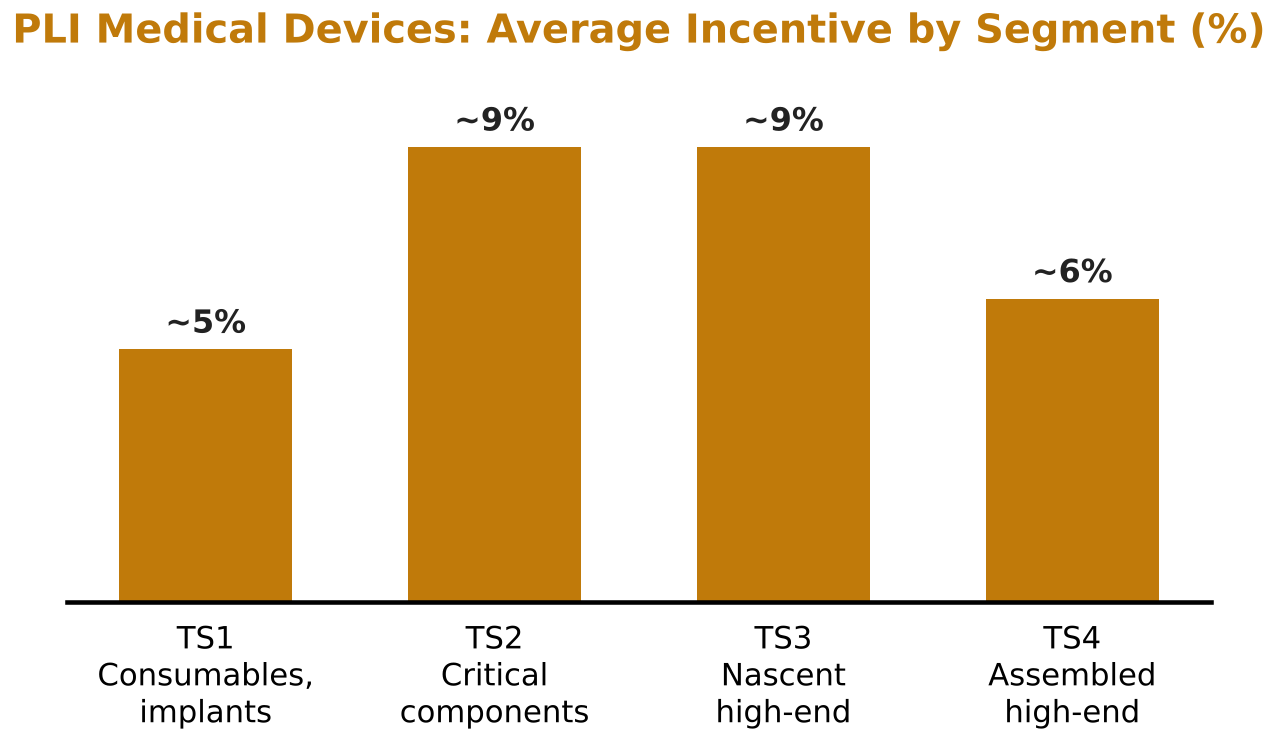
Four target segments with average tapering incentives: consumables/implants about 5%, critical components about 9%, nascent high-end devices about 9%, assembled high-end devices about 6%.
Aims to bring 3T MRI, PET-CT, ultrasound probes and high-throughput lab analysers into Indian production.
Way forward
Testing labs, standards and support for component-making MSMEs will decide whether India moves from assembly to real manufacturing.
Concept
PLI scheme: the government pays a percentage of extra (incremental) sales of goods made in India for a fixed period - a reward linked to output, not a one-time subsidy. Tapering incentive: the rate falls year by year, so firms must become competitive on their own. India imports a large part of its high-end medical equipment; local making can cut costs and protect supply during crises such as COVID-19. Exam angle: Prelims: PLI meaning, department in charge, target segments. Mains: Are PLIs the right tool for deep manufacturing? Linking device making with affordable healthcare.
Bar chart of average PLI incentive rates for the four medical device target segments — StudyForGS
📜 Asked before in the exam — previous-year question on this topic
BPSC Prelims 2023 (69th CCE)Consider the following statements about the Production-Linked Incentive (PLI) scheme: 1. The scheme offers a production-linked incentive to boost domestic manufacturing and attract large investments in mobile phone manufacturing and specified electronic components. 2. The scheme has two categories of applicants, namely, global companies and domestic companies. 3. The scheme shall extend an average incentive of around 8% on net incremental sales (over base year) of goods manufactured in India and covered under the target segment, to eligible companies, for a period of six years. 4. The target segment under PLI shall include (i) laptops, (ii) tablets, (iii) all- in-one PCs, (iv) servers and (v) Ultra-Small Form Factor (USFF). Which of the above statements are incorrect?
Linked because this news is about the same topic. The answer is as per the official key of that year.
20. PLFS: Unemployment Falls to 5.1%
ECONOMYUPSC: Prelims + Mains GS3
Syllabus linkage
GS3: Indian economy - employment, growth. Prelims: PLFS, LFPR/WPR/UR, CWS; Mains: quality of jobs and women's participation.
Context
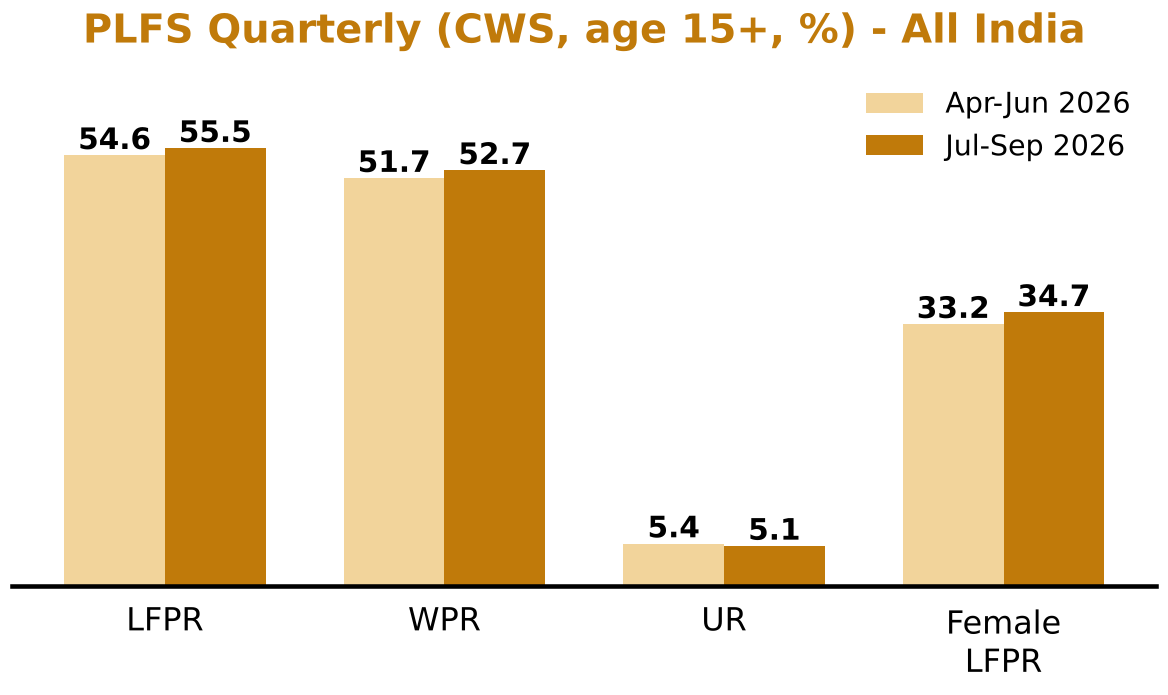
A government survey shows that in July-September 2026, more people were working or looking for work, and the unemployment rate fell to 5.1% - mainly because of villages. The Ministry of Statistics and Programme Implementation (MoSPI) released the Periodic Labour Force Survey (PLFS) quarterly bulletin for July-September 2026. For persons aged 15 and above (Current Weekly Status), the unemployment rate fell to 5.1% from 5.4% in April-June. Rural unemployment fell to 4.3% while urban stayed broadly stable at 6.8%. Female labour force participation rose to 34.7% from 33.2%.
Urban female UR 8.8% - still the highest of all groups.
Rural jobs rose with the kharif season; share of agriculture in rural employment went up.
Way forward
Policies should focus on good-quality urban jobs, especially for educated young women.
Concept
LFPR (Labour Force Participation Rate) = % of people working or seeking work; WPR (Worker Population Ratio) = % of people actually working; UR = % of the labour force without work. CWS (Current Weekly Status): a person's status in the last 7 days - used for quarterly and monthly estimates. PLFS was started by NSO in 2017; since 2025 it gives monthly and quarterly estimates for both rural and urban India. Exam angle: Prelims: definitions of LFPR, WPR, UR, CWS vs Usual Status, which body releases PLFS. Mains: jobless growth debate, women's low participation, informal and farm-dependent jobs.
Bar chart comparing LFPR, WPR, unemployment rate and female LFPR for April-June and July-September 2026 — StudyForGS
📜 Asked before in the exam — previous-year question on this topic
BPSC Prelims 2025 (71st CCE)According to Annual PLFS 2023-24 report:
There is greater increase in Labour Force Participation Rate (LFPR) of rural females as compared to urban females since 2022
Among the 36 states and union territories, 19 states have a Workforce Participation Rate (WPR) (for all ages) below the national average of 43.7 percent
The share of female workers in agriculture has declined significantly from 2017-18 to 2023-24
More than one of the above
Show answer
Answer: (a) There is greater increase in Labour Force Participation Rate (LFPR) of rural females as compared to urban females since 2022 Practise all BPSC previous year papers →
Linked because this news is about the same topic. The answer is as per the official key of that year.
21. New Begonia Found in Siang Valley
ENVIRONMENTUPSC: Prelims + Mains GS3
Syllabus linkage
GS3: Biodiversity, Species in news; GS1: Geography of North-East. Prelims: Siang river, Eastern Himalaya hotspot; Mains: biodiversity documentation.
Context
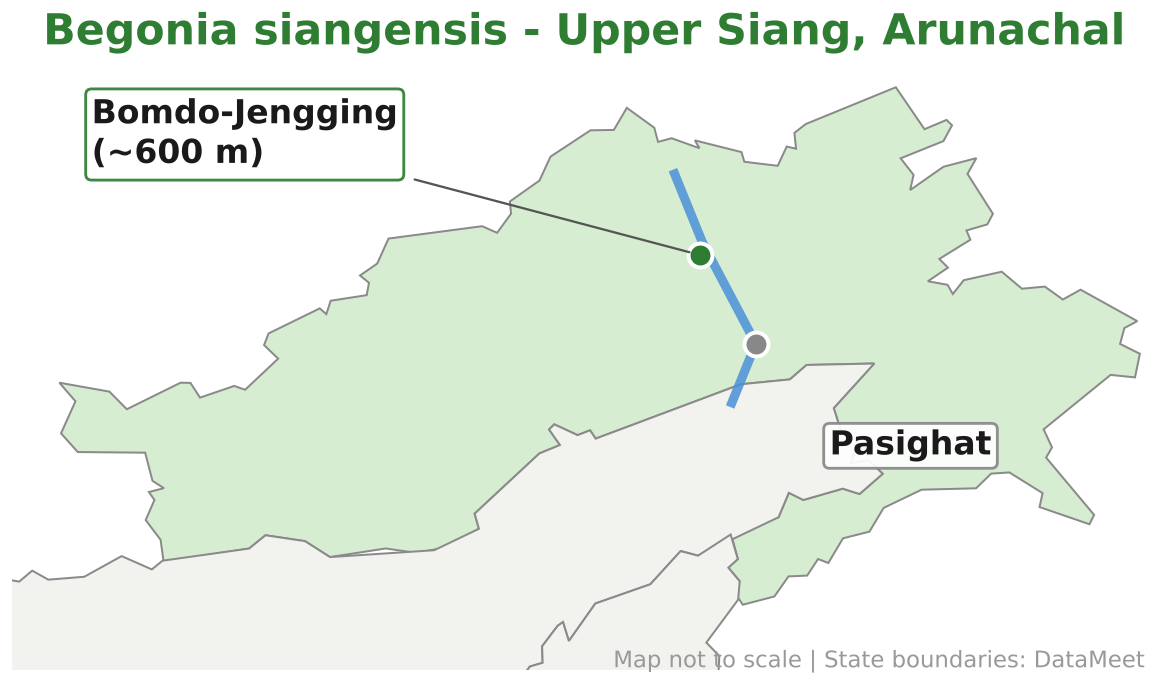
Botanists have found a new wild flowering plant in Arunachal Pradesh and named it Begonia siangensis after the Siang river valley where it grows. A new species of begonia, Begonia siangensis, has been described from the Siang river basin in Upper Siang district, Arunachal Pradesh. It grows at about 600 m along a secluded mountain stream between Bomdo and Jengging. It has pale-pink flowers, creeping stems and solid dark-green leaves with tiny blister-like bumps underneath. It is provisionally assessed as 'Data Deficient' under IUCN guidelines.
Key facts
Location: Upper Siang district, Arunachal Pradesh; about 600 m altitude.
Belongs to genus Begonia, section Platycentrum.
Close relative B. iridescens has shimmering blue leaves; the new species does not.
IUCN status (provisional): Data Deficient.
Way forward
Protect the stream habitat and survey nearby valleys to know how widely the species occurs.
Concept
Siang is the name of the Brahmaputra in Arunachal Pradesh - it begins as the Yarlung Tsangpo in Tibet and becomes the Brahmaputra after joining the Dibang and Lohit in Assam. Data Deficient (IUCN): not enough information to judge extinction risk - not a 'threatened' category. Arunachal is part of the Himalaya and Indo-Burma biodiversity hotspots - India has 4 of the world's 36 hotspots. Exam angle: Prelims: Siang-Brahmaputra names, IUCN categories, hotspots in India. Mains: need for biodiversity surveys before big dams and roads in the Eastern Himalaya.
Map of Arunachal Pradesh marking the Bomdo-Jengging area of Upper Siang where Begonia siangensis was found, with the Siang river — StudyForGS
22. Global Carbon Budget 2026
ENVIRONMENTUPSC: Prelims + Mains GS3
Syllabus linkage
GS3: Climate change, Environmental reports. Prelims: Global Carbon Project, ppm, remaining budget; Mains: India's development vs emissions.
Context
Scientists estimate that the world's fossil-fuel CO2 emissions will fall slightly in 2026. But the carbon 'budget' left to stay within 1.5 degrees C of warming is almost used up - less than four years at today's rate. The Global Carbon Project released its 21st annual Global Carbon Budget. It projects fossil fuel and cement CO2 emissions to fall 0.4% to 38.2 billion tonnes in 2026. Total CO2 emissions (including land-use change) are put at 43.3 billion tonnes because emissions from fires and forest damage are rising. Emissions are projected to fall in China, the US and the EU, but rise 4.4% in India.
Key facts
Fossil CO2 2026: 38.2 billion tonnes (-0.4%); total CO2 43.3 billion tonnes.
Change in 2026: China -0.9%, US -1.3%, EU -1.5%, India +4.4%.
Remaining budget for 1.5 degrees C: about 150 billion tonnes CO2 - less than 4 years of current emissions.
Atmospheric CO2 expected to reach 427.7 ppm, about 54% above pre-industrial levels.
Oceans and land absorbed about 49% of human CO2 during 2016-2025.
Way forward
Faster clean energy, protection of forests and peatlands, and climate finance for poorer countries are needed to bend the curve.
Concept
Carbon budget: the total amount of CO2 humans can still emit while keeping warming below a chosen limit (1.5 or 2 degrees C). Carbon sinks: oceans, forests and soils that absorb CO2; weakening sinks make warming faster. ppm (parts per million): unit for CO2 concentration in air; pre-industrial level was about 280 ppm. Exam angle: Prelims: who publishes the report, 1.5 degrees C budget, ppm values, carbon sinks. Mains: per-capita fairness - India's emissions grow but its per-capita emissions remain far below the world average.
Bar chart of projected 2026 change in fossil CO2 emissions for China, the US, the EU, the world and India — StudyForGS
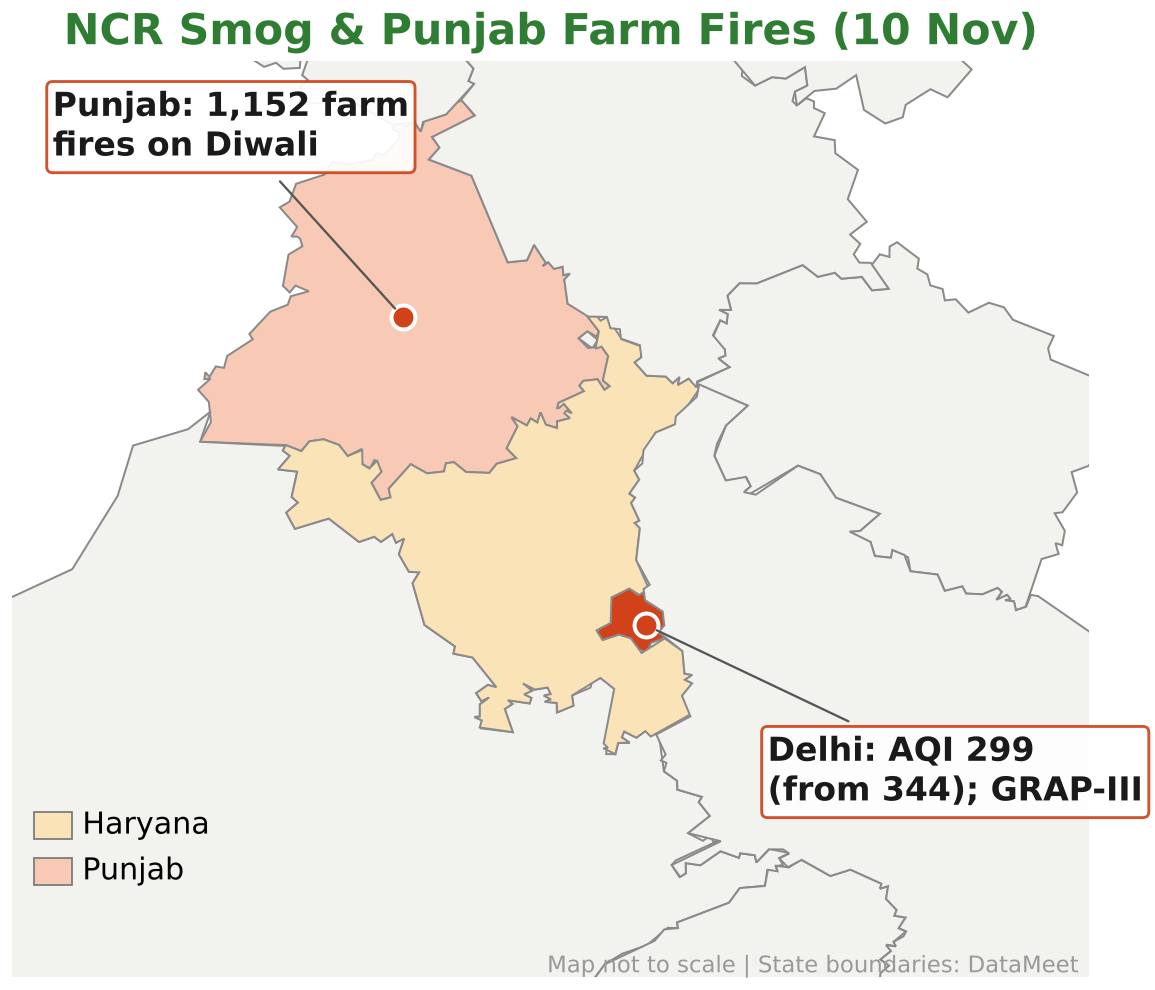
After Diwali, Delhi's air became 'very poor' and stubble burning in Punjab jumped. Emergency anti-pollution steps are in force in the capital region. Delhi's 24-hour average AQI was 299 on 10 November, down from 344 the previous day, after post-Diwali pollution pushed parts of north India into 'very poor' to 'severe' levels. Punjab recorded 1,152 farm fires on Diwali, the highest one-day rise this season. Earlier, on 6 November, the Commission for Air Quality Management (CAQM) invoked Stage III of the Graded Response Action Plan (GRAP) across NCR, with curbs on construction and demolition. Doctors advised N95 masks and less outdoor activity.
Key facts
Delhi AQI: 344 (9 Nov) -> 299 (10 Nov).
Punjab: 1,152 farm fires on Diwali day.
GRAP Stage III invoked in NCR on 6 November (AQI 382 that day).
CPCB rejected claims that AQI data is under-reported.
Way forward
Pay farmers for straw, scale up ex-situ use (biofuel, power plants) and enforce dust and vehicle rules all year, not only in winter.
Concept
GRAP stages by AQI: Stage I 'Poor' (201-300), Stage II 'Very Poor' (301-400), Stage III 'Severe' (401-450), Stage IV 'Severe+' (above 450); stages can be invoked in advance based on forecasts. CAQM is a statutory body under the CAQM Act, 2021 for NCR and adjoining areas (it replaced EPCA). Stubble burning: farmers burn paddy straw to clear fields quickly for wheat; alternatives include Happy Seeder, bio-decomposers and using straw in power plants and biofuel units. Exam angle: Prelims: AQI bands, GRAP stages, CAQM Act year. Mains: why stubble burning continues despite schemes; role of weather (low wind, inversion) in winter smog.
Map of Punjab, Haryana and Delhi showing farm fires in Punjab and Delhi's air quality on 10 November — StudyForGS
24. India's Opening Stand at COP31
ENVIRONMENTUPSC: Prelims + Mains GS3 / GS2
Syllabus linkage
GS3: Climate change, International environmental agreements; GS2: International groupings. Prelims: COP31 host, Article 9.1, CBDR-RC, negotiating blocs; Mains: climate finance and equity.
Context
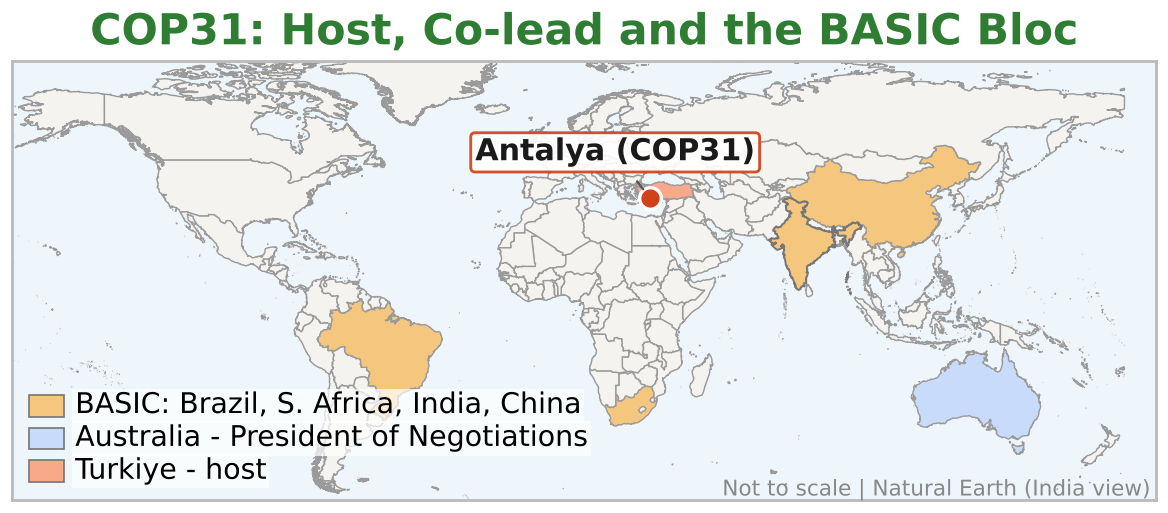
The world's yearly climate summit, COP31, is on in Antalya, Turkiye. India said rich countries must provide money for climate action and that fairness (equity) must guide all decisions. COP31 of the UN Framework Convention on Climate Change (UNFCCC) opened in Antalya, Turkiye on 9 November and runs till 20 November; the World Leaders' Summit is on 11-12 November. Turkiye hosts it, while Australia's minister Chris Bowen is 'President of Negotiations' under a sharing deal. Environment Secretary Narendra Bhooshan gave India's opening statement on 10 November. India welcomed the 'COP of Implementation' vision and aligned with the G77 and China, LMDC and BASIC groups.
Key facts
India's pillars: equity, CBDR-RC, just transition, adaptation for the Global South, and public climate finance from developed countries.
India stressed Article 9.1 of the Paris Agreement - developed countries 'shall provide' finance to developing countries.
India wants adaptation indicators to be voluntary and carbon market participation to stay voluntary.
UNEP: developing countries' adaptation needs about USD 305 billion a year by 2035; public adaptation finance was only about USD 28-32 billion in 2024.
Delegates from 197 countries and the EU; Nepal pushed for a work programme on mountains.
Way forward
India should push for a clear climate-finance work programme and practical adaptation support, while showing its own progress on renewables.
Concept
CBDR-RC (Common But Differentiated Responsibilities and Respective Capabilities): all countries must act, but rich countries that caused most past emissions must do more - a UNFCCC (1992) principle. BASIC = Brazil, South Africa, India, China; LMDC = Like-Minded Developing Countries; G77 + China = the largest developing-country bloc at the UN. Global Goal on Adaptation (GGA): a Paris Agreement goal to build resilience; indicators are being negotiated to track it. Exam angle: Prelims: COP31 host and city, Article 9.1, BASIC members, CBDR-RC origin. Mains: the climate finance gap and India's 'equity' argument; adaptation vs mitigation priorities.
World map highlighting Turkiye as COP31 host, Australia as President of Negotiations and the BASIC countries — StudyForGS
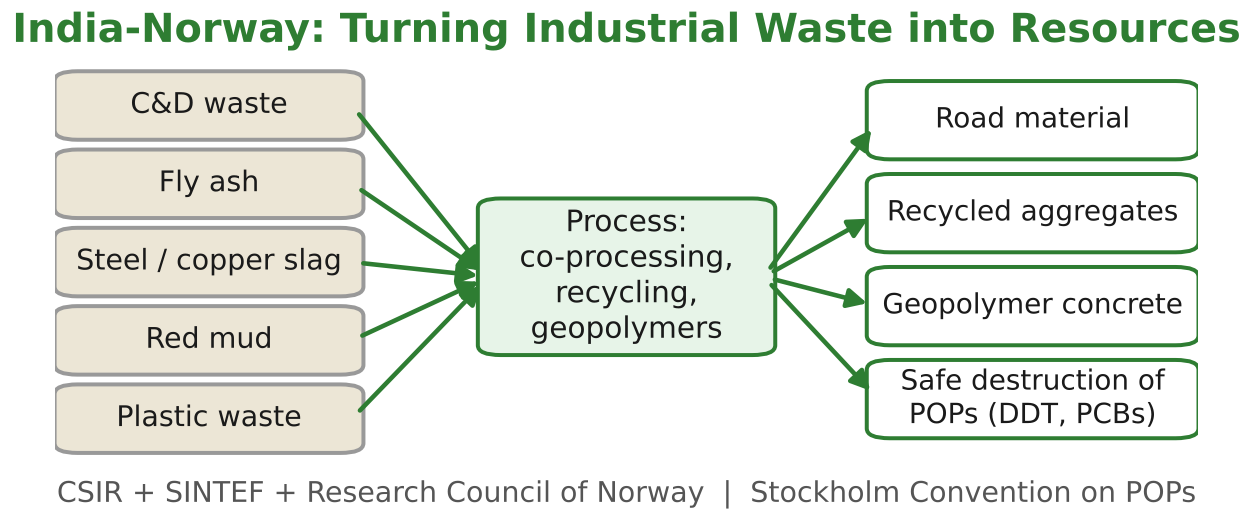
Industries produce lots of waste like fly ash, slag and red mud. India and Norway are working together to turn such waste into material for roads and buildings, and to destroy toxic chemicals safely. CSIR, Norway's SINTEF and the Research Council of Norway held a dialogue on 'Waste to Resource Solutions in the Cement and Construction Sector' in New Delhi on 10 November. It covered construction and demolition waste, steel and copper slag, fly ash, red mud, plastic waste, and safe destruction of Persistent Organic Pollutants (POPs) such as DDT and PCBs. Both sides agreed to prepare 2-3 joint research proposals and pilot projects.
Key facts
Partners: CSIR labs (CBRI, NEERI, CRRI, AMPRI), SINTEF, Research Council of Norway.
Linked to the India-Norway Green Strategic Partnership.
Plan: 2-3 joint proposals, pilot plants for hazardous waste, guidelines for DDT- and PCB-contaminated waste.
Way forward
Clear standards for recycled materials and public procurement preference can create a market for waste-based products.
Concept
POPs: toxic chemicals that do not break down, travel long distances and build up in living bodies; the Stockholm Convention (2001, in force 2004) aims to eliminate them - India ratified it in 2006. Co-processing: burning or using waste as fuel/raw material in cement kilns at very high temperature, which destroys toxins and saves coal. Red mud is a by-product of aluminium making (Bayer process); fly ash comes from coal power plants. Exam angle: Prelims: Stockholm Convention, POP examples, sources of red mud/fly ash, co-processing. Mains: circular economy and green construction; India-Nordic cooperation.
Diagram showing industrial wastes such as fly ash, slag and red mud being processed into road material, aggregates and geopolymer concrete — StudyForGS
📜 Asked before in the exam — previous-year question on this topic
UPSC Prelims 2015With reference to 'fly ash' produced by the power plants using coal as fuel, which of the following statements is/are correct? 1. Fly ash can be used in the production of bricks for building construction. 2. Fly ash can be used as a replacement for some of the Portland cement contents of concrete. 3. Fly ash is made up of silicon dioxide and calcium oxide only, and does not contain any toxic elements. Select the correct answer using the code given below.
1 and 2
2 only
1 and 3
3 only
Show answer
Answer: (a) 1 and 2 Fly ash is the fine residue left after burning pulverised coal in thermal power plants. It is widely used to make fly ash bricks and, because it is pozzolanic, it can replace part of the Portland cement in concrete, so statements 1 and 2 are correct. Its main constituents are silica, alumina, iron oxide and calcium oxide, but it also carries traces of toxic elements such as arsenic, lead, mercury, cadmium and chromium, so statement 3 is wrong. Hence option (a). Practise all UPSC Prelims 2015 paper (free) →
Linked because this news is about the same topic. The answer is as per the official key of that year.
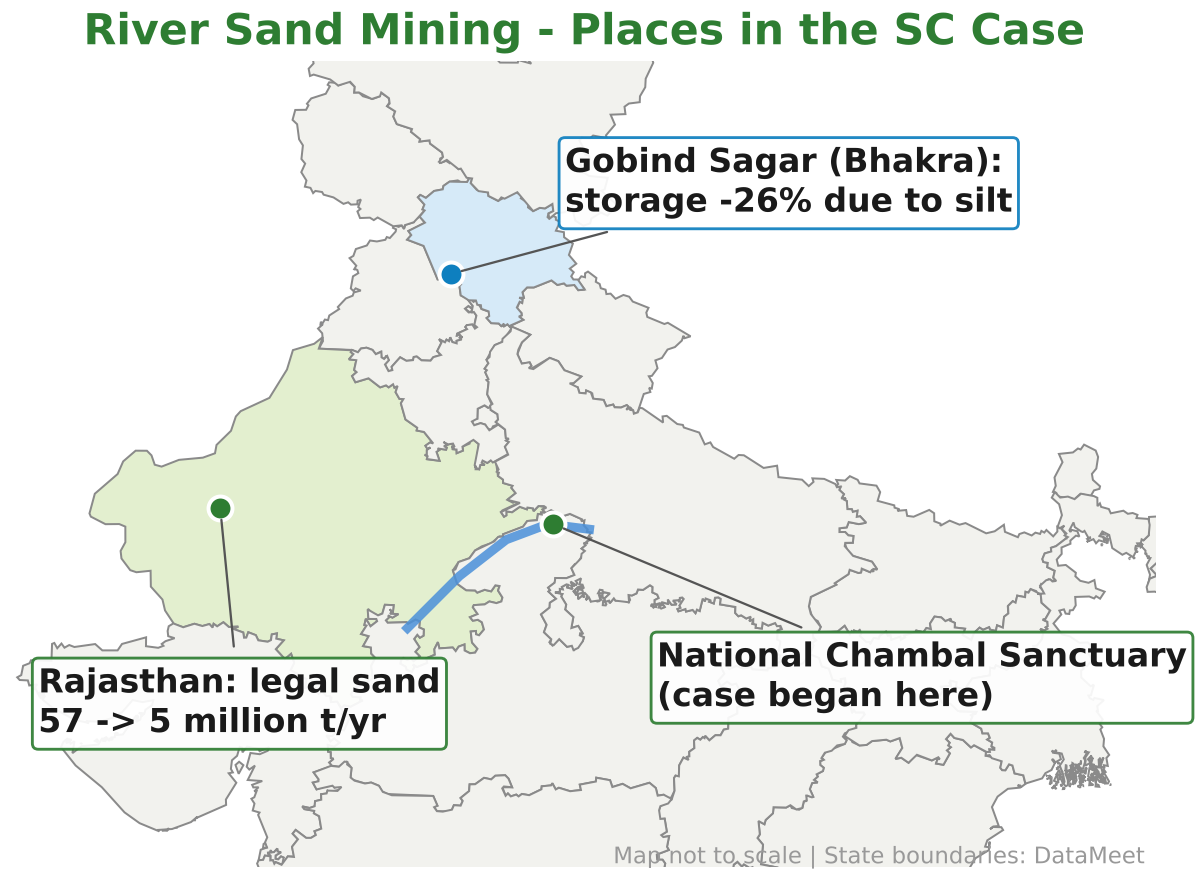
Too much sand is being dug from rivers, which damages them. A Supreme Court committee says river-bed mining should be phased out in three years and sand should come from dam silt, crushed rock and recycled debris instead. The Supreme Court-appointed Central Empowered Committee (CEC) submitted its Report No. 36 of 2026 on 2 November. The case began as a suo motu matter on illegal sand mining in the National Chambal Sanctuary and was widened to all of India. The CEC recommends a time-bound exit from unsustainable mining in active river channels over three years and a shift to alternative sources.
Key facts
Alternatives: sand from planned dam desilting, manufactured sand (M-sand) meeting BIS standards, and recycled construction and demolition (C&D) waste.
Of 439 reservoirs assessed, average storage loss due to silt is 19.24%; 23 reservoirs have lost over half their storage.
Gobind Sagar (Bhakra Dam) storage fell from 9,868 to about 7,300 million cubic metres (about -26%).
Desilt about one-tenth of suitable reservoirs each year in a 10-year cycle; focus on dams older than 15 years.
Digital tracking: e-transit permits with QR codes, barcodes or RFID tags.
Way forward
Build a national database of sand demand and supply, and grow M-sand and recycled sand before tightening river mining.
Concept
Sand is a 'minor mineral' under the MMDR Act, 1957, so States make rules and grant leases; water is also a State subject - hence Centre-State coordination is needed. River sand protects river beds, recharges groundwater and supports aquatic life; over-mining deepens channels, erodes banks and damages bridges. National Chambal Sanctuary (MP-Rajasthan-UP) protects the gharial, red-crowned roof turtle and Gangetic river dolphin. Exam angle: Prelims: minor minerals, CEC, Chambal Sanctuary species and States, M-sand. Mains: illegal sand mining as an environmental and law-and-order problem; circular economy in construction.
Map of north-west India showing the National Chambal Sanctuary, Gobind Sagar reservoir and Rajasthan's fall in legal sand supply — StudyForGS
📜 Asked before in the exam — previous-year question on this topic
UPSC Prelims 2019With reference to the management of minor minerals in India, consider the following statements: 1. Sand is a 'minor mineral' according to the prevailing law in the country. 2. State Governments have the power to grant mining leases of minor minerals, but the powers regarding the formation of rules related to the grant of minor minerals lie with the Central Government. 3. State Governments have the power to frame rules to prevent illegal mining of minor minerals. Which of the statements given above is/are correct?
1 and 3 only
2 and 3 only
3 only
1, 2 and 3
Show answer
Answer: (a) 1 and 3 only Statements 1 and 3 are correct. Under Section 3(e) of the Mines and Minerals (Development and Regulation) Act, 1957, ordinary sand is a minor mineral. Under Section 15 of the Act, State Governments make the rules for granting concessions and leases for minor minerals, so the rule-making power rests with the States and not the Centre. That makes statement 2 wrong. Section 23C empowers States to make rules to prevent illegal mining, transport and storage of minerals. Practise all UPSC Prelims 2019 paper (free) →
Linked because this news is about the same topic. The answer is as per the official key of that year.
27. Yuge Yugeen Bharat Museum Takes Shape
ART & CULTUREUPSC: Prelims + Mains GS1
Syllabus linkage
GS1: Indian culture - heritage and its conservation. Prelims: museum location, galleries; Mains: adaptive reuse of heritage buildings.
Context
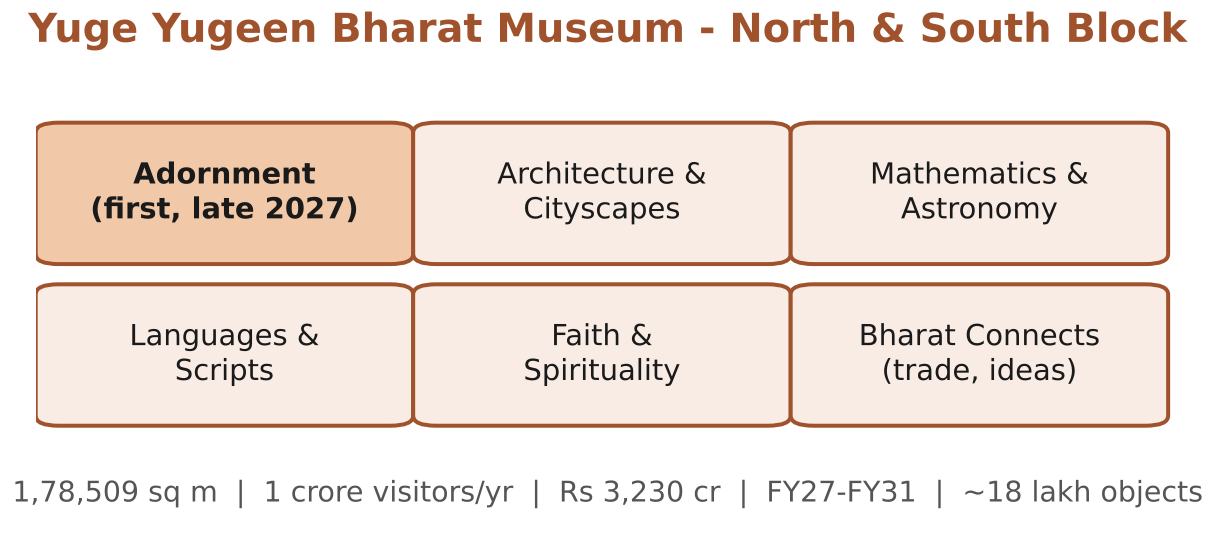
India's old government buildings, North Block and South Block, will become a huge national museum telling India's 5,000-year story. The first gallery should open in late 2027. The Ministry of Culture shared details of the Yuge Yugeen Bharat Museum (YYBM) to be built through adaptive reuse (new use of old buildings) of the North and South Block complex in New Delhi. It will have a built-up area of about 1,78,509 sq m and can handle 1 crore visitors a year. The estimated cost is Rs 3,230 crore, approved by the Cabinet Committee on Economic Affairs, with phased work from 2026-27 to 2030-31.
Key facts
Announced by the PM on 18 May 2023 (International Museum Day).
First gallery, on 'Adornment', planned to open in North Block in late 2027.
Planned galleries: Architecture and Cityscapes, Mathematics and Astronomy, Languages and Scripts, Faith and Spirituality, 'Bharat Connects' (trade and ideas).
About 18 lakh objects identified from the National Museum, 52 ASI site museums, State and private collections.
Claimed to have the largest display area of any museum in the world.
Way forward
Strong conservation of the buildings and digital access for those who cannot visit Delhi will add value.
Concept
North and South Blocks were designed by Herbert Baker as part of New Delhi (capital moved from Calcutta, announced 1911); ministries are shifting to the new Central Secretariat under the Central Vista project. Adaptive reuse keeps historic buildings alive by giving them a new purpose instead of demolishing them. The ASI (founded 1861, first DG Alexander Cunningham) manages site museums and protected monuments. Exam angle: Prelims: location, architect of North/South Block, ASI founding, museum name meaning ('through the ages'). Mains: museums as soft power; heritage conservation with modern use.
Planned galleries of the Yuge Yugeen Bharat Museum in North and South Block, with key figures on area, visitors and cost — StudyForGS
28. Buddha Relics on Display in Arunachal
ART & CULTUREUPSC: Prelims + Mains GS1
Syllabus linkage
GS1: Art and culture - Buddhism, sites; GS2: Cultural diplomacy. Prelims: Bomdila, Namsai, Buddhist sects; Mains: Buddhist heritage and the North-East.
Context
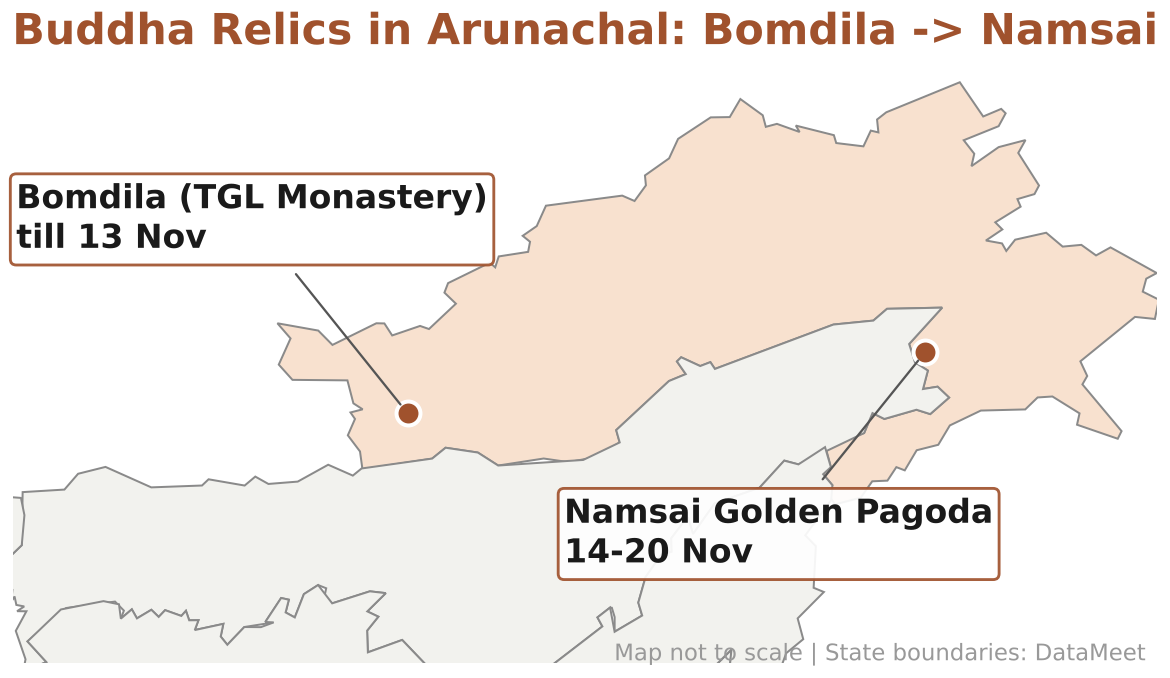
Holy relics of the Buddha from the National Museum, New Delhi, are being shown to devotees in Arunachal Pradesh - first at Bomdila and then at Namsai. The sacred relics of Shakyamuni Buddha are on public display at the Thubchog Gatsel Ling (Lower Gompa) Monastery, Bomdila (West Kameng) till 13 November; nearly 12,000 devotees came in the first two days. On 14 November they will be taken to the Golden Pagoda, Namsai, for darshan from 14 to 20 November, and will return to the National Museum, New Delhi, on 21 November. The Ministry of Culture, National Museum, Government of Arunachal Pradesh and the International Buddhist Confederation (IBC) organised it.
Key facts
Bomdila: 11,969 devotees in the first two days.
Namsai Golden Pagoda: 14-20 November 2026.
Return to National Museum, New Delhi: 21 November.
Organisers: Ministry of Culture, National Museum, Arunachal government, IBC (New Delhi).
Way forward
Such expositions can be linked with a North-East Buddhist circuit to boost tourism and local livelihoods.
Concept
'Shakyamuni' means 'sage of the Shakya clan' - a title of Gautama Buddha, born at Lumbini (Nepal). Bomdila monasteries follow Tibetan Mahayana Buddhism, while the Golden Pagoda at Namsai (Kongmu Kham) belongs to the Theravada tradition of the Tai Khamti people. IBC, set up in 2012 with HQ in New Delhi, is an umbrella body of Buddhist organisations that supports India's Buddhist diplomacy. Exam angle: Prelims: locations of Bomdila and Namsai, Theravada vs Mahayana, IBC, Tai Khamti. Mains: Buddhist heritage as a tool of soft power and of national integration in the North-East.
Map of Arunachal Pradesh marking Bomdila and Namsai where the Buddha relics are displayed — StudyForGS
29. IIT Jodhpur's Light Heat-Proof Alloy
SCI-TECHUPSC: Prelims + Mains GS3
Syllabus linkage
GS3: Science and technology - indigenisation, new materials; defence and space technology. Prelims: refractory metals; Mains: strategic materials and self-reliance.
Context
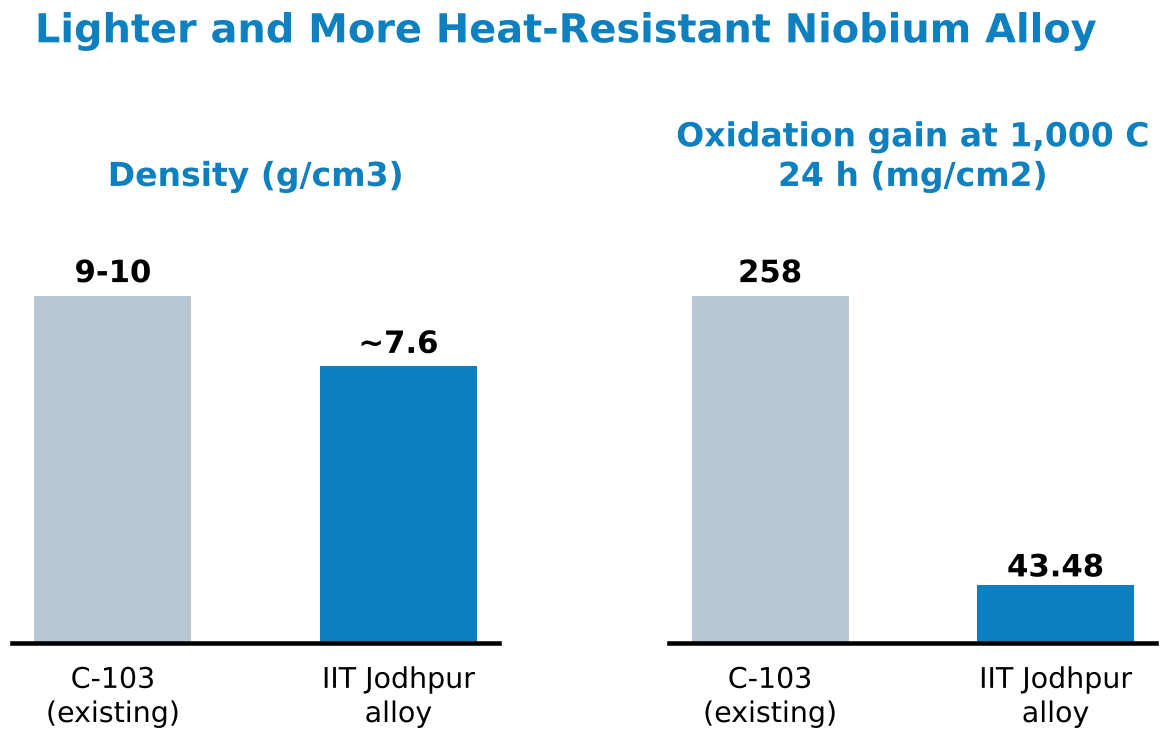
Parts of jet engines and rockets must survive very high heat. IIT Jodhpur has made a lighter and cheaper niobium-based metal mix that resists heat damage much better than the alloy used today. A team led by Dr Saurabh Nene at IIT Jodhpur developed niobium-rich 'Refractory Complex Lean Alloys'. Their density is about 7.6 g/cm3, compared with 9-10 for common niobium alloys such as C-103. In a test at 1,000 degrees C for 24 hours, the new alloy gained only 43.48 mg/cm2 from oxidation (rusting by heat) against 258 for C-103. The work was published in the journal Materials and Design.
Key facts
Density: about 7.6 g/cm3 vs 9-10 g/cm3 for C-103 type alloys (lighter).
Oxidation gain at 1,000 degrees C / 24 h: 43.48 vs 258 mg/cm2 (about 6 times less damage).
Yield strength about 1.13 GPa; no costly hafnium used.
Estimated cost advantage of about 11 times.
Way forward
Testing in real engine and space conditions and partnership with DRDO, ISRO and industry can take it from lab to use.
Concept
Refractory metals: metals with very high melting points - niobium, molybdenum, tantalum, tungsten, rhenium - used in jet engines, rocket nozzles and nuclear reactors. Oxidation resistance: ability of a metal to resist reacting with oxygen at high heat, which otherwise weakens it. 'Lean' alloy: uses fewer costly or scarce elements, which matters for strategic supply security. Exam angle: Prelims: list of refractory metals, uses of niobium. Mains: role of advanced materials in defence/space self-reliance and the lab-to-industry gap.
Bar charts comparing density and high-temperature oxidation of the IIT Jodhpur alloy with the existing C-103 alloy — StudyForGS
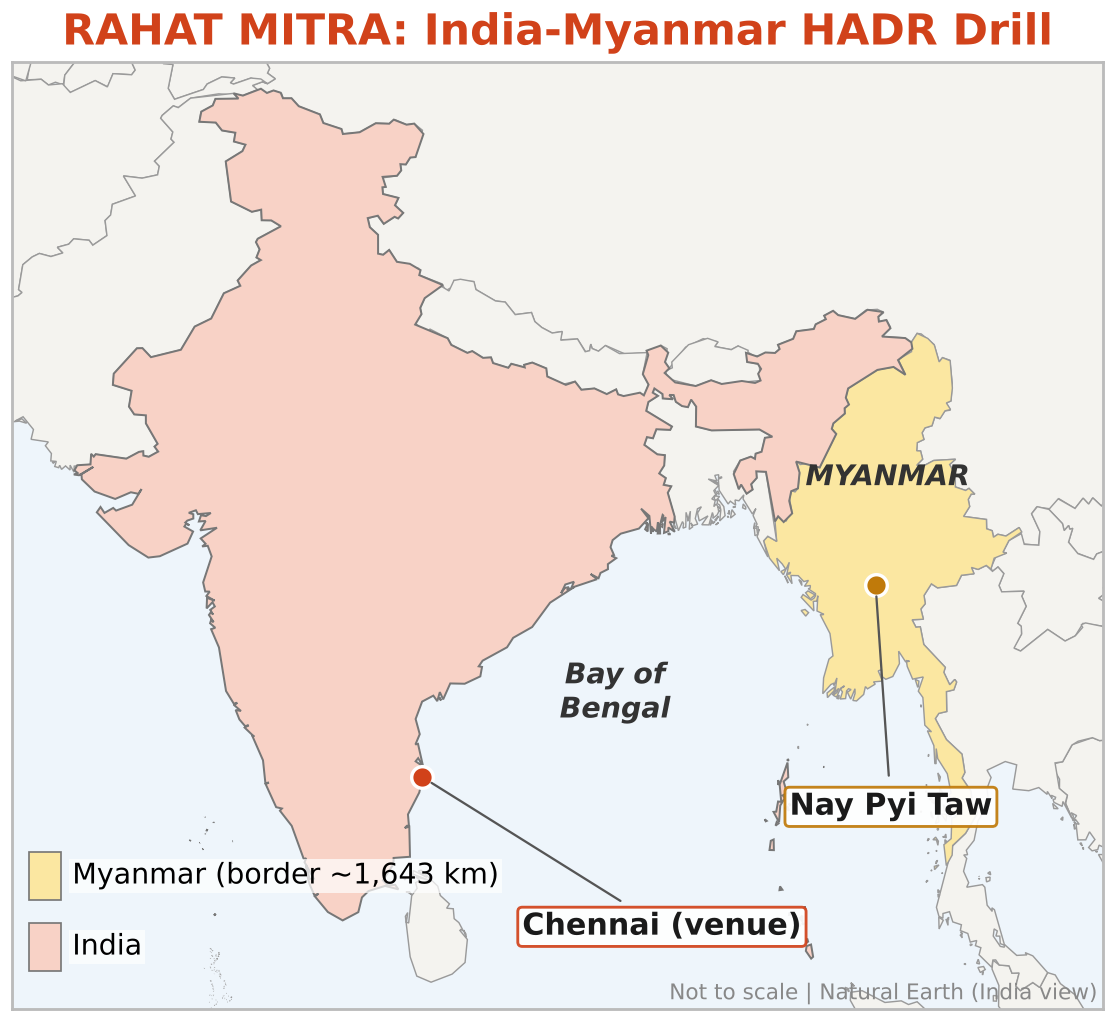
India and Myanmar held their first joint drill of army, navy and air force on how to help people after disasters like cyclones. The first bilateral tri-services Humanitarian Assistance and Disaster Relief (HADR) exercise between India and Myanmar, RAHAT MITRA, was held in Chennai on 5-6 November 2026. It included a tabletop exercise on a severe cyclone and demonstrations at INS Adyar, the Military Hospital and at sea. INS Bitra and a Chetak helicopter showed maritime search and rescue, and an IAF Advanced Light Helicopter showed casualty evacuation.
Key facts
First edition; venue Chennai; 5-6 November 2026.
Theme: 'Together for Humanity, Stronger through Partnership'; over 300 personnel.
Ships: INS Sukanya, INS Adyar, INS Bitra; helicopters: Chetak and ALH.
Army showed obstacle clearance and bridge-laying; Navy flood relief teams; field medical triage.
Way forward
Regular drills and shared early-warning data on Bay of Bengal cyclones will help both countries save lives.
Concept
HADR: use of armed forces and agencies to give quick relief, rescue and medical help after disasters; India sees itself as a 'first responder' in the Indian Ocean Region. India helped Myanmar under Operation Brahma after the March 2025 earthquake. Myanmar is India's land bridge to South-East Asia (Act East Policy); India-Myanmar border is about 1,643 km touching Arunachal, Nagaland, Manipur and Mizoram. Exam angle: Prelims: exercise partner and type, Operation Brahma, Myanmar border States. Mains: HADR as a tool of foreign policy and regional leadership.
Map of India and Myanmar marking Chennai, venue of Exercise RAHAT MITRA, and Nay Pyi Taw — StudyForGS
31. Naseem Al Bahr: India-Oman Navies Meet
DEFENCEUPSC: Prelims + Mains GS3 / GS2
Syllabus linkage
GS2: India and the Gulf; GS3: Maritime security. Prelims: India-Oman exercises, INS Surat class; Mains: India's Western Indian Ocean strategy.
Context
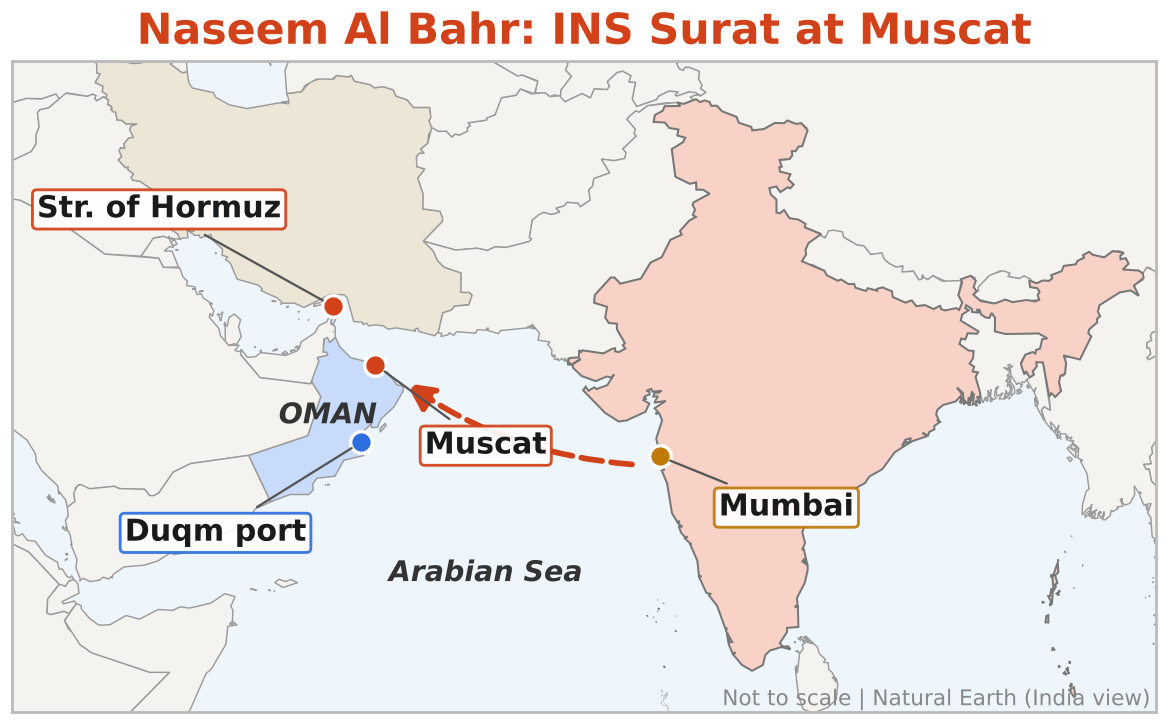
India's navy ship INS Surat reached Muscat for 'Naseem Al Bahr' (Sea Breeze), the 15th edition of India's naval exercise with Oman, an old and close partner in the Arabian Sea. INS Surat arrived in Muscat, Oman on 8 November 2026 for the 15th edition of the bilateral maritime exercise Naseem Al Bahr. The exercise has a harbour phase (cross-deck visits, professional talks, sports) and a sea phase, followed by a coordinated patrol (CORPAT) between the two navies. The deployment supports India's MAHASAGAR vision.
Key facts
15th edition; series began in 1993.
Oman was the first Gulf Cooperation Council (GCC) country to hold naval exercises with India.
Harbour + sea phases, then CORPAT.
Other India-Oman drills: Al Najah (Army), Eastern Bridge (Air Force).
Way forward
Joint patrols and information sharing with Oman can secure the energy sea lanes India depends on.
Concept
MAHASAGAR: 'Mutual and Holistic Advancement for Security and Growth Across Regions' - India's 2025 maritime vision that builds on SAGAR (2015). INS Surat is a Project 15B (Visakhapatnam-class) stealth guided-missile destroyer built at Mazagon Dock, commissioned in January 2025. Oman sits at the mouth of the Gulf, next to the Strait of Hormuz; India has access to Oman's Duqm port for its navy. Exam angle: Prelims: exercise names with Oman, MAHASAGAR full form, Project 15B, Duqm. Mains: securing sea lanes near Hormuz amid West Asia tensions.
Map of the Arabian Sea showing Muscat, Duqm port, the Strait of Hormuz and the route of INS Surat from Mumbai — StudyForGS
Data point of the day
5.1%
Unemployment rate (PLFS, Jul-Sep 2026, CWS, age 15+) Down from 5.4% in April-June 2026; rural 4.3%, urban 6.8%, urban women 8.8%.
Prelims rapid-fire
National Education Day (11 Nov): Birth anniversary of Maulana Abul Kalam Azad, India's first Education Minister; observed since 2008; Azad got the Bharat Ratna posthumously in 1992.
World Pneumonia Day (12 Nov): Theme 2026: 'A New Era of Pneumonia Control'; first observed in 2009; pneumonia caused about 2.5 million deaths in 2023, incl. about 6.1 lakh children under five.
India-Lebanon: First Foreign Office Consultations held in New Delhi on 9 Nov; focus on trade and investment, digital public infrastructure and pharmaceuticals.
Patna Municipal Bond: Bihar's first municipal bond listed on NSE (10 Nov): Rs 199.99 crore raised for 15 urban projects; 9.20% coupon; rated AA (Stable).
Yamuna River Cruise: Delhi's first recreational cruise launched (Sonia Vihar-Jagatpur, about 6 km round trip, 30-seat electric vessel); Yamuna is National Waterway-110; developed by IWAI.
Joint HADR Exercise 2026: Annual tri-services HADR exercise at AFS Jamnagar, Gujarat from 17 Nov with NDMA, Coast Guard and friendly foreign countries.
Exports: India has achieved 48% of its USD 1 trillion export target for this year (Commerce Minister Piyush Goyal).
Ease of Vehicle Ownership Index: Ranks 15 States/UTs on buying, selling and transferring used vehicles; Andhra Pradesh 1st, Uttar Pradesh last.
DRI seizure: About 13,000 e-cigarettes worth over Rs 4 crore seized at JNPT; e-cigarettes are banned under the Prohibition of Electronic Cigarettes Act, 2019.
Mains practice question
Q. Online frauds such as 'digital arrest' scams show the limits of a law-and-order approach to cybercrime. Discuss the shared responsibility of platforms, banks, telecom companies and the State in protecting citizens, in the light of recent Supreme Court directions. (250 words, 15 marks)
Hint / approach
Explain the modus operandi; cite the suo motu case, directions to intermediaries and I4C, and bank liability for lack of due diligence; link with Section 79 and IT Rules 2021; suggest a shared fraud registry, awareness via 1930, and faster bank freezes; conclude with citizen trust in digital India.
📌 One-line revision: Digital arrest is always fake (report on 1930); the Article 22 clock starts at detention; India at COP31 stands on equity and Article 9.1; PLFS unemployment is 5.1%.