Tuesday, 10 November 2026 · IST · National & International · 30 items
COP31 began in Antalya, Turkiye as the Global Carbon Budget 2026 showed world fossil CO2 dipping 0.4% while India's rose 4.4%. The Supreme Court held that the Article 22 24-hour clock starts the moment a person is held, and clarified its OBC creamy-layer ruling. Ten years after demonetisation, cash with the public has hit Rs 42.55 lakh crore, and cancer drug price cuts took effect on 9 November.
Today at a glance — things to remember
SC: the 24-hour Art. 22(2) clock starts when a person is first held, not at the formal arrest memo.
OBC creamy layer: parent's post status, not salary alone, decides; ruling applies to CSE 2025 allocation.
National Legal Services Day (9 Nov): LSA Act 1987 came into force on 9 Nov 1995; Art. 39A.
COP31 in Antalya, Turkiye (9-20 Nov); Turkiye presides, Australia leads talks; COP32 in Ethiopia (2027).
Global Carbon Budget 2026: world fossil CO2 -0.4% to 38.2 bn t; India +4.4%; CO2 at 427.7 ppm.
Demonetisation at 10: cash with public Rs 42.55 lakh cr (Oct 2026); currency-to-GDP back to ~12.1%.
Cancer drugs: NPPA trade-margin cap on 137 drugs in force from 9 Nov; saving ~Rs 3,540 cr a year.
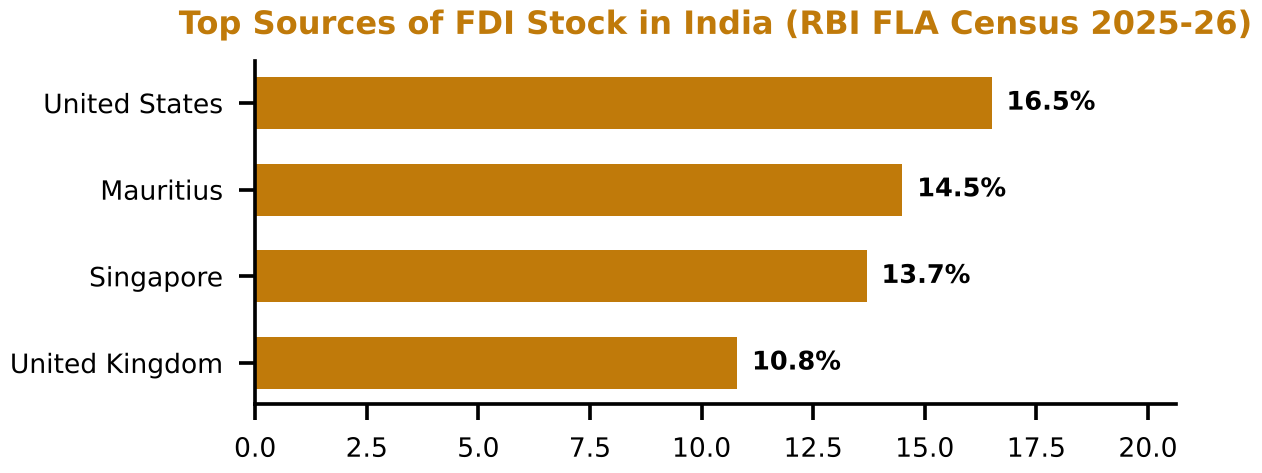
RBI FLA census 2025-26: US (16.5%) is now the top source of FDI stock, ahead of Mauritius and Singapore.
G7 foreign ministers in Paris (9-10 Nov); Russia-Ukraine-US talks in Abu Dhabi (10-11 Nov).
RAHAT MITRA: first India-Myanmar tri-services HADR exercise, Chennai, 5-6 Nov.
Detailed notes
1. 24-Hour Arrest Clock Starts at Detention
POLITYUPSC: Prelims + Mains GS2
Syllabus linkage
GS2 - Fundamental Rights (Art. 21, 22), criminal justice, role of the judiciary. Prelims: Art. 22 clauses, BNSS sections; Mains: police reforms and custodial rights.
Context
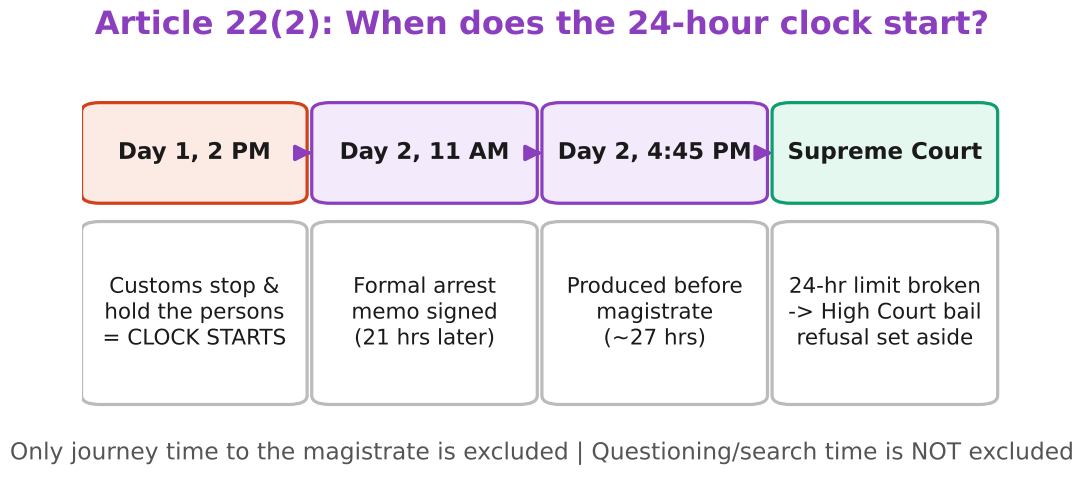
The Supreme Court has said the 24 hours within which an arrested person must be taken to a magistrate start the moment police or any agency stop a person's freedom, not when they write the formal arrest memo later. Customs officers in Agartala (Tripura) stopped the accused at 2 PM with 60 kg of methamphetamine tablets. The formal arrest memo was signed only at 11 AM the next day, and they were produced before a magistrate at 4:45 PM - more than 24 hours after they were first held. The agency said the gap was used for search, seizure and questioning. The Supreme Court rejected this, set aside the Tripura High Court's refusal of bail, and said such time cannot be used as a 'buffer zone'.
Key facts
The clock starts when a person's liberty is actually curtailed (held/stopped), not at the 'paper' arrest.
Only the journey time to the nearest magistrate is excluded from the 24 hours.
Searches, seizures and questioning cannot pause the clock.
Magistrates must check detention on their own and may refuse police remand even if production was within 24 hours.
The Court said bail limits under Sec. 37 of the NDPS Act cannot override Articles 21 and 22 (citing Union of India v. K.A. Najeeb, 2021).
Way forward
Agencies must record the exact time a person is first held, and CCTV with audio in police stations and agency offices should be fully implemented.
Concept
Article 22(2): an arrested person must be produced before the nearest magistrate within 24 hours (excluding travel time); longer detention needs the magistrate's order. Art. 22 protections do NOT apply to enemy aliens or to persons held under preventive detention laws. Section 58, BNSS 2023 (Bharatiya Nagarik Suraksha Sanhita, which replaced the CrPC): a person arrested without warrant cannot be held beyond 24 hours without a magistrate's special order - it is the statutory twin of Art. 22(2). D.K. Basu v. State of West Bengal (1997) laid down arrest guidelines (arrest memo, informing a relative, medical check) - this ruling builds on that line of cases. Exam angle: Prelims: who is excluded from Art. 22 safeguards; what time is excluded from 24 hours; BNSS section numbers. Mains: 'Informal detention defeats constitutional safeguards' - discuss with this ruling, D.K. Basu, CCTV directions (Paramvir Singh Saini, 2020).
Timeline of the Tripura customs case: persons held Day 1 at 2 PM, arrest memo next day 11 AM, produced before magistrate about 27 hours later; Supreme Court held the 24-hour limit was broken. — StudyForGS
2. OBC Creamy Layer: SC Clarifies Ruling
POLITYUPSC: Prelims + Mains GS2
Syllabus linkage
GS2 - Reservation, welfare of vulnerable sections, judiciary. Prelims: Indra Sawhney, Art. 16(4), income ceiling; Mains: fairness in creamy-layer rules.
Context
The Supreme Court said that a parent's salary alone cannot push an OBC candidate into the 'creamy layer' (the better-off group that does not get reservation). Now it has clarified how far this ruling will apply, including to UPSC CSE 2025 service allocation. In Union of India v. Rohith Nathan (11 March 2026) the Court held that for children of PSU or private-sector employees, the status of the parent's post (whether it equals a Group A/B/C/D government post) must be checked, not just salary. On 6 November 2026 it clarified the order: it applies to the parties and intervenors, governs service allocation for eligible OBC candidates of CSE 2025 (still pending), and covers 148 selected Indian Forest Service candidates. Completed appointments and seniority will not be reopened, and the Centre got extra time to comply.
Key facts
Income ceiling for creamy layer: Rs 8 lakh per year - unchanged since 2017.
Under the 1993 Office Memorandum, salary and agricultural income are NOT counted in the income/wealth test.
A 2004 clarification allowed counting salary of PSU/private parents - this caused about 100 OBC candidates (since CSE 2015) to be denied.
Selections after 11 March 2026 must follow the 1993 OM as read by the Court.
Excluding only on salary, without checking post status, can be 'hostile discrimination' (Art. 14).
Way forward
DoPT should issue clear rules on post equivalence across PSUs and private firms and review the income limit regularly.
Concept
Creamy layer: the economically and socially advanced members of OBCs who are kept out of reservation so that benefits reach the truly backward - introduced by Indra Sawhney v. Union of India (1992), the Mandal case that also fixed the 50% ceiling. Article 16(4): lets the State reserve government jobs for backward classes not adequately represented. Article 141: law declared by the Supreme Court binds all courts. Post equivalence: deciding which PSU/private job equals a Group A or B government post - the core gap the Court wants the government to fill. Exam angle: Prelims: case names (Indra Sawhney 1992), year of income limit revision (2017), what income is excluded. Mains: Is the creamy-layer test fair to children of salaried private employees? Need for periodic revision of the ceiling.
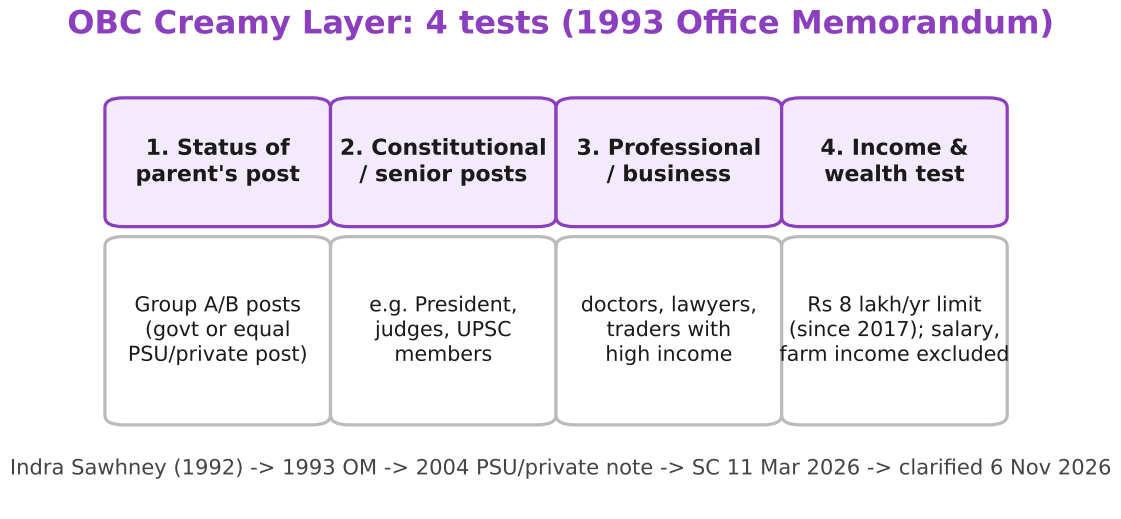
Four tests of the OBC creamy layer under the 1993 Office Memorandum: status of parent's post, constitutional/senior posts, professional/business class, and income-wealth test with the Rs 8 lakh limit. — StudyForGS
3. Voter ID for Welfare: Why It Worries
POLITYUPSC: Prelims + Mains GS2
Syllabus linkage
GS2 - Welfare schemes, ECI and electoral rolls, Aadhaar, issues of exclusion. Prelims: EPIC vs Aadhaar basics; Mains: identity systems and welfare delivery.
Context
A Union Minister said voter ID cards with biometrics could be used to identify welfare beneficiaries instead of Aadhaar. After criticism he said it would be used along with Aadhaar, but experts warn that people dropped from voter lists could also lose rations and pensions. Panchayati Raj Minister Rajiv Ranjan (Lalan) Singh claimed Aadhaar cards can be made 'at every street corner' and that voter IDs (EPIC = Electors Photo Identity Card) plus biometrics would be better. Opposition parties linked this to the Special Intensive Revision (SIR) of electoral rolls, in which over 13 crore names have reportedly been removed. The Supreme Court, while hearing a challenge to West Bengal linking welfare to rolls, called the EPIC a 'derivative document' whose use should have only electoral consequences. The Minister later clarified voter ID would be used alongside Aadhaar.
Key facts
EPIC has been accepted as a supporting document (e.g. MGNREGA job cards) but never as the only national welfare ID.
10 states (starting with MP and Rajasthan) use 'family cards' because many schemes target households.
West Bengal (June 2026) linked PDS ration cards to electoral rolls - drew pushback; 21 lakh roll-deletion appeals pending there.
SC: SIR is not a citizenship inquiry, so using rolls for welfare is legally doubtful.
Fix any Aadhaar-security weakness instead of switching IDs, and keep voter rolls strictly for elections.
Concept
Aadhaar Act 2016, Section 7: the government can require Aadhaar authentication to receive subsidies/benefits paid from the Consolidated Fund of India; upheld in K.S. Puttaswamy (Aadhaar) 2018. Electoral rolls are prepared under the Representation of the People Act, 1950 by the ECI (Art. 324-326). They are revised often, so a name can be removed - unlike a lifelong Aadhaar number. 'Double exclusion': losing both the vote and welfare because of one deletion - the main fear of critics. Exam angle: Prelims: Section 7 Aadhaar Act; Art. 326 (adult suffrage); who prepares rolls. Mains: Should electoral identity be used for welfare? Balance between leak-proof delivery and exclusion errors.
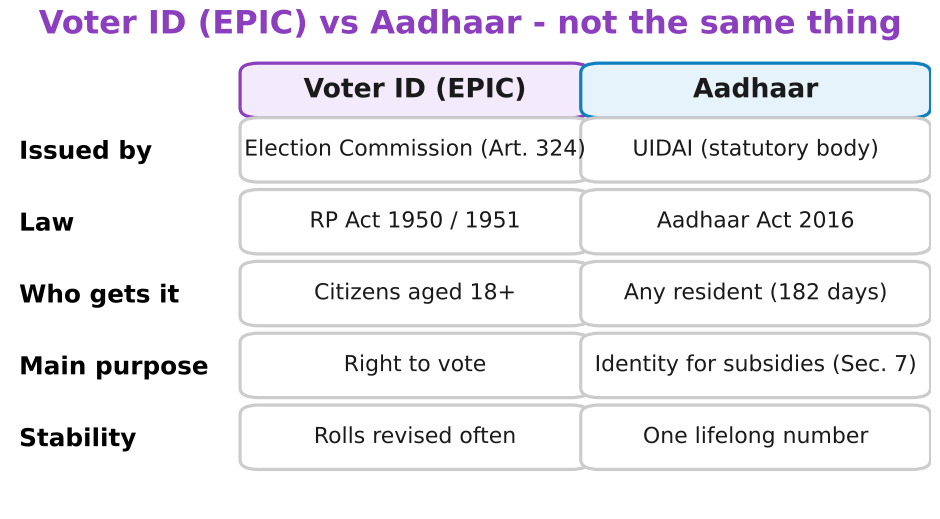
Comparison table of Voter ID (EPIC) and Aadhaar: issuing body, governing law, who can get it, main purpose and stability of records. — StudyForGS
4. National Legal Services Day (9 Nov)
POLITYUPSC: Prelims + Mains GS2
Syllabus linkage
GS2 - Access to justice, statutory bodies, DPSP. Prelims: Art. 39A, NALSA structure, Lok Adalat; Mains: legal aid and pendency.
Context
Every year on 9 November India marks National Legal Services Day, the day the law giving free legal help to poor and weak people came into force in 1995. Free legal aid means a lawyer and court help without paying. The day marks the coming into force of the Legal Services Authorities Act, 1987 on 9 November 1995. The Act created a nationwide set-up - NALSA at the top, State, District and Taluk legal services bodies below - to give free legal aid and run Lok Adalats (people's courts that settle disputes by compromise). Women, children, SC/ST members, persons with disabilities, industrial workers and people in custody are among those entitled.
Key facts
Act passed 1987; in force 9 November 1995.
NALSA: Chief Justice of India is Patron-in-Chief; senior-most SC judge is Executive Chairman.
Lok Adalat award = a civil court decree; it is final and no appeal lies against it.
No court fee in Lok Adalat; if fee was paid, it is refunded when the case settles.
All women and children are eligible for free legal aid regardless of income.
Way forward
Strengthen legal aid clinics in jails and villages and use technology (tele-law) to reach remote areas.
Concept
Article 39A (Directive Principle, added by the 42nd Amendment, 1976): the State shall provide free legal aid so that no citizen is denied justice because of poverty or disability. Lok Adalat: an alternative dispute resolution (ADR) forum - 'people's court' - that settles pending or pre-litigation cases through compromise; National Lok Adalats are held across the country on one day. Hussainara Khatoon (1979) and M.H. Hoskot (1978) cases read free legal aid into Article 21. Exam angle: Prelims: date and year of the Act, NALSA heads, Art. 39A amendment, finality of Lok Adalat awards. Mains: Role of legal aid in reducing undertrial population and pendency.
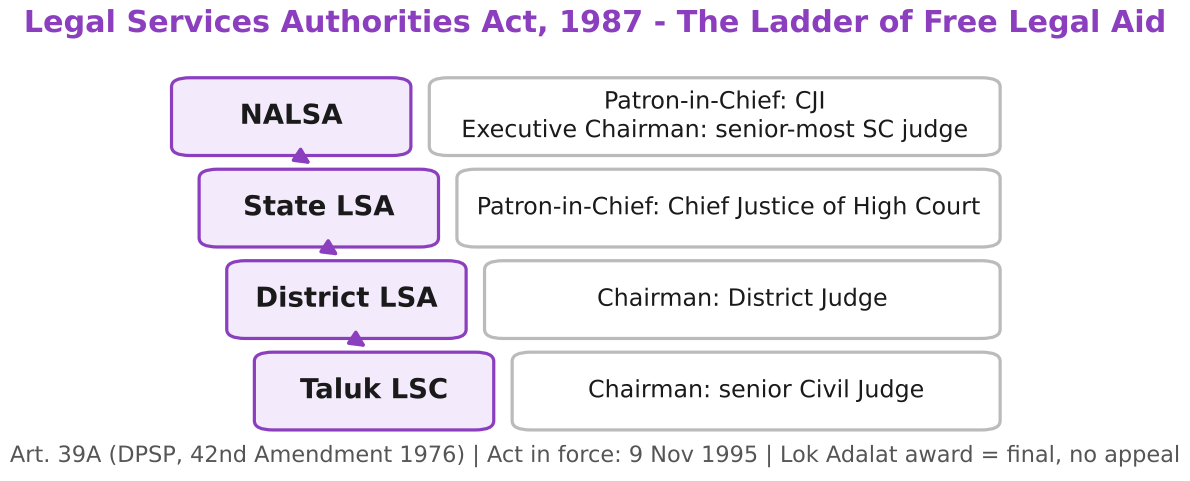
Ladder of free legal aid under the Legal Services Authorities Act 1987: NALSA, State LSA, District LSA and Taluk Legal Services Committee with their heads. — StudyForGS
5. Swachh Survekshan 2025-26 Awards
POLITYUPSC: Prelims + Mains GS2
Syllabus linkage
GS2 - Government schemes, urban governance. Prelims: Swachh Bharat Mission-Urban, survey facts; Mains: urban sanitation and peer learning.
Context
President Droupadi Murmu will give the Swachh Survekshan awards on 11 November - a yearly cleanliness ranking of Indian cities. This is the 10th edition. The awards for Swachh Survekshan 2025-26 will be given at Vigyan Bhawan, New Delhi, on 11 November 2026. More than 4,751 cities were assessed on 43 indicators across 10 areas such as citizen feedback, source segregation of waste, cleanliness of water bodies and behaviour change. Over 3,000 assessors were used. The 'Swachh Shehar Jodi' initiative paired better cities (mentors) with weaker ones (mentees).
Key facts
10th edition of the survey; it runs under Swachh Bharat Mission-Urban (Ministry of Housing and Urban Affairs).
Mentee cities' visible cleanliness rose from 48% (2024) to 70%.
Swachh Survekshan was first held in 2016 (73 cities).
Way forward
Link rankings with funds for weaker cities and make waste processing, not just collection, the main yardstick.
Concept
Swachh Bharat Mission (SBM): launched 2 October 2014; SBM-Urban 2.0 (2021-26) aims at 'Garbage Free' cities and safe management of used water. Source segregation: separating wet, dry and hazardous waste at home itself - the base of scientific waste processing under the Solid Waste Management Rules, 2016. Peer learning (city-to-city mentoring) is a cooperative-federalism tool for urban local bodies (74th Amendment, 12th Schedule includes public health and sanitation). Exam angle: Prelims: launch year of SBM, ministry, first survey year, Schedule 12 items. Mains: Has competitive ranking improved urban sanitation? Role of ULBs.
6. G7 Foreign Ministers Meet in Paris
IRUPSC: Prelims + Mains GS2
Syllabus linkage
GS2 - Important international groupings, effect of policies of developed countries on India. Prelims: G7 members, presidency; Mains: G7 relevance and India's outreach role.
Context
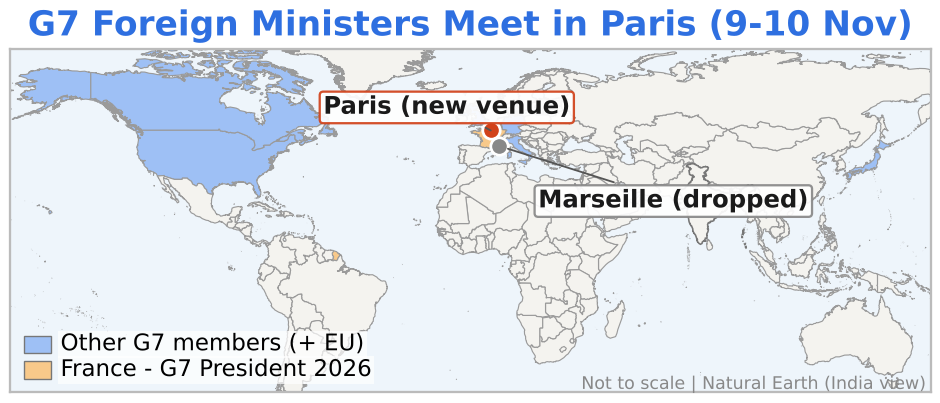
Foreign ministers of the G7 - seven rich democracies - are meeting in Paris on 9-10 November. France shifted the meeting from Marseille at the last minute. Wars in Ukraine and West Asia top the agenda. The meeting was planned in Marseille but France told delegations on 4 November it would move to Paris, citing logistics as the G7 meeting and the Paris Peace Forum fell close together; reports linked it to weeks of nationwide protests stretching security forces. US Secretary of State Marco Rubio is attending. Key topics are the Russia-Ukraine war, the US-Iran conflict and shipping through the Strait of Hormuz.
Key facts
G7 members: USA, UK, France, Germany, Italy, Japan, Canada; the EU also takes part.
France holds the G7 presidency in 2026.
Dates: 9-10 November 2026; venue moved from Marseille to Paris.
Rubio said US-Iran talks are not productive and no breakthrough is near.
India is not a member but is often invited as an outreach partner.
Way forward
India should use outreach invites to push Global South concerns like energy security and debt.
Concept
G7 (Group of Seven): an informal forum of advanced economies, born from the 1975 Rambouillet (France) summit of six countries; Canada joined in 1976. Russia joined to make the G8 in 1997-98 but was suspended in 2014 after annexing Crimea. G7 has no permanent secretariat or charter - the presidency rotates each year and the host sets the agenda. G20 vs G7: G20 (1999) includes emerging economies like India, China and Brazil; G7 is only rich democracies. Exam angle: Prelims: G7 members, year of formation, why Russia left, who holds presidency. Mains: Is the G7 still relevant in a multipolar world? India's role as a bridge for the Global South.
World map highlighting G7 members, with France (2026 G7 president) shaded orange and markers for Paris (new venue) and Marseille (dropped venue). — StudyForGS
7. Russia-Ukraine-US Talks in Abu Dhabi
IRUPSC: Prelims + Mains GS2
Syllabus linkage
GS2 - Bilateral/multilateral relations, effect of conflicts on India. Prelims: places (Zaporizhzhia, Kharkiv, Black Sea); Mains: India's position and energy/food security.
Context
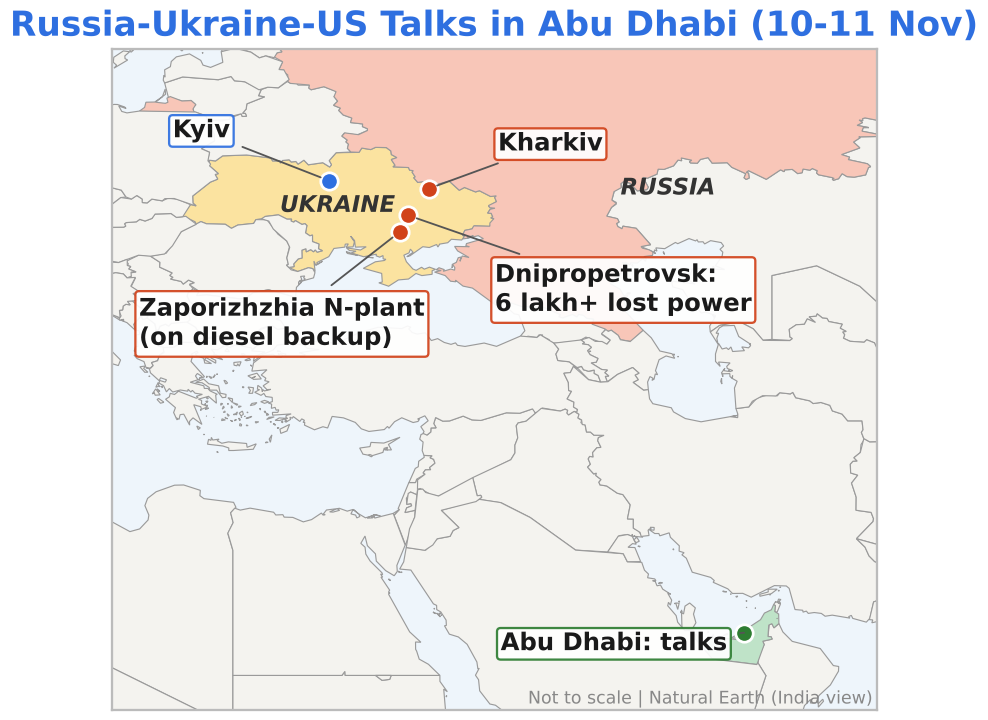
Negotiators from Ukraine, Russia and the US are meeting in Abu Dhabi (UAE) on 10-11 November to discuss ending the war. European representatives will also attend. Just before the talks, Russian strikes cut power to about 8.5 lakh Ukrainians. President Zelenskyy said the talks will cover security guarantees, an 'energy ceasefire' and a Black Sea truce to protect food exports; it is the first direct three-way round since February. Sunday's Russian strikes on energy sites left over 6 lakh people in Dnipropetrovsk and about 2.5 lakh in Kharkiv without power. The Zaporizhzhia nuclear plant lost external power and is running emergency diesel generators for reactor cooling.
Key facts
Venue: Abu Dhabi, UAE; dates 10-11 November 2026.
Agenda: security guarantees, energy ceasefire, Black Sea truce (grain exports).
About 8,50,000 people lost power after strikes on 8 November.
Zaporizhzhia NPP - Europe's largest nuclear power plant - is on diesel backup.
Leaked Russian records suggest about 3.93 lakh war-related deaths (Feb 2022-Aug 2026); not fully verified.
Way forward
A lasting deal must protect civilian energy sites and nuclear safety first; India can back any process acceptable to both sides.
Concept
Zaporizhzhia Nuclear Power Plant: six-reactor plant on the Dnipro river in southern Ukraine, under Russian control since 2022; the IAEA (International Atomic Energy Agency, Vienna) monitors its safety. Black Sea grain corridor: sea route from Ukrainian ports (e.g. Odesa) through the Bosphorus; a truce here protects world food prices, important for food-importing developing countries. UAE as mediator: it has hosted prisoner swaps and talks - an example of Gulf states' rising 'middle power' diplomacy. Exam angle: Prelims: map places (Kharkiv, Dnipro, Zaporizhzhia, Black Sea, Bosphorus); IAEA HQ. Mains: India's stand of 'dialogue and diplomacy' and its interest in energy and fertiliser supply.
Regional map of Ukraine, Russia and the UAE marking Abu Dhabi (talks venue), Kyiv, Kharkiv, Dnipropetrovsk power cuts and the Zaporizhzhia nuclear plant on diesel backup. — StudyForGS
8. West Asia: Iran War Keeps Region Tense
IRUPSC: Prelims + Mains GS2
Syllabus linkage
GS2 - West Asia, India's energy security and diaspora. Prelims: Strait of Hormuz, Qeshm, Kurdistan; Mains: impact of West Asian conflicts on India.
Context
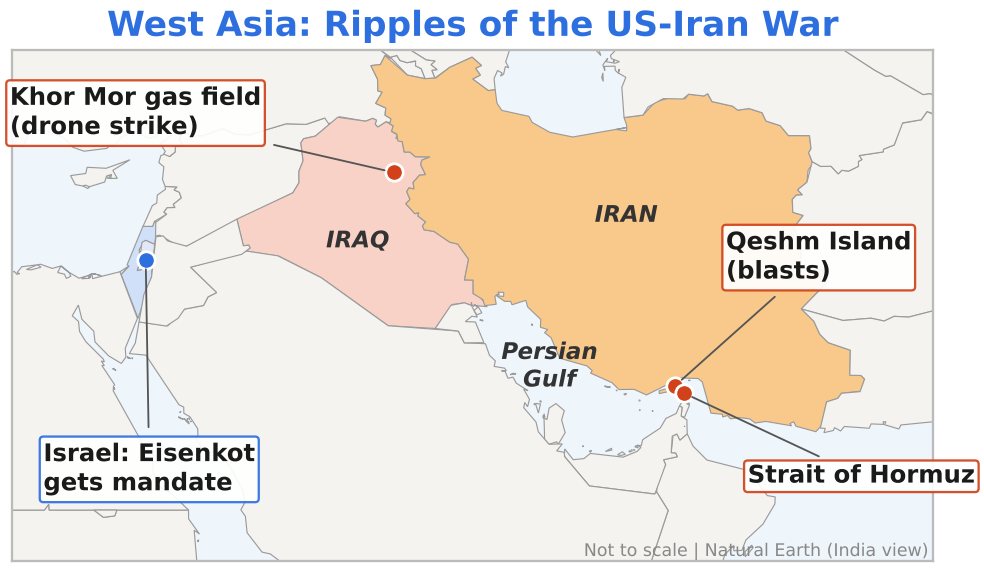
The US-Iran war that began in February 2026 is still shaking the region: a drone hit a big gas field in Iraq, blasts were reported on an Iranian island in the Strait of Hormuz, and Israel is trying to form a new government. An explosive-laden drone hit a liquefied petroleum gas (LPG) tank at the Khor Mor gas field in Iraq's Kurdistan region on 8 November, halting output and cutting about 2.8 GW of the region's power generation. Iranian state media reported explosions on Qeshm Island in the Strait of Hormuz. In Israel, President Isaac Herzog gave opposition leader Gadi Eisenkot the first chance to form a government after October's inconclusive election.
Key facts
The war began on 28 February 2026 with US-Israeli strikes on Iran; Iran blockaded Hormuz in early March.
Khor Mor is operated by UAE-based Dana Gas and feeds most of Kurdistan's power plants.
Israel: Eisenkot's alliance has 48 seats vs 53 for Netanyahu's bloc; 61 needed for majority in the 120-seat Knesset.
Eisenkot has up to six weeks to form a coalition; Netanyahu stays caretaker PM.
US Secretary of State says US-Iran talks are 'not productive'.
Way forward
India should keep diversifying crude sources, fill its strategic petroleum reserves and back de-escalation diplomacy.
Concept
Strait of Hormuz: narrow sea passage between Iran and Oman linking the Persian Gulf to the Gulf of Oman/Arabian Sea - a 'chokepoint' (a narrow route many ships must use) carrying roughly a fifth of world oil. India imports most of its crude and LPG from the Gulf, so Hormuz disruption raises fuel prices, the import bill and the current account deficit. Knesset: Israel's 120-member single-chamber parliament elected by proportional representation - so coalitions are the norm. Exam angle: Prelims: islands/straits of the Gulf (Qeshm, Hormuz, Bab-el-Mandeb), Knesset strength. Mains: How should India secure energy supplies amid chokepoint risks? (Diversification, SPR, Chabahar, rupee trade.)
West Asia map highlighting Iran, Iraq and Israel with markers for the Khor Mor gas field drone strike, Qeshm Island blasts, the Strait of Hormuz and Israel's government formation. — StudyForGS
9. Democracy Watch: Paraguay & South Africa
IRUPSC: Prelims + Mains GS2
Syllabus linkage
GS2 - Developments in other countries, comparative politics. Prelims: impeachment processes, BRICS member politics; Mains: coalition politics.
Context
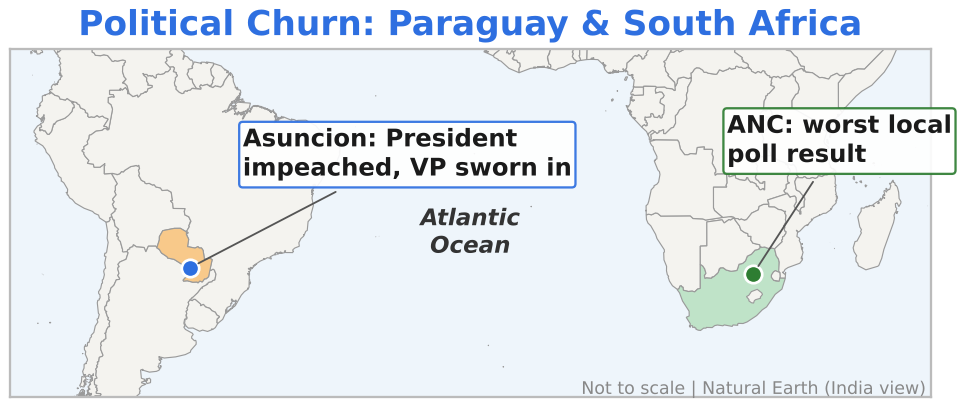
Two big political shake-ups: Paraguay's Senate removed President Santiago Pena through impeachment over a bank collapse, and in South Africa the ANC - Nelson Mandela's party - got its worst-ever result in local elections. Pedro Alliana, the Vice President, took over as Paraguay's President on 6 November after the Senate impeached Santiago Pena over the collapse of digital lender Ueno Bank, which froze customers' deposits; he will finish the term ending 15 August 2028. In South Africa's local elections the ANC won 30.76% (down from 46% in 2021), the Democratic Alliance 24.64% and Jacob Zuma's MK party 9.76%. Parties have 14 days to form coalitions and cities like Johannesburg may slip from the ANC.
Key facts
Paraguay: landlocked South American country; capital Asuncion; Alliana belongs to the Colorado Party.
ANC (African National Congress) lost its national majority in 2024 for the first time since 1994.
Voters cited unemployment, corruption and poor water/electricity supply.
ANC holds a majority in only one of nine provinces.
South Africa is a BRICS and IBSA partner of India.
Way forward
Stable coalitions and strong financial regulation are key lessons for both nations.
Concept
Impeachment: a process by which a legislature removes a head of state for misconduct. In India, the President is impeached under Article 61 for 'violation of the Constitution', needing a two-thirds majority of the total membership in each House. Hung council/coalition: when no party wins a majority, parties must share power - common in proportional representation systems like South Africa's. IBSA (India-Brazil-South Africa, 2003) and BRICS link India with both continents. Exam angle: Prelims: Article 61 procedure; IBSA year; capitals and landlocked countries of South America. Mains: Rise of coalition politics and its effect on governance in emerging democracies.
Map of South America and southern Africa highlighting Paraguay (president impeached) and South Africa (ANC's worst local poll result). — StudyForGS
10. UN Shuts Western Sahara Mission
IRUPSC: Prelims + Mains GS2
Syllabus linkage
GS2 - UN peacekeeping, important international institutions. Prelims: MINURSO, disputed territories; Mains: decline of UN peacekeeping and India's role.
Context
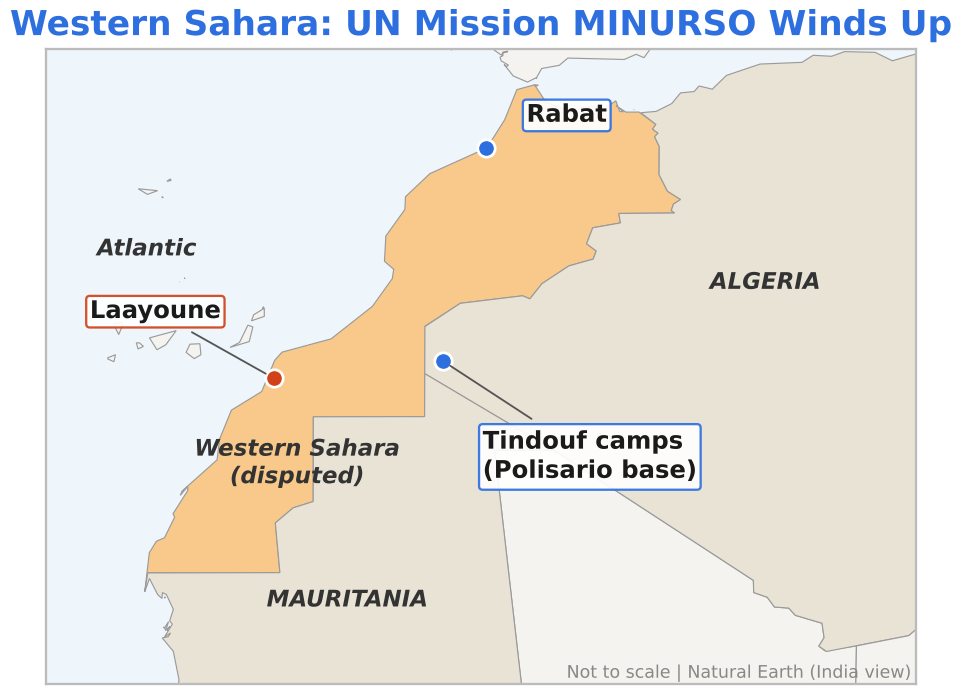
The UN has started closing MINURSO, its 35-year-old peacekeeping mission in Western Sahara, because the Security Council could not agree to extend it. The territory is disputed between Morocco and the Polisario Front. MINURSO (Mission for the Referendum in Western Sahara) began winding down on 1 November 2026 after its mandate expired without renewal. It was set up in 1991 under Security Council Resolution 690 to watch the ceasefire and prepare a referendum on self-determination, which never happened. The Council was deadlocked between rival US and Russian draft resolutions. Morocco offers autonomy under its sovereignty; the Algeria-backed Polisario Front wants independence.
Key facts
MINURSO: set up 1991, UNSC Resolution 690.
Mandate lapsed; drawdown started 1 November 2026.
Morocco backs an autonomy plan; Polisario seeks an independent Sahrawi state.
Diplomacy will continue through the UN Secretary-General's Personal Envoy.
Western Sahara is on the UN list of Non-Self-Governing Territories.
Way forward
Without a UN presence, the risk of renewed fighting rises; a negotiated political solution is the only durable path.
Concept
UN peacekeeping: mandated by the Security Council; troops come from member states and wear blue helmets. India is one of the largest troop contributors historically. Self-determination: the right of a people to choose their political status, usually via a referendum - recognised in the UN Charter and the 1960 Decolonisation Declaration. Polisario Front: Sahrawi independence movement, based in refugee camps around Tindouf, Algeria. Exam angle: Prelims: UNSC resolution numbers are rarely asked - focus on which mission is where (MINURSO-Western Sahara, UNIFIL-Lebanon, UNMISS-South Sudan). Mains: Why are UN peacekeeping missions shrinking? Implications for conflict zones.
Map of north-west Africa showing Morocco (including the disputed Western Sahara region), Algeria and Mauritania, with Laayoune, Tindouf camps and Rabat marked. — StudyForGS
11. Cancer Drugs Cheaper from 9 November
HEALTHUPSC: Prelims + Mains GS2
Syllabus linkage
GS2 - Health, government policies; GS3 - pricing. Prelims: NPPA, DPCO, trade margin; Mains: affordable medicines and out-of-pocket expenditure.
Context
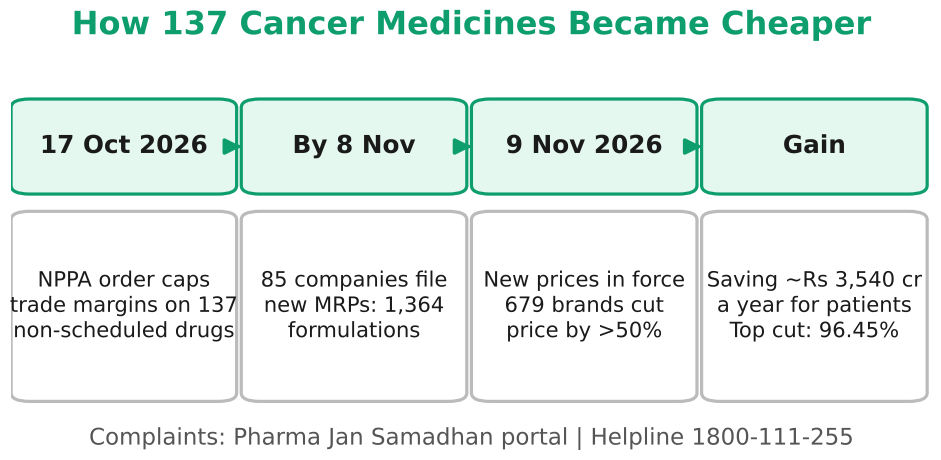
Prices of 137 anti-cancer medicines have dropped from 9 November because the drug price regulator capped the profit margin traders can add. Hundreds of brands are now more than 50% cheaper. The National Pharmaceutical Pricing Authority (NPPA) issued an order on 17 October covering 137 non-scheduled anti-cancer drugs, including patented ones, based on a DGHS expert committee's advice. By 8 November, 85 companies had filed revised MRPs for 1,364 formulations of 121 drugs, and the new prices took effect on 9 November. 679 brands cut prices by more than half; the biggest cut was 96.45%.
1,364 formulations, 85 companies, 121 drugs filed new MRPs.
Estimated consumer saving: Rs 3,540.38 crore a year.
Complaints: Pharma Jan Samadhan portal; helpline 1800-111-255.
Note: the price-capped drugs here are 'non-scheduled' - outside the NLEM list.
Way forward
Strict monitoring of compliance at pharmacies and wider screening under Ayushman Bharat will maximise the benefit.
Concept
NPPA: set up in 1997 under the Department of Pharmaceuticals (Ministry of Chemicals and Fertilizers); it fixes ceiling prices under the Drugs (Prices Control) Order (DPCO), 2013, issued under the Essential Commodities Act, 1955. Scheduled vs non-scheduled drugs: scheduled drugs are those in the National List of Essential Medicines (NLEM) with ceiling prices; for non-scheduled drugs NPPA can still act in public interest (para 19 of DPCO). Trade margin: the gap between the price at which a maker sells to the trade and the final MRP - capping it cuts prices without fixing manufacturers' prices. Exam angle: Prelims: NPPA's parent ministry, DPCO year, law under which DPCO is made, NLEM. Mains: Out-of-pocket health expenditure in cancer care and role of price control.
Flow diagram: NPPA order of 17 October capping trade margins on 137 cancer drugs, 85 companies filing new MRPs for 1,364 formulations, new prices from 9 November and an estimated saving of Rs 3,540 crore a year. — StudyForGS
12. ADB Funds Mizoram Health Scheme
HEALTHUPSC: Prelims + Mains GS2
Syllabus linkage
GS2 - Health, centre-state finance, international institutions. Prelims: ADB facts, externally aided projects; Mains: universal health coverage.
Context
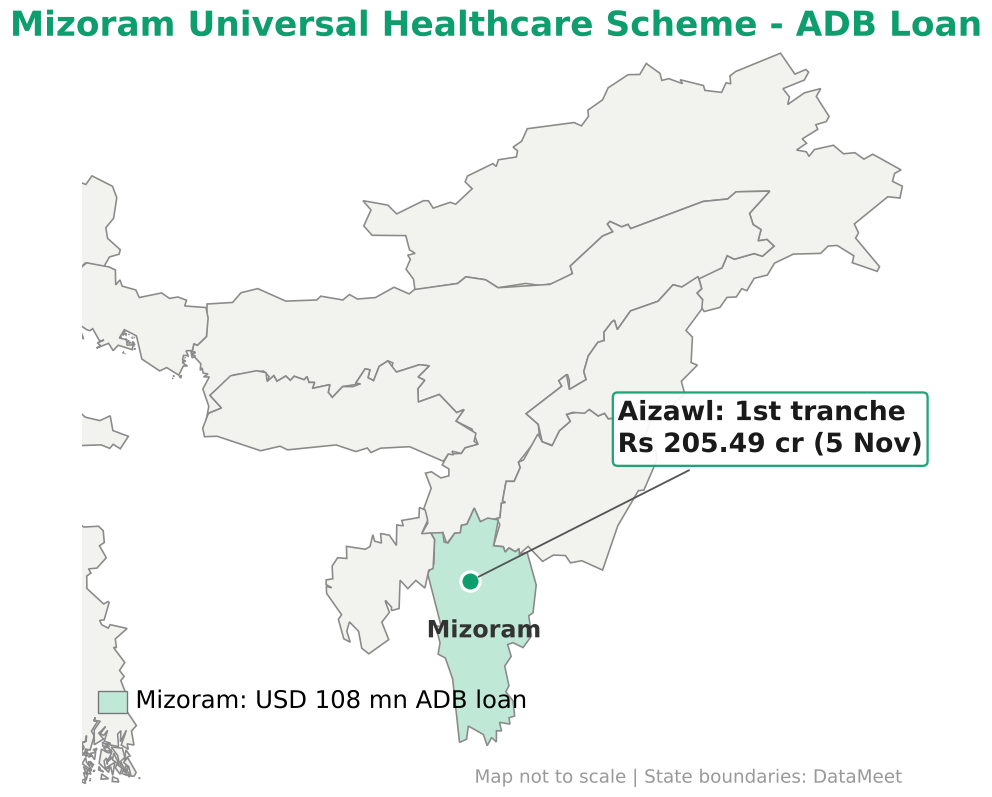
The Asian Development Bank released the first part of a 108 million dollar loan for Mizoram's universal health insurance scheme. Most of it is a grant from the Centre, so Mizoram repays only a small share. Mizoram received Rs 205.49 crore on 5 November 2026 after meeting two Disbursement Linked Indicators (targets that must be met before money is released). The Centre bears 90% (Rs 184.93 crore) as a grant and Mizoram repays 10% (Rs 20.54 crore) as a soft loan - the normal pattern for North-Eastern and Himalayan states. Funds go into the state's Healthcare Corpus Fund for long-term sustainability of the Mizoram Universal Healthcare Scheme (MUHCS).
Key facts
Loan size: USD 108 million; approved by ADB on 5 December 2025.
First tranche: Rs 205.49 crore released on 5 November 2026.
90:10 grant-loan funding for special category/NE states.
Project closes 31 March 2030.
Money parked in a Healthcare Corpus Fund.
Way forward
Link the scheme with Ayushman Bharat and build hospitals in remote districts so cover leads to real care.
Concept
Asian Development Bank (ADB): founded 1966, HQ Manila (Philippines); Japan and the US are the largest shareholders; India is a founding member and a major borrower. Results-based lending: money is released only when measurable results (Disbursement Linked Indicators) are achieved - encourages performance. Universal Health Coverage (SDG 3.8): everyone gets needed health services without financial hardship; India's flagship is Ayushman Bharat PM-JAY (2018). Exam angle: Prelims: ADB HQ and founding year, funding ratio for NE states. Mains: Can state-level health insurance with corpus funds be a model for UHC?
Map of north-east India highlighting Mizoram with Aizawl marked, showing the first ADB loan tranche of Rs 205.49 crore released on 5 November. — StudyForGS
13. Anthrax Kills Hippos in Virunga
HEALTHUPSC: Prelims + Mains GS3
Syllabus linkage
GS3 - Biodiversity, zoonotic diseases; GS2 - health. Prelims: anthrax basics, Virunga, UNESCO sites; Mains: One Health approach.
Context
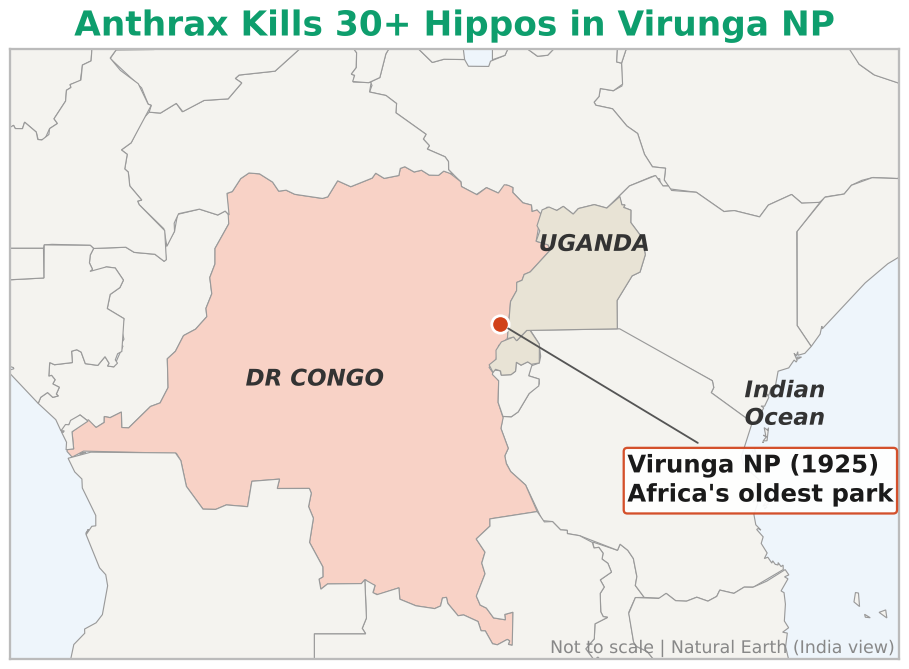
At least 30 hippos have died of anthrax, a bacterial disease, in Virunga National Park in DR Congo since September. The disease can also jump from animals to humans. Laboratory tests confirmed anthrax in the dead hippos. Authorities are watching the affected areas, disposing of carcasses safely and warning people not to touch or eat dead animals. Anthrax spores survive in soil for years, so outbreaks can return. Humans can be infected through contact with infected animals, their products or contaminated meat.
Key facts
Pathogen: Bacillus anthracis - a spore-forming bacterium.
Virunga NP (DR Congo): set up 1925 - Africa's oldest national park.
UNESCO World Heritage Site since 1979; famous for mountain gorillas.
Hippo deaths: at least 30 since September 2026.
Anthrax is not usually spread person-to-person.
Way forward
Joint surveillance by wildlife, veterinary and health departments and vaccination of livestock around parks can contain spread.
Concept
Zoonosis: a disease that passes from animals to humans (e.g. anthrax, rabies, Nipah, bird flu). About 60% of known infectious diseases are zoonotic. One Health: an approach that treats human, animal and environmental health as linked; India is building a National One Health Mission linking these sectors. Anthrax in India: reported from Odisha, Andhra Pradesh, Kerala and other states, often after eating meat of dead cattle. Exam angle: Prelims: nature of anthrax pathogen (bacterium, spores), oldest national park in Africa, India's One Health initiatives. Mains: Why is the One Health approach necessary for pandemic preparedness?
Map of central Africa highlighting the Democratic Republic of the Congo with Virunga National Park marked, where anthrax killed over 30 hippos. — StudyForGS
14. Demonetisation at 10: Cash Still King
ECONOMYUPSC: Prelims + Mains GS3
Syllabus linkage
GS3 - Indian economy, money and banking, digital payments. Prelims: currency in circulation, cash-GDP ratio; Mains: evaluation of demonetisation.
Context
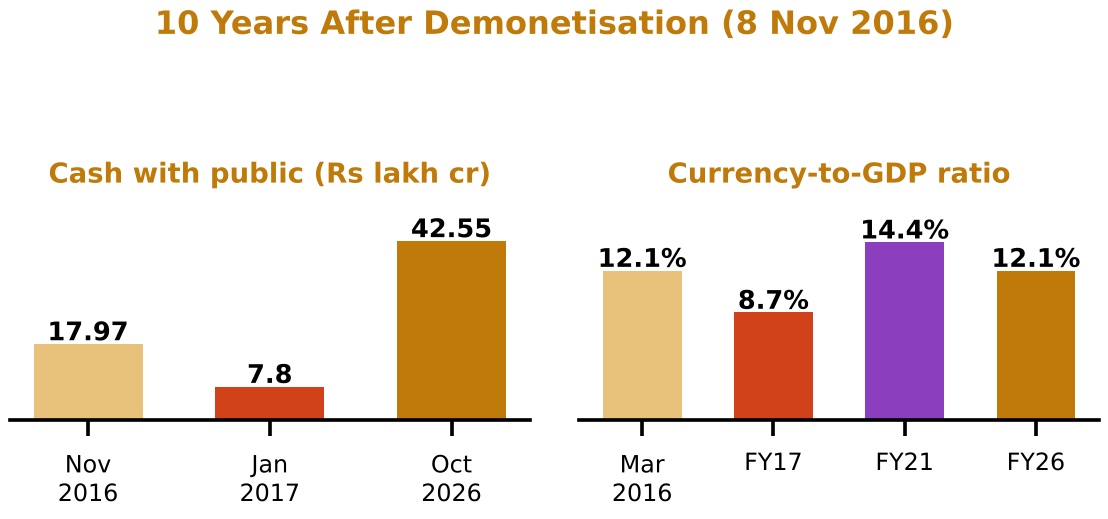
Ten years after Rs 500 and Rs 1,000 notes were withdrawn on 8 November 2016, Indians hold more cash than ever. Digital payments grew hugely, but they grew alongside cash instead of replacing it. Demonetisation was announced on 8 November 2016 at 8 PM; the old Rs 500 and Rs 1,000 notes made up about 86% of currency in circulation. Currency with the public fell from Rs 17.97 lakh crore (4 Nov 2016) to Rs 7.8 lakh crore (Jan 2017), but has now reached Rs 42.55 lakh crore (15 Oct 2026) - 137% above the pre-demonetisation level. The currency-to-GDP ratio is back at about 12.1% in FY26, the same as in March 2016.
Key facts
8 Nov 2016: Rs 500 and Rs 1,000 notes (~86% of cash) became invalid.
Other countries: Japan 16%+, China 10.2%, US 7.3%.
Total digital payments in FY2025-26: Rs 3,251.04 lakh crore.
Way forward
Improve digital access, cyber-safety and merchant acceptance so that people choose digital by convenience, not force.
Concept
Currency in circulation (CIC): all notes and coins issued by RBI; 'currency with the public' = CIC minus cash held by banks. It is part of M1 (narrow money) and M3 (broad money). Legal tender: money that must be accepted for payment of debts; the Centre can withdraw legal tender status of notes on RBI's recommendation under Section 26(2) of the RBI Act, 1934. Cash-to-GDP ratio: cash in the economy as a share of GDP - a measure of cash dependence, not necessarily of black money. Exam angle: Prelims: RBI Act section for demonetisation, components of M1/M3, meaning of CIC. Mains: Did demonetisation meet its goals of curbing black money, fake notes and boosting digital payments?
Two bar charts: cash with the public at Rs 17.97 lakh crore (Nov 2016), Rs 7.8 lakh crore (Jan 2017) and Rs 42.55 lakh crore (Oct 2026); currency-to-GDP ratio 12.1% (Mar 2016), 8.7% (FY17), 14.4% (FY21) and 12.1% (FY26). — StudyForGS
15. Ease of Vehicle Ownership Index
ECONOMYUPSC: Prelims + Mains GS3
Syllabus linkage
GS3 - Infrastructure, ease of doing business; GS2 - governance, e-governance. Prelims: VAHAN, DigiLocker; Mains: digitisation gaps in state services.
Context
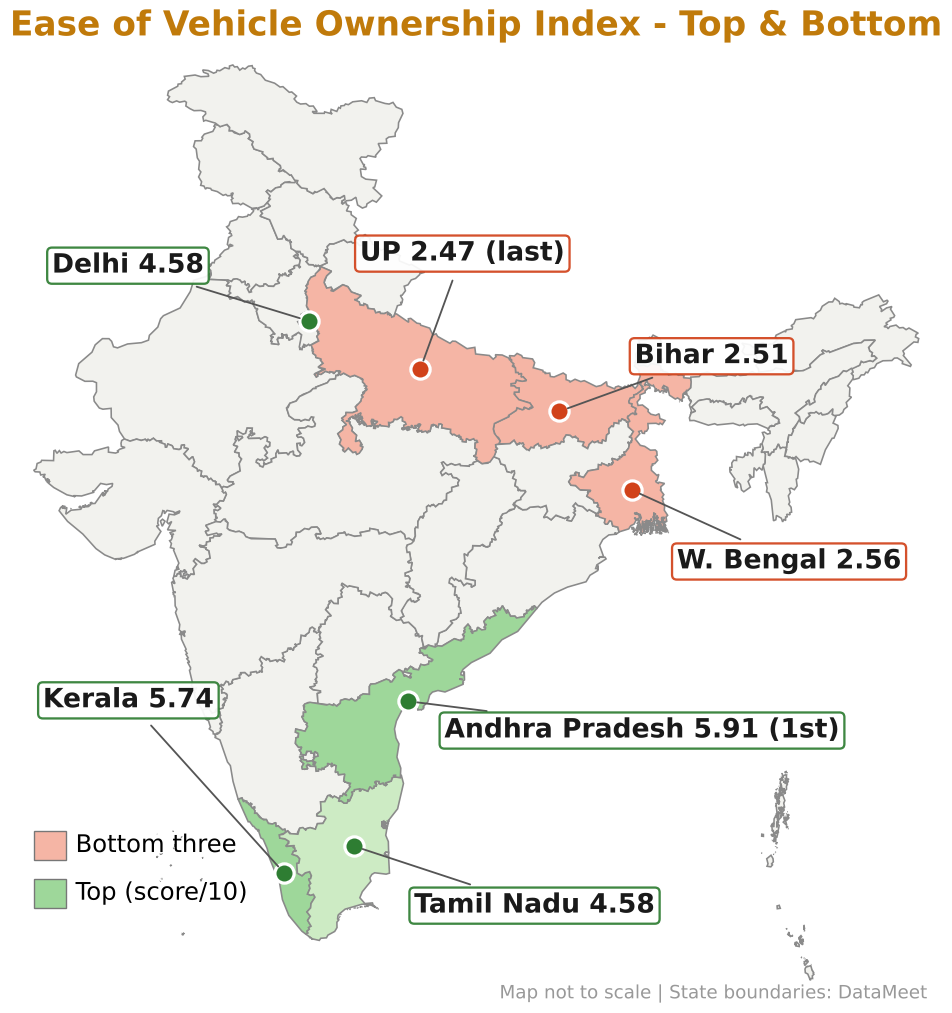
A new index ranks 15 states on how easy it is to transfer ownership of a used vehicle. Andhra Pradesh topped, Uttar Pradesh came last, and no state scored even 6 out of 10. The Ease of Vehicle Ownership Index (EVOI) was released by the Minister of State for Road Transport and Highways. It was prepared by IndiaTech.org with Consumer VOICE and covers 15 states that make up over 85% of the organised used-car market. Andhra Pradesh (5.91) and Kerala (5.74) led; West Bengal (2.56), Bihar (2.51) and UP (2.47) were at the bottom. RC (registration certificate) transfers take 7-10 days in AP (biometric authentication) but over 30 days in UP.
Key facts
Six pillars incl. clarity of rules, online systems, speed, fee clarity, consumer protection and real cost.
Hidden costs can push real transfer cost to ~10 times the official fee.
13 of 15 states still demand physical copies after online filing ('dual filing').
Road tax on a Rs 6 lakh petrol car: 3% (UP) to 14% (Karnataka).
Amend the MV Act for time-bound transfers, accept DigiLocker documents everywhere, and link banks with VAHAN to remove loan hypothecation automatically.
Concept
VAHAN and SARATHI: national digital platforms of MoRTH for vehicle registration and driving licences under the Motor Vehicles Act, 1988. Road tax and vehicle registration are largely state subjects, which is why costs and procedures differ across states. DigiLocker / mParivahan: government digital document wallets - documents in them are legally valid under the IT Rules, so dual paper filing is avoidable. Exam angle: Prelims: VAHAN/SARATHI, which list (State) covers taxes on vehicles (Entry 57, List II). Mains: Index-based competition among states as a tool of governance reform.
India map shading top and bottom states in the Ease of Vehicle Ownership Index: Andhra Pradesh 5.91, Kerala 5.74, Tamil Nadu and Delhi 4.58 at the top; West Bengal 2.56, Bihar 2.51 and Uttar Pradesh 2.47 at the bottom. — StudyForGS
16. Indigenising 100 Critical Items
ECONOMYUPSC: Prelims + Mains GS3
Syllabus linkage
GS3 - Industrial policy, Make in India, supply chains, energy. Prelims: solar value chain, MIP; Mains: import dependence on China.
Context
The industry department (DPIIT) has launched a drive to make 100 critical items in India - from solar machinery to petrochemicals - because China may restrict exports of them. The Department for Promotion of Industry and Internal Trade (DPIIT) wants to indigenise 100 critical intermediates and capital goods. They include solar manufacturing equipment, heavy machinery like tunnel boring machines (a TBM plant has come up in Tamil Nadu) and petrochemicals such as PVC, polyethylene, polypropylene, ammonia and phosphoric acid. India's trade deficit with China has crossed USD 100 billion this fiscal.
Key facts
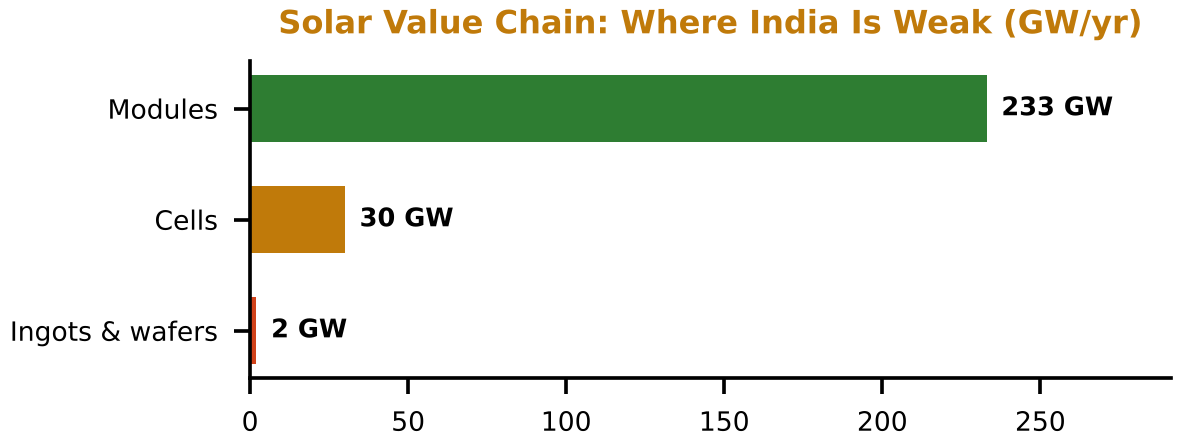
Solar: modules ~233 GW/yr capacity, cells ~30 GW, ingots & wafers only ~2 GW - the weakest link.
India adds about 50 GW solar capacity a year.
Buying machines from Europe/Japan instead of China could raise costs 20-40%.
MNRE is preparing guidelines for solar module waste recycling.
Way forward
Target upstream stages with PLI support, R&D and long-term supply contracts while avoiding sudden cost shocks for users.
Concept
Solar value chain: polysilicon -> ingots -> wafers -> cells -> modules. 'Upstream' stages (polysilicon, wafers) are highly concentrated in China. Minimum Import Price (MIP): a floor price below which imports are not allowed - a trade defence tool to protect domestic producers. PLI scheme for high-efficiency solar PV modules (2021) and ALMM (Approved List of Models and Manufacturers) are India's main tools to build solar manufacturing. Exam angle: Prelims: stages of solar value chain, MIP vs anti-dumping duty. Mains: 'Atmanirbharta in critical inputs is a strategic necessity' - discuss with examples.
Bar chart of India's solar manufacturing capacity: modules about 233 GW a year, cells about 30 GW and ingots and wafers only about 2 GW. — StudyForGS
17. RBI FLA Census: Top FDI Sources
ECONOMYUPSC: Prelims + Mains GS3
Syllabus linkage
GS3 - Investment models, external sector. Prelims: FDI sources, ODI, FLA census; Mains: quality of FDI and round-tripping.
Context
RBI's yearly survey of foreign assets and liabilities shows the US is now the biggest source of foreign direct investment (FDI) held in Indian firms, ahead of Mauritius and Singapore. Provisional results of RBI's Census on Foreign Liabilities and Assets (FLA) for 2025-26 show the US with 16.5% of outstanding FDI equity, followed by Mauritius (14.5%), Singapore (13.7%) and the UK (10.8%). The ratio of inward FDI to India's outward direct investment (ODI) fell to 4.2 times at end-March 2026 from 5.5 times a year earlier, as Indian firms invest more abroad. Manufacturing held 50.1% of FDI equity and services 45%.
Key facts
Top 4 sources (stock): US, Mauritius, Singapore, UK.
Inward FDI / outward ODI: 5.5x -> 4.2x.
Manufacturing share in FDI equity: 50.1%; services: 45%.
Results released on 6 November 2026 (provisional).
Mauritius and Singapore's big shares reflect tax-treaty routing.
Way forward
Simpler rules, stable taxes and faster dispute resolution can keep long-term FDI flowing into manufacturing.
Concept
FDI vs FPI: FDI is a lasting investment with 10% or more equity in a company; FPI (portfolio) is below 10% and more volatile. ODI (overseas direct investment): investment by Indian companies in businesses abroad - rising ODI shows Indian firms going global. Round-tripping: Indian money going out through a tax-haven and coming back as 'FDI' - a reason the India-Mauritius DTAA was amended in 2016. Exam angle: Prelims: 10% FDI-FPI threshold, top FDI source countries, who conducts FLA census (RBI). Mains: Changing composition of FDI and what it means for 'Make in India'.
Bar chart of top sources of FDI stock in India from the RBI FLA census 2025-26: United States 16.5%, Mauritius 14.5%, Singapore 13.7%, United Kingdom 10.8%. — StudyForGS
18. Island Fisheries Power the Blue Economy
ECONOMYUPSC: Prelims + Mains GS3
Syllabus linkage
GS3 - Blue economy, agriculture and allied sectors, island development. Prelims: EEZ, PMMSY, tuna species; Mains: sustainable fisheries.
Context
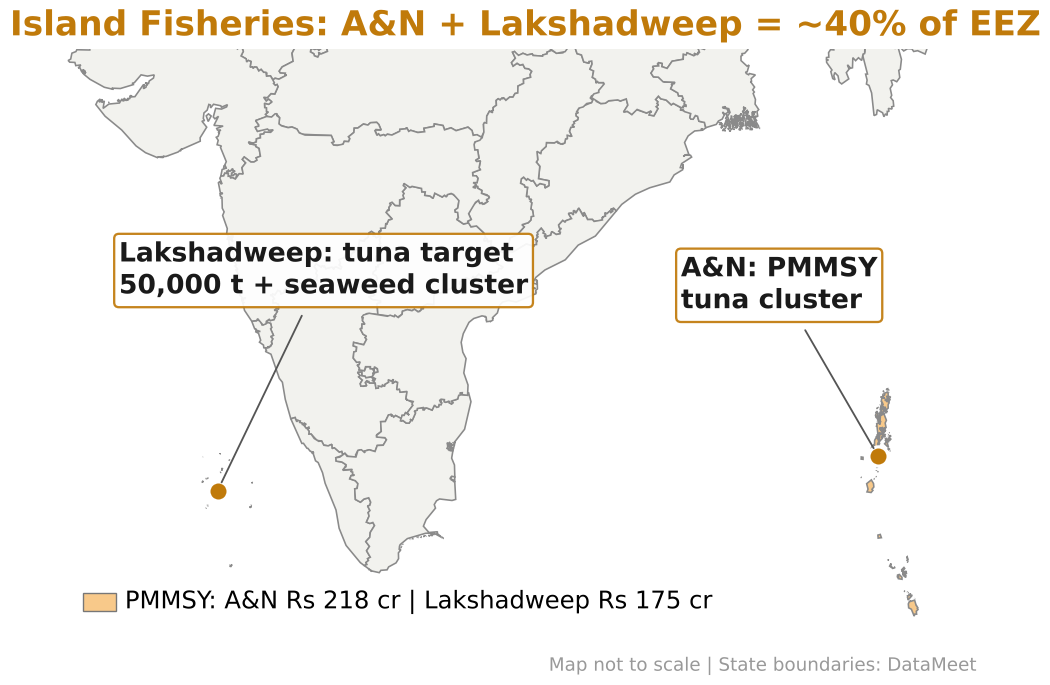
A government release explains how Andaman & Nicobar and Lakshadweep - which together hold about 40% of India's sea economic zone - can grow India's fish output through tuna fishing, seaweed farming and ornamental fish. India has a coastline of about 11,099 km and an Exclusive Economic Zone (EEZ) of about 24 lakh sq km with an estimated marine fish potential of 58.6 lakh tonnes. The two island groups hold large, under-used stocks of yellowfin, skipjack and bigeye tuna. Lakshadweep plans to double tuna output to 50,000 tonnes in five years using eco-friendly pole-and-line fishing and has been notified as a seaweed cluster; A&N has a PMMSY tuna cluster.
Key facts
Marine seafood exports FY 2025-26: about Rs 73,890 crore; ~50 lakh fishers depend on the sector.
Public investment commitment in fisheries since 2015: Rs 39,272 crore.
Lakshadweep has 300+ reef-associated ornamental fish species.
MPEDA presence to enable direct exports from the islands.
Way forward
Grow production with cold chains and local processing while protecting coral reefs and fishers' livelihoods.
Concept
EEZ: sea area up to 200 nautical miles from the baseline where a country has rights over fish, oil and other resources (UNCLOS 1982). Territorial sea is only up to 12 nm. PMMSY (Pradhan Mantri Matsya Sampada Yojana): launched 2020 for 5 years with about Rs 20,050 crore to boost fish production and post-harvest infrastructure. Pole-and-line fishing: catching tuna one by one with hooks - low bycatch, so it is eco-friendly and fetches premium prices. Exam angle: Prelims: EEZ vs territorial sea limits, PMMSY launch year, tuna species, Lakshadweep seaweed cluster. Mains: Potential of island territories in India's blue economy and the need for ecological safeguards.
Map of India's island territories Andaman & Nicobar and Lakshadweep, which hold about 40% of the EEZ, with tuna and seaweed cluster notes and PMMSY allocations. — StudyForGS
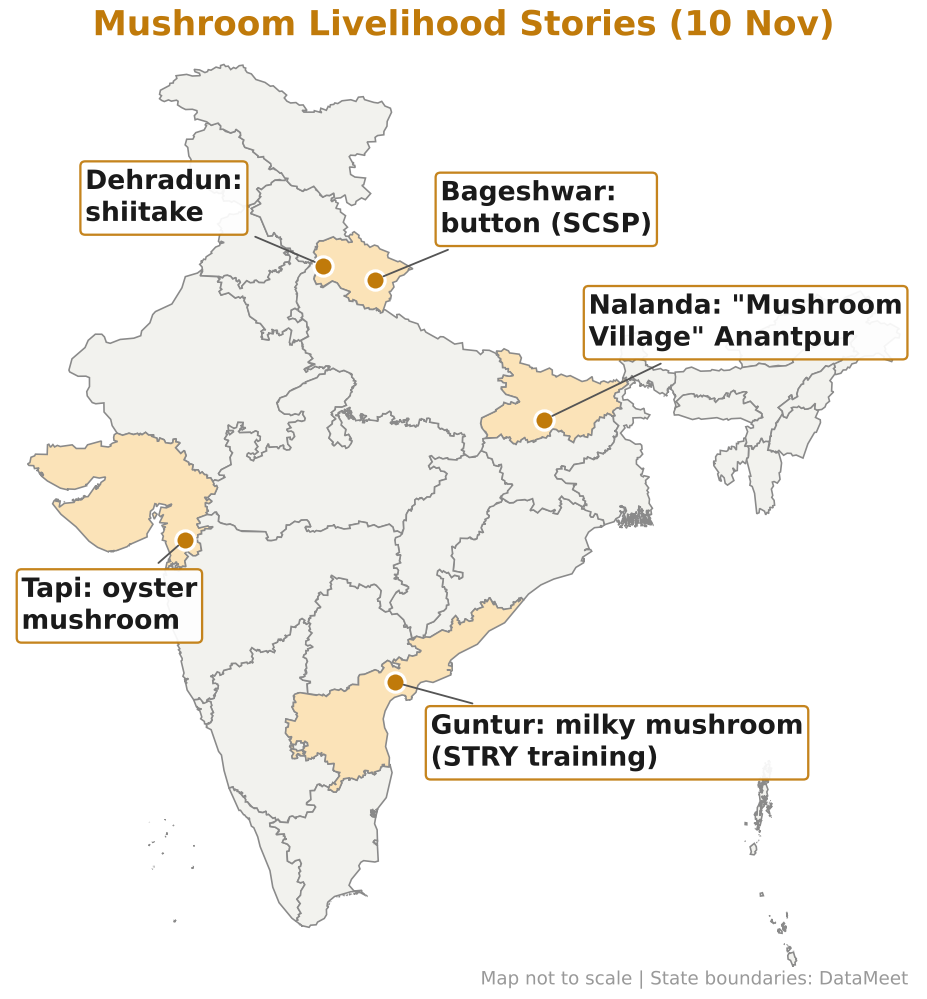
A government release shows how mushroom farming - which needs little land, water and money and uses farm waste - is giving good incomes to women, youth and small farmers in five states. Case studies include a former waste picker in Guntur (Andhra Pradesh) earning about Rs 35,000 a month from milky mushrooms after STRY training; Anantpur in Nalanda (Bihar), declared a 'Mushroom Village' in 2012, where 250+ JEEViKA SHG women now work; an engineer in Tapi (Gujarat) growing oyster mushrooms; an IT professional in Dehradun running a 1-tonne-a-day unit; and a farmer in Bageshwar (Uttarakhand) doubling income with button mushrooms under the Scheduled Caste Sub-Plan.
Key facts
Mushrooms are grown on crop residue (straw), so they also reduce stubble waste.
Training mostly through Krishi Vigyan Kendras (KVKs) and ICAR-Directorate of Mushroom Research (Solan).
Nalanda's Anitha Devi set up a spawn lab with Rs 15 lakh National Horticulture Mission subsidy.
Types in news: milky, oyster, button, shiitake, ganoderma.
Rich in protein and fibre, low in fat and calories.
Way forward
Better spawn supply, cold storage and market links (FPOs, e-NAM) can scale this up.
Concept
Krishi Vigyan Kendra (KVK): district-level farm science centres under ICAR that train farmers and test technologies; the first KVK was set up in 1974 at Puducherry. JEEViKA: Bihar's rural livelihoods programme (Bihar Rural Livelihoods Promotion Society) that organises women into self-help groups - part of DAY-NRLM. Agricultural diversification into allied activities (mushroom, bee-keeping, fisheries) reduces risk and raises income per acre. Exam angle: Prelims: ICAR-DMR location (Solan, HP), KVK role, JEEViKA state. Mains: Role of allied activities and SHGs in women's economic empowerment.
India map marking mushroom livelihood case studies in Guntur (Andhra Pradesh), Nalanda (Bihar), Tapi (Gujarat), Dehradun and Bageshwar (Uttarakhand). — StudyForGS
20. Delhi's First Yamuna River Cruise
ECONOMYUPSC: Prelims + Mains GS3
Syllabus linkage
GS3 - Infrastructure (inland waterways), tourism. Prelims: NW-110, IWAI, National Waterways Act; Mains: potential of inland water transport.
Context
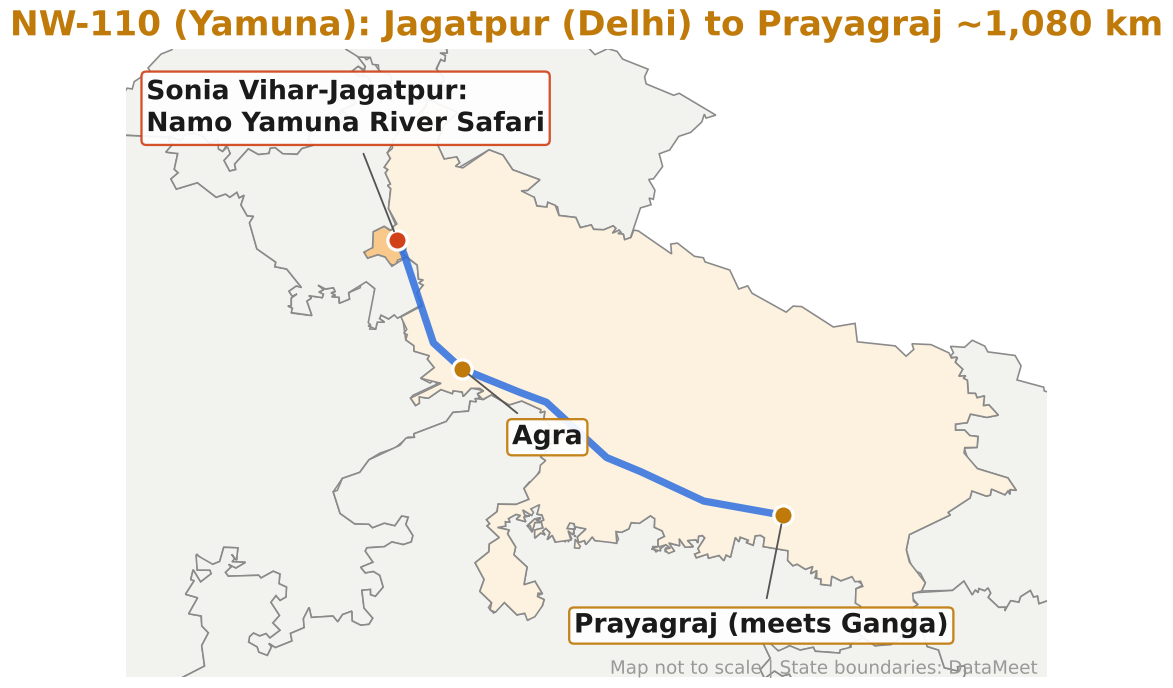
Delhi gets its first leisure boat ride on the Yamuna - the 'Namo Yamuna River Safari' using electric boats between Sonia Vihar and Jagatpur, launched on 10 November. Union Minister Sarbananda Sonowal launched the service with Delhi LG and CM on 10 November 2026. It runs on a roughly 6 km round trip (about 35-45 minutes) between Sonia Vihar and Jagatpur, using electric-powered vessels. The project is led by the Inland Waterways Authority of India (IWAI) with DDA, Delhi Tourism (DTTDC), Delhi Jal Board and the Irrigation & Flood Control Department.
Key facts
Route: Sonia Vihar - Jagatpur on the Yamuna (NW-110).
Electric vessels - zero tailpipe emissions on the river.
Trial runs held in October 2026.
NW-110 (Yamuna): about 1,080 km from Jagatpur (Delhi) to Prayagraj.
Ministry: Ports, Shipping and Waterways.
Way forward
River cleaning under Namami Gange/Yamuna action plans must go hand in hand with river tourism.
Concept
National Waterways Act, 2016: declared 111 national waterways (5 existing + 106 new). NW-1 is Ganga-Bhagirathi-Hooghly (Haldia-Prayagraj), the longest. IWAI: statutory body set up in 1986, HQ Noida, which develops and regulates inland waterways. Inland water transport is cheaper and greener per tonne-km than road or rail, but needs enough water depth (draft) round the year. Exam angle: Prelims: IWAI HQ and year, number of NWs, NW-1 and NW-110 stretches. Mains: Challenges of using rivers like the Yamuna for transport (pollution, low flow, dredging).
Map of the Yamuna (National Waterway 110) from Jagatpur in Delhi past Agra to Prayagraj, with the new Sonia Vihar-Jagatpur river safari marked. — StudyForGS
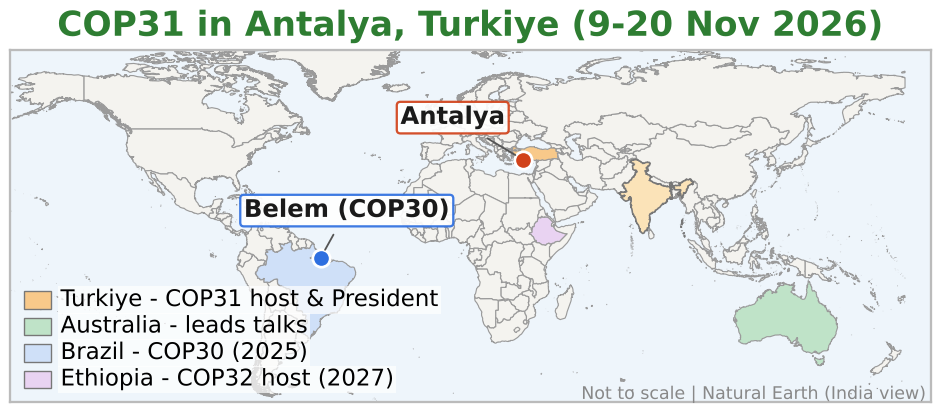
The yearly UN climate summit, COP31, started on 9 November in Antalya, Turkiye and runs till 20 November. Nearly 200 countries, including India, are negotiating on money, adaptation and moving away from fossil fuels. Turkiye holds the COP31 presidency while Australia leads the negotiations - a special shared arrangement. The hosts call it an 'implementation COP' and want electricity's share in world energy use to rise from about 20-21% to 35% by 2035. The United States, the second-largest emitter, is absent. The Iran war has disrupted oil through Hormuz and pushed some countries to burn more coal.
Key facts
Dates: 9-20 November 2026; over one lakh attendees expected.
India wants predictable, mostly public, concessional finance under Article 9.1 of the Paris Agreement that does not add to debt.
India wants the Just Transition Work Programme to continue and a Climate Finance Work Programme to begin.
India wants Global Goal on Adaptation (GGA) indicators to stay voluntary.
India coordinates with G-77+China, LMDC and BASIC (Brazil, South Africa, India, China).
Way forward
A clear finance roadmap with grants for adaptation will decide whether COP31 is truly an 'implementation COP'.
Concept
COP: Conference of the Parties to the UNFCCC (1992, Rio Earth Summit) - the yearly decision-making meeting. COP30 was in Belem, Brazil (2025); COP32 is due in Ethiopia (2027). Article 9.1 of the Paris Agreement: developed countries 'shall provide' financial resources to help developing countries - India stresses this legal duty. CBDR-RC: Common But Differentiated Responsibilities and Respective Capabilities - rich countries polluted more historically, so they should do more. Exam angle: Prelims: venues of COP29/30/31/32, BASIC members, what Article 9.1 says. Mains: Why is climate finance the key to climate ambition for the Global South?
World map highlighting Turkiye (COP31 host and president), Australia (leads negotiations), Brazil (COP30) and Ethiopia (COP32 host), with Antalya and Belem marked. — StudyForGS
22. Global Carbon Budget 2026 Released
ENVIRONMENTUPSC: Prelims + Mains GS3
Syllabus linkage
GS3 - Climate change, emissions data. Prelims: CO2 ppm, carbon budget, sinks; Mains: India's development needs vs emissions.
Context
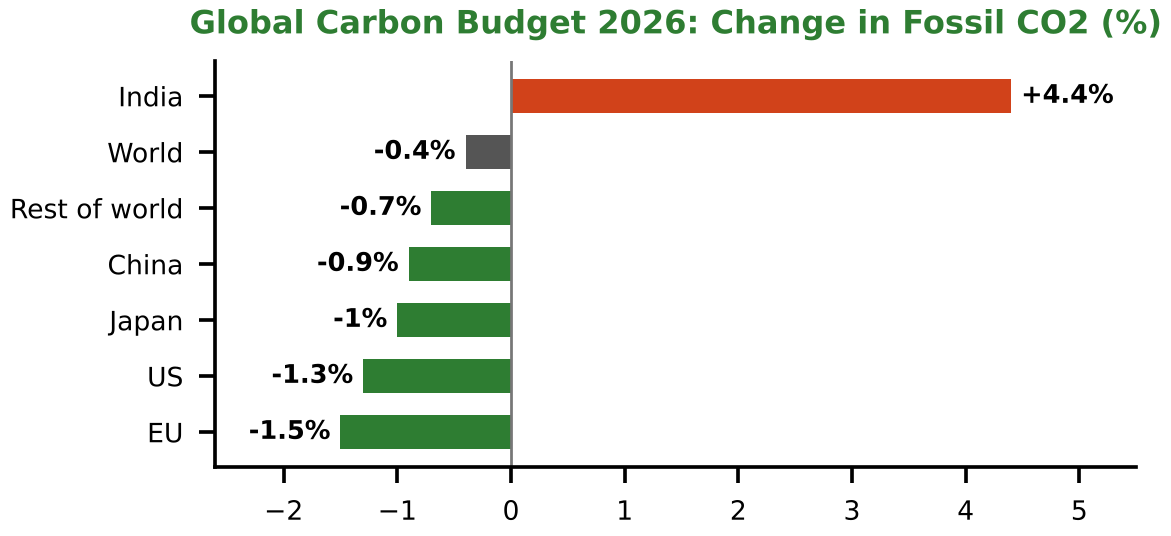
A major yearly report says the world's fossil fuel CO2 emissions will fall slightly (0.4%) in 2026, mainly because the Iran war cut oil use. But India's emissions will rise 4.4%, and the world has less than four years of 'carbon budget' left for 1.5 C. The Global Carbon Project's 21st annual report (released 10 November 2026) projects fossil CO2 emissions at 38.2 billion tonnes in 2026, down 0.4%. Oil emissions fell 1.9%, seen as a short-term reaction to the energy shock from the Iran conflict. Land-use emissions rose to about 5.1 billion tonnes because of peat fires and forest degradation, so total CO2 rises to 43.3 billion tonnes. Solar, wind and EVs are meeting about two-thirds of the extra energy demand.
Key facts
Change in 2026: China -0.9%, US -1.3%, EU -1.5%, Japan -1%, India +4.4%.
India's rise is above its 10-year average of about 3.5% a year.
Atmospheric CO2: 427.7 ppm - about 54% above pre-industrial level.
Remaining budget for 1.5 C: ~150 billion tonnes CO2 = under 4 years at current rate.
Oceans and land absorbed about 49% of human CO2 in 2016-2025.
Way forward
India can bend its curve faster through storage-backed renewables, green hydrogen and efficiency while pressing rich nations to cut deeper.
Concept
Carbon budget: the total amount of CO2 the world can still emit while keeping warming below a limit (like 1.5 C) - like money left in a bank account. Carbon sinks: natural systems (oceans, forests, soils) that absorb more CO2 than they release; El Nino years weaken land sinks because of heat and drought. India's per-capita emissions are still far below the world average - India uses this to argue for 'carbon space' to develop. Exam angle: Prelims: current CO2 ppm range, meaning of carbon budget, role of sinks. Mains: 'Global emissions fall while India's rise' - how should India balance growth and climate commitments (net zero 2070)?
Bar chart of projected change in fossil CO2 emissions in 2026: India +4.4%, world -0.4%, rest of world -0.7%, China -0.9%, Japan -1%, US -1.3%, EU -1.5%. — StudyForGS
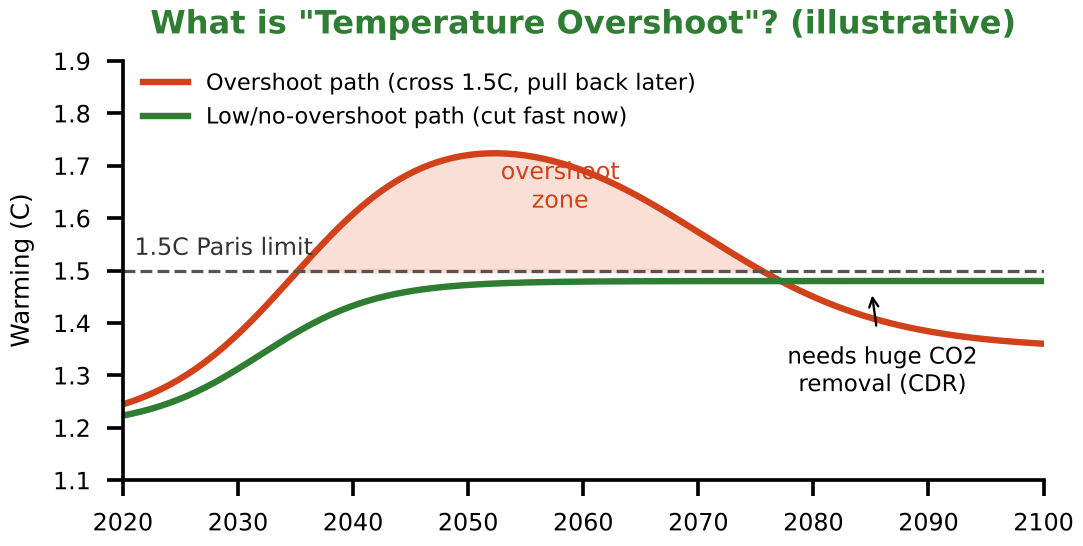
'Overshoot' means letting world temperature go above 1.5 C for some years and then bringing it back down by pulling CO2 out of the air. At COP31, critics say this idea should not become an excuse to delay cutting emissions now. UNEP's report 'Limiting Overshoot' estimates that reversing just 0.1 C of warming would need about 220 billion tonnes of CO2 to be removed permanently. Natural sinks remove about 2.2 billion tonnes a year, while Direct Air Capture removes only about 2 million tonnes a year at around USD 600 per tonne. National pledges already depend on about 1.2 billion hectares of land for CO2 removal, much of it in the Global South.
Key facts
Paris goal: well below 2 C, pursue 1.5 C (2015).
Climate finance: developed countries reported USD 137 bn (2024) but estimated real value only USD 33-45 bn; ~65% was loans.
Adaptation finance fell to USD 26 bn (2023) vs need of USD 310-365 bn a year by 2035.
Fossil fuels: ~83% of primary energy in the US, ~73% in the EU (2025).
EU CBAM (iron, steel, cement, aluminium) worries Global South industry.
Way forward
Deep near-term cuts by rich nations plus genuine grant-based adaptation finance should come before betting on removals.
Concept
Carbon Dioxide Removal (CDR): methods that take CO2 out of the air - natural (afforestation, soil carbon) or technological (Direct Air Capture with storage, BECCS). Direct Air Capture (DAC): machines that suck CO2 from ambient air using chemicals; very costly and energy-hungry today. CBAM (Carbon Border Adjustment Mechanism): EU charge on carbon content of imports - seen by India as a unilateral trade barrier. Exam angle: Prelims: meaning of overshoot, CDR, DAC, CBAM sectors. Mains: Is reliance on future carbon removal fair to developing countries? Link with climate justice.
Illustrative line chart comparing an overshoot path that crosses 1.5 C and needs large CO2 removal to come back down, with a low-overshoot path that stays near 1.5 C through fast early cuts. — StudyForGS
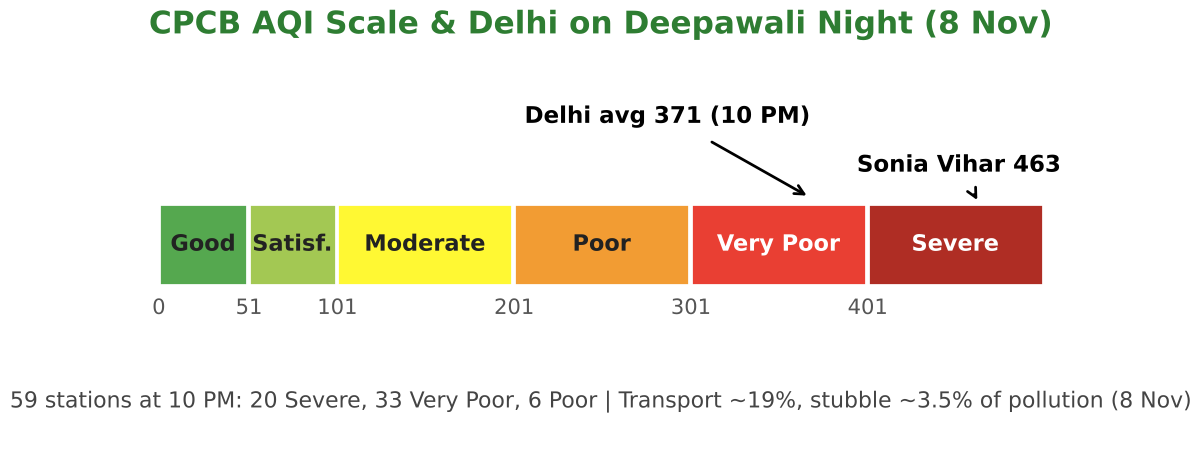
Delhi's air turned 'very poor' to 'severe' on Deepawali night (8 November) as firecrackers added to vehicle smoke, dust and stubble smoke. Cold, still air trapped the pollution near the ground. At 10 PM on 8 November, Delhi's overall AQI was 371 (Very Poor); of 59 stations, 20 were 'Severe', 33 'Very Poor' and 6 'Poor'. Sonia Vihar (463) and Jahangirpuri (450) were the worst. The Supreme Court had allowed only certified green crackers in Delhi-NCR on 7-8 November in fixed hours (6-7 AM, 8-10 PM), with the ban back from 9 November, but bursting outside these hours was widely reported. GRAP Stage III was already in force.
Key facts
AQI 376 (8 Nov average) vs 369 (7 Nov) - air was already bad before Diwali.
Transport ~19% and stubble burning ~3.5% of Delhi's pollution on 8 Nov (estimate).
Low wind (below 10 km/h) and ventilation index below 6,000 sq m/s hinder dispersion.
SC (Arjun Gopal case): religious practice under Art. 25(1) is subject to public order and health; Art. 21 includes a pollution-free environment.
PM2.5 can enter deep into lungs and the bloodstream.
Way forward
Year-round action on vehicles, dust and industry, crop-residue solutions in Punjab-Haryana, and strict enforcement of cracker rules.
Concept
AQI (Air Quality Index): launched 2014 by CPCB; 6 categories from Good (0-50) to Severe (401-500), based on 8 pollutants including PM10, PM2.5, NO2, SO2, CO, O3, NH3 and Pb. GRAP (Graded Response Action Plan): stage-wise curbs in NCR - Stage I Poor, II Very Poor, III Severe (AQI 401-450), IV Severe+ (above 450) - enforced by the Commission for Air Quality Management (CAQM, statutory since 2021). Ventilation index: mixing height x wind speed - shows how easily pollution can spread out; low values in winter trap smog. Exam angle: Prelims: AQI categories and pollutants, GRAP stages, CAQM's legal status. Mains: Why have seasonal bans failed to clean Delhi's air? Suggest an airshed-level approach.
CPCB AQI colour scale from Good to Severe, marking Delhi's average AQI of 371 at 10 PM on Deepawali night and Sonia Vihar at 463. — StudyForGS
25. Bandi Chhor Divas and Guru Hargobind
ART & CULTUREUPSC: Prelims + Mains GS1
Syllabus linkage
GS1 - Indian culture, religion, medieval history (Mughals and Sikh Gurus). Prelims: Sikh Gurus and their contributions; Mains: syncretic festivals.
Context
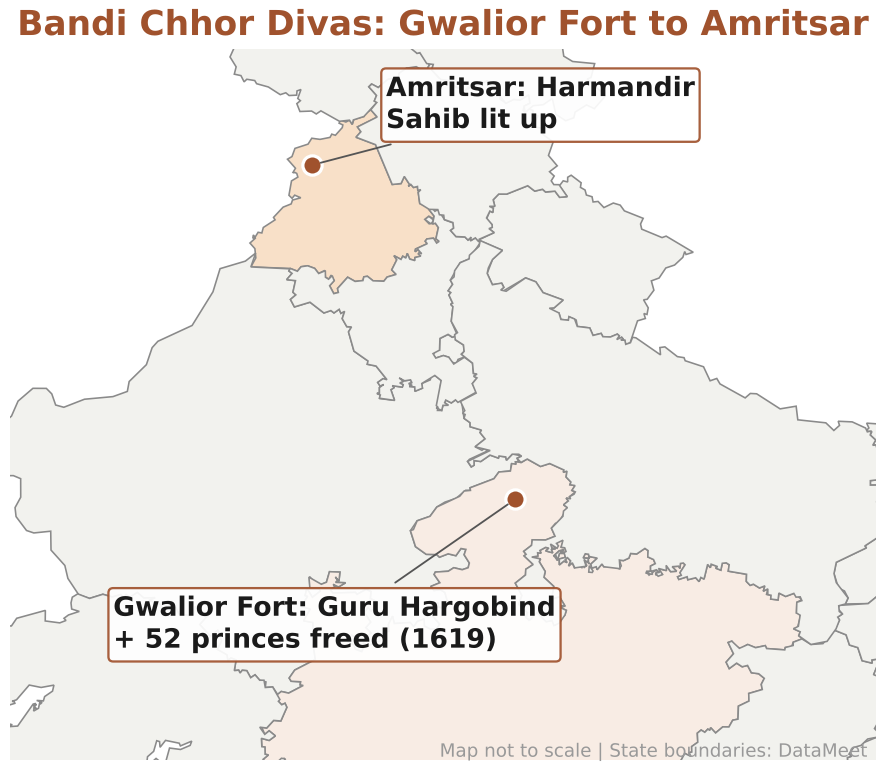
Sikhs celebrated Bandi Chhor Divas on 8 November along with Diwali. It remembers the sixth Sikh Guru, Guru Hargobind, being released from Gwalior Fort in 1619 with 52 imprisoned princes. 'Bandi Chhor' means 'liberation of prisoners'. During Emperor Jahangir's reign, Guru Hargobind was held at Gwalior Fort; when released in 1619, tradition says he made sure all 52 princes held there could leave with him by holding on to his robe. The day is marked with prayers, kirtan (hymns), community service and lighting at Sri Harmandir Sahib (Golden Temple), Amritsar.
Key facts
Observed on 8 November 2026, coinciding with Diwali/Kartik Amavasya.
Guru Hargobind: sixth Sikh Guru (Guru 1606-1644).
Released from Gwalior Fort in 1619, during Jahangir's rule.
Celebrated most grandly at Harmandir Sahib, Amritsar.
Govardhan Puja followed on 10 November.
Way forward
Such festivals can be promoted as part of India's shared cultural heritage and religious tourism.
Concept
Guru Hargobind introduced the idea of 'Miri-Piri' (temporal and spiritual authority), wore two swords, built the Akal Takht (1606) in Amritsar and began armed resistance after the martyrdom of his father Guru Arjan Dev. Guru Arjan Dev (5th Guru) compiled the Adi Granth (1604) and was executed by Jahangir in 1606. Gwalior Fort (Madhya Pradesh): a major hill fort used by many dynasties; it has the Teli ka Mandir and Man Singh Palace. Exam angle: Prelims: match Sikh Gurus with contributions (Akal Takht, Adi Granth, Khalsa 1699). Mains: Festivals as carriers of India's composite culture.
Map of north and central India marking Gwalior Fort, where Guru Hargobind and 52 princes were freed in 1619, and Amritsar's Harmandir Sahib. — StudyForGS
26. Buddha Relics Tour Arunachal Pradesh
ART & CULTUREUPSC: Prelims + Mains GS1
Syllabus linkage
GS1 - Art & culture, Buddhism; GS2 - cultural diplomacy. Prelims: monasteries of Arunachal, IBC; Mains: Buddhist heritage as soft power.
Context
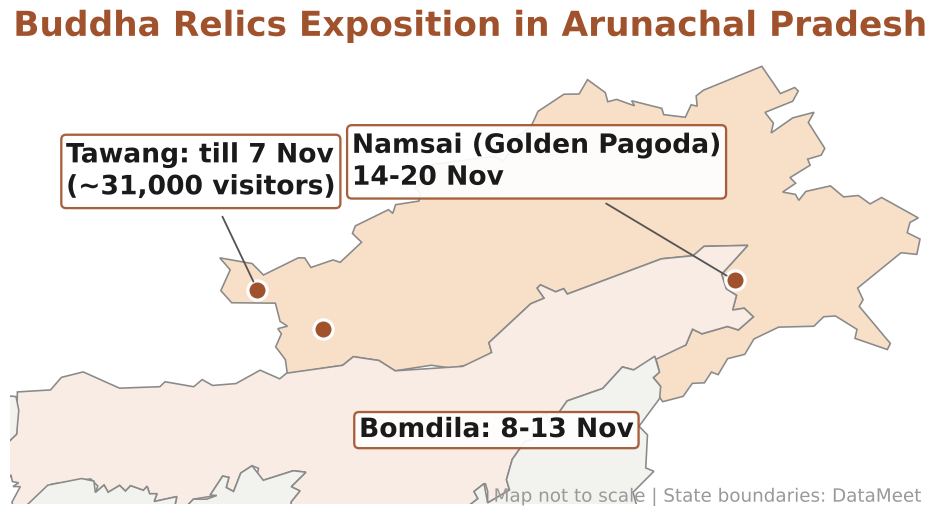
Sacred relics (bodily remains) of Lord Buddha, kept at the National Museum in Delhi, are being shown to devotees in Arunachal Pradesh - first at Tawang, now Bomdila, and next at Namsai. The seven-day exposition at Gaden Namgyal Lhatse (Tawang Monastery) closed on 7 November with about 31,000 visitors. The relics were flown by an IAF Chinook to Bomdila and enshrined at Thubchog Gatsel Ling Monastery (Lower Gompa) on 8 November, where they stay till 13 November. They go to the Golden Pagoda, Namsai, from 14-20 November and return to the National Museum on 21 November.
Key facts
Organised by the Ministry of Culture, Arunachal government and International Buddhist Confederation (IBC).
Tawang Monastery: largest monastery in India, founded in the 17th century (Gelugpa school).
About 4,000 devotees on day one at Bomdila.
Golden Pagoda, Namsai, follows the Theravada tradition (Tai Khamti community).
Relics move: Tawang -> Bomdila -> Namsai -> New Delhi.
Way forward
Develop a Buddhist circuit in the Northeast with good connectivity while protecting fragile monastery sites.
Concept
Relics of the Buddha (e.g. from Piprahwa, UP) are kept at the National Museum; they are sent abroad and within India for exposition as a tool of cultural diplomacy. Schools of Buddhism: Mahayana/Vajrayana (Tawang, Gelugpa 'Yellow Hat' sect) vs Theravada (Namsai) - Arunachal has both. International Buddhist Confederation: New Delhi-based umbrella body set up in 2012 under the Ministry of Culture's support. Exam angle: Prelims: Tawang Monastery's sect and founder period; Theravada vs Mahayana; Piprahwa relics. Mains: Role of Buddhist heritage in India's Act East and neighbourhood diplomacy.
Map of Arunachal Pradesh showing the Buddha relics route: Tawang (till 7 November), Bomdila (8-13 November) and Namsai Golden Pagoda (14-20 November). — StudyForGS
27. Painter Arpita Singh Passes Away
ART & CULTUREUPSC: Prelims + Mains GS1
Syllabus linkage
GS1 - Modern Indian art, personalities. Prelims: Padma awards, art forms (Kantha, miniature), Lalit Kala Akademi; Mains: women in Indian art.
Context
Arpita Singh, one of India's best-known modern painters, died in Delhi on 9 November at 89. Her colourful paintings mixed modern art with Indian miniature, folk art and Kantha embroidery, often showing women's lives. Born in 1937 in Baranagar, West Bengal, she studied fine arts at Delhi Polytechnic (1954-59) and later worked as a textile designer at the Government of India's Weavers' Service Centre. Her work dealt with women, home life, social inequality, conflict and violence, using bright colours, maps, numbers and text on canvas.
Key facts
Born 1937, Baranagar (West Bengal); died 9 November 2026, Delhi.
Padma Bhushan: 2011.
Lalit Kala Akademi Fellowship: 2014.
Style: modernism + Indian miniature + folk art + Kantha.
Worked at the Weavers' Service Centre as textile designer.
Way forward
Her works can be digitised and exhibited in public museums to inspire young artists.
Concept
Kantha: a traditional running-stitch embroidery of Bengal and Odisha, made on layered old saris (Nakshi Kantha is also famous in Bangladesh). Indian miniature painting: small, detailed paintings - Mughal, Rajput, Pahari (Kangra, Basohli) schools - often illustrating texts and court life. Lalit Kala Akademi: national academy of fine arts set up in 1954 (New Delhi); its Fellowship is its highest honour. Exam angle: Prelims: Kantha region, Lalit Kala Akademi year, schools of miniature painting. Mains: Contribution of women artists to modern Indian art.
28. Uttarakhand at 26: States Born in 2000
ART & CULTUREUPSC: Prelims + Mains GS1
Syllabus linkage
GS1 - Post-independence consolidation, reorganisation of states; GS2 - Art. 3. Prelims: dates, Acts, renaming; Mains: small states and development.
Context
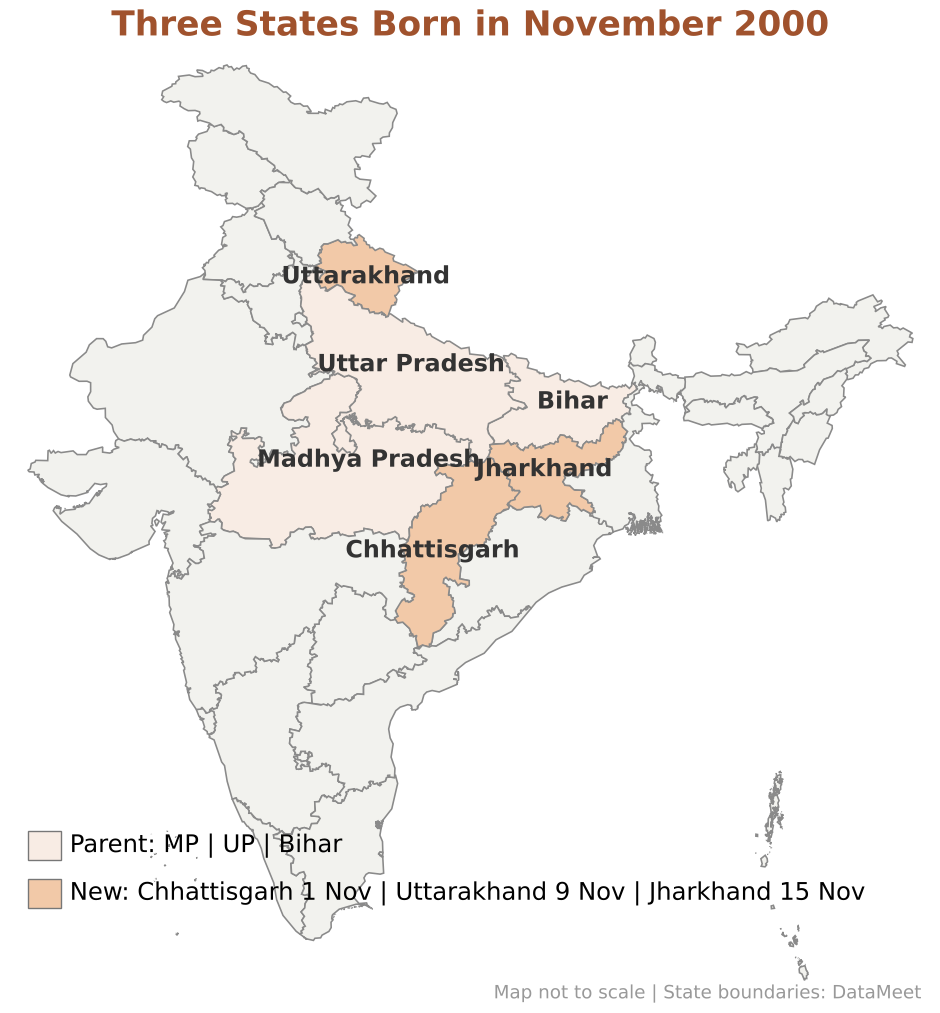
Uttarakhand marked its 26th Foundation Day on 9 November. It was carved out of Uttar Pradesh in 2000 - the same month Chhattisgarh and Jharkhand were also formed. Uttarakhand was formed on 9 November 2000 under the Uttar Pradesh Reorganisation Act, 2000, first named 'Uttaranchal'. It was renamed Uttarakhand from 1 January 2007 by the Uttaranchal (Alteration of Name) Act, 2006. The statehood movement grew strong in 1994, including the Rampur Tiraha incident. President Murmu and PM Modi greeted the people of the state.
Key facts
Chhattisgarh: 1 November 2000 (from Madhya Pradesh).
Jharkhand: 15 November 2000 (from Bihar), on Birsa Munda's birth anniversary.
Name changed from Uttaranchal to Uttarakhand in 2007.
Uttarakhand's capital: Dehradun (winter); Gairsain (Bhararisain) declared summer capital in 2020.
Way forward
Hill-specific planning on disasters, migration and tourism should guide Uttarakhand's next phase.
Concept
Article 3: Parliament can form new states or change boundaries/names by a simple majority law; the Bill needs the President's recommendation and the President must refer it to the affected state legislature for views (not binding). Article 4: such laws are not treated as constitutional amendments under Article 368. Arguments for small states: better administration and focus on regional needs (hills, tribal areas); critics fear weak finances. Exam angle: Prelims: formation dates and parent states of 2000 states; Art. 3 procedure; whether state legislature's view is binding (No). Mains: Have small states delivered better development? Use Uttarakhand/Jharkhand/Chhattisgarh examples.
India map highlighting the three states created in November 2000 - Chhattisgarh (1 Nov), Uttarakhand (9 Nov) and Jharkhand (15 Nov) - and their parent states Madhya Pradesh, Uttar Pradesh and Bihar. — StudyForGS
29. TRAI: New Port Charges & Rail Drive Test
SCI-TECHUPSC: Prelims + Mains GS3
Syllabus linkage
GS3 - Science & tech (communications), infrastructure, regulators. Prelims: TRAI, interconnection; Mains: quality of service and digital connectivity in the Northeast.
Context
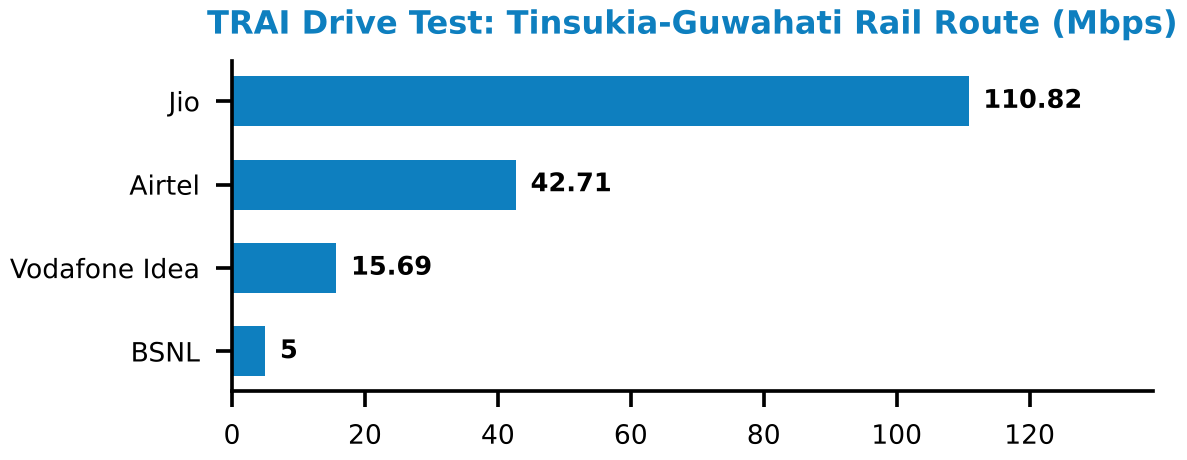
The telecom regulator TRAI has set new maximum charges that telecom companies can ask each other for connecting networks over internet-based (IP) links, from 1 January 2027. A separate TRAI test checked mobile network quality along a rail route in Assam. The Telecommunication Interconnection (Port Charges) (Third Amendment) Regulations, 2026, released on 9 November, cap yearly charges at Rs 5.6 lakh for a 1 Gbps IP port and Rs 42.3 lakh for a 10 Gbps port; operators can agree on lower charges. Penalties for violation are capped at Rs 15 lakh per service area. A September 2026 drive test over 515.9 km on the New Tinsukia-Guwahati rail route found average download speeds of Jio 110.82 Mbps, Airtel 42.71, Vodafone Idea 15.69 and BSNL 5.00 Mbps.
Key facts
Effective date of new port-charge ceilings: 1 January 2027.
Airtel had the fewest call drops (5 of 166); BSNL the most (65 of 205).
Drive test covered 515.9 km plus two station hotspots.
Interconnection lets a user of one network call/reach users of another.
Way forward
Lower interconnection costs and better coverage targets for rail routes can improve service quality for users.
Concept
TRAI (Telecom Regulatory Authority of India): statutory body set up in 1997 under the TRAI Act; it regulates tariffs, interconnection and quality of service. Disputes go to TDSAT. IP-based interconnection: linking networks using internet protocol (data packets) instead of older circuit-switched (TDM) links - cheaper and suited to 4G/5G (VoLTE). Drive test: measuring real network performance (speed, call drops) by moving along a route with test phones. Exam angle: Prelims: TRAI year and appellate body (TDSAT), meaning of interconnection. Mains: Digital divide along transport corridors in the Northeast - steps needed.
Bar chart of average download speeds in TRAI's drive test on the New Tinsukia-Guwahati rail route: Jio 110.82 Mbps, Airtel 42.71, Vodafone Idea 15.69 and BSNL 5.0 Mbps. — StudyForGS
30. RAHAT MITRA: India-Myanmar HADR Drill
DEFENCEUPSC: Prelims + Mains GS3
Syllabus linkage
GS3 - Disaster management, security; GS2 - India-Myanmar relations, Neighbourhood First. Prelims: exercise names and partners; Mains: HADR as diplomacy.
Context
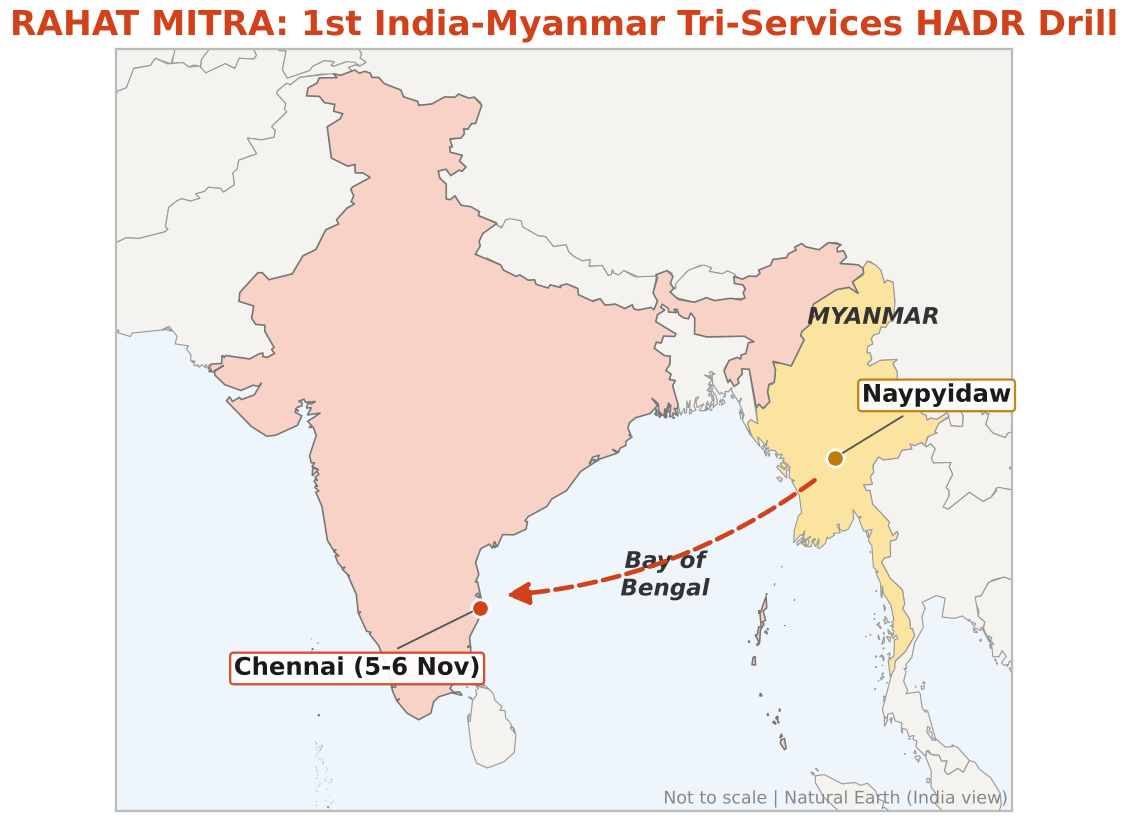
India and Myanmar held their first joint disaster-relief exercise involving all three services (Army, Navy, Air Force) in Chennai, practising how to respond to a severe cyclone. Exercise RAHAT MITRA was held in Chennai on 5-6 November 2026 with more than 300 personnel and a Myanmar Defence Forces delegation. It began with a Table-Top Exercise (TTX - a discussion-based drill) on a severe cyclone scenario, followed by bridge-laying, flood rescue, maritime search and rescue using a Chetak helicopter and INS Bitra, medical triage at Military Hospital Chennai, and casualty evacuation by an IAF Advanced Light Helicopter.
Key facts
First bilateral tri-services HADR exercise between India and Myanmar.
Theme: 'Together for Humanity, Stronger through Partnership'.
Assets: INS Sukanya, INS Bitra, INS Adyar, Chetak and ALH helicopters.
Linked to Neighbourhood First and MAHASAGAR vision.
Bay of Bengal is one of the world's most cyclone-prone regions.
Way forward
Regular joint drills and shared early-warning systems can save lives in Bay of Bengal cyclones.
Concept
HADR (Humanitarian Assistance and Disaster Relief): use of military assets for disasters - India has acted as 'first responder' in the region (e.g. Operation Brahma for the Myanmar earthquake, 2025). MAHASAGAR (Mutual and Holistic Advancement for Security and Growth Across Regions): India's 2025 upgrade of the SAGAR (2015) maritime vision for the Global South. India-Myanmar: share a ~1,643 km land border with four NE states (Arunachal, Nagaland, Manipur, Mizoram); key projects - Kaladan multi-modal project, India-Myanmar-Thailand Trilateral Highway. Exam angle: Prelims: exercise-partner matching, states bordering Myanmar, full form of MAHASAGAR. Mains: HADR as a tool of India's regional leadership in the Indian Ocean.
Map of India, Myanmar and the Bay of Bengal showing Exercise RAHAT MITRA in Chennai (5-6 November) with Myanmar's capital Naypyidaw marked. — StudyForGS
Data point of the day
Rs 42.55 lakh crore
Cash with the public (15 Oct 2026) 137% above the pre-demonetisation level of Rs 17.97 lakh crore (4 Nov 2016); currency-to-GDP ratio back to about 12.1% in FY26.
Prelims rapid-fire
Chess: Anuj Shrivatri (22, Katni, Madhya Pradesh) became India's 100th Grandmaster on 8 Nov by winning the 7th ASEAN+ Individual Open (Philippines) - MP's first GM. India's first GM: Viswanathan Anand (1988).
Youth Olympics: Dakar 2026 (Senegal - first Olympic event in Africa): Taniya won silver in women's 75 kg beach wrestling (India's first in this discipline); Shourya Ambure bronze in 100m hurdles (13.59 s); Tanvi Patri silver in badminton singles.
Shooting: Niveditha Veloor Nair won bronze in women's 25m standard pistol at the ISSF World Championship, Doha (8 Nov).
Tennis: Carlos Alcaraz (Spain) won his first Paris Masters title, beating Ben Shelton (USA) 7-6(5), 7-5 - his 9th ATP Masters 1000 crown.
Yemen: Indian Embassy evacuated 19 Indian seafarers stranded about two weeks in Hodeidah and Sana'a amid Red Sea security concerns.
Defence: Rajnath Singh celebrated Deepawali with 33 Corps (Trishakti Corps) at Sherathang, Sikkim, with Army Chief Gen. Dhiraj Seth; paid homage at Baba Harbhajan Singh Memorial.
Coast Guard: INS Chilka (Odisha) Passing Out Parade on 13 Nov: 3,300+ Agniveers and Coast Guard Naviks - largest batch ever.
Entrepreneurship: National Entrepreneurship Day (9 Nov) marks the 2014 creation of the Ministry of Skill Development and Entrepreneurship; India has 2.62 lakh+ DPIIT-recognised startups.
Award: Dr Devi Shetty (Narayana Health) made Chevalier of France's National Order of Merit (instituted 1963 by Charles de Gaulle) for COVID-era help to the French community in Bengaluru.
Mains practice question
Q. Informal detention before a formal arrest defeats the safeguards of Article 22. Discuss in the light of the Supreme Court's recent ruling on when the 24-hour clock begins.
Hint / approach
Art. 22(2) and BNSS Sec. 58; clock starts at curtailment of liberty; only travel time excluded; D.K. Basu (1997) guidelines; CCTV directions (Paramvir Singh Saini, 2020); duty of magistrates; balance with NDPS Sec. 37.
📌 One-line revision: Art. 22(2): 24 hours from the moment liberty is curtailed | COP31 Antalya 9-20 Nov | India's fossil CO2 +4.4% in 2026 | Cash with public Rs 42.55 lakh cr.