Thursday, 26 November 2026 · IST · National & International · 11 items · 2 MCQs
The Union Cabinet approved a ₹11,000 crore scheme for construction and infrastructure equipment, a ₹4,288.26 crore container terminal at Kamarajar Port and a ₹2,014 crore airport at Doloo (Silchar), while six urea plants worth about ₹54,000 crore were cleared under NIPU-2026. RBI's 47th half-yearly report put forex reserves at US$ 737.78 bn (end-September 2026), the US proposed Section 301 tariffs of up to 25% on India, and the nation marks Constitution Day today.
Today at a glance — things to remember
Cabinet: ₹11,000 cr CIE manufacturing scheme (Ministry of Heavy Industries), 8 years from FY2026-27.
Six urea plants of 12.7 LMT each (~₹54,000 cr) approved under NIPU-2026.
Greenfield airport at Doloo, Silchar (Assam): ₹2,014 cr, built by AAI.
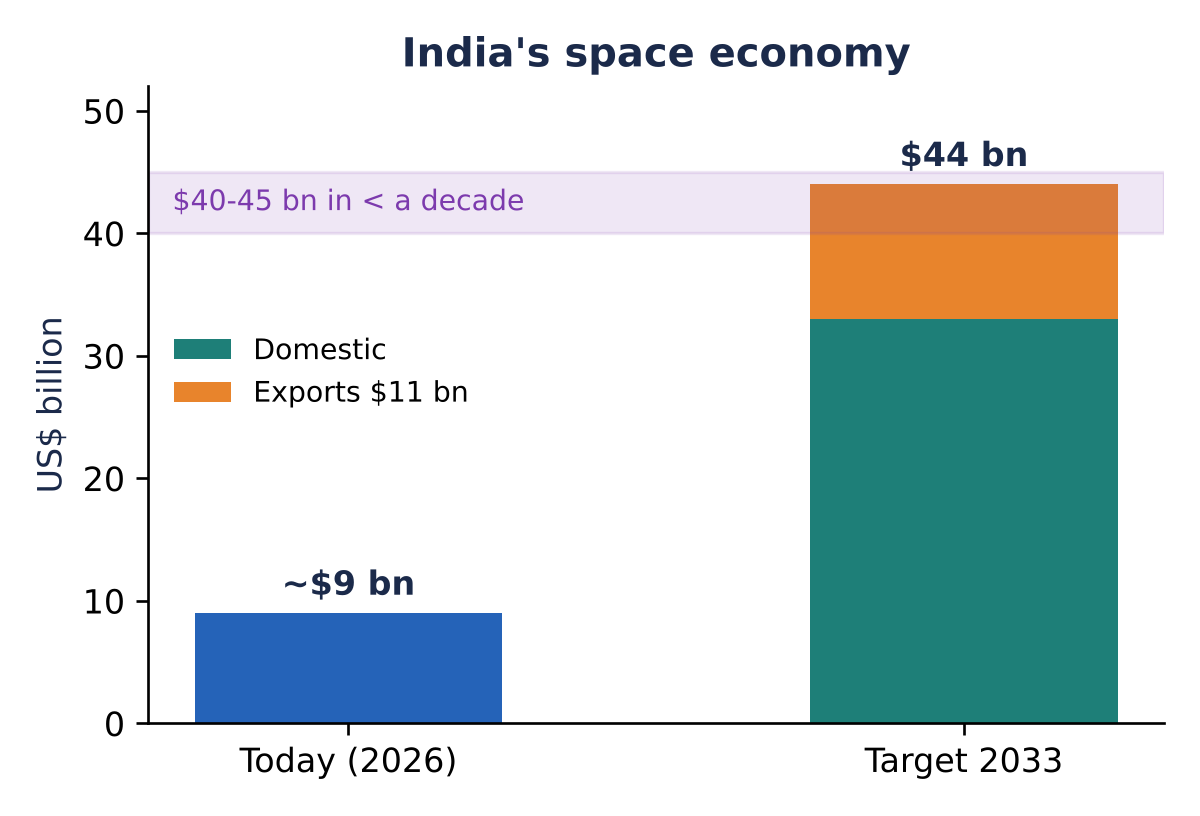
Space economy: ~$9 bn now → $40-45 bn in under a decade; PSLV-N1 in Q1 2027.
SURYAKIRAN XX (India–Nepal): Saljhandi, 25 Nov–8 Dec 2026, 334 troops each.
Forex reserves US$ 737.78 bn (end-Sep 2026); gold held in India 740.13 t.
Constitution Day: adopted 26 Nov 1949; observed since 2015.
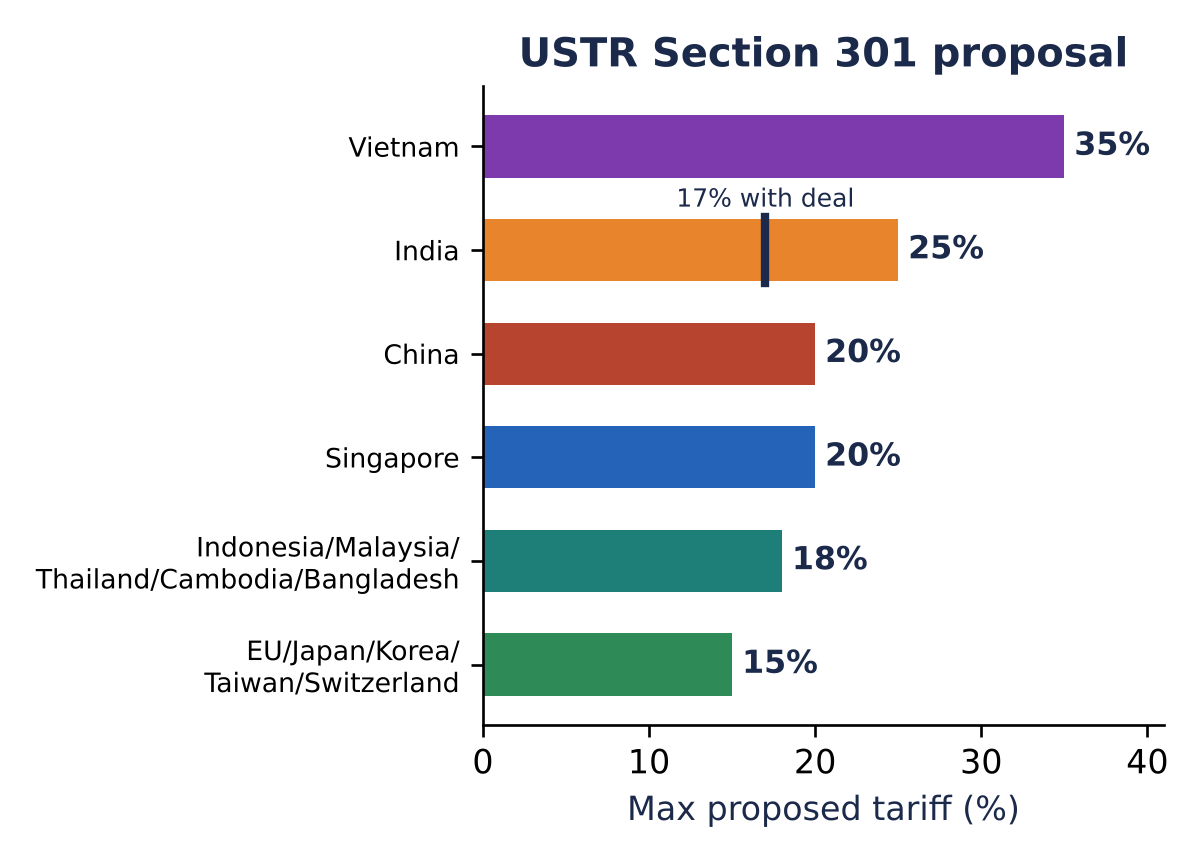
USTR Section 301 proposal: India up to 25%, or 17% with a trade deal.
DoRD–NABARD: extra ₹10 lakh cr SHG credit targeted in 5 years.
Detailed notes
1. Cabinet clears ₹11,000 crore scheme for Construction & Infrastructure Equipment (CIE) manufacturing
ECONOMYCOMMON: Prelims + Mains GS3
Syllabus linkage
GS-III: Indian Economy – industrial policy, manufacturing, capital goods. Prelims: outlay, nodal ministry, incentive design.
Context
On 25 November 2026 the Union Cabinet approved a ₹11,000 crore scheme to boost domestic manufacturing of construction and infrastructure equipment (CIE) and its components, along with a dedicated CIE testing facility.
Key facts
Nodal ministry: Ministry of Heavy Industries (MHI); tenure 8 years from FY2026-27.
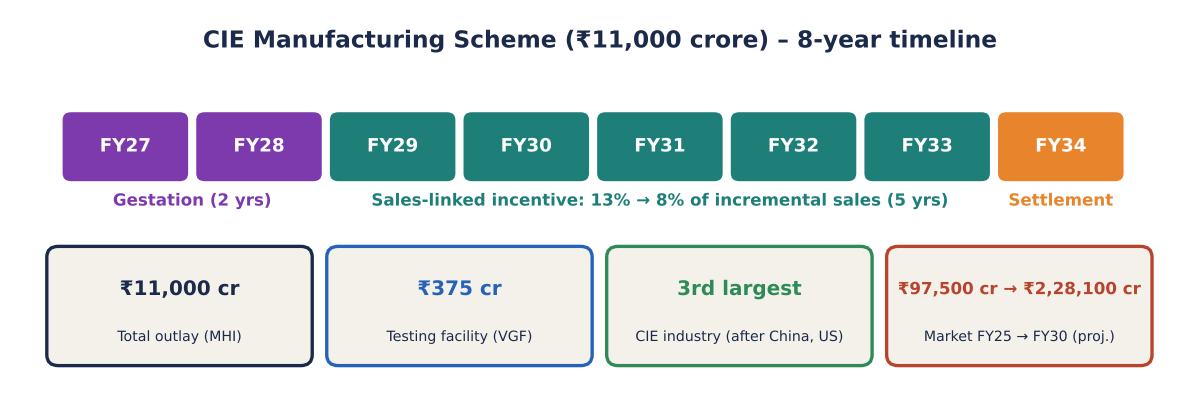
Sales-linked incentive of 13% tapering to 8% of incremental sales over 5 years (FY2028-29 to FY2032-33), after a 2-year gestation (FY2026-27 and FY2027-28).
Grant of up to ₹375 crore as Viability Gap Funding for a CIE testing facility; final settlement in FY2033-34.
India's CIE industry is the world's 3rd largest (after China and the US): about ₹97,500 crore (FY2024-25), projected at about ₹2,28,100 crore by FY2029-30.
Pair incentives with component localisation, testing and certification standards and skilling so that high-end equipment imports fall durably.
Concept
Sales-linked incentive schemes reward incremental output, like the PLI schemes (launched 2020). Viability Gap Funding is a capital grant that makes a socially desirable but commercially unviable project bankable.
Timeline of the CIE scheme: 2-year gestation (FY2026-27, FY2027-28), 5 incentive years (FY2028-29 to FY2032-33) with incentive tapering from 13% to 8%, settlement in FY2033-34; tiles show ₹11,000 crore outlay, ₹375 crore testing grant and industry size rising from ₹97,500 crore to ₹2,28,100 crore. — StudyForGS
2. Six brownfield urea plants worth about ₹54,000 crore approved under NIPU-2026
On 25 November 2026 the Centre approved six urea plants of 12.7 LMT per year each under the National Investment Policy for Urea (NIPU-2026), involving about ₹54,000 crore, to cut import dependence.
Key facts
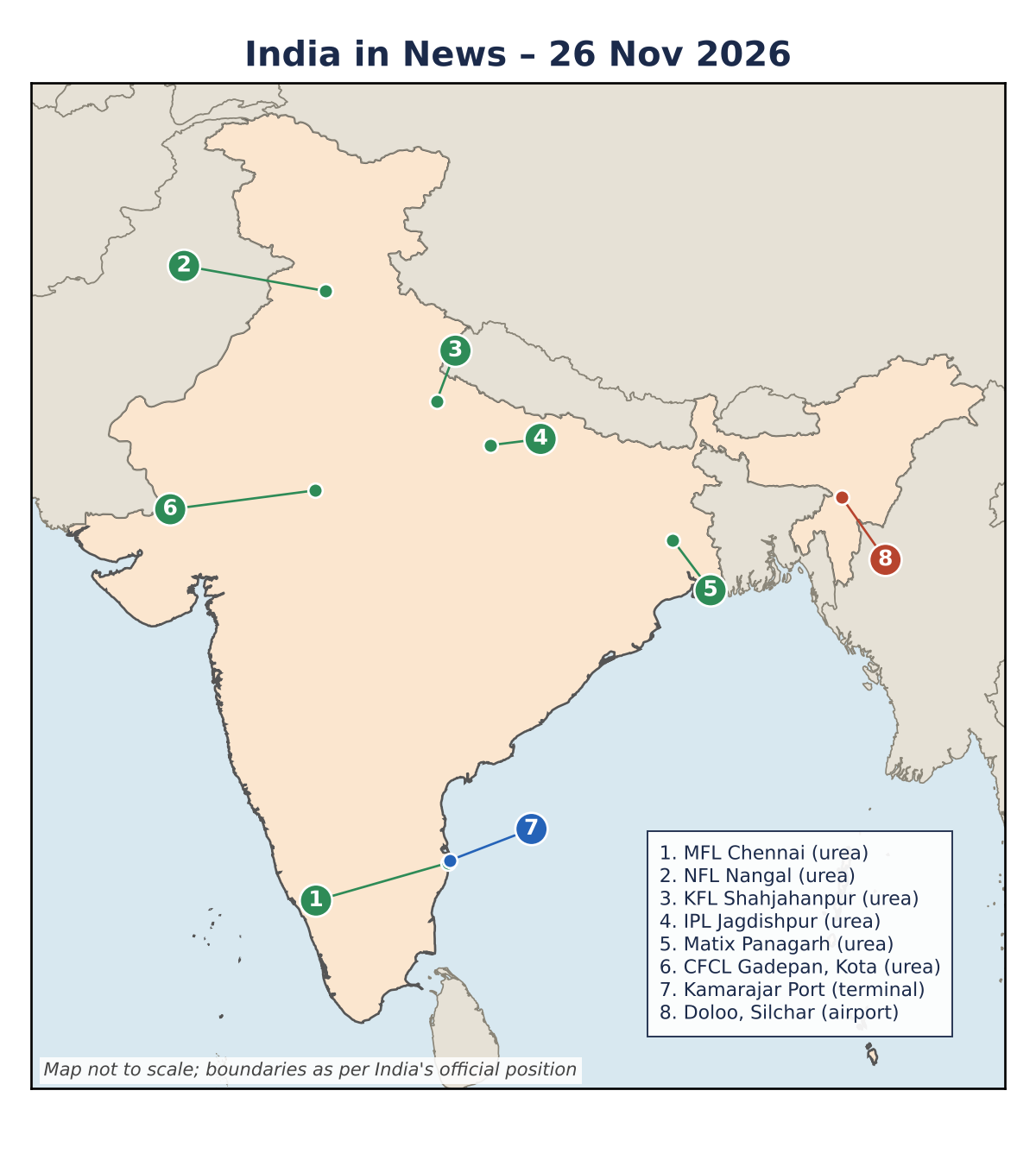
Sites: MFL Chennai (TN), NFL Nangal (Punjab), KRIBHCO Fertilizers Shahjahanpur (UP), Indian Potash Jagdishpur (UP), Matix Panagarh (WB), CFCL Gadepan, Kota (Rajasthan).
Chennai and Nangal replace ageing plants; the other four are brownfield expansions.
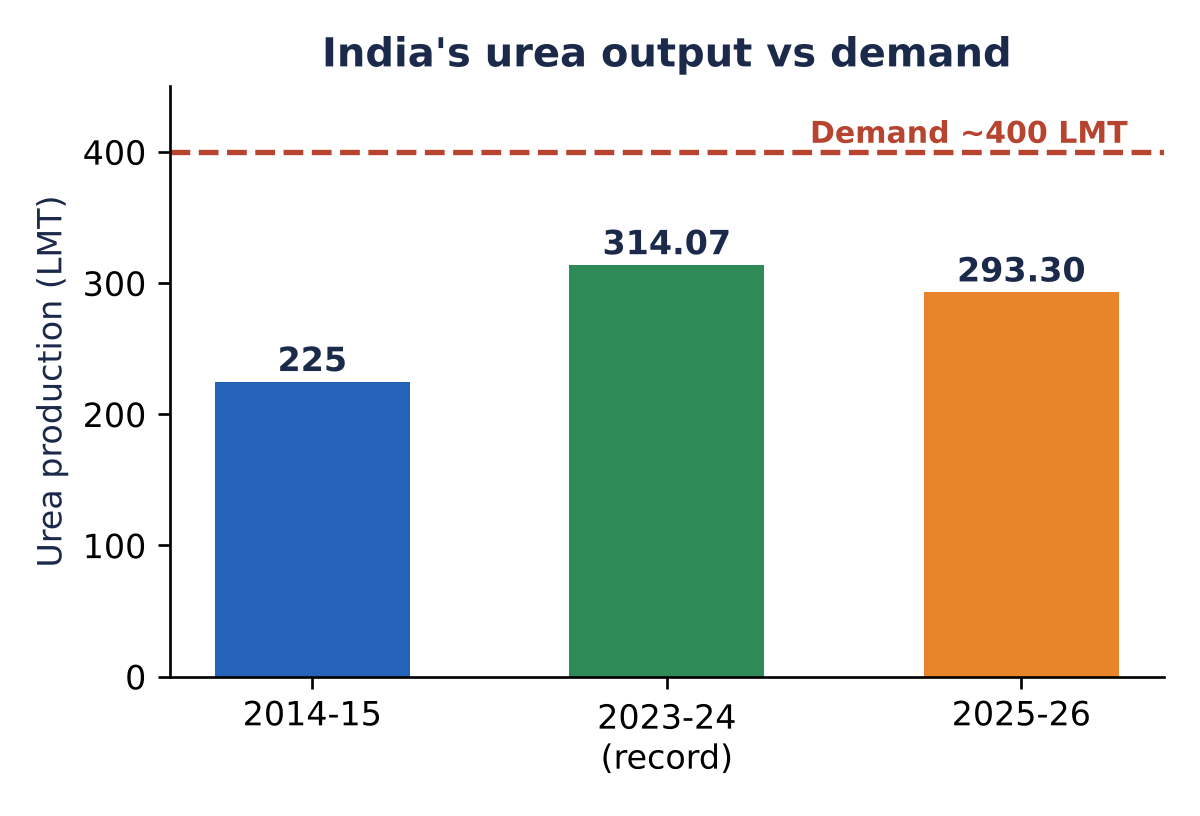
Annual urea demand about 400 LMT; domestic output 225 LMT (2014-15) → record 314.07 LMT (2023-24) → 293.30 LMT (2025-26).
Secure long-term natural gas supply and promote Nano Urea and balanced NPK use to cut both imports and soil degradation.
Concept
Urea contains 46% nitrogen; its MRP is statutorily controlled by the Centre, while P&K fertilisers fall under the Nutrient Based Subsidy (NBS) scheme (2010). NIPU-2026 was cleared by the Cabinet in July 2026; the earlier framework was the New Investment Policy-2012.
Bar chart of India's domestic urea production: 225 LMT in 2014-15, 314.07 LMT in 2023-24 and 293.30 LMT in 2025-26, against annual demand of about 400 LMT shown as a dashed line. — StudyForGS
3. CCEA approves Kamarajar Port's second container terminal and greenfield Doloo airport at Silchar
On 25 November 2026 the CCEA approved a ₹4,288.26 crore second container terminal at Kamarajar Port (Ennore, Tamil Nadu) and a ₹2,014 crore greenfield airport at Doloo, Silchar (Assam).
Key facts
Terminal on PPP – DBFOT with a 40-year concession: Phase I ₹2,429.32 cr (1.1 mn TEU) + Phase II ₹1,858.94 cr (0.9 mn TEU) = 2.0 million TEU/yr.
The port separately bears dredging of about ₹450 crore; the terminal can handle ships of up to 24,346 TEU.
Doloo airport by the Airports Authority of India (AAI): terminal 12,351 sq m, 800 peak-hour passengers, runway 2,705 m × 45 m.
It will replace the constrained civil enclave at the Silchar defence airfield, improving Barak Valley connectivity.
Way forward
Timely land, rail-road evacuation links and Act East cargo planning can turn both assets into regional logistics drivers.
Concept
Kamarajar Port (formerly Ennore Port) was India's first corporatised major port. DBFOT = Design-Build-Finance-Operate-Transfer. AAI was constituted on 1 April 1995 under the AAI Act, 1994.
India in News locator map with India's official boundary, numbered pins for the six approved urea plant sites (Chennai, Nangal, Shahjahanpur, Jagdishpur, Panagarh, Gadepan-Kota), Kamarajar Port near Chennai and the Doloo airport site near Silchar in Assam. — StudyForGS
4. India–Nepal Exercise SURYAKIRAN XX begins at Saljhandi, Nepal
DEFENCECOMMON: Prelims + Mains GS2/GS3
Syllabus linkage
GS-II: India and its neighbourhood; GS-III: Security. Prelims: exercises and partner countries.
Context
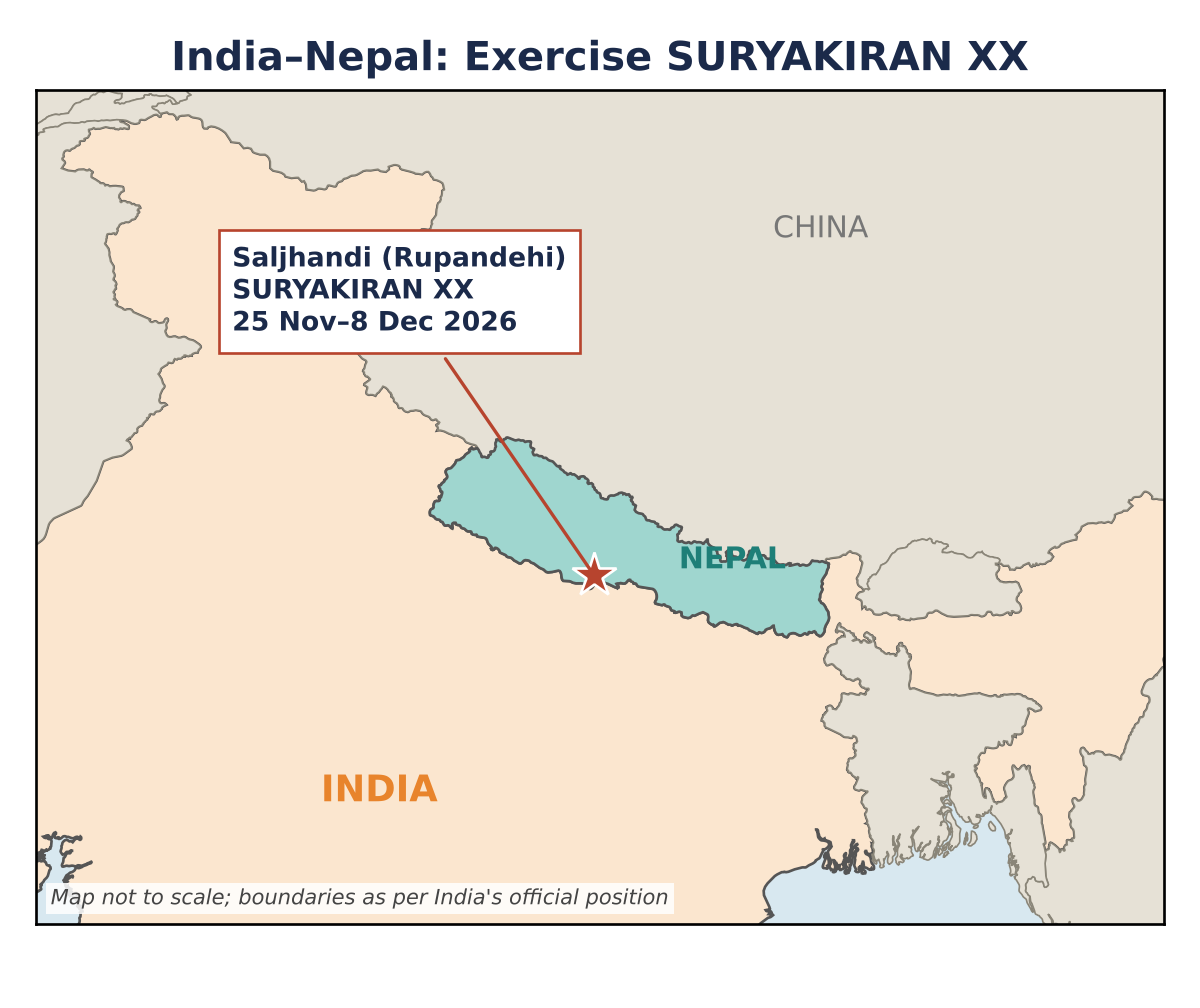
The 20th edition of the India–Nepal joint military exercise SURYAKIRAN began on 25 November 2026 at the Nepal Army Battle School, Saljhandi (Rupandehi district) and will run till 8 December 2026.
Key facts
Total 668 troops: 334 from India's Kumaon Regiment and 334 from the Nepal Army's Shri Jawla Dal Battalion.
Focus: counter-insurgency and counter-terrorism in difficult terrain, jungle warfare, heliborne operations, disaster response and medical training.
Annual bilateral exercise held alternately in India and Nepal; the 19th edition was held in Uttarakhand (2025).
Opened in the presence of Maj Gen Purna Bahadur Khatri, GOC of the Nepal Army's Mid-Western Division.
Way forward
Build on the shared Gorkha military bond with joint HADR planning for Himalayan disasters and closer border-security cooperation.
Concept
Nepal borders 5 Indian states: Uttarakhand, Uttar Pradesh, Bihar, West Bengal and Sikkim. The 1950 Treaty of Peace and Friendship underpins ties. Other exercises: Mitra Shakti (Sri Lanka), Sampriti (Bangladesh), Nomadic Elephant (Mongolia).
Regional map showing India with its full official boundary and Nepal highlighted, with a pin at Saljhandi in Rupandehi district of Nepal, venue of Exercise SURYAKIRAN XX. — StudyForGS
5. India's space economy to grow from about $9 bn to $40-45 bn; first industry-built PSLV targeted for Q1 2027
At the 5th India International Space Conclave in New Delhi (from 24 November 2026), organised by the Indian Space Association (ISpA) with ISRO and IN-SPACe, the report 'Space Economy 2036: The India Blueprint' was released.
Key facts
India's space economy is about $9 billion today and is projected at $40-45 billion in under a decade.
Target: a $44 billion space economy by 2033, including $11 billion of exports.
Ecosystem of about 400-500 companies; about 440 registered space start-ups (August 2026).
PSLV-N1, built by the HAL–L&T consortium, is the first industry-built PSLV; its maiden launch is targeted for Q1 2027.
Way forward
Faster authorisations, assured anchor demand and clear liability and insurance rules through a space activities law can scale private launches.
Concept
IN-SPACe (June 2020) authorises private space activity; NSIL (March 2019) is ISRO's commercial arm. The Indian Space Policy 2023 opened all space segments to non-government entities. PSLV's first successful flight was in 1994.
Bar chart comparing India's space economy of about $9 billion today with the $44 billion target for 2033, of which $11 billion is exports. — StudyForGS
6. RBI's 47th half-yearly report: forex reserves rise to US$ 737.78 bn; more gold brought home
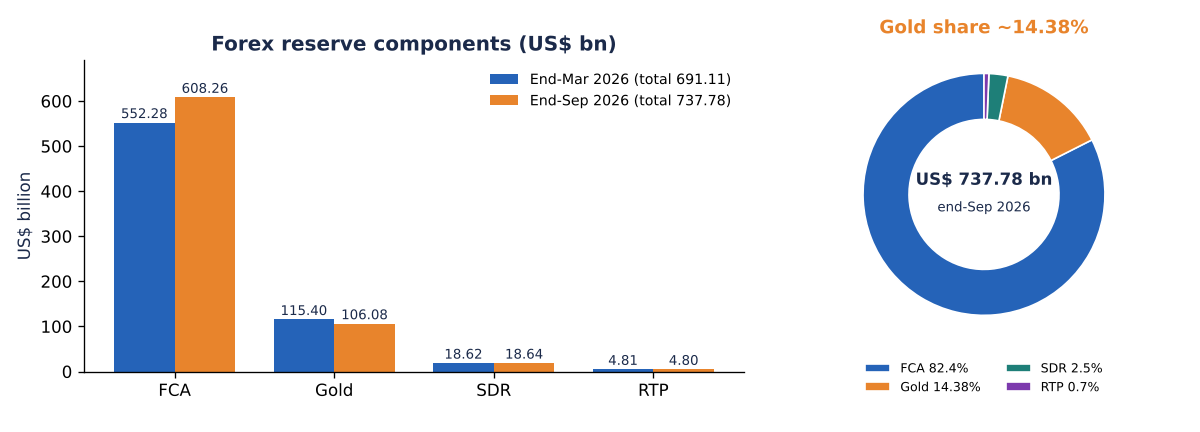
The RBI's 47th Half-Yearly Report on Management of Foreign Exchange Reserves (April–September 2026), released on 25 November 2026, shows reserves rising from US$ 691.11 bn (end-March) to US$ 737.78 bn (end-September 2026).
Gold's share in reserves fell from 16.70% to about 14.38% – a valuation effect, as holdings stayed at 880.52 tonnes.
Gold held within India rose to 740.13 tonnes; 140.39 tonnes are held abroad (Bank of England and BIS).
Import cover: 9.8 months (end-June 2026), down from 10.6 months (end-March 2026).
Way forward
Keep reserves adequate against volatile capital flows while diversifying assets and avoiding excessive rupee intervention.
Concept
Reserve components: FCA, Gold, SDRs and Reserve Tranche Position in the IMF. RBI manages reserves under the RBI Act, 1934 and FEMA, 1999. The SDR was created by the IMF in 1969.
Grouped bar chart of India's forex reserve components at end-March and end-September 2026 (FCA 552.28 to 608.26, gold 115.40 to 106.08, SDR 18.62 to 18.64, RTP 4.81 to 4.80 US$ bn) with a donut chart of the end-September composition. — StudyForGS
7. Samvidhan Divas today: 77 years since the Constitution was adopted on 26 November 1949
POLITYCOMMON: Prelims + Mains GS2
Syllabus linkage
GS-II: Indian Constitution – historical underpinnings, evolution, features, Preamble. Prelims: dates and Articles.
Context
India observes Constitution Day (Samvidhan Divas) on 26 November 2026, marking the day the Constituent Assembly adopted the Constitution in 1949; it came into force on 26 January 1950.
Key facts
Observed since 2015, notified by the Ministry of Social Justice & Empowerment in the 125th birth anniversary year of Dr B.R. Ambedkar; earlier the day was marked as National Law Day.
Some provisions – citizenship (Arts 5-9), elections (Art 324), the provisional Parliament and the short title (Art 393) – came into force on 26 November 1949 itself.
Original Constitution: 395 Articles, 22 Parts, 8 Schedules; it took 2 years, 11 months and 18 days to frame.
The Preamble has been amended only once – the 42nd Amendment (1976) added Socialist, Secular and Integrity.
Way forward
Use the day for constitutional literacy – Preamble values, Fundamental Duties (Art 51A) and rights awareness in schools and panchayats.
Concept
Dr B.R. Ambedkar chaired the Drafting Committee (set up on 29 August 1947); Dr Rajendra Prasad was President of the Constituent Assembly, which first met on 9 December 1946.
📜 Asked before in the exam — previous-year question on this topic
BPSC Prelims 2023 (69th CCE)Consider the following statements regarding the 42nd Amendment to the Constitution of India: 1. It added three words to the Preamble - 'Socialist', 'Secular' and 'Integrity'. 2. It added eight Fundamental Duties to the Constitution. 3. It added new Directive Principles, i.e., Article 39A, Article 43A and Article 47. 4. It granted power to the President, in consultation with the Election Commission, to disqualify members of the State Legislatures. Which of the above statements are incorrect?
Linked because this news is about the same topic. The answer is as per the official key of that year.
8. US proposes Section 301 'excess capacity' tariffs on 14 economies – up to 25% on India
IRCOMMON: Prelims + Mains GS2/GS3
Syllabus linkage
GS-II: India–US relations, effect of policies of developed countries on India; GS-III: external trade. Prelims: Section 301, WTO principles.
Context
On 25 November 2026 the USTR determined, under Section 301 of the US Trade Act of 1974, that 'structural excess capacity' practices of 14 economies burden US commerce, and proposed new tariffs.
Key facts
India: up to 25% (net of existing Section 301 tariffs), or 17% if India concludes a responsive Agreement on Reciprocal Trade.
Others: Vietnam up to 35%; China and Singapore up to 20%; Indonesia, Malaysia, Thailand, Cambodia, Bangladesh up to 18%; EU, Japan, Korea, Taiwan, Switzerland up to 15%.
Written comments due by 5 January 2027; public hearing on 25 January 2027; final action expected in early 2027.
India has maintained that it has no structural excess manufacturing capacity and seeks to address concerns through bilateral trade talks.
Way forward
Fast-track the India–US trade agreement, document market-driven capacity, and diversify exports towards FTA partners.
Concept
Section 301 lets the US act unilaterally against 'unfair' foreign trade practices; critics call it inconsistent with WTO dispute settlement and the Most-Favoured-Nation (MFN) principle (Article I, GATT).
Horizontal bar chart of maximum proposed Section 301 tariff rates: Vietnam 35%, India 25% (17% with a trade deal), China 20%, Singapore 20%, Indonesia, Malaysia, Thailand, Cambodia and Bangladesh 18%, EU, Japan, Korea, Taiwan and Switzerland 15%. — StudyForGS
9. DoRD–NABARD pact for cheaper credit to women SHGs; Interest Subvention Portal launched
On 25 November 2026 the Department of Rural Development (DoRD) and NABARD signed an agreement for management and technical support of the Interest Subvention Scheme for women SHGs and the Women Enterprise Acceleration Fund (WEAF) under DAY-NRLM.
Key facts
NABARD becomes the single nodal agency across public, private, small finance, regional rural and cooperative banks.
Interest Subvention Portal launched jointly by Rural Development Secretary Rohit Kansal and NABARD Chairman Dr Shaji Krishnan V.
Over ₹14 lakh crore of formal credit has been mobilised for SHGs so far.
Five-year target: an additional ₹10 lakh crore for SHGs and ₹1 lakh crore for individual women's enterprises; guarantee fees to be reimbursed to make collateral-free loans safer.
Way forward
Help SHG women move 'from livelihoods to enterprises' with market linkages, digital records and financial literacy, keeping NPAs low.
Concept
DAY-NRLM began in 2011 as Aajeevika (Ministry of Rural Development). NABARD was set up on 12 July 1982 under the NABARD Act, 1981, on the recommendation of the CRAFICARD (B. Sivaraman) Committee.
10. SAMAVESH and new e-Anudaan portals launched for social justice schemes
On 25 November 2026 Union Minister Dr Virendra Kumar launched SAMAVESH and a new e-Anudaan portal of the Ministry of Social Justice & Empowerment.
Key facts
SAMAVESH = Single Access Mechanism for All Verticals of Empowerment and Social Harmony – a common digital platform for organisations working with the Ministry.
AI chatbot 'Samajik Sahayak' supports more than 22 languages through an MoU with BHASHINI.
Supports schemes on drug de-addiction, senior citizens, SMILE and SHRESHTA; aims to cut paperwork and ease doing business for partner organisations.
Way forward
Integrate with DBT and social registries, and add grievance redress and offline help for low-literacy users.
Concept
SMILE (2022): livelihood and rehabilitation of transgender persons and persons engaged in begging. SHRESHTA: residential education for meritorious SC students in reputed private schools. BHASHINI is MeitY's AI language-translation mission (2022).
11. Cabinet continues Postal Operations and Estates Management schemes for 2026-31
POLITYCOMMON: Prelims + Mains GS2
Syllabus linkage
GS-II: Government policies and interventions; service delivery. Prelims: outlays, Union List entries.
Context
On 25 November 2026 the Union Cabinet approved continuation of two Department of Posts schemes for FY2026-27 to FY2030-31, in line with the 16th Finance Commission cycle.
Key facts
Postal Operations Scheme: ₹1,141 crore – mail network ₹575 cr, parcels ₹278 cr, rural access ₹120 cr, marketing ₹100 cr, philately ₹60 cr, international mail ₹8 cr.
Estates Management Scheme: ₹1,491 crore for building and maintaining postal infrastructure.
India Post has about 1.65 lakh post offices, the largest postal network in the world.
Way forward
Turn post offices into last-mile logistics and financial hubs – IPPB, e-commerce parcels and Dak Ghar Niryat Kendras.
Concept
Posts and telegraphs is a Union List subject (Entry 31, Seventh Schedule). The 16th Finance Commission (Chairman: Arvind Panagariya) covers the award period 2026-31.
Data point of the day
US$ 737.78 bn
India's forex reserves, end-September 2026 Up by US$ 46,676 million from US$ 691.11 bn at end-March 2026; FCA at US$ 608.26 bn; gold's share down to about 14.38%.
Prelims rapid-fire
Kashi Tamil Sangamam 5.0: 28 November–12 December 2026, theme centred on the Thirukkural; about 1,400 delegates from Tamil Nadu.
Aero India 2027 (16th edition): 8–12 February 2027 at Air Force Station Yelahanka, Bengaluru.
National Milk Day (26 November) marks the birth anniversary of Dr Verghese Kurien, architect of the White Revolution (Operation Flood, 1970).
Cabinet approved an India–Singapore MoU on aviation MRO (maintenance, repair and overhaul) skills and industry development.
AAI builds Doloo airport; runway 2,705 m × 45 m, terminal for 800 peak-hour passengers.
Practice MCQs — UPSC Prelims pattern
Q1. With reference to RBI's half-yearly report on forex reserves (April–September 2026), consider the following statements: 1. The share of gold in total reserves rose during the half-year. 2. More than four-fifths of RBI's gold is now held within India. 3. The Reserve Tranche Position is held with the World Bank. Which of the statements given above is/are correct?
1 only
2 only
2 and 3 only
1, 2 and 3
Show answer
Answer: B Gold's share fell from 16.70% to about 14.38%, so 1 is wrong. 740.13 t of 880.52 t (about 84%) is held in India, so 2 is right. The Reserve Tranche Position is held with the IMF, not the World Bank, so 3 is wrong.
Q2. Consider the following pairs (Exercise – Partner country with India): 1. SURYAKIRAN – Nepal 2. Mitra Shakti – Sri Lanka 3. Sampriti – Bangladesh 4. Nomadic Elephant – Mongolia. How many of the pairs given above are correctly matched?
Only one
Only two
Only three
All four
Show answer
Answer: D All four are correct: SURYAKIRAN (Nepal; 20th edition began 25 November 2026 at Saljhandi), Mitra Shakti (Sri Lanka), Sampriti (Bangladesh) and Nomadic Elephant (Mongolia).
Mains practice question
Q. The ₹11,000 crore CIE manufacturing scheme and the six new urea plants under NIPU-2026 signal a push to cut import dependence in capital goods and critical farm inputs. Examine the potential and the challenges of such incentive-led industrial policy for India. (15 marks, 250 words)
Hint / approach
Intro: CIE scheme (₹11,000 cr, 13%→8% sales-linked incentive) and urea plants (~₹54,000 cr). Potential: import substitution, infrastructure supply chains, jobs, fertiliser security. Challenges: fiscal cost, gas import dependence, technology gaps, trade-rule scrutiny, lessons from PLI uptake. Conclude: time-bound, outcome-linked incentives with R&D and standards.
📌 One-line revision: Today in one line: ₹11,000 cr CIE scheme + 6 urea plants + Kamarajar and Doloo for self-reliance, forex at US$ 737.78 bn, SURYAKIRAN XX with Nepal, and Samvidhan Divas – 26 November 1949.