Wednesday, 25 November 2026 · IST · National & International · 11 items · 2 MCQs
The RBI proposed a customer-controlled 'Stop Switch' and Trusted Person Mechanism against digital fraud and retained SBI, HDFC Bank and ICICI Bank as D-SIBs. India announced a ₹15,000 crore package for Nepal during PM Balendra Shah's visit, while the US weighs fresh Section 301 tariffs on 16 economies including India. ICMR's SAMPADA survey, the World Landslide Forum, the Paschim Banga renaming move and two new social-sector launches complete the day.
Today at a glance — things to remember
RBI draft: Stop Switch blocks all future outward debits; Trusted Person must approve within 1 hour.
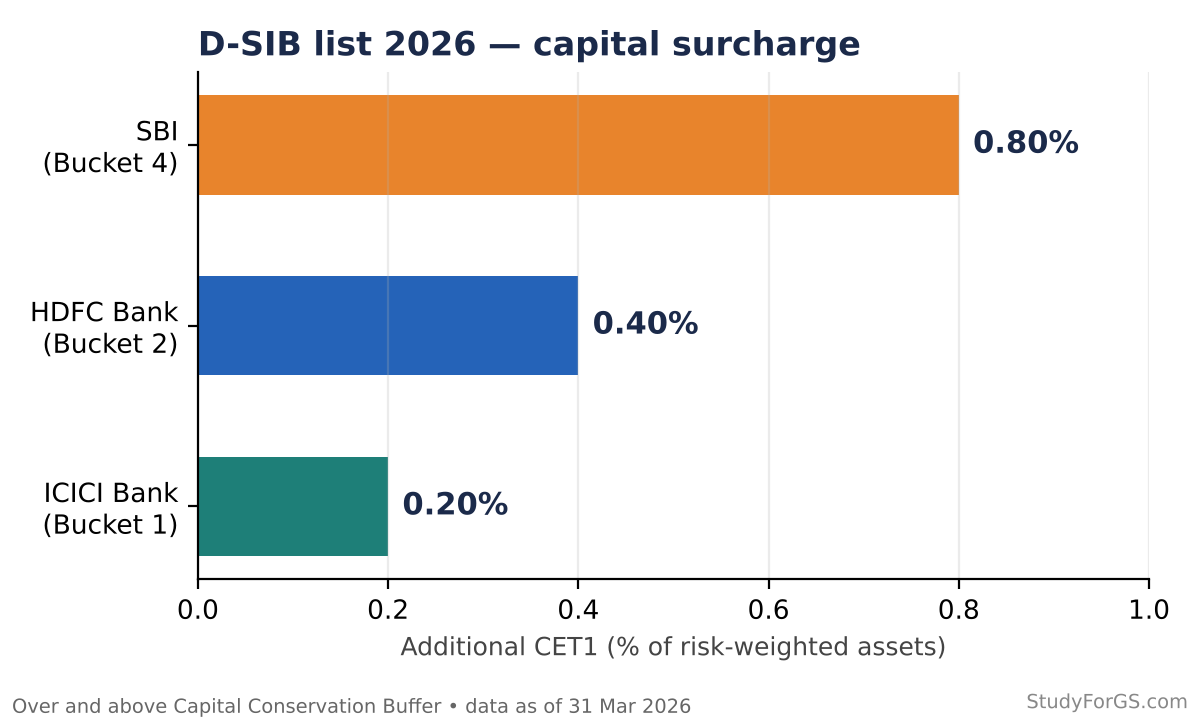
RBI 2026 D-SIB list: SBI (Bucket 4, 0.80%), HDFC Bank (Bucket 2, 0.40%), ICICI Bank (Bucket 1, 0.20%).
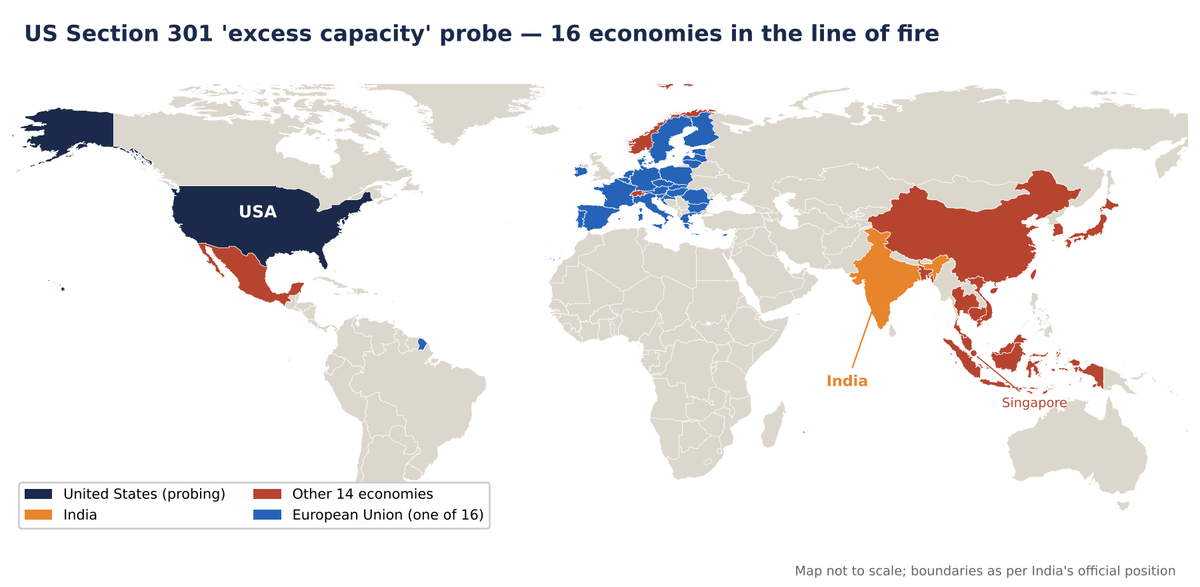
US weighs new Section 301 tariffs on 16 economies incl. India after excess-capacity probe.
Space economy: ~USD 9 bn now, projected USD 40–45 bn within about a decade.
JWALA MK-1 counter-drone micro-missile (range 5 km) test-fired at Pokhran.
7th World Landslide Forum — first time in India, at Faridabad (22–27 Nov).
New CPI: food & beverages weight 36.8% (from 45.9%).
On 23 Nov 2026 the RBI released draft preventive safeguards against fraudulent electronic banking transactions, building on its 9 April 2026 discussion paper. Comments are invited till 14 Dec 2026.
Key facts
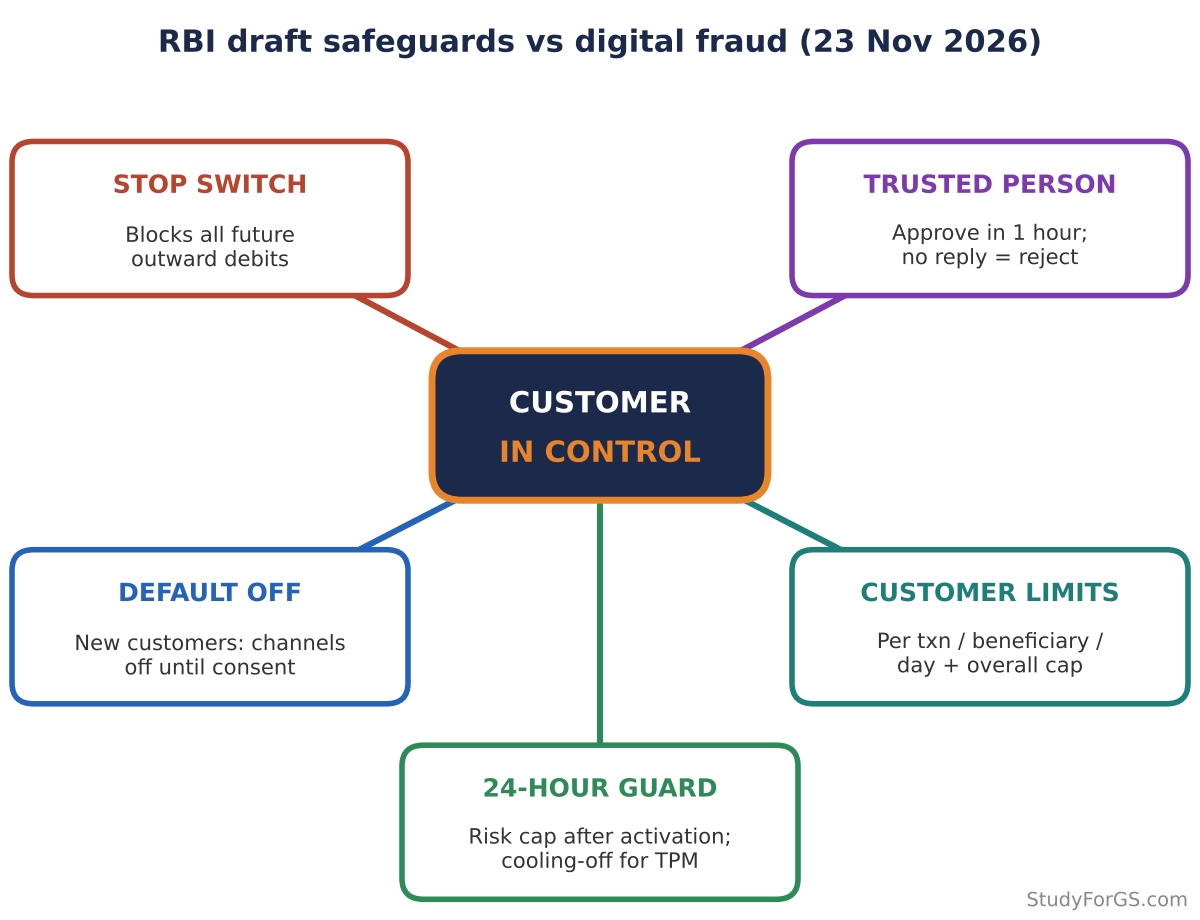
Stop Switch: blocks all future outward debits, new mandates, new standing instructions and UPI registration on new third-party apps; inward credits and existing recurring mandates continue.
Trusted Person Mechanism (voluntary): a person aged 18+ approves transfers above a customer-set threshold within 1 hour — no response means rejection; 24-hour cooling-off before activation or change.
Digital channels disabled by default for new customers until consent; a risk-based cap applies for the first 24 hours after activation.
Customers can set limits per transaction, per beneficiary and per day for each channel, plus one overall daily limit.
The 1-hour delay on high-value transfers floated in the discussion paper has been dropped.
Way forward
Pair customer controls with awareness drives for the elderly and first-time users, and ensure uniform rollout across commercial, small finance, payments and co-operative banks.
Concept
RBI regulates banks under the Banking Regulation Act, 1949 and payment systems under the Payment and Settlement Systems Act, 2007. Under RBI's 2017 customer-liability norms, a customer has zero liability for a third-party breach reported within 3 working days.
Mind-map of RBI's proposed digital payment safeguards: Stop Switch, Trusted Person Mechanism, default-off channels, customer-set limits and card controls. — StudyForGS
2. RBI's 2026 D-SIB list: SBI, HDFC Bank, ICICI Bank retained
On 23 Nov 2026 the RBI released the 2026 list of Domestic Systemically Important Banks (D-SIBs) based on data as of 31 March 2026; all three banks stay in the same buckets as last year.
Key facts
SBI — Bucket 4: additional CET1 of 0.80% of risk-weighted assets (RWAs).
HDFC Bank — Bucket 2: 0.40%; ICICI Bank — Bucket 1: 0.20%.
The surcharge is over and above the Capital Conservation Buffer.
Framework issued 22 July 2014, updated 28 Dec 2023; SBI and ICICI Bank first named in 2015, HDFC Bank added in 2017.
Way forward
Higher capital buffers must go with closer supervision and credible resolution plans, so that 'too big to fail' does not become a moral hazard.
Concept
D-SIBs are banks whose failure would disrupt the domestic financial system ('too big to fail'); scoring uses size, interconnectedness, substitutability and complexity. G-SIBs are identified globally by the Financial Stability Board (FSB) — no Indian bank is a G-SIB.
Bar chart of additional CET1 requirement for D-SIBs 2026: SBI 0.80% (Bucket 4), HDFC Bank 0.40% (Bucket 2), ICICI Bank 0.20% (Bucket 1). — StudyForGS
3. JWALA MK-1 counter-drone micro-missile test-fired at Pokhran
On 23 Nov 2026, Noida-based private firm IG Defence test-fired JWALA MK-1 at Pokhran, Rajasthan, calling it India's first autonomous Counter-Unmanned Aircraft System (CUAS) micro-missile system.
Key facts
Surface-to-air hard-kill interceptor with an operational range of 5 km.
Runs on GRID, the firm's AI-based mission autonomy and battle-management system (detect, identify, classify, engage).
Uses a proximity fuse with a fragmentation warhead; two solid rocket motors were test-fired in October 2026.
Aimed at the cost asymmetry of using costly air-defence missiles against cheap drones.
Way forward
Move to user trials with the armed forces and build a layered counter-drone grid combining hard-kill and soft-kill tools.
Concept
Hard-kill physically destroys a drone (missile, gun, laser); soft-kill disables it by jamming or spoofing. Private-sector defence R&D is encouraged under iDEX and the positive indigenisation lists.
4. World Landslide Forum in India for the first time; M5.6 quake in east Nepal
The 7th World Landslide Forum (WLF7) opened on 23 Nov 2026 at Amrita Vishwa Vidyapeetham, Faridabad (Haryana) — the first in India (22–27 Nov). On 24 Nov, an M5.6 quake in Taplejung, Nepal jolted Sikkim, North Bengal and Bihar.
Key facts
Experts from 75+ countries; organised with the International Consortium on Landslides (ICL).
Landslide susceptibility mapping done for ~4.3 lakh sq km; inventory of ~91,000 historical landslides (end-2025).
National Landslide Forecasting Centre, Kolkata (2024) now covers 20 districts.
₹1,000 crore National Landslide Mitigation Project for 15 states (10 Himalayan + 5 others).
Quake epicentre near Olangchung Gola (Nepal–Tibet border); no casualties reported.
Way forward
Shift from relief to prevention: integrate rainfall forecasts with soil-moisture, slope and ground data for impact-based early warning.
Concept
NDMA is chaired by the Prime Minister under the Disaster Management Act, 2005; the Geological Survey of India (GSI) is the nodal agency for landslides. Global DRR roadmap: Sendai Framework 2015–2030.
5. US weighs new Section 301 tariffs on 16 economies, including India
Reports on 24–25 Nov 2026 say the US Trade Representative (USTR) may announce results of Section 301 probes into 16 economies as early as this week, with higher tariffs on China, India and others under consideration.
Key facts
Section 301 of the US Trade Act of 1974 lets the USTR impose tariffs for 'unfair' trade practices.
Probes launched in March 2026 on 'structural excess capacity' in manufacturing.
The 16: China, EU, India, Japan, South Korea, Mexico, Vietnam, Taiwan, Thailand, Malaysia, Indonesia, Switzerland, Norway, Singapore, Bangladesh, Cambodia.
Rates not yet disclosed; India already faces an additional 10% duty imposed in July 2026.
India aims to close the first tranche of the India–US Bilateral Trade Agreement by the end of this financial year.
Way forward
Fast-track the BTA first tranche, diversify markets through FTAs, and use WTO forums against unilateral measures.
Concept
Most-Favoured-Nation (MFN) treatment (GATT Article I) bars discrimination among WTO members; unilateral Section 301 action is widely seen as WTO-inconsistent, unlike WTO-sanctioned anti-dumping and countervailing duties.
World map highlighting the United States and the 16 economies covered by the Section 301 excess-capacity probe, including India, China, the EU and ASEAN members. — StudyForGS
6. India's space economy to grow from ~USD 9 bn to USD 40–45 bn
SCI-TECHCOMMON: Prelims + Mains GS3
Syllabus linkage
GS3 — Space technology, private sector in space; Prelims — IN-SPACe, NSIL
Context
Addressing the 5th India International Space Conclave (New Delhi, 23–24 Nov 2026, organised by the Indian Space Association), MoS Dr Jitendra Singh said on 24 Nov that the space economy will grow manifold within about a decade.
Key facts
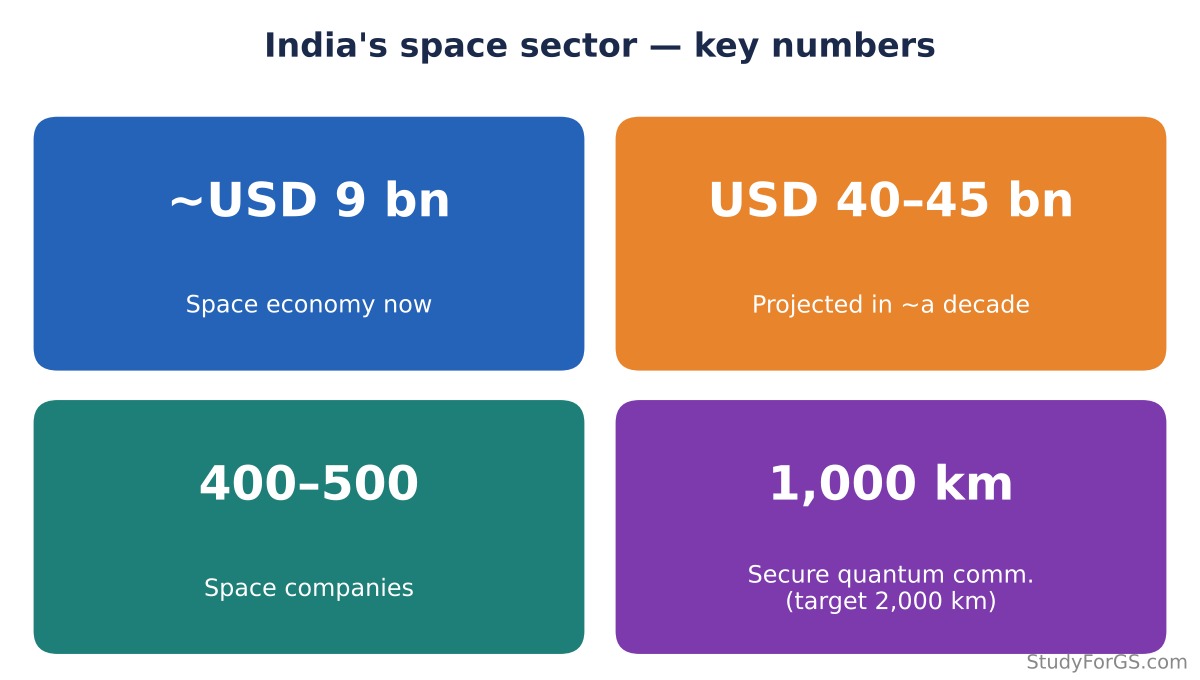
Space economy now ~USD 9 billion; projected USD 40–45 billion within about a decade.
Space companies grew from single-digit start-ups to about 400–500.
Report 'Space Economy 2036: The India Blueprint' released at the conclave.
National Quantum Mission (2023, 8 years) has achieved 1,000 km of secure quantum communication against a 2,000 km target.
Way forward
Raise demand-side awareness of space applications across ministries and channel private and CSR investment into R&D through ANRF and the RDI Fund.
Concept
NSIL (2019) is ISRO's commercial arm; IN-SPACe (2020) authorises and promotes private space activity under the Department of Space; the Indian Space Policy 2023 defines roles of ISRO, NSIL, IN-SPACe and private players.
Stat tiles: space economy about USD 9 billion now, USD 40-45 billion projected, 400-500 space companies, 1,000 km quantum communication achieved. — StudyForGS
7. India–Nepal: ₹15,000 crore package during PM Balendra Shah's visit
IRCOMMON: Prelims + Mains GS2
Syllabus linkage
GS2 — India and its neighbourhood; Prelims — cross-border projects, places in news
Context
Nepal PM Balendra Shah made a state visit on 22–23 Nov 2026 — his first bilateral foreign visit since taking office in March 2026 — and held talks with PM Modi at Hyderabad House on 23 Nov.
Key facts
₹15,000 crore package: ₹3,500 crore grant (post-flood reconstruction after the Bhotekoshi floods) + ₹11,500 crore Line of Credit.
8 MoUs — incl. forensic science, police training and satellite communication via the South Asia Satellite.
Saryu–Kamala Express (Ayodhya–Janakpur Dham, weekly) flagged off on 23 Nov under the Ramayana Circuit.
No progress on the boundary issue or the Pancheshwar project.
Way forward
Time-bound execution of projects, a structured dialogue on the boundary question, and deeper power trade can convert goodwill into results.
Concept
The India–Nepal Treaty of Peace and Friendship (1950) allows open borders; Nepal borders 5 Indian states — Uttarakhand, Uttar Pradesh, Bihar, West Bengal and Sikkim. Motihari–Amlekhgunj (2019) was South Asia's first cross-border petroleum pipeline.
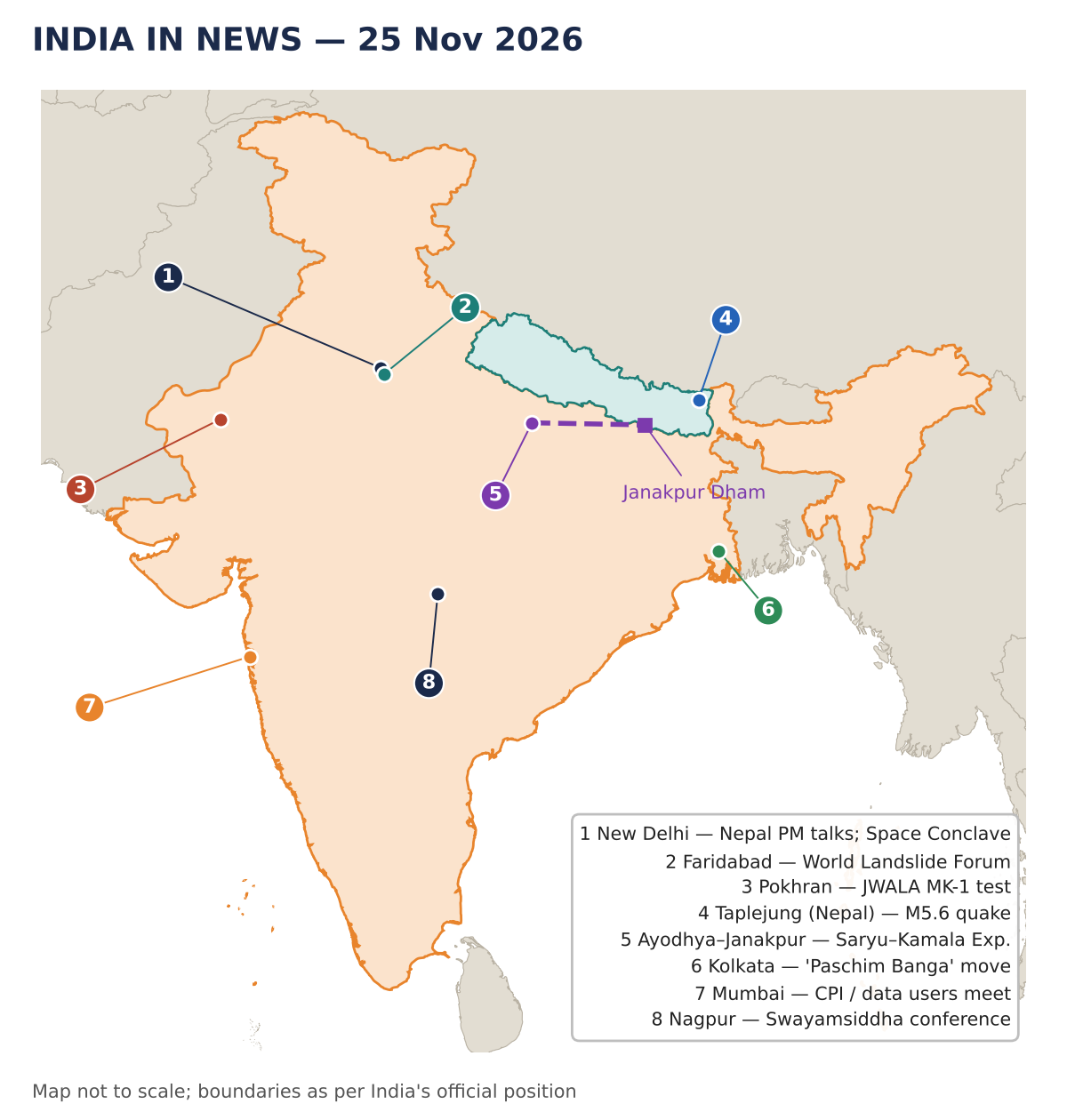
India in News locator map with numbered pins: New Delhi, Faridabad, Pokhran, Taplejung (Nepal), Ayodhya–Janakpur rail link, Kolkata, Mumbai and Nagpur; India's boundary as per official position. — StudyForGS
8. ICMR's SAMPADA survey finds lower anaemia than earlier surveys
On 23 Nov 2026, ICMR released findings of SAMPADA (Survey for Assessment of Markers of Population Health, Activity, Diet and Anthropometry, 2023–25), showing lower anaemia prevalence than previous national surveys.
Key facts
2 lakh+ people, 81,000+ households, 183 districts in 35 States/UTs; venous blood with automated analysers (gold standard).
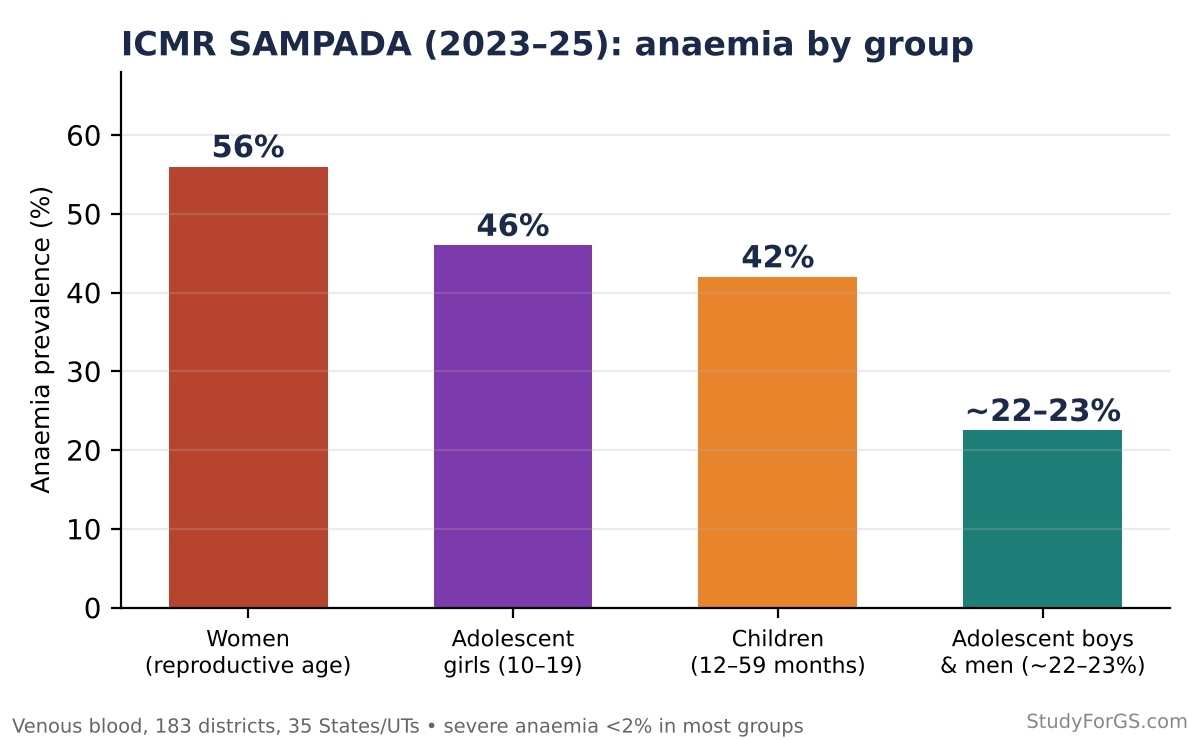
Anaemia: women of reproductive age 56%, adolescent girls 46%, children 12–59 months 42%, adolescent boys & men ~22–23%.
Severe anaemia below 2% in most age groups; most cases are mild.
Iron deficiency causes about half of anaemia in women, girls and children; B12/folate contribute little.
Way forward
Use findings under Anaemia Mukt Bharat 2.0 to test, treat and track moderate/severe cases, and address infections and haemoglobinopathies.
Concept
Anaemia Mukt Bharat (2018) follows a 6×6×6 strategy (6 beneficiary groups, 6 interventions, 6 institutional mechanisms). NFHS-5 (2019–21, capillary blood) reported anaemia in 57% of women (15–49) and 67.1% of children (6–59 months).
Bar chart of anaemia prevalence in SAMPADA 2023-25: women of reproductive age 56%, adolescent girls 46%, children 12-59 months 42%, adolescent boys and men about 22-23%. — StudyForGS
9. West Bengal cabinet clears renaming the state 'Paschim Banga'
POLITYCOMMON: Prelims + Mains GS2
Syllabus linkage
GS2 — Federalism, Union and its territory (Articles 1–4); Prelims — Article 3 procedure
Context
On 23 Nov 2026, CM Suvendu Adhikari announced that the state cabinet approved the name 'Paschim Banga' in all languages, including English; the proposal will be tabled in the Assembly on 9 Dec (winter session from 4 Dec).
Key facts
Name linked to the partition of Bengal — the decision of 20 June 1947.
After Assembly passage the proposal goes to the Union Government; Parliament must pass a law under Article 3.
The earlier 'Bangla' proposal (Assembly resolution, 2018) was not approved by the Union Home Ministry.
Argument: a 'P' name would move the state up in alphabetical official lists.
Way forward
Renaming should rest on cultural consensus and be processed quickly by the Centre to avoid a repeat of the stalled 2018 proposal.
Concept
Under Article 3, Parliament may by law alter a State's name; the Bill needs the President's recommendation, and the President refers it to the State legislature, whose views are not binding. Such laws are not amendments under Article 368 (Article 4). Precedent: Orissa → Odisha (2011).
10. SAMAVESH: AI-enabled single gateway for social justice schemes
Union Minister Dr Virendra Kumar launches SAMAVESH, a unified digital gateway of the Department of Social Justice & Empowerment, and a revamped e-Anudaan portal today, 25 Nov 2026, at Dr Ambedkar International Centre, New Delhi.
Key facts
Integrates 20+ portals (9 with end-to-end digital workflows) behind a common login.
'Samajik Sahayak' AI chatbot in 22+ languages via BHASHINI; linked with DigiLocker and PFMS.
e-Anudaan covers grant-in-aid under NAPDDR, SMILE, AVYAY and SHRESHTA, with video e-inspection and geo-tagged evidence.
MoUs with BHASHINI and NSDC (skilling under PM-AJAY).
Way forward
Keep assisted access (CSCs, helplines) for beneficiaries with low digital literacy and protect beneficiary data privacy.
Concept
Article 46 (DPSP) directs the State to promote the educational and economic interests of SCs, STs and weaker sections. SMILE supports transgender persons and those engaged in begging; AVYAY is for senior citizens; SHRESHTA funds residential schooling for SC students.
11. Nayi Chetna 5.0 launched on Day for Elimination of Violence against Women
Union Minister Shivraj Singh Chouhan launches the 5th edition of the Nayi Chetna gender campaign under DAY-NRLM today, 25 Nov 2026, at NASC Complex, New Delhi; it runs till 23 Dec 2026.
Key facts
Theme: 'From Access to Agency: Empowering Women through Livelihoods and Equal Opportunities for a Viksit Bharat'.
4 focus areas: women as economic contributors, access to and control over assets, safe mobility, sharing unpaid care work.
Quadripartite MoU for a Violence-Free Village Initiative — MoRD, MoWCD, Department of Justice and NALSA.
Joint advisory of 15 ministries/departments; campaign began in 2022.
Way forward
Link the campaign with SHG credit, land titling in women's names and Gender Resource Centres so that awareness turns into measurable agency.
Concept
DAY-NRLM began in 2011 as Aajeevika and was later renamed. The UN General Assembly designated 25 Nov as the International Day for the Elimination of Violence against Women in 1999; the 16 Days of Activism end on 10 Dec (Human Rights Day).
Data point of the day
36.8%
Food & beverages weight in the new CPI (base 2024) Down from 45.9% in the 2012-base series. On 23 Nov 2026, RBI Deputy Governor Poonam Gupta said the lower food weight should make headline inflation less volatile; the new series uses HCES 2023-24 weights and prices from 12 online markets.
Prelims rapid-fire
Guru Tegh Bahadur Shaheedi Diwas (24 Nov) — 9th Sikh Guru, martyred at Chandni Chowk, Delhi in 1675 on Aurangzeb's orders; revered as 'Hind di Chadar'.
Guru Nanak Jayanti (24 Nov, Kartik Purnima) — 557th Parkash Purab; born 1469 at Talwandi (now Nankana Sahib, Pakistan).
Lachit Divas (24 Nov, Assam) — Ahom general Lachit Borphukan (b. 1622) defeated the Mughals at Saraighat (1671).
Constitution Day (26 Nov) — Observed since 2015; the Constitution was adopted on 26 Nov 1949.
National Milk Day (26 Nov) — Birth anniversary of Dr Verghese Kurien, architect of Operation Flood (White Revolution).
Swayamsiddha National Conference 2026 — VP C.P. Radhakrishnan inaugurates it at RTM Nagpur University on 25 Nov; theme 'VIJAYA'.
Practice MCQs — UPSC Prelims pattern
Q1. With reference to Domestic Systemically Important Banks (D-SIBs) in India, consider the following statements: 1. The RBI issued the D-SIB framework in 2014. 2. In the 2026 list, SBI is in Bucket 4 with an additional CET1 requirement of 0.80% of RWAs. 3. HDFC Bank is also designated a Global Systemically Important Bank (G-SIB). Which of the statements given above is/are correct?
1 only
1 and 2 only
2 and 3 only
1, 2 and 3
Show answer
Answer: B The framework dates to 22 July 2014 and SBI is in Bucket 4 (0.80%). G-SIBs are identified by the FSB and no Indian bank is a G-SIB, so statement 3 is wrong.
Q2. With reference to changing the name of a State in India, consider the following statements: 1. A Bill for this purpose can be introduced in Parliament only on the recommendation of the President. 2. The views of the concerned State legislature are binding on Parliament. 3. Such a law is not deemed to be an amendment of the Constitution under Article 368. Which of the statements given above are correct?
1 and 2 only
1 and 3 only
2 and 3 only
1, 2 and 3
Show answer
Answer: B Under Article 3, the Bill needs the President's recommendation and the State's views are not binding; Article 4 says such laws are not amendments under Article 368.
Mains practice question
Q. The RBI's proposed 'Stop Switch' and Trusted Person Mechanism shift digital-fraud prevention towards customer control. Discuss their potential and limitations in the context of rising digital payment frauds in India. (15 marks, 250 words)
Hint / approach
Intro: growth of UPI/digital payments and fraud. Body: features (Stop Switch, TPM with 1-hour window, default-off channels, limits); benefits (instant control, protection of elderly); limits (digital literacy, convenience trade-off, bank-side negligence, mule accounts). Conclude: customer controls + bank accountability + awareness.
📌 One-line revision: Stop Switch + 1-hour Trusted Person (RBI) • D-SIB buckets 4-2-1 = SBI 0.80, HDFC 0.40, ICICI 0.20 • Nepal ₹15,000 cr = 3,500 grant + 11,500 LoC • State rename = Article 3.