Retail inflation breaches RBI's 6% limit at 6.09%; NITI Aayog's PLI audit finds jobs at 28% of target; Cabinet hikes Rabi fertiliser subsidy 64% to ₹62,370 crore
Friday, 13 November 2026 · IST · National & International · 10 items · 2 MCQs
CPI inflation rose to 6.09% in October 2026, the first breach of the RBI's upper tolerance band in about two years, driven by food inflation of 8.94%. NITI Aayog's first impact assessment of the 14 PLI schemes shows investment at 76% but jobs at only 28% of target, while the Cabinet raised NBS support for Rabi 2026-27 to ₹62,370 crore. Also in focus: ICBR-III border roads in Arunachal, a 38% fall in India's TB deaths, COP31 at Antalya and a planned special session on delimitation.
Today at a glance — things to remember
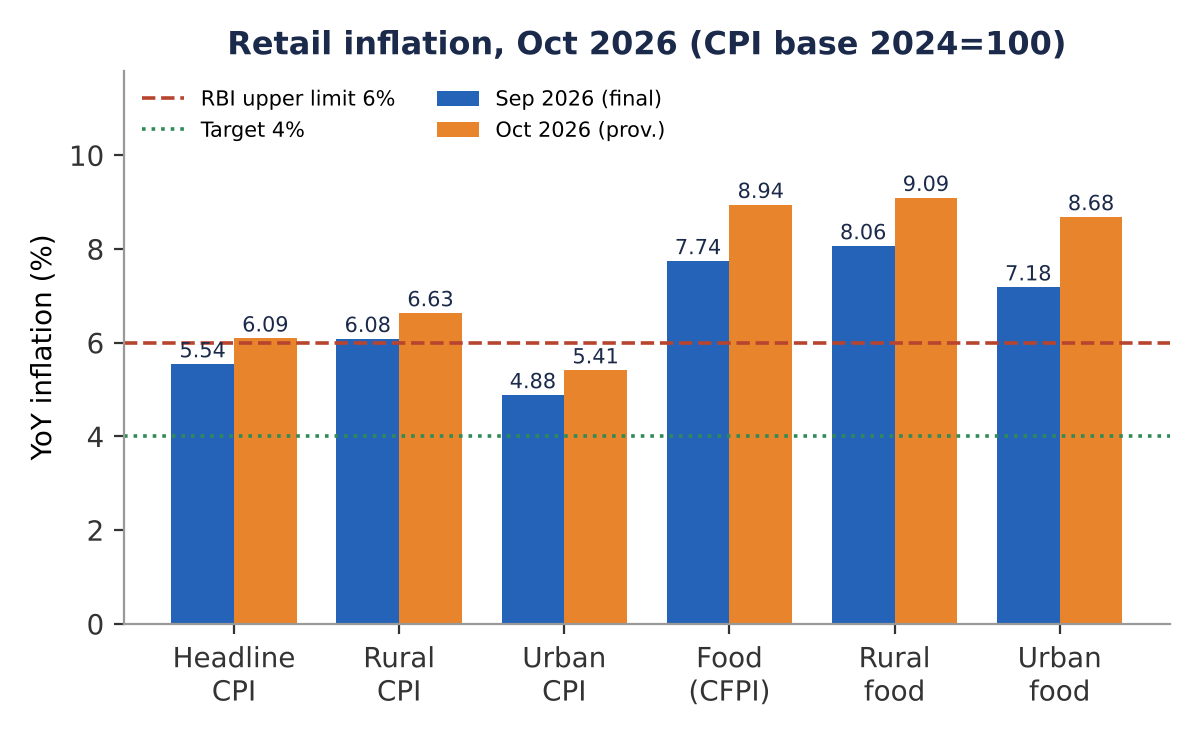
CPI inflation Oct 2026: 6.09% (Sept 5.54%); food 8.94%
Rural CPI 6.63% vs urban 5.41%; CPI base year 2024=100
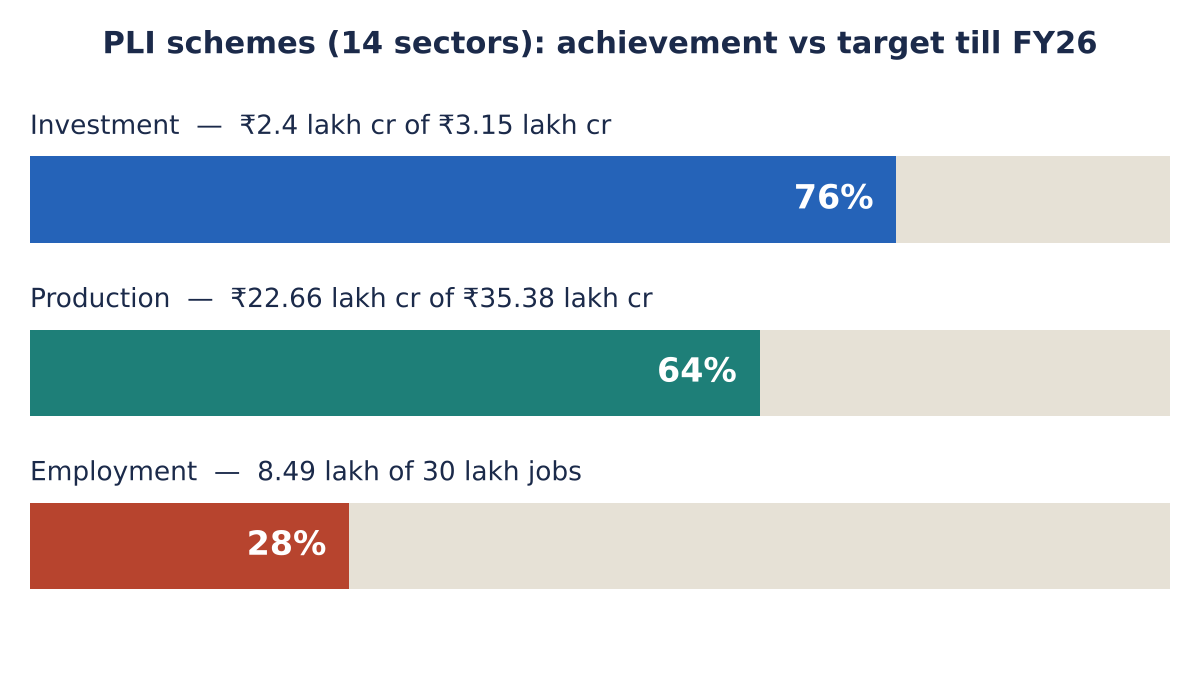
PLI audit: jobs 8.49 lakh = 28% of 30 lakh target
PLI investment 76%, production 64% of target till FY26
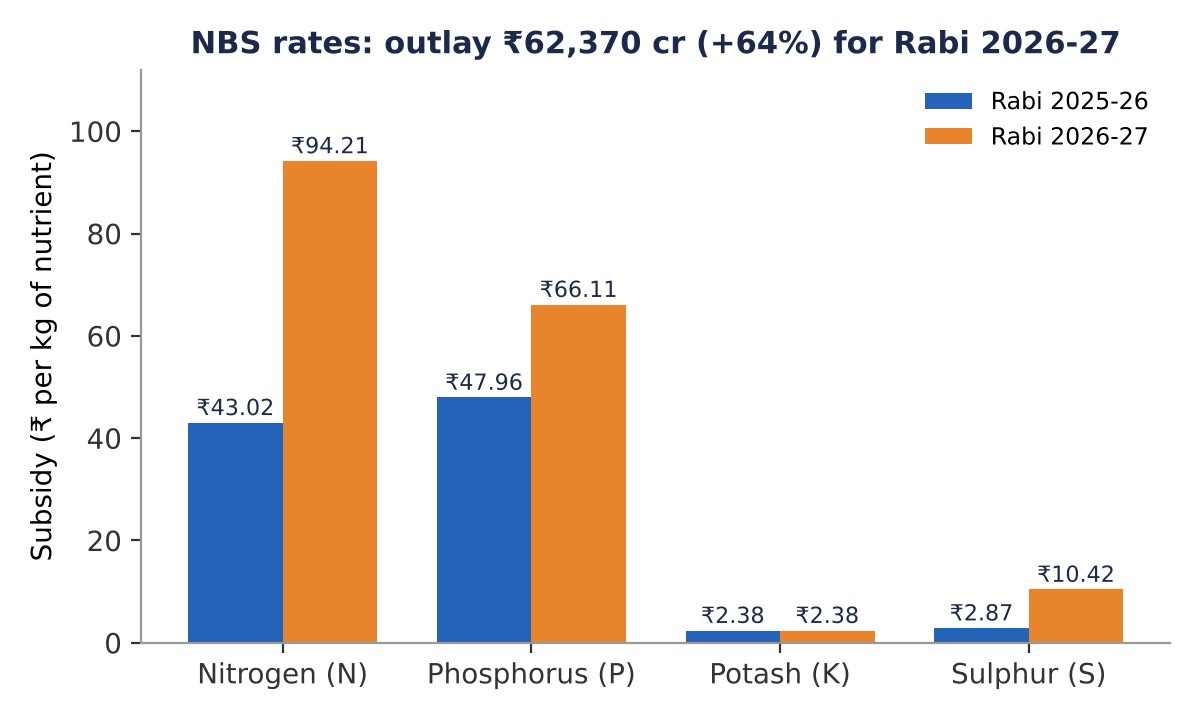
NBS Rabi 2026-27: ₹62,370 crore, up 64%; N subsidy ₹94.21/kg
ACC battery PLI: 22 bids for 10 GWh grid-scale storage
ICBR-III: 26 roads along LAC in Arunachal Pradesh
WHO TB Report 2026: India TB deaths down 38% (global 35%)
COP31 at Antalya, Türkiye, 9-20 Nov 2026; COP32 in Addis Ababa
Lok Sabha may expand to 850 seats via delimitation special session
Detailed notes
1. Retail inflation crosses RBI's upper limit at 6.09%
Provisional CPI data released on 12 November 2026 put October retail inflation at 6.09%, above the RBI's 6% upper tolerance limit for the first time in about two years, led by food prices.
Series uses new base year 2024=100; released by NSO, MoSPI.
Next MPC review in December; pressure for tighter policy.
Way forward
Supply-side steps (buffer stock release, import duty tweaks on edibles) plus calibrated MPC action to anchor expectations without hurting growth.
Concept
Flexible Inflation Targeting (Section 45ZA, RBI Act): CPI target 4% ± 2%. If inflation stays outside the band for 3 consecutive quarters, the RBI must report reasons to the Government.
Grouped bar chart comparing September and October 2026 inflation for headline, rural, urban and food CPI, with the 6% RBI upper limit and 4% target lines. — StudyForGS
2. NITI Aayog's PLI impact assessment: investment ahead, jobs lag
ECONOMYCOMMON: Prelims + Mains GS3 (Industry)
Syllabus linkage
GS3: Industrial policy, employment, Make in India. Prelims: PLI sectors, NITI Aayog.
Context
NITI Aayog released its first comprehensive report, "Impact Assessment of PLI Schemes", on 12 November 2026, prepared with IIM Ahmedabad, reviewing all 14 sectors at mid-course.
Key facts
Jobs: 8,49,069 created by FY26 vs target 30 lakh (28%).
Investment ~₹2.4 lakh crore of ₹3.15 lakh crore (76%).
Production ₹22.66 lakh crore of ₹35.38 lakh crore (64%).
On track: large-scale electronics, pharma drugs, telecom, food products.
Weak/partial: bulk drugs (exports), medical devices (jobs), IT Hardware 2.0 (investment).
Way forward
Refine scheme design: link a share of incentives to jobs and domestic value addition, speed up disbursal and add demand-side support.
Concept
PLI: incentive of a percentage of incremental sales over a base year, for 14 sectors notified in 2020-21. Report notes investment comes first; production, exports and jobs follow with a gestation lag.
Progress bars showing PLI achievement against target till FY26: investment 76%, production 64%, employment 28%. — StudyForGS
3. Cabinet hikes NBS subsidy for Rabi 2026-27 to ₹62,370 crore
The Union Cabinet on 11 November 2026 approved NBS rates on phosphatic and potassic (P&K) fertilisers for Rabi 2026-27 (1 Oct 2026 - 31 Mar 2027) to shield farmers from high global prices.
Key facts
Tentative outlay ₹62,370.02 crore, up ~64% from ₹37,952.29 crore.
Covers 28 grades incl. DAP and NPKS; Dept of Fertilizers.
Driver: global price spike after Gulf supply disruption.
Way forward
Diversify import sources, long-term offtake deals for rock phosphate and potash, and push nano and bio-fertilisers to cut the subsidy bill.
Concept
NBS (since 1 April 2010): fixed subsidy per kg of N, P, K, S for P&K fertilisers; urea is outside NBS with a statutorily fixed MRP. Ideal NPK ratio 4:2:1.
Grouped bar chart of NBS subsidy rates per kg for nitrogen, phosphorus, potash and sulphur, Rabi 2025-26 versus Rabi 2026-27. — StudyForGS
4. 22 bids for 10 GWh grid-scale ACC battery capacity under PLI
SCI-TECHCOMMON: Prelims + Mains GS3 (Energy)
Syllabus linkage
GS3: Energy storage, renewables integration, manufacturing. Prelims: ACC, PLI-ACC, BESS.
Context
The Ministry of Heavy Industries received 22 bids for 10 GWh of Advanced Chemistry Cell capacity earmarked for Grid-Scale Stationary Storage (GSSS); technical bids were opened on 11 November 2026.
Key facts
Global tender floated 15 July 2026; bid deadline 10 Nov 2026.
Part of 50 GWh target under the National Programme on ACC Battery Storage.
Amid face-offs with Chinese troops in Arunachal Pradesh since late July, the Centre has sanctioned new border infrastructure; the Cabinet Committee on Security had cleared ICBR-III in February 2026.
Key facts
ICBR-III: 26 roads along the LAC in Arunachal Pradesh.
ITBP has authorised 15 pedestrian suspension bridges and 18 log bridges since September.
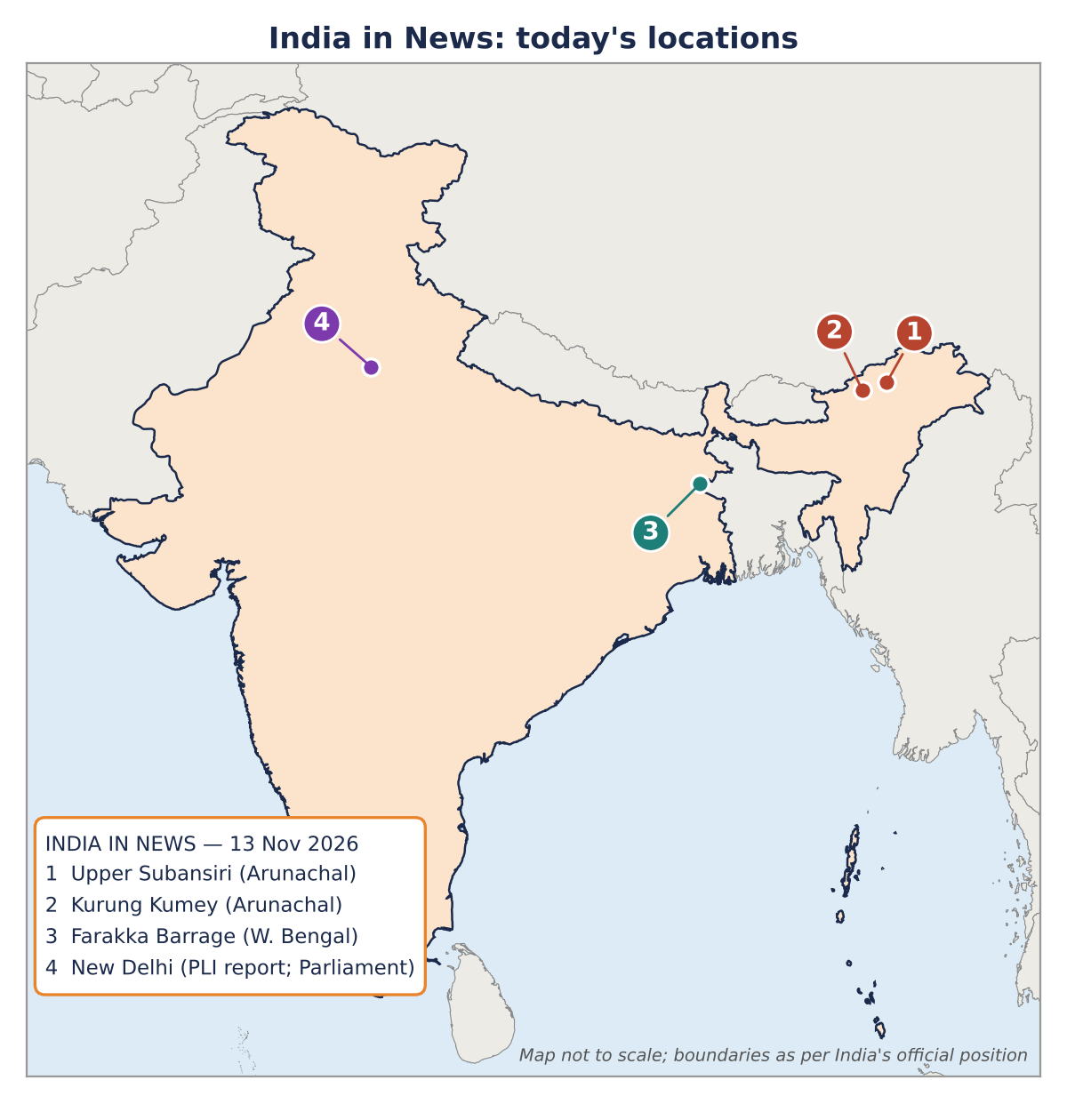
Bridges in Upper Subansiri and Kurung Kumey districts.
Only the second ICBR phase after the 2020 Galwan clash.
Way forward
"Talk and build": pursue dialogue on border peace while closing the infrastructure gap and linking roads with the Vibrant Villages Programme.
Concept
ITBP: Central Armed Police Force under MHA, raised in 1962, guards the 3,488 km India-China border. McMahon Line (Simla Convention, 1914) is India's boundary in the east.
Map of India (official boundaries) with numbered pins: Upper Subansiri and Kurung Kumey in Arunachal Pradesh, Farakka Barrage in West Bengal and New Delhi. — StudyForGS
6. WHO Global TB Report 2026: India's TB deaths fall 38% since 2015
HEALTHCOMMON: Prelims + Mains GS2 (Health)
Syllabus linkage
GS2: Health, communicable diseases. Prelims: WHO reports, NTEP, SDG 3.3.
Context
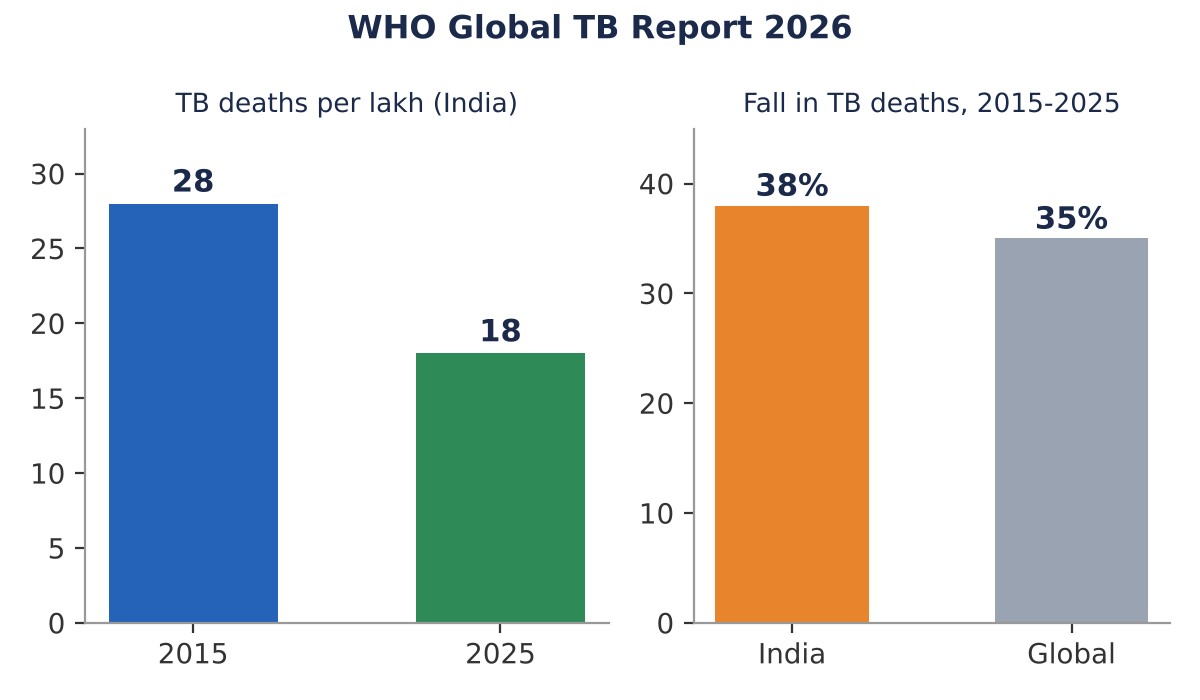
The WHO's Global Tuberculosis Report 2026, released on 12 November, records a 38% reduction in India's TB mortality since 2015, faster than the global decline of 35%.
Key facts
Mortality fell from 28 per lakh (2015) to 18 per lakh (2025).
Treatment success 94% for drug-susceptible TB.
India still has the highest burden: ~25% of global TB cases.
Mortality estimates used SRS, verbal autopsy and Ni-kshay data.
India's incidence estimates are under review by WHO.
Way forward
Scale up active case-finding, AI-enabled screening and nutrition support (Ni-kshay Poshan) to cut incidence, not just deaths.
Concept
SDG 3.3: end TB epidemic by 2030. WHO End TB Strategy milestone (2025): 75% fewer deaths and 50% lower incidence vs 2015. TB is caused by Mycobacterium tuberculosis (bacterium).
Two bar charts: India's TB deaths per lakh falling from 28 in 2015 to 18 in 2025, and the fall in TB deaths since 2015 of 38% for India versus 35% globally. — StudyForGS
7. COP31 at Antalya: India pushes climate finance, rejects new top-down targets
GS3: Climate change, international agreements. GS2: Global groupings. Prelims: UNFCCC, COP venues, CBDR-RC.
Context
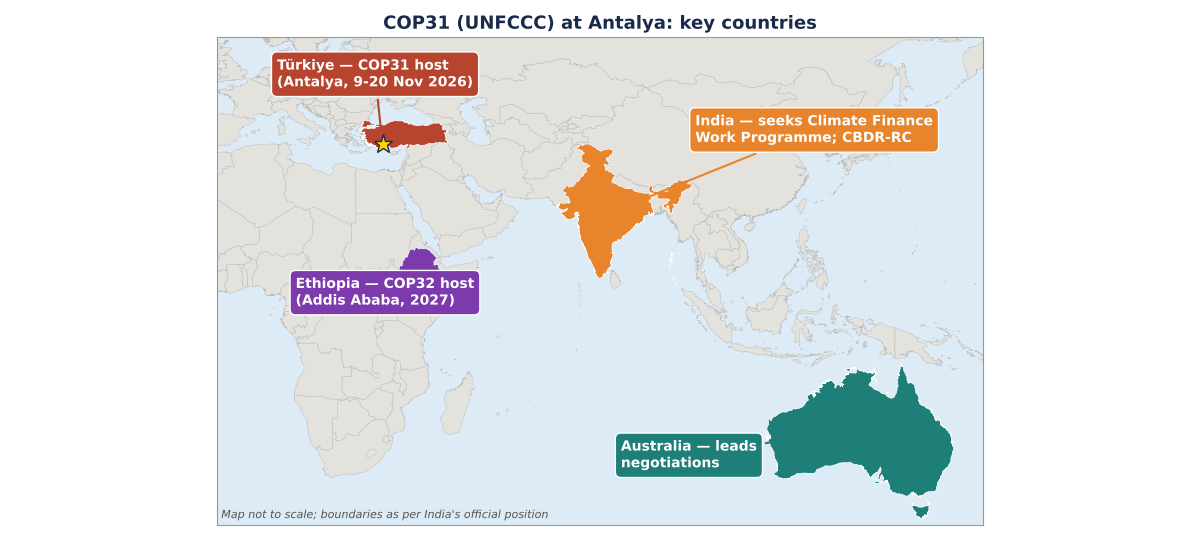
The 31st Conference of the Parties (COP31) to the UNFCCC is under way at Antalya, Türkiye (9-20 November 2026), billed by the presidency as a "COP of Implementation".
Key facts
Türkiye holds the presidency; Australia leads negotiations.
World Leaders Summit held on 11-12 November.
India seeks a decision launching a Climate Finance Work Programme.
India declined a pledge to raise electricity's share of final energy from 23% to 35% by 2035.
COP32 will be hosted by Ethiopia (Addis Ababa) in 2027.
Way forward
Hold developed countries to past finance promises, predictable funding and technology transfer before adding new emission targets.
Concept
CBDR-RC (Common But Differentiated Responsibilities and Respective Capabilities) is a core UNFCCC (1992) principle; NDCs under the Paris Agreement (2015) are nationally determined, bottom-up pledges.
Map highlighting Türkiye (COP31 host, Antalya), India, Australia (leads negotiations) and Ethiopia (COP32 host), with India's official boundaries. — StudyForGS
8. Centre mulls special session to pass delimitation-linked Constitution amendment
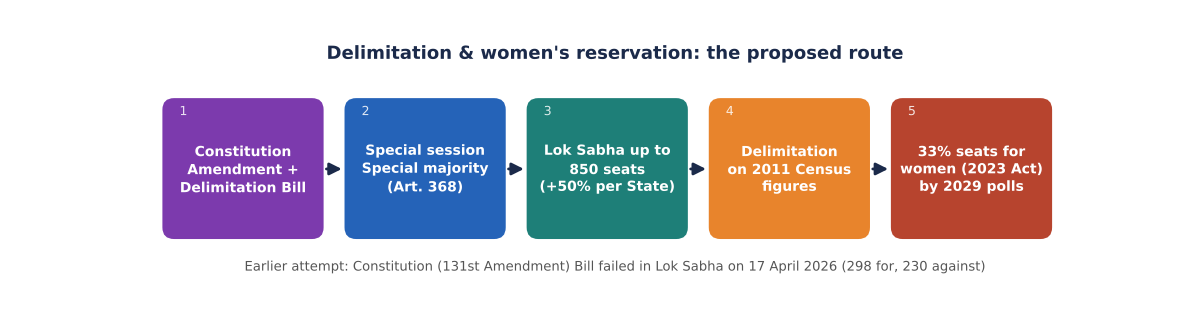
The Government is weighing a special session of Parliament to pass a Constitution amendment and the Delimitation Bill, 2026, to operationalise 33% women's reservation before the 2029 polls; the Opposition has sought an all-party meeting.
Key facts
Lok Sabha strength to rise from 543 to a maximum of 850.
Seats of every State to rise by about 50% to address southern concerns.
Delimitation proposed on 2011 Census figures.
Govt sources claim a margin of 15-18 votes over the required majority.
Earlier 131st Amendment Bill failed in Lok Sabha on 17 April 2026 (298-230).
Way forward
Build consensus through an all-party meeting and protect federal balance so that gender justice is not held hostage to the seat-share debate.
Concept
Art. 368 special majority: 2/3 of members present and voting + majority of total membership. Art. 82: readjustment after each Census; 84th Amendment froze seats till the first Census after 2026. Women's quota: 106th Amendment (2023).
Five-step flowchart: Constitution amendment and Delimitation Bill, special session with special majority, Lok Sabha up to 850 seats, delimitation on 2011 Census, 33% seats for women by 2029. — StudyForGS
9. India-Bangladesh talks postponed as Ganga Water Treaty nears expiry
IRCOMMON: Prelims + Mains GS2 (IR)
Syllabus linkage
GS2: India and its neighbourhood, transboundary rivers. Prelims: Farakka, Ganga Water Treaty, JRC.
Context
An India-Bangladesh consular dialogue has been postponed amid a rift over former PM Sheikh Hasina, whose extradition Dhaka seeks, even as the Ganga Water Treaty expires next month with renewal talks stalled.
Key facts
Treaty signed 12 December 1996 for 30 years.
It shares Ganga flows at Farakka Barrage in the lean season (1 Jan - 31 May).
India and Bangladesh share 54 rivers.
Joint Rivers Commission set up in 1972.
India must balance humanitarian hosting with vital ties to Dhaka.
Way forward
Delink water diplomacy from political frictions; seek an interim extension and a basin-wide approach, including the pending Teesta issue.
Concept
Farakka Barrage (Murshidabad, West Bengal; commissioned 1975) diverts water into the Bhagirathi-Hooghly via a feeder canal to keep Kolkata port navigable.
10. One Nation One Ration Card: portability now routine across all 36 States/UTs
A government status note says One Nation One Ration Card (ONORC) operates in all 36 States/UTs, letting NFSA beneficiaries, especially migrants, draw rations from any fair price shop.
Key facts
About 3.27 crore portability transactions a month.
e-KYC done for 71.52 crore beneficiaries (91%) as on 30 Sept 2026.
Covers about 80 crore NFSA beneficiaries.
Mera Ration app available in 13 languages.
Launched August 2019; Assam became the 36th State/UT (2022).
Way forward
Fix biometric authentication failures, improve last-mile connectivity and integrate ONORC data with welfare registries for better targeting.
Concept
NFSA 2013 covers up to 75% rural and 50% urban population; works on Aadhaar-seeded ration cards and ePoS devices. Food distribution falls under Entry 33, Concurrent List.
Data point of the day
6.09%
CPI (Combined) inflation, October 2026 Up from 5.54% in September; food (CFPI) at 8.94%; rural 6.63%, urban 5.41%. Above the RBI's 2-6% tolerance band around the 4% target; next MPC review due in December.
Prelims rapid-fire
New CPI series uses base year 2024=100; data released by NSO, MoSPI
NBS scheme for P&K fertilisers in force since 1 April 2010; covers 28 grades
PLI impact report prepared with IIM Ahmedabad as knowledge partner
Ganga Water Treaty with Bangladesh signed 12 Dec 1996 for 30 years
Practice MCQs — UPSC Prelims pattern
Q1. Consider the following statements about the Nutrient Based Subsidy (NBS) scheme:
1. It covers urea along with P&K fertilisers.
2. It has been in force since April 2010.
3. Subsidy is fixed per kg of N, P, K and S nutrients.
Which of the statements given above is/are correct?
1 and 2 only
2 and 3 only
1 and 3 only
1, 2 and 3
Show answer
Answer: B Urea is outside NBS; its MRP is statutorily fixed and it is subsidised separately. NBS (since 1 April 2010) fixes a per-kg subsidy on N, P, K and S for 28 grades of P&K fertilisers.
Q2. With reference to border infrastructure in Arunachal Pradesh, consider the following statements:
1. ICBR-III envisages 26 roads along the LAC in Arunachal Pradesh.
2. The first phase of the India-China Border Roads project began in 2005.
3. The Indo-Tibetan Border Police functions under the Ministry of Defence.
Which of the statements given above are correct?
1 and 2 only
2 and 3 only
1 and 3 only
1, 2 and 3
Show answer
Answer: A ICBR-III covers 26 roads; ICBR-I began in 2005 with 27 roads (608 km). ITBP is a Central Armed Police Force under the Ministry of Home Affairs, not Defence.
Mains practice question
Q. "The Production Linked Incentive schemes have mobilised investment far faster than employment." Examine the reasons for this gap and suggest design changes to make the schemes more job-intensive. (15 marks, 250 words)
Hint / approach
Intro with NITI Aayog data (76% investment, 64% production, 28% jobs). Body: gestation lags, capital-intensive sectors (electronics, ACC), assembly-led low value addition, slow disbursal. Way forward: employment-linked incentive tranches, labour-intensive sectors (textiles, footwear, food), MSME supplier links, skilling. Conclude with Atmanirbhar Bharat and quality jobs.
📌 One-line revision: CPI 6.09% (food 8.94%) | PLI jobs 28% of target | NBS Rabi ₹62,370 cr | ACC 22 bids | ICBR-III 26 roads | TB deaths -38% | COP31 Antalya | Lok Sabha up to 850