Thursday, 12 November 2026 · IST · National & International · 12 items · 2 MCQs
The Union Cabinet extended the Credit Guarantee Fund for Micro Units till 31 March 2031 with a cheaper 0.75% fee and approved ₹62,370 crore of NBS subsidy for Rabi 2026-27. The Home Ministry cut main visa categories from 13 to 9, the Supreme Court clarified the OBC creamy-layer test, and the Navy is exercising with Myanmar (IMNEX-26) and Oman (Naseem Al Bahr).
Today at a glance — things to remember
CGFMU (Mudra guarantee) extended to 31 Mar 2031; corpus ₹5,000 cr, fee cut to 0.75%.
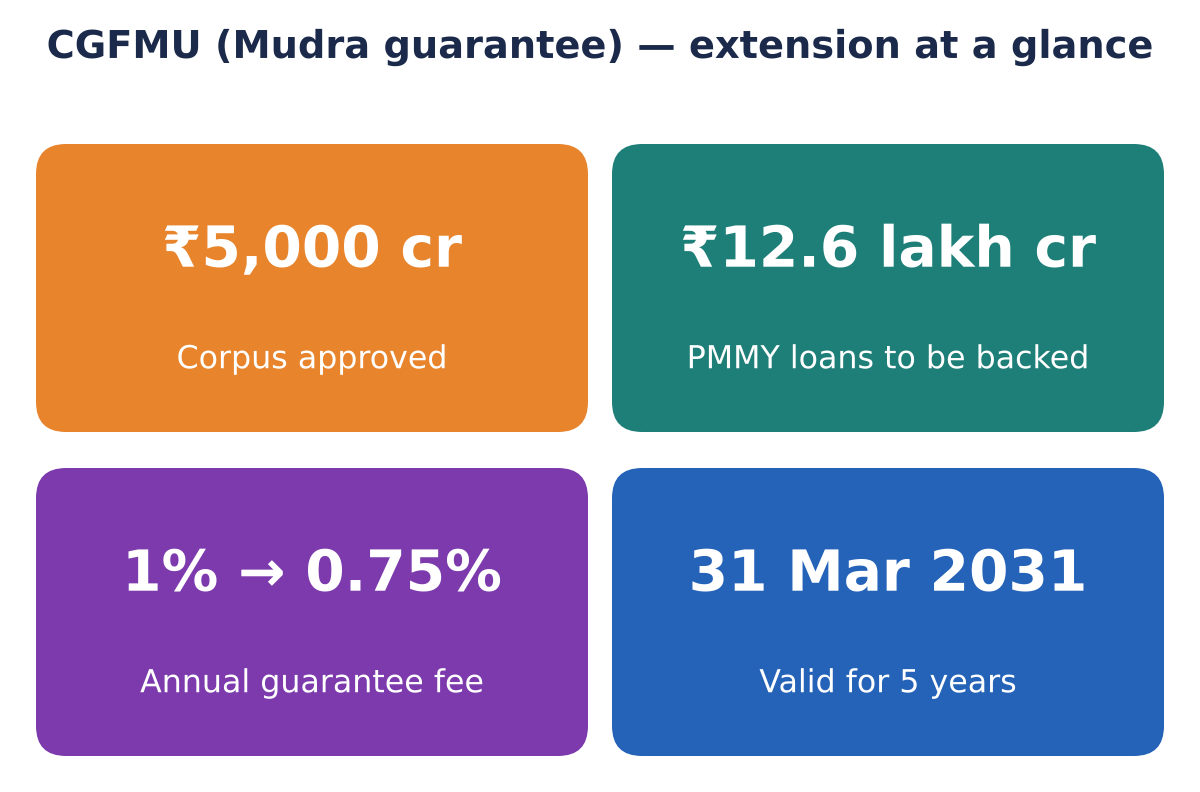
On 11 November 2026 the Union Cabinet approved continuation of the Credit Guarantee Fund for Micro Units (CGFMU) for five years, till 31 March 2031, with a corpus of ₹5,000 crore, and also cleared continuation of the Stand-Up India scheme for SC, ST and women entrepreneurs.
Key facts
Corpus of ₹5,000 crore is expected to back ₹12.6 lakh crore of PMMY (Mudra) loans over five years.
Annual guarantee fee cut from 1% to 0.75%; SHG loans unchanged at 0.25% (first year) and 0.50% (later years).
Covers collateral-free PMMY loans up to ₹20 lakh; trustee is NCGTC (National Credit Guarantee Trustee Company); CGFMU began in January 2016.
Stand-Up India (launched 5 April 2016) gives bank loans of ₹10 lakh to ₹1 crore for greenfield units — at least one SC/ST and one woman borrower per bank branch.
Way forward
Faster claim settlement, digital credit scoring of first-time borrowers and close tracking of NPAs in the Tarun and Tarun Plus slabs will decide the real impact.
Concept
Credit guarantee = a Govt-backed trust promises to bear part of the lender's loss on default, so banks lend without collateral. PMMY slabs: Shishu (up to ₹50,000), Kishore (₹50,000–5 lakh), Tarun (₹5–10 lakh), Tarun Plus (₹10–20 lakh).
Stat tiles showing CGFMU extension: ₹5,000 crore corpus, ₹12.6 lakh crore loans enabled, guarantee fee cut from 1% to 0.75%, valid till 31 March 2031, covering PMMY loans up to ₹20 lakh. — StudyForGS
2. Cabinet approves ₹62,370-crore nutrient-based subsidy for Rabi 2026-27
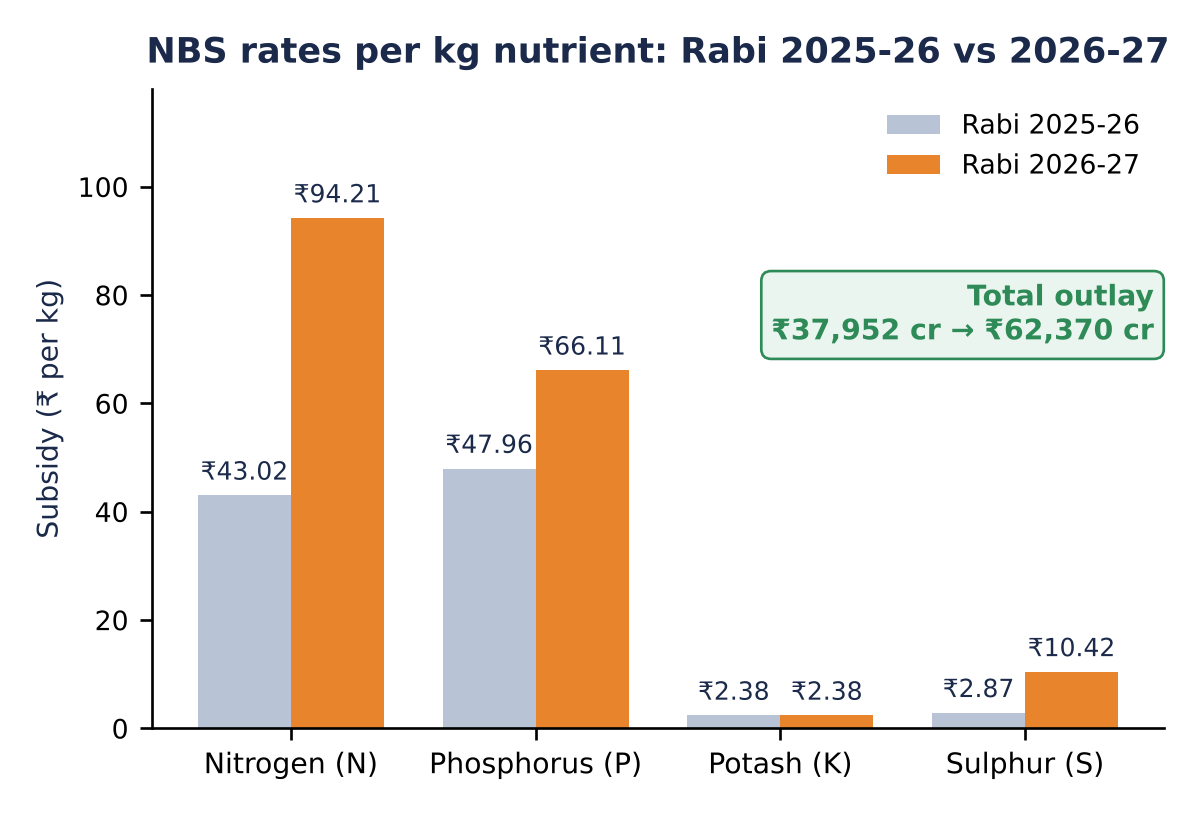
The Cabinet fixed Nutrient Based Subsidy (NBS) rates on Phosphatic & Potassic (P&K) fertilisers for Rabi 2026-27 (1 Oct 2026 – 31 Mar 2027) at a tentative cost of ₹62,370.02 crore — about ₹24,417.73 crore (~64%) more than Rabi 2025-26 — as global fertiliser and input prices stay high.
Steepest jump in sulphur (from ₹2.87, over 260%); nitrogen up about 119% and phosphorus about 38% over Rabi 2025-26.
DAP retail price kept unchanged at ₹1,350 per 50-kg bag.
With the Kharif 2026-27 allocation of ₹41,534 crore, the FY27 NBS outlay crosses ₹1 lakh crore, far above the Budget Estimate.
NBS in force since 1 April 2010; urea is outside NBS (its MRP is fixed by the Government).
Way forward
Long-term import contracts and joint ventures abroad, nano-fertilisers and moving urea to a nutrient-based regime can correct the skewed N:P:K use (ideal 4:2:1).
Concept
Under NBS, a fixed subsidy per kg of nutrient (N, P, K, S) is paid to companies and the MRP is decontrolled — unlike urea, where the Govt fixes the MRP and pays the gap. Fertiliser subsidy is revenue expenditure.
Grouped bar chart comparing NBS per-kg subsidy rates for Rabi 2025-26 and Rabi 2026-27: nitrogen ₹43.02 to ₹94.21, phosphorus ₹47.96 to ₹66.11, potash ₹2.38 unchanged, sulphur ₹2.87 to ₹10.42; total outlay ₹37,952 crore to ₹62,370 crore. — StudyForGS
3. Deepavali smog: about 70% of monitoring stations logged 'severe' PM2.5 peaks
ENVIRONMENTCOMMON: Prelims + Mains GS3
Syllabus linkage
GS-III: Environmental pollution and degradation | Prelims: PM2.5, CAAQMS, NCAP, GRAP, WHO guidelines
Context
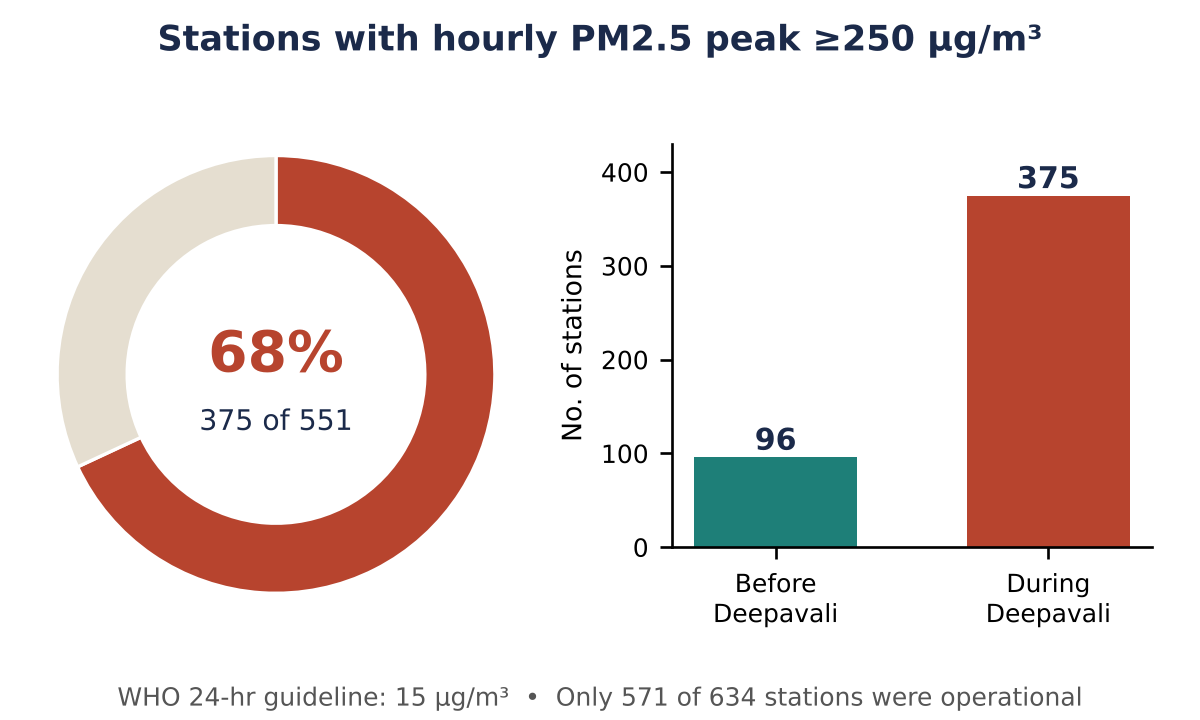
An analysis of official air-quality data shows that during Deepavali 375 of 551 reporting stations (~70%) recorded hourly PM2.5 peaks of 250 µg/m³ or more, up from 96 stations before the festival; Delhi's AQI is still in the 'very poor' band.
Key facts
High readings spread across Delhi, Maharashtra, Uttar Pradesh, Rajasthan, Haryana, Madhya Pradesh, Gujarat and Andhra Pradesh.
Only 571 of 634 continuous stations were working; in Tamil Nadu just 9 of 37 reported PM2.5.
Some analysers have an upper limit of 1,000 µg/m³, so readings went missing at peak pollution — a data-gap concern.
WHO (2021) 24-hour PM2.5 guideline is 15 µg/m³; the 250 mark here is an hourly peak, not India's daily AQI band.
Way forward
Upgrade and maintain sensors, publish reasons for data gaps, enforce green-cracker norms and take airshed-level action across State borders.
Concept
PM2.5 = particles ≤2.5 micrometres that reach deep into lungs and blood. Legal base: Air (Prevention and Control of Pollution) Act, 1981; NCAP (2019) drives city-level reduction; GRAP = graded emergency steps in Delhi-NCR.
Donut and bar chart: 375 of 551 reporting stations (about 68%) recorded PM2.5 hourly peaks of 250 µg/m³ or more during Deepavali, against 96 stations before the festival. — StudyForGS
4. Gravitational-wave catalogue grows to 390 candidate events
The LIGO–Virgo–KAGRA collaboration has released an expanded catalogue of 390 candidate gravitational-wave events, allowing population-level study of black-hole masses and spins; LIGO-India will sharpen sky localisation once it is ready.
Key facts
Gravitational waves are ripples in spacetime, predicted by Einstein's General Theory of Relativity (1915), travelling at the speed of light.
First direct detection in 2015 (announced 2016) — a binary black-hole merger.
Detectors: LIGO (USA, two sites), Virgo (Italy), KAGRA (Japan) — laser interferometers that sense tiny changes in arm length.
LIGO-India at Hingoli, Maharashtra, expected around 2030, adds a distant baseline for triangulation.
Way forward
Timely completion of LIGO-India and building Indian strength in precision optics, ultra-high vacuum and data science.
Concept
Chirp = rising frequency as two compact objects spiral in; ringdown = fading signal after the merger. Other mega-science projects with India: Thirty Meter Telescope, Square Kilometre Array, ITER.
5. Navy drills east and west: IMNEX-26 with Myanmar, Naseem Al Bahr with Oman
DEFENCECOMMON: Prelims + Mains GS2/GS3
Syllabus linkage
GS-II/III: India and its neighbourhood, maritime security | Prelims: exercise names, partners, venues, ships
Context
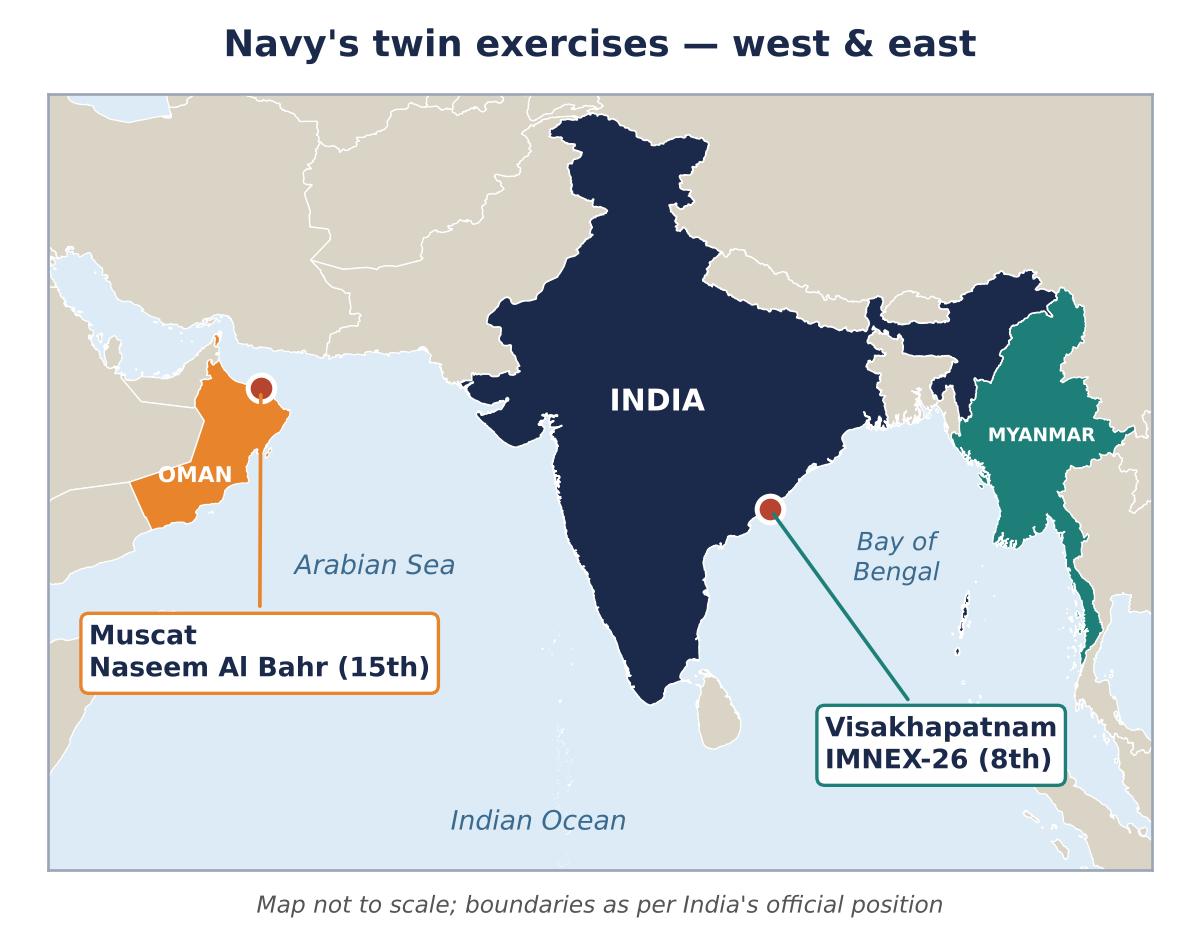
The 8th India–Myanmar Naval Exercise (IMNEX-26) is under way at Visakhapatnam (10–14 Nov 2026), while the 15th edition of Naseem Al Bahr ('Sea Breeze') with the Royal Navy of Oman concluded off Muscat on 11 Nov.
Key facts
IMNEX-26: Myanmar's UMS King Sin Phyu Shin with INS Rana and INS Sumedha; opening ceremony onboard INS Rana; harbour phase followed by sea phase.
Naseem Al Bahr: INS Surat (Project 15B destroyer) reached Muscat on 8 Nov; a Coordinated Patrol (CORPAT) follows the exercise.
Naseem Al Bahr series began in 1993; the India–Oman Army exercise is Al Najah.
Both are linked to India's MAHASAGAR vision; Myanmar is also central to Act East and Neighbourhood First.
Way forward
Turn drills into regular CORPATs, hydrography and maritime-domain-awareness data-sharing, and keep Myanmar engaged despite its internal turmoil.
Concept
MAHASAGAR = Mutual and Holistic Advancement for Security and Growth Across Regions (2025, successor to SAGAR, 2015). Other India–Myanmar formats: IMCOR (coordinated patrol), IMBAX (army).
Map of the northern Indian Ocean highlighting India, Oman and Myanmar, with pins at Muscat for Naseem Al Bahr 2026 and at Visakhapatnam for IMNEX-26; boundaries as per India's official position. — StudyForGS
6. Supreme Court clarifies OBC creamy-layer ruling: salary alone is not the test
The Supreme Court reaffirmed (on 6 Nov 2026) its 11 March 2026 ruling that parents' salary alone cannot decide OBC creamy-layer status, and clarified that settled appointments will not be reopened while pending and future cases must follow the corrected test.
Key facts
Creamy-layer exclusion flows from Indra Sawhney v. Union of India (1992); criteria laid down in the DoPT Office Memorandum of 1993.
Income/wealth test ceiling is ₹8 lakh a year (revised in 2017); salary and agricultural income are excluded from this calculation.
Children of PSU employees cannot be excluded merely because salary crosses the limit — equivalence of posts with Govt posts matters.
No blanket reopening of completed selections; Govt given two more months to comply; relevant for CSE 2025 service allocation.
Way forward
Notify clear post-equivalence tables for PSUs, banks and the private sector, plus a time-bound grievance system for NCL certificates.
Concept
Art. 15(4) and 16(4) enable special provisions and reservation for backward classes; Art. 340 — Backward Classes Commission; the 102nd Amendment (2018) gave constitutional status to the NCBC (Art. 338B).
7. Karnataka moves SC against High Court verdict scrapping SC/ST quota hike
Karnataka has filed a Special Leave Petition (SLP) in the Supreme Court against the High Court ruling of 12 Oct 2026 that struck down the hike in SC reservation from 15% to 17% and ST reservation from 3% to 7%.
Key facts
With OBC at 32%, the hike took total reservation to 56%, breaching the 50% ceiling set in Indra Sawhney (1992).
HC struck down Sections 3 and 4 of the Karnataka SC and ST (Reservation) Act, 2022, in force from 12 Jan 2023.
The hike rested on the Justice H.N. Nagamohan Das Commission; the State argued that over 90% of its people are SC/ST/OBC.
Contrast: Tamil Nadu's 69% quota law is placed in the Ninth Schedule (76th Amendment, 1994).
Way forward
Any breach of 50% needs quantifiable data on backwardness and inadequate representation and must meet the 'extraordinary circumstances' test.
Concept
SLP — Art. 136: the SC's discretionary power to grant special leave to appeal against any court or tribunal order. EWS 10% (103rd Amendment) was upheld in Janhit Abhiyan (2022); the Court held the 50% cap governs backward-class quotas.
8. Home Ministry overhauls visa regime: 13 main categories cut to nine
POLITYCOMMON: Prelims + Mains GS2/GS3
Syllabus linkage
GS-II: Government policies and interventions; GS-III: tourism, ease of doing business | Prelims: visa categories, AYUSH visa
Context
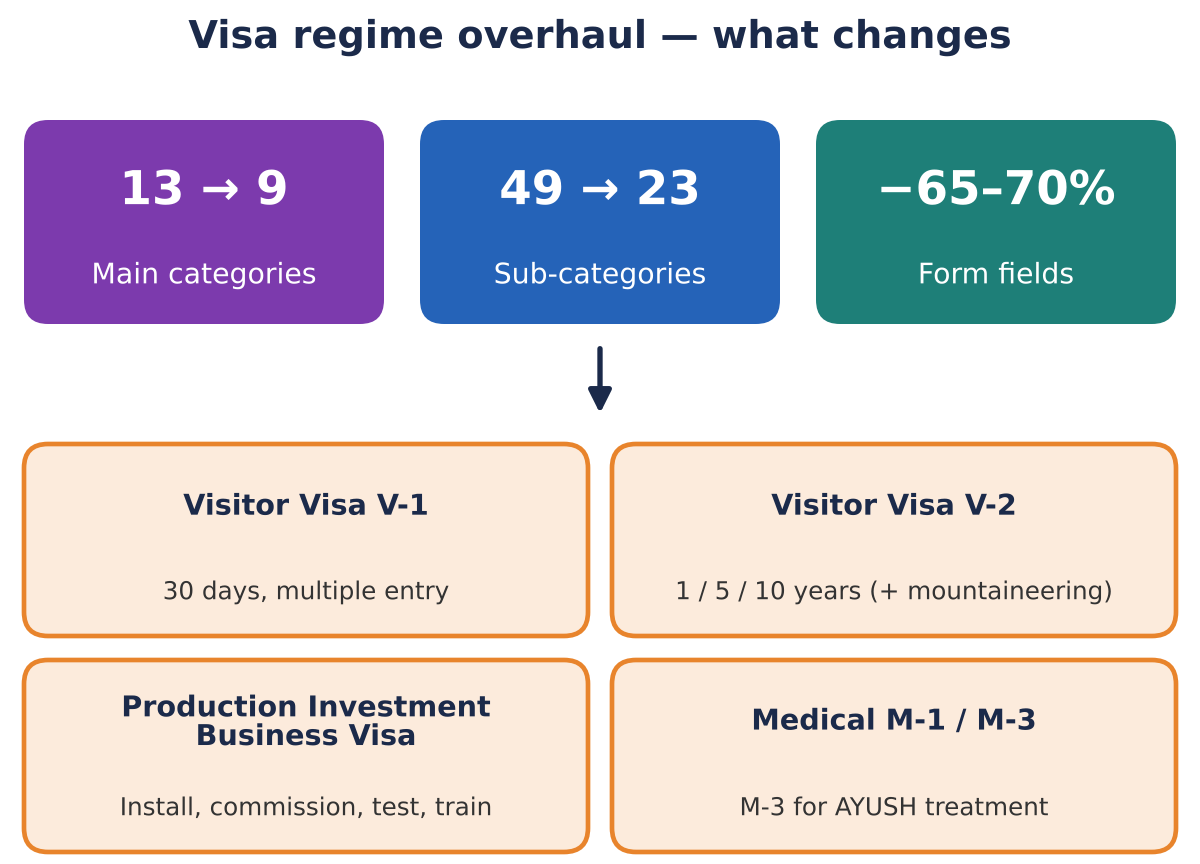
The Ministry of Home Affairs has simplified the visa system — main categories cut from 13 to 9, sub-categories from 49 to 23, and application forms shortened by 65–70% — while upgrading IT systems to roll it out.
Key facts
Tourist Visa renamed 'Visitor Visa': V-1 valid 30 days, multiple entry (tourism, business meetings, medical consultation, short courses); V-2 for 1, 5 or 10 years, also covering mountaineering.
New Production Investment Business Visa for foreign engineers and technicians doing machinery installation, commissioning, testing and training.
Medical: M-1 (conventional medicine) and M-3 (AYUSH treatment) — generally 1 year, multiple entry.
Aims: ease of doing business, medical value travel, tourism and Make in India technology transfer.
Way forward
Simplification must go with robust biometric and identity checks, multilingual portals and coordination among MHA, the Bureau of Immigration and missions abroad.
Concept
Entry and stay of foreigners is now governed by the Immigration and Foreigners Act, 2025, which replaced the Foreigners Act, 1946 and older laws; India's e-Visa journey began in 2014.
Flow diagram of the visa overhaul: main categories 13 to 9, sub-categories 49 to 23, forms 65–70% shorter, leading to new Visitor Visa V-1 and V-2, Production Investment Business Visa, and M-1/M-3 medical visas. — StudyForGS
9. Cabinet clears ₹3,230-crore Yuge Yugeen Bharat Museum; ASI moves to protect Raniwas Mound
SOCIETYCOMMON: Prelims + Mains GS1
Syllabus linkage
GS-I: Indian art and culture, heritage conservation | Prelims: North and South Block, ASI, AMASR Act, Kesariya
Context
The CCEA approved the Yuge Yugeen Bharat Museum (YYBM) through adaptive reuse of the historic North and South Block complex in New Delhi at ₹3,230 crore; separately, the ASI has begun the process to declare the Raniwas Mound in East Champaran, Bihar a monument of national importance.
Key facts
YYBM: built-up area about 1,78,509 sq m, pitched as the world's largest display area; designed for 1 crore visitors a year.
Announced by the PM on 18 May 2023; the first gallery, on 'Adornment', is expected in late 2027; cost appraised by the Public Investment Board.
Raniwas Mound: about 1.63 acres, north-east of the Kesariya Stupa; believed to hold a Buddhist vihara; examined by Alexander Cunningham.
Protection under the AMASR Act, 1958; the ASI (set up in 1861) works under the Ministry of Culture.
Way forward
Careful conservation of the Herbert Baker-designed blocks, transparent shifting of offices, and linking Raniwas to the Buddhist circuit with local participation.
Concept
Adaptive reuse = giving a heritage building a new use while keeping its character. The North and South Blocks are part of the Central Vista redevelopment; Kesariya Stupa is among the tallest Buddhist stupas in India.
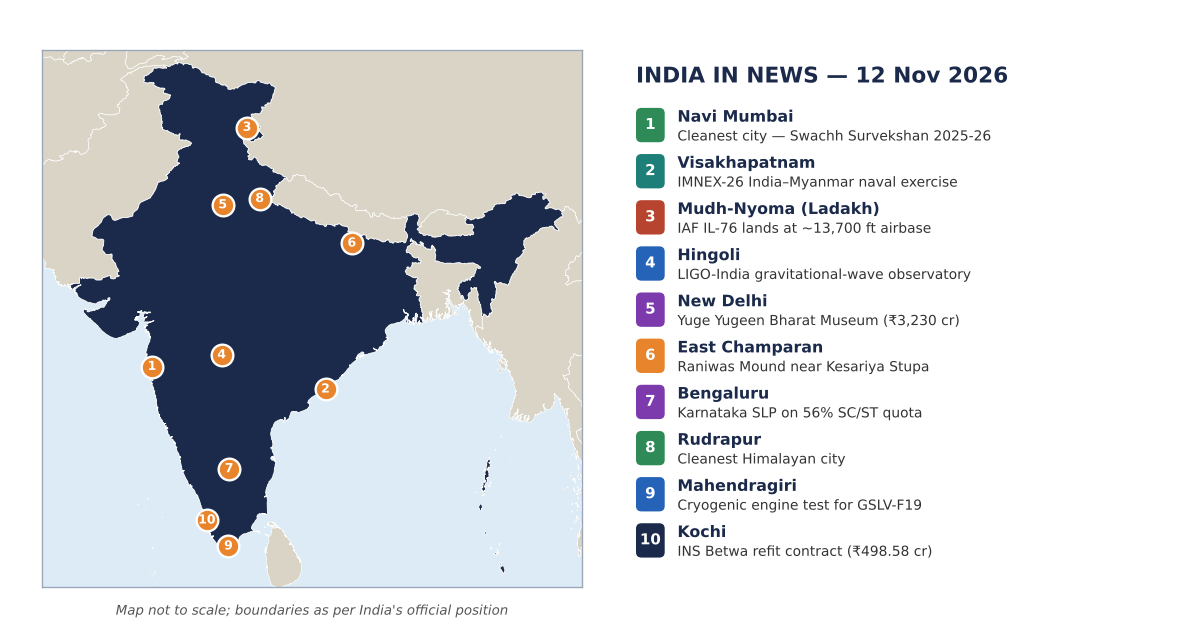
India in News locator map with numbered pins: Navi Mumbai, Visakhapatnam, Mudh-Nyoma in Ladakh, Hingoli, New Delhi, East Champaran, Bengaluru, Rudrapur, Mahendragiri and Kochi; India's full official boundary shown. — StudyForGS
GS-II: Government schemes, urban local bodies; GS-III: solid waste management | Prelims: SBM-U, Super Swachh League
Context
President Droupadi Murmu presented the Swachh Survekshan 2025-26 awards in New Delhi on 11 Nov 2026; Navi Mumbai topped the Super Swachh League, followed by Surat and Vijayawada.
Key facts
Indore, the cleanest city for eight consecutive years, did not retain the top spot.
Cleanest Himalayan city: Rudrapur (Uttarakhand), followed by Jammu and Shopian.
Super Swachh League = cities ranked in the top three at least once in the last three years and still in the top 20% of their population category.
Survey run under Swachh Bharat Mission–Urban (SBM-U) by the Ministry of Housing and Urban Affairs; first edition in 2016 covered 73 cities.
Way forward
Shift the focus from rankings to source segregation, legacy-dumpsite remediation and the safety and dignity of safai mitras.
Concept
SBM-U 2.0 (2021–26) aims at 'Garbage Free Cities'; Swachh Survekshan is billed as the world's largest urban sanitation survey.
11. India, France hold first Dialogue on Economic Security and Critical Technologies
Foreign Secretary Vikram Misri led the first India–France Dialogue on Economic Security and Critical Technologies and the 3rd Strategic Dialogue on Space in Paris this week, focusing on resilient supply chains.
Key facts
Focus areas: critical minerals, semiconductors, cybersecurity, energy and supply-chain resilience.
The dialogue was agreed in 2026 when ties were raised to a 'Special Global Strategic Partnership', along with the Innovation Roadmap 2030.
France is India's second-largest arms supplier; India is buying 26 Rafale-M jets for the Navy.
Convert the dialogue into joint critical-mineral processing, chip-supply and space-industry projects, and co-development of engines and defence platforms.
Concept
Economic security = shielding an economy from coercion and supply shocks (de-risking). The India–France Strategic Partnership of 1998 was India's first such partnership.
12. Nasha Mukt Bharat Abhiyaan at six: from awareness drive to demand-reduction framework
HEALTHCOMMON: Prelims + Mains GS2
Syllabus linkage
GS-II: Health, welfare schemes for vulnerable sections; GS-III: drug trafficking | Prelims: NMBA, NDPS Act, Seventh Schedule entries
Context
The Nasha Mukt Bharat Abhiyaan (NMBA), launched on 15 August 2020 by the Ministry of Social Justice and Empowerment, has completed six years and is now positioned as India's main drug-demand-reduction platform.
Key facts
Outreach crossed 34.54 crore citizens, including 13.70 crore youth and 10.64 crore women (September 2026 figures).
Three-pronged approach: supply curb (NCB), outreach and awareness (MoSJE) and treatment (health system).
Grassroots volunteers are called 'Nasha Mukti Mitr'; focus on schools, colleges and Panchayati Raj institutions.
Seventh Schedule: public health — State List Entry 6; drugs and poisons — Concurrent List Entry 19; opium for export — Union List Entry 59.
Way forward
Expand district-level de-addiction and counselling capacity, link with Tele-MANAS and school curricula, and reduce stigma around treatment.
Concept
NDPS Act, 1985 governs narcotic drugs; Art. 47 (DPSP) asks the State to prohibit intoxicating drinks and drugs injurious to health; the Narcotics Control Bureau was set up in 1986.
Data point of the day
5.1%
Unemployment rate (15+ years), PLFS July–September 2026 Down from 5.4% in April–June 2026; rural 4.3% (from 4.8%), urban 6.8% (from 6.7%); LFPR 55.5%, WPR 52.7%; youth (15–29) unemployment 15.3% (from 15.9%). Measured on Current Weekly Status (CWS) by the NSO, MoSPI.
Prelims rapid-fire
Haj Agreement-2027 signed in Jeddah; India's pilgrim quota fixed at 1,75,025 (unchanged since 2025).
IAF IL-76 landed at Mudh-Nyoma airbase, eastern Ladakh — about 13,700 ft, runway ~2.7 km, upgraded by BRO (Project Himank).
ISRO completed a 200-second flight acceptance test of the cryogenic engine for GSLV-F19 (NVS-04) at Mahendragiri, Tamil Nadu.
Defence Ministry signed a ₹498.58 crore contract with Cochin Shipyard for refit and re-powering of INS Betwa.
RBI issued Master Directions on Cyber Resilience for non-bank Payment System Operators (PSOs).
IRDAI set up two working groups to frame a risk-based capital (RBC) regime aligned with Ind-AS.
Practice MCQs — UPSC Prelims pattern
Q1. With reference to the Credit Guarantee Fund for Micro Units (CGFMU), recently extended by the Union Cabinet, consider the following statements: 1. It covers loans up to ₹20 lakh under the Pradhan Mantri Mudra Yojana. 2. The annual guarantee fee has been reduced to 0.75%. 3. The Small Industries Development Bank of India is its trustee. Which of the statements given above are correct?
1 and 2 only
2 and 3 only
1 and 3 only
1, 2 and 3
Show answer
Answer: A CGFMU covers PMMY loans up to ₹20 lakh and the fee is cut from 1% to 0.75%. Its trustee is the National Credit Guarantee Trustee Company (NCGTC), not SIDBI, so statement 3 is wrong.
Q2. Which one of the following fertilisers is NOT covered under the Nutrient Based Subsidy (NBS) scheme?
Di-ammonium Phosphate (DAP)
Muriate of Potash (MOP)
Urea
NPKS complex fertilisers
Show answer
Answer: C NBS (since 1 April 2010) covers P&K fertilisers such as DAP, MOP and NPKS grades. Urea is outside NBS — its MRP is fixed by the Government and the gap is paid as subsidy.
Mains practice question
Q. States breaching the 50% reservation ceiling have repeatedly faced judicial scrutiny. Examine the constitutional position on the ceiling and discuss whether a quantified-data approach can reconcile social justice with equality of opportunity. (250 words, 15 marks)
Hint / approach
Intro: Indra Sawhney (1992) 50% rule with the 'extraordinary circumstances' exception. Body: Karnataka 56% case, Maratha quota (2021), Tamil Nadu 69% and the Ninth Schedule (I.R. Coelho, 2007), EWS (Janhit Abhiyan, 2022), creamy-layer exclusion. Way forward: credible caste and representation data, periodic review, exit of the creamy layer. Conclude with substantive equality.