Wednesday, 11 November 2026 · IST · National & International · 11 items · 2 MCQs
Unemployment eased to 5.1% in Jul–Sep 2026 as labour-force participation rose, and Round 3 of the ₹37,500 crore coal gasification scheme opened. In GS-II, the Supreme Court's creamy-layer clarification, Ladakh's 4 December hill council polls and Tamil Nadu winding up the Kurian Joseph panel lead, while the COP31 World Leaders' Summit opens today in Antalya.
Ladakh: polls to 8 Hill Councils on 4 Dec 2026; elected seats up from 52 to 100.
Tamil Nadu winds up the Justice Kurian Joseph panel on Union–State relations (G.O. of 6 Nov 2026).
SC asks UP to free undertrials stuck despite bail — exercise in all 75 districts with DLSAs.
Naseem Al Bahr (India–Oman navies), 15th edition at Muscat, 8–11 Nov; INS Surat took part.
Detailed notes
1. PLFS Jul–Sep 2026: unemployment eases to 5.1% as participation rises
ECONOMYCOMMON: Prelims + Mains GS3
Syllabus linkage
GS-III: Indian Economy — growth, development & employment. Prelims: PLFS, CWS, LFPR, WPR, NSO (MoSPI).
Context
The National Statistics Office (MoSPI) released the PLFS Quarterly Bulletin for July–September 2026 on 10 November 2026. Joblessness fell and labour-force participation rose, led by rural India.
Key facts
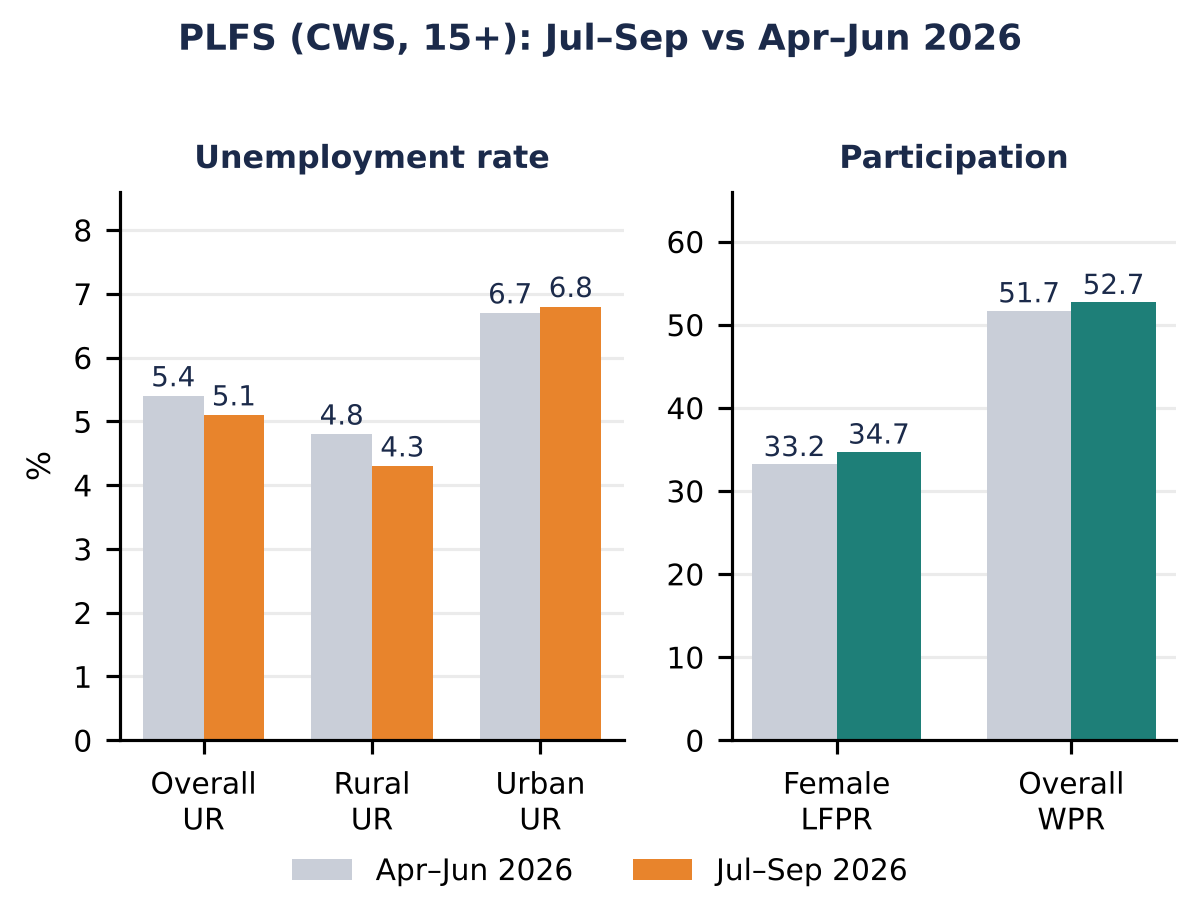
Overall unemployment rate (UR) for persons 15+ years (Current Weekly Status) fell to 5.1% from 5.4% in Apr–Jun 2026.
Rural UR dropped to 4.3% (from 4.8%); urban UR was broadly stable at 6.8% (from 6.7%).
LFPR rose to 55.5% (from 54.6%); WPR rose to 52.7% (from 51.7%).
Female LFPR improved to 34.7% from 33.2%; agriculture's share of rural jobs rose to 56.7%.
Revamped PLFS (since January 2025) gives monthly and quarterly estimates for rural and urban India.
Way forward
Convert rising rural participation into non-farm, formal jobs through MSME credit, skilling and labour-code implementation; watch for distress-driven farm employment.
Concept
CWS = activity status in the last 7 days (vs Usual Status = last 365 days). LFPR = labour force ÷ population; WPR = employed ÷ population; UR = unemployed ÷ labour force.
Grouped bar chart comparing PLFS Apr–Jun and Jul–Sep 2026: overall unemployment 5.4% to 5.1%, rural 4.8% to 4.3%, urban 6.7% to 6.8%, female LFPR 33.2% to 34.7%, overall WPR 51.7% to 52.7%. — StudyForGS
📜 Asked before in the exam — previous-year question on this topic
BPSC Prelims 2025 (71st CCE)According to Annual PLFS 2023-24 report:
There is greater increase in Labour Force Participation Rate (LFPR) of rural females as compared to urban females since 2022
Among the 36 states and union territories, 19 states have a Workforce Participation Rate (WPR) (for all ages) below the national average of 43.7 percent
The share of female workers in agriculture has declined significantly from 2017-18 to 2023-24
More than one of the above
Show answer
Answer: (a) There is greater increase in Labour Force Participation Rate (LFPR) of rural females as compared to urban females since 2022 Practise all BPSC previous year papers →
Linked because this news is about the same topic. The answer is as per the official key of that year.
2. Coal gasification push: Round 3 opens under the ₹37,500 crore scheme
The Ministry of Coal said on 10 November 2026 that Round 2 of the Scheme for Promotion of Surface Coal/Lignite Gasification Projects closed with two bids, both from NTPC, and Round 3 opened the same day.
Key facts
Scheme outlay: ₹37,500 crore, approved by the Union Cabinet in May 2026.
Round 2 bids by NTPC: one for urea, another for methanol and dimethyl ether (DME).
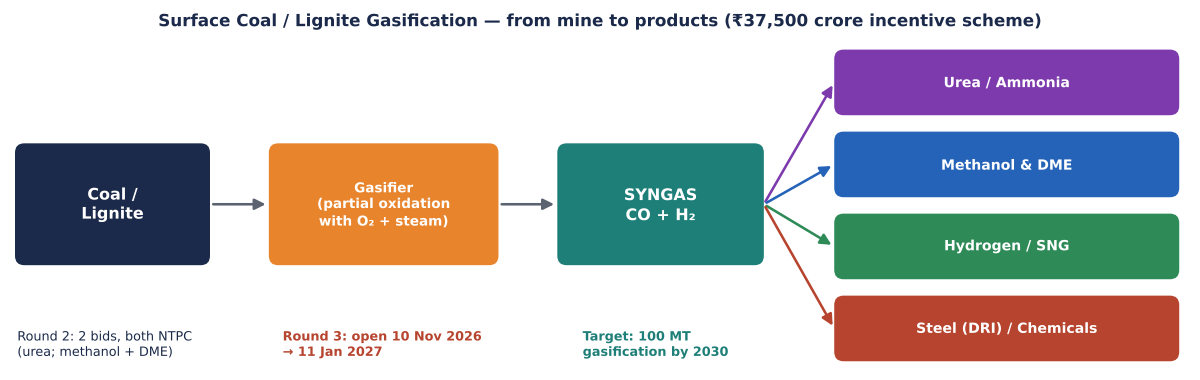
Round 3 applications are open from 10 Nov 2026 to 11 Jan 2027.
National target: 100 million tonnes (MT) of coal gasification by 2030.
Aim: replace imported LNG, urea, ammonia and methanol with products from domestic coal.
Way forward
Pair incentives with carbon capture (CCUS) pilots, water-efficient gasifiers and long-term offtake contracts so projects stay viable and climate-compatible.
Concept
Coal gasification = partial oxidation of coal with oxygen and steam to form syngas (CO + H2) — a feedstock for fertilisers, fuels and chemicals; cleaner at point of use than burning coal.
Flowchart: coal or lignite goes into a gasifier to make syngas (CO + H2), which yields urea/ammonia, methanol and DME, hydrogen/SNG, and steel/chemicals; notes Round 3 open 10 Nov 2026 to 11 Jan 2027 and the 100 MT by 2030 target. — StudyForGS
3. Blue Economy: island fisheries put at the centre of India's marine push
ECONOMYCOMMON: Prelims + Mains GS3
Syllabus linkage
GS-III: Agriculture — fisheries; Blue Economy. GS-I: island geography. Prelims: PMMSY, EEZ, tuna & seaweed clusters.
Context
On 10 November 2026, the Ministry of Fisheries, Animal Husbandry and Dairying highlighted Lakshadweep and the Andaman & Nicobar Islands as growth engines for marine fisheries — tuna, seaweed and ornamental fish.
Key facts
The two island groups hold nearly 40% of India's Exclusive Economic Zone (EEZ), with under-used stocks of yellowfin, skipjack and bigeye tuna.
Under PMMSY, investments of ₹218 crore (A&N) and ₹175 crore (Lakshadweep) are envisaged.
Lakshadweep is a notified Seaweed Cluster; Andaman & Nicobar is a notified Tuna Cluster.
A five-year plan aims to double Lakshadweep's tuna output to 50,000 tonnes.
India's seafood exports were about ₹73,890 crore in 2025-26.
Way forward
Build cold chains, processing units and port links on the islands, keep pole-and-line tuna fishing sustainable, and protect fragile coral ecosystems.
Concept
PMMSY (2020) — flagship fisheries scheme with an outlay of ₹20,050 crore. The EEZ extends up to 200 nautical miles under UNCLOS; India's EEZ is about 2.37 million sq km.
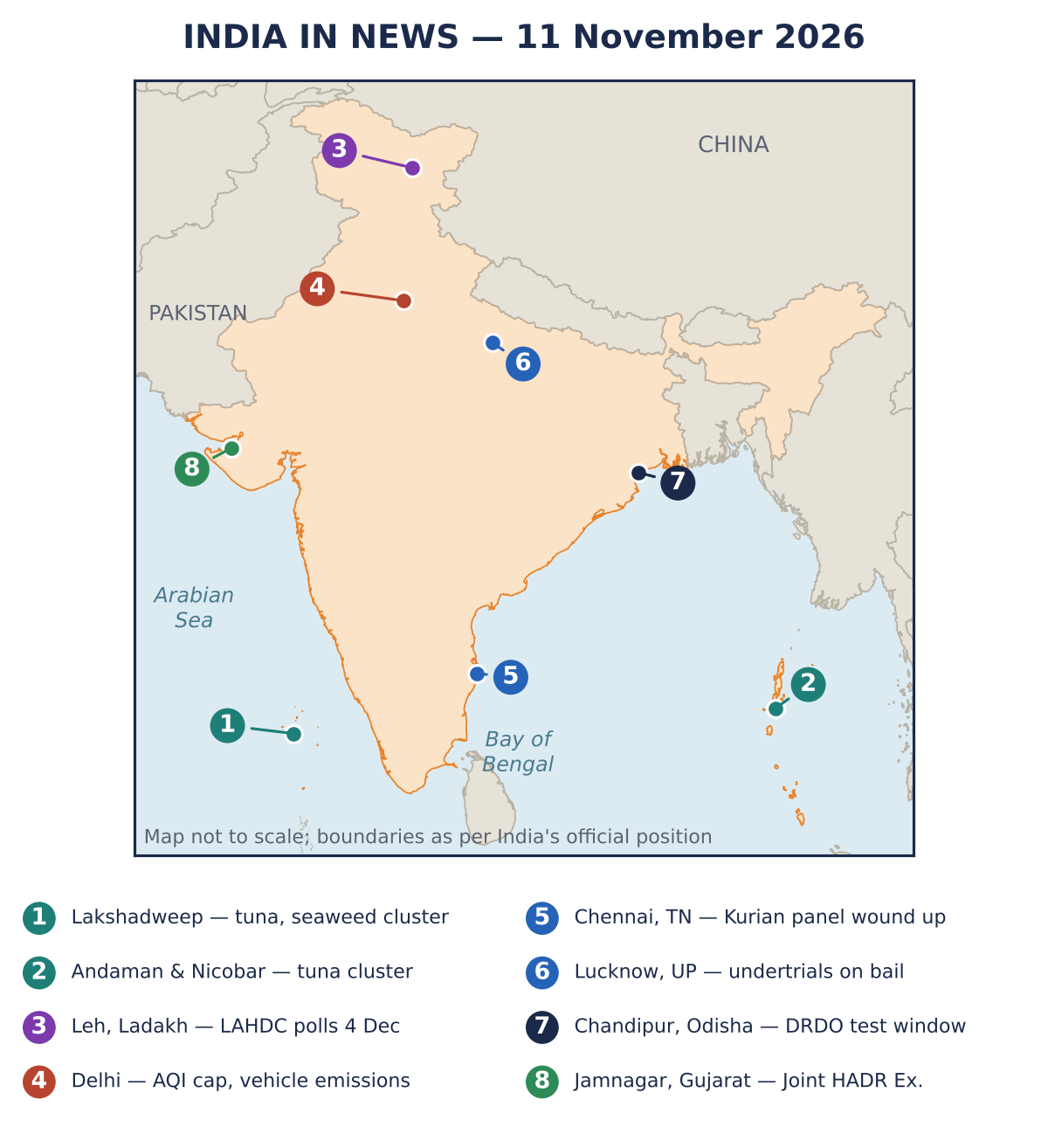
India in News locator map (India's official boundary) with eight numbered pins: Lakshadweep and Andaman & Nicobar fisheries clusters, Leh hill council polls, Delhi air pollution, Chennai Kurian panel, Lucknow undertrials, Chandipur DRDO test window and Jamnagar joint HADR exercise. — StudyForGS
4. Delhi air: CPCB to fix 1,000 µg/m³ data cap; SC flags vehicular emissions
ENVIRONMENTCOMMON: Prelims + Mains GS3
Syllabus linkage
GS-III: Environment — pollution & degradation. GS-II: role of judiciary. Prelims: AQI, CPCB, CAQM, GRAP, PM2.5.
Context
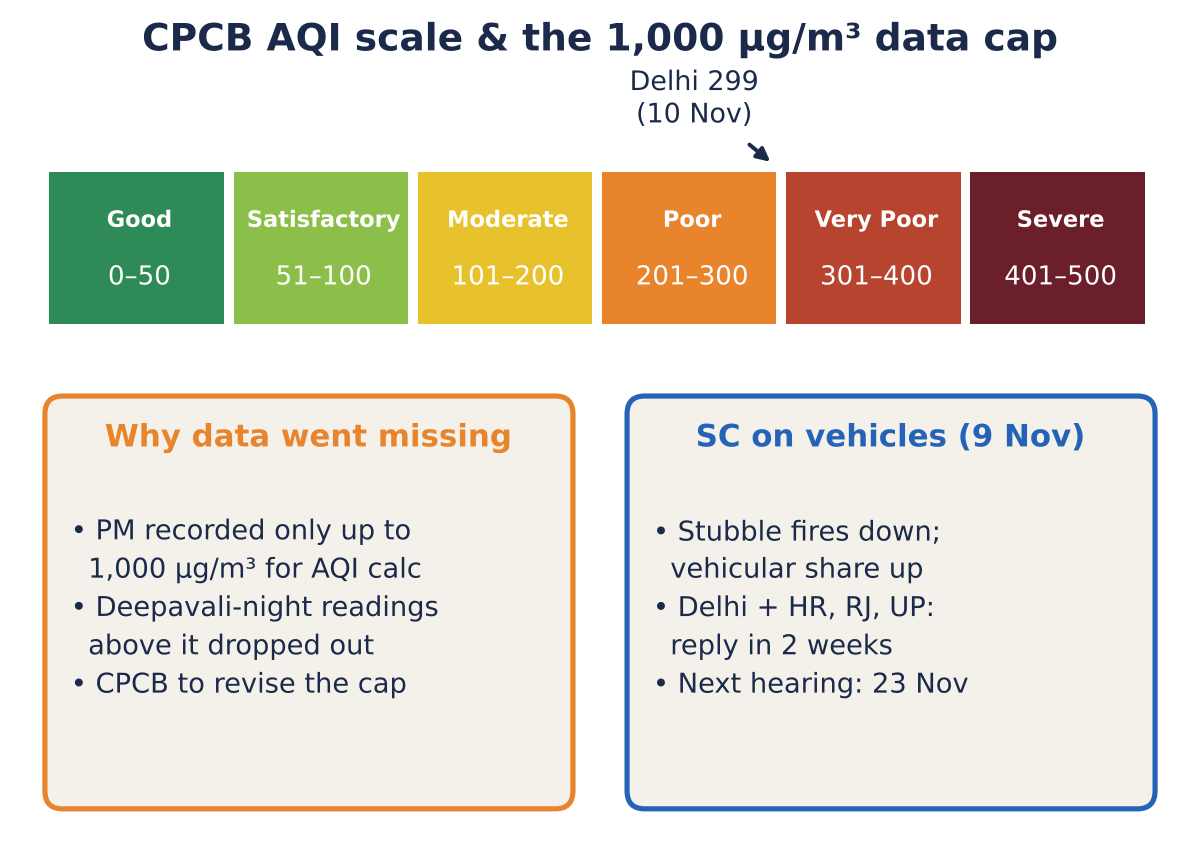
The Central Pollution Control Board (CPCB) said readings went missing on Deepavali night because particulate matter is recorded only up to 1,000 µg/m³ for AQI calculation, and that the cap will be fixed. Separately, the Supreme Court sought answers on NCR vehicular emissions.
Key facts
SC bench led by CJI Surya Kant (order of 9 Nov 2026) noted stubble-burning incidents fell while problems from vehicular emissions rose sharply.
Delhi, Haryana, Rajasthan and Uttar Pradesh (plus MCD and Delhi Police) must reply in two weeks; next hearing 23 Nov.
Issues raised: entry of vehicles from neighbouring States, PUC enforcement, end-of-life vehicles and enforcement data.
Delhi's AQI improved to 299 ('poor') on 10 Nov.
AQI is computed from 8 pollutants: PM10, PM2.5, NO2, SO2, CO, O3, NH3 and Pb.
Way forward
Remove artificial data caps, add monitors in hotspots, and build an NCR-wide vehicle-entry and PUC regime coordinated by CAQM.
Concept
CAQM — statutory body under the CAQM Act, 2021 for the NCR and adjoining areas; GRAP is its four-stage emergency plan. The case continues the M.C. Mehta line of 'continuing mandamus'.
CPCB AQI scale from Good (0–50) to Severe (401–500) with Delhi's 299 marked, plus panels explaining the 1,000 µg/m³ data cap behind missing Deepavali readings and the Supreme Court's 9 November directions on vehicular emissions. — StudyForGS
5. COP31 leaders' summit opens in Antalya; India presses for climate finance
ENVIRONMENTCOMMON: Prelims + Mains GS3
Syllabus linkage
GS-III: Climate change & conservation. GS-II: international groupings. Prelims: UNFCCC, Paris Agreement Art. 9.1, CBDR-RC, BASIC, LMDC.
Context
COP31 (9–20 Nov 2026) at the Antalya Expo Center, Türkiye, holds its World Leaders' Summit on 11–12 November. In its opening statement, India sought a fair and equitable outcome grounded in CBDR-RC.
Key facts
Türkiye hosts COP31; Australia leads the negotiations (Chris Bowen, President of Negotiations) under a compromise deal.
India's delegation is led by Environment Minister Bhupender Yadav; the opening statement was delivered by Environment Secretary Narendra Bhooshan.
India underlined Article 9.1 of the Paris Agreement — the obligation of developed countries to provide climate finance.
India aligned with G77 & China, LMDC and BASIC; wants voluntary adaptation indicators and a non-punitive stocktake process.
UN adaptation-gap estimates put developing-country needs at about $305 billion a year by 2035.
Way forward
Push a Climate Finance Work Programme with predictable, largely public and concessional money, and link adaptation to agriculture and food security.
Concept
CBDR-RC (UNFCCC, 1992) — all countries share responsibility but developed nations must lead. The NCQG agreed at COP29 (Baku): at least $300 billion a year by 2035.
6. Starlink debate: strategic autonomy must guide satellite-internet policy
SCI-TECHCOMMON: Prelims + Mains GS3
Syllabus linkage
GS-III: Science & Tech — space, IT; security of communication networks. Prelims: LEO constellations, IN-SPACe, satcom spectrum.
Context
Commentary today argues that India's approach to SpaceX's Starlink and other foreign low-earth-orbit (LEO) satcom operators must be shaped by strategic autonomy, not just telecom licensing.
Key facts
Satellite spectrum is assigned administratively, not auctioned, under the Telecommunications Act, 2023.
Security conditions sought: Indian gateways, data stored in India, lawful interception and a domestic 'kill switch' in emergencies.
Starlink operates in roughly 160 countries and territories; its commercial launch in India still awaits final clearances.
Lessons from Ukraine and Iran: foreign-controlled networks can be switched off, throttled or jammed in a crisis.
Other players: Eutelsat OneWeb and Jio-SES; calls are growing for an indigenous constellation.
Way forward
Apply technology-neutral rules to all operators, mandate local control of network operations, and fund an Indian LEO constellation for border and disaster connectivity.
Concept
LEO satellites orbit at roughly 500–2,000 km, giving low latency. IN-SPACe (2020) authorises private space activity; satcom services also need a DoT licence and security clearance.
GS-II: Polity — Articles 14, 15(4), 16(4); welfare of vulnerable sections. Prelims: Indra Sawhney, creamy layer, DoPT OM 1993.
Context
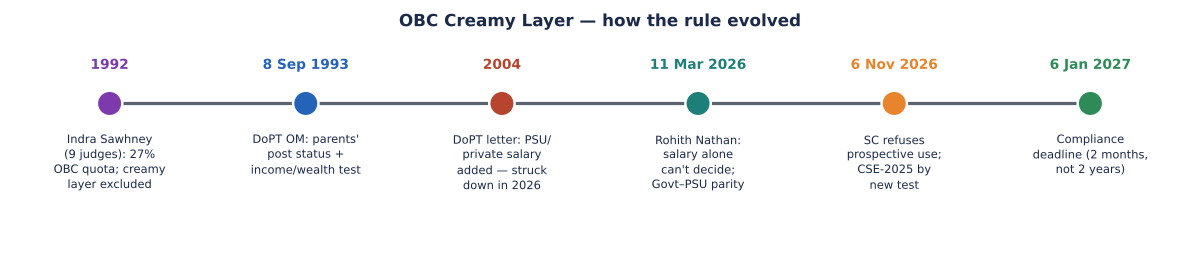
In an order of 6 November 2026, the Supreme Court refused the Centre's plea to apply its 11 March 2026 verdict in Union of India v. Rohith Nathan only prospectively. Today's commentary stresses applying the creamy-layer exclusion consistently.
Key facts
Bench: Justices P.S. Narasimha and R. Mahadevan.
Creamy-layer status cannot be decided on parental salary alone; the status and post of parents must be weighed.
No artificial distinction between children of Government and PSU employees — it violates Articles 14 and 16.
Pending CSE-2025 service allocations must follow the corrected test; time extended by 2 months (not the 2 years sought), to about 6 January 2027.
The Centre had argued that over 6.69 lakh reserved posts filled in a decade could be affected.
Way forward
DoPT should frame clear post-equivalence norms for PSU, bank and private jobs and revise the income ceiling periodically to keep the exclusion fair and predictable.
Concept
Indra Sawhney (1992), a nine-judge bench, upheld 27% OBC reservation but excluded the creamy layer; the DoPT OM of 8 September 1993 set the criteria. The income ceiling is ₹8 lakh a year (since 2017).
Timeline of the OBC creamy layer rule: Indra Sawhney 1992, DoPT OM of 8 Sep 1993, the 2004 DoPT letter later struck down, Rohith Nathan verdict of 11 Mar 2026, SC order of 6 Nov 2026 and compliance deadline of 6 Jan 2027. — StudyForGS
8. Ladakh sets 4 December polls for 8 hill councils amid Sixth Schedule demand
POLITYCOMMON: Prelims + Mains GS2
Syllabus linkage
GS-II: Federalism & local governance — UTs, special provisions. Prelims: LAHDC, Sixth Schedule, Article 244(2), Article 371.
Context
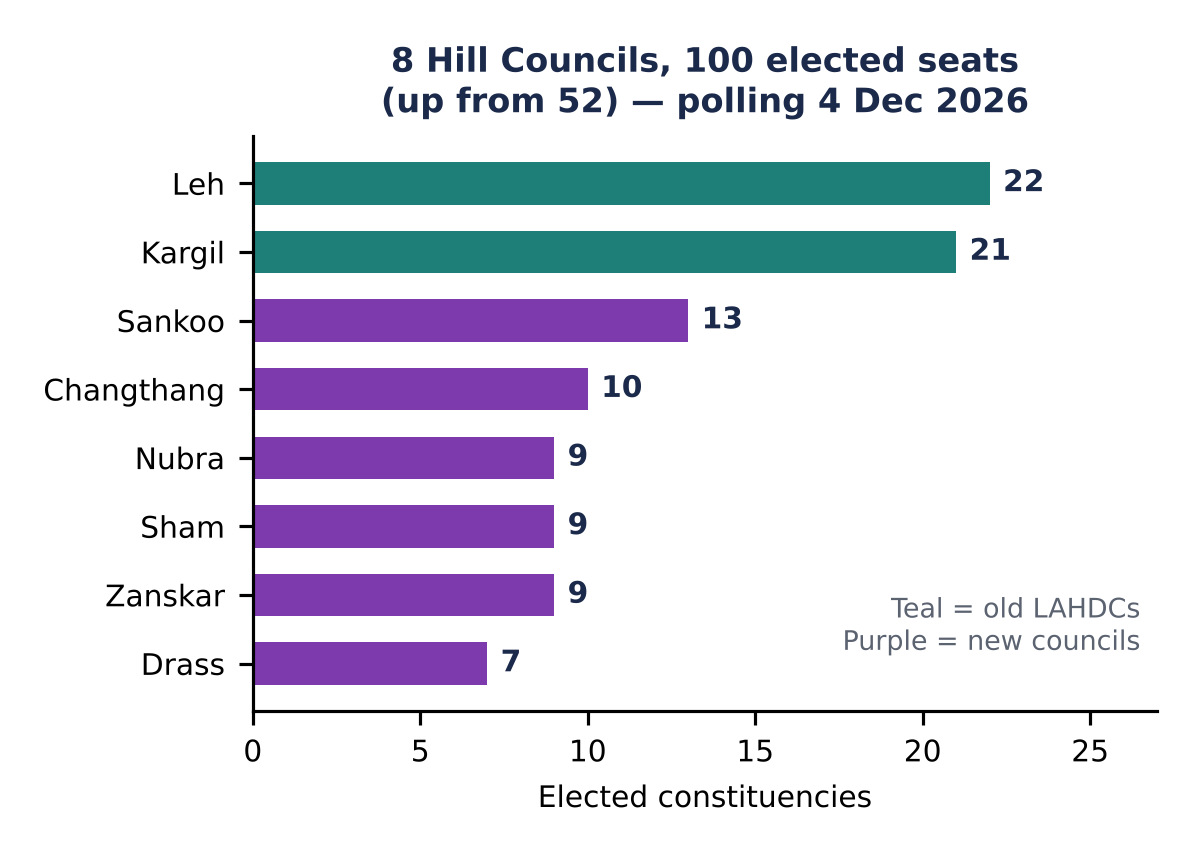
On 10 November 2026, the Ladakh administration announced polls to all eight Ladakh Autonomous Hill Development Councils (LAHDCs) on 4 December 2026, with the process to end by 8 December.
Key facts
Schedule: nominations till 17 Nov, scrutiny 18 Nov, withdrawal till 20 Nov, polling 4 Dec.
Councils expanded from 2 (Leh, Kargil) to 8 — adding Drass, Sankoo, Sham, Changthang, Nubra and Zanskar; elected seats up from 52 to 100.
Done through the LAHDC (Amendment) Regulation, 2026, promulgated by the President.
Kargil and Sankoo observed a shutdown on 10 Nov against winter polls; panchayat polls are due on 21 Nov.
The Leh Apex Body (LAB) and Kargil Democratic Alliance (KDA) seek Statehood and Sixth Schedule status.
Way forward
Hold the polls with weather-proof logistics and resume MHA–LAB–KDA talks on land, jobs and cultural safeguards (Sixth Schedule or Article 371-type provisions).
Concept
The Sixth Schedule (Arts 244(2), 275(1)) covers tribal areas of Assam, Meghalaya, Tripura and Mizoram through law-making Autonomous District Councils; Ladakh's hill councils are statutory bodies without law-making power.
Horizontal bar chart of elected constituencies in Ladakh's eight hill councils: Leh 22, Kargil 21, Sankoo 13, Changthang 10, Nubra 9, Sham 9, Zanskar 9, Drass 7 — 100 seats in all, polling on 4 December 2026. — StudyForGS
9. Tamil Nadu winds up the Kurian Joseph panel on Union–State relations
By a Government Order of 6 November 2026, Tamil Nadu discontinued the High-Level Committee on Union–State Relations headed by former SC judge Justice Kurian Joseph, about six months before its final report was due.
Key facts
Panel set up in April 2025; members K. Ashok Vardhan Shetty and economist M. Naganathan.
Its interim report (16 Feb 2026) covered the Governor's powers, delays in assent to Bills, delimitation, GST, education and health.
The final report was due by 31 May 2027, on financial relations, river disputes, emergency provisions and more.
Reason given: its mandate overlaps with the reconstituted Tamil Nadu State Law Commission, which takes over its records.
Several parties criticised the move as a retreat on State autonomy; others welcomed it.
Way forward
Federal reform needs continuity: the Law Commission should publish the panel's work, and issues should be pursued through the Inter-State Council and constitutional dialogue.
Concept
Rajamannar Committee (1969) — Tamil Nadu's first State-autonomy review. Union-level reviews: Sarkaria (1983–88) and Punchhi (2007–10) Commissions. Inter-State Council — Article 263.
10. SC to UP: undertrials granted bail must actually be released
On reports that prisoners stay jailed despite bail because they cannot meet surety conditions, the Supreme Court (order of 4 Nov, uploaded 6 Nov 2026) directed Uttar Pradesh to extend an identify-and-release exercise to all 75 districts.
Key facts
Bench: Justices M.M. Sundresh and Prasanna B. Varale, in the suo motu bail-policy case (SMWP (Crl) 4/2021).
The exercise is to be done with District Legal Services Authorities (DLSAs); courts asked to modify bail conditions where needed.
UP reported 158 such prisoners released and a decision pending on 106 others — data covered only 20 districts.
Separately (3 Nov), the SC ordered the immediate release of a man held over a month after bail and asked UP why compensation should not be paid.
Earlier SC directions require release the same day or the next day after a bail order.
Way forward
Use e-prisons alerts, accept personal bonds instead of cash sureties for the poor, and fix accountability of officials for illegal detention.
Concept
Article 21 (personal liberty) and Article 39A (free legal aid). Section 479 of the BNSS, 2023 — release of undertrials after half the maximum sentence (one-third for first-time offenders).
11. India–Oman Exercise Naseem Al Bahr 2026 held off Muscat
IRCOMMON: Prelims + Mains GS2 & GS3
Syllabus linkage
GS-II: India and West Asia; bilateral relations. GS-III: maritime security. Prelims: Naseem Al Bahr, Duqm, Strait of Hormuz, CORPAT.
Context
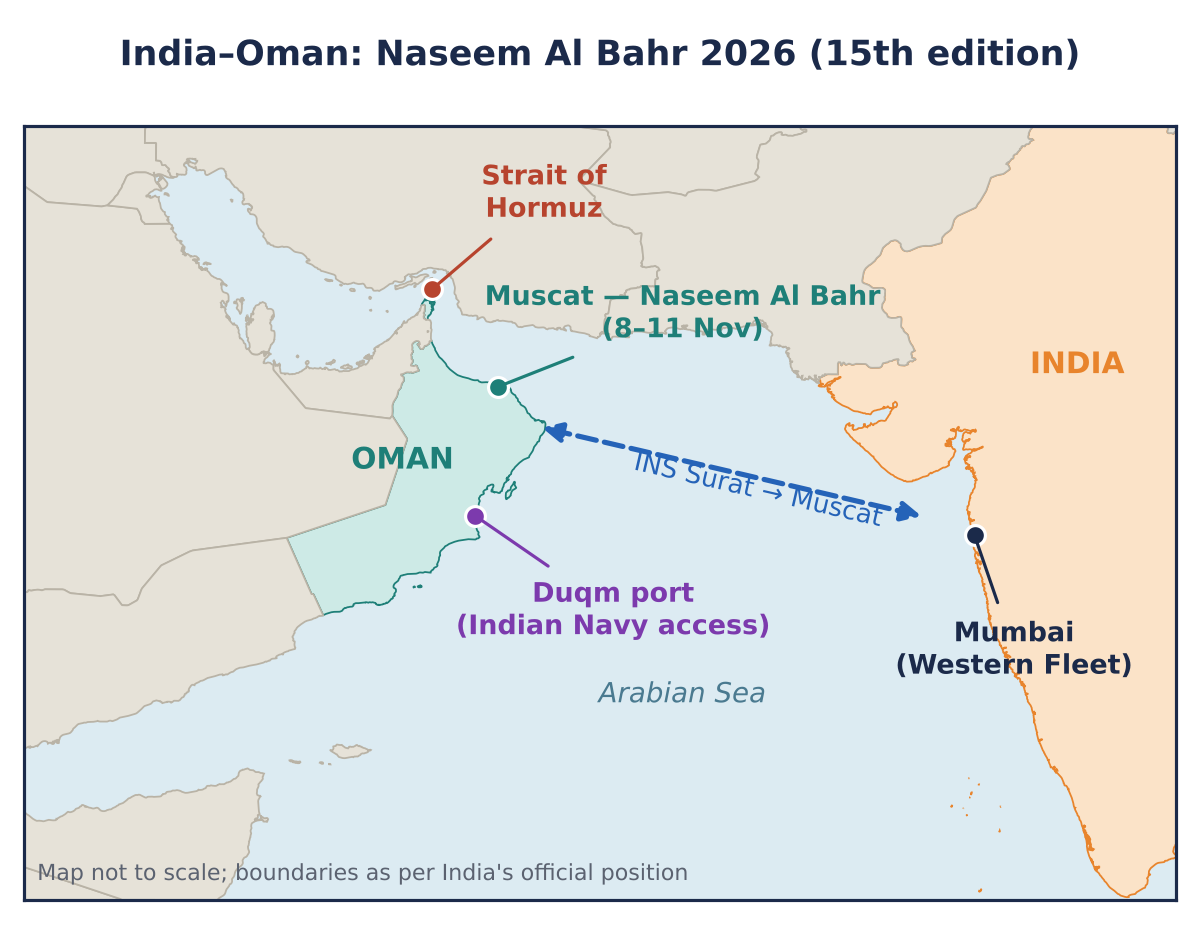
The 15th edition of the India–Oman maritime exercise ‘Naseem Al Bahr’ (Sea Breeze) is being held at Muscat, Oman, from 8 to 11 November 2026, with INS Surat representing the Indian Navy; a Coordinated Patrol (CORPAT) follows.
Key facts
Participants: the Indian Navy and the Royal Navy of Oman (RNO); sea phase in the Al Batinah maritime area.
The series began in 1993 — one of India's oldest naval exercises with a Gulf partner.
INS Surat is the fourth and last Project-15B (Visakhapatnam-class) guided-missile destroyer.
Oman sits at the mouth of the Strait of Hormuz, the chokepoint for a large share of India's crude imports.
India has access to Duqm port for naval logistics and maintenance (arrangement of 2018).
Way forward
Deepen maritime domain awareness, joint anti-piracy patrols and energy-route security as West Asian tensions threaten Hormuz shipping.
Concept
Other India–Oman exercises: Al Najah (Army) and Eastern Bridge (Air Force). Oman is a key defence partner of India within the Gulf Cooperation Council (GCC).
Regional map of the Arabian Sea showing India and Oman highlighted, with Muscat (Naseem Al Bahr venue), Duqm port, the Strait of Hormuz and Mumbai marked, and INS Surat's route from India to Muscat. — StudyForGS
Data point of the day
5.1%
Unemployment rate (CWS, 15+ years), July–September 2026 Down from 5.4% in Apr–Jun 2026; rural 4.3%, urban 6.8%; LFPR 55.5%, female LFPR 34.7%, WPR 52.7%.
Prelims rapid-fire
Haj-2027 agreement: India–Saudi Arabia Bilateral Haj Agreement signed at Jeddah (9 Nov); India's quota 1,75,025 pilgrims.
Namo Yamuna River Safari: Delhi's first recreational cruise on the Yamuna (National Waterway-110), Sonia Vihar–Jagatpur, 6 km.
Joint HADR Exercise 2026: Army, Navy, Air Force, Coast Guard and NDMA with friendly nations at AFS Jamnagar from 17 Nov.
Abu Dhabi talks: First US-mediated Russia–Ukraine talks in nine months held on 10 Nov; both sides agreed to continue.
IIT Jodhpur alloy: Niobium-rich refractory alloy, density ~7.6 g/cm³, resists oxidation at 1,000°C — for aerospace and hypersonics.
DRDO test window: NOTAM for missile flight trials off Chandipur (Integrated Test Range), Odisha, 11–13 Nov.
Practice MCQs — UPSC Prelims pattern
Q1. With reference to the Periodic Labour Force Survey (PLFS), consider the following statements: 1. The Current Weekly Status (CWS) approach uses a reference period of seven days. 2. In July–September 2026, the urban unemployment rate was lower than the rural unemployment rate. 3. The PLFS is released by the National Statistics Office under MoSPI. Which of the statements given above are correct?
1 and 2 only
1 and 3 only
2 and 3 only
1, 2 and 3
Show answer
Answer: B Statement 2 is wrong: urban UR (6.8%) was higher than rural UR (4.3%). CWS uses a 7-day reference week and PLFS is released by the NSO (MoSPI).
Q2. The Sixth Schedule of the Constitution of India applies to the tribal areas of which of the following States? 1. Assam 2. Manipur 3. Meghalaya 4. Mizoram 5. Tripura. Select the correct answer using the code given below:
1, 2 and 3 only
1, 3, 4 and 5 only
2, 3, 4 and 5 only
1, 2, 3, 4 and 5
Show answer
Answer: B Under Article 244(2), the Sixth Schedule covers Assam, Meghalaya, Tripura and Mizoram. Manipur's hill areas are dealt with under Article 371C, not the Sixth Schedule. Ladakh is seeking inclusion.
Mains practice question
Q. Excluding the ‘creamy layer’ is essential to keep OBC reservation targeted at the genuinely backward. In the light of the Supreme Court's 2026 rulings, discuss the challenges in determining creamy-layer status and suggest reforms. (15 marks, 250 words)
Hint / approach
Intro: Indra Sawhney (1992) and the DoPT OM of 1993. Body: income test vs status test; Government–PSU parity under Arts 14 and 16; missing post-equivalence norms; outdated ₹8 lakh ceiling; impact on CSE-2025. Way forward: equivalence rules, periodic revision, better data, sub-categorisation. Conclude with substantive equality.
📌 One-line revision: PLFS UR 5.1% • Coal gasification Round 3 till 11 Jan 2027 • Ladakh's 8 LAHDCs vote on 4 Dec • Creamy layer ≠ salary alone • COP31 leaders meet in Antalya, 11–12 Nov.