Thursday, 26 November 2026 · IST · National & International · 29 items
The US has proposed tariffs of up to 25% on Indian goods over alleged excess capacity, and India has rejected the charge. The Cabinet cleared a construction equipment scheme, a new container terminal at Kamarajar Port, an airport near Silchar and an aviation MRO pact with Singapore, while six urea plants were approved. Constitution Day, the SIR voter-roll debate and the Colombo Security Conclave meeting in Male complete the day's key themes.
Today at a glance — things to remember
US proposes up to 25% Section 301 tariff on Indian goods; India denies any structural excess capacity.
Cabinet clears Rs 11,000 crore scheme for construction and infrastructure equipment manufacturing.
Six brownfield urea plants of 12.7 LMT each approved under NIPU-2026 (about Rs 54,000 crore).
Kamarajar Port gets a Rs 4,288.26 crore second container terminal; Rs 2,014 crore Doloo airport near Silchar approved.
8th Colombo Security Conclave NSA meeting held in Male; India pledges capacity-building help.
Constitution Day: 77 years since adoption on 26 November 1949.
SIR phase 3 draft rolls: about 6.15 crore names removed in 17 States/UTs.
Forex reserves rose to US$ 737.78 billion by end-September 2026.
IN-SPACe report: about 60% of satellite costs come from imported components.
Exercise SURYAKIRAN-XX with Nepal begins at Saljhandi.
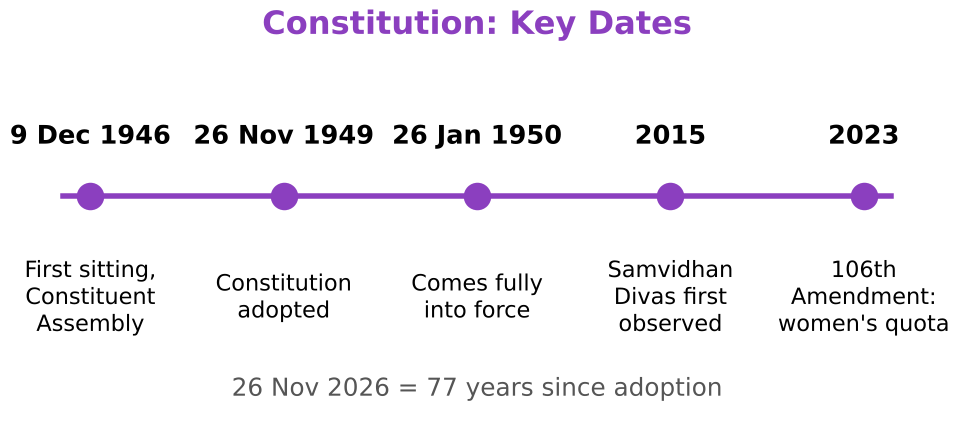
26 November is Samvidhan Divas (Constitution Day). On this day in 1949, India formally adopted its Constitution. Today's editorials ask citizens to protect its values, not just celebrate the book. India marks Constitution Day on 26 November 2026, 77 years after the Constituent Assembly adopted the Constitution on 26 November 1949. The full Constitution came into force on 26 January 1950, which is why that day is Republic Day. Editorials today stress 'constitutional patriotism' (loyalty to constitutional values rather than to one community) and 'constitutional morality' (respecting the spirit of the Constitution and its institutions). Another piece traces the journey from Dr B.R. Ambedkar's drafting work to recent amendments such as the women's reservation law.
Key facts
Constitution adopted: 26 Nov 1949; fully in force: 26 Jan 1950.
Some provisions (citizenship, elections, provisional Parliament, etc.) came into force on 26 Nov 1949 itself.
Constituent Assembly first met on 9 December 1946; Dr B.R. Ambedkar chaired the Drafting Committee.
Constitution Day has been observed since 2015 (the 125th birth anniversary year of Ambedkar); the day was earlier marked as National Law Day.
106th Constitutional Amendment Act, 2023 (Nari Shakti Vandan Adhiniyam) reserves one-third of seats for women in Lok Sabha and State Assemblies.
Way forward
Constitutional literacy in schools, strong independent institutions and respectful debate can turn Constitution Day from a ritual into everyday practice.
Concept
Constitutional morality: following not only the words but also the spirit of the Constitution - checks and balances, rule of law, respect for rights. Ambedkar used the term in the Constituent Assembly (4 November 1948). Basic structure doctrine (Kesavananda Bharati, 1973): Parliament can amend the Constitution but cannot destroy its core features such as democracy, secularism, federalism and judicial review. Women's reservation (106th Amendment): new Articles 330A and 332A; it will start only after delimitation (redrawing of constituencies) based on the first Census after the Act. Exam angle: Prelims: dates (1946, 1949, 1950), which provisions came into force on 26 Nov 1949, 106th Amendment details. Mains: 'Constitutional morality is the soul of the Constitution' - discuss with examples; role of citizens and courts in protecting it.
Timeline of key Constitution dates: 9 Dec 1946, 26 Nov 1949, 26 Jan 1950, 2015 and 2023 — StudyForGS
📜 Asked before in the exam — previous-year question on this topic
UPSC Prelims 2024Consider the following statements regarding 'Nari Shakti Vandan Adhiniyam': 1. Provisions will come into effect from the 18th Lok Sabha. 2. This will be in force for 15 years after becoming an Act. 3. There are provisions for the reservation of seats for Scheduled Castes Women within the quota reserved for the Scheduled Castes. Which of the statements given above are correct?
1, 2 and 3
1 and 2 only
2 and 3 only
1 and 3 only
Show answer
Answer: (c) 2 and 3 only Statements 2 and 3 are correct. The Nari Shakti Vandan Adhiniyam, the Constitution (106th Amendment) Act, 2023, reserves one-third of seats in the Lok Sabha, state Assemblies and the Delhi Assembly for women. It takes effect only after a delimitation based on the first census published after the Act began, so not from the 18th Lok Sabha. The reservation lasts 15 years, extendable by Parliament, and one-third of SC and ST seats are reserved for women of those groups. Practise all UPSC Prelims 2024 paper (free) →
Linked because this news is about the same topic. The answer is as per the official key of that year.
2. SIR Draft Rolls: 6.15 Crore Names Removed
POLITYUPSC: Prelims + Mains GS2
Syllabus linkage
GS2 - Salient features of the Representation of People's Act; Election Commission; electoral reforms. Prelims (Articles 324, 326) + Mains (free and fair elections, right to vote).
Context
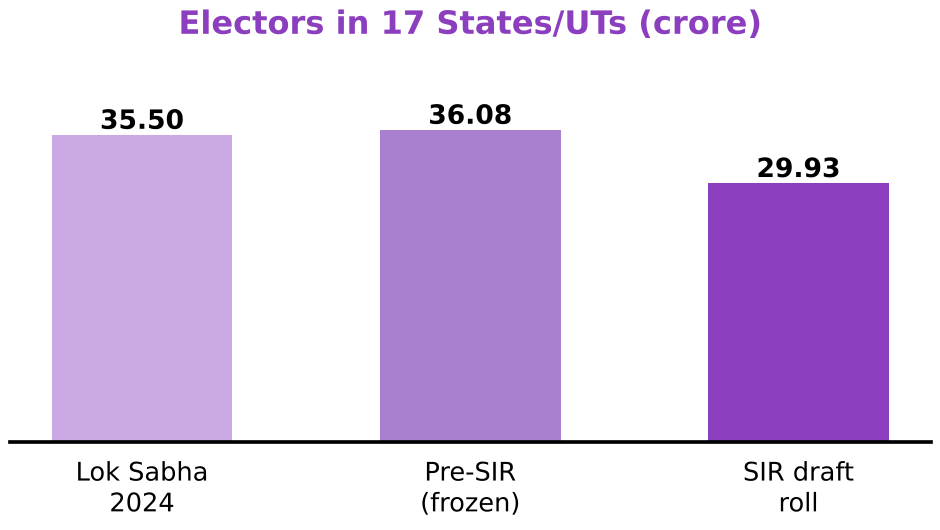
The Election Commission is cleaning voter lists through a Special Intensive Revision (SIR). In the third phase, draft lists of 17 States/UTs have about 6.15 crore fewer names, which has started a debate on accuracy versus exclusion. Data discussed today show that in the 17 States and Union Territories covered by the third phase of SIR, the draft electoral rolls list about 29.93 crore voters. Before SIR, the frozen rolls had about 36.08 crore names, so about 6.15 crore names were removed; about 1.11 crore of them were marked as dead. Compared with the 2024 Lok Sabha election (35.50 crore voters), the draft rolls are about 15.7% smaller. Delhi shows the biggest fall, around 35.89%. Critics worry that genuine voters, especially poor and migrant people, may be left out and may also lose welfare access linked to documents.
About 1.11 crore deleted names (about 18%) marked as dead.
Draft rolls about 15.7% below the 2024 Lok Sabha figure of 35.50 crore.
Delhi: largest percentage drop (about 35.89%); Chandigarh about 31.84%.
Draft rolls are followed by a claims-and-objections stage before the final roll is published.
Way forward
Door-to-door verification, easy re-entry through claims, clear reasons for every deletion and public data can keep rolls clean without excluding genuine voters.
Concept
Article 324: gives the Election Commission 'superintendence, direction and control' over preparing electoral rolls and conducting elections. Article 326: adult suffrage - every citizen aged 18 or above (lowered from 21 by the 61st Amendment, 1988) can vote unless disqualified by law. Representation of the People Act, 1950: Section 21 allows the EC to order a special revision of rolls; the Electoral Registration Officer (ERO) prepares the roll, helped by Booth Level Officers (BLOs). Exam angle: Prelims: Articles 324/326, RP Act 1950 vs 1951, role of ERO/BLO. Mains: Balance between clean voter lists and the right to vote; burden of proof on citizens; safeguards needed in large-scale deletions.
Bar chart of electors in 17 States/UTs in crore: 35.50 at Lok Sabha 2024, 36.08 pre-SIR, 29.93 in SIR draft roll — StudyForGS
3. 16th Finance Commission Grants for Panchayats
POLITYUPSC: Prelims + Mains GS2
Syllabus linkage
GS2 - Devolution of powers and finances up to local levels; Finance Commission. Prelims (Article 280, 243-I) + Mains (fiscal federalism, local governance).
Context
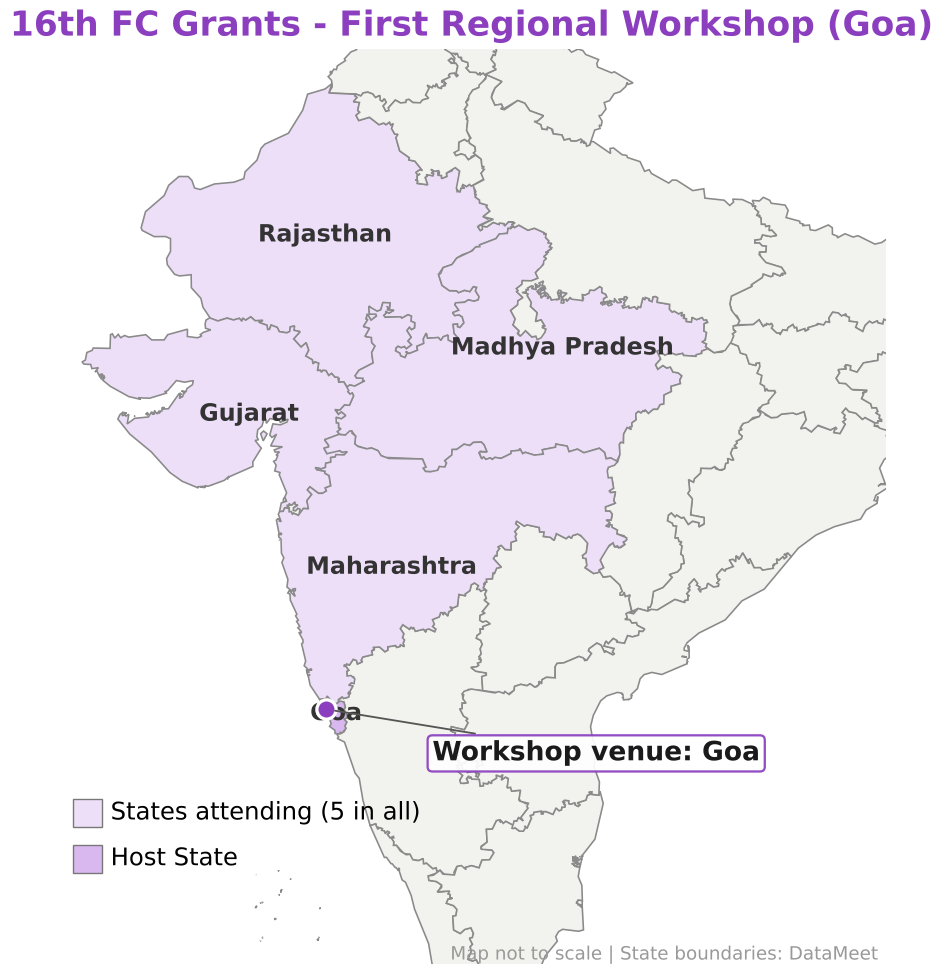
The 16th Finance Commission has recommended about Rs 4.35 lakh crore for village panchayats over five years. The Panchayati Raj Ministry is now teaching States how to use this money properly, starting with a workshop in Goa. The Ministry of Panchayati Raj is holding the first regional workshop in Goa on 26 November 2026 on implementing the 16th Finance Commission's grants for Rural Local Bodies (RLBs). Officers from Goa, Gujarat, Madhya Pradesh, Maharashtra and Rajasthan are attending. The Commission has recommended Rs 4,35,236 crore for Panchayati Raj Institutions across all 28 States for 2026-27 to 2030-31. The Department of Expenditure issued operational guidelines on 21 May 2026, and the Commission itself asked the Ministry to handhold States through such workshops.
Key facts
Total RLB grant: Rs 4,35,236 crore for 2026-27 to 2030-31 (all 28 States).
First regional workshop: Goa, 26 Nov 2026; 5 States attending.
Operational guidelines issued by Department of Expenditure on 21 May 2026.
Aim: shared understanding of conditions States must meet to get the money (compliance conditions).
16th Finance Commission chaired by Arvind Panagariya; award period 2026-31.
Way forward
Timely release, strong State Finance Commissions and better own-revenue (property tax, user fees) can make panchayats real 'institutions of self-government'.
Concept
Finance Commission (Article 280): a body set up by the President every five years to recommend how taxes are shared between Centre and States and what grants States get. Article 280(3)(bb): FC also suggests measures to boost a State's Consolidated Fund to support panchayats (added by the 73rd Amendment, 1992). State Finance Commission (Article 243-I): set up by the Governor every five years to review panchayat finances within the State. Exam angle: Prelims: Article 280, 243-I, 280(3)(bb), award period of 16th FC. Mains: Why panchayats remain financially weak despite FC grants; role of conditional grants and own-source revenue.
India map highlighting host State Goa and attending States Gujarat, Madhya Pradesh, Maharashtra and Rajasthan — StudyForGS
4. MoSPI-DSCI Pact on Trusted Data Sharing
POLITYUPSC: Prelims + Mains GS2
Syllabus linkage
GS2 - Government policies and interventions; GS3 - IT, data governance. Prelims (DPDP Act, DSCI) + Mains (privacy vs data-driven governance).
Context
The statistics ministry has tied up with a data-security body to build safe ways of sharing data between government agencies, so that people's personal information stays private when it is used for official statistics. The Ministry of Statistics and Programme Implementation (MoSPI) signed an MoU with the Data Security Council of India (DSCI) in New Delhi on 25 November 2026. They will design protocols for trusted data sharing within and across government agencies while protecting privacy and statistical confidentiality. Statistical agencies now use alternative data sources (like digital records) that may contain personal identifiers, so they must prepare for the Digital Personal Data Protection (DPDP) Act, 2023, whose main duties come into force in 2027. First, the two bodies will prepare a policy paper on trusted data flows, based on international good practice.
Key facts
MoU signed on 25 Nov 2026 in New Delhi.
DSCI: a not-for-profit body set up by NASSCOM for data protection and cyber security.
Focus: privacy-protecting data sharing for official statistics.
First output: a joint policy paper on trusted data flows and data management.
Context: DPDP Act, 2023 scheduled to take effect in 2027.
Way forward
Anonymisation standards, audit trails and clear purpose limits should be built into all data-sharing arrangements before 2027.
Concept
DPDP Act, 2023: India's personal data law - data can be processed only with consent or for 'legitimate uses'; sets up a Data Protection Board to hear complaints and impose penalties. Statistical confidentiality: information given by people/firms for statistics must not be used to identify or act against them - this keeps trust and honest responses. Right to privacy: declared a fundamental right under Article 21 in K.S. Puttaswamy (2017). Exam angle: Prelims: DPDP Act 2023 basics, Data Protection Board, Puttaswamy case, DSCI. Mains: How can the government use big data for better statistics without violating privacy?
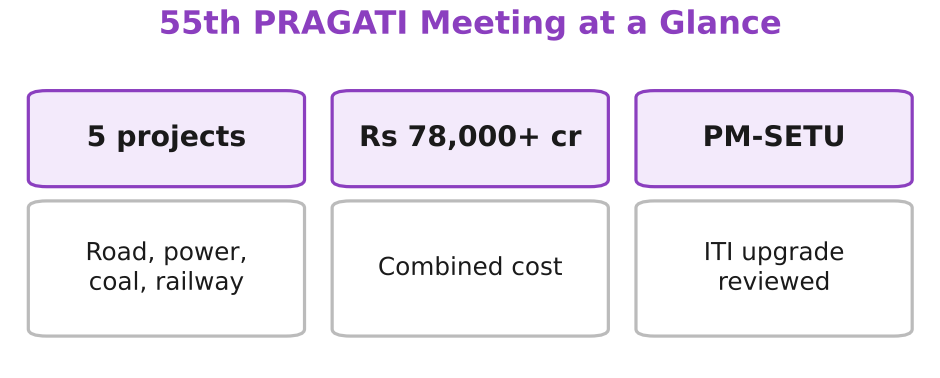
PRAGATI is the PM's video-conference review system to speed up stuck projects. In the 55th meeting, he reviewed five big projects worth over Rs 78,000 crore and the scheme to upgrade ITIs. Prime Minister Narendra Modi chaired the 55th PRAGATI meeting at Seva Teerth on 25 November 2026. Five infrastructure projects in road, power, coal and railways, together costing over Rs 78,000 crore, were reviewed. The PM said delays postpone benefits to citizens and asked the Centre and States to fix issues with clear responsibility and realistic timelines without compromising quality. On a power project he suggested decentralised solar and wind plants near where power is used. He also reviewed the ITI ecosystem and PM-SETU, asking States, industry and PSUs to link ITIs with training and jobs.
Key facts
55th PRAGATI meeting on 25 Nov 2026; 5 projects, combined cost over Rs 78,000 crore.
Sectors: road, power, coal, railways.
Suggestion: decentralised solar/wind plants closer to consumption centres.
PM-SETU (ITI upgradation scheme) reviewed.
PRAGATI = Pro-Active Governance And Timely Implementation.
Way forward
Faster land, forest and environment clearances, plus single-point accountability, are needed so PRAGATI fixes become systemic, not case-by-case.
Concept
PRAGATI (launched 2015): an ICT-based, multi-modal platform where the PM, Union Secretaries and State Chief Secretaries review projects, schemes and public grievances together through video-conferencing - an example of cooperative federalism. PM-SETU: Pradhan Mantri Skilling and Employability Transformation through Upgraded ITIs - approved in 2025 with Rs 60,000 crore to upgrade 1,000 government ITIs in a hub-and-spoke model with industry partners. Exam angle: Prelims: full form of PRAGATI, year of launch, PM-SETU. Mains: Causes of time and cost overruns in Indian infrastructure projects and how tech-enabled monitoring helps.
Summary boxes of the 55th PRAGATI meeting: 5 projects, over Rs 78,000 crore cost, PM-SETU reviewed — StudyForGS
A national campaign for women's safety and equality has started under the rural livelihoods mission. Ten ministries and the legal services authority have jointly told States how to help women get support and legal aid. Union Ministers Shivraj Singh Chouhan and Annpurna Devi launched Nayi Chetna 5.0, a national campaign on gender equality under DAY-NRLM, on 25 November 2026. The date is the International Day for the Elimination of Violence against Women, which also starts the global 16 Days of Activism against Gender-Based Violence. A joint advisory from 10 Ministries and the National Legal Services Authority (NALSA) guides States and UTs on awareness, access to support services and legal aid. The theme is 'From awareness to action and From access to agency'. The Women and Child Development Ministry also started the '#NumberSaveKiya?' campaign urging people to save helpline numbers.
Key facts
Launched 25 Nov 2026 under DAY-NRLM (Ministry of Rural Development).
Joint advisory: 10 Ministries + NALSA.
Theme: 'From awareness to action and From access to agency'.
Coincides with 16 Days of Activism (25 Nov to 10 Dec, Human Rights Day).
WCD Ministry also launched the '#NumberSaveKiya?' helpline-awareness campaign.
Way forward
Gender help desks in SHG federations, trained para-legal volunteers and quick police response can turn awareness into safety on the ground.
Concept
DAY-NRLM (Deendayal Antyodaya Yojana - National Rural Livelihoods Mission): launched in 2011 as NRLM; organises poor rural women into Self Help Groups (SHGs) for savings, credit and livelihoods. NALSA: set up under the Legal Services Authorities Act, 1987 to give free legal aid; it flows from Article 39A (equal justice and free legal aid, a Directive Principle added in 1976). International Day for the Elimination of Violence against Women (25 Nov): designated by the UN General Assembly in 1999. Exam angle: Prelims: 25 Nov significance, 16 Days of Activism dates, Article 39A, NALSA's Act. Mains: Role of SHG networks in fighting gender-based violence in rural India.
No new national highway stretch will be opened to traffic unless ambulances, patrol vans and tow cranes are already in place, so accident victims get help quickly. The National Highways Authority of India (NHAI) has made Incident Management Services compulsory before any national highway stretch is opened to traffic. These include ambulances, route-patrolling vehicles and tow-away cranes, all linked to the 1033 National Highway Helpline and coordinated with police, fire services and hospitals. On running stretches, ambulances are placed at toll (user fee) plazas or other spots chosen using accident data. For highways handed to NHAI by the Road Transport Ministry, ambulances will come through a central agency, while patrol vehicles and cranes are contracted separately.
Key facts
Incident management must be ready before a stretch opens.
Linked to helpline 1033; coordination with police, fire, hospitals.
Ambulance location based on accident data of the stretch.
Aim: faster response in the 'golden hour' after a crash.
Way forward
Real-time crash mapping, trauma centres every short distance on highways and Good Samaritan protection can cut road deaths further.
Concept
Golden hour: the first one hour after a serious injury, when quick treatment gives the best chance of survival; defined in the Motor Vehicles Act after the 2019 amendment. NHAI: statutory body under the NHAI Act, 1988 (made operational in 1995) to develop and maintain national highways. Cashless treatment scheme (2025): road accident victims can get cashless treatment up to Rs 1.5 lakh for up to 7 days at designated hospitals. Exam angle: Prelims: 1033 helpline, golden hour, NHAI Act 1988. Mains: Why India has very high road deaths and how post-crash care fits into the '4 E' approach (Engineering, Enforcement, Education, Emergency care).
8. US Proposes 25% Tariff on India
IRUPSC: Prelims + Mains GS2/GS3
Syllabus linkage
GS2 - Bilateral relations, effect of policies of developed countries on India; GS3 - External sector. Prelims (Section 301, WTO) + Mains (India-US trade, protectionism).
Context
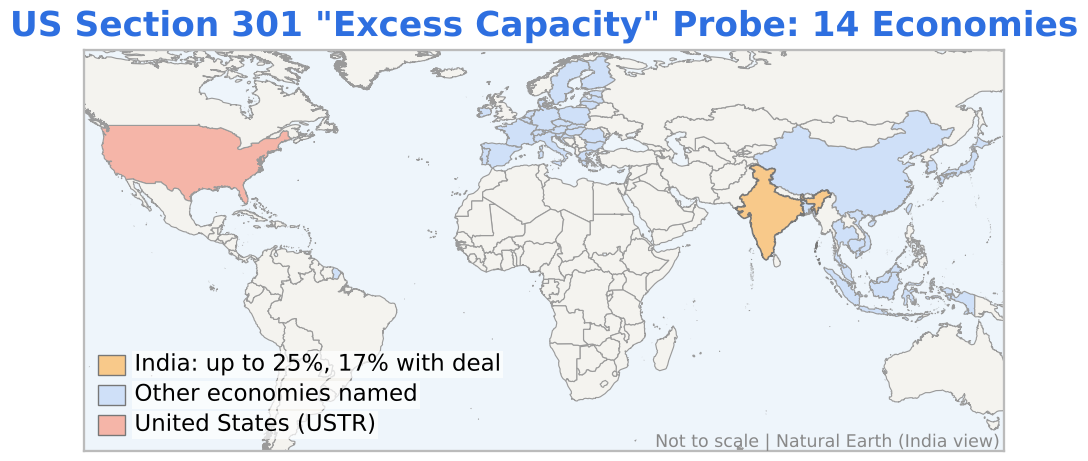
The US says many countries, including India, make far more goods than they need and dump them abroad. It has proposed extra import taxes of up to 25% on Indian goods. India says it has no such 'excess capacity' and wants the issue settled in trade talks. On 25 November 2026 the US Trade Representative (USTR) announced findings in 14 investigations under Section 301 of the US Trade Act of 1974 on 'structural excess capacity' in manufacturing. For India, it proposed tariffs of up to 25% on all goods (net of existing Section 301 duties), falling to 17% if India signs an Agreement on Reciprocal Trade with the US. Other economies named include China, the EU, Japan, South Korea, Vietnam, Singapore and Switzerland. India's Commerce Ministry said it is examining the notice, that India has 'no structural excess capacity in any sector', and that concerns should be handled in the ongoing bilateral trade talks. The rates are only proposals; public comments and hearings in January 2027 come first.
Key facts
Legal tool: Section 301, US Trade Act of 1974 (unilateral action against 'unfair' practices).
India: up to 25%; 17% with a reciprocal trade agreement.
Highest proposed: Vietnam up to 35%; EU 15%; Japan up to 15%; China up to 20%.
Hearings expected in January 2027 - tariffs not yet in force.
India and the US are negotiating a Bilateral Trade Agreement (talks launched in 2025).
Way forward
India should push for an early, balanced trade deal while diversifying exports and building cost competitiveness so that tariff shocks hurt less.
Concept
Excess (over) capacity: when a country can produce much more than its own market buys, often due to subsidies, leading to cheap exports that hurt other countries' industries. MFN principle (WTO): a member should not discriminate between trading partners; unilateral country-specific tariffs are often challenged as violating WTO rules. Tariff: a tax on imported goods; it raises their price for consumers in the importing country. Exam angle: Prelims: Section 301 vs Section 232, MFN, WTO dispute settlement. Mains: Impact of US protectionism on India's exports and the case for diversifying markets through FTAs (UK, EU, EFTA).
World map colouring the United States, India and the other economies named in the Section 301 probe — StudyForGS
9. Colombo Security Conclave Meets in Male
IRUPSC: Prelims + Mains GS2/GS3
Syllabus linkage
GS2 - India and its neighbourhood, regional groupings; GS3 - Maritime security. Prelims (members, pillars, MAHASAGAR) + Mains (India's role as net security provider).
Context
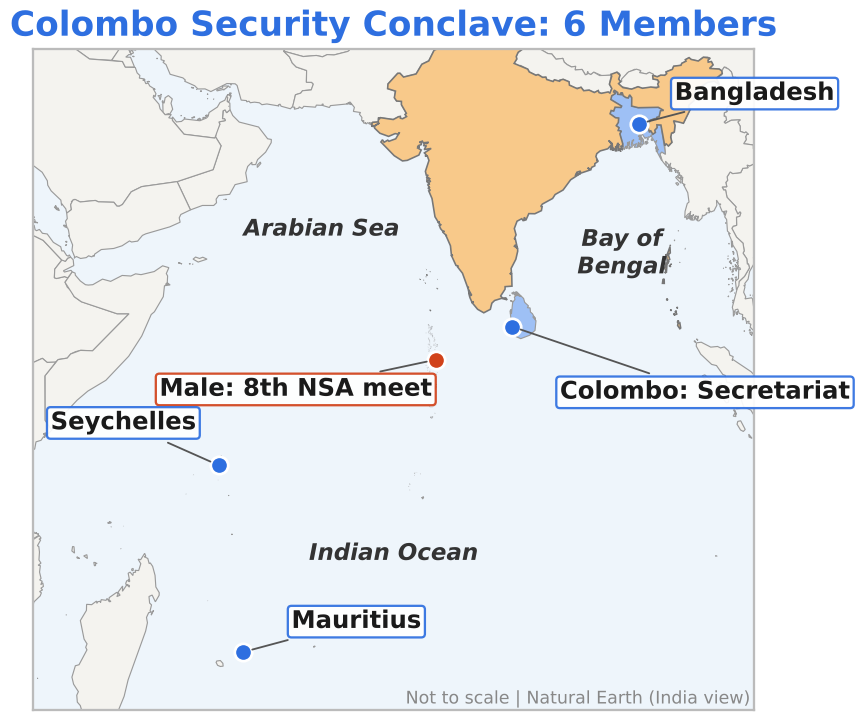
Six Indian Ocean neighbours work together on sea security, terror, smuggling and disasters under the Colombo Security Conclave. At its 8th NSA-level meeting in Male, India promised more help to build partners' capacity. The 8th National Security Advisers' meeting of the Colombo Security Conclave (CSC) was held in Male, Maldives, on 25 November 2026. NSA Ajit Doval said India will work closely with CSC countries to strengthen their collective capacity against changing security threats and will provide 'all necessary help'. He linked the CSC to India's Neighbourhood First policy and the MAHASAGAR vision, and said 'the seas must remain a space that connects nations rather than divides them'. Members are India, Sri Lanka, Maldives, Mauritius, Bangladesh and Seychelles.
Key facts
8th CSC NSA meeting: Male, 25 Nov 2026.
Members (6): India, Sri Lanka, Maldives, Mauritius, Bangladesh, Seychelles.
Bangladesh and Seychelles became full members at the 7th meeting (New Delhi, Nov 2025).
Five pillars: maritime safety and security; counter-terrorism and radicalisation; trafficking and organised crime; cyber security and critical infrastructure; humanitarian assistance and disaster relief.
Secretariat: Colombo (charter signed in 2024).
Way forward
Joint maritime domain awareness, shared coast-guard training and quick HADR coordination can make CSC a working security community.
Concept
CSC origin: began as a trilateral maritime security group of India, Sri Lanka and Maldives (2011); renamed Colombo Security Conclave in 2020; Mauritius joined in 2022. MAHASAGAR: Mutual and Holistic Advancement for Security and Growth Across Regions - India's Global South maritime vision announced in Mauritius in March 2025, building on SAGAR (2015). Net security provider: a country that helps others' security (training, patrols, disaster aid) beyond protecting itself. Exam angle: Prelims: CSC members and pillars, SAGAR vs MAHASAGAR, secretariat location. Mains: How minilateral groupings help India counter China's growing presence in the Indian Ocean Region.
Indian Ocean map showing the six Colombo Security Conclave members with Male and Colombo marked — StudyForGS
Aircraft must be regularly checked and repaired (MRO). India sends much of this work abroad. A new pact with Singapore will train Indian workers and build this industry at home. The Union Cabinet on 25 November 2026 approved an MoU with Singapore on cooperation in skills and industry development in aviation Maintenance, Repair and Overhaul (MRO). Civil Aviation Minister Ram Mohan Naidu said the aim is to make India a regional aviation 'workshop' where aircraft components are repaired at home. Indian training institutions will improve courses through knowledge exchange and industry exposure. Over time the pact should cut India's dependence on foreign MRO and save foreign exchange.
Key facts
Cabinet approval: 25 Nov 2026.
Area: skills and industry development in aviation MRO.
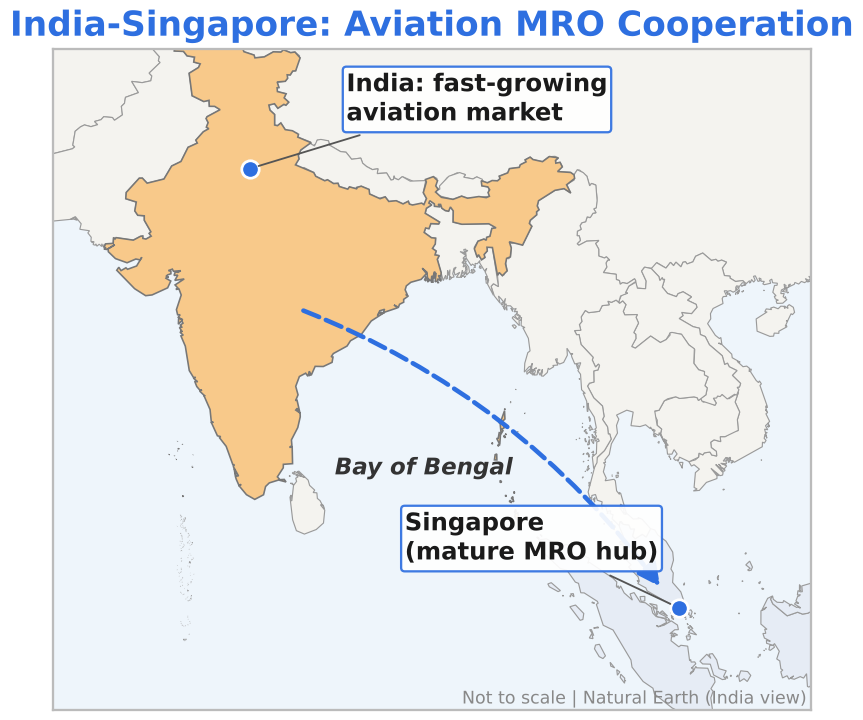
Singapore: a mature, well-established MRO hub.
India: among the world's fastest-growing aviation markets.
Benefit: less forex outflow, more skilled jobs.
Way forward
Pair the skills pact with stable tax rules and MRO zones at major airports to attract global players.
Concept
MRO: Maintenance, Repair and Overhaul - all the checks, repairs and part replacements that keep aircraft safe to fly; a high-skill, high-value service industry. India-Singapore ties: Singapore is a major source of FDI for India and a key partner in India's Act East Policy; the two have a Comprehensive Strategic Partnership. Exam angle: Prelims: meaning of MRO, Act East Policy partners. Mains: Why India's MRO sector lags and what policy steps (tax, skills, land at airports) can make India an MRO hub.
Map with an arrow from India to Singapore, a mature aviation MRO hub — StudyForGS
11. New Antivenom for North-East Pit Vipers
HEALTHUPSC: Prelims + Mains GS2/GS3
Syllabus linkage
GS2 - Health; GS3 - Science and technology, indigenous technology. Prelims (Big Four, antivenom) + Mains (snakebite as a neglected public health problem).
Context
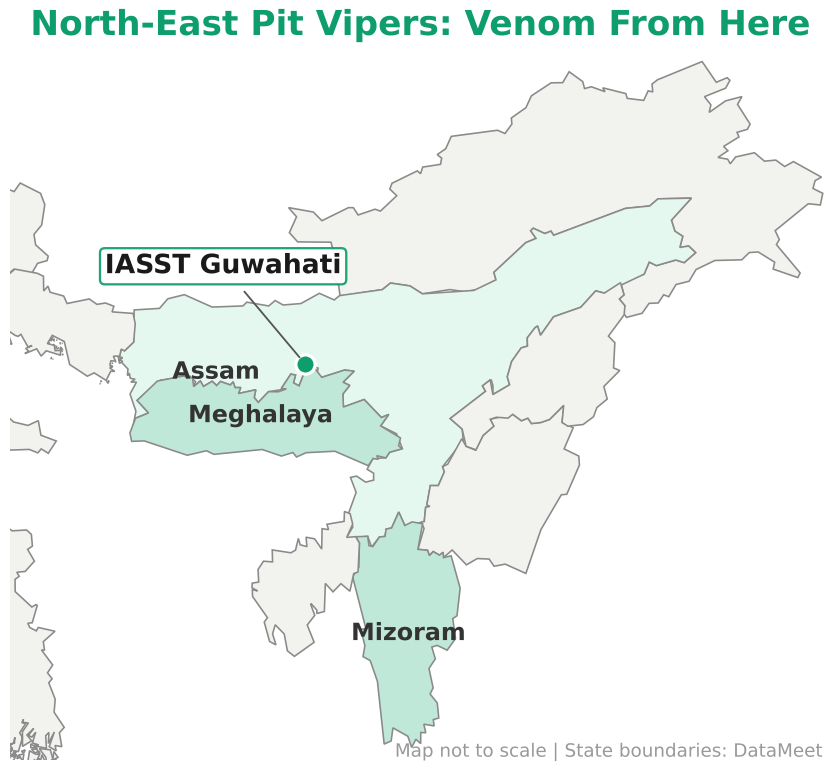
India's usual snakebite medicine works against four common snakes but poorly against many North-East snakes. Scientists in Guwahati have made a new antivenom that works better against two local pit vipers. A team led by Prof. Ashis K. Mukherjee at the Institute of Advanced Study in Science and Technology (IASST), Guwahati, has developed a bivalent (two-snake) antivenom against the red-tailed bamboo pit viper and Pope's pit viper. Venom samples came from Mizoram and Meghalaya. In laboratory and pre-clinical tests, it gave clearly better protection against these pit vipers than India's commercial polyvalent antivenom. Partners included Premium Serums and Vaccines, Amrita Research Center, Mizoram University and Aaranyak.
Key facts
Developed by IASST Guwahati (autonomous institute under the Department of Science and Technology).
Type: equine F(ab')2 bivalent antivenom.
Targets: red-tailed bamboo pit viper and Pope's pit viper.
Venom from Mizoram and Meghalaya.
Still at pre-clinical stage - human trials needed before use.
Way forward
Fast-track clinical trials and build a venom map of India so that each region gets antivenom matched to its snakes.
Concept
Big Four: Russell's viper, spectacled cobra, common krait and saw-scaled viper - India's polyvalent antivenom is made against these and may not neutralise other regional snakes. How antivenom is made: small doses of venom are injected into horses; their antibodies are collected, purified (F(ab')2 = antibody fragments) and given to bite victims. NAPSE (2024): National Action Plan for Prevention and Control of Snakebite Envenoming, aiming to halve snakebite deaths by 2030. Exam angle: Prelims: Big Four snakes, what monovalent/bivalent/polyvalent mean, NAPSE. Mains: Snakebite as a neglected tropical disease - why region-specific antivenoms and better rural care are needed.
North-East India map highlighting Mizoram, Meghalaya and Assam with IASST Guwahati marked — StudyForGS
12. Rs 11,000 Crore Construction Equipment Scheme
ECONOMYUPSC: Prelims + Mains GS3
Syllabus linkage
GS3 - Industrial policy, Make in India, infrastructure. Prelims (scheme features) + Mains (capital goods and Atmanirbhar Bharat).
Context
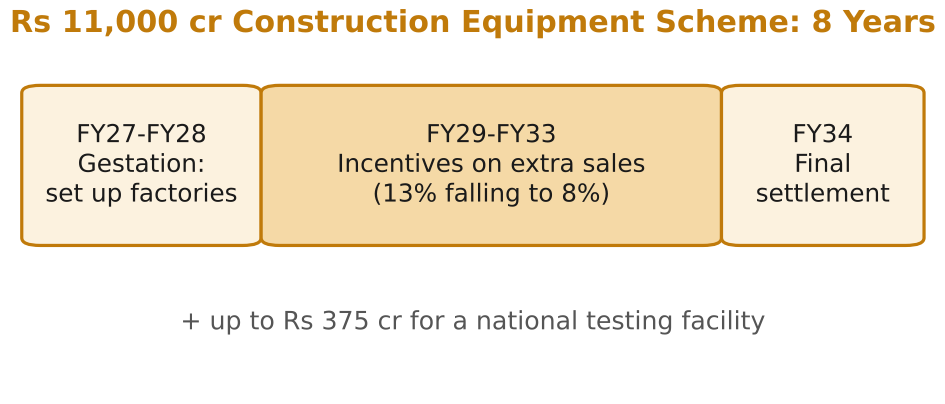
India imports many big machines like tunnel boring machines and port cranes. A new Rs 11,000 crore scheme will pay incentives to companies that make such machines and their parts in India. The Union Cabinet on 25 November 2026 approved the Scheme for Enhancement of Construction and Infrastructure Equipment (CIE) Manufacturing Ecosystem with Rs 11,000 crore, run by the Ministry of Heavy Industries for eight years from FY 2026-27. The first two years are a gestation period to set up factories; incentives on extra (incremental) sales will be paid for five years at rates falling from 13% to 8%. Up to Rs 375 crore is set aside as viability gap funding for a national CIE testing facility. Target products include ship-to-shore cranes, tunnel boring machines, hydraulic excavators and off-highway trucks.
Key facts
Outlay Rs 11,000 crore; 8 years from FY 2026-27; Ministry of Heavy Industries.
Incentives on incremental sales: 13% falling to 8% over five years.
Up to Rs 375 crore for a testing facility.
India: 3rd-largest CIE market after China and US.
Market: about Rs 97,500 crore (FY 2024-25), projected about Rs 2,28,100 crore by FY 2029-30.
Way forward
Link the scheme with public procurement, testing standards and R&D support so Indian machines can also compete in export markets.
Concept
Incentive linked to incremental sales: like PLI - the government pays a percentage only on sales above a base level, so it rewards actual growth in production. Viability Gap Funding (VGF): a one-time government grant that makes a socially useful but less profitable project financially viable. Capital goods: machines used to make other goods or build infrastructure; a strong capital goods sector reduces import dependence and supports long-term growth. Exam angle: Prelims: outlay, ministry, period, VGF meaning. Mains: Why domestic capital goods capacity matters for India's infrastructure push and strategic autonomy.
Eight-year timeline of the construction equipment scheme: gestation FY27-FY28, incentives FY29-FY33 falling from 13% to 8%, final settlement FY34 — StudyForGS
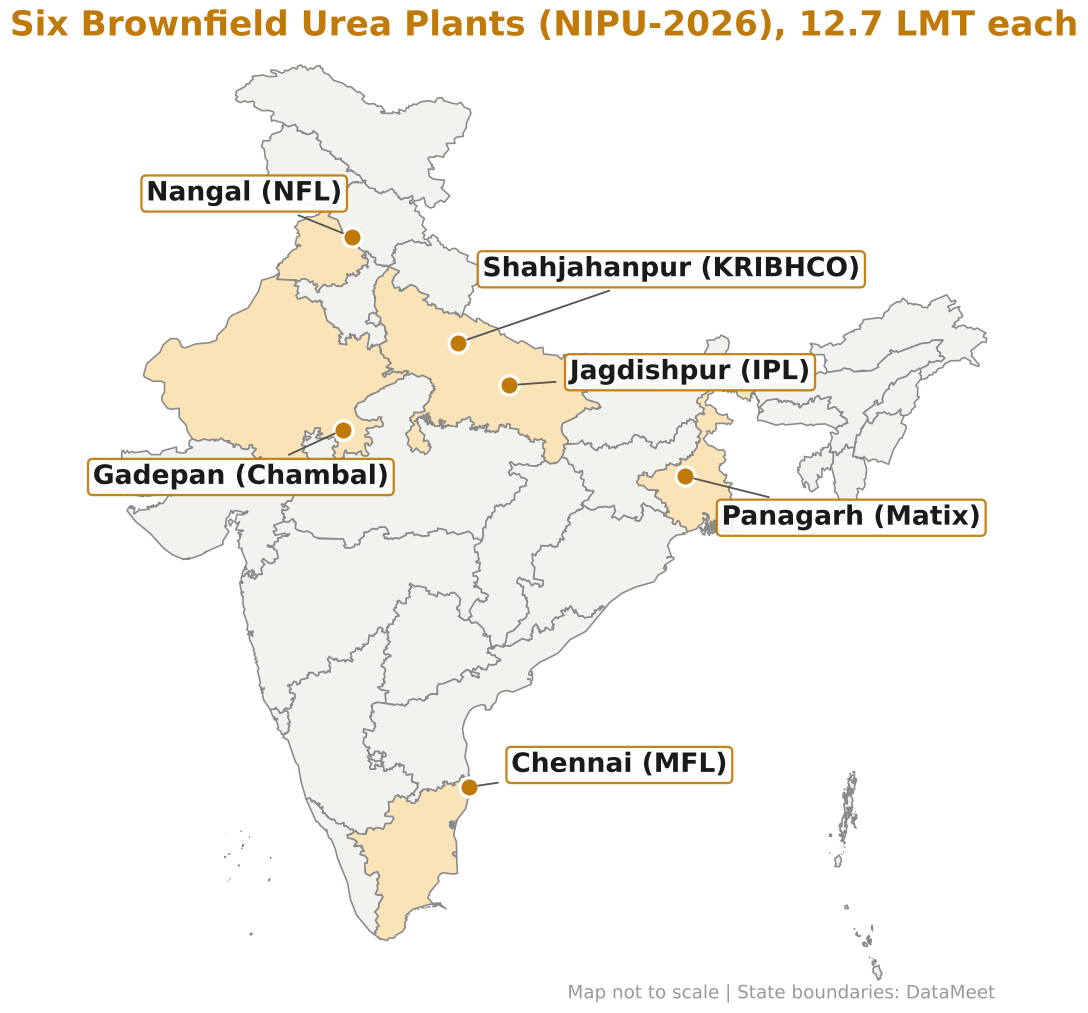
India still imports urea, a key fertiliser. The government has approved six new urea plants inside existing fertiliser complexes, worth about Rs 54,000 crore, to make more at home. On 25 November 2026 the government approved six brownfield urea plants under the National Investment Policy for Urea (NIPU)-2026, with an estimated investment of about Rs 54,000 crore. Each will have 12.7 lakh metric tonnes (LMT) annual capacity. They are at Chennai (Madras Fertilizers), Nangal (NFL), Shahjahanpur (KRIBHCO), Jagdishpur (Indian Potash Ltd), Panagarh (Matix) and Gadepan (Chambal Fertilisers). Some will replace old, energy-hungry plants; for example Nangal uses 6.498 Gcal of energy per tonne against a new-plant norm of 5 Gcal per tonne.
Key facts
6 plants x 12.7 LMT each; about Rs 54,000 crore.
Locations: Chennai (TN), Nangal (Punjab), Shahjahanpur and Jagdishpur (UP), Panagarh (WB), Gadepan (Rajasthan).
Brownfield = built inside existing complexes using land, utilities and staff already there.
Way forward
New capacity should come with energy efficiency, assured gas supply and policies that encourage balanced fertiliser use.
Concept
Brownfield vs greenfield: brownfield projects expand or rebuild at an existing site; greenfield projects start on fresh land - brownfield is usually faster and cheaper. Urea pricing: urea's farm-gate price is fixed by the government and the gap with cost is paid as subsidy - this leads to over-use of urea compared with P and K fertilisers (soil nutrient imbalance). Neem-coated urea (made 100% mandatory in 2015) slows nitrogen release and reduces diversion of subsidised urea to industry. Exam angle: Prelims: plant locations, NIPU-2026, neem coating. Mains: How to reduce urea import dependence while correcting NPK imbalance (nano urea, soil health cards, balanced use).
India map marking six urea plants at Nangal, Shahjahanpur, Jagdishpur, Gadepan, Panagarh and Chennai — StudyForGS
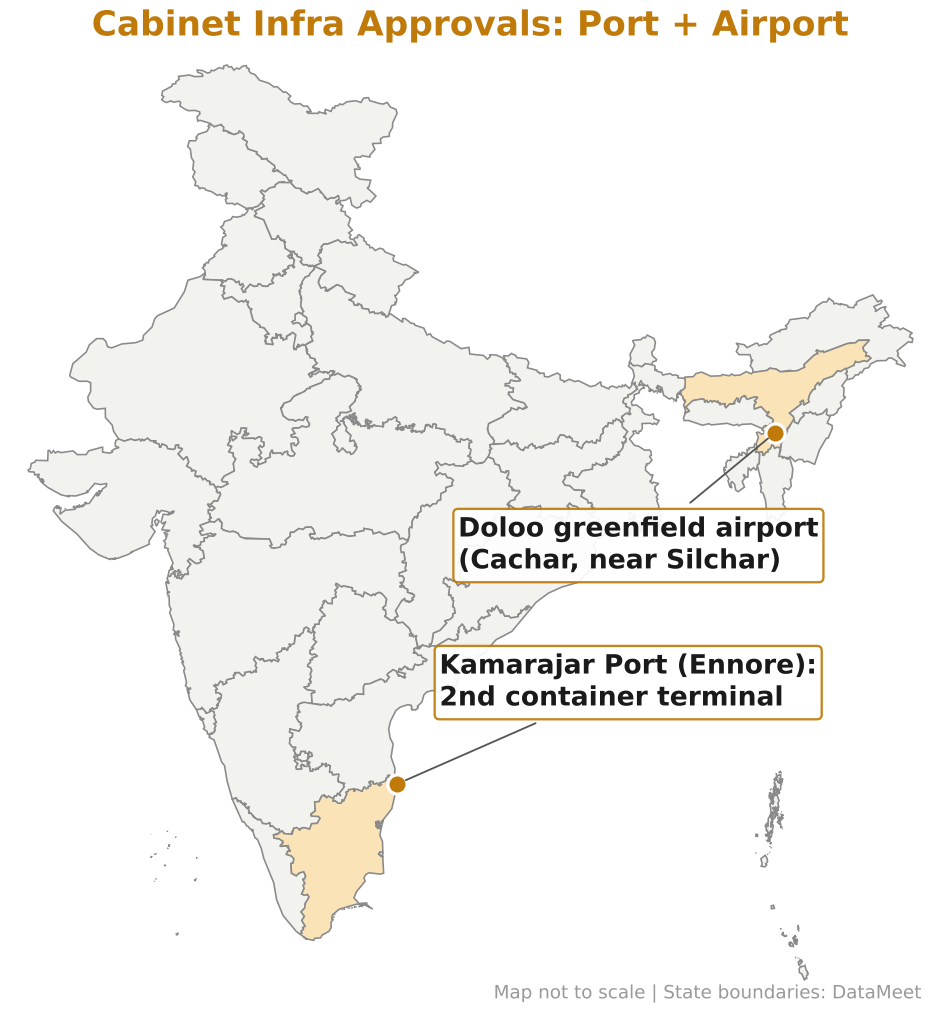
Kamarajar Port near Chennai is almost full for containers. The Cabinet has approved a second, much bigger container terminal built with private partners. The Cabinet Committee on Economic Affairs on 25 November 2026 approved a second container terminal at Kamarajar Port (formerly Ennore Port), Tamil Nadu, at Rs 4,288.26 crore (Phase I Rs 2,429.32 crore; Phase II Rs 1,858.94 crore). It will be built on a PPP basis in DBFOT mode, with the port separately spending Rs 450 crore on dredging. The terminal will be 900 m long with an 18 m draft and 2.0 million TEU yearly capacity, able to handle ships of up to 24,346 TEU and 400 m length. The existing terminal (0.8 million TEU) handled about 0.7 million TEU in FY 2025-26, about 88% use.
Key facts
Cost Rs 4,288.26 crore (incl. GST); two phases; DBFOT PPP.
Capacity 2.0 million TEU per year; 900 m quay; 18 m draft.
Can berth ships up to 24,346 TEU and 400 m long.
Port handled 49.08 million tonnes cargo in FY 2025-26.
Aligned with Maritime India Vision 2030 and Maritime Amrit Kaal Vision 2047.
Way forward
Better rail and road links to the hinterland and faster customs will decide whether the new capacity is fully used.
Concept
TEU (Twenty-foot Equivalent Unit): standard measure of container capacity = one 20-foot container. DBFOT: Design, Build, Finance, Operate and Transfer - a private firm builds and runs the asset for a fixed period, earns from it, then hands it back to the government. Draft: depth of water a ship needs; deeper drafts let bigger ships dock - vital for attracting mainline (large) container vessels. Exam angle: Prelims: TEU, DBFOT, port's former name, major port status. Mains: Role of port capacity and logistics in making Indian manufacturing export-competitive.
India map marking Kamarajar Port in Tamil Nadu and Doloo greenfield airport in Assam — StudyForGS
15. Greenfield Airport at Doloo Near Silchar
ECONOMYUPSC: Prelims + Mains GS3
Syllabus linkage
GS3 - Infrastructure (airports), regional connectivity; GS2 - North-East development. Prelims (location, AAI) + Mains (connectivity and NE growth).
Context
Silchar's present airport is cramped. The Cabinet has approved a brand-new airport at Doloo in Assam's Cachar district to better connect the Barak Valley. The Cabinet Committee on Economic Affairs on 25 November 2026 approved a greenfield airport at Doloo, Cachar district, Assam, at a cost of Rs 2,014 crore, to be built by the Airports Authority of India (AAI) from its own resources. It will handle 800 passengers in peak hours and about 10.1 lakh passengers a year. The new airport is meant to overcome space and operating limits of the existing Silchar airport and improve links to the Barak Valley and nearby North-Eastern regions, helping tourism and tea and agro-based industries.
Key facts
Cost Rs 2,014 crore; built and funded by AAI.
Capacity: 800 peak-hour passengers; about 10.1 lakh passengers a year.
Location: Doloo (tea estate land), Cachar district, near Silchar.
Serves the Barak Valley and neighbouring North-Eastern areas.
Total of Kamarajar terminal + Doloo airport: Rs 6,302 crore.
Way forward
Pair the airport with UDAN routes, cargo facilities for tea and perishables, and road links across the Barak Valley.
Concept
Greenfield airport: an airport built on new land rather than expanding an old one. Airports Authority of India: statutory body formed in 1995 under the AAI Act, 1994; it builds, runs and manages most civil airports and air navigation services in India. UDAN (2016): regional connectivity scheme that makes flying to small towns affordable through viability gap funding. Exam angle: Prelims: AAI, UDAN, Barak Valley geography. Mains: How air connectivity can reduce the North-East's isolation and boost its economy.
16. Forex Reserves Climb to US$ 737.78 Billion
ECONOMYUPSC: Prelims + Mains GS3
Syllabus linkage
GS3 - Indian economy, external sector, monetary policy. Prelims (composition of reserves) + Mains (external vulnerability).
Context
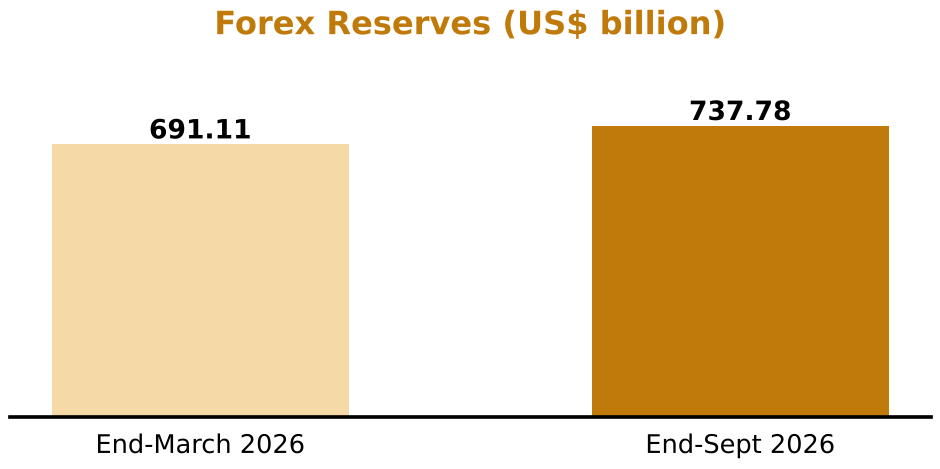
India's foreign currency savings, held by the RBI, rose by about US$ 47 billion in six months. These reserves protect the rupee and help pay for imports in a crisis. The RBI's 47th Half-Yearly Report on Management of Foreign Exchange Reserves, released on 25 November 2026, shows reserves rose from US$ 691.11 billion to US$ 737.78 billion between April and September 2026. The RBI has published these reports since 2004 to improve transparency about the size, makeup and investment of reserves. Separately, a strong surge of foreign equity inflows and RBI action have helped the rupee recover in recent weeks.
Report: RBI's 47th half-yearly report; series started 2004.
Reserves are a buffer against sudden capital outflows.
Also covers how reserves are invested (safety, liquidity, returns).
Way forward
Keep reserves strong but use them mainly to smooth sharp swings, while building export strength for lasting rupee stability.
Concept
Components of forex reserves: Foreign Currency Assets (largest part), gold, Special Drawing Rights (SDRs - IMF's reserve asset) and Reserve Tranche Position with the IMF. Import cover: how many months of imports the reserves can pay for - a common measure of reserve adequacy. Legal basis: RBI manages reserves under the RBI Act, 1934 and the Foreign Exchange Management Act (FEMA), 1999. Exam angle: Prelims: four components of reserves, SDR, who manages reserves. Mains: Are India's reserves adequate? Costs and benefits of holding large reserves.
Bar chart of forex reserves: US$ 691.11 billion at end-March 2026 and US$ 737.78 billion at end-September 2026 — StudyForGS
📜 Asked before in the exam — previous-year question on this topic
BPSC Prelims 2023 (69th CCE)The Foreign Exchange Reserves (FER) of RBI include which of the following? 1. Foreign Currency Assets (FCA) 2. Gold 3. Special Drawing Rights (SDR) 4. Reserve Tranche Position. Select the correct answer using the codes given below.
Women's Self Help Groups get cheaper loans through an interest subsidy. Now NABARD will manage this subsidy for all banks, using a new online portal, making payments faster and simpler. On 25 November 2026 the Department of Rural Development and NABARD signed an agreement under which NABARD becomes the single nodal agency for two DAY-NRLM schemes: the Interest Subvention Scheme for women SHGs and the Women Enterprise Acceleration Fund (WEAF). It will cover public, private, small finance, regional rural and cooperative banks. An Interest Subvention Portal was launched. The Rural Development Secretary said over Rs 14 lakh crore of formal credit has already reached SHGs, and the target is Rs 10 lakh crore more for SHGs and Rs 1 lakh crore for individual women's enterprises in five years.
Key facts
NABARD: single nodal agency for SHG interest subvention + WEAF.
Interest Subvention Portal launched.
Over Rs 14 lakh crore formal credit mobilised for SHGs so far.
Five-year target: Rs 10 lakh crore more for SHGs, Rs 1 lakh crore for individual enterprises.
Guarantee fee reimbursement makes collateral-free loans safer for banks.
Way forward
Move from group loans to enterprise finance with market links, digital records and skill training.
Concept
Interest subvention: the government pays part of the interest so the borrower pays a lower rate. NABARD (1982): apex development bank for agriculture and rural development; refinances rural banks and supervises RRBs and cooperative banks. SHG-Bank Linkage: groups of 10-20 women save together and then borrow from banks as a group - peer pressure keeps repayment high. Exam angle: Prelims: NABARD's role, DAY-NRLM, WEAF. Mains: How SHG credit can create 'Lakhpati Didis' and what stops SHGs moving from small loans to real enterprises.
18. Two Postal Schemes Extended Till 2031
ECONOMYUPSC: Prelims + Mains GS2/GS3
Syllabus linkage
GS2 - Government policies; GS3 - Infrastructure, logistics. Prelims (Central Sector schemes, India Post) + Mains (post offices in last-mile delivery).
Context
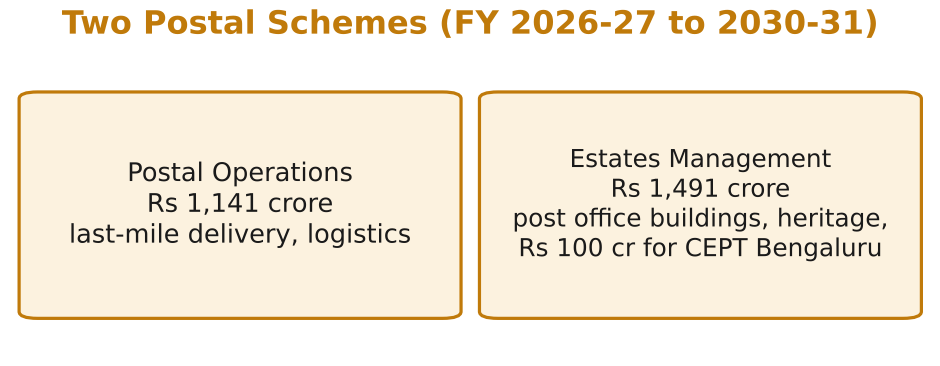
India Post will get money for five more years to improve delivery and logistics and to repair and build post office buildings, including heritage post offices. The Cabinet on 25 November 2026 approved continuing two Central Sector Schemes of the Department of Posts for the 16th Finance Commission cycle, FY 2026-27 to FY 2030-31. The Postal Operations Scheme (Rs 1,141 crore) will strengthen infrastructure, last-mile delivery and logistics as e-commerce grows. The Estates Management Scheme (Rs 1,491 crore) covers building and renovating post offices and staff quarters, uniform branding, heritage postal buildings and Rs 100 crore for permanent infrastructure of the Centre for Excellence in Postal Technology (CEPT), Bengaluru. India Post has about 1.65 lakh post offices, most of them rural.
Modern parcel hubs, digital tracking and partnerships with e-commerce firms can keep India Post relevant.
Concept
Central Sector Scheme: fully funded and run by the Union government (unlike Centrally Sponsored Schemes, where States share cost and implement). Department of Posts: under the Ministry of Communications; also runs India Post Payments Bank (2018) and small savings schemes. Exam angle: Prelims: Central Sector vs Centrally Sponsored schemes, CEPT location. Mains: Can India Post become a backbone for rural e-commerce and financial inclusion?
Two postal schemes: Postal Operations Rs 1,141 crore and Estates Management Rs 1,491 crore including Rs 100 crore for CEPT Bengaluru — StudyForGS
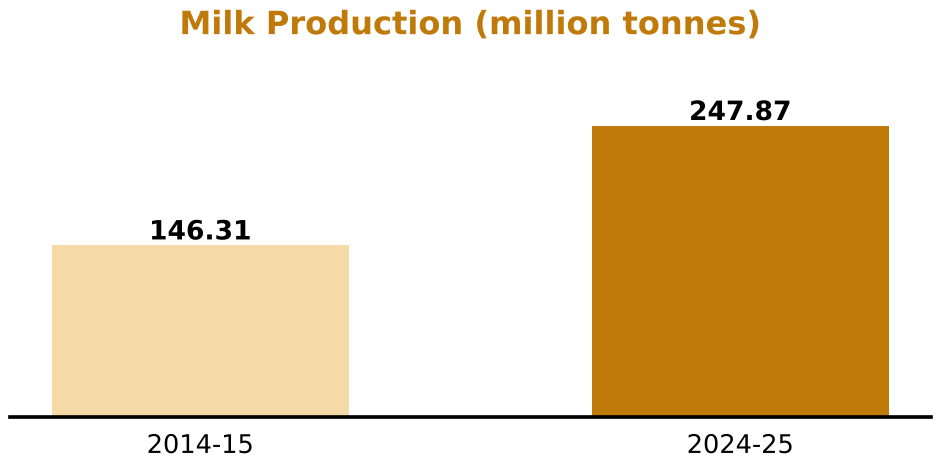
26 November is National Milk Day, the birthday of Dr Verghese Kurien. India, the world's biggest milk producer, made 247.87 million tonnes of milk in 2024-25 - about 69% more than ten years ago. An official factsheet released ahead of National Milk Day (26 November 2026) says milk production reached 247.87 million tonnes in 2024-25, up from 146.31 million tonnes in 2014-15, a 69.41% rise. Production grew at a compound annual rate of 5.41%. Per capita availability rose to 485 grams per day from 319 grams. Average yield per animal went from 1,640 kg to 2,800 kg a year. India produces nearly one-fourth of the world's milk.
Key facts
Milk output 2024-25: 247.87 million tonnes (2014-15: 146.31 MT).
Growth: 69.41% in a decade; CAGR 5.41%.
Per capita availability: 485 g/day (from 319 g).
Average yield per animal: 1,640 kg -> 2,800 kg per year.
India's share: nearly one-fourth of world milk output.
Way forward
Better breeds, fodder security, animal health and cooperative processing can raise yields further while keeping farmers' share high.
Concept
Dr Verghese Kurien (born 26 November 1921): 'Father of the White Revolution'; led Amul and the National Dairy Development Board (NDDB, 1965, Anand). Operation Flood (launched 1970): linked village milk cooperatives to city markets and made India self-sufficient in milk. White Revolution 2.0 (2024): Ministry of Cooperation plan to expand dairy cooperatives and raise their milk procurement; World Milk Day is on 1 June (FAO). Exam angle: Prelims: dates (26 Nov vs 1 June), Operation Flood, NDDB HQ, latest production data. Mains: Dairy cooperatives as a model for raising rural incomes and women's participation.
Bar chart of milk production: 146.31 million tonnes in 2014-15 and 247.87 million tonnes in 2024-25 — StudyForGS
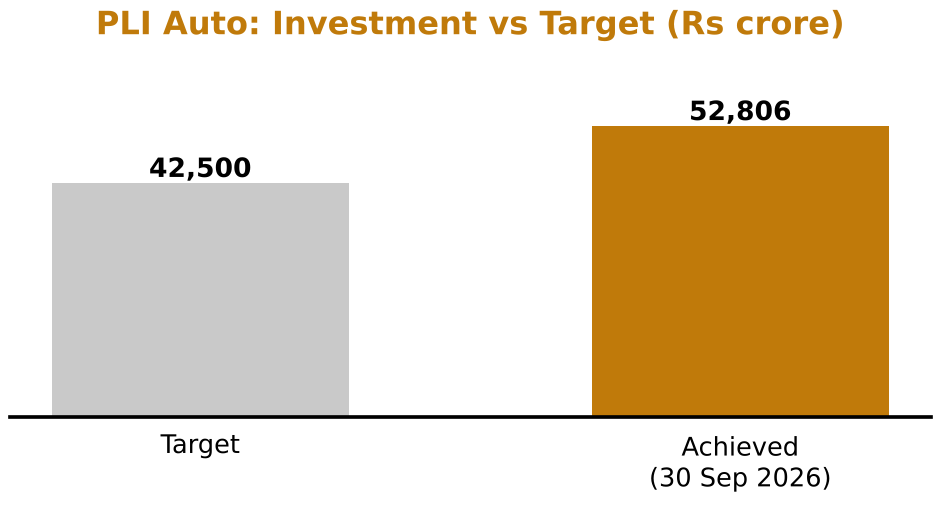
The production-linked incentive scheme for cars and auto parts has brought more investment than planned. Companies have invested Rs 52,806 crore against a target of Rs 42,500 crore. Heavy Industries Minister H.D. Kumaraswamy reviewed the PLI scheme for automobiles and auto components on 25 November 2026. The scheme has a total outlay of Rs 25,938 crore. In FY 2026-27 so far, Rs 4,385.28 crore of incentives has been paid; the cumulative total is Rs 6,771.64 crore. By 30 September 2026, approved companies had invested Rs 52,806 crore (target Rs 42,500 crore), added incremental sales of Rs 82,993 crore over the FY 2019-20 base year and created 77,755 jobs.
Investment Rs 52,806 crore vs target Rs 42,500 crore.
Incremental sales Rs 82,993 crore; 77,755 jobs.
Advanced Automotive Technology products need at least 50% domestic value addition.
Way forward
Shift focus to deep component localisation (batteries, chips) and exports to make the gains lasting.
Concept
PLI (Production Linked Incentive): the government pays a percentage of extra sales over a base year to firms that meet investment and output targets - started in 2020 for many sectors. Domestic Value Addition (DVA): the share of a product's value created inside India; a high DVA rule stops simple assembly of imported kits. Exam angle: Prelims: PLI auto outlay, base year, DVA condition. Mains: Has PLI succeeded? Compare targets with actual investment, jobs and exports.
Bar chart of PLI auto investment: target Rs 42,500 crore versus Rs 52,806 crore achieved by 30 Sep 2026 — StudyForGS
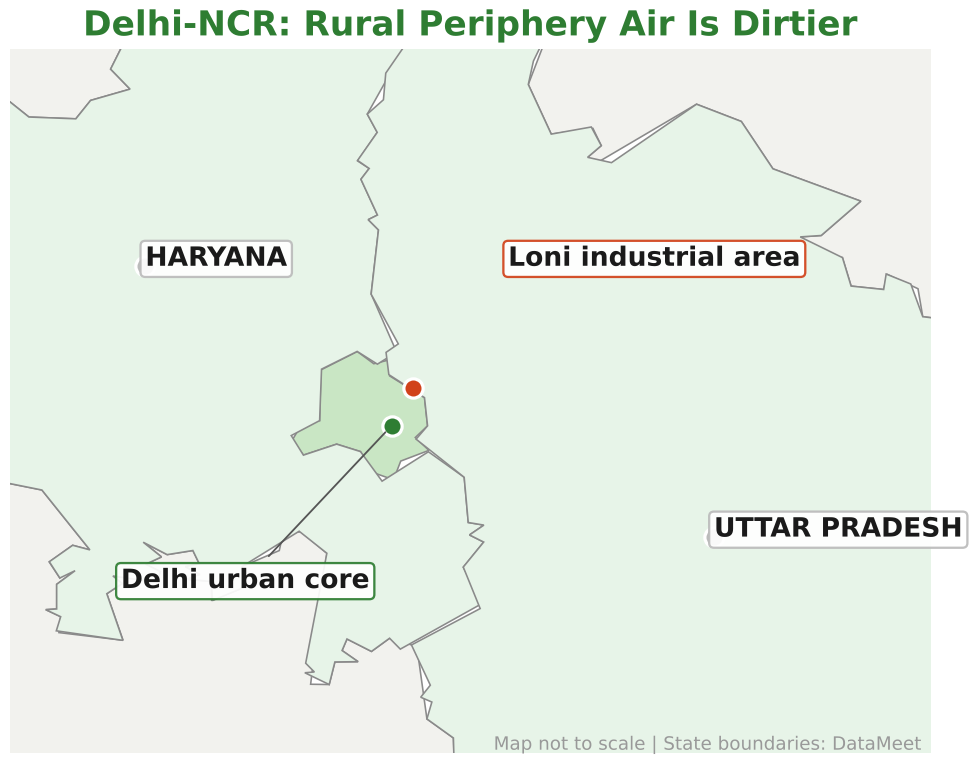
We usually think villages have cleaner air than cities. A new study finds the rural areas around Delhi have about 20% more fine dust (PM2.5) than Delhi's urban core, mainly from cooking with dung and wood, brick kilns and diesel. A study by IIT Delhi and the University of California, Berkeley, using 49 monitoring stations across the Delhi region from July to November 2024, found PM2.5 in rural areas around Delhi was about 20% higher than in urban centres. The gap appeared even in the monsoon months of July and August, so crop burning alone does not explain it. Main sources were household burning of dung cakes, firewood and crop waste for cooking and heating, brick kilns and small unregulated units, diesel generators, construction and heavy vehicles on unpaved roads. Researchers say clean air programmes must stop treating villages as 'clean'.
Higher even in monsoon months, so not only stubble burning.
Loni industrial area flagged as a major source.
Call: clean cooking fuel and regulation of brick kilns in rural NCR.
Way forward
Airshed-level planning, more rural monitors, affordable LPG refills and cleaner brick kiln technology (zig-zag) are needed.
Concept
PM2.5: tiny particles 2.5 micrometres or smaller in diameter; they go deep into lungs and blood and cause heart and lung disease. NCAP (National Clean Air Programme, 2019): mainly targets cities ('non-attainment cities'), which can leave rural pollution unmonitored. Commission for Air Quality Management (CAQM) in NCR and Adjoining Areas: statutory body (Act of 2021) that coordinates action against air pollution in the NCR region. Exam angle: Prelims: PM2.5 vs PM10, NCAP, CAQM. Mains: Why air pollution is a regional (airshed) problem and how household energy policy (Ujjwala refills) links to clean air.
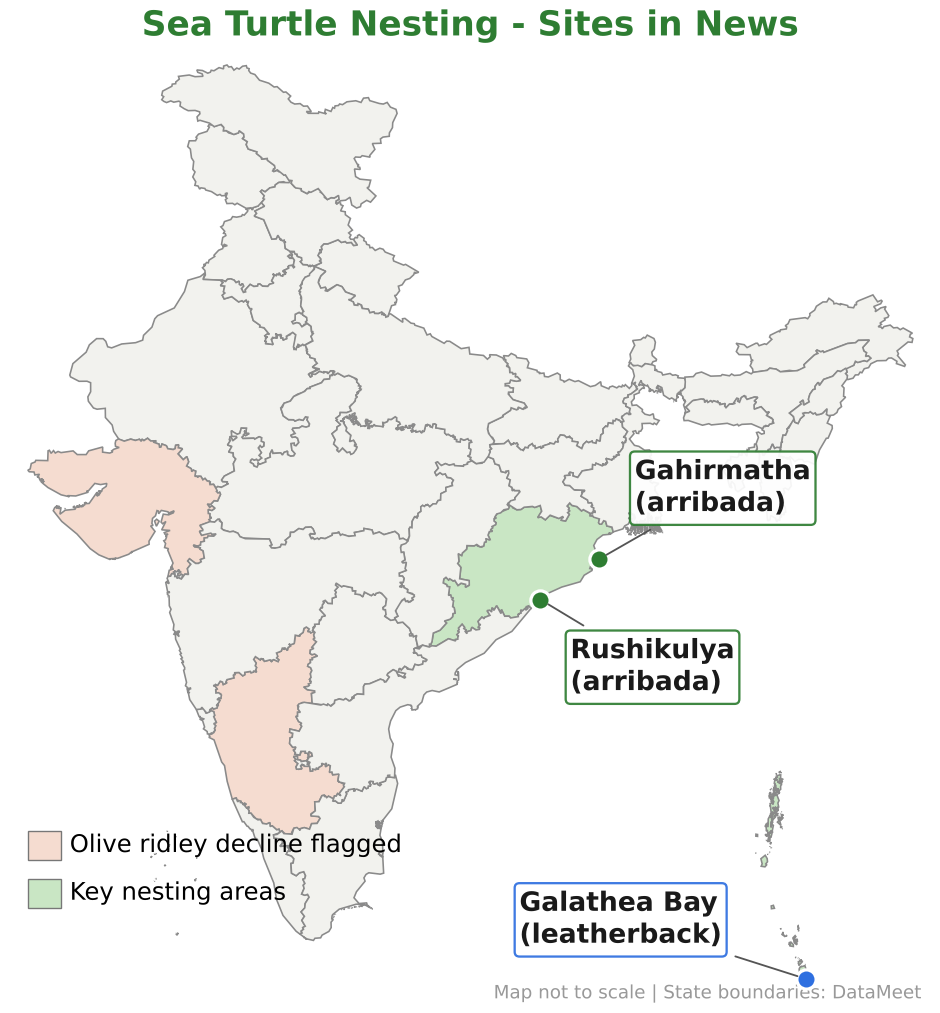
A national survey of sea turtles counted the highest-ever number of solitary olive ridley nests in India. But turtles are declining in some States, and big projects on islands like Great Nicobar may threaten nesting beaches. An all-India assessment by the Wildlife Institute of India (WII) recorded 18,713 solitary olive ridley nests in 2024-25, the highest count so far. Leatherback nests at Galathea Bay, Great Nicobar, rose from 643 (2023-24) to 889 (2024-25). Olive ridley numbers have fallen in Gujarat and Karnataka due to river-mouth closures, beach erosion and loss of sandy beaches. WII flagged data gaps in Lakshadweep and the Andaman and Nicobar Islands and recommends on-site egg protection and flipper tagging. Concerns remain over the Great Nicobar transshipment port project near nesting habitats.
Year-round monitoring, protected nesting beaches and careful environmental clearance for island projects are needed.
Concept
Olive ridley: smallest sea turtle; famous for 'arribada' (mass nesting) at Gahirmatha, Devi river mouth and Rushikulya in Odisha; IUCN Vulnerable; Schedule I of Wildlife (Protection) Act, 1972. Leatherback: largest living turtle, has a leathery shell instead of hard plates; Galathea Bay is one of its key nesting sites in India. Operation Olivia: Indian Coast Guard's yearly operation to protect olive ridleys off Odisha during the nesting season. Exam angle: Prelims: arribada sites, IUCN status, Schedule I, Galathea Bay. Mains: Great Nicobar project - balancing strategic and economic goals with fragile island ecology and tribal rights.
India map marking Gahirmatha and Rushikulya in Odisha and Galathea Bay in Great Nicobar, with Gujarat and Karnataka shaded for decline — StudyForGS
23. Nal Jal Mitra: Skilling for Village Water
ENVIRONMENTUPSC: Prelims + Mains GS2/GS3
Syllabus linkage
GS2 - Government schemes; GS3 - Water resources, skilling. Prelims (JJM, DGT) + Mains (sustaining rural water supply).
Context
Many villages now have tap water, but pipes and pumps need trained people to run and repair them. A new programme will train one lakh 'Nal Jal Mitras' for this job. The Directorate General of Training (Ministry of Skill Development and Entrepreneurship) signed an MoU with the Department of Drinking Water and Sanitation (Ministry of Jal Shakti) on 25 November 2026 for the Water Supply Operation and Maintenance Skilling Programme, called Nal Jal Mitra, under Jal Jeevan Mission 2.0. It aims to train and certify at least one lakh candidates at an estimated Rs 111.93 crore, fully paid by the Drinking Water Department. Training will run through ITIs and National Skill Training Institutes.
Key facts
Target: at least 1 lakh trained and certified Nal Jal Mitras.
Cost: Rs 111.93 crore (Department of Drinking Water and Sanitation).
Under Jal Jeevan Mission 2.0.
Delivered through ITIs and National Skill Training Institutes.
MoU signed 25 Nov 2026.
Way forward
Village water committees with trained local mechanics and user fees can keep taps running for decades.
Concept
Jal Jeevan Mission (launched 15 August 2019): aims to give every rural household a functional tap water connection (Har Ghar Jal); later extended to 2028. Operation and maintenance (O&M): the daily running and repair of water systems - without it, taps built under schemes stop working ('slip-back'). Exam angle: Prelims: JJM launch year, Har Ghar Jal, ministry. Mains: Why sustaining service delivery matters as much as building infrastructure in rural water schemes.
📜 Asked before in the exam — previous-year question on this topic
UPSC Prelims 2025Consider the following statements about 'PM Surya Ghar Muft Bijli Yojana': I. It targets installation of one crore solar rooftop panels in the residential sector. II. The Ministry of New and Renewable Energy aims to impart training on installation, operation, maintenance and repairs of solar rooftop systems at grassroot levels. III. It aims to create more than three lakhs skilled manpower through fresh skilling, and up-skilling, under scheme component of capacity building. Which of the statements given above are correct?
I and II only
I and III only
II and III only
I, II and III
Show answer
Answer: (d) I, II and III PM Surya Ghar Muft Bijli Yojana, launched in February 2024, aims to install rooftop solar in one crore households in the residential sector with up to 300 units of free electricity a month. MNRE provides grassroots training on installation, operation, maintenance and repair. Its capacity-building component targets more than three lakh skilled workers through fresh skilling and up-skilling. All three statements are correct. Practise all UPSC Prelims 2025 paper (free) →
Linked because this news is about the same topic. The answer is as per the official key of that year.
24. Kashi Tamil Sangamam 5.0 on Thirukkural
ART & CULTUREUPSC: Prelims + Mains GS1
Syllabus linkage
GS1 - Indian culture: literature, art forms; GS2 - national integration. Prelims (Thirukkural, KTS) + Mains (cultural unity in diversity).
Context
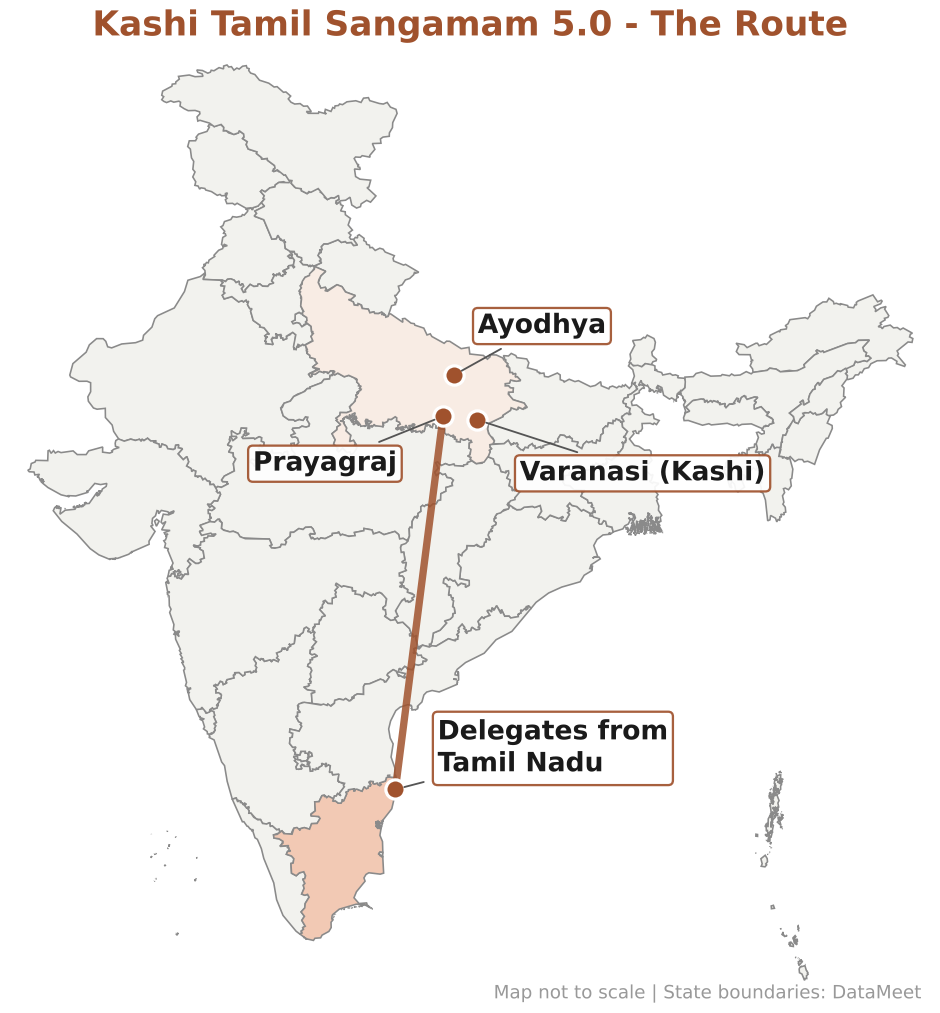
Kashi Tamil Sangamam celebrates the old cultural links between Tamil Nadu and Varanasi. Its fifth edition, from 28 November, focuses on the Thirukkural, a famous ancient Tamil book of wisdom. The fifth Kashi Tamil Sangamam runs from 28 November to 12 December 2026 with the theme 'Thirukkural Payilvom - Thirukkural Abhyas Karen' (Let us learn the Thirukkural). About 1,400 delegates from Tamil Nadu will visit Varanasi, Prayagraj and Ayodhya. A nationwide Students' Engagement Programme will involve 1,000 higher education institutions, and Tamil Nadu teachers will introduce the Thirukkural in schools and colleges in Uttar Pradesh. The event reflects the Ek Bharat Shreshtha Bharat spirit.
Key facts
Dates: 28 Nov - 12 Dec 2026; 5th edition.
Theme: Thirukkural.
About 1,400 delegates; Varanasi, Prayagraj, Ayodhya.
1,000 higher education institutions in student engagement.
First edition held in 2022.
Way forward
Translate classics like the Thirukkural into many Indian languages and build lasting student exchanges beyond event days.
Concept
Thirukkural: classical Tamil text by Thiruvalluvar - 1,330 couplets (kurals) in 133 chapters, divided into three parts: Aram (virtue), Porul (wealth/statecraft) and Inbam (love). Ek Bharat Shreshtha Bharat (2015): programme pairing States to promote cultural exchange and mutual understanding. Exam angle: Prelims: Thirukkural author and structure, KTS edition and theme. Mains: Role of cultural exchange programmes in strengthening national integration.
India map showing the route from Tamil Nadu to Varanasi, Prayagraj and Ayodhya — StudyForGS
25. India Pavilion Wins Visitors' Lion at Venice
ART & CULTUREUPSC: Prelims + Mains GS1
Syllabus linkage
GS1 - Indian art and culture; GS2 - soft power. Prelims (Venice Biennale, institutions) + Mains (cultural diplomacy).
Context
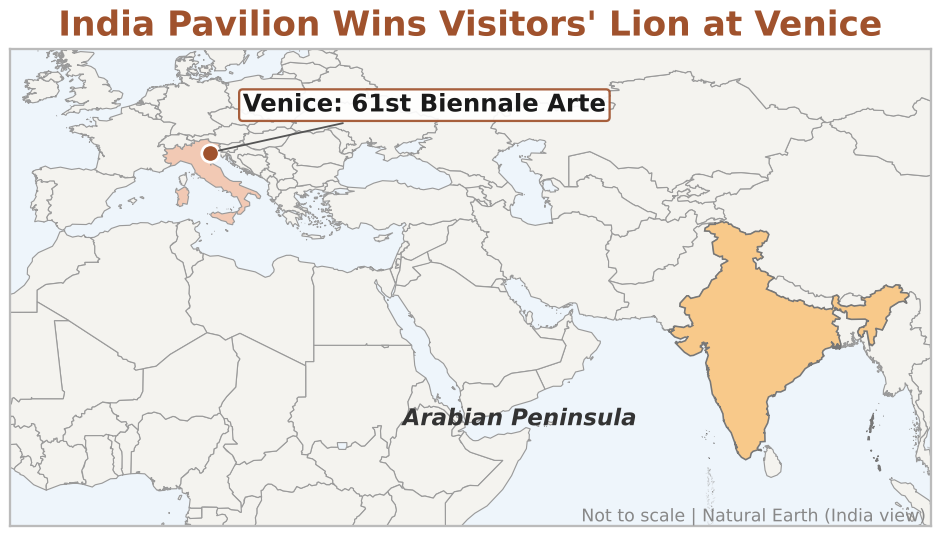
At the Venice Biennale, one of the world's top art shows, India's pavilion won the 'Visitors' Lion' - a prize decided by public votes - for best national participation. India's pavilion 'Geographies of Distance: Remembering Home' won the Visitors' Lion for Best National Participation at the 61st International Art Exhibition (Biennale Arte 2026), announced on 25 November 2026; the award is based on public preference. Prime Minister Narendra Modi welcomed it. The pavilion was presented by the Ministry of Culture with the Nita Mukesh Ambani Cultural Centre and Serendipity Arts; the National Gallery of Modern Art was Commissioner and IGNCA the implementing partner. Housed in the Arsenale di Venezia and opened on 6 May 2026, it explores how 'home' survives through memory, material and ritual, responding to the Biennale theme 'In Minor Keys'.
Key facts
Award: Visitors' Lion for Best National Participation (public vote).
Event: 61st International Art Exhibition, Venice Biennale 2026.
Pavilion: 'Geographies of Distance: Remembering Home'.
Commissioner: National Gallery of Modern Art; implementing partner: IGNCA.
Biennale theme: 'In Minor Keys'.
Way forward
Regular participation in global art events and support to contemporary artists can grow India's cultural diplomacy.
Concept
Venice Biennale: an international art exhibition held in Venice, Italy, since 1895; countries show work in national pavilions; its top prize is the Golden Lion. IGNCA (Indira Gandhi National Centre for the Arts): autonomous body under the Ministry of Culture for research and documentation of the arts. Exam angle: Prelims: Venice Biennale basics, NGMA and IGNCA roles. Mains: Soft power - how art and culture shape India's global image.
Map from Europe to India with Venice in Italy marked for the 61st Biennale Arte — StudyForGS
26. Satellite Supply Chain Depends on Imports
SCI-TECHUPSC: Prelims + Mains GS3
Syllabus linkage
GS3 - Space technology, indigenisation, Make in India. Prelims (IN-SPACe, space policy) + Mains (private sector in space).
Context
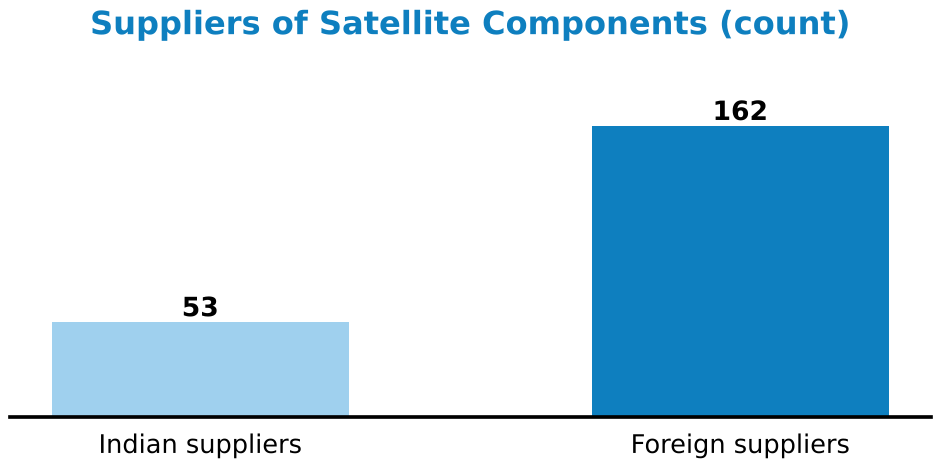
India builds satellites, but many of their key parts come from abroad. A space regulator's report says nearly 60% of satellite cost goes on imported components, and suggests ways to make them in India. A report by IN-SPACe released on 25 November 2026 says India's satellite supply chain is 'highly dependent' on imports. Nearly 60% of satellite cost comes from imported electronic, electrical and electromechanical components and special materials. It lists 53 Indian and 162 foreign suppliers, from countries such as the US, Germany, Japan, France and the Netherlands. Private firms mostly make structures and propulsion parts. Problems include few testing facilities, a project-by-project manufacturing model, 12-16 month procurement delays and a shortage of skilled staff. With the right policies, India could become a trusted supplier of space-grade parts within a decade.
Key facts
About 60% of satellite costs from imported components and materials.
Suppliers listed: 53 Indian vs 162 foreign.
Procurement delays of 12-16 months.
Gaps: testing facilities, skilled manpower.
Goal: India as a global supplier of space-grade components in 10 years.
Way forward
Shared testing labs, assured demand from ISRO and bulk orders, and skilled workforce programmes can cut import dependence.
Concept
IN-SPACe (Indian National Space Promotion and Authorization Centre, 2020): single-window agency under the Department of Space that authorises and promotes private space activities; HQ Ahmedabad. Indian Space Policy 2023: opens all space activities to private players; ISRO to focus on R&D. FDI in space (2024 change): satellite manufacturing allowed up to 74% under automatic route; components and sub-systems up to 100%. Exam angle: Prelims: IN-SPACe role and HQ, Space Policy 2023, FDI limits. Mains: Steps needed to build a domestic space component industry.
Bar chart of satellite component suppliers: 53 Indian and 162 foreign — StudyForGS
The bio-economy means businesses using living things - like microbes, cells and genes - to make medicines, fuels, food and materials. India aims to grow this to US$ 300 billion by 2030, and its startup ecosystem is now the third-largest in the world. Science and Technology Minister Dr Jitendra Singh said on 25 November 2026 at the CII Global Genomics Summit in New Delhi that India's bio-economy is set to reach US$ 300 billion by 2030, urging more investment in genomics and multi-omics. At HealthX Elevate 2026 the same day, he said India had about 350 startups in 2014 and now has over 2.5 lakh, making it the world's third-largest startup ecosystem. Over 60% of startups now come from Tier-II and Tier-III cities and smaller towns.
Key facts
Bio-economy target: US$ 300 billion by 2030.
Startups: about 350 (2014) -> over 2.5 lakh now.
India: 3rd-largest startup ecosystem.
Over 60% of startups from Tier-II/III cities and small towns.
Over 11,000 biotech startups reported.
Way forward
Shared bio-manufacturing facilities, clear regulation and patient capital will be key to meeting the target.
Concept
Genomics and multi-omics: study of all genes (genomics) together with proteins, metabolites etc. ('omics'), used for precision medicine and better crops. BioE3 Policy (2024): Biotechnology for Economy, Environment and Employment - promotes bio-manufacturing (biofoundries, bio-manufacturing hubs). BIRAC (2012): Biotechnology Industry Research Assistance Council under the Department of Biotechnology, funds biotech startups. Exam angle: Prelims: BioE3, BIRAC, Genome India Project. Mains: Can biotechnology be India's next IT story? Opportunities and constraints.
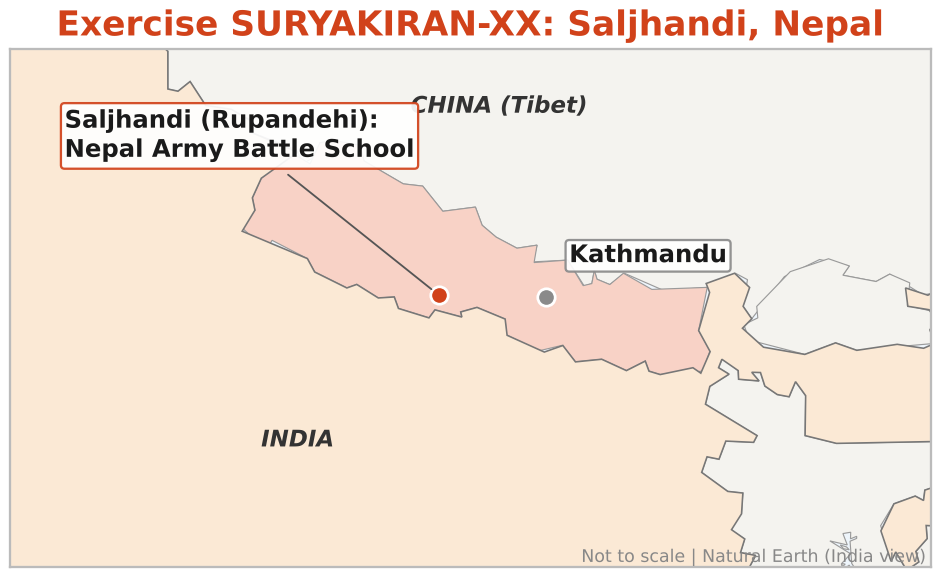
Indian and Nepalese soldiers are training together in Nepal for two weeks to fight insurgents and terrorists in tough hilly terrain and to handle disasters. The 20th edition of Exercise SURYAKIRAN began on 25 November 2026 at the Nepal Army Battle School, Saljhandi, Nepal, and will run until 8 December 2026. The Indian contingent of 334 personnel is from the Kumaon Regiment, with an equal number from the Nepal Army's Shree Jwala Dal Battalion. The focus is on working together (interoperability) in counter-insurgency and counter-terrorism in difficult terrain, plus heliborne operations, disaster response and medical training. It is an annual exercise held alternately in India and Nepal.
Key facts
20th edition; 25 Nov - 8 Dec 2026; Saljhandi, Nepal.
Joint disaster drills and training for the Himalayan region can deepen trust beyond military ties.
Concept
India-Nepal Treaty of Peace and Friendship (1950): basis of open border and close ties; Nepal borders five Indian States - Uttarakhand, Uttar Pradesh, Bihar, West Bengal and Sikkim. Honorary General tradition: the Indian and Nepal Army Chiefs are made honorary Generals of each other's army - a symbol of special military ties. Interoperability: the ability of two armies to plan and fight together using common procedures and communication. Exam angle: Prelims: exercise name and partner, Kumaon Regiment, States bordering Nepal. Mains: Defence diplomacy as a tool in India's Neighbourhood First policy towards Nepal.
Map of Nepal marking the Nepal Army Battle School at Saljhandi, Rupandehi, and Kathmandu — StudyForGS
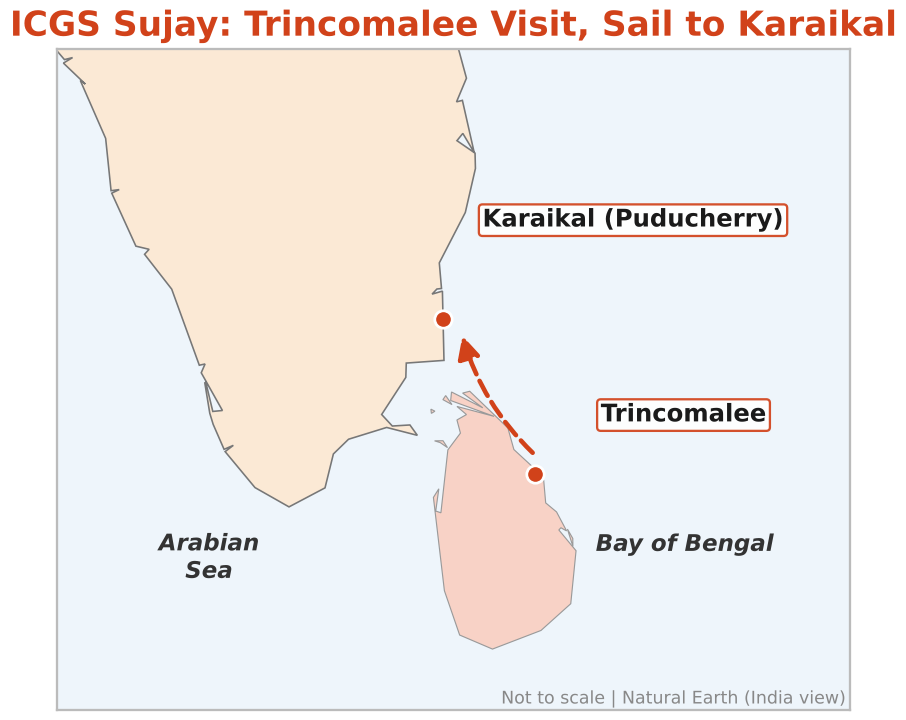
An Indian Coast Guard ship visited Trincomalee in Sri Lanka and trained Sri Lankan Coast Guard staff on handling oil and marine pollution at sea. ICGS Sujay, a Samarth-class Offshore Patrol Vessel of the Indian Coast Guard, made a three-day visit to Trincomalee, Sri Lanka, from 23 to 25 November 2026. The main focus was marine pollution response, with a specialist team training Sri Lanka Coast Guard personnel on pollution-response equipment. Activities also included a joint yoga session, a volleyball match and an open-ship visit. The ship carried 22 NCC cadets and staff of the India-Sri Lanka 'Maitri Sethu Yatra' cycling expedition from Trincomalee to Karaikal.
Carried 22 NCC cadets of Maitri Sethu Yatra to Karaikal.
Reflects Neighbourhood First and SAGAR vision.
Way forward
Joint pollution-response drills and shared equipment can protect the shared waters of the Palk Bay and Bay of Bengal.
Concept
Indian Coast Guard: armed force under the Ministry of Defence, set up under the Coast Guard Act, 1978; it is India's nodal agency for responding to oil spills at sea (National Oil Spill Disaster Contingency Plan). Trincomalee: a deep natural harbour on Sri Lanka's east coast, of strategic interest in the Bay of Bengal. Exam angle: Prelims: ICG's role in oil spills, location of Trincomalee and Karaikal. Mains: Maritime cooperation as a pillar of India-Sri Lanka relations.
Map of Sri Lanka and south India showing the route from Trincomalee to Karaikal — StudyForGS
Data point of the day
18,713
Solitary olive ridley nests recorded in India, 2024-25 Highest count recorded so far in an all-India assessment by the Wildlife Institute of India.
Prelims rapid-fire
Udyam 10 crore: MSME registrations on the Udyam portal and Udyam Assist Platform crossed 10 crore (30 Oct 2026); Udyam portal launched 1 July 2020.
Operation Drishti: Armed Forces Medical Services did 412 free eye surgeries at Military Hospital, Meerut (22-24 Nov 2026); 197 patients were underprivileged civilians.
Aero India 2027: 16th edition at Air Force Station Yelahanka, Bengaluru, 8-12 Feb 2027; two new hangars, and for the first time exhibitors may build mezzanine floors.
World Chess Championship: D. Gukesh (India, champion) vs Javokhir Sindarov (Uzbekistan) in Geneva, Switzerland (22 Nov - 12 Dec 2026); maximum 14 classical games.
Services PPI: DPIIT's Office of the Economic Adviser released provisional Service Producer Price Indices for Q2 FY 2026-27 (base 2022-23), covering 7 services; next release 24 Feb 2027.
Infra flash report: MoSPI (Oct 2026): 1,862 central projects worth Rs 38.11 lakh crore monitored; 46.88% of cost spent.
Yuva Somnath Yatra: Over 1,100 students completed the 5-day yatra (20-25 Nov 2026) to Somnath (first Jyotirlinga), Gujarat, under Somnath Swabhiman Parv.
25 November: International Day for the Elimination of Violence against Women; starts 16 Days of Activism (to 10 Dec). WCD Ministry launched '#NumberSaveKiya?' helpline-awareness campaign.
Mains practice question
Q. Large-scale revision of electoral rolls must balance accuracy with the right to vote. In the light of the Special Intensive Revision, discuss the constitutional and statutory framework and suggest safeguards against wrongful exclusion. (250 words)
Hint / approach
Cover Articles 324 and 326 and RP Act 1950 (Section 21); use the phase-3 data (6.15 crore deletions, 15.7% below 2024 rolls); weigh clean rolls vs exclusion of poor and migrant voters; suggest door-to-door verification, reasons for deletion, easy claims and public data.
📌 One-line revision: Section 301 = US unilateral trade tool; CSC has 6 members with secretariat in Colombo; Constitution adopted 26 Nov 1949; milk output 247.87 MT; forex US$ 737.78 bn.