Wednesday, 25 November 2026 · IST · National & International · 26 items
Today's digest covers the debate over a reported 50% rise in Lok Sabha seats, Nepal PM Balendra Shah's India visit with the 669 MW Lower Arun project, and RBI's draft Stop Switch and Trusted Person safeguards. It also explains COP31's collapse in Antalya, the Shenzhen Declaration, HPV vaccination crossing 1 crore doses, and 26 items in simple language with maps and diagrams.
Today at a glance — things to remember
Sibal warns opposition against a reported 50% Lok Sabha seat hike; amendment needs 362 votes.
SC issues notice on Lok Prahari PIL to finalise the judges' appointment MoP.
West Bengal cabinet clears renaming the state 'Paschim Banga'; Assembly tabling on 9 December.
Foundation stone laid for the 669 MW Lower Arun hydro project in Nepal.
COP31 in Antalya ends without a pact; COP32 goes to Addis Ababa.
HPV vaccination crosses 1 crore doses in under nine months.
RBI drafts Stop Switch and Trusted Person safeguards; comments till 14 December.
Ethanol blending reaches 19.99% in ESY 2025-26.
GRSE delivers ASW shallow water craft Ashank; Exercise Suryakiran XX begins in Nepal.
Detailed notes
1. Delimitation Row: The '50% Seat Hike' Offer
POLITYUPSC: Prelims + Mains GS2
Syllabus linkage
GS2 - Parliament, Representation of People, Constitutional Amendments, Federalism. Prelims: Articles 81, 82, 170, 368; Mains: North-South balance in representation.
Context
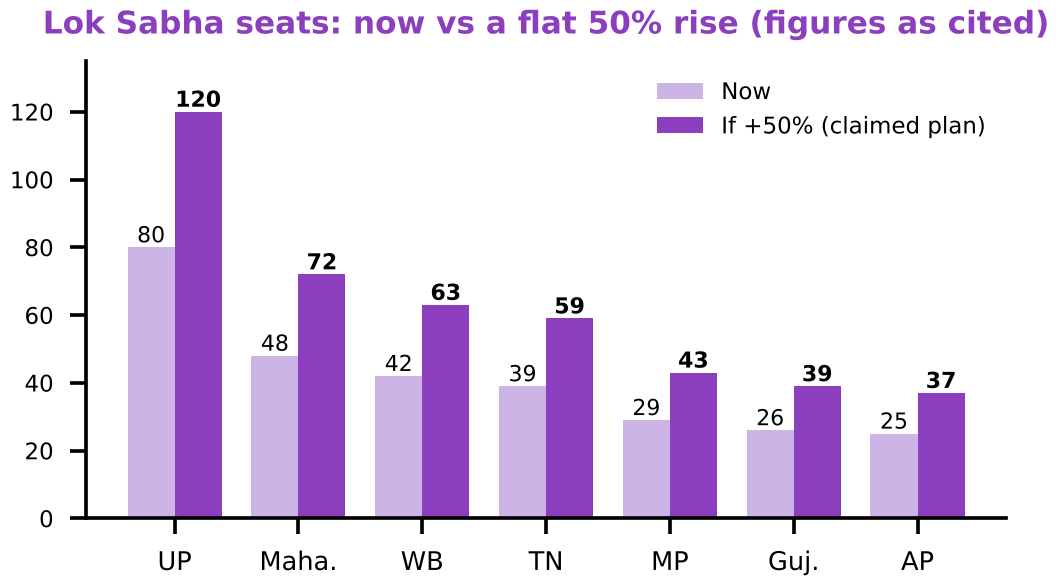
An opposition MP says the Centre may offer every state 50% more Lok Sabha seats to win support for a delimitation amendment. The fight is really about how power is shared between North and South. On 24 November 2026, Rajya Sabha MP Kapil Sibal warned opposition parties not to accept a reported plan to raise every state's Lok Sabha seats by 50%. He said the plan would need a constitutional amendment, for which 362 Lok Sabha votes are needed, and claimed the gains would favour northern states. As per his figures, Uttar Pradesh would go from 80 to 120 seats and Tamil Nadu from 39 to 59. Earlier, the Delimitation Bill, 2026 (introduced on 16 April 2026) proposed raising Lok Sabha strength from 543 to 850.
Key facts
Sibal's claim: 50% more seats for every state; constitutional amendment needs 362 votes in the Lok Sabha.
Examples cited: UP 80 -> 120, Maharashtra 48 -> 72, West Bengal 42 -> 63, Tamil Nadu 39 -> 59.
Delimitation Bill, 2026 (16 April 2026): Lok Sabha from 543 to 850 seats (815 from states, 35 from UTs).
Monsoon Session was adjourned sine die (without a fixed date) on 13 August 2026 but not prorogued (formally closed).
Women's reservation (106th Amendment, 2023) starts only after the next delimitation.
Way forward
Any change in seats should come after wide consultation with states, so that population control is not punished and equal value of votes is also respected.
Concept
Delimitation = redrawing the number and boundaries of constituencies after a census. Art. 82 (Lok Sabha) and Art. 170 (state assemblies) require readjustment after each census; it is done by a Delimitation Commission. Seat freeze: the 42nd Amendment (1976) froze seats on the 1971 Census; the 84th Amendment (2001) extended the freeze until the first census after 2026. So states that controlled population (mostly southern) fear losing share. Special majority (Art. 368) = majority of total membership + two-thirds of members present and voting. Two-thirds of 543 is 362. Exam angle: Prelims: Articles 81/82/170, 42nd and 84th Amendments, 106th Amendment link, meaning of sine die vs prorogation. Mains: 'one person, one vote' vs federal fairness; options like a fixed share for states, raising seats, or strengthening the Rajya Sabha.
Bar chart: Lok Sabha seats now vs a 50% rise for UP, Maharashtra, West Bengal, Tamil Nadu, MP, Gujarat and Andhra Pradesh — StudyForGS
📜 Asked before in the exam — previous-year question on this topic
UPSC Prelims 2016The Parliament of India acquires the power to legislate on any item in the State List in the national interest if a resolution to that effect is passed by the
Lok Sabha by a simple majority of its total membership
Lok Sabha by a majority of not less than two-thirds of its total membership
Rajya Sabha by a simple majority of its total membership
Rajya Sabha by a majority of not less than two-thirds of its members present and voting
Show answer
Answer: (d) Rajya Sabha by a majority of not less than two-thirds of its members present and voting Under Article 249, if the Rajya Sabha passes a resolution, supported by not less than two-thirds of the members present and voting, declaring that it is necessary in the national interest, Parliament may make laws on any matter in the State List. Such a resolution remains in force for up to one year and can be renewed. The Lok Sabha has no role in passing this resolution. Hence option (d). Practise all UPSC Prelims 2016 paper (free) →
Linked because this news is about the same topic. The answer is as per the official key of that year.
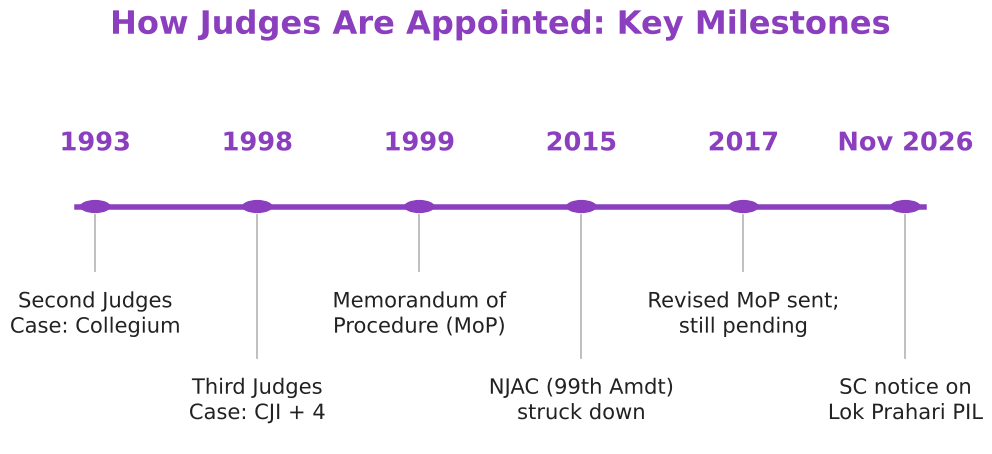
The Supreme Court has asked the government why the rulebook for appointing judges (MoP) is still not final after a decade. A clear rulebook means faster, more transparent appointments. A bench of Justices M M Sundresh and P B Varale issued notice to the Union government, the Chief Justice of India and the Supreme Court (in its administrative role) on a PIL filed by the NGO Lok Prahari. The petition seeks finalisation of the revised Memorandum of Procedure (MoP) for appointing judges and wants Collegium decisions to come under the RTI Act. Appointments still follow the 1999 MoP because the revised version has been 'under consideration' since 2017.
Key facts
Petitioner: NGO Lok Prahari; bench: Justices M M Sundresh and P B Varale.
Original MoP drawn up in 1999, after the Second (1993) and Third (1998) Judges Cases.
NJAC (99th Amendment) struck down by a five-judge bench in October 2015.
In December 2015 the Court said drafting the MoP is an executive job, done with the CJI, but gave no deadline.
Sticking points: Centre's wish to reject names on 'national security' grounds and a permanent Collegium secretariat.
Way forward
A finalised MoP with fixed timelines and clear reasons for rejection can cut vacancies and build trust without hurting judicial independence.
Concept
Collegium = a group of the CJI and the four senior-most SC judges (for SC) that recommends names; created by judgments, not by the Constitution's text. Art. 124(2) (SC) and Art. 217 (HC) speak only of 'consultation'. MoP (Memorandum of Procedure) = an agreed rulebook between government and judiciary on how names move, who checks them and in what time. NJAC = National Judicial Appointments Commission (CJI, two senior judges, Law Minister, two eminent persons); struck down as it hurt judicial independence (basic structure). Exam angle: Prelims: Judges Cases years, 99th Amendment, Articles 124/217/224. Mains: delays in appointments, transparency of the Collegium, need for a time-bound MoP.
Timeline of judicial appointment milestones from the Second Judges Case 1993 to the Supreme Court notice in November 2026 — StudyForGS
📜 Asked before in the exam — previous-year question on this topic
BPSC Prelims 2023 (69th CCE)Consider the following statements about the collegium system: 1. The Supreme Court collegium is a five-member body, headed by the incumbent Chief Justice of India (CJI) and comprises four other senior most Judges. 2. The Parliament by law has evolved the collegium system. 3. The Judges of the Supreme Court and High Courts are appointed only through the collegium system. 4. The collegium system was introduced in the year 1993 by Justice P. N. Bhagwati in the landmark First Judges Case. Which of the above statements is/are correct?
Linked because this news is about the same topic. The answer is as per the official key of that year.
3. West Bengal to Become 'Paschim Banga'?
POLITYUPSC: Prelims + Mains GS2
Syllabus linkage
GS2 - Federalism, Union and its territory (Articles 3 and 4). Prelims: procedure to rename states; Mains: Centre-state relations.
Context
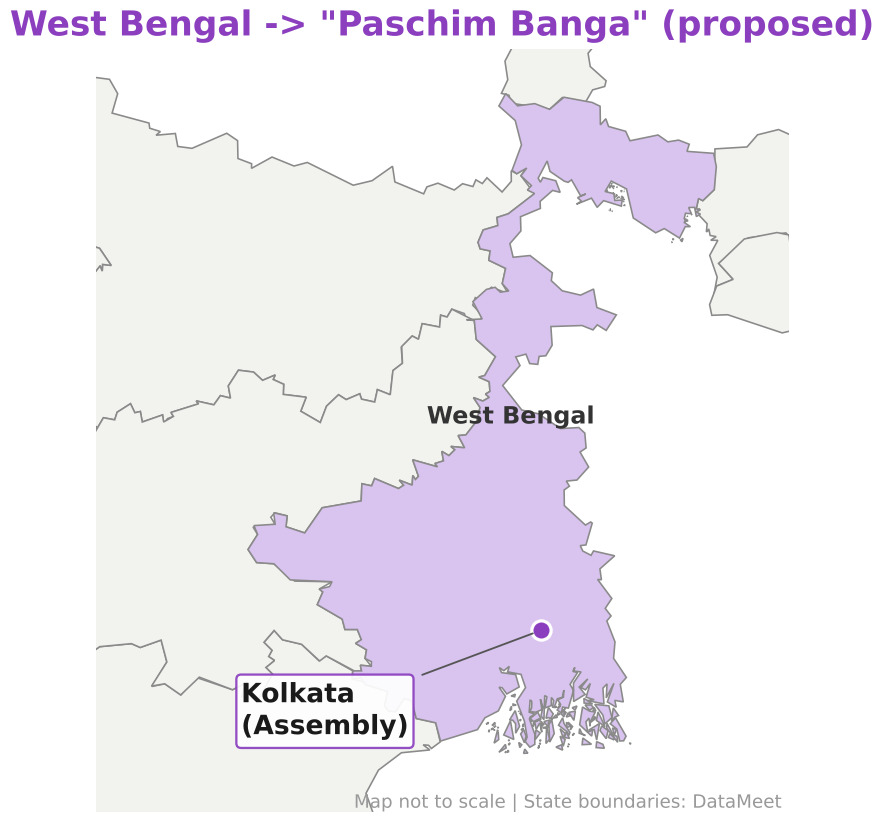
The West Bengal government wants to change the state's English name to 'Paschim Banga'. Only Parliament can finally change a state's name. On 23 November 2026, West Bengal Chief Minister Suvendu Adhikari said the state cabinet has approved renaming the state 'Paschim Banga', to be written the same way in English and other languages. The proposal is to be tabled in the Assembly on 9 December, during the winter session that begins on 4 December. If passed, it goes to the Union government; Parliament must then pass a law under Article 3. One stated reason: 'West' Bengal appears near the bottom of alphabetical lists.
Key facts
Announced 23 November 2026 after a cabinet meeting; Assembly tabling planned for 9 December.
Earlier attempts: 2011 ('Paschim Banga'), 2016 (three names) and 2018 ('Bangla') - none approved by the Centre.
Final change needs a Parliamentary law under Article 3 and the President's assent.
Name to reflect post-Partition history (Bengal was partitioned in 1947).
Way forward
The Centre should decide quickly and transparently, while the state builds consensus across parties.
Concept
Article 3 = Parliament can form new states or change the area, boundaries or name of any state by law. The Bill needs the President's recommendation, and the President first refers it to the state legislature for its views (views are not binding). Article 4 = such laws are not 'constitutional amendments' under Art. 368, so a simple majority is enough. Past renamings: Orissa to Odisha (2011), Uttaranchal to Uttarakhand (2007), Pondicherry to Puducherry (2006). Exam angle: Prelims: Article 3 procedure, simple majority, President's recommendation. Mains: should states have the final say on their own name?
India map zoomed on West Bengal with Kolkata marked — StudyForGS
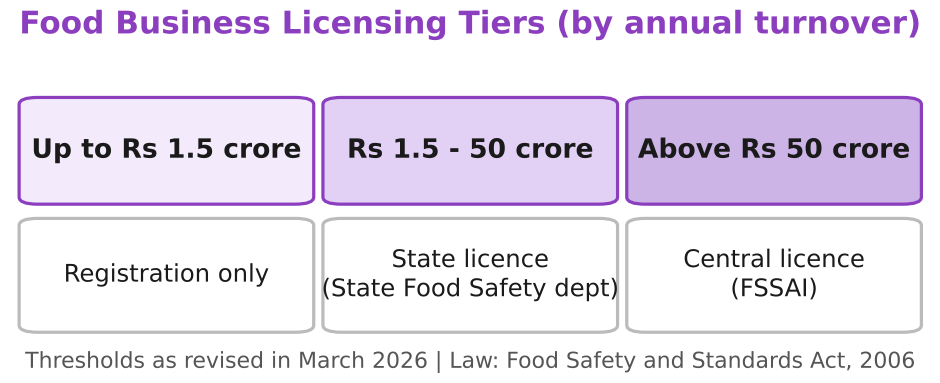
Maharashtra's food department had gone to court saying the central food regulator was taking away state powers. The case was withdrawn, but the question of who checks which food business is still open. In September 2026, Maharashtra's Food and Drug Administration (FDA) Commissioner had petitioned the Bombay High Court, alleging that the Centre and FSSAI built a 'parallel enforcement system' that took over state powers under the Food Safety and Standards Act, 2006. It said its officers could not independently raid centrally licensed units. The petition has now been withdrawn, leaving the jurisdiction question unresolved. Under the March 2026 thresholds, businesses above Rs 50 crore turnover need a Central licence.
Key facts
Petition filed in Bombay HC in September 2026; now withdrawn.
Licensing tiers: up to Rs 1.5 crore = registration; Rs 1.5-50 crore = State licence; above Rs 50 crore = Central licence.
Maharashtra cited Section 36(1) of the FSS Act (state-appointed Designated Officers).
FoSCoS online licensing portal launched in October 2020.
Way forward
A clear joint protocol on inspections and data sharing can protect consumers better than court fights.
Concept
FSSAI = Food Safety and Standards Authority of India, a statutory body under the FSS Act, 2006, working under the Union Health Ministry; HQ New Delhi. It sets food standards. Implementation is shared: State Food Safety Commissioners and Designated Officers enforce the Act on the ground. Food adulteration is in the Concurrent List (Entry 18), so both Centre and states can make laws on it. Exam angle: Prelims: FSSAI's parent Act and ministry, licensing thresholds, Concurrent List entry. Mains: uniform national standards vs state enforcement - how to avoid overlap.
Diagram of food business licensing tiers by annual turnover — StudyForGS
📜 Asked before in the exam — previous-year question on this topic
UPSC Prelims 2018Consider the following statements: 1. The Food Safety and Standards Act, 2006 replaced the Prevention of Food Adulteration Act, 1954. 2. The Food Safety and Standards Authority of India (FSSAI) is under the charge of Director General of Health Services in the Union Ministry of Health and Family Welfare. Which of the statements given above is/are correct?
1 only
2 only
Both 1 and 2
Neither 1 nor 2
Show answer
Answer: (a) 1 only Statement 1 is correct: the Food Safety and Standards Act, 2006 consolidated various food laws and repealed the Prevention of Food Adulteration Act, 1954. Statement 2 is wrong. The Food Safety and Standards Authority of India is a statutory body under the administrative control of the Union Ministry of Health and Family Welfare, headed by its own chairperson with a chief executive officer, and it is not placed under the Director General of Health Services. Practise all UPSC Prelims 2018 paper (free) →
Linked because this news is about the same topic. The answer is as per the official key of that year.
5. Santhal Daughters' Right to Property
POLITYUPSC: Prelims + Mains GS2
Syllabus linkage
GS2 - Rights of Scheduled Tribes, gender justice; GS1 - Indian society, tribes. Prelims: Hindu Succession Act Sec 2(2), Santhals, Ol Chiki; Mains: customary law vs equality.
Context
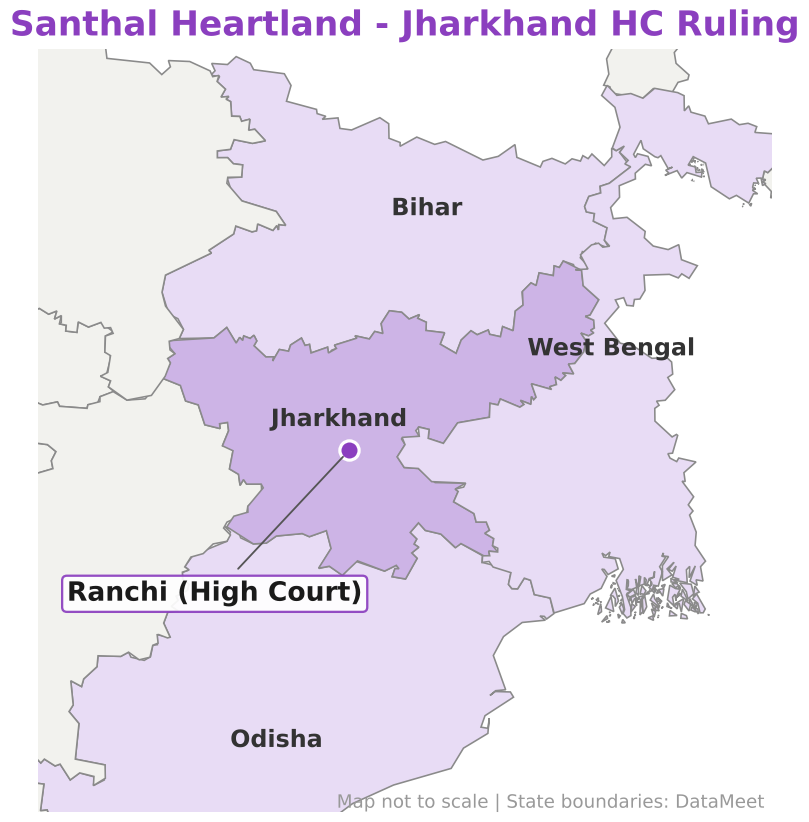
The Jharkhand High Court has said Santhal daughters cannot be kept out of their father's property just because of tradition. A custom must be properly proved in court. As reported on 23 November 2026, the Jharkhand High Court held that daughters in the Santhal Adivasi community cannot be denied their father's property 'solely on traditional grounds'. The issue arises because the Hindu Succession Act does not apply to Scheduled Tribes, so tribal inheritance follows custom. Courts insist that a custom which departs from the general law must be proved as ancient, certain and continuous.
Key facts
Court: Jharkhand High Court (Ranchi); community: Santhal.
Santhals are among India's largest Scheduled Tribes, living mainly in Jharkhand, West Bengal, Bihar and Odisha.
Santhali is in the Eighth Schedule (added by the 92nd Amendment, 2003); script: Ol Chiki.
Santhal Hul (rebellion) of 1855-56 was led by Sidhu and Kanhu Murmu.
Way forward
Codifying tribal inheritance through community consultation can give women rights without erasing tribal identity.
Concept
Section 2(2), Hindu Succession Act, 1956 = the Act does not apply to members of Scheduled Tribes (Art. 366(25)) unless the Central Government notifies otherwise. So tribal women often depend on custom. Customary law = unwritten rules followed for a long time; a court accepts it only if it is proved to be ancient, certain, reasonable and not against public policy. Equality clauses (Articles 14 and 15) push courts to read customs in favour of women where custom is not clearly proved. Exam angle: Prelims: Sec 2(2) HSA, Santhali in 8th Schedule, Ol Chiki, Santhal Hul. Mains: balancing tribal autonomy (Fifth Schedule, PESA) with gender justice.
India map showing Jharkhand and neighbouring Santhal-majority states with Ranchi marked — StudyForGS
6. Nepal PM Balendra Shah's India Visit
IRUPSC: Prelims + Mains GS2
Syllabus linkage
GS2 - India and its neighbourhood, bilateral agreements. Prelims: places and projects; Mains: Neighbourhood First, trust deficit with Nepal.
Context
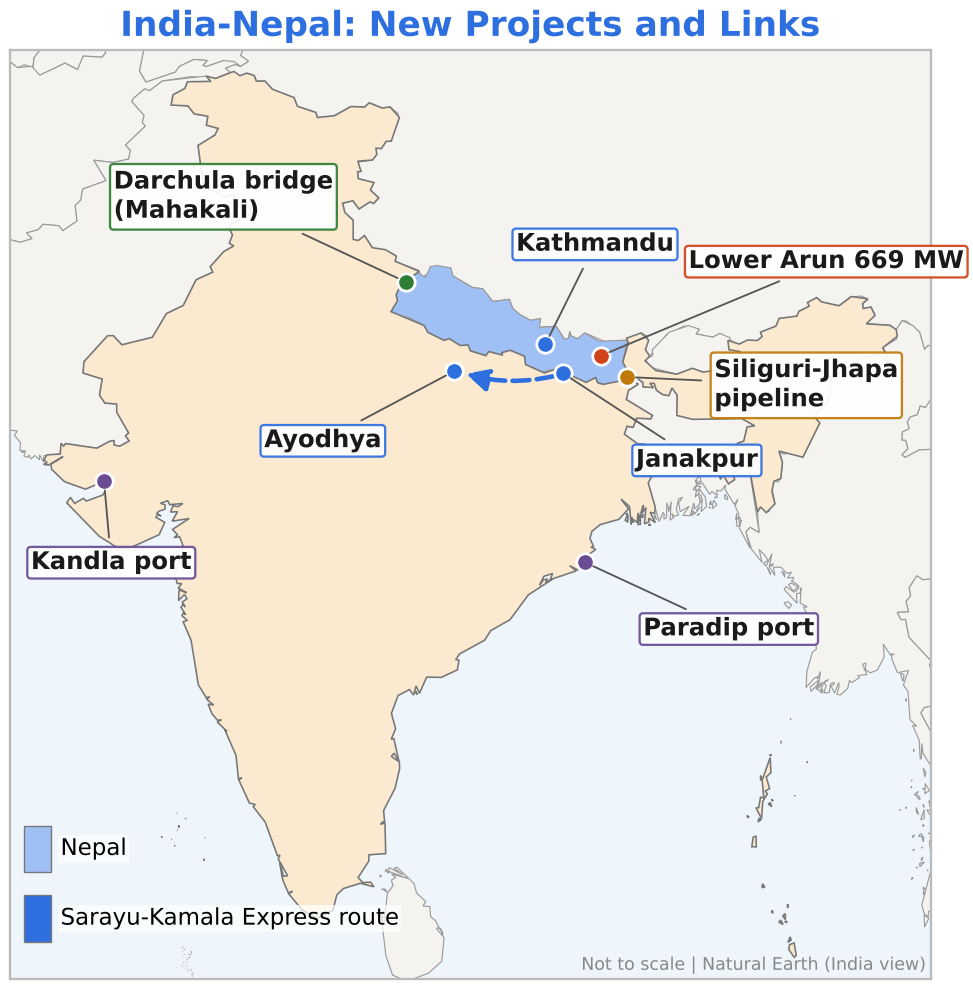
Nepal's new Prime Minister made an official visit to India. Both sides announced money for projects, a new train, a pipeline and better port access for Nepal. Nepal's Prime Minister Balendra Shah spent about 25 hours in New Delhi on an official visit (main events on 23 November 2026). PM Modi announced support worth NPR 240 billion (about Rs 15,000 crore): NPR 56 billion in grants and NPR 184 billion in concessional loans, mainly for energy. The two sides exchanged eight MoUs and issued a 10-point vision document that says existing agreements, including the 1950 Treaty, may be reviewed by mutual consent. Boundary issues were left to foreign secretaries.
Sarayu-Kamala Express (Janakpur-Ayodhya) flagged off; regular weekly service from 28 November.
Siliguri-Jhapa oil pipeline (Indian grant) and Lower Arun hydro project: foundation stones laid.
Ports for Nepal's trade: Kandla first, Paradip later; a motorable bridge over the Mahakali at Darchula opened.
Way forward
Quick delivery of announced projects and a calm dialogue on boundary and treaty issues will matter more than announcements.
Concept
1950 Treaty of Peace and Friendship = gives Nepalese citizens national treatment in India (work, residence). Nepal wants it revised; the Eminent Persons Group (EPG) report on it has been pending since 2018. Kalapani-Lipulekh-Limpiyadhura dispute = Nepal's 2020 map claims this area near the India-Nepal-China trijunction; India rejects it. The Sugauli Treaty (1816) made the Kali (Mahakali) river the boundary. Neighbourhood First policy = India's priority to connectivity, trade and development help for neighbours. Exam angle: Prelims: Janakpur, Darchula, Mahakali, Kandla/Paradip, 1950 Treaty, Sugauli Treaty. Mains: how energy and connectivity projects can reduce the trust deficit with Nepal.
Map of India and Nepal marking Kathmandu, Janakpur, Ayodhya, Lower Arun, Siliguri-Jhapa pipeline, Darchula bridge, Kandla and Paradip ports — StudyForGS
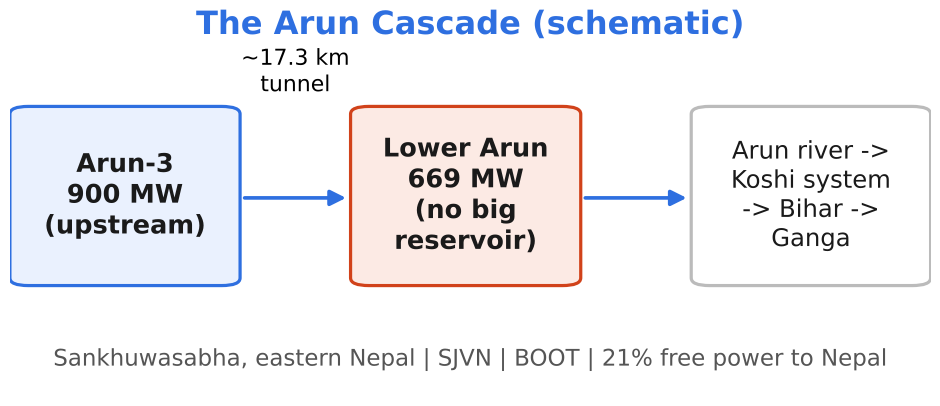
India and Nepal have started building a 669 MW hydropower plant on Nepal's Arun river. Nepal gets free power and India gets clean electricity. The two Prime Ministers jointly laid the foundation stone of the 669 MW Lower Arun Hydropower Project in Sankhuwasabha district of Koshi Province, eastern Nepal. It costs about NPR 92.67 billion (about Rs 5,792 crore) and is being developed by an SJVN company under a BOOT model. It is a run-of-river project with no big reservoir: water released by the 900 MW Arun-3 project upstream will travel through a tunnel of about 17.3 km to the Lower Arun powerhouse.
Nepal gets 21% of the power generated free of cost.
BOOT: handed over to Nepal 25 years after commercial operation begins.
Linked to Arun-3 (900 MW), also built by SJVN; surplus power to flow from Dhalkebar (Nepal) to Muzaffarpur (India).
Way forward
Timely completion and a fair power-trade market will help Nepal earn from hydropower and build trust in Indian projects.
Concept
Run-of-river project = uses the natural flow of a river with little or no storage, so it floods less land than a big dam. BOOT = Build, Own, Operate, Transfer - a private/PSU developer builds and runs the plant for a fixed period, then hands it to the host government. Arun river = rises in Tibet, cuts through the Himalaya and joins the Koshi (Sapta Koshi) system, which flows into Bihar and the Ganga. SJVN is a joint venture of the Government of India and Himachal Pradesh. Exam angle: Prelims: Arun-Koshi river system, SJVN, BOOT, Dhalkebar-Muzaffarpur line. Mains: India-Nepal power trade, flood control in the Koshi basin, China's competing projects.
Schematic of the Arun cascade: Arun-3 900 MW feeding Lower Arun 669 MW through a tunnel, flowing into the Koshi system — StudyForGS
8. Shenzhen Declaration: US-China-Russia
IRUPSC: Prelims + Mains GS2
Syllabus linkage
GS2 - Important international groupings, global security, arms control. Prelims: APEC, New START; Mains: great power rivalry and India.
Context
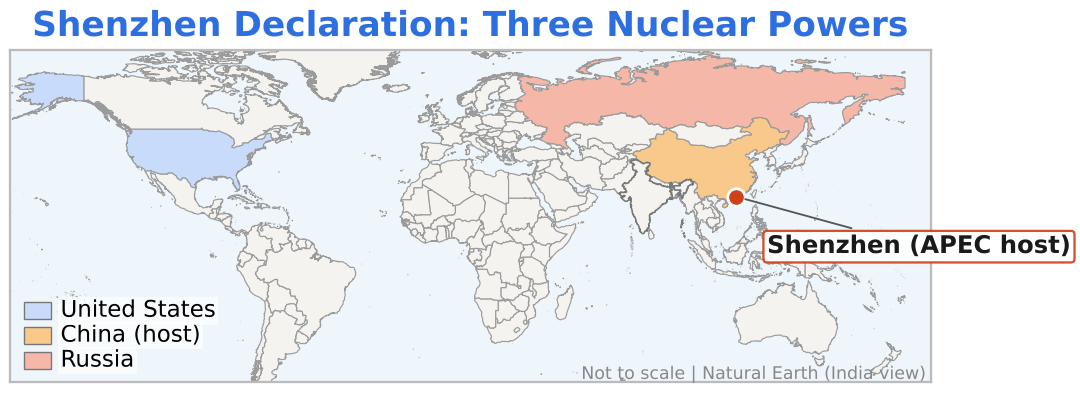
The leaders of the US, China and Russia met together for the first time and issued a short four-point statement. It reaffirms that nuclear war must never be fought, but sets no arms cuts. On 19 November 2026, Xi Jinping hosted Donald Trump and Vladimir Putin for their first-ever trilateral meeting in Shenzhen, China, on the sidelines of the APEC summit. They issued a non-binding four-point declaration on global energy supplies, immunity of state officials from the International Criminal Court and similar bodies, nuclear risk reduction and UN reform. It reaffirmed that 'a nuclear war cannot be won and must never be fought', but set no arms cuts or timetable. This matters because New START, the last US-Russia arms treaty, expired on 5 February 2026.
Key facts
Date and place: 19 November 2026, Shenzhen (APEC 2026 host: China).
Four points: energy supplies, ICC/immunity of officials, nuclear risk reduction and non-proliferation, UN reform.
Ukraine and the Iran war were largely left out of the text.
New START expired on 5 February 2026, leaving no binding limits on the two largest arsenals.
Way forward
India should push for inclusive arms-control talks and UN reform that also reflect the voice of the Global South.
Concept
New START = US-Russia treaty signed in Prague (2010), in force 2011; capped deployed strategic warheads at 1,550 and deployed launchers at 700. APEC = Asia-Pacific Economic Cooperation, founded 1989, 21 member economies; India is not a member. India's nuclear doctrine (2003) = No First Use and credible minimum deterrence; the Political Council of the Nuclear Command Authority, chaired by the PM, alone can authorise use. Exam angle: Prelims: New START limits and dates, APEC membership, ICC (Rome Statute; India not a party). Mains: what a US-China-Russia understanding means for India's strategic autonomy.
World map highlighting the United States, China and Russia with Shenzhen marked — StudyForGS
9. COP31 Ends Without a Climate Pact
IRUPSC: Prelims + Mains GS3
Syllabus linkage
GS3 - Environment, international climate negotiations; GS2 - international bodies. Prelims: UNFCCC, COP venues; Mains: equity and climate finance.
Context
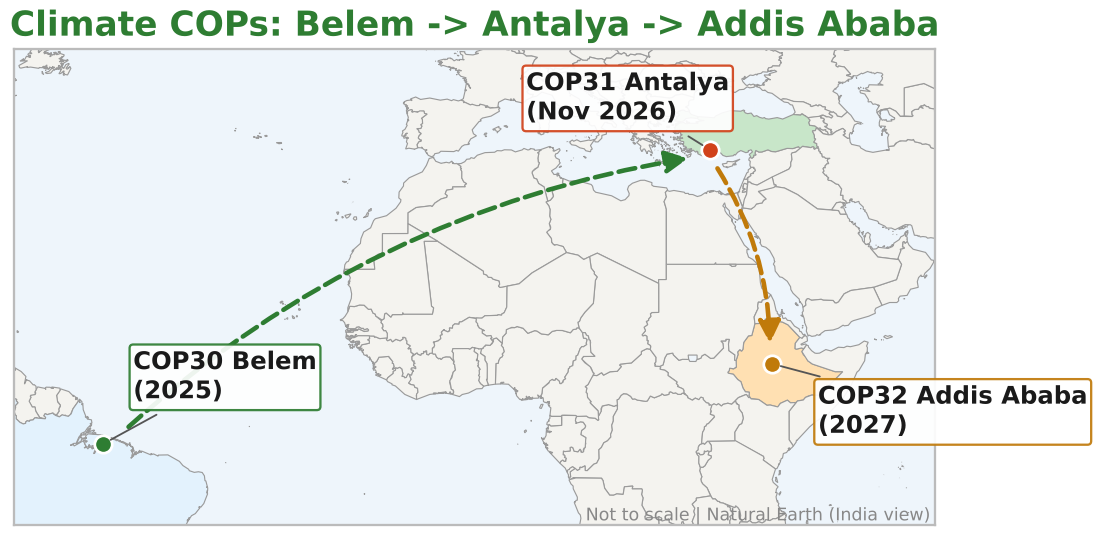
The UN climate summit in Antalya, Turkey, ended without an agreed final text because countries fought over fossil fuels. The unresolved issues now go to COP32 in Ethiopia. COP31 in Antalya, Turkiye, ended on 22 November 2026 after two extra days, without adopting a climate pact. The EU objected that the text left out any reference to moving away from fossil fuels; Panama and the Marshall Islands also rejected it, while oil exporters defended carbon capture. UN Secretary-General Antonio Guterres said there may be no consensus in the room but there is 'no ambiguity in the science' and warned that 1.5 C will be crossed. COP32 will be held in Addis Ababa, Ethiopia.
Key facts
Venue: Antalya, Turkiye; planned 9-20 November, ended 22 November 2026.
COP31 President: Murat Kurum (Turkiye); Australia's Chris Bowen led negotiations.
Main split: fossil-fuel phase-out language and climate finance.
Some progress noted on a just transition and an Action Agenda (electrification, resilience, investment).
Next: COP32 in Addis Ababa (2027).
Way forward
Clear finance commitments from developed countries are the key to unlocking stronger action by developing countries.
Concept
UNFCCC = UN Framework Convention on Climate Change, adopted at Rio in 1992; its annual meeting is the COP (Conference of the Parties). CBDR-RC = Common But Differentiated Responsibilities and Respective Capabilities: rich countries, which emitted more in the past, should do more and pay more. India strongly backs this principle. COP28 (Dubai, 2023) first called for 'transitioning away from fossil fuels'; India's net-zero target is 2070 (announced at COP26, Glasgow). Exam angle: Prelims: COP venues (COP30 Belem, COP31 Antalya, COP32 Addis Ababa), UNFCCC year, CBDR-RC. Mains: why consensus-based climate talks stall; India's stand on finance and equity.
Map showing COP30 Belem, COP31 Antalya and COP32 Addis Ababa — StudyForGS
10. HPV Vaccination Crosses 1 Crore Doses
HEALTHUPSC: Prelims + Mains GS2
Syllabus linkage
GS2 - Health, government schemes, vulnerable sections (women). Prelims: HPV, U-WIN; Mains: preventive healthcare and cancer burden.
Context
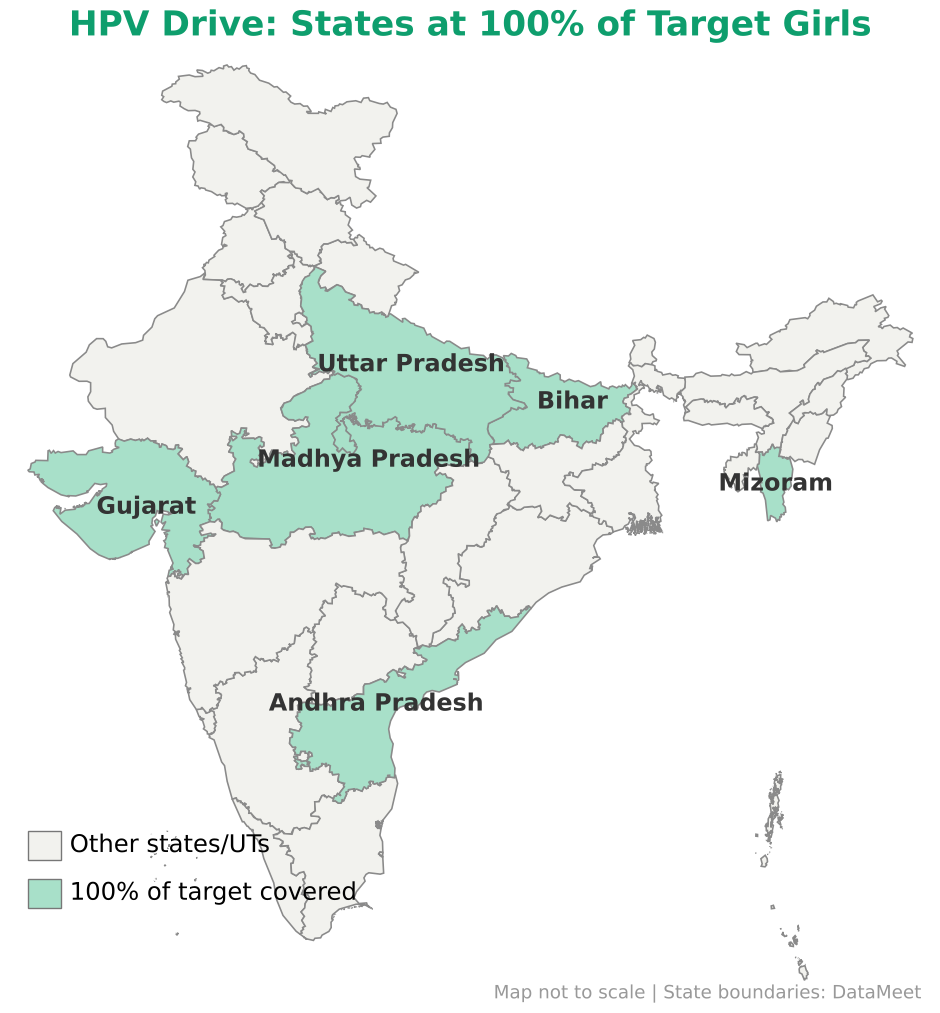
More than 1 crore girls have got the free HPV vaccine in under nine months. The vaccine protects against the virus that causes most cervical cancer. As per a Health Ministry release of 21 November 2026, India has given over 1 crore HPV vaccine doses in under nine months under the national campaign launched by the Prime Minister in February 2026. The target is about 1.2 crore 14-year-old girls, and cumulative coverage is nearly 87%. It is a single-dose, free and voluntary vaccine given with parental consent at government health facilities. Six states have covered 100% of their target.
Key facts
Over 1 crore doses; target about 1.2 crore girls aged 14; coverage nearly 87%.
Most girls vaccinated: UP (over 29.33 lakh), Bihar (over 13.70 lakh), Gujarat (over 7.75 lakh).
Tracked on the U-WIN digital platform (slot booking, digital certificates).
Worldwide, more than 800 million HPV doses have been given.
Way forward
Lagging states need targeted outreach, and screening must expand alongside vaccination.
Concept
HPV = Human Papillomavirus; long infection with high-risk types (mainly 16 and 18) causes most cervical cancer. Vaccinating before exposure gives the best protection. WHO's cervical cancer elimination goal (90-70-90 by 2030): 90% girls vaccinated by age 15, 70% women screened, 90% of those with disease treated. U-WIN = digital registry for the Universal Immunisation Programme, like CoWIN for routine vaccines. Exam angle: Prelims: HPV and cervical cancer link, target age, single dose, U-WIN. Mains: role of vaccination plus screening in reducing cancer deaths among women.
India map highlighting states that vaccinated 100% of target girls against HPV — StudyForGS
11. RBI's 'Stop Switch' Against Digital Fraud
ECONOMYUPSC: Prelims + Mains GS3
Syllabus linkage
GS3 - Banking, digital payments, cyber security. Prelims: RBI draft directions, customer protection; Mains: financial inclusion vs fraud risk.
Context
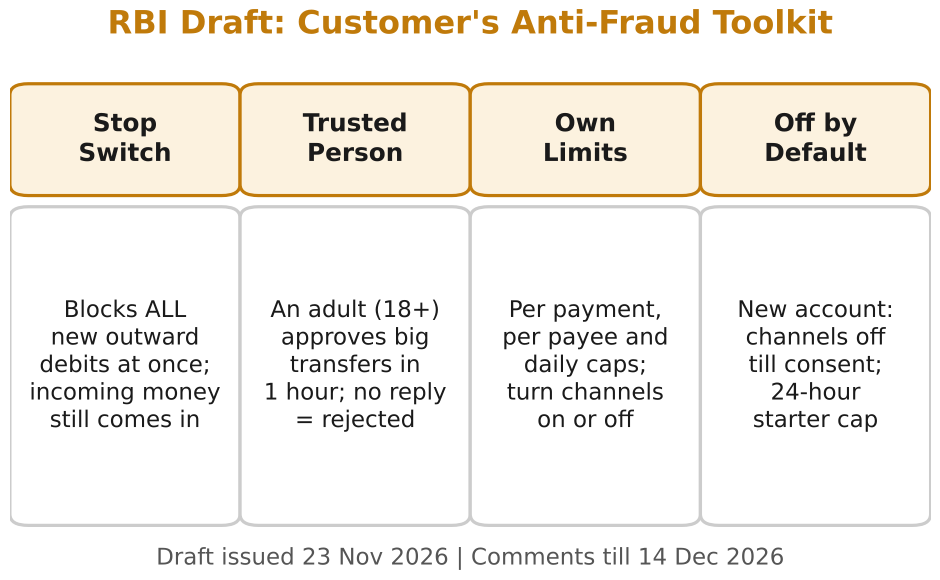
RBI has proposed a 'stop switch' that lets a customer instantly block all money going out of their account, plus a 'trusted person' who must approve big transfers. The aim is to stop online fraud. On 23 November 2026, RBI released seven draft amendment directions (for commercial, small finance, payments, local area, regional rural, urban co-operative and rural co-operative banks) to give customers more control over digital banking. Key ideas: a Stop Switch, a voluntary Trusted Person Mechanism, customer-set limits, and digital channels kept off by default for new accounts. Comments are invited till 14 December 2026. For commercial banks, most safeguards apply from 1 July 2027.
Key facts
Stop Switch: instantly blocks all future outward debits, new mandates and new third-party UPI registrations; incoming credits continue.
Trusted Person (18+): approves transfers above a customer-set limit within 1 hour; no reply = rejected. Not for UPI, merchant or recurring payments.
Limits per payment, per beneficiary and per day; channels can be switched off or put on a time window.
New channels: risk-based ceiling for the first 24 hours; cards: domestic/international on-off and PoS/ATM/online/contactless limits.
Wider meaning of 'bank negligence' (e.g. no alerts, no 24x7 fraud reporting) from 1 January 2027.
Way forward
Banks should make these controls simple to use in local languages, with strong awareness drives.
Concept
RBI's 2017 customer-liability framework = zero liability for the customer if fraud is due to bank negligence, or if a third-party breach is reported within 3 working days. Draft directions = proposed rules put out for public comment before they are made final. Authorised push payment fraud = victim is tricked into sending money himself, which OTPs alone cannot stop; hence tools like cooling periods and trusted persons. Exam angle: Prelims: features of the Stop Switch and Trusted Person, timelines. Mains: balancing ease of digital payments with safety, especially for elderly and first-time users.
Diagram of RBI's proposed anti-fraud tools: Stop Switch, Trusted Person, own limits and channels off by default — StudyForGS
📜 Asked before in the exam — previous-year question on this topic
UPSC Prelims 2018Which one of the following best describes the term "Merchant Discount Rate" sometimes seen in news?
The incentive given by a bank to a merchant for accepting payments through debit cards pertaining to that bank.
The amount paid back by banks to their customers when they use debit cards for financial transactions for purchasing goods or services.
The charge to a merchant by a bank for accepting payments from his customers through the bank's debit cards.
The incentive given by the Government to merchants for promoting digital payments by their customers through Point of Sale (PoS) machines and debit cards.
Show answer
Answer: (c) The charge to a merchant by a bank for accepting payments from his customers through the bank's debit cards. The Merchant Discount Rate is the fee that a bank charges a merchant for providing the facility of accepting payments from customers through debit or credit cards and, later, other digital modes. It is usually a percentage of each transaction and is shared among the acquiring bank, the card-issuing bank and the card network. It is not an incentive paid to the merchant or a refund to customers. The RBI and government have at times capped or waived MDR to promote digital payments. Practise all UPSC Prelims 2018 paper (free) →
Linked because this news is about the same topic. The answer is as per the official key of that year.
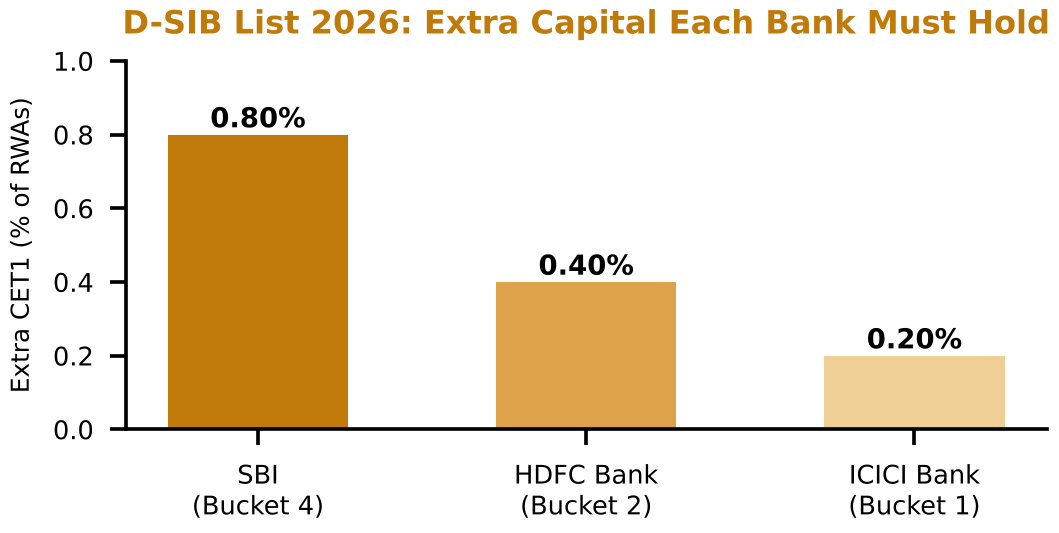
SBI, HDFC Bank and ICICI Bank remain India's 'too big to fail' banks. They must keep extra capital so that a crisis in them does not shake the whole economy. RBI's 2026 list of Domestic Systemically Important Banks (D-SIBs) keeps SBI, HDFC Bank and ICICI Bank in the same buckets as last year. SBI is in Bucket 4 and must keep an extra 0.80% of risk-weighted assets as Common Equity Tier 1 (CET1) capital; HDFC Bank (Bucket 2) 0.40%; ICICI Bank (Bucket 1) 0.20%. This is over and above the capital conservation buffer.
Key facts
SBI - Bucket 4 - extra CET1 0.80%.
HDFC Bank - Bucket 2 - extra CET1 0.40%.
ICICI Bank - Bucket 1 - extra CET1 0.20%.
D-SIB framework issued in 2014; SBI and ICICI first named in 2015, HDFC Bank added in 2017.
Way forward
Regular stress tests and strong resolution plans should go with higher capital for these banks.
Concept
D-SIB = a bank so large and connected that its failure could disrupt the whole financial system ('too big to fail'); placed in buckets by a Systemic Importance Score. CET1 = the highest-quality capital (mainly equity shares and retained earnings). Risk-weighted assets = loans and assets adjusted for how risky they are. Indicators used: size (biggest weight), interconnectedness, substitutability and complexity. Global list (G-SIBs) is made by the Financial Stability Board, based on Basel Committee rules. Exam angle: Prelims: names, buckets, CET1, who publishes G-SIBs. Mains: moral hazard in 'too big to fail' and how extra capital reduces it.
Bar chart of extra CET1 capital for SBI, HDFC Bank and ICICI Bank — StudyForGS
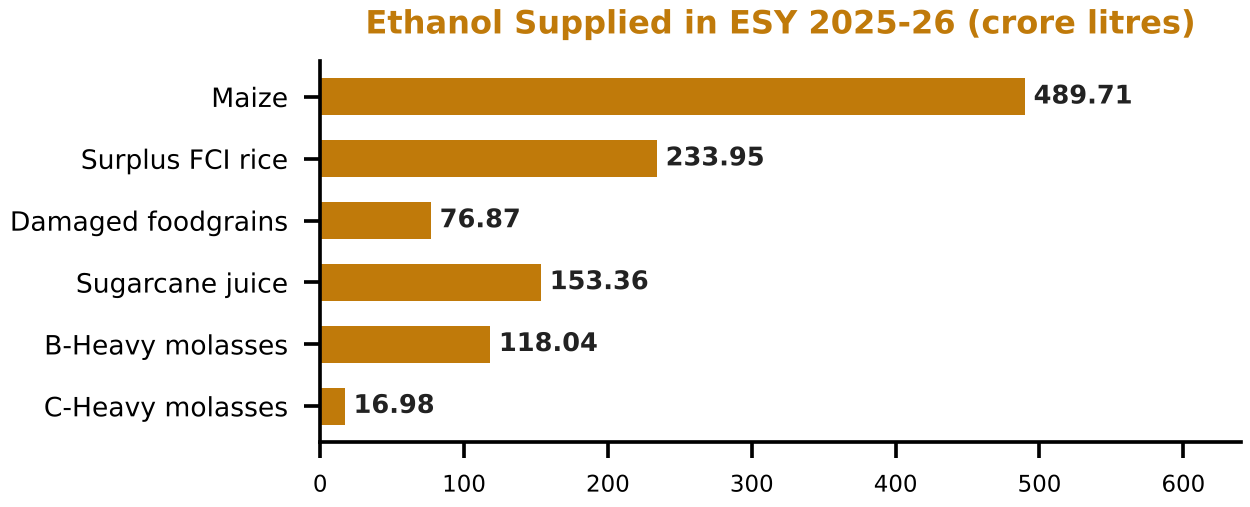
India almost exactly met its target of mixing 20% ethanol in petrol in 2025-26. Most ethanol now comes from grains like maize, not sugarcane. According to the All India Distillers' Association (data released 20 November 2026, provisional till 31 October 2026), the average ethanol blending in petrol reached 19.99% in Ethanol Supply Year (ESY) 2025-26. About 1,134.36 crore litres were blended against a requirement of 1,050 crore litres, and 1,088.91 crore litres were supplied. Grain-based feedstock gave 73.52% of supply and sugar-based feedstock 26.48%. Maize alone supplied about 45%.
About 32.45 lakh tonnes of sugar diverted to ethanol.
Way forward
Shift towards second-generation (2G) ethanol from crop waste to reduce pressure on food grains.
Concept
Ethanol blending = mixing ethanol (an alcohol made from crops) with petrol to cut crude oil imports and emissions. E20 = 20% ethanol, 80% petrol. National Policy on Biofuels, 2018 (amended 2022) advanced the 20% target from 2030 to ESY 2025-26. Food vs fuel = using maize and rice for fuel can raise feed and food prices; maize demand has pushed up poultry feed costs. Exam angle: Prelims: E20, ESY, feedstocks (B-heavy, C-heavy molasses). Mains: energy security gains vs water use, food prices and vehicle compatibility.
Bar chart of ethanol supplied by feedstock in ESY 2025-26 — StudyForGS
14. New CPI: Food Weight Cut to 36.8%
ECONOMYUPSC: Prelims + Mains GS3
Syllabus linkage
GS3 - Inflation, monetary policy, data systems. Prelims: CPI base year, weights, inflation target; Mains: data quality and policy.
Context
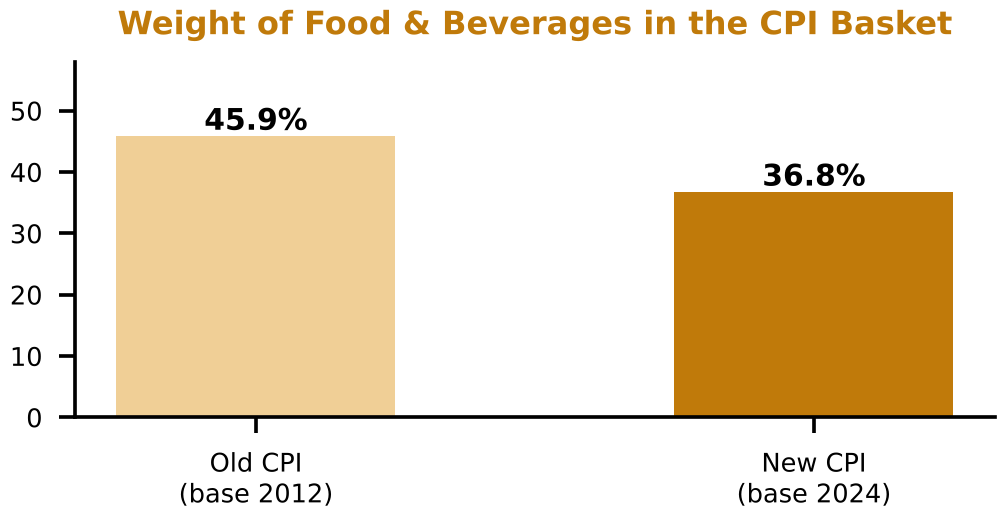
In the new retail inflation index, food has a smaller share than before because families now spend less of their budget on food. This should make inflation numbers less jumpy. Speaking at MoSPI's Data Users Conference in Mumbai on 23 November 2026, RBI Deputy Governor Poonam Gupta noted that the weight of food and beverages in the revised CPI has fallen from 45.9% to 36.8%. The new CPI series, with base year 2024, was released in February 2026 and uses weights from the Household Consumption Expenditure Survey 2023-24. A lower weight for volatile food prices should make headline inflation less volatile and reduce uncertainty for monetary policy.
Key facts
Food and beverages weight: 45.9% (old, base 2012) -> 36.8% (new, base 2024).
Weights taken from HCES 2023-24 instead of 2011-12.
Inflation target: 4% CPI with a band of 2-6%.
CPI is compiled by MoSPI (National Statistics Office).
Way forward
More frequent base revisions and better services data will keep the index close to how people actually spend.
Concept
CPI (Consumer Price Index) = measures change in retail prices of a basket of goods and services households buy; 'headline inflation' is its yearly change. Engel's Law = as incomes rise, the share of income spent on food falls; that is why the food weight dropped. Flexible inflation targeting = RBI Act amended in 2016 (Section 45ZA); the Monetary Policy Committee sets the repo rate to keep CPI inflation near 4%. Exam angle: Prelims: base year, food weight, who compiles CPI, inflation target band. Mains: why updated weights matter for policy and for measuring real wages.
Bar chart comparing food and beverages weight in old and new CPI — StudyForGS
📜 Asked before in the exam — previous-year question on this topic
UPSC Prelims 2020Consider the following statements: 1. The weightage of food in Consumer Price Index (CPI) is higher than that in Wholesale Price Index (WPI). 2. The WPI does not capture changes in the prices of services, which CPI does. 3. Reserve Bank of India has now adopted WPI as its key measure of inflation and to decide on changing the key policy rates. Which of the statements given above is/are correct?
1 and 2 only
2 only
3 only
1, 2 and 3
Show answer
Answer: (a) 1 and 2 only Statements 1 and 2 are correct. Food has a much higher weight in the Consumer Price Index, about 46 per cent in the combined CPI, than in the Wholesale Price Index, where food articles weigh around 15 per cent. The WPI covers only goods, while the CPI also includes services such as housing, health, education and transport. Since 2014, following the Urjit Patel Committee, the RBI has used CPI, not WPI, as its main inflation measure. Its target is 4 per cent CPI inflation within a band of 2 to 6 per cent. Practise all UPSC Prelims 2020 paper (free) →
Linked because this news is about the same topic. The answer is as per the official key of that year.
15. Airtel Tops India's Brand Value List
ECONOMYUPSC: Prelims + Mains GS3
Syllabus linkage
GS3 - Indian economy, corporate sector. Prelims: rankings and report sources.
Context
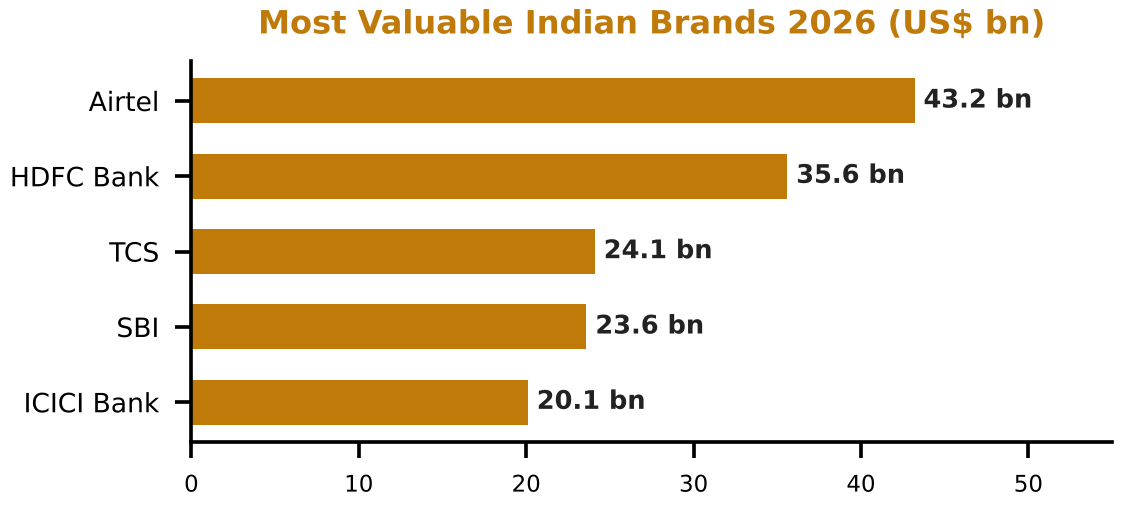
A global ranking says Airtel is now India's most valuable brand. India's top 100 brands together are worth about 11% of the country's GDP. The Kantar BrandZ Most Valuable Indian Brands 2026 ranking (released 19 November 2026) places Airtel first at US$ 43.2 billion, followed by HDFC Bank (US$ 35.6 bn), TCS (US$ 24.1 bn), SBI (US$ 23.6 bn) and ICICI Bank (US$ 20.1 bn). The Top 100 are worth US$ 460.3 billion, about 11% of India's GDP, though overall value fell 12% from last year. Meesho was the fastest riser, up 64% to US$ 1.9 billion.
Key facts
No. 1: Airtel, US$ 43.2 bn (up 5% in a year).
Top 100 total: US$ 460.3 bn (about 11% of GDP).
Financial services = largest category (29% of total).
Highest new entrant: Blinkit (US$ 4.3 bn); three Indian brands in the Global Top 100.
Way forward
Indian firms need more R&D and global reach to turn domestic strength into global brands.
Concept
Brand value = the money value of a brand's name and reputation, estimated from financial results and consumer surveys. Such rankings are private reports, not official statistics, but are used to track the growth of Indian firms. Exam angle: Prelims: who publishes the ranking, the top brand. Mains: limited direct use; can be cited for the rise of Indian consumer and digital firms.
Bar chart of the five most valuable Indian brands in 2026 — StudyForGS
16. New PUC Rules: Longer Validity for BS-VI
ENVIRONMENTUPSC: Prelims + Mains GS3
Syllabus linkage
GS3 - Environmental pollution (air), conservation; GS2 - government policies. Prelims: Bharat Stage norms, PUC; Mains: urban air pollution.
Context
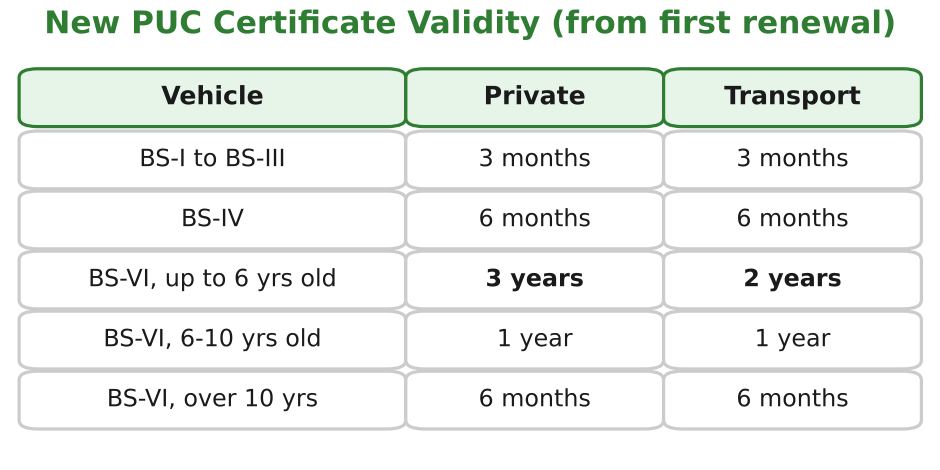
Newer BS-VI private cars can now get a pollution certificate valid for 3 years, while old vehicles must get checked more often. Testing is focused on vehicles that pollute more. The Ministry of Road Transport and Highways notified the Central Motor Vehicles (Sixteenth Amendment) Rules, 2026 (reported 19 November 2026). BS-VI private vehicles up to six years old get a Pollution Under Control (PUC) certificate valid for 3 years, and BS-VI transport vehicles of that age get 2 years. Older vehicles get shorter validity: BS-I to BS-III only 3 months and BS-IV 6 months. The new periods apply from the first renewal after the rules came into force.
Key facts
BS-VI up to 6 years: 3 years (private), 2 years (transport).
BS-VI 6-10 years: 1 year; over 10 years: 6 months.
BS-I to BS-III: 3 months; BS-IV: 6 months.
Renewal within 10 days before expiry: new certificate starts from the old expiry date.
Way forward
Better testing centres and on-road checks are needed so longer validity does not become a loophole.
Concept
Bharat Stage (BS) norms = India's vehicle emission standards set by the Centre; India jumped from BS-IV straight to BS-VI from 1 April 2020. PUC certificate = proof that a vehicle's exhaust is within limits; required under the Central Motor Vehicles Rules, 1989 framed under the Motor Vehicles Act, 1988. Older engines without modern catalytic converters emit much more PM, NOx and CO; hence more frequent checks. Exam angle: Prelims: BS-VI date, PUC validity, MoRTH. Mains: vehicle emissions and urban air quality; need for remote sensing of on-road emissions.
Table of new PUC certificate validity by vehicle type and age — StudyForGS
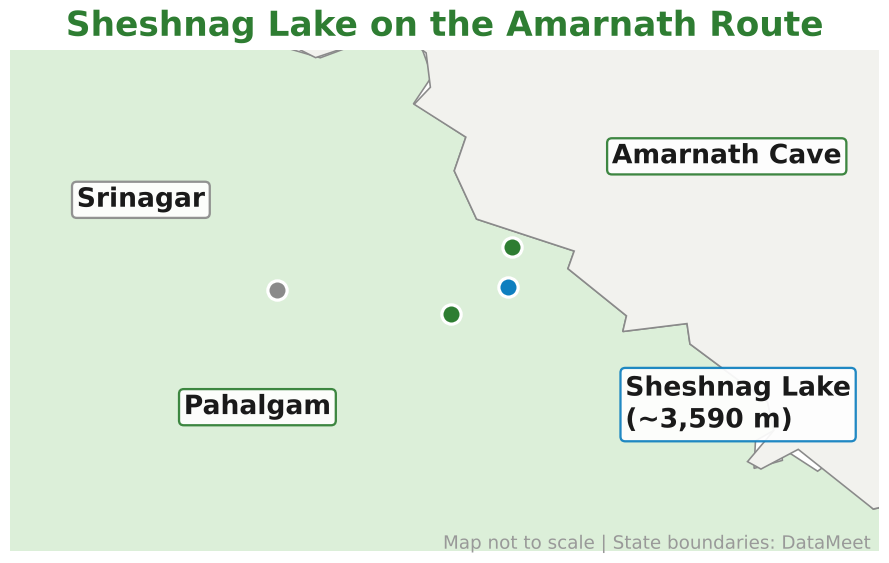
17. Sheshnag Lake: Digging Near a Risky Glacial Lake
A video showing an excavator near Sheshnag Lake in Kashmir caused anger. The lake is a high-risk glacial lake, and digging near it can raise flood danger. A video showing an excavator working near Sheshnag Lake, on the Pahalgam-Amarnath pilgrimage route in Anantnag district of Jammu and Kashmir, sparked outrage. The glacier-fed lake lies at about 3,590 m, is about 1.1 km long, and is surrounded by steep slopes and loose moraine. It is one of 14 high-risk glacial lakes in Jammu and Kashmir being monitored. Experts fear that disturbing the slopes could raise the risk of a glacial lake outburst flood (GLOF).
Key facts
Location: near Pahalgam, Anantnag district, on the Amarnath Yatra route.
Altitude about 3,590 m; size about 1.1 km by 0.1 km; freezes fully in winter.
Drains into a tributary of the Lidder river.
Oligotrophic lake (low nutrients, very clear water).
One of 14 high-risk glacial lakes in J&K.
Way forward
Any work near high-risk lakes should need scientific clearance, with early warning systems along pilgrim routes.
Concept
Moraine = loose rock, gravel and soil left by a glacier; a moraine wall holding a lake can collapse suddenly. GLOF = Glacial Lake Outburst Flood - sudden release of water from a glacial lake. Examples: Kedarnath 2013 (Chorabari lake), South Lhonak, Sikkim 2023. NDMA issued national guidelines on managing GLOFs in 2020; early warning systems and lake-level lowering are key steps. Exam angle: Prelims: location of Sheshnag, Lidder river, oligotrophic lakes, GLOF examples. Mains: tourism and construction pressure in the Himalaya and disaster risk.
Map of Jammu and Kashmir marking Sheshnag Lake, Pahalgam, Amarnath Cave and Srinagar — StudyForGS
18. Toxic Foam on the Manjeera River
ENVIRONMENTUPSC: Prelims + Mains GS3
Syllabus linkage
GS3 - Water pollution, environmental governance; GS1 - river systems. Prelims: Godavari tributaries, dams; Mains: industrial pollution control.
Context
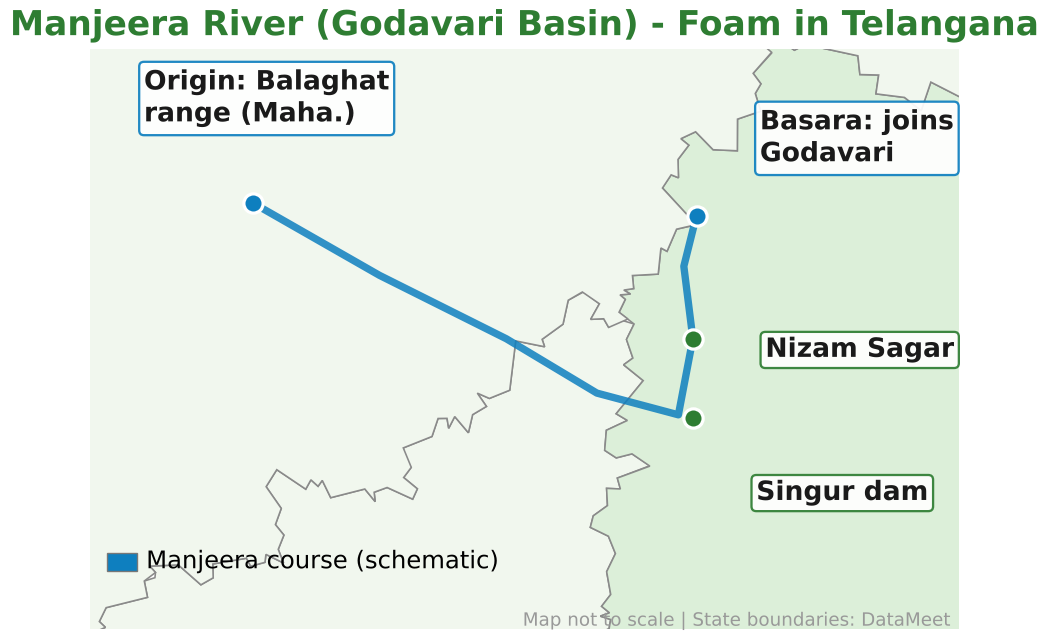
Thick white foam has covered the Manjeera river in Telangana because factory waste and sewage are flowing into it. Foam is a sign of serious water pollution. Thick white foam has been seen on the Manjeera river in Telangana. Industrial effluents and household wastewater are entering the river through the Nakkavagu stream. The Manjeera rises in the Balaghat range in Maharashtra at about 823 m, flows through Maharashtra, Karnataka and Telangana, and joins the Godavari near Basara in Nizamabad district. The Singur reservoir and Nizam Sagar project are on it.
Key facts
Cause: industrial effluents and sewage via the Nakkavagu stream.
Origin: Balaghat range, Maharashtra (about 823 m).
Joins the Godavari near Basara (Nizamabad district, Telangana).
Catchment area: about 30,844 sq km; dams: Singur, Nizam Sagar.
Its last stretch forms part of the Maharashtra-Telangana boundary.
Way forward
Zero liquid discharge in industries and sewage treatment before water reaches the river are needed.
Concept
River foam = forms when detergents (surfactants) and organic waste mix with fast-moving water; it shows high pollution and low oxygen. Water (Prevention and Control of Pollution) Act, 1974 created the Central and State Pollution Control Boards to control discharge into rivers. Godavari = India's second-longest river; rises at Trimbakeshwar (Nashik) and is called 'Dakshin Ganga'. Exam angle: Prelims: Manjeera origin, confluence, dams; Godavari tributaries (Manjeera, Pranhita, Indravati, Sabari). Mains: weak enforcement of effluent norms.
Map of the Manjeera river course from Maharashtra to its confluence with the Godavari at Basara — StudyForGS
19. Katarniaghat: Leopard Attack and Conflict
ENVIRONMENTUPSC: Prelims + Mains GS3
Syllabus linkage
GS3 - Biodiversity, conservation, human-wildlife conflict. Prelims: protected areas and tiger reserves; Mains: conflict management.
Context
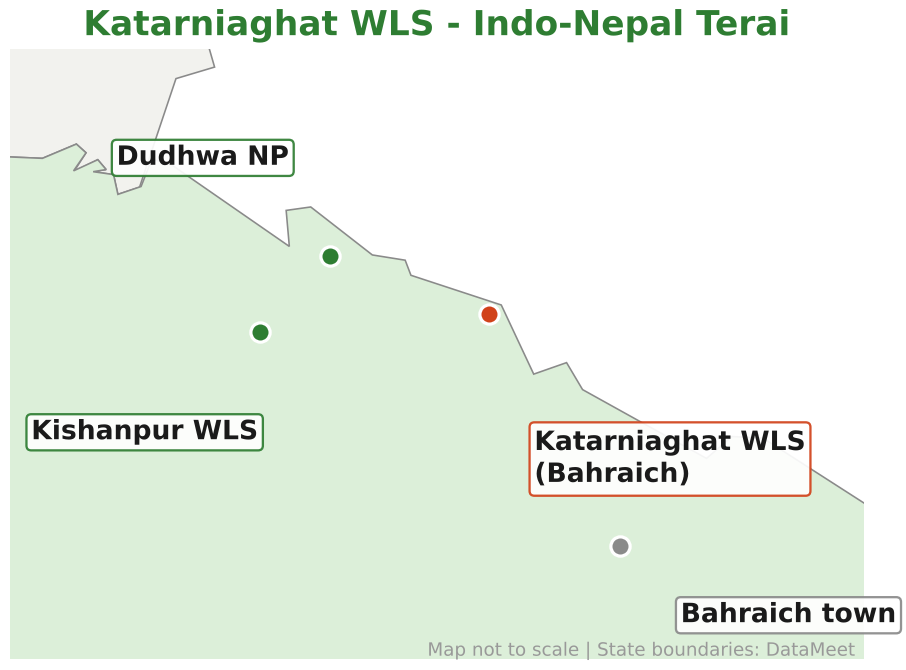
A man was killed by a leopard in Katarniaghat Wildlife Sanctuary in Uttar Pradesh. As forests shrink, conflicts between people and wild animals are rising. A 45-year-old man was killed in a leopard attack in the Sujauli area of Katarniaghat Wildlife Sanctuary in Bahraich district, Uttar Pradesh. The sanctuary lies in the Terai belt close to the Nepal border and covers about 400 sq km. It is part of the Dudhwa Tiger Reserve along with Dudhwa National Park and Kishanpur Wildlife Sanctuary, and links tiger habitats with Bardia National Park in Nepal.
Key facts
Location: Bahraich district, UP, Terai belt near the Nepal border; area about 400 sq km.
Part of Dudhwa Tiger Reserve (with Dudhwa NP and Kishanpur WLS).
Girwa river (tributary of the Ghaghara) here is a sanctuary for gharial and mugger.
Community-based alert systems and fast compensation can reduce anger against wildlife.
Concept
Terai = marshy grassland and forest belt at the foot of the Himalaya, south of the Bhabar; rich in tall grasses. Leopard = listed in Schedule I of the Wild Life (Protection) Act, 1972 (as revised in 2022), giving it the highest protection. Human-wildlife conflict causes: habitat loss, prey decline and farms near forests; solutions include early warning, fencing and quick compensation. Exam angle: Prelims: Katarniaghat location, Girwa river, Dudhwa Tiger Reserve parts, transboundary corridor with Bardia. Mains: managing conflict while protecting wildlife.
Map of the Terai in Uttar Pradesh marking Katarniaghat, Dudhwa and Kishanpur — StudyForGS
20. India Hosts World Landslide Forum
ENVIRONMENTUPSC: Prelims + Mains GS3
Syllabus linkage
GS3 - Disaster management; GS1 - physical geography. Prelims: ICL, host bodies, landslide-prone regions; Mains: shift from relief to prevention.
Context
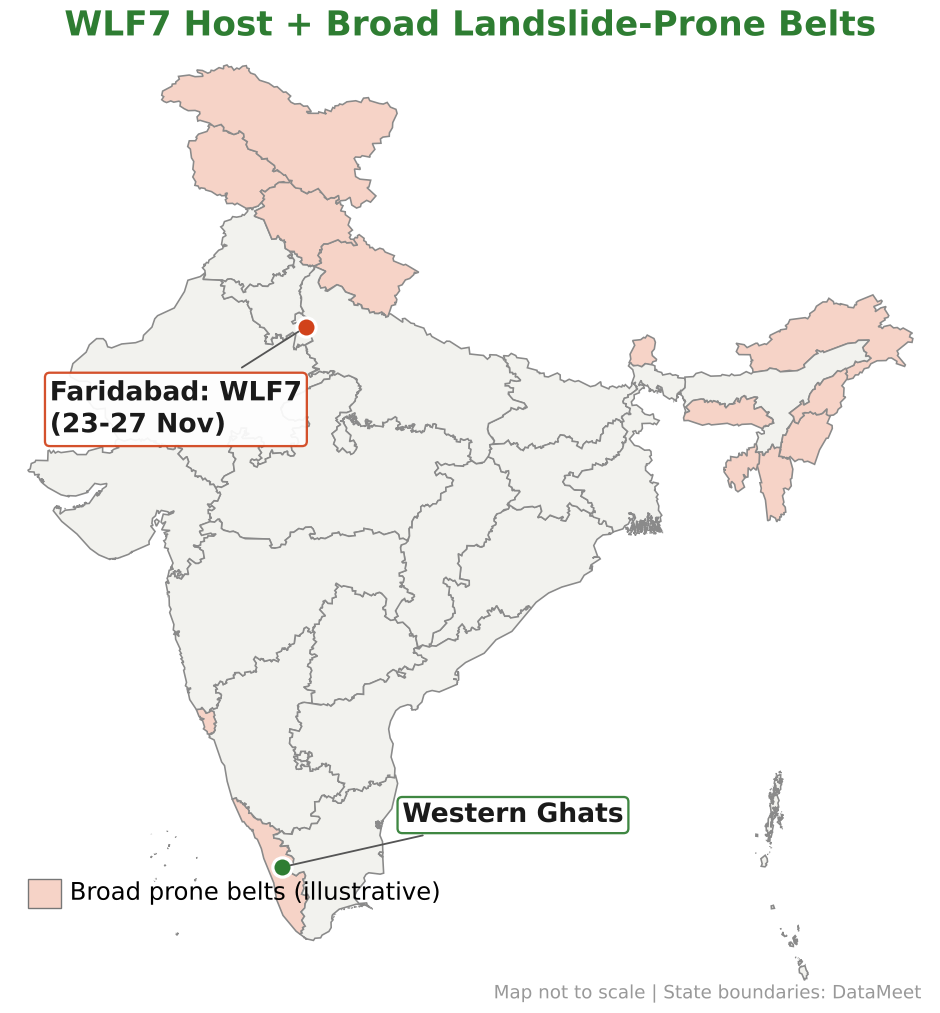
India is hosting the World Landslide Forum for the first time, at Faridabad. Experts are discussing how to predict landslides early and save lives. The 7th World Landslide Forum (WLF7) is being held from 23 to 27 November 2026 at Amrita Vishwa Vidyapeetham's Faridabad campus - the first time in India. It is organised under the International Consortium on Landslides (ICL) with the Geological Survey of India, NDMA, DST, NIDM and ISRO. Its theme is 'Landslide Science and Practice for Safe and Resilient Communities'. Over 1,900 authors from more than 75 countries are taking part.
Key facts
Dates: 23-27 November 2026; venue: Faridabad (Delhi-NCR).
India becomes the fifth host country after Japan, Italy, China and Slovenia.
Linking scientific warnings with local action plans in hill districts is the next step.
Concept
Landslide = mass movement of rock, soil or debris down a slope; triggered by heavy rain, earthquakes, deforestation, road cutting. Prone regions in India: Himalaya, North-East and Western Ghats; GSI is the nodal agency for landslide studies. Landslide Atlas of India was released by ISRO's National Remote Sensing Centre in 2023. Exam angle: Prelims: WLF7 venue, ICL, nodal agency (GSI), prone regions. Mains: early warning and land-use planning in hill states.
India map marking Faridabad and the broad landslide-prone belts — StudyForGS
21. Guru Nanak Jayanti and Guru Tegh Bahadur
ART & CULTUREUPSC: Prelims + Mains GS1
Syllabus linkage
GS1 - Indian culture, medieval history, Bhakti and Sikh traditions. Prelims: Sikh Gurus, places; Mains: values of religious freedom.
Context
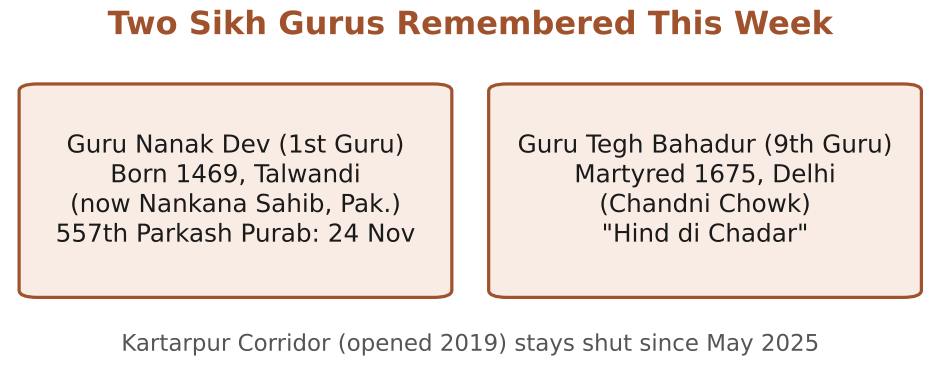
On 24 November, the birth anniversary of Guru Nanak Dev (the first Sikh Guru) was celebrated, and the martyrdom day of Guru Tegh Bahadur (the ninth Guru) was observed. The 557th Parkash Purab (birth anniversary) of Guru Nanak Dev was celebrated on 24 November 2026 in India and Pakistan, with lakhs of devotees at the Golden Temple in Amritsar. Guru Tegh Bahadur's martyrdom day was also observed on 24 November; he is remembered for giving his life to defend religious freedom. Meanwhile, the Kartarpur Corridor has stayed shut since May 2025.
Key facts
Guru Nanak: born 1469 at Talwandi (now Nankana Sahib, Pakistan); Gurpurab falls on Kartik Purnima.
Guru Tegh Bahadur: 9th Guru, executed in 1675 in Delhi on Aurangzeb's orders; called 'Hind di Chadar'.
Gurdwara Sis Ganj Sahib (Chandni Chowk) marks the place of his martyrdom.
Kartarpur Corridor (opened 2019) links Dera Baba Nanak (Gurdaspur) to Kartarpur Sahib (Narowal, Pakistan).
Way forward
Such days are a chance to spread the Gurus' message of harmony and service.
Concept
Guru Nanak's teachings = one God (Ik Onkar), equality, honest work (kirat karni), sharing (vand chhakna) and remembering God (naam japna); started langar (community kitchen). Guru Tegh Bahadur founded Anandpur Sahib; his hymns are in the Guru Granth Sahib. Guru Granth Sahib = Sikh holy book compiled first by Guru Arjan Dev (Adi Granth, 1604). Exam angle: Prelims: order of Gurus, birthplaces, gurdwaras, Kartarpur. Mains: Sikh Gurus' contribution to equality and freedom of conscience.
Two boxes comparing Guru Nanak Dev and Guru Tegh Bahadur — StudyForGS
22. Kashi Tamil Sangamam 5.0 from 28 Nov
ART & CULTUREUPSC: Prelims + Mains GS1
Syllabus linkage
GS1 - Art and culture, literature; GS2 - schemes for national integration. Prelims: Thirukkural, EBSB; Mains: cultural unity.
Context
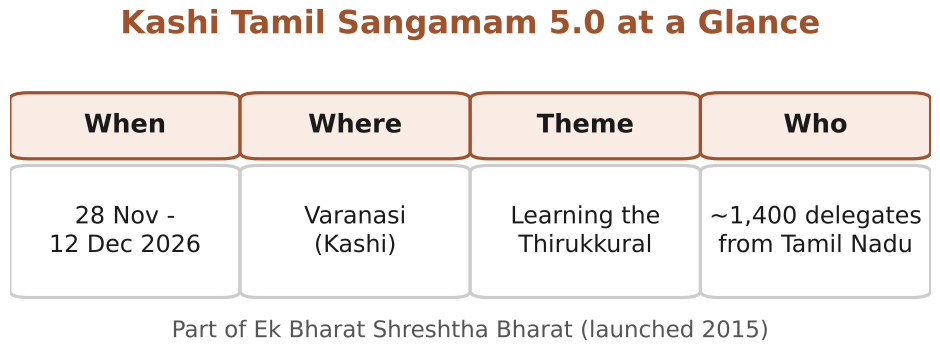
The fifth Kashi Tamil Sangamam will be held in Varanasi from 28 November to 12 December, with a focus on learning the Thirukkural. It celebrates the old cultural link between Tamil Nadu and Kashi. The fifth edition of the Kashi Tamil Sangamam (KTS 5.0) will be held in Varanasi from 28 November to 12 December 2026. Its theme focuses on learning the Thirukkural ('Thirukkural Payilvom - Thirukkural Abhyas Karen'). About 1,400 delegates from Tamil Nadu are expected to visit Kashi in groups. The event is organised by the Union Ministry of Education.
Key facts
Dates: 28 November - 12 December 2026; venue: Varanasi.
Theme: learning the Thirukkural.
About 1,400 delegates from Tamil Nadu.
Under the Ek Bharat Shreshtha Bharat spirit (launched 2015).
Way forward
Linking the event with language learning and student exchanges will give it lasting value.
Concept
Thirukkural = classic Tamil text by Thiruvalluvar with 1,330 couplets in three parts: virtue (aram), wealth (porul) and love (inbam). Ek Bharat Shreshtha Bharat = programme to link states in pairs for cultural exchange, launched on 31 October 2015. Kashi-Tamil link: places like Tenkasi ('Kashi of the South') and the Rameswaram-Kashi pilgrimage show old ties. Exam angle: Prelims: Thirukkural author and structure, EBSB, KTS host city. Mains: role of cultural exchange in national integration.
Fact boxes for Kashi Tamil Sangamam 5.0: dates, venue, theme, delegates — StudyForGS
23. Light-Powered Material to Break Pyrene
SCI-TECHUPSC: Prelims + Mains GS3
Syllabus linkage
GS3 - Science and technology, nanotechnology, pollution control. Prelims: PAHs, MOFs; Mains: green technologies.
Context
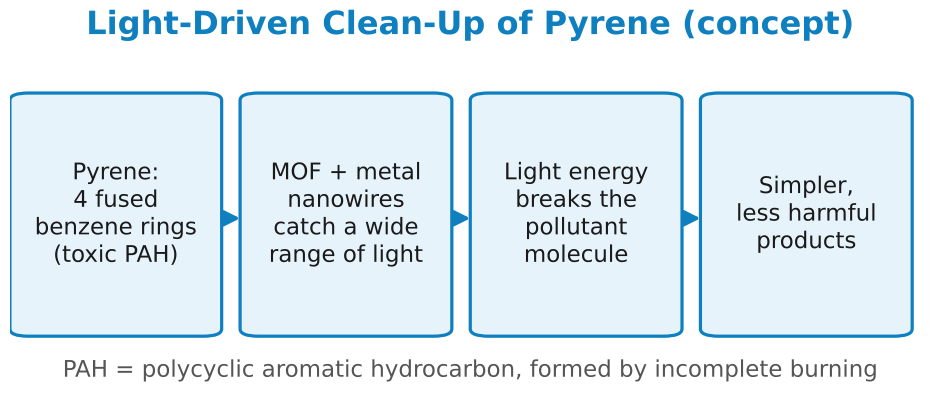
Scientists have made a new material that uses light to break down pyrene, a toxic pollutant. It could help clean polluted soil and water. Scientists have developed a light-responsive material by adding metallic nanowires to a metal-organic framework (MOF). The material can use a broad range of light wavelengths to break down environmental pollutants such as pyrene. Pyrene is a persistent polycyclic aromatic hydrocarbon (PAH) that lodges in soil, water and air.
Works with a broad range of light wavelengths (photocatalysis).
Pyrene: four fused benzene rings; pale yellow, insoluble in water.
Source: incomplete burning of organic matter; found in coal tar pitch.
Way forward
Lab success must be tested at field scale and for safe disposal of the nanomaterial.
Concept
MOF = metal-organic framework, a crystal made of metal ions linked by organic molecules, full of tiny pores like a sponge; used for capture and catalysis. PAHs = polycyclic aromatic hydrocarbons, formed by incomplete burning (vehicle exhaust, coal, stubble, cigarettes); many are toxic and may cause cancer. Photocatalysis = a material absorbs light and uses that energy to speed up a chemical reaction that breaks pollutants. Exam angle: Prelims: PAHs, MOFs, photocatalysis basics. Mains: role of nanotechnology in pollution clean-up.
Flow diagram of light-driven breakdown of pyrene by a MOF material — StudyForGS
24. Rare Triple Star System Near Earth
SCI-TECHUPSC: Prelims + Mains GS3
Syllabus linkage
GS3 - Space science. Prelims: life cycle of stars; basic astronomy terms.
Context
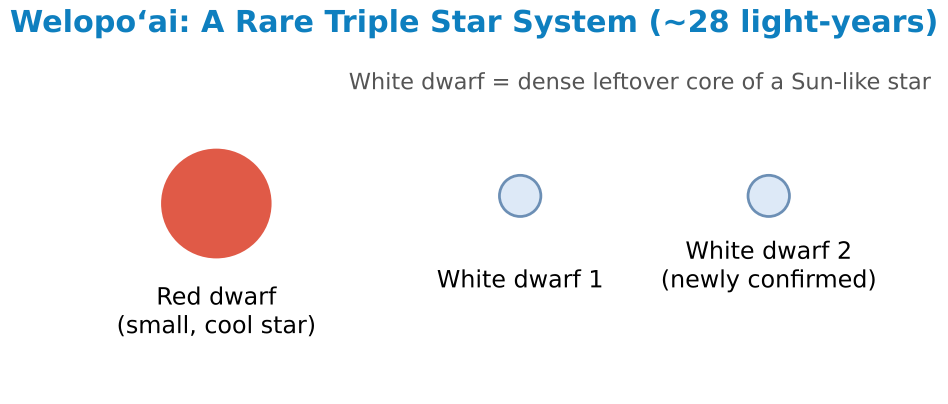
Astronomers found a nearby system with three stars - two white dwarfs and one red dwarf - only about 28 light-years away. Nothing similar is known this close to Earth. A team led by the Trottier Institute for Research on Exoplanets at the Universite de Montreal has described Welopo'ai, a triple star system about 28 light-years from Earth, in a paper published on 19 November 2026. It has two white dwarfs and one red dwarf - the closest known triple system with two white dwarfs. The SPIRou instrument on the Canada-France-Hawaii Telescope spotted the red dwarf's wobble, and the Gemini North telescope confirmed a faint white dwarf companion.
Key facts
Distance about 28 light-years; members: two white dwarfs + one red dwarf.
No similar triple system known within 100 light-years.
Mystery: the red dwarf survived its neighbour swelling into a red giant.
Published in Astronomy & Astrophysics, 19 November 2026.
Way forward
Further study can test theories on how stars in close groups evolve.
Concept
Red dwarf = small, cool, long-living star; the most common type in our galaxy. White dwarf = the dense leftover core of a Sun-like star after it sheds its outer layers; it cannot be heavier than about 1.4 solar masses (Chandrasekhar limit). Light-year = distance light travels in one year (about 9.46 trillion km) - a unit of distance, not time. Exam angle: Prelims: stellar evolution (red giant, white dwarf), Chandrasekhar limit, light-year. Mains: limited.
Sketch of a triple star system with one red dwarf and two white dwarfs — StudyForGS
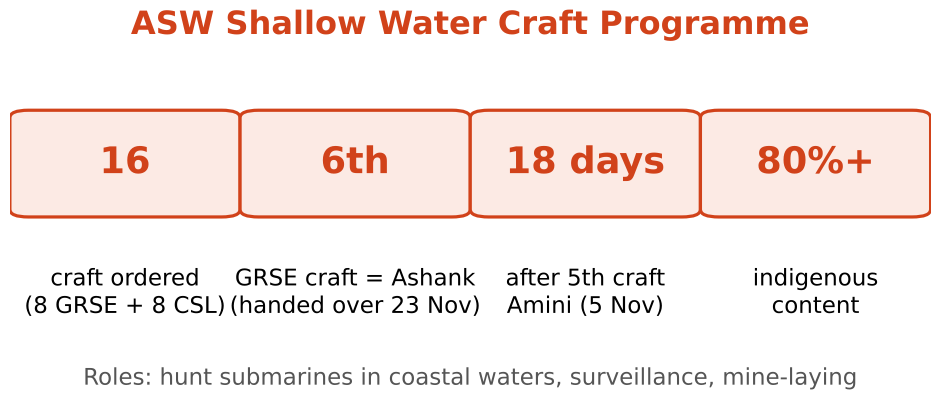
The Navy received 'Ashank', a small warship made in India to hunt enemy submarines in shallow coastal waters. It is the second such ship delivered in 18 days. Garden Reach Shipbuilders and Engineers (GRSE), Kolkata, handed over Ashank, an Anti-Submarine Warfare Shallow Water Craft (ASW SWC), to the Indian Navy at Visakhapatnam on 23 November 2026. It is GRSE's sixth craft in its series of eight, delivered 18 days after Amini (5 November). The ship carries lightweight torpedoes, indigenous anti-submarine rockets and advanced sonar, and uses waterjet propulsion. It has over 80% indigenous content.
Key facts
Builder: GRSE, Kolkata; delivered at Visakhapatnam on 23 November 2026.
Sixth of eight GRSE craft; the Navy ordered 16 in all (8 GRSE + 8 Cochin Shipyard).
Weapons: lightweight torpedoes, ASW rockets, 30 mm gun; advanced sonar.
Handover is not commissioning; commissioning comes later.
Way forward
Timely delivery of the remaining craft and local supply of sensors will strengthen coastal defence.
Concept
Anti-submarine warfare (ASW) = finding, tracking and attacking enemy submarines using sonar, torpedoes and rockets. Shallow water craft = small, low-draught ships that can work close to the coast where big warships cannot. Waterjet propulsion = pushes the ship using a powerful jet of water instead of a propeller; good for agility and lower noise. Exam angle: Prelims: ASW SWC programme, builders, first ship (Arnala). Mains: rising submarine presence in the Indian Ocean and coastal defence.
Fact boxes on the ASW shallow water craft programme — StudyForGS
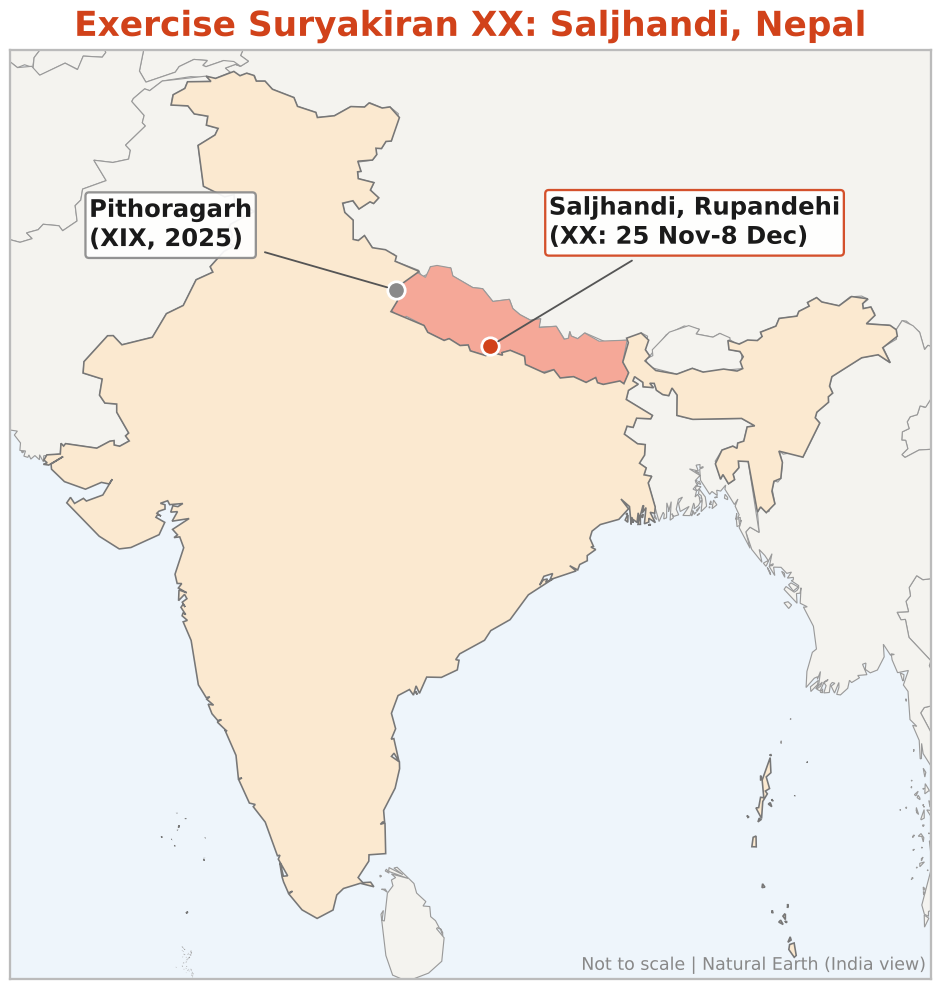
The armies of India and Nepal are holding their 20th joint exercise, Suryakiran, in Nepal. It builds trust and helps them work together in jungles, mountains and disasters. The 20th edition of the India-Nepal joint military exercise Suryakiran is being held from 25 November to 8 December 2026 at the Nepal Army Battle School in Saljhandi, Rupandehi district. The Indian contingent is from the 12 Kumaon Regiment and Nepal is represented by the Jwala Dal Battalion. The previous (19th) edition was held in Pithoragarh, Uttarakhand, in 2025. The exercise alternates between the two countries.
Key facts
Edition: 20th (Suryakiran XX); dates 25 November - 8 December 2026.
Venue: Nepal Army Battle School, Saljhandi, Rupandehi (Nepal).
Units: 12 Kumaon (India), Jwala Dal Battalion (Nepal).
19th edition: Pithoragarh, Uttarakhand (2025).
Way forward
Joint training in disaster response is especially useful for the earthquake-prone Himalayan region.
Concept
Suryakiran = annual battalion-level India-Nepal army exercise focusing on jungle warfare, counter-terrorism in mountains and disaster relief (HADR). Gorkha link: Nepali Gorkhas serve in the Indian Army's Gorkha regiments; Army Chiefs of both countries hold honorary ranks in each other's army. Other India-Nepal ties: open border, Treaty of 1950, power trade, and the visit of PM Balendra Shah this week. Exam angle: Prelims: exercise name, edition, venue, partner. Mains: military diplomacy as part of the Neighbourhood First policy.
Map of India and Nepal marking Saljhandi in Rupandehi and Pithoragarh — StudyForGS
Data point of the day
Over 1 crore
HPV vaccine doses given In under nine months; nearly 87% of the target of about 1.2 crore girls aged 14.
Prelims rapid-fire
ADB Chief Economist: Karthik Muralidharan (UC San Diego) named Chief Economist and DG of ADB's Economic Research and Development Impact Department, from 1 July 2027 (ADB release, 18 Nov 2026).
Tripura civic polls: Voting on 27 November in 16 of Tripura's 21 urban local bodies; counting on 2 December.
Exercise Malabar 2026: Indian Navy frigate INS Sahyadri took part in Malabar 2026 off Japan (Yokosuka) with the US, Japan and Australia, then continued its Far East deployment.
Sarayu-Kamala Express: New weekly Janakpur (Nepal) - Ayodhya train; regular service from 28 November 2026.
Siliguri-Jhapa pipeline: Indian-grant oil pipeline to Nepal worth NPR 11.14 billion; foundation laid; target 54 months.
Lachit Diwas (24 Nov): Marks the birth anniversary of Ahom general Lachit Borphukan, hero of the Battle of Saraighat (1671) against the Mughals.
Constitution Day (26 Nov): Samvidhan Divas marks adoption of the Constitution on 26 November 1949; observed since 2015.
25 November: International Day for the Elimination of Violence against Women (UN).
Mains practice question
Q. The freeze on inter-state allocation of Lok Sabha seats is due to end after the first census after 2026. Discuss the challenges in balancing equal value of votes with fairness to states that controlled population, and suggest a way forward. (250 words)
Hint / approach
Explain Articles 81/82, the 42nd and 84th Amendments; contrast 'one person, one vote' with federal fairness; cite proposals like raising total seats, a fixed share for states, or a stronger Rajya Sabha; link to women's reservation; conclude with consensus-based reform.
📌 One-line revision: Delimitation 543 -> 850 debate; MoP pending since 2017; Lower Arun 669 MW; New START expired 5 Feb 2026; COP32 Addis Ababa; HPV 1 crore; D-SIB SBI 0.80%; E20 at 19.99%; CPI food weight 36.8%.