Tuesday, 17 November 2026 · IST · National & International · 33 items
Census self-enumeration opened in four poll-bound states amid a row over a religion drop-down, while PM Modi attended the ASEAN-India and East Asia summits and the Quad met in Manila. Wholesale inflation hit 12.3% on fuel and a weak monsoon, COP31 talks in Antalya produced a draft text on electrification, and Cyclone Akvan is heading for the Andhra coast.
Today at a glance — things to remember
Census 2027 self-enumeration opens in UP, Punjab, Goa and Uttarakhand; 287-option religion list removed.
New visa framework: 13 categories cut to 9, forms 65-70% shorter.
PM Modi at the 23rd ASEAN-India Summit in Manila: cooperation over competition.
Quad leaders meet in Manila; Trump-Xi-Putin trilateral planned in Shenzhen on 19 Nov.
WPI inflation climbs to 12.3% in October - second double-digit month.
PLI review: investment at 76% of target, jobs at only 28%.
COP31 draft proposes raising electricity's share of energy use to 35% by 2035.
Cyclone Akvan to hit the Andhra coast around 20 November.
New Red and Blue Ensigns replace 1961 maritime flag rules.
Rare megalithic female figures found at Rakasi Mitta, Telangana.
Detailed notes
1. Census 2027 Self-Enumeration Opens
POLITYUPSC: Prelims + Mains GS1/GS2
Syllabus linkage
GS1 Population; GS2 Governance, welfare of vulnerable sections. Prelims: Census Act 1948, Union List entry, reference dates. Mains: caste count, data privacy, digital divide.
Context
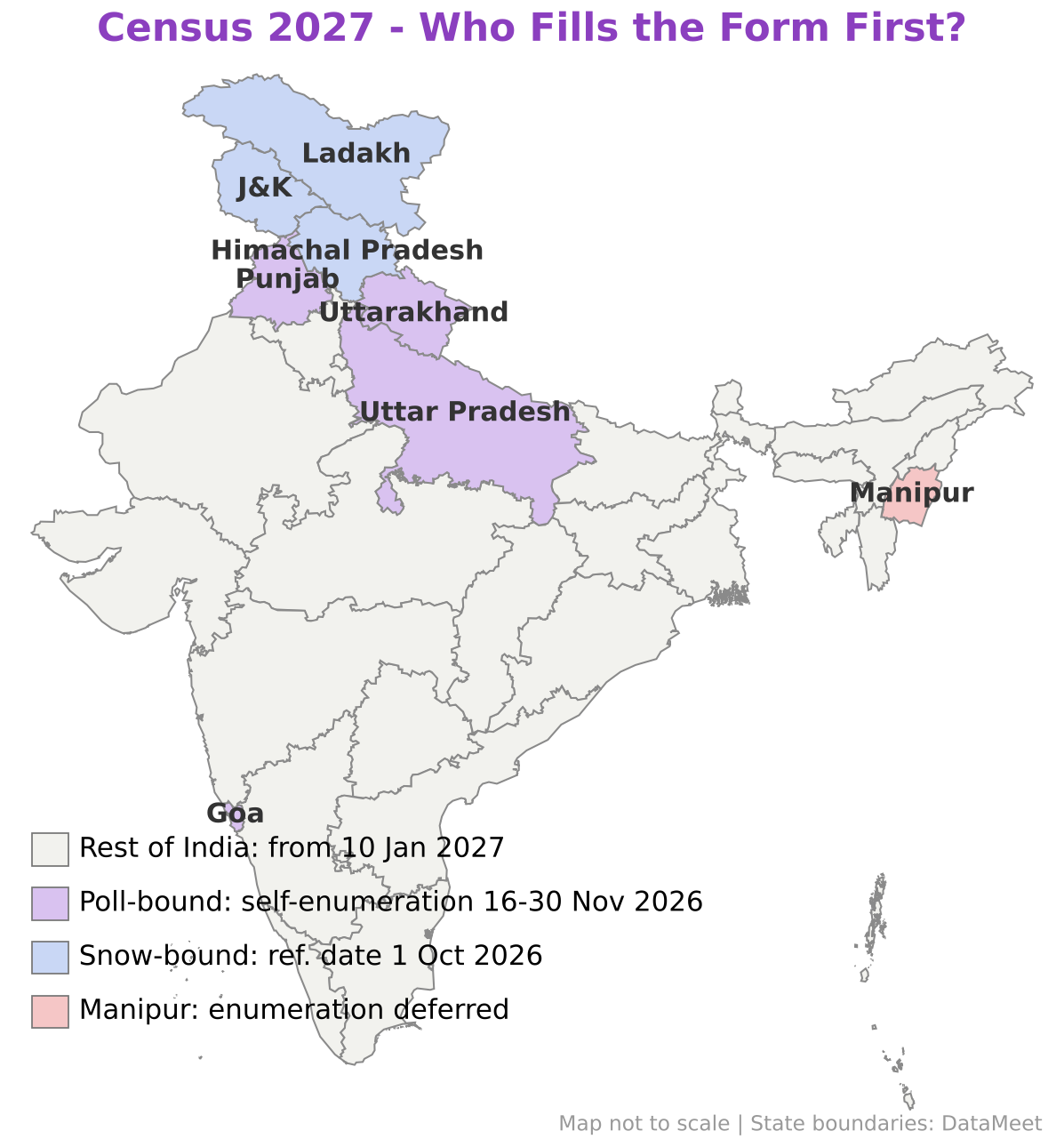
People in four poll-bound states can now fill their own Census form online. A strange 287-option religion list on the portal caused a row and was removed. The Census self-enumeration (fill-it-yourself) portal opened for Uttar Pradesh, Punjab, Goa and the non-snow-bound parts of Uttarakhand, which go to polls in 2027. Its 'Others' religion box showed a drop-down of 287 entries that mixed religions with sects, denominations and even deities. After media questions the list was removed; officials called it 'predictive text' and the Registrar General said people can still write any religion. Self-enumeration here runs 16-30 November 2026, and house-to-house enumeration from 1 December 2026 to 4 January 2027.
Key facts
Census 2027 = 16th Census, 8th since Independence, first digital Census, first full caste count since 1931.
Main reference date: 1 March 2027; snow-bound areas: 1 October 2026; poll-bound states: 5 January 2027.
Rest of India: self-enumeration from 10 January 2027, enumeration 25 January - 28 February 2027.
Caste enumeration approved by the Cabinet Committee on Political Affairs on 30 April 2025; Census notified 16 June 2025.
Enumeration in Manipur is deferred.
Way forward
Publish a clear, consulted religion and caste code list before the national phase, and keep the online portal secure, multilingual and simple for first-time digital users.
Concept
Census: Union List subject (Entry 69, Seventh Schedule), conducted under the Census Act, 1948 by the Registrar General and Census Commissioner (Ministry of Home Affairs). Reference date = the 'snapshot moment' - everyone is counted as they were on that date, so figures from different days are comparable. SECC 2011 (Socio-Economic and Caste Census) produced over 46 lakh caste entries - a warning that caste lists need careful coding. Tribal religion demand: Sarna code (Jharkhand resolution, 2020). Exam angle: Prelims: Census Act 1948, Entry 69, reference dates, 'first since 1931' caste count, Registrar General under MHA. Mains: caste data and reservation policy (Indra Sawhney 1992, Rohini Commission), privacy under DPDP Act 2023, women's reservation linked to delimitation after Census (106th Amendment).
India map shading the poll-bound, snow-bound and deferred regions for Census 2027 — StudyForGS
2. New Visa Framework: 13 Categories Become 9
POLITYUPSC: Prelims + Mains GS2
Syllabus linkage
GS2 Government policies; GS3 Internal security (immigration). Prelims: Immigration and Foreigners Act 2025, visa categories. Mains: ease of travel vs border security.
Context
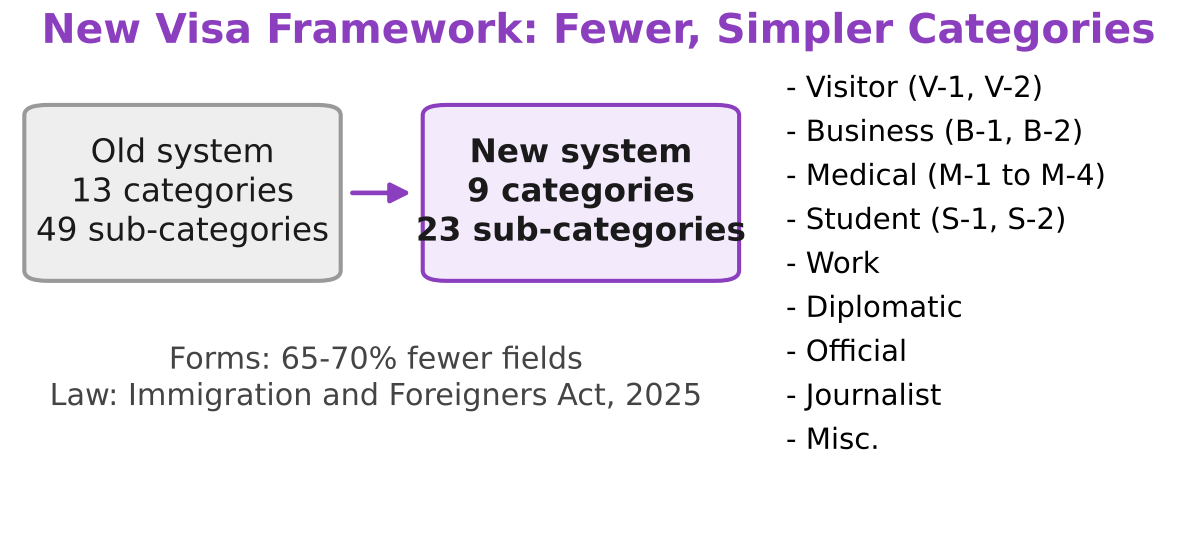
India has simplified its visa system: fewer types of visa, shorter forms, and longer multi-year options for tourists, students and patients. The Ministry of Home Affairs announced a new visa framework on 11 November 2026. Main visa categories fall from 13 to 9 and sub-categories from 49 to 23, and application forms will have 65-70% fewer fields. The 'Tourist' visa becomes a 'Visitor' visa (V-1 for 30 days multiple entry, V-2 valid 1, 5 or 10 years). The system is expected to go live by the end of 2026 after IT upgrades.
Exemptions kept for persecuted minorities from Afghanistan, Bangladesh, Pakistan who entered by 31 Dec 2024, Tibetans and registered Sri Lankan Tamil refugees.
Way forward
Roll out the IT system smoothly, publish the Visa Manual in simple language, and keep security vetting strong even as forms get shorter.
Concept
Immigration and Foreigners Act, 2025: a single modern law that replaced the older Passport (Entry into India) Act 1920, Registration of Foreigners Act 1939, Foreigners Act 1946 and Immigration (Carriers' Liability) Act 2000. Exemption Order: a government order that frees certain groups from specific rules (for example, a visa needed for stay) - amended now by the Immigration and Foreigners (Exemption) (Amendment) Order, 2026. AYUSH visa (M-3): supports 'Heal in India' - medical value travel for Ayurveda, Yoga, Unani, Siddha, Sowa-Rigpa and Homoeopathy. Exam angle: Prelims: which Acts were merged into the 2025 Act; new category names (Visitor, M-3 AYUSH). Mains: how visa reform supports tourism, education hub and medical tourism while keeping security checks.
Diagram comparing the old 13-category visa system with the new 9-category system — StudyForGS
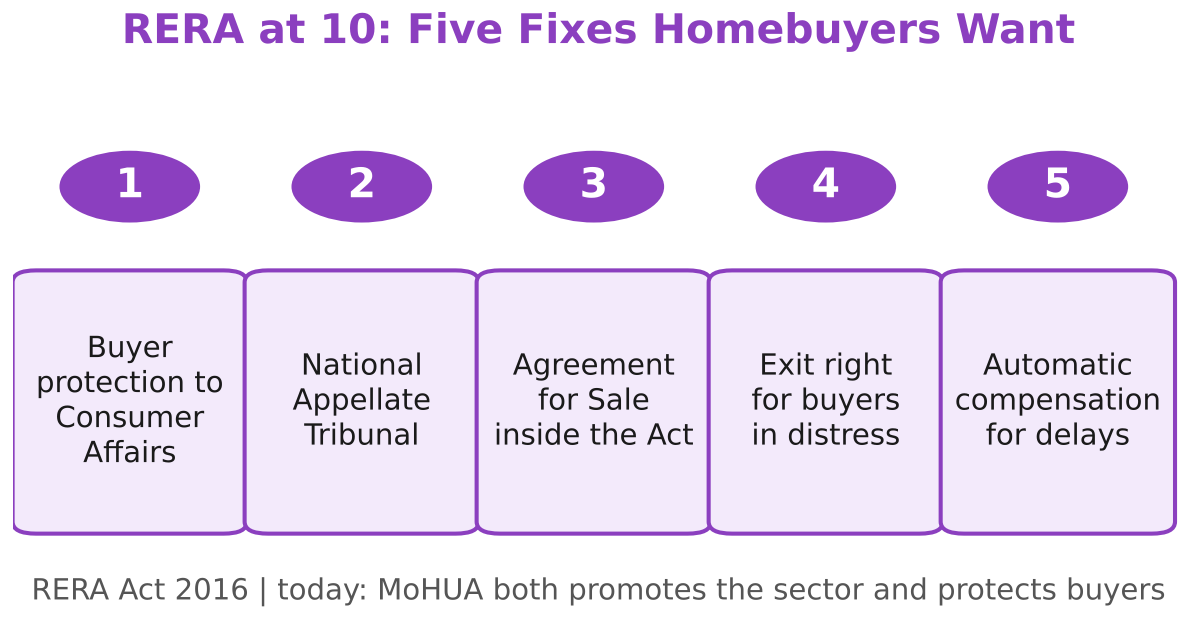
A decade after the real estate law, homebuyers say they still suffer delays and weak remedies, and have asked the government for five changes. The Forum for People's Collective Efforts (FPCE), a homebuyers' body that helped bring RERA, wrote to the Prime Minister in October 2026. Cabinet Secretary T.V. Somanathan acknowledged the concerns and officials met the forum. Problems include empty state appellate tribunals (one state tribunal lacked quorum to pass any order), builders deviating from the model Agreement for Sale, and compensation that needs long individual litigation.
Key facts
Reform 1: move homebuyer protection from MoHUA to the Department of Consumer Affairs (end conflict of interest).
Reform 2: a National Appellate Tribunal for Real Estate, modelled on NCLAT and NGT.
Reform 3: put the Agreement for Sale (AFS) in a Schedule of the Act so it is binding.
Reform 4: exit right for buyers in personal distress - full refund within one month if cancelled within a year of booking.
Reform 5: automatic compensation for all allottees of delayed projects.
Way forward
Fill tribunal vacancies, make the model AFS binding and create an automatic compensation system so that protection does not depend on who can afford a lawyer.
Concept
RERA = Real Estate (Regulation and Development) Act, 2016: sets up a Real Estate Regulatory Authority in each state, mandatory project registration, and a Central Advisory Council. Section 18 of RERA: lets buyers exit with refund and interest only when the developer is at fault (for example, delay). Conflict of interest: when one ministry both promotes an industry and protects its customers, protection tends to get weaker - similar debates exist in other sectors. Exam angle: Prelims: RERA year (2016), state-level authority, appellate tribunal, Section 18. Mains: 'Has RERA delivered on its promise?' - delays, vacancies, model AFS dilution, need for a national appellate body.
Diagram of the five RERA reforms sought by homebuyers — StudyForGS
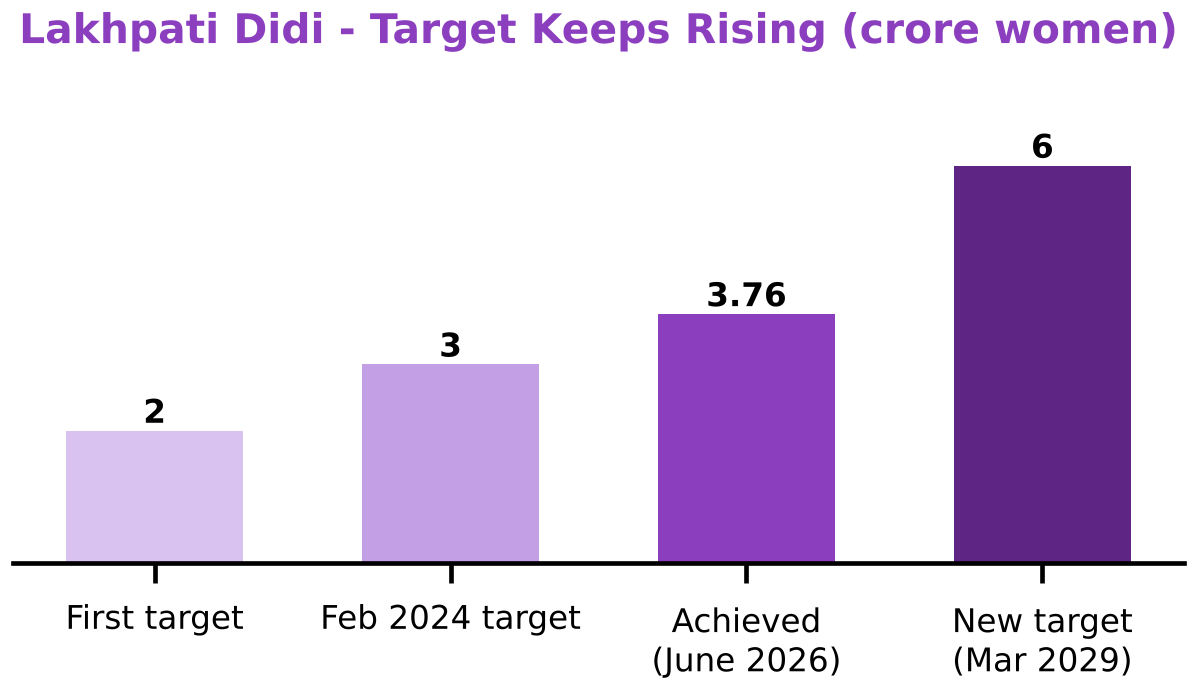
The government wants 6 crore rural women in self-help groups to earn at least Rs 1 lakh a year by March 2029. The target of the Lakhpati Didi initiative has been raised to 6 crore women by March 2029. It began with a target of 2 crore, raised to 3 crore in February 2024. As of June 2026, 3.76 crore Lakhpati Didis had been enabled, so about 2.24 crore more are needed. The Ministry of Rural Development runs it through the Self-Help Group (SHG) network.
Key facts
Announced on 15 August 2023; nodal ministry: Rural Development.
Lakhpati Didi = SHG member with annual household income of at least Rs 1 lakh, sustained over time.
Achieved: 3.76 crore (June 2026); new target: 6 crore by March 2029.
Uses a Cascade Training Strategy across all States and UTs.
Focus on micro-enterprises and diversified livelihoods in villages.
Way forward
Link SHG products to markets and e-commerce, improve credit and skills, and measure income gains independently.
Concept
DAY-NRLM (Deendayal Antyodaya Yojana - National Rural Livelihoods Mission, launched 2011 as Aajeevika): organises poor rural women into SHGs and gives them credit and training. Self-Help Group: a small group (usually 10-20 women) who save together and take small loans from the group or banks - the base of India's women-led rural finance. Exam angle: Prelims: launch year, ministry, definition of Lakhpati Didi, link with DAY-NRLM. Mains: role of SHGs in women's empowerment and rural income; challenges of market access and credit.
Bar chart of Lakhpati Didi targets and achievement: 2, 3, 3.76 and 6 crore — StudyForGS
5. Tech Education Push in Tribal Schools
POLITYUPSC: Prelims + Mains GS2
Syllabus linkage
GS2 Education, welfare of Scheduled Tribes. Prelims: EMRS, NESTS. Mains: bridging the digital divide for tribal students.
Context
Eklavya Model Residential Schools for tribal children will get a coding and technology programme run with a private partner. The National Education Society for Tribal Students (NESTS) has partnered with Learning Links Foundation to bring the Amazon Future Engineer programme to Eklavya Model Residential Schools (EMRS). The aim is to boost computer science and technology education for tribal students. Four newly built EMRS in Tripura were also recently inaugurated by the Prime Minister.
Key facts
EMRS started in 1998; revamped in 2018-19.
Each EMRS: 480 students, equal seats for boys and girls.
Set up in every block with more than 50% ST population and at least 20,000 tribal persons.
Up to 10% seats for non-ST students; 20% sports-quota seats for ST students.
Ministry of Tribal Affairs runs EMRS through NESTS.
Way forward
Ensure trained teachers, internet and devices in remote schools, and track learning outcomes, not just enrolment.
Concept
NESTS: an autonomous society under the Ministry of Tribal Affairs that sets up and manages EMRS across India. Digital divide: the gap between those who have access to computers, internet and digital skills and those who do not - wider in remote tribal areas. Exam angle: Prelims: EMRS criteria (50% ST, 20,000 tribals), NESTS, ministry. Mains: education as a tool for tribal development; public-private partnerships in school education.
6. Senior Citizen Care Reaches Cantonments
POLITYUPSC: Prelims + Mains GS2
Syllabus linkage
GS2 Welfare of vulnerable sections (elderly); GS1 Population ageing. Prelims: AVYAY, Cantonment Boards. Mains: preparing for an ageing India.
Context
Welfare schemes for elderly people will now reach Cantonment Boards too, through an agreement between two ministries. The Department of Social Justice and Empowerment and the Directorate General Defence Estates (Ministry of Defence) signed an MoU in New Delhi. It extends the Atal Vayo Abhyudaya Yojana (AVYAY) to Cantonment Boards across the country. Ministers Rajnath Singh and Dr Virendra Kumar witnessed it. It builds on the Vayo Samman Rashtriya Abhiyan launched on 4 November 2026.
Key facts
New and upgraded Day Care Centres for the elderly in cantonment areas.
Financial support for 25-bed and 50-bed Senior Citizen Homes.
Training youth as geriatric caregivers (people who look after the elderly).
Student-senior interaction and awareness camps.
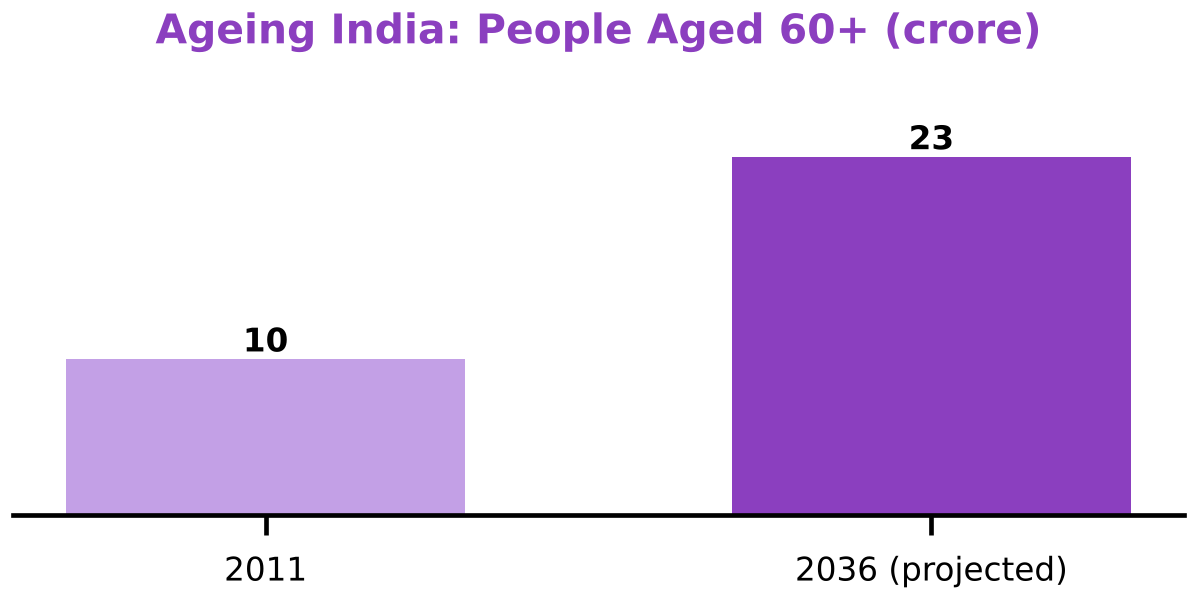
Population aged 60+: about 10 crore (2011) projected to reach 23 crore (2036).
Way forward
Use such inter-ministry tie-ups to reach elderly people in all local bodies and build a trained care workforce.
Concept
AVYAY (Atal Vayo Abhyudaya Yojana): umbrella scheme of the Social Justice Ministry for senior citizens - homes, day care, healthcare, livelihood. Cantonment Board: a local body for civil areas inside military cantonments, under the Cantonments Act, 2006 and the Ministry of Defence. Exam angle: Prelims: AVYAY ministry, Cantonments Act 2006, DGDE. Mains: India's ageing population - care economy, pensions, health and the Maintenance and Welfare of Parents and Senior Citizens Act, 2007.
Bar chart of India's population aged 60 and above: 10 crore in 2011 to 23 crore in 2036 — StudyForGS
7. National Press Day and the Press Council
POLITYUPSC: Prelims + Mains GS2
Syllabus linkage
GS2 Statutory bodies, Article 19(1)(a). Prelims: PCI history and Acts. Mains: media ethics, regulation vs freedom.
Context
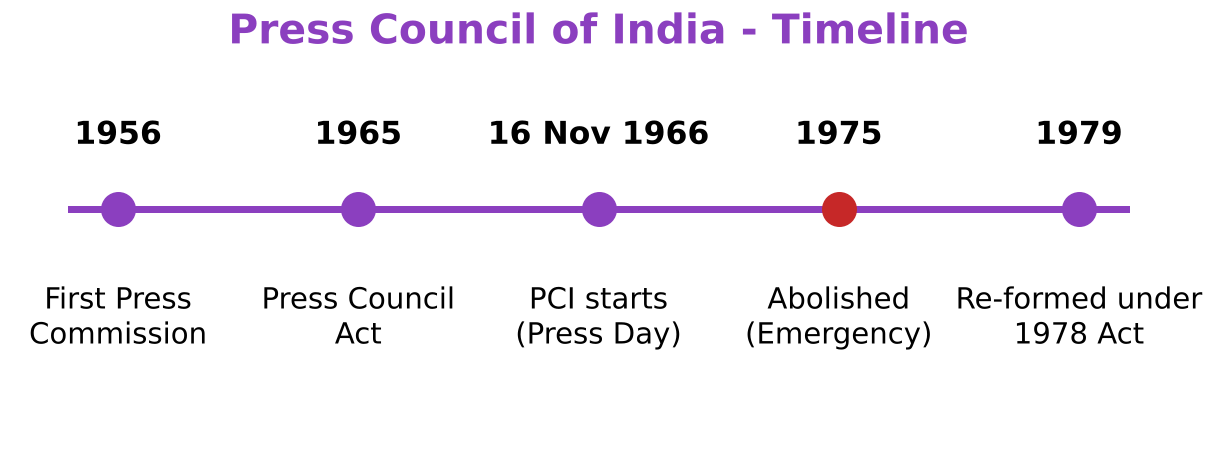
16 November is National Press Day, the day the Press Council of India began work in 1966 to protect press freedom and keep standards. National Press Day was observed on 16 November 2026 with the theme 'Journalism: Populist or Responsible'. The Press Council of India (PCI) was set up on 4 July 1966 under the Indian Press Council Act, 1965 and began functioning on 16 November 1966. It was abolished in 1975 during the Emergency and re-formed in 1979 under the Press Council Act, 1978.
Key facts
First Press Commission (1956) recommended a statutory press body.
First chairman: Justice J.R. Mudholkar (1966-68).
PCI is a quasi-judicial body: it can warn, admonish or censure a newspaper.
PCI covers print media only, not TV or digital news.
2026 theme: 'Journalism: Populist or Responsible'.
Way forward
Debate a modern framework that covers print, TV and digital news while protecting editorial independence.
Concept
Statutory body = created by an Act of Parliament (PCI is under the Press Council Act, 1978), unlike a constitutional body. Freedom of the press is not written separately in the Constitution; it flows from Article 19(1)(a) (freedom of speech and expression), with reasonable limits under Article 19(2). Exam angle: Prelims: dates (1956, 1965, 1966, 1975, 1978), PCI powers, print-only coverage. Mains: self-regulation vs statutory regulation of media, fake news, paid news.
Timeline of the Press Council of India from 1956 to 1979 — StudyForGS
8. 23rd ASEAN-India Summit in Manila
IRUPSC: Prelims + Mains GS2
Syllabus linkage
GS2 India and its neighbourhood, regional groupings. Prelims: ASEAN members, EAS, Act East milestones. Mains: Act East Policy and Indo-Pacific.
Context
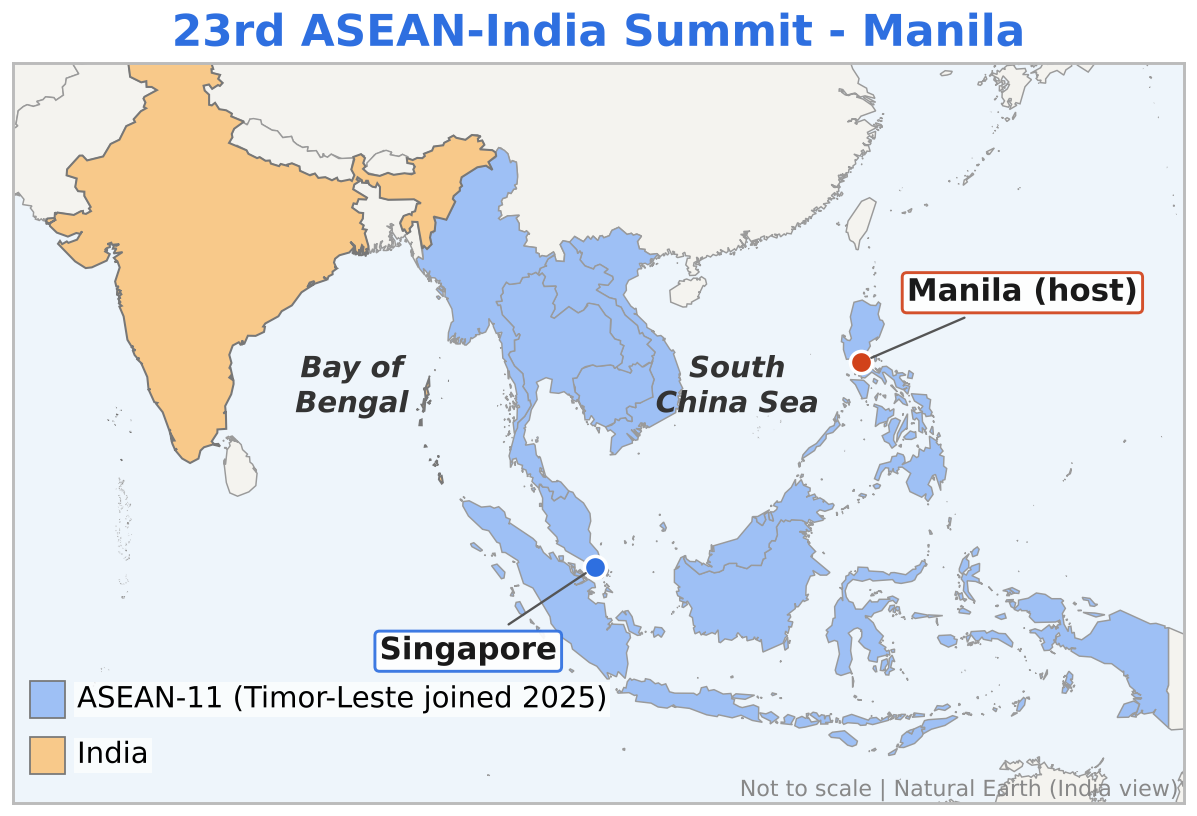
PM Modi met ASEAN leaders in Manila and said Asia's future should be shaped by cooperation, not rivalry. PM Modi attended the 23rd ASEAN-India Summit in Manila on 17 November 2026 and the 21st East Asia Summit the same day. He said the world needs 'peace, stability and predictability', and that India and ASEAN together hold nearly a quarter of the world's population. The summit reviewed the Comprehensive Strategic Partnership and the ASEAN-India Plan of Action 2026-2030. The Philippines chairs ASEAN in 2026; 2026 is the ASEAN-India Year of Maritime Cooperation.
Key facts
ASEAN-India trade: about $128.37 billion (2025-26); India wants a review of AITIGA.
2027 = 35 years of Dialogue Relations and 5 years of Comprehensive Strategic Partnership.
Modi linked ASEAN Community Vision 2045 with Viksit Bharat 2047.
ASEAN has 11 members after Timor-Leste joined in 2025.
Way forward
Finish the AITIGA review, speed up connectivity projects and deepen maritime and digital cooperation.
Concept
ASEAN: founded 1967 (Bangkok Declaration); India became sectoral partner 1992, full dialogue partner 1996, summit partner 2002, strategic partner 2012, Comprehensive Strategic Partner 2022. AITIGA: ASEAN-India Trade in Goods Agreement (2009); India says it has led to a large trade deficit, hence the review. East Asia Summit (EAS): began 2005 in Kuala Lumpur - ASEAN plus 8 partners including India, US, China, Russia. 'ASEAN centrality' = ASEAN sits in the driver's seat of these forums. Exam angle: Prelims: ASEAN members and founding year, EAS membership, Act East (2014), 'Year of Maritime Cooperation'. Mains: ASEAN in India's Indo-Pacific strategy; trade deficit and AITIGA review; connectivity (Kaladan, Trilateral Highway).
Map of the 11 ASEAN member countries and India with host city Manila marked — StudyForGS
9. Quad in Manila, Big-Three Meet in Shenzhen
IRUPSC: Prelims + Mains GS2
Syllabus linkage
GS2 Groupings involving India, effect of policies of developed countries. Prelims: Quad history, APEC. Mains: India's multi-alignment and strategic autonomy.
Context
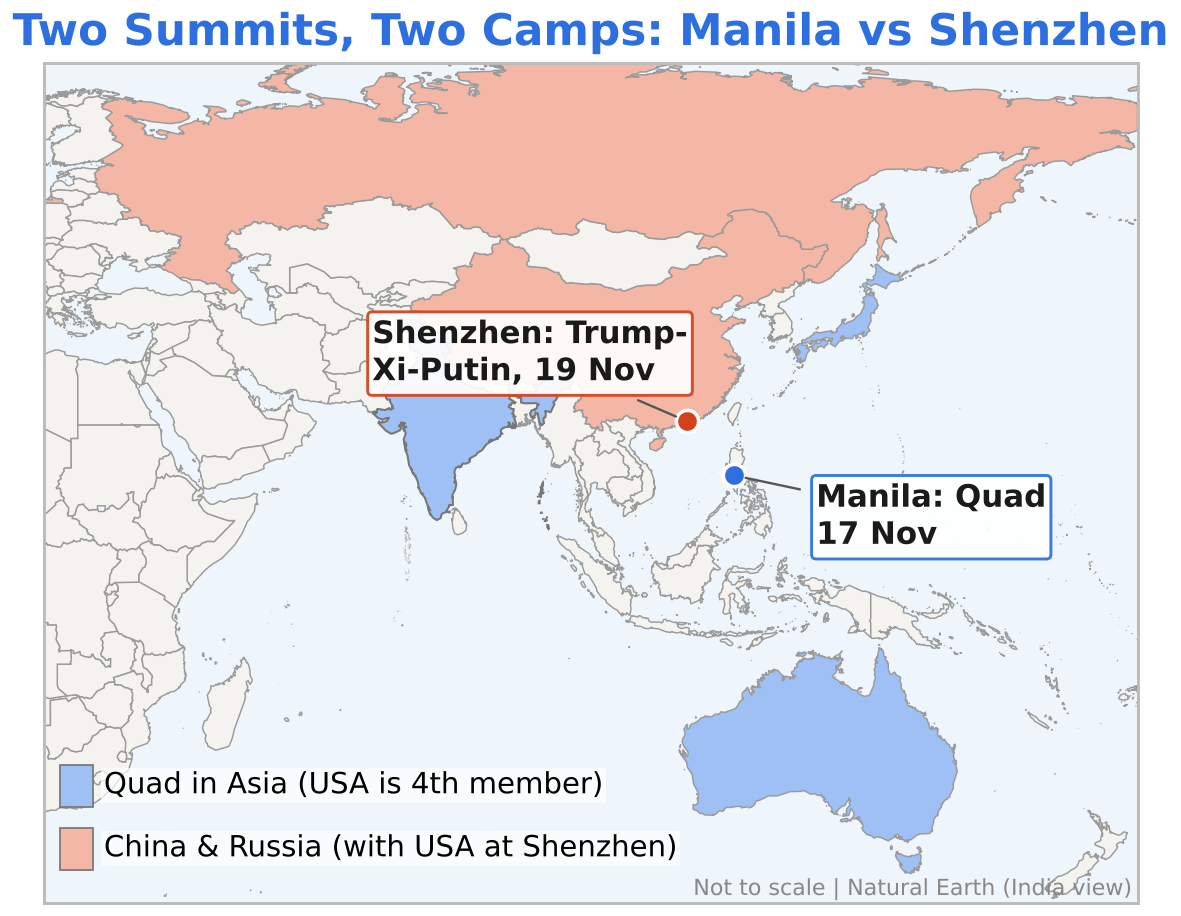
Quad leaders met in Manila, and two days later the leaders of the US, China and Russia are set to hold their first three-way meeting in Shenzhen. Quad leaders - Modi, Trump, Japan's PM Takaichi and Australia's PM Albanese - were set to meet in Manila on 17 November 2026 on the sidelines of the ASEAN summits. It is the first Quad leaders' meeting since September 2024 (Wilmington). Separately, Trump, Xi Jinping and Putin plan their first trilateral in Shenzhen on 19 November on the sidelines of APEC, which China is hosting.
Key facts
Quad = India, USA, Japan, Australia.
Roots: 2004 tsunami Core Group; 2007 proposal by Shinzo Abe; revived 2017; leaders' level from 2021.
APEC: founded 1989 in Canberra, 21 member economies, India not a member.
A new US rule tightens Chinese access to advanced AI chips through overseas data centres.
Way forward
India should keep Quad focused on practical public goods (maritime awareness, health, tech) while protecting its strategic autonomy.
Concept
Multi-alignment: India works with many groups at once (Quad, BRICS, SCO) to protect its own interests - linked to 'strategic autonomy'. Minilateral: a small group of 3-4 countries working on specific issues (like Quad), faster than big multilateral bodies such as the UN. Exam angle: Prelims: Quad members and timeline, APEC membership (India not member), IPMDA. Mains: Quad's relevance amid US-China-Russia contacts; India's balancing act.
Map showing the Quad countries and China and Russia with Manila and Shenzhen marked — StudyForGS
10. India Signs Pax Silica San Francisco Declaration
IRUPSC: Prelims + Mains GS2/GS3
Syllabus linkage
GS2 International groupings; GS3 Science and technology, semiconductors. Prelims: Pax Silica members. Mains: tech supply-chain security.
Context
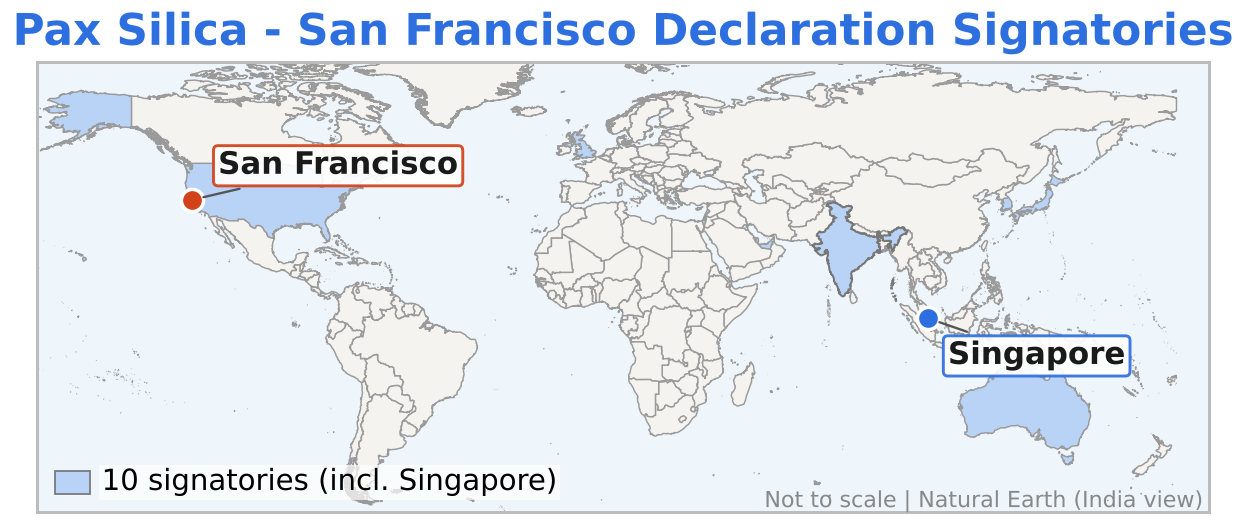
India and nine partners promised to protect the supply chains of AI chips, materials and know-how from theft and hostile takeover. India signed the San Francisco Declaration at the Pax Silica Founders Retreat in the USA. The Indian delegation was led by S. Krishnan, Secretary, MeitY. The declaration covers software, materials, technical knowledge, components and manufacturing for AI and 'Super Intelligence' supply chains, including protection against theft and hostile acquisition.
Key facts
10 signatories: USA, India, Australia, Israel, Japan, South Korea, Qatar, Singapore, UAE, UK.
Pax Silica is a US-led initiative on trusted tech supply chains.
India had joined Pax Silica earlier in 2026, around the AI Impact Summit.
Focus areas: chips, critical minerals, AI computing and manufacturing.
Indian lead: Ministry of Electronics and IT (MeitY).
Way forward
Use the partnership to bring chip, materials and AI investment to India while building domestic capability.
Concept
Supply chain: all steps from raw material to finished product; a 'trusted' chain avoids dependence on rivals at choke points. Hostile acquisition: when a rival-linked company buys a key firm to gain its technology - many countries now screen such investments. Exam angle: Prelims: Pax Silica signatories, lead ministry. Mains: India's semiconductor mission and tech partnerships (iCET/TRUST) vs strategic autonomy.
World map of the 10 signatories of the Pax Silica San Francisco Declaration — StudyForGS
11. India-Egypt 7th Joint Trade Committee
IRUPSC: Prelims + Mains GS2
Syllabus linkage
GS2 Bilateral relations (West Asia and North Africa). Prelims: Egypt geography. Mains: India's Africa and Arab outreach.
Context
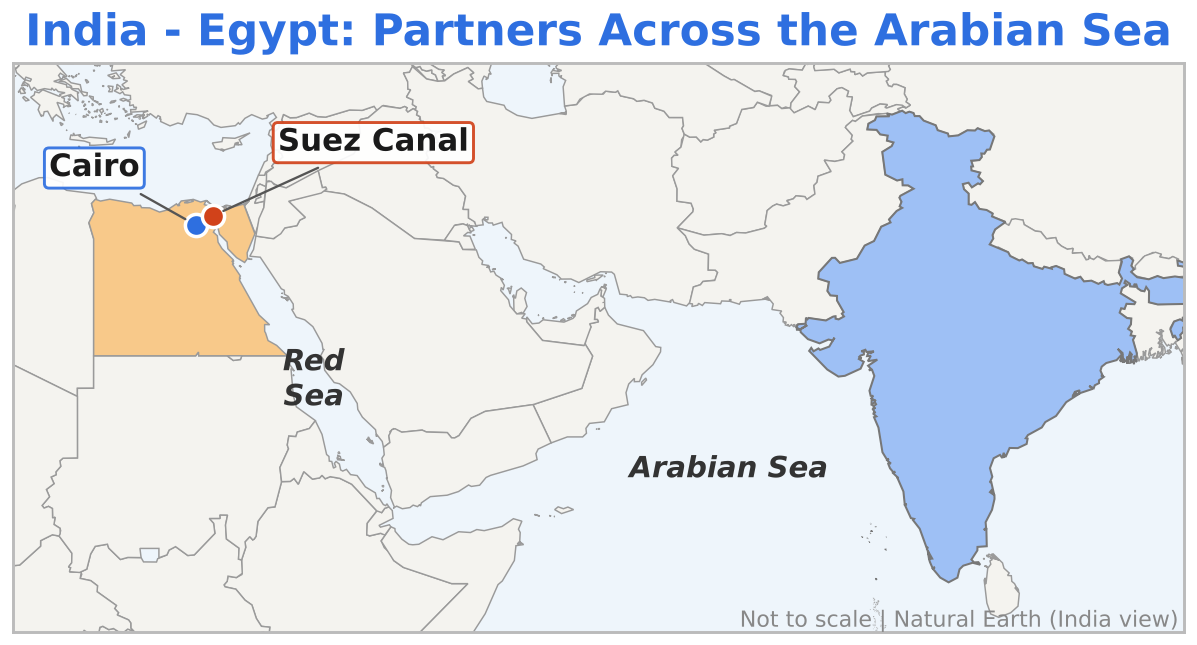
India and Egypt held a minister-level trade meeting to grow business between the two countries. India and Egypt held the 7th ministerial-level Joint Trade Committee (JTC) meeting to strengthen bilateral economic ties. Egypt is a key partner for India in the Arab world and Africa, and sits on the Suez Canal route that carries much of India's trade with Europe.
Key facts
Egypt borders Sudan (south), Libya (west), Israel and Gaza Strip (northeast).
Coasts: Mediterranean Sea (north), Red Sea and Gulf of Aqaba (east).
Sinai Peninsula links Africa and Asia; capital Cairo.
Highest point: Mount Catherine (2,642 m); Nile flows south to north.
Resources: petroleum, natural gas, phosphates, iron ore.
Way forward
Expand trade in fertilisers, energy and pharma, and use Egypt's Suez Canal Economic Zone for Indian investment.
Concept
Joint Trade Committee: a regular meeting of trade ministers/officials of two countries to remove trade barriers and set targets. India-Egypt ties were raised to a Strategic Partnership in 2023, when Egypt's President was Chief Guest at Republic Day. Exam angle: Prelims: map - Egypt's neighbours, Suez Canal, Sinai, Gulf of Aqaba. Mains: Egypt in India's West Asia and Africa policy; Suez/Red Sea route security.
Map of Egypt and India with Cairo and the Suez Canal marked — StudyForGS
12. Kochi Hosts Coconut Community Ministers
IRUPSC: Prelims + Mains GS2/GS3
Syllabus linkage
GS2 International organisations; GS3 Agriculture (plantation crops). Prelims: ICC HQ, founding. Mains: plantation crops and trade.
Context
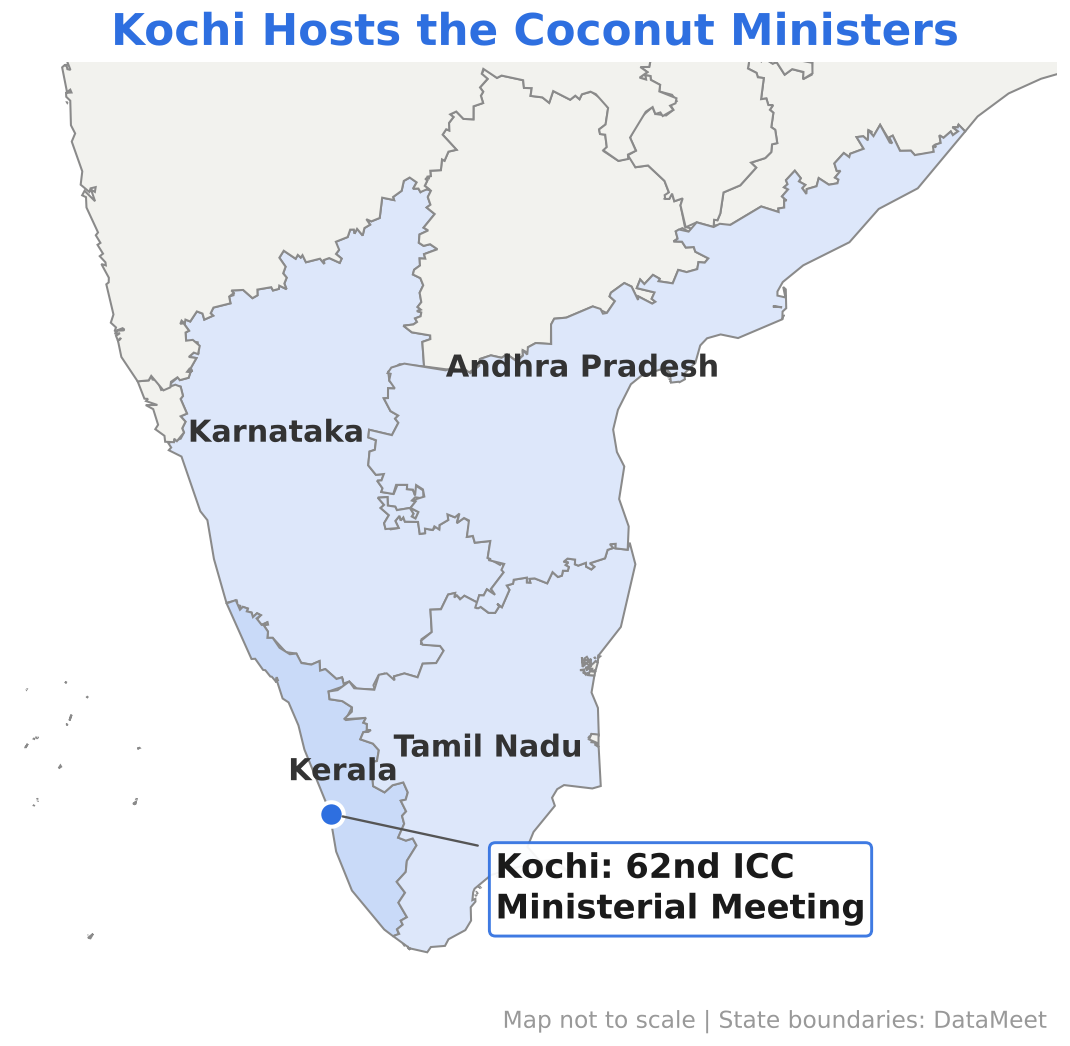
India is hosting the yearly meeting of coconut-producing countries in Kochi to discuss production, trade and quality. India is hosting the 62nd Session and Ministerial Meeting of the International Coconut Community (ICC) in Kochi, Kerala. The ICC is an inter-governmental body of coconut-producing countries that works to raise production, harmonise quality standards and reduce trade barriers.
Key facts
ICC founded in 1969 under UN-ESCAP.
Secretariat: Jakarta, Indonesia.
21 member countries - over 90% of world coconut production and exports.
India is a member and a top coconut producer.
Functions: training, quality standards, linking members with donors.
Way forward
Push value-added coconut products (virgin oil, coir, activated carbon) and common quality standards to boost exports.
Concept
UN-ESCAP: UN Economic and Social Commission for Asia and the Pacific (HQ Bangkok) - helped create several regional commodity bodies. Coconut Development Board (India): statutory body under the Ministry of Agriculture, HQ Kochi - set up under the Coconut Development Board Act, 1979. Exam angle: Prelims: ICC HQ (Jakarta), founding year (1969), UN-ESCAP link; Coconut Development Board HQ (Kochi). Mains: value addition in plantation crops for farmer income.
Map of southern India showing major coconut-growing states and meeting venue Kochi — StudyForGS
13. Health Accounts: Families Paying Less
HEALTHUPSC: Prelims + Mains GS2
Syllabus linkage
GS2 Health, government policies. Prelims: NHA terms (OOPE, GHE, THE). Mains: public health financing, Ayushman Bharat.
Context
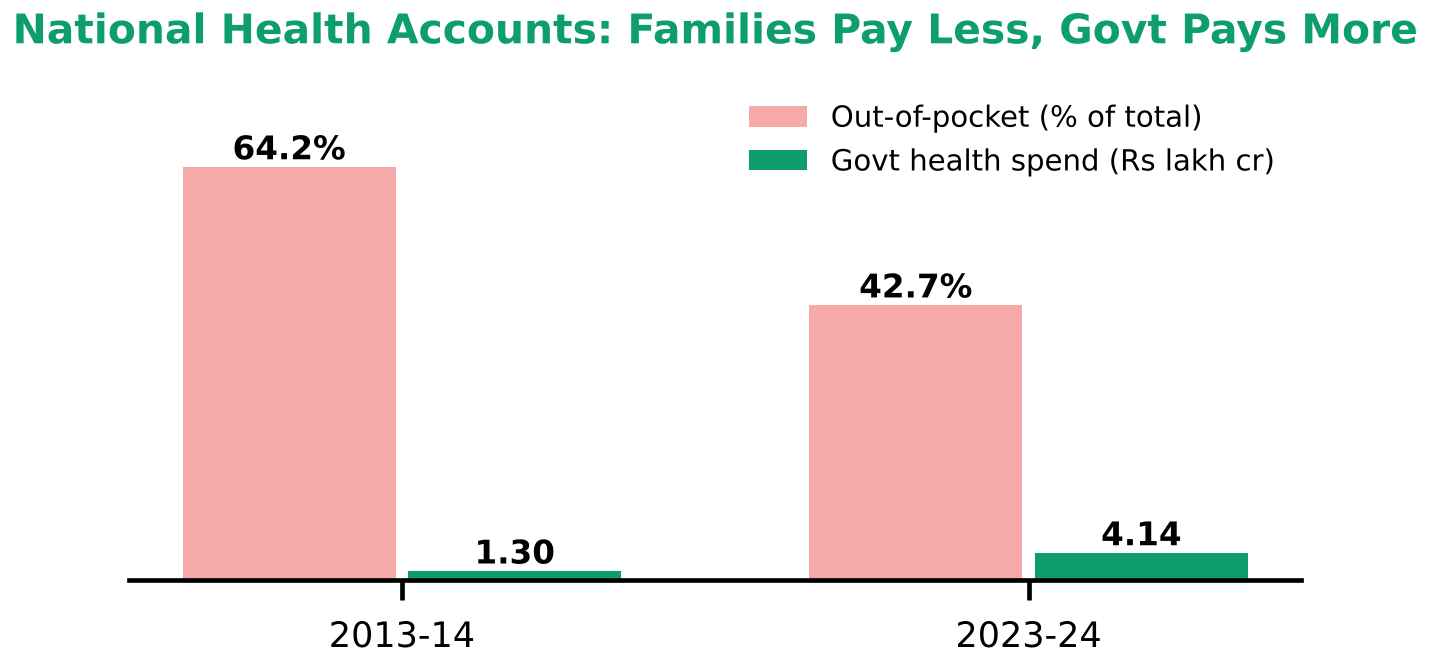
New national health spending data show the government is paying a bigger share of India's health bills, and families are paying less from their own pockets. The Health Ministry released the National Health Accounts (NHA) estimates for 2023-24. Government Health Expenditure (GHE) rose to Rs 4.14 lakh crore, from Rs 1.30 lakh crore in 2013-14. Out-of-pocket expenditure (money families pay directly at the time of treatment) fell from 64.2% of total health spending in 2013-14 to 42.7%. Total Health Expenditure was about Rs 9.52 lakh crore, or 3.29% of GDP.
Key facts
GHE about 1.43% of GDP; states contribute about 68% and the Union about 32%.
OOPE down 21.5 percentage points in a decade (64.2% to 42.7%).
Per capita total health spending: about Rs 6,801.
Government's share of total health spending up 14.9 percentage points since 2013-14.
National Health Policy 2017 target: public health spending of 2.5% of GDP by 2025.
Way forward
Move public spending towards the 2.5% of GDP target, focus on primary care and cheaper medicines, since medicines remain a large part of OOPE.
Concept
National Health Accounts: a standard accounting method (WHO System of Health Accounts) that tracks who pays for health and on what; prepared by NHSRC for the Health Ministry. Out-of-pocket expenditure (OOPE): payments made directly by households at the point of care - high OOPE pushes families into poverty ('catastrophic health spending'). Health is a State List subject (Entry 6), which is why states carry most public spending. Exam angle: Prelims: definitions of GHE, THE, OOPE; NHP 2017 target; who prepares NHA. Mains: has public spending reduced the financial burden of illness? Role of PM-JAY and state schemes.
Bar chart comparing out-of-pocket share and government health spending in 2013-14 and 2023-24 — StudyForGS
17 November is National Epilepsy Day. Most people with epilepsy can live seizure-free with the right treatment, but stigma stops many from seeking care. National Epilepsy Day is observed in India on 17 November, an initiative of the Epilepsy Foundation of India. According to WHO, about 50 million people worldwide live with epilepsy, including an estimated 10 million in India. Up to 70% of people with epilepsy could become seizure-free with proper diagnosis and treatment.
Key facts
Epilepsy = a brain disorder causing repeated seizures (sudden bursts of electrical activity in the brain).
Diagnosis: history, neurological exam, EEG and brain imaging.
Treatment: anti-seizure medicines, ketogenic diet for some, surgery, deep brain stimulation.
Way forward
Train primary-care doctors to diagnose and treat epilepsy, keep cheap medicines in stock, and run awareness drives against stigma.
Concept
Neurocysticercosis: infection of the brain by the larva of the pork tapeworm (Taenia solium), spread through poor sanitation - a major preventable cause of epilepsy in India. Treatment gap: the share of people who need treatment but do not get it - large in rural India due to stigma and lack of neurologists. Exam angle: Prelims: neurocysticercosis-tapeworm link, EEG, WHO numbers. Mains: neurological disorders in public health; stigma and the Rights of Persons with Disabilities Act, 2016.
15. World Toilet Day: Safe Toilets, Equal Futures
HEALTHUPSC: Prelims + Mains GS2
Syllabus linkage
GS2 Health and sanitation, SDGs. Prelims: UN resolution, SBM facts. Mains: from ODF to safely managed sanitation.
Context
19 November is World Toilet Day. This year's theme links safe toilets with the safety and dignity of women and girls. World Toilet Day falls on 19 November; the 2026 theme is 'Safe toilets. Equal futures.' The UN formally recognised the day in 2013 through the 'Sanitation for All' resolution (A/RES/67/291). About 3.4 billion people worldwide still lack safely managed sanitation.
Key facts
Linked to SDG 6: clean water and sanitation for all by 2030.
Swachh Bharat Mission launched 2014; India declared Open Defecation Free (ODF) in 2019.
WHO-UNICEF JMP 2024: about 5.5 crore more urban Indians got safely managed sanitation in two years.
Resolution backed by 122 countries at the 67th UN General Assembly.
Way forward
Focus on treatment of faecal sludge, upkeep of community toilets and women-friendly design.
Concept
Safely managed sanitation: a toilet not shared with other households, where waste is safely disposed of or treated - a higher bar than just 'having a toilet'. ODF Plus: villages that stay ODF and also manage solid and liquid waste - the next stage of SBM-Grameen. Exam angle: Prelims: date, UN resolution year, SDG 6, SBM timeline. Mains: sustaining ODF status, faecal sludge management, sanitation and women's safety.
16. Wholesale Inflation Hits 12.3%
ECONOMYUPSC: Prelims + Mains GS3
Syllabus linkage
GS3 Inflation, monetary policy, agriculture; GS1 El Nino. Prelims: WPI vs CPI, Section 45ZA. Mains: supply-side inflation and RBI's response.
Context
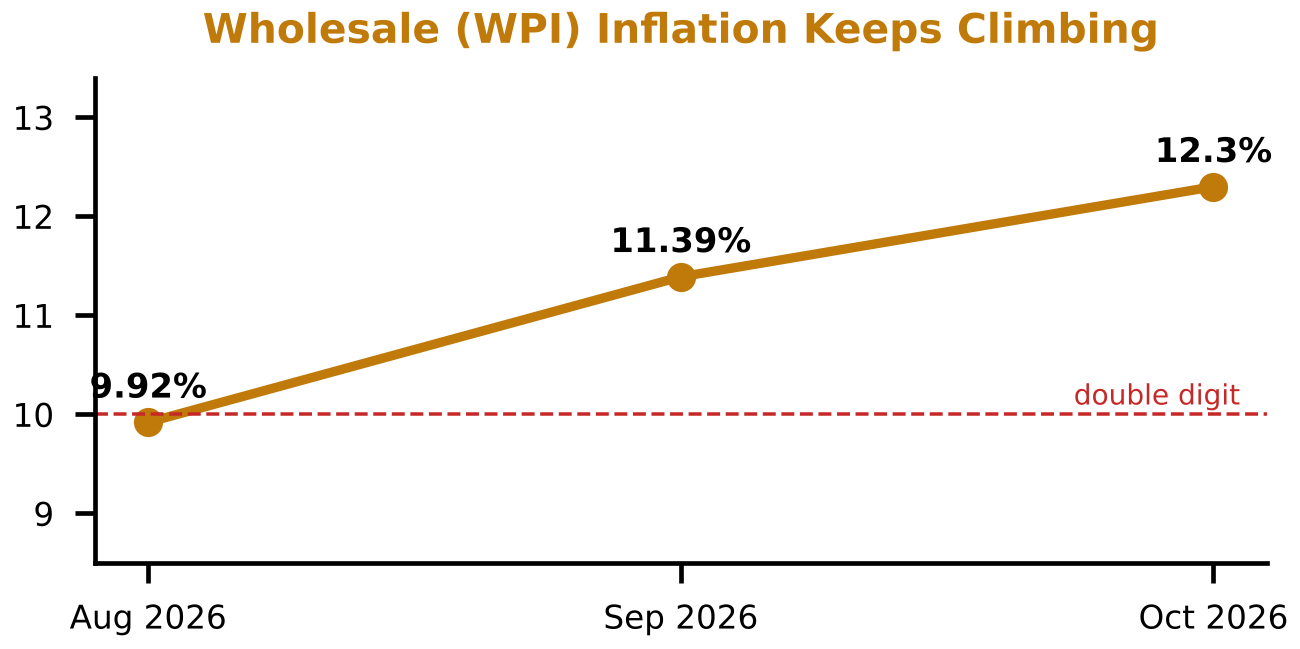
Prices at the wholesale (factory and farm-gate) level rose 12.3% in October - the second month in double digits - driven by fuel and a poor monsoon. WPI inflation was 12.3% in October 2026, after 11.39% in September and 9.92% in August. Crude petroleum and natural gas prices rose over 70%, manufactured products 9.5%, and food inflation reached a 23-month high. A very strong El Nino weakened rains: the southwest monsoon was 12.6% below normal and the northeast monsoon 33.6% below normal (as of 16 November). The RBI raised the repo rate in October 2026.
Key facts
Consumer food inflation (CFPI) 8.9%; CPI above 6% (upper band of RBI target).
Central pool stocks (1 Oct 2026): 101.79 million tonnes rice+wheat, about 3.3 times the buffer norm.
Pulses and oilseeds are more exposed than cereals.
Unemployment rate was reported at 4.9% in October.
Way forward
Release surplus grain through OMSS, import pulses and edible oils in time, and support rabi sowing with seeds and crop insurance.
Concept
WPI: Wholesale Price Index, compiled by the Office of the Economic Adviser, DPIIT (new base 2022-23). CPI: Consumer Price Index by NSO, MoSPI (base 2024=100). RBI targets CPI, not WPI. Inflation target: 4% CPI with a band of plus/minus 2% under Section 45ZA of the RBI Act (for 1 April 2026 - 31 March 2031); if missed for 3 quarters in a row, RBI must report to the government. El Nino: warming of the central/east Pacific Ocean that usually weakens the Indian monsoon; cost-push inflation = prices rise because input costs (fuel, food) rise. Exam angle: Prelims: who compiles WPI/CPI, base years, Section 45ZA, MPC. Mains: can rate hikes control supply-driven inflation? Role of buffer stocks, OMSS, Price Stabilisation Fund.
Line chart of WPI inflation from August to October 2026: 9.92%, 11.39% and 12.3% — StudyForGS
📜 Asked before in the exam — previous-year question on this topic
UPSC Prelims 2020Consider the following statements: 1. The weightage of food in Consumer Price Index (CPI) is higher than that in Wholesale Price Index (WPI). 2. The WPI does not capture changes in the prices of services, which CPI does. 3. Reserve Bank of India has now adopted WPI as its key measure of inflation and to decide on changing the key policy rates. Which of the statements given above is/are correct?
1 and 2 only
2 only
3 only
1, 2 and 3
Show answer
Answer: (a) 1 and 2 only Statements 1 and 2 are correct. Food has a much higher weight in the Consumer Price Index, about 46 per cent in the combined CPI, than in the Wholesale Price Index, where food articles weigh around 15 per cent. The WPI covers only goods, while the CPI also includes services such as housing, health, education and transport. Since 2014, following the Urjit Patel Committee, the RBI has used CPI, not WPI, as its main inflation measure. Its target is 4 per cent CPI inflation within a band of 2 to 6 per cent. Practise all UPSC Prelims 2020 paper (free) →
Linked because this news is about the same topic. The answer is as per the official key of that year.
17. PLI Scheme: Investment Up, Jobs Lag
ECONOMYUPSC: Prelims + Mains GS3
Syllabus linkage
GS3 Industrial policy, employment, Make in India. Prelims: PLI launch, sectors, outlay. Mains: supply-side vs demand-side incentives.
Context
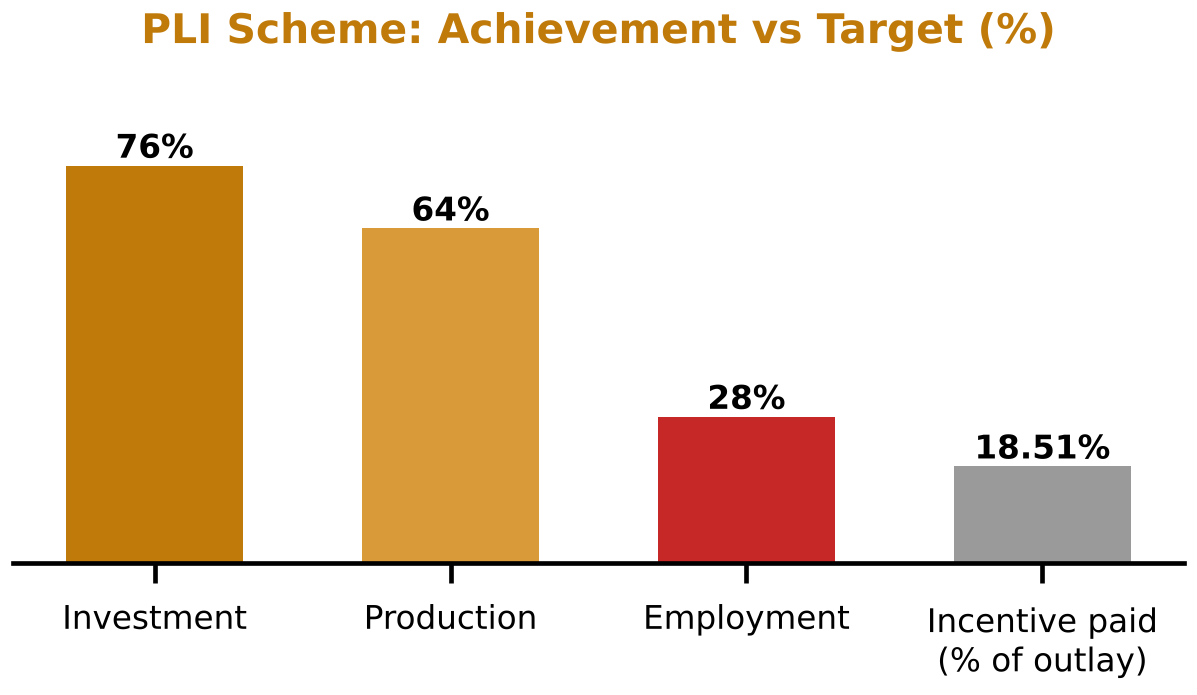
An official review of the Production-Linked Incentive scheme finds that investment is near target but jobs created are only about a quarter of what was promised. A joint NITI Aayog-IIM Ahmedabad assessment of the PLI scheme shows investment at 76% of target (Rs 2.40 lakh crore) and production at 64% (Rs 22.66 lakh crore). But employment reached only 28% of target - 8.49 lakh jobs against 30.18 lakh. Only 18.51% of the outlay had been paid as incentives by March 2026.
Key facts
Launched March 2020; 14 schemes; total outlay Rs 1.91 lakh crore.
Autos and auto parts: 67,820 jobs vs 1.48 lakh target.
9 of 14 schemes paid less than 10% of their outlay.
About 70% of targeted segments broadly on track.
Way forward
Set sector-specific targets, standardise data reporting across ministries and add demand-side measures to lift job creation.
Concept
PLI: firms get a cash incentive as a percentage of the extra (incremental) sales they make from Indian factories - rewards output, not just setting up. Why jobs lag: long gestation (time to build factories), mechanisation and automation, strict targets, demand uncertainty. Supply-side vs demand-side support: PLI helps producers; the report suggests also boosting demand from downstream firms and consumers. Exam angle: Prelims: launch year, number of schemes, outlay, sectors. Mains: Is PLI an effective tool for manufacturing-led jobs? Compare with labour-intensive sectors like textiles and footwear.
Bar chart of PLI scheme achievement against targets for investment, production, employment and incentives paid — StudyForGS
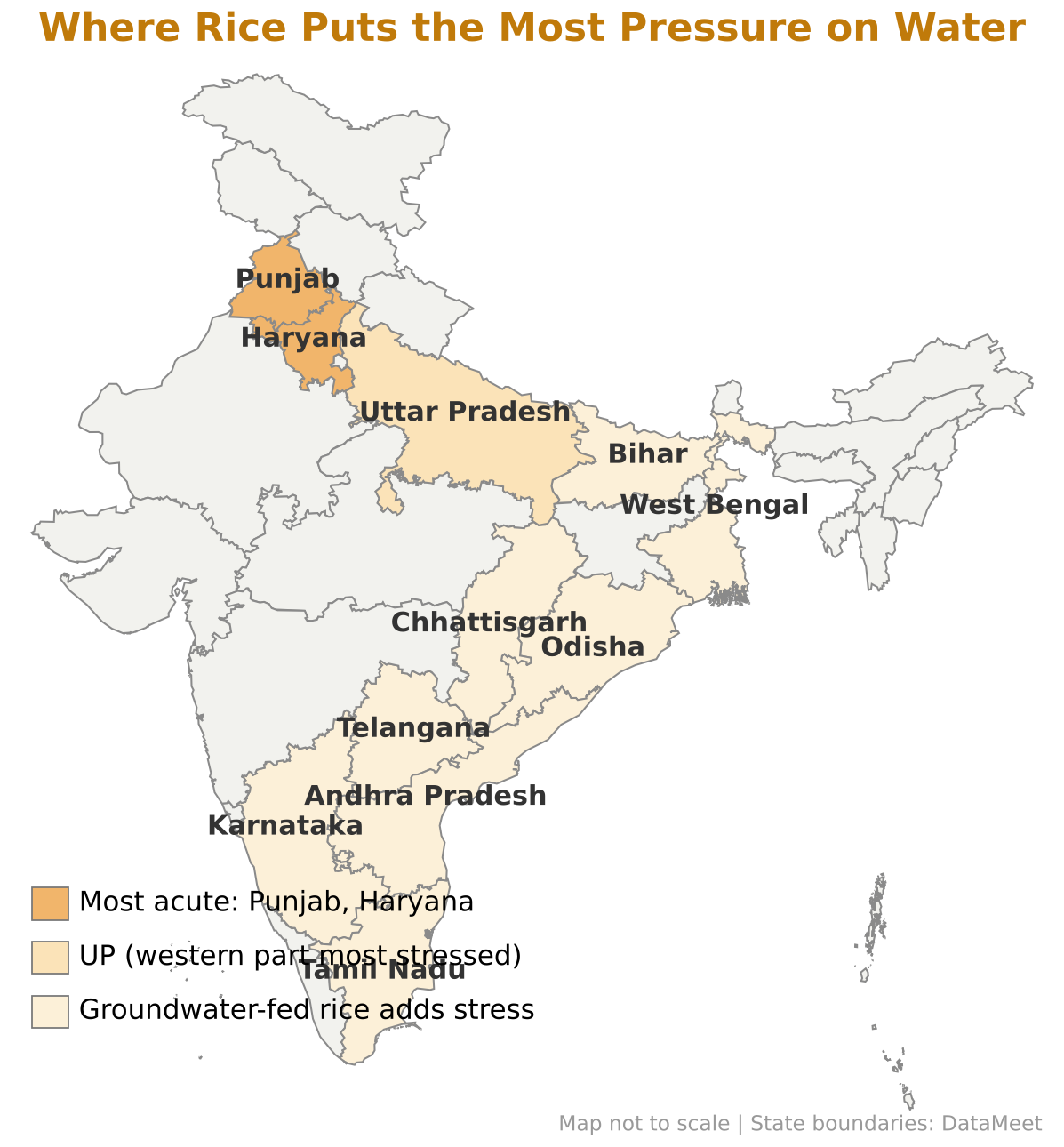
India is the world's biggest rice exporter, but every shipload also exports scarce groundwater from water-stressed states like Punjab and Haryana. India produced an estimated 154.02 million tonnes of rice in 2025-26. Exports rose from 17.73 million tonnes (2020-21) to 21.57 million tonnes (2025-26), and earnings from $8.82 billion to $11.54 billion. India has been the largest rice exporter since 2012, with about 30-35% of world exports. But water pressure is most severe in Punjab, Haryana and western Uttar Pradesh, where rice depends on groundwater.
Key facts
Basmati 2025-26: 6.52 million tonnes ($5.67 bn); non-Basmati: 15.04 million tonnes ($5.86 bn).
Non-Basmati has over twice the volume of Basmati but only slightly more value.
Suggested: water-carbon-value indicators, e.g. export value per cubic metre of blue water.
Better methods: Alternate Wetting and Drying (AWD), Direct-Seeded Rice (DSR).
Way forward
Differentiate production by region, reward farmers who shift from paddy in water-stressed areas, and earn more per tonne through quality and GI branding.
Concept
Virtual water: the water used to grow a product; exporting rice means exporting that water too. Blue water = river, reservoir and groundwater (scarce); green water = rain stored in soil (less pressure). AWD: letting the field dry for a few days between irrigations - saves water and cuts methane; DSR: sowing seeds directly instead of transplanting seedlings in flooded fields. Exam angle: Prelims: virtual water, blue vs green water, AWD, DSR, top rice states. Mains: balancing food security, exports and groundwater; crop diversification in Punjab-Haryana.
India map of states where rice farming puts the most pressure on water, with Punjab and Haryana most acute — StudyForGS
19. Unpaid Care Work Keeps Women Out
ECONOMYUPSC: Prelims + Mains GS1/GS3
Syllabus linkage
GS1 Role of women, social empowerment; GS3 Employment. Prelims: PLFS, Time Use Survey. Mains: female labour force participation.
Context
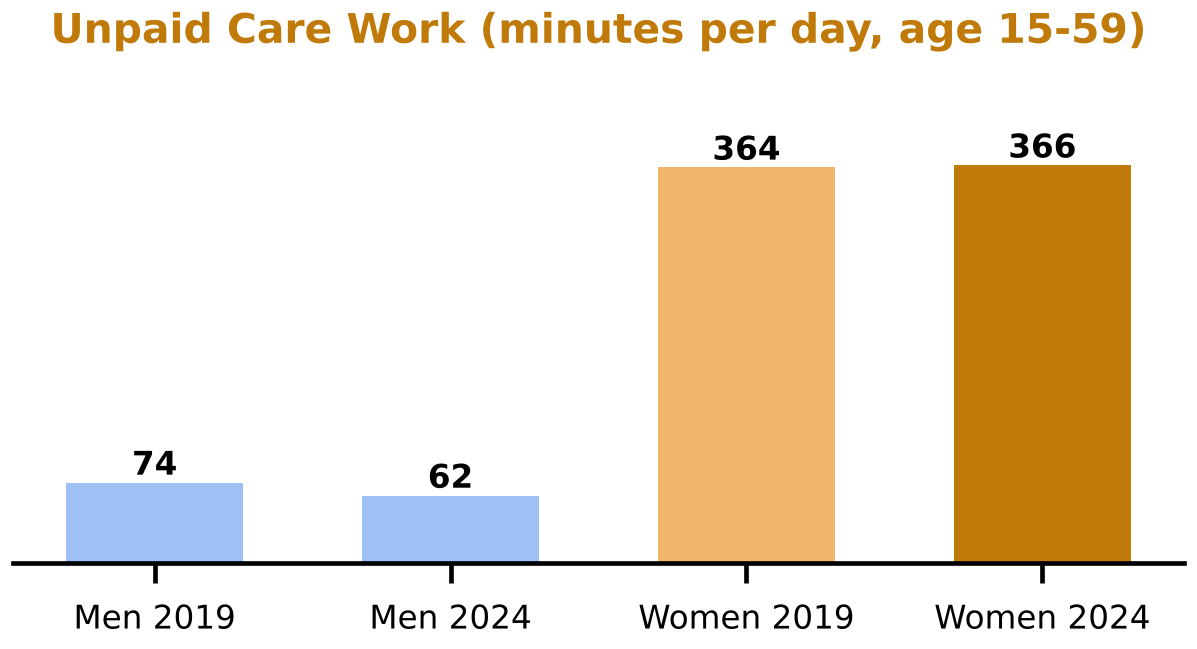
Indian women do about six times more unpaid housework and care than men, which is a big reason fewer women take paid jobs. Time Use Surveys show women aged 15-59 spent 366 minutes a day on unpaid domestic and care work in 2024 (364 in 2019), against 62 minutes for men (74 in 2019). In 2025, 44.4% of women not seeking jobs cited childcare or homemaking as the main reason (PLFS). The World Bank suggests a target of 50% female labour force participation.
Key facts
Female labour force participation rose from about 26.5% (2019) to 43.6% (2024) as per the cited data.
Men's unpaid work fell while women's stayed the same.
Barriers: care duties, safety and mobility, distance to work, low wages.
PLFS categories are too broad to separate choice from social pressure.
Build public creches and eldercare, count unpaid work in policy, and create safe, formal jobs for women near their homes.
Concept
Unpaid care work: cooking, cleaning, looking after children and the elderly - real work that is not counted in GDP. LFPR (Labour Force Participation Rate): share of people working or looking for work; measured by the Periodic Labour Force Survey (PLFS) of NSO. Care economy: paid and unpaid work of caring for others - investing in it creates jobs and frees women's time. Exam angle: Prelims: PLFS and Time Use Survey (NSO), LFPR definition. Mains: why India's female LFPR is low; role of care infrastructure and the Maternity Benefit Act.
Bar chart of daily unpaid care work minutes for men and women in 2019 and 2024 — StudyForGS
20. India Ranked Most Resilient Major Economy
ECONOMYUPSC: Prelims + Mains GS3
Syllabus linkage
GS3 Growth and development. Prelims: report names and ranks. Mains: macroeconomic stability indicators.
Context
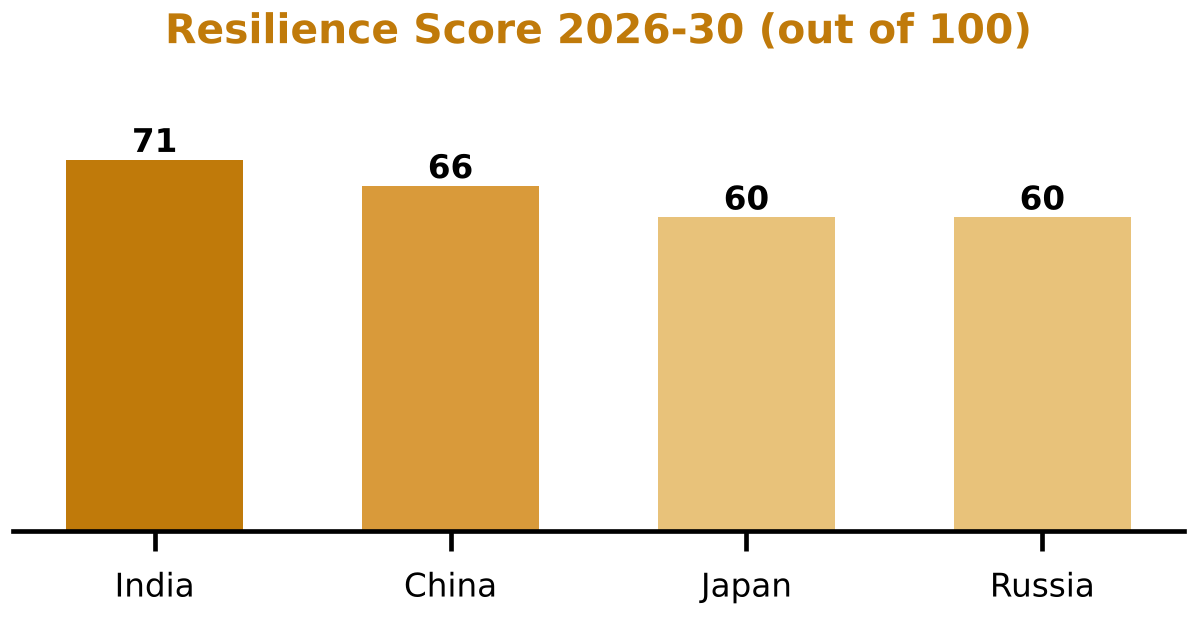
An industry report ranks India first among the top 10 economies for economic resilience in 2026-30, and Goldman Sachs expects India to stay the fastest-growing big economy. ASSOCHAM's report 'India's Economic Edge in the Top Ten Economies' ranks India 1st with 71/100 for 2026-30, ahead of China (66), Japan and Russia (60 each). It uses IMF World Economic Outlook data on 10 indicators. Separately, Goldman Sachs projects global growth of 2.8% in 2027 and India's growth at 7.2% in 2027 (7.9% in 2026).
Key facts
India 1st in real GDP and per capita GDP growth; 2nd in savings and capital formation.
India weaker on current account and fiscal balance (7th-8th).
India's score up from 66 (2021-25, then 3rd).
Goldman: global AI investment $1.8 trillion in 2027; AI could add 0.4 percentage point to world growth.
Risks: Iran conflict, wider fiscal deficits, weaker AI spending.
Way forward
Keep fiscal consolidation on track and strengthen exports to fix the weaker indicators.
Concept
Economic resilience: an economy's ability to absorb shocks (war, oil price jumps, pandemics) and recover quickly. Twin deficits: fiscal deficit (government spends more than it earns) plus current account deficit (country imports more than it exports) - India's weak spots in the ranking. Exam angle: Prelims: who publishes World Economic Outlook (IMF), ASSOCHAM. Mains: strengths and vulnerabilities of India's macro-economy amid high inflation.
Bar chart of 2026-30 resilience scores: India 71, China 66, Japan 60, Russia 60 — StudyForGS
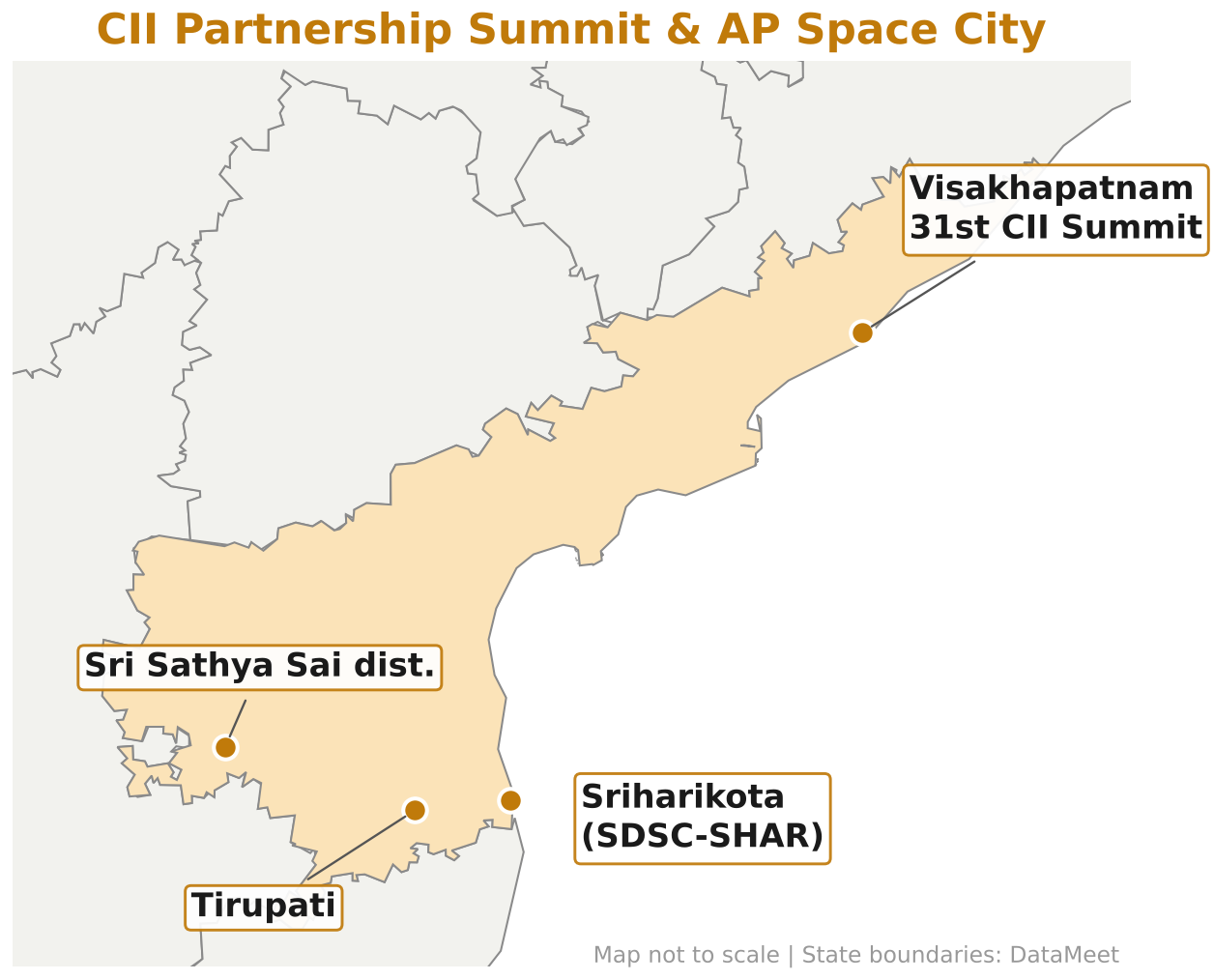
At a big investment summit in Visakhapatnam, Andhra Pradesh announced deals worth nearly Rs 10 lakh crore and a planned space city near Sriharikota. The 31st CII Partnership Summit was held in Visakhapatnam on 12-13 November 2026, with the theme 'Navigating the New World Order: Trade | Technology | Trust | Thought Leadership'. Andhra Pradesh announced 303 MoUs worth Rs 9.89 lakh crore that could create 3.5 lakh jobs. India and the UAE agreed to set up an India-Oman-UAE technical trilateral committee in civil aviation.
Key facts
Organised by CII with DPIIT (Commerce Ministry).
109 MoUs worth Rs 9.02 lakh crore signed at the summit itself.
Renewable energy: 17 MoUs and 3 government orders.
AP plans a Rs 25,000 crore space city in Sri Sathya Sai and Tirupati districts, 40-60 km from Sriharikota.
Co-chaired by Piyush Goyal and CM N. Chandrababu Naidu.
Way forward
Track how many MoUs turn into real projects and jobs, and fast-track land and approvals.
Concept
Competitive federalism: states compete to attract investment with better policies and infrastructure. MoU (Memorandum of Understanding): a statement of intent, not a binding contract - actual investment is often much lower than MoU value. Exam angle: Prelims: venue and organisers. Mains: MoU-to-investment conversion; states as drivers of investment; space-sector clusters.
Andhra Pradesh map marking Visakhapatnam, Sriharikota, Tirupati and Sri Sathya Sai district — StudyForGS
22. COP31 Draft Cover Decision at Antalya
ENVIRONMENTUPSC: Prelims + Mains GS3
Syllabus linkage
GS3 Climate change, environment conventions; GS2 International institutions. Prelims: COP31 hosts, NCQG, CBAM. Mains: equity in climate action.
Context
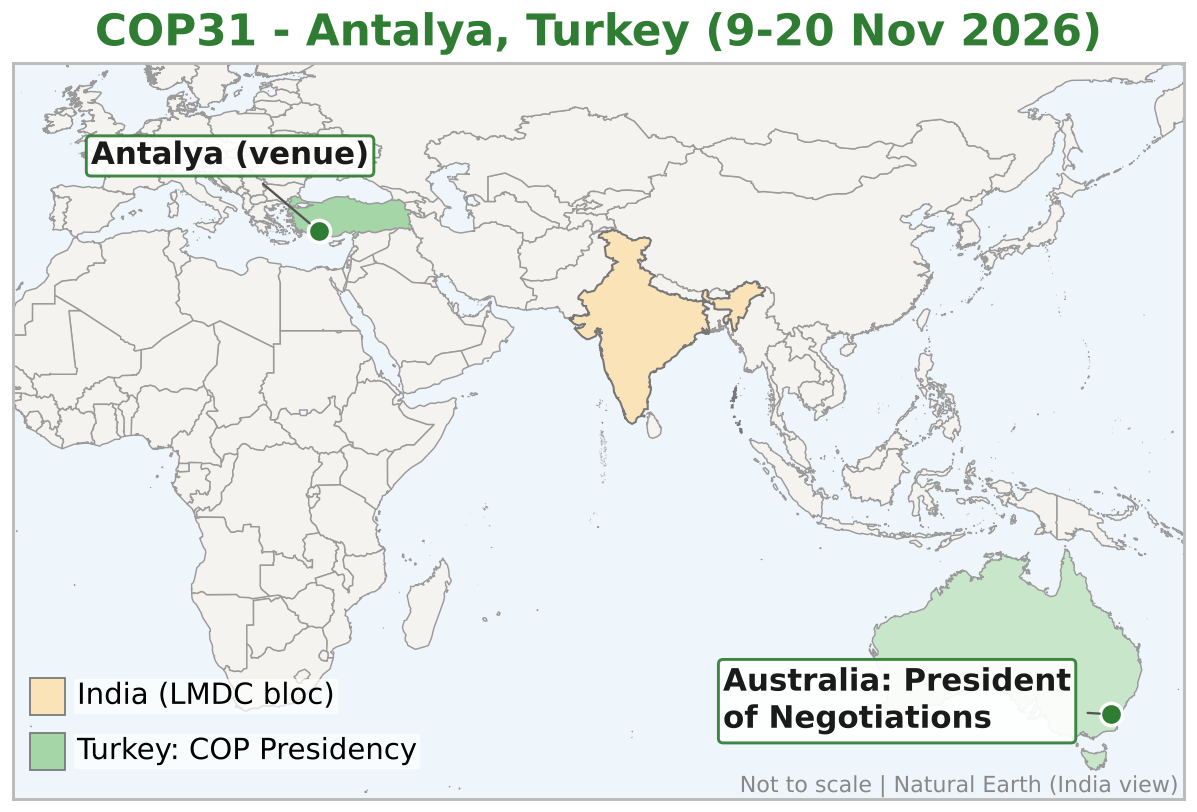
Midway through the UN climate talks in Turkey, a draft text calls for bringing warming back to 1.5 degrees C and raising electricity's share of energy use, but rich and poor nations still disagree on money. COP31 is being held in Antalya, Turkey, from 9 to 20 November 2026. Turkey holds the Presidency and Australia is President of Negotiations. A draft cover decision (the main summary decision of a COP) accepts that warming may temporarily exceed 1.5 degrees C, but calls for returning to it as soon as possible. It proposes a global goal to raise electricity's share of final energy use from about 23% to 35% by 2035. The presidency says the text does not yet reflect consensus.
Key facts
Asks to keep implementing COP28 Global Stocktake paras 28-29 (transition away from fossil fuels).
Proposes addressing unilateral trade measures like CBAM, possibly with a time-bound phase-out.
UNEP: current NDCs lead to about 2.6 degrees C of warming.
NCQG (new climate finance goal): $300 billion a year by 2035, agreed at COP29 Baku.
The US has withdrawn from the Paris Agreement.
Way forward
India should push for predictable public finance and technology transfer while advancing its own electrification and renewable targets.
Concept
CBDR-RC: Common But Differentiated Responsibilities and Respective Capabilities - rich countries polluted more, so they should do more and pay more. India's key principle. CBAM: the EU's Carbon Border Adjustment Mechanism - a charge on carbon-heavy imports like steel; India sees it as a trade barrier. Overshoot: temporarily crossing 1.5 degrees C before bringing temperature back down using deep emission cuts and carbon removal. Exam angle: Prelims: COP31 venue and co-hosts, NCQG amount, Article 9.1 (developed countries to provide finance), LMDC bloc. Mains: India's stand - finance first, no new obligations, net zero 2070, opposition to CBAM.
World map showing COP31 venue Antalya in Turkey, Australia and India — StudyForGS
23. Cyclone Akvan Heads for Andhra Coast
ENVIRONMENTUPSC: Prelims + Mains GS1/GS3
Syllabus linkage
GS1 Geophysical phenomena (cyclones); GS3 Disaster management. Prelims: cyclone naming, IMD scale. Mains: early warning and evacuation.
Context
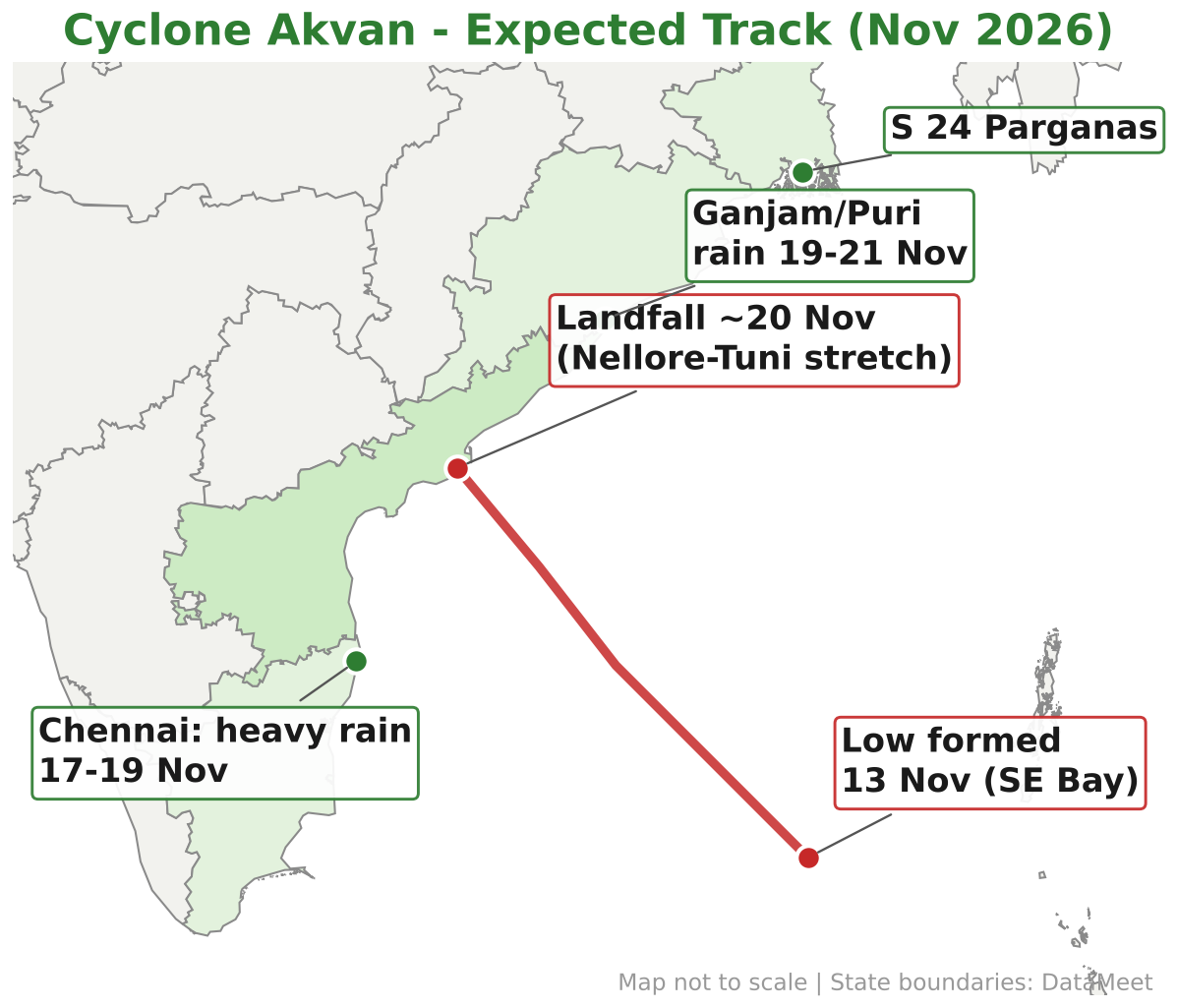
A cyclone named Akvan is growing stronger in the Bay of Bengal and is expected to hit the Andhra Pradesh coast around 20 November. Akvan formed from a low-pressure area over the southeast Bay of Bengal on 13 November 2026 and became a cyclonic storm on 16 November. IMD expects it to become a severe cyclonic storm on 17 November and a very severe cyclonic storm by 19 November, with winds of 120-130 km/h gusting to 145 km/h. Landfall is likely on the Andhra Pradesh-Yanam coast between Nellore and Tuni around 20 November. Odisha has begun evacuations.
Key facts
Name given by Iran; linked to Akvan-e Div, a demon-like figure in Ferdowsi's Shahnameh.
Extremely heavy rain (over 21 cm) likely in north coastal AP on 19-20 Nov.
Tamil Nadu (Chennai, Tiruvallur, Chengalpattu) heavy rain 17-19 Nov; Odisha and West Bengal 19-21 Nov.
Follows Cyclones Arnab and Murasu this season.
Way forward
Complete evacuations early, protect fishers and crops, and keep shelters and power backup ready along the coast.
Concept
Cyclone naming: WMO/ESCAP Panel on Tropical Cyclones - 13 countries gave 169 names, used in order; RSMC New Delhi (run by IMD) names storms in the Bay of Bengal and Arabian Sea. Why the Bay of Bengal gets more cyclones: warmer sea surface, funnel shape and remnants of Pacific typhoons; post-monsoon (Oct-Dec) is a peak season. Exam angle: Prelims: RSMC New Delhi, number of member countries (13), IMD wind categories. Mains: India's cyclone preparedness (Odisha model, NDMA guidelines, early warning).
Bay of Bengal map showing the expected track of Cyclone Akvan and landfall on the Andhra coast — StudyForGS
24. Five New Horned Frogs in Arunachal
ENVIRONMENTUPSC: Prelims + Mains GS3
Syllabus linkage
GS3 Biodiversity, conservation. Prelims: species names, places, Eastern Himalaya hotspot. Mains: documenting biodiversity in the Northeast.
Context
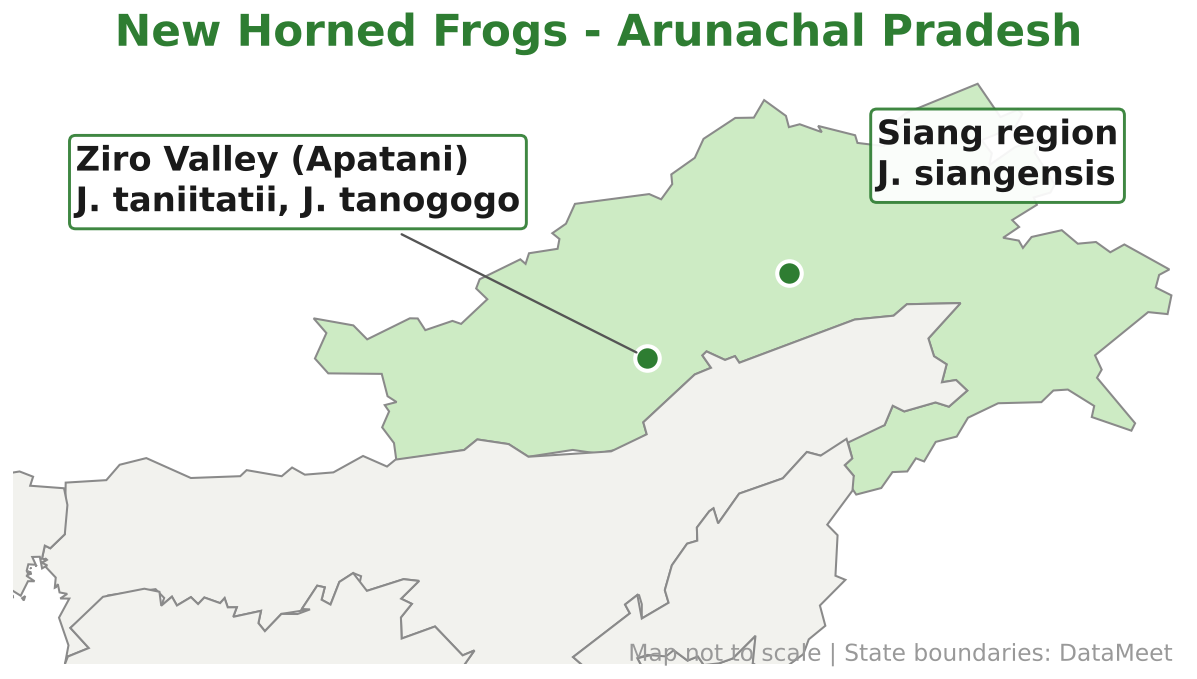
Scientists found five new frog species in Arunachal Pradesh, including India's first frog known to eat snails. A team of Indian and American scientists described five new species of diminutive horned frogs (genus Jingophrys) from Arunachal Pradesh. One, Jingophrys tanogogo, is India's first known snail-eating frog and the first report of snail-eating in the frog family Megophryidae. The names honour local Apatani words and the Siang region.
Key facts
J. taniitatii (Tanii Horned Frog): honours the Tanii (Apatani) people of Ziro Valley; 'tatii' = frogs and toads.
J. tanogogo (Snail-eating Horned Frog): 'tanogogo' = snails in Apatani.
J. siangensis: named after the Siang region.
J. hrdy and J. wularsoni: honour scientists.
Family Megophryidae = Asian horned frogs.
Way forward
Protect forest streams where these frogs live and support more surveys with local communities.
Concept
Eastern Himalaya: part of the Himalaya biodiversity hotspot - high endemism (species found nowhere else). Ziro Valley: home of the Apatani tribe, known for paddy-cum-fish farming; on UNESCO's tentative World Heritage list. Exam angle: Prelims: genus Jingophrys, snail-eating frog, Ziro/Apatani link. Mains: role of taxonomy and local knowledge in conservation.
Arunachal Pradesh map showing Ziro Valley and Siang region where new frog species were found — StudyForGS
25. Kerala Finds: New Moss, New Butterflies
ENVIRONMENTUPSC: Prelims + Mains GS3
Syllabus linkage
GS3 Biodiversity, protected areas. Prelims: Silent Valley NP, Western Ghats. Mains: Western Ghats conservation.
Context
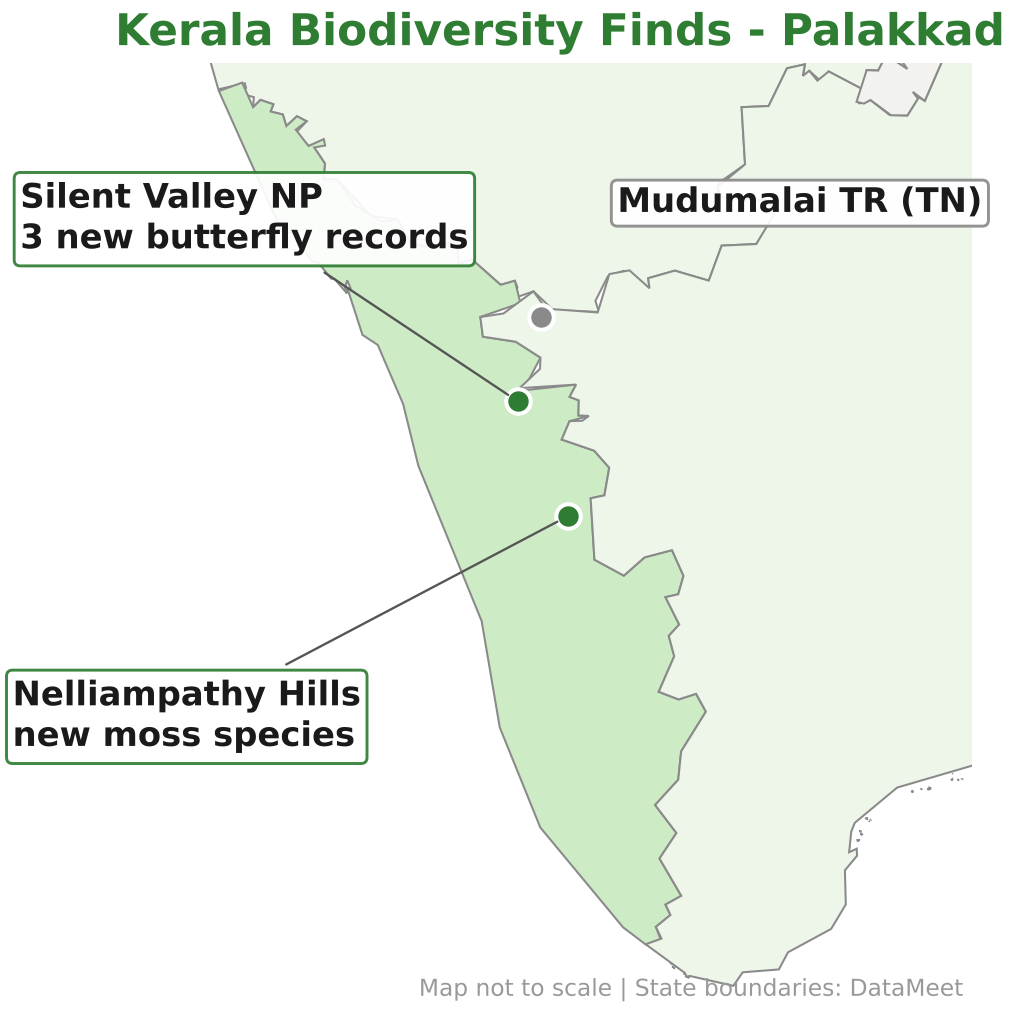
A new moss species was found in the Nelliampathy Hills and three butterflies were recorded for the first time in Silent Valley - both in Palakkad, Kerala. Botanists named a new moss Macromitrium nelliampathyanum, found at about 1,400 m on Hill Top Mount in the Nelliampathy Hills. It shows anisospory - one capsule makes spores of two different sizes. Separately, a three-day survey recorded the Branded Royal, Extra Lascar and Orange-spotted Grass Jewel butterflies in Silent Valley National Park for the first time.
Key facts
Silent Valley NP: about 237.52 sq km, Palakkad district, part of Nilgiri Biosphere Reserve.
Kunthipuzha river - 'Silent River of India'; named 'silent' due to absence of cicadas.
Known for the lion-tailed macaque (endemic to the Western Ghats).
Tribes: Kurumba, Muduga, Irula, Kattu Naiken.
Macromitrium mosses grow on trees and rocks across the tropics.
Way forward
Keep surveys going in the Western Ghats and protect micro-habitats like rock and tree surfaces where mosses grow.
Concept
Type locality: the place where a species is first found and described - the moss is named after it. Silent Valley Movement (1970s-80s): protests stopped a hydroelectric dam on the Kunthipuzha; the area became a National Park in 1984. Nilgiri Biosphere Reserve (1986): India's first biosphere reserve, spread over Kerala, Tamil Nadu and Karnataka. Exam angle: Prelims: Silent Valley location, river, macaque, Nilgiri BR. Mains: Silent Valley as a landmark environmental movement.
Map of Palakkad, Kerala marking Silent Valley, Nelliampathy Hills and Mudumalai Tiger Reserve — StudyForGS
26. Yamuna Clean-Up Drive and SC Concern
ENVIRONMENTUPSC: Prelims + Mains GS3
Syllabus linkage
GS3 Environmental pollution; GS1 Rivers of India. Prelims: Yamuna course and tributaries. Mains: why river clean-ups fail.
Context
A big drive to clean the Yamuna in three years has begun, while the Supreme Court has warned authorities to act effectively on its pollution. A large Yamuna cleaning drive with a four-pronged strategy aims to restore the river within three years. The Supreme Court has expressed concern over the river's pollution and warned states and local bodies to take effective steps. The Delhi stretch, though short, receives most of the river's sewage load.
Key facts
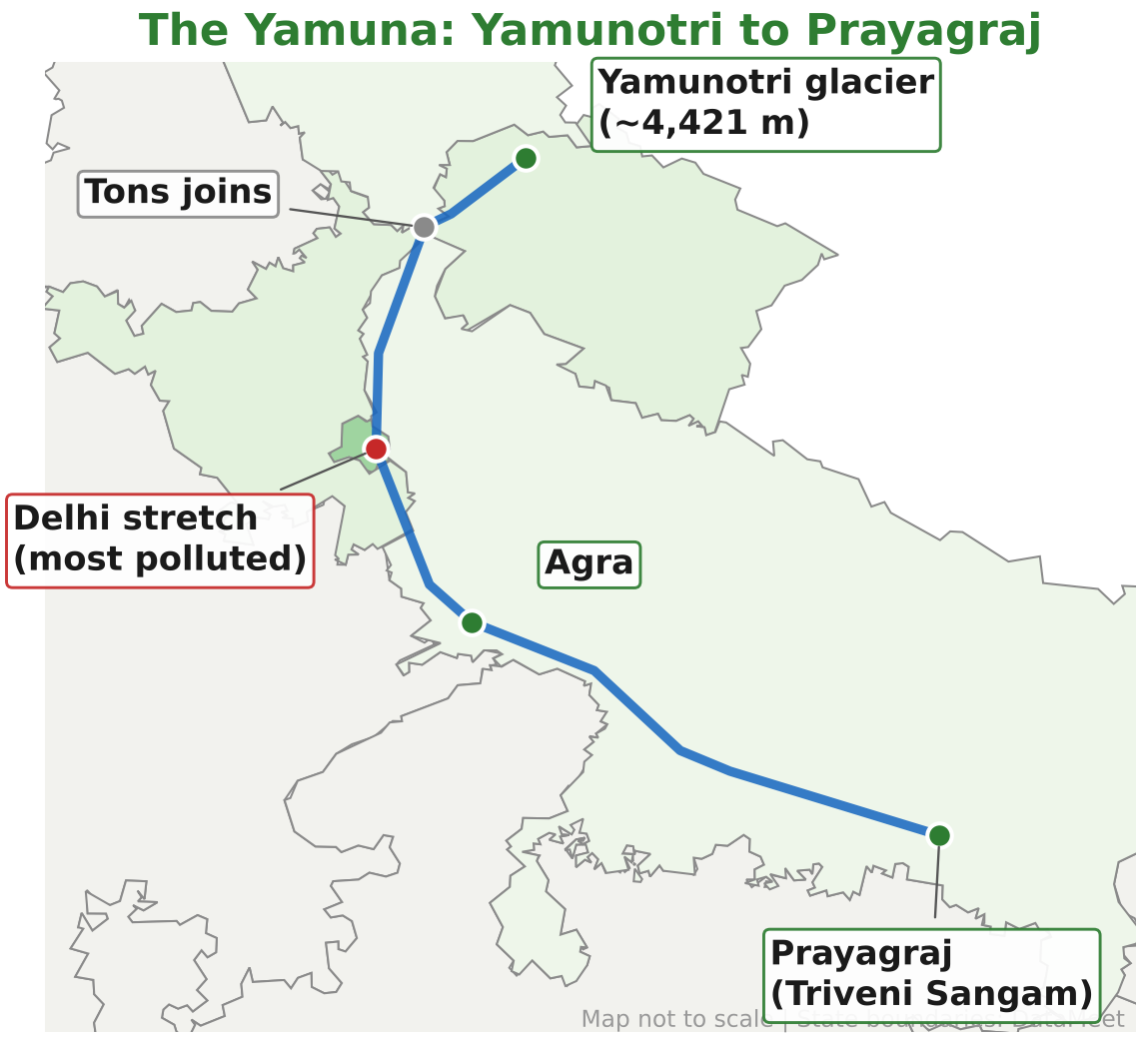
Origin: Yamunotri Glacier (about 4,421 m), Uttarakhand.
Length: about 1,376 km; joins the Ganga at Prayagraj (Triveni Sangam).
Tons: largest tributary; Chambal: biggest right-bank tributary.
Other tributaries include the Giri, Hindon, Sindh, Betwa and Ken.
Flows through Uttarakhand, Himachal border, Haryana, Delhi and Uttar Pradesh.
Way forward
Treat all sewage before it enters drains, ensure minimum environmental flow from barrages, and fix accountability across states.
Concept
BOD (Biochemical Oxygen Demand): oxygen needed by microbes to break down waste - high BOD means sewage pollution and dead water. Toxic froth on the Yamuna: caused by phosphates and surfactants from detergents in untreated sewage. Exam angle: Prelims: Yamuna origin, tributaries, confluence. Mains: role of sewage treatment, e-flow (minimum flow) and coordination between states in river revival.
Map of the Yamuna river from Yamunotri to Prayagraj with Delhi and Agra marked — StudyForGS
27. Rare Megalithic Female Figures in Telangana
ART & CULTUREUPSC: Prelims + Mains GS1
Syllabus linkage
GS1 Indian heritage and culture, prehistory. Prelims: megalith types, Black-and-Red Ware. Mains: protecting unprotected heritage sites.
Context
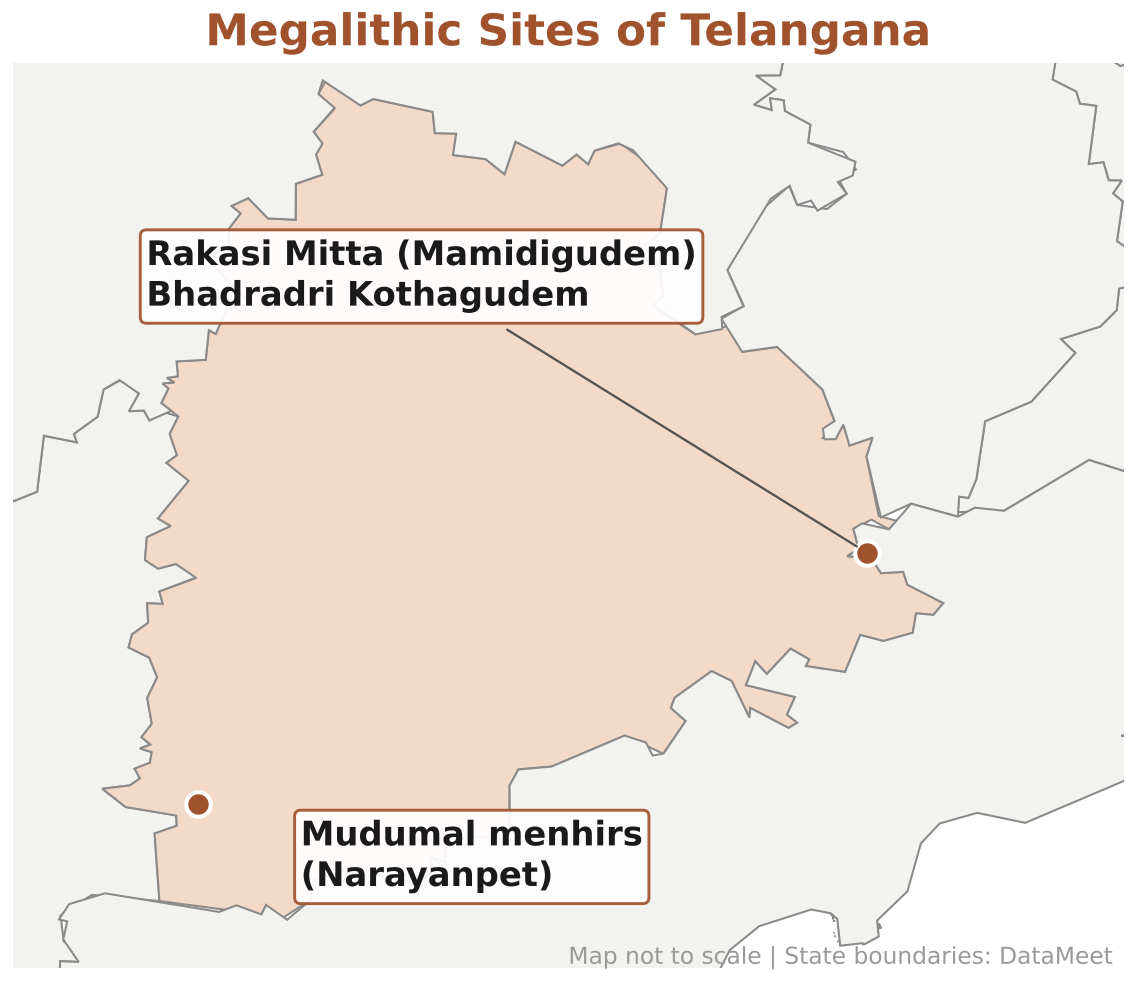
Researchers found Iron Age stone burials with over 100 human-shaped stone figures, including two rare female figures, in Telangana's Bhadradri Kothagudem district. Megalithic burials were reported at Rakasi Mitta hill near Mamidigudem village, Bhadradri Kothagudem district. More than 100 anthropomorphic (human-shaped) stone sculptures stand in front of the burials, including two rare female figures - only one female figure had been found earlier, at Padugonigudem. The burials are dated to about 1200 BCE-300 BCE.
Key facts
Burial types: dolmens and dolmenoid cists with stone circles and passageways.
Each burial holds 2-4 stone sarcophagi (stone coffins).
A trident-shaped rock carving (petroglyph) hints at even older human activity.
Found by researchers from Matti Foundation and Kakatiya University.
Mudumal (Narayanpet) is among India's largest menhir sites.
Way forward
Give legal protection, carry out scientific dating and GIS mapping, and involve villagers in guarding the sites.
Concept
Megalith: a monument made of big stones, mostly for burial or memory; in South India linked mainly with the Iron Age. Black-and-Red Ware (BRW): typical megalithic pottery, black inside and red outside, made by inverted firing. AMASR Act, 1958: central law that protects ancient monuments and sites; many megalithic sites are still unprotected. Exam angle: Prelims: dolmen, cist, menhir, BRW, AMASR Act. Mains: megalithic culture as a link between prehistory and early historic South India (Satavahanas, Sangam age).
Telangana map marking Rakasi Mitta in Bhadradri Kothagudem and Mudumal menhirs in Narayanpet — StudyForGS
28. National Integration Day and Qaumi Ekta Week
ART & CULTUREUPSC: Prelims + Mains GS1
Syllabus linkage
GS1 Modern India personalities, unity in diversity; GS2 Constitutional values. Prelims: dates, events of Indira Gandhi's tenure. Mains: national integration challenges.
Context
19 November is National Integration Day (Qaumi Ekta Divas), marking Indira Gandhi's birth anniversary and promoting unity in diversity. National Integration Day is observed on 19 November, the birth anniversary of Indira Gandhi (born 1917, Allahabad), India's first woman Prime Minister (1966-77, 1980-84). It opens Qaumi Ekta (National Integration) Week, observed from 19 to 25 November to promote communal harmony, secularism and linguistic unity.
Key facts
Tenure events: bank nationalisation (1969), 1971 war and Bangladesh's birth, Pokhran-I test (1974), Green Revolution push.
Qaumi Ekta Week: 19-25 November.
Linked to Articles 14-16, 25-30 and Fundamental Duties 51A(c), (e), (f).
Observed with pledges, seminars and cultural programmes.
Theme idea: 'Unity in Diversity'.
Way forward
Use schools and local bodies to promote dialogue across communities year-round, not just on one day.
Concept
Fundamental Duty 51A(e): to promote harmony and the spirit of common brotherhood among all people beyond religion, language and region. National Integration Council: first set up in 1961 under Nehru to fight communalism, casteism and regionalism. Exam angle: Prelims: date, week, Indira Gandhi milestones (1969, 1971, 1974). Mains: threats to national integration and constitutional tools to address them.
29. Space Sector Reforms and Gaganyaan Crew
SCI-TECHUPSC: Prelims + Mains GS3
Syllabus linkage
GS3 Space technology, indigenisation, economy. Prelims: IN-SPACe, NSIL, FDI limits, Gaganyaan crew. Mains: role of private sector in space.
Context
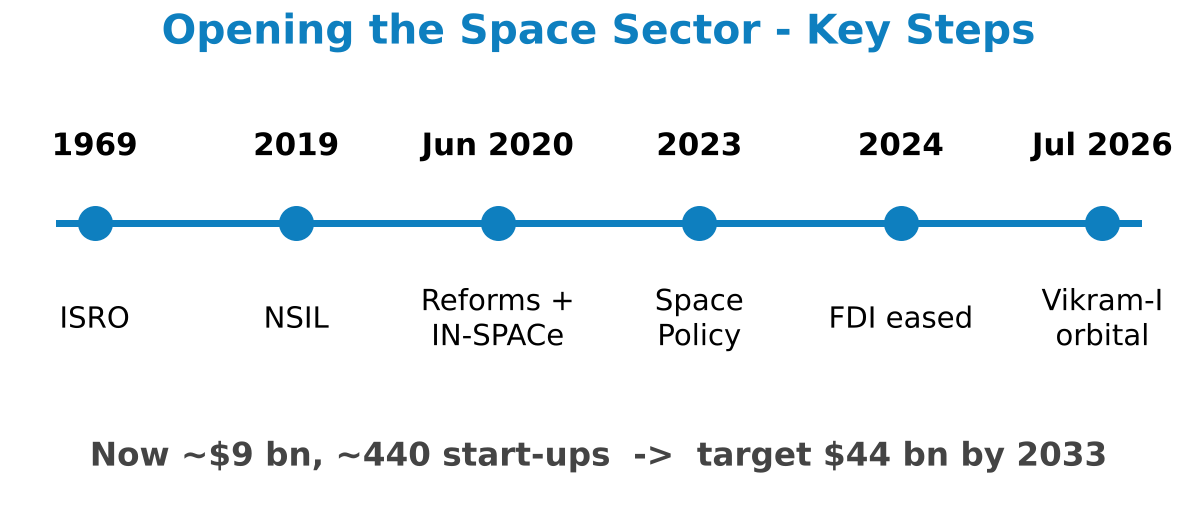
A government note shows private space companies have grown fast since the 2020 reforms, and four Indian Air Force pilots are training to be Gaganyaan astronauts. A Department of Space note (15 November 2026) reviewed reforms since June 2020 that opened the whole space value chain to non-government entities (NGEs). India's space economy is about $9 billion with around 440 space start-ups (from one in 2014) and $618.5 million of start-up investment by March 2026. The Gaganyaan astronaut-designates are Group Captains Prasanth Balakrishnan Nair, Ajit Krishnan, Angad Pratap and Wing Commander Shubhanshu Shukla.
Key facts
IN-SPACe (2020): single-window regulator and promoter for private space activity.
Vikram-S (Skyroot, Nov 2022) - first private rocket; Vikram-I orbital launch on 18 July 2026.
399 foreign satellites launched by ISRO (2014 to January 2026).
Targets: $44 billion by 2033 and $100 billion by 2040.
Way forward
Pass a dedicated space activities law, give clear liability rules and boost demand through government purchase of private services.
Concept
NSIL (2019): ISRO's commercial arm; IN-SPACe: authorises and supports private players; ISpA (2021): industry association. Indian Space Policy 2023: clearly divides roles - ISRO for R&D, NSIL for commercial work, IN-SPACe for regulation. Karman line (100 km): commonly used boundary between Earth's atmosphere and outer space. Exam angle: Prelims: institutions and years, FDI limits, Gaganyaan crew names, Mission Prarambh. Mains: how private participation can make India a global space hub; need for a Space Activities law.
Timeline of India's space sector reforms from ISRO in 1969 to Vikram-I in July 2026 — StudyForGS
30. Genome Editing Centre for Horticulture
SCI-TECHUPSC: Prelims + Mains GS3
Syllabus linkage
GS3 Biotechnology, agriculture. Prelims: genome editing vs GM, ICAR-IIHR. Mains: biotech for climate-resilient farming.
Context
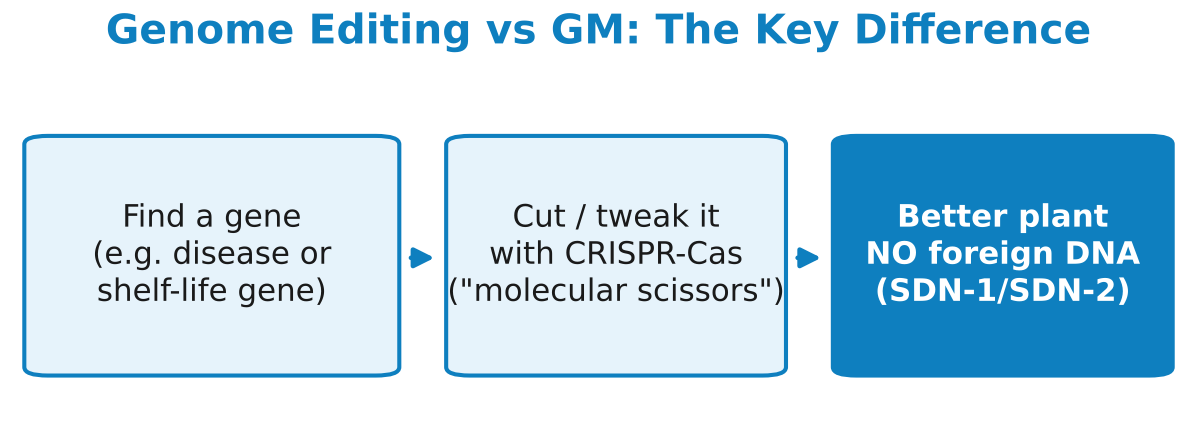
A new centre in Bengaluru will use gene editing to develop better tomatoes, chillies, papayas, grapes and pomegranates that can cope with climate stress. ICAR Director General Dr M.L. Jat inaugurated a Centre of Excellence for Genome Editing in Horticultural Crops and a Farmers' Agri-Tech Centre at ICAR-IIHR, Bengaluru, on 15 November 2026. It has a BSL-II lab, tissue culture and transformation facility, plant growth chambers and a bioinformatics lab. The farmers' centre will train growers in natural farming and coping with El Nino.
Funded under an ICAR project on climate resilience and nutrition security via genome editing.
IIHR = Indian Institute of Horticultural Research, Bengaluru.
India released its first two genome-edited rice varieties in 2025.
SDN-1 and SDN-2 edits (no foreign DNA) are exempt from GM rules in India (2022).
Way forward
Keep transparent biosafety checks, involve farmers early and ensure seeds reach small growers at fair prices.
Concept
Genome editing (e.g. CRISPR-Cas9): precisely cutting or changing a plant's own gene - like a word-processor 'edit'. GM (genetically modified) crop: carries a gene from another organism (e.g. Bt cotton) - regulated by GEAC; edited crops without foreign DNA face lighter rules. Exam angle: Prelims: CRISPR, SDN-1/2/3, GEAC, IIHR location. Mains: can genome editing boost farm resilience while addressing biosafety concerns?
Flow diagram of genome editing: find a gene, edit with CRISPR, better plant without foreign DNA — StudyForGS
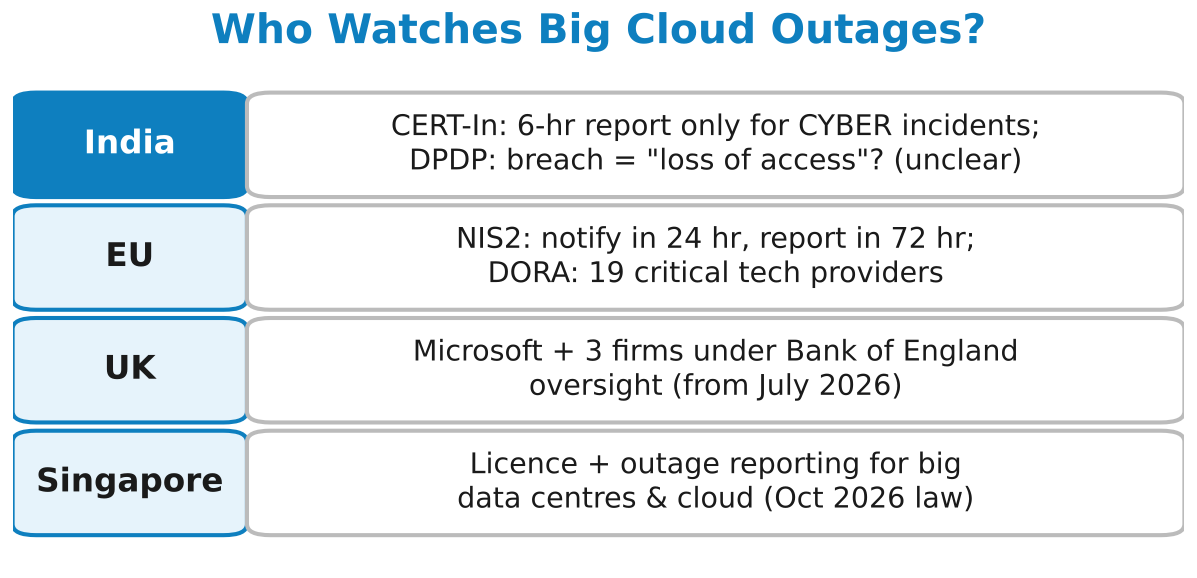
A global Microsoft outage disrupted airlines and businesses in India, showing that Indian rules do not clearly cover big technical failures by cloud companies. A Microsoft 365 outage on 12-13 November 2026 cut access to Outlook and other services worldwide; Microsoft blamed a fault during a network upgrade. In India, IndiGo and Akasa Air warned about email support disruption. CERT-In's 2022 directions require cyber incidents to be reported within six hours, but they cover cyberattacks, not technical failures.
Key facts
CERT-In can seek information from providers under Section 70B(6) of the IT Act, 2000.
DPDP Act 2023: 'accidental loss of access to personal data' is a breach; Rules take effect May 2027; penalty up to Rs 200 crore.
RBI outsourcing rules: banks using cloud must have an exit strategy.
EU NIS2: notify within 24 hours, full report within 72 hours.
12.68 lakh official email accounts moved to a Chennai-based Zoho platform (Dec 2025 reply in Lok Sabha).
Way forward
Extend reporting to technical outages, designate a regulator for the largest digital providers and clarify DPDP rules before May 2027.
Concept
CERT-In: Indian Computer Emergency Response Team under MeitY - national agency for cyber incident response (Section 70B, IT Act). Concentration risk: when many firms rely on a few cloud providers, one failure hits everyone at once. Service credits: discounts on future bills that cloud firms give when they miss promised uptime - the main remedy for customers today. Exam angle: Prelims: CERT-In parent ministry and legal basis, DPDP Act penalties, Data Protection Board. Mains: should big cloud providers be regulated as critical infrastructure? Digital sovereignty.
Diagram comparing cloud outage rules in India, the EU, the UK and Singapore — StudyForGS
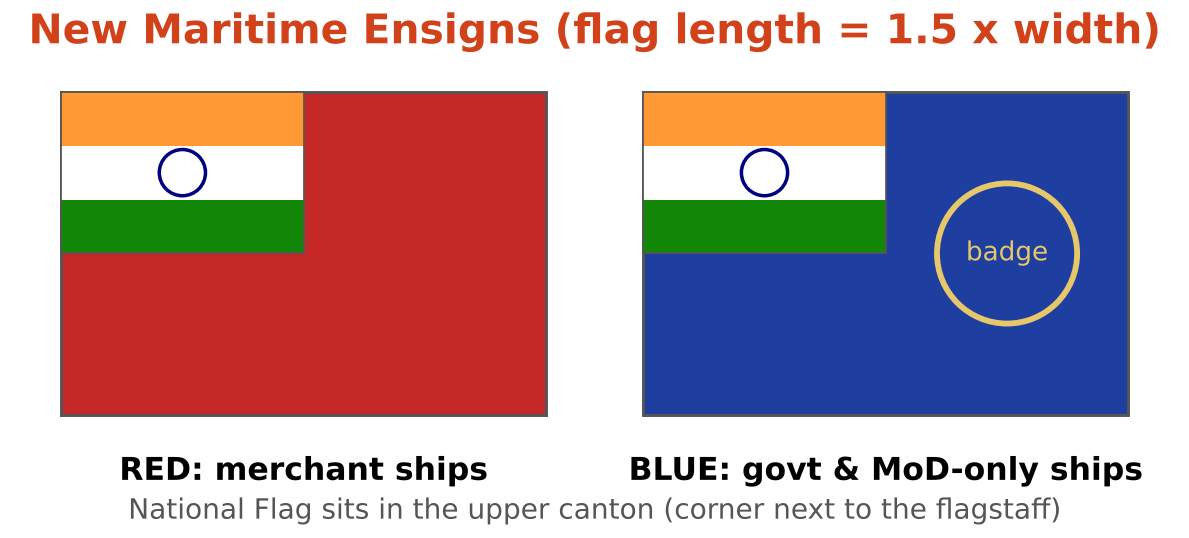
India has replaced its 1961 rules on which flags Indian ships must fly: merchant ships get a Red Ensign and government ships a Blue Ensign. New maritime flag rules have been notified under Section 37(1) of the Merchant Shipping Act, 2025, replacing an order of 9 February 1961. Indian merchant ships must fly the Red Ensign - a red flag with the National Flag in the upper canton. Government-owned vessels and merchant ships working only for the Ministry of Defence fly the Blue Ensign with a golden badge. Navy and Coast Guard ships are excluded.
Key facts
Flag length = 1.5 times width, per the Flag Code of India, 2002.
Blue Ensign: royal blue, light golden badge in the centre of the fly half; badge fits a circle up to 13/30 of flag width.
Govt vessel badges approved by the Centre via the Director General of Maritime Administration.
MoD-only ships: badge by a Warrant from the Chief of the Naval Staff.
Foreign ships may not fly Indian colours to pass as Indian, except to escape capture in war.
Way forward
Use the new law to grow the Indian-flagged fleet and strengthen enforcement against flag misuse.
Concept
Ensign: the national flag flown by a ship to show its nationality; canton = the upper corner next to the flagstaff, fly = the far side. Section 37: ships must hoist colours when signalled by a Navy/Coast Guard vessel and when entering or leaving port; officers can board and seize misused flags. Flag state: the country where a ship is registered - it has legal control over the ship under UNCLOS. Exam angle: Prelims: Red vs Blue Ensign, Merchant Shipping Act 2025, Flag Code 2002, 1961 order. Mains: modernising maritime law for Maritime India Vision and ship registration.
Illustration of the new Red Ensign for merchant ships and Blue Ensign with badge for government ships — StudyForGS
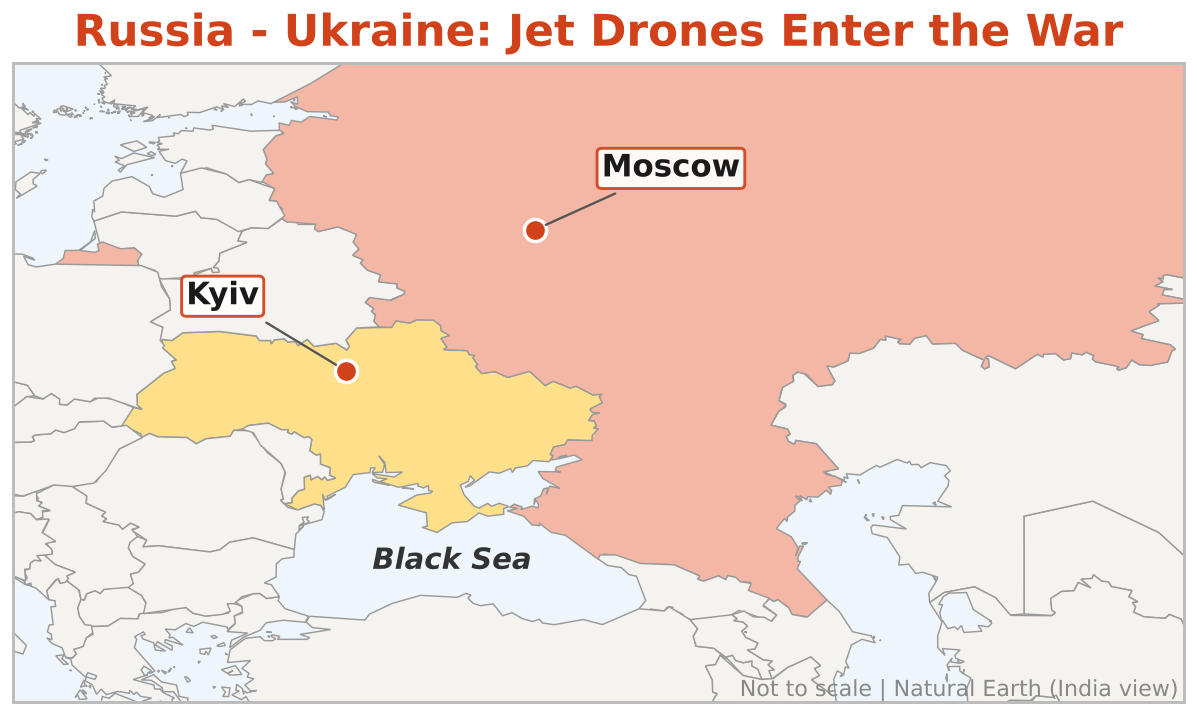
Russia has started using a faster, jet-powered attack drone, the Geran-5, against Ukrainian cities - a sign of how cheap drones are changing war. Ukraine's military intelligence (GUR) said Russia has begun using the K5-K variant of the Geran-5 to attack Ukrainian cities. The Geran-5 is a one-way attack drone shaped like a small cruise missile, with a turbojet engine. Unlike the propeller-driven Geran-2 used in Shahed-style attacks, it flies much faster, making it harder to shoot down.
Key facts
Length 6.5 m, wingspan 3.2 m, take-off weight up to 850 kg.
Warhead about 90 kg; speed 450-600 km/h; range about 950 km.
Flies up to 6 km; uses optical navigation that matches ground images.
Russian strikes recently damaged Kyiv infrastructure including bridges.
Geran-2 = Russian version of Iran's Shahed-136.
Way forward
India should invest in layered air defence, low-cost interceptors and domestic drone and counter-drone industry.
Concept
Loitering munition / one-way attack drone: a drone that flies to a target and explodes on it - a cheap 'cruise missile'. Electro-optical navigation: uses camera images of the ground to correct its path, so GPS jamming is less effective. Exam angle: Prelims: difference between drones, cruise missiles and loitering munitions. Mains: lessons from Ukraine for India's air defence and counter-drone systems.
Map of Russia and Ukraine with Kyiv and Moscow marked — StudyForGS
Data point of the day
12.3%
WPI inflation, October 2026 Second straight double-digit month, up from 11.39% in September and 9.92% in August.
Prelims rapid-fire
ICC Chairman: Jay Shah re-appointed unopposed as ICC Chairman for a second two-year term at the ICC Board meeting in Bali, Indonesia (16 Nov 2026).
ICC events: India to host the 2029 Men's Champions Trophy (first time since 2006); India and Bangladesh to co-host the 2031 ODI World Cup.
National Sports Board: Devesh Chaturvedi (retd IAS) appointed Chairman of the National Sports Board for three years; Cdr (Retd) P.K. Garg named Member.
Khelo India Youth Games: 8th edition in Telangana (first time), 11-22 Dec 2026, six cities; mascot 'Neelamani'; softball debuts; sailing and Karra Samu as demonstration sports.
ISSF World Championship: Doha, Qatar (1-14 Nov 2026): India 3rd with 13 medals (2 gold, 7 silver, 4 bronze) and 3 LA28 quota places; China topped.
Badminton: Lakshya Sen won the men's singles title at the Kumamoto Masters in Japan.
SpaceX: Starship 'Ship 42' was caught mid-air by the launch tower's 'Chopsticks' arms - the first recovery of a Starship upper stage.
Word of the Year: Collins Dictionary picked 'Mogging' (outshining others) as Word of the Year 2026; 2025 word was 'Vibe Coding'.
Transnational Organized Crime Day: 15 Nov - marks adoption of the Palermo Convention (15 Nov 2000); 2026 theme 'Follow the money. Stop organized fraud.'
Road Traffic Victims Day: World Day of Remembrance for Road Traffic Victims: third Sunday of November (15 Nov 2026); slogan 'Remember. Support. Act.'
Mudumalai TR: A minister drew criticism over a video of him pursuing a tiger in Mudumalai Tiger Reserve (Nilgiris, TN) - at the TN-Karnataka-Kerala tri-junction, Moyar river, part of Nilgiri BR.
Jobs data: India's unemployment rate was reported at 4.9% in October 2026.
Mains practice question
Q. Census 2027 will be India's first digital census and the first full caste count since 1931. Discuss the opportunities and challenges this presents for evidence-based policymaking. (250 words)
Hint / approach
Cover uses (welfare targeting, reservation data, delimitation, women's reservation), challenges (caste and religion coding, privacy under DPDP Act, digital divide, delays), and suggest safeguards like consulted code lists, data security and independent audits.
📌 One-line revision: Census 2027 = 16th census, first digital, first full caste count since 1931; WPI 12.3%; COP31 at Antalya; Akvan named by Iran; Red Ensign for merchant ships, Blue for government ships.