Monday, 16 November 2026 · IST · National & International · 30 items
PM Modi is in the Philippines for the 23rd ASEAN-India and 21st East Asia Summits, with a Quad meeting likely. Retail inflation crossed the RBI's 6% upper band in October even as exports hit a record. Other key stories: new visa rules, DPDP consent managers, SIR voter restoration, Delhi-NCR pollution action and COP31.
Today at a glance — things to remember
PM Modi in Manila for the 23rd ASEAN-India and 21st East Asia Summits; Quad leaders likely to meet
Retail inflation crosses 6% in October 2026; food inflation 8.94%
Exports hit a record US$89.99 bn in October, up 29.9%
MHA cuts main visa categories from 13 to 9
DPDP Act: consent manager registration opens from 13 Nov 2026
EC tells SC it will restore voters wrongly deleted in SIR
Centre orders sealing of 191 polluting units in Delhi-NCR
Cyclone threat to north coastal Andhra Pradesh around 19-20 Nov
AIIMS performs India's first open fetal surgery
Detailed notes
1. New Visa Rules: 13 Categories Cut to 9
POLITYUPSC: Prelims + Mains GS2
Syllabus linkage
GS2: Government policies and interventions; Indian diaspora. GS3: Tourism and ease of doing business. Prelims: Immigration and Foreigners Act 2025, visa types; Mains: soft power, medical and education tourism.
Context
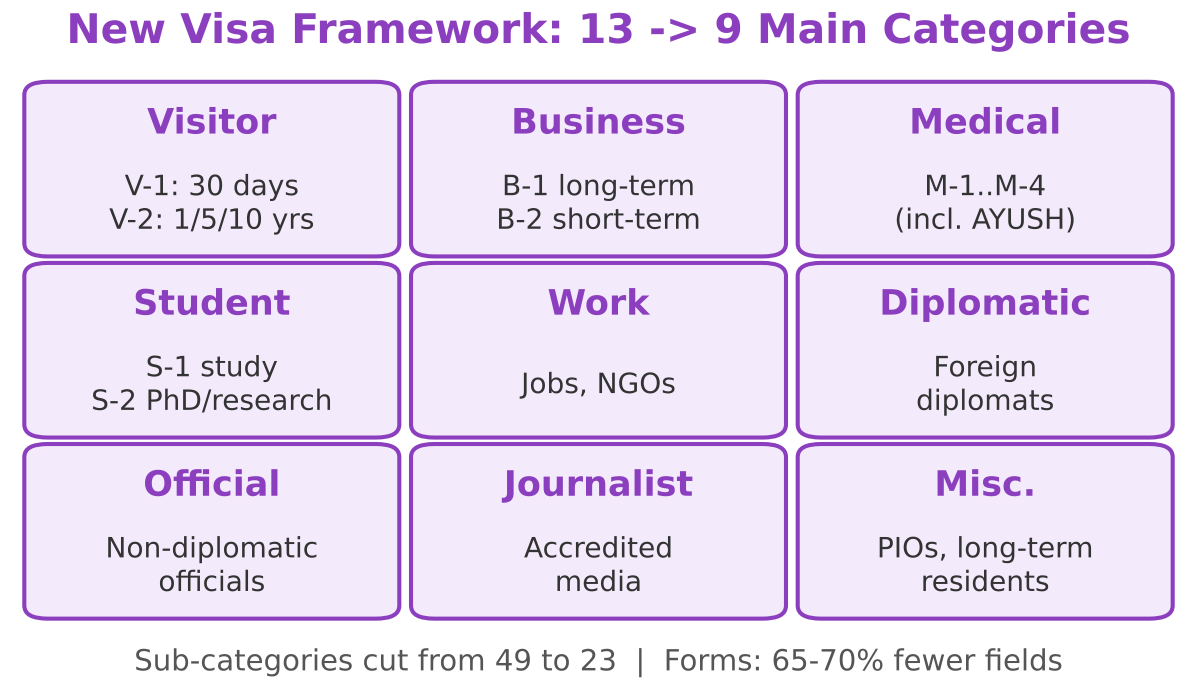
India has made its visa system simpler. There will now be 9 main visa types instead of 13, with shorter forms, so tourists, students and patients can come more easily. The Ministry of Home Affairs (MHA) announced a simplified visa framework on 11 November 2026. Main visa categories fall from 13 to 9 and sub-categories from 49 to 23. Application forms will have 65-70% fewer fields. The 'Tourist Visa' is renamed the 'Visitor Visa'. The new system should be running by the end of 2026 after IT upgrades.
Visitor visa: V-1 (short-term, 30 days, multiple entry) and V-2 (1, 5 or 10 years)
Medical: M-1 to M-4; M-3 covers AYUSH treatment; M-1 and M-3 usually one-year multiple entry
Student e-S1 visa: up to 5 years or course length, whichever is shorter
Exemption order 2026 keeps relief for persecuted minorities from Afghanistan, Bangladesh, Pakistan who came by 31 Dec 2024, Tibetans and Sri Lankan Tamil refugees
Way forward
Fast IT roll-out, clear online guidance in many languages, and regular review so that easier entry does not weaken security checks.
Concept
Immigration and Foreigners Act, 2025: one law that replaced four old laws (Passport Act 1920, Registration of Foreigners Act 1939, Foreigners Act 1946, Immigration (Carriers' Liability) Act 2000). It governs entry, stay and exit of foreigners. Visa Manual: the Centre's rule book of instructions on visas and immigration; Nepal and Bhutan citizens can travel to India without a passport, using prescribed ID documents. AYUSH = Ayurveda, Yoga and Naturopathy, Unani, Siddha, Sowa-Rigpa and Homoeopathy - India's traditional medicine systems. Exam angle: Prelims: number of categories, new sub-codes (V, B, M, S), AYUSH medical visa, the 2025 Act and which old laws it replaced. Mains: visa reform as a tool for tourism, medical value travel, attracting foreign students and investment (GS2/GS3).
Grid of the nine new visa categories and their sub-codes — StudyForGS
2. DPDP Act: Consent Managers Can Now Register
POLITYUPSC: Prelims + Mains GS2
Syllabus linkage
GS2: Government policies, rights issues (Right to Privacy). GS3: Cyber security, IT. Prelims: DPDP Act 2023, Data Protection Board; Mains: privacy vs innovation.
Context
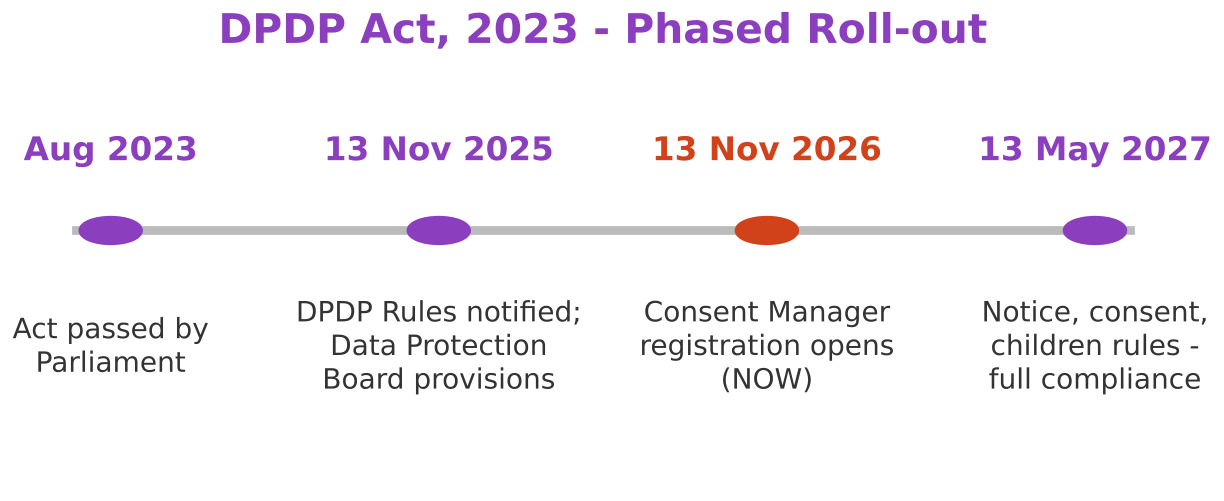
From 13 November 2026, companies can apply to become 'consent managers' - trusted apps that help you give or take back permission for using your personal data. The Ministry of Electronics and IT (MeitY) opened a portal for companies to register as Consent Managers under the Digital Personal Data Protection (DPDP) Act, 2023. This provision took effect on 13 November 2026, one year after the DPDP Rules were notified. Applicants must be Indian companies with a net worth of at least Rs 2 crore. The main duties on apps about notice and consent start on 13 May 2027.
Key facts
DPDP Act passed in August 2023; DPDP Rules notified on 13 November 2025
Consent manager: Indian company, net worth at least Rs 2 crore, interoperable platform
It cannot read the personal data passing through it; must keep consent records for at least 7 years
Registration is with the Data Protection Board of India
Full compliance (notice, consent, children's verifiable parental consent) from 13 May 2027
Way forward
Appoint the Board quickly, publish the interoperability standards, and run public awareness so people actually use consent tools.
Concept
Data Principal = the person whose data it is; Data Fiduciary = the company that decides why and how data is used. Consent manager = a middleman that works for the Data Principal. Right to Privacy is a fundamental right under Article 21 (K.S. Puttaswamy judgment, 2017, nine-judge bench). The DPDP Act is the law that puts this into practice for digital data. Data Protection Board of India: an adjudicating body that hears complaints and can impose heavy penalties (up to Rs 250 crore for some breaches). Exam angle: Prelims: who registers consent managers, net worth rule, key dates, meaning of data principal/fiduciary. Mains: whether consent managers give real control to citizens; privacy vs ease of business; independence of the Data Protection Board.
Timeline of the DPDP Act roll-out from 2023 to May 2027 — StudyForGS
3. SIR: EC Promises Fix for Wrong Deletions
POLITYUPSC: Prelims + Mains GS2
Syllabus linkage
GS2: Salient features of the Representation of People Act; constitutional bodies (ECI). Prelims: Articles 324, 326, Forms 6/7/8; Mains: inclusion vs purity of electoral rolls.
Context
During the special clean-up of voter lists, some real voters were wrongly removed. The Election Commission told the Supreme Court it has steps in place to put them back. The Election Commission of India (ECI) told the Supreme Court that it has added measures to restore eligible voters who were wrongly left out of draft rolls as 'absent, shifted, dead or duplicate' during the Special Intensive Revision (SIR). Voters who missed submitting enumeration forms can now submit them from their current ordinary residence. The Court is hearing petitions on how the SIR is being carried out.
Key facts
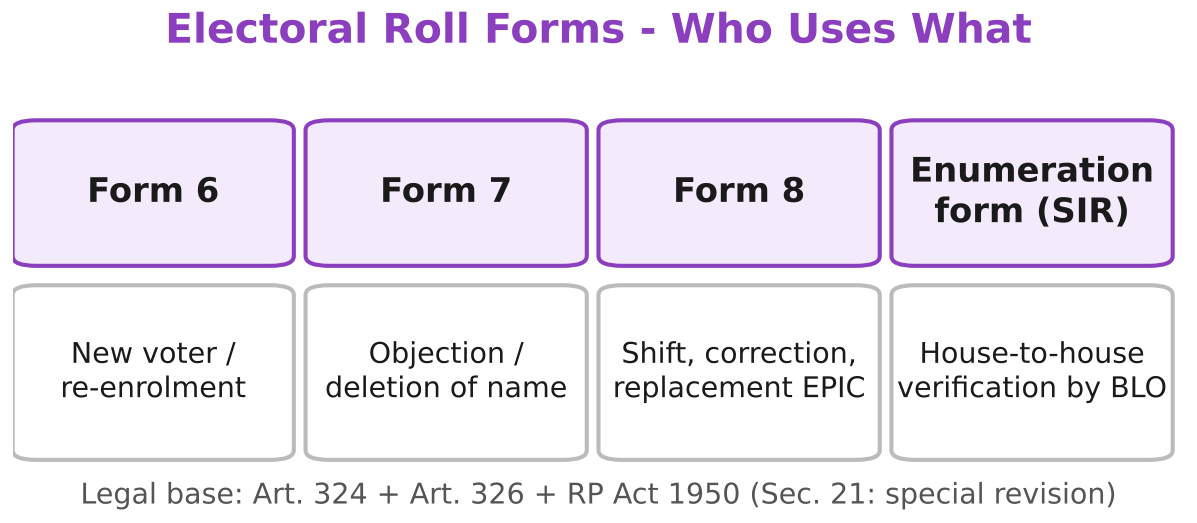
SIR = house-to-house check of voter lists by Booth Level Officers (BLOs) using enumeration forms
Forms can now be filed from the place of present ordinary residence
Supreme Court had earlier upheld ECI's power to conduct SIR (May 2026)
Issue: balance between clean rolls and not excluding genuine voters
Way forward
Give every deleted voter a notice and a simple appeal route, publish deletion lists booth-wise, and use door-to-door re-verification before final rolls.
Concept
Article 324: gives the ECI superintendence, direction and control of elections, including preparing electoral rolls. Article 326: elections on the basis of adult suffrage (every citizen 18+). Representation of the People Act, 1950: deals with electoral rolls; Section 21 allows a special revision of rolls at any time. Ordinarily resident: a person is enrolled where he/she normally lives, not simply where he/she owns property. Exam angle: Prelims: Articles 324/326, RP Act 1950 vs 1951 (1950 = rolls, 1951 = conduct of elections), Forms 6/7/8. Mains: due process in deletions, burden of proof on citizens, role of the judiciary in protecting the right to vote.
Chart of electoral roll Forms 6, 7, 8 and the SIR enumeration form — StudyForGS
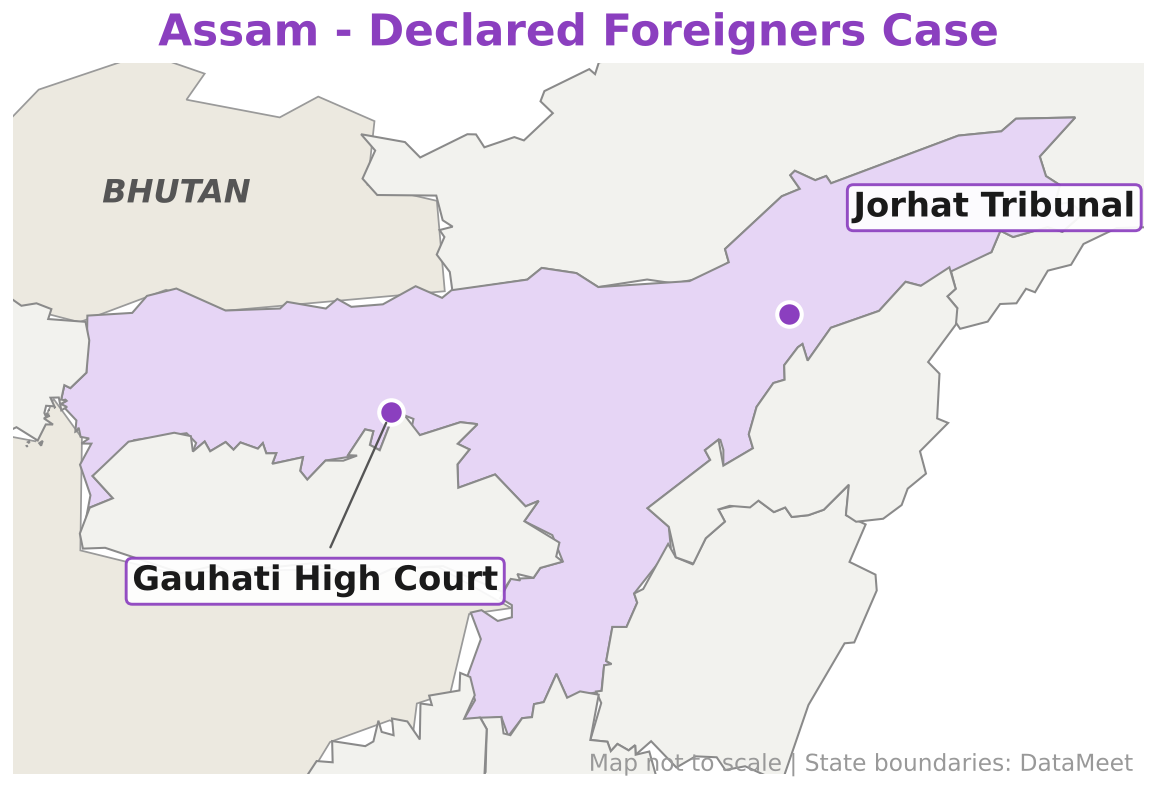
Courts in Assam have declared many people to be foreigners, but over 1.16 lakh of them have not been found or sent back. The High Court called this a 'very grim picture'. The Gauhati High Court said 1,16,946 people declared foreigners in Assam were still not detected and expelled as of 30 June. The bench refused to release a woman whom the Foreigners Tribunal at Jorhat had declared a foreigner. The court called the situation a 'very grim picture'.
Key facts
1,16,946 declared foreigners yet to be detected/deported (as of 30 June)
Case arose from a Jorhat Foreigners Tribunal order
Foreigners Tribunals are quasi-judicial bodies (they decide cases but are not regular courts)
Assam shares a long border with Bangladesh
Linked issues: NRC Assam (final list 2019 left out about 19 lakh people)
Way forward
Speed up nationality verification with Bangladesh, ensure legal aid in tribunals, and use biometric records to track declared persons.
Concept
Foreigners Tribunals: set up under the Foreigners (Tribunals) Order, 1964 to decide whether a person is a foreigner. Burden of proof is on the person to show he/she is a citizen. Assam Accord, 1985: set 24 March 1971 as the cut-off date for detecting foreigners in Assam; Section 6A of the Citizenship Act gives this legal form (upheld by Supreme Court in 2024). Deportation needs the other country to accept the person as its citizen, which is why many cases get stuck. Exam angle: Prelims: Foreigners Tribunals (1964 Order), Assam Accord cut-off date, Section 6A. Mains: human rights vs border security, fairness of tribunal process, need for bilateral repatriation deals.
Map of Assam marking the Jorhat tribunal and Gauhati High Court with neighbouring Bhutan and Bangladesh — StudyForGS
5. National Sports Board Gets Its Chairman
POLITYUPSC: Prelims + Mains GS2
Syllabus linkage
GS2: Statutory bodies, governance. Prelims: National Sports Governance Act 2025; Mains: transparency in sports bodies.
Context
A new National Sports Board has been set up to oversee sports federations. A retired IAS officer will head it, and it can recognise or suspend federations. Retired IAS officer Devesh Chaturvedi, former Union Agriculture Secretary, has been appointed Chairman of the new National Sports Board (NSB). P.K. Garg, former CEO of the Target Olympic Podium Scheme (TOPS), is a member. The Board can grant or suspend recognition of National Sports Federations (NSFs).
Power: grant, renew or suspend recognition of National Sports Federations
Created under the National Sports Governance Act, 2025
Aim: better governance, athlete welfare and fair elections in sports bodies
Comes ahead of India's bid to host the 2036 Olympics
Way forward
Make the Board's decisions transparent and time-bound, and keep athletes in decision-making.
Concept
National Sports Governance Act, 2025: sets up the National Sports Board, a National Sports Tribunal for disputes, and rules on federation elections and athlete representation. TOPS (Target Olympic Podium Scheme, 2014): a Sports Ministry scheme giving funds and training support to medal hopefuls. 'Sports' is a State subject (Entry 33, State List), but the Centre regulates national federations that represent India internationally. Exam angle: Prelims: name of the Act, powers of NSB, TOPS. Mains: autonomy of federations vs government oversight, IOC rules against political interference.
6. Janjatiya Gaurav Diwas: 246 Tribal Projects
POLITYUPSC: Prelims + Mains GS2
Syllabus linkage
GS2: Welfare schemes for vulnerable sections (STs). GS1: Modern Indian history - tribal revolts. Prelims: PM-JANMAN, DAJGUA, EMRS, Van Dhan; Mains: tribal development.
Context
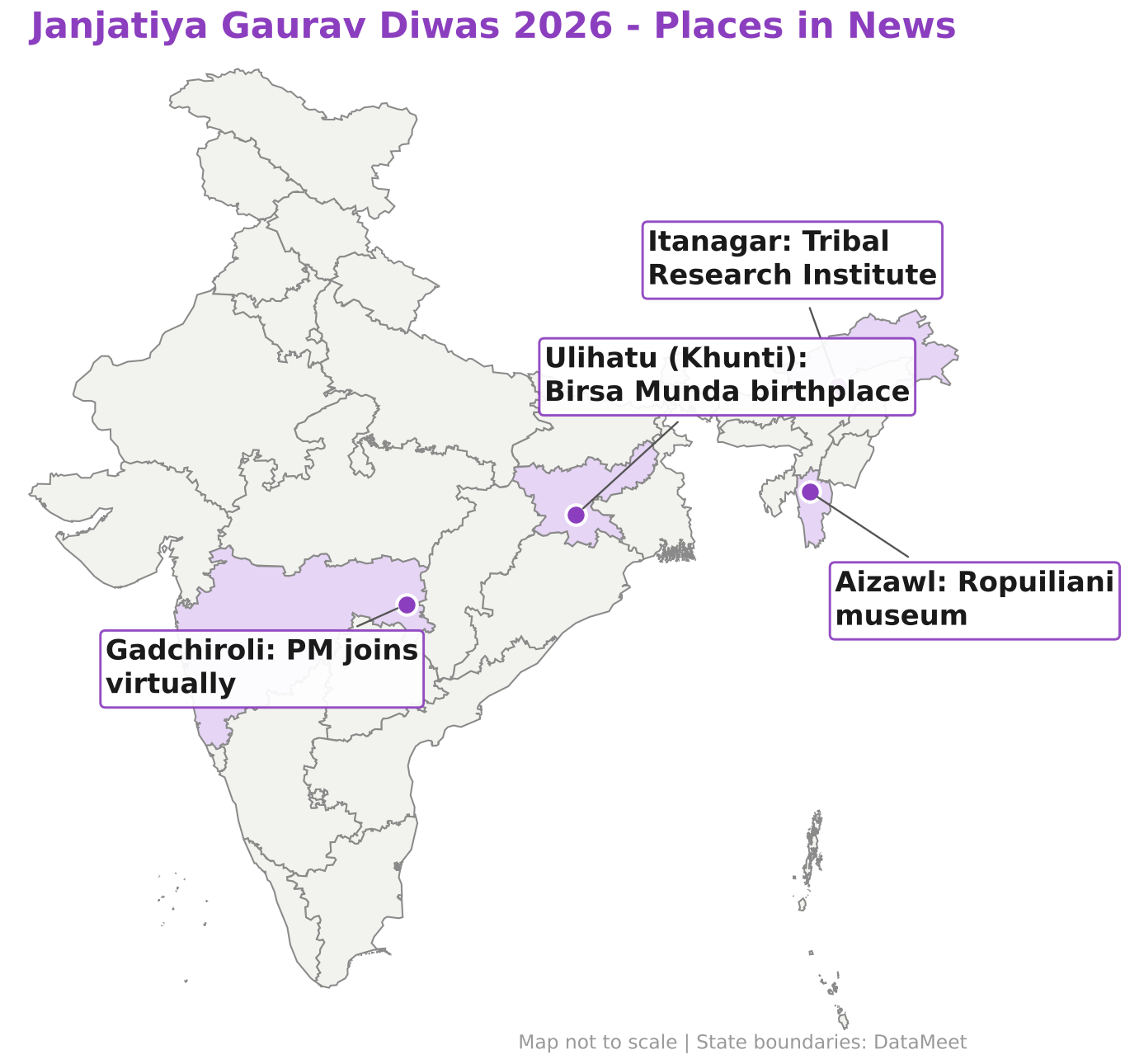
On Birsa Munda's birth anniversary (15 November), the PM launched 246 tribal welfare projects worth about Rs 3,000 crore, including new residential schools. Janjatiya Gaurav Diwas was marked on 15 November 2026, the 151st birth anniversary of Bhagwan Birsa Munda. PM Modi joined virtually from Gadchiroli, Maharashtra, and inaugurated or laid foundation stones for 246 projects (173 inaugurated, 73 foundation stones) worth about Rs 3,000 crore. These include 38 Eklavya Model Residential Schools (EMRS) with 19 more planned, 100 Multi-Purpose Centres under PM-JANMAN and 12 Tribal Multipurpose Marketing Centres. A Tribal Research Institute building in Itanagar and the Ropuiliani Tribal Freedom Fighter Museum in Aizawl were also opened. The 1-15 November period was observed as Janjatiya Gaurav Pakhwada.
Key facts
246 projects, about Rs 3,000 crore; 38 EMRS inaugurated, 19 more foundation stones
Ropuiliani: 19th-century Mizo chieftainess who resisted British rule
Pradhan Mantri Janjatiya Vikas Mission (PMJVM, 2021-22) runs Van Dhan Vikas Kendras: 15 SHGs, about 300 members, at least 60% STs
India has about 10.4 crore Scheduled Tribes; many earn 20-40% of income from Minor Forest Produce
PM claimed India is now free of Naxalism; about 125 districts were affected in 2014
Way forward
Ensure fair prices for forest produce, staff and quality in EMRS, and full implementation of forest rights.
Concept
Birsa Munda (born 15 Nov 1875, Ulihatu, now Jharkhand): led the 'Ulgulan' (great tumult, 1899-1900) against British rule and land grabbing; called 'Dharti Aaba' (Father of the Earth). 15 Nov declared Janjatiya Gaurav Diwas in 2021. PM-JANMAN (Nov 2023): mission for 75 Particularly Vulnerable Tribal Groups (PVTGs). DAJGUA (Dharti Aaba Janjatiya Gram Utkarsh Abhiyan, 2024): saturation of basic services in tribal villages. Minor Forest Produce (MFP): non-timber forest produce like honey, lac, tendu leaves; the Forest Rights Act 2006 and PESA 1996 give tribals rights over MFP. Exam angle: Prelims: Birsa Munda facts, Ulgulan, PM-JANMAN (PVTGs = 75), EMRS, Van Dhan structure, TRIFED buys MFP at MSP. Mains: livelihood-based tribal development, implementation of FRA and PESA.
India map marking Gadchiroli, Itanagar, Aizawl and Ulihatu, Birsa Munda's birthplace — StudyForGS
7. PM in Manila for ASEAN-India, EAS Summits
IRUPSC: Prelims + Mains GS2
Syllabus linkage
GS2: India and its neighbourhood, regional groupings (ASEAN, EAS). Prelims: ASEAN members, EAS, AITIGA; Mains: Act East Policy, South China Sea.
Context
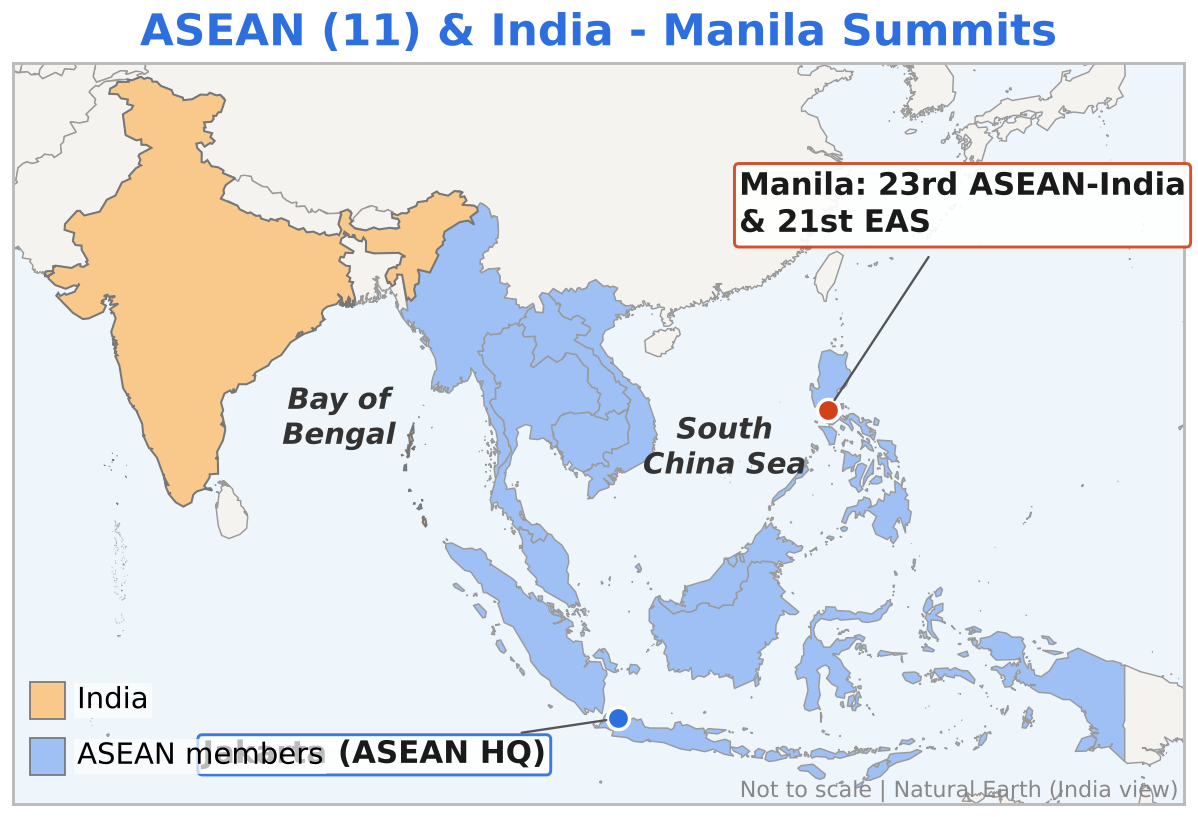
PM Modi is in the Philippines for meetings with Southeast Asian leaders. Talks focus on sea security, trade and keeping the Indo-Pacific open. PM Narendra Modi is visiting Manila from 16 to 18 November 2026 for the 23rd ASEAN-India Summit and the 21st East Asia Summit (EAS) on 17 November. The Philippines chairs ASEAN in 2026 and is hosting the 49th ASEAN Summit under the theme 'Navigating the Future'. India wants an early conclusion of the review of the ASEAN-India Trade in Goods Agreement (AITIGA). ASEAN and China have agreed on about 80% of a South China Sea Code of Conduct, but it will not be finished this year.
2026 = ASEAN-India Year of Maritime Cooperation; 2027 = 35 years of dialogue relations
India-ASEAN trade: about US$122 billion; AITIGA (signed 2009) under review
ASEAN now has 11 members (Timor-Leste joined in 2025)
Modi called ASEAN 'central' to India's Act East Policy and MAHASAGAR vision
Way forward
Push a balanced AITIGA review, complete connectivity projects like the Trilateral Highway, and deepen maritime cooperation.
Concept
ASEAN: Association of Southeast Asian Nations, formed 8 August 1967 (Bangkok Declaration); Secretariat in Jakarta. India: dialogue partner 1992 (sectoral) -> summit partner 2002 -> strategic 2012 -> Comprehensive Strategic Partnership 2022. East Asia Summit (2005): leaders' forum of ASEAN + 8 partners (India, China, Japan, South Korea, Australia, New Zealand, US, Russia) on strategic issues. Act East Policy (2014): upgraded 'Look East' (1991) - focuses on Southeast and East Asia through commerce, culture and connectivity. MAHASAGAR = India's updated maritime vision for the Global South. Exam angle: Prelims: summit numbers, ASEAN founding and membership, EAS members, AITIGA. Mains: ASEAN centrality, South China Sea code of conduct, India's trade deficit with ASEAN.
Map of the 11 ASEAN members and India with Manila and Jakarta marked — StudyForGS
8. Quad Leaders Likely to Meet in Manila
IRUPSC: Prelims + Mains GS2
Syllabus linkage
GS2: Bilateral, regional and global groupings affecting India's interests. Prelims: Quad origin and members; Mains: Indo-Pacific strategy.
Context
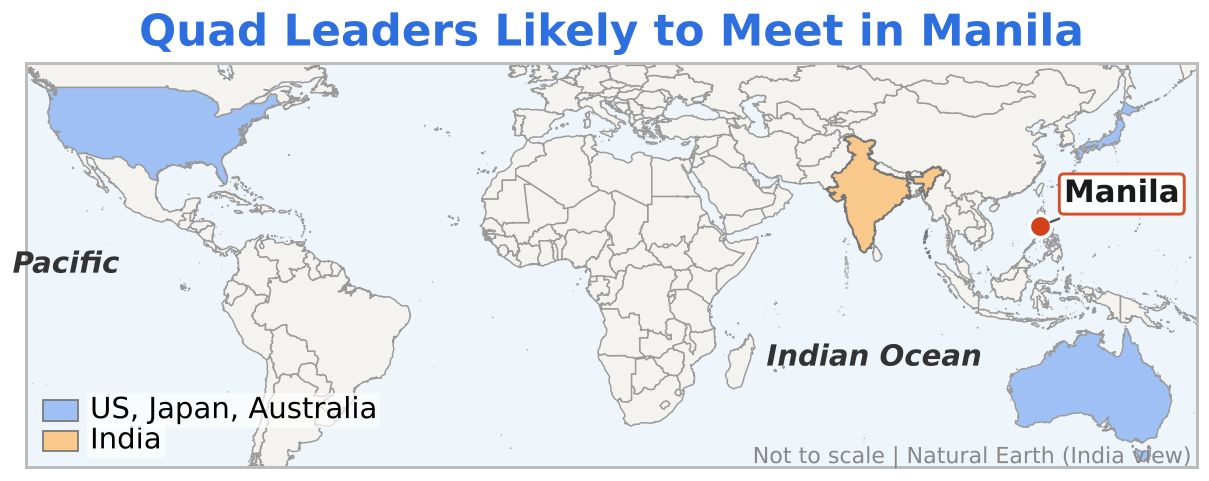
The leaders of India, the US, Japan and Australia may meet in Manila on the sidelines of the ASEAN meetings - their first in-person summit since 2024. A Quad leaders' meeting is expected in Manila on 17 November alongside the ASEAN summits, with PM Modi, US President Donald Trump, Japanese PM Sanae Takaichi and Australian PM Anthony Albanese. It would be the first meeting of the four leaders since September 2024. India was to host the Quad summit last year, but it did not take place. Official confirmation was still awaited.
Key facts
Members: India, US, Japan, Australia
Last in-person leaders' summit: Wilmington, USA, September 2024
Focus areas: maritime security, critical and emerging technologies, infrastructure, free and open Indo-Pacific
Quad Sea initiatives include Maritime Domain Awareness (IPMDA)
Meeting in Southeast Asia shows support for 'ASEAN centrality'
Way forward
Keep the Quad focused on public goods (health, tech, disaster relief, maritime awareness) so that regional partners see it as helpful, not divisive.
Concept
Quad (Quadrilateral Security Dialogue): began after the 2004 tsunami relief effort; first meeting 2007; revived 2017; first leaders' summit (virtual) March 2021. It is not a military alliance and has no secretariat. Indo-Pacific: the joined space of the Indian and Pacific Oceans; India's approach is SAGAR/MAHASAGAR and the Indo-Pacific Oceans Initiative (IPOI, 2019). IPMDA (2022): helps partner countries track 'dark shipping' (ships that switch off tracking) using satellite data. Exam angle: Prelims: Quad members, origin year, IPMDA. Mains: Quad vs China concerns, Quad's value for India without being an alliance, US policy uncertainty.
World map of Quad countries India, US, Japan and Australia with Manila marked — StudyForGS
9. New Janakpur-Ayodhya Train for Pilgrims
IRUPSC: Prelims + Mains GS2
Syllabus linkage
GS2: India and its neighbourhood (Nepal). GS1: Indian culture - Ramayana circuit. Prelims: places, rail links with Nepal; Mains: cultural connectivity as diplomacy.
Context
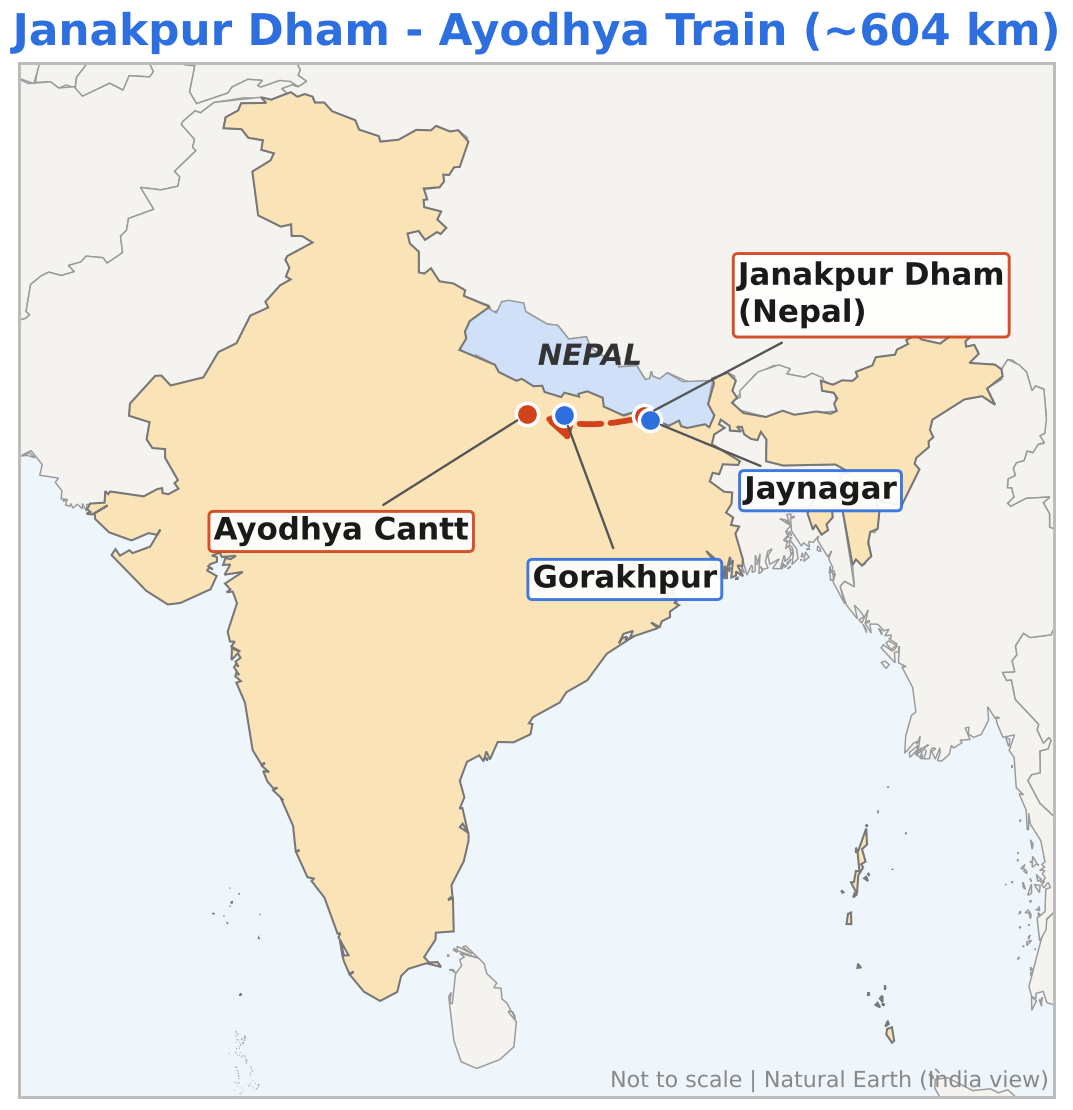
A weekly train will link Janakpur in Nepal (Sita's birthplace) with Ayodhya in India (Ram's birthplace), boosting religious tourism and people-to-people ties. Indian Railways approved a weekly train between Janakpur Dham (Nepal) and Ayodhya Cantt (Uttar Pradesh), covering about 604 km with 10 stops through Bihar and UP. It will leave Janakpur on Saturdays and Ayodhya on Mondays, with stops including Jaynagar, Sitamarhi, Raxaul, Gorakhpur and Basti. The service builds on the Janakpur-Jaynagar cross-border rail line.
Janakpur = believed birthplace of Sita (Mithila region); Ayodhya = Ram Janmabhoomi
Part of the Ramayana circuit under religious tourism push
Jaynagar-Kurtha (Janakpur) line was rebuilt with Indian aid
Way forward
Ease border formalities for pilgrims and add more cross-border rail links like Raxaul-Kathmandu.
Concept
India-Nepal Treaty of Peace and Friendship, 1950: allows open border and equal treatment of citizens; Nepalese citizens can work in India without permits. Swadesh Darshan scheme (2014-15): Tourism Ministry scheme for theme-based circuits such as the Ramayana and Buddhist circuits. Connectivity projects with Nepal: Raxaul-Birgunj integrated check post, Motihari-Amlekhganj oil pipeline (first cross-border petroleum pipeline in South Asia, 2019). Exam angle: Prelims: location of Janakpur, border towns (Raxaul, Jaynagar), India-Nepal treaties and projects. Mains: role of shared culture in neighbourhood policy.
Map of India and Nepal showing the Janakpur Dham to Ayodhya Cantt train route — StudyForGS
10. Pakistan Invited to SCO Dialogue in Delhi
IRUPSC: Prelims + Mains GS2
Syllabus linkage
GS2: India and neighbourhood; regional groupings (SCO). Prelims: SCO members, HQ, RATS; Mains: India-Pakistan ties in multilateral settings.
Context
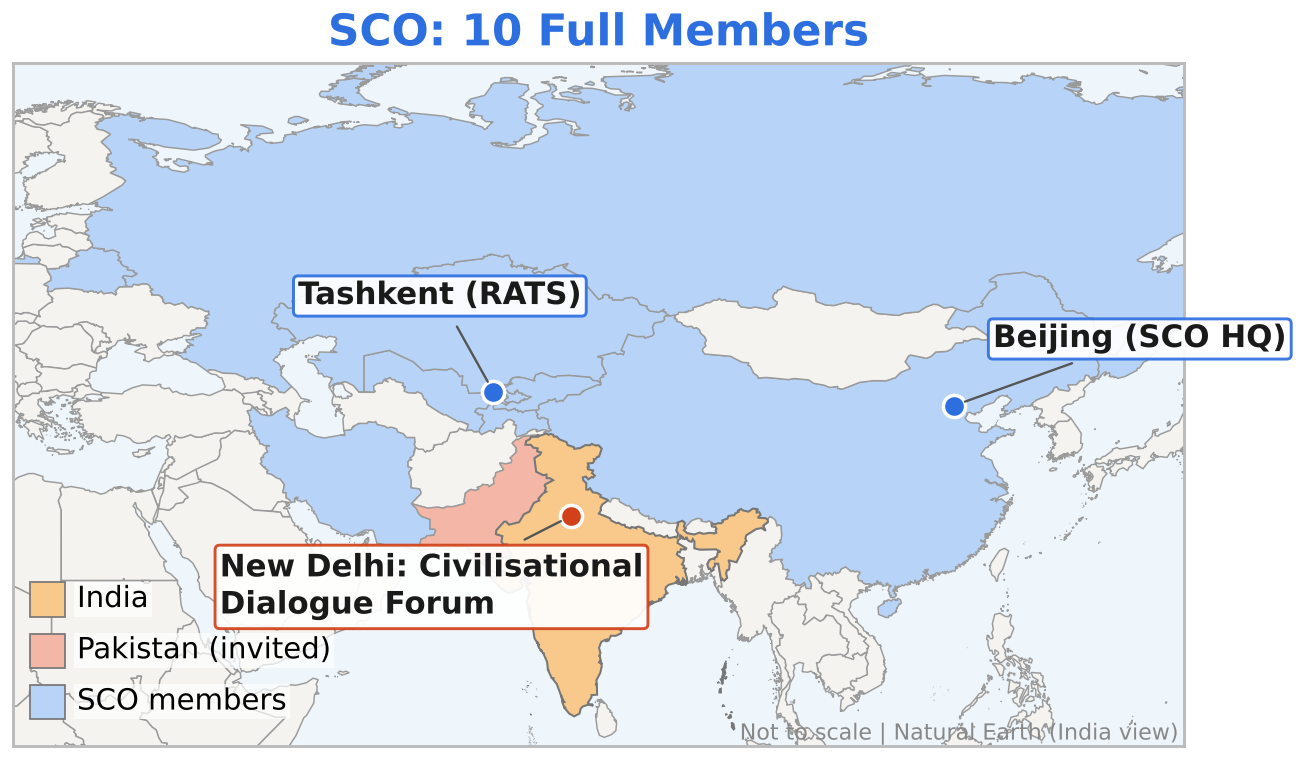
India has invited a Pakistani minister to an SCO cultural dialogue in New Delhi. It would be the first ministerial visit from Pakistan since the May 2025 conflict. Pakistan is set to send a minister to India for the SCO Civilisational Dialogue Forum in New Delhi. India had invited Pakistan's culture/heritage minister. This would be the first ministerial visit from Pakistan since the military conflict of May 2025.
Key facts
Event: SCO Civilisational Dialogue Forum, New Delhi
First Pakistani ministerial trip to India since the May 2025 conflict (Operation Sindoor)
SCO has 10 full members including India, Pakistan, China, Russia, Iran, Belarus
Hosting SCO events is a member's duty; does not mean a thaw in bilateral ties
India and Pakistan both became full SCO members in 2017
Way forward
Use the SCO platform to press on cross-border terrorism while keeping cultural and people-to-people channels open.
Concept
SCO (Shanghai Cooperation Organisation): founded 15 June 2001 in Shanghai; grew from the 'Shanghai Five' (1996). Secretariat: Beijing. Regional Anti-Terrorist Structure (RATS): Tashkent. Members: China, Russia, Kazakhstan, Kyrgyzstan, Tajikistan, Uzbekistan, India, Pakistan, Iran (2023), Belarus (2024). India refused to sign some SCO statements in the past (e.g. on China's Belt and Road) to protect its sovereignty position on PoK. Exam angle: Prelims: SCO founding year, HQ, RATS location, newest members. Mains: using multilateral forums for limited engagement with Pakistan; terrorism as India's core concern.
Map of the 10 SCO member states with New Delhi, Beijing and Tashkent marked — StudyForGS
11. Pannun Case: Can India Refuse Summons?
IRUPSC: Prelims + Mains GS2
Syllabus linkage
GS2: Effect of policies of developed countries on India; international treaties. Prelims: Hague Service Convention 1965; Mains: sovereignty vs judicial cooperation.
Context
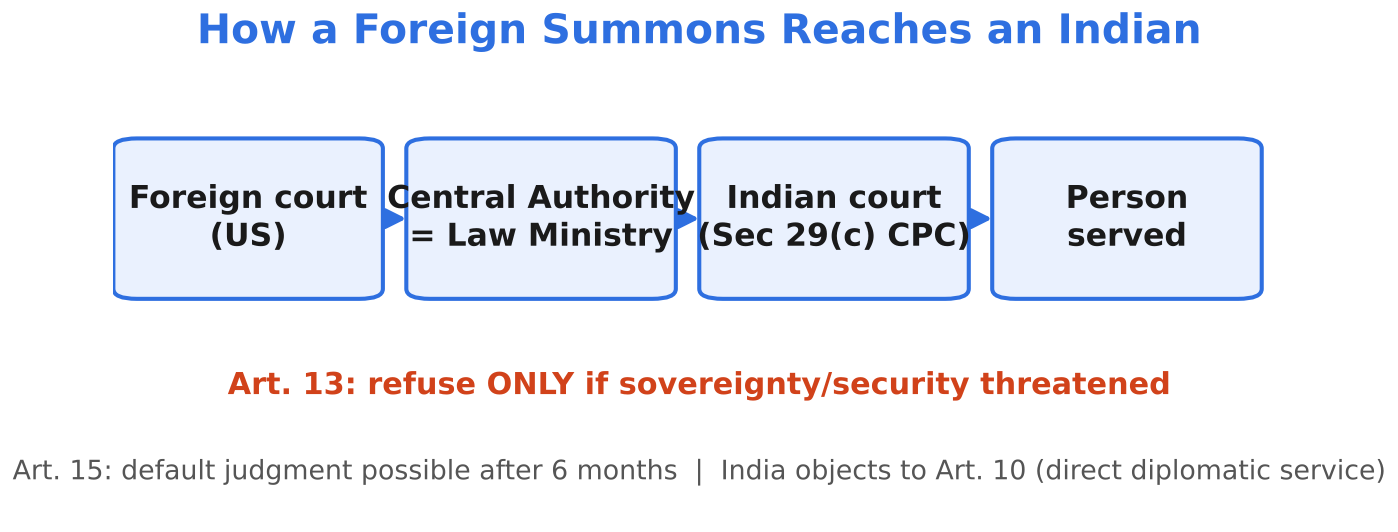
A US court allowed Khalistani separatist Pannun to send court summons to India's NSA and a former RAW chief through Indian courts. India calls the case baseless. A US District Court allowed Gurpatwant Singh Pannun to serve summons on National Security Adviser Ajit Doval and former RAW chief Samant Kumar Goel through Indian courts. The summons relates to a civil case alleging a plot to kill Pannun, who is wanted in India on terror charges. The court used the Hague Service Convention and Section 29(c) of the Code of Civil Procedure to send the papers to three Delhi district courts (Patiala House, Dwarka, Tis Hazari). India calls the allegations fabricated; the External Affairs Minister said all communication will go through the Law Ministry.
Key facts
Hague Service Convention (1965): India and the US are both parties
India's Central Authority under the Convention = Ministry of Law and Justice
Article 13: India can refuse only if service threatens its sovereignty or security
India objected to Article 10 (direct service by foreign diplomats on Indian citizens)
Article 15: a US court may give a default judgment after 6 months without proof of service
Way forward
India should give a clear legal reply through the Law Ministry, using Article 13 grounds if needed, while keeping security cooperation with the US on track.
Concept
Service of summons = formally delivering court papers to a person so that he/she knows about the case. It does NOT decide guilt. Section 29(c), CPC 1908: Indian courts can serve summons issued by foreign courts that the Centre has notified (2009 notification covers all Convention members). Sovereign/official immunity: a principle that state officials may be protected from foreign courts for official acts; Article 13 itself allows refusal only on sovereignty or security grounds. Exam angle: Prelims: Hague Service Convention year and its Central Authority in India; CPC Section 29(c). Mains: balancing treaty duties with national security; impact on India-US ties.
Flow of a foreign summons from a foreign court via the Law Ministry and an Indian court to the person — StudyForGS
12. Dhaka Presses for Sheikh Hasina's Return
IRUPSC: Prelims + Mains GS2
Syllabus linkage
GS2: India and its neighbourhood (Bangladesh); international treaties. Prelims: India-Bangladesh Extradition Treaty; Mains: extradition vs political asylum.
Context
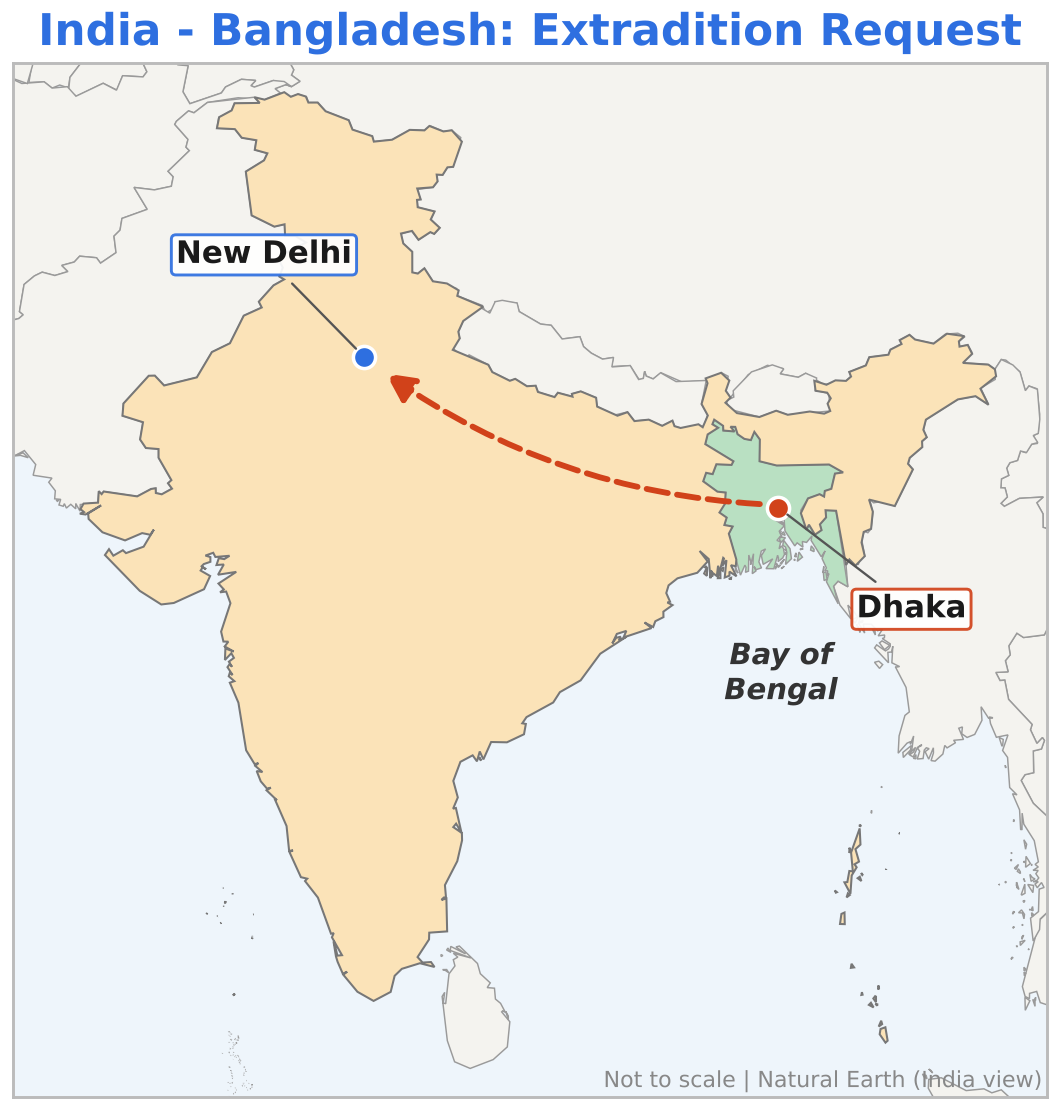
Bangladesh says it has finished all legal steps and wants India to send back former PM Sheikh Hasina, who has lived in India since August 2024. Bangladesh's interim government says all legal steps for the return of former PM Sheikh Hasina have been taken and an extradition request has been sent to India. Its law minister called her a 'convicted criminal'. Hasina fled to India on 5 August 2024 after mass protests. In November 2025, Bangladesh's International Crimes Tribunal sentenced her to death in absentia (without her being present).
Key facts
Hasina in India since 5 August 2024
Sentenced to death in absentia by International Crimes Tribunal-1, Dhaka (Nov 2025)
India-Bangladesh Extradition Treaty: signed 2013, amended 2016
Treaty allows refusal for 'political offence' and if request is not in good faith
India has so far not publicly accepted the request
Way forward
Handle the request strictly through legal processes while keeping trade, water and border cooperation with Bangladesh stable.
Concept
Extradition = handing over a person by one country to another for trial or punishment. In India it is governed by the Extradition Act, 1962 plus bilateral treaties; the MEA is the nodal ministry. Dual criminality: the act must be a crime in both countries (here, punishable with at least 1 year). Political offence exception: a person may not be extradited for a 'political' crime; but serious crimes like murder are usually excluded from this exception. Exam angle: Prelims: treaty year, Extradition Act 1962, dual criminality. Mains: humanitarian and political considerations vs treaty obligations; impact on India-Bangladesh ties.
Map of India and Bangladesh showing an extradition request from Dhaka to New Delhi — StudyForGS
13. Diabetes May Raise Alzheimer's Risk by 53%
HEALTHUPSC: Prelims + Mains GS2
Syllabus linkage
GS2: Health, non-communicable diseases. GS3: Biotechnology basics. Prelims: Alzheimer's, amyloid-beta, World Diabetes Day; Mains: NCD burden in India.
Context
A review of studies says people with diabetes may have a 53% higher risk of Alzheimer's disease. This came as World Diabetes Day (14 Nov) urged early action. A review of research found that people with diabetes may face about 53% higher risk of Alzheimer's disease than those without it. World Diabetes Day was observed on 14 November with the theme 'Early Action on Diabetes', stressing early testing, control of blood sugar, diet, exercise and obesity control. Experts warned that diabetes is now hitting younger Indians, and Indians are prone to central (belly) obesity.
Key facts
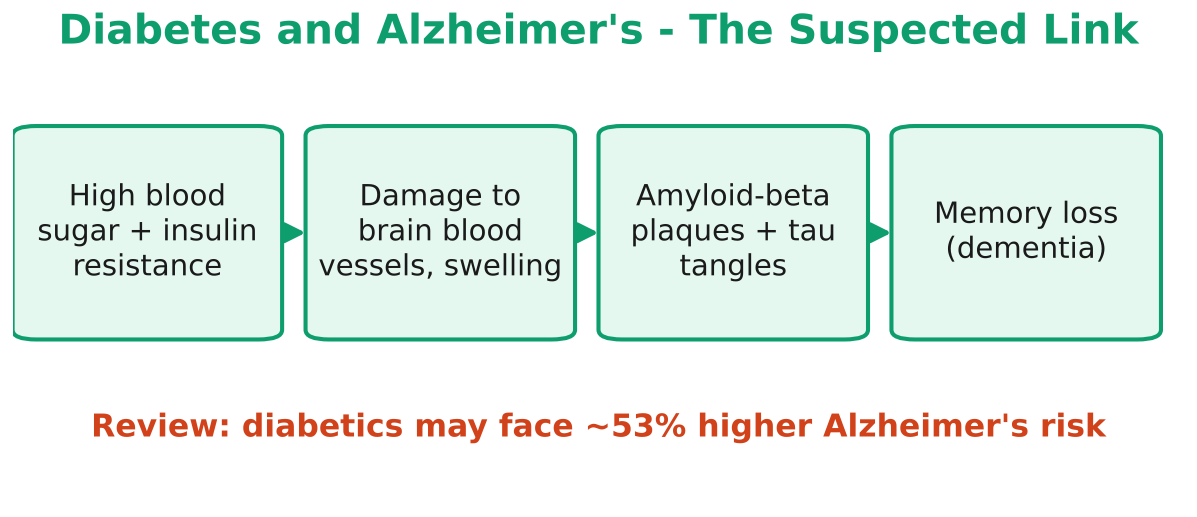
Diabetes linked to about 53% higher Alzheimer's risk (review of studies)
Alzheimer's causes 60-80% of all dementia cases; mostly after age 65
World Diabetes Day: 14 November (Frederick Banting's birthday; he co-discovered insulin in 1921)
Started by IDF and WHO in 1991; UN recognised it in 2006
Diabetes covered under NP-NCD (National Programme for Prevention and Control of NCDs)
Way forward
Expand early screening, promote physical activity and healthy diets, and add memory checks for older diabetics.
Concept
Alzheimer's disease: a brain disease where amyloid-beta protein clumps into plaques between nerve cells and tau protein forms tangles inside them, slowly killing neurons. No cure yet. Type 1 diabetes = body makes no insulin; Type 2 = body does not use insulin well (insulin resistance); gestational = during pregnancy. ICMR-INDIAB study: a large national survey that shows India has one of the world's largest diabetic populations. Exam angle: Prelims: amyloid-beta and tau, Banting and insulin, World Diabetes Day date. Mains: rising NCD burden, prevention through lifestyle, screening under Ayushman Arogya Mandirs.
Flow chart of the suspected link from high blood sugar to brain damage, plaques and memory loss — StudyForGS
14. AIIMS Does India's First Open Fetal Surgery
HEALTHUPSC: Prelims + Mains GS2
Syllabus linkage
GS2: Health services. GS3: Achievements of Indians in science and technology. Prelims: neural tube defects, JSSK; Mains: tertiary care capacity.
Context
Doctors at AIIMS Delhi operated on a baby still in the mother's womb to repair a serious spine defect - a first of its kind in India. AIIMS New Delhi performed India's first open fetal surgery on 12 November, repairing a severe spinal defect called myelomeningocele in a 25-week-old unborn baby. The six-hour operation involved more than 30 doctors and nurses. It was done free of cost under the Janani Shishu Suraksha Karyakram (JSSK).
Key facts
First open fetal (in-womb) surgery in India; done at AIIMS New Delhi
Condition: myelomeningocele - the most severe form of spina bifida
Baby's age: 25 weeks of pregnancy; surgery took 6 hours, 30+ staff
Free under JSSK
Early repair can reduce nerve damage and the need for brain fluid shunts after birth
Way forward
Train more fetal medicine teams at AIIMS-like centres and strengthen folic acid coverage to prevent such defects.
Concept
Spina bifida: a 'neural tube defect' where the spine does not close fully in early pregnancy; myelomeningocele means the spinal cord and nerves bulge out. Folic acid (vitamin B9) taken before and early in pregnancy greatly lowers the risk of neural tube defects - this is why India fortifies foods and gives iron-folic acid tablets. JSSK (2011): entitles pregnant women and sick infants (up to 1 year) to free delivery, C-section, drugs, diagnostics, diet and transport in public hospitals. Exam angle: Prelims: spina bifida, folic acid role, JSSK benefits. Mains: building advanced fetal medicine in public hospitals; maternal and child health.
15. Bird Flu Confirmed in Cuddalore, Tamil Nadu
HEALTHUPSC: Prelims + Mains GS3
Syllabus linkage
GS2: Health - zoonotic diseases. GS3: Animal husbandry, disaster management. Prelims: H5N1, One Health; Mains: preparedness for pandemics.
Context
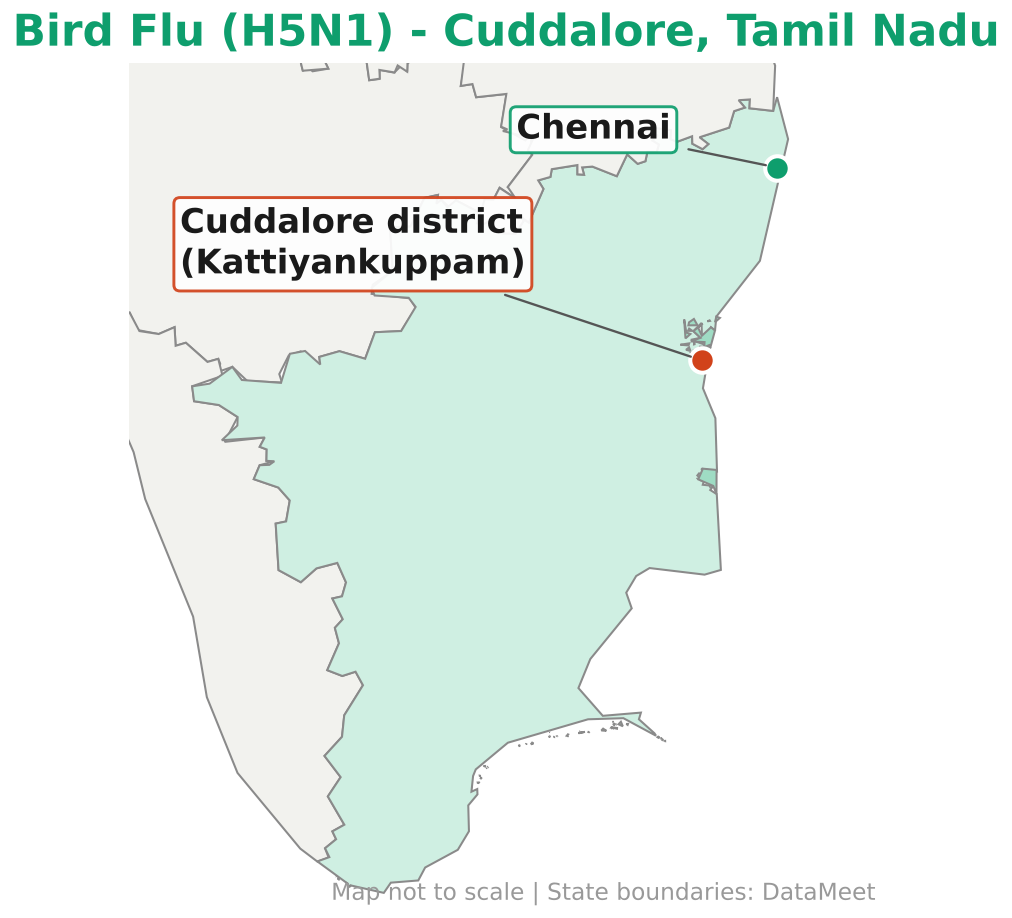
Bird flu (H5N1) has hit poultry farms in Cuddalore district. Over 35,000 birds have died, and birds within 1 km are being culled to stop the spread. Avian influenza (H5N1) was confirmed at a poultry farm in Kattiyankuppam, Cuddalore district, Tamil Nadu. About 35,647 birds have died and 15 farms are affected. Culling (killing and safe disposal of birds) is underway within a one-km radius, as per the national action plan.
Culling in 1 km radius; surveillance zone usually up to 10 km
National reference lab: ICAR-NIHSAD, Bhopal
H5N1 can rarely infect humans who handle sick birds
Way forward
Pay quick compensation to farmers, test poultry workers, and strengthen bio-security on farms.
Concept
Zoonosis: a disease that jumps from animals to humans (e.g. bird flu, Nipah, rabies). One Health approach: treats human, animal and environmental health as linked; India has a National One Health Mission. 'H' and 'N' in H5N1 = haemagglutinin and neuraminidase, two proteins on the virus surface. Exam angle: Prelims: meaning of H and N, zoonotic diseases, NIHSAD Bhopal. Mains: One Health, poultry economy losses, compensation for farmers.
Tamil Nadu map marking the affected village in Cuddalore district and Chennai — StudyForGS
16. Retail Inflation Crosses 6% in October
ECONOMYUPSC: Prelims + Mains GS3
Syllabus linkage
GS3: Indian economy - inflation, monetary policy. Prelims: CPI, core inflation, RBI targets; Mains: drivers of inflation and RBI response.
Context
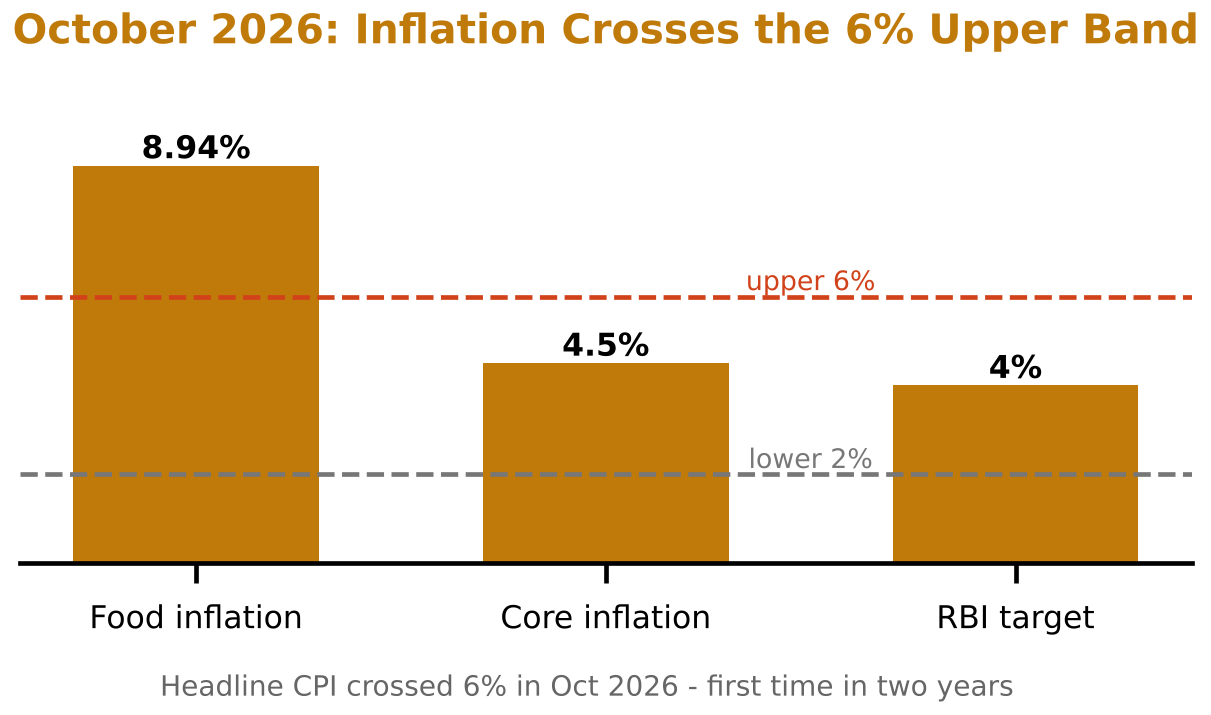
Prices are rising fast. Retail inflation crossed the RBI's upper limit of 6% in October 2026 for the first time in two years, led by food, airfares and electronics. India's CPI (Consumer Price Index) inflation crossed 6% in October 2026, the first time in two years. Food inflation rose to 8.94% due to weak monsoon effects and festival demand. Average airfares rose 43% year-on-year because of costly jet fuel (West Asia war) and festive travel. Memory-chip shortages ('chipflation') pushed up prices of pen drives (22%) and phones and laptops (9%). Core inflation (without food and fuel) was 4.5%, above the RBI's own forecast.
Key facts
Headline CPI above 6% - upper end of RBI's 2-6% band
Food inflation 8.94%; core inflation 4.5%
Airfares: highest month-on-month jump (13.36%) among 358 CPI items
Items with 6%+ inflation rose to 95 of 358 (from 40 in January)
WPI (wholesale) inflation in double digits - more price rise may pass to consumers
Way forward
Use supply steps for food (stock limits, open market sales), watch jet fuel taxes, and keep monetary policy alert to broad-based price rise.
Concept
Inflation targeting: under RBI Act Section 45ZA, the government sets a CPI target of 4% with a band of 2-6%. If inflation stays outside the band for three straight quarters, the RBI has 'failed' and must report reasons to the government. Core inflation = headline inflation minus volatile food and fuel; shows the underlying trend. Monetary Policy Committee (MPC): 6 members (3 from RBI incl. Governor, 3 external) decide the repo rate. Exam angle: Prelims: CPI vs WPI, core inflation, 45ZA target, MPC composition. Mains: supply-side vs demand-side inflation, limits of interest-rate tools for food inflation.
Bar chart of October 2026 food and core inflation and the RBI target with 2% and 6% band lines — StudyForGS
📜 Asked before in the exam — previous-year question on this topic
UPSC Prelims 2020Consider the following statements: 1. The weightage of food in Consumer Price Index (CPI) is higher than that in Wholesale Price Index (WPI). 2. The WPI does not capture changes in the prices of services, which CPI does. 3. Reserve Bank of India has now adopted WPI as its key measure of inflation and to decide on changing the key policy rates. Which of the statements given above is/are correct?
1 and 2 only
2 only
3 only
1, 2 and 3
Show answer
Answer: (a) 1 and 2 only Statements 1 and 2 are correct. Food has a much higher weight in the Consumer Price Index, about 46 per cent in the combined CPI, than in the Wholesale Price Index, where food articles weigh around 15 per cent. The WPI covers only goods, while the CPI also includes services such as housing, health, education and transport. Since 2014, following the Urjit Patel Committee, the RBI has used CPI, not WPI, as its main inflation measure. Its target is 4 per cent CPI inflation within a band of 2 to 6 per cent. Practise all UPSC Prelims 2020 paper (free) →
Linked because this news is about the same topic. The answer is as per the official key of that year.
17. Exports Hit Record US$90 bn in October
ECONOMYUPSC: Prelims + Mains GS3
Syllabus linkage
GS3: Indian economy - external sector, trade. Prelims: trade data terms; Mains: export competitiveness.
Context
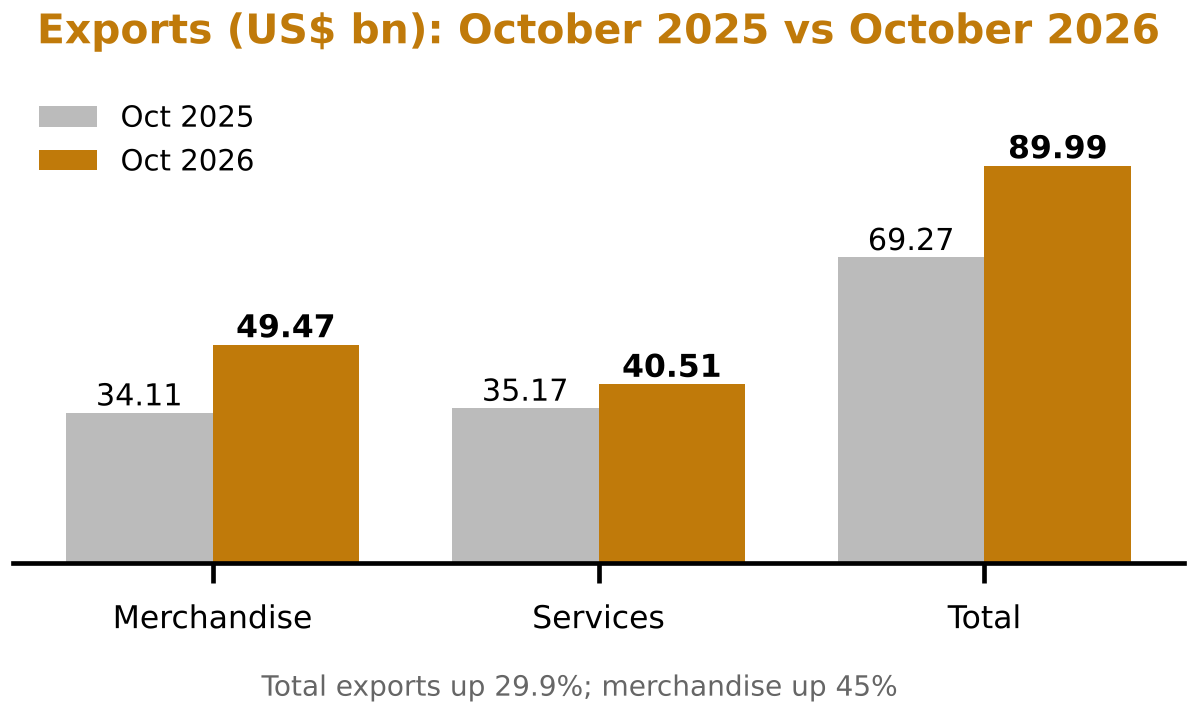
India's total exports of goods and services jumped about 30% in October 2026 to nearly US$90 billion - a new record. Total exports (goods + services) rose 29.90% to US$89.99 billion in October 2026 compared with US$69.27 billion a year ago. Merchandise exports rose 45.03% to US$49.47 billion and services exports were US$40.51 billion. Petroleum products (+140%), electronics (+63%) and engineering goods (+36%) led growth. From April to October 2026-27, total exports reached US$568.84 billion (+16.66%).
Key facts
Oct 2026 total exports: US$89.99 bn (+29.90%); imports US$110.07 bn
Fastest destination growth: Spain, Malaysia, Singapore, China, USA
Way forward
Keep the momentum with trade deals, lower logistics costs and support for MSME exporters.
Concept
Trade deficit = imports minus exports. India runs a big goods deficit but a large services surplus (IT, business services), which partly offsets it. Current Account Deficit (CAD): broader than trade - also includes remittances and investment income; a key measure of external stability. PLI (Production Linked Incentive) schemes: give incentives on extra output; a major reason for the rise in electronics exports. Exam angle: Prelims: meaning of merchandise vs services trade, trade deficit, top export items. Mains: diversifying markets, role of PLI, services as growth engine.
Bar chart comparing merchandise, services and total exports in October 2025 and October 2026 — StudyForGS
18. Coal Gasification: Which Products First?
ECONOMYUPSC: Prelims + Mains GS3
Syllabus linkage
GS3: Infrastructure - energy; mobilisation of resources. Prelims: syngas, National Coal Gasification Mission; Mains: energy security vs climate goals.
Context
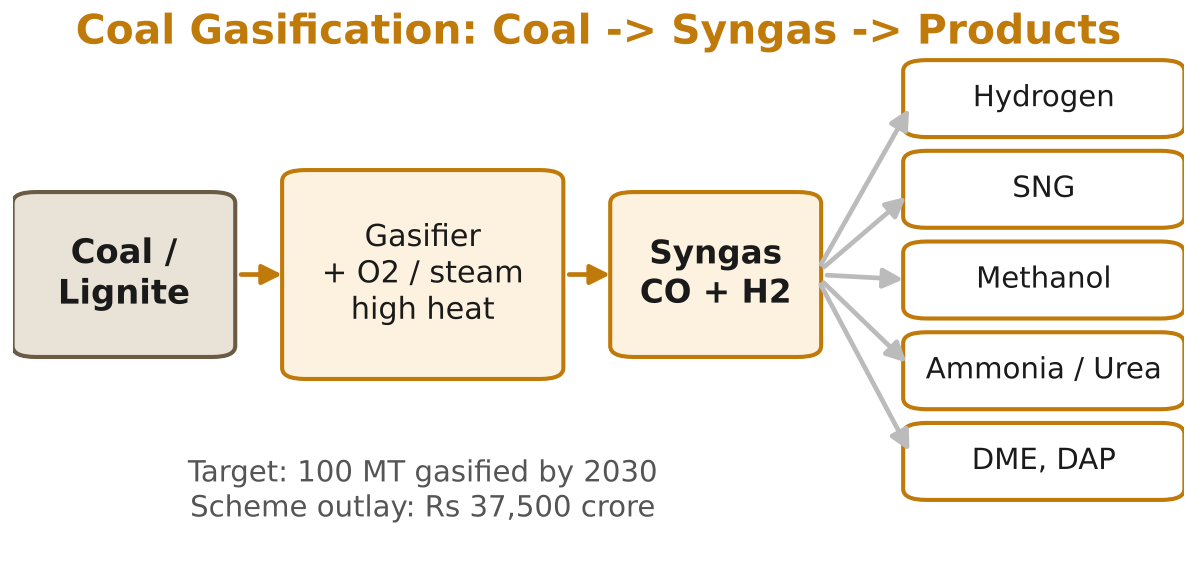
India wants to turn coal into gas and then into useful products like hydrogen, fertiliser and methanol, to cut costly imports. A study ranks which products to make first. A study by C-DEP and the Centre for WTO Studies ranked 23 coal-based products and said India should first make hydrogen, synthetic natural gas (SNG), methanol and ammonia under the Rs 37,500-crore coal gasification scheme. India imported nearly US$37 billion worth of LPG, LNG, urea and DAP in 2024. The study warns, using China's example, against fast and unplanned expansion because plants are costly and need a lot of water.
Key facts
Scheme: Rs 37,500 crore for surface coal and lignite gasification; extra 75 MT a year
National target: 100 million tonnes of coal gasification by 2030
Top priority product: hydrogen; then SNG, methanol, ammonia; also DME, urea, DAP
Imports in 2024: LPG + LNG over US$27 bn; urea + DAP about US$9.6 bn
Suggests integrated clusters - one gasifier feeding many chemical plants
Way forward
Go phase-wise, back commercially viable projects, plan for water and carbon capture, and build shared industrial clusters.
Concept
Coal gasification: coal reacts with limited oxygen/steam at high heat to make 'syngas' (mainly carbon monoxide + hydrogen), which can be burnt or turned into chemicals - unlike burning coal only for heat. Import substitution: making at home what is now imported, to save foreign exchange and reduce supply risk. India has about 378 billion tonnes of coal resources (one of the world's largest), but most is high-ash coal. Exam angle: Prelims: what syngas is, 2030 target, products from gasification. Mains: energy security, fertiliser self-reliance, water use and carbon emissions of coal-to-chemicals.
Flow from coal to gasifier, syngas and products such as hydrogen, SNG, methanol and ammonia — StudyForGS
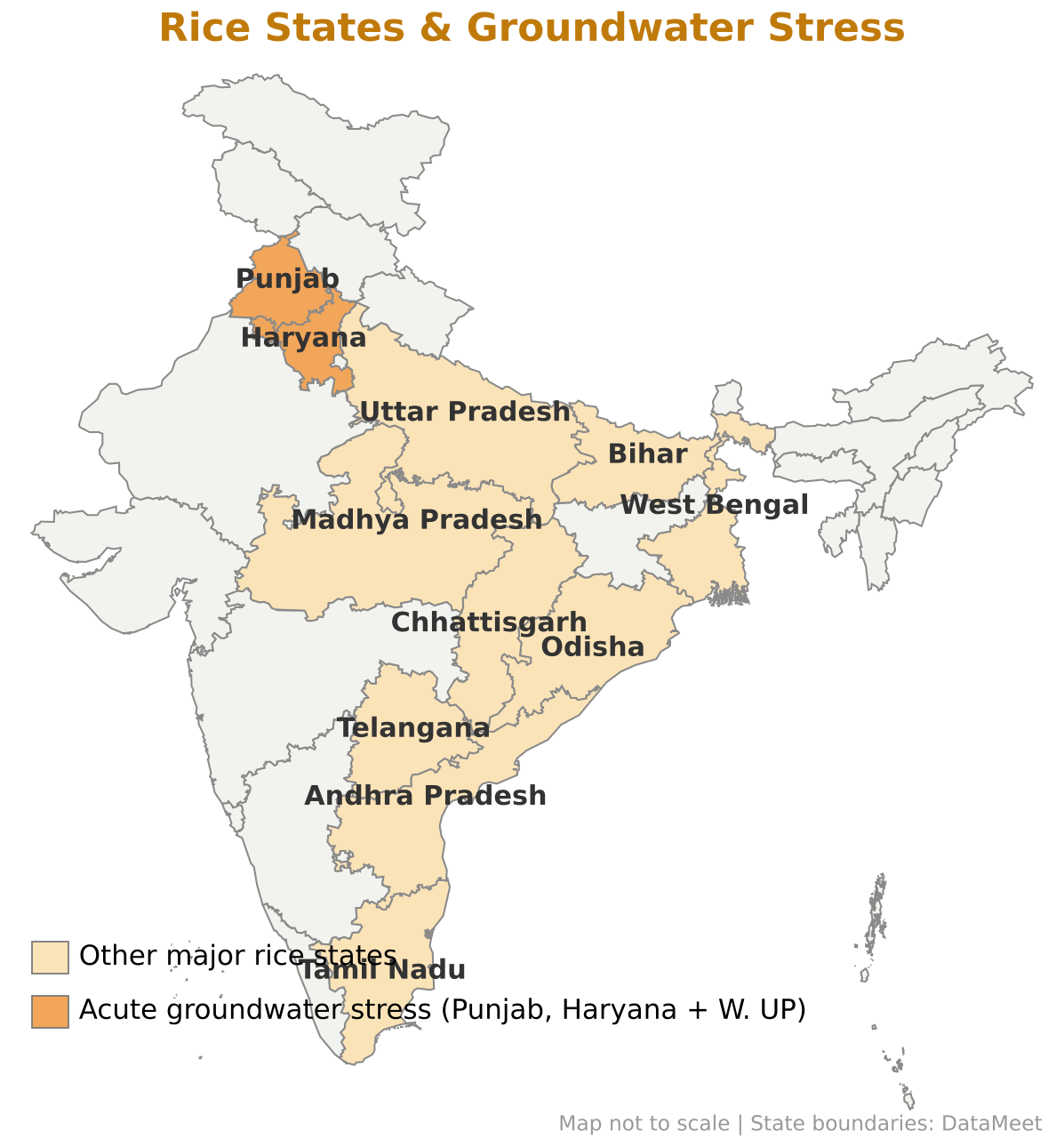
India sells more rice abroad than any other country, but growing it uses a lot of groundwater. Experts say India should earn more per tonne and use less water. India has been the world's largest rice exporter since 2012 and supplies about 30-35% of global rice exports. In 2025-26, exports reached 21.57 million tonnes worth US$11.54 billion; production was estimated at 154.02 million tonnes. Non-Basmati rice is more than twice Basmati's volume but earns only slightly more. Experts say exporting rice also means exporting 'virtual water'. Separately, the Centre has made traders, millers and retailers declare paddy and rice stocks on an online portal to stop hoarding, and Tamil Nadu has imposed stock limits as prices climb.
Most water-stressed rice belt: Punjab, Haryana, western UP
Proposed 'Water-Carbon-Value' indicators, e.g. export value per cubic metre of water
Centre: weekly stock declaration portal for paddy/rice to curb hoarding
Tamil Nadu stock limit: wholesalers up to 2,000 tonnes; retailers 8 tonnes per outlet
Way forward
Reward water-saving methods, diversify crops in stressed areas, and promote branding, GI and processing to raise value per tonne.
Concept
Virtual water: water used to grow a product that is 'exported' along with it. Blue water = from rivers, reservoirs, groundwater; green water = rain stored in soil. Alternate Wetting and Drying (AWD) and Direct-Seeded Rice (DSR): methods that save water and cut methane from flooded paddy fields. Stock limits are imposed under the Essential Commodities Act, 1955, to stop hoarding and control prices. Exam angle: Prelims: virtual water, AWD/DSR, Basmati GI, Essential Commodities Act. Mains: crop diversification in Punjab-Haryana, export policy vs food security.
India map of major rice states with acute groundwater stress in Punjab and Haryana — StudyForGS
20. Women at Work: Measuring Unpaid Care
ECONOMYUPSC: Prelims + Mains GS1
Syllabus linkage
GS1: Role of women, social empowerment. GS3: Employment, inclusive growth. Prelims: PLFS, Time Use Survey, LFPR; Mains: barriers to women's work.
Context
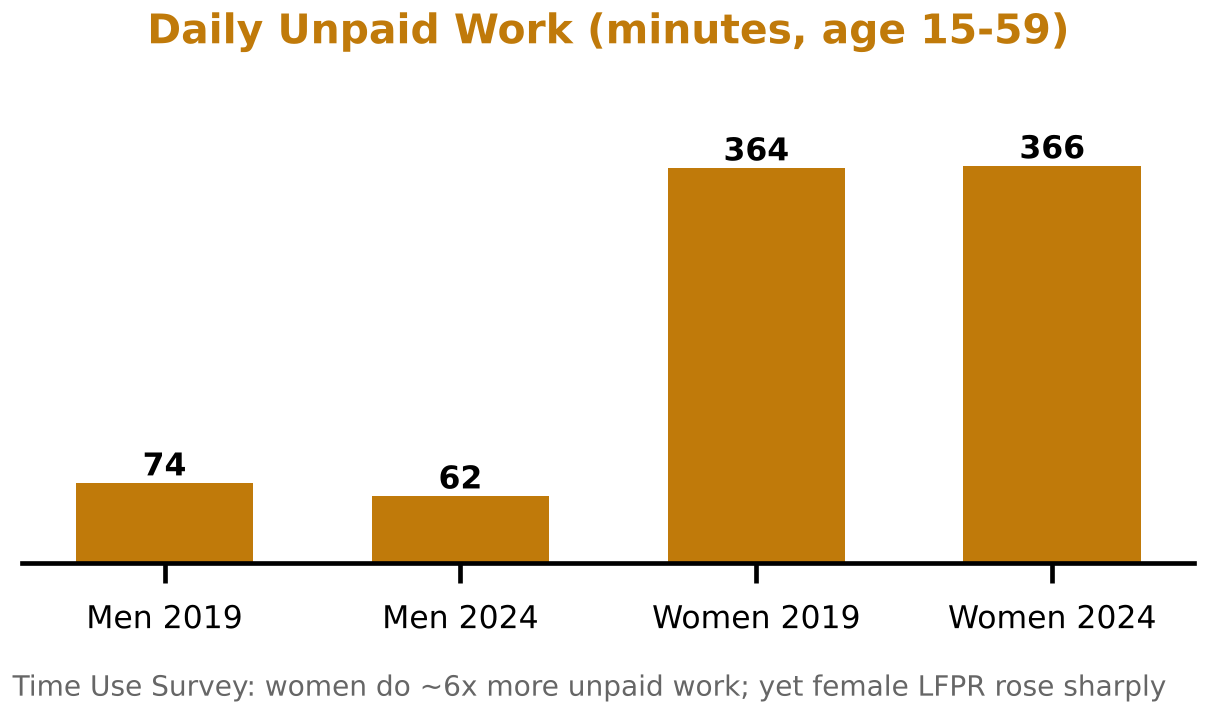
Many Indian women do not work for pay because of housework and caring for children and elders. The government will ask new survey questions to understand why. The World Bank says raising women's labour force participation to 50% could speed India's path to high income. MoSPI has proposed new questions in the Periodic Labour Force Survey (PLFS) - for example, whether a woman looked for paid work in the last 30 days and the main reasons for not seeking work - and in the ASUSE survey on barriers faced by women business owners. Time Use Surveys show women spend about six times more time than men on unpaid work.
Key facts
Female LFPR about 34.6% in September 2026
Women's daily unpaid work: 364 min (2019) and 366 min (2024); men: 74 -> 62 min
In 2025, 44.4% of women outside the workforce cited childcare/homemaking
Tamil Nadu employs 4 in 10 directly employed women factory workers; uses worker dormitories
Viksit Bharat 2047 needs higher growth and more women in work
Way forward
Build creches and elder care, safe transport and hostels, and encourage men to share household work.
Concept
Labour Force Participation Rate (LFPR): share of people (15+) who are working or looking for work. Unemployed people seeking work are counted in it. PLFS (since 2017, by NSO under MoSPI): India's main source of job data. Time Use Survey (2019, 2024): records how people spend each minute of the day. Care economy: paid and unpaid work of caring for children, the sick and elderly; unpaid care is not counted in GDP. Exam angle: Prelims: LFPR definition, PLFS, Time Use Survey, ASUSE. Mains: why female LFPR is low, care infrastructure, safety and mobility for women workers.
Bar chart of daily unpaid work minutes for men and women in 2019 and 2024 — StudyForGS
📜 Asked before in the exam — previous-year question on this topic
BPSC Prelims 2025 (71st CCE)According to Annual PLFS 2023-24 report:
There is greater increase in Labour Force Participation Rate (LFPR) of rural females as compared to urban females since 2022
Among the 36 states and union territories, 19 states have a Workforce Participation Rate (WPR) (for all ages) below the national average of 43.7 percent
The share of female workers in agriculture has declined significantly from 2017-18 to 2023-24
More than one of the above
Show answer
Answer: (a) There is greater increase in Labour Force Participation Rate (LFPR) of rural females as compared to urban females since 2022 Practise all BPSC previous year papers →
Linked because this news is about the same topic. The answer is as per the official key of that year.
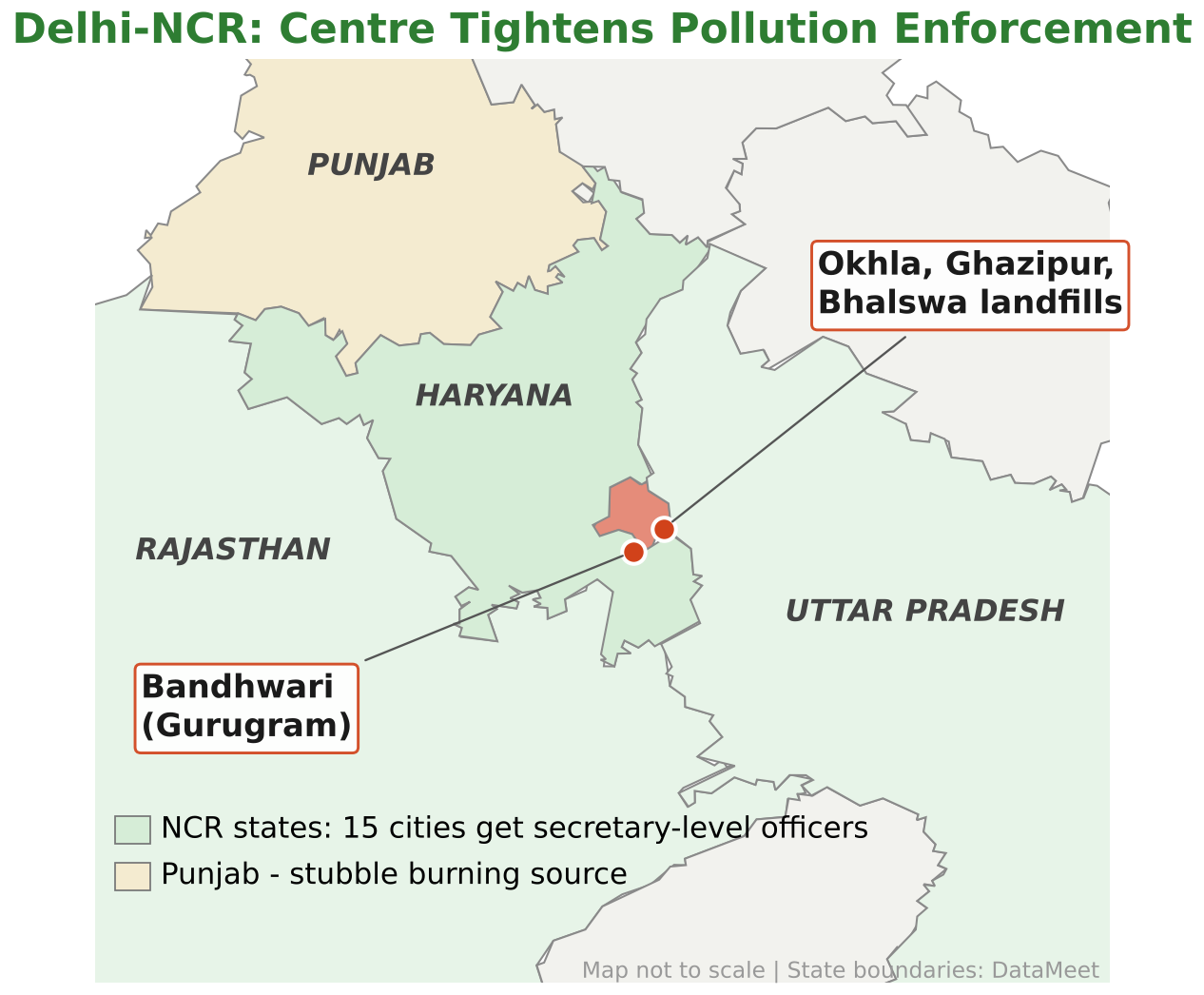
Delhi's air is 'very poor'. The Centre has ordered 191 polluting factories to be sealed and made senior officers personally responsible for action in NCR cities. Union Environment Minister Bhupender Yadav directed the Central Pollution Control Board (CPCB) to seal 191 polluting industries in Delhi-NCR that have not installed air pollution control devices. Haryana, UP and Rajasthan must name secretary-level officers for 15 NCR cities, who will report weekly to the Commission for Air Quality Management (CAQM). ANPR cameras must be installed by 30 November or officials may be prosecuted. Delhi's 24-hour AQI is around 370 (very poor), with PM10 the main pollutant.
Key facts
191 non-compliant industries to be sealed; 2,298 of 2,345 units linked to OCEMS
Industrial particulate limit: 50 mg/Nm3
Multi-Lane Free Flow tolling at 154 Delhi entry points by 31 Dec 2026
Only 3,221 km of 5,480 km roads redeveloped; NCR waste-processing shortfall 6,747 tonnes/day
Move to year-round, region-wide airshed management with better public transport, clean fuels and strict accountability.
Concept
CAQM: statutory body under the CAQM in NCR and Adjoining Areas Act, 2021; replaced EPCA; can issue binding directions and prosecute. GRAP (Graded Response Action Plan): steps that get stricter as AQI worsens - Stage I (201-300), II (301-400), III (401-450), IV (above 450). OCEMS (Online Continuous Emission Monitoring System): sensors in factory chimneys that send live emission data to regulators. Exam angle: Prelims: AQI categories, GRAP stages, CAQM Act 2021, PM10 vs PM2.5. Mains: why seasonal action fails, need for year-round regional airshed planning.
Delhi-NCR map showing Punjab, Haryana, UP, Rajasthan and the main landfill sites — StudyForGS
22. Mekedatu: Karnataka-Tamil Nadu Water Row
ENVIRONMENTUPSC: Prelims + Mains GS2
Syllabus linkage
GS2: Inter-state relations, inter-state water disputes. GS1: Rivers of India. Prelims: Cauvery basin places; Mains: federal water sharing.
Context
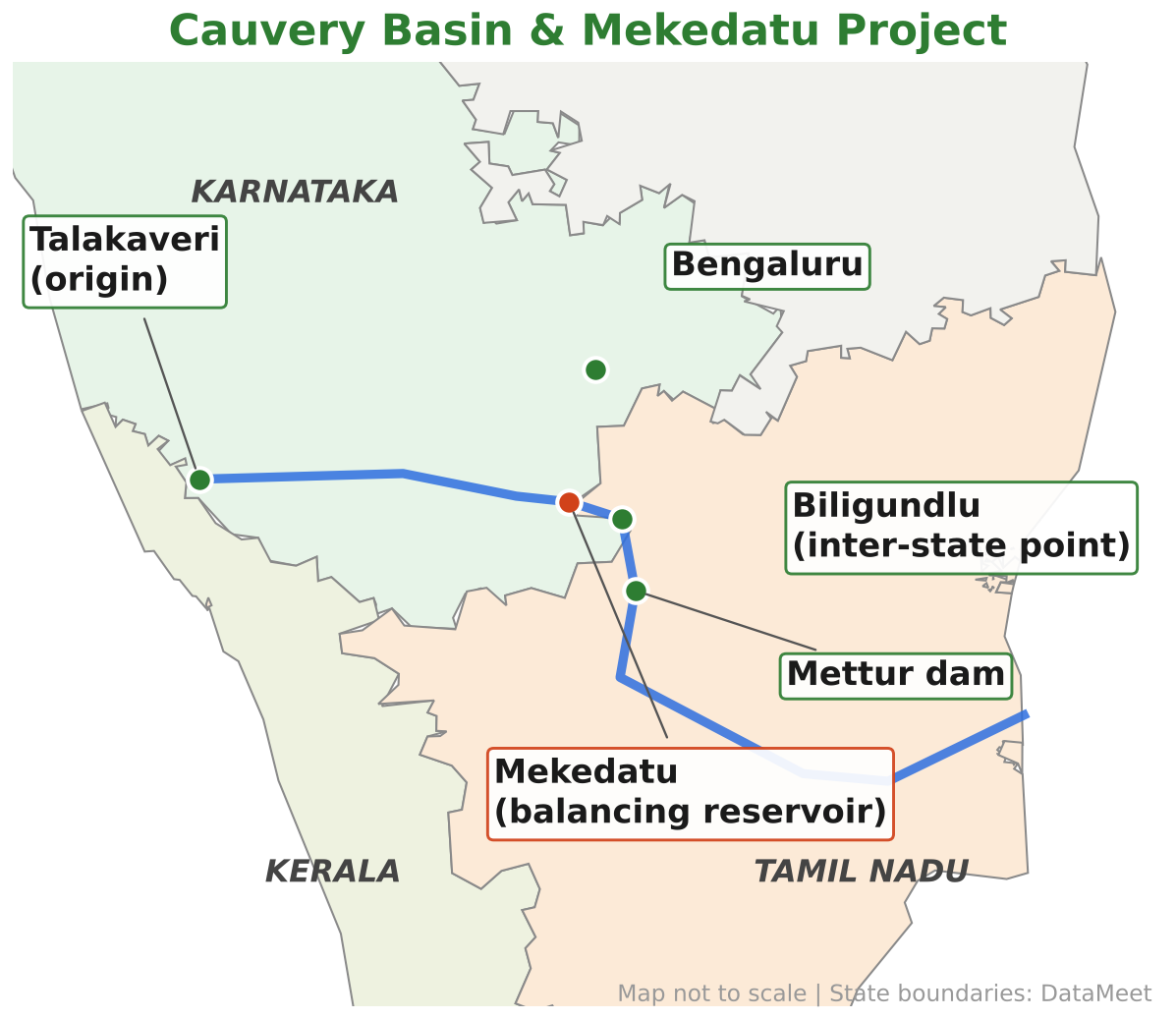
Karnataka says it has the right to build the Mekedatu reservoir on the Cauvery for Bengaluru's drinking water. Tamil Nadu opposes it, fearing less water for its farmers. Karnataka's Chief Minister said the Mekedatu project is 'Karnataka's right' after the Supreme Court dismissed Tamil Nadu's plea. The project is a balancing reservoir on the Cauvery near Kanakapura, meant mainly for Bengaluru's drinking water, with about 400 MW of pumped-storage power. About 5,400 hectares of forest land would be submerged. Tamil Nadu's Chief Minister has written to the PM opposing it. Karnataka says it will keep releasing 177 TMC of water to Tamil Nadu as ordered by the Supreme Court.
Key facts
Location: Mekedatu, Kanakapura taluk, Karnataka, on the Cauvery
Purpose: drinking water for Bengaluru + about 400 MW power
About 5,400 ha forest land to be submerged; forest and environment clearances needed
SC (2018) fixed Karnataka's release to Tamil Nadu at 177.25 TMC at Biligundlu
Cauvery Water Management Authority (CWMA) oversees implementation
Way forward
Settle the issue through CWMA with clear data on flows, and ensure Tamil Nadu's share is protected in distress years.
Concept
Article 262: Parliament can make laws to settle inter-state river disputes; Inter-State River Water Disputes Act, 1956 sets up tribunals. Cauvery: rises at Talakaveri (Kodagu, Karnataka), flows through Karnataka and Tamil Nadu into the Bay of Bengal near Poompuhar; tributaries include Hemavati, Kabini, Arkavathi, Bhavani. Balancing reservoir: a reservoir that stores and regulates flows downstream rather than mainly for new irrigation. Exam angle: Prelims: Cauvery origin and tributaries, Biligundlu, Art. 262. Mains: cooperative federalism in water sharing, role of CWMA, drinking water vs irrigation priorities.
Cauvery basin map with Talakaveri, Mekedatu, Bengaluru, Biligundlu and Mettur dam — StudyForGS
23. COP31 in Antalya Enters Final Week
ENVIRONMENTUPSC: Prelims + Mains GS3
Syllabus linkage
GS3: Conservation, climate change, international agreements. Prelims: UNFCCC, COP host details; Mains: climate finance and equity.
Context
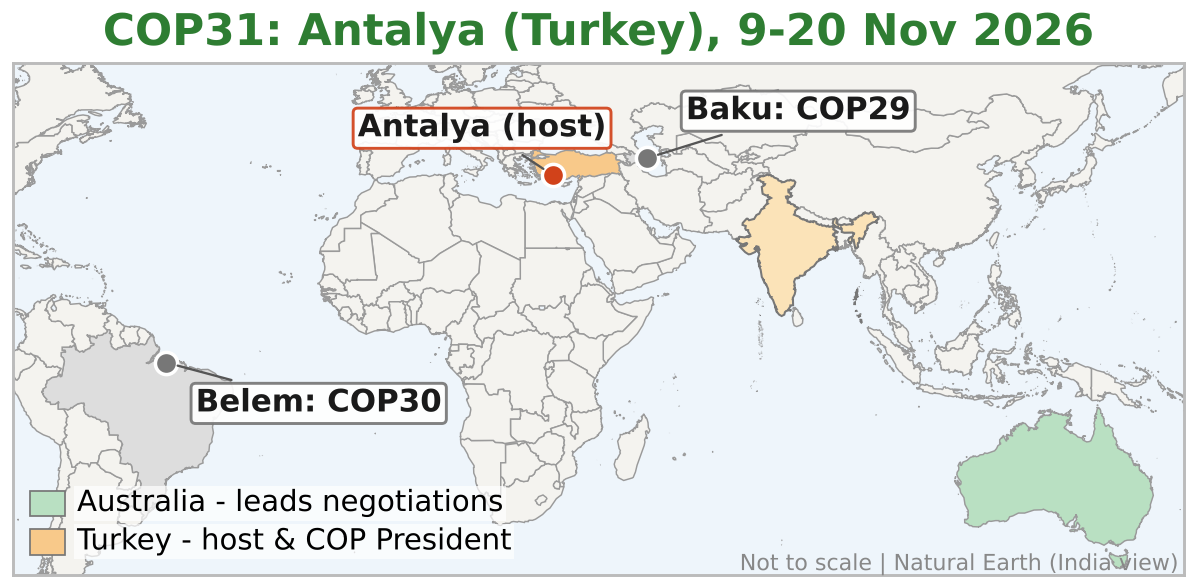
The world's main climate meeting, COP31, is under way in Antalya, Turkey. India is pushing rich countries to give more money and technology for climate action. The 31st Conference of the Parties (COP31) to the UNFCCC is being held in Antalya, Turkey, from 9 to 20 November 2026. Under a special deal, Turkey hosts and holds the COP Presidency (Murat Kurum is COP President), while Australia's Chris Bowen leads the negotiations. A World Leaders' Summit was held on 11-12 November. India is pressing for climate finance, adaptation support and technology transfer, based on equity and 'common but differentiated responsibilities'.
Key facts
COP31: Antalya, Turkey, 9-20 November 2026
Turkey = host and Presidency; Australia = President of Negotiations
Pre-COP held in Fiji; Pacific leaders' event in Tuvalu
COP29 (Baku, 2024) set a new finance goal of US$300 bn a year by 2035
Way forward
India should push for predictable finance and adaptation support while showcasing its own renewable energy progress.
Concept
UNFCCC (1992 Rio Earth Summit): the parent climate treaty; COP is its yearly meeting. Kyoto Protocol (1997) and Paris Agreement (2015) are under it. Paris Agreement: keep warming well below 2 degrees C, aim for 1.5 degrees C; countries submit Nationally Determined Contributions (NDCs) every 5 years. CBDR-RC: Common But Differentiated Responsibilities and Respective Capabilities - rich countries polluted more historically, so they should do more. Exam angle: Prelims: COP31 venue and dates, UNFCCC year, NCQG figure. Mains: climate justice, adaptation finance gap, India's position at COPs.
World map of COP31 host Turkey (Antalya), negotiations lead Australia, and past COP venues Belem and Baku — StudyForGS
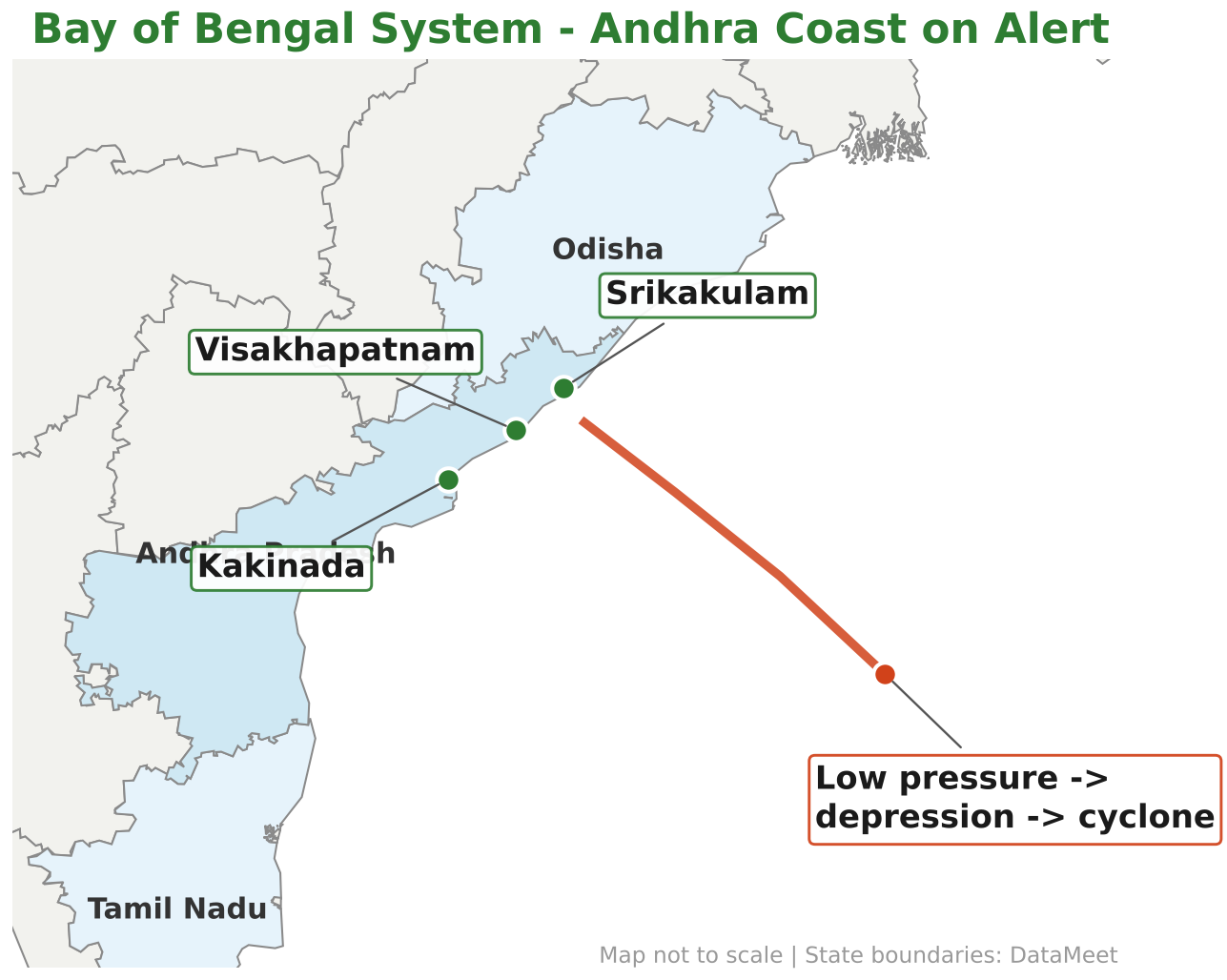
A low-pressure area in the Bay of Bengal may grow into a severe cyclonic storm and hit north coastal Andhra Pradesh around 19-20 November. The India Meteorological Department (IMD) said a low-pressure area over the Bay of Bengal may become a depression, then a cyclonic storm around 16 November and a severe cyclonic storm by 18 November. Landfall is likely on north coastal Andhra Pradesh around 19 or 20 November. This follows Cyclones Arnab and Murasu earlier this season, which also hit India's east coast.
Likely landfall: north coastal Andhra Pradesh, about 19-20 November
October-December is the main cyclone season on the east coast (post-monsoon)
IMD's RSMC New Delhi names cyclones of the North Indian Ocean
Names come from a list given by 13 member countries of WMO/ESCAP Panel
Way forward
Timely evacuation, fishing bans, and strong mangrove and shelter-belt protection along the coast.
Concept
Tropical cyclone: a low-pressure storm that forms over warm sea water (above about 26-27 degrees C); winds rotate anticlockwise in the Northern Hemisphere. IMD stages by wind speed: Depression (31-49 km/h), Deep Depression, Cyclonic Storm (62-88), Severe (89-117), Very Severe, Extremely Severe, Super Cyclonic Storm (222 and above). The Bay of Bengal gets more cyclones than the Arabian Sea because it is warmer, gets remnants of Pacific typhoons and has a funnel-shaped coast. Exam angle: Prelims: cyclone categories, naming system, why the Bay is cyclone-prone. Mains: early warning success (zero-casualty approach), coastal shelters, NDMA role.
Likely cyclone track in the Bay of Bengal with Visakhapatnam, Kakinada and Srikakulam on the Andhra coast — StudyForGS
25. Wangala: 1,000 Drums at Golden Jubilee
ART & CULTUREUPSC: Prelims + Mains GS1
Syllabus linkage
GS1: Indian culture - festivals, tribal traditions. Prelims: festivals of the Northeast; Mains: culture-based tourism.
Context
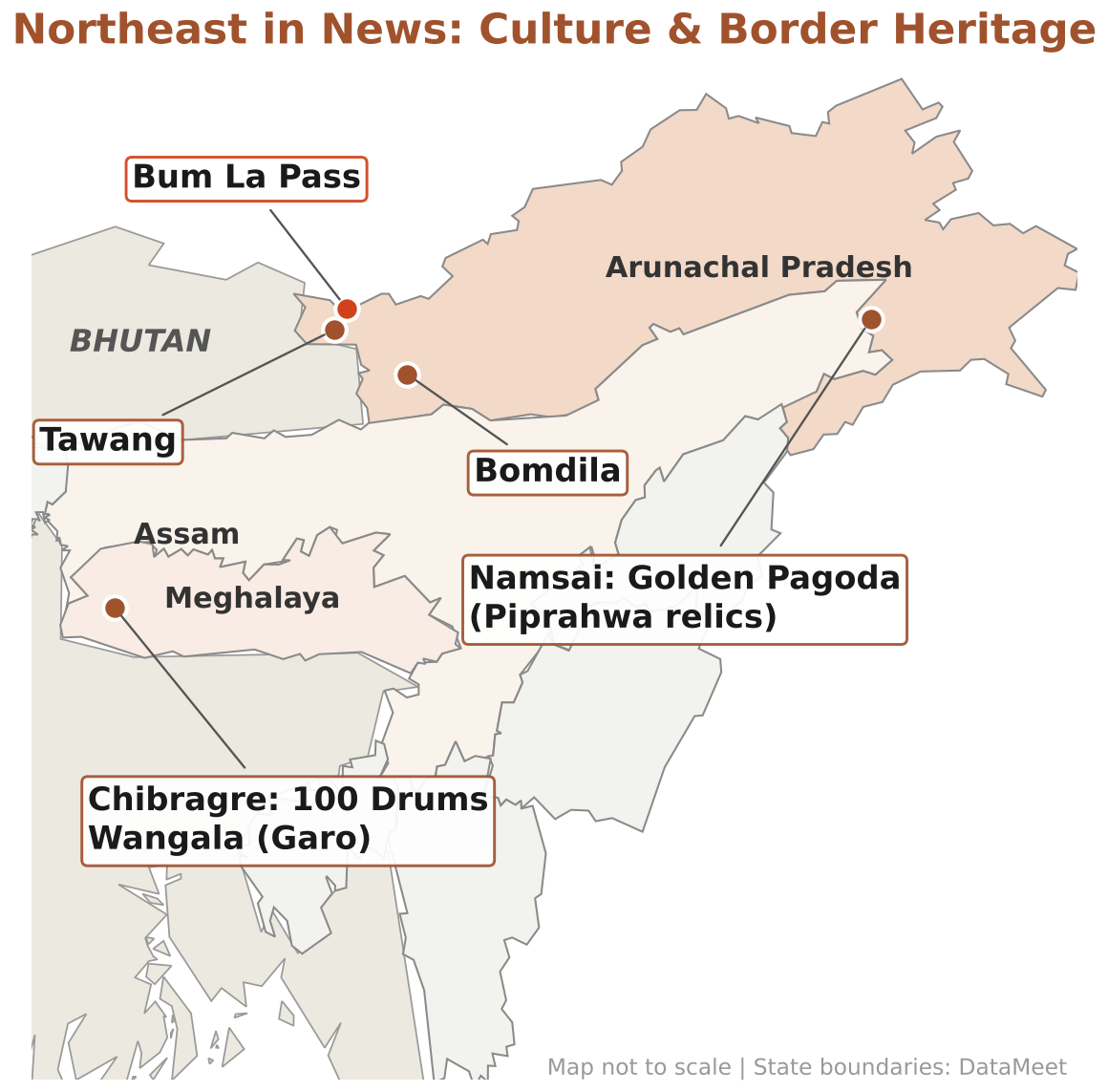
Meghalaya's Garo people celebrated their harvest festival Wangala with a record 1,000 drums, marking 50 years of the famous '100 Drums' festival. The 100 Drums Wangala Festival began on 11 November 2026 at Wangala A'dam, Chibragre, West Garo Hills, Meghalaya, as its Golden Jubilee celebration. Highlights include the 'Rhythm of 1,000 Drums', a handloom and handicrafts exhibition with 300 stalls, and folk dances. The festival ends with a Guinness world record attempt.
Key facts
Tribe: Garo (A'chik); state: Meghalaya
Honours the Sun God Misi Saljong for a good harvest
Venue: Chibragre, West Garo Hills; Golden Jubilee edition
Dance with long drums called 'dama' in a line formation
Other Meghalaya festivals: Shad Suk Mynsiem (Khasi), Behdienkhlam (Jaintia/Pnar)
Way forward
Promote community-led cultural tourism that brings income to local artisans without commercialising sacred rituals.
Concept
Wangala is a post-harvest thanksgiving festival held in October-November; it marks the end of the agricultural year for the Garos. Meghalaya's three main tribes: Garo (Garo Hills), Khasi (Khasi Hills), Jaintia/Pnar (Jaintia Hills); Garo and Khasi societies are matrilineal (descent traced through the mother). Sixth Schedule: Meghalaya's tribal areas have Autonomous District Councils (Garo Hills, Khasi Hills, Jaintia Hills) with powers over land and customs. Exam angle: Prelims: festival-tribe-state matching, Misi Saljong, matrilineal societies, Sixth Schedule. Mains: preserving tribal culture through tourism.
Northeast map with Wangala venue Chibragre, Namsai Golden Pagoda, Bomdila, Tawang and Bum La Pass — StudyForGS
26. Buddha's Piprahwa Relics in Arunachal
ART & CULTUREUPSC: Prelims + Mains GS1
Syllabus linkage
GS1: Indian art and culture - Buddhism. GS2: Cultural diplomacy. Prelims: Piprahwa, Buddhist sites; Mains: Buddhism as soft power.
Context
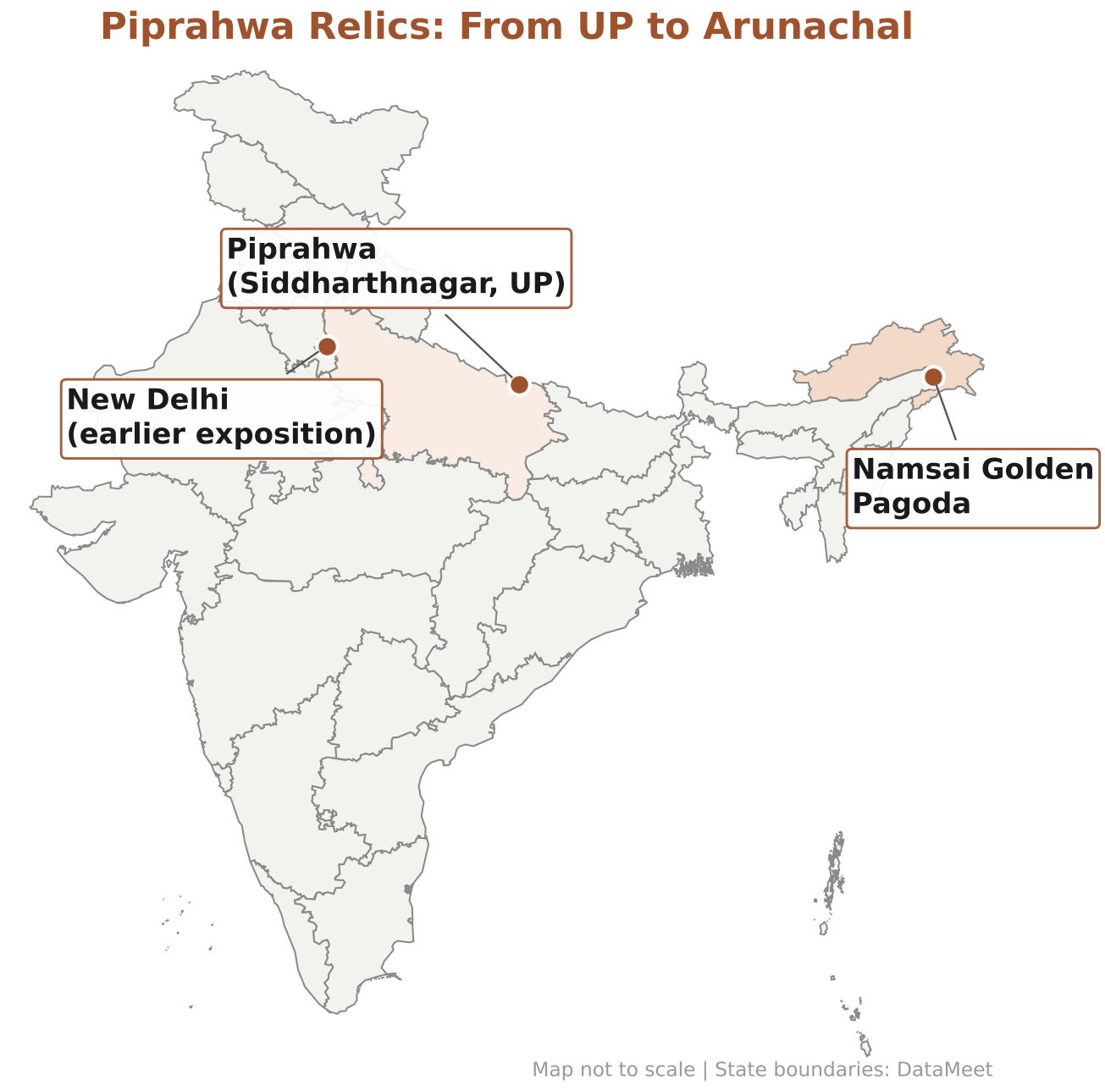
Sacred relics of Lord Buddha from Piprahwa (UP) have reached the Golden Pagoda in Namsai, Arunachal Pradesh, for public viewing. The Piprahwa relics of the Buddha reached the Golden Pagoda in Namsai, Arunachal Pradesh, for public exposition. Namsai is the last stop of a three-district journey in the state, after a six-day exposition at Bomdila.
Key facts
Relics: from Piprahwa, Siddharthnagar district, Uttar Pradesh
Excavated in 1898 by William Claxton Peppe; linked to the Shakya clan (Buddha's own)
Gems linked to the relics were brought back to India in 2025 after a planned auction abroad was stopped
Namsai Golden Pagoda (Kongmu Kham): a Theravada Buddhist site of the Tai Khamti people
Earlier stop in Arunachal: Bomdila (six-day exposition)
Way forward
Use such expositions to build the Buddhist circuit and strengthen ties with Buddhist-majority countries.
Concept
Piprahwa is identified by many scholars with ancient Kapilavastu, where Siddhartha Gautama spent his early life; an inscription on the casket mentions the relics of the Buddha of the Shakyas. Theravada vs Mahayana: Theravada (Way of the Elders) follows Pali texts and is common in Sri Lanka, Myanmar, Thailand; Mahayana (Great Vehicle) spread to Tibet, China, Japan. Arunachal has both traditions (Tawang - Mahayana/Vajrayana; Namsai - Theravada). Antiquities and Art Treasures Act, 1972: ancient objects over 100 years old cannot be exported without permission. Exam angle: Prelims: Piprahwa location, Peppe 1898, Shakyas, Theravada vs Mahayana, Namsai Golden Pagoda. Mains: Buddhist heritage as diplomacy with Southeast and East Asia.
India map showing Piprahwa in Uttar Pradesh, New Delhi and Namsai Golden Pagoda in Arunachal — StudyForGS
Bum La, a high pass near Tawang on the India-China border, is in the news as a place where tourists can see army life and learn about the 1962 war. Bum La Pass is a high-altitude mountain pass near Tawang, Arunachal Pradesh, at about 15,200 feet (4,633 m) on the India-China border. It is one of the few border points open to tourists. It is linked to the Dalai Lama's escape from Tibet in 1959 and saw heavy fighting in the 1962 India-China war.
Key facts
Altitude about 15,200 ft (4,633 m); near Tawang, Arunachal Pradesh
1959: linked to the Dalai Lama's escape route into India
1962 war: Subedar Joginder Singh fought here; awarded Param Vir Chakra (posthumous)
Official Border Personnel Meeting (BPM) point between Indian Army and China's PLA
Other BPM points: Daulat Beg Oldi, Chushul (Ladakh), Kibithu (Arunachal), Nathu La (Sikkim)
Way forward
Develop border tourism carefully under the Vibrant Villages Programme while keeping security first.
Concept
Line of Actual Control (LAC): the de facto border between India and China (about 3,488 km) divided into Western, Middle and Eastern sectors; Bum La is in the Eastern sector. McMahon Line (1914 Simla Convention): the boundary in the Eastern sector that India accepts and China rejects. Tawang Monastery (17th century) is one of the largest Buddhist monasteries in India; the sixth Dalai Lama was born in Tawang. Exam angle: Prelims: passes and states (Bum La - Arunachal; Nathu La - Sikkim; Shipki La - Himachal), Param Vir Chakra awardees, McMahon Line. Mains: border tourism and Vibrant Villages Programme.
28. Physical AI: When Machines Learn to Act
SCI-TECHUPSC: Prelims + Mains GS3
Syllabus linkage
GS3: Science and technology - developments in AI, robotics. Prelims: digital twin, reinforcement learning; Mains: AI, jobs and productivity.
Context
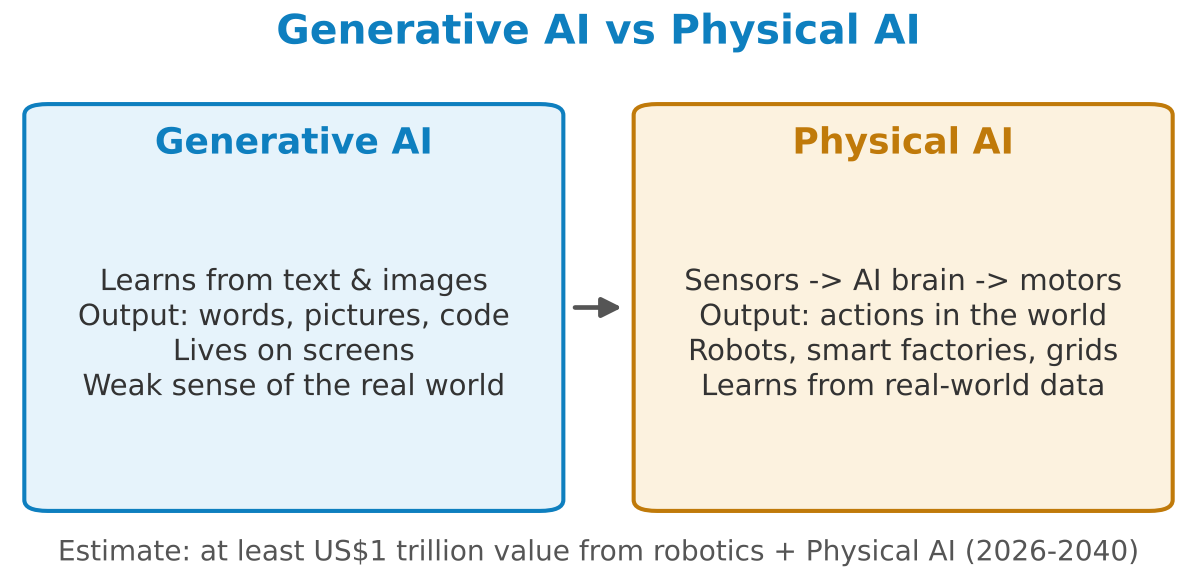
'Physical AI' means AI that can see, understand and act in the real world - like smart robots and self-running factories - not just write text on a screen. Companies worldwide are putting AI into physical machines. Oil firms use AI for predictive maintenance and drilling (BP reported 7% lower exploration and drilling costs), while Foxconn uses AI robots and digital twins to cut deployment time by about 50% and errors by 25%. Abu Dhabi's ADNOC has partnered with G42 and OpenAI. McKinsey estimates robotics and Physical AI could add at least US$1 trillion in value between 2026 and 2040.
Key facts
Physical AI = AI models + sensors + actuators (motors) + control systems
Uses multimodal data: images, video, speech, sensor and spatial data
Shell monitors 13,000+ equipment items with predictive maintenance AI
Challenges: real-world data, safety, fitting into old machines, cost
Way forward
India should link the IndiaAI Mission with manufacturing, train workers for robot-assisted jobs, and set safety standards.
Concept
Digital twin: a live virtual copy of a physical object or factory, used to test changes safely before doing them in reality. Reinforcement learning: AI learns by trial and error, getting 'rewards' for good actions - key for teaching robots. IndiaAI Mission (2024, about Rs 10,372 crore): India's programme for AI compute, datasets and startups. Exam angle: Prelims: digital twin, reinforcement learning, generative vs physical AI. Mains: impact of automation on jobs, need for AI safety rules, opportunity for India's manufacturing.
Comparison chart of Generative AI and Physical AI — StudyForGS
29. Harimau Shakti 2026: India-Malaysia Drill
DEFENCEUPSC: Prelims + Mains GS3
Syllabus linkage
GS2: Bilateral relations (Malaysia). GS3: Security forces. Prelims: joint exercises and partner countries; Mains: defence diplomacy in Southeast Asia.
Context
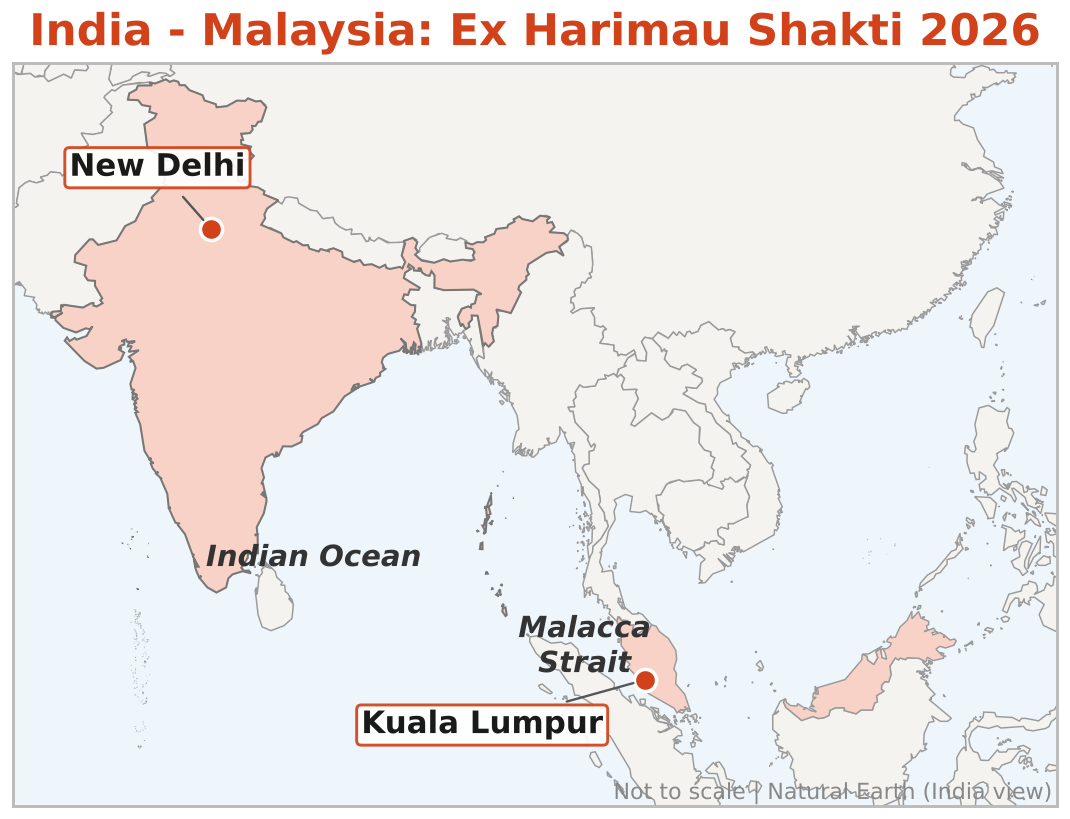
Indian and Malaysian armies will train together from 18 to 30 November, focusing on jungle warfare and counter-insurgency. The armies of India and Malaysia will hold the joint exercise 'Harimau Shakti 2026' from 18 to 30 November. The focus is on jungle and counter-insurgency operations with joint planning and sharing of drills and best practices. The exercise comes as PM Modi attends ASEAN summits, underlining India's defence outreach in Southeast Asia.
Key facts
Exercise: Harimau Shakti ('harimau' = tiger in Malay)
Previous (2025) edition was held at Mahajan Field Firing Range, Rajasthan
India and Malaysia upgraded ties to a Comprehensive Strategic Partnership in 2024
Way forward
Expand exercises to include humanitarian and disaster relief and defence industry cooperation.
Concept
Joint military exercises build 'interoperability' - the ability of two armies to work together smoothly in operations or disaster relief. Other India-Malaysia exercises: Samudra Laksamana (navy), Udara Shakti (air force). Strait of Malacca: narrow sea route between Malaysia and Indonesia's Sumatra that carries a large share of world trade; key to India's Andaman-based security role. Exam angle: Prelims: match exercises with countries (Harimau Shakti - Malaysia; Garuda Shakti - Indonesia; Maitree - Thailand; Vinbax - Vietnam). Mains: defence diplomacy under Act East.
Map of India and Malaysia with New Delhi, Kuala Lumpur and the Malacca Strait — StudyForGS
30. Private Missile Test, Indigenous Welding Tech
DEFENCEUPSC: Prelims + Mains GS3
Syllabus linkage
GS3: Indigenisation of technology; defence. Prelims: ITR Chandipur, DRDO; Mains: private sector role in defence manufacturing.
Context
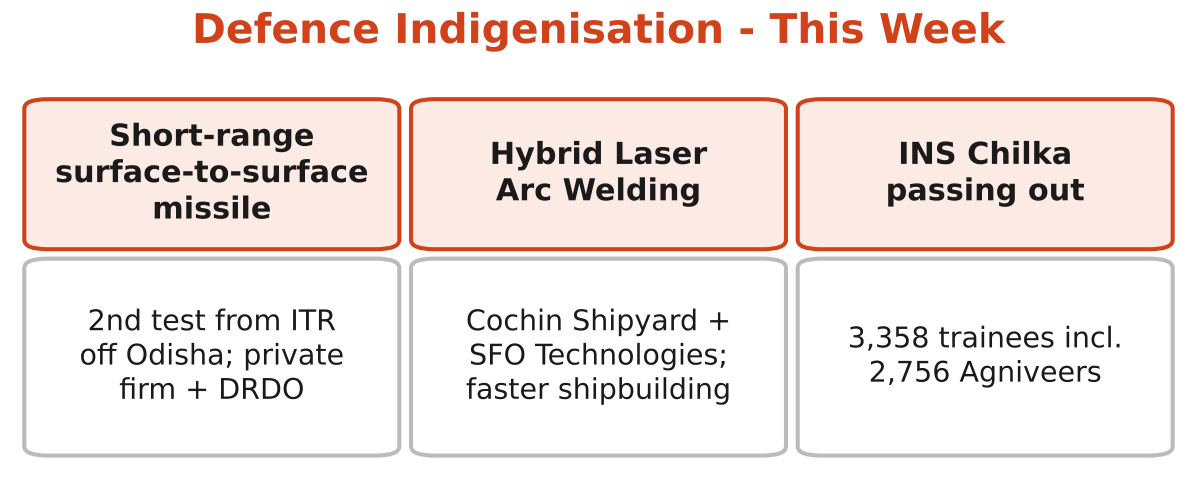
A short-range missile made by an Indian private company passed its second test, and Cochin Shipyard unveiled a home-grown welding technology - both boosts to self-reliance in defence. A short-range surface-to-surface missile developed by an Indian private firm, with DRDO support, completed its second successful flight test from the Integrated Test Range (ITR) off Odisha; the first flight was on 3 November. Cochin Shipyard and SFO Technologies unveiled India's first indigenous Hybrid Laser Arc Welding (HLAW) technology at Kalamassery, Kochi, to speed up shipbuilding. At INS Chilka, Odisha, 3,358 trainees, including 2,756 Agniveers, passed out.
Key facts
Missile: short-range surface-to-surface; private developer + DRDO support; 2nd test
Test site: Integrated Test Range (ITR), Chandipur, off Odisha coast
HLAW: combines laser and electric arc welding - faster, deeper welds, less distortion
INS Chilka passing out: 2,756 Agniveers, 286 Navy Medical Assistants, 316 Coast Guard Naviks
Also: India-Italy Defence Industry Cooperation Dialogue held in New Delhi
Way forward
Give private firms steady orders and testing access, and scale shipbuilding with modern technologies like HLAW.
Concept
Defence Acquisition Procedure 2020 and 'positive indigenisation lists' push private firms into making weapons that India used to import. Agnipath scheme (2022): recruits 'Agniveers' for 4 years; up to 25% may be retained in regular service. DRDO's Development-cum-Production Partner model and Technology Development Fund help private industry build defence systems. Exam angle: Prelims: ITR location, Agnipath features, HLAW meaning. Mains: private sector in defence, defence exports, shipbuilding capacity.
Three defence indigenisation milestones: missile test, HLAW welding and INS Chilka passing out — StudyForGS
Data point of the day
366 minutes
Women's daily unpaid work (2024) Nearly six times men's 62 minutes, as per the Time Use Survey - a key barrier behind low female labour force participation.
Prelims rapid-fire
National Press Day (16 Nov): Marks the day the Press Council of India began working in 1966; the PCI is a statutory body under the Press Council Act, 1978.
Day for Tolerance (16 Nov): International Day for Tolerance, adopted by UNESCO member states in 1995.
Periyar sand mining: Illegal sand mining continues on the Periyar, Kerala's longest river (244 km), which rises in the Sivagiri Hills and joins the Arabian Sea near Kochi.
Pioxaniliprole: PI Industries launched it as the first insecticide molecule discovered in India (brand Pioxazon), registered for rice, chilli, tomato, Bengal gram and maize fall armyworm.
Bharat Taxi, Pune: Amit Shah launched cooperative-run Bharat Taxi services in Pune - a driver-owned, zero-commission ride-hailing model under the Ministry of Cooperation.
IMO Council: The International Maritime Organization (UN agency, London; India a member since 1959) urged stronger protection of seafarers amid threats to shipping.
TRAI anti-spam action: Over 1.24 lakh numbers barred or disconnected and 374 entities blacklisted for a year for spam in July-September.
Kumamoto Masters: Lakshya Sen won the men's singles title, beating Japan's Koki Watanabe in the final.
ICC 2028-2035 calendar: India will host the 2029 Champions Trophy and co-host the 2031 ODI World Cup with Bangladesh.
Khelo India Youth Games: 8th edition logo and mascot unveiled; games in six Telangana cities from 11 to 22 December 2026.
Italy fines Meta: Italy fined Meta EUR 805 million over using users' photos and videos without adequate informed consent.
Mahanadi Coalfields IPO: Coal India's subsidiary filed its Red Herring Prospectus for an IPO of about Rs 9,500 crore (offer for sale of 10% stake).
Mains practice question
Q. The Special Intensive Revision of electoral rolls seeks clean rolls but risks excluding genuine voters. Discuss the constitutional and legal safeguards needed to balance purity and inclusiveness of electoral rolls. (250 words)
Hint / approach
Cover Articles 324 and 326, Section 21 of the RP Act 1950, due process for deletions (notice, hearing, appeal), the ASD categories, role of BLOs and the Supreme Court; conclude with technology plus door-to-door verification and transparent booth-wise lists.
📌 One-line revision: Today: ASEAN-India 23rd + EAS 21st in Manila; CPI above 6%, food 8.94%; exports US$89.99 bn; visas 13 -> 9; DPDP consent managers from 13 Nov 2026; Birsa Munda born 15 Nov 1875.