Friday, 20 November 2026 · IST · National & International · 11 items · 2 MCQs
The International Court of Justice ruled that Myanmar committed genocide against the Rohingya, while India and Japan agreed at their fourth 2+2 in Tokyo that Japanese forces will train at Indian firing ranges for the first time. At home, India dedicated its first indigenous H5N1 bird-flu vaccine for chickens, electronics exports rose 44% in H1 FY27, and the EPFO board approved a Systematic Withdrawal Plan with a lower minimum PF balance.
Today at a glance — things to remember
ICJ holds Myanmar responsible for genocide against the Rohingya — case The Gambia v. Myanmar (judgment 19 Nov 2026).
4th India–Japan 2+2 in Tokyo: Japan's forces to hold live-fire training in India for the first time.
PM inaugurates the first SCO Civilisational Dialogue Forum at Purana Qila, New Delhi (20–22 Nov).
First indigenous H5N1 (clade 2.3.2.1a) poultry vaccine dedicated at ICAR-NIHSAD, Bhopal.
Electronics exports up 44% to US$ 31.97 bn in Apr–Sep FY27; non-smartphone share 43.2%.
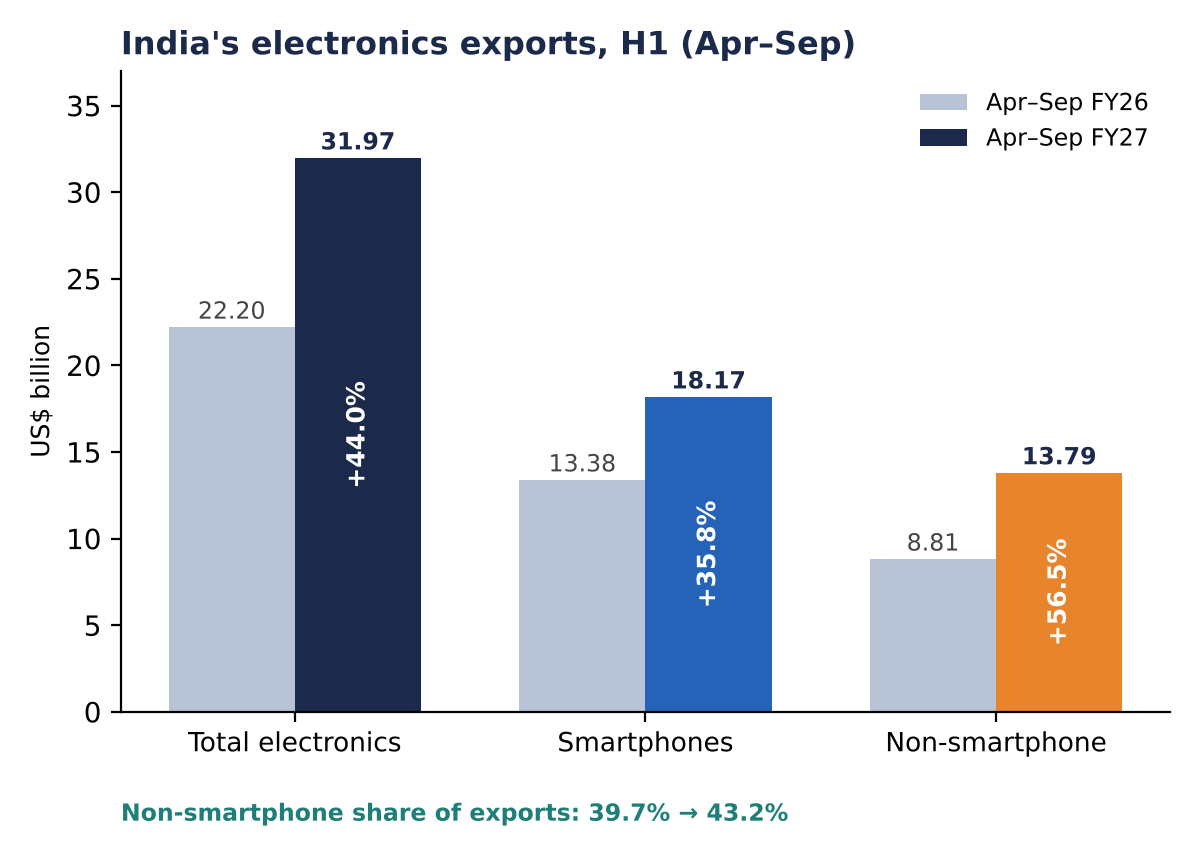
Official commerce data released on 17 Nov 2026 show India's electronic goods exports rose 44.0% to US$ 31.97 bn in April–September 2026-27, against US$ 22.20 bn a year earlier. Growth is now broader than phone assembly.
Key facts
Smartphones: US$ 13.38 bn → 18.17 bn (+35.8%) — still the largest single item.
Non-smartphone electronics: US$ 8.81 bn → 13.79 bn (+56.5%); share up from 39.7% to 43.2%.
Fastest risers: mounted PCBs, memory ICs, solid-state storage and network equipment (very high % partly due to a low base).
Main markets for these items: Singapore, China, Hong Kong, Malaysia; US and Netherlands for network gear.
Way forward
Deepen component and sub-assembly capacity (ECMS, semiconductor fabs) so that domestic value addition rises along with export volume.
Concept
PLI for Large Scale Electronics Manufacturing (2020) drove phone assembly; the Electronics Component Manufacturing Scheme (ECMS, 2025) and India Semiconductor Mission target the deeper value chain. Low-base effect: a big % jump from a small base can overstate real change.
Grouped bar chart of India's electronics exports in April–September FY26 versus FY27: total 22.20 to 31.97 billion US dollars (+44.0%), smartphones 13.38 to 18.17 (+35.8%), non-smartphone 8.81 to 13.79 (+56.5%). — StudyForGS
2. India's First Indigenous H5N1 Bird-Flu Vaccine for Chickens Dedicated to the Nation
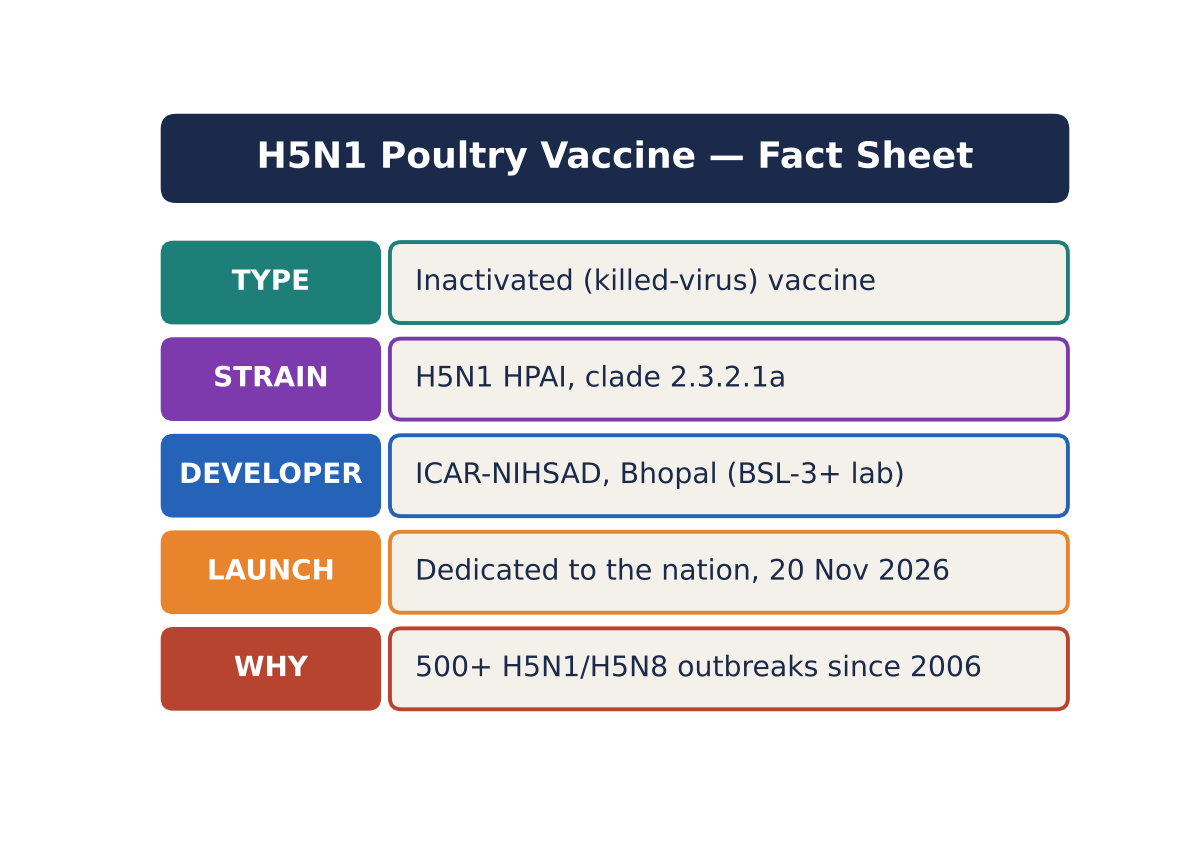
Union Agriculture Minister Shivraj Singh Chouhan dedicated on 20 Nov 2026 India's first indigenous inactivated H5N1 (clade 2.3.2.1a) HPAI vaccine for chickens, developed by ICAR-NIHSAD, Bhopal.
Key facts
Targets clade 2.3.2.1a, behind most chicken outbreaks in India; no specific commercial vaccine existed for it.
India has recorded over 500 outbreaks of H5N1 and H5N8 since 2006 (first: Navapur, Maharashtra).
Outbreaks cause near-100% bird mortality, mass culling and trade bans — hitting farm incomes and egg/chicken prices.
This clade has also spilled over into mammals, with a few human infections recorded.
Way forward
Use vaccination alongside surveillance, biosecurity and culling (not instead of them), with a DIVA strategy so that trade partners accept vaccinated flocks.
Concept
HPAI = Highly Pathogenic Avian Influenza. Inactivated vaccine: killed virus that cannot replicate — safer, but may need boosters. DIVA = Differentiating Infected from Vaccinated Animals. ICAR-NIHSAD Bhopal is India's high-security (BSL-3+) animal disease lab. One Health links human, animal and environmental health.
Fact sheet of the H5N1 poultry vaccine: type inactivated; strain H5N1 HPAI clade 2.3.2.1a; developer ICAR-NIHSAD Bhopal; dedicated 20 Nov 2026; over 500 H5N1/H5N8 outbreaks since 2006. — StudyForGS
3. NALCO–RUSAL MoU to Recover Critical Mineral Scandium from Red Mud
ECONOMYCOMMON: Prelims + Mains GS3
Syllabus linkage
GS3 – Mineral resources, industrial waste, circular economy; GS1 – distribution of resources. Prelims: scandium, red mud, NCMM.
Context
NALCO (Navratna CPSE, Ministry of Mines) signed an MoU with Russian aluminium major RUSAL on 17 Nov 2026 at ICSOBA 2026, Bengaluru to explore recovery of scandium from red mud (bauxite residue).
Key facts
Red mud is the waste left when bauxite is refined into alumina (Bayer process); India generates over 5 million tonnes a year.
Indian red mud holds about 45–70 ppm of scandium.
Scandium strengthens aluminium–scandium alloys for aerospace and defence; also used in solid-oxide fuel cells.
Builds on NALCO's January 2026 pact with CSIR-NML for a 10 tonnes-per-day red-mud pilot plant.
Way forward
Scale pilots to commercial plants and pair them with safe red-mud storage norms, turning a pollution liability into a critical-mineral source.
Concept
Scandium is one of the 17 rare earth elements (with yttrium and the 15 lanthanides). National Critical Mineral Mission (2025): ₹34,300 crore over 7 years (₹16,300 crore govt + ₹18,000 crore PSUs etc.). NALCO's main units are in Odisha (Damanjodi refinery, Angul smelter).
4. PUC Certificate Validity Now Linked to Emission Norm and Vehicle Age
ENVIRONMENTCOMMON: Prelims + Mains GS3
Syllabus linkage
GS3 – Environmental pollution (air); GS2 – government policies. Prelims: Bharat Stage norms, CMVR 1989, Motor Vehicles Act.
Context
MoRTH has amended sub-rule (7) of Rule 115 of the Central Motor Vehicles Rules, 1989 (notified 19 Nov 2026). Newer, cleaner vehicles get longer Pollution Under Control (PUC) validity; older ones face more frequent checks.
Key facts
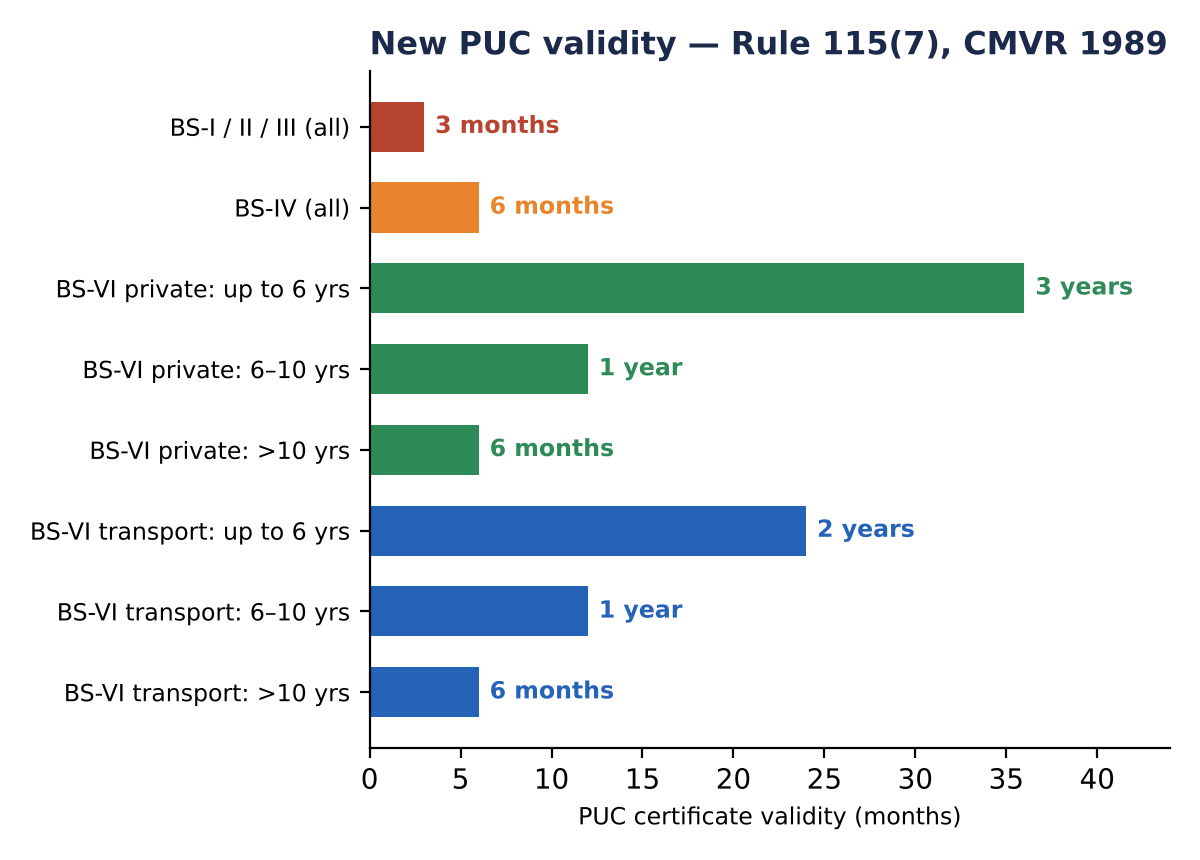
BS-I to BS-III: 3 months; BS-IV: 6 months.
BS-VI non-transport: 3 years (up to 6 yrs old) → 1 year (6–10 yrs) → 6 months (over 10 yrs).
BS-VI transport: 2 years → 1 year → 6 months for the same age bands.
Existing certificates shift to the new validity only at first renewal; renewal within 10 days before expiry counts from the old expiry date.
Way forward
Back longer validity with remote sensing of tailpipe emissions and strict action against fake PUC centres, so that easier compliance does not weaken pollution control.
Concept
Bharat Stage (BS) norms are modelled on Euro norms; India leapfrogged from BS-IV to BS-VI on 1 April 2020, skipping BS-V. BS-VI sharply cuts diesel NOx and needs 10 ppm sulphur fuel. PUC is mandated under the Motor Vehicles Act, 1988.
Horizontal bar chart of new PUC validity: BS-I to III 3 months, BS-IV 6 months, BS-VI private up to 6 years 3 years, 6–10 years 1 year, over 10 years 6 months; BS-VI transport 2 years, 1 year and 6 months. — StudyForGS
5. Draft Rules Bring Antimicrobials Under 'New Drug' Definition to Fight AMR
The Union Health Ministry issued draft notification G.S.R. 983(E) dated 6 Nov 2026 to include 'antimicrobials' in the definition of 'New Drug' under Rule 2(1)(w)(v) of the New Drugs and Clinical Trials (NDCT) Rules, 2019.
Key facts
Concern: State licences were issued without full bioavailability/bioequivalence and stability studies.
Makers must first get permission from the Central Licensing Authority (CLA) before applying to a State Licensing Authority (SLA).
Aim: stop substandard antimicrobials, which fuel antimicrobial resistance (AMR).
Public objections and suggestions invited within 30 days.
Way forward
Pair stricter licensing with prescription audits and curbs on over-the-counter and farm/veterinary antibiotic use, under a One Health approach.
Concept
AMR: microbes stop responding to medicines. CDSCO (headed by the DCGI) is the CLA under the Drugs and Cosmetics Act, 1940. India's National Action Plan on AMR (2017); the Red Line campaign marks prescription-only antibiotics. The G20 New Delhi Declaration (2023) backed a One Health approach to AMR.
6. Very Severe Cyclonic Storm 'Akvan' Heads for the Andhra Pradesh Coast
GS1 – Physical geography (cyclones); GS3 – Disaster management. Prelims: IMD classification, cyclone naming, Bay of Bengal.
Context
IMD forecast that Cyclone Akvan over the Bay of Bengal would cross the Andhra Pradesh–Yanam coast around noon on 20 Nov 2026 as a Very Severe Cyclonic Storm, with heavy-rain alerts for AP, Tamil Nadu and Odisha.
Key facts
Expected winds of 120–130 km/h, gusting to 145 km/h, at landfall.
The name 'Akvan' was contributed by Iran.
Third cyclone on this coast in about a month, after Arnab (near Kakinada, 28 Oct) and Murasu (near Ongole, 3 Nov).
Later bulletins shifted the likely landfall zone north, towards north AP and south Odisha.
Way forward
Strengthen impact-based forecasting, timely evacuation and cyclone shelters; quickly assess crop losses for farmers already hit by two earlier storms.
Concept
Naming: the WMO/ESCAP Panel on Tropical Cyclones (13 countries) uses a pre-set list; names are not reused. IMD scale: Cyclonic Storm 63–88 km/h, Severe 89–117, Very Severe 118–166, Extremely Severe 167–221, Super ≥222 km/h. Oct–Dec (post-monsoon) is a peak cyclone season in the Bay of Bengal.
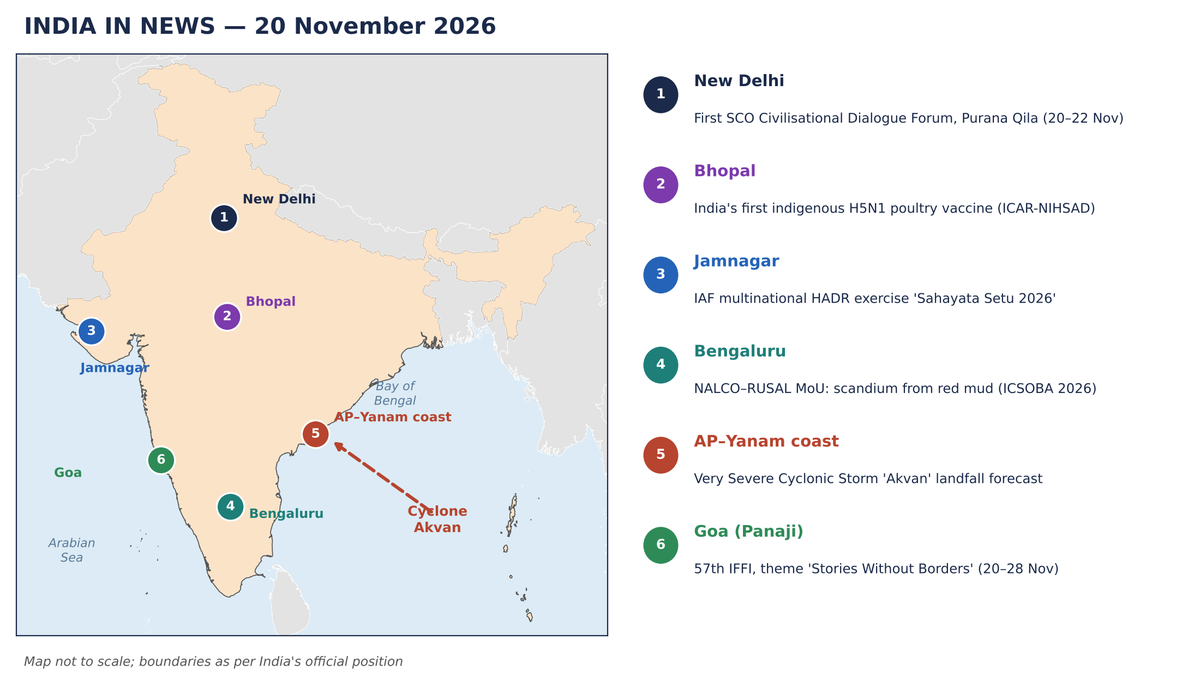
India in News locator map with numbered pins: 1 New Delhi (SCO Civilisational Dialogue Forum), 2 Bhopal (H5N1 vaccine), 3 Jamnagar (Sahayata Setu), 4 Bengaluru (NALCO–RUSAL MoU), 5 Andhra Pradesh–Yanam coast (Cyclone Akvan track), 6 Goa (57th IFFI); boundaries as per India's official position. — StudyForGS
The 6th edition of the India–Malaysia Army exercise Harimau Shakti is under way at Ipoh, Malaysia (till 30 Nov 2026). Separately, the IAF ran the multinational HADR exercise Sahayata Setu 2026 at Air Force Station Jamnagar (17–19 Nov).
Key facts
Harimau Shakti: 120 personnel from each side; counter-terrorism under a UN Chapter VII mandate in jungle and semi-urban terrain.
Special focus on drones (UAS) and counter-drone (C-UAS) drills; held annually since 2012, alternately in each country.
5th edition was held at Mahajan Field Firing Range, Rajasthan (Dec 2025).
Sahayata Setu: seminar, table-top exercise and multi-agency demo; a QUAD HADR Working Group meeting was held alongside.
Way forward
Use such drills to build interoperability with ASEAN partners and to position India as the first responder in the Indian Ocean Region under MAHASAGAR.
Concept
India–Malaysia exercises: Harimau Shakti (army), Samudra Laksamana (navy), Udara Shakti (air). Ties raised to a Comprehensive Strategic Partnership in 2024. UN Charter Chapter VII covers enforcement action against threats to peace. MAHASAGAR (2025) expands the earlier SAGAR (2015) vision.
8. ICJ Rules Myanmar Committed Genocide Against the Rohingya
IRCOMMON: Prelims + Mains GS2 (IR)
Syllabus linkage
GS2 – International institutions, India and its neighbourhood, human rights. Prelims: ICJ, Genocide Convention 1948, Rakhine.
Context
On 19 Nov 2026 the International Court of Justice (ICJ) held that Myanmar committed genocide against the Rohingya in northern Rakhine State during the 2017 'clearance operations', in the case The Gambia v. Myanmar.
Key facts
Case filed by The Gambia on 11 Nov 2019, backed by the OIC; 11 States intervened.
Myanmar also breached the Court's provisional measures order of 23 Jan 2020; its preliminary objections were rejected on 22 July 2022.
Remedies: prosecute perpetrators, guarantee non-repetition, allow safe, voluntary return, and pay compensation; Myanmar to report within 2 years.
The 2017 violence drove over 7 lakh Rohingya into Bangladesh (Cox's Bazar camps).
Way forward
India, which shares a 1,643 km border with Myanmar and hosts Rohingya refugees, should back safe repatriation and regional stability while engaging all stakeholders in Myanmar.
Concept
ICJ: principal judicial organ of the UN at The Hague; 15 judges, 9-year terms. Judgments are final and binding, with no appeal; non-compliance can go to the UNSC (Art. 94). Standing rests on erga omnes partes duties — any party to the Genocide Convention (1948) may sue. India ratified it in 1959. ICJ judges States; the ICC tries individuals.
9. 4th India–Japan 2+2 in Tokyo: Japanese Forces to Train at Indian Firing Ranges
Rajnath Singh and Dr S. Jaishankar met Japan's Foreign Minister Motegi Toshimitsu and Defence Minister Koizumi Shinjiro in Tokyo on 19 Nov 2026 for the fourth 2+2, under the Special Strategic and Global Partnership.
Key facts
Letter of Intent: Japan's Self-Defense Forces to hold live-fire training (incl. surface-to-ship missiles) at firing ranges in India — a first.
Defence industry: early arrangements on UNICORN naval mast technology, with India's AoN targeted by Feb 2027; theme 'Design with Japan, Make in India'.
India to host the 5th Coast Guard Global Summit in Feb 2027; synergy of IPOI/MAHASAGAR with Japan's FOIP.
Ministers noted the first visit of Japanese fighter jets to India for exercise Veer Guardian 26.
Way forward
Turn the partnership into joint production of defence platforms and resilient supply chains, while coordinating in the Quad for a stable Indo-Pacific.
Concept
2+2 dialogue: joint meeting of foreign and defence ministers; India holds it with the US, Japan, Australia, Russia and others. Previous India–Japan 2+2: New Delhi, 20 Aug 2024. Exercises: JIMEX (navy), Dharma Guardian (army), Veer Guardian (air). Logistics pact (ACSA) signed in 2020.
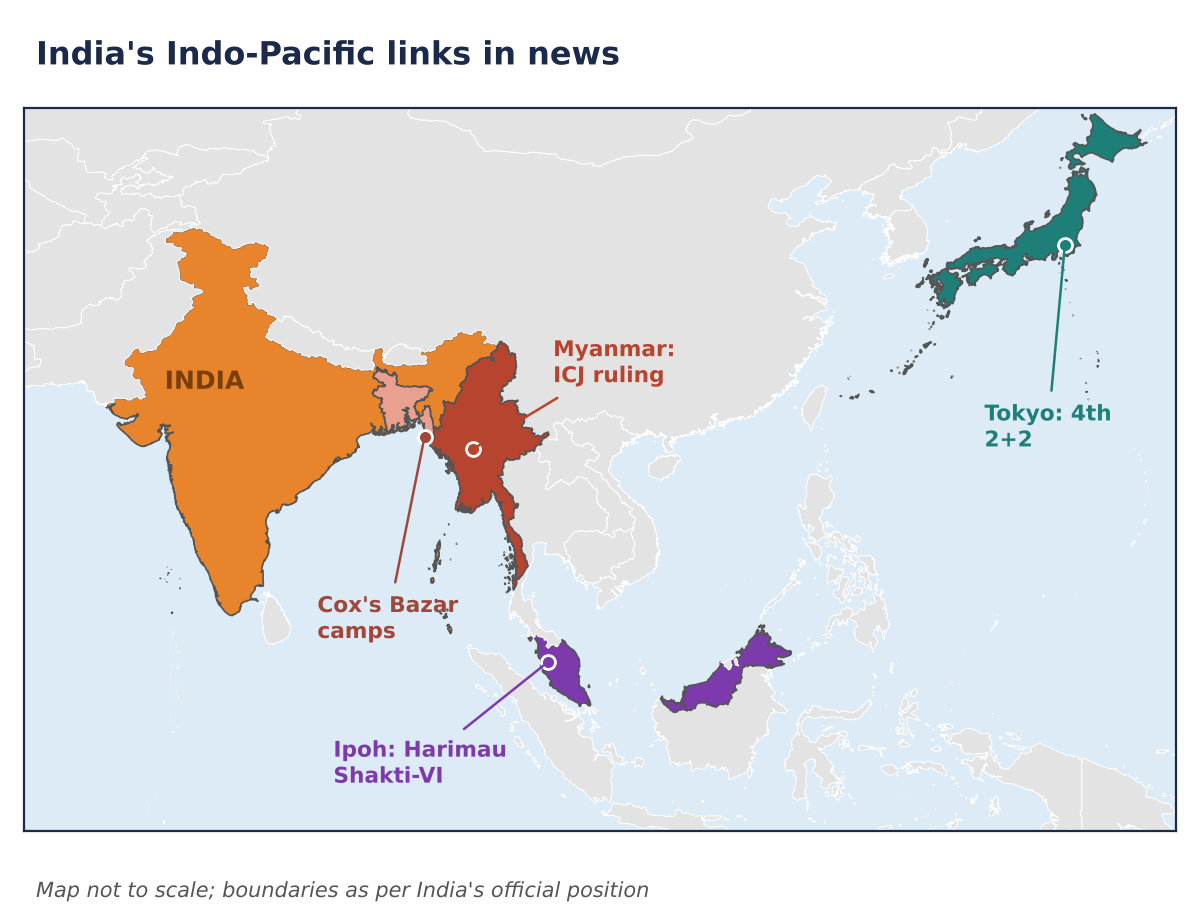
Indo-Pacific map highlighting India, Japan (Tokyo: 4th 2+2), Malaysia (Ipoh: Harimau Shakti-VI), Myanmar (ICJ ruling) and Bangladesh (Cox's Bazar camps); boundaries as per India's official position. — StudyForGS
10. PM Inaugurates First SCO Civilisational Dialogue Forum at Purana Qila
IRCOMMON: Prelims + Mains GS1/GS2
Syllabus linkage
GS2 – Regional groupings; GS1 – Indian art, culture and heritage. Prelims: SCO members, Purana Qila, soft power.
Context
India is hosting the first SCO Civilisational Dialogue Forum at Purana Qila, New Delhi from 20 to 22 Nov 2026, inaugurated by PM Narendra Modi and organised by the Ministries of Culture and External Affairs.
Key facts
Idea proposed by PM Modi at the SCO Summit, Tianjin (2025); welcomed in the Bishkek Declaration (2026).
Cultural show on 'Vasudhaiva Kutumbakam'; exhibition 'ASTITVA' on Delhi's archaeology from 1200 BCE to 1200 CE.
About 25 countries (members, observers, dialogue partners) invited, including Pakistan.
Sessions: performing arts, textiles and cuisine; art and architecture; languages, scripts and manuscripts; monastic trails and philosophy.
Way forward
Use cultural diplomacy to build trust in a security- and economy-focused grouping, and showcase India's civilisational links with Central Asia.
Concept
SCO: founded 2001 (Shanghai); 10 members — India and Pakistan joined in 2017, Iran 2023, Belarus 2024. Secretariat in Beijing; RATS in Tashkent. Purana Qila is linked to Humayun (Dinpanah) and Sher Shah Suri. Trap: it is not a UNESCO World Heritage Site.
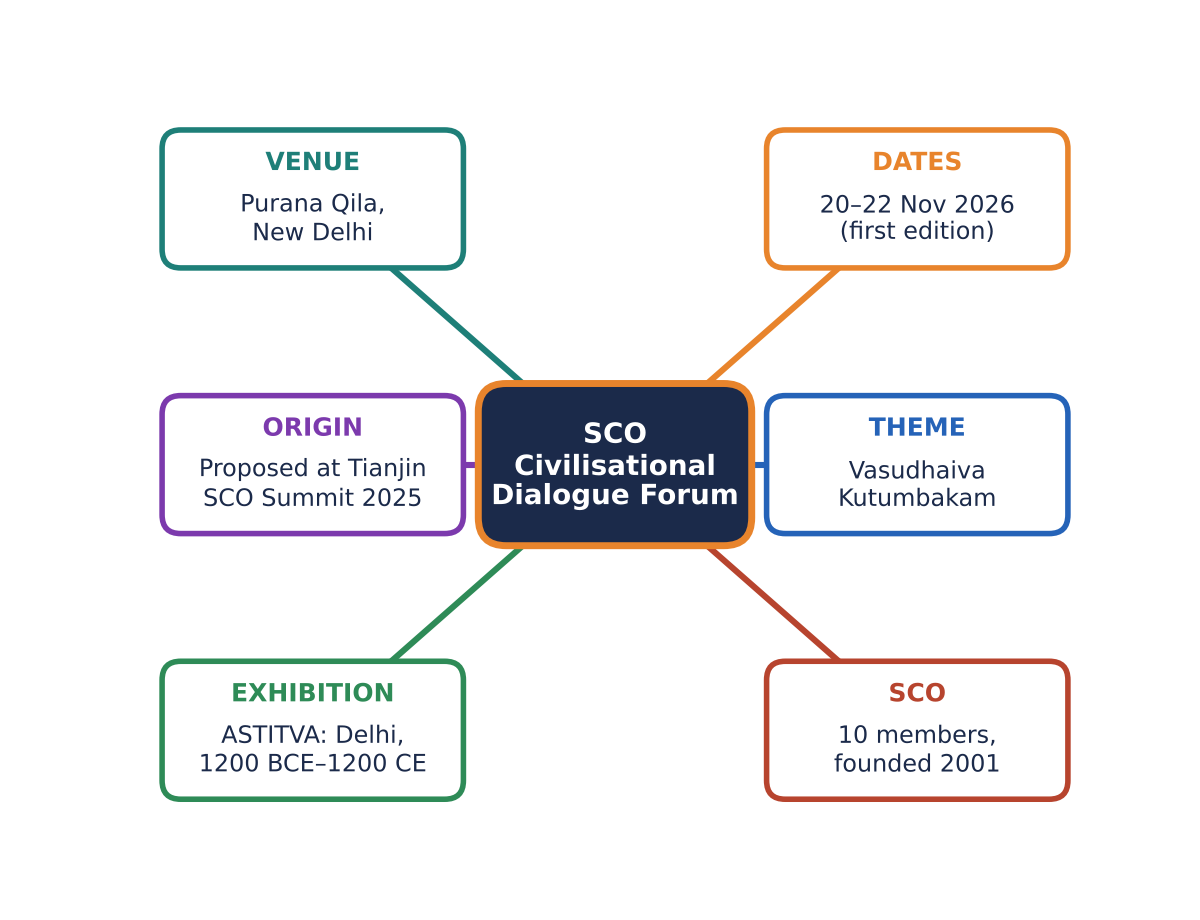
Mind-map of the first SCO Civilisational Dialogue Forum: venue Purana Qila New Delhi; dates 20–22 Nov 2026; origin Tianjin SCO Summit 2025; theme Vasudhaiva Kutumbakam; exhibition ASTITVA (1200 BCE–1200 CE); SCO has 10 members, founded 2001. — StudyForGS
GS2 – Welfare schemes, social security for vulnerable sections; GS3 – inclusive growth. Prelims: EPFO, CBT, EDLI, Code on Social Security.
Context
The 240th meeting of the Central Board of Trustees (CBT), EPF, chaired by Labour Minister Dr Mansukh Mandaviya on 19 Nov 2026, approved a Systematic Withdrawal Plan (SWP) for retiring members and eased withdrawal rules.
Key facts
SWP (voluntary): retirees can draw PF in monthly, quarterly or half-yearly instalments while the rest keeps earning interest.
First eligible: about 6.32 lakh members aged above 55 with a PF balance above ₹5 lakh.
Minimum balance cut from 25% to 10% of contributions; final withdrawal wait cut from 12 months to 2 months.
New routes: UAN-linked voluntary contributions and third-party micro-contributions; EDLI six-month window for legacy cases.
Way forward
Pair flexible withdrawals with financial-literacy nudges so that retirement savings are not exhausted early, and extend coverage to gig and platform workers.
Concept
EPFO (under the Ministry of Labour & Employment) runs EPF, EPS (1995) and EDLI (1976). The CBT is tripartite (govt, employers, employees) and chaired by the Labour Minister. The Code on Social Security, 2020 subsumes the EPF & MP Act, 1952; the four Labour Codes took effect on 21 Nov 2025.
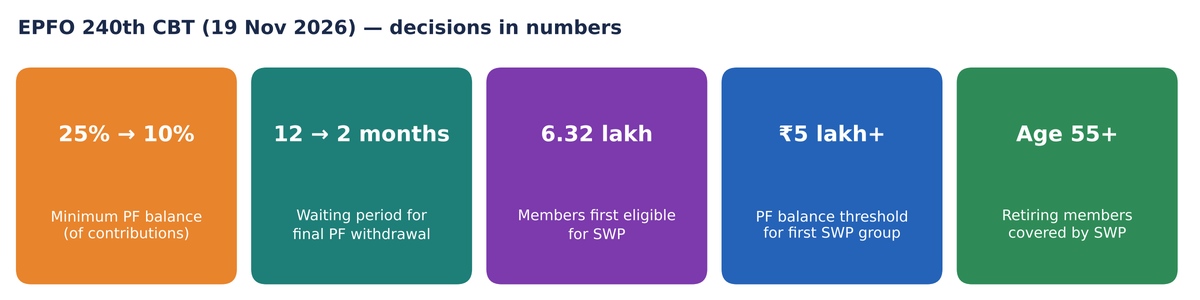
Stat tiles of EPFO 240th CBT decisions: minimum PF balance 25% to 10%; final withdrawal wait 12 to 2 months; 6.32 lakh members first eligible for SWP; PF balance threshold above ₹5 lakh; age 55 and above. — StudyForGS
Data point of the day
US$ 13.79 bn (+56.5%)
Non-smartphone electronics exports, Apr–Sep FY27 Up from US$ 8.81 bn; their share in total electronics exports rose from 39.7% to 43.2% — the clearest sign yet of diversification beyond phones.
Prelims rapid-fire
57th IFFI: Panaji, Goa (20–28 Nov): theme 'Stories Without Borders'; Spain is Country of Honour, Russia Partner Country.
Indira Gandhi Peace Prize: 2025 prize for Peace, Disarmament and Development → Graça Machel (Mozambique), conferred 19 Nov 2026; award ₹1 crore.
India–Italy JCEC: 23rd session in Rome (18 Nov): bilateral trade target of €20 bn by 2029 under the Joint Strategic Action Plan 2025–2029.
RBI liquidity: 3-day Variable Rate Repo (VRR) auction of ₹50,000 crore on 20 Nov — a liquidity-injecting tool (VRRR absorbs liquidity).
Hockey: Women's Asian Champions Trophy, Bhopal: defending champions India beat Malaysia 4-1.
Trap watch: Purana Qila is not a UNESCO World Heritage Site; nearby Humayun's Tomb and the Red Fort are.
Practice MCQs — UPSC Prelims pattern
Q1. With reference to the case 'The Gambia v. Myanmar', consider the following statements: 1. It was filed under the Genocide Convention, 1948. 2. A judgment of the International Court of Justice can be appealed before the UN General Assembly. 3. India is a party to the Genocide Convention. Which of the statements given above are correct?
1 and 2 only
1 and 3 only
2 and 3 only
1, 2 and 3
Show answer
Answer: B ICJ judgments are final and binding with no appeal; non-compliance can be referred to the UNSC (Art. 94). The case was filed under the Genocide Convention (1948), which India ratified in 1959.
Q2. Consider the following pairs (Exercise – Partner country of India): 1. Harimau Shakti – Malaysia 2. Dharma Guardian – Japan 3. Samudra Laksamana – Indonesia. How many of the pairs given above are correctly matched?
Only one
Only two
All three
None
Show answer
Answer: B Harimau Shakti (army) is with Malaysia and Dharma Guardian (army) with Japan. Samudra Laksamana is the India–Malaysia naval exercise, not with Indonesia.
Mains practice question
Q. India's electronics exports are diversifying beyond smartphones. Examine whether this signals a move up the global value chain, and suggest measures to deepen domestic value addition. (15 marks, 250 words)
Hint / approach
Intro: 44% growth to US$ 31.97 bn; non-smartphone share 43.2%. Body: PLI → ECMS → semiconductor mission; positives (PCBs, memory, network gear) vs low-base effect and import dependence for chips and displays. Way forward: component clusters, R&D, FTAs, skilling. Conclude with the Viksit Bharat 2047 link.
📌 One-line revision: Today in one line: ICJ — Myanmar genocide ruling; Tokyo — 4th 2+2; Delhi — SCO Civilisational Forum; Bhopal — H5N1 vaccine; exports — electronics +44%; EPFO — SWP and 10% minimum balance.