Monday, 9 November 2026 · IST · National & International · 11 items · 2 MCQs
The 31st UN Climate Conference (COP31) opened in Antalya, Türkiye on 9 November, with India pressing for climate justice and finance. Delhi's AQI stood at 368 the morning after Diwali under GRAP Stage III, while the week's big policy moves include a ₹14,500-crore VGF for 92 GWh storage, 12 new ECMS projects and India's entry into Horizon Europe.
Today at a glance — things to remember
COP31: 9-20 Nov 2026, Antalya (Türkiye); Türkiye hosts, Australia presides over negotiations.
Delhi AQI 368 (9 Nov, 7 am); 15 of 54 stations 'severe'; GRAP-III since 6 Nov.
Energy storage VGF: ₹14,500 cr for 92 GWh (60 PSP + 30 BESS + 2 others), FY27-FY31.
BESS bids must meet a 40% Domestic Content Requirement.
ECMS: 12 new projects; total 118, cumulative investment ~₹77,000 cr.
Pralay quasi-ballistic missile flight-tested from Dr APJ Abdul Kalam Island (user trials).
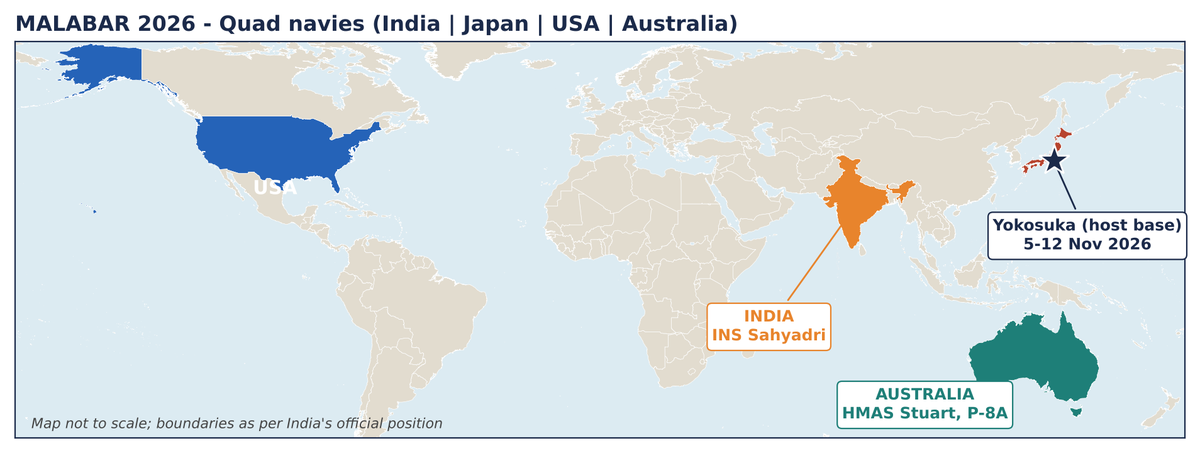
MALABAR 2026 began at Yokosuka, Japan, on 5 Nov; INS Sahyadri represents India.
The 31st Conference of Parties (COP31) to the UNFCCC opened on 9 November 2026 at Antalya, Türkiye, and runs till 20 November. It is billed as a 'COP of action' focused on implementation.
Key facts
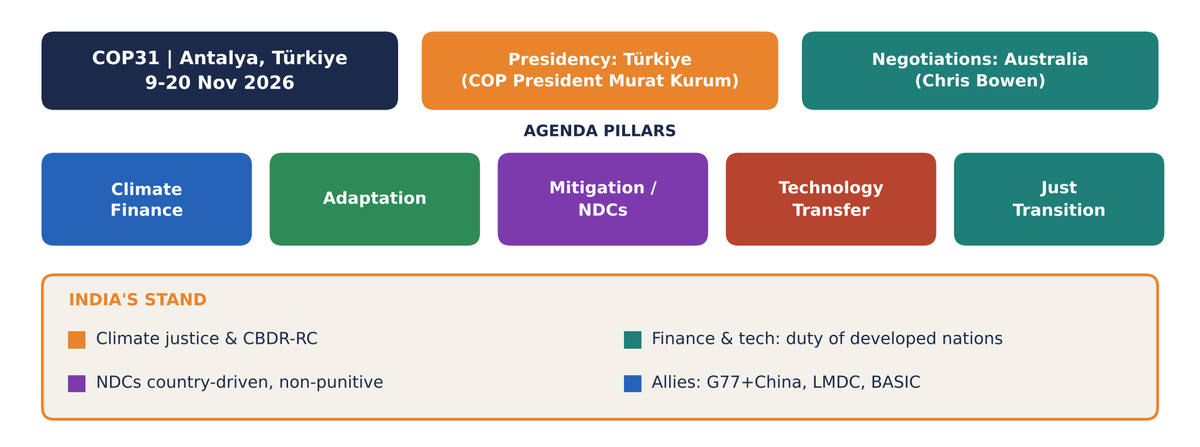
Unique split: Türkiye holds the presidency (COP President Murat Kurum); Australia (Chris Bowen) presides over negotiations.
World Leaders' Summit on 11-12 Nov; agenda: climate finance, adaptation, mitigation, technology transfer, just transition.
Türkiye proposes voluntary goals: 35% global electrification and 25% cut in building energy intensity by 2035.
India's delegation led by Bhupender Yadav; India wants NDCs country-driven, non-punitive, works with G77+China, LMDC, BASIC.
Backdrop: 2026 virtually certain to exceed 1.5°C, amid a strong El Niño; prep for 2nd Global Stocktake (2028).
Way forward
India should convert CBDR-RC principles into concrete finance and technology flows while showcasing domestic action (500 GW non-fossil, storage push) as credible leadership of the Global South.
Concept
UNFCCC (adopted 1992, Rio) - COP is its supreme body. NDCs under the Paris Agreement (2015); Global Stocktake every 5 years. CBDR-RC = Common But Differentiated Responsibilities and Respective Capabilities.
Flow diagram of COP31: Türkiye presidency and Australia-led negotiations at the top, five agenda pillars in the middle, and India's four negotiating priorities at the bottom. — StudyForGS
2. Post-Diwali smog: Delhi AQI 'very poor', GRAP Stage III in force
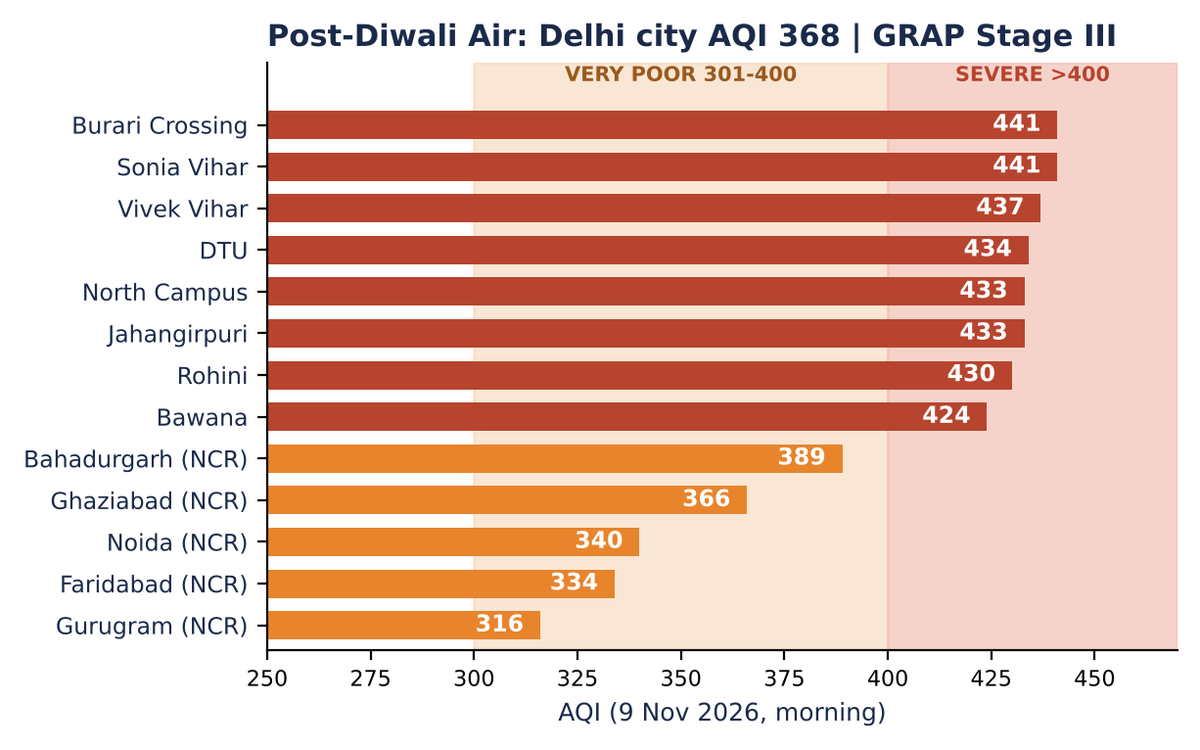
A day after Diwali (8 Nov), Delhi's average AQI was 368 ('very poor') at 7 am on 9 November, with PM2.5 as the lead pollutant; forecasts warn of 'severe' air for the next few days.
Key facts
Of 54 stations, 50 above 300 and 15 'severe' (>400); worst: Burari Crossing & Sonia Vihar (441).
Supreme Court allowed only certified green crackers in fixed slots (6-7 am, 8-10 pm) on 7-8 Nov; violations reported.
CAQM invoked GRAP Stage III on 6 Nov: ban on non-essential construction, curbs on certain diesel vehicles and industry.
Shift from episodic bans to airshed-level planning: year-round dust and vehicle control, crop-residue alternatives and strict enforcement with real-time public data.
Concept
National AQI (2014): 6 categories - Good (0-50) to Severe (401-500); 8 pollutants. CAQM created under the CAQM Act, 2021. GRAP has 4 stages (Poor / Very Poor / Severe / Severe+).
Horizontal bar chart of AQI on 9 November 2026 at eight Delhi stations and five NCR cities, with colour bands for very poor and severe categories. — StudyForGS
3. ₹14,500-crore VGF to build 92 GWh grid-scale energy storage
ECONOMYCOMMON: Prelims + Mains GS3
Syllabus linkage
GS3: Infrastructure - energy; Indian economy and investment models. Prelims: VGF, BESS, Pumped Storage, DCR.
Context
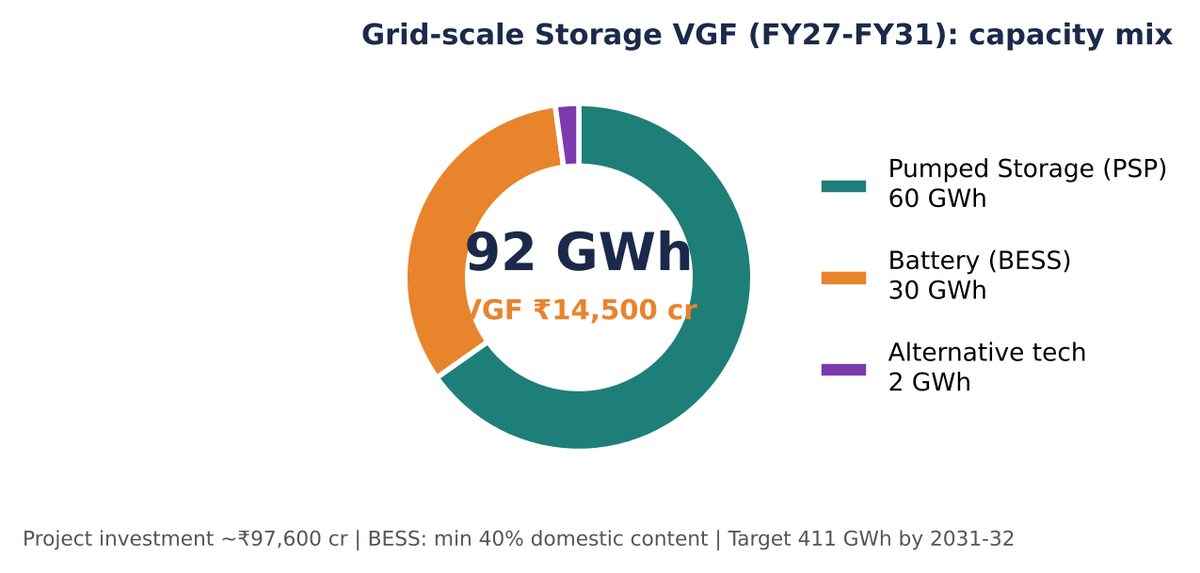
The Union Cabinet (4 Nov) approved a Viability Gap Funding scheme of ₹14,500 crore for 92 GWh of new grid-scale storage, to firm up intermittent solar and wind power for 24x7 supply.
Period FY 2026-27 to FY 2030-31; expected project investment ₹97,600 crore.
Allocation via tariff-based competitive bidding; BESS needs min. 40% Domestic Content.
Linked targets: 411 GWh storage by 2031-32; 500 GW non-fossil capacity by 2030.
Way forward
Pair VGF with battery-cell PLI, ancillary-services markets and faster PSP clearances to avoid stranded renewable capacity.
Concept
VGF: a one-time capital grant that bridges the gap between project cost and commercial viability (used in PPP projects). Pumped storage pumps water uphill in surplus hours and generates in peak hours.
Donut chart splitting the 92 GWh storage target into 60 GWh pumped storage, 30 GWh battery storage and 2 GWh alternative technologies. — StudyForGS
4. ECMS: 12 more electronics component projects cleared
ECONOMYCOMMON: Prelims + Mains GS3
Syllabus linkage
GS3: Industrial policy, Make in India, effects of liberalisation. Prelims: ECMS, PLI, MeitY schemes.
Context
The Centre approved 12 new projects worth over ₹7,500 crore under the ₹40,000-crore Electronics Component Manufacturing Scheme (ECMS), deepening the component base beyond assembly.
Key facts
Projected production ₹39,045 crore across 7 states incl. Gujarat, MP, UP, Maharashtra, TN.
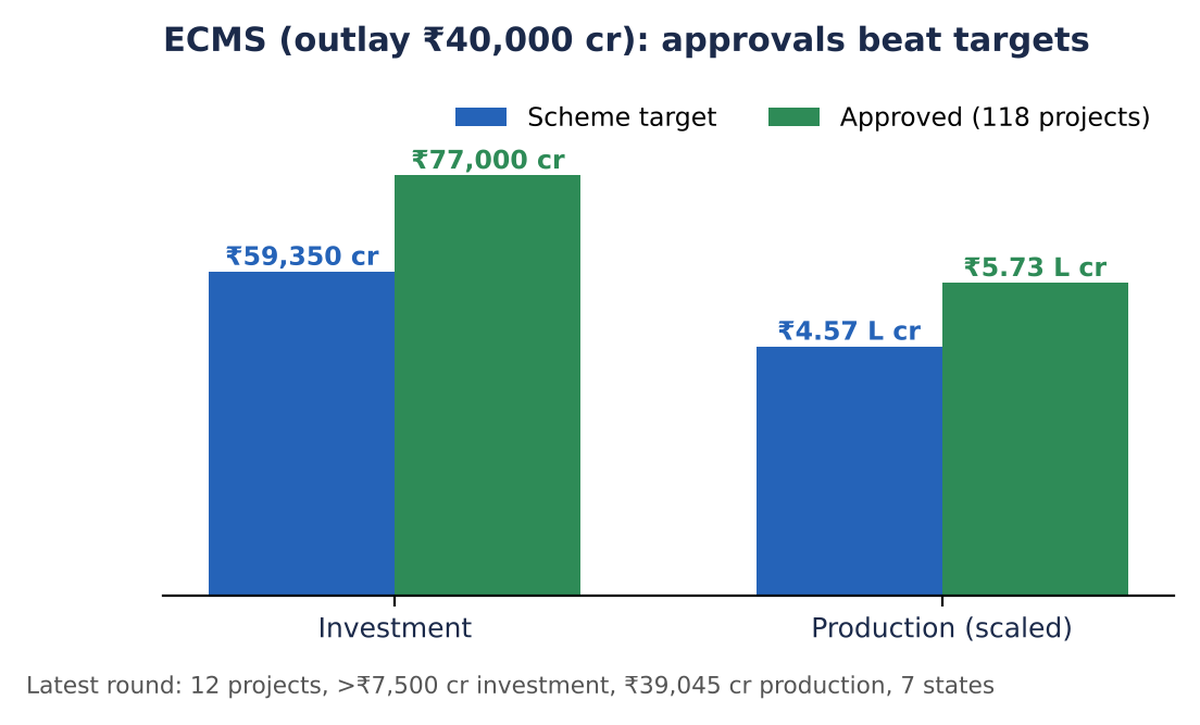
Cumulative: 118 projects, investment ~₹77,000 cr vs target ₹59,350 cr.
Cumulative production ₹5.73 lakh cr vs target ₹4.565 lakh cr - targets already exceeded.
Way forward
Build design and R&D capacity, secure critical-mineral inputs and cluster-based supplier ecosystems to raise domestic value addition.
Concept
ECMS (notified 2025, MeitY) offers turnover-linked, capex and hybrid incentives for components like PCBs, Li-ion cells, passive components. Complements PLI for mobile phones and ISM for semiconductors.
Grouped bar chart comparing ECMS targets with cumulative approvals: investment ₹59,350 crore target vs ₹77,000 crore approved, and production ₹4.57 lakh crore target vs ₹5.73 lakh crore. — StudyForGS
5. Pralay quasi-ballistic missile clears user evaluation trial
DEFENCECOMMON: Prelims + Mains GS3
Syllabus linkage
GS3: Security; indigenisation of technology. Prelims: missile types, DRDO labs, test ranges.
Context
DRDO successfully flight-tested the indigenous Pralay missile on 5 November from Dr APJ Abdul Kalam Island, off Odisha, as part of user evaluation trials; induction is now 'imminent'.
Key facts
Quasi-ballistic surface-to-surface missile - flies a low, manoeuvrable trajectory that is hard to intercept.
Developed by Research Centre Imarat (RCI), Hyderabad with other DRDO labs.
Data tracked by the Integrated Test Range, Chandipur; test attended by user Services and industry.
Strengthens conventional precision-strike capability; Defence Minister Rajnath Singh called it a milestone.
Way forward
Speed up induction into a dedicated rocket-missile force structure and integrate with theatre commands for credible conventional deterrence.
Concept
Ballistic missiles follow a parabolic, mostly unpowered path; cruise missiles fly powered, low and level (e.g. BrahMos). Quasi-ballistic = ballistic path with in-flight manoeuvre. Dr APJ Abdul Kalam Island was earlier Wheeler Island.
6. MALABAR 2026 under way at Yokosuka; INS Sahyadri joins Quad navies
DEFENCECOMMON: Prelims + Mains GS2/GS3
Syllabus linkage
GS2: Groupings involving India (Quad); GS3: Security. Prelims: military exercises, ship classes.
Context
The multilateral naval exercise MALABAR 2026, hosted by Japan, began at Yokosuka on 5 November with India, the US, Japan and Australia, and runs till 12 November.
Key facts
India: INS Sahyadri, a Shivalik-class stealth frigate of the Eastern Fleet; came via a bilateral drill with South Korea at Busan.
Drills: anti-submarine and anti-surface warfare, harbour and sea phases.
Australia fielded HMAS Stuart and a P-8A Poseidon aircraft.
Visit also covers JAIMEX-2026, marking 75 years of India-Japan diplomatic ties.
Way forward
Use MALABAR to build interoperability and maritime domain awareness for a free, open Indo-Pacific, while keeping India's strategic autonomy.
Concept
MALABAR began in 1992 as an India-US bilateral drill; Japan became permanent in 2015, Australia rejoined in 2020. Other India-Japan drills: JIMEX/JAIMEX (navy), Dharma Guardian (army).
World map highlighting the four MALABAR 2026 navies - India, Japan, United States and Australia - with a pin at Yokosuka, Japan; India's boundary as per India's official position. — StudyForGS
7. NITI Aayog launches India S&T Scoreboard for States/UTs
NITI Aayog launched the interactive India Science & Technology Scoreboard (3 Nov) to map research, patents, start-ups and funding across all 36 States/UTs.
After a weak, uneven monsoon pushed up prices, the Centre (order of 6 Nov) asked traders, wholesalers, retailers, big chains, processors and millers to declare rice and paddy stocks every Friday.
Key facts
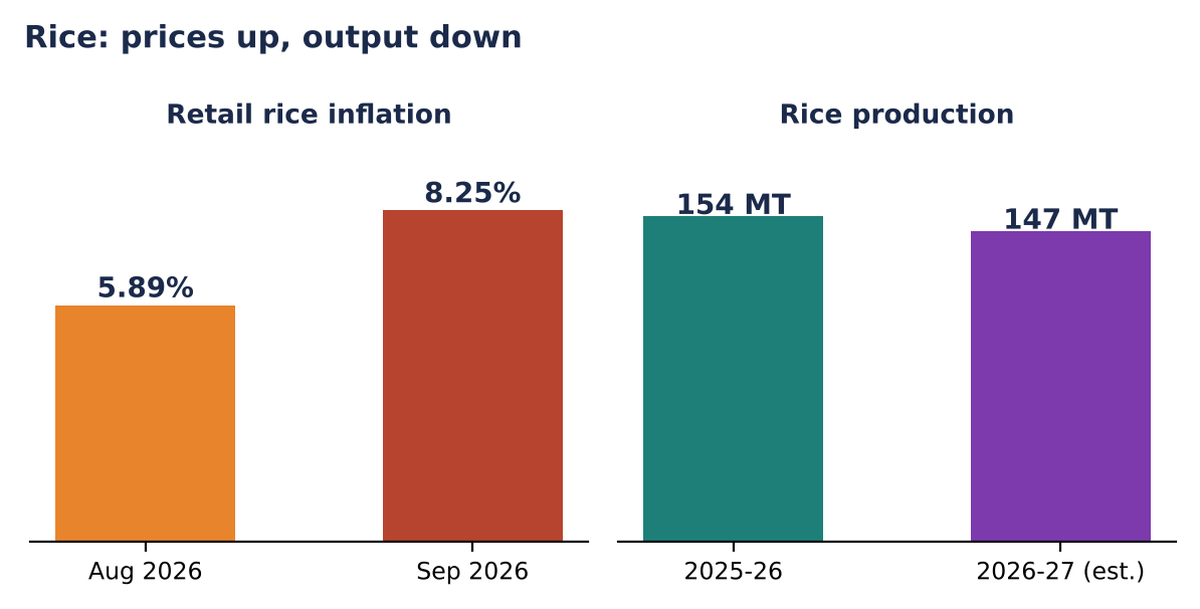
Retail rice inflation 8.25% (Sept) vs 5.89% (Aug); average retail price ~₹48.23/kg.
5 southern states (AP, Karnataka, Kerala, TN, Telangana) may impose stock limits till 31 Jan 2027.
OMSS (D) rice sale target doubled from 25 to 50 lakh tonnes for 2026-27.
Output estimate ~147 MT (2026-27) vs record 154 MT (2025-26); kharif area down ~4%.
Way forward
Use targeted OMSS releases and data-driven monitoring rather than blanket curbs; invest in climate-resilient paddy varieties and irrigation.
Concept
Essential Commodities Act, 1955 - Centre can regulate production, supply and stock limits; violations under Sections 6 & 7. OMSS = sale of surplus FCI grain in the open market to cool prices.
Two-panel bar chart: retail rice inflation rising from 5.89% in August to 8.25% in September 2026, and rice production falling from 154 million tonnes in 2025-26 to an estimated 147 million tonnes in 2026-27. — StudyForGS
9. India concludes talks to associate with EU's Horizon Europe
The European Commission and India concluded negotiations on India's association with Horizon Europe, the EU's €93.5-billion research and innovation programme (2021-27).
Key facts
Agreement likely to be signed in January 2027; Indian entities join on equal terms, India contributes financially.
Indian researchers can lead projects under Pillar II - Global Challenges & European Industrial Competitiveness.
Exploratory talks began Feb 2026; formal negotiations from July 2026.
Comes ahead of the India-EU FTA (market of ~2 billion people); supported by EU-India Trade and Technology Council.
Way forward
Align Horizon calls with ANRF priorities, prepare universities for EU-style grant competition and protect IPR in joint outputs.
Concept
Horizon Europe = 9th EU Framework Programme with 3 pillars (Excellent Science; Global Challenges; Innovative Europe). India-EU Strategic Partnership since 2004; TTC launched 2022.
10. National Legal Services Day (9 Nov): free legal aid as a constitutional promise
POLITYCOMMON: Prelims + Mains GS2
Syllabus linkage
GS2: Statutory bodies, access to justice, vulnerable sections. Prelims: Art. 39A, NALSA, Lok Adalat.
Context
India observes National Legal Services Day on 9 November, marking the day the Legal Services Authorities Act, 1987 came into force in 1995, to spread awareness of free legal aid.
Key facts
Article 39A (added by 42nd Amendment, 1976) - DPSP on equal justice and free legal aid.
NALSA: Patron-in-Chief is the CJI; Executive Chairman is the senior-most SC judge after the CJI.
Three-tier set-up: SLSA (state), DLSA (district), TLSC (taluk); Lok Adalat awards are final - no appeal.
Eligible: women, children, SC/ST, persons with disability, industrial workmen, people in custody, low-income persons.
Way forward
Improve quality of legal-aid lawyers, expand Legal Aid Defence Counsel offices and use tele-law to reach undertrials and remote areas.
Concept
Hussainara Khatoon v. State of Bihar (1979) read free legal aid into Article 21. Art. 14 (equality before law) and Art. 22(1) (right to counsel) also underpin access to justice.
11. Rajatarangini, Mahabharata and Arthashastra enter UNESCO's Asia-Pacific register
SOCIETYCOMMON: Prelims + Mains GS1
Syllabus linkage
GS1: Indian culture - literature, ancient history; GS2: International institutions. Prelims: Memory of the World, MOWCAP.
Context
Manuscripts of three classical works were inscribed on UNESCO's Memory of the World Regional Register for Asia and the Pacific at the 11th MOWCAP session in Jakarta, Indonesia; dossiers prepared by IGNCA.
Key facts
Rajatarangini by Kalhana (c. 1148-50 CE), Sanskrit, Sharada script on birch bark, 8 Tarangas; held at Oriental Research Library, Srinagar.
Mahabharata: old Kashmiri recension acquired by Georg Bühler (1875); held at BORI, Pune.
Arthashastra of Kautilya: 16th-century palm-leaf, Grantha script, 15 books; held at ORI, Mysuru; edited by R. Shamasastry.
Earlier (April 2025): Bhagavad Gita and Natyashastra entered the international MoW register.
Way forward
Digitise and conserve manuscript repositories under Gyan Bharatam Mission, and push more nominations to the international register.
Concept
Memory of the World Programme - UNESCO, 1992, for documentary heritage; has international, regional and national registers. Distinct from World Heritage (1972 Convention) and Intangible Heritage (2003 Convention).
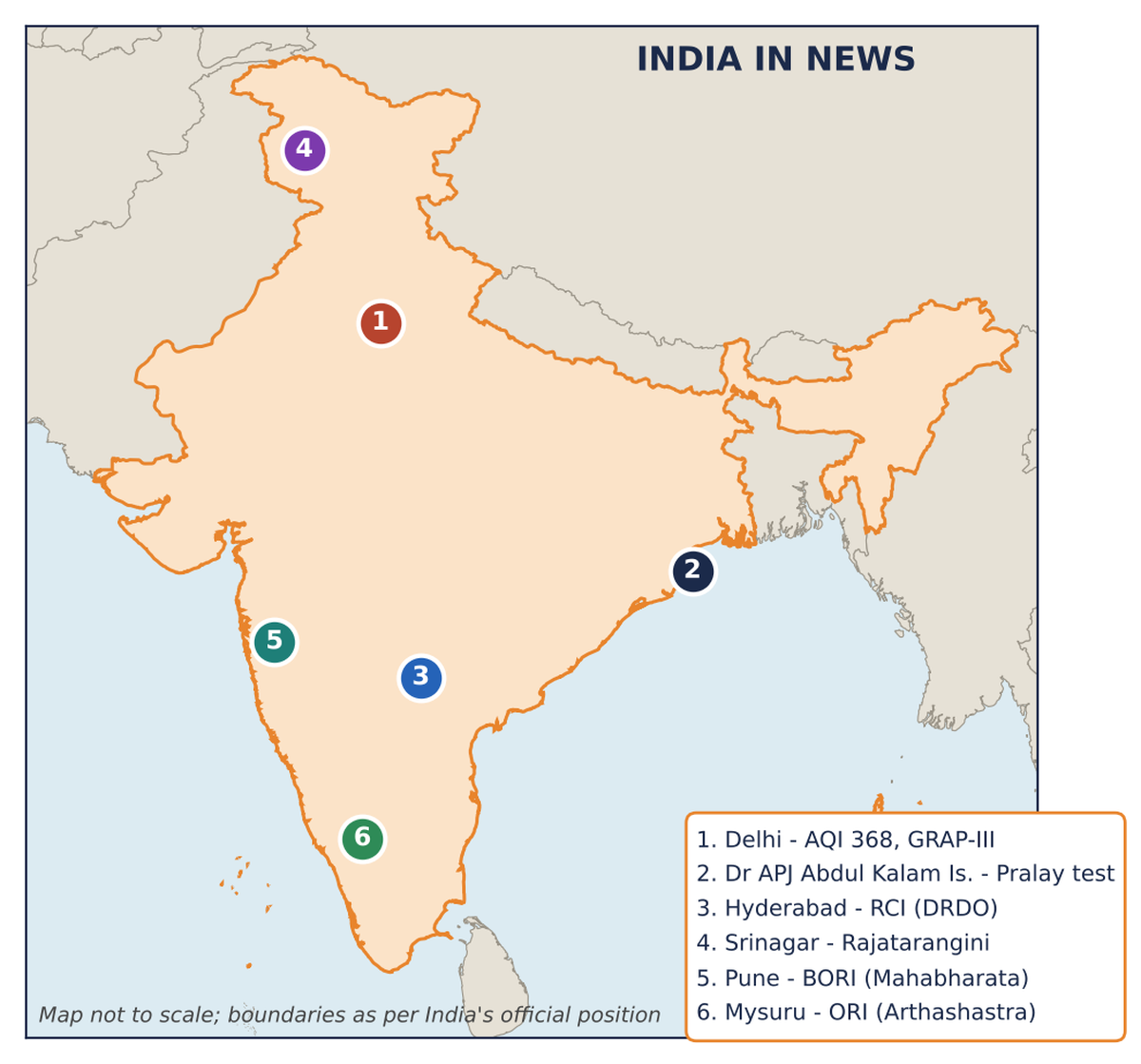
India in News locator map with numbered pins: 1 Delhi (air quality), 2 Dr APJ Abdul Kalam Island, Odisha (Pralay test), 3 Hyderabad (RCI), 4 Srinagar (Rajatarangini), 5 Pune (Mahabharata manuscript), 6 Mysuru (Arthashastra manuscript); boundaries as per India's official position. — StudyForGS
Data point of the day
8.25%
Retail rice inflation, September 2026 Up from 5.89% in August; average retail price ~₹48.23/kg, about 12% higher than a year ago, as a deficient, uneven monsoon cut the kharif crop.
Prelims rapid-fire
Bahamas became the 116th member of the International Solar Alliance (launched by India & France at COP21, 2015; HQ Gurugram).
New herb species Disporum kamakhasiense (family Colchicaceae) described from Assam & Meghalaya.
Muthuswami Dikshitar (Carnatic trinity) - ₹250 commemorative coin released for his 250th birth anniversary.
Vayo Samman Rashtriya Abhiyan launched by MoSJE under AVYAY for senior citizens, with volunteer wing Vayo SAATHI.
Asteroid 2026 QQ8: a ~1 m 'mini-moon' temporarily captured by Earth's gravity, expected to stay till Dec 2026.
9 November is also Uttarakhand Foundation Day - created in 2000 as India's 27th state.
Practice MCQs — UPSC Prelims pattern
Q1. With reference to COP31 of the UNFCCC, consider the following statements: 1. It is being held in Antalya, Türkiye. 2. Australia presides over the formal negotiations while Türkiye holds the presidency. 3. It is the first COP to be held after the conclusion of the Second Global Stocktake. Which of the statements given above is/are correct?
1 only
1 and 2 only
2 and 3 only
1, 2 and 3
Show answer
Answer: B Statements 1 and 2 are correct. Statement 3 is wrong: the Second Global Stocktake is due to conclude only in 2028.
Q2. Which one of the following manuscripts recently inscribed on UNESCO's Asia-Pacific Memory of the World register is written in Sharada script on birch bark?
Arthashastra
Rajatarangini
Natyashastra
Bhagavad Gita
Show answer
Answer: B Kalhana's Rajatarangini (Srinagar manuscript) is in Sharada script on birch bark; the Arthashastra copy is palm-leaf in Grantha.
Mains practice question
Q. Grid-scale energy storage is the missing link in India's renewable energy transition. Examine in the light of the recently approved Viability Gap Funding scheme. (150 words, 10 marks)
Hint / approach
Intro: 500 GW goal and intermittency. Body: VGF ₹14,500 cr / 92 GWh mix, 40% DCR, PSP vs BESS trade-offs, challenges (cell imports, land/water for PSP, market design). Conclude: storage + markets + manufacturing for 24x7 clean power.
📌 One-line revision: COP31 Antalya (9-20 Nov) | AQI 368 + GRAP-III | ₹14,500 cr VGF = 92 GWh | ECMS 118 projects | Pralay test | MALABAR at Yokosuka | Horizon Europe | Art. 39A | MOWCAP: 3 manuscripts.