PM Modi meets global chip CEOs on the eve of SEMICON India 2026; Supreme Court dismisses 271 government appeals on armed-forces disability pension; World Ozone Day marks 10 years of the Kigali Amendment
Wednesday, 16 September 2026 · IST · National & International · 11 items · 2 MCQs
India's semiconductor push dominated 16 September, with the Prime Minister holding a roundtable with global chip CEOs a day before SEMICON India 2026 opens at Yashobhoomi. The Supreme Court delivered a major service-law ruling for armed-forces veterans, dismissing 271 Union appeals on disability pension, while the External Affairs Minister began a two-day Bhutan visit and India lodged a formal protest with Pakistan over an unsafe naval manoeuvre in the North Arabian Sea. On the economy, a 9.92% wholesale inflation print sitting far above 4.82% retail inflation has flipped rate expectations towards hikes.
Today at a glance — things to remember
PM Modi holds roundtable with global semiconductor CEOs; SEMICON India 2026 opens 17 September at Yashobhoomi.
Supreme Court dismisses 271 Union appeals, clearing the way for armed-forces disability pension claims.
World Ozone Day 2026 theme: “Global action for a cooler planet” — Kigali Amendment turns 10.
EAM S. Jaishankar begins two-day Bhutan visit; royal audience and talks on rivers and hydropower.
India protests to Pakistan over an unsafe naval manoeuvre in the North Arabian Sea.
WPI inflation at 9.92% in August against CPI at 4.82% — the widest wedge in the current series.
RBI drains ₹1 lakh crore through its first net bond sale in two years; five-year yield jumps 22 bps.
August merchandise trade deficit narrows to a five-month low of $26.86 billion as exports rise 26%.
PM Vishwakarma completes three years with 30 lakh artisans registered — its full target.
Unemployment rate eases to a six-month low of 5.0% in August; rural joblessness at 4.1%.
Detailed notes
1. PM Modi meets global chip CEOs as SEMICON India 2026 opens tomorrow at Yashobhoomi
SCI-TECHCOMMON: Prelims + Mains GS3
Syllabus linkage
GS-III — Science & Technology; indigenisation of technology; industrial and investment policy. Prelims pointers: India Semiconductor Mission, ATMP/OSAT, Yashobhoomi, MeitY.
Context
On 16 September 2026 the Prime Minister held a roundtable with global semiconductor industry leaders in New Delhi, a day before he inaugurates the fifth edition of SEMICON India 2026. The event runs 17–19 September 2026 at Yashobhoomi, Dwarka, and is the country's biggest annual showcase of its chip ambitions.
Key facts
Theme: “Transform Tomorrow: Silicon to Systems — Building the Ecosystem”. Organised jointly by the India Semiconductor Mission (ISM), MeitY and industry body SEMI at Yashobhoomi (India International Convention & Expo Centre).
Scale: 500+ exhibitors, 243 international companies, 150+ speakers, delegates from 40+ countries and 15,000 sq m of exhibition space, with 6 country pavilions (Japan, South Korea, Singapore, Malaysia, Germany, Netherlands) and 10 state pavilions.
Semicon 1.0 scorecard: 12 approved projects worth ₹1.64 lakh crore (≈ US$20 billion) across Gujarat, Assam, Uttar Pradesh, Punjab, Odisha and Andhra Pradesh — of which 3 units are already in commercial production.
Semicon 2.0 was approved by the Union Cabinet on 15 July 2026 with an outlay of ₹1,27,500 crore, and the programme duration was stretched to 12 years. Its six pillars are chip design, machines and materials, fab setup, ATMP/OSAT, R&D and talent.
ISM CEO Amitesh Kumar Sinha said India's own semiconductor requirement will climb from about US$100 billion to US$200 billion, as the global market doubles from roughly US$1 trillion to US$2 trillion.
Way forward
India must graduate from assembly and packaging to advanced-node fabrication, while locking in critical minerals, ultra-pure water and firm power. A deep design talent pipeline matters more than any single fab.
Concept
India Semiconductor Mission (2021) — an independent business division under Digital India Corporation, MeitY, covering fabs, display fabs, compound semiconductors and the Design Linked Incentive (DLI) scheme. ATMP = Assembly, Testing, Marking and Packaging; OSAT = Outsourced Semiconductor Assembly and Test. Links to PLI and Atmanirbhar Bharat.
Stat-tile row showing India Semiconductor Mission numbers: 12 approved projects, ₹1.64 lakh crore committed, 3 units in production, ₹1,27,500 crore Semicon 2.0 outlay, 12-year duration and 6 host states. — StudyForGS
2. Wholesale inflation at 9.92% pulls far ahead of 4.82% retail; RBI drains ₹1 lakh crore
ECONOMYCOMMON: Prelims + Mains GS3
Syllabus linkage
GS-III — Indian economy; inflation; monetary policy and money markets. Prelims pointers: WPI vs CPI base years, open market operations, flexible inflation targeting, MPC composition.
Context
Official price data released on 14 September 2026 showed wholesale inflation climbing to 9.92% even as retail inflation stayed at 4.82%. On 15 September the bond market sold off sharply after the central bank announced its first net bond sale in two years, and rate expectations flipped from cuts to hikes.
Key facts
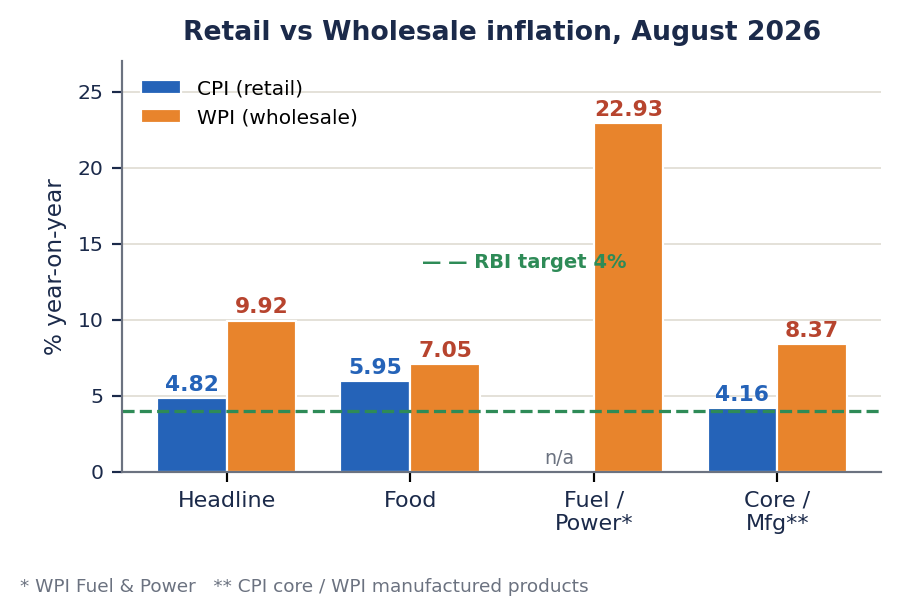
WPI inflation: 9.92% in August 2026, up from 9.78% in July (all-commodities index 110.8 vs 110.0). Fuel & power 22.93%, manufactured products 8.37% — a series high, primary articles 7.76%, and WPI food 7.05%, a 20-month high.
CPI inflation: 4.82% in August, up from 4.45% in July — a third straight month above the 4% target. Food 5.95%, core 4.16%, rural 5.23%, urban 4.31%. Telangana was highest at 6.27%, Mizoram lowest at 2.35%.
The RBI announced ₹1,00,000 crore of open market operation (OMO) bond sales — its first net bond sale in two years — in three tranches: ₹50,000 crore on 17 September, ₹25,000 crore on 21 September and ₹25,000 crore on 28 September 2026.
On 15 September the five-year yield jumped 22 basis points to 6.80% — its sharpest rise since May 2022 — and the 10-year rose 6 bps to 7.07%. SBI Research now projects two 25-bps repo hikes, in October and December 2026, with CPI peaking near 6.70%. The Indian crude basket is up from $82.04 in July to $109.76 in September; the next MPC meets 5–7 October 2026.
Way forward
A supply-side shock in energy cannot be cured by rate action alone — duty calibration, strategic reserve releases and targeted food-supply management must carry part of the load.
Concept
WPI (base 2022-23, DPIIT) tracks producer-level transactions and excludes services; CPI (base 2024, NSO) tracks retail prices and is the nominal anchor. Flexible inflation targeting under Section 45ZA, RBI Act, 1934 sets 4% ± 2%, decided by a six-member MPC. OMO sales absorb rupee liquidity.
Grouped bar chart comparing CPI and WPI inflation for August 2026 across headline, food, fuel/power and core categories, with the RBI's 4% target marked. — StudyForGS
3. August trade deficit narrows to a five-month low as merchandise exports jump 26%
ECONOMYCOMMON: Prelims + Mains GS3
Syllabus linkage
GS-III — External sector; balance of payments; effects of liberalisation. Prelims pointers: merchandise vs services trade, current account, India's top export destinations.
Context
Trade data released on 15 September 2026 showed the merchandise trade deficit narrowing to a five-month low of US$26.86 billion in August, as goods exports grew at their fastest pace in years and services continued to run a large surplus.
Key facts
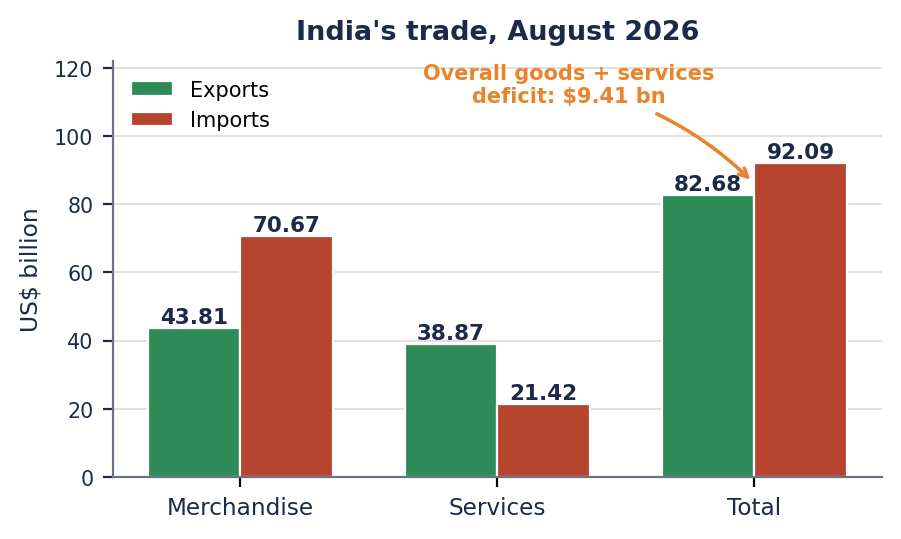
Merchandise exports: US$43.81 billion, up 26.12% year-on-year from $34.74 billion. Merchandise imports: US$70.67 billion. Merchandise deficit: US$26.86 billion, down from $31.98 billion in July 2026.
Services exports: US$38.87 billion (up 24.61%) against services imports of US$21.42 billion — a services surplus of about US$17.45 billion.
Overall goods-plus-services deficit: US$9.41 billion, narrower than $11.62 billion in August 2025.
April–August FY27: exports US$215.91 billion, imports US$363 billion. The United States remains the largest destination at US$42.79 billion (+6.17%), while exports to China rose 38.71% to US$9.61 billion; imports from China were US$65.49 billion.
Way forward
The export surge is welcome but rides on a weak rupee and a high import bill. Durable gains need diversification into higher-value engineering and electronics and faster conclusion of pending trade agreements.
Concept
Merchandise (goods) trade and invisibles (services + remittances + income) together form the current account of the Balance of Payments. India runs a structural goods deficit offset by a services and remittances surplus — which is why the headline goods deficit and the overall deficit differ so sharply.
Grouped bar chart of India's August 2026 exports and imports for merchandise, services and total trade in US$ billion, highlighting the $9.41 billion overall deficit. — StudyForGS
4. Chandrayaan-1 data points to “Australe Basin” — possibly the Moon's oldest impact basin
SCI-TECHCOMMON: Prelims + Mains GS3
Syllabus linkage
GS-III — Space technology; achievements of Indians in science. Prelims pointers: Chandrayaan-1, Moon Mineralogy Mapper, South Pole–Aitken Basin, Chandrayaan-4.
Context
Researchers reported on 15 September 2026 that archival data from India's first lunar mission has revealed a previously unrecognised impact structure — the Australe Basin — which may be older than any confirmed basin on the Moon.
Key facts
The study was led by the Physical Research Laboratory (PRL), Ahmedabad, with Neha Panwar as lead author, and published in The Planetary Science Journal on 15 September 2026.
It used the Moon Mineralogy Mapper (M3), the NASA imaging spectrometer flown aboard Chandrayaan-1 (2008) — the same instrument that confirmed water molecules on the lunar surface.
The Australe Basin may predate the South Pole–Aitken (SPA) Basin, which at over 4 billion years is currently the Moon's oldest confirmed impact structure.
Because its rims are heavily eroded, the basin was invisible to ordinary imaging; it was identified instead through distinct mineralogical and gravity signatures.
Its volcanic rocks show unusual mineralogy — lower calcium-bearing minerals but higher magnesium content than typical lunar basalts. Scientists estimate about 300 impact basins exist on the Moon, of which only 74 have been detected — making this a candidate target for the Chandrayaan-4 sample-return mission.
Way forward
Reanalysing legacy mission archives with new techniques is among the cheapest sources of scientific return; sustained funding for planetary data science should accompany each new launch.
Concept
Chandrayaan-1 (2008) was India's first lunar probe; M3 was a NASA payload aboard it. An impact basin is a very large crater with concentric rings. Older surfaces carry more craters, so basin chronology anchors the dating of the entire inner Solar System. Chandrayaan-4 is India's planned lunar sample-return mission.
5. Yudh Abhyas 2026 opens at two sites for the first time — Auli and Mahajan
DEFENCECOMMON: Prelims + Mains GS3
Syllabus linkage
GS-III — Security; defence exercises and interoperability. GS-II — India–US bilateral relations. Prelims pointers: names and partner countries of India's military exercises.
Context
The 22nd edition of Exercise Yudh Abhyas, the annual India–United States army exercise, began on 15 September 2026 — and for the first time is being run simultaneously at two geographically distinct locations, one Himalayan and one desert.
Key facts
Venues: the Auli Foreign Training Node, Uttarakhand (high-altitude) and the Mahajan Field Firing Range, Rajasthan (desert). The exercise runs to 28 September 2026.
Participation: about 1,200 personnel, roughly 600 from each country. India is represented by the 14 Infantry Division; the US by the 1st (Mobile) Brigade Combat Team, 11th Airborne Division (“Arctic Angels”).
Systems in play include HIMARS, Stinger air-defence missiles and the M-LIDS counter-drone system — reported as deployed in India for the first time.
Training focus: Integrated Battle Group operations, mountain and cold-weather warfare, counter-UAS, drones and autonomous systems, and space and cyber multi-domain integration.
Yudh Abhyas has been held annually since 2004 under US Army Pacific sponsorship, alternating between India and the United States.
Way forward
Two-theatre exercising lets India rehearse its real two-front problem in one window; the gain is greatest if counter-drone and multi-domain lessons feed directly into procurement.
Concept
India–US defence ties rest on the foundational agreements LEMOA (2016), COMCASA (2018) and BECA (2020), plus the 2+2 Ministerial Dialogue. An Integrated Battle Group is a brigade-sized, self-contained, quick-reaction formation. Counter-UAS is counter-unmanned aerial systems.
6. Supreme Court dismisses 271 Union appeals on armed-forces disability pension
POLITYCOMMON: Prelims + Mains GS2
Syllabus linkage
GS-II — Judiciary; statutory bodies and tribunals; welfare of vulnerable sections including veterans. Prelims pointers: Armed Forces Tribunal, Article 136, Entitlement Rules 2008.
Context
In the single most consequential ruling of 16 September 2026, the Supreme Court dismissed 271 civil appeals and special leave petitions filed by the Union of India against the grant of disability pension to armed-forces personnel, holding that a decade-old government commitment had “not been faithfully implemented”.
Key facts
Case: Union of India & Ors. v. Col. N.C. Isaac (Retd.), citation 2026 INSC 993, decided by a bench of Justice Pamidighantam Sri Narasimha and Justice Alok Aradhe. All 271 matters were dismissed with no order as to costs.
The dispute turns on “NANA” — “Neither Attributable to Nor Aggravated by” military service — the Ministry of Defence classification used to deny disability pension by holding a disability unconnected to service.
The Raksha Mantri's Committee of Experts recommended in 2015 that pending NANA appeals be withdrawn, and the MoD formally accepted this in 2018 — but the Court held the recommendation “has not been faithfully implemented”.
Core holding: the Entitlement Rules, 2008 substantially preserve the protective framework of the 1982 Rules, so the burden of proof stays with the Department — with a narrow exception for claims raised more than 15 years after discharge.
The bench stressed that “transparency, clarity and certainty are of enormous importance” in service jurisprudence affecting large classes of litigants.
Way forward
The government is the single largest litigant in Indian courts. Implementing accepted expert-committee recommendations and adopting a firm litigation policy would free judicial time and spare veterans years of avoidable proceedings.
Concept
The Armed Forces Tribunal was created by the Armed Forces Tribunal Act, 2007 to hear service matters and court-martial appeals. Appeals reach the Supreme Court through Article 136 (Special Leave Petition). Disability pension = disability element + service element, payable where disability is attributable to or aggravated by service.
7. EAM Jaishankar begins two-day Bhutan visit; second senior Indian visit in a week
IRCOMMON: Prelims + Mains GS2
Syllabus linkage
GS-II — India and its neighbourhood; bilateral agreements; Neighbourhood First policy. Prelims pointers: India–Bhutan Treaty of Friendship, Punatsangchhu projects, Bhutan's institutions.
Context
External Affairs Minister S. Jaishankar landed at Paro on 16 September 2026 for a two-day visit, the second high-level Indian visit to Thimphu inside a week and a set-piece of the “Neighbourhood First” policy.
Key facts
He was received by Bhutan's Foreign Minister Lyonpo D.N. Dhungyel. The programme includes bilateral talks, a royal audience with King Jigme Khesar Namgyel Wangchuck and a call on Prime Minister Tshering Tobgay.
Carry-over agenda from August 2026 talks: trans-border river management, flood forecasting, hydrological data sharing and progress on the jointly implemented Punatsangchhu-I Hydroelectric Project.
The visit followed Chief Election Commissioner Gyanesh Kumar's three-day Bhutan visit from 14 September 2026, during which he met the King and attended Bhutan's National Voters' Day.
Recent India-funded deliverables include three community development projects in Panbang, Zhemgang, with road works costing roughly Nu 31 million.
Hydropower remains the spine of the relationship: Bhutan exports surplus power to India, and the revenue is a dominant share of Bhutanese government income.
Way forward
As Bhutan diversifies into the Gelephu Mindfulness City and digital assets, India's offer must broaden beyond hydropower to connectivity, fintech and education — or risk being outbid elsewhere.
Concept
The India–Bhutan Treaty of Friendship (1949, revised 2007) governs relations; the 2007 revision removed the clause on Indian ‘guidance’ in external affairs. Bhutan is a founder member of SAARC and a member of BIMSTEC, but is not a member of the United Nations Security Council system of alliances and has no diplomatic relations with China or any P5 state. The Ngultrum is pegged to the Indian Rupee.
8. India at G20 Energy Abundance Ministerial in Houston; non-fossil capacity crosses half the mix
Union Minister for Power and Housing & Urban Affairs Manohar Lal represented India at the G20 Energy Abundance Ministerial Meeting in Houston, Texas (14–16 September 2026), held under the United States G20 Presidency, and held bilaterals with the US and Canada on 16 September.
Key facts
The ministerial was built on three pillars: Energy Security and Affordable Baseload; Permitting and Regulatory Efficiency; and Critical Minerals and Resilient Supply Chains.
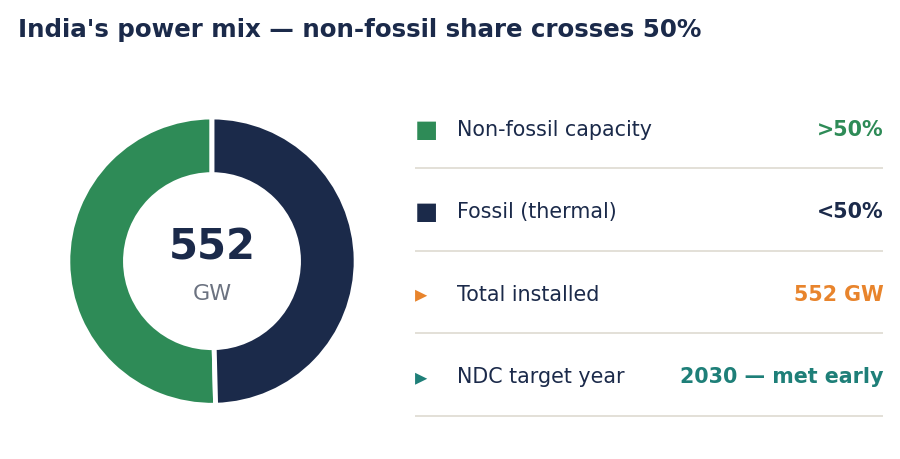
India told the meeting it has 552 GW of installed electricity capacity, with the non-fossil share now exceeding 50% — achieved ahead of its 2030 commitment.
India–US: the minister met US Energy Secretary Chris Wright and reaffirmed the US–India Energy Security Partnership, covering clean energy, power infrastructure for AI, high-performance computing and data centres, and India's nuclear expansion roadmap.
India–Canada: he met Corey Hogan, Parliamentary Secretary to Canada's Minister of Energy and Natural Resources, on energy efficiency and offshore exploration under the Samudra Manthan scheme. India pressed for “practical, inclusive and technology-neutral” solutions.
Way forward
Installed capacity is not generation. The harder task is storage, transmission and grid flexibility so that a majority-non-fossil fleet actually delivers a majority of the electricity.
Concept
India's Panchamrit pledges at COP26 (Glasgow, 2021) include 500 GW non-fossil capacity by 2030, 50% of energy requirements from renewables, and net zero by 2070. The G20 has no permanent secretariat and its presidency rotates annually; India held it in 2023.
Donut chart showing India's 552 GW installed power capacity split, with the non-fossil share crossing 50% ahead of the 2030 NDC commitment. — StudyForGS
9. PM Vishwakarma completes three years; 30 lakh artisans registered, meeting its full target
The government released a three-year scorecard for PM Vishwakarma on 16 September 2026, a day before the scheme's third anniversary. Launched on 17 September 2023, it targets traditional artisans and craftspeople working with their hands and tools.
Key facts
30 lakh (3 million) beneficiaries registered — meeting the scheme's registration target in three years.
Over 6.19 lakh loans sanctioned, worth approximately ₹5,316 crore, under collateral-free credit at a 5% concessional interest rate.
Over ₹42 crore disbursed as digital transaction incentives to 8.11 lakh beneficiaries.
Over 24.37 lakh artisans given basic skill training and over 18.16 lakh issued toolkit e-vouchers; more than 12,000 were trained in AI tools for branding and product design.
Over 30,000 beneficiaries onboarded onto GeM and ONDC and private marketplaces, with 82 trade fairs and 37 state-level exhibitions organised.
Way forward
Registration targets are an input, not an outcome. The measure that matters is whether artisan incomes and market access rose — which calls for an independent third-party impact evaluation.
Concept
PM Vishwakarma is a central-sector scheme of the Ministry of Micro, Small and Medium Enterprises, with an outlay of ₹13,000 crore for FY2023-24 to FY2027-28, covering 18 traditional trades (carpenter, blacksmith, goldsmith, potter, cobbler, barber, washerman and others). Benefits: recognition certificate and ID, skill training with a ₹500 daily stipend, a ₹15,000 toolkit incentive, and credit of ₹1 lakh followed by ₹2 lakh.
10. World Ozone Day 2026: “Global action for a cooler planet” marks 10 years of the Kigali Amendment
ENVIRONMENTCOMMON: Prelims + Mains GS3
Syllabus linkage
GS-III — Environmental pollution; conservation; international environmental conventions. Prelims pointers: Vienna Convention, Montreal Protocol, Kigali Amendment, ODS vs GHG.
Context
16 September is the International Day for the Preservation of the Ozone Layer, marking the signing of the Montreal Protocol in 1987. The 2026 theme is “Global action for a cooler planet”, chosen to mark the tenth anniversary of the Kigali Amendment.
Key facts
The Kigali Amendment, adopted in 2016, governs the global phase-down of hydrofluorocarbons (HFCs) — which are not ozone-depleting but are potent greenhouse gases.
Full implementation of the Kigali Amendment alone could avoid up to 0.5°C of global warming by the end of the century.
The Montreal Protocol (1987) is the first UN treaty to achieve universal ratification — 198 parties — and sits under the framework Vienna Convention for the Protection of the Ozone Layer (1985).
India ratified the Kigali Amendment in 2021 and will begin its HFC phase-down from a 2032 baseline, reaching an 85% cut by 2047.
The Antarctic ozone hole is projected to recover to 1980 levels by about 2066, with the Arctic by 2045 and the rest of the world by 2040.
Way forward
The next gain lies in energy-efficient cooling: pairing the HFC phase-down with efficient appliances under India's Cooling Action Plan would multiply the climate benefit.
Concept
Ozone-depleting substances (ODS) such as CFCs, halons and HCFCs destroy stratospheric ozone; HFCs replaced them and are harmless to ozone but have very high global warming potential. India's Ozone Cell (MoEFCC) is the national body; the India Cooling Action Plan (2019) was the world's first such national plan. Ozone is beneficial in the stratosphere and a pollutant in the troposphere.
Flowchart timeline of the ozone regime from the 1985 Vienna Convention through the 1987 Montreal Protocol and 1992 Copenhagen Amendment to the 2016 Kigali Amendment and its tenth anniversary in 2026. — StudyForGS
11. Unemployment eases to a six-month low of 5.0% in August; female participation rises
REPORTCOMMON: Prelims + Mains GS3
Syllabus linkage
GS-III — Growth, development and employment. GS-II — Government data systems. Prelims pointers: PLFS, Current Weekly Status, LFPR, Worker Population Ratio.
Context
The monthly Periodic Labour Force Survey (PLFS) bulletin released on 15 September 2026 put the all-India unemployment rate at 5.0% in August, the lowest in six months, with participation rates improving for women in particular.
Key facts
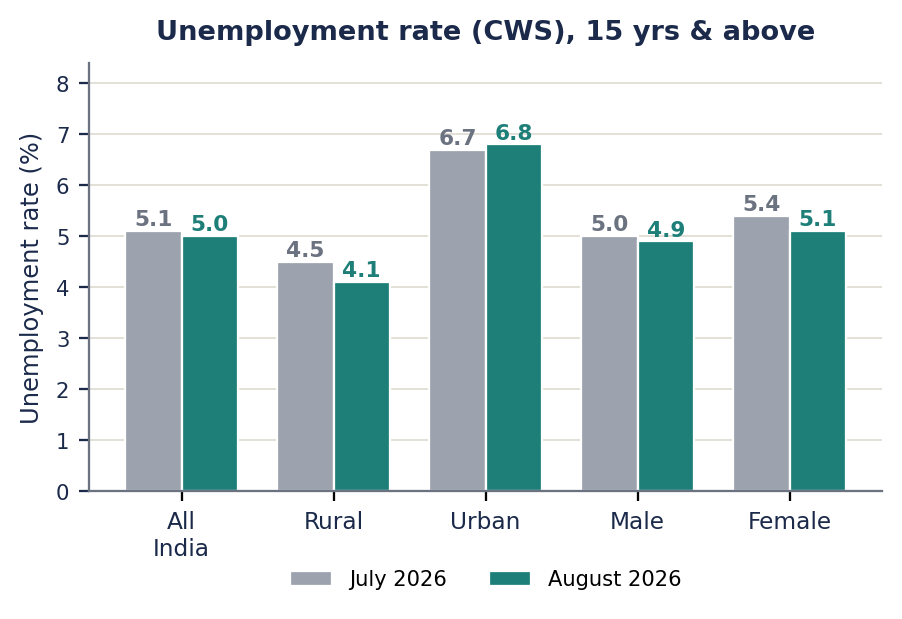
All-India unemployment rate: 5.0% (Current Weekly Status, 15 years and above), down from 5.1% in July.
Rural unemployment fell to 4.1% from 4.5% — the lowest since January 2026 — while urban rose marginally to 6.8% from 6.7%.
Male unemployment 4.9% (from 5.0%) and female 5.1% (from 5.4%); rural female joblessness fell to 3.9% from 4.3%.
Labour Force Participation Rate (15+): 55.6% (from 55.4%) and Worker Population Ratio: 52.8% — the highest since March 2026. Female LFPR rose to 34.8%, with rural female LFPR at 39.4%. The survey covered 3,70,160 persons.
Way forward
Falling rural joblessness alongside rising female participation is encouraging, but much of it is self-employment and unpaid family work. The real test is the share of regular wage employment with social security.
Concept
The PLFS is conducted by the National Statistics Office under MoSPI; it moved to monthly bulletins in 2025. Current Weekly Status (CWS) uses a 7-day reference period — a person is employed if they worked at least one hour on any day of that week. LFPR = labour force / population; WPR = workers / population; UR = unemployed / labour force.
Grouped bar chart comparing July and August 2026 unemployment rates for all-India, rural, urban, male and female categories. — StudyForGS
Data point of the day
9.92%
Wholesale price inflation, August 2026 Up from 9.78% in July and now more than double the 4.82% retail (CPI) print — a divergence driven almost entirely by fuel and power inflation of 22.93%, with WPI food at a 20-month high of 7.05%.
Prelims rapid-fire
Moon Mineralogy Mapper (M3) — NASA imaging spectrometer flown on Chandrayaan-1 (2008); confirmed lunar water and has now revealed the Australe Basin.
NANA — “Neither Attributable to Nor Aggravated by” service; the Ministry of Defence classification at the heart of the 16 September disability-pension ruling.
Kigali Amendment (2016) — amends the Montreal Protocol to phase down HFCs, which are greenhouse gases, not ozone-depleting substances. India ratified it in 2021.
Current Weekly Status (CWS) — PLFS activity measure using a 7-day reference period; the basis of the 5.0% August unemployment rate.
Punatsangchhu-I — India-assisted hydroelectric project in Bhutan, on the agenda of the External Affairs Minister's 16–17 September visit.
1991 India–Pakistan Agreement on Advance Notice of Military Exercises — invoked by India on 16 September after an unsafe Pakistan Navy manoeuvre in the North Arabian Sea; it requires three nautical miles of separation between the two navies' vessels.
Practice MCQs — UPSC Prelims pattern
Q1. With reference to the Kigali Amendment, consider the following statements:
1. It was adopted in 2016 and amends the Montreal Protocol.
2. It provides for the phase-down of hydrofluorocarbons, which are ozone-depleting substances.
3. India has ratified it and will begin its phase-down from a 2032 baseline.
Which of the statements given above are correct?
1 and 2 only
1 and 3 only
2 and 3 only
1, 2 and 3
Show answer
Answer: B Statements 1 and 3 are correct. Statement 2 is wrong on a point examiners love: HFCs do NOT deplete ozone — they were adopted precisely because they are ozone-safe. They are, however, extremely potent greenhouse gases, which makes Kigali a climate instrument grafted onto an ozone treaty.
Q2. With reference to India's price data for August 2026, consider the following statements:
1. Headline retail (CPI) inflation remained below the Reserve Bank's 4% target.
2. Wholesale (WPI) inflation was higher than retail inflation.
3. Fuel and power was the fastest-rising major group within the WPI.
Which of the statements given above are correct?
1 and 2 only
1 and 3 only
2 and 3 only
1, 2 and 3
Show answer
Answer: C Statements 2 and 3 are correct. CPI was 4.82% — above, not below, the 4% target, and the third consecutive month above it, so statement 1 fails. WPI at 9.92% was more than double CPI, and within WPI fuel and power rose 22.93%, far ahead of manufactured products (8.37%).
Mains practice question
Q. A sustained divergence between wholesale and retail inflation complicates the conduct of monetary policy. In the light of India's August 2026 price data, examine the causes of this divergence and discuss whether interest rate action is the appropriate instrument to address it. (250 words, 15 marks)
Hint / approach
Open with the numbers — WPI 9.92% against CPI 4.82%. Explain the wedge structurally: WPI carries no services and a heavy fuel and manufacturing weight, while CPI is food- and services-dominated and cushioned by administered prices. Then argue that an imported energy shock is a supply-side, relative-price event — rate hikes compress demand but cannot produce a barrel of oil, so the case for hiking rests on anchoring expectations and defending the rupee. Balance that against pass-through and second-round effects, which inflation targeting exists to prevent. Conclude with a policy mix: calibrated tightening plus duty rationalisation, reserve management and food-supply intervention.
📌 One-line revision: Chips at Yashobhoomi, courts for the veterans, and a 9.92% wholesale print that will not let the Reserve Bank cut — 16 September 2026 in one line.