PM inaugurates SEMICON India 2026 as Semiconductor Mission 2.0 scales to ₹1,27,500 crore; EPFO wage ceiling doubles to ₹25,000 from today; Supreme Court orders RBI to end forcible vehicle repossession
Thursday, 17 September 2026 · IST · National & International · 10 items · 2 MCQs
Today's biggest story is SEMICON India 2026 at Yashobhoomi, where the Prime Minister opened the fifth edition and set out India Semiconductor Mission 2.0 with an outlay of ₹1,27,500 crore. The revised EPFO statutory wage ceiling of ₹25,000 a month takes effect today, extending provident fund, pension and insurance cover to more than 51 lakh additional workers. In the courts, the Supreme Court directed the RBI to enforce genuine compliance with its recovery norms after a truck was seized at 1 a.m., and a separate Bench sought answers on 25 unnatural deaths in Manipur relief camps.
Today at a glance — things to remember
PM opens SEMICON India 2026 at Yashobhoomi; ISM 2.0 outlay ₹1,27,500 crore
EPFO statutory wage ceiling rises from ₹15,000 to ₹25,000 with effect from today
Supreme Court directs RBI to secure genuine compliance with loan-recovery norms
Supreme Court seeks Manipur affidavit on 25 unnatural deaths in relief camps
New Zealand Parliament ratifies the India-New Zealand FTA by 93 votes to 29
UPI MDR framework notified: 0.4% only on P2M above ₹2,000, from 15 October
WPI inflation for August 2026 prints at 9.92% on the new 2022-23 base year
World Ozone Day: India launches a Net Zero Portal and an NAPCC Dashboard
India summons Pakistan's Charge d'Affaires over the PNS Hunain naval collision
Chandrayaan-1 data reveals a lost lunar impact basin, the Australe Basin
Detailed notes
1. SEMICON India 2026 opens; Semiconductor Mission 2.0 scales up to ₹1,27,500 crore
SCI-TECHCOMMON: Prelims + Mains GS3
Syllabus linkage
GS-III: Science & Technology, indigenisation of technology; Indian economy — industrial policy. Prelims: India Semiconductor Mission, Design Linked Incentive, Yashobhoomi, node sizes.
Context
The Prime Minister inaugurated the fifth edition of SEMICON India 2026 at Yashobhoomi, Dwarka, New Delhi today, on the theme "Silicon to Systems: Building the Ecosystem". The event runs 17-19 September 2026 and showcases India Semiconductor Mission (ISM) 2.0.
Key facts
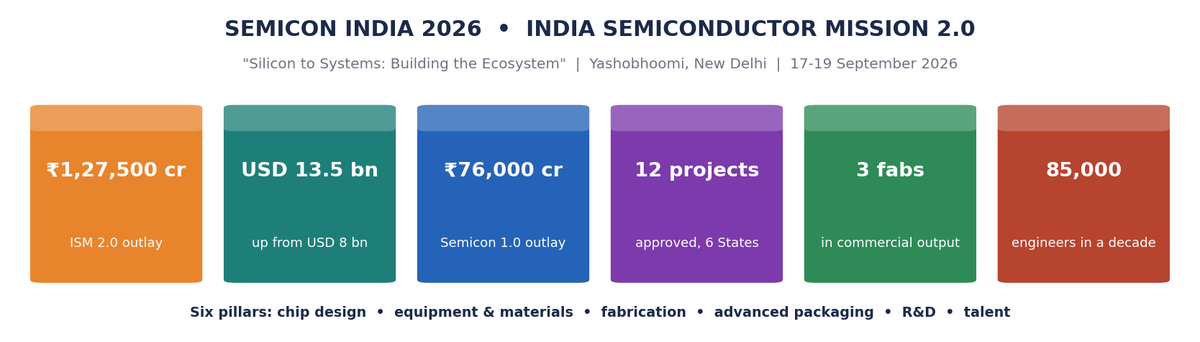
ISM 2.0 outlay ₹1,27,500 crore (about USD 13.5 billion), against ₹76,000 crore under Semicon 1.0 announced in 2021.
12 semiconductor projects approved across six States; 3 are already in commercial production.
Six pillars: chip design, equipment & materials, fabrication, advanced packaging, R&D and talent.
Targets include 200+ chip-design companies, 1 lakh technicians and 85,000 semiconductor engineers in a decade; focus on mature nodes of 28 nm and above.
24 startups supported under the Design Linked Incentive (DLI) scheme; 7 chips fabricated at the 12 nm node.
Way forward
Convert approved fabs into working supply chains — secure ultrapure materials and equipment, deepen design-to-fab linkages, and make talent pipelines keep pace with capital.
Concept
A semiconductor fab turns wafers into integrated circuits; node size (28 nm, 12 nm) is the process generation, not literal transistor width. OSAT means Outsourced Semiconductor Assembly and Test. ISM sits under MeitY and is the industrial-policy arm of Atmanirbhar Bharat in electronics.
Stat-tile row for India Semiconductor Mission 2.0 showing an outlay of ₹1,27,500 crore or USD 13.5 billion against ₹76,000 crore for Semicon 1.0, 12 approved projects in six States, 3 fabs in commercial output and a target of 85,000 engineers in a decade. — StudyForGS
2. UPI merchant discount rate returns: 0.4% only on large P2M payments
ECONOMYCOMMON: Prelims + Mains GS3
Syllabus linkage
GS-III: Indian economy — digital payments, financial inclusion, banking. Prelims: NPCI, UPI, MDR, P2P vs P2M vs P2PM.
Context
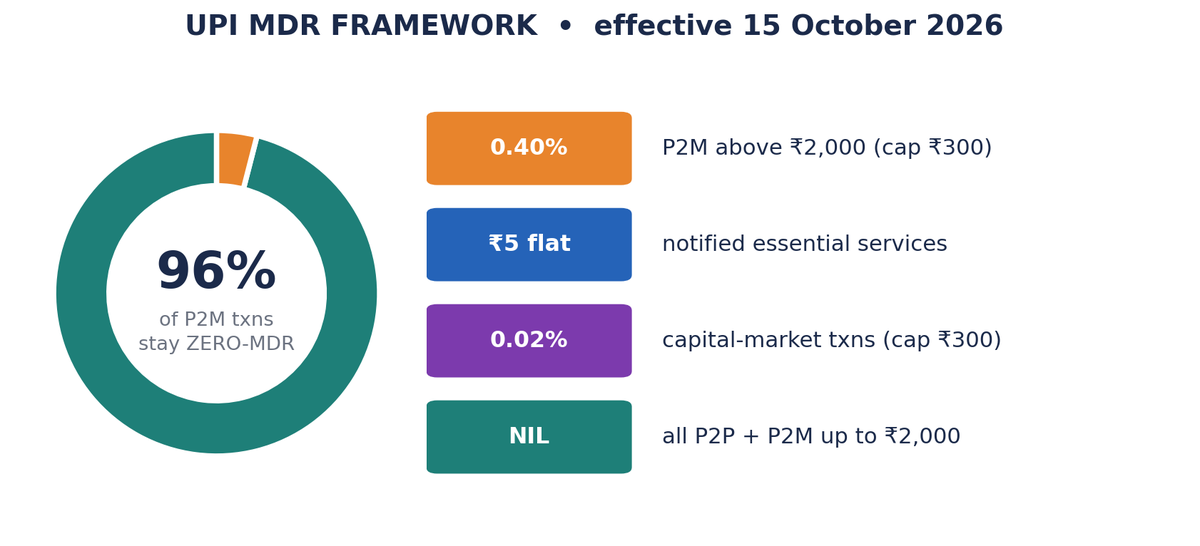
NPCI issued its FAQ sheet on the new Merchant Discount Rate (MDR) framework for UPI, and the Department of Financial Services clarified that UPI remains free for all peer-to-peer transfers and for 96% of merchant transactions. The framework takes effect 15 October 2026, ending six years of zero MDR.
Key facts
0.4% MDR on person-to-merchant (P2M) transactions above ₹2,000, capped at ₹300 per transaction.
Notified essential services — railways, telecom, insurance and fuel — attract a flat ₹5 per transaction; capital-market transactions 0.02%, capped at ₹300.
Fully exempt: all P2P transfers, all P2M up to ₹2,000, and small merchants under the P2PM framework receiving up to ₹1 lakh a month via UPI QR.
The merchant, not the consumer, bears the MDR; 5% of collections goes to a small-merchant support fund.
The government separately denied reports of any GST on UPI transactions.
Way forward
Price the rail without pricing out the small shop: monitor whether the ₹2,000 threshold holds as ticket sizes rise, and publish data on who actually absorbs the cost.
Concept
MDR is the fee a merchant pays the payment ecosystem per transaction, shared among acquirer, issuer and network. UPI is operated by the National Payments Corporation of India (NPCI), an umbrella organisation set up under the Payment and Settlement Systems Act, 2007, regulated by the RBI.
Donut chart showing 96% of UPI person-to-merchant transactions stay zero-MDR against 4% that attract a charge, with a rate table listing 0.4% above ₹2,000, a flat ₹5 for notified essential services, 0.02% for capital-market transactions and nil for all P2P payments. — StudyForGS
3. India summons Pakistan envoy after PNS Hunain collides with Indian warship
DEFENCECOMMON: Prelims + Mains GS2 + GS3
Syllabus linkage
GS-II: India and its neighbourhood, bilateral agreements; GS-III: security, maritime domain. Prelims: COLREGs, UNCLOS zones, 1991 India-Pakistan agreement.
Context
The Ministry of External Affairs today summoned Pakistan's Charge d'Affaires and lodged a strong protest over the collision of the Pakistan Navy vessel PNS Hunain with an Indian Navy warship in the North Arabian Sea, calling the conduct unacceptable and unprofessional.
Key facts
PNS Hunain is a 98-metre offshore patrol vessel of the Pakistan Navy.
The incident occurred on 16 September 2026 in international waters, roughly 220 km (about 120 nautical miles) east of the Oman coast.
No major damage to the Indian warship and no injuries were reported.
India invoked Article 10 of the 1991 India-Pakistan Agreement on Prevention of Airspace Violations and Advance Notice on Military Exercises, Manoeuvres and Troop Movements, under which naval vessels shall not approach within three nautical miles of each other in international waters.
India also cited the COLREGs — the International Regulations for Preventing Collisions at Sea.
Way forward
Confidence-building measures are only as good as their hotlines: revive naval-to-naval communication channels so an unprofessional manoeuvre does not become an incident.
Concept
A Charge d'Affaires heads a mission when no ambassador or high commissioner is in post. Under UNCLOS, the territorial sea extends 12 nautical miles, the contiguous zone 24 and the Exclusive Economic Zone 200; beyond the EEZ lie the high seas, where freedom of navigation applies but COLREGs still bind every vessel.
4. Pangwala tribal gut study finds a deep antimicrobial-resistance reservoir
A study of the Pangwala, a Scheduled Tribe of the remote Pangi Valley in Chamba district, Himachal Pradesh, found that native residents and urban migrants keep a strikingly similar core gut microbiome — and that healthy, largely antibiotic-naive volunteers already carry over 100 antibiotic-resistance genes.
Key facts
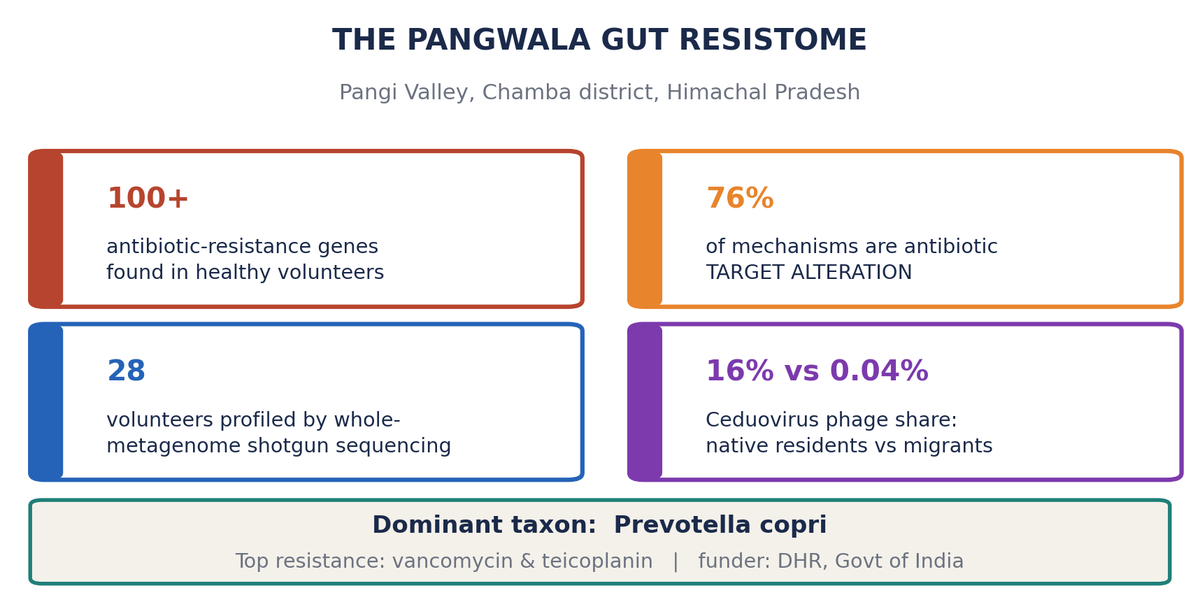
28 volunteers were profiled using whole-metagenome shotgun sequencing, covering bacteria, fungi and viruses.
Dominant species: Prevotella copri, alongside Bifidobacterium and Succinivibrionaceae.
Stability despite diet change is explained by functional redundancy — different microbes performing the same job.
Highest resistance was to vancomycin, alone and with teicoplanin; the dominant mechanism was antibiotic target alteration (about 76%).
The phage Ceduovirus was far more abundant in native residents (16%) than migrants (0.04%).
Way forward
Feed baseline resistome data from remote populations into the National Action Plan on AMR, so stewardship targets rest on Indian evidence rather than imported assumptions.
Concept
The resistome is the full set of antibiotic-resistance genes in a microbial community. Antimicrobial resistance (AMR) spreads by horizontal gene transfer as much as by mutation, which is why a healthy gut can act as a silent reservoir. India's National Action Plan on AMR follows the One Health approach.
Fact-sheet panel on the Pangwala gut resistome listing over 100 antibiotic-resistance genes in healthy volunteers, 76% of mechanisms being antibiotic target alteration, 28 volunteers profiled by whole-metagenome shotgun sequencing, and a Ceduovirus phage share of 16% in native residents against 0.04% in migrants. — StudyForGS
5. World Ozone Day 2026: India launches a Net Zero Portal and an NAPCC Dashboard
ENVIRONMENTCOMMON: Prelims + Mains GS3
Syllabus linkage
GS-III: environment — conservation, international environmental agreements, climate change. Prelims: Montreal Protocol, Kigali Amendment, ODS, HFCs, NAPCC missions.
Context
India observed its 32nd World Ozone Day on 16 September 2026 with a national function in Mumbai on the global theme "Global action for a cooler planet", marking a decade of the Kigali Amendment. Two digital platforms were launched.
Key facts
The Net Zero Portal is a national registry where Indian entities voluntarily disclose greenhouse-gas emissions and declare net-zero targets.
The NAPCC Dashboard digitally tracks the missions under the National Action Plan on Climate Change.
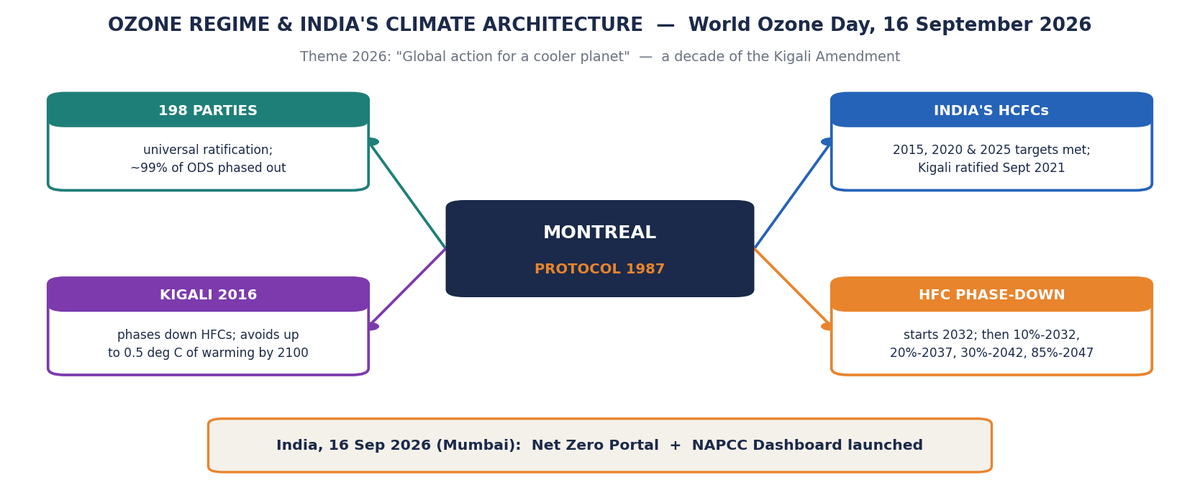
The Montreal Protocol was signed on 16 September 1987 and has 198 parties — universal ratification; about 99% of ozone-depleting substances have been phased out.
The Kigali Amendment (2016) phases down hydrofluorocarbons (HFCs), which are potent greenhouse gases but not ozone-depleting; full implementation could avoid up to 0.5 degrees Celsius of warming by 2100.
India ratified the Kigali Amendment in September 2021; its HFC phase-down begins in 2032, with cuts of 10% by 2032, 20% by 2037, 30% by 2042 and 85% by 2047.
Way forward
Make voluntary disclosure count: link the Net Zero Portal to carbon-credit trading and to the servicing-sector cooling workforce, so reporting translates into measurable abatement.
Concept
The Montreal Protocol is the only universally ratified environmental treaty and works on common but differentiated responsibilities, giving developing countries a grace period. ODS damage stratospheric ozone; HFCs replaced them but have very high Global Warming Potential, which is why Kigali was needed. NAPCC (2008) runs eight national missions.
Mind-map of the ozone regime with the Montreal Protocol 1987 at the centre, branching to 198 parties with about 99% of ozone-depleting substances phased out, the Kigali 2016 amendment avoiding up to 0.5 degrees Celsius of warming, India's HCFC targets met and Kigali ratified in September 2021, and India's HFC phase-down schedule from 2032 to 2047. — StudyForGS
6. WPI inflation at 9.92% in August 2026 as fuel prices stay elevated
ECONOMYCOMMON: Prelims + Mains GS3
Syllabus linkage
GS-III: Indian economy — inflation, monetary policy, index numbers. Prelims: WPI vs CPI, base years, weights, releasing agencies.
Context
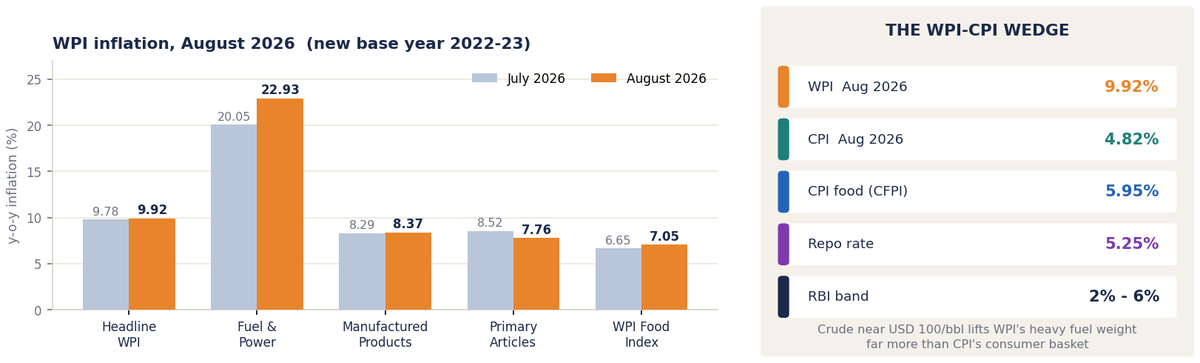
Wholesale price inflation rose to 9.92% in August 2026 from 9.78% in July, the second month of the new 2022-23 base-year series. Retail inflation for the same month was 4.82% — an unusually wide wedge driven by fuel.
Key facts
Sub-indices for August 2026: Fuel and Power 22.93%, Manufactured Products 8.37%, Primary Articles 7.76%, WPI Food Index 7.05%.
The spike is led by mineral oils at 38.48% and crude petroleum and natural gas at 34.41%, with Brent crude near USD 100 a barrel.
CPI for August 2026 was 4.82%, with food inflation (CFPI) at 5.95%; rural 5.23% and urban 4.31%.
The new WPI series (base 2022-23) was released in June 2026, raising the item basket from 697 to 957 and shifting weights to Gross Value of Output; crude petroleum moved from Primary Articles into Fuel and Power.
WPI is released by the Office of the Economic Adviser, DPIIT; CPI by the National Statistics Office, MoSPI (base year 2024).
Way forward
Watch the pass-through: if elevated wholesale fuel costs feed into core retail prices, the neutral policy stance will come under pressure well before the next base-year revision.
Concept
WPI measures prices at the wholesale or producer stage and excludes services, so it carries a heavy weight of fuel and intermediate goods; CPI measures a household consumption basket and includes services. The RBI's flexible inflation targeting mandate, in force since 2016, is anchored to CPI at 4% with a band of plus or minus 2 percentage points. A change of base year updates the basket and weights and does not by itself raise or lower the economy's size.
Grouped bar chart comparing July and August 2026 WPI inflation for headline WPI, fuel and power, manufactured products, primary articles and the WPI food index, alongside a panel showing WPI at 9.92%, CPI at 4.82%, CPI food at 5.95%, the repo rate at 5.25% and the RBI tolerance band of 2 to 6 per cent. — StudyForGS
7. Supreme Court seeks Manipur affidavit on 25 unnatural deaths in relief camps
POLITYCOMMON: Prelims + Mains GS2
Syllabus linkage
GS-II: judiciary, protection of vulnerable sections, government policies for internally displaced persons; GS-I: communalism and ethnic conflict.
Context
A Bench of Chief Justice Surya Kant, Justice Joymalya Bagchi and Justice V. Mohana expressed shock at 25 unnatural deaths in Manipur relief camps and directed the Chief Secretary to file a detailed affidavit.
Key facts
The affidavit must cover post-mortem reports and causes of death, and explain why post-mortems were conducted in only 20 of the cases.
The Court questioned the "meagre" compensation of ₹20,000 to ₹30,000 per family when ₹5 lakh to ₹10 lakh was contemplated in comparable cases.
The Manipur State Legal Services Authority must ensure an FIR is registered in every unnatural death.
Investigation status placed before the Court: about 3,020 cases across 8 districts through 42 SITs; 302 chargesheets, 1,583 closure reports and 1,135 still under investigation.
In the CBI's 31 cases, only 6 of 978 cited witnesses have been examined; the Court discussed two additional NIA courts in Assam.
Way forward
Standardise ex-gratia norms for relief-camp deaths and publish camp-wise health and mortality audits, so judicial monitoring is not the only accountability mechanism.
Concept
The Supreme Court's continuing mandamus lets it monitor compliance over time rather than dispose of a case in one order. Legal Services Authorities exist under the Legal Services Authorities Act, 1987 (Article 39A). Relief-camp residents are internally displaced persons, who remain citizens of their own State and are not covered by refugee law.
8. Supreme Court tells RBI its loan-recovery norms exist only on paper
Deciding Hari Dutta Sharma v. State of Uttar Pradesh, a Bench of Justice P.S. Narasimha and Justice Alok Aradhe held that the RBI's recovery guidelines "have existed only on paper" and directed the central bank to secure genuine compliance by banks and NBFCs alike.
Key facts
Recovery agents seized the borrower's truck at about 1 a.m. on 9 April 2023 in Ayodhya, breaking the steering lock; it was sold for ₹4.50 lakh on 31 August 2023 without proper notice.
Relief: refund of ₹4,50,000 with 6% interest, compensation of ₹10,00,000 for mental agony and loss of livelihood, ₹50,000 costs, and closure of both loan accounts.
The Court invoked Article 21 (right to livelihood) and Article 14 (arbitrariness), and relied on Section 35-A of the Banking Regulation Act, 1949.
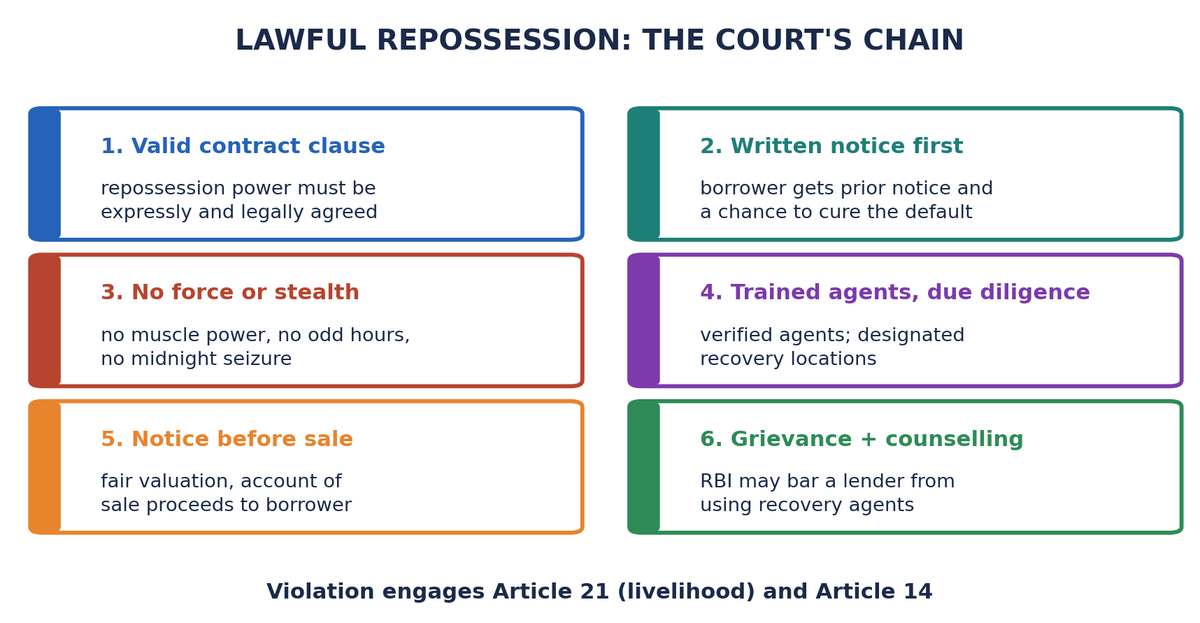
It distilled guiding principles: no undue harassment, no force or stealth, prior notice before repossession, due diligence on recovery agents, designated recovery locations and a credit-counsellor mechanism.
The RBI may bar an institution from engaging recovery agents; the Registry was directed to forward the judgment to the RBI.
Way forward
Convert the judgment into an enforceable code: a time-bound RBI circular with penalties and a public complaints dashboard will do more than another master circular.
Concept
Section 35-A of the Banking Regulation Act empowers the RBI to issue binding directions in the public interest. NBFCs are registered under the RBI Act, 1934; they lend but cannot accept demand deposits. The Fair Practices Code governs lender conduct. Note the distinction: Article 300A protects property as a constitutional right, while Article 21 was the route used here because livelihood was at stake.
Flowchart of the six safeguards the Supreme Court set out for lawful vehicle repossession: a valid contract clause, written notice first, no force or stealth, trained agents and due diligence, notice before sale, and a grievance plus credit-counselling mechanism, with a footer noting that violation engages Article 21 and Article 14. — StudyForGS
9. EPFO wage ceiling rises to ₹25,000 a month with effect from today
SOCIETYCOMMON: Prelims + Mains GS2 + GS3
Syllabus linkage
GS-II: welfare schemes and social-sector mechanisms; GS-III: employment, formalisation of the workforce. Prelims: EPF and MP Act 1952, EPS 1995, EDLI 1976.
Context
The Union Cabinet's decision of 16 September 2026 raising the statutory EPFO wage ceiling from ₹15,000 to ₹25,000 a month takes effect today, 17 September 2026. It is the first revision in 12 years.
Key facts
More than 51 lakh additional employees in the ₹15,001 to ₹25,000 wage band enter the statutory social-security net.
Fiscal cost: ₹11,339 crore a year against the existing ₹10,250 crore, and about ₹56,696 crore over five years.
The ceiling was last revised in September 2014, when it rose from ₹6,500 to ₹15,000.
EPFO scale today: about 7.98 crore contributing members across 7.68 lakh establishments, and roughly 82 lakh EPS pensioners.
Statutory basis: the Employees' Provident Funds and Miscellaneous Provisions Act, 1952, with consequential changes to the EPF Scheme 1952, EPS 1995 and EDLI Scheme 1976.
Way forward
Formalisation must not become an employment tax: watch whether firms respond by restructuring pay or hiring off the rolls, and pair the ceiling rise with simpler compliance for small establishments.
Concept
The EPF is a defined-contribution retirement fund; the EPS is a defined-benefit pension; the EDLI provides life insurance linked to the provident fund. A wage ceiling sets the salary level up to which membership is compulsory and contributions are computed. EPFO is administered by a tripartite Central Board of Trustees under the Ministry of Labour and Employment.
10. New Zealand Parliament ratifies the India-New Zealand FTA by 93 votes to 29
IRCOMMON: Prelims + Mains GS2 + GS3
Syllabus linkage
GS-II: bilateral agreements involving India, effect of policies of developed countries; GS-III: external sector, trade. Prelims: tariff lines, TRQ, exclusion lists, CPTPP.
Context
On 16 September 2026 the New Zealand Parliament ratified the India-New Zealand Free Trade Agreement by 93 votes to 29, with both the governing and principal opposition parties in favour. The agreement was signed on 27 April 2026.
Key facts
Negotiations were launched in March 2025 and concluded in about nine months — billed as India's fastest-concluded FTA.
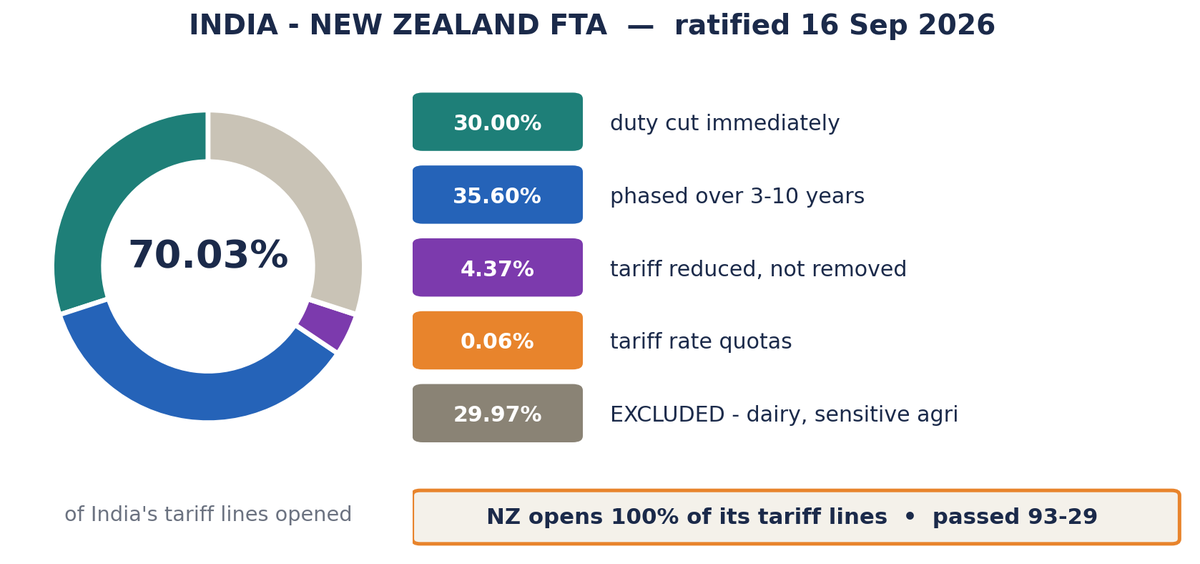
New Zealand grants duty-free access on 100% of its tariff lines; India opens 70.03% of its tariff lines, covering about 95% of bilateral trade.
India's schedule: 30% of lines see immediate elimination, 35.60% phased over 3 to 10 years, 4.37% reduced but not eliminated, 0.06% under tariff rate quotas, and 29.97% excluded.
Dairy is fully excluded by India, along with other sensitive agriculture and sugar — the headline defensive win.
Bilateral merchandise trade rose from USD 873 million in 2023-24 to USD 1.3 billion in 2024-25.
Way forward
Ratification is the easy half: MSME exporters need rules-of-origin guidance, shared testing and certification support if the 70% opening is to become actual shipments.
Concept
A tariff line is a single product code in the customs schedule. A tariff rate quota allows a fixed quantity at a low duty and charges a higher duty beyond it. An exclusion list protects sensitive sectors from any concession. New Zealand is a member of the Commonwealth, APEC and the CPTPP; its capital is Wellington and largest city Auckland.
Donut chart of India's tariff-line commitments under the India-New Zealand FTA showing 70.03% opened, split into 30% immediate elimination, 35.60% phased over three to ten years, 4.37% reduced not removed and 0.06% under tariff rate quotas, against 29.97% excluded including dairy and sensitive agriculture, with New Zealand opening 100% of its tariff lines. — StudyForGS
Data point of the day
9.92%
Wholesale Price Index inflation, August 2026 Up from 9.78% in July 2026 on the new 2022-23 base year. Fuel and Power ran at 22.93% and mineral oils at 38.48%, while retail CPI inflation for the same month was only 4.82% — the widest wholesale-retail wedge in years, and a reminder that WPI carries no services and a heavy fuel weight.
Prelims rapid-fire
Gucchi (Morchella esculenta), the Himalayan morel served at the BRICS 2026 gala dinner, sells for ₹15,000 to ₹40,000 a kg and grows wild in Jammu & Kashmir, Himachal Pradesh and Uttarakhand.
India exported about 500 tonnes of hilsa (Tenualosa ilisha) to Bangladesh over two months — the first time the trade has run in this direction. Hilsa is anadromous and Bangladesh's national fish.
PLFS bulletin, August 2026: unemployment rate 5.0%, LFPR 55.6%, worker-population ratio 52.8%; released by the NSO under MoSPI.
Merchandise trade, August 2026: exports USD 43.81 billion, imports USD 70.67 billion, deficit USD 26.86 billion; the overall goods-and-services deficit narrowed to USD 9.41 billion.
Exercise Yudh Abhyas 2026, the 22nd India-US army exercise, runs 15-28 September 2026 at Auli, Uttarakhand and Mahajan Field Firing Range, Rajasthan — the first time on two terrains at once, with about 600 personnel a side.
PRL Ahmedabad used Chandrayaan-1's Moon Mineralogy Mapper (M3) to identify the Australe Basin, a lost lunar impact basin ringed by orthopyroxene and inferred to be older than 4 billion years.
Practice MCQs — UPSC Prelims pattern
Q1. With reference to the Wholesale Price Index (WPI) in India, consider the following statements:
1. It is released by the National Statistics Office under the Ministry of Statistics and Programme Implementation.
2. It does not cover services.
3. The Reserve Bank of India's flexible inflation-targeting mandate is anchored to the WPI.
Which of the statements given above is/are correct?
1 and 2 only
2 only
2 and 3 only
1, 2 and 3
Show answer
Answer: B Statement 1 is incorrect: the WPI comes from the Office of the Economic Adviser, DPIIT, while the CPI comes from the NSO under MoSPI. Statement 2 is correct: the WPI covers only goods. Statement 3 is incorrect: flexible inflation targeting is anchored to CPI at 4% with a 2-6% band.
Q2. With reference to the Kigali Amendment, consider the following statements:
1. It was adopted under the Montreal Protocol and targets hydrofluorocarbons.
2. Hydrofluorocarbons are potent ozone-depleting substances.
3. India ratified the Amendment in 2021 and will begin its phase-down in 2032.
Which of the statements given above is/are correct?
1 only
1 and 3 only
2 and 3 only
1, 2 and 3
Show answer
Answer: B Statements 1 and 3 are correct: the Kigali Amendment of 2016 phases down HFCs under the Montreal Protocol; India ratified it in September 2021 and starts its cuts in 2032, reaching 85% by 2047. Statement 2 is incorrect: HFCs do not deplete ozone at all — they are targeted as potent greenhouse gases.
Mains practice question
Q. "India's semiconductor push has moved from incentive announcements to an ecosystem problem." In the light of India Semiconductor Mission 2.0, examine the constraints that stand between approved fabrication projects and a resilient domestic chip supply chain. (250 words, 15 marks)
Hint / approach
Open with the scale shift: ₹76,000 crore to ₹1,27,500 crore, 12 approved projects, 3 in production. Structure the constraints under four heads — import-dependent upstream inputs, capital equipment and a narrow global vendor base, talent, and demand-side anchoring through design wins. Balance with enablers: DLI, EDA access, and mature 28 nm and above nodes as a realistic entry point. Conclude that resilience is measured in yield and supply-chain depth, not in approved outlay.
📌 One-line revision: Remember today by five numbers: ₹1,27,500 crore for Semiconductor Mission 2.0, ₹25,000 as the new EPFO wage ceiling, 9.92% WPI inflation, 70.03% of India's tariff lines opened to New Zealand, and 0.4% UPI MDR above ₹2,000.