Centre bars charges on UPI up to ₹2,000; wholesale inflation jumps to 9.92% while retail holds at 4.82%; the BRICS New Delhi Declaration closes India's presidency
Tuesday, 15 September 2026 · IST · National & International · 10 items · 2 MCQs
A Finance Ministry notification under Section 10A of the Payment and Settlement Systems Act bars any charge on UPI payments up to ₹2,000 and on RuPay debit card transactions, reopening the merchant discount rate question for larger payments. August inflation data showed a widening wedge — wholesale prices up 9.92% on a fuel shock, retail at 4.82% inside the RBI band. Diplomatically, the 18th BRICS Summit in New Delhi adopted a 140-paragraph declaration and India handed the chair to China, while India and Mercosur launched talks to widen their preferential trade pact.
Today at a glance — things to remember
Centre bars any charge on UPI payments up to ₹2,000 and on all RuPay debit card transactions.
WPI inflation at 9.92% in August 2026 — Fuel & Power at 22.93% does the damage.
Retail inflation 4.82%, food at 5.95% — still inside the RBI's 2–6% band.
18th BRICS Summit in New Delhi adopts a 140-paragraph New Delhi Declaration.
India hands the BRICS chair to China for 2027.
India–Mercosur launch talks to widen the 2004 PTA; e-certificates of origin get legal parity.
Supreme Court: an honest but broken marriage promise is not an offence under Section 69 BNS.
World Circular Economy Forum opens at Gandhinagar — the first edition in South Asia.
Project Cheetah count reaches 52; habitat under the project at 3,428 sq km.
India and Vietnam agree to co-produce defence hardware at the 19th Joint Commission Meeting.
Detailed notes
1. Centre bars all charges on UPI and RuPay debit card payments up to ₹2,000
ECONOMYCOMMON: Prelims + Mains GS3
Syllabus linkage
GS-III — Indian Economy: mobilisation of resources, banking and digital payments. Prelims pointers: Payment and Settlement Systems Act 2007, Section 10A, MDR, NPCI, RuPay, UPI.
Context
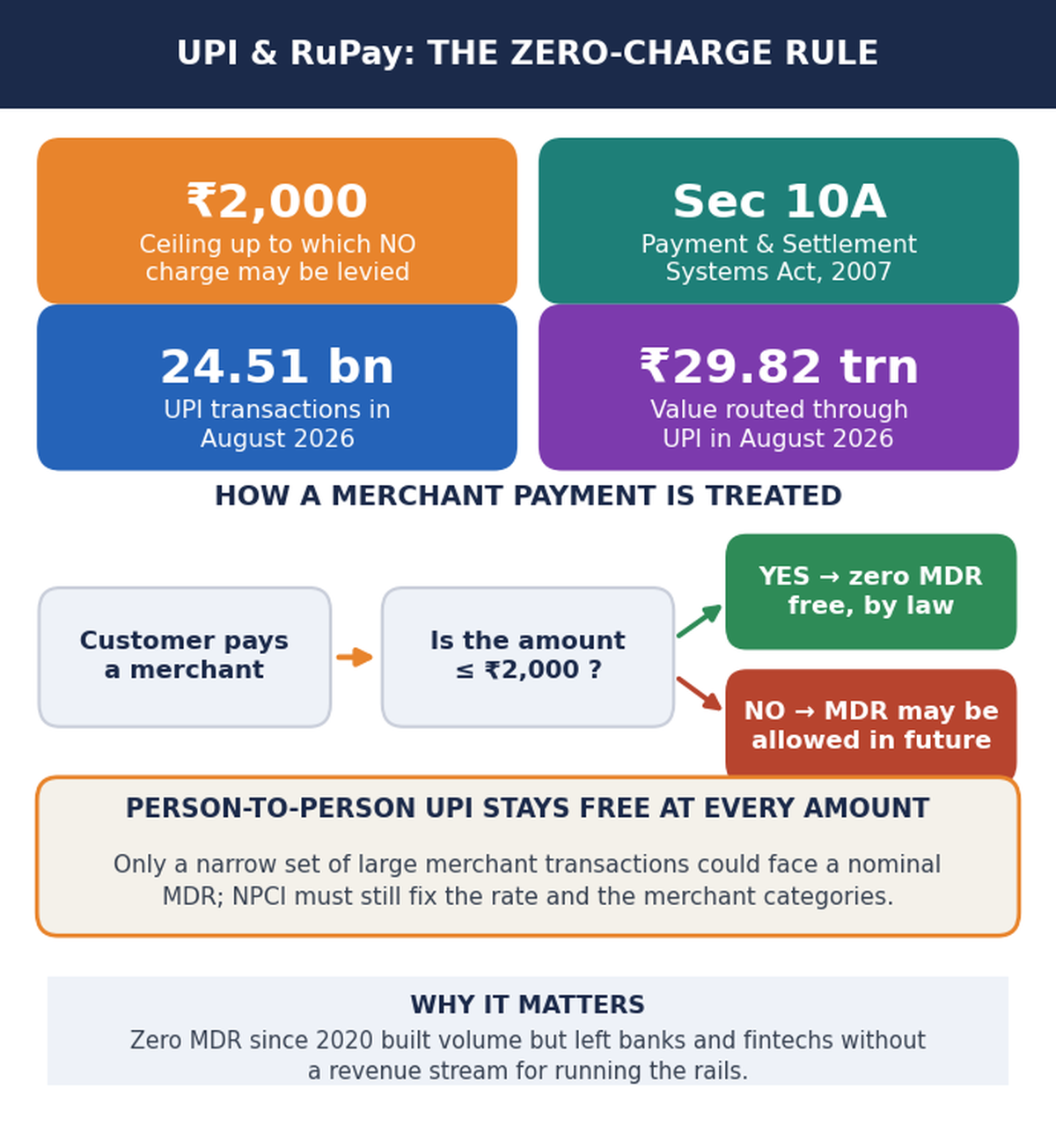
A Finance Ministry notification of 14 September 2026 prohibits banks and system providers from levying any charge, direct or indirect, on UPI transactions up to ₹2,000 and on RuPay debit card transactions. By fixing a ceiling, it also reopens the question of a Merchant Discount Rate above that line.
Key facts
Issued under Section 10A of the Payment and Settlement Systems Act, 2007, which empowers the Centre to bar charges on prescribed electronic payment modes.
The bar covers UPI payments up to ₹2,000 and all RuPay debit card transactions; person-to-person UPI stays free at every value.
Zero MDR has applied to UPI and RuPay since 1 January 2020; banks and fintechs have carried the cost of running the rails since.
UPI handled 24.51 billion transactions worth ₹29.82 trillion in August 2026.
NPCI must still fix the rate and the merchant categories; industry expects 25–30 basis points, and only for larger merchants.
Way forward
Any MDR must be calibrated so that small merchants stay on digital rails while the payment system gets a sustainable revenue base — a turnover-linked slab with continued incentive support is the likeliest middle path.
Concept
MDR is the fee a merchant pays its bank on a digital payment, shared between the acquiring bank, the issuing bank and the network. Section 10A was inserted by the Finance (No. 2) Act, 2019. NPCI, set up in 2008 under the Payment and Settlement Systems Act, 2007, is a Section 8 not-for-profit company and the umbrella body for retail payments.
Infographic on the UPI zero-charge rule: the ₹2,000 ceiling, Section 10A of the Payment and Settlement Systems Act 2007, 24.51 billion UPI transactions worth ₹29.82 trillion in August 2026, and a flowchart showing that payments at or below ₹2,000 carry zero MDR while larger merchant payments may attract one in future. — StudyForGS
2. Telecom department's Financial Fraud Risk Indicator heads off ₹5,043 crore of suspected cyber fraud
SCI-TECHCOMMON: Prelims + Mains GS3
Syllabus linkage
GS-III — Internal security: cyber security, money laundering, role of technology in security. Prelims: Digital Intelligence Platform, Sanchar Saathi, FRI risk tiers, I4C.
Context
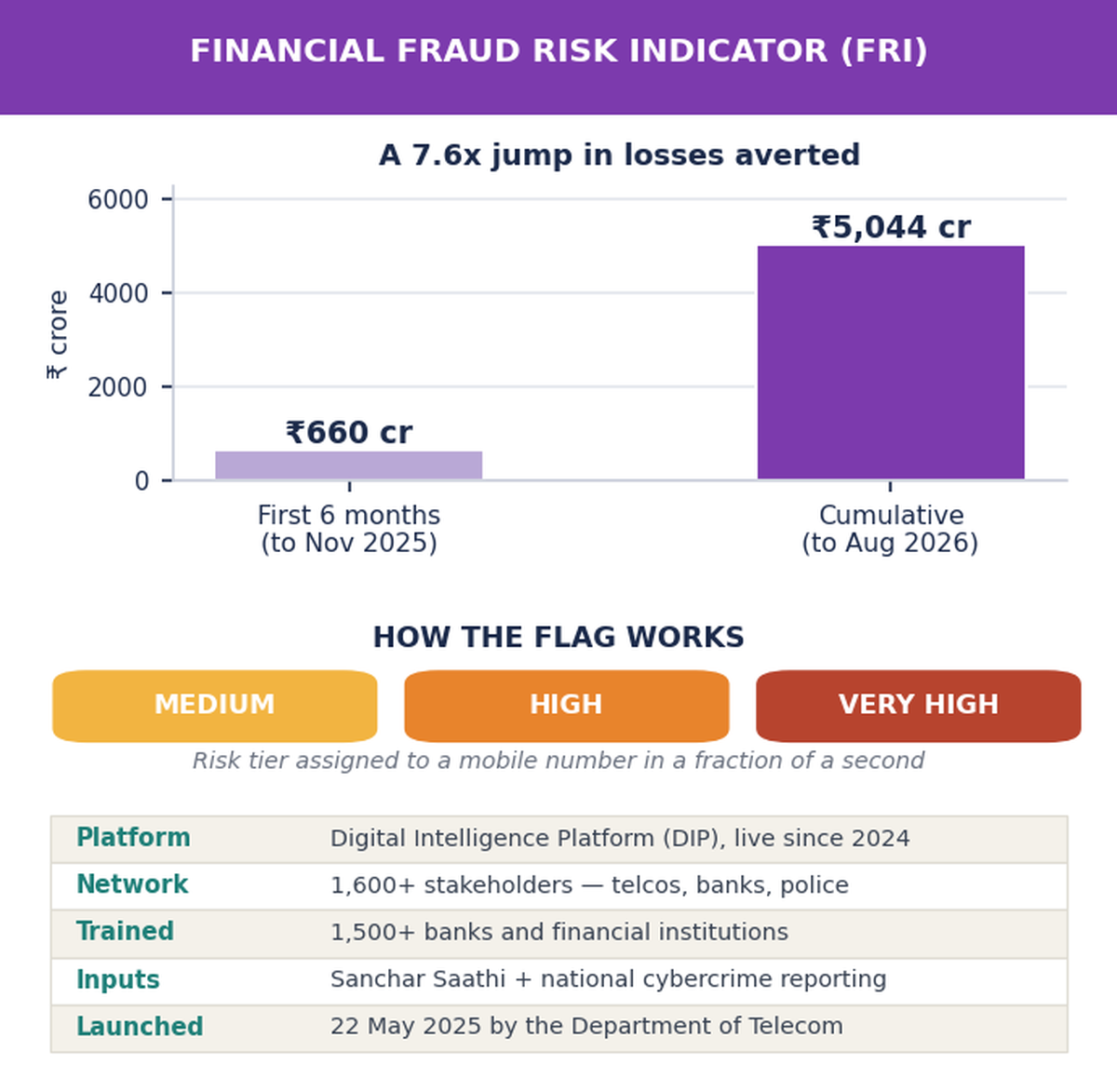
Cumulative figures to August 2026 show the Financial Fraud Risk Indicator has helped banks stop suspected fraudulent transfers worth ₹5,043.73 crore, against ₹660 crore in its first six months — evidence that telecom-side intelligence is now a working layer of financial security.
Key facts
FRI was launched by the Department of Telecommunications on 22 May 2025; it labels a mobile number Medium, High or Very High risk in a fraction of a second when a payment starts.
It runs on the Digital Intelligence Platform (DIP), live since 2024, linking over 1,600 stakeholders — telecom operators, banks and law-enforcement agencies.
Suspected fraud prevented rose from ₹660 crore in the first six months to ₹5,043.73 crore cumulatively by August 2026 — a roughly 7.6-fold jump.
More than 1,500 banks and financial institutions have been trained across 25-plus sessions.
Inputs come from citizen reports on the Sanchar Saathi portal and the national cybercrime reporting system; the RBI has asked banks to integrate the tool.
Way forward
Extend real-time flagging beyond mobile numbers to device and account fingerprints, and give wrongly flagged users a fast, transparent appeal route so financial inclusion is not the collateral cost.
Concept
Sanchar Saathi lets a citizen check the connections issued in their name and report suspected fraud communication; Chakshu is its reporting facility. Cybercrime complaints go to the national cybercrime reporting portal run under the Indian Cyber Crime Coordination Centre (I4C) of the Ministry of Home Affairs.
Chart and fact sheet on the Financial Fraud Risk Indicator: a bar chart comparing ₹660 crore of fraud prevented in the first six months with ₹5,043.73 crore cumulatively by August 2026, the Medium, High and Very High risk tiers, and details of the Digital Intelligence Platform. — StudyForGS
3. Semicon 2.0 becomes formal policy as India's chip design base widens before SEMICON India 2026
SCI-TECHCOMMON: Prelims + Mains GS3
Syllabus linkage
GS-III — Science and technology: indigenisation and achievements in the semiconductor sector; industrial policy. Prelims: India Semiconductor Mission, ChipIN Centre, DLI, ATMP/OSAT, tape-out.
Context
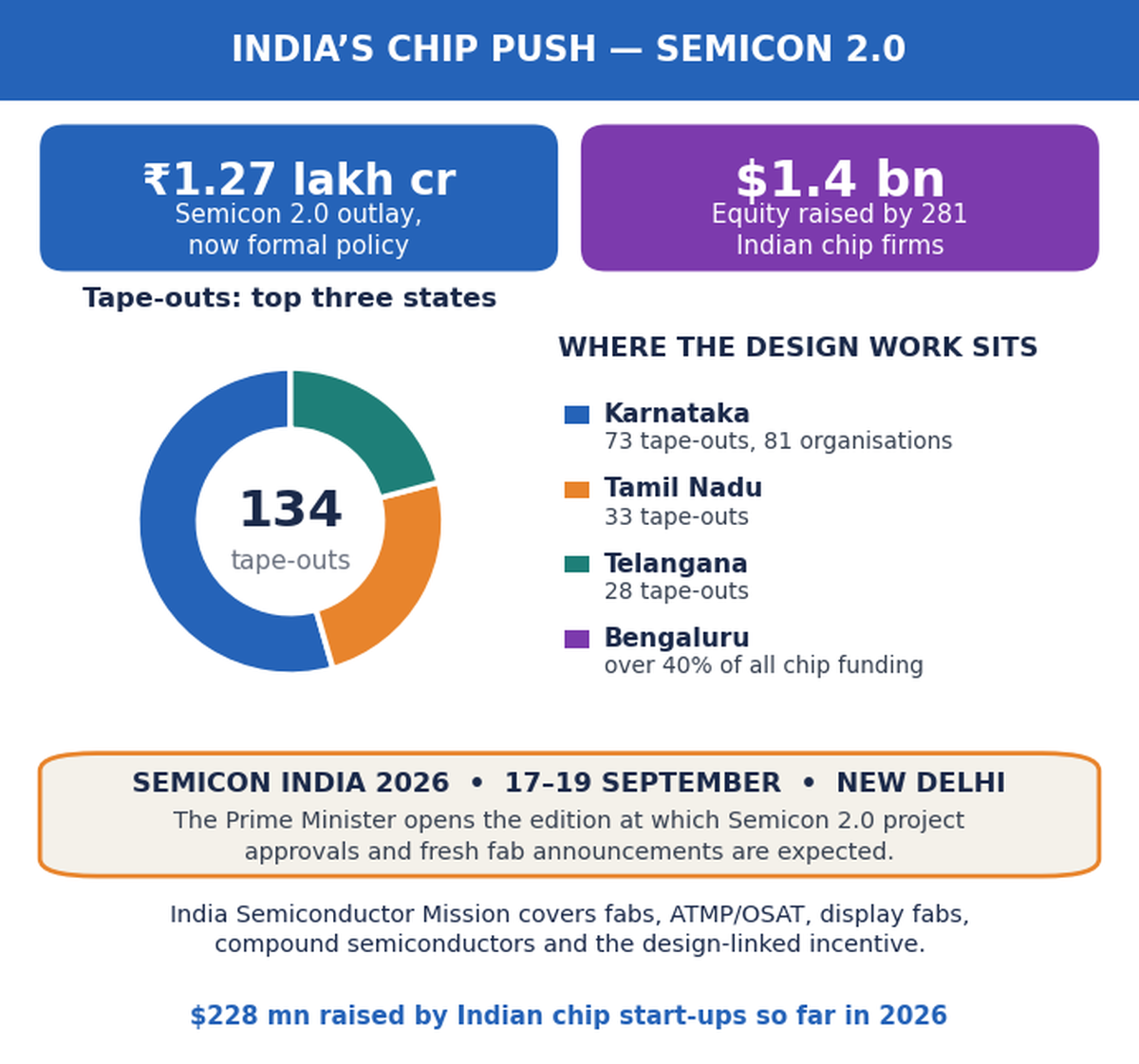
The second phase of India's semiconductor programme — Semicon 2.0, with an outlay of ₹1.27 lakh crore — is now settled policy, and fresh data show design activity spreading across states. SEMICON India 2026 opens in New Delhi on 17 September.
Key facts
Semicon 2.0 carries an outlay of ₹1.27 lakh crore, succeeding the first phase of the India Semiconductor Mission.
281 Indian semiconductor companies have raised about $1.4 billion in equity, of which $228 million came in 2026 so far.
Under the ChipIN Centre, Karnataka leads with 73 tape-outs and 81 supported organisations, ahead of Tamil Nadu (33) and Telangana (28).
Bengaluru alone accounts for over 40% of all semiconductor funding raised in India.
SEMICON India 2026 runs 17–19 September in New Delhi and is to be inaugurated by the Prime Minister.
Way forward
Money for fabs must be matched by IP ownership and deep R&D — the durable value in semiconductors sits in design and process know-how, not in assembly capacity alone.
Concept
A tape-out is the point at which a completed chip design is sent for fabrication. ATMP/OSAT covers assembly, testing, marking and packaging. The Design Linked Incentive (DLI) scheme supports domestic fabless design firms, and the ChipIN Centre at C-DAC gives start-ups shared access to expensive EDA tools and design infrastructure.
Fact sheet on India's semiconductor push: ₹1.27 lakh crore Semicon 2.0 outlay, $1.4 billion raised by 281 chip companies, and a donut chart of 134 tape-outs across Karnataka (73), Tamil Nadu (33) and Telangana (28), with SEMICON India 2026 dates. — StudyForGS
4. World Circular Economy Forum opens in Gandhinagar — first edition hosted in South Asia
The World Circular Economy Forum 2026 opens today at the Mahatma Mandir in Gandhinagar and runs to 18 September. It is the tenth edition of the forum and the first to be held anywhere in South Asia.
Key facts
Dates 15–18 September 2026, venue Mahatma Mandir, Gandhinagar, Gujarat; theme "Circular Economy: Transition for People and Prosperity".
The forum was created in 2017 by Sitra, Finland's innovation fund; the 2026 edition marks its tenth anniversary and its first South Asian hosting.
Expected participation of over 2,000 stakeholders from 65+ countries with 125+ exhibitors.
Four tracks: finance and investment; technology and innovation (AI, IoT, digital product passports); policy and EPR harmonisation; market solutions.
India co-chairs the board of the UN 10-Year Framework of Programmes on Sustainable Consumption and Production (10YFP), which meets during the forum.
Way forward
Circularity will scale only when recycled material is cheaper and easier to source than virgin material — that needs enforceable EPR targets, quality standards for secondary raw material, and credit lines for the informal recycling sector.
Concept
A circular economy replaces the take-make-dispose linear model by designing out waste and keeping materials in use. Extended Producer Responsibility (EPR) makes the producer responsible for a product's end-of-life stage. Mission LiFE (Lifestyle for Environment), proposed by India, promotes mindful consumption over mindless consumption.
5. Gujarat action plan for the Great Indian Bustard; soft-release centre opens in Kachchh
ENVIRONMENTCOMMON: Prelims + Mains GS3
Syllabus linkage
GS-III — Environment and biodiversity: conservation of species and habitats, grassland ecology. Prelims: Great Indian Bustard, IUCN status, Kachchh, Schedule I of the Wild Life (Protection) Act, 1972.
Context
The Union Environment Minister reviewed Great Indian Bustard conservation and grassland restoration in Gujarat on 13 September 2026, released the state action plan and opened a soft-release centre for captive-bred birds in Kachchh.
Key facts
The Gujarat Action Plan targets a minimum viable population of 30 or more birds over 200–500 sq km.
Lala–Rawa in Kachchh (about 200 sq km) is the priority landscape; around 11 sq km of degraded grassland has been restored with predator-proof fencing.
A GIB Soft Release Centre has been set up to acclimatise captive-bred birds brought from Rajasthan before release into the wild.
The Great Indian Bustard (Ardeotis nigriceps) is Critically Endangered on the IUCN Red List and is listed in Schedule I of the Wild Life (Protection) Act, 1972.
Overhead power lines remain the single biggest mortality risk; the species now survives mainly in Rajasthan's Thar landscape and in Kachchh.
Way forward
Grasslands must stop being treated as wasteland. Undergrounding transmission lines or fitting bird diverters in bustard landscapes, plus community stewardship of village commons, will do more than captive breeding alone.
Concept
Soft release means acclimatising captive-bred animals inside a fenced enclosure within the target habitat before full release. India's grasslands are still recorded as "wastelands" in revenue records, which is the root cause of their diversion. The firefly bird diverter is the standard mitigation fitted on power lines in bustard habitat.
6. Project Cheetah crosses 52 animals as habitat under the programme widens to 3,428 sq km
ENVIRONMENTCOMMON: Prelims + Mains GS3
Syllabus linkage
GS-III — Environment: conservation, species reintroduction, protected areas. Prelims: Kuno, Gandhi Sagar, Banni, Nauradehi, IUCN status of the cheetah.
Context
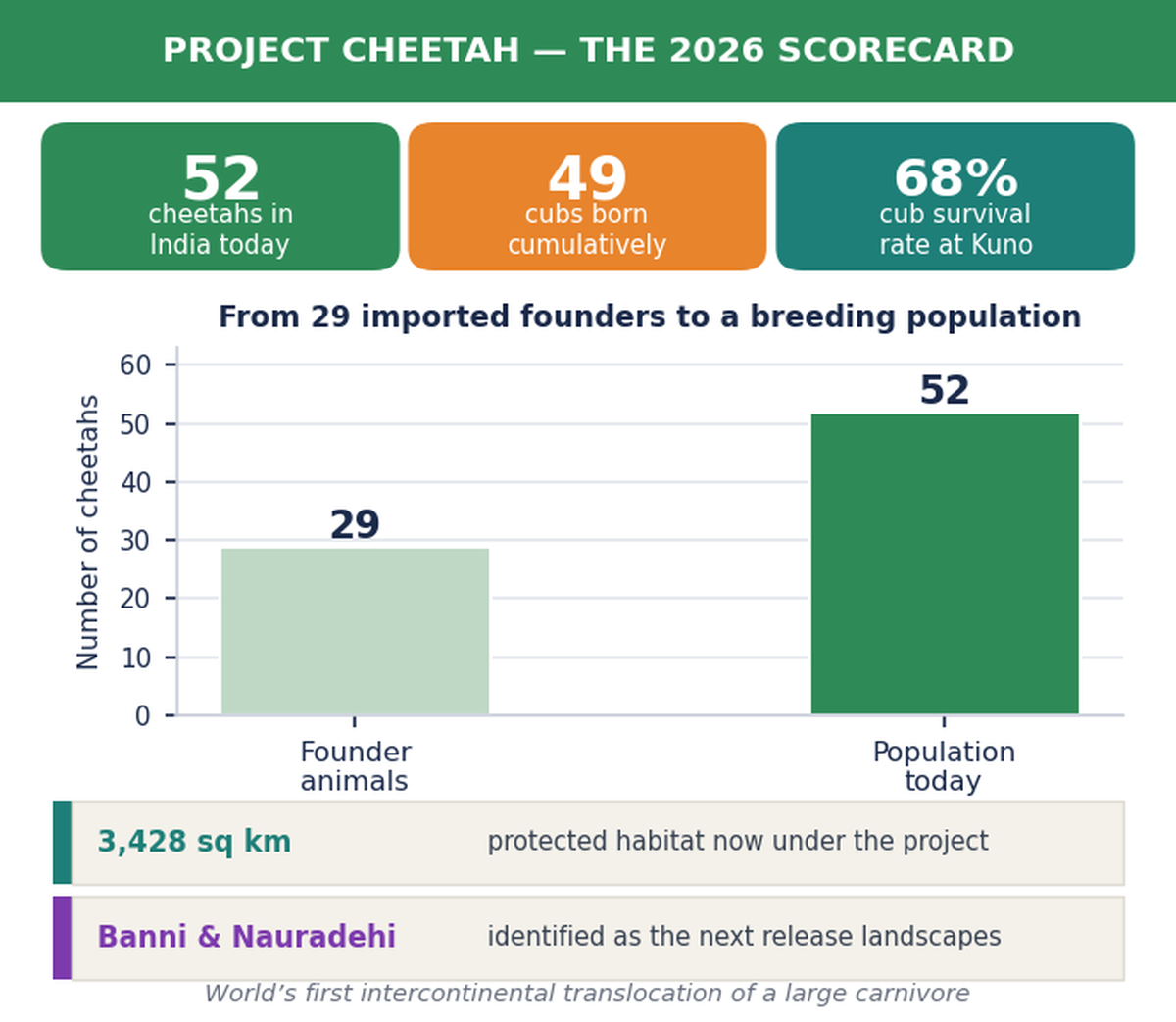
A review of Project Cheetah placed the Indian population at 52 animals, grown from 29 founder individuals imported from Namibia and South Africa, with the protected landscape under the project now covering 3,428 sq km.
Key facts
The population has risen from 29 founder cheetahs to 52 individuals; 49 cubs have been born in India cumulatively.
Cub survival at Kuno National Park is about 68%.
Protected habitat under the project now covers 3,428 sq km.
Banni Grasslands (Gujarat) and Nauradehi (Madhya Pradesh) are identified as future release sites, alongside Gandhi Sagar Wildlife Sanctuary.
Project Cheetah, begun in September 2022, is the world's first intercontinental translocation of a large carnivore.
Way forward
Long-term success needs a genuine metapopulation across several sites linked by corridors, prey-base augmentation and local livelihood support — not a single showcase park.
Concept
The Asiatic cheetah was declared extinct in India in 1952; the animals introduced are African cheetahs (Acinonyx jubatus jubatus), listed as Vulnerable on the IUCN Red List. Kuno National Park lies in the Sheopur district of Madhya Pradesh, in the Chambal landscape.
Scorecard for Project Cheetah showing 52 cheetahs in India, 49 cubs born, 68% cub survival at Kuno, a bar chart comparing 29 founder animals with the present 52, and 3,428 sq km of protected habitat. — StudyForGS
7. Supreme Court: a genuine marriage promise later broken is not an offence under Section 69 BNS
POLITYCOMMON: Prelims + Mains GS2
Syllabus linkage
GS-II — Polity and Governance: structure and functioning of the judiciary; criminal law reform. Prelims: Bharatiya Nyaya Sanhita 2023, Section 69, quashing of FIRs, misconception of fact.
Context
In Kunal Rameshbhai Kalyani v. State of Gujarat, a Bench of Justices J.B. Pardiwala and K. Vinod Chandran held that Section 69 of the Bharatiya Nyaya Sanhita punishes a promise that was false when made, not one honestly made and later not kept. The FIR was quashed.
Key facts
Bench of Justices J.B. Pardiwala and K. Vinod Chandran; the judgment was delivered on 7 September 2026 and reported this week.
Section 69 BNS penalises sexual intercourse obtained by deceitful means or a promise to marry made without any intention of fulfilling it — a distinct offence carved out from rape.
The Court held the deception must exist at the inception of the promise; a later failure to marry is not by itself an offence.
The man had withdrawn from the marriage citing his mother's objection; the Court read the relationship as consensual.
The Court relied on Deepak Gulati v. State of Haryana (2013), which distinguished a false promise from a breach of promise.
Way forward
Clear judicial standards reduce misuse of a provision meant for genuine deceit, while leaving the offence intact where consent was actually obtained by fraud — investigation manuals should now build in an inception-of-intent test.
Concept
The Bharatiya Nyaya Sanhita, 2023 replaced the Indian Penal Code, 1860 with effect from 1 July 2024, alongside the Bharatiya Nagarik Suraksha Sanhita and the Bharatiya Sakshya Adhiniyam. Consent given under a misconception of fact is not valid consent in criminal law.
8. 18th BRICS Summit adopts the New Delhi Declaration; India hands the chair to China
IRCOMMON: Prelims + Mains GS2
Syllabus linkage
GS-II — International relations: bilateral, regional and global groupings involving India. Prelims: BRICS members and partners, New Development Bank, Contingent Reserve Arrangement, CBAM.
Context
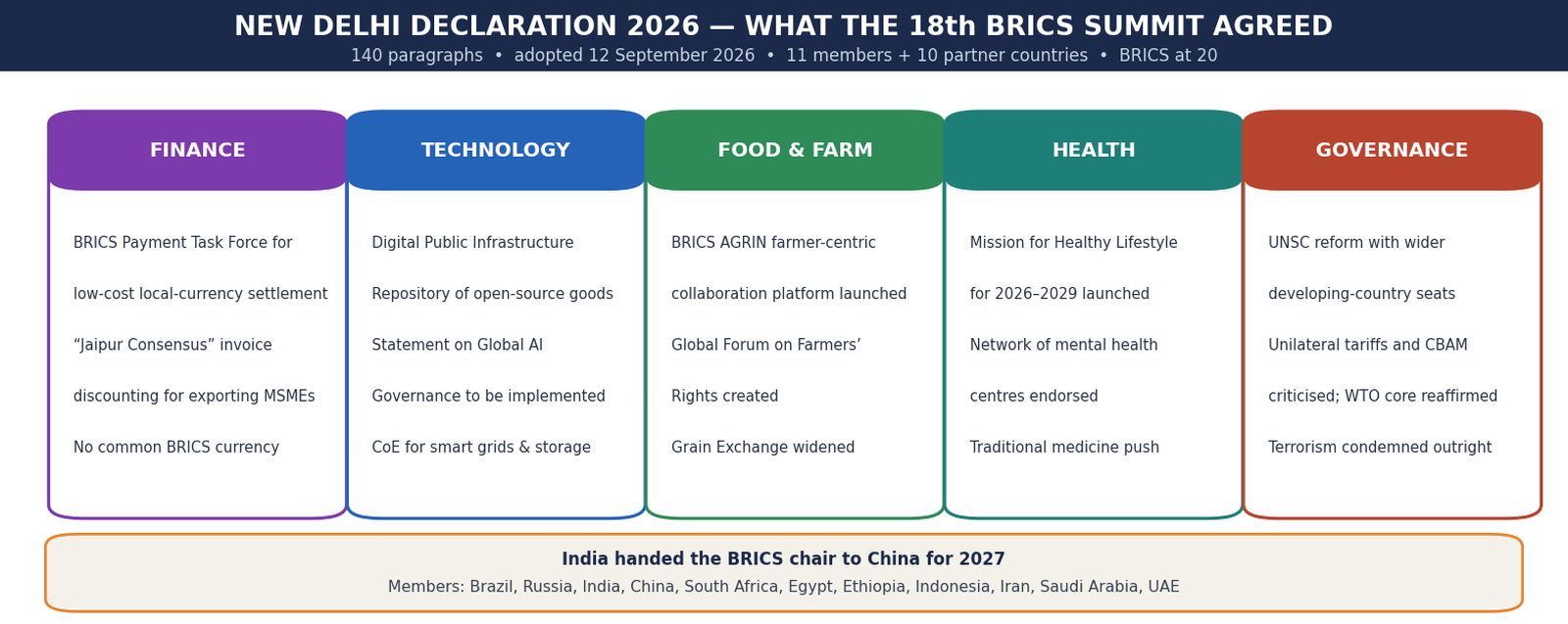
The 18th BRICS Summit, held at Bharat Mandapam in New Delhi on 12–13 September 2026 under India's presidency, adopted a 140-paragraph New Delhi Declaration. India handed the chair to China for 2027.
Key facts
Theme: "Building for Resilience, Innovation, Cooperation and Sustainability"; the grouping marked its 20th anniversary.
11 members — Brazil, Russia, India, China, South Africa, Egypt, Ethiopia, Indonesia, Iran, Saudi Arabia and the UAE — plus 10 partner countries.
Finance: the BRICS Payment Task Force was tasked with low-cost local-currency settlement, and the "Jaipur Consensus" invoice-discounting mechanism for exporting MSMEs was endorsed. No common BRICS currency was agreed.
New initiatives: BRICS AGRIN farmer platform, a Global Forum on Farmers' Rights, a Digital Public Infrastructure Repository and the BRICS Mission for Healthy Lifestyle (2026–2029).
The declaration pressed for UN Security Council reform, criticised unilateral tariffs and carbon border measures (CBAM), and condemned terrorism, naming the April 2025 Jammu & Kashmir attack.
Way forward
India's value inside BRICS lies in keeping it a reform-of-multilateralism platform rather than an anti-West bloc — an agenda of payment plumbing, food security and AI governance serves that better than currency symbolism.
Concept
BRIC began as a 2001 coinage, became a formal grouping in 2006 and added South Africa in 2010. Its institutions are the New Development Bank (Shanghai, 2014) and the Contingent Reserve Arrangement. CBAM is the European Union's carbon border adjustment mechanism — effectively a tariff on the embedded carbon of imports.
Five-pillar summary of the New Delhi Declaration 2026 covering finance, technology, food and farm, health and governance outcomes of the 18th BRICS Summit, with the member list and the handover of the chair to China for 2027. — StudyForGS
9. India and Mercosur launch talks to widen their preferential trade pact, sign e-certificate protocol
IRCOMMON: Prelims + Mains GS2
Syllabus linkage
GS-II — International relations: regional groupings and agreements involving India; GS-III: external trade. Prelims: Mercosur members, PTA vs FTA vs customs union, rules of origin, certificate of origin.
Context
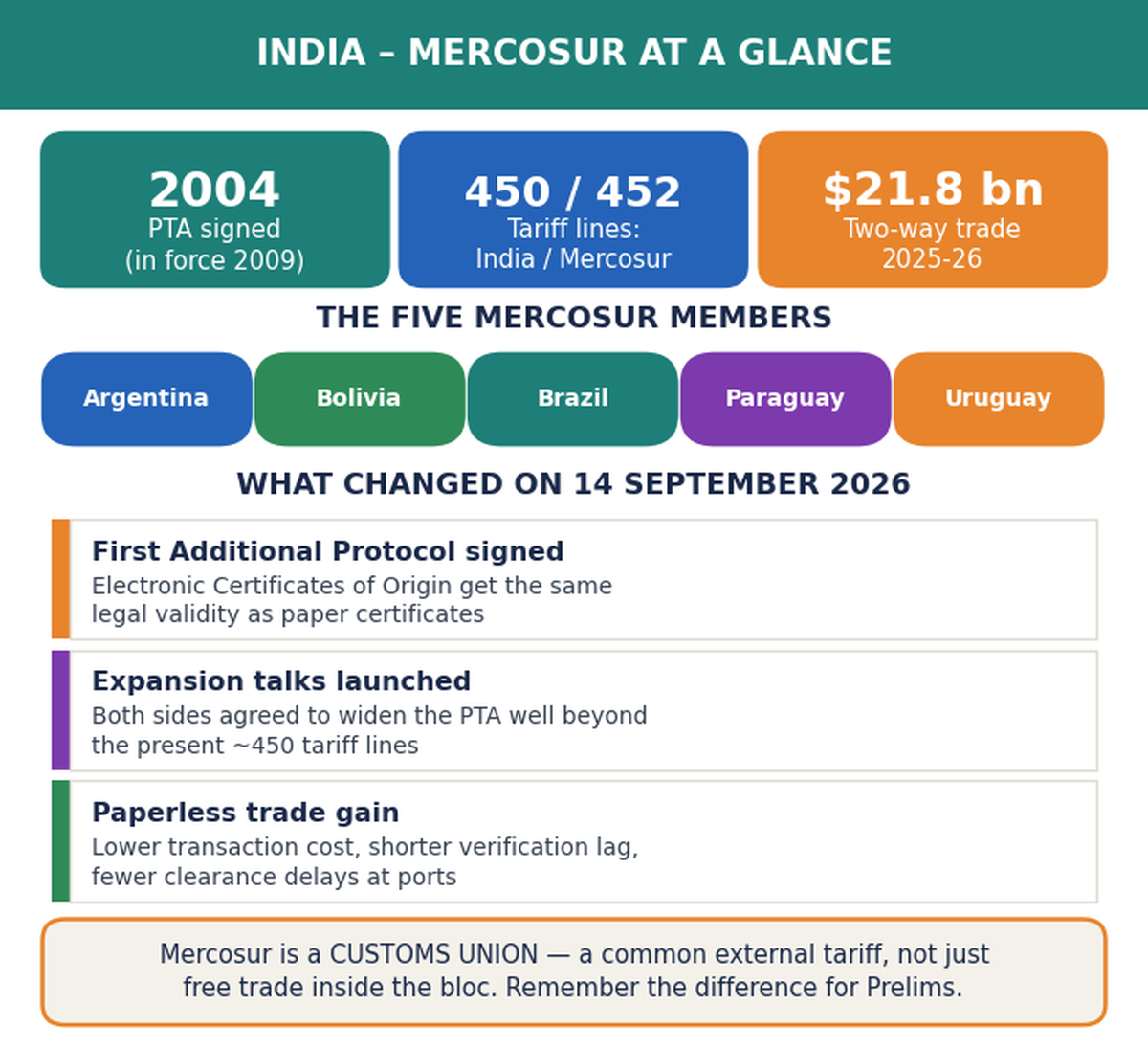
India and the South American bloc Mercosur announced on 14 September 2026 the launch of negotiations to expand their 2004 preferential trade agreement, and signed a first additional protocol giving electronic certificates of origin the same legal standing as paper ones.
Key facts
The India–Mercosur PTA was signed in 2004 and came into force in 2009, covering 450 tariff lines on India's side and 452 on Mercosur's.
Two-way trade stood at $21.8 billion in 2025-26.
The First Additional Protocol makes electronic Certificates of Origin legally equivalent to paper certificates, cutting transaction cost and verification lag.
Mercosur's five full members are Argentina, Bolivia, Brazil, Paraguay and Uruguay.
The protocol enters into force once both sides complete internal procedures and notify each other.
Way forward
A wider Mercosur pact is India's most direct route into South American agri-inputs, critical minerals and pharmaceutical markets — the negotiation should target tariff lines that diversify India's import basket away from single-source dependencies.
Concept
A PTA offers tariff concessions on a limited list of goods; an FTA removes tariffs on substantially all trade; a customs union like Mercosur adds a common external tariff; a common market adds free movement of factors of production. Rules of origin, evidenced by a certificate of origin, prevent trade deflection through a low-tariff member.
Fact sheet on India–Mercosur trade: PTA signed in 2004 and in force from 2009, 450 and 452 tariff lines, $21.8 billion two-way trade in 2025-26, the five member countries, and the three outcomes of 14 September 2026. — StudyForGS
10. India and Vietnam agree to co-produce defence hardware at the 19th Joint Commission Meeting
DEFENCECOMMON: Prelims + Mains GS2
Syllabus linkage
GS-II — International relations: India's bilateral partnerships and the Indo-Pacific; GS-III: defence indigenisation and exports. Prelims: Enhanced Comprehensive Strategic Partnership, Act East Policy, UNCLOS, South China Sea.
Context
External Affairs Minister S. Jaishankar and Vietnam's Deputy Prime Minister and Foreign Minister Le Hoai Trung co-chaired the 19th India–Vietnam Joint Commission Meeting on 14 September 2026, agreeing to deepen defence ties through co-production of Indian defence items.
Key facts
The two sides identified co-production of Indian defence equipment and mutually beneficial supply chains as the next step in defence cooperation.
Ties were elevated to an Enhanced Comprehensive Strategic Partnership in May 2026, with a trade target of $25 billion a year by 2030.
Cooperation was widened to air connectivity, nuclear energy, space, port infrastructure, heritage conservation and people-to-people exchange.
Both sides discussed West Asia and the South China Sea, reaffirming a maritime order based on international law.
The next defence policy dialogue is to be held during Aero India 2027.
Way forward
Vietnam is the clearest test of India's defence-export ambition in the Indo-Pacific; converting letters of intent into delivered platforms and serviceable supply chains is what will make the partnership strategic in practice.
Concept
Vietnam is a pillar of India's Act East Policy and of the Indo-Pacific Oceans Initiative. South China Sea disputes turn on the UNCLOS framework and the 2016 arbitral award in the Philippines v. China case. India has extended defence lines of credit to Vietnam, under which fast-attack craft were built and delivered.
Data point of the day
WPI 9.92% | CPI 4.82%
India's inflation split — August 2026 Wholesale inflation edged up from 9.78% in July on a fuel-led cost shock — Fuel & Power at 22.93%, Primary Articles at 7.76%, Manufactured Products at 8.37%. Retail inflation at 4.82% stayed inside the RBI's 2–6% band, with food (CFPI) at 5.95%, rural at 5.23% and urban at 4.31%. Both series were released on 14 September 2026. The 5.1 percentage-point wedge means producers are absorbing costs that have not yet reached the shopper — a margin squeeze today, a possible retail pass-through tomorrow.
Prelims rapid-fire
Section 10A, Payment and Settlement Systems Act, 2007 — the provision used to bar charges on UPI and RuPay debit card payments.
$56.846 billion — inflows drawn by the RBI's special swap window; FCNR(B) alone brought in $52.3 billion.
Semicon 2.0 — India's second-phase chip programme, outlay ₹1.27 lakh crore; SEMICON India 2026 runs 17–19 September in New Delhi.
Lala–Rawa, Kachchh — the priority Great Indian Bustard landscape; the bird is Critically Endangered and in Schedule I of the Wild Life (Protection) Act, 1972.
Sitra, Finland's innovation fund, created the World Circular Economy Forum in 2017; the 2026 edition at Gandhinagar is its tenth.
15 September — International Day of Democracy, and in India Engineer's Day, marking Sir M. Visvesvaraya's birth anniversary.
Practice MCQs — UPSC Prelims pattern
Q1. With reference to the September 2026 notification on charges for digital payments, consider the following statements:
1. It bars any charge on UPI transactions up to ₹2,000 and on RuPay debit card transactions.
2. It has been issued under Section 10A of the Payment and Settlement Systems Act, 2007.
3. It permits banks to levy a charge on person-to-person UPI transfers above ₹2,000.
Which of the statements given above is/are correct?
1 and 2 only
2 and 3 only
1 and 3 only
1, 2 and 3
Show answer
Answer: A Statements 1 and 2 are correct. Statement 3 is wrong — person-to-person UPI transfers stay free at every value; only a narrow set of merchant transactions above ₹2,000 could attract an MDR in future, and NPCI has still to fix the rate and the eligible merchant categories.
Q2. Consider the following pairs of trade arrangements and their defining feature:
1. Preferential Trade Agreement — tariff concessions on a limited list of goods
2. Customs Union — a common external tariff against non-members
3. Common Market — free movement of goods, services, capital and labour
How many of the pairs given above are correctly matched?
Only one
Only two
All three
None
Show answer
Answer: C All three pairs are correctly matched. India and Mercosur signed a PTA in 2004, in force from 2009, covering about 450 tariff lines on each side. Mercosur itself is a customs union, which is why it negotiates trade agreements as a bloc rather than country by country.
Mains practice question
Q. Zero Merchant Discount Rate made India's digital payments universal but left the rails without a revenue model. Examine the case for and against reintroducing a calibrated MDR on large-value merchant transactions, and suggest safeguards for small merchants. (250 words)
Hint / approach
Frame it as a public-good-versus-sustainability trade-off. FOR: banks and fintechs currently cross-subsidise 24.51 billion transactions a month; unpriced infrastructure underinvests in fraud control and uptime. AGAINST: MDR raises the cost of accepting digital money exactly at the margin where cash competes, and can push small merchants back to cash. SAFEGUARDS: a turnover threshold, a capped nominal rate, continued incentive outlay for small merchants, and person-to-person transfers staying free. Close with the ₹2,000 ceiling as the government's chosen dividing line.
📌 One-line revision: 14–15 September 2026: the Centre froze charges on UPI up to ₹2,000, wholesale inflation hit 9.92% against retail's 4.82%, and the BRICS New Delhi Declaration closed India's presidency.