Tuesday, 24 November 2026 · IST · National & International · 27 items
India and Nepal signed eight MoUs and launched new rail, bridge, pipeline and port links during Nepal PM Balendra Shah's first visit. The COP31 climate summit in Antalya closed without an agreed cover decision over fossil-fuel language, while the ICJ, for the first time, held a State responsible for genocide. At home, Parliament crossed a record 100 days without prorogation and RBI proposed a 'stop switch' and 'trusted person' to fight digital fraud.
COP31 (Antalya) ended on 22 November without an agreed cover decision; COP32 in Addis Ababa
ICJ (19 November): Myanmar committed genocide against the Rohingya
Parliament unprorogued for a record 100 days since 13 August 2026
RBI draft: 'stop switch' and 'trusted person' approval within 1 hour
ICMR SAMPADA: anaemia 56% in women of reproductive age, severe anaemia below 2%
Ganga Water Treaty (1996) expires on 12 December 2026; 91st Joint Committee met in Dhaka
NBWL 92nd standing committee: first drone count of dugongs - 270 plus or minus 16 in Tamil Nadu
BepiColombo (ESA-JAXA) enters Mercury orbit
GRSE delivers sixth ASW shallow water craft 'Ashank' to the Navy
Detailed notes
1. Parliament Unprorogued for Record 100 Days
POLITYUPSC: Prelims + Mains GS2
Syllabus linkage
GS2 - Parliament: structure, functioning, conduct of business. Prelims: Article 85, prorogation vs adjournment sine die; Mains: executive control over the parliamentary calendar.
Context
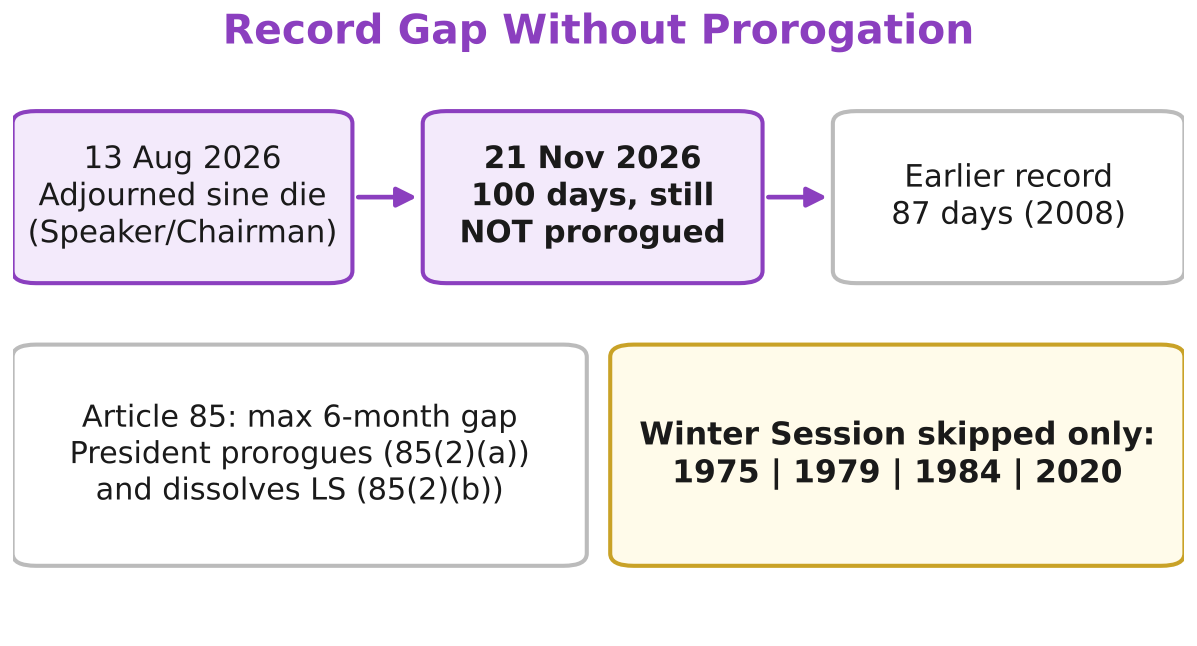
Parliament's Monsoon Session ended on 13 August 2026, but the President has not formally closed it. On 21 November it crossed 100 days in this 'open' state - the longest ever - while an analysis shows the Winter Session has been skipped only four times since 1947. Both Houses were adjourned sine die (adjourned without fixing a date to meet again) on 13 August 2026 at the end of the Monsoon Session. They have not been prorogued (formally closed by the President). By 21 November the gap reached 100 days, beating the earlier record of 87 days set in 2008. An unprorogued House can be recalled at short notice for more sittings, while a fresh session conventionally needs about 14 days' notice. Separately, an analysis noted the Winter Session was skipped only in 1975, 1979, 1984 and 2020.
Key facts
Adjourned sine die: 13 August 2026; 100th unprorogued day: 21 November 2026
In the last 12 years the Winter Session has started anywhere between 16 November and 15 December
The 3-session calendar (Budget, Monsoon, Winter) is a convention, not written in the Constitution
Way forward
A fixed annual parliamentary calendar and a minimum number of sitting days would make the schedule predictable and strengthen scrutiny of the executive.
Concept
Article 85: the President summons and prorogues the Houses and can dissolve the Lok Sabha; the gap between two sessions cannot exceed six months. The President acts on the advice of the Cabinet (dates are fixed by the Cabinet Committee on Parliamentary Affairs). Adjournment sine die is done by the Presiding Officer and ends a sitting; prorogation is done by the President and ends the session; dissolution ends the life of the Lok Sabha (Rajya Sabha is permanent and is never dissolved). The National Commission to Review the Working of the Constitution (2000-02, chaired by Justice M.N. Venkatachaliah) suggested at least 120 sittings a year for the Lok Sabha. Exam angle: Prelims: who adjourns vs who prorogues; six-month rule of Article 85; which House can be dissolved. Mains: falling number of sittings, executive discretion over sessions and its effect on accountability.
Timeline: adjourned sine die on 13 August 2026, 100 days without prorogation by 21 November 2026, earlier record 87 days (2008); Article 85 provisions and years the Winter Session was skipped: 1975, 1979, 1984, 2020. — StudyForGS
📜 Asked before in the exam — previous-year question on this topic
UPSC Prelims 2024With reference to the Parliament of India, consider the following statements: 1. Prorogation of a House by the President of India does not require the advice of the Council of Ministers. 2. Prorogation of a House is generally done after the House is adjourned sine die but there is no bar to the President of India prorogating the House which is in session. 3. Dissolution of the Lok Sabha is done by the President of India who, save in exceptional circumstances, does so on the advice of the Council of Ministers. Which of the statements given above is/are correct?
1 only
1 and 2
2 and 3
3 only
Show answer
Answer: (c) 2 and 3 Statements 2 and 3 are correct. Prorogation under Article 85 is done by the President, but like other such functions it is done on the advice of the Council of Ministers under Article 74, so statement 1 is wrong. A House is usually prorogued after it is adjourned sine die, but nothing stops the President from proroguing a House that is in session. The Lok Sabha is dissolved by the President, normally on the advice of the Council of Ministers, except in exceptional situations. Practise all UPSC Prelims 2024 paper (free) →
Linked because this news is about the same topic. The answer is as per the official key of that year.
The Supreme Court suspended the life sentences of two men convicted in the 2002 Bilkis Bano gang-rape case and released them on bail while their appeals are pending. Today's debate is about whether the survivor should have been heard before such relief. A bench of Justices M.M. Sundresh and P.B. Varale suspended the life sentences of Bipin Chandra Joshi and Pradeep Mordhiya and granted them bail pending their appeals. The order was passed on 28 October 2026 and became public in mid-November. The court noted they had spent more than 17 years in prison and that one of them has a severe disability. Critics point out that the survivor was not heard before the relief was given.
Key facts
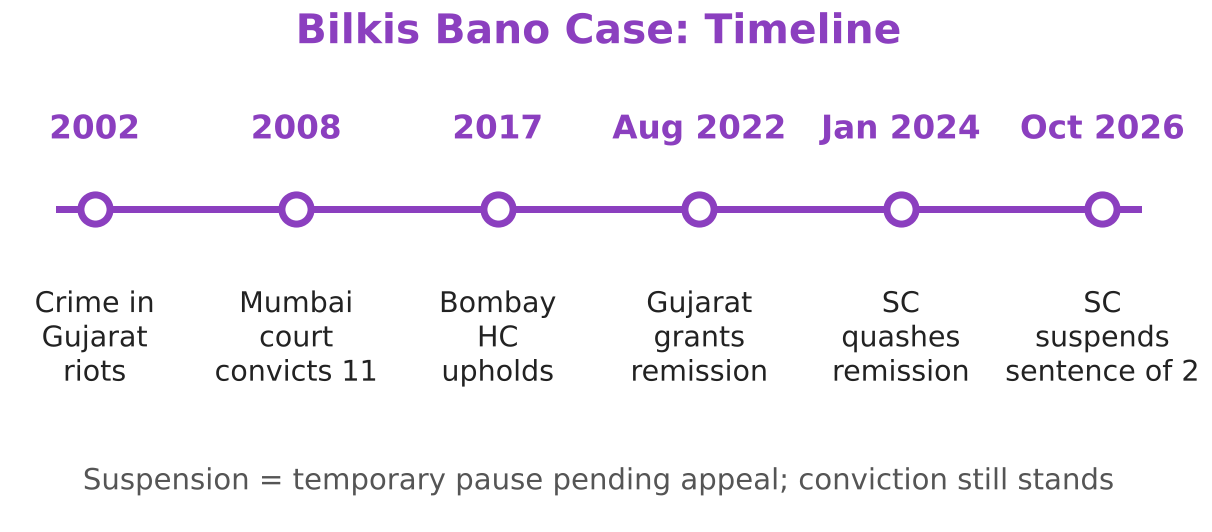
Crime: 2002, during the Gujarat riots; trial shifted to Maharashtra; special court in Mumbai convicted 11 men in 2008
Bombay High Court upheld the convictions (2017)
August 2022: Gujarat government granted early release (remission) to all 11; January 2024: Supreme Court quashed that remission
Now: two convicts get suspension of sentence and bail after serving 17+ years
Relief is temporary - the conviction stands until the appeal is decided
Way forward
Courts could make it standard practice to notify and hear victims before suspending sentences in heinous crimes, and appeals pending for decades need fast-track hearing.
Concept
Suspension of sentence (Section 389 of the old CrPC, now Section 430 of the Bharatiya Nagarik Suraksha Sanhita, 2023): an appeal court can pause a sentence while the appeal is heard. It is different from remission (cutting the prison term short by the government) and pardon. Jagjeet Singh vs Ashish Mishra (2022): the Supreme Court held that a victim has a right to be heard at every stage of criminal proceedings, including bail. Article 21 protects both sides: the convict's right to a speedy appeal and the victim's right to a fair process and dignity. Exam angle: Prelims: difference between suspension, remission, commutation and pardon (Articles 72 and 161). Mains: balancing long pendency of appeals with victims' participation rights.
Timeline of the Bilkis Bano case: 2002 crime, 2008 conviction of 11 by Mumbai court, 2017 Bombay High Court upholds, August 2022 Gujarat remission, January 2024 Supreme Court quashes it, October 2026 sentence of two suspended. — StudyForGS
3. IIM Governance: Autonomy vs Oversight
POLITYUPSC: Prelims + Mains GS2
Syllabus linkage
GS2 - Education, statutory bodies, governance. Prelims: IIM Act 2017, Visitor, Institutes of National Importance; Mains: institutional autonomy in higher education.
Context
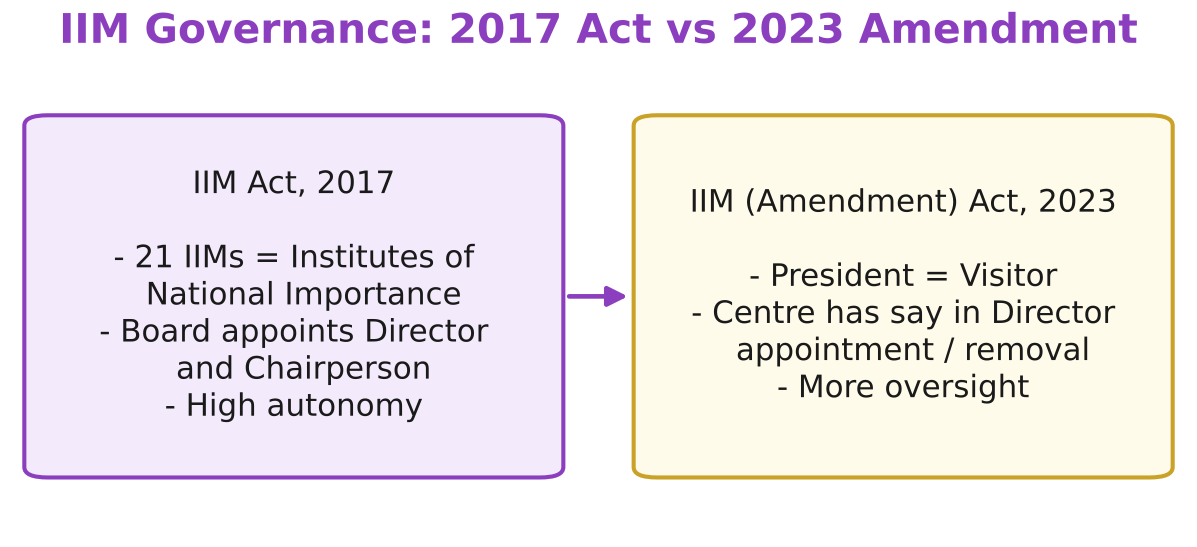
An editorial argues that India's 21 IIMs need real autonomy and merit-based leadership, after a 2023 amendment gave the Centre more control over them. The IIM Act, 2017 made all IIMs Institutes of National Importance and gave their boards the power to choose directors and run the institutes. The IIM (Amendment) Act, 2023 made the President of India the 'Visitor' of every IIM, giving the Centre a say in appointing and removing directors and in board matters. The editorial says governance must rest on merit, independent boards and a clear separation of roles, and warns against diluting academic focus.
Key facts
Number of IIMs: 21, all Institutes of National Importance
IIM Act, 2017: boards got power to appoint directors and chairpersons
IIM (Amendment) Act, 2023: President made the Visitor of all IIMs
Proposed role split: board = oversight, director = execution, academic council = curriculum
Way forward
Clear rules on the Visitor's powers and transparent, merit-based selection of directors can keep both accountability and autonomy.
Concept
Institute of National Importance (INI): a status given by an Act of Parliament to top institutions (IITs, AIIMS, IIMs, NITs). It allows them to award degrees and get central funding. Visitor: a supervisory head (usually the President for central institutions) who can inspect, inquire into and approve key appointments. NEP 2020 aims to give colleges and universities graded autonomy, with strong independent Boards of Governors. Exam angle: Prelims: what changed in 2017 vs 2023; meaning of INI and Visitor. Mains: balancing accountability of publicly funded institutes with academic freedom.
Comparison: IIM Act 2017 (21 IIMs as Institutes of National Importance, board appoints director, high autonomy) versus IIM Amendment Act 2023 (President as Visitor, Centre's say in director appointment, more oversight). — StudyForGS
4. Kerala's First Tribal Panchayat in Crisis
POLITYUPSC: Prelims + Mains GS2
Syllabus linkage
GS2 - Local self-government, devolution of funds; welfare of Scheduled Tribes. Prelims: Muthuvan tribe, Articles 243G-243I; Mains: fiscal health of panchayats.
Context
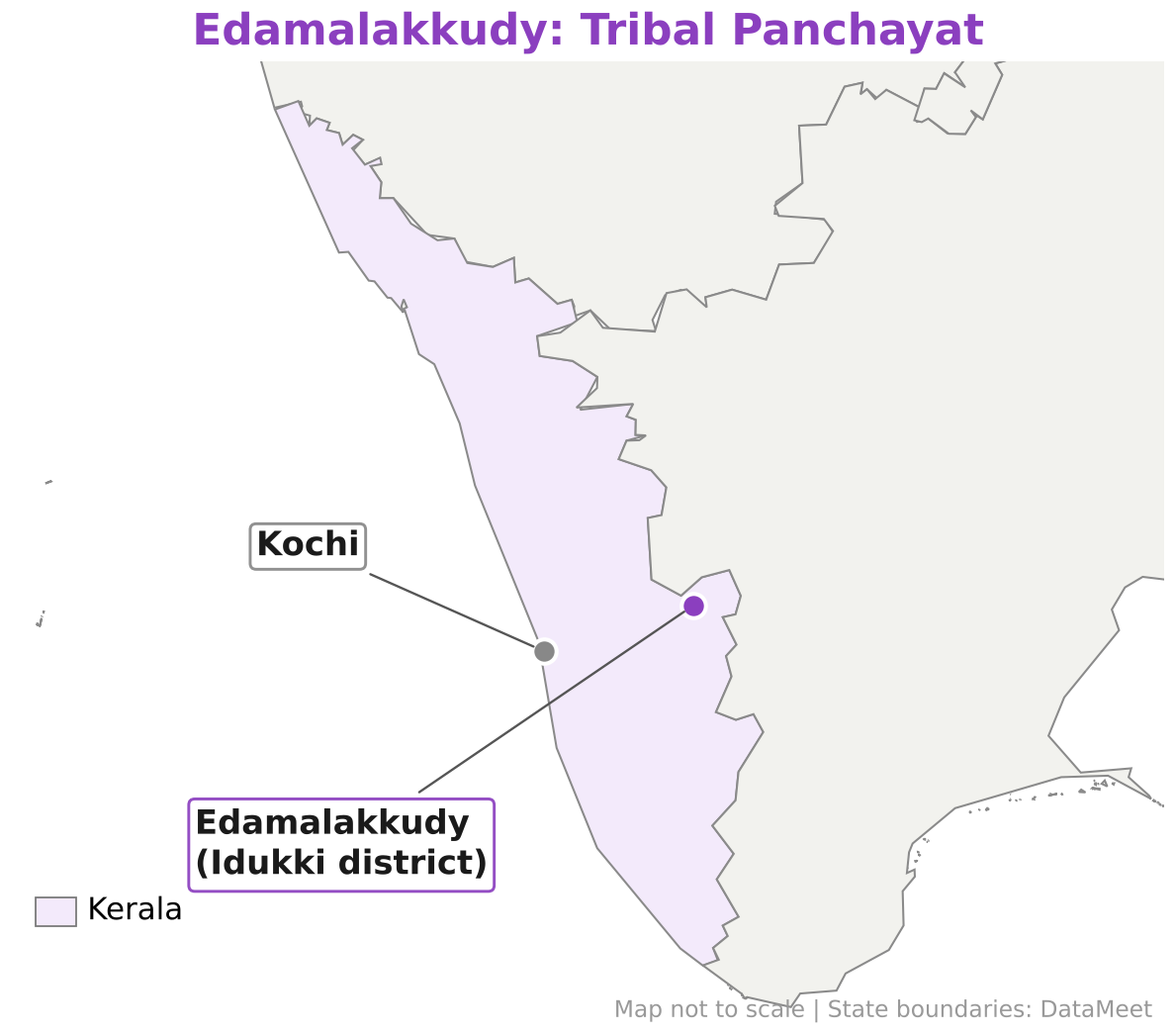
Edamalakkudy in Idukki, Kerala's first panchayat set up only for the Muthuvan tribe, has stopped functioning because it has run out of money. Edamalakkudy, in the forests of Idukki district, is Kerala's first tribal grama panchayat, created exclusively for the Muthuvan community. It has shut down operations due to an acute financial crisis. The remote, forest-bound panchayat has very little own revenue and depends on grants. The closure raises worries about governance and welfare delivery to an isolated tribal community.
Key facts
Panchayat: Edamalakkudy, Idukki district, Kerala
Community: Muthuvan (also called Mudugar), living in the Western Ghats of Kerala and Tamil Nadu
Muthuvans have six matrilineal clans (kootams), marry within the community but outside the clan
Traditional self-rule under a headman called the Kani with a council of elders
Livelihood: shifting cultivation (virippukrishi), millets, and now cardamom, pepper and lemon grass
Way forward
A special grant formula for remote tribal panchayats and timely release of State Finance Commission funds can keep such bodies alive.
Concept
Article 243G gives panchayats powers for local planning; Article 243H lets states allow them to levy taxes and give them grants; Article 243I sets up a State Finance Commission every five years to share state funds with panchayats. PESA Act, 1996 extends special self-rule only to Fifth Schedule areas in 10 states. Kerala has no Fifth Schedule area, so PESA does not apply there - tribal panchayats work under the normal Kerala Panchayat Raj Act. Own Source Revenue: money a panchayat raises itself (property tax, fees). Remote tribal panchayats have almost none, so they depend on state and Finance Commission grants. Exam angle: Prelims: Muthuvan tribe (Kerala/Tamil Nadu, matrilineal), Articles 243G-243I, PESA states. Mains: weak finances of rural local bodies and special needs of tribal areas.
Map of Kerala marking Edamalakkudy in Idukki district, with Kochi for reference. — StudyForGS
5. Nayi Chetna 5.0 Gender Campaign
POLITYUPSC: Prelims + Mains GS2
Syllabus linkage
GS2 - Welfare schemes for vulnerable sections, women empowerment; GS1 - Role of women. Prelims: DAY-NRLM, Nayi Chetna theme.
Context
The Rural Development Ministry is starting the fifth round of its month-long 'Nayi Chetna' campaign on 25 November to push women's jobs, income and safe movement in villages. Nayi Chetna 5.0 will be launched on 25 November 2026 by the Ministry of Rural Development under the Deendayal Antyodaya Yojana-National Rural Livelihoods Mission (DAY-NRLM). The month-long national gender campaign has the theme 'From Access to Agency: Empowering Women through Livelihoods and Equal Opportunities for a Viksit Bharat'. It focuses on women as earners, their control over assets, safe mobility and sharing of unpaid care work.
Key facts
Edition: 5th; launch: 25 November 2026; duration: about one month
Ministry: Rural Development; run through DAY-NRLM and its Self-Help Groups (SHGs)
Theme: 'From Access to Agency: Empowering Women through Livelihoods and Equal Opportunities for a Viksit Bharat'
Four focus areas: women as economic contributors, access to and control over assets, safe mobility, redistributing unpaid care work
Launch date coincides with the International Day for the Elimination of Violence against Women (25 November)
Way forward
Linking SHG women to markets, land and asset ownership, and building childcare and safe transport, can turn awareness into real economic gains.
Concept
DAY-NRLM: launched in 2011 as NRLM (renamed in 2016). It organises poor rural women into SHGs and links them to bank credit and livelihoods. 'Lakhpati Didi' is its target of SHG women earning at least Rs 1 lakh a year. Unpaid care work: cooking, cleaning, caring for children and elders - work mostly done by women, not counted in GDP, and a major reason for low female labour force participation. Agency: the ability of a woman to make her own choices and act on them - going beyond merely having access to a scheme. Exam angle: Prelims: Nayi Chetna is under which ministry/mission; DAY-NRLM year. Mains: why access alone does not lead to empowerment - role of assets, mobility and care burden.
6. India-Nepal: Rs 15,000 Crore Package
IRUPSC: Prelims + Mains GS2
Syllabus linkage
GS2 - India and its neighbourhood; bilateral agreements. Prelims: places (Janakpur, Dharchula, Mahakali river, Lower Arun), 1950 Treaty; Mains: connectivity diplomacy.
Context
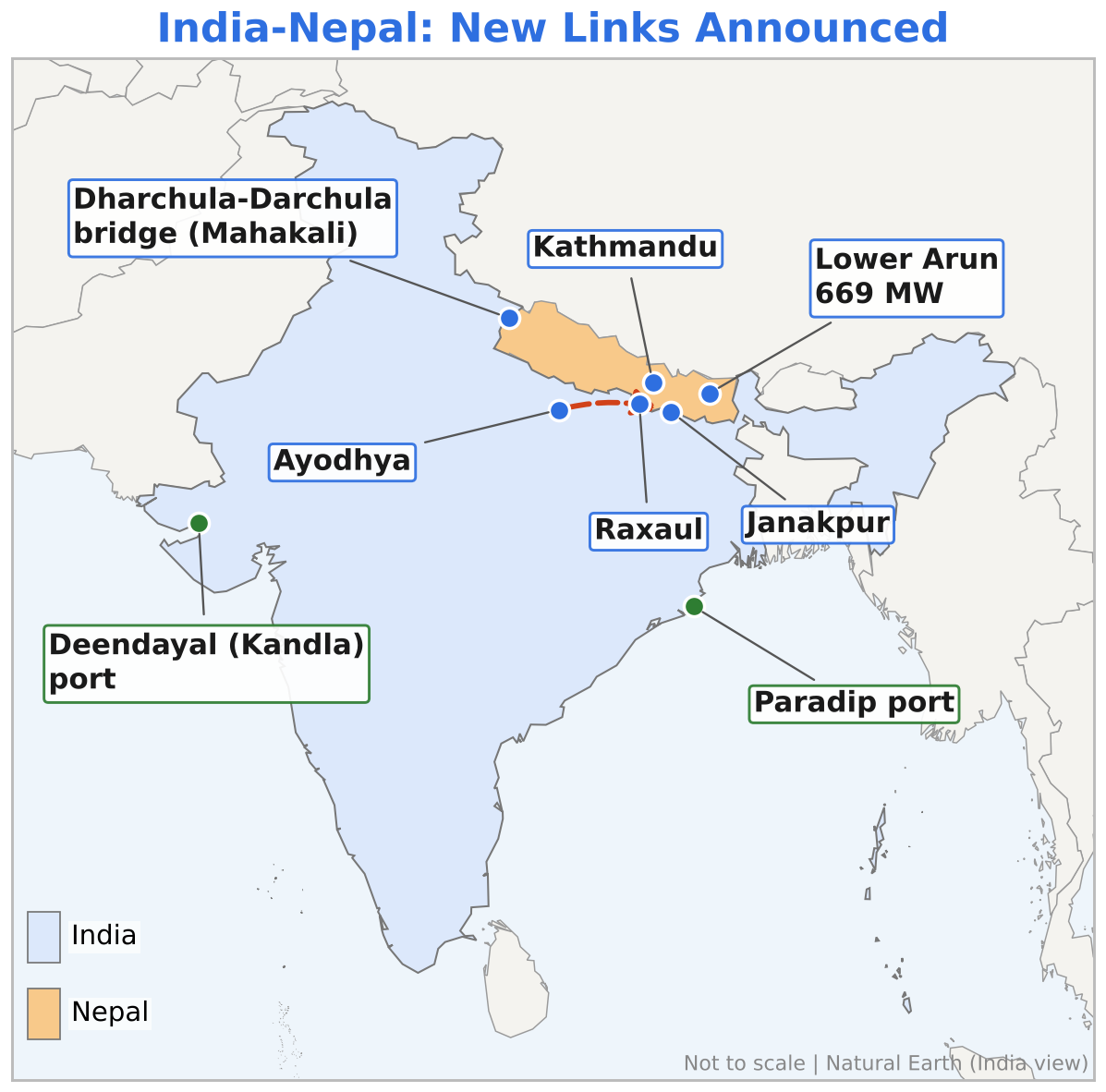
Nepal's Prime Minister Balendra Shah made his first visit to India; the two countries signed eight agreements and India announced Rs 15,000 crore for Nepal's energy and reconstruction, plus new train, bridge, pipeline and port links. Balendra Shah, who became Nepal's Prime Minister in March 2026, made a state visit to India on 22-23 November 2026 and held talks with PM Narendra Modi. The two sides adopted a 10-pillar roadmap titled 'Viksit Bharat and Samunnat Nepal'. India announced Rs 15,000 crore: an Rs 11,500 crore line of credit for energy and an Rs 3,500 crore grant for reconstruction. The Sarayu-Kamala Express (Ayodhya-Janakpur) was flagged off and Nepal's transit cargo got access to Deendayal (Kandla) and Paradip ports.
Key facts
8 MoUs: forensic science, police training, civil-servant training, Ayurveda, satellite communication (South Asia Satellite), urban development, health, livestock and fisheries
New bridge over the Mahakali river between Dharchula (Uttarakhand) and Darchula (Nepal)
Foundation stones: 669 MW Lower Arun hydro project and Banbasa Integrated Check Post; Phase II of Motihari-Amlekhgunj oil pipeline dedicated
Final location survey done for the Raxaul-Kathmandu electrified broad-gauge railway
An offshore IIT campus to be set up in Nepal; 1950 Treaty may be reviewed by mutual consent
Way forward
Timely completion of projects, a joint mechanism for the boundary issue and fair power trade will decide whether this reset lasts.
Concept
India-Nepal Treaty of Peace and Friendship, 1950: allows open borders, and lets citizens of each country live and work in the other. Nepal has long asked for it to be revised. Line of Credit (LoC): a soft (low-interest) loan given by India to a partner government for chosen projects, usually through the Exim Bank; a grant does not have to be repaid. Integrated Check Post (ICP): a single border facility for customs, immigration and quarantine, run by the Land Ports Authority of India, to speed up trade. Exam angle: Prelims: map-based - Janakpur, Mahakali river (border river in the west), Lower Arun, Raxaul, transit ports. Mains: how connectivity and energy trade can rebuild trust with Nepal.
Map of India and Nepal marking the Ayodhya-Janakpur rail route, Dharchula-Darchula bridge, Lower Arun project, Raxaul, Kathmandu, and Deendayal (Kandla) and Paradip ports. — StudyForGS
7. Ganga Water Treaty Nears Expiry
IRUPSC: Prelims + Mains GS2
Syllabus linkage
GS2 - India-Bangladesh relations, water diplomacy; GS1 - River systems. Prelims: Farakka Barrage, treaty formula, Joint Rivers Commission.
Context
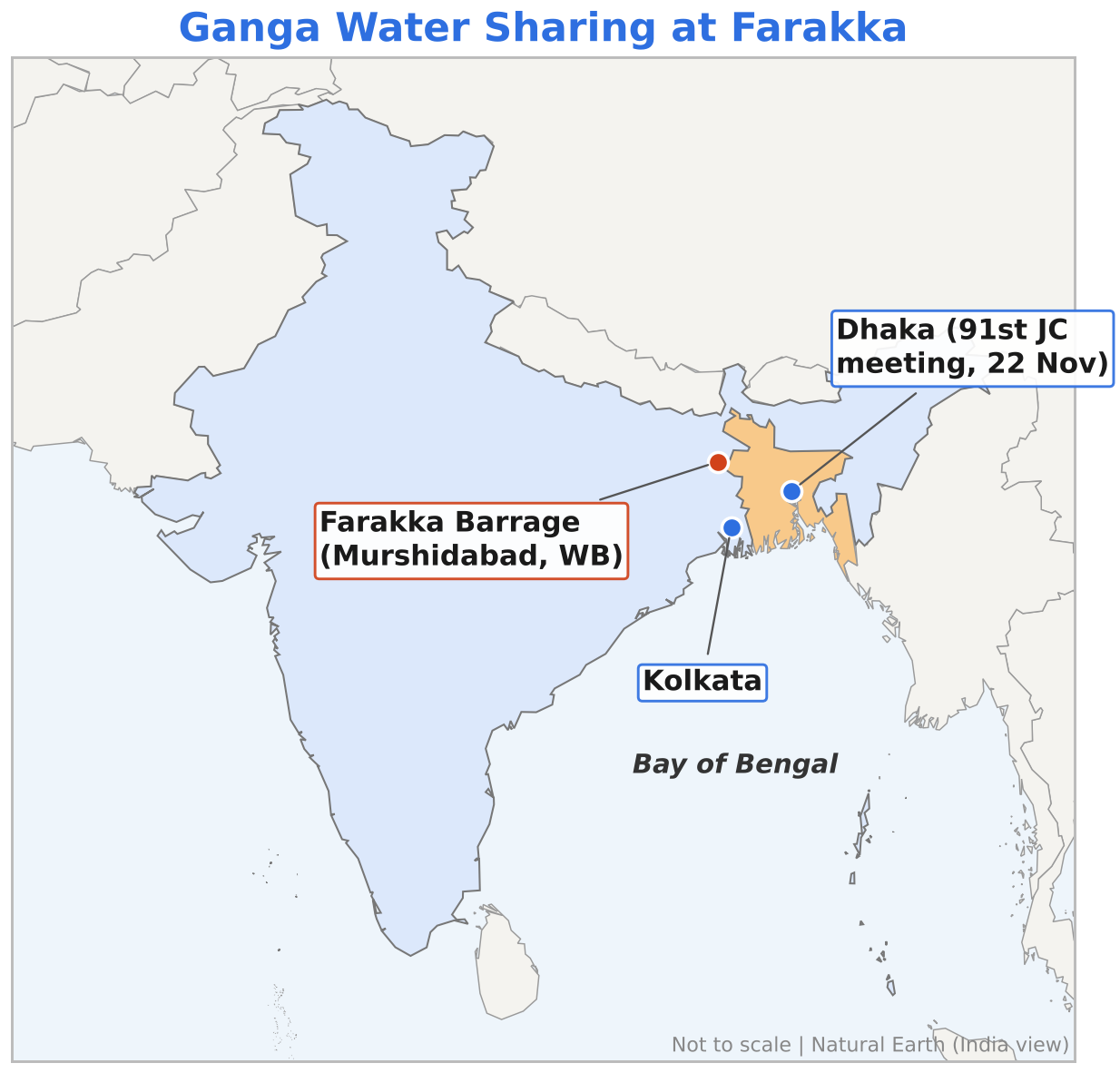
The 1996 India-Bangladesh deal on sharing Ganga water at Farakka ends on 12 December 2026; the two sides met in Dhaka, but no renewal has been agreed yet. The 91st meeting of the India-Bangladesh Joint Committee on the Ganga Water Treaty was held in Dhaka on 22 November 2026. The two sides finalised the treaty's annual report for 2026. Bangladesh urged India to start formal talks on a new or renewed deal before the treaty expires on 12 December 2026 and wants a 'guarantee clause' for minimum water in the dry season. India's External Affairs Ministry said the Joint Rivers Commission is the established mechanism for such talks.
Key facts
Treaty signed: 12 December 1996 by PMs H.D. Deve Gowda and Sheikh Hasina; valid for 30 years
Water is shared at Farakka Barrage from 1 January to 31 May in 10-day periods
Formula: flow 70,000 cusecs or less - 50:50; 70,000-75,000 - Bangladesh gets 35,000; above 75,000 - India gets 40,000
No guaranteed minimum flow; if flow falls below 50,000 cusecs, both must consult immediately
Joint Committee normally meets 3 times a year; 89th (Dhaka, 8 April) and 90th (Kolkata, 22 May) were held earlier in 2026
Way forward
A renewal that uses updated flow data and adds a review clause for climate-driven changes would protect both countries' needs.
Concept
Farakka Barrage: built on the Ganga in Murshidabad district, West Bengal (commissioned in 1975) to divert water into the Bhagirathi-Hooghly and keep Kolkata port navigable. Joint Rivers Commission (JRC): set up in 1972 to handle water issues on the 54 rivers India and Bangladesh share. Cusec: cubic foot of water per second - a unit of river flow. Exam angle: Prelims: treaty year, sharing season, Farakka location, JRC year. Mains: lean-season water stress, Teesta issue and climate change in a renewed treaty.
Map of India and Bangladesh marking Farakka Barrage in Murshidabad (West Bengal), Dhaka (91st Joint Committee meeting on 22 November) and Kolkata. — StudyForGS
8. SCO Adopts Indraprastha Communique
IRUPSC: Prelims + Mains GS2
Syllabus linkage
GS2 - Regional groupings (SCO); GS1 - Art and culture, heritage. Prelims: SCO members and bodies, Purana Qila; Mains: soft power and cultural diplomacy.
Context
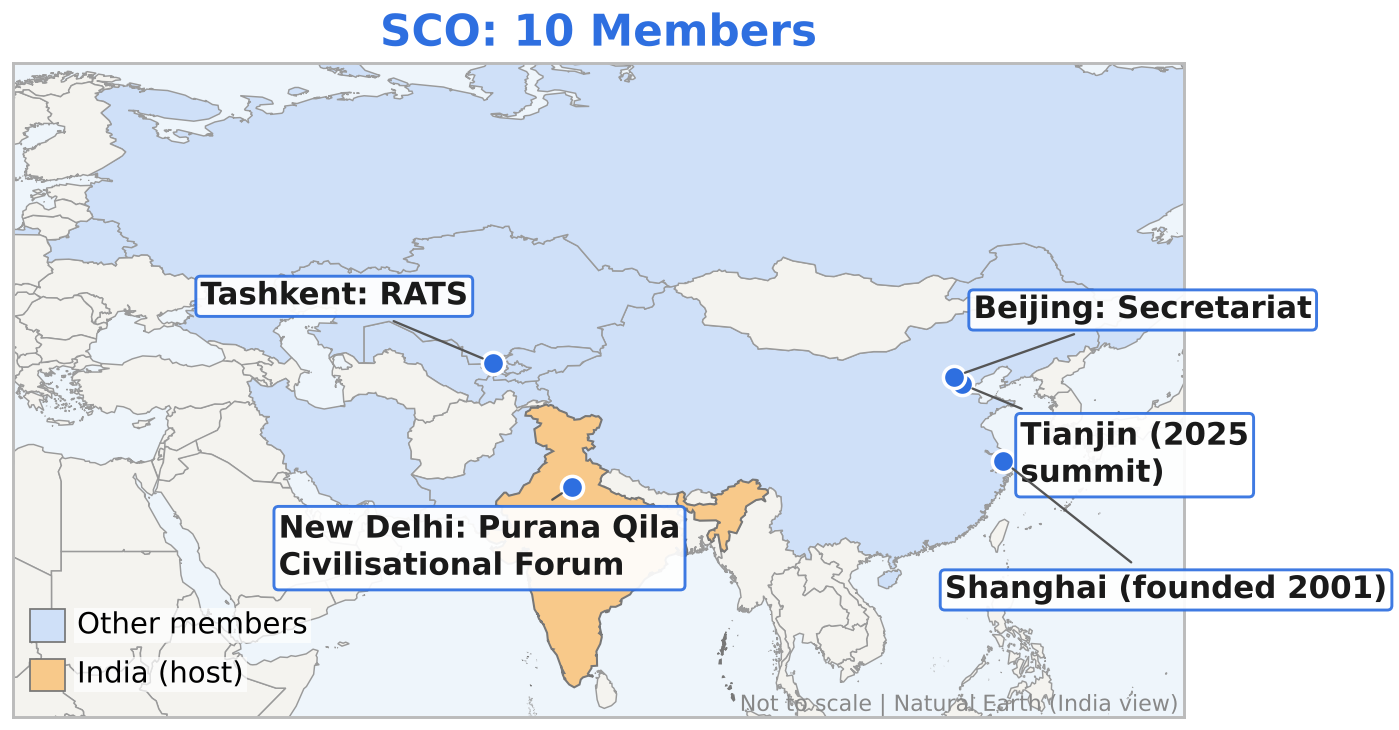
India hosted the first-ever SCO Civilisational Dialogue Forum at Purana Qila, Delhi; it ended with the 'Indraprastha Communique', a 12-point plan for cultural cooperation. PM Modi inaugurated the first SCO Civilisational Dialogue Forum at Purana Qila, New Delhi, on 20 November 2026. It was organised by the Ministry of Culture with the External Affairs Ministry and closed on 22 November with the 12-point Indraprastha Communique, read out by Culture Secretary Vivek Aggarwal. It calls for treating every civilisation as an equal voice, protecting heritage from illegal trafficking and disasters, joint UNESCO nominations, a shared digital repository of manuscripts and responsible use of AI.
Key facts
Dates: 20-22 November 2026; venue: Purana Qila, New Delhi
Outcome: 12-point 'Indraprastha Communique'
Idea came from India's proposal at the 2025 SCO summit in Tianjin, China
India suggested holding the dialogue once every two years
All 10 SCO members, including Pakistan, were invited
Way forward
Turning the communique into joint projects - digitised manuscripts, shared UNESCO dossiers, anti-smuggling cooperation - would give it real value.
Concept
SCO (Shanghai Cooperation Organisation): founded in 2001 in Shanghai. Members: China, Russia, India, Pakistan, Iran, Kazakhstan, Kyrgyzstan, Tajikistan, Uzbekistan, Belarus. India and Pakistan joined in 2017, Iran in 2023, Belarus in 2024. Secretariat: Beijing; anti-terror body RATS: Tashkent. Purana Qila: a 16th-century fort linked to Humayun and Sher Shah Suri, built on a mound believed to be the site of ancient Indraprastha; ASI digs show habitation from about the Mauryan period onward. Illicit trafficking of cultural property is addressed by the 1970 UNESCO Convention; India's law is the Antiquities and Art Treasures Act, 1972. Exam angle: Prelims: SCO members/HQ/RATS; Purana Qila history. Mains: civilisational and cultural diplomacy as a tool of India's foreign policy.
Map of the 10 SCO member countries with India as host, marking New Delhi (Purana Qila), Tianjin, Shanghai, Tashkent (RATS) and Beijing (Secretariat). — StudyForGS
9. ICJ Holds Myanmar Guilty of Genocide
IRUPSC: Prelims + Mains GS2
Syllabus linkage
GS2 - International institutions (ICJ, UN); India's neighbourhood (Myanmar, Bangladesh). Prelims: ICJ, Genocide Convention; Mains: refugees and international law.
Context
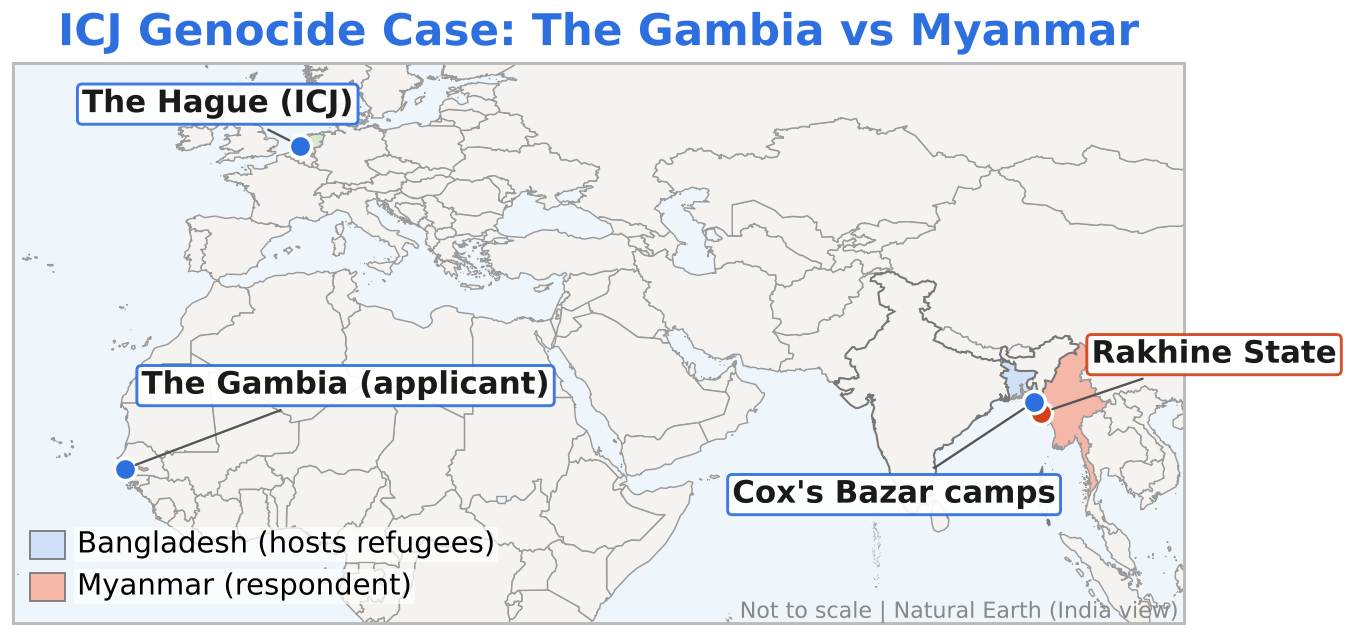
The UN's top court ruled that Myanmar committed genocide against the Rohingya Muslims in 2017 - the first time it has held a country itself responsible for genocide. On 19 November 2026 the International Court of Justice (ICJ) in The Hague, led by President Yuji Iwasawa, delivered its judgment in The Gambia vs Myanmar. It found Myanmar's security forces committed genocide against the Rohingya during the 2017 'clearance operations' and failed to prevent and punish it. The court estimated about 10,000 Rohingya were killed and nearly 400 villages destroyed; around 7 lakh fled to Bangladesh. Myanmar must prosecute offenders, allow safe and voluntary return, pay compensation and report back within two years.
Key facts
Case filed by The Gambia in November 2019 under the Genocide Convention
First ICJ ruling holding a State responsible for genocide
Killings, serious harm and measures to prevent births counted as genocidal acts
Judgment is final and binding, with no appeal; compensation amount to be fixed later
UN Secretary-General called it a 'powerful recognition' of the victims
Way forward
Real justice will depend on safe return conditions in Rakhine and pressure from regional powers on Myanmar's military rulers.
Concept
ICJ: the main judicial body of the UN, set up in 1945, seated at The Hague (Netherlands), with 15 judges elected for 9 years. It settles disputes between States (not individuals - that is the ICC). Genocide Convention, 1948: makes it a crime to commit acts with intent to destroy a national, ethnic, racial or religious group. That special intent is called 'dolus specialis'. Any party can sue another because the duties are owed to all parties ('erga omnes partes'). If a State ignores an ICJ ruling, the other side can approach the UN Security Council under Article 94 of the UN Charter - where a veto can block action. Exam angle: Prelims: ICJ vs ICC, seat, judges; Genocide Convention year; Rakhine State. Mains: enforcement gaps in international law; Rohingya refugee issue for India and Bangladesh.
Map marking The Hague (ICJ), The Gambia (applicant), Rakhine State in Myanmar and the Cox's Bazar camps in Bangladesh. — StudyForGS
10. After New START: Nuclear Risk Talks
IRUPSC: Prelims + Mains GS2
Syllabus linkage
GS2 - Global groupings and treaties; GS3 - Security. Prelims: New START, CTBT, NFU, APEC; Mains: arms control and India's nuclear doctrine.
Context
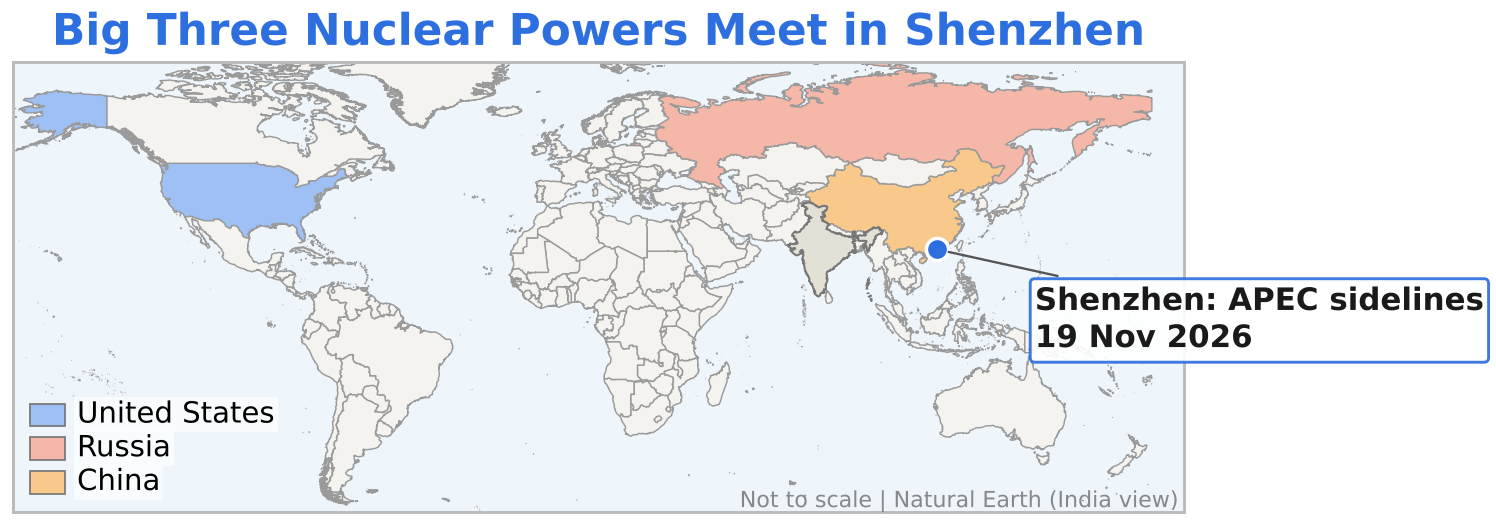
With the last US-Russia arms control treaty gone, the leaders of the US, Russia and China met in Shenzhen and agreed only to start talks on reducing nuclear risks. New START, the last treaty limiting US and Russian strategic nuclear weapons, expired in February 2026 with no replacement - so the largest nuclear arsenals have no legal cap for the first time since 1972. On 19 November 2026, on the sidelines of the APEC summit in Shenzhen, China, the US, Russian and Chinese leaders held their first formal three-way meeting and issued a 'Declaration toward Peace'. It includes a promise to hold a dialogue on nuclear risk reduction, but no dates or verification. An editorial urges hotlines, launch notifications and human control over launch decisions.
Key facts
New START: signed 2010, in force 2011, extended in 2021, expired 5 February 2026
It capped each side at 1,550 deployed strategic warheads
Russia suspended its participation in 2023 and withdrew its ratification of the CTBT in 2023
The US wants a three-way deal including China; China refuses caps because its arsenal is much smaller
Risk: use of AI in nuclear command systems could speed up mistakes
Way forward
Simple confidence-building steps - hotlines, notifications, keeping humans in the loop - can reduce risk even before a new treaty.
Concept
SALT I (1972): the first US-Soviet agreement to limit strategic arms - the start of the arms control era now ending. No First Use (NFU): a promise to use nuclear weapons only in retaliation. China and India both follow NFU; India's doctrine dates to 2003 and pairs NFU with 'credible minimum deterrence'. APEC: Asia-Pacific Economic Cooperation, 21 member economies, formed in 1989. India is not a member. Exam angle: Prelims: New START limits and dates, CTBT status, APEC membership (India not a member). Mains: why arms control is collapsing and what it means for India-China-Pakistan deterrence.
World map shading the United States, Russia and China and marking Shenzhen, where the three leaders met on the sidelines of APEC on 19 November 2026. — StudyForGS
11. COP31 Ends Without a Climate Deal
IRUPSC: Prelims + Mains GS3
Syllabus linkage
GS3 - Environment, climate change negotiations; GS2 - International fora. Prelims: COP31/COP32 hosts, UNFCCC, CBDR; Mains: equity in climate action.
Context
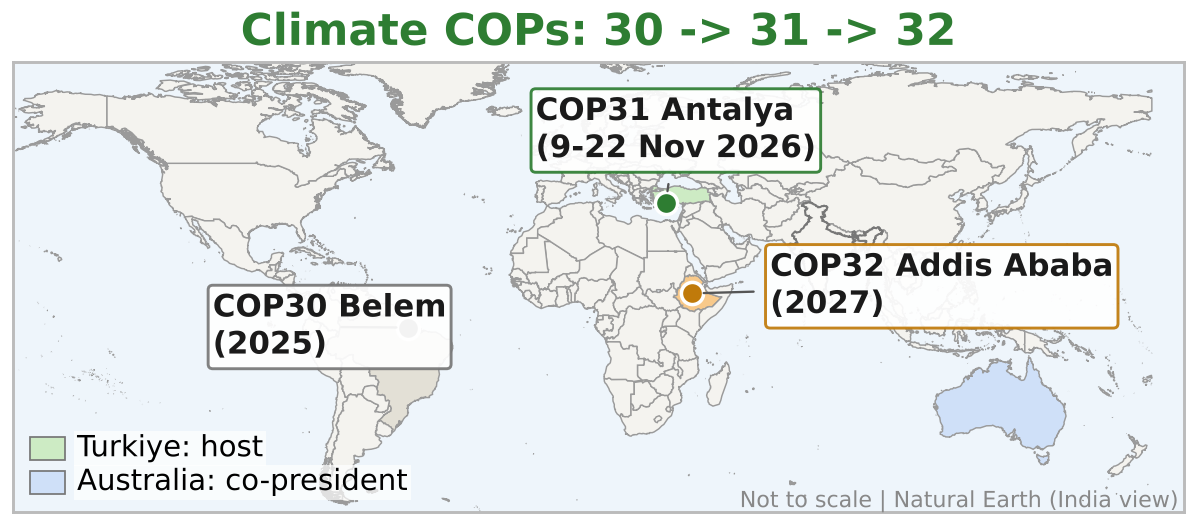
The UN climate summit in Antalya, Turkey, ended two days late without an agreed final declaration, because countries could not agree on whether to mention moving away from fossil fuels. COP31 was held in Antalya, Turkiye, from 9 November and closed on 22 November 2026, two days behind schedule. The draft 'cover decision' (the main political text) did not mention fossil fuels, so the European Union formally objected; Panama and the Marshall Islands also refused support. COP31 President Murat Kurum said there was no agreement, so the decisions were not adopted. UN Secretary-General Antonio Guterres called it 'deeply disappointing', saying 'there is no ambiguity in the science'. India said it worked with BASIC and LMDC partners for an equity-based outcome.
Key facts
Host: Antalya, Turkiye; Turkiye presided, with Australia (Chris Bowen) as co-president for negotiations
Main block: no wording on moving away from coal, oil and gas
Saudi Arabia (speaking for Arab countries) defended the text's references to carbon capture
Some progress was reported on a just transition and on action initiatives for electrification and resilience
COP32: Addis Ababa, Ethiopia (2027)
Way forward
Clear finance numbers from developed countries and fair timelines for developing ones are needed to rebuild trust before COP32.
Concept
UNFCCC: adopted at the 1992 Rio Earth Summit, in force since 1994. Its yearly meeting is the COP (Conference of Parties). Decisions need consensus - so one country or bloc can block a text. CBDR-RC (Common But Differentiated Responsibilities and Respective Capabilities): rich countries, which emitted most in the past, should do more and pay more. India's core position. Just Transition: shifting away from fossil fuels in a fair way - protecting workers and communities who depend on coal or oil. Exam angle: Prelims: COP31/COP32 venues, UNFCCC year, BASIC (Brazil, South Africa, India, China). Mains: why consensus-based climate talks keep stalling; India's equity argument.
World map marking COP30 Belem (2025), COP31 Antalya (9-22 November 2026) and COP32 Addis Ababa (2027), with Turkiye as host and Australia as co-president shaded. — StudyForGS
12. ICMR SAMPADA: Lower Anaemia Levels
HEALTHUPSC: Prelims + Mains GS2
Syllabus linkage
GS2 - Health, nutrition; GS3 - Science in everyday life. Prelims: SAMPADA, Anaemia Mukt Bharat; Mains: measuring malnutrition correctly.
Context
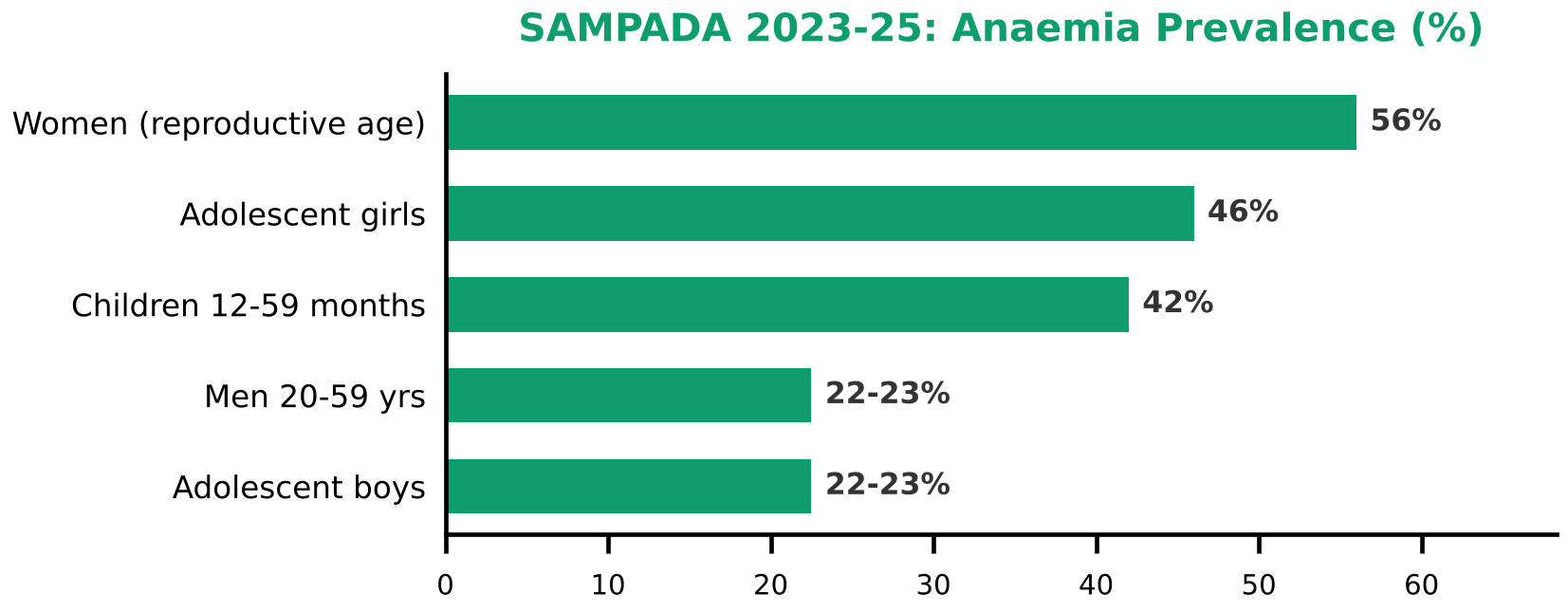
A large new ICMR survey that tested blood from veins finds anaemia is much less common in India than earlier surveys showed, and that only about half of it is due to lack of iron. The Indian Council of Medical Research (ICMR) released results of SAMPADA 2023-25 (Survey for Assessment of Markers of Population Health, Activity, Diet and Anthropometry). It covered over 2 lakh people from 81,000 households in 183 districts across 35 States/UTs. It used venous blood (blood from a vein, tested by machines), which is more accurate than finger-prick tests. Anaemia was found in 56% of women of reproductive age, 46% of adolescent girls, 42% of children aged 12-59 months and 22-23% of men and adolescent boys.
Key facts
Severe anaemia: below 2% in most age groups
Nearly three-fourths of anaemia among men and boys is mild
Iron deficiency explains roughly half the anaemia in vulnerable groups
Folate and vitamin B12 deficiency showed negligible link with anaemia
Other causes flagged: chronic inflammation, infections and inherited blood disorders
Way forward
Anaemia programmes should add testing for inflammation and inherited disorders (like thalassaemia and sickle cell) instead of relying on iron pills alone.
Concept
Anaemia: low haemoglobin (the iron-rich protein in red blood cells that carries oxygen). It causes tiredness and affects pregnancy outcomes and learning. Earlier data (NFHS-5, 2019-21) used finger-prick capillary blood and reported higher numbers (for example 57% of women aged 15-49), so methods matter when comparing. Anaemia Mukt Bharat (2018) began with a '6x6x6' strategy - six age groups, six interventions (iron-folic acid supplements, deworming, testing etc.), six institutional mechanisms; revised Abhiyaan guidelines released in June 2026 moved it to a '7x7x7' framework. Exam angle: Prelims: SAMPADA full form and agency; venous vs capillary testing. Mains: why 'one-size' iron supplementation may not fit; need for cause-specific anaemia policy.
Bar chart of anaemia in SAMPADA 2023-25: women of reproductive age 56%, adolescent girls 46%, children 12-59 months 42%, men 20-59 years 22-23%, adolescent boys 22-23%. — StudyForGS
13. ICMR AMR Report: Last-Line Drugs at Risk
HEALTHUPSC: Prelims + Mains GS2
Syllabus linkage
GS2 - Health; GS3 - Biotechnology, science in everyday life. Prelims: AMR, carbapenems, Schedule H1; Mains: One Health approach.
Context
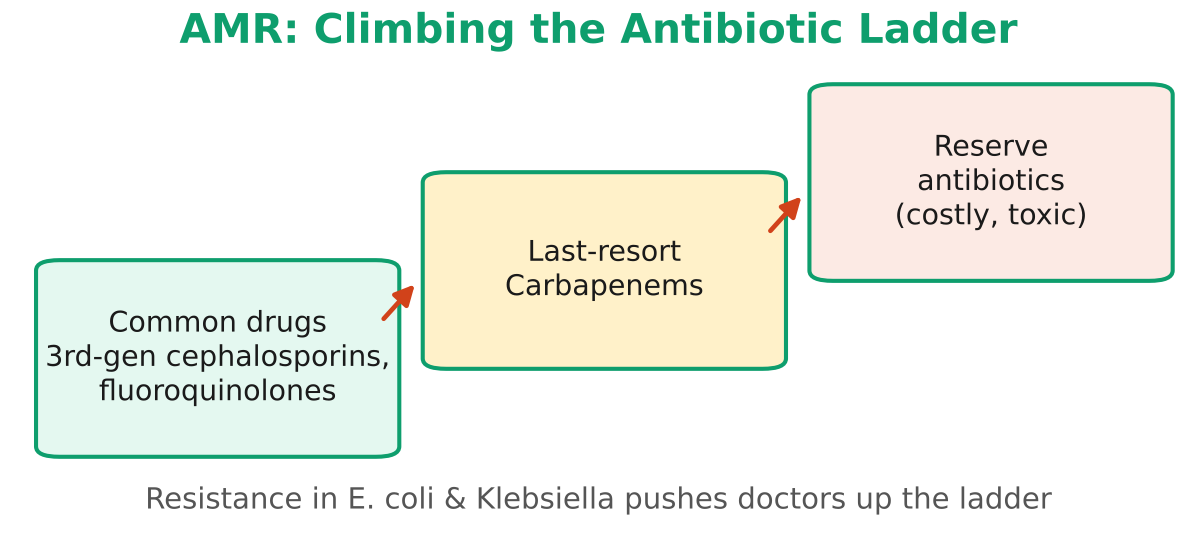
ICMR's yearly report on antibiotic resistance warns that common germs like E. coli and Klebsiella are no longer killed by many usual antibiotics, even in district-level hospitals. ICMR released the Antimicrobial Resistance Surveillance and Research Network (AMRSN) Annual Report 2025. For the first time, the network also tracked 34 secondary-care (district-level) hospitals. E. coli and Klebsiella pneumoniae showed high resistance to third-generation cephalosporins and fluoroquinolones, two widely used antibiotic classes. Klebsiella pneumoniae is the leading cause of bloodstream infections in newborn intensive-care units. Resistance to carbapenems (last-resort antibiotics) is concentrated in big referral hospitals.
Key facts
Report: ICMR AMRSN Annual Report 2025
Network expanded to 34 secondary-care hospitals
Main concern germs: E. coli and Klebsiella pneumoniae
Klebsiella: top cause of bloodstream infection in NICUs (newborn ICUs)
Doctors forced to use 'reserve' antibiotics - costlier, more toxic, longer hospital stays
Way forward
Infection-control committees in district hospitals, strict prescription audits and limits on antibiotic use in animals are urgent.
Concept
Antimicrobial Resistance (AMR): when bacteria, viruses or fungi change so that medicines stop working on them. Overuse and misuse of antibiotics speed it up. Schedule H1 (Drugs Rules, 2013-14): certain antibiotics can be sold only on prescription and the chemist must keep a record. The 'Red Line' campaign (2016) marked prescription-only antibiotics with a red line on the pack. One Health: the idea that human, animal and environmental health are linked - antibiotics used in poultry or farms also drive resistance in humans. India's first National Action Plan on AMR came in 2017. Exam angle: Prelims: carbapenems, Schedule H1, Red Line campaign, WHO AWaRe (Access-Watch-Reserve) groups. Mains: AMR as a 'silent pandemic' and the One Health response.
Antibiotic ladder: common drugs (third-generation cephalosporins, fluoroquinolones) to last-resort carbapenems to reserve antibiotics. — StudyForGS
14. Mercury in Fairness Creams Damages Kidneys
HEALTHUPSC: Prelims + Mains GS2
Syllabus linkage
GS2 - Health, regulation of drugs and cosmetics; GS3 - Environment (Minamata Convention). Prelims: Minamata Convention, CDSCO, Cosmetics Rules 2020.
Context
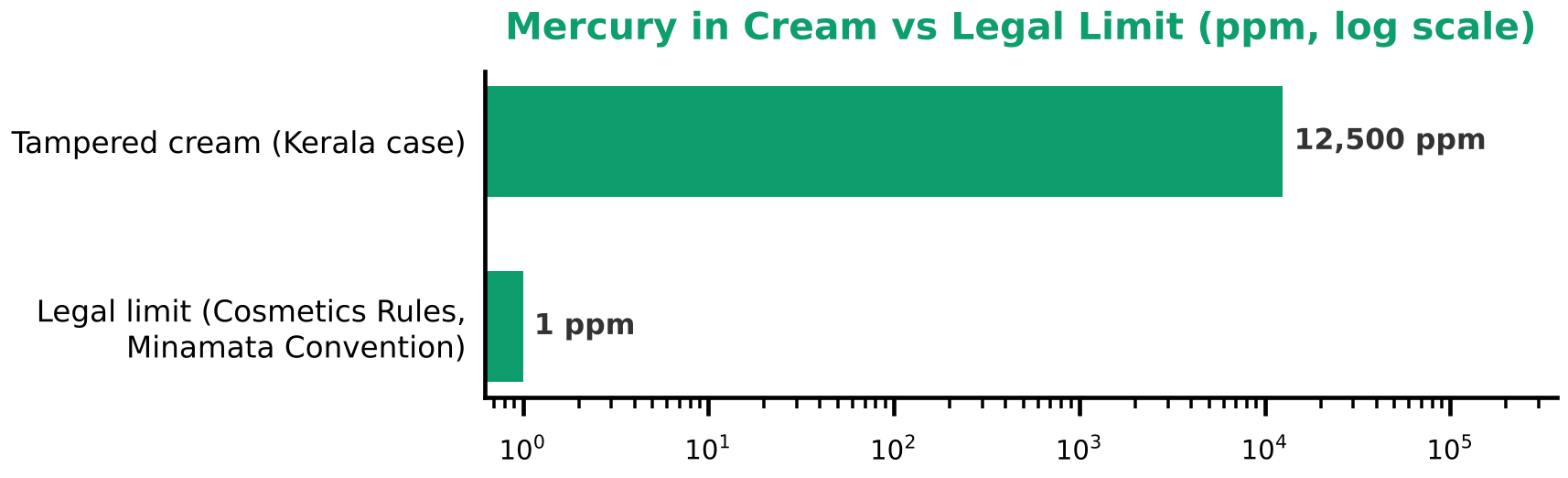
A 17-year-old girl in Kerala got a serious kidney disease after using a skin-whitening cream bought online that had 12,500 times the allowed amount of mercury. The girl developed membranous nephropathy (a kidney disease where protein leaks into urine) after using a tampered skin-lightening cream bought from an e-commerce platform. Tests found 12,500 parts per million (ppm) of mercury, while the legal limit is 1 ppm. Kerala and Madhya Pradesh have started crackdowns on unapproved imported cosmetics.
Key facts
Mercury found: 12,500 ppm; permitted limit: 1 ppm
Disease: membranous nephropathy (kidney filters damaged, protein lost in urine)
Mercury enters the blood through skin; long use can cause nerve damage and kidney failure
Problem route: online third-party sellers and unchecked cross-border imports
Regulator for imports: Central Drugs Standard Control Organisation (CDSCO); states license and inspect retail
Way forward
Making online platforms responsible for product safety and random testing of imported creams can stop such cases.
Concept
Minamata Convention on Mercury (2013, in force 2017): a global treaty to cut mercury use; it bans making, importing or exporting cosmetics with more than 1 ppm mercury. India ratified it in 2018. Named after Minamata, Japan, where mercury poisoning hit thousands. Drugs and Cosmetics Act, 1940 and Cosmetics Rules, 2020: India's law for licensing, labelling and importing cosmetics. Bioaccumulation: a toxic substance building up in the body faster than it can be removed - why even small daily doses of mercury are dangerous. Exam angle: Prelims: Minamata Convention year/limit; CDSCO. Mains: regulating e-commerce sale of cosmetics and drugs; social pressure of 'fairness' products.
Log-scale bar chart: 12,500 ppm mercury in the cream in the Kerala case versus the 1 ppm legal limit. — StudyForGS
15. RBI Proposes 'Stop Switch' Against Fraud
ECONOMYUPSC: Prelims + Mains GS3
Syllabus linkage
GS3 - Banking, cyber security; GS2 - Consumer protection. Prelims: RBI powers under Banking Regulation Act; Mains: digital fraud and customer protection.
Context
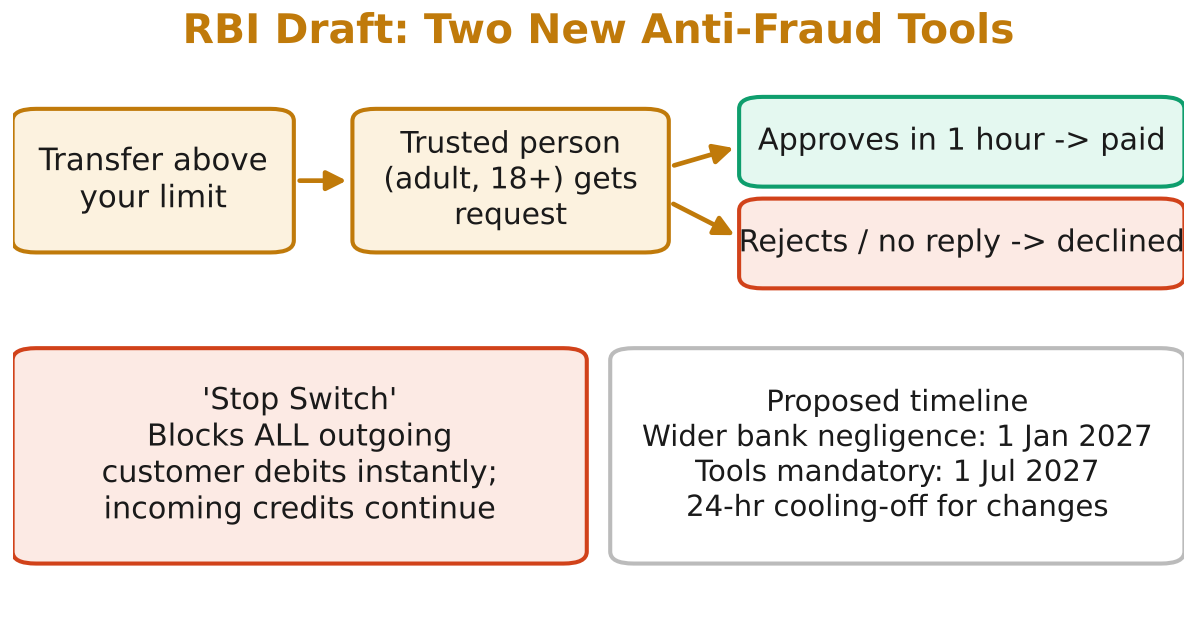
RBI has proposed two new safety tools for bank customers: a 'stop switch' to instantly block all outgoing digital payments, and a 'trusted person' who must approve big transfers. RBI released draft Commercial Banks - Responsible Business Conduct (Fifth Amendment) Directions, 2026. The 'stop switch' lets a customer instantly turn off all future customer-started debits (money going out), while money coming in still works. Under the 'trusted person' facility, a customer can name an adult who must approve transfers above a limit the customer sets, within one hour; no reply means the transfer is rejected. The draft also widens the meaning of 'negligence by a bank', for example failure to send alerts.
Key facts
Trusted person: must be 18+; voluntary; needs consent of both; cannot see balances or operate the account
Approval window: 1 hour per transaction; silence = rejection
24-hour cooling-off period before activating or changing the trusted-person facility
UPI, merchant payments and recurring payments (standing instructions, e-mandates, NACH) are kept out of the trusted-person check
Proposed dates (subject to feedback): wider negligence rule from 1 January 2027; trusted person and stop switch mandatory from 1 July 2027
Way forward
Simple app design and awareness drives will decide whether customers - especially senior citizens - actually use these tools.
Concept
Section 35A of the Banking Regulation Act, 1949 lets RBI issue binding directions to banks in public interest - the legal basis of such rules. Customer liability rules (RBI, 2017): if a customer reports an unauthorised electronic transaction within 3 working days, liability can be zero; this was amended again in June 2026. NACH (National Automated Clearing House): an NPCI system for bulk, recurring payments like EMIs, SIPs and salaries. Exam angle: Prelims: who issues such directions and under which law; what NACH and e-mandate mean. Mains: balancing fast digital payments with fraud safeguards, especially for the elderly.
Flow diagram: a transfer above the set limit goes to the trusted person; approved within 1 hour it is paid, rejected or unanswered it is declined; the stop switch blocks all outgoing debits; proposed dates 1 January 2027 and 1 July 2027. — StudyForGS
16. Floriculture: Output and Exports Bloom
ECONOMYUPSC: Prelims + Mains GS3
Syllabus linkage
GS3 - Agriculture, cropping patterns, agri-exports. Prelims: top states, APEDA, MIDH; Mains: high-value agriculture for farm incomes.
Context
India grew about 48.8 lakh tonnes of flowers in 2025-26, with Andhra Pradesh the top producer, and exported flowers and seeds worth about USD 258 million. A government release said India's floriculture output in 2025-26 was 4,882 thousand tonnes from 410 thousand hectares. Loose flowers (used in garlands and worship) made up 3,653 thousand tonnes and cut flowers 1,229 thousand tonnes. Exports of floriculture and seeds were USD 258.26 million, led by the US and the Netherlands. The release also recalled that APEDA had helped the North-East send its first-ever consignment of Anthurium flowers, from Mizoram to Singapore, in 2025.
Key facts
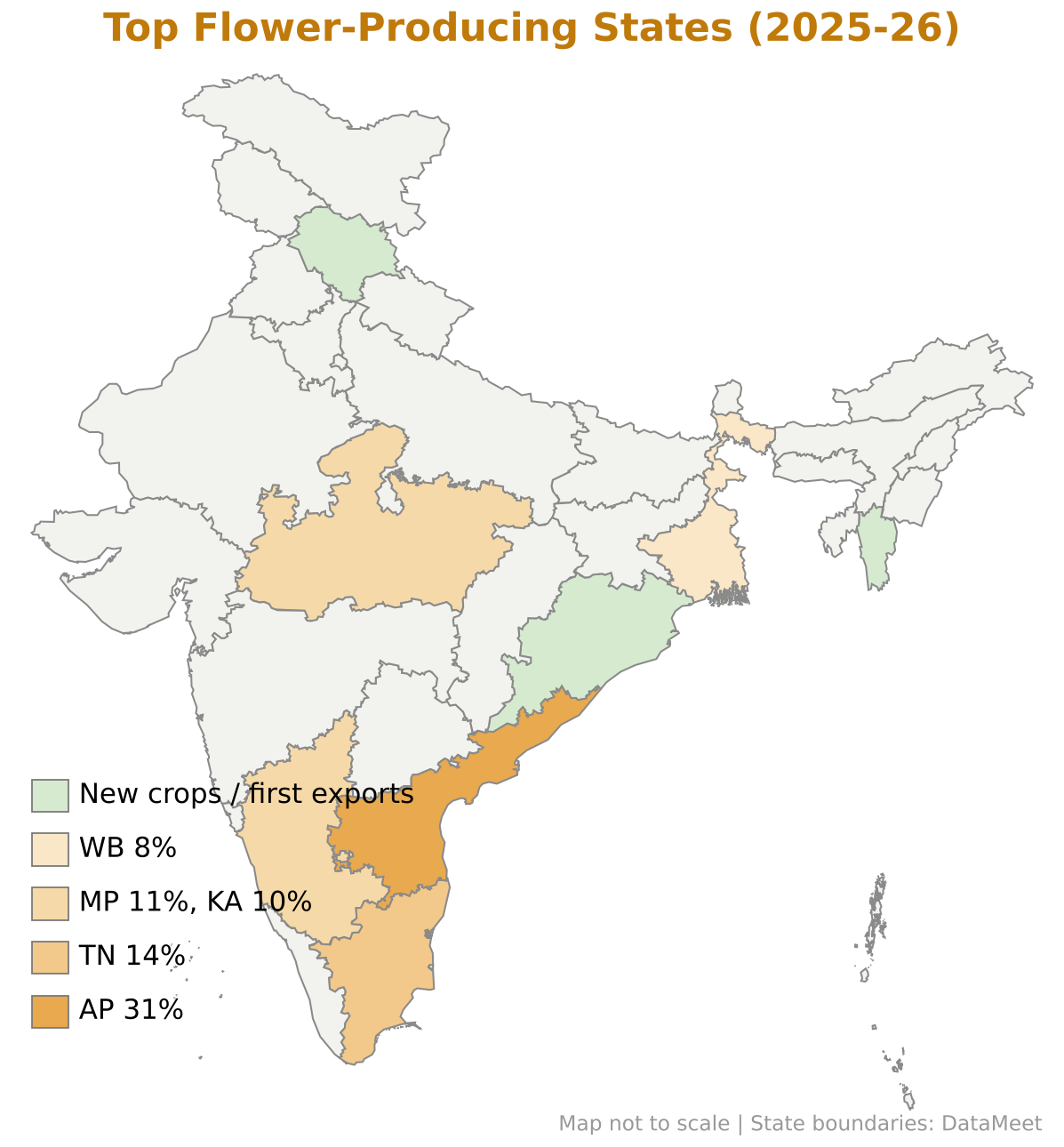
Top producing states: Andhra Pradesh 31%, Tamil Nadu 14%, Madhya Pradesh 11%, Karnataka 10%, West Bengal 8%
Exports FY 2025-26: USD 258.26 million; US USD 45.94 million, Netherlands USD 42.18 million
Dried flowers form the biggest part of exports (long shelf life)
CSIR Floriculture Mission: cultivation spread over 2,208 hectares
New crops: tulips in Himachal Pradesh, Eustoma in Odisha
Way forward
Cold chains near airports and support for polyhouses can help India grab a larger share of the global flower trade.
Concept
APEDA (Agricultural and Processed Food Products Export Development Authority): set up under an Act of 1985, under the Commerce Ministry, to promote agri-exports. MIDH (Mission for Integrated Development of Horticulture, 2014-15): central scheme for fruits, vegetables, flowers, spices etc. - supports nurseries, polyhouses and cold chains. Protected cultivation: growing crops in greenhouses or polyhouses where heat, light and moisture can be controlled - needed for export-quality cut flowers. Exam angle: Prelims: largest flower-producing state; APEDA ministry. Mains: floriculture as a 'sunrise sector' for small farmers and women.
Map of India shading the top flower-producing states: Andhra Pradesh 31%, Tamil Nadu 14%, Madhya Pradesh 11%, Karnataka 10%, West Bengal 8%, plus Mizoram, Himachal Pradesh and Odisha for new crops. — StudyForGS
17. New Coal Mining and Mine Closure Rules
ECONOMYUPSC: Prelims + Mains GS3
Syllabus linkage
GS3 - Infrastructure (energy), mining, environment. Prelims: underground coal gasification, mine closure escrow; Mains: ease of doing business vs ecological restoration.
Context
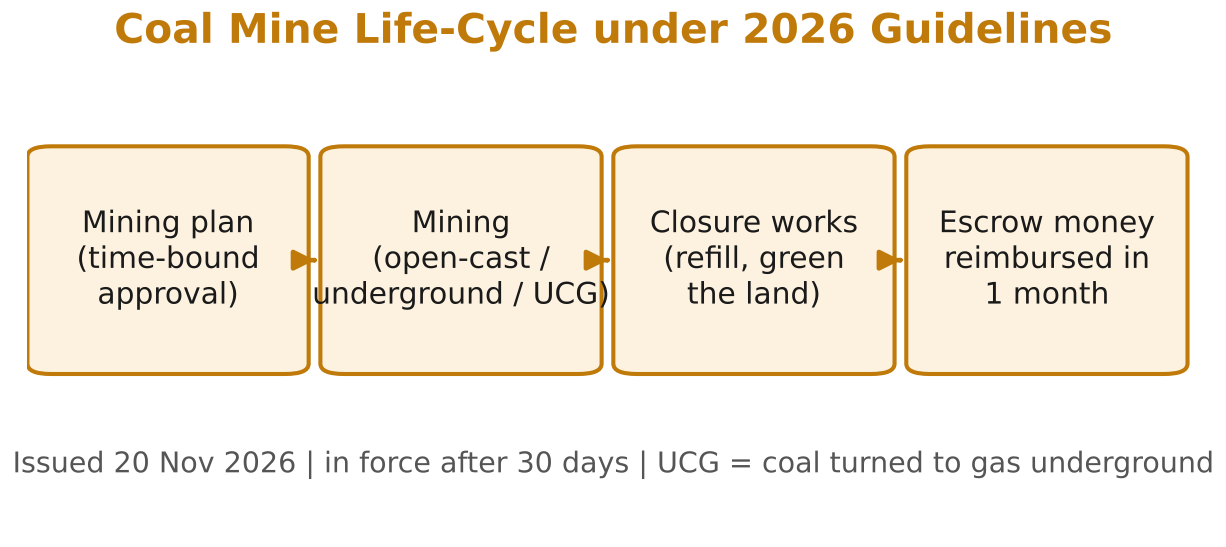
The Coal Ministry has issued new guidelines that set deadlines for approving mining plans, speed up release of mine-closure money, and officially allow underground coal gasification. On 20 November 2026 the Ministry of Coal issued the Guidelines for Preparation of Mining Plan and Mine Closure Plan for Coal and Lignite Mines, 2026. They come into force 30 days after issue. Every stage of scrutiny and approval of a mining plan now has a fixed timeline. Money for mine-closure work held in an escrow account must be reimbursed within one month of a claim, and Underground Coal Gasification (UCG) is recognised as an approved mining method.
Key facts
Issued: 20 November 2026; effective 30 days later
Fixed timelines for each stage of mining plan approval
Escrow reimbursement for closure works: within 1 month of claim
UCG formally recognised, with separate sub-guidelines
More agencies allowed to verify five-yearly escrow withdrawal claims
Way forward
Faster approvals must go with strict monitoring so that closure money is actually spent on restoring land for local communities.
Concept
Mine Closure Plan: a plan for refilling, greening and safely handing back mined land once mining ends. Escrow account: money deposited with a neutral bank so that funds are guaranteed for land restoration even if the miner defaults. Underground Coal Gasification (UCG): burning coal in a controlled way deep underground to produce syngas (a fuel gas) without digging the coal out - less land damage, but risk of groundwater pollution. Exam angle: Prelims: what UCG is; purpose of escrow in mine closure. Mains: coal's role in energy security vs just transition and land restoration.
Coal mine life-cycle: mining plan with time-bound approval, mining (open-cast, underground or UCG), closure works, and escrow money reimbursed within 1 month. — StudyForGS
18. Small Hydro: Only a Quarter Tapped
ECONOMYUPSC: Prelims + Mains GS3
Syllabus linkage
GS3 - Energy, renewable energy, infrastructure. Prelims: SHP definition and ministry; Mains: decentralised energy for hilly and border areas.
Context
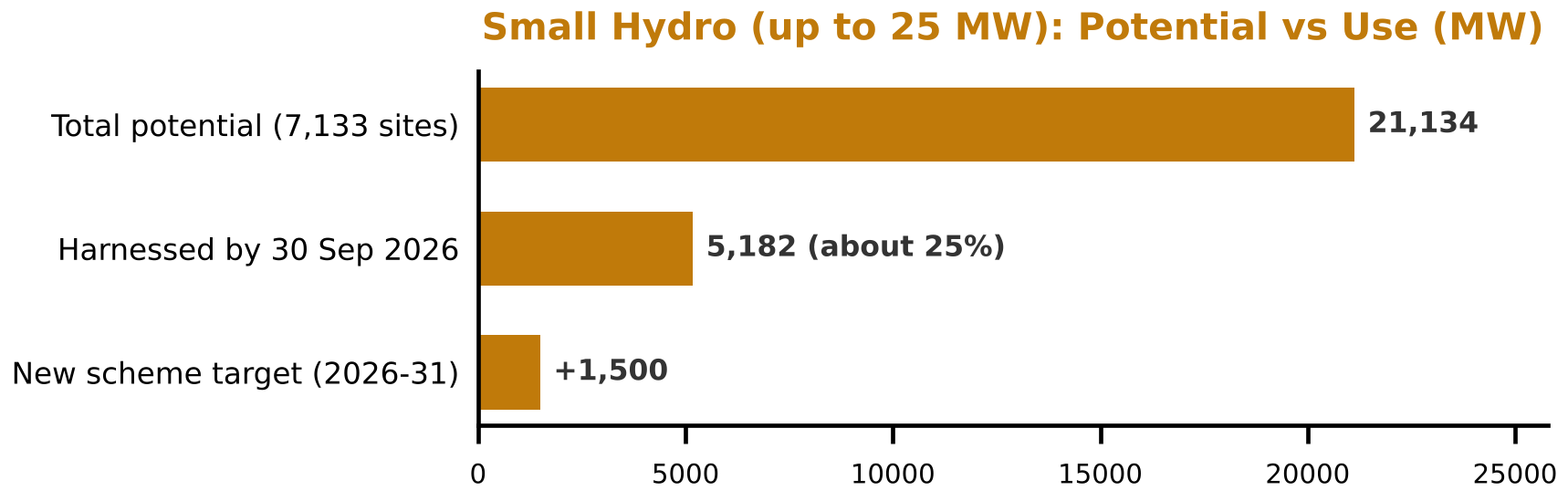
India can produce about 21,000 MW from small hydro projects (up to 25 MW each), but only about a quarter has been used so far; a new scheme aims to add about 1,500 MW. A government backgrounder (22 November 2026) said India's small hydro power (SHP) potential is about 21,134 MW at 7,133 sites. About 5,182 MW had been harnessed by 30 September 2026 - roughly 25%. The SHP Development Scheme for 2026-27 to 2030-31, with an outlay of Rs 2,584.60 crore, aims to add about 1,500 MW. It gives priority to hilly, North-Eastern and border areas.
Key facts
Small hydro = projects up to 25 MW; handled by the Ministry of New and Renewable Energy (MNRE)
Bigger hydro projects come under the Ministry of Power
Potential: 21,134 MW (7,133 sites); harnessed about 5,182 MW
Scheme: FY 2026-27 to 2030-31, Rs 2,584.60 crore, about 1,500 MW
Northern region has the largest potential (8,030 MW), then Southern (5,490 MW)
Way forward
Quick clearances, local participation and careful study of fragile Himalayan slopes can unlock this clean energy safely.
Concept
Run-of-the-river hydro: most small plants use the natural flow of a stream without a big dam or reservoir, so displacement and submergence are small. Since 2019, large hydro projects (above 25 MW) are also counted as renewable energy in India and get hydro purchase obligations. Decentralised energy: small local plants can power remote hill villages that are hard to connect to the national grid. Exam angle: Prelims: SHP size limit and nodal ministry. Mains: role of small hydro in energy access and in the Himalayan ecology debate.
Bar chart: small hydro potential 21,134 MW, harnessed 5,182 MW by 30 September 2026 (about 25%), new scheme target +1,500 MW. — StudyForGS
19. Small Towns Face Delhi-Level Pollution
ENVIRONMENTUPSC: Prelims + Mains GS3
Syllabus linkage
GS3 - Environmental pollution; GS2 - Governance. Prelims: NCAP, AQI, Air Act 1981, thermal inversion; Mains: airshed approach to pollution.
Context
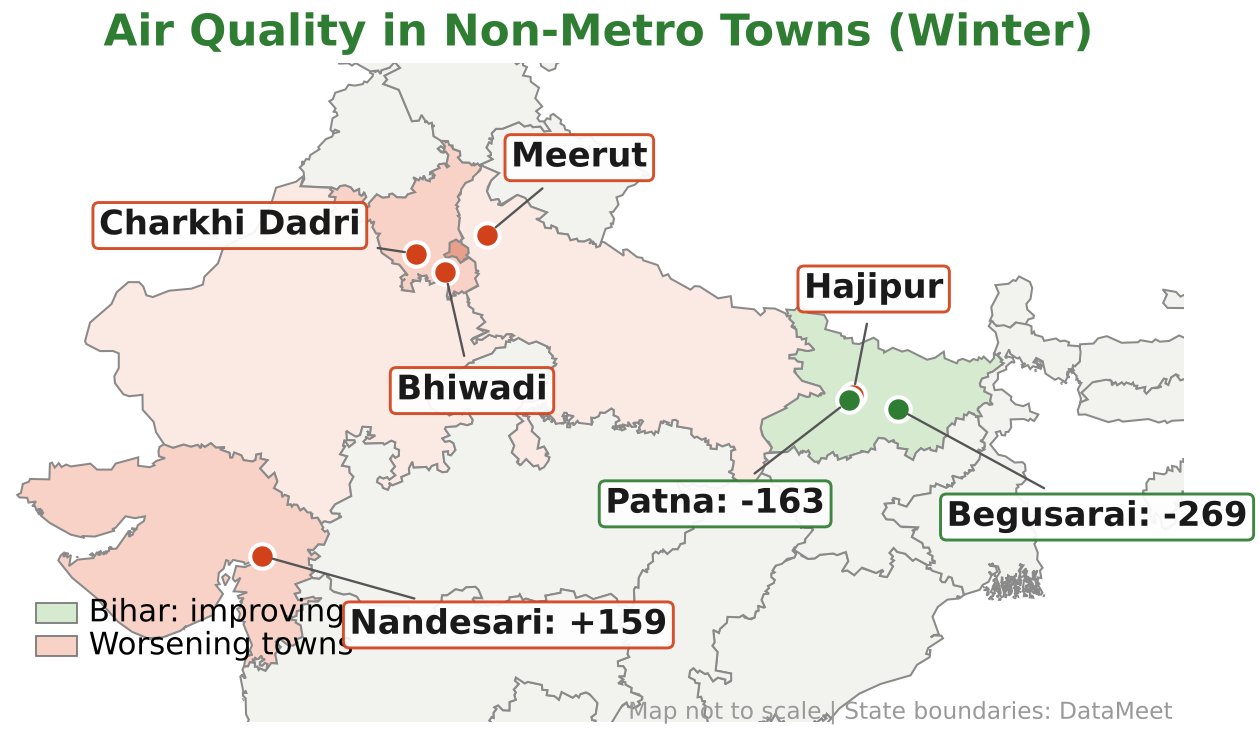
Pollution board data show that some small industrial towns now have air as bad as Delhi in winter, while Bihar's cities have improved; many monitoring stations also have big data gaps. Central Pollution Control Board (CPCB) data show air quality worsening in several non-metro industrial towns. Nandesari in Gujarat saw its AQI rise by 159 points over four winters. Indo-Gangetic towns such as Bhiwadi, Charkhi Dadri, Meerut and Hajipur had winter pollution similar to Delhi-NCR. In Bihar, Patna's median winter AQI fell by 163 points and Begusarai's by 269 points between 2022 and 2026. However, 21 monitoring stations did not record enough hours of data on 200 or more days in 2026.
Key facts
Nandesari (Gujarat): AQI up 159 points over four winters
Patna AQI down 163 and Begusarai down 269 points (2022-2026)
A valid reading needs at least 16 hours of data a day for three pollutants including particulate matter
21 stations logged too few hours on 200+ days in 2026
Way forward
Regional airshed plans across states, more monitors in small towns and strict data-quality checks are needed.
Concept
National Clean Air Programme (NCAP, 2019): aims to cut particulate pollution in 130-plus 'non-attainment' cities (cities that fail air standards). Bihar's gains are linked to cleaner zig-zag brick kilns under such efforts. Thermal inversion: in winter, a layer of warm air sits over cold air near the ground, acting like a lid that traps smoke and dust. The whole Indo-Gangetic plain behaves as one 'airshed' (one shared air basin), ignoring state borders. National AQI (2014): combines up to eight pollutants into one number with six colour categories, from Good to Severe. Air pollution law: Air (Prevention and Control of Pollution) Act, 1981. Exam angle: Prelims: NCAP year, AQI categories, thermal inversion, Air Act year. Mains: why city-wise plans fail without an airshed approach; reliability of monitoring data.
Map of north and west India marking worsening towns Nandesari (+159), Bhiwadi, Charkhi Dadri, Meerut, Hajipur and improving Patna (-163) and Begusarai (-269). — StudyForGS
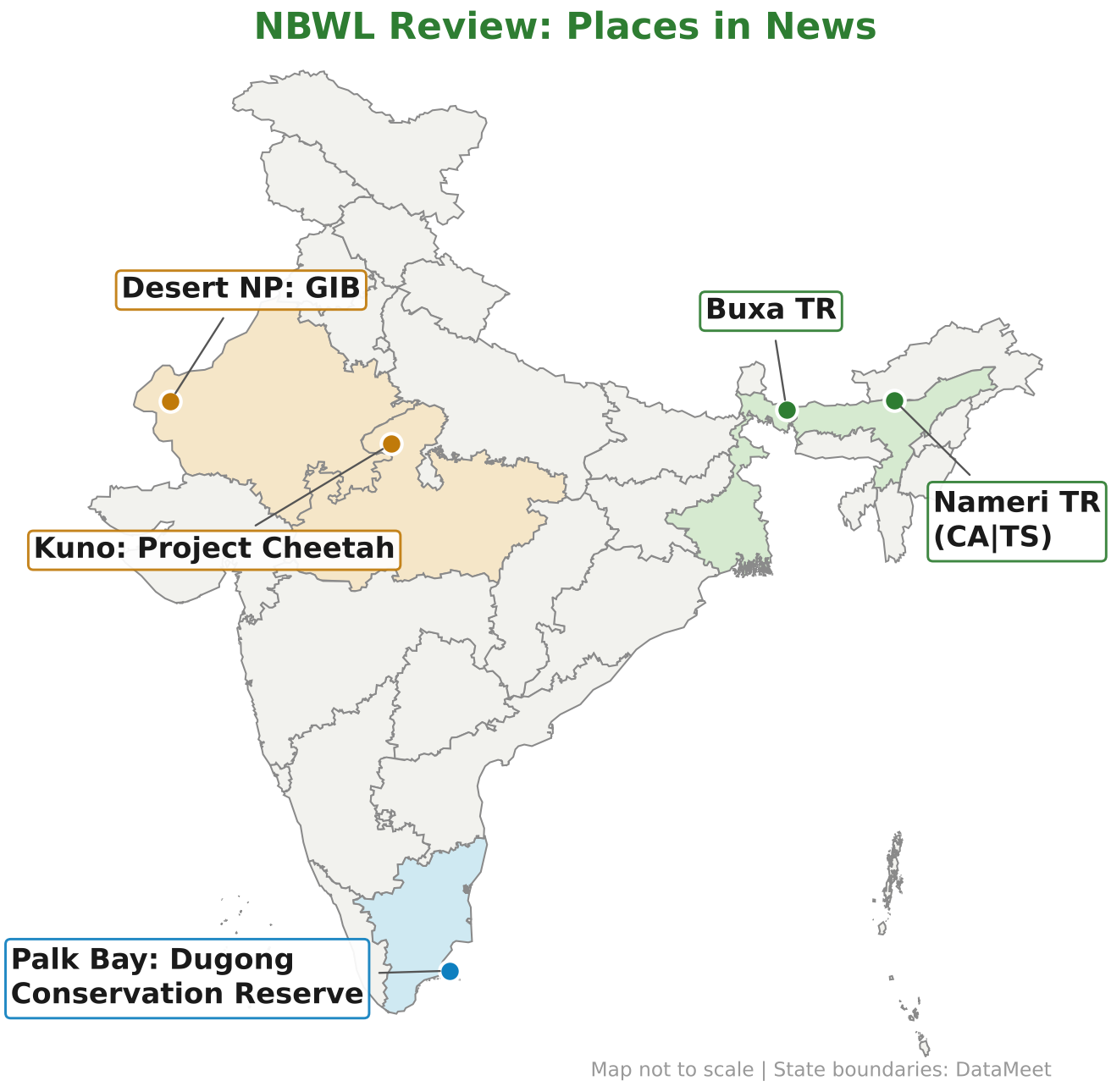
The National Board for Wildlife's standing committee met for the 92nd time and reviewed marine wildlife: India now has its first drone-based count of dugongs (sea cows) - about 270 in Tamil Nadu. The 92nd meeting of the Standing Committee of the National Board for Wildlife (NBWL), chaired by Union Environment Minister Bhupender Yadav in New Delhi on 23 November 2026, focused on marine conservation. A first drone-based estimate put Tamil Nadu's dugongs at 270 plus or minus 16. Nesting of four turtle species was documented across 1,300 km of coast, and seven hotspots of Arabian Sea humpback whales were identified. Nameri Tiger Reserve in Assam received CA|TS accreditation, and 133 project proposals needing wildlife clearance were examined.
Key facts
Dugongs: 270 plus or minus 16 in Tamil Nadu (first drone survey); India's first Dugong Conservation Reserve is in Palk Bay
108 coastal and marine protected areas assessed through Management Effectiveness Evaluation (MEE)
Turtle nesting mapped over 1,300 km coastline for 4 species (Marine Turtle Action Plan 2021-2026)
Nameri Tiger Reserve (Assam) - CA|TS accredited; Buxa tiger reintroduction, Great Indian Bustard releases in Rajasthan and Project Cheetah reviewed
Field Manual on Small Cats (9 species) released with the Global Tiger Forum and UNDP
Way forward
Animal crossings and eco-sensitive design in big projects, plus seagrass protection, can balance development and conservation.
Concept
NBWL: a statutory body under Section 5A of the Wild Life (Protection) Act, 1972 (added in 2002), chaired by the Prime Minister. Its Standing Committee, chaired by the Environment Minister, clears projects in and around protected areas. Dugong (sea cow): a plant-eating marine mammal that grazes on seagrass; listed Vulnerable on the IUCN Red List and in Schedule I in India. Found in Gulf of Mannar-Palk Bay, Gulf of Kutch and Andaman and Nicobar. CA|TS (Conservation Assured | Tiger Standards): a global accreditation that checks whether a tiger site meets set management standards. Exam angle: Prelims: dugong habitat and status, NBWL chair, Nameri TR state, CA|TS. Mains: linear infrastructure (roads, railways) fragmenting habitats and how to reduce it.
Map of India marking Palk Bay Dugong Conservation Reserve, Nameri Tiger Reserve (CA|TS), Buxa Tiger Reserve, Desert National Park (Great Indian Bustard) and Kuno (Project Cheetah). — StudyForGS
21. Landslide Maps and India's First WLF
ENVIRONMENTUPSC: Prelims + Mains GS1
Syllabus linkage
GS1 - Geophysical phenomena; GS3 - Disaster management. Prelims: GSI, landslide-prone regions, Sendai Framework; Mains: from relief to prevention.
Context
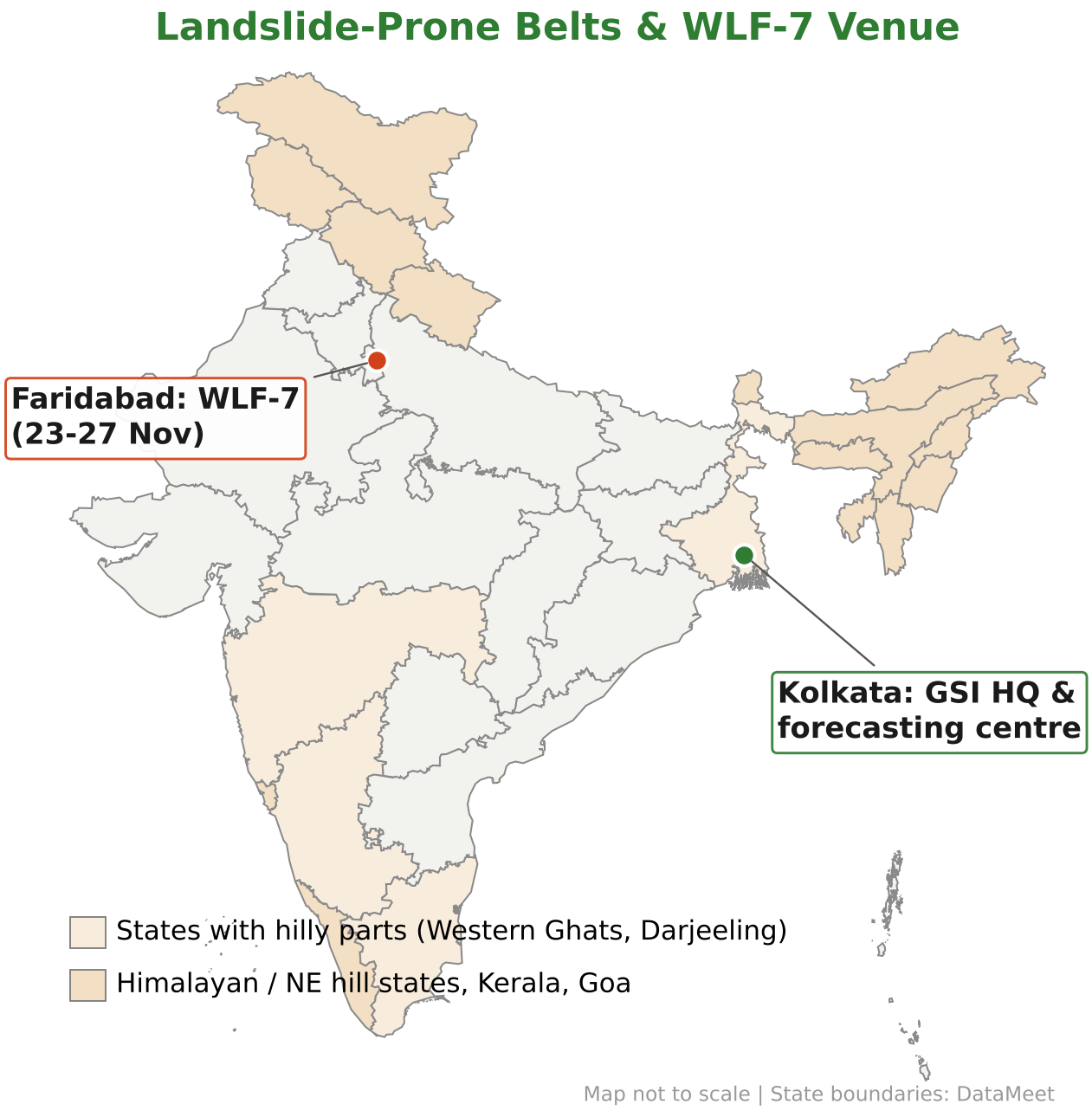
As India hosts the World Landslide Forum for the first time, the focus is on GSI's national landslide-risk map covering about 4.3 lakh sq km in 19 states and UTs, and on early warning. The 7th World Landslide Forum (WLF-7) is being held in Faridabad (Delhi-NCR) from 23 to 27 November 2026 - the first time in India. It is hosted by Amrita Vishwa Vidyapeetham under the International Consortium on Landslides, with GSI, NDMA, DST, NIDM and ISRO collaborating. Under its National Landslide Susceptibility Mapping programme, the Geological Survey of India (GSI) has mapped about 4.3 lakh sq km of hilly land in 19 States/UTs. Its national inventory holds about 91,000 past landslide records.
Key facts
WLF-7: 23-27 November 2026, Faridabad; over 1,900 authors from 75+ countries
Area mapped: about 4.3 lakh sq km, 19 States/UTs, at 1:50,000 scale
Next step: detailed maps at 1:10,000 for local building rules
About 12.6% of India's land area is landslide-prone (Himalayas, North-East hills, Western Ghats)
Data shared on GSI's Bhukosh portal; forecasts combine IMD rainfall thresholds with ground sensors
Way forward
Using these maps in town planning, road design and building permits will save more lives than post-disaster relief.
Concept
Landslide susceptibility map: a map that grades land by how likely its slopes are to fail, based on rock type, slope angle, soil and vegetation. Pore-water pressure: water filling the gaps between soil particles pushes them apart and weakens the slope - why heavy rain triggers most landslides. Sendai Framework for Disaster Risk Reduction (2015-2030): a UN agreement that shifts the focus from responding to disasters to reducing risk and early warning. GSI (founded 1851) is the nodal agency for landslides in India. Exam angle: Prelims: share of landslide-prone area, GSI as nodal agency, Sendai Framework years. Mains: unplanned construction in hills (Joshimath, Wayanad) and role of early warning.
Map of India shading landslide-prone Himalayan and North-Eastern hill states, Kerala, Goa and states with Western Ghats; Faridabad (WLF-7, 23-27 November) and Kolkata (GSI HQ and forecasting centre) marked. — StudyForGS
22. Winter Visitors: Owl and Migratory Birds
ENVIRONMENTUPSC: Prelims + Mains GS3
Syllabus linkage
GS3 - Biodiversity, migratory species; GS1 - Geography of India. Prelims: short-eared owl, Kawal TR, Central Asian Flyway.
Context
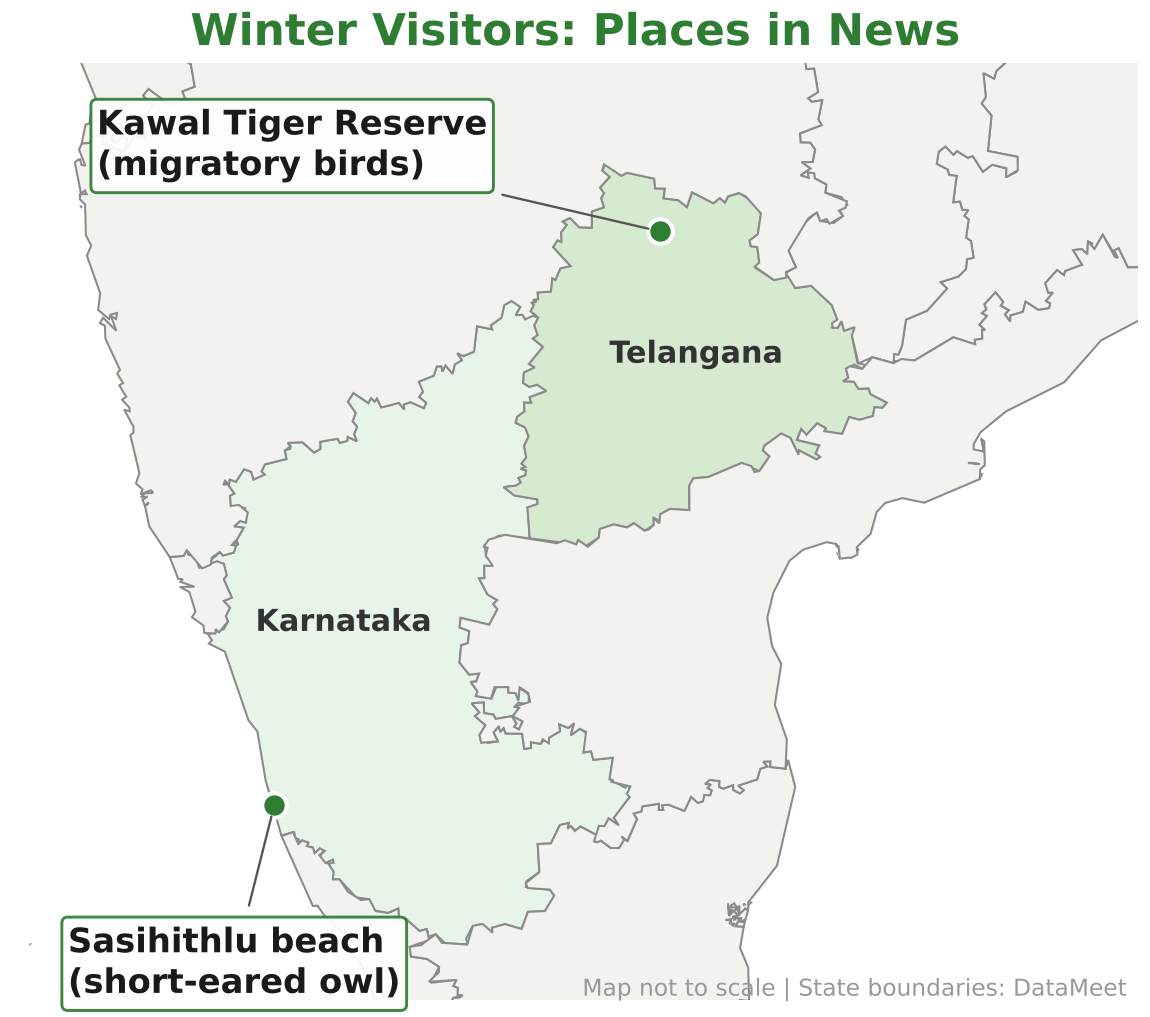
A rare short-eared owl was spotted on a Karnataka beach, and birds from Siberia and Central Asia have reached Telangana's Kawal Tiger Reserve - signs of the winter migration season. A short-eared owl was recently sighted at Sasihithlu beach and estuary in Dakshina Kannada, Karnataka. It is a medium-sized owl named after its tiny, hard-to-see ear tufts, and it spends winters in grasslands of the Indian subcontinent. Separately, migratory birds from Siberia, Central Asia and other northern regions have arrived at Kawal Tiger Reserve in Telangana, highlighting its ecological importance.
Key facts
Short-eared owl: Asio flammeus, family Strigidae; IUCN: Least Concern
Found on every continent except Australia and Antarctica; northern birds fly south in winter
Kawal Tiger Reserve: Telangana, in the Godavari catchment, linked to Tadoba-Andhari (Maharashtra) and Indravati (Chhattisgarh) reserves
Kawal forests: southern tropical dry deciduous, with teak and bamboo
Kawal fauna: tiger, chousingha (four-horned antelope), blackbuck, sambar, wild dog
Way forward
Protecting grasslands and estuaries - often treated as 'wasteland' - is key for winter migrants.
Concept
Central Asian Flyway: a bird migration route from Siberia and Central Asia to the Indian subcontinent, crossing about 30 countries. India hosted the CMS COP13 (Convention on Migratory Species) in Gandhinagar in 2020. Estuary: where a river meets the sea - mixed fresh and salt water, rich in food, so a key stopover for birds. Tiger reserves are notified under Section 38V of the Wild Life (Protection) Act, 1972 on the advice of the National Tiger Conservation Authority (NTCA). Exam angle: Prelims: map-based - Kawal TR (Telangana), Sasihithlu (Karnataka); owl's IUCN status; CMS. Mains: protecting wetlands and grasslands for migratory birds.
Map of south India marking Sasihithlu beach in Karnataka (short-eared owl) and Kawal Tiger Reserve in Telangana (migratory birds). — StudyForGS
23. Tangail Saree: GI Dispute in Madras HC
ART & CULTUREUPSC: Prelims + Mains GS1
Syllabus linkage
GS1 - Indian art and culture (handlooms), Partition; GS3 - IPR (GI). Prelims: GI Act, GI Registry, UNESCO intangible heritage.
Context
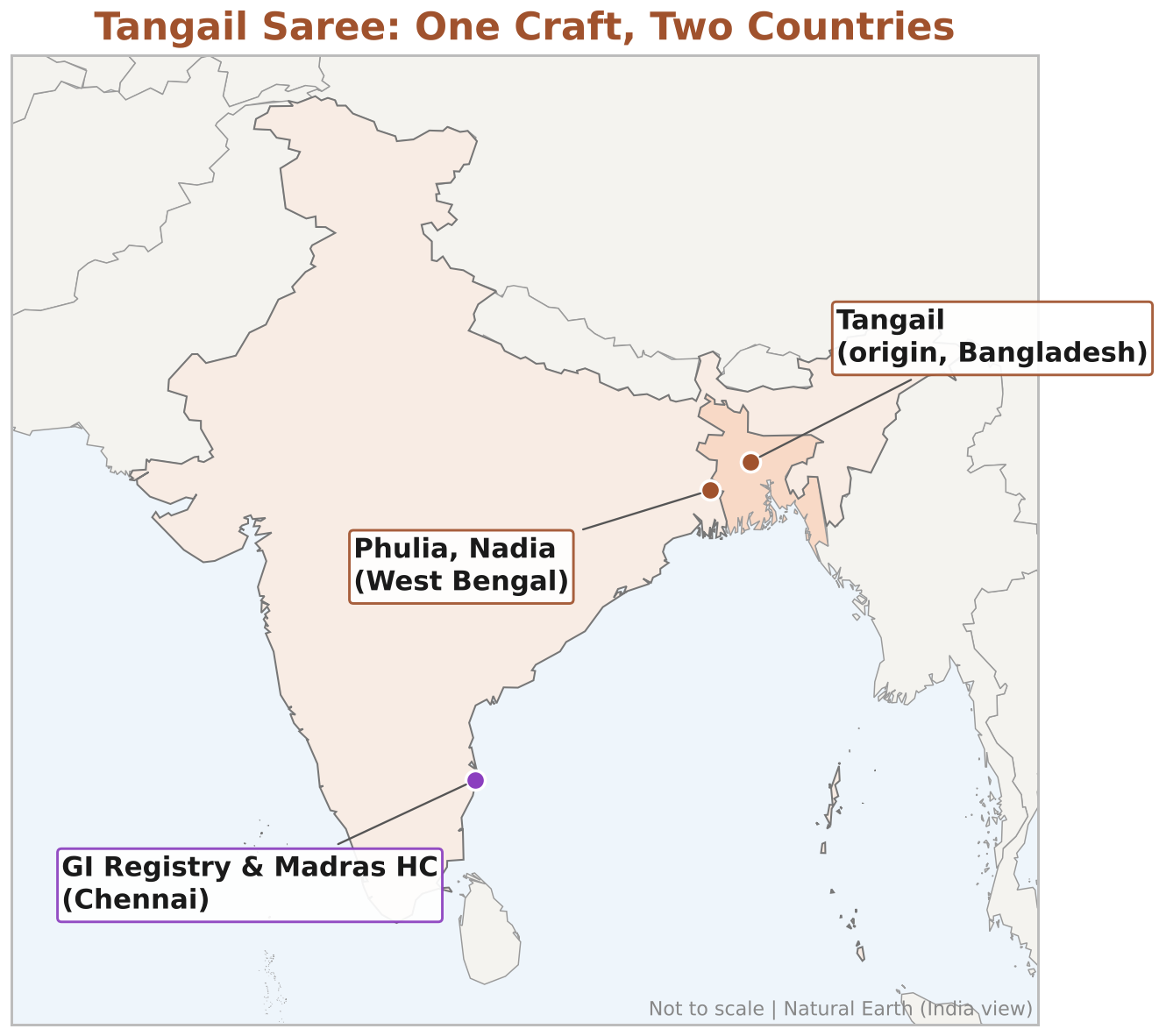
The Madras High Court has allowed Bangladesh's challenge to India's GI tag for the 'Tangail Saree of Bengal' to go ahead - a dispute rooted in the Partition, which split the weavers across two countries. The Madras High Court held that Bangladesh's petition against India's GI registration of the 'Tangail Saree of Bengal' is maintainable (can be heard). India granted the GI on 2 January 2024 to the West Bengal State Handloom Weavers Co-operative Society. Bangladesh secured its own GI for 'Tangail Sari' in 2024. In December 2025 UNESCO inscribed Bangladesh's traditional Tangail saree weaving on its intangible heritage list.
Key facts
Origin: Tangail district, present-day Bangladesh
After Partition, many weavers settled in Phulia and nearby areas of West Bengal - now woven on both sides
India's GI: 2 January 2024, by the GI Registry, Chennai
Bangladesh: own GI in 2024; UNESCO intangible heritage listing in December 2025
Madras HC: Bangladesh's challenge is maintainable - case will now be heard on merits
Way forward
A joint or shared approach to crafts with common roots could protect weavers on both sides rather than turning heritage into a legal fight.
Concept
Geographical Indication (GI): a tag for a product whose quality comes from a specific place (Darjeeling Tea was India's first, 2004-05). Law: Geographical Indications of Goods (Registration and Protection) Act, 1999, in force from 2003; GI Registry is in Chennai. Appeals against GI decisions go to the High Court since the Intellectual Property Appellate Board (IPAB) was abolished in 2021. UNESCO Representative List of Intangible Cultural Heritage (2003 Convention): lists living traditions like crafts, festivals and music. India's entries include Durga Puja in Kolkata, Kumbh Mela and Garba. Exam angle: Prelims: GI Act year, first GI, GI Registry location; Tangail (Bangladesh) - Phulia (Nadia, West Bengal). Mains: shared heritage of the subcontinent and cross-border IPR disputes.
Map of India and Bangladesh marking Tangail (origin, Bangladesh), Phulia in Nadia (West Bengal) and Chennai (GI Registry and Madras High Court). — StudyForGS
📜 Asked before in the exam — previous-year question on this topic
UPSC Prelims 2024Which one of the following was the latest inclusion in the Intangible Cultural Heritage List of UNESCO?
Chhau dance
Durga puja
Garba dance
Kumbh mela
Show answer
Answer: (c) Garba dance Garba, the devotional dance of Gujarat performed during Navratri, was inscribed on UNESCO's Representative List of the Intangible Cultural Heritage of Humanity in December 2023, becoming India's 15th element. The others came earlier: Chhau dance in 2010, Kumbh Mela in 2017 and Durga Puja in Kolkata in 2021. Update: Deepavali was inscribed in December 2025, so Garba is no longer the latest Indian entry. Practise all UPSC Prelims 2024 paper (free) →
Linked because this news is about the same topic. The answer is as per the official key of that year.
24. BepiColombo Enters Orbit Around Mercury
SCI-TECHUPSC: Prelims + Mains GS3
Syllabus linkage
GS3 - Space technology, awareness in science. Prelims: BepiColombo agencies, orbiters, earlier Mercury missions.
Context
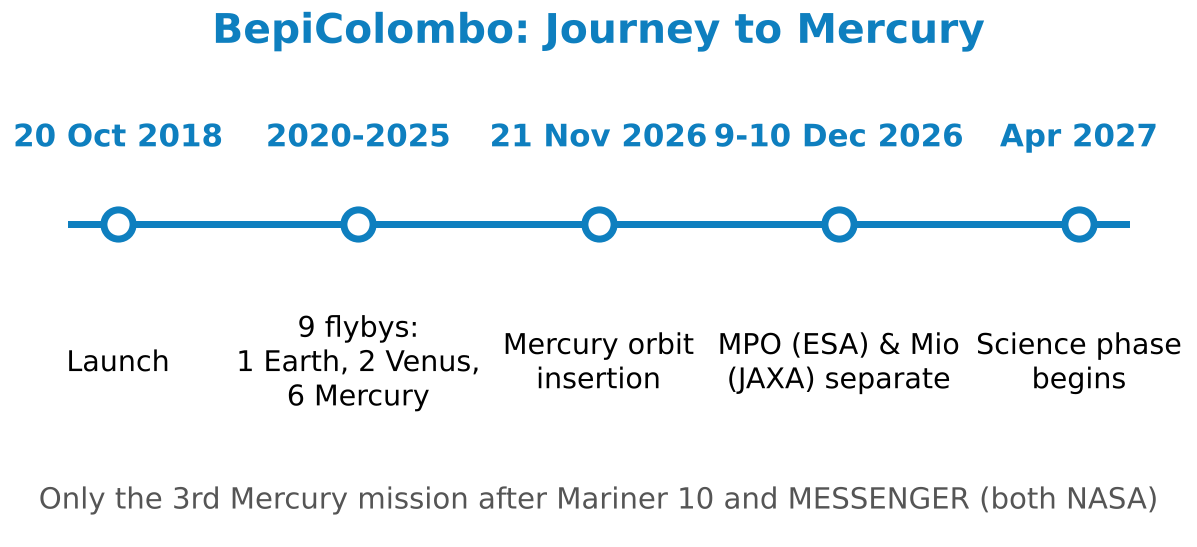
A joint European-Japanese spacecraft, BepiColombo, has reached orbit around Mercury, the planet closest to the Sun, after an eight-year trip. BepiColombo, a mission of the European Space Agency (ESA) and the Japan Aerospace Exploration Agency (JAXA), was launched on 20 October 2018. It was due to enter Mercury's orbit on 21 November 2026 after an eight-year journey using nine planetary flybys to slow down. It carries two orbiters: ESA's Mercury Planetary Orbiter (MPO) and JAXA's Mercury Magnetospheric Orbiter (Mio). They will separate on 9-10 December 2026, and the main science phase is to begin in April 2027.
Key facts
Launched: 20 October 2018
Flybys: 1 of Earth, 2 of Venus, 6 of Mercury
Two orbiters: MPO (ESA) - surface and interior; Mio (JAXA) - magnetic field
Only the third mission to Mercury, after NASA's Mariner 10 and MESSENGER
Named after Italian scientist Giuseppe 'Bepi' Colombo, who studied Mercury's orbit
Way forward
Data from the two orbiters will help explain how rocky planets like Earth formed.
Concept
Gravity assist (flyby): using a planet's gravity to change a spacecraft's speed and path without burning fuel. Going towards the Sun, a craft must lose speed, which is why so many flybys were needed. Magnetosphere: the bubble of magnetic field around a planet that deflects charged particles from the Sun (solar wind). Mercury is the only rocky planet besides Earth with a global magnetic field. Mercury: smallest planet, a year of 88 Earth days, very large iron core, almost no atmosphere (only a thin 'exosphere'). Exam angle: Prelims: BepiColombo agencies, orbiter names, earlier missions; Mercury facts. Mains: value of international collaboration in deep-space science.
BepiColombo timeline: launch 20 October 2018, nine flybys 2020-2025 (1 Earth, 2 Venus, 6 Mercury), orbit insertion 21 November 2026, orbiters separate 9-10 December 2026, science phase April 2027. — StudyForGS
25. Indian Astronomers Find 'Stellar Fossil'
SCI-TECHUPSC: Prelims + Mains GS3
Syllabus linkage
GS3 - Achievements of Indians in science, space. Prelims: CEMP stars, metallicity, nucleosynthesis, IIA.
Context
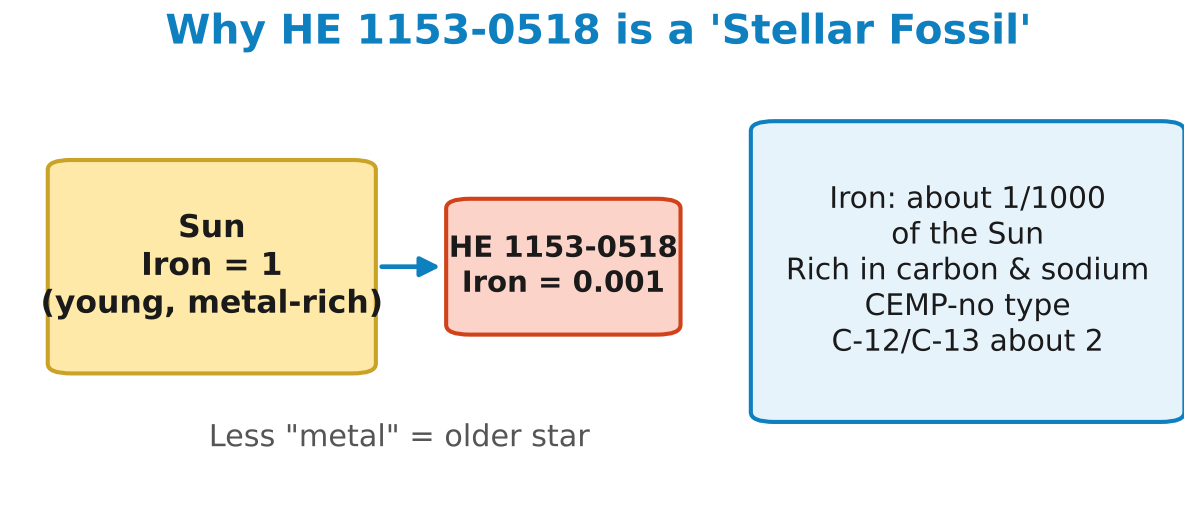
Indian astronomers have studied a very old star, HE 1153-0518, which has almost no iron but a lot of carbon - a 'fossil' that records what the universe was made of soon after the first stars. Astronomers from the Indian Institute of Astrophysics (IIA), Bengaluru and Dakshin Kamrup College, Assam characterised the star HE 1153-0518 using high-resolution spectra from the Subaru Telescope in Hawaii. It is a CEMP-no star (Carbon-Enhanced Metal-Poor star without extra heavy 'neutron-capture' elements). Its iron content is about one-thousandth of the Sun's, and it is rich in carbon and sodium. The results appeared in the Monthly Notices of the Royal Astronomical Society.
Key facts
Star: HE 1153-0518 - a newly identified CEMP-no star
Iron: about 1/1000th of the Sun's; strongly enriched in carbon and sodium
Low carbon-12 to carbon-13 ratio (about 2) - shows strong internal mixing
Extra infrared glow hints at dust around the star
Such stars formed from gas enriched by the very first generation of massive stars that exploded as supernovae
Way forward
Studying more such stars, including with upcoming large telescopes India is part of, can map how early galaxies were chemically built.
Concept
Metallicity: the share of elements heavier than hydrogen and helium (astronomers call all of them 'metals'). The earliest stars had almost none, so low metallicity means very old. Nucleosynthesis: making new elements inside stars and in supernova explosions. Hydrogen and helium came from the Big Bang; carbon, oxygen, iron etc. were made later by stars. IIA: an autonomous institute under the Department of Science and Technology; it runs observatories such as Kavalur (Tamil Nadu) and Hanle (Ladakh). Exam angle: Prelims: CEMP star meaning, metallicity, nucleosynthesis. Mains: India's growing role in observational astronomy.
Comparison: the Sun (iron = 1, young and metal-rich) versus HE 1153-0518 (iron = 0.001, rich in carbon and sodium, CEMP-no, carbon-12/carbon-13 about 2); less metal means an older star. — StudyForGS
26. Genome Language Models: AI Reads DNA
SCI-TECHUPSC: Prelims + Mains GS3
Syllabus linkage
GS3 - Biotechnology, AI, emerging technologies. Prelims: genome, base pairs, LLMs; Mains: opportunities and biosafety risks.
Context
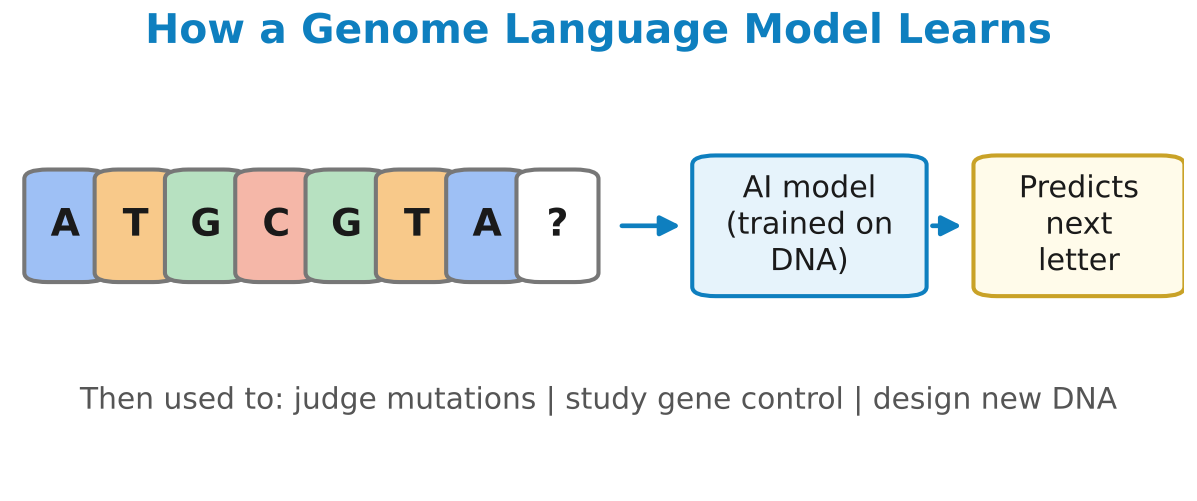
Scientists are training AI models on DNA the way chatbots are trained on text, so they can predict what a genetic change will do and even design new DNA. A genome language model is an AI model trained on huge amounts of DNA (and RNA) sequences from many organisms. Like a text model that guesses the next word, it learns by predicting the next DNA letter or filling in missing ones. After training it can spot patterns in genes and how genes control each other, without being taught the rules. Scientists are now using such models to predict the effects of mutations and to generate new DNA sequences for simple biological systems.
Key facts
DNA alphabet: four bases - adenine (A), thymine (T), guanine (G), cytosine (C)
Genome: the full set of genetic instructions of an organism
Training method: predict the next or missing DNA letter
Uses: judging harmful mutations, studying gene control, designing new sequences
Results still need checking by lab experiments
Way forward
India can combine its genome data projects with AI, while setting clear biosafety and data-privacy rules.
Concept
Large language model (LLM): an AI system trained on vast data to predict the next token; a genome model applies the same idea to DNA 'text'. Mutation: a change in the DNA sequence; some are harmless, some cause disease - predicting which is a major use of these models. Biosecurity: AI that can design DNA could also be misused, so safeguards on training data and access are being discussed worldwide. India's Genome India project has sequenced 10,000 genomes as a reference. Exam angle: Prelims: DNA bases, genome, how language models learn. Mains: AI in healthcare and the need for biosafety rules.
Diagram: a DNA letter sequence A T G C G T A and a blank go into an AI model that predicts the next letter; uses: judging mutations, gene control, designing new DNA. — StudyForGS
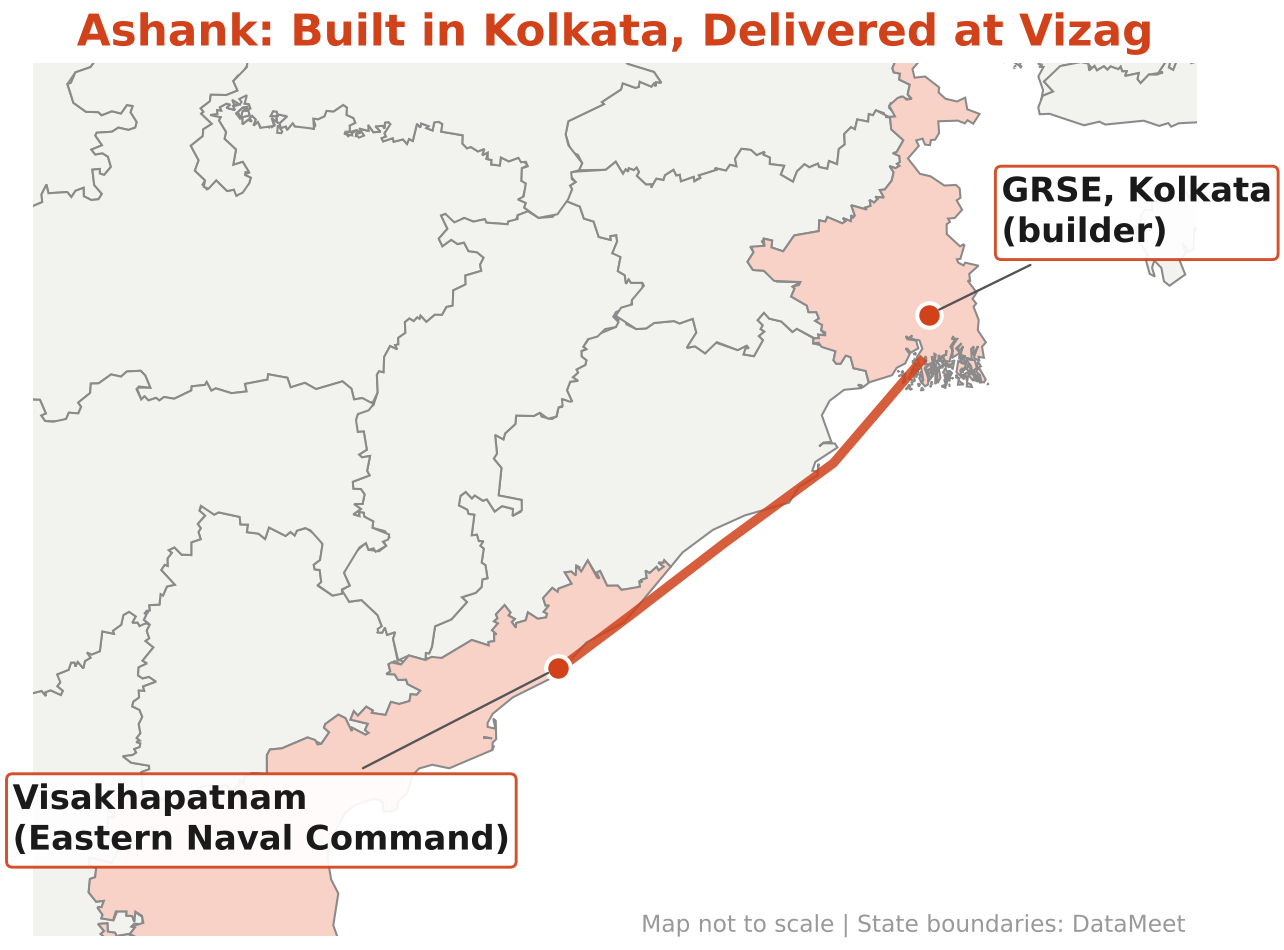
Kolkata's GRSE has delivered 'Ashank', its sixth small submarine-hunting warship built for shallow coastal waters, to the Indian Navy. Garden Reach Shipbuilders and Engineers (GRSE), Kolkata, delivered Ashank, an Anti-Submarine Warfare Shallow Water Craft (ASW-SWC), to the Navy at Visakhapatnam on 23 November 2026. It was received by Rear Admiral Gautam Marwaha of the Eastern Naval Command. It is GRSE's second warship delivery within a month, after Amini. Ashank has over 80% indigenous content (reported at about 88%) and carries a GRSE-made 30 mm naval surface gun.
Key facts
Type: ASW Shallow Water Craft - hunts submarines close to the coast
Sixth of eight Arnala-class craft being built by GRSE
Waterjet propulsion - good for shallow water and quieter
GRSE has built 120 warships so far, 82 of them for the Navy
Way forward
Timely delivery of the remaining craft and a domestic supply chain for sonars and weapons will cut import dependence.
Concept
ASW-SWC programme: 16 craft ordered in 2019 - 8 Arnala-class from GRSE and 8 Mahe-class from Cochin Shipyard. Lead ship Arnala was delivered on 8 May 2025. Sonar: sends sound pulses underwater and listens for echoes to find submarines and map the sea floor. Littoral waters: shallow sea areas close to the shore, where big frigates and destroyers cannot operate easily. Exam angle: Prelims: GRSE location, ASW-SWC classes and builders. Mains: indigenisation in shipbuilding and threats in the Indian Ocean Region.
Map of east India showing Ashank's delivery route from GRSE Kolkata (builder) to Visakhapatnam (Eastern Naval Command). — StudyForGS
Data point of the day
about 25%
Small hydro potential harnessed About 5,182 MW of an estimated 21,134 MW small hydro potential had been harnessed by 30 September 2026.
Prelims rapid-fire
25 Nov: International Day for the Elimination of Violence against Women - set by UN General Assembly resolution 54/134 (1999); starts the '16 Days of Activism' that run to 10 December (Human Rights Day).
26 Nov: Constitution Day (Samvidhan Divas) - marks adoption of the Constitution on 26 November 1949; observed since 2015. The Constitution came into force on 26 January 1950.
Heritage: World Heritage Week (19-25 November) - organised by the Archaeological Survey of India (Ministry of Culture); different from World Heritage Day on 18 April.
Libya: An explosion and fire were reported on a Russian ship at Benghazi port in eastern Libya; the eastern-based government suspects a drone attack. Benghazi lies on the Gulf of Sidra (Mediterranean).
Bulgaria: Bulgaria's Foreign Minister called on President Droupadi Murmu to discuss wider cooperation. Bulgaria: capital Sofia, on the Black Sea, member of the EU and NATO.
Pali: Explainers on Pali inscriptions: Pali, the language of the Theravada Buddhist canon (Tipitaka), got Classical Language status in October 2024 with Marathi, Prakrit, Assamese and Bengali - India now has 11 classical languages.
Rail link: Sarayu-Kamala Express - new train linking Ayodhya (India) and Janakpur (Nepal), flagged off during the Nepal PM's visit.
Mains practice question
Q. Long gaps between the adjournment and prorogation of Parliament, and the falling number of sitting days, weaken legislative scrutiny of the executive. Discuss in the light of Article 85 and suggest reforms. (250 words)
Hint / approach
Explain adjournment sine die vs prorogation under Article 85; cite the record 100-day gap and skipped Winter Sessions; discuss executive control of the calendar via the CCPA; suggest a fixed calendar, minimum 120 sittings (NCRWC) and opposition say in scheduling.
📌 One-line revision: Article 85: President prorogues, max 6-month gap; Ganga Treaty ends 12 Dec 2026; COP32 Addis Ababa; ICJ: Myanmar genocide; RBI stop switch; SAMPADA anaemia.