Monday, 23 November 2026 · IST · National & International · 25 items
The UN climate summit in Antalya collapsed over fossil-fuel language, while Nepal's new PM Balendra Shah held talks in Delhi and a weekly Ayodhya-Janakpur train was launched. At home, a survey found 13.2% ineligible households in PMGKAY, Parliament crossed 100 days without prorogation, and EPFO 3.0 prepared to bring gig workers under provident fund cover.
Today at a glance — things to remember
Parliament: about 100 days since the Monsoon Session was adjourned sine die, still not prorogued (Article 85).
PMGKAY survey: 13.2% inclusion error; West Bengal 39.5%, Tripura 39.2%, Tamil Nadu 38.7%.
EPFO 3.0: one UAN for many employers, UPI withdrawals, gig worker coverage.
Nepal PM Balendra Shah's first India visit; Saryu-Kamala Express links Ayodhya and Janakpur (604 km).
SCO Civilisational Dialogue Forum adopts the 12-point Indraprastha Communique in New Delhi.
COP31 in Antalya ends without its cover text; COP32 goes to Addis Ababa in 2027.
Exports in April-October 2026: US$ 568.84 billion, up 16.66%; ASEAN exports up 58% (Apr-Sep).
Small Hydro scheme: Rs 2,584.60 crore for about 1,500 MW; extra aid for NE and border districts.
BepiColombo enters Mercury orbit - only the second mission ever to do so.
India-China Corps Commander talks on the Arunachal LAC run for nearly 10 days.
Detailed notes
1. Parliament Left Unprorogued for 100 Days
POLITYUPSC: Prelims + Mains GS2
Syllabus linkage
GS2 - Parliament: structure, functioning, conduct of business. Prelims: Article 85, adjournment vs prorogation vs dissolution. Mains: executive control over Parliament's calendar.
Context
Parliament's Monsoon Session ended on 13 August, but the President has still not formally closed (prorogued) it. This gap of about 100 days is the longest such gap in India's history, and it has started a debate on how sessions are opened and closed. The Monsoon Session ran from 20 July to 13 August 2026 and was then adjourned sine die (closed with no date fixed for the next sitting). The President has not prorogued (formally ended) the session, so both Houses technically remain in the same session. As of 23 November this is about 100 days without prorogation - longer than the earlier record of 87 days in 2008. Some saw this as a way to recall Parliament at short notice, possibly for a delimitation-related constitutional amendment, but that idea weakened as the Winter Session nears.
Key facts
Monsoon Session: 20 July - 13 August 2026; adjourned sine die on 13 August.
About 100 days without prorogation - longest ever; earlier long gap: 87 days (2008).
While a House is not prorogued, the Lok Sabha Speaker can call a sitting under Rule 15 of the Lok Sabha Rules.
Average sitting days per year have fallen from about 135 (First Lok Sabha) to about 55 now.
MPs keep their parliamentary privileges during such periods.
Way forward
A fixed annual calendar with a minimum number of sitting days, as many committees have suggested, would make Parliament less dependent on the government's timing.
Concept
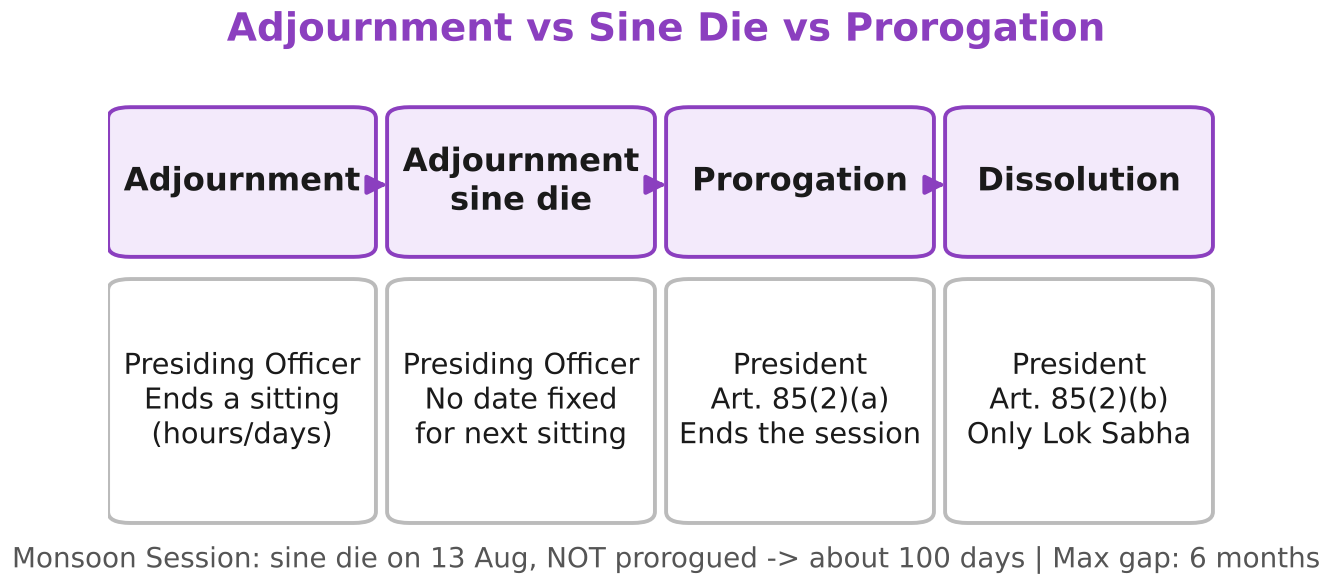
Article 85: the President summons and prorogues each House (on the advice of the Council of Ministers); the gap between two sessions cannot be more than six months. No minimum notice is written in the Constitution; by convention about 14 days are given. Adjournment = a pause in a sitting (by the Speaker/Chairman); adjournment sine die = sitting ends with no next date; prorogation = the session itself ends (by the President); dissolution = Lok Sabha's life ends (Art. 85(2)(b)). Rajya Sabha is never dissolved. Effect of prorogation: pending bills do NOT lapse, but pending notices (except for introducing bills) lapse. Only dissolution of Lok Sabha makes certain bills lapse. Exam angle: Prelims: who adjourns vs who prorogues; six-month rule; whether bills lapse on prorogation. Mains: executive dominance over Parliament's sittings, falling sitting days and the case for a fixed parliamentary calendar.
Diagram comparing adjournment, adjournment sine die, prorogation and dissolution of Parliament, with who orders each and the relevant Article — StudyForGS
📜 Asked before in the exam — previous-year question on this topic
UPSC Prelims 2024With reference to the Parliament of India, consider the following statements: 1. Prorogation of a House by the President of India does not require the advice of the Council of Ministers. 2. Prorogation of a House is generally done after the House is adjourned sine die but there is no bar to the President of India prorogating the House which is in session. 3. Dissolution of the Lok Sabha is done by the President of India who, save in exceptional circumstances, does so on the advice of the Council of Ministers. Which of the statements given above is/are correct?
1 only
1 and 2
2 and 3
3 only
Show answer
Answer: (c) 2 and 3 Statements 2 and 3 are correct. Prorogation under Article 85 is done by the President, but like other such functions it is done on the advice of the Council of Ministers under Article 74, so statement 1 is wrong. A House is usually prorogued after it is adjourned sine die, but nothing stops the President from proroguing a House that is in session. The Lok Sabha is dissolved by the President, normally on the advice of the Council of Ministers, except in exceptional situations. Practise all UPSC Prelims 2024 paper (free) →
Linked because this news is about the same topic. The answer is as per the official key of that year.
2. Free Ration Scheme: 13% Inclusion Error
POLITYUPSC: Prelims + Mains GS2
Syllabus linkage
GS2 - Government schemes, issues in their design and implementation; GS3 - Public Distribution System, food security. Prelims: NFSA coverage, PMGKAY, AAY vs PHH.
Context
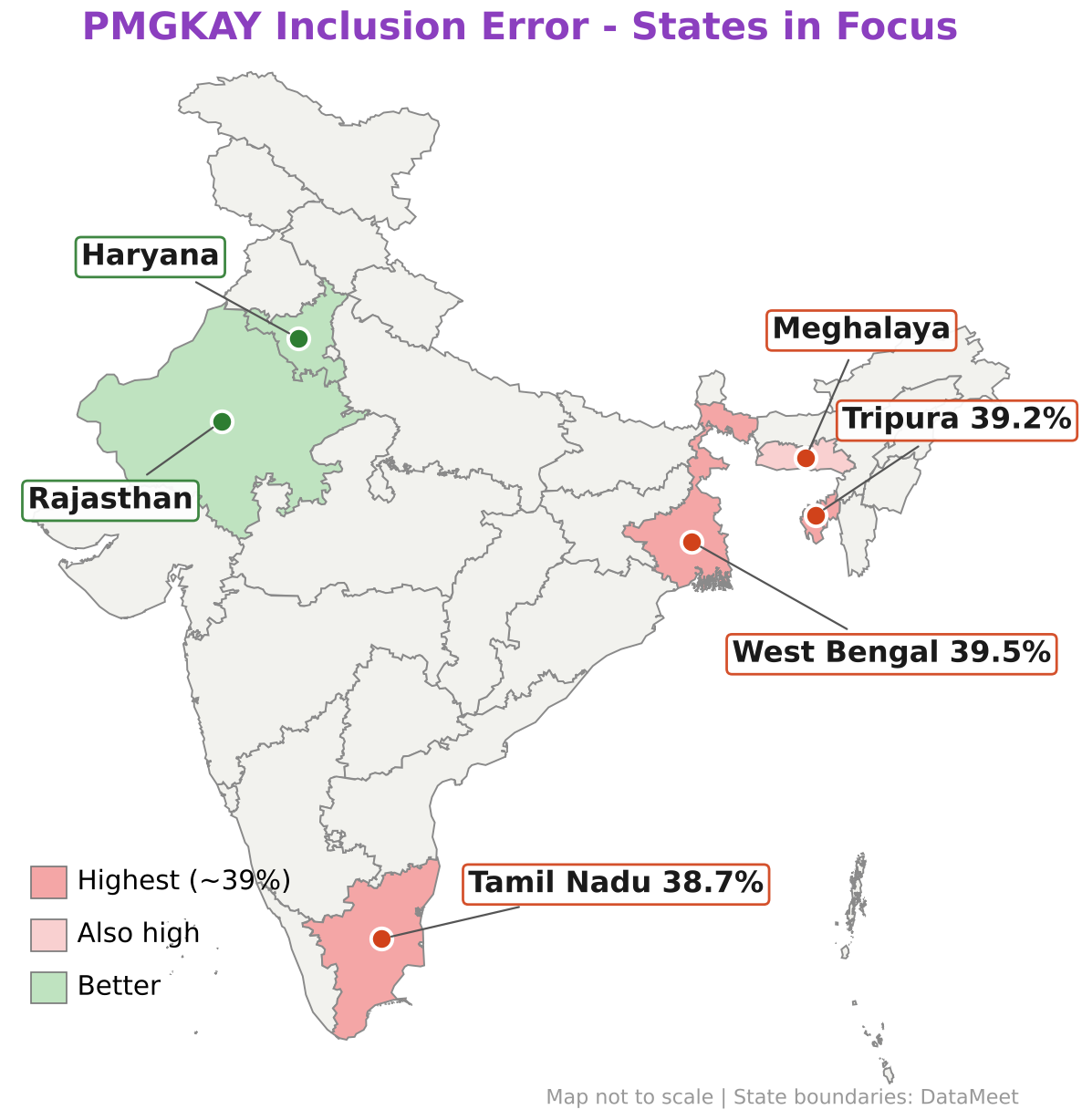
A government study found that about 13 out of every 100 households getting free ration under PMGKAY should not be getting it - for example, families owning a car or having a government job. The Department of Food and Public Distribution surveyed over 51,000 beneficiary households for 2025-26 under the Pradhan Mantri Garib Kalyan Anna Yojana (PMGKAY). It found an overall inclusion error (ineligible people included) of 13.2%. The error was higher in urban areas (15.6%) than rural areas (12.5%). West Bengal (39.5%), Tripura (39.2%) and Tamil Nadu (38.7%) had the highest error, while Haryana and Rajasthan did better because of stronger data systems.
Antyodaya Anna Yojana (AAY) households: 12.2%; Priority Households (PHH): 13.4%.
Highest: West Bengal 39.5%, Tripura 39.2%, Tamil Nadu 38.7%; Meghalaya also among the high-error states.
Examples of ineligible beneficiaries: owning a car or air conditioner, a family member in a government job.
About 78.63 crore people covered as of October 2026; the report suggests regular database checks.
Way forward
Use regular data matching (vehicle, tax, salary records) to remove ineligible names, but with care so that genuinely poor families are not wrongly cut off.
Concept
Inclusion error = giving benefits to people who are not eligible; exclusion error = leaving out people who are eligible. Both waste money or deny rights. National Food Security Act (NFSA), 2013 covers up to 75% of rural and 50% of urban population; AAY families get 35 kg grain per household per month, PHH get 5 kg per person. Each state decides its own criteria to pick beneficiaries. PMGKAY began in 2020 during COVID; since 1 January 2024 the NFSA grain is given free for five years under PMGKAY. Exam angle: Prelims: NFSA coverage ratios, AAY vs PHH entitlement, PMGKAY timeline. Mains: targeting in welfare schemes - inclusion vs exclusion errors, role of data (Aadhaar, e-KYC, SECC), and Centre-state roles in PDS.
Map of India highlighting West Bengal, Tripura and Tamil Nadu with the highest PMGKAY inclusion error, Meghalaya also high, and Haryana and Rajasthan as better performers — StudyForGS
3. EPFO 3.0 to Cover Gig Workers
POLITYUPSC: Prelims + Mains GS2
Syllabus linkage
GS2 - Welfare of vulnerable sections; GS3 - Inclusive growth, labour reforms. Prelims: EPFO, UAN, Code on Social Security 2020. Mains: social security for gig and platform workers.
Context
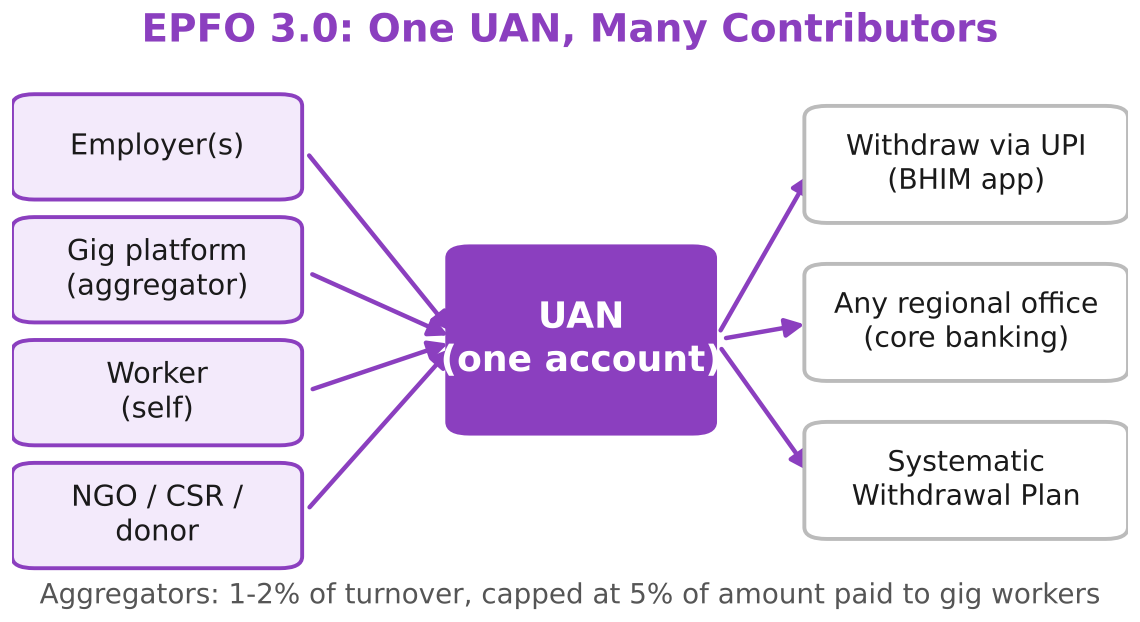
The Employees' Provident Fund Organisation (EPFO) is rebuilding its system so that even gig workers like delivery riders and cab drivers can save in a PF account, and all members can withdraw money through UPI. EPFO 3.0 is a full technology and structural overhaul of EPFO. It aims to bring all formal and informal workers, including gig and platform workers, into the provident fund system for the first time. One Universal Account Number (UAN) can be linked to many employers and platforms at the same time. Withdrawals through the BHIM UPI app are expected by end-December 2026, and the system is built to handle data of 200 crore workers over 50 years.
Key facts
One-to-many mapping: one UAN linked to several employers and aggregators, with employer-wise break-up.
Third-party contributions (NGOs, individuals, CSR funds) allowed, with an upper limit - a co-contribution model for gig workers.
Core Banking Solution: members can get service at any regional office, like a bank branch.
EPFO expects to cover about 2.5 crore gig and construction workers in five years.
EPFO today: about 8 crore active members, over 34 crore total members, corpus of nearly Rs 32 lakh crore.
Way forward
Clear rules for aggregator payments, easy self-registration and awareness drives are needed so that gig workers actually join and keep contributing.
Concept
EPFO: statutory body under the Ministry of Labour and Employment, set up under the Employees' Provident Funds and Miscellaneous Provisions Act, 1952. It runs EPF, EPS (pension) and EDLI (insurance). Code on Social Security, 2020 (one of four labour codes in force since 21 November 2025): for the first time defines gig and platform workers; aggregators must pay 1-2% of annual turnover, capped at 5% of the amount paid to such workers, for their social security. Gig worker = someone who earns outside a traditional employer-employee relationship, task by task (e.g. food delivery). Platform worker = a gig worker who gets work through an online app. Exam angle: Prelims: EPFO's parent Act and ministry, aggregator contribution rates, UAN. Mains: gaps in social security for India's informal workforce and how technology (UPI, UAN portability) can close them.
Flow diagram of EPFO 3.0 showing employers, gig platforms, the worker and NGO or CSR donors contributing to one UAN, with UPI withdrawal, core banking and systematic withdrawal as outputs — StudyForGS
4. NCS ONE Portal and Shortage Index
POLITYUPSC: Prelims + Mains GS2
Syllabus linkage
GS2 - Government policies and interventions; GS3 - Employment, skill development. Prelims: National Career Service, e-Shram, NCO-2015.
Context
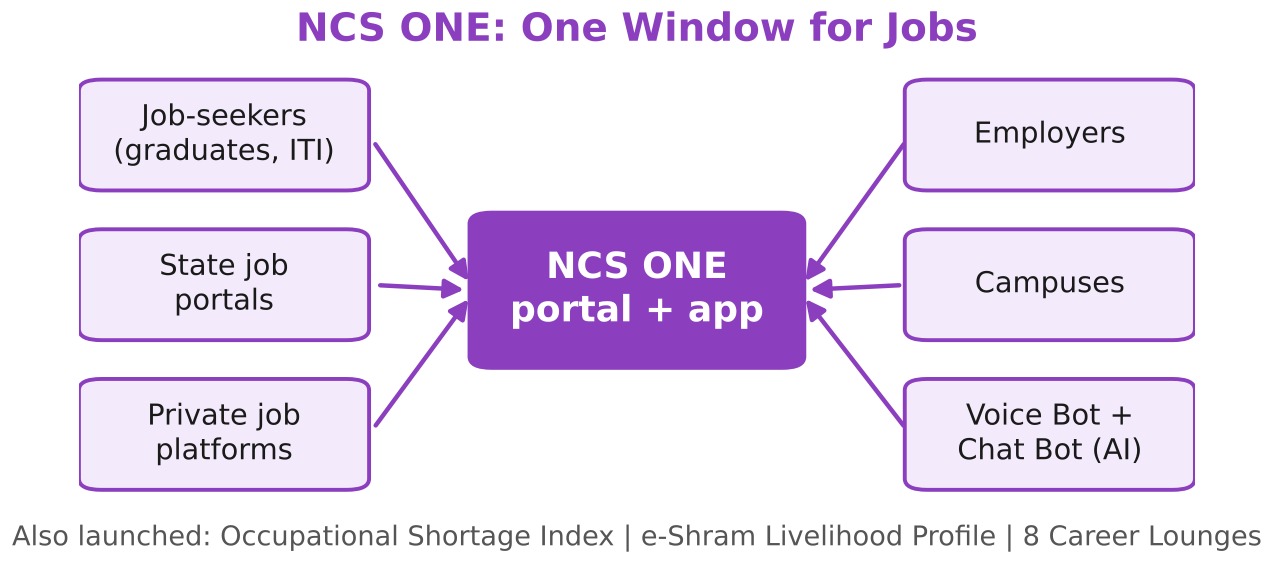
The Labour Ministry launched a single job platform, NCS ONE, that links job-seekers, employers, state job portals and colleges, along with a new index that shows which jobs lack enough skilled workers. Labour Minister Mansukh Mandaviya launched the National Career Service (NCS) ONE portal at the two-day Labour Ministers' Chintan Shivir in Gandhinagar, which ended on 22 November. The portal connects job-seeker and employer apps, state portals, private job platforms and campuses, and has an AI Voice Bot and Chat Bot. He also launched an Occupational Shortage Index, the e-Shram Livelihood Profile Module and eight NCS Career Lounges.
Key facts
NCS ONE = single window for jobs: graduates, ITI-pass youth and skilled artisans meet employers.
Occupational Shortage Index: measures gaps between demand and supply of workers in each occupation.
e-Shram Livelihood Profile Module linked to 'Panch Suraksha' (food, health, life insurance, accident/disability cover, pension).
8 Career Lounges opened (Jaipur, Ludhiana, Bhubaneswar, Kanpur, Bengaluru, Varanasi, Hyderabad, Guwahati); plan: 200, mainly in Tier-II/III cities.
Released: an addendum to NCO-2015 and a compilation of green occupations.
Way forward
The index should feed into skilling plans (like Skill India) so that training matches the jobs that are actually vacant.
Concept
National Career Service: launched in 2015 by the Ministry of Labour and Employment as a digital platform for job matching, career counselling and job fairs. e-Shram: national database of unorganised workers launched in August 2021, giving each worker an e-Shram card (UAN-like ID). NCO-2015 (National Classification of Occupations): the official list and coding of all occupations in India, used for surveys and job matching. Exam angle: Prelims: launch year of NCS and e-Shram, what an occupational shortage index measures. Mains: skill mismatch and youth unemployment; role of digital public infrastructure in labour markets.
Hub diagram of the NCS ONE portal linking job-seekers, state job portals and private platforms with employers, campuses and AI voice and chat bots — StudyForGS
5. Arunachal: Cooperatives and Border Villages
POLITYUPSC: Prelims + Mains GS2
Syllabus linkage
GS2 - Government policies; GS3 - Border area development, inclusive growth, cooperatives. Prelims: Vibrant Villages Programme, PACS, 'Sahkar se Samriddhi'.
Context
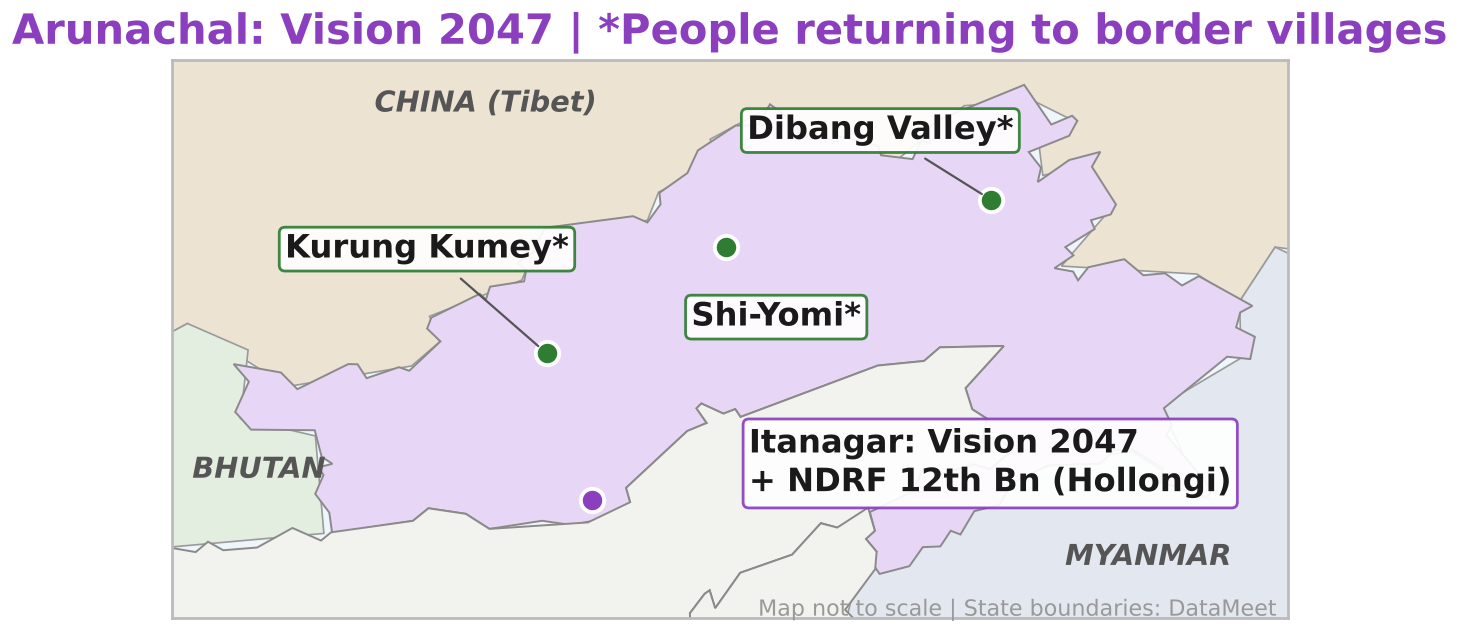
Home and Cooperation Minister Amit Shah released a 2047 vision for cooperatives in Arunachal Pradesh and said people have started returning to 40 villages along the China border after roads, power and services improved. At a Cooperative Festival in Itanagar on 22 November, Amit Shah unveiled the 'Arunachal Pradesh Cooperative Vision 2047' under the theme 'Sahkar se Samriddhi' (prosperity through cooperation). Projects worth Rs 5,610.95 crore were announced. He said migration from 40 villages along the China border has stopped and people are returning, linked to the Vibrant Villages Programme. The Army and ITBP have been asked to buy vegetables, eggs, milk and dairy products directly from local cooperatives.
Key facts
Projects of Rs 5,610.95 crore: Mission Shikshit Arunachal Phase II (Rs 1,500 crore), power and rural roads (Rs 2,000 crore each).
Cooperatives: 185 PACS, 52 dairy and 43 fisheries cooperatives, linking over 56,000 people.
NDDB and Amul to procure milk; a milk-processing plant to be set up; local sourcing could help at least 32,000 families.
SARAS Mela inaugurated; a women SHG federation's cooperative got its registration certificate.
Way forward
An independent impact study of the Vibrant Villages Programme would confirm the return of residents with data and guide the next phase.
Concept
Vibrant Villages Programme-I (February 2023): centrally sponsored scheme for villages on the northern (China) border in 46 blocks of 19 districts in Arunachal, Himachal, Sikkim, Uttarakhand and Ladakh. VVP-II (April 2025, Rs 6,839 crore) covers other land borders in 15 states and 2 UTs. PACS (Primary Agricultural Credit Societies): village-level cooperatives that give farmers short-term credit; they are the base of India's three-tier cooperative credit system. Ministry of Cooperation: created in July 2021; 'Sahkar se Samriddhi' is its guiding motto. Cooperatives are a State subject (Entry 32, State List); Part IXB was added by the 97th Amendment (2011). Exam angle: Prelims: VVP phases and coverage, PACS, Part IXB. Mains: reverse migration in border villages as a security tool ('villages as first line of defence') and role of cooperatives in rural livelihoods.
Zoomed map of Arunachal Pradesh marking Itanagar and the border districts Kurung Kumey, Dibang Valley and Shi-Yomi where people are reported to be returning — StudyForGS
6. Nepal PM Balendra Shah in India
IRUPSC: Prelims + Mains GS2
Syllabus linkage
GS2 - India and its neighbourhood relations; bilateral agreements. Prelims: India-Nepal Treaty 1950, border states, connectivity projects.
Context
Nepal's new Prime Minister Balendra Shah is on his first visit to India. He and PM Modi held talks on energy, trade, connectivity and help for Nepal's recovery from floods. Balendra Shah, Nepal's Prime Minister since March 2026, began a two-day State visit on 22 November - his first bilateral visit abroad. On 23 November he received a ceremonial welcome at Rashtrapati Bhavan, paid tribute at Rajghat and held talks with PM Modi at Hyderabad House. The agenda covered hydropower, trade, investment, air connectivity (new routes to Pokhara and Bhairahawa airports), and a development package of about US$ 2 billion under discussion, partly for rebuilding after the August glacial floods.
Key facts
First visit to India since Shah took office in March 2026; he met EAM S. Jaishankar on 22 November.
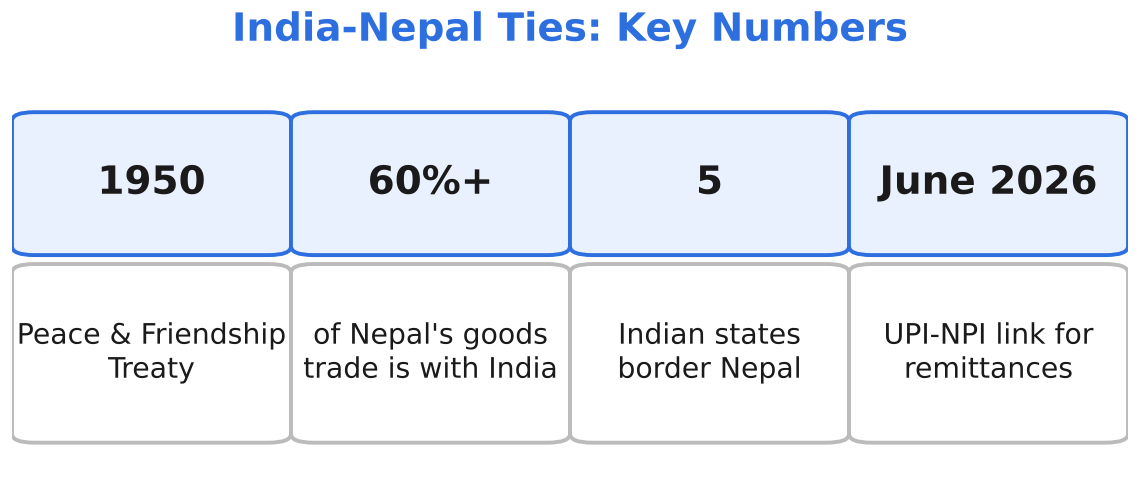
India is Nepal's largest trading partner - over 60% of Nepal's goods trade; about US$ 9.38 billion in FY 2025-26.
Nepal exported about 1,100 MW of power to India last year and also sold power to Bangladesh through the Indian grid.
UPI-NPI link for cross-border remittances began in June 2026.
Planned: an Integrated Check Post at Banbasa (Uttarakhand) and a Nepal-India Business Forum.
Way forward
Quick delivery of announced projects and long-term power purchase deals can build trust with Nepal's new leadership.
Concept
India-Nepal Treaty of Peace and Friendship (31 July 1950): the base of ties; allows open border and lets citizens of each country live and work in the other. Five Indian states border Nepal: Uttarakhand, Uttar Pradesh, Bihar, West Bengal and Sikkim. The border is open (no visa or passport needed for Indians and Nepalis). Existing links: Motihari-Amlekhgunj petroleum pipeline (South Asia's first cross-border oil pipeline), Jaynagar-Bijalpura rail line, and Integrated Check Posts. Exam angle: Prelims: states bordering Nepal, 1950 Treaty, Motihari-Amlekhgunj pipeline. Mains: India's 'Neighbourhood First' policy, hydropower trade and China's growing presence in Nepal.
Key numbers of India-Nepal ties: 1950 treaty, over 60 percent of Nepal's goods trade with India, five Indian states bordering Nepal, UPI-NPI link from June 2026 — StudyForGS
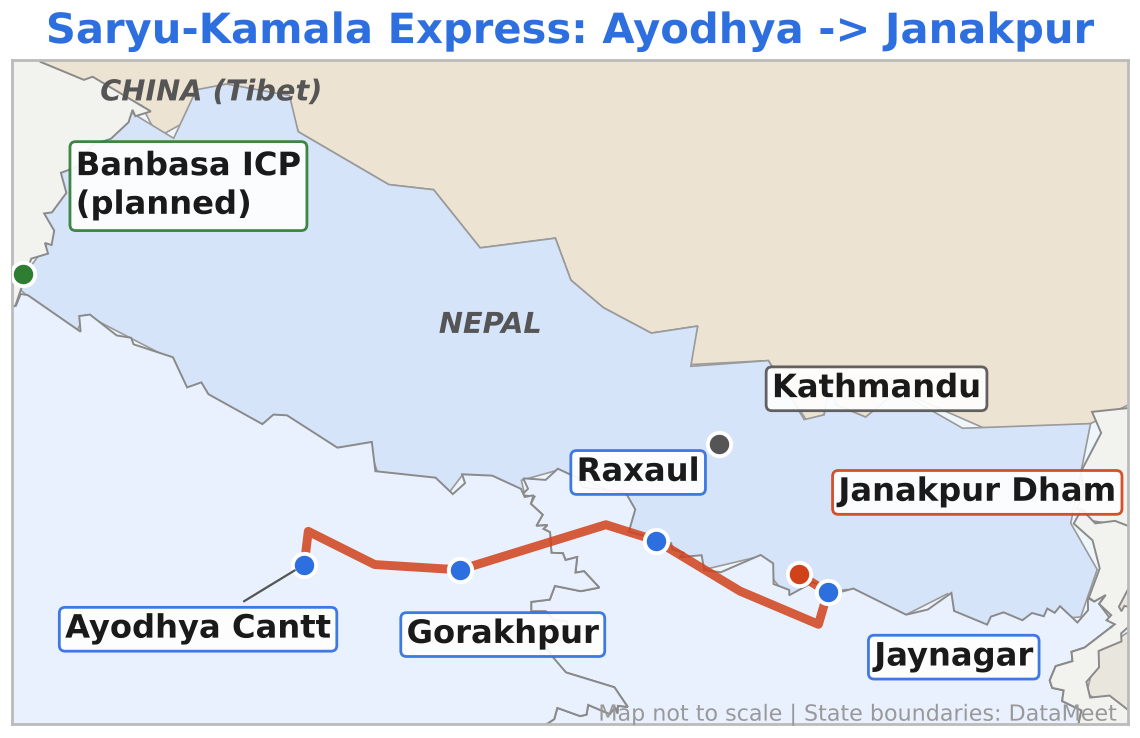
A new weekly train will run between Ayodhya (birthplace of Lord Ram) and Janakpur in Nepal (birthplace of Goddess Sita), linking the two countries through the Ramayana story. PM Modi and Nepal PM Balendra Shah were to flag off the Saryu-Kamala Express virtually on 23 November. The train runs 604 km from Ayodhya Cantt (Uttar Pradesh) to Janakpur Dham (Nepal) in about 19 hours, with regular service from 28 November. It leaves Ayodhya every Monday and returns from Janakpur every Saturday. The Saryu river flows past Ayodhya, and the Kamala river flows through the Janakpur region of Nepal.
Key facts
Distance: 604 km; travel time about 19 hours; weekly service.
Stops include Mankapur, Basti, Gorakhpur, Narkatiaganj, Raxaul, Sitamarhi, Madhubani and Jaynagar.
Aim: religious tourism (Ramayana circuit), trade, education and family travel for border people.
Other India-Nepal rail links: Jaynagar-Bijalpura-Bardibas, Jogbani-Biratnagar; Raxaul-Kathmandu line proposed.
Way forward
Smooth border checks, ticketing in both currencies and more frequency (if demand grows) will make the train a lasting success.
Concept
Ramayana Circuit: one of the themes under the Swadesh Darshan scheme (Ministry of Tourism, launched 2014-15) to develop places linked to Lord Ram in India and beyond. Janakpur: city in Madhesh Province of Nepal, believed to be the capital of King Janak and the birthplace of Sita; the Janaki Mandir is located here. Cultural diplomacy = using shared culture, religion and history to build friendly ties between countries; it is a form of soft power. Exam angle: Prelims: map location of stations (Raxaul, Jaynagar, Janakpur), Ramayana circuit. Mains: role of cultural and people-to-people links in India's neighbourhood policy.
Map of the Saryu-Kamala Express route from Ayodhya Cantt via Gorakhpur, Raxaul and Jaynagar to Janakpur Dham in Nepal, with Kathmandu and the planned Banbasa check post — StudyForGS
8. SCO Adopts Indraprastha Communique
IRUPSC: Prelims + Mains GS2
Syllabus linkage
GS2 - Regional groupings involving India; GS1 - Art and culture, heritage. Prelims: SCO members, Secretariat, RATS.
Context
India hosted the first-ever SCO Civilisational Dialogue Forum in Delhi. Member countries agreed on a 12-point plan to treat culture as a bridge and to protect heritage together. The first SCO Civilisational Dialogue Forum was held at Purana Qila, New Delhi, from 20 to 22 November 2026. PM Modi opened it, and it ended with the 12-point 'Indraprastha Communique'. The forum had 116 delegates from 22 countries and SCO Secretary-General Nurlan Yermekbayev. Pakistan's Climate Change Minister attended - the first visit by a Pakistani minister since Operation Sindoor (May 2025) - but India said no bilateral meeting took place.
Key facts
Organised by the Ministries of Culture and External Affairs; IGNCA was knowledge partner.
Communique: culture as a basis for trust; every civilisation an equal contributor; fight illegal trafficking of cultural objects.
Ideas: joint SCO nominations for UNESCO World Heritage, joint exhibitions and film festivals, AI for heritage records.
Four areas: manuscripts and languages, archaeology, cultural expressions, monastic trails.
India proposed making it a regular (biennial) forum; Modi had first proposed it at the 2025 Tianjin SCO Summit.
Way forward
An action plan with yearly projects (joint heritage work, scholarships, film exchange) will turn the communique into real cooperation.
Concept
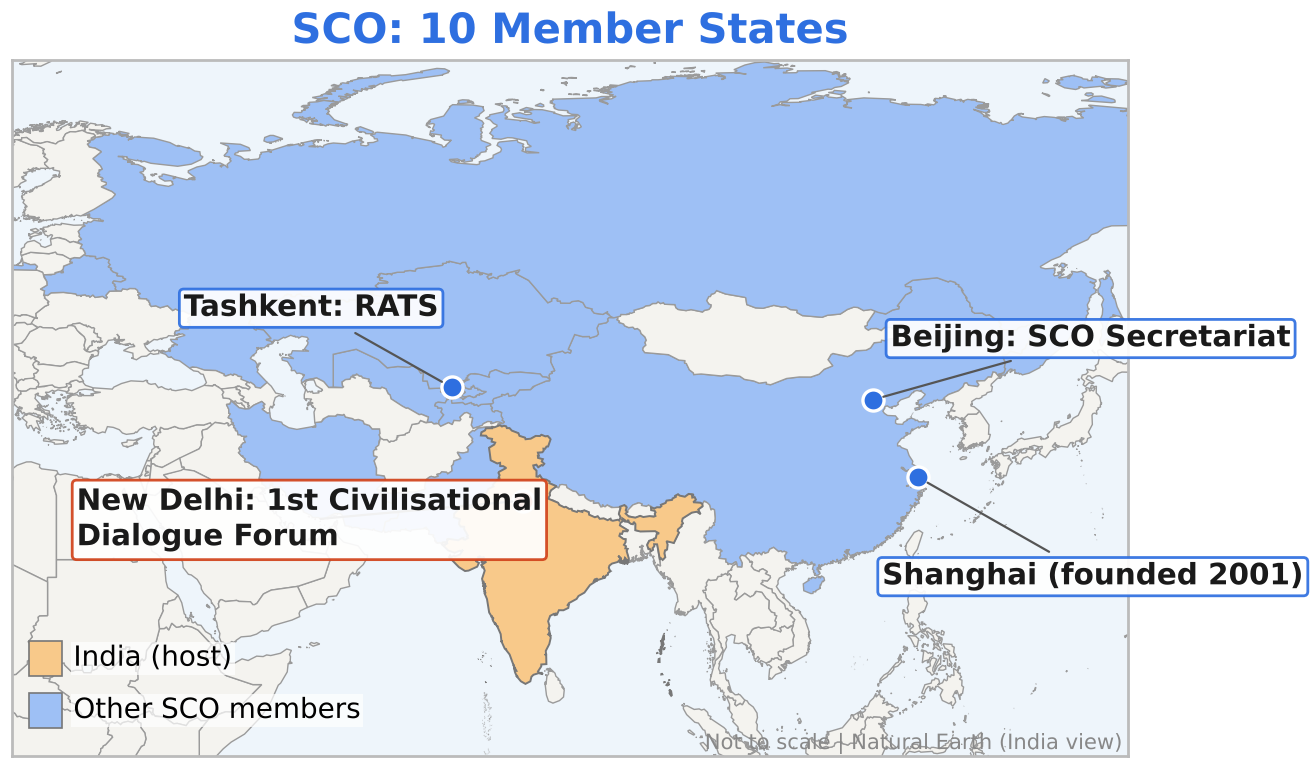
SCO (Shanghai Cooperation Organisation): founded in 2001 in Shanghai; 10 members - China, Russia, India, Pakistan, Kazakhstan, Kyrgyzstan, Tajikistan, Uzbekistan, Iran (2023) and Belarus (2024). India and Pakistan became full members in 2017. SCO has two permanent bodies: the Secretariat in Beijing and the Regional Anti-Terrorist Structure (RATS) in Tashkent. Indraprastha: the ancient city of the Pandavas mentioned in the Mahabharata; Purana Qila in Delhi is traditionally linked with it, and excavations there have found remains of many periods. Exam angle: Prelims: SCO members and bodies, Purana Qila-Indraprastha link. Mains: cultural diplomacy as a tool to widen SCO beyond security; India's balancing within SCO.
World map of the 10 SCO member states with India highlighted as host, marking New Delhi, Beijing (Secretariat), Tashkent (RATS) and Shanghai — StudyForGS
9. US, Russia, China Fuel Supply Pledge
IRUPSC: Prelims + Mains GS2
Syllabus linkage
GS2 - Effect of policies of developed countries on India's interests; GS3 - Energy security. Prelims: refining, chokepoints.
Context
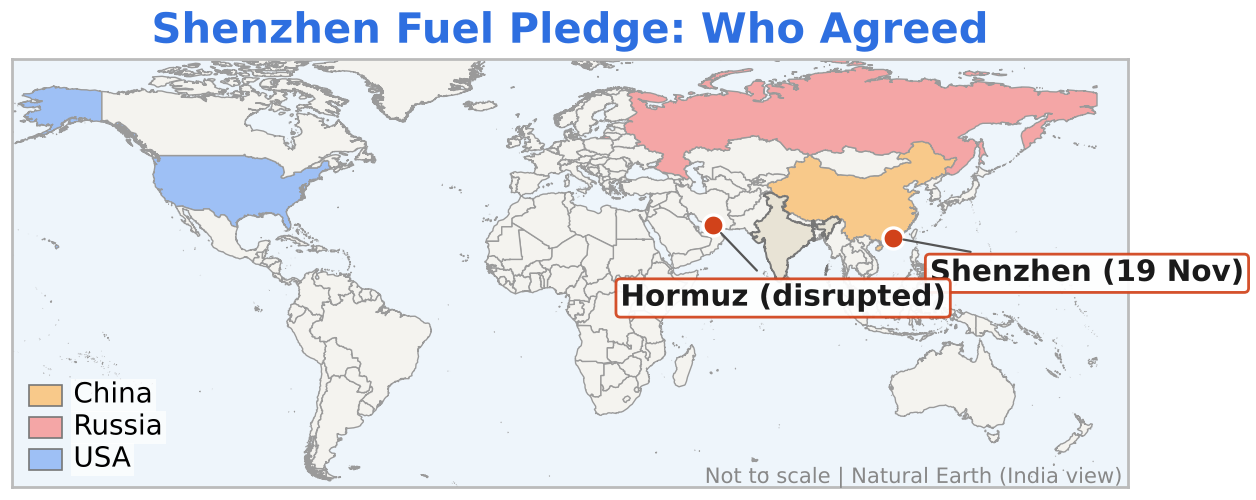
The leaders of the USA, Russia and China met in Shenzhen and promised to produce and supply more petrol and diesel to the world, but experts say the promise has no numbers or dates. US President Donald Trump, Chinese President Xi Jinping and Russian President Vladimir Putin met in Shenzhen, China on 19 November 2026. Their joint statement said they plan to increase the production and supply of refined petroleum products and stressed stable energy flows. The pledge came as wars involving Iran and Ukraine have disturbed fuel markets - shipping through the Strait of Hormuz has been hit and drone strikes have damaged Russian refineries. Analysts called it vague, since it names no volumes or timelines.
Key facts
Venue: Shenzhen, China; date: 19 November 2026.
Refining capacity: China about 18.5-18.8 million barrels per day (bpd), USA about 18.16 million bpd, Russia about 6.5 million bpd, India about 5.36 million bpd.
Russian refinery throughput fell to about 3.8 million bpd in June 2026 - its lowest in over 20 years; some Russian regions rationed petrol.
The statement also mentioned UN reforms and dialogue on nuclear issues.
Way forward
India should keep diversifying suppliers, build strategic petroleum reserves and speed up its clean-energy shift to reduce exposure to such shocks.
Concept
Refined products = what crude oil is turned into at a refinery: petrol, diesel, jet fuel, LPG. A shortage of refining capacity can push fuel prices up even when crude is available. Strait of Hormuz: narrow sea route between Iran and Oman joining the Persian Gulf to the Arabian Sea; a large share of world oil and LNG passes through it - a 'chokepoint'. India imports over 85% of its crude oil needs but is a net exporter of petroleum products thanks to large refineries such as Jamnagar. Exam angle: Prelims: chokepoints, refining capacity rankings. Mains: great-power energy diplomacy and what it means for India's energy security and fuel prices.
World map highlighting the USA, Russia and China, marking Shenzhen where the fuel pledge was made and the disrupted Strait of Hormuz — StudyForGS
10. Health Research Shifts to Prevention
HEALTHUPSC: Prelims + Mains GS2
Syllabus linkage
GS2 - Issues relating to health; GS3 - Developments in science and technology. Prelims: NCDs, Siddha/Varmam, biobanks.
Context
Science Minister Jitendra Singh said medical research is moving from treating disease to preventing it early, because lifestyle diseases like diabetes are now hitting younger Indians. IIT Madras opened a sleep study centre and an autism lab. Union Minister Jitendra Singh said healthcare research is shifting towards prevention, early detection and molecular and genetic study. Diabetes, obesity, high blood pressure and heart disease now increasingly affect young people. Separately, Health Secretary Punya Salila Srivastava opened a Sleep Study Facility and an Autism Lab at IIT Madras, and flagged off an e-cart ambulance. The Autism Lab studies Integrated Varmam Therapy for children with autism.
Key facts
Focus areas: prevention, early detection, genetic and molecular research.
Lifestyle diseases (diabetes, obesity, hypertension, heart disease) are appearing at younger ages.
IIT Madras: Sleep Study Facility, Autism Lab, e-cart ambulance.
Visits also covered the Sudha Gopalakrishnan Brain Centre and the National Cancer Tissue Biobank at IIT Madras.
Linked to the goal of Viksit Bharat 2047.
Way forward
Regular screening at Ayushman Arogya Mandirs and clinical testing of traditional therapies can make prevention both scientific and widely available.
Concept
Non-communicable diseases (NCDs): diseases that do not spread from person to person, like diabetes, cancer, heart disease; they cause the majority of deaths in India. Programme: NP-NCD (earlier NPCDCS). Varmam: a traditional therapy of the Siddha system of medicine (Tamil tradition), using pressure on vital points of the body; Siddha is part of AYUSH. Autism Spectrum Disorder: a developmental condition affecting communication and behaviour; it is one of the 21 disabilities under the Rights of Persons with Disabilities Act, 2016. Exam angle: Prelims: AYUSH systems, RPwD Act disabilities. Mains: India's NCD burden among youth and the case for preventive, research-based public health.
11. Exports Grow 16.66% in Apr-Oct
ECONOMYUPSC: Prelims + Mains GS3
Syllabus linkage
GS3 - Indian economy, external sector, trade agreements. Prelims: FTAs, export schemes (RoDTEP, Districts as Export Hubs). Mains: export diversification.
Context
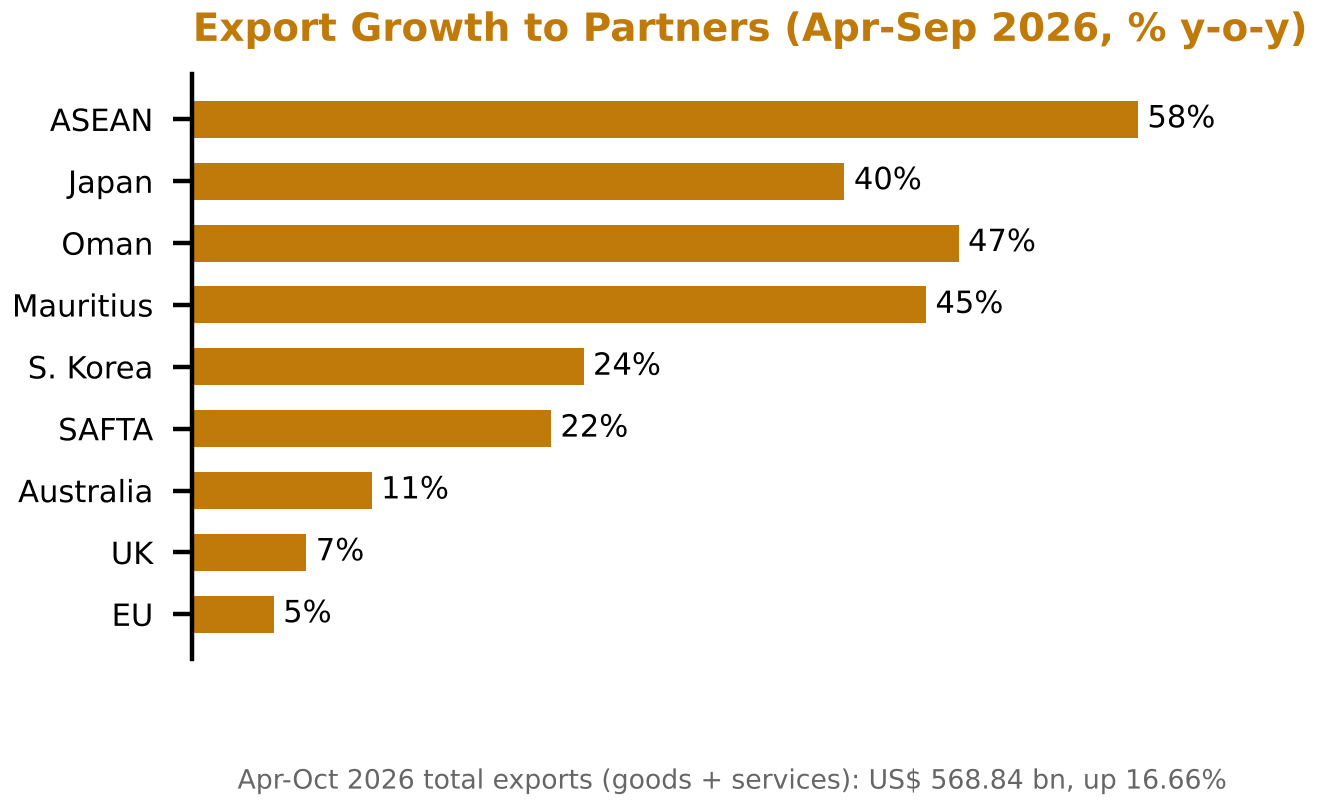
India's total exports of goods and services rose sharply this year, and exports to free-trade partners like ASEAN, Japan and Oman jumped the most. A government release shows India's total exports in April-October 2026 were US$ 568.84 billion, up 16.66% over last year. Merchandise (goods) exports grew 21.96% and services 10.93%. In October alone, goods exports jumped 45.06% to US$ 49.47 billion. Exports to trade-agreement partners grew fast: ASEAN by 58% and SAFTA by 22% in April-September.
Key facts
April-October 2026 total exports: US$ 568.84 billion (+16.66%); seventh straight month of growth.
April-September: ASEAN +58%, Japan +40%, Oman +47%, Mauritius +45%, South Korea +24%, SAFTA +22%.
Electronics exports (Apr-Sep): US$ 31.97 billion, up 44%.
FY 2025-26 total exports were a record US$ 863.1 billion.
Forex reserves: US$ 719.55 billion (6 November 2026); India-EU FTA expected to take effect early next year.
Way forward
Using FTAs better (higher utilisation by small exporters) and lower logistics costs will help keep growth going.
Concept
Free Trade Agreement (FTA): a deal in which partner countries cut tariffs on each other's goods. India's partners include ASEAN (goods deal 2009/10), Japan (CEPA 2011), South Korea (CEPA 2010), UAE (CEPA 2022), Australia (ECTA 2022), Mauritius (CECPA 2021), Oman (CEPA) and the UK (CETA). SAFTA (South Asian Free Trade Area): agreement among SAARC countries, in force since 2006. RoDTEP: refunds taxes and duties hidden in export costs that are not refunded otherwise; extended to 31 December 2026. Exam angle: Prelims: which agreement is with which country (CEPA/ECTA/CECPA), SAFTA. Mains: role of FTAs and electronics manufacturing in export diversification amid global disruptions.
Horizontal bar chart of India's export growth to trade partners in April-September 2026: ASEAN 58%, Japan 40%, Oman 47%, Mauritius 45%, South Korea 24%, SAFTA 22%, Australia 11%, UK 7%, EU 5% — StudyForGS
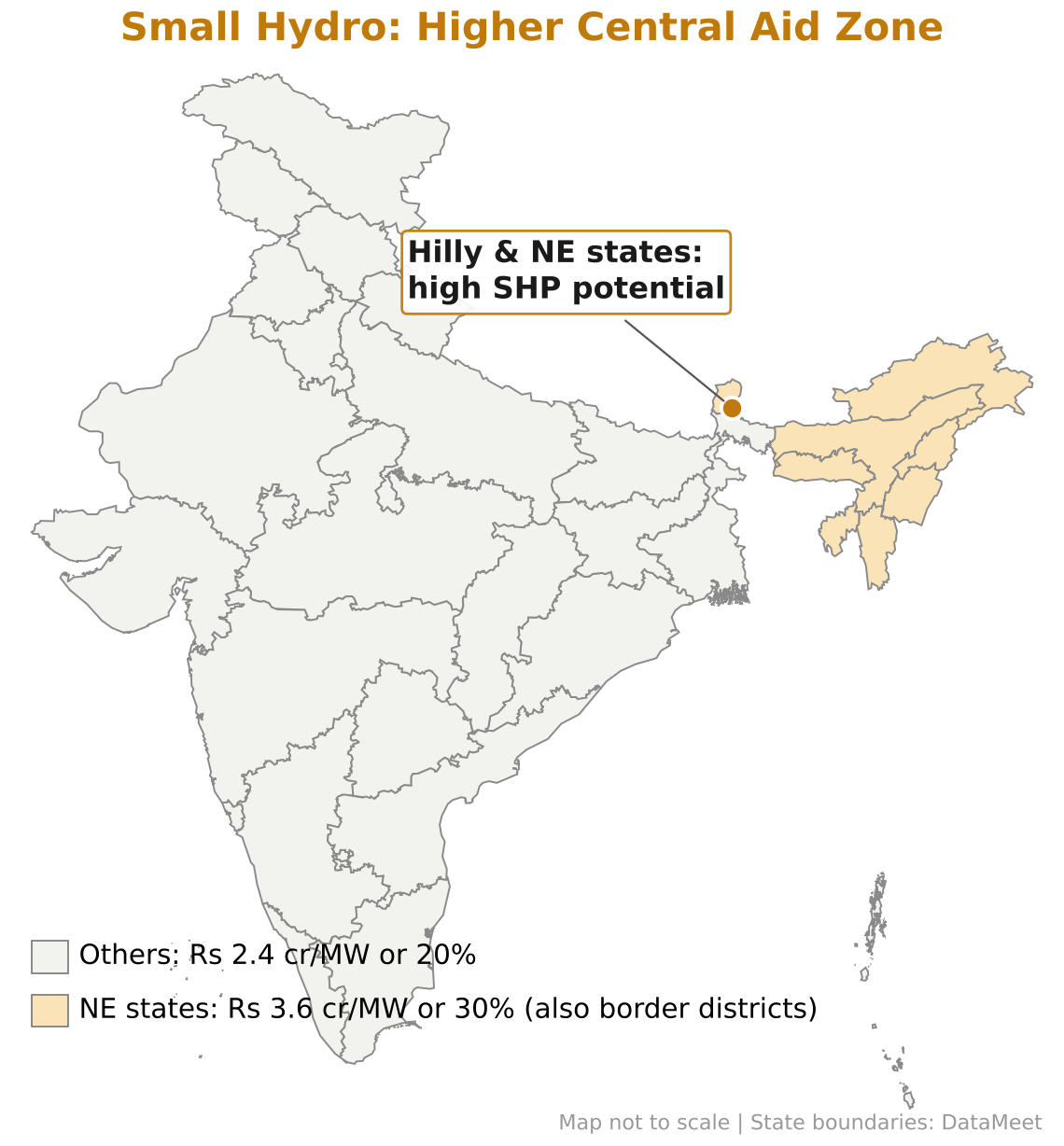
The government is funding small hydro projects (up to 25 MW) that use flowing water in hills and streams to make clean electricity, with extra help for the Northeast and border districts. A government backgrounder highlighted the Small Hydro Power (SHP) Development Scheme for 2026-27 to 2030-31. It has an outlay of Rs 2,584.60 crore and aims to add about 1,500 MW. India's small hydro potential is about 21,134 MW at 7,133 sites, but only about a quarter is used. North-Eastern states and districts on international borders get higher support: Rs 3.6 crore per MW or 30% of project cost (whichever is lower), capped at Rs 30 crore per project.
Key facts
Outlay: Rs 2,584.60 crore; target about 1,500 MW; projects of 1-25 MW.
Other states: Rs 2.4 crore per MW or 20% of cost, capped at Rs 20 crore per project.
Rs 30 crore set aside for Detailed Project Reports (DPRs) for at least 200 projects.
Expected investment about Rs 15,000 crore and 51 lakh person-days of jobs during construction.
Way forward
Simple single-window clearances and good grid links in hill states are key to using the large unused potential.
Concept
Small hydro = hydro projects up to 25 MW; looked after by the Ministry of New and Renewable Energy (MNRE). Larger hydro (above 25 MW) is under the Ministry of Power. Run-of-river projects use the natural flow of a stream with little or no dam, so they cause less flooding and displacement than big dams. In 2019 large hydro projects were also declared renewable energy, so they count towards renewable purchase obligations. Exam angle: Prelims: 25 MW cut-off, MNRE vs Ministry of Power, higher assistance for NE. Mains: small hydro for energy access in remote hilly areas and its environmental trade-offs.
Map of India highlighting the eight North-Eastern states that get higher central assistance under the Small Hydro Power scheme — StudyForGS
13. Tea Sector Review in Darjeeling Hills
ECONOMYUPSC: Prelims + Mains GS3
Syllabus linkage
GS3 - Agriculture, plantation crops, exports; GS1 - Distribution of crops. Prelims: Tea Board, GI tags, tea regions.
Context
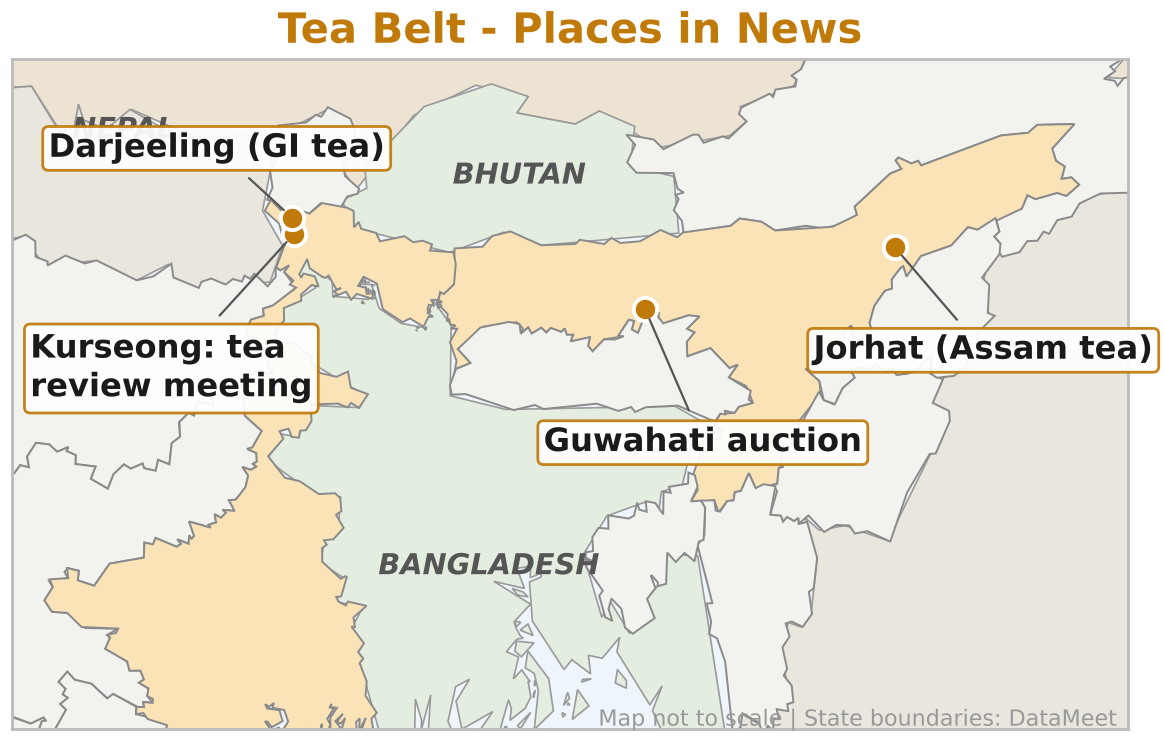
Commerce Minister Piyush Goyal met tea planters and workers in Kurseong (Darjeeling hills) to discuss reviving Darjeeling tea, faster auctions and help for small growers and tea workers. On 22 November, Piyush Goyal reviewed the tea sector in Kurseong, in a meeting organised by the Tea Board. Topics included reviving Darjeeling tea, speeding up auctions, extending research support to small tea growers, and the Pradhan Mantri Cha Shramik Protsahan Yojana for tea workers in West Bengal. India exported a record 282.11 million kg of tea in 2025-26.
Key facts
Venue: Kurseong, Darjeeling hills (West Bengal); organised by the Tea Board.
Tea exports 2025-26: 282.11 million kg - a record (about 7% more than the previous year by volume).
Darjeeling tea needs revival after years of falling output and closed gardens.
PM Cha Shramik Protsahan Yojana aims to support tea garden workers.
Way forward
Better prices through quality branding, support to small growers and fair wages for workers can revive the hills' tea economy.
Concept
Tea Board of India: statutory body under the Tea Act, 1953, under the Ministry of Commerce and Industry; headquarters in Kolkata. Darjeeling Tea was India's first product to get a Geographical Indication (GI) tag (2004-05). A GI tag shows a product comes from a particular place and has qualities linked to it. Tea needs warm, humid climate, rainfall of about 150-300 cm and well-drained slopes; main areas are Assam, West Bengal (Darjeeling, Dooars), and the Nilgiris in the South. India is the world's second-largest tea producer after China. Exam angle: Prelims: Tea Board HQ and Act, first GI product, tea-growing conditions. Mains: crisis in tea plantations - low wages, closed gardens, competition - and policy support for small growers.
Zoomed map of the tea belt marking Kurseong and Darjeeling in West Bengal and Jorhat and Guwahati in Assam — StudyForGS
14. E20 Ethanol: Fuel vs Food Debate
ECONOMYUPSC: Prelims + Mains GS3
Syllabus linkage
GS3 - Energy, agriculture (food security), environment. Prelims: Ethanol Blended Petrol programme, feedstocks, National Policy on Biofuels.
Context
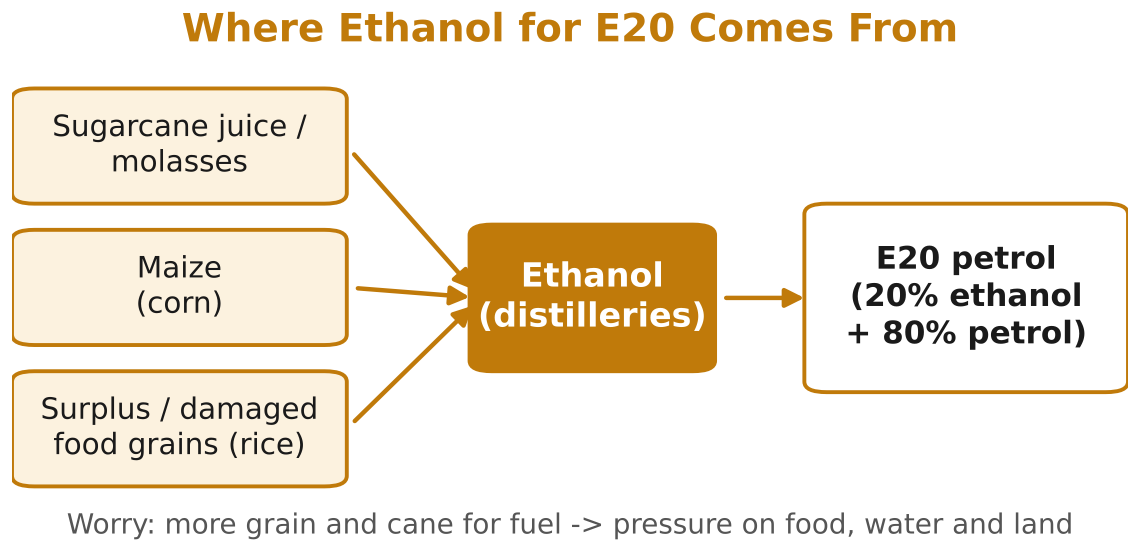
India now mixes 20% ethanol in petrol (E20). An editorial asks how to keep this going without using too much grain and sugarcane that people need for food. An editorial discussed how to sustain E20 (20% ethanol blended with petrol) without hurting food security. India reached the 20% blending target in 2025, five years earlier than the original 2030 goal. But more ethanol now comes from grains like maize and rice, which can raise feed and food prices and use a lot of water. The editorial calls for second-generation ethanol from crop waste.
Key facts
India achieved 20% ethanol blending in 2025 (target was advanced from 2030 to 2025-26).
Feedstocks: sugarcane juice and molasses, maize, and surplus or damaged food grains.
Concern: diverting maize and rice raises prices for poultry feed and food.
Benefits: lower crude oil imports, lower emissions, extra income for farmers.
Way forward
Shift ethanol production towards crop residue (2G) and surplus stocks, and set clear limits on using food grains.
Concept
Ethanol Blended Petrol (EBP) Programme: started in 2003; Oil Marketing Companies buy ethanol from distilleries and mix it with petrol. National Policy on Biofuels 2018 (amended 2022) allows ethanol from sugarcane, damaged grains, maize and surplus FCI rice, and set the 20% target for 2025-26. 2G (second-generation) ethanol: made from crop waste like rice straw; it does not compete with food. PM JI-VAN Yojana (2019) supports 2G plants. Exam angle: Prelims: EBP start year, feedstocks allowed, PM JI-VAN. Mains: food-fuel-water trade-offs in biofuel policy.
Flow diagram showing sugarcane, maize and surplus food grains turned into ethanol at distilleries and blended into E20 petrol — StudyForGS
15. COP31 Ends Without Main Deal
ENVIRONMENTUPSC: Prelims + Mains GS3
Syllabus linkage
GS3 - Environment, climate change, international agreements; GS2 - International institutions. Prelims: UNFCCC, COP venues, LMDC. Mains: India's climate stand.
Context
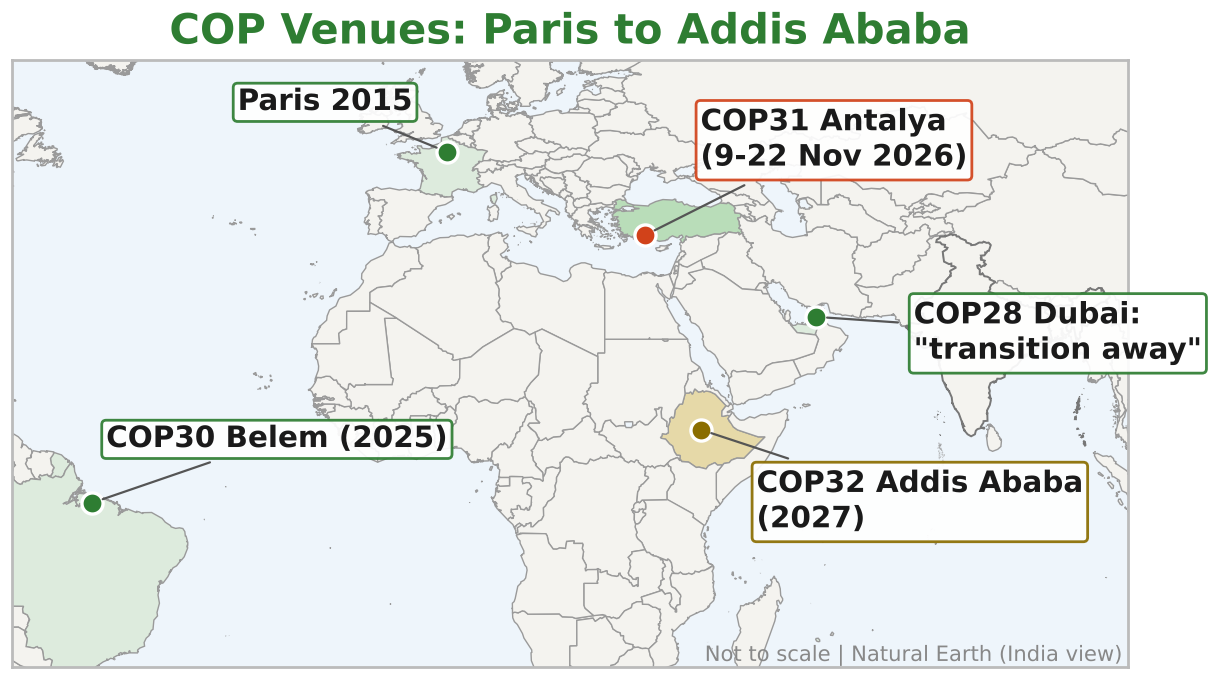
The UN climate summit COP31 in Antalya, Turkey ended without its main political agreement, because countries could not agree whether to name fossil fuels and call for their phase-out. COP31 was held in Antalya, Turkey from 9 November and ended on 22 November 2026, after running a record 48 hours over time. The proposed cover text ('Antalya Pact') was dropped. The EU, backed by over 130 countries, refused a text without a fossil fuel phase-out, while Saudi Arabia, China and India (in the Like-Minded Developing Countries group) opposed explicit fossil fuel language. Decisions on other agenda items still stand.
Key facts
Venue: Antalya, Turkey; hosts: Turkey with Australia in a presidency role; next COP32 in Addis Ababa, Ethiopia (2027).
Other disputes: a voluntary 35% electrification target by 2035; tripling adaptation finance to US$ 120 billion by 2035 (figure later dropped).
First COP since the UN confirmed that the 1.5 degree C limit will be overshot.
India: energy transitions must be 'nationally determined, just and equitable'; lack of a cover decision 'does not pause climate action'.
Last similar failure: COP15 Copenhagen (2009).
Way forward
Clear finance numbers from developed countries can build the trust needed to agree on fossil fuel language at COP32.
Concept
UNFCCC (1992, Rio Earth Summit): the parent climate treaty; COP (Conference of the Parties) is its yearly meeting. Decisions need consensus, so a few countries can block a deal. COP28 (Dubai, 2023) was the first to call for 'transitioning away from fossil fuels'. Paris Agreement (2015) aims to keep warming well below 2 degree C, trying for 1.5 degree C. CBDR-RC (Common But Differentiated Responsibilities and Respective Capabilities): rich countries that polluted more in the past should do more; India strongly supports this principle. LMDC is a group of developing countries including India, China and Saudi Arabia. Exam angle: Prelims: COP venues (COP28 Dubai, COP30 Belem, COP31 Antalya, COP32 Addis Ababa), UNFCCC year, CBDR. Mains: equity vs ambition debate; India's position on fossil fuels and climate finance.
Map marking COP venues: Paris 2015, COP28 Dubai, COP30 Belem, COP31 Antalya in Turkey and COP32 Addis Ababa in Ethiopia — StudyForGS
16. Clean Air Needs a Sustained Movement
ENVIRONMENTUPSC: Prelims + Mains GS3
Syllabus linkage
GS3 - Environmental pollution and degradation. Prelims: NCAP, GRAP, CAQM, AQI. Mains: governance of air pollution.
Context
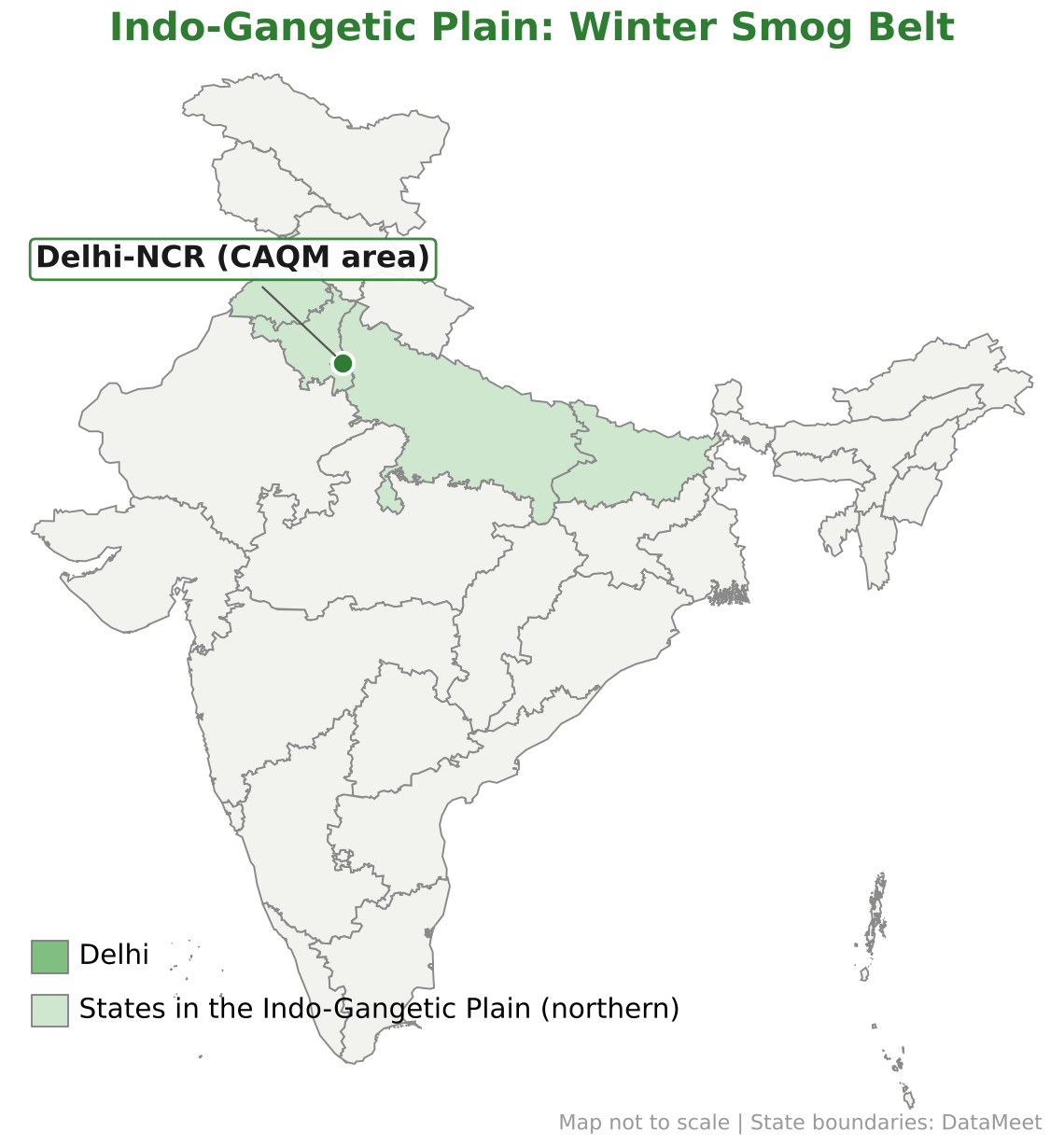
Every winter North India chokes on smog. An editorial says short emergency steps are not enough; India needs a year-round, people-backed movement for clean air. An editorial argued that India's recurring pollution crisis needs a sustained national movement rather than seasonal fire-fighting. Every winter, still air, crop-residue burning, vehicle and industrial smoke, dust and waste burning push AQI to 'severe' in Delhi-NCR and the Indo-Gangetic Plain. Emergency curbs under GRAP give short relief but do not fix the sources.
Key facts
Main sources: vehicles, industry, construction dust, burning of crop residue and waste, power plants.
Winter makes it worse: low wind and temperature inversion trap pollutants near the ground.
GRAP has four stages linked to AQI levels (Poor to Severe+).
The editorial stresses round-the-year action and public participation.
Way forward
An airshed-wide plan across states, cleaner fuels and transport, and real-time public data can make clean air a year-round mission.
Concept
National Clean Air Programme (NCAP), launched January 2019: covers 131 non-attainment cities; target is up to 40% cut in PM10 by 2025-26 (compared with 2017-18). GRAP (Graded Response Action Plan): stage-wise emergency steps in Delhi-NCR; now enforced by the Commission for Air Quality Management (CAQM), set up under the CAQM Act, 2021. AQI (Air Quality Index): one number for air quality based on eight pollutants (PM10, PM2.5, NO2, SO2, CO, O3, NH3, Pb), in six categories from Good to Severe. Temperature inversion = warm air layer above cooler ground air, which stops smoke from rising. Exam angle: Prelims: NCAP year and target, CAQM Act, AQI pollutants, inversion. Mains: why pollution persists despite many laws; airshed (region-wide) approach.
Map of India highlighting the northern Indo-Gangetic Plain states Punjab, Haryana, Delhi, Uttar Pradesh and Bihar, with Delhi-NCR marked — StudyForGS
17. Kawal Tiger Reserve Hosts Migrants
ENVIRONMENTUPSC: Prelims + Mains GS3
Syllabus linkage
GS3 - Conservation, biodiversity; GS1 - Geography of India. Prelims: tiger reserves, rivers, location.
Context
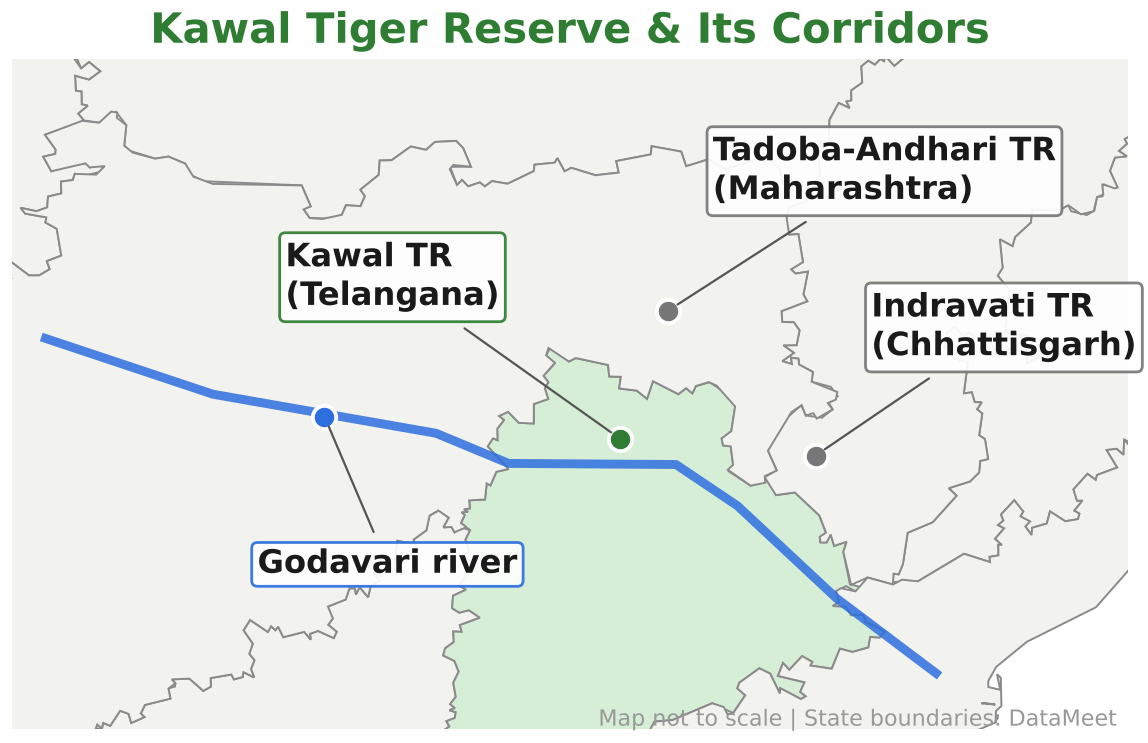
Migratory birds from Siberia and Central Asia have arrived at Kawal Tiger Reserve in Telangana, drawing attention to its rich ecology. The arrival of migratory birds from Siberia, Central Asia and other northern regions has brought Kawal Tiger Reserve into the news. The reserve is in Telangana, at the southern tip of the Central Indian tiger landscape. It is a major catchment of the Godavari river and is linked through forest corridors with Tadoba-Andhari (Maharashtra) and Indravati (Chhattisgarh) tiger reserves.
Key facts
Location: northern Telangana, on the Godavari catchment; local streams include Peddavagu and Kadam.
Corridors: Tadoba-Andhari (Maharashtra) and Indravati (Chhattisgarh).
Way forward
Protecting the Kawal-Tadoba-Indravati corridor from fragmentation is key for tigers to recolonise Kawal.
Concept
Tiger reserves are notified under Section 38V of the Wildlife (Protection) Act, 1972 (added in 2006) on the advice of the National Tiger Conservation Authority (NTCA); each has a core and a buffer zone. Wildlife corridor = a strip of forest that links two habitats so animals can move and breed between them; it keeps tiger populations healthy. Central Asian Flyway: a major bird migration route covering India; India hosted CMS COP13 at Gandhinagar (2020). Exam angle: Prelims: match tiger reserve with state and river; which TRs connect with Kawal. Mains: corridor loss due to mining, roads and dams in Central India.
Zoomed map of Telangana and neighbouring states marking Kawal Tiger Reserve, Tadoba-Andhari and Indravati tiger reserves and the Godavari river — StudyForGS
18. IFFI 2026 and Northeast Cinema
ART & CULTUREUPSC: Prelims + Mains GS1
Syllabus linkage
GS1 - Indian culture, art forms, tribal languages; GS2 - Soft power. Prelims: IFFI, Golden Peacock, tribes of the Northeast.
Context
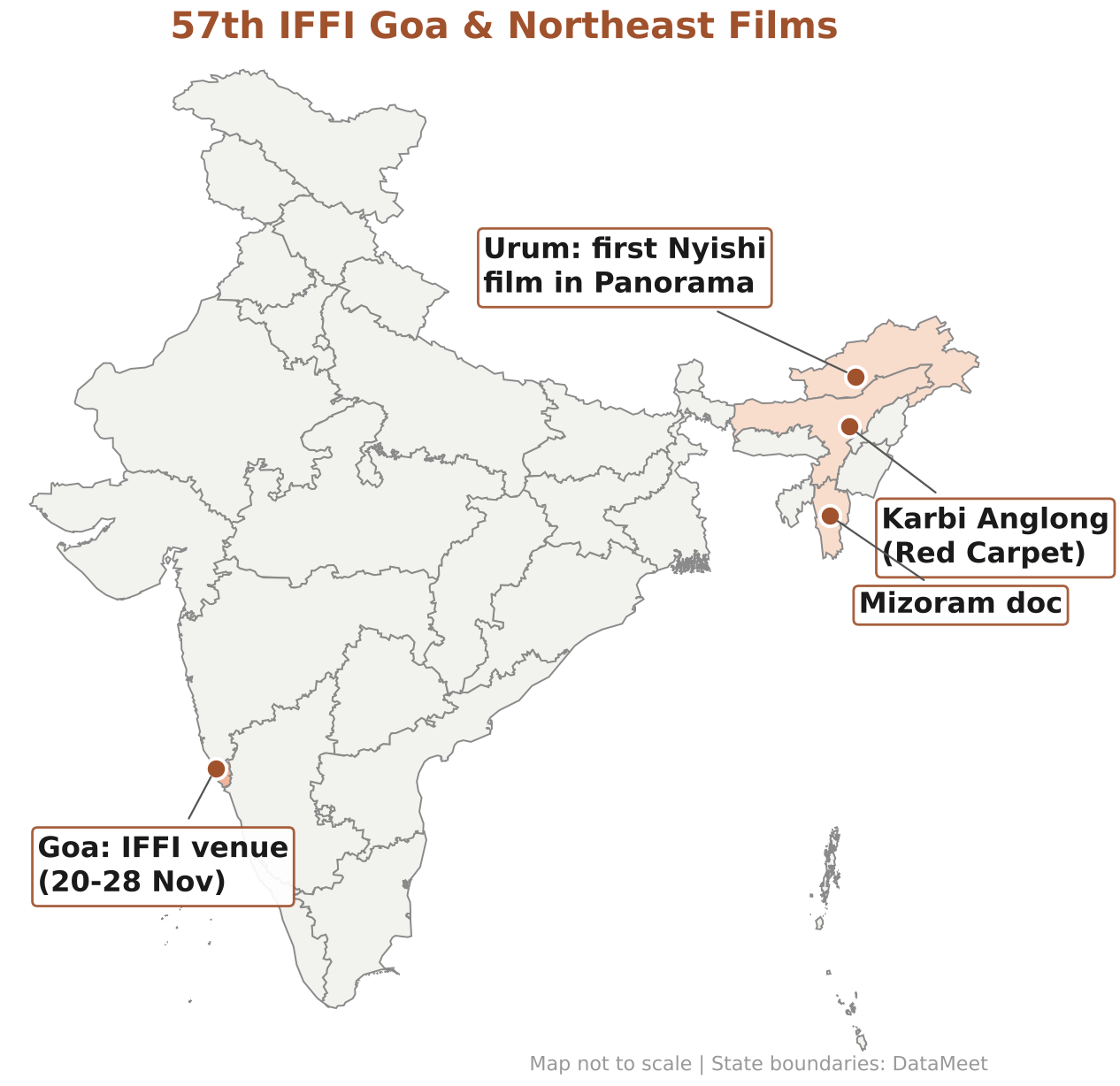
The 57th International Film Festival of India is on in Goa. For the first time a film in the Nyishi language of Arunachal Pradesh is in the Indian Panorama section. The 57th IFFI is being held in Goa from 20 to 28 November 2026 with the theme 'Stories Without Borders'. Over 230 films are being shown, with Spain as Country of Honour and Russia as Partner Country. 'Urum', directed by Duyu Tabyo, is the first Nyishi-language film selected for the Indian Panorama feature section. 'Red Carpet' by Aimee Baruah shows the handloom heritage of the Karbi community of Assam.
Key facts
Dates: 20-28 November 2026; theme: 'Stories Without Borders'.
Country of Honour: Spain; Partner Country: Russia; 230+ films from many countries.
Four Northeast films in Indian Panorama: 'Urum' (Nyishi, Arunachal), 'Surjyamukhi' (Assamese), 'Red Carpet' (Karbi weaver, Assam), a Mizoram documentary.
'India Cine Hub' (single-window portal run by NFDC) now links state governments for film shooting permissions.
NFDC-Sony Pictures Networks India MoU for creators under WAVES Bazaar.
Way forward
Funding and distribution support for films in tribal and minority languages can help keep these languages alive.
Concept
IFFI: started in 1952; Goa is its permanent venue since 2004; organised by the Ministry of Information and Broadcasting through NFDC with the Goa government. Top award: Golden Peacock. Nyishi: the largest tribe of Arunachal Pradesh, speaking a Tibeto-Burman language; Karbi: a major tribe of Assam (Karbi Anglong district, under the Sixth Schedule). Soft power: the ability to win friends through culture and values rather than force; cinema is one of India's strongest soft-power tools. Exam angle: Prelims: IFFI venue and organiser, tribes and their states, Sixth Schedule areas. Mains: cinema in preserving endangered languages and as cultural diplomacy.
Map of India marking Goa as the IFFI venue and the Northeast film locations in Arunachal Pradesh, Karbi Anglong in Assam and Mizoram — StudyForGS
19. Thumba to Kourou: India-France in Space
ART & CULTUREUPSC: Prelims + Mains GS3
Syllabus linkage
GS3 - Space technology; GS2 - India-France relations; GS1 - Modern history of science. Prelims: TERLS, Kourou, CNES.
Context
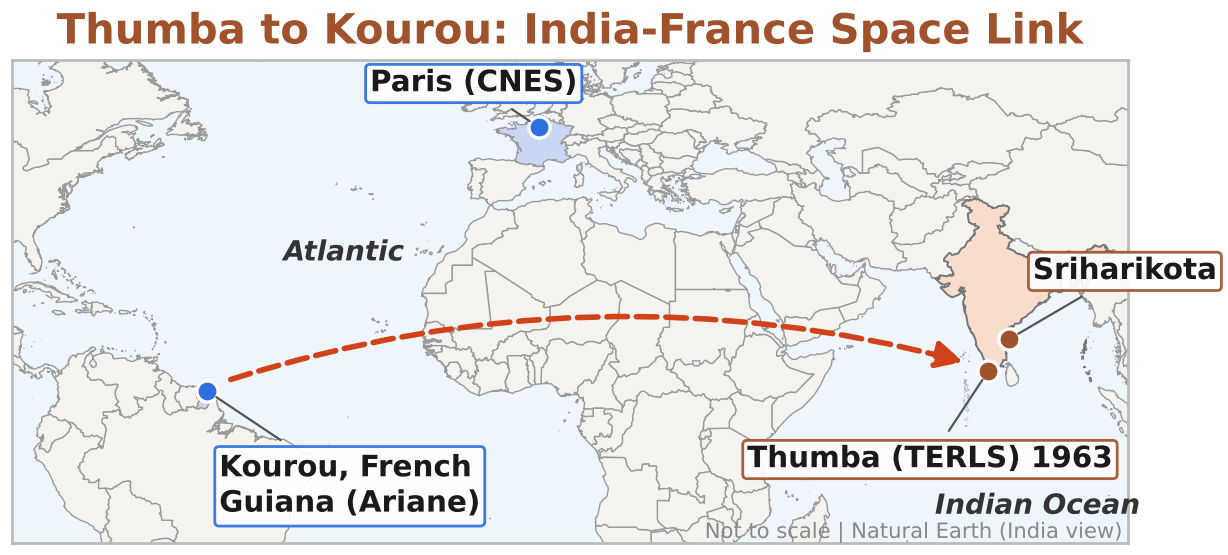
An article looked back at more than 60 years of space friendship between India and France - from India's first rocket launch site at Thumba to French launch pads at Kourou in South America. The article traced India-France space ties from the 1960s. India's first rocket was launched from Thumba near Thiruvananthapuram on 21 November 1963, and French Centaure sounding rockets were later built in India under licence. Many Indian satellites, starting with APPLE in 1981, went to space on French Ariane rockets from Kourou in French Guiana. Today the two countries work on missions like TRISHNA and on human spaceflight support.
Key facts
Thumba Equatorial Rocket Launching Station (TERLS): first launch on 21 November 1963 (a US-made Nike-Apache sounding rocket).
Thumba was chosen because it lies very close to the magnetic equator - good for studying the upper atmosphere.
APPLE (1981), India's first experimental communication satellite, was launched on an Ariane rocket from Kourou.
BepiColombo (now orbiting Mercury) was also launched from Kourou in 2018.
Way forward
Joint work on human spaceflight, space situational awareness and private-sector partnerships can take the 60-year partnership forward.
Concept
CNES: France's national space agency (founded 1961); ISRO: India's space agency (founded 1969, under the Department of Space). Kourou (Guiana Space Centre): France's launch site in French Guiana, South America; being close to the equator, rockets get an extra push from Earth's spin, saving fuel. Sounding rocket = small rocket that goes up to study the upper atmosphere and comes down, without going into orbit. Exam angle: Prelims: TERLS date and reason for choice, APPLE, Kourou location, joint missions. Mains: India-France strategic partnership in space and defence.
World map showing India and France with a dashed route from Kourou in French Guiana to Thumba in Kerala, and Paris and Sriharikota marked — StudyForGS
20. BepiColombo Enters Mercury's Orbit
SCI-TECHUPSC: Prelims + Mains GS3
Syllabus linkage
GS3 - Science and technology: space. Prelims: space missions, agencies, Mercury facts.
Context
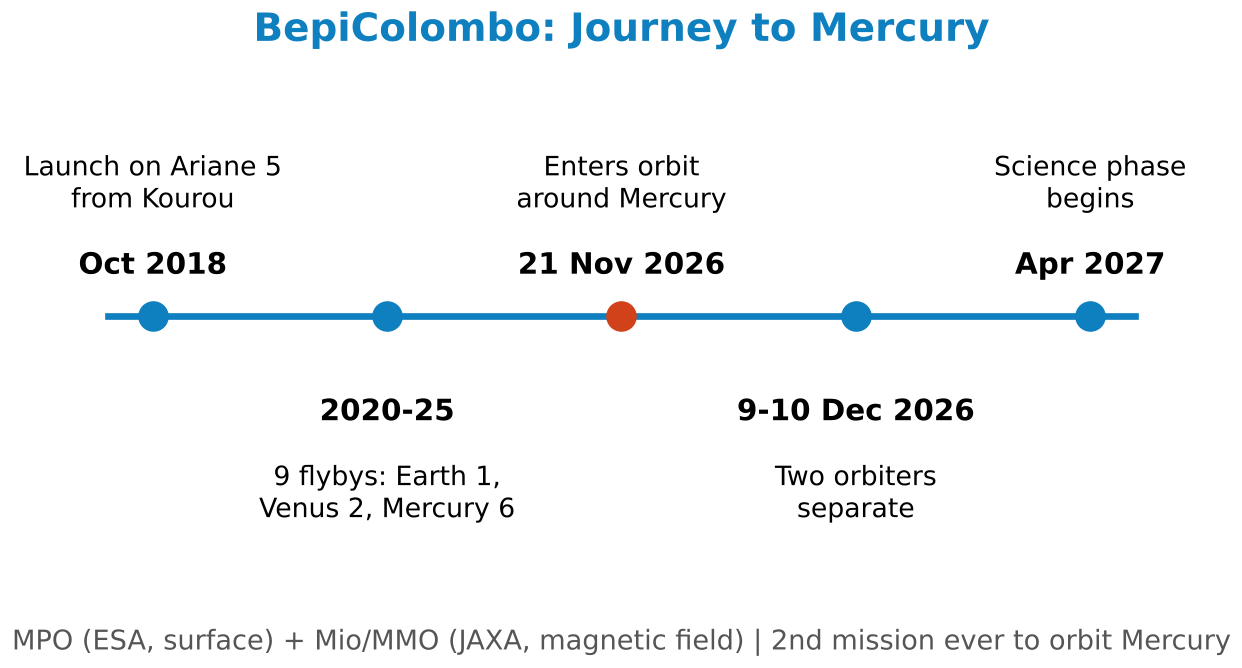
A joint European-Japanese spacecraft, BepiColombo, has reached orbit around Mercury after an eight-year journey. It is only the second mission ever to orbit the smallest planet. BepiColombo, run by the European Space Agency (ESA) and Japan's JAXA, entered orbit around Mercury on 21 November 2026 (confirmed on 22 November). It was launched in October 2018 on an Ariane 5 rocket from Kourou, French Guiana. On the way it flew past Earth once, Venus twice and Mercury six times to slow down. Its two orbiters will separate on 9-10 December, and science work begins in April 2027.
Key facts
Two orbiters: ESA's Mercury Planetary Orbiter (MPO) - surface and composition; JAXA's Mio (Mercury Magnetospheric Orbiter) - magnetic field.
Only earlier orbiter: NASA's MESSENGER (2011-2015).
Named after Italian scientist Giuseppe 'Bepi' Colombo, who worked on Mercury's orbit.
Science goals: surface, magnetic field, interaction with solar wind, thin exosphere, tests of Einstein's general relativity.
Orbit entry was delayed by about 11 months because of engine problems.
Way forward
Data from BepiColombo will help understand how rocky planets, including Earth, formed near the Sun.
Concept
Mercury: smallest planet and closest to the Sun; has no moons and almost no atmosphere (only a thin exosphere); one year is 88 Earth days. It is hard to reach because a spacecraft speeds up as it falls towards the Sun. Gravity assist (flyby): using a planet's gravity to change a spacecraft's speed and direction without using much fuel. Magnetosphere: the region around a planet controlled by its magnetic field, which shields it from the solar wind (charged particles from the Sun). Exam angle: Prelims: agencies, orbiters, first Mercury orbiter, Mercury facts. Mains: value of international cooperation in deep-space science.
Timeline of BepiColombo from launch in October 2018 through nine flybys to entering Mercury orbit on 21 November 2026, orbiter separation and science phase from April 2027 — StudyForGS
21. Riemann Hypothesis: AI-Assisted Proof Claim
SCI-TECHUPSC: Prelims + Mains GS3
Syllabus linkage
GS3 - Science and technology, awareness in IT and AI. Prelims: Millennium Prize Problems, prime numbers. Mains: AI in scientific discovery.
Context
A researcher at the AI company Anthropic has claimed a proof of the Riemann Hypothesis, one of the most famous unsolved problems in mathematics, made with help from the AI model Claude. Other mathematicians must still check it. Anthropic mathematician Levent Alpoge has claimed a proof of the Riemann Hypothesis, posed in 1859, with the help of the company's AI model Claude. The claim has not yet been verified by the mathematics community, which normally takes months of careful review. Earlier in 2026, researchers had reported partial progress on the problem using an unreleased Claude model, with the work checked in the Lean proof software.
Key facts
Riemann Hypothesis: proposed by Bernhard Riemann in 1859.
It is one of the seven Millennium Prize Problems of the Clay Mathematics Institute (prize: US$ 1 million each).
Status: claim only - not yet peer-reviewed or accepted.
Shows the growing role of AI as a research partner in pure mathematics.
Way forward
Open publication, formal computer checking and expert review should confirm or reject the claim before it is accepted.
Concept
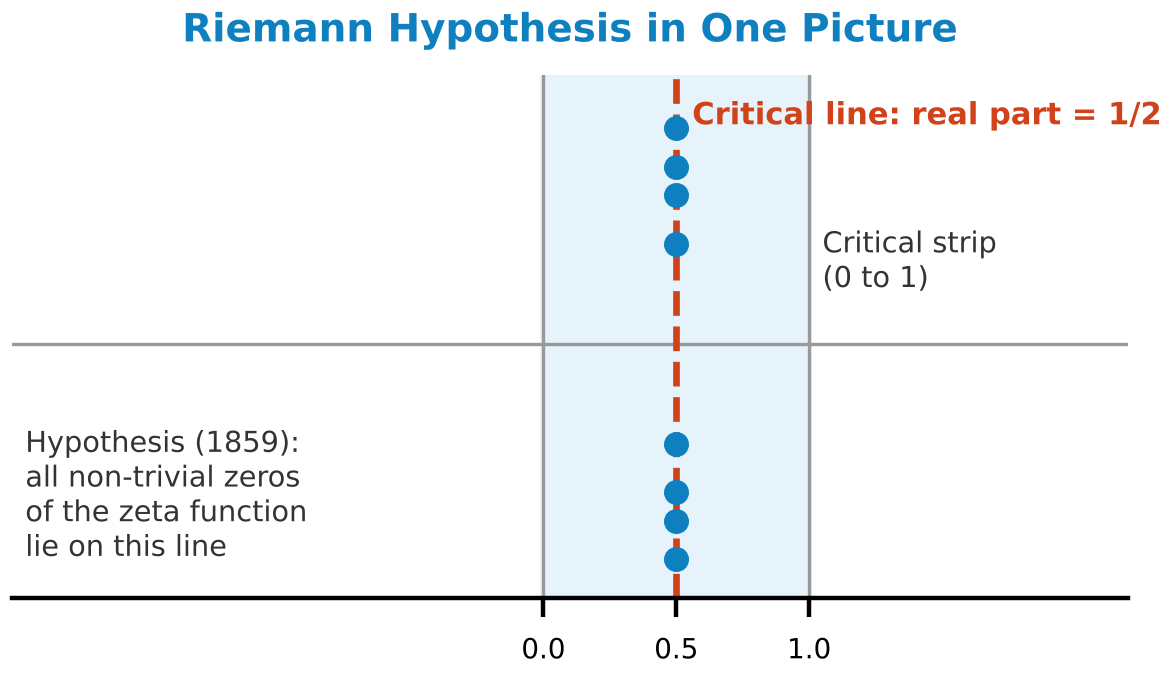
The hypothesis says that all 'non-trivial zeros' of the Riemann zeta function lie on one straight line (where the real part equals 1/2). If true, it tells us how prime numbers are spread among all numbers. Prime numbers are the basis of modern encryption (like RSA) used in online banking; but proving the hypothesis would not by itself break encryption. Millennium Prize Problems (2000): seven problems; only one - the Poincare conjecture - has been solved (by Grigori Perelman). Exam angle: Prelims: Millennium Problems, solved one (Poincare). Mains: AI in research - speed vs need for human verification, credit and ethics.
Diagram of the complex plane showing the critical strip between 0 and 1 and the critical line at real part one half, with zeros of the zeta function lying on it — StudyForGS
22. Genome Language Models Explained
SCI-TECHUPSC: Prelims + Mains GS3
Syllabus linkage
GS3 - Biotechnology, AI. Prelims: DNA basics, genome, Genome India Project. Mains: AI in biology, biosafety.
Context
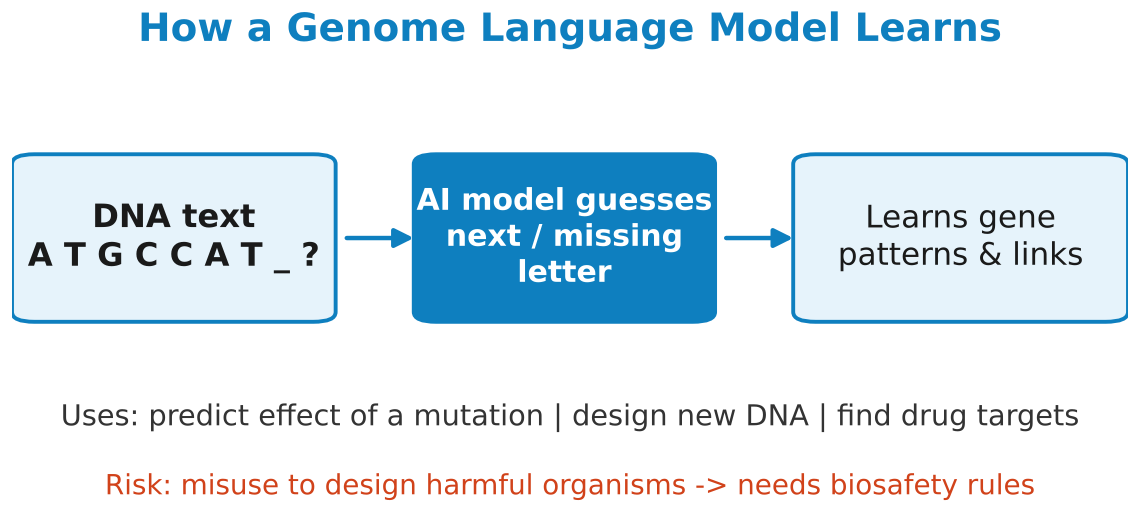
Just as chatbots learn language by reading text, genome language models are AI systems that 'read' DNA and learn its patterns, so they can predict what a gene change will do or even design new DNA. Scientists are using genome language models (gLMs) to predict the effects of genetic changes and to create new DNA sequences. A gLM is a large language model trained on DNA, RNA and related sequences from many organisms. It learns by guessing the next or missing DNA 'letter', and in doing so learns how genes are controlled and how distant parts of the genome affect each other - without being taught biology rules directly.
Key facts
DNA is written in four chemical letters: A (adenine), T (thymine), G (guanine), C (cytosine).
Training: predict the next letter or fill in missing letters in huge DNA datasets.
Uses: predict effect of mutations, design simple biological systems, find new treatments.
Concern: misuse to design harmful organisms; needs strong biosafety rules.
Way forward
India can use its genome data and AI skills to build gLMs for Indian health needs, with clear ethical and biosafety safeguards.
Concept
Genome = the full set of genetic instructions of an organism; the human genome has about 3 billion DNA letters (base pairs). Genome India Project (Department of Biotechnology, 2020): sequenced 10,000 genomes of Indians; data released in 2025 for research. Large language model (LLM): AI trained on huge amounts of text to predict the next word; a gLM uses the same idea on DNA. Exam angle: Prelims: DNA bases, Genome India Project. Mains: promise and risks of AI-driven biology; regulation of dual-use research.
Flow diagram showing DNA text being read by an AI model that guesses the next or missing letter and learns gene patterns, with uses and misuse risk — StudyForGS
23. Indian AI Needs Better Language Data
SCI-TECHUPSC: Prelims + Mains GS3
Syllabus linkage
GS3 - IT, AI, indigenisation of technology; GS2 - Digital inclusion. Prelims: IndiaAI Mission, Bhashini, Eighth Schedule.
Context
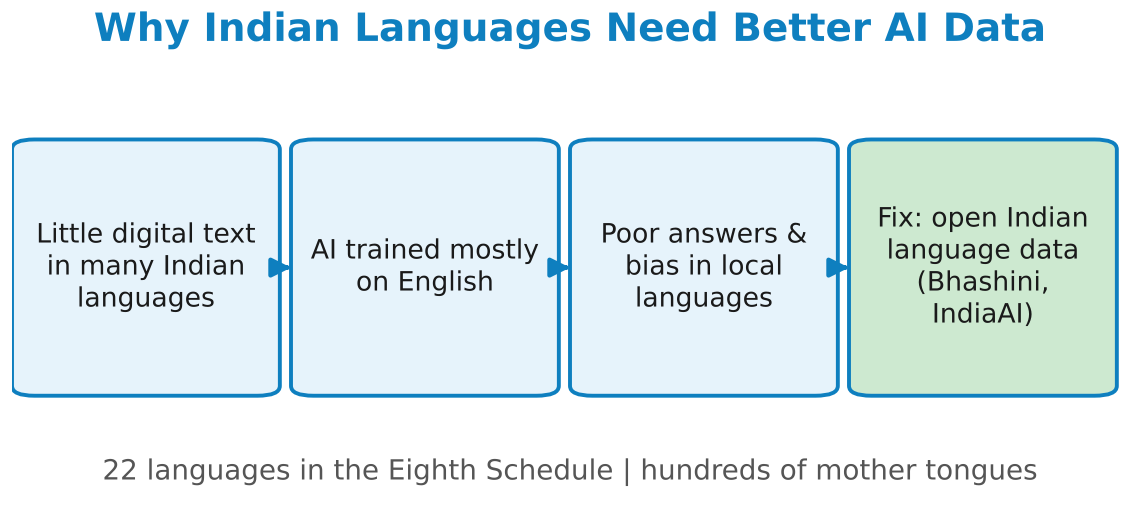
AI chatbots work best in English because they are trained mostly on English text. An article says Indian AI models need much more good-quality data in Indian languages to serve all citizens. An article explained why Indian AI models need better data for regional languages. Most online text is in English, and many Indian languages have very little digital content. So AI tools give weaker or biased answers in those languages. Building large, clean, openly available datasets - speech, text and translations - is the key fix.
Key facts
Most AI training data is in English; many Indian languages are 'low-resource' (little digital text).
Result: poorer accuracy, mistakes and cultural bias in Indian-language answers.
Government efforts: Bhashini (language translation platform) and the IndiaAI Mission's datasets and foundation models.
Speech data is important because many users prefer voice over typing.
Way forward
Crowdsourced, consent-based data collection (with fair pay to contributors) and open datasets can make AI truly inclusive.
Concept
IndiaAI Mission: approved in March 2024 with an outlay of Rs 10,371.92 crore; includes compute capacity (GPUs), datasets platform (AIKosh) and Indian foundation models. Bhashini: platform under the National Language Translation Mission (Ministry of Electronics and IT, launched 2022) for translation and speech tools in Indian languages. Eighth Schedule of the Constitution lists 22 languages; Articles 343-351 deal with official language. Exam angle: Prelims: IndiaAI outlay and year, Bhashini ministry, number of Eighth Schedule languages. Mains: AI and digital divide; sovereign AI for a multilingual country.
Four-step diagram: little digital text in Indian languages, AI trained mostly on English, poor answers and bias, and the fix of open Indian language data through Bhashini and IndiaAI — StudyForGS
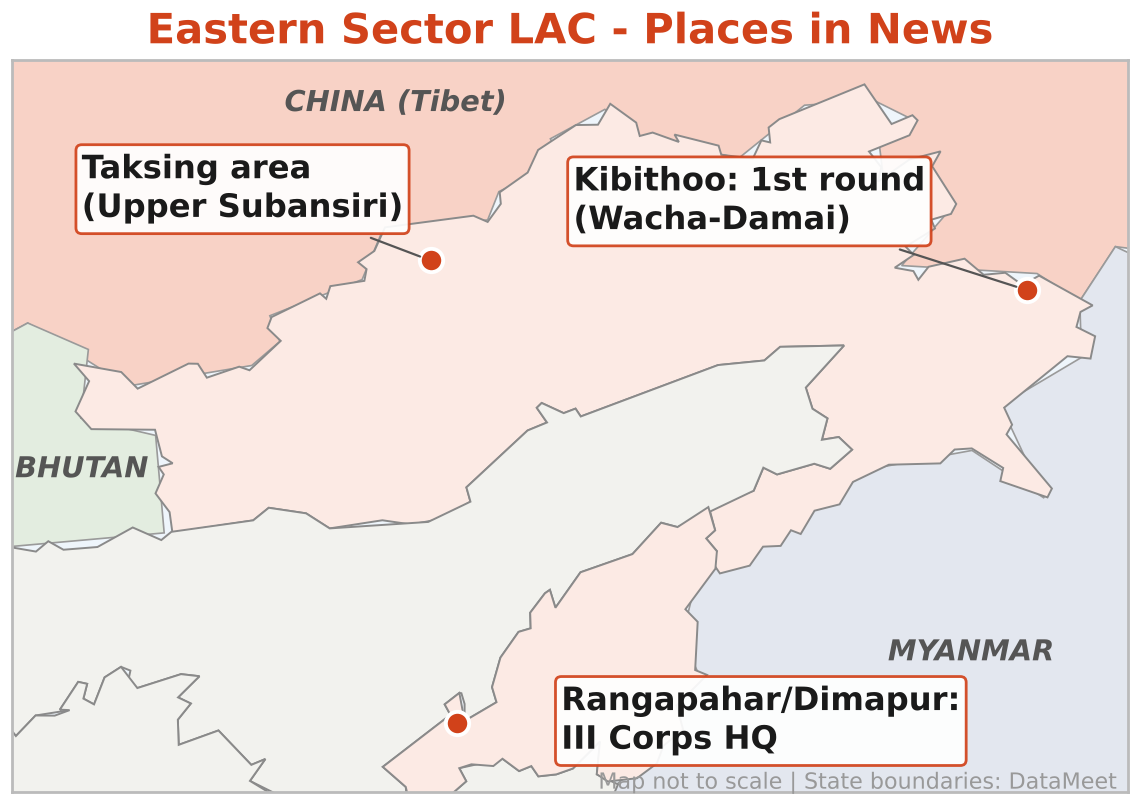
Army commanders of India and China met for about 10 days to reduce tension along the border in Arunachal Pradesh before the harsh winter sets in. India and China held a second round of Corps Commander-level talks on tensions along the Line of Actual Control (LAC) in Arunachal Pradesh. The talks began on 8 November and ran for nearly 10 days. India's side was led by Lt Gen Girish Kalia, head of III Corps (Spear Corps), with an MEA official present. They discussed rules of engagement, avoiding clashes and keeping communication open.
Key facts
Second round of Corps Commander talks for the eastern sector; began 8 November, ran nearly 10 days.
First round: 6-7 September at Wacha-Damai meeting point, Kibithoo sector (India's easternmost border meeting point).
Trigger: tension in the Taksing area of Upper Subansiri district; face-offs at several places reported.
III Corps HQ: Rangapahar, near Dimapur (Nagaland).
Aim: lower tension before winter, when holding troops at heights is very hard.
Way forward
Clear patrolling rules, more border meeting points and faster border infrastructure can prevent small incidents from escalating.
Concept
LAC (Line of Actual Control): the de facto border between India and China, about 3,488 km long, in three sectors - Western (Ladakh), Middle (Himachal, Uttarakhand) and Eastern (Sikkim, Arunachal). McMahon Line (1914 Simla Convention): India's boundary in the east; China does not accept it and claims Arunachal as 'South Tibet'. Special Representatives (SR) mechanism: NSA of India and China's Foreign Minister hold boundary talks; Corps Commander talks are the military channel. Exam angle: Prelims: LAC sectors and states, Kibithoo, McMahon Line. Mains: managing the India-China border - patrolling protocols, infrastructure race and confidence-building measures.
Zoomed map of the eastern sector of the LAC marking Kibithoo, the Taksing area of Upper Subansiri and III Corps headquarters at Rangapahar near Dimapur — StudyForGS
25. NDRF Campus for Northeast Opens
DEFENCEUPSC: Prelims + Mains GS3
Syllabus linkage
GS3 - Disaster and disaster management. Prelims: NDRF, NDMA, DM Act 2005. Mains: disaster preparedness in the Northeast.
Context
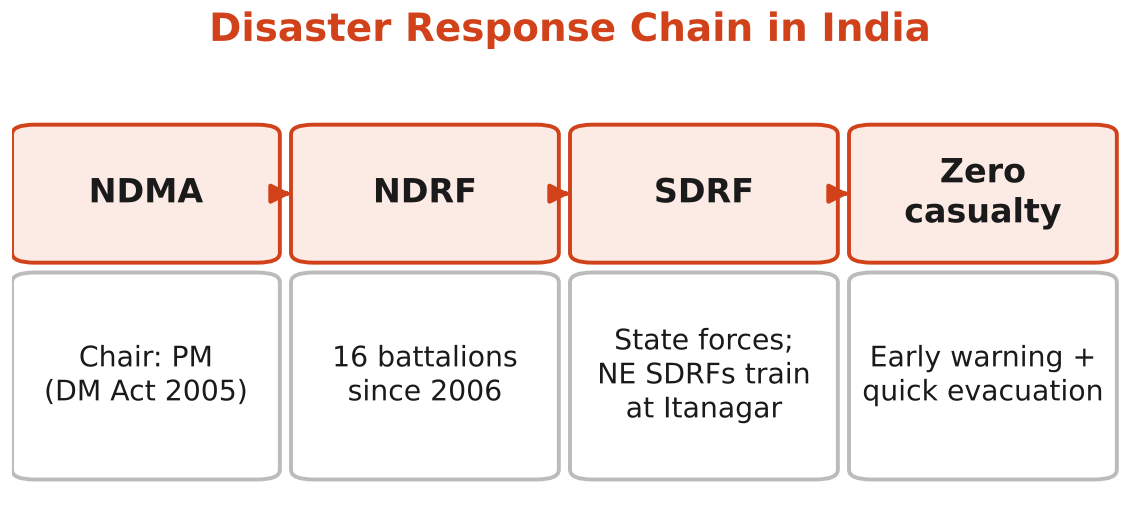
Amit Shah opened a new earthquake-resistant campus of the National Disaster Response Force near Itanagar. It will also train disaster forces of all eight Northeastern states. On 22 November, Amit Shah inaugurated the 12th Battalion campus of the NDRF at Hollongi near Itanagar, Arunachal Pradesh. The buildings meet earthquake-resistant standards. The campus will train State Disaster Response Force (SDRF) staff of all eight Northeastern states and has an Olympic-size swimming pool, free for local swimmers. Shah said India follows a 'zero-casualty' approach based on early warnings and quick evacuation.
Key facts
12th Bn NDRF campus at Hollongi, near Itanagar; earthquake-resistant.
Will train SDRFs of all 8 NE states; Olympic-size pool and diving tank.
NDRF has done over 11,000 operations in India and abroad (Japan, Nepal, Turkey, Sri Lanka) and saved over 1.61 lakh lives.
2026 is NDRF's 'Year of Capacity Building'.
Cyclone warnings 24-48 hours ahead have helped achieve near-zero deaths in recent cyclones.
Way forward
Regular joint drills with SDRFs, community volunteers (Aapda Mitra) and better early-warning in hills will strengthen response in the Northeast.
Concept
Disaster Management Act, 2005: set up NDMA (chaired by the Prime Minister), SDMAs (chaired by Chief Ministers) and DDMAs; NDRF formed in 2006 under Section 44 of this Act. NDRF: a specialised force drawn from central armed police forces (BSF, CRPF, ITBP, CISF, SSB, Assam Rifles); now 16 battalions. The Northeast lies in India's highest earthquake-risk zone and also faces floods and landslides - so local response capacity is vital. Exam angle: Prelims: NDRF origin, NDMA chair, seismic zones. Mains: shift from relief-centric to preparedness-centric disaster management; Sendai Framework.
Diagram of India's disaster response chain from NDMA to NDRF to SDRF and the zero-casualty approach of early warning and quick evacuation — StudyForGS
Data point of the day
13.2%
PMGKAY inclusion error Share of surveyed beneficiary households (over 51,000) found ineligible in 2025-26; urban 15.6%, rural 12.5%.
Prelims rapid-fire
NCC Day: Observed on the fourth Sunday of November (22 Nov 2026). NCC was formed in 1948 under the NCC Act; motto 'Unity and Discipline'.
J.C. Bose: Death anniversary on 23 November (died 1937). He invented the crescograph, pioneered radio/microwave research and founded the Bose Institute, Kolkata in 1917.
Gurpurab: 24 November 2026: 557th birth anniversary of Guru Nanak Dev Ji, first Sikh Guru; Indian stock markets closed. Sikh pilgrims crossed the Attari-Wagah border for celebrations in Pakistan.
Samvidhan Divas: 26 November - Constitution Day (Constitution adopted on 26 Nov 1949). The 99th 'Fit India Sundays on Cycle' (22 Nov) was themed on it; 100th edition on 29 Nov.
IAF Air Festival: Maintenance Command Air Festival held at Vayu Sena Nagar, Nagpur (21-22 Nov) with Surya Kiran, Sarang and Akash Ganga teams. Nagpur is HQ of IAF Maintenance Command.
Palamau TR: Jharkhand's only tiger reserve; among the first nine under Project Tiger (1973-74); in Latehar and Garhwa districts; North Koel river; Betla National Park is part of it.
Textiles target: Textiles Minister Giriraj Singh, reviewing the sector in Pune, reiterated the goal of a US$ 350 billion textile market by 2030-31.
Navdeep Bains: Indian-origin former Canadian federal minister elected leader of the Ontario Liberal Party (Canada).
Cricket record: India declared at 720/9 against New Zealand in Wellington - their highest Test total outside India; K.L. Rahul (136) became the first Indian opener with Test centuries in all four SENA countries. The Test ended in a draw.
Hockey & Snooker: Women's Asian Champions Trophy (Bhopal): India beat Thailand 7-0. IBSF Women's Snooker (Indore): Anupama Ramachandran retained her title.
Mains practice question
Q. Parliament remaining unprorogued for an unusually long period raises questions about executive control over the legislature's calendar. Examine the constitutional provisions on summoning and prorogation, and suggest reforms to strengthen parliamentary functioning. (250 words)
Hint / approach
Article 85 and the six-month rule; adjournment vs sine die vs prorogation; effect on bills and notices; falling sitting days; ideas such as a fixed calendar and minimum sitting days.
📌 One-line revision: Prorogation is by the President (Art. 85), adjournment by the Speaker; COP31 Antalya had no cover text; BepiColombo is the second Mercury orbiter after MESSENGER.