Friday, 20 November 2026 · IST · National & International · 25 items
The Supreme Court held that prior Gram Sabha consent is compulsory before land in Scheduled Areas is acquired for private mining. Abroad, the US, China and Russia held their first three-way summit in Shenzhen, and the ICJ ruled that Myanmar committed genocide against the Rohingya. At home, EPFO cleared a Systematic Withdrawal Plan, while the COP31 draft dropped fossil fuel phase-out language.
Today at a glance — things to remember
SC: Gram Sabha consent under Section 41(3), LARR Act 2013 is mandatory in Scheduled Areas.
US, China, Russia leaders hold first trilateral summit in Shenzhen; agree on nuclear-risk dialogue.
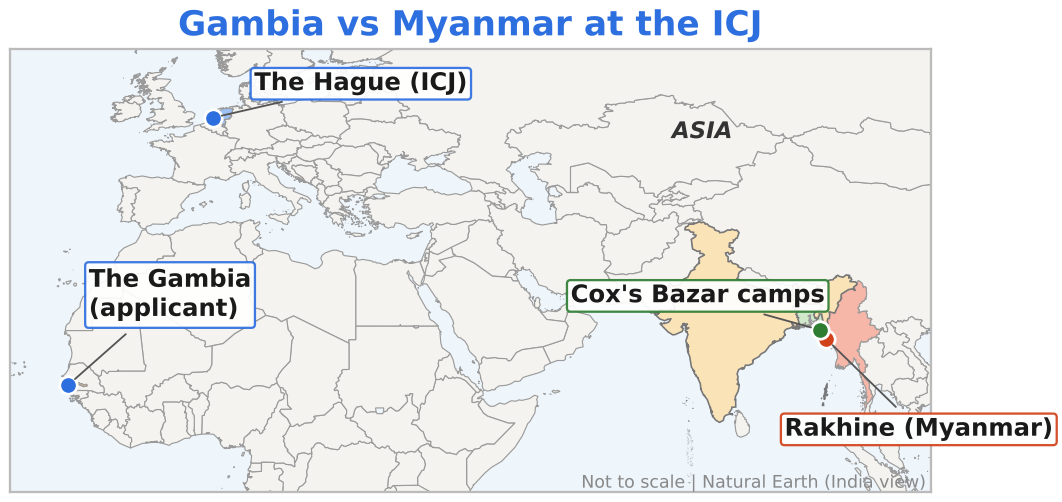
ICJ rules Myanmar committed genocide against the Rohingya (The Gambia vs Myanmar).
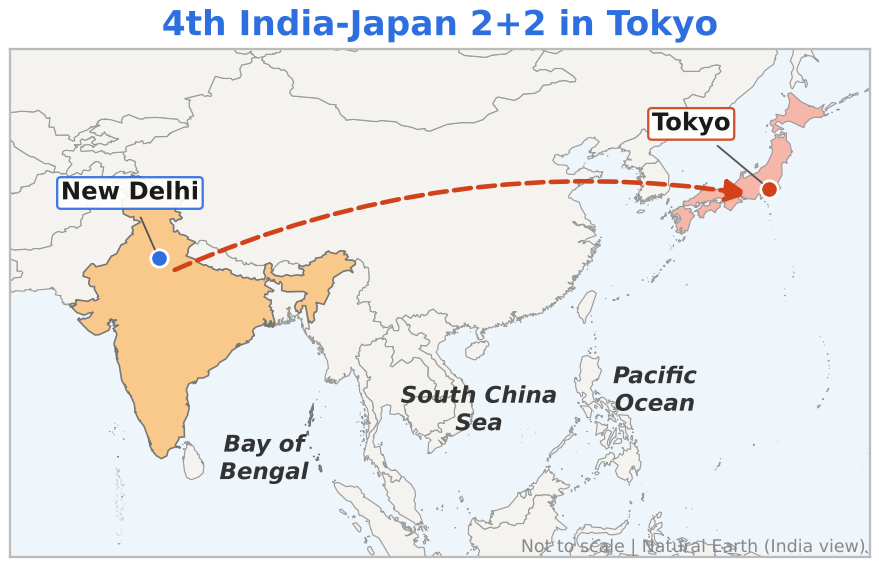
4th India-Japan 2+2 in Tokyo: Japanese forces to do live-fire training at Indian ranges.
COP31 draft text in Antalya drops fossil fuel phase-out and net-zero dates.
PAC calls the 2014 Green India Mission a 'total failure'.
OPEC share in India's crude imports falls to 27.4% (Apr-Oct 2026).
WHO TB Report: India's TB deaths down 38% since 2015.
Harimau Shakti-VI India-Malaysia exercise begins at Ipoh.
Detailed notes
1. Gram Sabha Consent Is Mandatory: SC
POLITYUPSC: Prelims + Mains GS2
Syllabus linkage
GS2 Polity - Fifth Schedule, Scheduled Areas, judiciary; GS3 land acquisition and mining. Prelims: LARR Act 2013 sections; Mains: tribal rights vs development.
Context
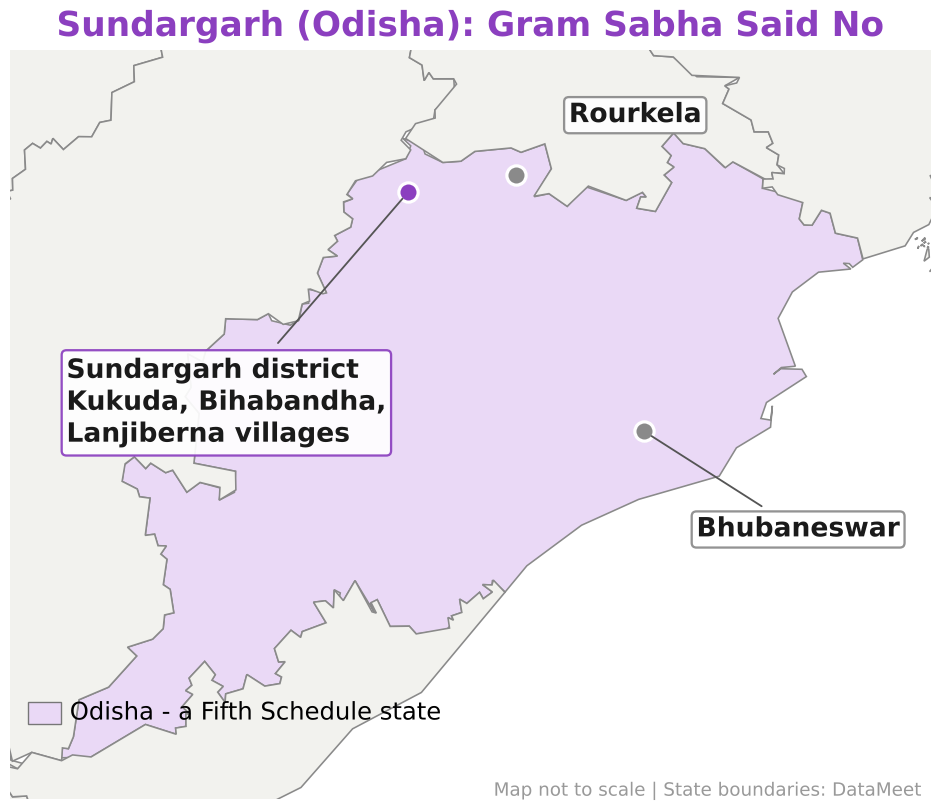
The Supreme Court cancelled a land acquisition in Odisha for a private mining company because the tribal village councils (Gram Sabhas) had said no, and their prior consent is compulsory under the law. On 18 November 2026, a Supreme Court bench of Justices Dipankar Datta and Satish Chandra Sharma decided Bibol Toppo vs State of Odisha. Land in three villages (Kukuda, Bihabandha and Lanjiberna) of Sundargarh district was being acquired so that Dalmia Cements could extend its limestone mine. The Gram Sabhas had rejected the proposal by resolutions of 26 January 2020. The Court held that prior consent of the Gram Sabha in a Scheduled Area is mandatory, set aside the Orissa High Court's 2024 judgment, and quashed the acquisition.
Key facts
Case: Bibol Toppo vs State of Odisha, 2026 INSC 1244, decided 18 Nov 2026
Section 41(3), LARR Act 2013: prior consent of Gram Sabha needed in Scheduled Areas - held MANDATORY, not optional
Section 2(2)(b): when land is acquired for a private company, consent of at least 80% of affected families is needed
Consent must come BEFORE the decision; consent collected later cannot cure the defect
Expert group for Social Impact Assessment (SIA) was not independent - the company's own adviser was a member
Way forward
States should follow consent and SIA steps honestly and early; strengthen Gram Sabhas with information and legal help so that consent is free, prior and informed.
Concept
LARR Act 2013 (Right to Fair Compensation and Transparency in Land Acquisition, Rehabilitation and Resettlement Act): replaced the colonial 1894 Act; needs SIA, consent (80% for private, 70% for PPP projects) and fair compensation. Fifth Schedule (Article 244(1)): special protection for Scheduled Areas and tribes in 10 states incl. Odisha; Governor can modify laws there; Tribes Advisory Council advises. Gram Sabha = all adult voters of a village; under PESA 1996 it must be consulted before land acquisition in Scheduled Areas (like the Niyamgiri case, 2013). Exam angle: Prelims can test which section/Act needs Gram Sabha consent, the 80%/70% consent rule, Fifth Schedule states. Mains: balancing mining-led growth with constitutional protection of tribal land; role of courts in enforcing participatory democracy.
Map of Odisha highlighting Sundargarh district villages where Gram Sabhas rejected land acquisition for mining — StudyForGS
2. India's 'Great Stagnation' in State Capacity
POLITYUPSC: Prelims + Mains GS2
Syllabus linkage
GS2 Governance - civil services, local bodies, role of the state; Mains essay/GS2 on administrative reforms.
Context
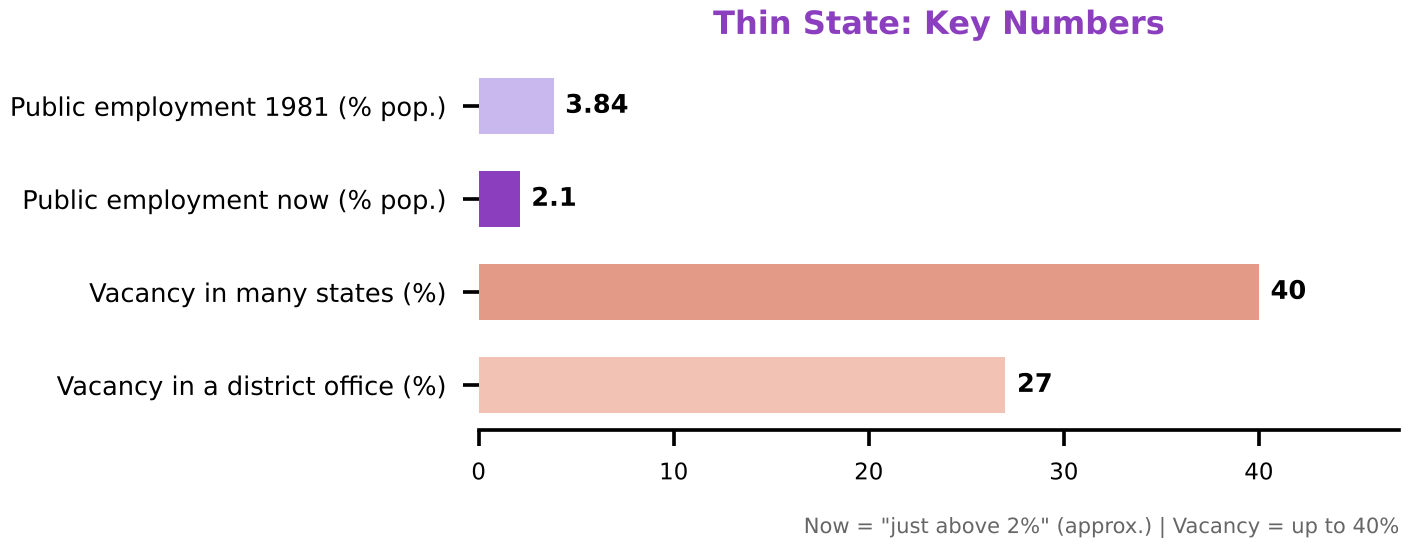
An editorial argues that India's economy has grown but its government machinery (staff, judges, local officials) has not grown with it, so schemes and laws are not delivered properly. In an editorial on 20 November 2026, Pratap Bhanu Mehta called this India's 'Great Stagnation' in state capacity (state capacity = the ability of government to make and enforce rules and deliver services). Public employment peaked at 3.84% of the population in 1981 and is now a little above 2%, among the lowest in Asia. India has about 1.1 judges per lakh people. In China and the US, about two-thirds of government workers are in local government - roughly five times the Indian share. Vacancies of 27% in district offices and up to 40% in many states are reported.
Key facts
Public employment: 3.84% (1981 peak) -> just above 2% now
About 1.1 judges per lakh population
Local governments employ about two-thirds of public staff in China/US vs a much smaller share in India
Vacancies: 27% in a district office; up to 40% in many states, worse at lower levels
Overloaded officials -> uneven enforcement, more discretion, unspent funds
Way forward
Do a staffing assessment for every new scheme or law, fill lower-level vacancies on a fixed timeline, and give real money and staff to panchayats and municipalities.
Concept
73rd and 74th Amendments (1992): gave constitutional status to panchayats and municipalities; 11th and 12th Schedules list 29 and 18 subjects for them - but funds, functions and functionaries are often not transferred. Mission Karmayogi (2020): national programme for civil-service capacity building (training on the iGOT platform). Second Administrative Reforms Commission (2005, chaired by Veerappa Moily): recommended right-sizing, not just downsizing, of government. Exam angle: Prelims: 73rd/74th Amendment schedules, Mission Karmayogi, ARC. Mains: 'Minimum government, maximum governance' vs need for more staff; link between staff shortage and poor welfare delivery.
Bar chart of public employment share falling from 3.84 percent in 1981 to about 2 percent and vacancy rates of 27 to 40 percent — StudyForGS
3. ULLAS: 11 States/UTs Now 'Fully Literate'
POLITYUPSC: Prelims + Mains GS2
Syllabus linkage
GS2 Social justice - education, government schemes; Prelims: scheme facts, NEP 2020.
Context
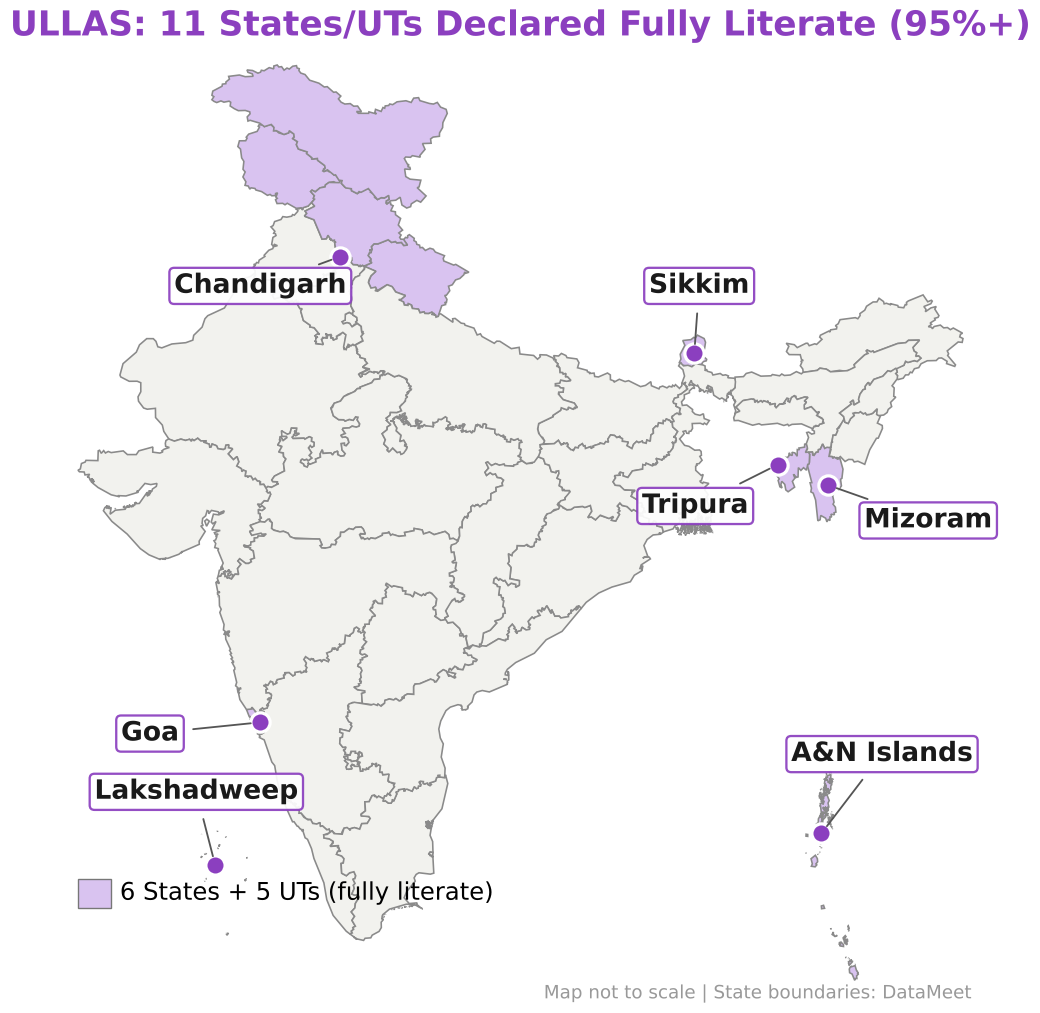
Under the adult literacy programme ULLAS, 11 States and Union Territories have declared themselves fully literate, meaning 95% or more of their people can read, write and do basic maths. Six states (Mizoram, Goa, Tripura, Himachal Pradesh, Sikkim, Uttarakhand) and five UTs (Ladakh, Chandigarh, Andaman and Nicobar Islands, Jammu and Kashmir, Lakshadweep) have declared full literacy under ULLAS - Nav Bharat Saaksharta Karyakram. 'Full literacy' is treated as a literacy rate of 95% or above, because 100% is practically difficult (very old age, some disabilities). Learners take the FLNAT test twice a year and get a certificate from NIOS. About 4.15 crore learners across 34 States/UTs have taken the test, with a success rate above 90%.
Key facts
11 = 6 States + 5 UTs; benchmark = 95% literacy
ULLAS = Understanding of Lifelong Learning for All in Society; runs since 2022-23 (to 2026-27)
FLNAT (Foundational Literacy and Numeracy Assessment Test) twice a year; certificate by NIOS
Most learners assessed: Madhya Pradesh (20.43 lakh), then Rajasthan (18.18 lakh)
Way forward
Check that learners retain skills over time, link literacy with digital and financial literacy, and focus on low-literacy districts and women.
Concept
NEP 2020: says adult education and lifelong learning are part of education; ULLAS follows it. Five components of ULLAS: foundational literacy and numeracy, critical life skills, basic education, vocational skills, continuing education. Census 2011 literacy was 74.04%; government now reports about 81.1% (PLFS-type surveys, not Census). Exam angle: Prelims: full form of ULLAS, age group, which body certifies (NIOS), which states/UTs declared. Mains: functional literacy vs certificate literacy; digital divide in adult education.
India map highlighting the 6 states and 5 union territories declared fully literate under ULLAS — StudyForGS
4. Shenzhen Trilateral: US, China, Russia Leaders Meet
IRUPSC: Prelims + Mains GS2
Syllabus linkage
GS2 IR - effect of policies of developed countries on India's interests, global groupings, UN reform, nuclear issues.
Context
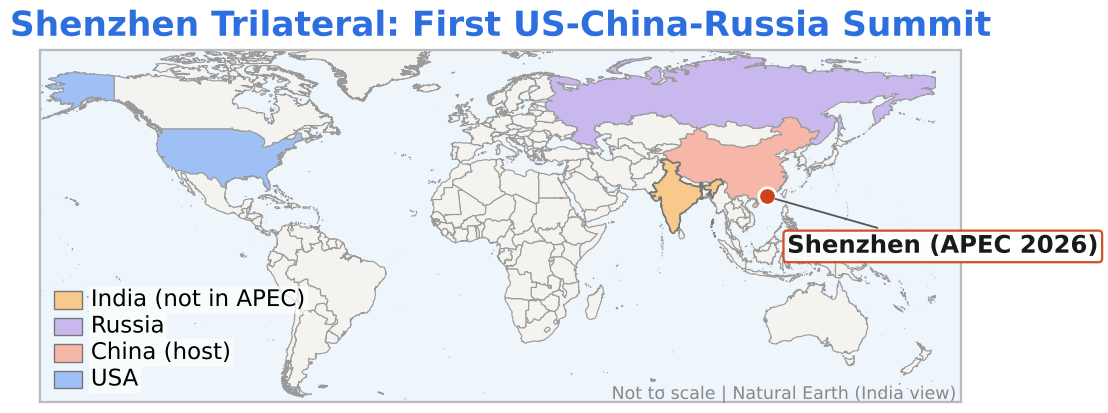
The leaders of the US, China and Russia met together for the first time, in Shenzhen (China), and agreed to talk about reducing nuclear risks and increasing oil product supply - but nothing concrete on Ukraine or Iran. Donald Trump, Xi Jinping and Vladimir Putin held their first trilateral summit in Shenzhen on 19 November 2026, on the sidelines of the 33rd APEC Economic Leaders' Meeting. The roughly 90-minute talks produced the 'China-Russia-US Heads of State Declaration toward Peace'. It says 'a nuclear war cannot be won and must never be fought', promises a dialogue on nuclear risk reduction, talks about UN reform without details, and calls for more production of refined petroleum products. It also says courts such as the ICC must not 'abuse jurisdiction'. Together, the three hold about 90% of the world's nuclear weapons.
Key facts
Date/venue: 19 Nov 2026, Shenzhen, alongside the 33rd APEC summit
Output: 'Heads of State Declaration toward Peace'
Nuclear: dialogue on reducing nuclear risks; the three hold about 90% of world nuclear warheads
Energy: boost supply of refined petroleum products
No breakthrough on Ukraine or Iran; compared by commentators to Yalta 1945 (but no spheres-of-influence deal)
Way forward
India should keep multi-alignment (Quad, SCO, BRICS, ASEAN), push for real UNSC reform, and make sure nuclear-risk rules respect India's position as a non-NPT nuclear power.
Concept
APEC (Asia-Pacific Economic Cooperation, 1989): 21 member economies; India is NOT a member (it has sought membership). ICC (International Criminal Court, Rome Statute 1998, HQ The Hague): tries individuals for genocide, war crimes; US, China, Russia - and India - are not parties. Thucydides Trap: idea that a rising power and a ruling power drift into war; Xi urged avoiding it. Exam angle: Prelims: APEC membership, ICC vs ICJ, which countries are not Rome Statute parties. Mains: what big-power deals mean for India's strategic autonomy, UNSC reform hopes and energy security (India is a refining hub).
World map highlighting the United States, China and Russia with Shenzhen marked as the trilateral summit venue — StudyForGS
5. ICJ: Myanmar Committed Genocide Against Rohingya
IRUPSC: Prelims + Mains GS2
Syllabus linkage
GS2 IR - international institutions, India's neighbourhood (Myanmar, Bangladesh), refugees; Prelims: ICJ, Genocide Convention.
Context
The UN's top court ruled that Myanmar's army committed genocide (acts meant to destroy a group) against the Rohingya Muslims in 2017, and ordered Myanmar to punish those responsible and pay compensation. On 19 November 2026, the International Court of Justice (ICJ) in The Hague decided The Gambia vs Myanmar. It held that Myanmar committed genocide against the Rohingya during the 2017 'clearance operations' in northern Rakhine State, and also failed to prevent and punish it. The Gambia filed the case on 11 November 2019 under the Genocide Convention, 1948. ICJ President Yuji Iwasawa read the verdict. Myanmar must prosecute suspects, allow safe and voluntary return of Rohingya, and pay compensation, reporting within two years.
Key facts
Case filed by The Gambia (11 Nov 2019) - a country not directly affected (erga omnes = obligation owed to all)
First time the ICJ has held a State itself responsible for committing genocide (in 2007 it found Serbia only failed to prevent)
Myanmar also breached the provisional measures order of 23 Jan 2020
About 7 lakh+ Rohingya fled to Bangladesh (Cox's Bazar) after 2017
Way forward
Global pressure for compliance and safe return; India can support humanitarian aid and Rakhine development while protecting its connectivity projects.
Concept
ICJ (1945, The Hague): principal judicial organ of the UN; settles disputes between STATES; 15 judges, 9-year terms. ICC instead tries INDIVIDUALS. Genocide Convention 1948: defines genocide as acts done with intent to destroy, in whole or in part, a national, ethnic, racial or religious group; India ratified it in 1959. Rakhine State borders Bangladesh; India's Kaladan Multi-Modal Project runs through Sittwe port in Rakhine. Exam angle: Prelims: ICJ vs ICC, Genocide Convention, location of Rakhine/Sittwe. Mains: India's balancing between Myanmar's junta, Bangladesh and refugee concerns; effectiveness of international law.
Map showing The Gambia, The Hague, Myanmar's Rakhine State and Cox's Bazar camps in Bangladesh — StudyForGS
6. 4th India-Japan 2+2: Live-Fire Drills in India
IRUPSC: Prelims + Mains GS2
Syllabus linkage
GS2 IR - India and its neighbourhood/Indo-Pacific, bilateral agreements; GS3 defence cooperation.
Context
India's foreign and defence ministers met their Japanese counterparts in Tokyo; for the first time Japan's forces will do live-firing training at Indian ranges. The fourth India-Japan 2+2 Foreign and Defence Ministerial Dialogue was held in Tokyo on 19 November 2026. Rajnath Singh and S. Jaishankar met Foreign Minister Toshimitsu Motegi and Defence Minister Shinjiro Koizumi. A Letter of Intent was signed under which the Japan Self-Defense Forces will, for the first time, carry out live-fire training (including surface-to-ship missiles) at Indian firing ranges. Both sides discussed defence industry links on UNICORN (a ship antenna/mast system), with the slogan 'Design with Japan, Make in India'. Japan's air force fighters also made their first visit to India for exercise Veer Guardian 26.
Key facts
4th 2+2, Tokyo, 19 Nov 2026 (framework: Special Strategic and Global Partnership)
Letter of Intent: Japanese forces' live-fire training at Indian ranges - a first
UNICORN cooperation; Indian approval (AoN) expected by Feb 2027
Maritime security, mine countermeasures and joint shipbuilding discussed
India to host the 5th Coast Guard Global Summit in Feb 2027
Way forward
Turn intent into joint production, speed up approvals, and widen training to all three services.
Concept
2+2 dialogue = foreign + defence ministers of two countries meet together; India has it with the US, Japan, Australia, Russia and a few others. Japan's Self-Defense Forces: Japan's Article 9 'peace constitution' limits use of force, so training abroad is a big step. IPOI (Indo-Pacific Oceans Initiative, 2019) and MAHASAGAR (India's ocean vision, 2025) are linked with Japan's Free and Open Indo-Pacific (FOIP). Exam angle: Prelims: India-Japan exercises (JIMEX, Dharma Guardian, Veer Guardian, Shinyuu Maitri), meaning of 2+2. Mains: India-Japan as a pillar of Indo-Pacific stability and defence-industrial self-reliance.
Map of Asia showing India and Japan with a route from New Delhi to Tokyo for the 2+2 dialogue — StudyForGS
7. First SCO Civilisational Dialogue Forum in Delhi
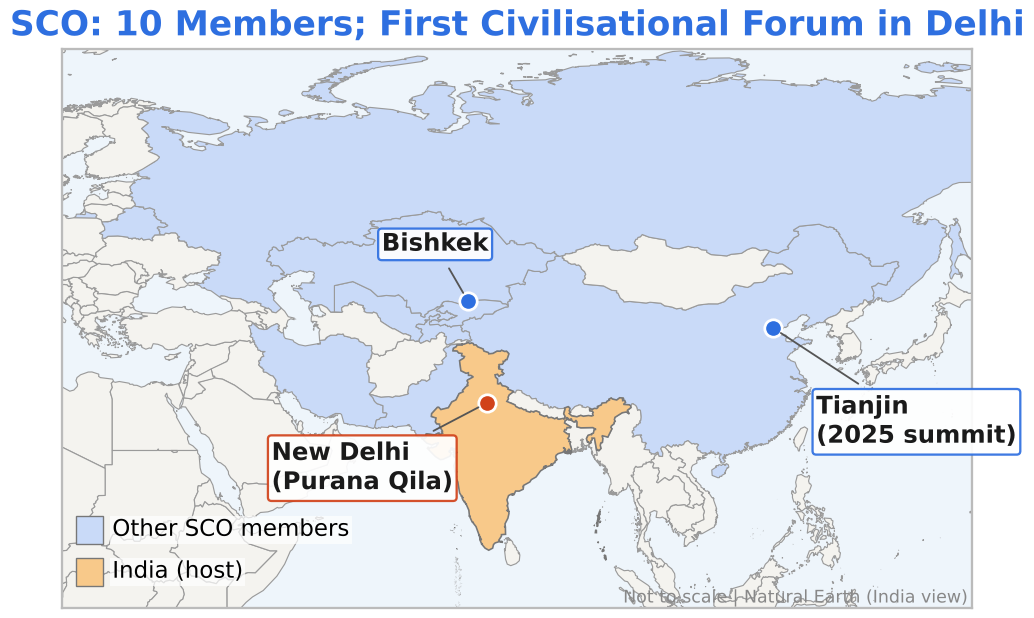
India is hosting the first meeting of a new SCO forum that uses culture, history and arts to bring the member countries' people closer. Prime Minister Narendra Modi inaugurated the first SCO Civilisational Dialogue Forum at Purana Qila, New Delhi, on 20 November 2026. It runs from 20 to 22 November with the theme 'Vasudhaiva Kutumbakam' (the world is one family). Modi had proposed the forum at the 2025 SCO Summit in Tianjin, China, and it was welcomed in the SCO's Bishkek Declaration. Events include the show 'Civilisations in Conversation', the exhibition 'ASTITVA' on Delhi's archaeology and a pavilion on a rare 18th-century Mahabharata scroll. Pakistan's delegation is led by a federal minister.
Key facts
1st forum: 20-22 Nov 2026, Purana Qila, New Delhi
Idea proposed by India at the Tianjin SCO Summit (2025)
Theme: 'Vasudhaiva Kutumbakam'
Four thematic sessions on 21-22 Nov
SCO has 10 members incl. India, China, Russia, Pakistan, Iran, Belarus
Way forward
Use the forum for youth, tourism and scholarly exchanges while keeping India's firm line on terrorism inside SCO.
Concept
SCO (2001, Shanghai): Secretariat in Beijing; RATS (Regional Anti-Terrorist Structure) in Tashkent; India and Pakistan became full members in 2017, Iran in 2023, Belarus in 2024. Soft power = influence through culture, values and ideas rather than force or money. India's SCO themes: SECURE (Security, Economy, Connectivity, Unity, Respect for sovereignty, Environment). Exam angle: Prelims: SCO founding year, HQ, RATS location, newest members. Mains: can cultural diplomacy help India in a grouping dominated by China and Russia?
Map of Eurasia highlighting the 10 SCO member countries with New Delhi, Tianjin and Bishkek marked — StudyForGS
8. India-Italy: 23rd Joint Commission in Rome
IRUPSC: Prelims + Mains GS2
Syllabus linkage
GS2 IR - India-EU relations, bilateral trade; GS3 external sector.
Context
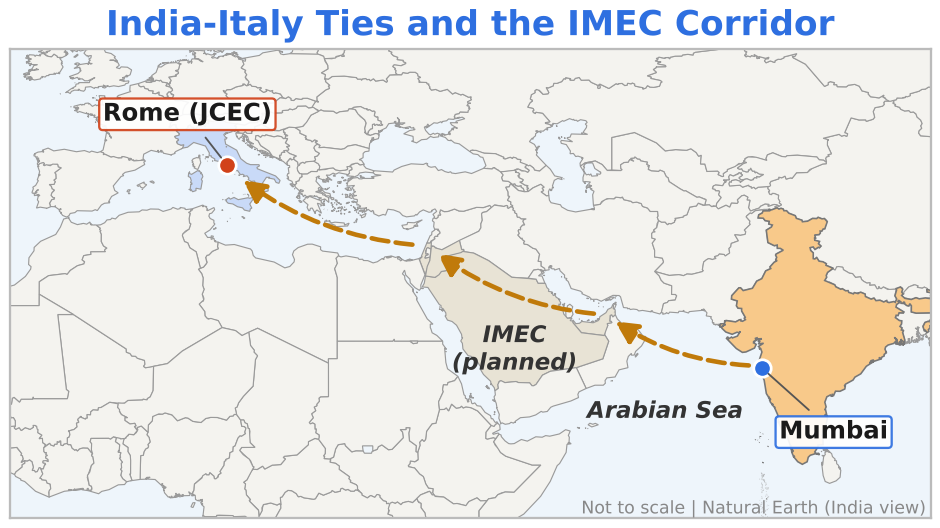
India and Italy held a high-level economic meeting in Rome and set a target of 20 billion euro trade by 2029. The 23rd India-Italy Joint Commission for Economic Cooperation (JCEC) met in Rome on 18 November 2026, co-chaired by Commerce Minister Piyush Goyal and Italy's Deputy PM and Foreign Minister Antonio Tajani. It works under the Joint Strategic Action Plan 2025-2029. The two sides set a target of 20 billion euro bilateral trade by 2029 and welcomed the conclusion of India-EU FTA negotiations. Priority sectors are automotive, aerospace, Industry 4.0, agri-tech, energy, critical minerals and tourism. About 80 Indian business delegates, including 12 startups, took part.
Key facts
23rd JCEC, Rome, 18 Nov 2026
Target: 20 billion euro trade by 2029
Joint Strategic Action Plan 2025-2029
Welcomed conclusion of India-EU FTA talks
Italy is a partner in IMEC (India-Middle East-Europe Economic Corridor)
Way forward
Use the FTA and IMEC to raise Italian investment in Indian manufacturing, defence and green energy.
Concept
IMEC (announced at G20 New Delhi, 2023): rail and sea corridor linking India, Gulf and Europe; Italy, France, Germany, EU, US, Saudi Arabia, UAE are partners. FTA (Free Trade Agreement): partners cut tariffs on most goods; India-EU talks restarted in 2022 after a 2013 freeze. Joint Commission = regular minister-level meeting to review trade and investment. Exam angle: Prelims: IMEC partners, India-EU FTA timeline. Mains: Europe as a diversification partner for India's trade and technology.
Map showing India, the Gulf and Italy with the planned IMEC corridor route from Mumbai to Rome — StudyForGS
9. WHO TB Report: India's Deaths Down 38%
HEALTHUPSC: Prelims + Mains GS2
Syllabus linkage
GS2 Health - communicable diseases, government programmes (NTEP, TB Mukt Bharat); Prelims: TB facts, End TB targets.
Context
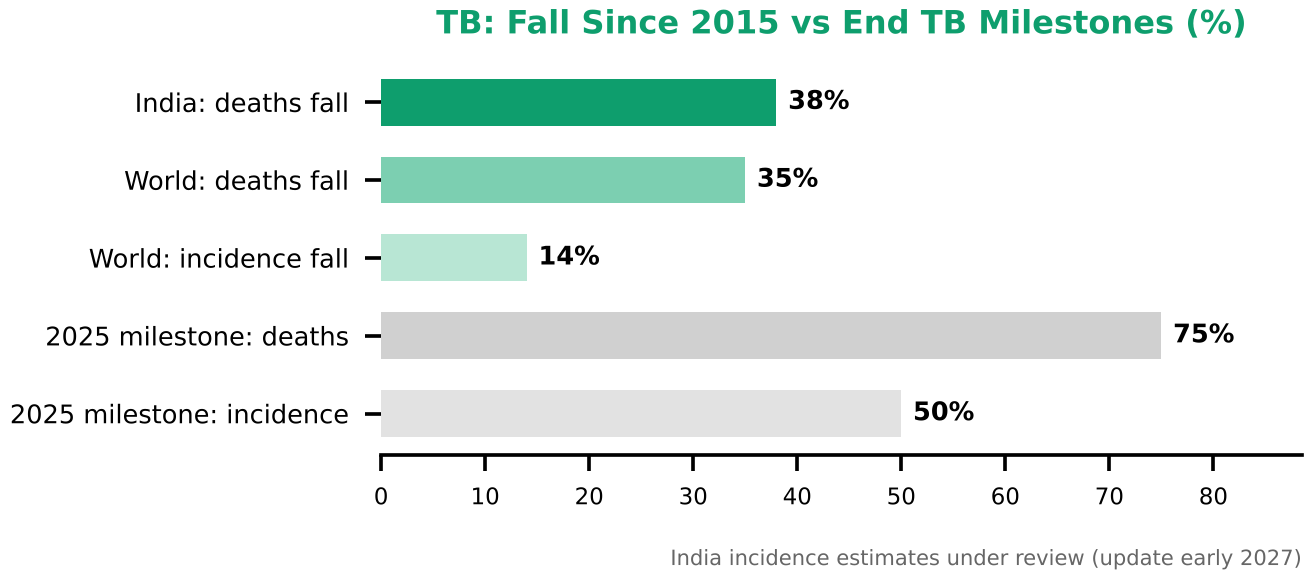
WHO's new global TB report says India has cut TB deaths by 38% since 2015, but India still has about one in four of the world's TB cases and missed the 2025 elimination goal. The WHO Global TB Report 2026 (data for 2025) says about 10.6 million people fell ill with TB worldwide and about 1.13 million died. India's TB death rate fell 38% from 2015 to 2025 (from 28 to 18 per lakh), better than the global fall of 35%. India reported 25.3 lakh cases and 2.63 lakh deaths in 2025. Treatment success for drug-sensitive TB in India is 94%. India had set itself a target to end TB by 2025, five years ahead of the global SDG target of 2030, but that has not been met.
Key facts
World 2025: 10.6 million cases, 1.13 million deaths
India: about 25% of global cases - highest of any country
India's TB death rate down 38% (2015-2025) vs 35% globally
Global incidence down only 14% vs the 50% milestone for 2025
TB Mukt Bharat Abhiyaan: 25 crore+ people screened; 67,933 TB-free panchayats in 2025
Way forward
Screen more people early, fix nutrition support, roll out shorter regimens for drug-resistant TB and involve private doctors fully.
Concept
TB is caused by the bacterium Mycobacterium tuberculosis; spreads through air; mostly affects lungs. End TB Strategy (WHO): by 2030 cut deaths by 90% and incidence by 80% vs 2015; SDG target 3.3 ends TB epidemic by 2030. Ni-kshay Poshan Yojana gives nutrition support (now Rs 1,000 per month) to TB patients; MDR-TB = resistant to rifampicin and isoniazid. Exam angle: Prelims: India's target year (2025) vs SDG (2030), TB-causing agent, Ni-kshay schemes. Mains: why incidence falls slowly - undernutrition, private sector notification, drug resistance.
Bar chart comparing India's 38 percent fall in TB deaths with global declines and End TB milestones — StudyForGS
10. Antimicrobials to Be Treated as 'New Drugs'
HEALTHUPSC: Prelims + Mains GS2
Syllabus linkage
GS2 Health - drug regulation, AMR; GS3 S&T - biotechnology. Prelims: CDSCO, NDCT Rules, AWaRe.
Context
The Health Ministry wants every antibiotic-type medicine to need central approval before it is made, to stop poor-quality drugs that help germs become resistant. The Union Health Ministry released a draft notification (G.S.R. 983(E), dated 6 November 2026) to include antimicrobials in the definition of 'New Drug' under the New Drugs and Clinical Trials (NDCT) Rules, 2019. Makers will first need permission from the Central Licensing Authority (CDSCO) before applying to a State authority. The reason: some licences were given without proper checks on stability and bioequivalence. A second draft under the Drugs Rules, 1945, creates a separate licence for wholesale sale of bulk drugs and Good Storage and Distribution Practices. Public comments are invited within 30 days.
Key facts
Draft G.S.R. 983(E), 6 Nov 2026; 30 days for comments
Central Licensing Authority approval needed first, then State licence
Separate wholesale licence for bulk drugs (APIs) under Drugs Rules 1945
Bacterial AMR directly caused about 1.27 million deaths globally in 2019
Way forward
Finalise the rules quickly, add more drug inspectors and labs, and control antibiotic use in poultry, dairy and fish farming.
Concept
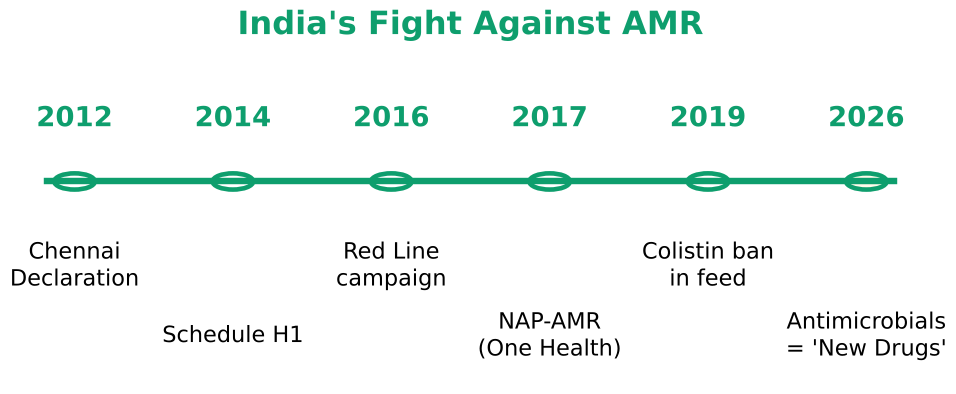
AMR (antimicrobial resistance): germs change so medicines stop working; driven by overuse, self-medication, incomplete courses and use in animals. India's steps: Chennai Declaration 2012, Schedule H1 (2014), Red Line campaign (2016), National Action Plan on AMR (2017, One Health), colistin ban in animal feed (2019). WHO AWaRe groups antibiotics into Access, Watch and Reserve (last-resort) categories. Exam angle: Prelims: CDSCO under which ministry, Drugs and Cosmetics Act 1940, AWaRe, Red Line. Mains: regulatory gaps between Centre and States in drug quality; One Health approach.
Timeline of India's anti-microbial resistance steps from the 2012 Chennai Declaration to the 2026 New Drug proposal — StudyForGS
11. EPFO Clears Systematic Withdrawal Plan
ECONOMYUPSC: Prelims + Mains GS3
Syllabus linkage
GS3 Economy - social security, pension reforms; GS2 welfare of vulnerable sections. Prelims: EPFO, CBT, EPS.
Context
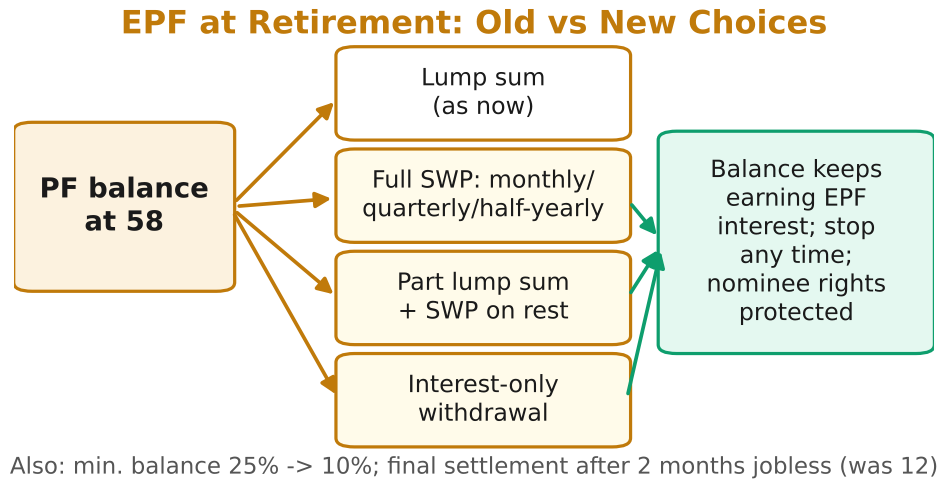
Retiring EPF members will be able to take their PF money in instalments (monthly, quarterly or half-yearly) while the rest keeps earning interest; the rules for early withdrawal have also been eased. The 240th meeting of EPFO's Central Board of Trustees (CBT), chaired by Labour Minister Mansukh Mandaviya on 19 November 2026, cleared a voluntary Systematic Withdrawal Plan (SWP). Today a member gets the whole PF amount at retirement (58) as a lump sum; under SWP they can take periodic payouts while the remaining balance earns EPF interest, and can stop any time. The board also cut the minimum balance to be kept from 25% to 10% and reduced the waiting time for final PF settlement after job loss from 12 months to 2 months. About 6.32 lakh members above 55 with PF above Rs 5 lakh are the first likely users.
Key facts
240th CBT meeting, 19 Nov 2026
SWP options: full SWP, part lump sum + SWP, or interest-only; voluntary
Minimum balance: 25% -> 10%; final settlement after 2 months of unemployment (was 12)
Gig workers: UAN-linked voluntary and third-party micro-contributions allowed
In-principle approval to put up to 3% of fresh accretions into AIFs (NIIF, SIDBI Fund of Funds 2.0)
Way forward
Keep SWP simple and digital, publish clear return estimates, and quickly bring gig and informal workers into EPF.
Concept
EPFO: statutory body under the Employees' Provident Funds and Miscellaneous Provisions Act, 1952; Ministry of Labour; CBT is its apex body chaired by the Labour Minister. EPS-95 (Employees' Pension Scheme) gives monthly pension after at least 10 years of service; EPF is a separate savings account. AIF (Alternative Investment Fund): privately pooled fund regulated by SEBI's AIF Regulations 2012 - higher risk, so the cap is small. Exam angle: Prelims: EPFO's parent Act, who chairs CBT, EPS eligibility (10 years). Mains: India's ageing population needs steady retirement income; extending social security to gig workers under the Code on Social Security.
Flow diagram of EPF withdrawal choices at retirement: lump sum, full systematic withdrawal, partial lump sum plus SWP, interest-only — StudyForGS
12. PM to India Inc: Share Gains With Workers
ECONOMYUPSC: Prelims + Mains GS3
Syllabus linkage
GS3 Economy - growth and employment, industrial policy, inclusive growth.
Context
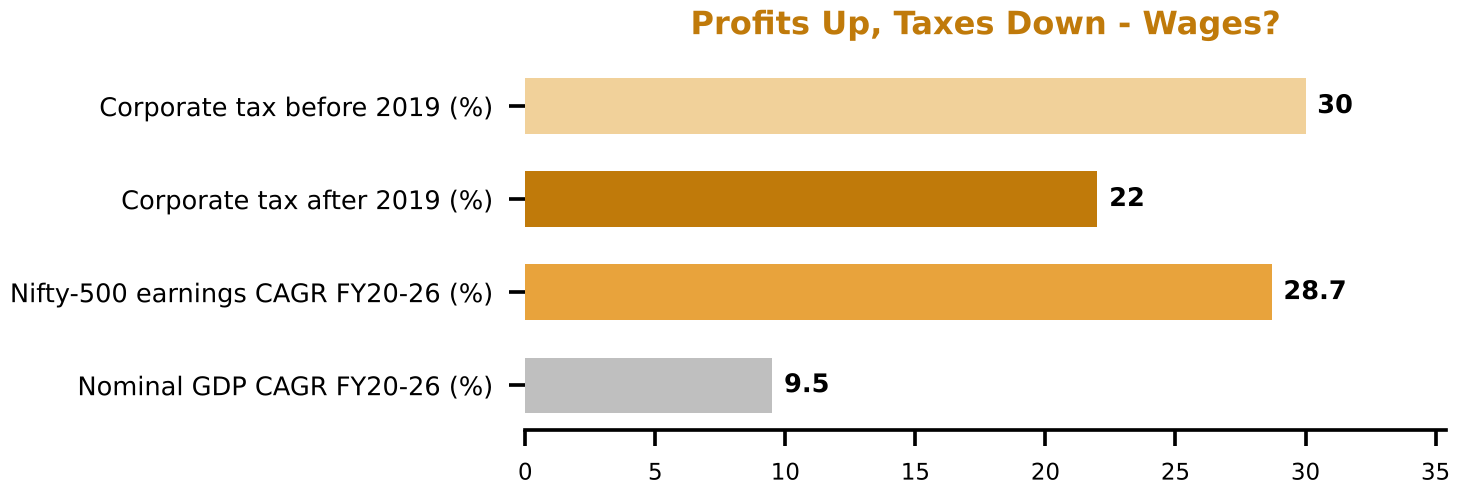
Speaking at FICCI's centenary, PM Modi asked companies why tax cuts and easier rules have not turned into higher salaries, more jobs and better products. At the centenary of the Federation of Indian Chambers of Commerce and Industry (FICCI) at Bharat Mandapam on 19 November 2026, PM Narendra Modi said corporate tax was cut from 30% to 22% in 2019 and income up to Rs 12 lakh is now effectively tax-free, but salaries and hiring have not risen to match. He asked firms to invest in areas where India imports a lot - active pharmaceutical ingredients (APIs), special steel and aluminium grades, food processing and machinery - and to use India's free trade agreements. Data show Nifty-500 company profits reached 5.2% of GDP in FY26, an all-time high.
Key facts
Corporate tax: 30% -> 22% (2019 cut; 15% for new manufacturing units)
Nifty-500 earnings grew about 28.7% a year (FY20-FY26) vs about 9.5% for GDP
Listed-company profit-to-GDP: 5.7%, an 18-year high
About 87% of workers are informal (NITI Aayog, PLFS 2023-24)
India's share of global farm exports only about 2-2.5%
Way forward
Link incentives to jobs and wages, push R and D and quality, and help MSMEs join supply chains of big firms.
Concept
FICCI: India's oldest apex business chamber, founded 1927 (so 2026-27 is its centenary year), on the advice of Mahatma Gandhi; G.D. Birla and Purushottamdas Thakurdas were founders. API (active pharmaceutical ingredient): the main chemical in a medicine; India imports most key APIs from China - the PLI scheme for bulk drugs targets this. Profit-wage gap: when profits grow faster than wages, demand stays weak - an issue of inclusive growth. Exam angle: Prelims: FICCI founding year, corporate tax rates. Mains: is India's growth 'jobless' or 'wageless'? Role of the private sector in Viksit Bharat 2047.
Bar chart of corporate tax cut from 30 to 22 percent and Nifty-500 earnings growth of 28.7 percent versus GDP growth of 9.5 percent — StudyForGS
13. One Year of Labour Codes: Layoff Safeguards
ECONOMYUPSC: Prelims + Mains GS3
Syllabus linkage
GS3 Economy - employment, labour reforms; GS2 social security. Prelims: four codes, thresholds.
Context
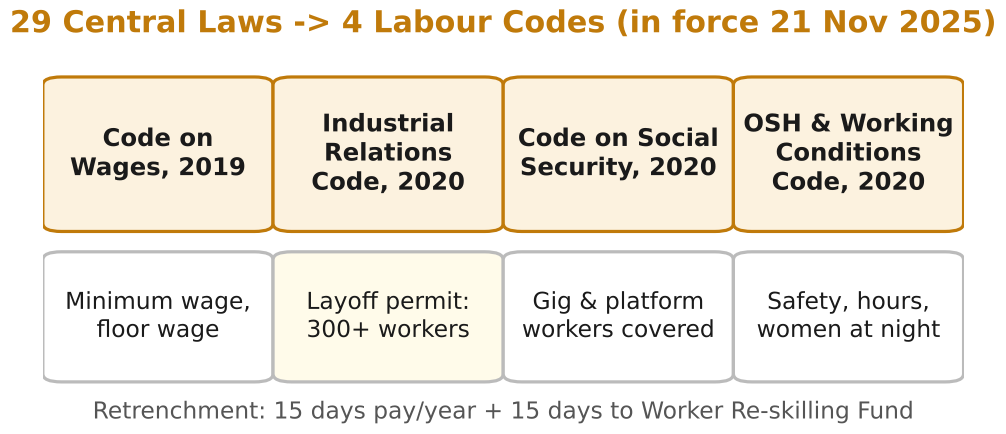
As the four Labour Codes complete one year, experts say workers who lose jobs still have weak protection - no unemployment insurance and strict layoff rules only for big factories. The four Labour Codes, which merged 29 central labour laws, complete one year on 21 November 2026. A discussion in a newspaper on 20 November looked at protections for workers facing layoffs, especially with AI-linked job cuts. Under the Industrial Relations Code, firms with 300 or more workers need government permission for layoffs (earlier 100). A retrenched worker gets 15 days' average pay for each year of service, and the employer pays another 15 days' wages into a Worker Re-skilling Fund. Experts say these rules mostly cover factories, mines and plantations, not IT and services.
Key facts
4 Codes: Wages (2019), Industrial Relations (2020), Social Security (2020), OSH and Working Conditions (2020)
Merged 29 central laws; in force from 21 Nov 2025
Government permission for layoffs: 300+ workers (was 100)
Retrenchment compensation: 15 days' pay per year + 15 days to Re-skilling Fund
India has no general unemployment insurance; ESIC's Atal Bimit Vyakti Kalyan Yojana is a small version
Way forward
Design a contributory unemployment insurance, make the Re-skilling Fund AI-ready, cover IT/services workers and fill tribunal vacancies.
Concept
Retrenchment = ending a worker's job for reasons other than punishment (e.g., cost cutting); layoff = temporary inability to give work. Code on Social Security 2020 first recognised gig and platform workers; e-Shram portal (2021) registers unorganised workers. Labour is in the Concurrent List (entries 22-24), so both Centre and States make labour laws. Exam angle: Prelims: names/years of codes, layoff threshold, Concurrent List entries. Mains: flexibility for employers vs security for workers; need for unemployment insurance in the AI age.
Diagram of the four Labour Codes that merged 29 central laws, with key provisions under each — StudyForGS
14. OPEC's Share in India's Crude Falls to 27.4%
ECONOMYUPSC: Prelims + Mains GS3
Syllabus linkage
GS3 Economy - energy security, external sector; GS2 IR - West Asia, Russia.
Context
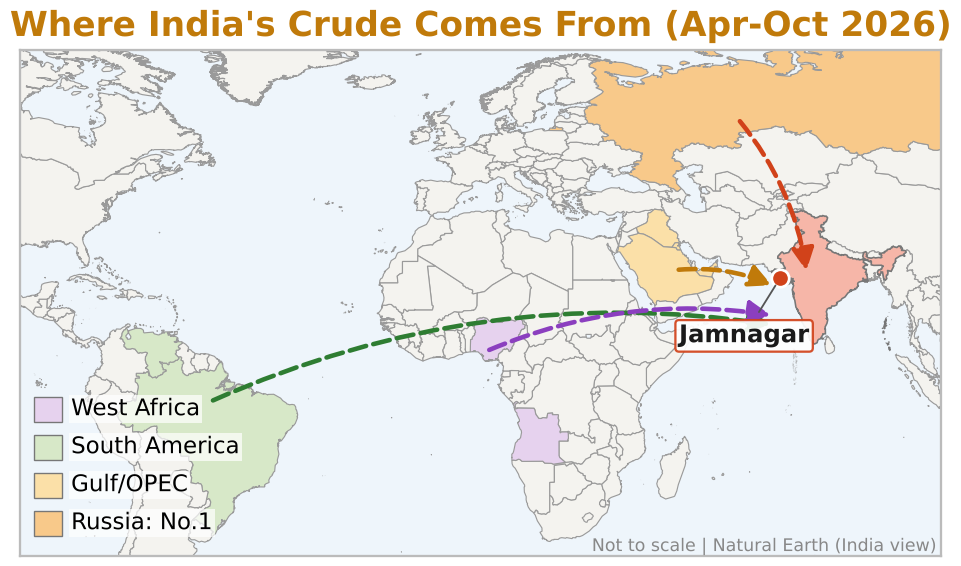
India now buys much less oil from OPEC countries and more from Russia and other regions; the oil import bill has jumped because prices and shipping costs rose during the West Asia conflict. Provisional data from the Petroleum Planning and Analysis Cell (PPAC) show OPEC's share of India's crude imports fell to 27.4% in April-October 2026, from 38.5% a year earlier. The crude import bill rose about 53.5% to 111 billion dollars, while volume grew only 2.7% to 146.6 million tonnes; the average landed price was about 103.3 dollars a barrel. Russia stayed the top supplier (about 1.85 million barrels per day in October). Saudi Arabia overtook the UAE as the No. 2 supplier, and October imports hit a record 5.58 million barrels per day.
Key facts
OPEC share: 38.5% -> 27.4% (Apr-Oct)
Import bill: 111 billion dollars, up 53.5%; volume up only 2.7%
Average landed price: about 103.3 dollars per barrel
Source mix: Eurasia 43.8%, Middle East 36%, South America 10.6%
Russia No. 1; Saudi Arabia No. 2; UAE fell to No. 3
Way forward
Keep diversifying suppliers, expand strategic reserves and speed up EVs, biofuels and green hydrogen to cut import dependence.
Concept
OPEC (1960, Baghdad; HQ Vienna): 12 oil-exporting members incl. Saudi Arabia, Iraq, Iran, UAE, Kuwait; OPEC+ adds Russia and others. PPAC: works under the Ministry of Petroleum and Natural Gas; publishes oil data. India imports about 85-88% of its crude oil; Strategic Petroleum Reserves are at Visakhapatnam, Mangaluru and Padur. Exam angle: Prelims: OPEC HQ and members, SPR locations, PPAC. Mains: diversification of crude sources as an energy-security tool; effect of oil prices on current account deficit and inflation.
World map showing crude oil supply routes to India from Russia, the Gulf, South America and West Africa — StudyForGS
15. Electronics Exports Up 44% in H1 FY27
ECONOMYUPSC: Prelims + Mains GS3
Syllabus linkage
GS3 Economy - industrial policy, Make in India, PLI; external trade.
Context
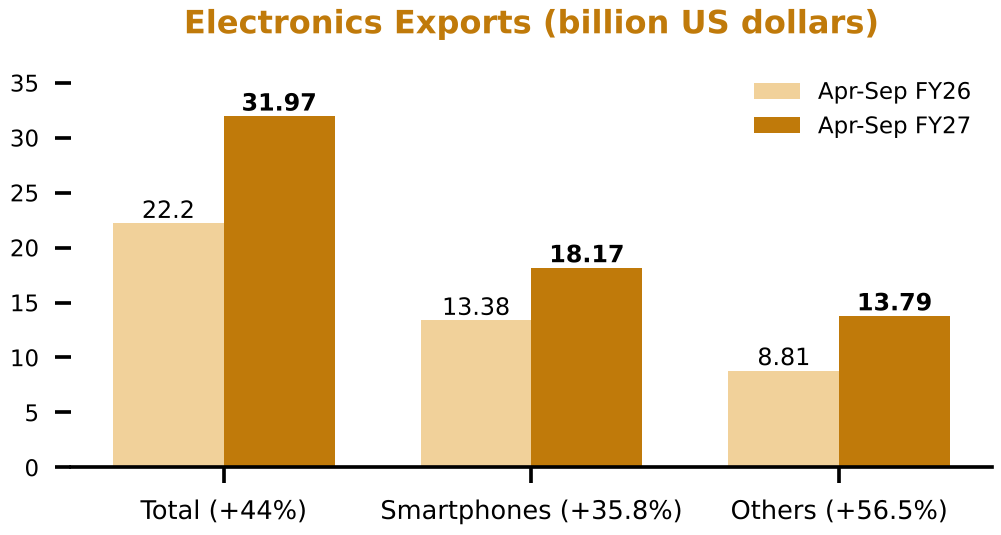
India's electronics exports grew 44% in April-September 2026, and products other than smartphones (like circuit boards and memory chips) are growing even faster. Government data released on 17 November 2026 show electronics exports rose 44% to 31.97 billion dollars in April-September FY 2026-27, from 22.20 billion dollars a year earlier. Smartphone exports rose 35.8% to 18.17 billion dollars, but their share fell from 60.3% to 56.8% because other items grew faster. Non-smartphone exports jumped 56.5% to 13.79 billion dollars. Mounted printed circuit boards (PCBs) and memory chips showed huge jumps, with Singapore, China, Hong Kong and Malaysia as key buyers.
Mounted PCBs: 2.10 billion dollars; memory ICs: 562 million dollars
Electronics is among India's fastest-growing export groups
Way forward
Deepen the component base, build design skills and keep logistics and tariff policies stable to attract global firms.
Concept
PLI (Production Linked Incentive, 2020): cash incentive linked to extra sales; large-scale electronics PLI drove mobile phone making. ECMS (Electronics Component Manufacturing Scheme, 2025): supports making parts like PCBs and displays inside India. India Semiconductor Mission (2021): supports chip fabs and assembly/testing (ATMP/OSAT) units. Exam angle: Prelims: PLI, ECMS, ISM launch years. Mains: moving from assembly to components and design for real value addition.
Grouped bar chart of electronics exports rising from 22.20 to 31.97 billion dollars, with smartphone and non-smartphone splits — StudyForGS
16. Surveillance Pricing: Same Item, Different Price
ECONOMYUPSC: Prelims + Mains GS3
Syllabus linkage
GS3 Economy - consumer protection, digital economy; GS2 data privacy. Mains: ethics of algorithms.
Context
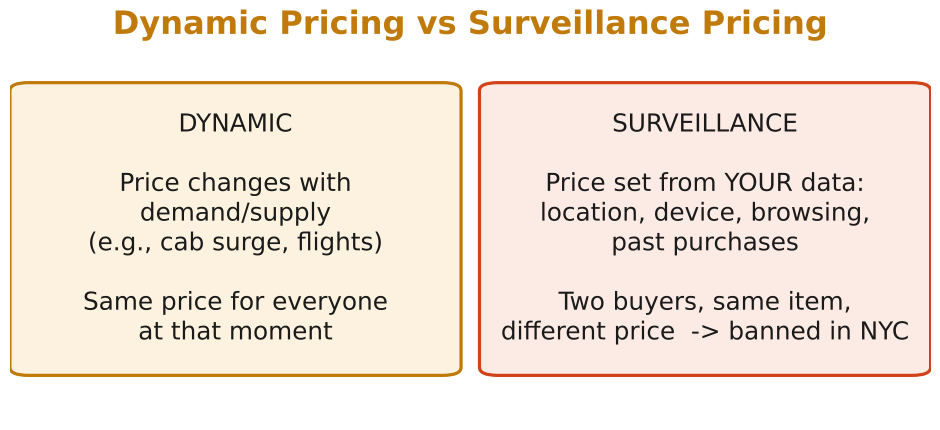
'Surveillance pricing' means a company uses your personal data (location, browsing, past buying) to show you a different price than someone else for the same thing; New York City has voted to ban it. The New York City Council passed a bill on 12 November 2026 banning surveillance pricing in consumer sales; it will take effect a year after becoming law. Surveillance pricing uses personal data and algorithms to set an individual price. It is different from dynamic pricing, which changes prices for everyone based on demand (for example, cab surge fares). Genuine discounts like loyalty programmes or senior-citizen offers are still allowed. The explainer raised the question for India, where apps collect huge amounts of user data.
Key facts
NYC Council bill passed 12 Nov 2026; effect one year after it becomes law
Surveillance pricing = personalised price from personal data
Dynamic pricing = same price for all at a moment, changing with demand
Loyalty and group discounts (seniors, veterans, teachers) remain allowed
India: DPDP Act 2023 and Consumer Protection Act 2019 are the relevant laws
Way forward
India can require platforms to disclose when prices are personalised and let the CCPA audit pricing algorithms.
Concept
DPDP Act 2023 (Digital Personal Data Protection): needs consent for using personal data; Data Protection Board decides complaints; DPDP Rules notified 2025. Consumer Protection Act 2019: created the Central Consumer Protection Authority (CCPA); 'dark patterns' guidelines (2023) ban tricks like drip pricing and false urgency. Price discrimination: charging different buyers different prices for the same good; economists call perfect personalised pricing 'first-degree' discrimination. Exam angle: Prelims: CCPA, DPDP Act, dark patterns. Mains: should India regulate algorithmic pricing? Balancing innovation, privacy and fairness.
Comparison diagram of dynamic pricing versus surveillance pricing — StudyForGS
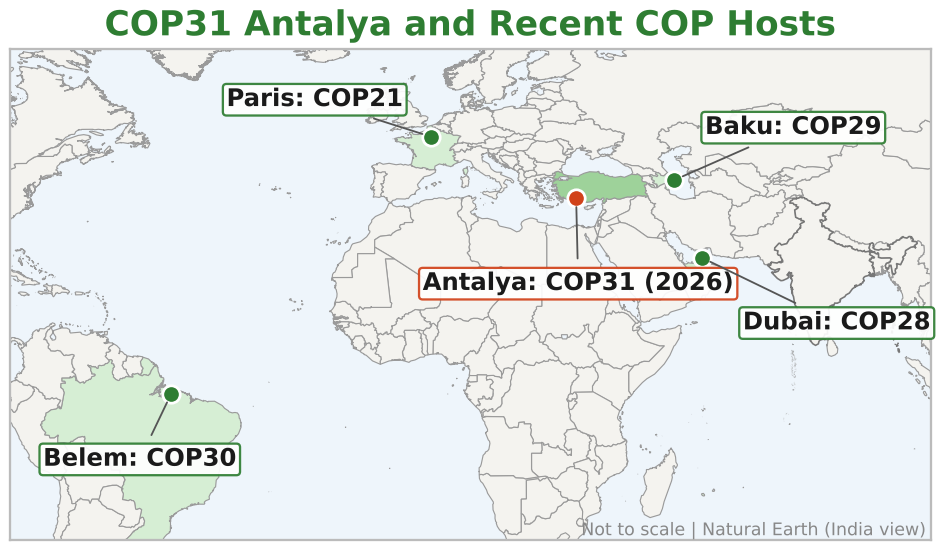
At the UN climate summit COP31 in Turkiye, the latest draft deal removed all mention of phasing out fossil fuels (coal, oil, gas) and of net-zero dates, showing deep divisions among countries. COP31 is being held in Antalya, Turkiye, and was officially due to end on 20 November 2026. The first draft asked for 'accelerated action to phase out fossil fuels', but the revised cover text of 19 November removed every reference to fossil fuels and net-zero dates; the text shrank from 144 to 80 paragraphs. The European Union led the push for a phase-out roadmap, oil producers opposed it, and big consumers like India and China were cautious, citing energy security. A firm 120-billion-dollar adaptation finance goal was also dropped, though a broad pledge to triple adaptation finance survived.
Key facts
Venue: Antalya, Turkiye; scheduled end 20 Nov 2026
Fossil fuels = nearly three-quarters of GHG emissions, over 80% of energy
Proposal to phase out unilateral trade measures like the EU's CBAM by 2027 was removed
Goal: universal early warning systems by 2027
Way forward
India should keep pushing finance and technology transfer for developing countries while speeding its own renewable and efficiency targets.
Concept
UNFCCC (1992, Rio): the COP is its yearly meeting; Paris Agreement (COP21, 2015) aims to keep warming well below 2 C, pursuing 1.5 C. COP28 (Dubai, 2023) first agreed on 'transitioning away from fossil fuels'; India prefers 'phase-down' of coal language (COP26 Glasgow). CBAM (Carbon Border Adjustment Mechanism): EU tax on carbon content of imports like steel and aluminium; India calls it a unilateral trade barrier. Exam angle: Prelims: COP venues (COP29 Baku, COP30 Belem, COP31 Antalya), CBAM, NCQG. Mains: India's stand on equity and CBDR-RC (common but differentiated responsibilities) vs pressure to phase out fossil fuels.
World map marking Antalya as COP31 host along with Paris, Dubai, Baku and Belem as earlier COP hosts — StudyForGS
18. PAC Calls Green India Mission a 'Total Failure'
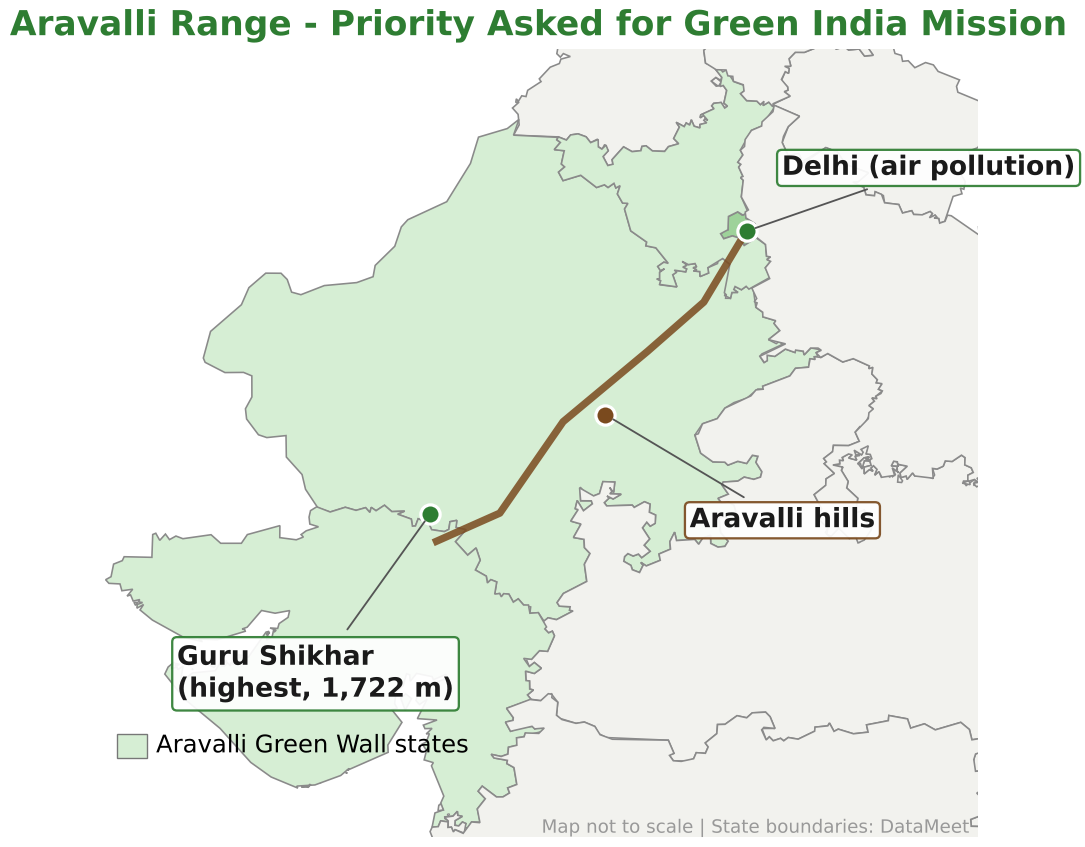
Parliament's Public Accounts Committee said the 2014 Green India Mission, meant to increase and improve forests, has achieved almost nothing in 10 years. After hearing the Environment Ministry on 19 November 2026 on a CAG performance audit, PAC chairman K.C. Venugopal called the Green India Mission (GIM) 'a total failure' and said 'nothing has happened in this mission over the last 10 years'. Members wanted the Aravalli range, important for Delhi's air, to be a top priority. The CAG audit earlier this year had found very large shortfalls against forest-cover targets. The Ministry promised new guidelines in one to two months, but the committee said it was 'totally dissatisfied'.
Key facts
GIM launched Feb 2014; one of 8 missions of NAPCC (2008)
Aim: protect, restore and increase forest cover; respond to climate change
PAC chairman: K.C. Venugopal; review based on a CAG audit (Report No. 4 of 2026)
PAC wants focus on Aravalli restoration (linked to Delhi pollution)
Ministry to finalise new guidelines in 1-2 months
Way forward
Measure tree survival and canopy, not just saplings planted; involve local communities and converge GIM with CAMPA and MGNREGA funds.
Concept
PAC (Public Accounts Committee): examines CAG audit reports on government spending; 22 members (15 LS + 7 RS); chairman by convention from the Opposition since 1967. NAPCC (2008) 8 missions: Solar, Enhanced Energy Efficiency, Sustainable Habitat, Water, Himalayan Ecosystem, Green India, Sustainable Agriculture, Strategic Knowledge. Aravalli Green Wall Project (2025): a 5-km wide green belt along the Aravalli range in Gujarat, Rajasthan, Haryana and Delhi. Exam angle: Prelims: PAC composition and chairman convention, NAPCC missions. Mains: why plantation drives fail - poor survival, monocultures, weak community role.
Map of Gujarat, Rajasthan, Haryana and Delhi showing the Aravalli range that the committee wants prioritised — StudyForGS
19. New PUC Validity Rules Linked to BS Norms
ENVIRONMENTUPSC: Prelims + Mains GS3
Syllabus linkage
GS3 Environment - air pollution; GS2 government policies. Prelims: Bharat Stage norms, CMVR.
Context
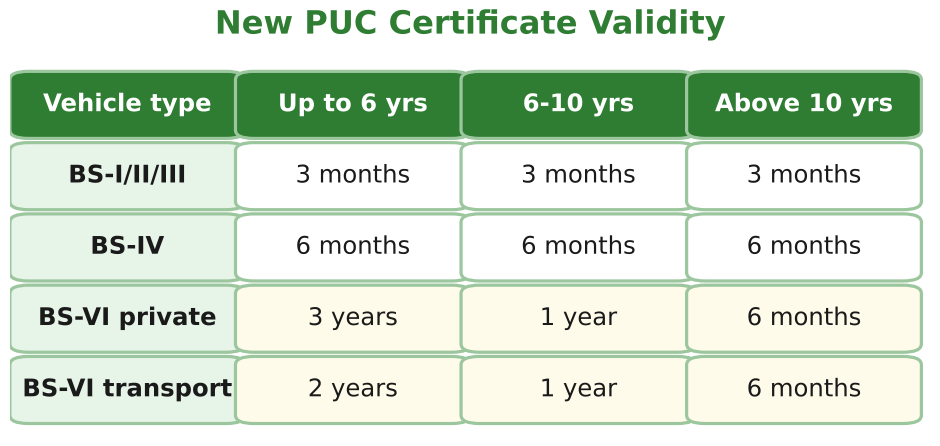
The pollution-check certificate (PUC) will now be valid for different periods depending on how old a vehicle is and which emission standard it meets; new BS-VI cars get longer validity. The Ministry of Road Transport and Highways amended Rule 115(7) of the Central Motor Vehicles Rules, 1989, to link Pollution Under Control (PUC) certificate validity to a vehicle's emission norm and age. BS-I to BS-III vehicles: 3 months; BS-IV: 6 months. BS-VI private (non-transport) vehicles: 3 years if up to 6 years old, 1 year if 6-10 years old, 6 months if older. BS-VI transport vehicles: 2 years, 1 year and 6 months for the same age groups. Existing certificates switch to the new validity at the first renewal.
Key facts
Rule 115(7), CMVR 1989 amended (announced 19 Nov 2026)
Renewal within 10 days before expiry counts from the old expiry date
Way forward
Digitise PUC testing with tamper-proof data on VAHAN, and use remote sensing to catch high-polluting vehicles on roads.
Concept
Bharat Stage (BS) norms: India's vehicle emission standards based on Euro norms; set by the Centre; India jumped from BS-IV to BS-VI in April 2020. BS-VI limits sulphur in fuel to 10 ppm and sharply cuts NOx and particulate matter. Older vehicles pollute more, so they need more frequent checks; the Vehicle Scrappage Policy (2021) encourages replacing old vehicles. Exam angle: Prelims: when BS-VI started, which Act/Rules govern PUC (Motor Vehicles Act 1988, CMVR 1989). Mains: vehicle emissions and urban air quality; enforcement gaps at PUC centres.
Table of new PUC certificate validity by Bharat Stage emission norm and vehicle age — StudyForGS
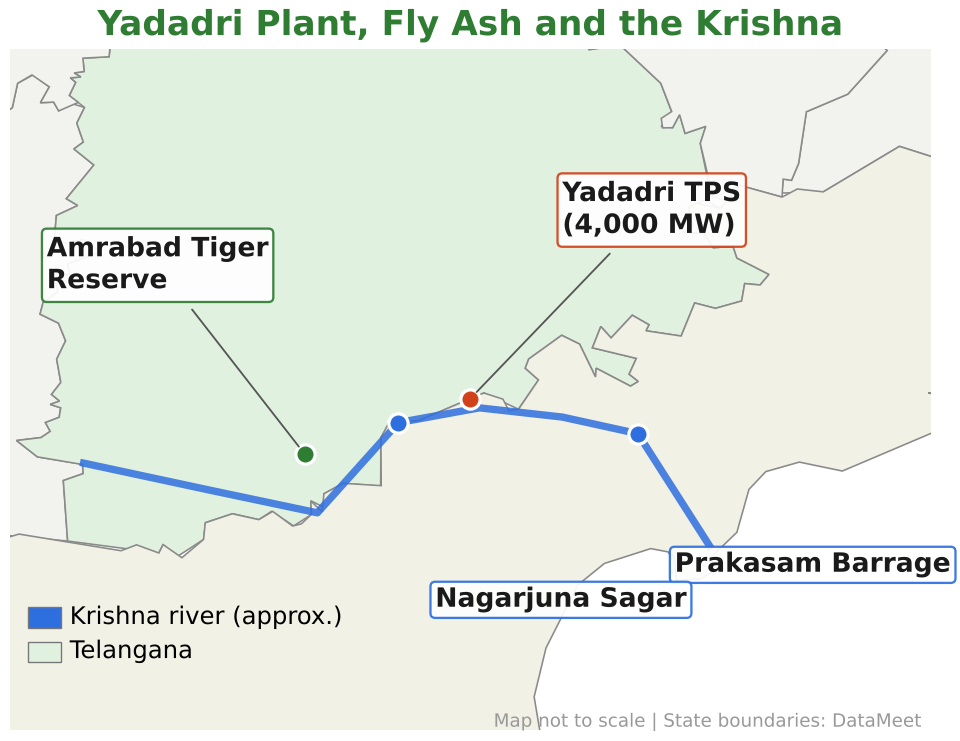
Ash-filled waste water from a big new coal power plant in Telangana is reportedly flowing into a stream that joins the Krishna river, hurting fishers, farmers and animals. The Yadadri Thermal Power Station (4,000 MW, five 800 MW units) in Damaracherla mandal of Nalgonda district, Telangana, is run by TG Genco. Residents say ash slurry is being released into the Thungapahad stream, which flows into the Krishna. In June 2026 the Telangana Pollution Control Board issued a show-cause notice after finding the Ash Water Recovery System not working and no effluent treatment plant. Fishers report their daily catch has crashed, and doctors report more skin and breathing problems. The plant's environmental clearance was earlier suspended by the NGT (2022) and granted again in 2024.
Key facts
Capacity 4,000 MW (5 x 800 MW); cost about Rs 36,000 crore
Ash generation: about 10,913 tonnes per day at 85% load
Stream: Thungapahad (Annameru) -> Krishna river
Show-cause notice by Telangana PCB, June 2026
Close to Amrabad Tiger Reserve; downstream Andhra villages were not heard
Way forward
Repair the ash water system, set up effluent plants, clean the stream, pay compensation and include downstream villages in future hearings.
Concept
Fly ash = fine powder left after burning coal; contains silica, alumina and heavy metals; can be used in cement, bricks and roads. Fly Ash Utilisation Notification 2021: plants must use 100% of ash; fines under the 'polluter pays' principle. EIA Notification 2006: big projects need prior environmental clearance and a public hearing; NGT (2010) hears environment cases. Exam angle: Prelims: fly ash rules, EIA steps, Krishna tributaries. Mains: weak post-clearance monitoring; inter-state impact of pollution.
Map of Telangana and Andhra Pradesh showing Yadadri thermal plant, the Krishna river, Nagarjuna Sagar, Prakasam Barrage and Amrabad Tiger Reserve — StudyForGS
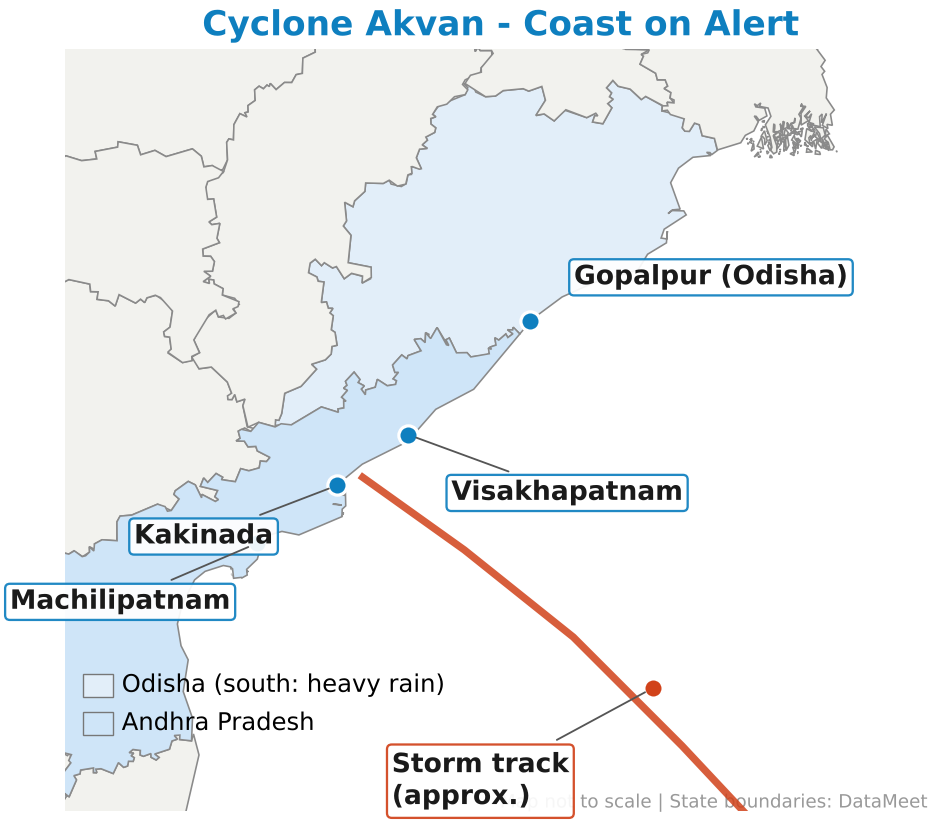
Severe Cyclonic Storm Akvan from the Bay of Bengal was crossing the north Andhra Pradesh coast on 20 November, bringing heavy rain to Andhra Pradesh and south Odisha. A low-pressure area over the southeast Bay of Bengal (13 November) grew into Severe Cyclonic Storm Akvan. IMD expected it to cross the north Andhra Pradesh coast on 20 November 2026, with strong winds and heavy to very heavy rain in coastal Andhra Pradesh and south Odisha. Odisha and Andhra Pradesh moved people to cyclone shelters and deployed NDRF and SDRF teams. Akvan is the third cyclonic storm over the Bay of Bengal in this post-monsoon season.
Key facts
Category: Severe Cyclonic Storm (winds 89-117 km/h)
Expected landfall: north Andhra Pradesh coast, 20 Nov 2026
Heavy rain also in south Odisha (Ganjam, Gajapati districts)
Third Bay of Bengal cyclonic storm of the post-monsoon season
NDRF/SDRF deployed; red alerts in coastal districts
Way forward
Keep strengthening early warnings, shelters and mangrove belts; plan quick restoration of power and crops after landfall.
Concept
Tropical cyclones need warm sea water (above about 26.5 C), Coriolis force, moist air and low wind shear; Bay of Bengal sees more cyclones than the Arabian Sea. Names are given by the WMO/ESCAP Panel on Tropical Cyclones (13 countries incl. India) from a fixed list; IMD New Delhi is the Regional Specialised Meteorological Centre. Post-monsoon (Oct-Dec) is the main cyclone season for India's east coast because of the retreating monsoon. Exam angle: Prelims: IMD categories (depression to super cyclone), who names cyclones, why the Bay is more prone. Mains: India's 'zero casualty' cyclone approach (Odisha model) and early warning.
Map of the Andhra Pradesh and Odisha coast showing the approximate track of Cyclone Akvan and key coastal towns — StudyForGS
22. Purana Qila: Stage for the SCO Forum
ART & CULTUREUPSC: Prelims + Mains GS1
Syllabus linkage
GS1 Art and Culture - architecture, medieval history; Prelims: monuments and builders.
Context
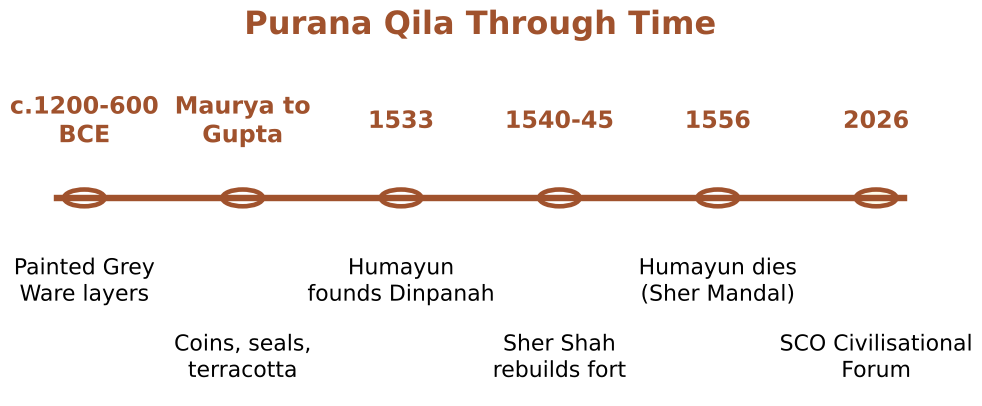
The SCO cultural forum is being held at Purana Qila in Delhi, an old fort linked by tradition to Indraprastha of the Mahabharata and later rebuilt by Humayun and Sher Shah Suri. The first SCO Civilisational Dialogue Forum opened at Purana Qila (Old Fort), New Delhi, on 20 November 2026. The exhibition 'ASTITVA - The Essence of Our Existence' shows Delhi's archaeology from about 1200 BCE to 1200 CE, and a pavilion displays a rare 18th-century Mahabharata scroll called 'Anant'. Purana Qila was built on a mound that tradition links with Indraprastha, the Pandava capital. ASI excavations here have found layers from the Painted Grey Ware period through Maurya, Sunga, Kushan, Gupta, Rajput, Sultanate and Mughal times.
Key facts
Humayun began the city 'Dinpanah' here in 1533
Sher Shah Suri took Delhi in 1540 and rebuilt the fort (Shergarh)
Qila-i-Kuhna Mosque (1541) by Sher Shah; Sher Mandal is linked to Humayun's fatal fall (1556)
ASI digs (B.B. Lal 1954-55, 1969-73; later 2013-14, 2017-18, 2022-23) found Painted Grey Ware
Exhibition 'ASTITVA' covers about 1200 BCE - 1200 CE
Way forward
Use such forums to showcase India's archaeology and protect monuments through ASI-community partnerships.
Concept
Painted Grey Ware (PGW) culture (about 1200-600 BCE): grey pottery with black designs in the Ganga-Yamuna doab, often linked with the later Vedic age and Mahabharata sites (Hastinapur, Indraprastha). Sher Shah Suri (Sur dynasty): introduced the silver 'rupiya', rebuilt the Grand Trunk Road (Sadak-e-Azam) and improved land revenue measurement. Humayun lost his empire to Sher Shah at Chausa (1539) and Kannauj/Bilgram (1540), and regained it in 1555. Exam angle: Prelims: who built Qila-i-Kuhna mosque, Dinpanah, battles of Chausa and Kannauj, PGW culture. Mains: monuments as tools of cultural diplomacy.
Timeline of Purana Qila from Painted Grey Ware layers to Humayun, Sher Shah Suri and the 2026 SCO forum — StudyForGS
23. Shah: Kashmir Free of Local Terrorists
DEFENCEUPSC: Prelims + Mains GS3
Syllabus linkage
GS3 Internal security - terrorism, role of agencies, border areas; Prelims: NIA, UAPA, MAC.
Context
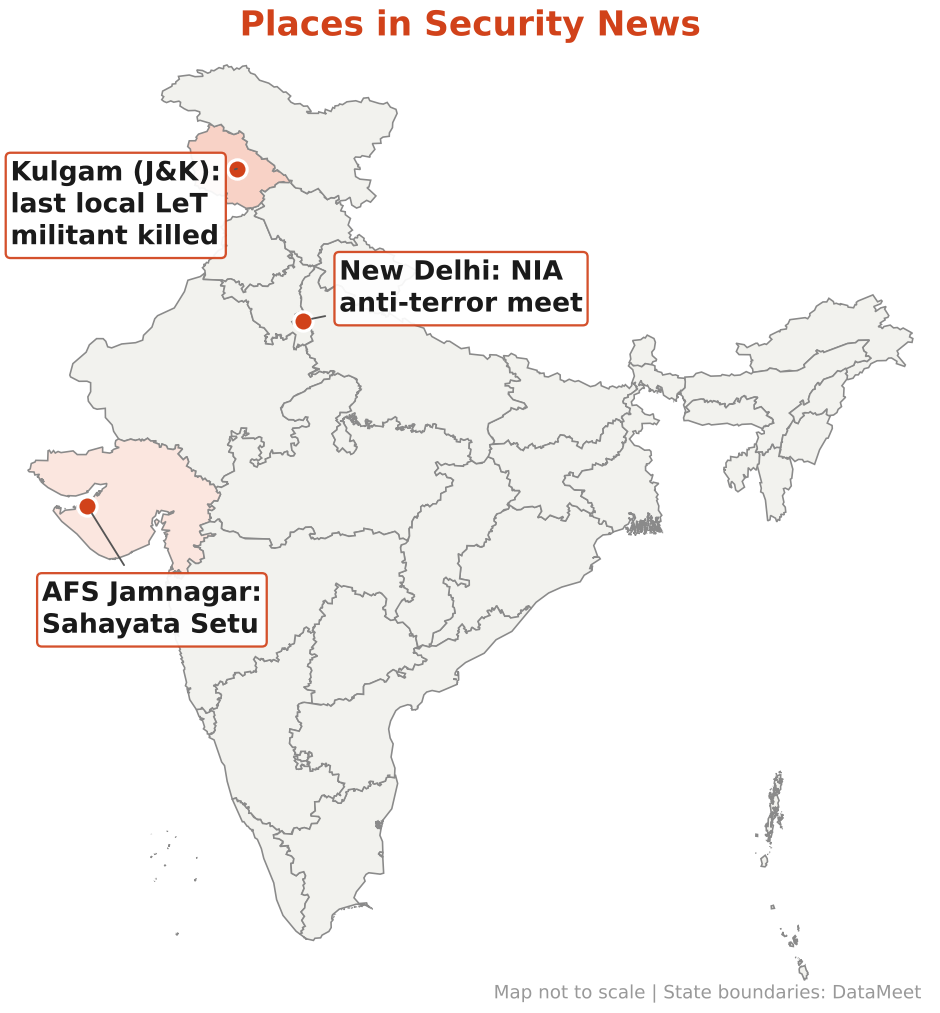
At the NIA's anti-terror conference, Home Minister Amit Shah said that, for the first time in about 35 years, there are no locally recruited terrorists active in Kashmir. Amit Shah inaugurated the two-day Anti-Terrorism Conference organised by the National Investigation Agency (NIA) in New Delhi on 19 November 2026. He said Kashmir is now free of locally recruited terrorists after security forces killed Lashkar-e-Taiba militant Lateef Bhat (bounty Rs 15 lakh) in a Kulgam encounter. He said 303 fugitives have been brought back to India from 36 countries since 2019, and that the Multi-Agency Centre is now tracking emerging radicalisation hotspots. A uniform counter-terror approach down to every police station was announced, and the NIA released a publication called 'Fail-Safe Investigation'.
Key facts
Conference by NIA, New Delhi, 19-20 Nov 2026
Claim: no locally recruited terrorists in Kashmir for the first time in about 35 years
303 fugitives brought back from 36 countries since 2019
Multi-Agency Centre (MAC) tracking radicalisation hotspots
Sessions: foreign evidence, digital forensics, hybrid threats, countering radicalisation
Way forward
Keep pressure on cross-border infiltration, focus on youth outreach and de-radicalisation, and speed up terror trials.
Concept
NIA: set up under the NIA Act 2008 after the 26/11 Mumbai attacks; can probe terror cases anywhere in India without state permission (Scheduled offences). Multi-Agency Centre (MAC): set up under the Intelligence Bureau in 2001 after the Kargil Review Committee to share intelligence among agencies; state-level units are SMACs. UAPA 1967 (Unlawful Activities Prevention Act): main anti-terror law; 2019 amendment allows designating individuals as terrorists. Exam angle: Prelims: NIA Act year, MAC under which body, UAPA 2019 amendment, NATGRID. Mains: shift from 'need to know' to 'duty to share'; de-radicalisation and foreign terror proxies.
India map marking Kulgam in Jammu and Kashmir, New Delhi and Air Force Station Jamnagar — StudyForGS
24. Harimau Shakti-VI Begins in Malaysia
DEFENCEUPSC: Prelims + Mains GS3
Syllabus linkage
GS3 Security - defence cooperation; GS2 IR - Act East Policy. Prelims: exercises and partners.
Context
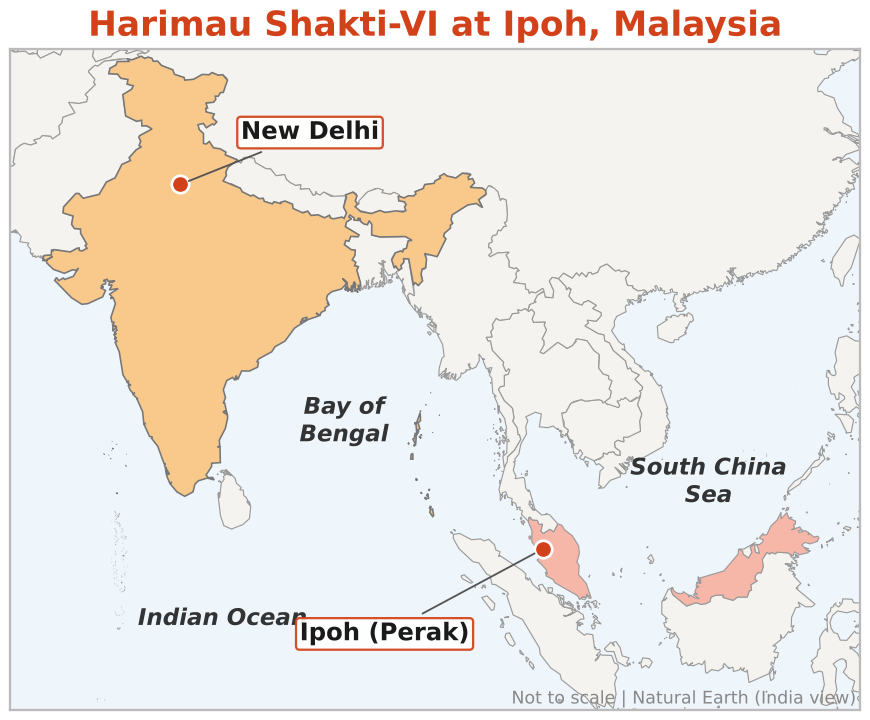
Indian and Malaysian soldiers started their sixth joint exercise in Malaysia to practise fighting terrorists in jungle and semi-urban areas. The 6th edition of India-Malaysia joint military exercise Harimau Shakti began at Ipoh, Malaysia, and runs from 19 to 30 November 2026. About 120 soldiers from each side take part. It focuses on sub-conventional (counter-terror) operations under Chapter VII of the UN Charter in jungle and semi-urban terrain. Drills include joint command posts, raids, cordon-and-search, combat engineering, and the use of drones and counter-drone systems. The exercise is held alternately in India and Malaysia.
Key facts
6th edition, Ipoh (Perak), Malaysia, 19-30 Nov 2026
About 120 personnel from each army
Theme: counter-terrorism under UN Chapter VII mandate; jungle/semi-urban terrain
Drones and counter-UAS used
'Harimau' means tiger in Malay
Way forward
Expand to tri-service drills and defence-industry cooperation (e.g., Tejas, BrahMos interest from ASEAN partners).
Concept
Chapter VII, UN Charter: allows the Security Council to authorise force to restore peace (peace enforcement); Chapter VI covers peaceful settlement. Act East Policy (2014, upgraded from Look East 1991): India's push for closer ties with Southeast Asia; Malaysia is a Comprehensive Strategic Partner (2024). Other India-Malaysia exercises: Samudra Laksamana (navy), Udara Shakti (air force). Exam angle: Prelims: match exercise-partner (Harimau Shakti-Malaysia, Garuda Shakti-Indonesia, Maitree-Thailand, Vinbax-Vietnam). Mains: defence diplomacy in India's Indo-Pacific strategy.
Map of South and Southeast Asia showing India and Malaysia with Ipoh marked as the exercise venue — StudyForGS
25. Sahayata Setu 2026: IAF HADR Exercise
DEFENCEUPSC: Prelims + Mains GS3
Syllabus linkage
GS3 Disaster management, security; GS2 IR - India as a net security provider.
Context
The Indian Air Force held a multi-nation disaster relief exercise at Jamnagar to show that India can be the first helper when disasters strike in the Indian Ocean region. Sahayata Setu 2026, a multinational Humanitarian Assistance and Disaster Relief (HADR) exercise, was held at Air Force Station Jamnagar (Gujarat) from 17 to 19 November 2026, under HQ Integrated Defence Staff and HQ South Western Air Command. Chief of Defence Staff Gen N.S. Raja Subramani was the chief guest. It had a seminar, a table-top exercise, a static display and a multi-agency capability demonstration across land, air and sea. A Quad HADR Working Group meeting was held alongside.
Key facts
Venue: AFS Jamnagar, Gujarat; 17-19 Nov 2026
Organised under HQ IDS and South Western Air Command
Chief guest: CDS Gen N.S. Raja Subramani
Quad HADR Working Group meeting held alongside
Message: India as first responder in the Indo-Pacific and IOR
Way forward
Pre-position relief stocks in the IOR, train jointly with neighbours and keep Quad HADR cooperation practical.
Concept
HADR = Humanitarian Assistance and Disaster Relief - using military planes, ships and teams to deliver aid after disasters (e.g., Operation Brahma, Myanmar 2025). SAGAR (2015) / MAHASAGAR (2025): India's vision of security and growth for all in the Indian Ocean region. NDMA (Disaster Management Act 2005) leads civil response; the armed forces support when asked. Exam angle: Prelims: India's HADR operations (Dost, Maitri, Brahma, Sadbhav), MAHASAGAR. Mains: India as 'first responder' and its soft-power value.
Data point of the day
27.4%
OPEC share in India's crude imports, Apr-Oct 2026 Down from 38.5% a year earlier as India bought more from Russia and other regions; import bill rose 53.5% to 111 billion dollars.
Prelims rapid-fire
IFFI 2026: 57th International Film Festival of India opens in Goa (20-28 Nov); theme 'Stories Without Borders'; Country of Honour Spain, Partner Country Russia.
Peace Prize: Indira Gandhi Prize for Peace, Disarmament and Development (2025) given to Graca Machel of Mozambique on 19 Nov - the only woman to have been First Lady of two countries (Mozambique, South Africa).
20 Nov: World Children's Day - marks adoption of the UN Convention on the Rights of the Child (1989); India ratified it in 1992.
20 Nov: Africa Industrialisation Day; 2026 theme 'Financing Industrialization for Inclusive and Sustainable Development'.
Tipu Sultan: Born 20 Nov 1750; ruler of Mysore known for iron-cased Mysorean rockets in the Anglo-Mysore Wars; died at Srirangapatna, 1799.
Rafale: A foreign publication put the IAF's active Rafale fleet at 32; officials disputed the claim (India bought 36 in 2016).
Hockey: India beat Malaysia 4-1 in the Women's Asian Champions Trophy at Bhopal; debutant Puja Sahoo was Player of the Match.
Badminton: 19-year-old Rakshitha Ramraj beat Olympic champion Chen Yufei at the Hong Kong Open.
CBIC: Directorate General of Taxpayer Services (CBIC) entered the World Book of Records for the largest government awareness drive on constitutional values and indirect taxes.
Labour: Labour Ministry held a two-day Chintan Shivir of State labour ministers on Labour Code implementation and unorganised-worker social security.
Mains practice question
Q. Prior consent of the Gram Sabha is the cornerstone of constitutional protection for Scheduled Areas. In the light of the Supreme Court's recent ruling on land acquisition for mining in Odisha, examine how the LARR Act, 2013 and PESA, 1996 balance development with tribal rights. (250 words)
Hint / approach
Intro: SC ruling of 18 Nov 2026 (Section 41(3) mandatory). Body: Fifth Schedule and PESA; LARR consent (80%/70%) and SIA; Niyamgiri precedent; gaps - token consent, captured SIA, weak Gram Sabhas. Way forward: free, prior, informed consent, independent SIA, capacity of Gram Sabhas. Conclude on participatory development.
📌 One-line revision: Section 41(3) LARR = Gram Sabha consent mandatory; Shenzhen = first US-China-Russia summit; ICJ: Gambia vs Myanmar = genocide; EPFO SWP + 10% min balance; OPEC share 27.4%; COP31 Antalya dropped fossil phase-out.