Thursday, 19 November 2026 · IST · National & International · 30 items
The first-ever three-way summit of the US, China and Russia leaders in Shenzhen dominates world news, while India told a UN Security Council meeting that river sharing cannot ignore bilateral ties. At home, VB-G RAM G complaint rules set a 15-day deadline, India gets its first indigenous bird flu vaccine for chickens, and a Rs 1,976-crore deal will upgrade the Navy's Barak missiles.
Today at a glance — things to remember
VB-G RAM G grievance rules: complaints to be solved in 15 days, tracked online.
11 States/UTs now fully literate under ULLAS; Madhya Pradesh leads in adult learners.
India votes against UN death-penalty moratorium (133-33-16).
First US-China-Russia leaders' summit held in Shenzhen alongside APEC 2026.
India at UNSC Arria-formula meeting: river sharing cannot ignore bilateral ties.
India's first indigenous H5N1 vaccine for chickens to be dedicated on 20 November.
Climate Risk Index 2027: India among 10 worst hit (1996-2025), 78,000+ deaths.
Rs 1,976-crore deal with Israel Aerospace Industries to upgrade Navy's Barak systems.
Navy marks 50 years of long-range maritime reconnaissance (INAS 312 Albatross).
Fossil jaw of giant elephant Palaeoloxodon namadicus found in Narmada valley.
Detailed notes
1. Job Scheme Complaints: 15-Day Deadline
POLITYUPSC: Prelims + Mains GS2
Syllabus linkage
GS2 - Government policies, welfare schemes, mechanisms for redressal of grievances. Prelims: timelines and levels; Mains: accountability in welfare delivery.
Context
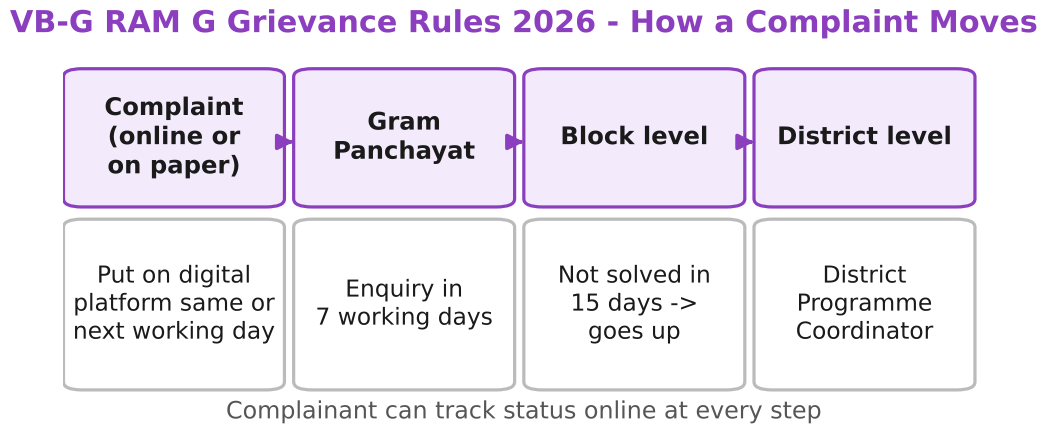
If a rural worker has a complaint under the new job-guarantee scheme (VB-G RAM G), officials must now solve it within 15 days, and the worker can track it online. The Ministry of Rural Development has put in place grievance redressal rules under the Viksit Bharat - Guarantee for Rozgar and Ajeevika Mission (Gramin), called VB-G RAM G. The rules were notified on 2 November 2026 and are now being rolled out as guidelines for handling complaints. Every complaint, whether given online or on paper, must be entered on a digital platform. An enquiry must finish in 7 working days and the complaint must be solved within 15 days. If it is not solved, it moves up to the next level.
Key facts
Rules notified 2 November 2026; draft rules were published on 22 May 2026.
Complaint resolution deadline: 15 days; enquiry: 7 working days.
Paper complaints must go on the digital platform the same day or the next working day.
Three levels: Gram Panchayat, Block and District; the District Programme Coordinator oversees the district level.
Complainants can track status and the action taken until final disposal.
Way forward
Train panchayat staff, keep offline help desks for those without phones, and publish complaint data so that social audits can use it.
Concept
VB-G RAM G Act, 2025: the new law for rural wage employment that has taken the place of the earlier MGNREGA framework; it promises paid work to rural households and links it with livelihood creation. Grievance redressal = a formal system where citizens can complain and get a time-bound answer. It is a key part of social accountability, along with social audits (public checking of works and spending by the Gram Sabha). Digital Public Infrastructure (DPI) = shared digital platforms (like Aadhaar, UPI) on which services are built; here it gives a permanent record from complaint to closure. Exam angle: Prelims can ask about the 15-day and 7-day timelines, the three levels, or which ministry notified the rules. Mains: role of grievance redressal and social audits in making welfare schemes accountable; digital tracking vs. the digital divide for poor workers.
VB-G RAM G complaint path: complaint, Gram Panchayat (enquiry in 7 working days), block (escalation after 15 days), District Programme Coordinator. — StudyForGS
2. 11 States/UTs Now 'Fully Literate'
POLITYUPSC: Prelims + Mains GS2
Syllabus linkage
GS2 - Education, government schemes for vulnerable sections; GS1 - Social empowerment. Prelims: ULLAS facts; Mains: adult literacy and human development.
Context
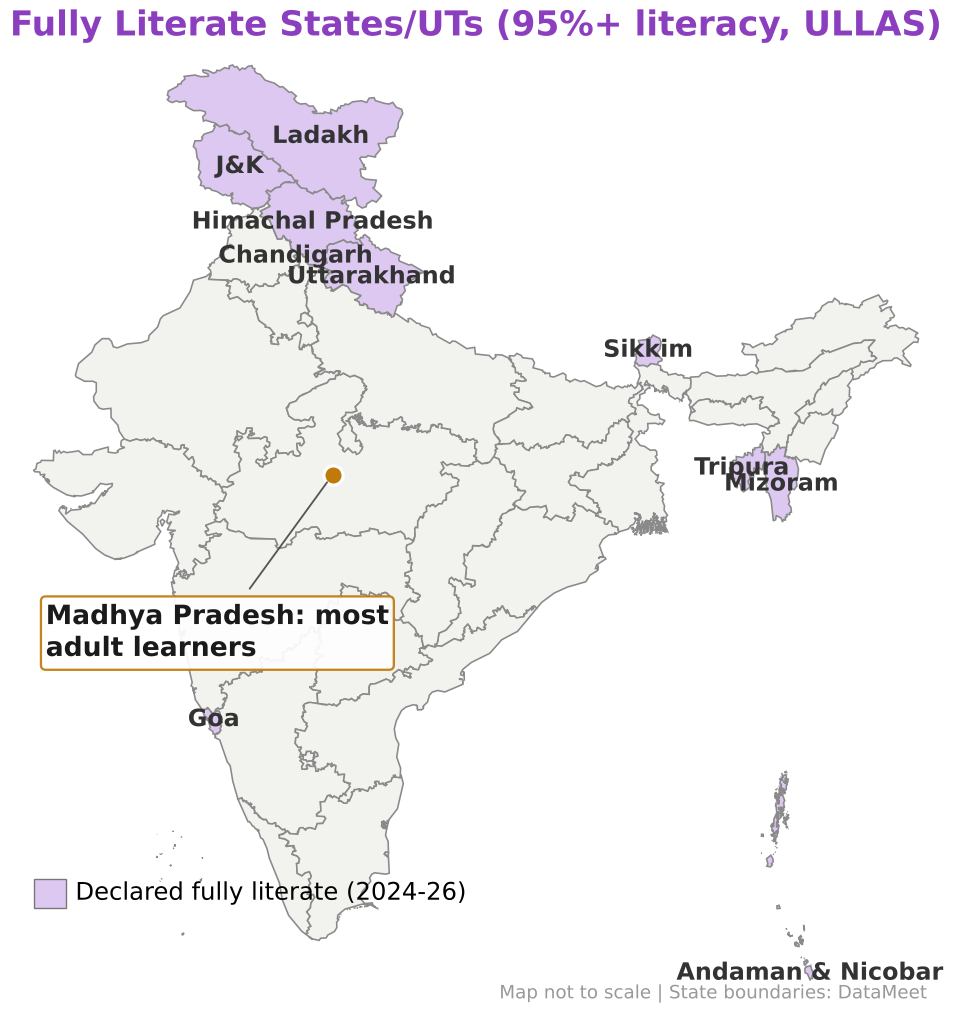
Eleven States and UTs now count as 'fully literate' (95% or more people can read, write and count), mainly thanks to the adult-literacy programme ULLAS. Madhya Pradesh has the most adult learners. Government data show that 11 States and Union Territories are now considered fully literate under ULLAS - Nav Bharat Saaksharta Karyakram. Earlier declarations covered Ladakh, Mizoram, Goa, Tripura, Himachal Pradesh, Chandigarh, Andaman and Nicobar Islands, Sikkim, Uttarakhand and Jammu and Kashmir. Madhya Pradesh leads in the number of adult learners enrolled. A State or UT with 95% literacy is treated as equal to full literacy.
Key facts
Full literacy benchmark: 95% literacy.
ULLAS target: 5 crore learners in 2022-27; about 4.03 crore registered so far.
Over 52 lakh volunteer teachers; more than 3.3 crore learners have taken the FLNAT test.
Outlay: Rs 1,037.90 crore for 2022-27; ULLAS app material in 27 languages.
Madhya Pradesh leads in adult learners.
Way forward
Move from basic literacy to digital and financial skills, and run independent checks so that 'full literacy' claims are reliable.
Concept
ULLAS (Understanding of Lifelong Learning for All in Society) = a Centrally Sponsored Scheme aligned with NEP 2020 for adults aged 15+ who missed school; motto 'Jan Jan Saakshar'. Literacy here = ability to read, write and compute with understanding, plus life skills like digital and financial literacy. FLNAT (Foundational Literacy and Numeracy Assessment Test) = the test that learners pass to be certified literate. Exam angle: Prelims: 95% benchmark, age group 15+, FLNAT, NEP 2020 link, list of fully literate States/UTs. Mains: why adult literacy matters for health, voting, financial inclusion and women's empowerment; quality vs. headline numbers.
India map shading States/UTs declared fully literate (Ladakh, J&K, Himachal, Uttarakhand, Chandigarh, Sikkim, Tripura, Mizoram, Goa, Andaman & Nicobar) and marking Madhya Pradesh as having the most adult learners. — StudyForGS
3. India Votes Against Death-Penalty Pause
POLITYUPSC: Prelims + Mains GS2
Syllabus linkage
GS2 - Judiciary, fundamental rights (Article 21), India and international bodies; GS4 - ethics of capital punishment. Prelims + Mains.
Context
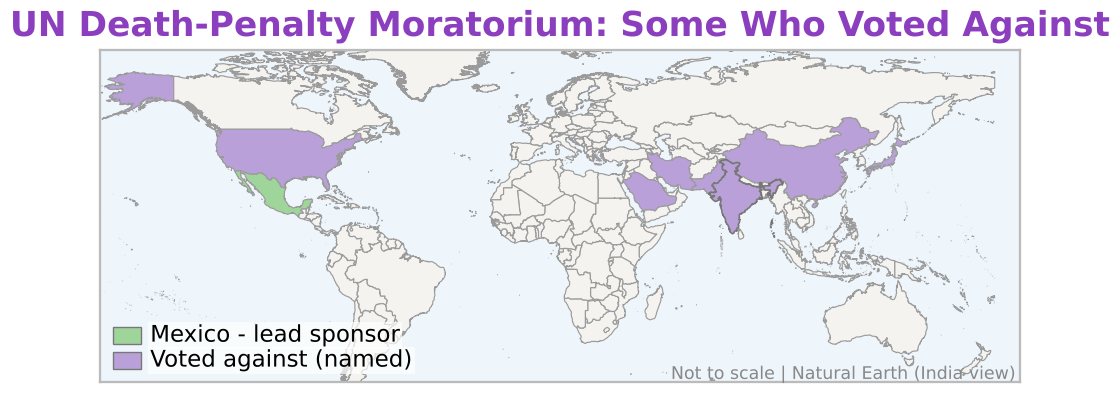
At the UN, India voted against a resolution asking all countries to stop executions for now. India says each country can decide its own punishment laws. The UN General Assembly's Third Committee voted on a Mexico-led draft that calls for a global moratorium (temporary stop) on executions. It was approved on 13 November with 133 votes for, 33 against and 16 abstentions. India voted against, along with the United States, China, Pakistan, Japan, Iran and Saudi Arabia. India said the death penalty is allowed under international law with limits, and objected to calling it 'state-inflicted death'. An editorial today argued that judges can make mistakes, so the risk of an irreversible error is a strong reason to rethink.
Key facts
Vote: 133 in favour, 33 against, 16 abstentions (13 November 2026).
Lead sponsor: Mexico; forum: UNGA Third Committee (social, humanitarian and human rights).
India also opposed similar resolutions in 2016, 2018 and 2024.
India cited Article 6 of the ICCPR, which regulates (not bans) the death penalty.
India's statement was made by First Secretary Bhavika Mangalanandan.
Way forward
Strengthen legal aid, mitigation investigation and sentencing guidelines so that the 'rarest of rare' test is applied consistently.
Concept
Rarest of rare doctrine (Bachan Singh case, 1980): the death penalty in India is given only in the rarest of rare cases, when life imprisonment is clearly not enough. Mercy powers: the President (Article 72) and the Governor (Article 161) can pardon or reduce a sentence; long unexplained delay in deciding mercy pleas can be a ground for commutation. ICCPR Second Optional Protocol (1989) aims at abolition of the death penalty; India is not a party to it. Exam angle: Prelims: Articles 72/161, ICCPR, which UNGA committee handles human rights, vote numbers. Mains: arguments for and against capital punishment, judicial fallibility, deterrence evidence, Law Commission's 262nd Report (2015) which suggested abolition except for terror cases.
World map shading named countries that voted against the death-penalty moratorium (India, US, China, Pakistan, Japan, Iran, Saudi Arabia) and lead sponsor Mexico. — StudyForGS
4. Police Reform: From Paper to Practice
POLITYUPSC: Prelims + Mains GS2
Syllabus linkage
GS2 - Role of police, separation of powers, governance; GS3 - internal security. Mains-heavy; Prelims on the Prakash Singh directives.
Context
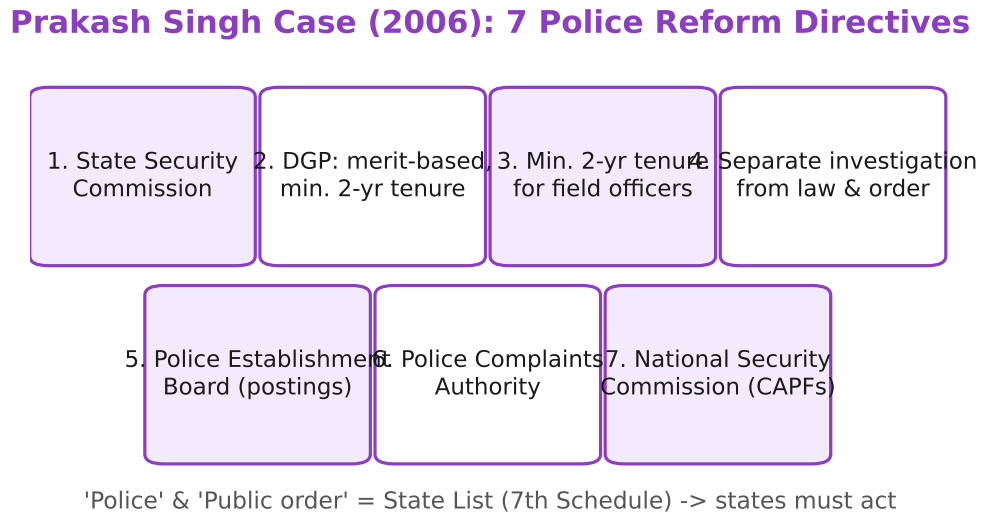
Twenty years after the Supreme Court ordered police reforms, most of its directions are still not fully followed. An opinion piece today asks states to actually put them into practice. An op-ed today argued that police reform in India has stayed mostly on paper. In the Prakash Singh case (2006) the Supreme Court gave seven directions to reduce political interference, give fixed tenure to officers and set up complaint bodies. Many states have passed new police laws but have diluted key parts, such as the independence of security commissions and complaint authorities. The article calls for real implementation rather than new announcements.
Key facts
Prakash Singh vs Union of India judgment: 22 September 2006.
Seven directions: State Security Commission, merit-based DGP with minimum 2-year tenure, fixed tenure for field officers, separate investigation and law-and-order wings, Police Establishment Board, Police Complaints Authority, National Security Commission.
Police and public order are State List subjects (Entries 1 and 2, List II).
Model Police Act, 2006 was drafted by the Soli Sorabjee Committee.
Most police forces still work under the Police Act of 1861.
Way forward
Set up truly independent complaint bodies, fill vacancies, and give investigators separate cadres with forensic support.
Concept
Police Complaints Authority = an independent body (State and district level) where citizens can complain against serious police misconduct. Separation of investigation from law and order = keeping detectives free from daily crowd-control duty so that cases are probed properly and faster. Federal angle: since police is a State subject, the Centre can only advise and fund (through modernisation schemes); states must act. Exam angle: Prelims: year of judgment, the seven directions, State List entries, 1861 Act. Mains: political interference, custodial violence, vacancies, training, and why reforms are slow; link with new criminal laws (BNS, BNSS, BSA).
Chart of the seven Prakash Singh (2006) police reform directions, noting that police and public order are State List subjects. — StudyForGS
5. PM SVANidhi Samman Awards 2026
POLITYUPSC: Prelims + Mains GS2
Syllabus linkage
GS2 - Welfare schemes for vulnerable sections; GS3 - financial inclusion. Prelims: loan amounts and features.
Context
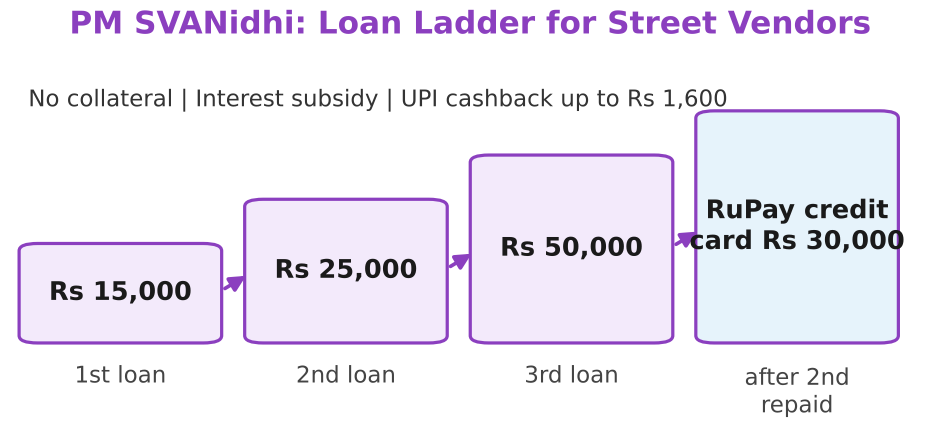
The government will give awards to cities, banks and others that helped street vendors the most under PM SVANidhi, a scheme that gives small loans without any security. The Ministry of Housing and Urban Affairs will hold the PM SVANidhi Samman Awards 2026 in New Delhi to honour good performers under the scheme. PM SVANidhi gives collateral-free working-capital loans to street vendors in three steps of Rs 15,000, Rs 25,000 and Rs 50,000. Vendors who repay the second loan can get a UPI-linked RuPay credit card with a limit up to Rs 30,000. The scheme also rewards digital payments with cashback.
Key facts
Launched June 2020 (COVID-19 period) as a Central Sector Scheme.
Run jointly by MoHUA and the Department of Financial Services.
Loans: Rs 15,000 -> Rs 25,000 -> Rs 50,000, with interest subsidy and credit guarantee.
Digital cashback up to Rs 1,600; RuPay credit card up to Rs 30,000.
'SVANidhi se Samriddhi' links vendors' families to 8 central welfare schemes.
Way forward
Use repayment records to graduate vendors to bigger formal loans and ensure vending zones are notified under the 2014 Act.
Concept
Central Sector Scheme = fully funded and run by the Centre (unlike a Centrally Sponsored Scheme, where states share cost). Street Vendors (Protection of Livelihood and Regulation of Street Vending) Act, 2014: gives vendors legal recognition through Town Vending Committees and vending certificates. Collateral-free loan = a loan without giving any asset as security; the credit guarantee protects banks if the vendor fails to repay. Exam angle: Prelims: launch year, loan steps, ministry, type of scheme, 2014 Act. Mains: informal sector, urban poverty, formal credit and digital footprint as tools of inclusion.
PM SVANidhi loan ladder: Rs 15,000, Rs 25,000 and Rs 50,000 loans, then a RuPay credit card up to Rs 30,000. — StudyForGS
6. US-China-Russia Leaders Meet in Shenzhen
IRUPSC: Prelims + Mains GS2
Syllabus linkage
GS2 - Effect of policies of developed countries on India's interests; global groupings. Prelims: APEC, Shenzhen; Mains: great-power politics and strategic autonomy.
Context
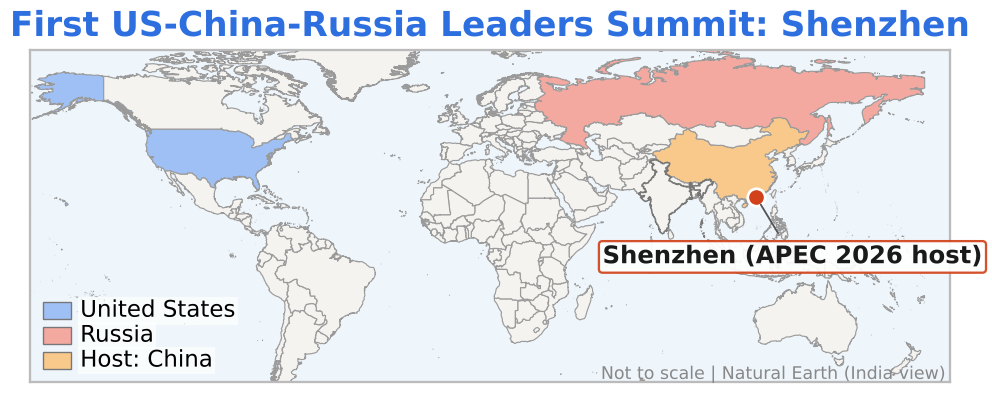
The leaders of the US, China and Russia are holding their first-ever three-way summit in Shenzhen, China, during the APEC meeting. What they agree on war, trade and AI will affect the whole world, including India. Chinese President Xi Jinping, Russian President Vladimir Putin and US President Donald Trump are meeting in Shenzhen, which is hosting the APEC summit in 2026. Ahead of the talks, Xi praised China's close ties with Russia. The agenda includes the Russia-Ukraine war, the US-Israeli war on Iran, nuclear weapons, trade and tariffs, and artificial intelligence. Reports say China wants to be seen as a co-director of the global order through this meeting.
Key facts
First three-way summit of US, China and Russia leaders; venue Shenzhen, Guangdong.
Held alongside APEC 2026, hosted by China.
Agenda: Ukraine war, Iran war, nuclear arms, trade, AI.
Xi hailed China-Russia ties before meeting Trump and Putin.
India is not an APEC member.
Way forward
India should deepen ties with all three, diversify energy sources, and use groupings like Quad, BRICS and SCO to protect its interests.
Concept
APEC (Asia-Pacific Economic Cooperation) = a forum of 21 Pacific Rim economies formed in 1989 to promote free trade; it works by consensus and non-binding commitments. India has applied but is not a member. Shenzhen = China's first Special Economic Zone (1980), a symbol of Deng Xiaoping's 'reform and opening up'. Strategic autonomy = India's policy of keeping freedom of choice by working with all powers without joining any military bloc. Exam angle: Prelims: APEC membership and founding year, Shenzhen SEZ, India's status. Mains: how a US-China-Russia understanding could affect India (Russia defence ties, China border, US partnership, oil prices due to Iran war).
World map shading host China, Russia and the United States, with Shenzhen marked as the APEC 2026 host city. — StudyForGS
7. Indus: India Links Water to Ties
IRUPSC: Prelims + Mains GS2
Syllabus linkage
GS2 - India and its neighbourhood, bilateral agreements; GS1 - river systems. Prelims: Indus rivers, treaty facts; Mains: water and security.
Context
At a UN Security Council meeting, India said sharing of river water cannot be separated from the overall relationship, meaning cross-border terrorism by Pakistan cannot be ignored. Pakistan objected strongly. At an informal UN Security Council 'Arria-formula' meeting on natural resources and conflict on 18 November, convened by Liberia, India's Permanent Representative Harish Parvathaneni defended India's position. India has kept the Indus Waters Treaty 'in abeyance' (on hold) since April 2025, after the Pahalgam terror attack. India said river sharing cannot ignore the state of bilateral ties and that the world has changed since 1960. Pakistan called India's move 'outlaw behaviour' in its reply.
Key facts
Indus Waters Treaty signed 19 September 1960 in Karachi; brokered by the World Bank.
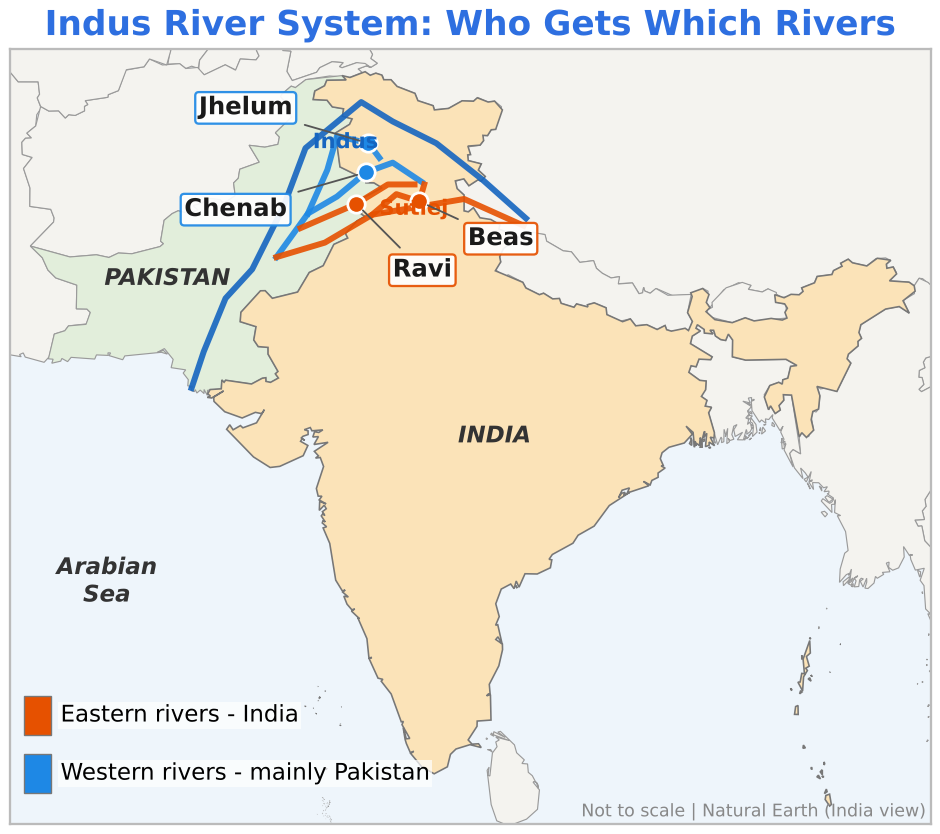
Eastern rivers (Ravi, Beas, Sutlej) mainly for India; Western rivers (Indus, Jhelum, Chenab) mainly for Pakistan.
Treaty in abeyance since April 2025 (after Pahalgam attack).
A Court of Arbitration award (31 August 2026) said the treaty remains in force; India rejects that process.
India also raised Pakistan's exploitation of natural resources at the meeting.
Way forward
India should speed up storage and canal projects on its share, keep its legal case strong, and link any normalisation to an end of cross-border terror.
Concept
Arria-formula meeting = an informal, flexible UNSC meeting (named after Venezuelan diplomat Diego Arria, 1992) where members hear views without formal decisions. Permanent Indus Commission = the treaty body with one commissioner from each side to share data and solve issues. Dispute steps in the treaty: 'question' (Commission) -> 'difference' (Neutral Expert) -> 'dispute' (Court of Arbitration). Exam angle: Prelims: which rivers go to whom, year and broker of the treaty, Arria-formula. Mains: can a water treaty be held in abeyance under international law; use of water as leverage vs humanitarian concerns; India's projects like Kishanganga and Ratle.
Map of the Indus river system: western rivers (Indus, Jhelum, Chenab) mainly for Pakistan and eastern rivers (Ravi, Beas, Sutlej) for India. — StudyForGS
📜 Asked before in the exam — previous-year question on this topic
BPSC Prelims 2025 (71st CCE)According to the Indus Waters Treaty, the three eastern rivers are allocated to India. Which of the following is not one of them?
Linked because this news is about the same topic. The answer is as per the official key of that year.
8. SCO Civilisational Dialogue at Purana Qila
IRUPSC: Prelims + Mains GS2
Syllabus linkage
GS2 - Regional groupings (SCO); GS1 - art and culture, soft power. Prelims: SCO facts, Purana Qila; Mains: cultural diplomacy.
Context
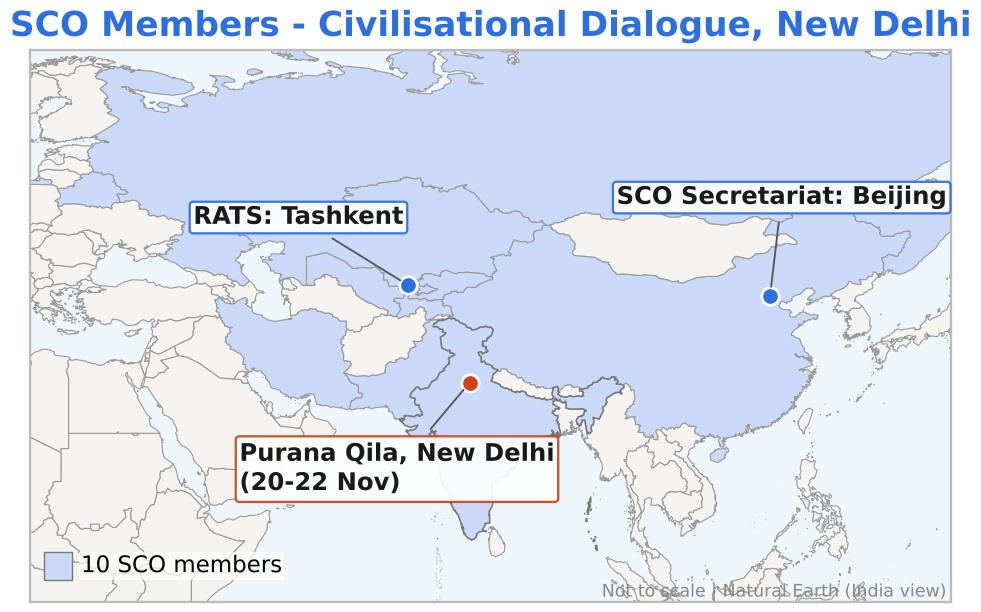
India is hosting the first SCO Civilisational Dialogue Forum in Delhi from 20 to 22 November, using the old fort Purana Qila to show 2,000 years of Delhi's history to visitors from member countries. India will host the first SCO Civilisational Dialogue Forum in New Delhi from 20 to 22 November 2026. Culture Minister Gajendra Singh Shekhawat said 15 countries have confirmed participation, and Pakistan's culture minister has also been invited. For the event, a cultural walk at Purana Qila will show layers of Delhi's history over about 2,000 years. The forum covers cultural expression, art and architecture, language and literature, and religious and philosophical traditions.
Key facts
Dates: 20-22 November 2026; venue: New Delhi (Purana Qila cultural walk).
15 countries confirmed, including China, Kazakhstan, Uzbekistan, Iran and Belarus.
Four themes: cultural expression, art and architecture, language and literature, religion and philosophy.
First edition of this forum within SCO.
Exhibitions and cultural performances planned besides talks.
Way forward
Use the forum to build people-to-people links, joint heritage projects and tourism with Central Asia.
Concept
SCO (Shanghai Cooperation Organisation) = founded 2001 in Shanghai; 10 members incl. India (full member 2017), Pakistan, Iran (2023) and Belarus (2024). HQ: Beijing; anti-terror body RATS: Tashkent. Purana Qila = 16th-century fort linked with Humayun's Dinpanah and Sher Shah Suri; excavations show settlement layers from the Mauryan period, and tradition links it with Indraprastha. Soft power = influence through culture, values and ideas rather than force or money. Exam angle: Prelims: SCO members, HQ, RATS location, Purana Qila builders. Mains: role of cultural diplomacy and civilisational links in India's foreign policy.
Map of the 10 SCO member countries marking Purana Qila in New Delhi (20-22 Nov), RATS in Tashkent and the SCO Secretariat in Beijing. — StudyForGS
9. India-Canada Eye Defence Pact
IRUPSC: Prelims + Mains GS2
Syllabus linkage
GS2 - Bilateral relations, Indian diaspora. Prelims: recent agreements; Mains: reset in India-Canada ties.
Context
After a few tense years, India and Canada are repairing ties. They are now working on a defence cooperation pact that could be signed during PM Modi's coming visit to Canada. India and Canada are discussing a defence cooperation agreement to be signed during PM Modi's visit to Canada. The two countries launched a Defence Dialogue in 2026 and signed a long-term uranium supply deal of about USD 2.6 billion. They have also started talks on a Comprehensive Economic Partnership Agreement (CEPA) and aim to take trade to USD 50 billion by 2030. Ties had fallen sharply in 2023-24 over allegations linked to Khalistani extremism.
Key facts
Defence pact under discussion for Modi's visit to Canada.
Inaugural India-Canada Defence Dialogue held in 2026.
Uranium supply deal worth about USD 2.6 billion for India's nuclear power plants.
Trade target: USD 50 billion by 2030; CEPA talks restarted.
Canada hosts one of the largest Indian diasporas.
Way forward
Keep security concerns on the table through intelligence sharing while expanding trade, energy and education links.
Concept
CEPA (Comprehensive Economic Partnership Agreement) = a trade deal covering goods, services, investment and more, wider than a simple FTA. Civil nuclear cooperation: India-Canada Nuclear Cooperation Agreement (2010) allows uranium supply under IAEA safeguards. Diaspora diplomacy = using links with people of Indian origin abroad to build ties, while handling concerns like extremism. Exam angle: Prelims: uranium deal, CEPA, trade target. Mains: reasons for the 2023-24 downturn and the current reset; security cooperation and diaspora issues.
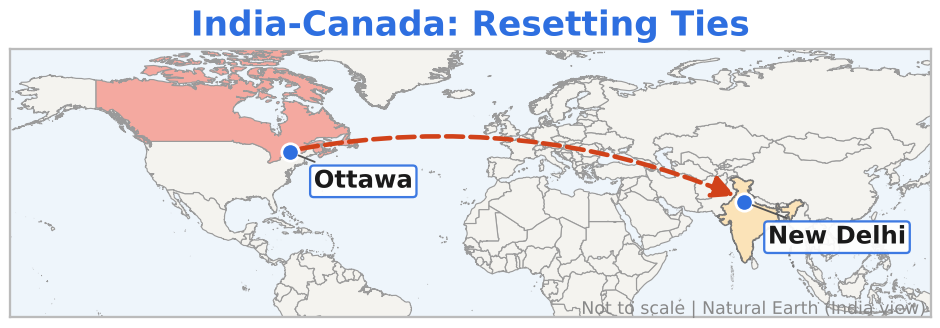
World map shading Canada and India with an arrow linking Ottawa and New Delhi. — StudyForGS
10. Expanding Jan Aushadhi Kendras
HEALTHUPSC: Prelims + Mains GS2
Syllabus linkage
GS2 - Health, government schemes; GS3 - inclusive growth. Prelims: scheme facts; Mains: out-of-pocket spending and access to medicines.
Context
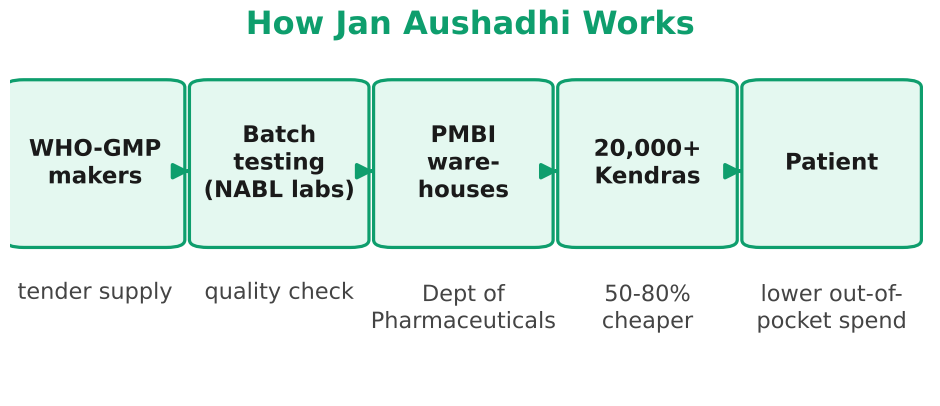
Jan Aushadhi shops sell good-quality generic medicines at 50-80% lower prices. An editorial says the scheme must grow further, but awareness, stock shortages and doctors' trust are still problems. An editorial today called for expanding the Pradhan Mantri Bhartiya Janaushadhi Pariyojana (PMBJP). The scheme runs over 20,000 Kendras (as of June 2026) and aims for 25,000 by March 2027. It sells 2,110 medicines and 315 surgical items, generally 50-80% cheaper than branded ones. Sales were Rs 2,252 crore in 2025-26 and citizens are estimated to have saved about Rs 45,000 crore over 12 years. Problems include stock shortages, low trust in generics and doctors writing brand names.
Key facts
Launched 2008, revamped 2015; run by the Department of Pharmaceuticals.
Implementing agency: Pharmaceuticals and Medical Devices Bureau of India (PMBI).
Publish independent test results, track stock in real time on the Jan Aushadhi Sugam app, and encourage doctors to prescribe by generic names.
Concept
Generic medicine = a medicine with the same active ingredient, strength and effect as a branded one, sold under its chemical (salt) name, usually much cheaper. WHO-GMP = Good Manufacturing Practice standards; suppliers to Jan Aushadhi must be WHO-GMP certified and every batch is tested. Out-of-pocket expenditure (OOPE) = money patients pay from their own pocket; medicines are its biggest part in India. Exam angle: Prelims: ministry, PMBI, launch year, product numbers. Mains: how affordable medicines support Universal Health Coverage (SDG 3.8); issues of quality perception, brand prescribing and supply chains.
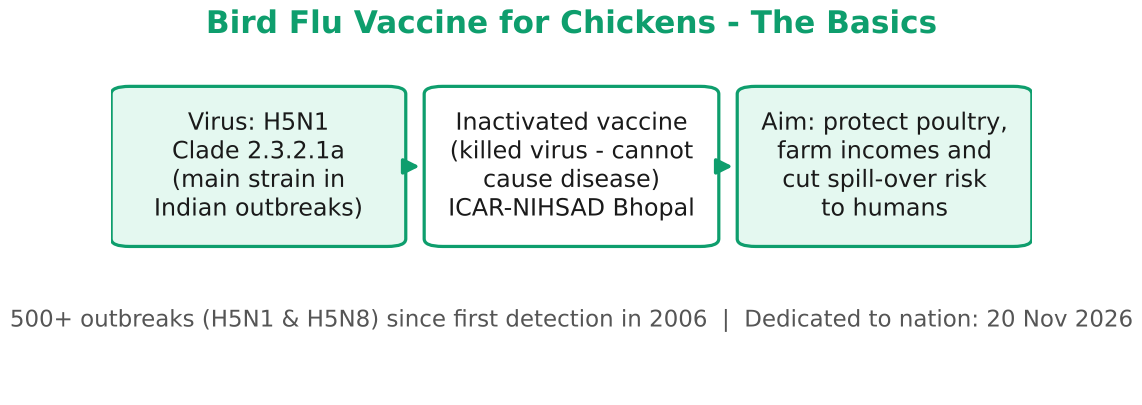
Indian scientists have made the country's first home-grown vaccine to protect chickens from bird flu (H5N1). It will be launched on 20 November. Union Agriculture Minister Shivraj Singh Chouhan will dedicate India's first indigenous H5N1 vaccine for chickens to the nation on 20 November 2026. It was developed by ICAR-National Institute of High Security Animal Diseases (NIHSAD), Bhopal. It is an inactivated (killed-virus) vaccine against clade 2.3.2.1a, the strain behind most bird flu outbreaks in Indian poultry. India has seen more than 500 bird flu outbreaks of H5N1 and H5N8 since the disease was first found in 2006.
No specific commercial vaccine for this strain existed in India before.
500+ outbreaks (H5N1, H5N8) since 2006 in India.
WHO: 1,003 human H5N1 cases and 479 deaths in 25 countries since 2003.
Way forward
Scale up production, combine vaccination with surveillance and culling rules, and keep watch for virus changes.
Concept
Avian influenza (bird flu) = a viral disease of birds; some types like H5N1 can jump to humans, so it is a zoonotic disease. Inactivated vaccine = made with killed virus; it cannot cause disease but trains the immune system to fight the real virus. One Health = an approach that treats human, animal and environmental health as linked; India has a National One Health Mission. Exam angle: Prelims: NIHSAD location, meaning of 'clade', inactivated vs live vaccines, zoonosis. Mains: protecting the poultry economy and preventing pandemics through animal vaccination.
Bird flu vaccine basics: H5N1 clade 2.3.2.1a virus, inactivated vaccine from ICAR-NIHSAD Bhopal, aim of protecting poultry and people. — StudyForGS
12. AI Blood Test to Spot Many Cancers
HEALTHUPSC: Prelims + Mains GS3
Syllabus linkage
GS3 - S&T developments, biotechnology, AI in health; GS2 - health. Prelims: cfDNA, liquid biopsy; Mains: early diagnosis and cost.
Context
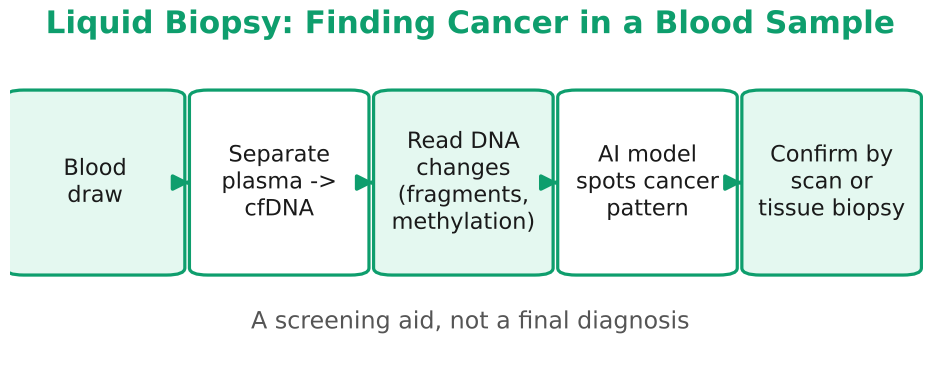
Scientists have built a blood test that uses artificial intelligence to read tiny bits of DNA in blood and flag several types of cancer early, without cutting out tissue. A new study describes an AI-based blood test that looks at changes in DNA floating in the blood to detect multiple types of cancer. Tumour cells release small pieces of DNA, called cell-free DNA (cfDNA), into the bloodstream. Their size, pattern and chemical tags (like methylation) differ from normal DNA. An AI model learns these patterns and tells which samples may have cancer. Such tests are meant for screening and must be confirmed by scans or a tissue biopsy.
Key facts
Method: liquid biopsy using cell-free DNA in plasma.
AI reads DNA fragment patterns and chemical changes to spot cancer signals.
Can screen for several cancers from one blood sample.
Detection is weaker for very early-stage cancers - a known limitation of such tests.
Not a final diagnosis; positive results need confirmation.
Way forward
Validate such tests on Indian populations through ICMR and integrate them with existing screening under national NCD programmes.
Concept
Liquid biopsy = testing body fluid (usually blood) for signs of disease instead of taking a piece of tissue. DNA methylation = adding small chemical tags (methyl groups) to DNA that switch genes on or off; cancer cells show abnormal patterns. Sensitivity vs specificity: sensitivity = how many true patients the test catches; specificity = how many healthy people it correctly clears. Exam angle: Prelims: cfDNA, methylation, liquid biopsy. Mains: role of AI in affordable early cancer detection in India (high late-stage diagnosis), data privacy and regulation of AI medical devices.
Liquid biopsy steps: blood draw, plasma cfDNA, reading DNA changes, AI detecting a cancer pattern, confirmation by scan or biopsy. — StudyForGS
13. Coal Stocks Dip, States Buy Spot Power
ECONOMYUPSC: Prelims + Mains GS3
Syllabus linkage
GS3 - Infrastructure: energy; Indian economy and resource mobilisation. Prelims: power markets; Mains: energy security.
Context
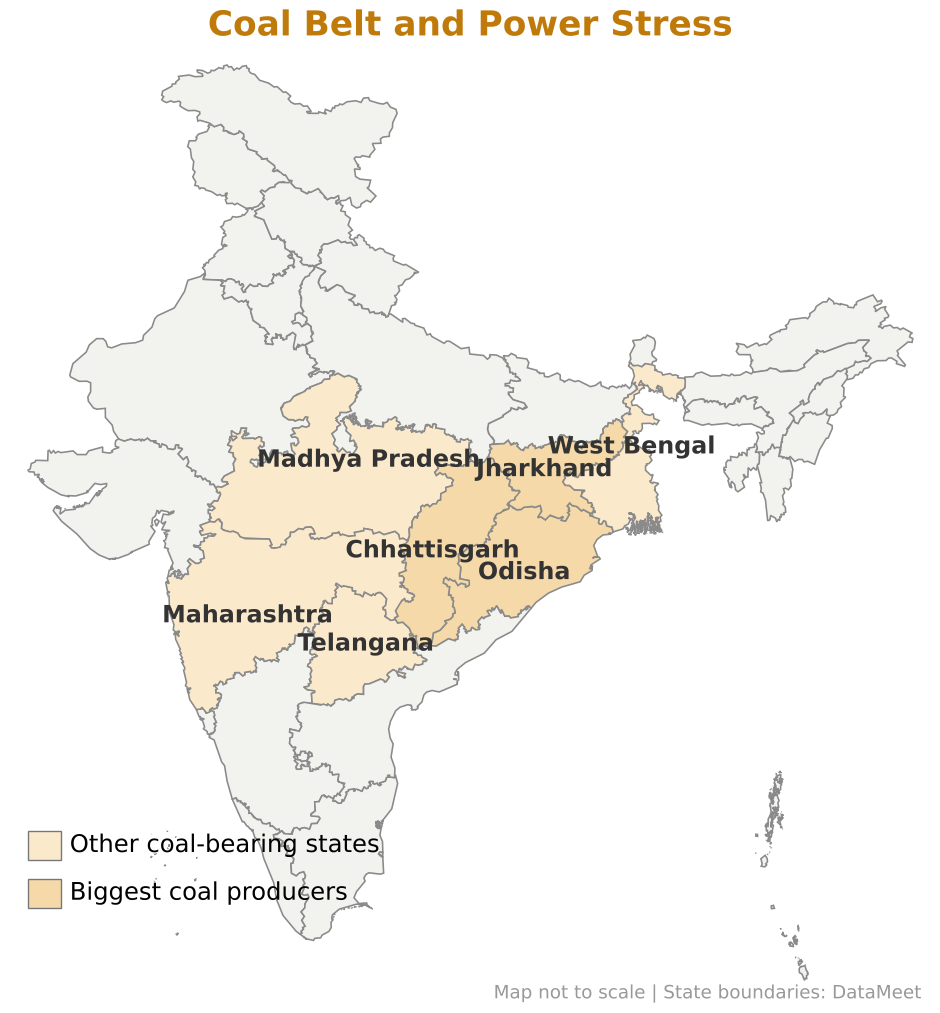
Coal piles at many power plants have fallen low, so several states are buying expensive electricity from the short-term (spot) market to avoid power cuts. Coal stocks at thermal power plants have dipped and a power shortage is feared, so multiple states are turning to the spot power market on exchanges. Since September 2026, many plants have reported critically low coal stocks as demand stayed high. A major problem is moving coal by rail from mines to plants on time. Buying on the spot market costs more, which adds to the losses of state distribution companies (discoms).
Key facts
Coal supplies about three-fourths of India's electricity generation.
States are buying short-term power on power exchanges to meet demand.
Low stocks are often a logistics (rail rake) problem, not just a mining problem.
Main coal states: Jharkhand, Chhattisgarh, Odisha.
Higher spot prices raise discoms' costs and can lead to load-shedding.
Way forward
Build coal stocks before peak months, fix rail bottlenecks, and add storage and flexible power so that renewables can fill gaps.
Concept
Spot (day-ahead / real-time) market = electricity bought and sold for the next day or the next hour on a power exchange, regulated by the CERC. Critical coal stock = when a plant has much less coal than its required (normative) stock, as tracked by the Central Electricity Authority. Electricity is in the Concurrent List (Entry 38, List III): both Centre and states can make laws on it. Exam angle: Prelims: CERC, CEA, Concurrent List entry, power exchanges. Mains: coal dependence vs energy transition, rail logistics, discom finances and the need for storage and diverse sources.
India map shading the biggest coal-producing states (Jharkhand, Chhattisgarh, Odisha) and other coal-bearing states. — StudyForGS
14. Export Mission Eases Rules for MSMEs
ECONOMYUPSC: Prelims + Mains GS3
Syllabus linkage
GS3 - Growth, MSMEs, external sector. Prelims: EPM structure; Mains: export competitiveness of small firms.
Context
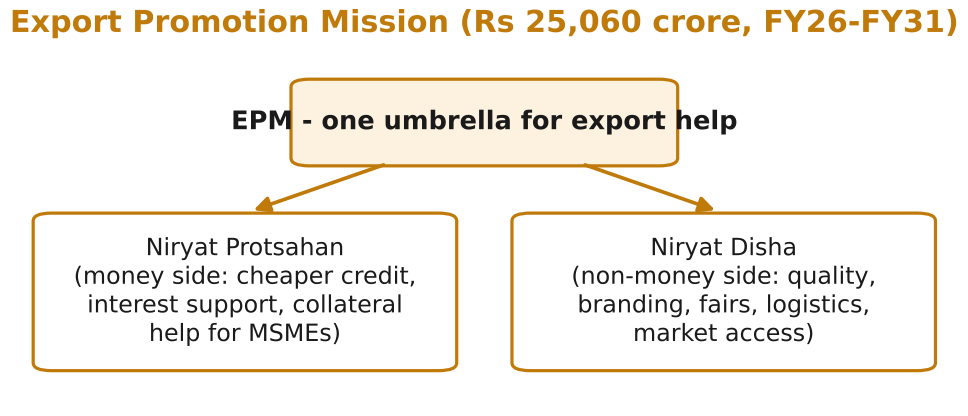
The government has relaxed some conditions under the Export Promotion Mission so that small businesses (MSMEs) find it easier to get export support. The Commerce Ministry has relaxed norms under the Export Promotion Mission (EPM) to help MSME exporters, who struggle with costly credit and paperwork. The EPM, approved in November 2025 with an outlay of Rs 25,060 crore for FY26 to FY31, brings many export schemes under one umbrella. It has two parts: Niryat Protsahan, which gives financial help such as cheaper credit, and Niryat Disha, which gives non-financial help such as branding, quality and market access. The relaxation comes as global trade faces high tariffs.
Key facts
EPM outlay: Rs 25,060 crore (FY 2025-26 to 2030-31).
Two sub-schemes: Niryat Protsahan (financial) and Niryat Disha (non-financial).
Implemented with the Directorate General of Foreign Trade (DGFT).
Focus: MSMEs, first-time exporters and labour-intensive sectors.
Relaxed norms aim to widen the number of eligible small exporters.
Way forward
Keep paperwork digital and simple, link support to outcomes, and help MSMEs meet standards demanded by FTA partners.
Concept
MSME = Micro, Small and Medium Enterprises, classified by investment and turnover (MSMED Act, 2006, revised criteria). Interest equalisation = the government pays part of the interest on export credit so that exporters get cheaper loans. DGFT = the body under the Commerce Ministry that frames and runs the Foreign Trade Policy. Exam angle: Prelims: EPM outlay, sub-scheme names, DGFT. Mains: why MSME exports lag (credit, compliance, scale) and how missions like EPM can help.
Export Promotion Mission structure: Rs 25,060 crore umbrella with Niryat Protsahan (financial) and Niryat Disha (non-financial). — StudyForGS
📜 Asked before in the exam — previous-year question on this topic
UPSC Prelims 2023Consider the following statements with reference to India: 1. According to the 'Micro, Small and Medium Enterprises Development (MSMED) Act, 2006', the 'medium enterprises' are those with investments in plant and machinery between 15 crore and 25 crore. 2. All bank loans to the Micro, Small and Medium Enterprises qualify under the priority sector. Which of the statements given above is/are correct?
1 only
2 only
Both 1 and 2
Neither 1 nor 2
Show answer
Answer: (b) 2 only Only statement 2 is correct. Statement 1 is wrong: since the revised criteria of July 2020, a medium enterprise under the MSMED Act framework has investment in plant and machinery of up to 50 crore rupees and turnover of up to 250 crore rupees, not 15 to 25 crore. Statement 2 is right: under RBI's Master Directions on priority sector lending, all bank loans to MSMEs that meet the official definition count as priority sector lending. Update: from April 2025, the limits for medium enterprises were raised to 125 crore rupees of investment and 500 crore rupees of turnover. Practise all UPSC Prelims 2023 paper (free) →
Linked because this news is about the same topic. The answer is as per the official key of that year.
15. Foreign Investors Return in November
ECONOMYUPSC: Prelims + Mains GS3
Syllabus linkage
GS3 - Indian economy, capital flows, monetary policy. Prelims: FPI vs FDI; Mains: volatility of portfolio flows.
Context
Foreign investors have put a record amount of money into Indian markets this month. At the same time, the gap between Indian and US bond interest rates has become small, and the Chief Economic Adviser says India should get used to it. Foreign portfolio investors (FPIs) put in a record USD 11.3 billion in November, as reported today. Reasons include hints of a cut in long-term capital gains tax, a fall in crude oil prices, a shift away from crowded AI stocks in other Asian markets and better company results. Separately, the CEA said the smaller difference between Indian and US government bond yields is something India must 'get used to'. A narrow gap means India's borrowing costs are moving closer to those of developed markets.
Key facts
FPI inflow in November: record USD 11.3 billion.
Drivers: LTCG tax cut hopes, cheaper crude, shift from AI-heavy Asian markets, earnings.
Buying focused on large financial companies.
CEA: narrow India-US bond yield gap is the 'new normal'.
Cheaper oil helps the current account and the rupee.
Way forward
Keep macro stability and tax certainty, and build forex buffers to handle sudden outflows.
Concept
FPI vs FDI: FPI = buying shares/bonds without control (below 10% of a company's equity); FDI = long-term investment with management interest (10% or more). Bond yield = the return an investor earns on a bond; a lower yield gap means less extra return for holding Indian bonds. Hot money = short-term capital that can leave quickly, causing market and currency swings. Exam angle: Prelims: FPI/FDI threshold, regulator (SEBI), meaning of yield. Mains: benefits and risks of portfolio flows; how bond index inclusion and tax policy affect them.
India's exports to countries with which it has free trade agreements (FTAs), from South-East Asia to Europe, are growing faster, the government says. A government release highlighted that India's exports are gaining momentum with FTA partners such as ASEAN, the UAE, Australia, the UK and EFTA, and with Europe. FTA partners made up about 40.5% of India's merchandise exports in FY26. Total exports of goods and services reached a record USD 863.1 billion in 2025-26. The India-EU FTA was concluded in January 2026, and new deals aim to help labour-intensive sectors such as textiles, leather and gems.
Key facts
Record total exports: USD 863.1 billion in FY 2025-26.
FTA partners: about 40.5% of merchandise exports in FY26.
India-UAE CEPA (2022), India-Australia ECTA (2022), India-EFTA TEPA (in force 2025), India-UK CETA (signed 2025).
India-EU FTA concluded on 27 January 2026.
ASEAN-India trade deal (AITIGA, 2010) is under review.
Way forward
Raise FTA utilisation by MSMEs, review weak deals, and match FTAs with domestic competitiveness reforms.
Concept
FTA = an agreement to cut or remove tariffs on most trade between partners; deeper versions (CEPA) also cover services and investment. Rules of origin = conditions that decide whether a product truly comes from a partner country and qualifies for low tariffs. Utilisation rate = share of eligible trade that actually uses FTA benefits; low use often reflects paperwork and awareness gaps. Exam angle: Prelims: dates and names of India's FTAs (CEPA/ECTA/TEPA/CETA), EFTA members (Switzerland, Norway, Iceland, Liechtenstein). Mains: are FTAs helping India or widening trade deficits (e.g. with ASEAN)?
17. Counting Women's Unpaid Work
ECONOMYUPSC: Prelims + Mains GS1
Syllabus linkage
GS1 - Role of women; GS3 - employment, inclusive growth. Prelims: PLFS, TUS, ICLS; Mains: female labour force participation.
Context
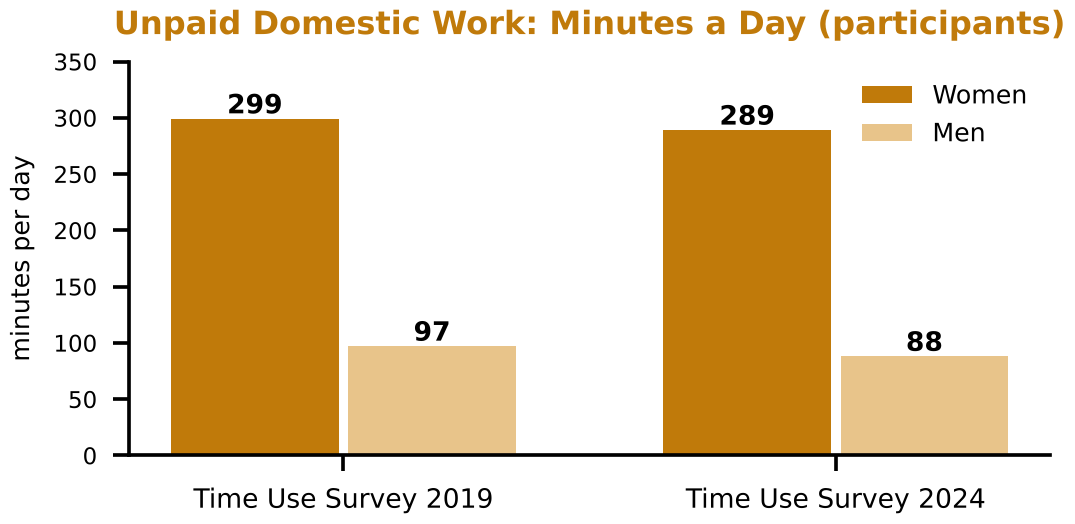
Women in India do over three times more unpaid housework and care than men, which keeps many out of paid jobs. The jobs survey (PLFS) will now ask about unpaid work too. An op-ed today argued that measuring women's unpaid work is key to understanding why so few women are in paid work. The Time Use Survey 2024 shows women spend 289 minutes a day on unpaid domestic work against 88 minutes for men. In October 2026 the National Statistics Office proposed adding unpaid work questions to the Periodic Labour Force Survey (PLFS) from January 2027. This will link time spent on care with women's job choices.
TUS 2024: 81.5% of women vs 27.1% of men do unpaid domestic work daily.
Minutes per day on domestic work: women 289 vs men 88 (2024).
Revised PLFS from January 2027 adds unpaid work and a gig-work stratum.
ILO (2018): women do about three-fourths of the world's unpaid care work.
Way forward
Invest in childcare and elder care, encourage shared care through paternity leave, and use time-use data in gender budgeting.
Concept
LFPR (Labour Force Participation Rate) = share of people working or looking for work; WPR counts only those working. 19th ICLS (2013) = international labour statisticians' standard that broadened 'work' to include own-use production, volunteer and unpaid trainee work. SDG target 5.4 = recognise and value unpaid care and domestic work through public services and shared responsibility. Exam angle: Prelims: PLFS (2017, NSO-MoSPI), TUS rounds (2019, 2024), SDG 5.4, 19th ICLS. Mains: why female LFPR is low; care economy, creches (Palna scheme), maternity benefits (26 weeks).
Bar chart of minutes per day on unpaid domestic work: women 299 vs men 97 in 2019, women 289 vs men 88 in 2024. — StudyForGS
📜 Asked before in the exam — previous-year question on this topic
BPSC Prelims 2025 (71st CCE)According to Annual PLFS 2023-24 report:
There is greater increase in Labour Force Participation Rate (LFPR) of rural females as compared to urban females since 2022
Among the 36 states and union territories, 19 states have a Workforce Participation Rate (WPR) (for all ages) below the national average of 43.7 percent
The share of female workers in agriculture has declined significantly from 2017-18 to 2023-24
More than one of the above
Show answer
Answer: (a) There is greater increase in Labour Force Participation Rate (LFPR) of rural females as compared to urban females since 2022 Practise all BPSC previous year papers →
Linked because this news is about the same topic. The answer is as per the official key of that year.
18. Climate Risk Index 2027: India Top-10
ENVIRONMENTUPSC: Prelims + Mains GS3
Syllabus linkage
GS3 - Climate change, disaster management; GS1 - geographical phenomena. Prelims: index publisher and ranks; Mains: adaptation and loss and damage.
Context
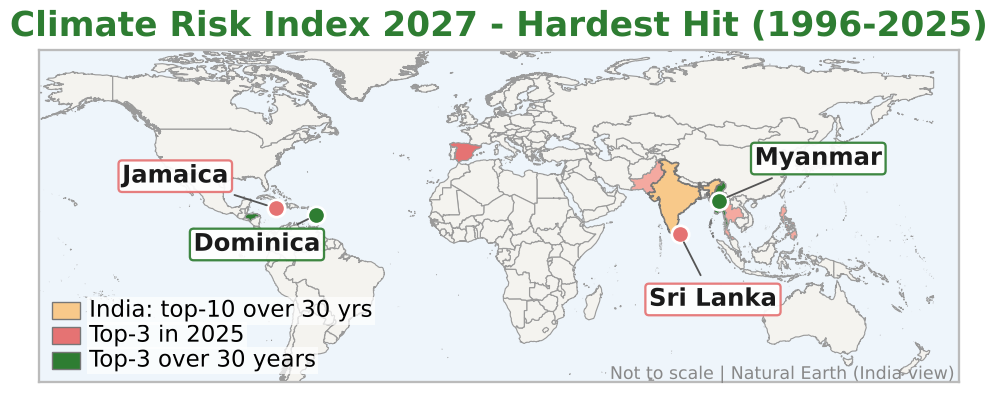
A new global report says India has been among the ten countries worst hit by extreme weather over the last 30 years, with over 78,000 deaths. Germanwatch released the Climate Risk Index 2027 at COP31 in Antalya, Turkiye. It covers 1996 to 2025. India stayed among the ten most affected countries, facing 436 extreme weather events, more than 78,000 deaths and over USD 170 billion in losses. Dominica, Myanmar and Honduras were the worst hit over 30 years, while Jamaica, Sri Lanka and Spain topped the list for 2025 alone. India ranked 12th for 2025.
Key facts
Publisher: Germanwatch (Bonn/Berlin); index running since 2006.
India 1996-2025: 436 events, 78,000+ deaths, 1.2 billion+ people affected, USD 170 billion+ losses.
Top 3 over 30 years: Dominica, Myanmar, Honduras.
Top 3 for 2025: Jamaica, Sri Lanka, Spain; India 12th in 2025.
Scale up heat action plans, early warning for all, and climate-proof infrastructure, and push for adaptation finance.
Concept
Climate Risk Index = a backward-looking index ranking countries by deaths and economic losses from extreme weather; data from EM-DAT (disasters) and IMF/World Bank (economy). Do not confuse: Climate Change Performance Index (CCPI) rates countries' climate action (India 28th in CCPI 2027) - a different index, also by Germanwatch with partners. Loss and damage = harm from climate impacts that cannot be avoided by adaptation; a fund for it was set up at COP27-28. Exam angle: Prelims: publisher, CRI vs CCPI, data sources, India's rank. Mains: India's vulnerability (heatwaves, floods, cyclones) and need for early warning, heat action plans and resilient infrastructure.
World map of countries hardest hit by extreme weather: top three over 30 years (Dominica, Myanmar, Honduras), top three in 2025 (Jamaica, Sri Lanka, Spain) and India in the top ten. — StudyForGS
19. Climate Finance: Promises to Practice
ENVIRONMENTUPSC: Prelims + Mains GS3
Syllabus linkage
GS3 - Climate change, energy; GS2 - international agreements. Prelims: NCQG, COP31; Mains: just transition and climate finance.
Context
Rich countries promised more money to help poorer countries fight climate change, but the money is slow, often comes as loans, and does not always reach people. An op-ed asks for real delivery at COP31. An op-ed today said the debate has moved from whether to act on climate change to how fast, how fairly and with what money. At COP29 in Baku (2024), countries agreed the New Collective Quantified Goal (NCQG): at least USD 300 billion a year by 2035 for developing countries, with a call to reach USD 1.3 trillion. COP31 in Antalya, Turkiye has a '35 by 35' goal to raise electricity's share in world energy use to 35% by 2035. India has reached 300.5 GW of non-fossil capacity, about 60% of its 500 GW target for 2030.
Key facts
NCQG (COP29, 2024): USD 300 billion/year by 2035; aim USD 1.3 trillion from all sources.
Old goal: USD 100 billion/year (Copenhagen 2009), first met in 2022.
COP31: Antalya, Turkiye (presidency), Australia leads negotiations; '35 by 35' electrification goal.
India: 300.5 GW non-fossil capacity (July 2026) vs 500 GW goal for 2030; net zero by 2070.
India crossed 50% non-fossil share in installed capacity in 2025.
Way forward
Simplify access to finance, fund grids and storage along with panels, and prepare just-transition plans for coal districts.
Concept
CBDR-RC (Common But Differentiated Responsibilities and Respective Capabilities) = principle from UNFCCC (1992): all must act, but rich countries must do more and pay more. Concessional loan = a loan at below-market rate or longer time; grants need not be repaid. Too many loans add to poor countries' debt. Just transition = moving away from coal while protecting workers and coal regions (Jharkhand, Chhattisgarh, Odisha) through reskilling and new jobs. Exam angle: Prelims: NCQG amounts, COP venues, Paris Article 9, India's NDC targets. Mains: gaps between climate promises and delivery; electrification is not the same as clean energy if power comes from coal.
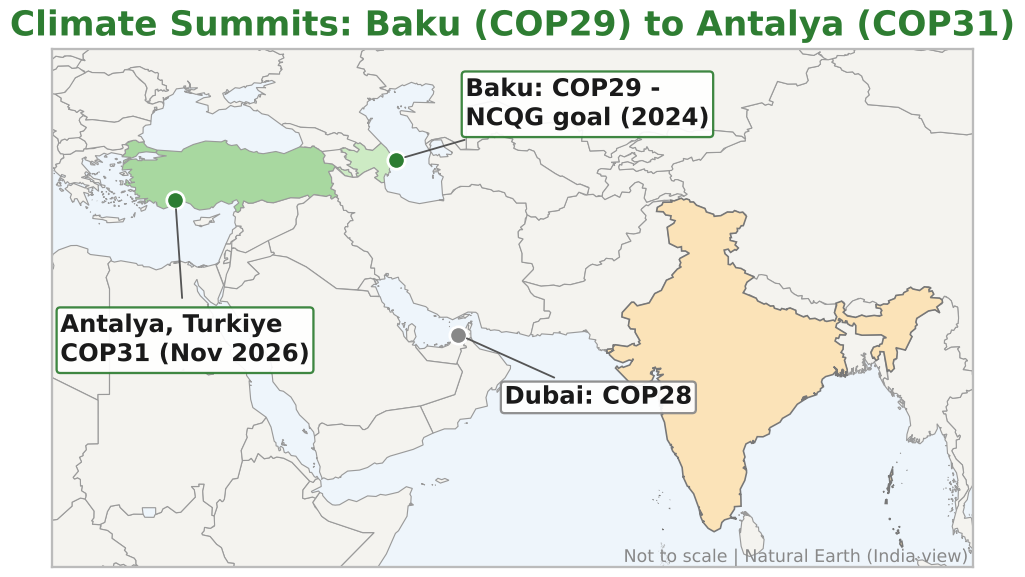
Map marking climate summit venues Baku (COP29), Dubai (COP28) and Antalya, Turkiye (COP31). — StudyForGS
20. Air Pollution: Learn from COVID
ENVIRONMENTUPSC: Prelims + Mains GS3
Syllabus linkage
GS3 - Environmental pollution and degradation; GS2 - health. Prelims: NCAP, CAQM, GRAP; Mains: governance of air quality.
Context
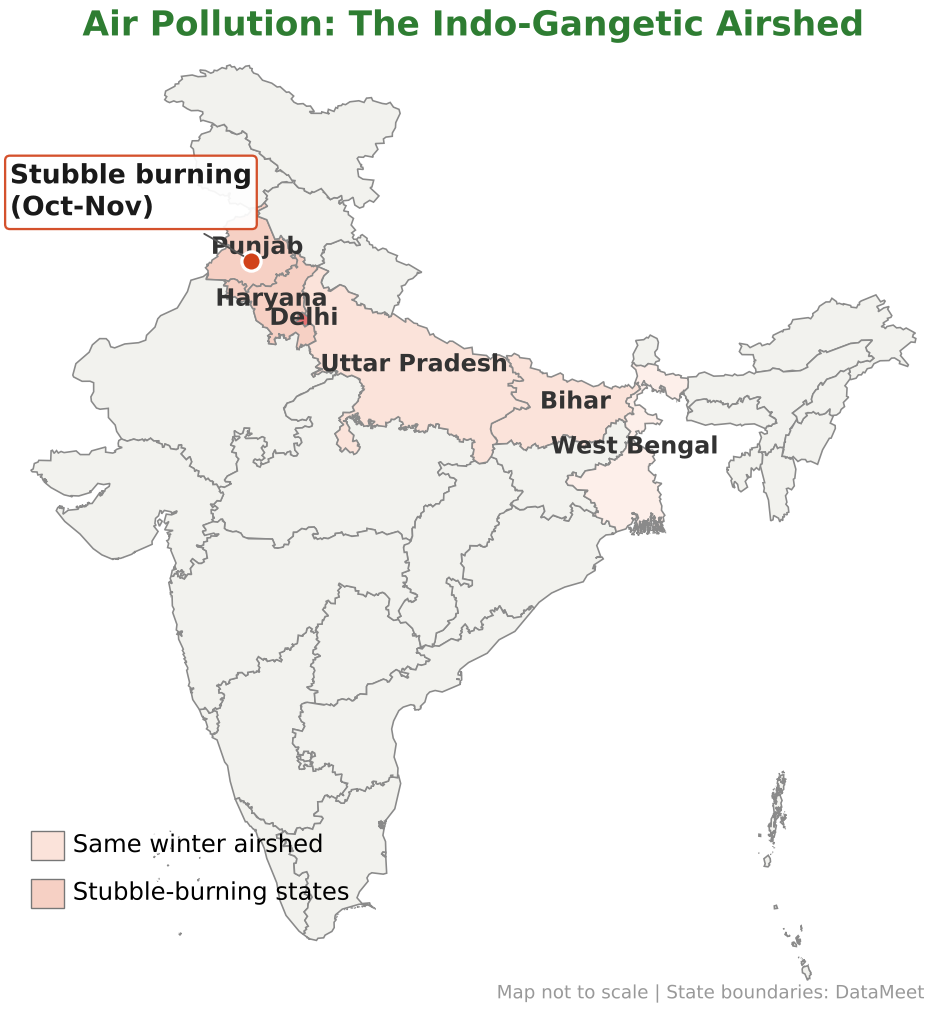
India's air pollution problem is not just a Delhi winter issue; it is a year-round public health emergency. An article argues we should respond to it with the urgency we showed during COVID-19. Articles today argued that air pollution continues even though science and technology to control it exist. Responses are often reactive, like smog towers and emergency bans, instead of tackling sources. Main sources are vehicles, coal plants and industry, brick kilns, stubble burning in Punjab and Haryana, household burning of wood and dung, and dust. In winter, temperature inversion and weak winds trap pollutants near the ground. Writers say lessons from COVID-19 - clear data, fast coordination and public communication - should guide the fight against bad air.
Key facts
National Clean Air Programme (NCAP, 2019) covers 130 cities.
In 2025-26, 108 cities had lower PM10 than in 2017-18.
CAQM coordinates action in Delhi-NCR and nearby areas.
GRAP Stage III in Delhi was recently revoked as air improved, but relief may be short.
Adopt airshed-level planning, clean public transport, crop residue markets, clean cooking fuel and measurable targets with audits.
Concept
Temperature inversion = when a warm air layer sits above cold air near the ground, stopping pollutants from rising and spreading. Airshed = an area where air moves together; pollution in the Indo-Gangetic Plain needs joint action by many states, not one city. GRAP (Graded Response Action Plan) = stage-wise emergency steps in Delhi-NCR based on AQI levels. Exam angle: Prelims: NCAP year and target, CAQM (Act 2021), GRAP stages, PM2.5 meaning. Mains: why city-level plans fail without airshed approach; health and economic costs.
Map of the Indo-Gangetic airshed: stubble-burning Punjab and Haryana, Delhi, and Uttar Pradesh, Bihar and West Bengal in the same winter airshed. — StudyForGS
21. India's Wind Energy Transition
ENVIRONMENTUPSC: Prelims + Mains GS3
Syllabus linkage
GS3 - Infrastructure: energy, renewable energy. Prelims: capacity, states, policies; Mains: role of wind in energy transition.
Context
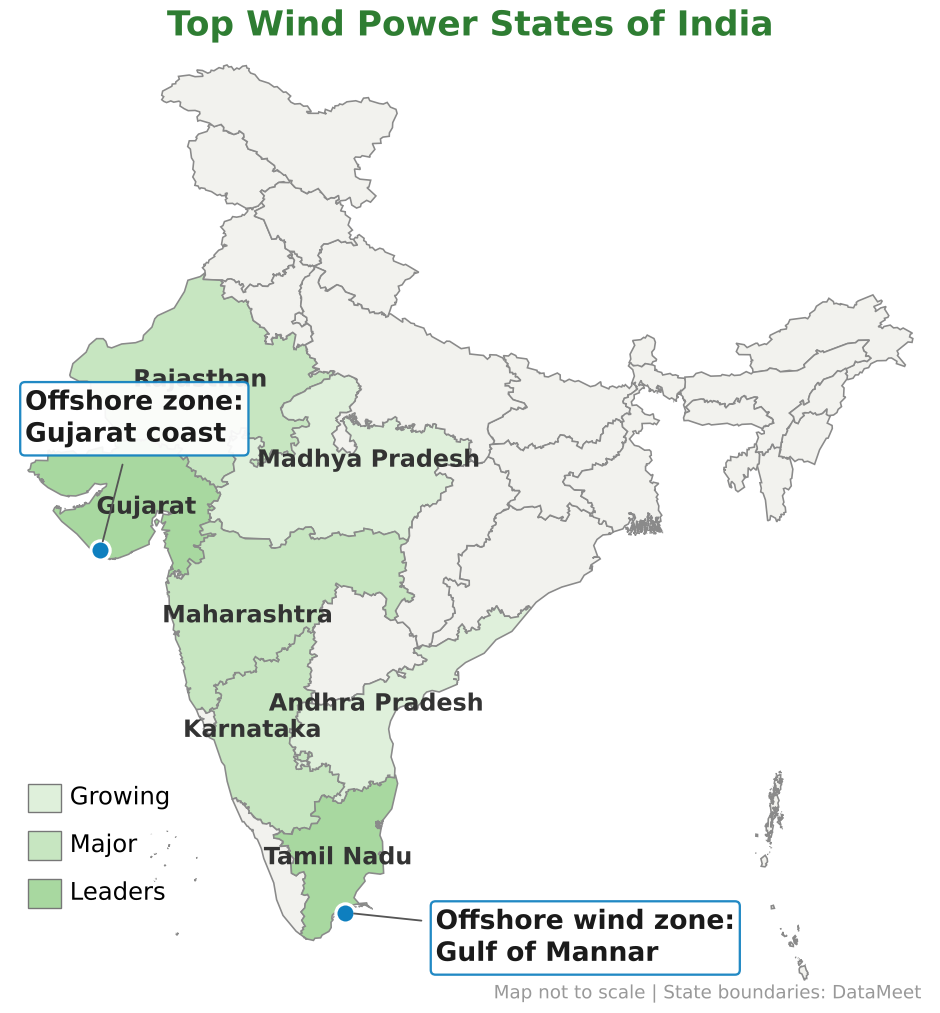
India now has over 57 GW of wind power and wants 100 GW by 2030. The government says wind is entering a new phase with better turbines and offshore projects. A government release explained India's wind energy transition. Installed wind capacity crossed 57.4 GW by mid-2026, and a record 6.05 GW was added in 2025-26. The aim is 100 GW by 2030. Most capacity is in Gujarat, Tamil Nadu, Karnataka, Maharashtra and Rajasthan. Wind complements solar because it often blows strongly in the evening and during the monsoon, when solar output falls.
Key facts
Installed wind capacity: about 57.4 GW (June 2026); target 100 GW by 2030.
Record addition: 6.05 GW in FY 2025-26.
India is among the top four countries in wind capacity.
Top states: Gujarat, Tamil Nadu, Karnataka, Maharashtra, Rajasthan.
Offshore wind zones identified off Gujarat and Tamil Nadu (Gulf of Mannar).
Way forward
Speed up repowering, offshore auctions and transmission links, and support local manufacturing of turbine parts.
Concept
Repowering = replacing old small turbines with bigger, more efficient ones on the same site to produce more power. Hybrid projects = wind + solar (and storage) at one site, giving steadier power and better use of transmission lines. NIWE (National Institute of Wind Energy), Chennai = the technical body under MNRE for wind resource assessment. Exam angle: Prelims: capacity numbers, top states, NIWE, offshore policy (2015). Mains: wind-solar complementarity, land and grid issues, domestic turbine manufacturing.
India map shading leading wind power states (Gujarat, Tamil Nadu, Karnataka, Maharashtra, Rajasthan and others) and marking offshore zones off Gujarat and the Gulf of Mannar. — StudyForGS
22. Rare White-bellied Heron Spotted
ENVIRONMENTUPSC: Prelims + Mains GS3
Syllabus linkage
GS3 - Biodiversity and conservation; species in news. Prelims-heavy.
Context
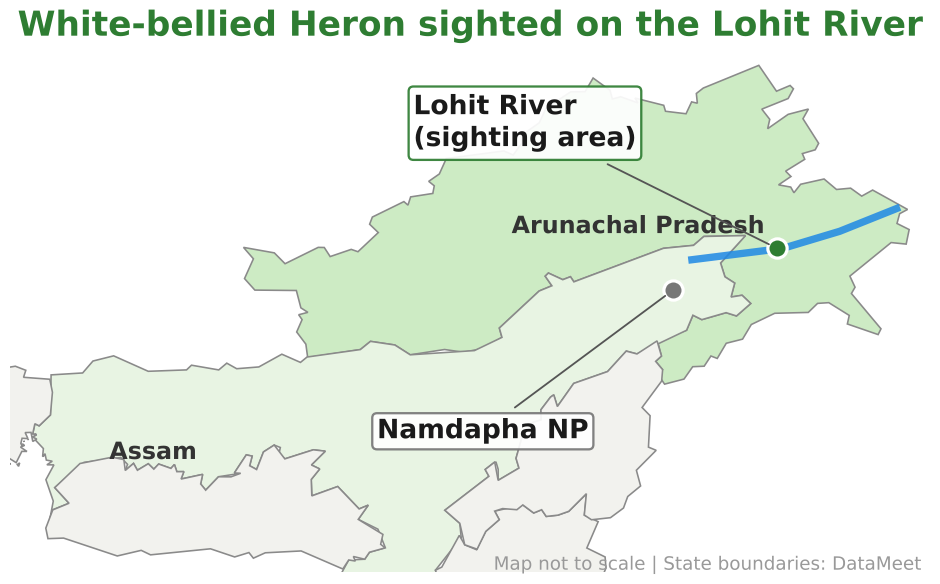
Researchers spotted the critically endangered White-bellied Heron on the Lohit River in Arunachal Pradesh. Fewer than 10 of these birds are believed to survive in India. Researchers from the Wildlife Institute of India (WII) recorded a sighting of the White-bellied Heron along the Lohit River in Arunachal Pradesh. It is one of the rarest birds in the world, with fewer than 100 mature birds left globally. It lives along clean, undisturbed rivers in the foothills of the eastern Himalayas. Dams, sand mining and disturbance to rivers are major threats.
Key facts
Scientific name: Ardea insignis; also called imperial heron.
IUCN status: Critically Endangered.
Global population below 100 mature birds; India fewer than 10.
Range: NE India (Assam, Arunachal), Bhutan, northern Myanmar.
Second-largest living heron, nearly one metre tall; among the top 100 EDGE species.
Way forward
Protect stretches of free-flowing rivers, involve local communities in monitoring, and check dam impacts carefully.
Concept
EDGE species = Evolutionarily Distinct and Globally Endangered; animals with few close relatives that are also at high risk. Indicator species = a species whose presence shows healthy habitat; this heron indicates clean, free-flowing rivers. Namdapha National Park (Arunachal) is a known habitat; Lohit is a tributary of the Brahmaputra. Exam angle: Prelims: IUCN status, scientific name, range, river and state of sighting. Mains: impact of hydropower dams on river biodiversity in the Northeast.
Map of northeast India marking the Lohit River sighting area in Arunachal Pradesh and Namdapha National Park. — StudyForGS
23. Giant Elephant Fossil in Narmada Valley
ART & CULTUREUPSC: Prelims + Mains GS1
Syllabus linkage
GS1 - Indian history (prehistory), geography; GS3 - fossils and biodiversity. Prelims: species, site, epoch.
Context
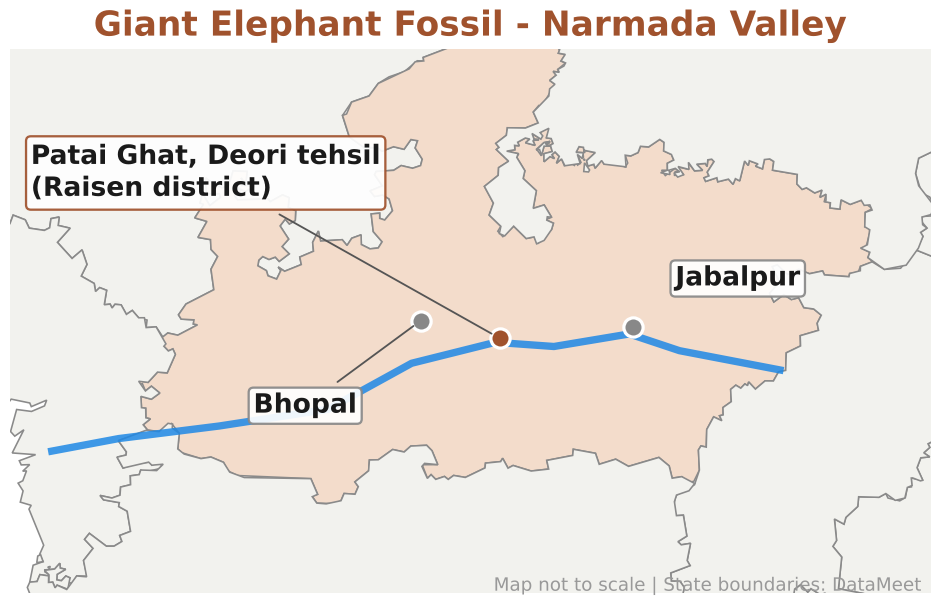
A huge fossil jaw found near the Narmada River in Madhya Pradesh may belong to Palaeoloxodon namadicus, an extinct elephant that was among the largest land animals ever. Researchers found a fossilised jaw, about 75 cm long, at Patai Ghat near Patai village in Deori tehsil of Raisen district, Madhya Pradesh. It may belong to Palaeoloxodon namadicus, an extinct straight-tusked elephant. This animal could be 4.5 to 5 metres tall at the shoulder and weigh up to 18-19 tonnes. Its remains are found in Pleistocene deposits of the Narmada and Godavari valleys and the Ganga plains.
Shoulder height 4.5-5 m; weight up to 18-19 tonnes - largest known proboscidean.
Lived in the Pleistocene epoch (about 2.6 million to 11,700 years ago).
Name 'namadicus' comes from Namada = Narmada.
Way forward
Protect fossil sites from sand mining and set up a geo-heritage reserve and museum in the valley.
Concept
Proboscidean = the elephant order of mammals (trunk-bearing animals), including mammoths and mastodons. Pleistocene = the 'Ice Age' epoch with repeated glacial cycles; early humans spread across the world in this period. Narmada Valley is also famous for the 'Narmada Human' skull from Hathnora (found 1982), an important find for Indian prehistory. Exam angle: Prelims: species name, location (Raisen district), Pleistocene period, Hathnora link. Mains: role of fossil records in understanding past climate and human evolution in India.
Map of Madhya Pradesh showing the Narmada River and the Patai Ghat fossil site in Deori tehsil, Raisen district, with Bhopal and Jabalpur. — StudyForGS
24. Saraiki Folk Song Wins Hearts in India
ART & CULTUREUPSC: Prelims + Mains GS1
Syllabus linkage
GS1 - Indian culture: languages, folk music, Partition and shared heritage. Prelims: language facts; Mains: culture as a bridge.
Context
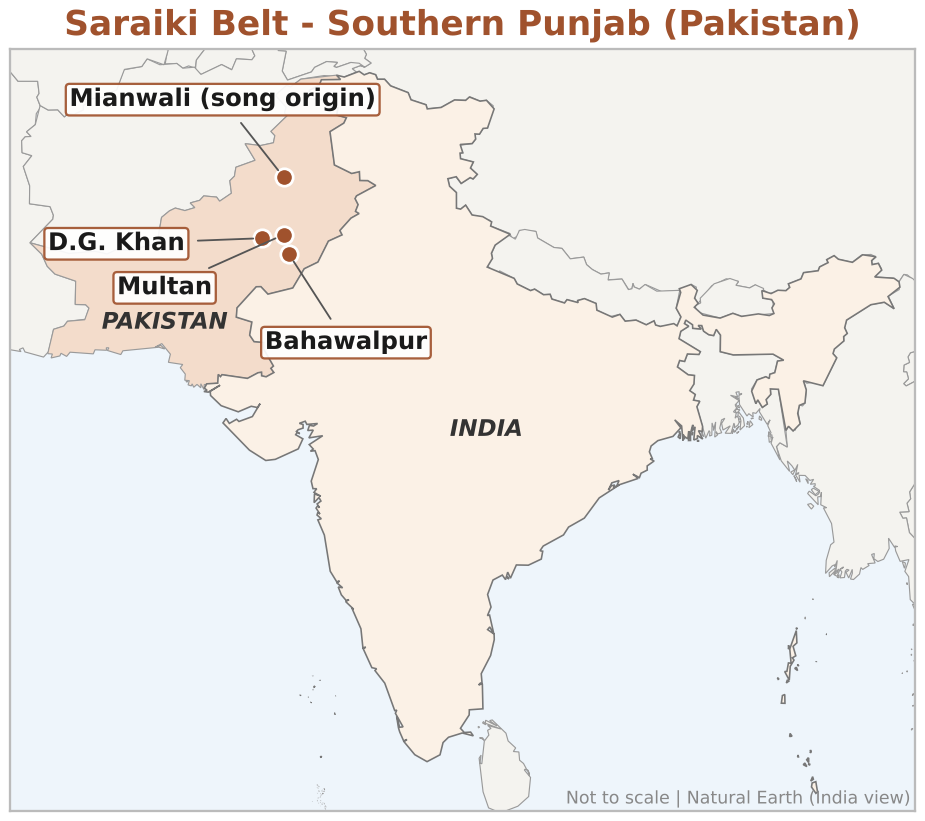
An old folk song in the Saraiki language, 'Chhalray Chhalray Waal', has become very popular on social media in India, showing shared culture across the border. A Saraiki folk song from the 1980s, first sung by Shafaullah Khan Rokhri of Mianwali in Pakistan's Punjab, has gone viral in India. Indian singers and even a UP Police sub-inspector have sung it. Saraiki is spoken mainly in southern Punjab of Pakistan, around Multan, Bahawalpur and Dera Ghazi Khan. Many Saraiki-speaking families moved to India after Partition and settled in Punjab, Haryana and Delhi.
Key facts
Song: 'Chhalray Chhalray Waal' (1980s), first sung by Shafaullah Khan Rokhri.
Saraiki is an Indo-Aryan language close to Punjabi and Sindhi.
Not among India's 22 Eighth Schedule languages.
Way forward
Document Partition-era migrant languages in India and support their oral traditions through cultural institutions.
Concept
Indo-Aryan languages = the language family that includes Hindi, Punjabi, Bengali, Sindhi and Saraiki, descended from Sanskrit/Prakrit roots. Eighth Schedule = list of 22 official languages in the Constitution (Articles 344 and 351). Sufi poetry (e.g. Khwaja Ghulam Farid in Saraiki) shaped folk music of the Punjab-Sindh region. Exam angle: Prelims: where Saraiki is spoken, language family, Eighth Schedule count. Mains: role of shared culture, music and diaspora memories in people-to-people ties despite political tension.
Map of the Saraiki belt in southern Punjab, Pakistan, marking Multan, Bahawalpur, D.G. Khan and Mianwali, the song's origin. — StudyForGS
25. IN-SPACe Picks Firms for 3D City Maps
SCI-TECHUPSC: Prelims + Mains GS3
Syllabus linkage
GS3 - Space technology, private sector in space; GS1 - urbanisation. Prelims: IN-SPACe facts; Mains: space for governance.
Context
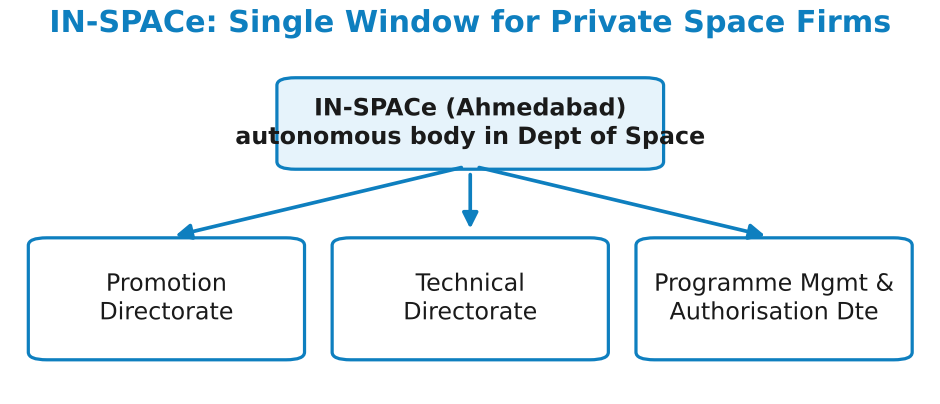
India's space regulator for private companies, IN-SPACe, has chosen three Indian space firms to build high-quality 3D maps of towns and cities using satellite data. IN-SPACe has selected three Indian space companies to develop high-resolution 3D reconstruction technology for mapping human settlements across Indian cities. Such 3D maps can help urban planning, property records, flood risk study and disaster response. IN-SPACe is a single-window, autonomous agency under the Department of Space, set up to promote and authorise private space activities. Its headquarters are in Ahmedabad.
Key facts
Three Indian space firms selected for 3D mapping of settlements.
IN-SPACe: autonomous body under the Department of Space; HQ Ahmedabad.
Created after the 2020 space-sector reforms.
Three directorates: Promotion, Technical, and Programme Management and Authorisation.
Acts as interface between ISRO and non-government entities (NGEs).
Way forward
Make the data open for public use where safe, and link it with schemes like SVAMITVA and smart city planning.
Concept
NGEs (Non-Governmental Entities) = private companies, startups and institutions in the space sector. Indian Space Policy, 2023 = defines roles of ISRO (R&D), IN-SPACe (promoter/regulator), NSIL (commercial arm) and private firms. 3D city model / digital twin = a computer copy of a real city used to test plans and respond to emergencies. Exam angle: Prelims: IN-SPACe HQ, parent department, role vs NSIL and ISRO. Mains: how private space firms and geospatial data can improve urban governance (with privacy safeguards).
IN-SPACe structure: autonomous body in Ahmedabad with Promotion, Technical, and Programme Management and Authorisation directorates. — StudyForGS
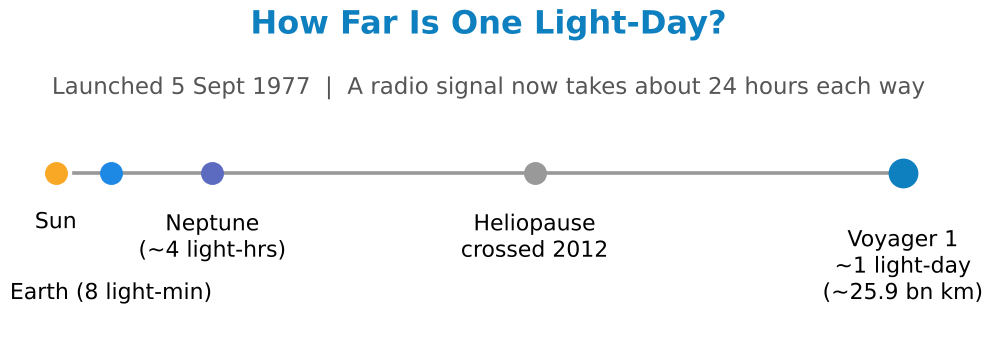
NASA's Voyager 1, launched almost 50 years ago, is now so far away that its radio signals take a whole day to reach Earth. Voyager 1 has reached about one light-day from Earth, roughly 25.9 billion km away. This means a radio command sent from Earth takes about 24 hours to reach it and another 24 hours for the reply. Launched on 5 September 1977, it became the first human-made object to enter interstellar space in August 2012. Its power supply is slowly declining, so engineers switch off instruments one by one.
Key facts
Launched: 5 September 1977 (Voyager 2: 20 August 1977).
Distance: about one light-day, roughly 25.9 billion km.
Crossed the heliopause into interstellar space in August 2012.
Powered by radioisotope thermoelectric generators (RTGs) using plutonium-238.
Carries the 'Golden Record' with sounds and images of Earth.
Way forward
Use Voyager's data to plan future deep-space probes, including Indian interplanetary missions.
Concept
Light-day = distance light travels in one day (about 2.59 x 10^10 km); a light-year is 365 times more. Heliopause = the boundary where the Sun's solar wind is stopped by the interstellar medium; beyond it is interstellar space. RTG = a power source that turns heat from radioactive decay into electricity, used where sunlight is too weak. Exam angle: Prelims: launch year, heliopause, RTG, light-day vs light-year. Mains: value of long-duration missions for science.
Distance scale: Sun, Earth (8 light-minutes), Neptune (about 4 light-hours), heliopause (crossed 2012) and Voyager 1 at about one light-day. — StudyForGS
27. Microsoft Outage: Risk of Central Systems
SCI-TECHUPSC: Prelims + Mains GS3
Syllabus linkage
GS3 - Cyber security, critical information infrastructure; GS2 - digital governance. Mains-heavy.
Context
A long Microsoft outage stopped email and office tools for millions, including Indian offices. An editorial warns that relying on one big company for key digital services is risky. A major Microsoft 365 outage in November 2026 disrupted Outlook, Teams and Copilot for around 10 hours in many countries, including India. Indian enterprises and some government users faced work disruption. An editorial today said such failures show the danger of putting critical digital services on a few centralised platforms. It called for backup systems, multi-vendor approaches and stronger rules for critical infrastructure.
Key facts
Outage hit Outlook, Teams, SharePoint and Copilot for many hours.
Indian businesses and users were widely affected.
Recalls the July 2024 CrowdStrike update failure that crashed Windows systems worldwide.
Issue: concentration risk in cloud and software services.
Debate on digital sovereignty and domestic cloud capacity.
Way forward
Mandate backup and continuity plans for key services, encourage multi-cloud use, and build Indian cloud capacity.
Concept
Concentration risk = when too many users depend on one provider, so a single failure affects everyone. Critical Information Infrastructure (Section 70, IT Act 2000) = systems whose failure would hurt national security, economy or public health; protected by NCIIPC. CERT-In (Section 70B, IT Act) = India's national agency for responding to cyber incidents; organisations must report incidents within 6 hours. Exam angle: Prelims: Sections 70 and 70B, NCIIPC, CERT-In. Mains: resilience of digital public and private systems; balancing global tech use and sovereignty.
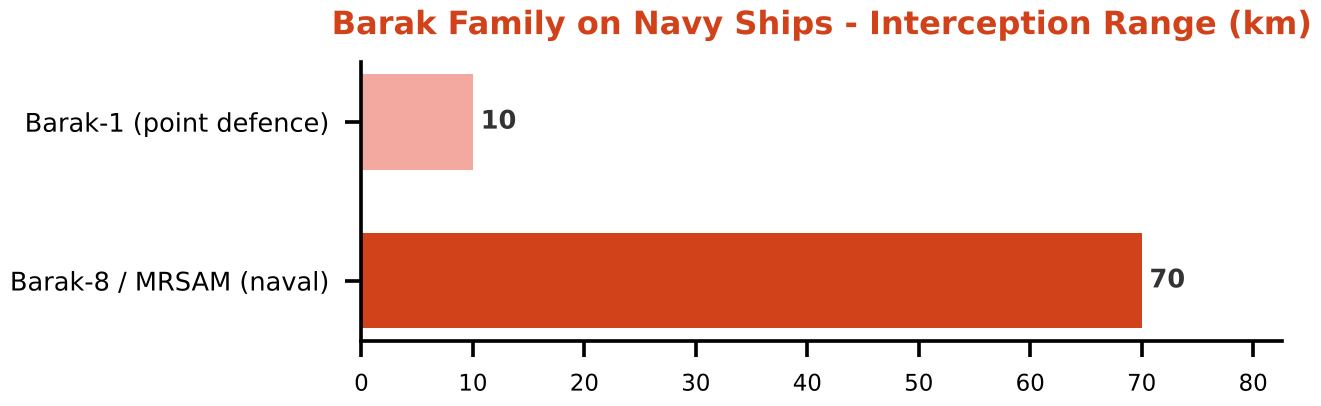
India has signed a Rs 1,976-crore deal with Israel Aerospace Industries to upgrade the Barak air-defence missiles on Navy warships, so they stay effective against modern threats. The Ministry of Defence signed a contract worth Rs 1,976.40 crore with Israel Aerospace Industries (IAI) on 18 November 2026. It covers full hardware and software upgrades of Barak point-defence missile systems already fitted on Indian Navy ships. The aim is to fix obsolescence (old parts and software going out of date). Barak-1 is on older destroyers and frigates, while the longer-range Barak-8 is on Kolkata-class destroyers.
Key facts
Contract value: Rs 1,976.40 crore; partner: Israel Aerospace Industries.
Upgrade of existing Barak systems on Navy warships.
Barak-1 range about 9-10 km; Barak-8 (naval) about 70 km.
Barak-1 was fitted on Delhi-class destroyers and Brahmaputra-class frigates.
Barak-8 / MRSAM was co-developed by DRDO and IAI.
Way forward
Ensure maximum Indian industry share and technology transfer in upgrades, and plan indigenous successors.
Concept
Point defence = a short-range system that protects the ship itself from incoming missiles and aircraft. MRSAM (Medium Range Surface-to-Air Missile) = Indian name for the Barak-8 family used by Navy, Army and Air Force. Obsolescence management = upgrading old systems so they can be maintained and remain useful, cheaper than buying new ones. Exam angle: Prelims: Barak-8/MRSAM, DRDO-IAI partnership, ranges. Mains: India-Israel defence ties, balancing imports with Aatmanirbhar Bharat in defence.
Bar chart of Barak interception ranges on Navy ships: Barak-1 about 10 km, Barak-8/MRSAM about 70 km. — StudyForGS
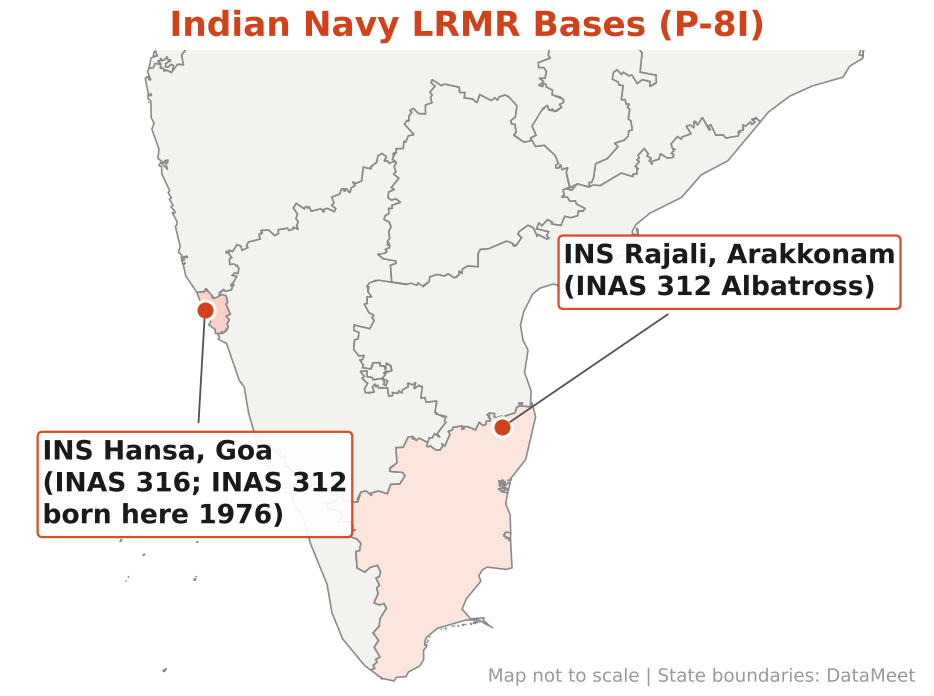
The Navy has completed 50 years of flying long-range patrol aircraft that watch the seas and hunt submarines, starting with old Super Constellations in 1976 and now using P-8I jets. The Indian Navy marked 50 years of Long-Range Maritime Reconnaissance (LRMR) on 18 November 2026. Its first LRMR squadron, INAS 312 'Albatross', was commissioned on 18 November 1976 at INS Hansa, Goa, with five Super Constellation aircraft from the Air Force. The fleet later used Il-38 (1977) and Tu-142M (1988), and since 2013 the Boeing P-8I. These aircraft have supported operations from Cactus to Sindoor and many search-and-rescue and anti-piracy missions.
Key facts
INAS 312 'Albatross' commissioned 18 November 1976 at INS Hansa, Goa.
P-8I squadrons: INAS 312 at INS Rajali, Arakkonam (TN); INAS 316 at INS Hansa, Goa.
Supported Operations Cactus, Vijay, Parakram and Sindoor.
Idea came after the 1971 war, to watch the Indian Ocean Region.
Way forward
Add more P-8I and MQ-9B drones, and expand information-sharing with friendly navies.
Concept
Maritime Domain Awareness (MDA) = knowing what is happening at sea (ships, submarines, threats) to protect trade and security. Anti-submarine warfare (ASW) = finding and tracking enemy submarines, using sonobuoys and sensors dropped from aircraft. IFC-IOR (Information Fusion Centre - Indian Ocean Region), Gurugram = shares maritime information with partner countries. Exam angle: Prelims: squadron name, bases, aircraft types and years. Mains: role of air surveillance in Indian Ocean security amid rising Chinese naval presence.
Map of India's coast marking INS Hansa, Goa (INAS 316; birthplace of INAS 312 in 1976) and INS Rajali, Arakkonam (INAS 312 Albatross). — StudyForGS
30. Kashmir: Attacks Show Peace Still Elusive
DEFENCEUPSC: Prelims + Mains GS3
Syllabus linkage
GS3 - Internal security, terrorism and linkages; GS2 - federalism. Mains: security + political approach in J&K.
Context
Recent militant attacks in Kashmir show that peace is not yet secure. An editorial says restoring statehood and political talks are needed along with security action. On 11 November, motorcycle-borne militants fired at a CRPF checkpost near Mir Bazar in Kulgam, injuring three personnel. On 18 November, security forces killed a Lashkar-e-Taiba commander, named as a suspect in that attack, in an encounter in Kulgam. An editorial today linked continuing attacks to the political vacuum since 2019 and urged the Centre to restore statehood and start dialogue with mainstream parties. The government says terror is mostly driven from across the border.
Key facts
11 Nov 2026: attack on CRPF checkpost in Kulgam; 3 personnel injured.
18 Nov 2026: LeT commander killed in Kulgam encounter.
Article 370 was abrogated on 5 August 2019; J&K became a Union Territory with a legislature.
Supreme Court (December 2023) upheld abrogation and asked for statehood to be restored at the earliest.
Assembly elections were held in 2024.
Way forward
Keep pressure on terror networks, strengthen local policing and intelligence, and move on statehood and political dialogue.
Concept
J&K Reorganisation Act, 2019 = split the state into two UTs: J&K (with legislature) and Ladakh (without). Restoring statehood needs a law of Parliament under Article 3 (formation and change of states). UAPA, 1967 = main anti-terror law; it allows banning terror groups and designating individuals as terrorists. Exam angle: Mains: balance of security operations and political process in J&K; role of local governance and development. Prelims: Article 3, 2019 Act, UAPA.
Data point of the day
289 vs 88 minutes a day
Women's unpaid domestic work (TUS 2024) Women spend over three times as much time as men on unpaid domestic work; the PLFS will measure unpaid work from January 2027.
Prelims rapid-fire
World Toilet Day (19 Nov): UN day (adopted by UNGA in 2013) on safe sanitation for all; linked to SDG 6. India's Swachh Bharat Mission began on 2 Oct 2014.
Rani Lakshmibai: Born 19 November 1828 in Varanasi; Rani of Jhansi and a leading figure of the 1857 Revolt; died fighting near Gwalior in June 1858.
Quami Ekta Week: Observed 19-25 November; starts on Indira Gandhi's birth anniversary (19 Nov 1917), also marked as National Integration Day.
International Men's Day: 19 November; focuses on men's health, well-being and positive role models.
Rosalind Franklin: New study of her notes shows she saw signs of DNA's helical shape in Photograph 49/51 (1952) before Watson and Crick built their model; she died in 1958.
EPFO: Considering allowing members to take their retirement savings as systematic (regular) withdrawals instead of a lump sum.
NCB drive: Narcotics Control Bureau-led drive targets illegal cannabis and opium cultivation; NDPS Act, 1985 governs narcotics control.
India-UK: PM Modi met Prince William and Princess Catherine; they discussed India-UK ties and climate initiatives.
Sarvam AI: Indian AI firm now offers some Chinese open AI models on its platform, raising debate on India's sovereign AI goals and data security.
Mains practice question
Q. Time-bound grievance redressal is the backbone of accountability in rights-based welfare schemes. In the light of the VB-G RAM G grievance rules, 2026, examine how digital grievance systems can strengthen social accountability, and the limits they face in rural India. (15 marks, 250 words)
Hint / approach
Introduce the rules (15-day resolution, 7-day enquiry, three levels, digital tracking). Body: benefits (record, escalation, transparency, data for social audits), limits (digital divide, capacity of panchayats, fear of reprisal, closure without real relief). Conclude with hybrid offline-online help desks and linking with social audits.
📌 One-line revision: Indus: eastern rivers (Ravi, Beas, Sutlej) for India, western (Indus, Jhelum, Chenab) for Pakistan; treaty signed 1960, in abeyance since April 2025.