Wednesday, 18 November 2026 · IST · National & International · 27 items
Today's big story is diplomacy in Manila - the Quad agreed on maritime surveillance, AI and critical minerals, while India offered plans on seafarer safety and cyber crime at the East Asia Summit. At home, the death penalty, transgender rights, J&K statehood and voter-roll revision are in focus. The ICMR's AMR report, a decade of solar power, Cyclone Akvan and COP31 also matter.
Today at a glance — things to remember
Quad in Manila: maritime surveillance collaboration, AI Accelerator, Business Forum in Mumbai in 2027
EAS and ASEAN-India summits: seafarers' safety initiative, free e-visas proposed for ASEAN tourists
UN death-penalty moratorium passed 133-33; India voted against
SSR draft rolls: nearly 75 lakh names added in 13 States/UTs; UP has 13.58 crore voters
LPG tanker attacked in Hormuz: 24 Indian crew, one missing
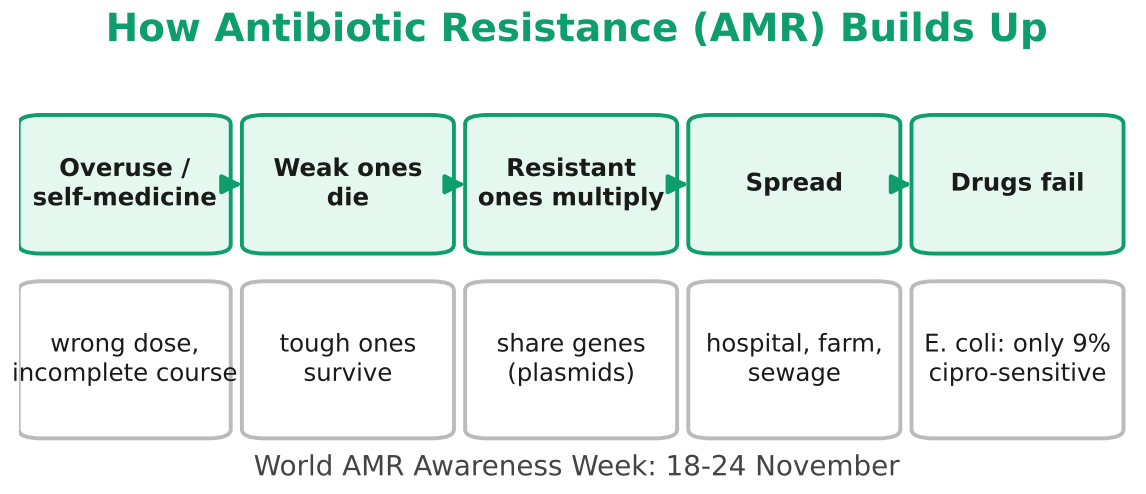
ICMR AMRSN 2025: only 9% of E. coli samples respond to ciprofloxacin
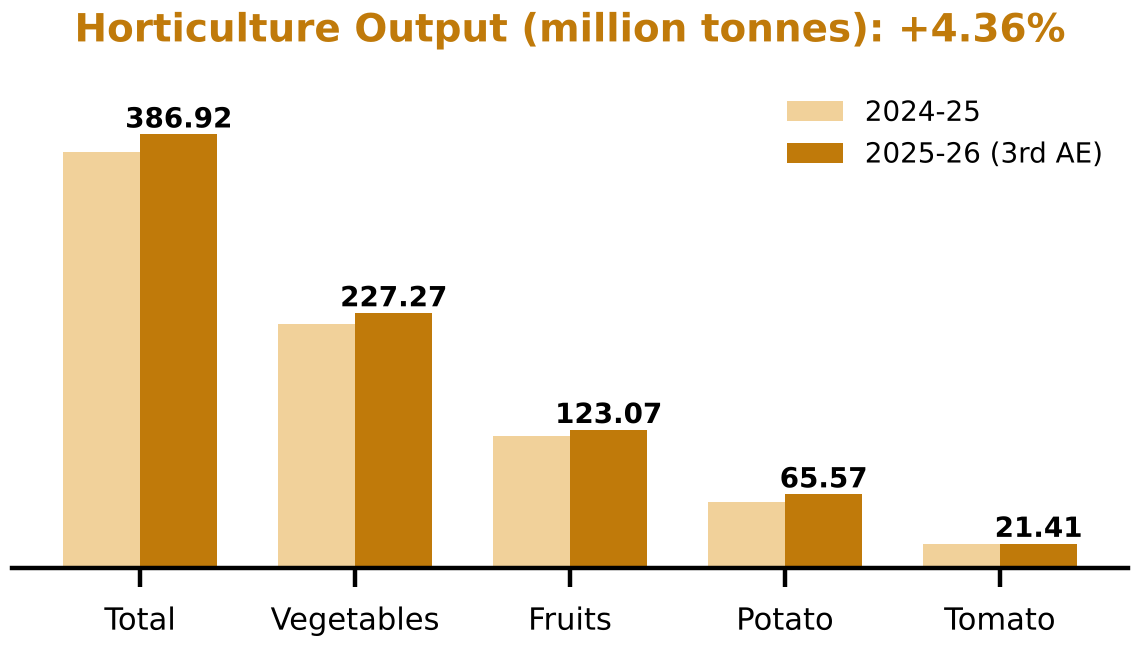
Horticulture output at record 386.92 million tonnes (+4.36%)
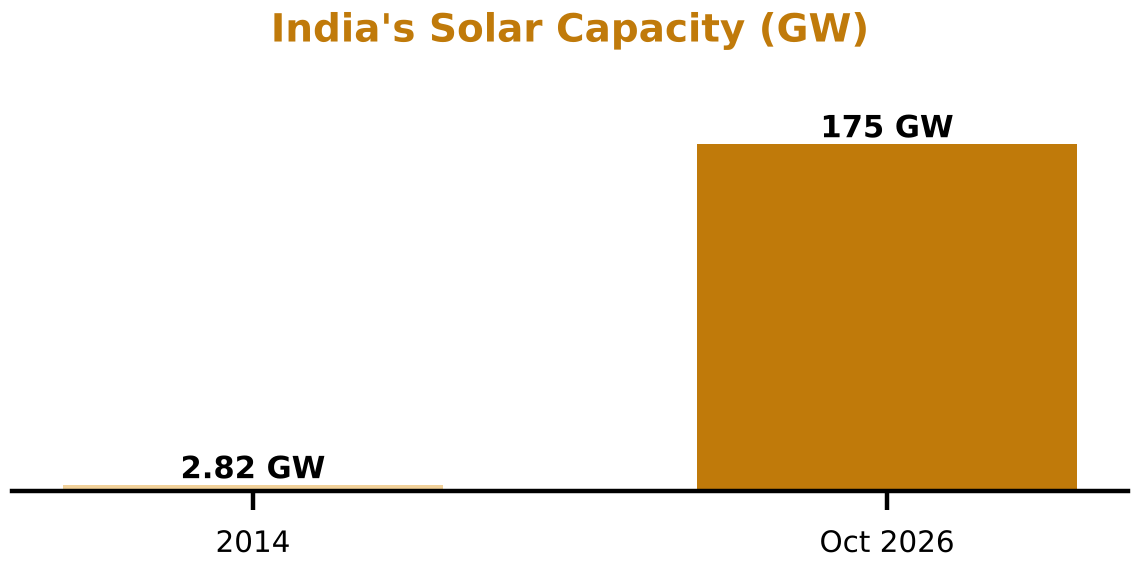
Solar capacity up from 2.82 GW (2014) to about 175 GW
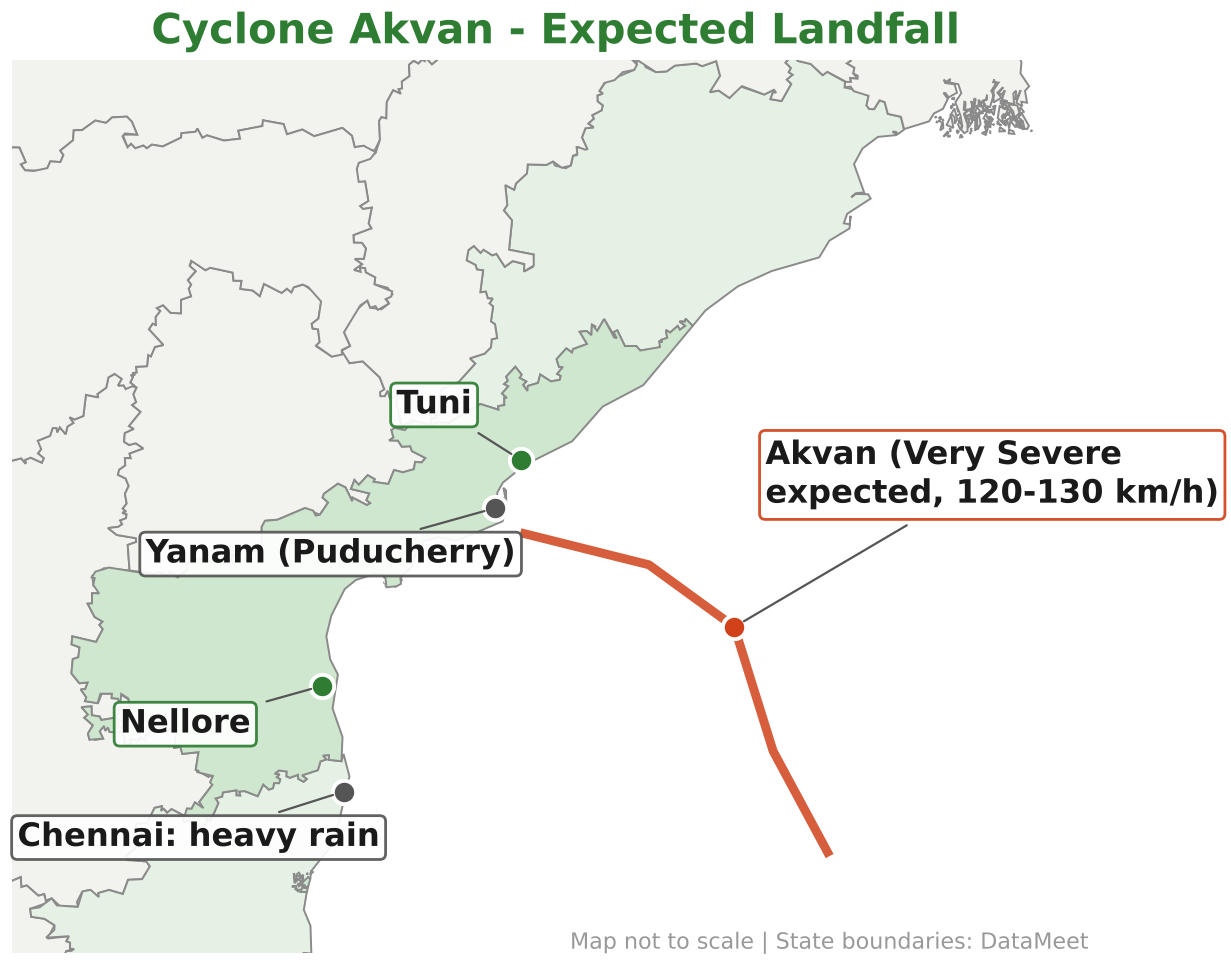
Cyclone Akvan likely to cross between Nellore and Tuni on 20 November
Voyager 1 is one light-day (about 26 billion km) from Earth
Detailed notes
1. India Votes Against UN Death-Penalty Pause
POLITYUPSC: Prelims + Mains GS2
Syllabus linkage
GS2 - Indian Constitution (Art. 21, 72, 161), judiciary, criminal justice reform; GS4 ethics of punishment. Prelims: landmark cases, clemency Articles; Mains: retention vs abolition.
Context
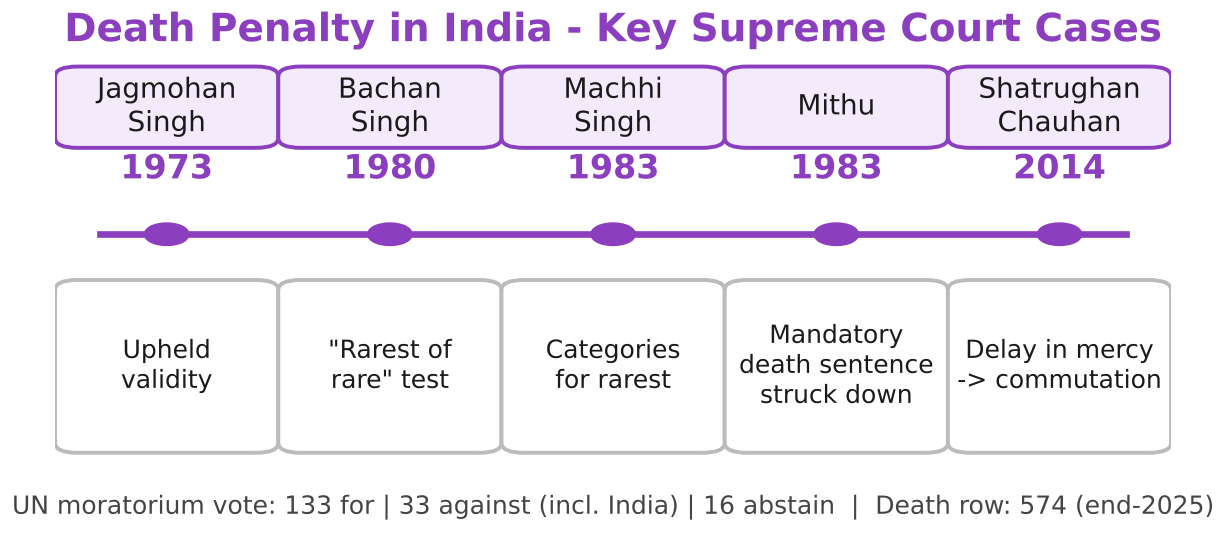
Most UN members voted for a worldwide pause on executions. India voted no, saying each country should decide its own criminal laws. An editorial asked whether our justice system is error-free enough to keep the death penalty. The UN General Assembly adopted a resolution calling for a global moratorium (a temporary stop) on the death penalty by 133 votes to 33, with 16 abstentions. India voted against it, along with the US, China, Japan, Pakistan, Iran and several Gulf countries. India's stand is that this is a matter of national law (sovereignty). At home, 574 people were on death row at the end of 2025, the highest since 2016. India's last executions were in 2020 (the 2012 Delhi gang-rape case).
Key facts
UN vote: 133 for, 33 against (incl. India), 16 abstentions
Death row in India: 574 (31 Dec 2025) - highest since 2016
Supreme Court freed 38 death-row prisoners in 2016-2025, after about 8 years each on death row (Project 39A data)
BNS (new criminal code) added capital offences such as gang rape of a girl below 18 and mob lynching
Law Commission 262nd Report (2015, Justice A.P. Shah): abolish except for terrorism and waging war
Way forward
Strengthen legal aid and forensic investigation, fix delays in mercy petitions, and hold an informed national debate on whether to limit the death penalty to the gravest crimes.
Concept
Article 21: life can be taken only by a 'procedure established by law' - so the death penalty is legal if the procedure is fair, just and reasonable. Clemency: the President (Art. 72) and Governors (Art. 161) can pardon, reduce or change a sentence. Only the President can pardon a death sentence. 'Rarest of rare' (Bachan Singh, 1980): death only when life imprisonment is clearly not enough. A Sessions Court death sentence must be confirmed by the High Court. Exam angle: Prelims: match cases (Jagmohan 1973, Bachan Singh 1980, Machhi Singh 1983, Mithu 1983, Shatrughan Chauhan 2014) with what they held; difference between Art. 72 and Art. 161. Mains: 'Is the death penalty a deterrent?' - discuss errors, delay, poverty of convicts and victims' rights.
Timeline of key Supreme Court death-penalty cases from 1973 to 2014, with the UN vote and death-row figures — StudyForGS
2. Transgender Amendment: Rights vs Medical Test
POLITYUPSC: Prelims + Mains GS2
Syllabus linkage
GS2 - Welfare of vulnerable sections, fundamental rights (Art. 14, 15, 19, 21), role of NHRC. Prelims: NALSA 2014, Transgender Act 2019; Mains: self-identification vs verification.
Context
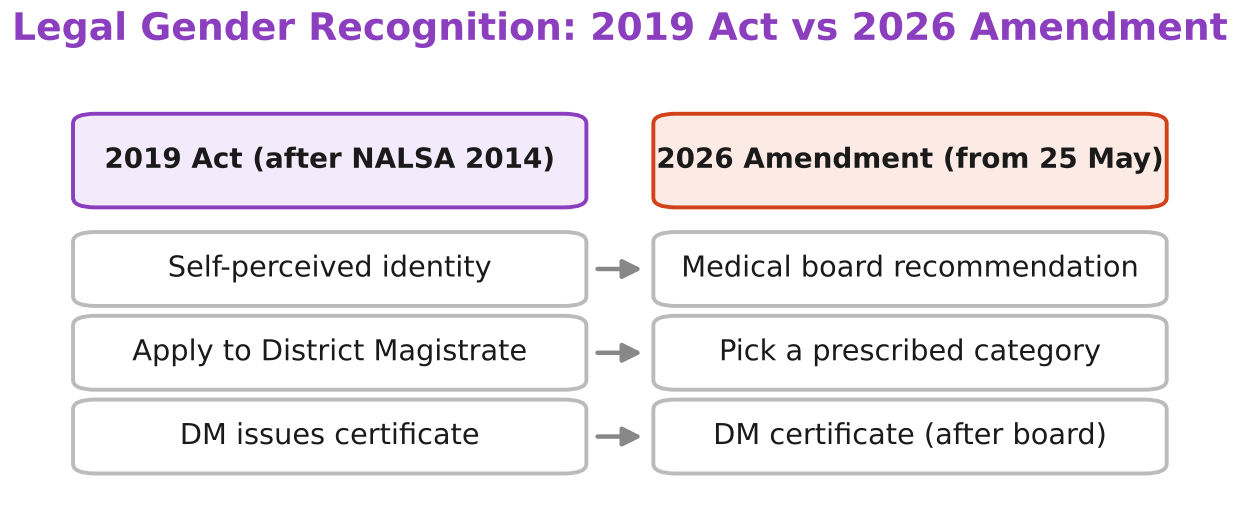
Earlier, a transgender person could get legal recognition based on how they see themselves. A 2026 amendment now needs a medical board's opinion. Doctors writing in a newspaper say this can hurt both rights and healthcare. The Transgender Persons (Protection of Rights) Amendment Act, 2026 got Presidential assent on 30 March 2026 and came into force on 25 May 2026. It removes 'self-perceived gender identity'. A person now needs a medical board's recommendation, must choose from prescribed categories, and then gets a District Magistrate (DM) certificate. Physicians and public health experts argued that this goes against the NALSA judgment and global medical guidelines, and may delay gender-affirming care.
Key facts
Amendment in force: 25 May 2026 (assent 30 March 2026)
Removes self-perceived identity; medical board + DM certificate now needed
Keeps socio-cultural identities like kinner, hijra, aravani and jogta, but even these need medical certification
Raises penalties for forcing someone into a transgender identity
NHRC's 2026 advisory had recommended self-identification
Way forward
Create an independent appeal process, separate identity recognition from welfare checks, train health staff, and consult the community while framing rules.
Concept
NALSA v. Union of India (2014): Supreme Court recognised the 'third gender' and the right to self-identify one's gender under Articles 14, 15, 19 and 21. Transgender Persons (Protection of Rights) Act, 2019: banned discrimination in jobs, education and health; set up the National Council for Transgender Persons; DM gives identity certificate. ICD-11 (WHO, 2019): removed 'gender incongruence' from the list of mental disorders - it is now under sexual health, not illness. Exam angle: Prelims: which case recognised third gender (NALSA 2014); who issues the certificate (DM). Mains: balancing welfare targeting (stopping misuse of benefits) with dignity, privacy (Puttaswamy 2017) and access to healthcare.
Comparison of the legal gender recognition process under the 2019 Act and the 2026 Amendment — StudyForGS
3. J&K Violence Revives Statehood Debate
POLITYUPSC: Prelims + Mains GS2
Syllabus linkage
GS2 - Federalism, Union Territories, Art. 3 and 4; GS3 - internal security, terrorism. Prelims: J&K Reorganisation Act 2019, LAHDC; Mains: statehood and security.
Context
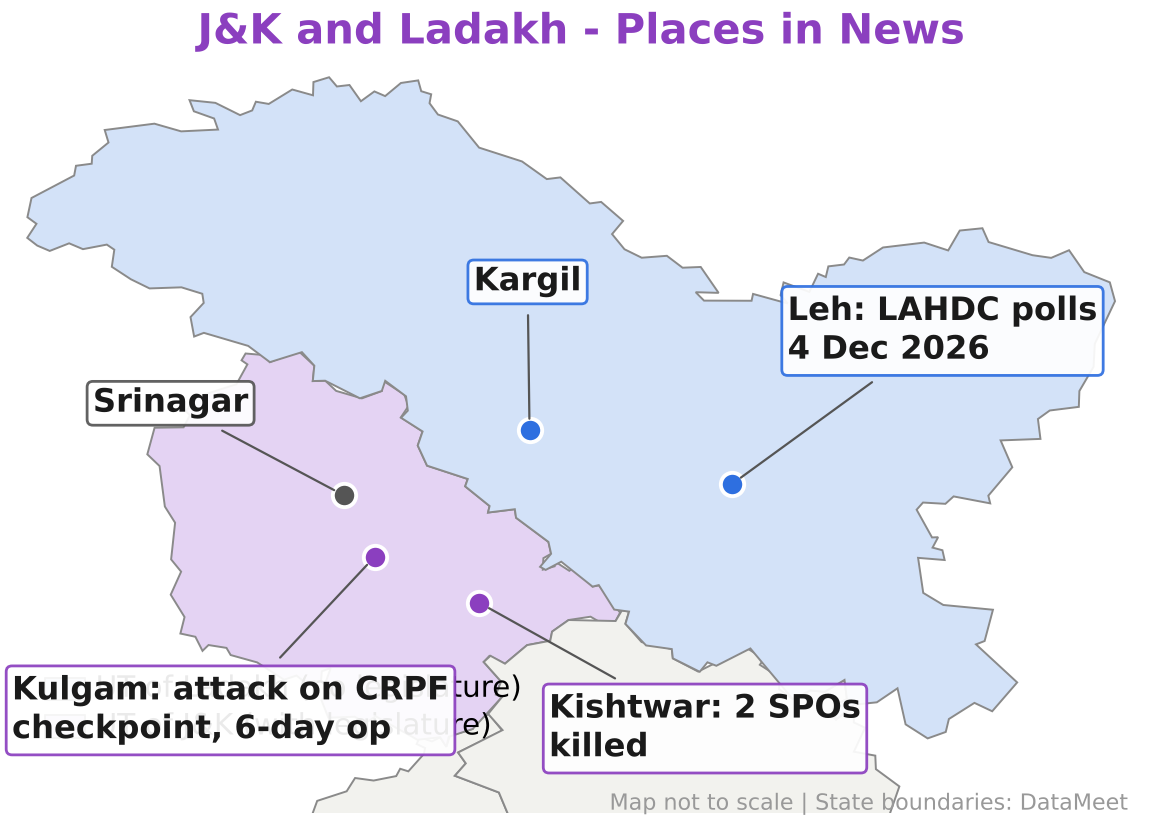
A string of militant attacks in Jammu and Kashmir has restarted the argument over when J&K will become a full State again. Its elected government has little control over police, which is with the Lieutenant Governor. Since 11 November 2026, there was an attack on a CRPF checkpoint in Kulgam (three jawans injured), two Special Police Officers were killed in Kishtwar, and a six-day anti-terror operation took place in Kulgam's residential areas. An editorial argued that restoring statehood is essential for lasting peace. The Centre says statehood will come 'at an appropriate time', and police say local recruitment into terror groups has fallen to single digits. In neighbouring Ladakh, 541 candidates are contesting 100 seats in the Ladakh Autonomous Hill Development Council (LAHDC) polls on 4 December 2026.
Key facts
5-6 Aug 2019: Article 370 made inoperative; J&K Reorganisation Act passed
31 Oct 2019: J&K became a UT with a legislature; Ladakh a UT without one
11 Dec 2023: Supreme Court (In re Article 370) upheld the move and recorded the Centre's promise on statehood
Sept-Oct 2024: Assembly elections; Omar Abdullah-led government formed
Public order and police in J&K are with the Lieutenant Governor
Way forward
A clear, time-bound roadmap to statehood, people-friendly security operations, and better Centre-UT coordination on counter-terrorism and youth jobs.
Concept
Article 3: Parliament can form new States, change boundaries or names by law (simple majority). Article 4 says such laws are not constitutional amendments under Art. 368. UT with legislature (like Delhi, Puducherry, J&K): has an elected Assembly and CM, but the Centre's representative (LG) keeps key powers. LAHDC: elected hill councils for Leh and Kargil that handle local development; they are Ladakh's main local democratic body. Exam angle: Prelims: Articles 3, 4, 239A; which UTs have legislatures. Mains: 'Restoration of statehood is both a democratic promise and a security question' - discuss.
Map of Jammu and Kashmir and Ladakh marking Kulgam, Kishtwar, Srinagar, Leh and Kargil — StudyForGS
4. Voter Rolls Grow After Special Revision
POLITYUPSC: Prelims + Mains GS2
Syllabus linkage
GS2 - Elections, Election Commission, Representation of the People Act 1950. Prelims: SSR vs SIR, Art. 324-326; Mains: clean and inclusive electoral rolls.
Context
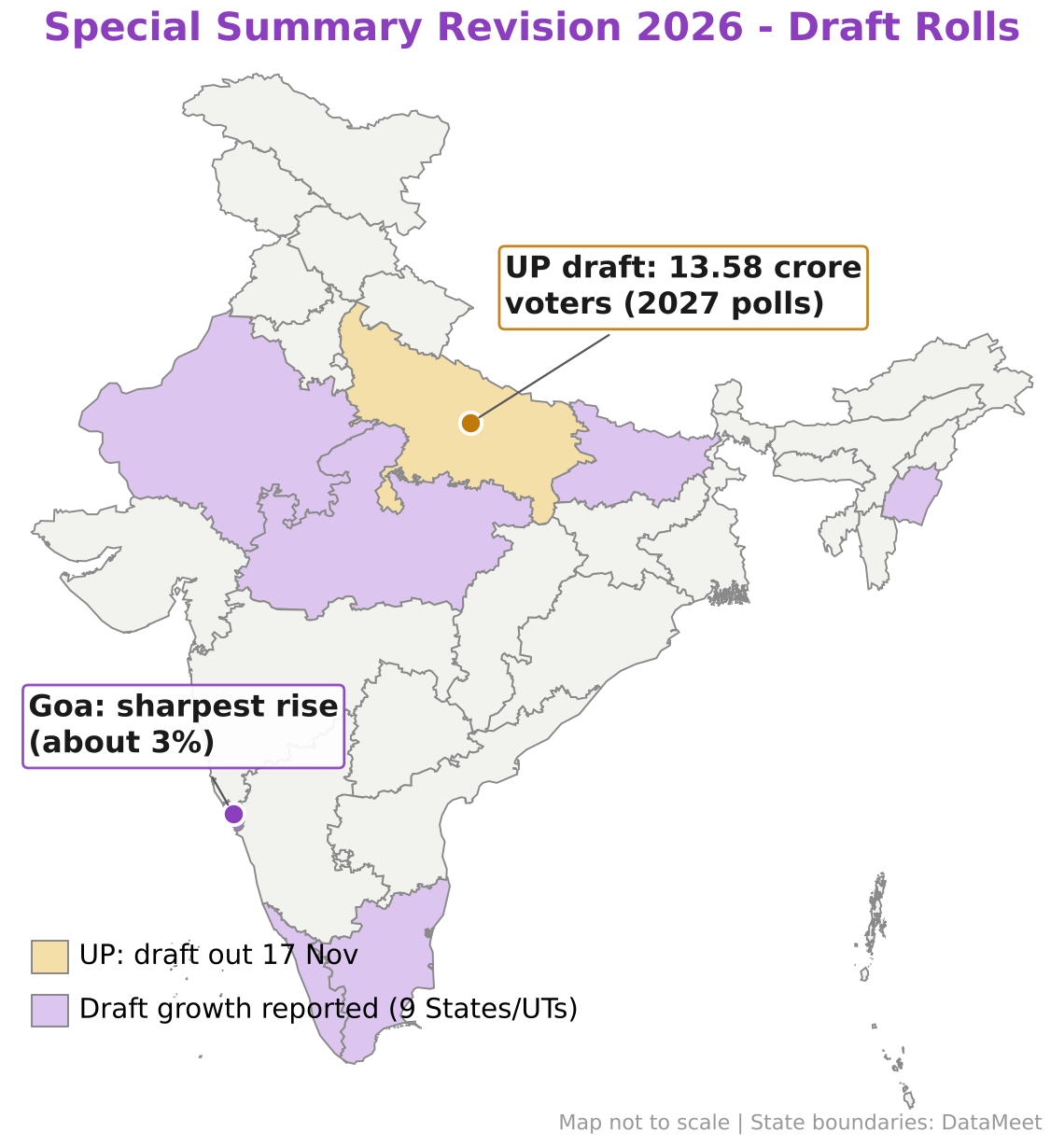
The Election Commission is updating voter lists across many States. Draft lists show nearly 75 lakh new names in 13 States/UTs, with Goa showing the biggest jump. Uttar Pradesh's draft list has 13.58 crore voters. After last year's Special Intensive Revision (SIR) of rolls, the Election Commission (ECI) restarted the regular Special Summary Revision (SSR), announced on 15 October 2026 for 17 States/UTs. Draft rolls added nearly 75 lakh names in 13 States/UTs. Goa saw the sharpest rise (about 3%), followed by Rajasthan (2.22%), and Bihar and Tamil Nadu (1.8% each). UP's draft roll, published on 17 November, has 13.58 crore voters ahead of the 2027 Assembly polls; claims and objections are open till 16 December and the final roll is due on 4 January 2027.
Key facts
Nearly 75 lakh names added in draft rolls of 13 States/UTs
UP draft: 13.58 crore voters; claims till 16 Dec 2026; final roll 4 Jan 2027
SSR = routine yearly update; SIR = fresh house-to-house verification
Assam held a separate Special Revision instead of the SIR
Way forward
Use door-to-door checks plus technology carefully, give voters easy ways to file claims, and publish deletion lists transparently.
Concept
Article 324: Election Commission superintends, directs and controls the preparation of electoral rolls and conduct of elections to Parliament, State legislatures, President and Vice-President. Article 326: elections on adult suffrage - every citizen aged 18 or above (lowered from 21 by the 61st Amendment, 1988). Representation of the People Act, 1950: deals with electoral rolls and seats; the 1951 Act deals with conduct of elections and disputes. Exam angle: Prelims: Articles 324-326, 61st Amendment, which Act covers electoral rolls (RPA 1950). Mains: how to keep rolls both clean (no duplicates/dead voters) and inclusive (no wrongful deletion).
India map showing States with draft electoral roll growth, Goa with the sharpest rise, and Uttar Pradesh — StudyForGS
5. VISTAR: AI Meets Official Statistics
POLITYUPSC: Prelims + Mains GS2
Syllabus linkage
GS2 - Government policies, governance; GS3 - Indian economy (data), AI. Prelims: VISTAR, MoSPI, synthetic data; Mains: data quality and policy-making.
Context
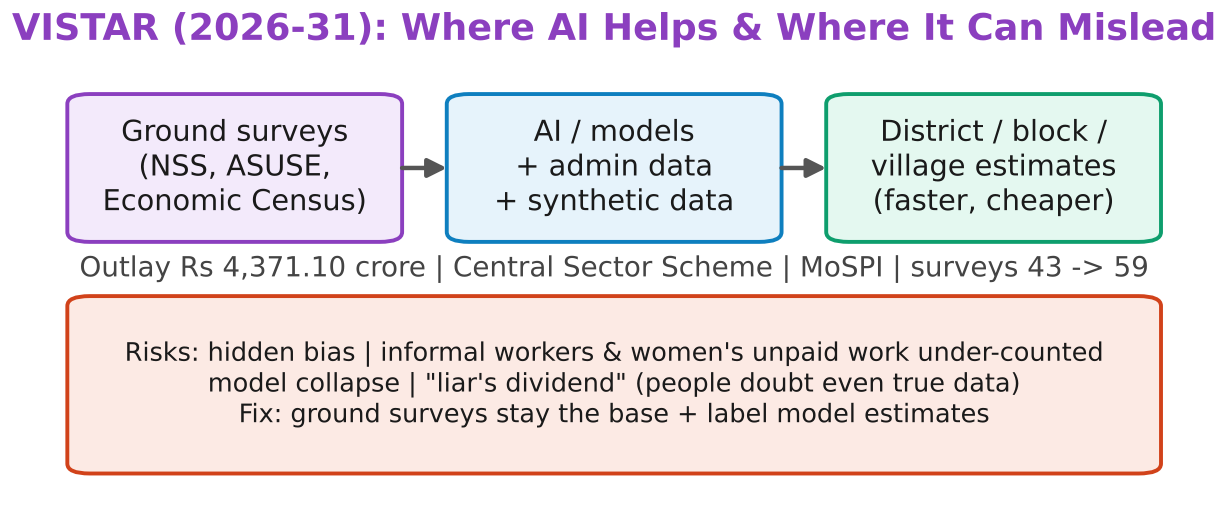
The government's new statistics scheme VISTAR wants to use AI to produce faster data down to village level. An editorial warns that computer-made estimates cannot replace real surveys on the ground. The Union Cabinet approved VISTAR (Viksit Bharat Initiative for Statistical Transformation, Analytics & Research) on 4 November 2026. It is a Central Sector Scheme run by MoSPI for 2026-27 to 2030-31 with an outlay of Rs 4,371.10 crore. Major surveys will rise from 43 to 59. An editorial welcomed AI for joining up administrative data and making district-level estimates, but warned that synthetic data can hide bias and under-count informal workers and women's unpaid work.
Key facts
Outlay: Rs 4,371.10 crore; period 2026-27 to 2030-31; Central Sector Scheme (100% Centre-funded)
Three parts: statistical operations and ecosystem, support to State statistics, Economic Census
Major surveys: 43 -> 59
ASUSE 2025 covered over 6.7 lakh establishments
Global reference: UNECE 2025 framework on responsible AI in official statistics
Way forward
Keep ground surveys as the base, label model-based estimates clearly, give statutory independence to the statistical system and train State statisticians.
Concept
Synthetic data: artificial data made by computer models (often GANs) that copies the patterns of real data - useful for privacy, risky if it copies hidden bias. Model collapse: when AI models are trained again and again on AI-made data, their quality keeps falling. Central Sector vs Centrally Sponsored: Central Sector schemes are fully funded and run by the Centre; Centrally Sponsored ones are shared with States. Exam angle: Prelims: VISTAR's ministry, outlay and type; meaning of synthetic data. Mains: 'Data is the foundation of good policy' - discuss AI's promise and risks in official statistics.
Diagram of VISTAR showing ground surveys, AI models and local estimates, with the risks involved — StudyForGS
6. Quad Summit in Manila: Sea, AI, Minerals
IRUPSC: Prelims + Mains GS2
Syllabus linkage
GS2 - Bilateral, regional and global groupings involving India; Indo-Pacific. Prelims: Quad initiatives, Malabar; Mains: Quad and India's strategic autonomy.
Context
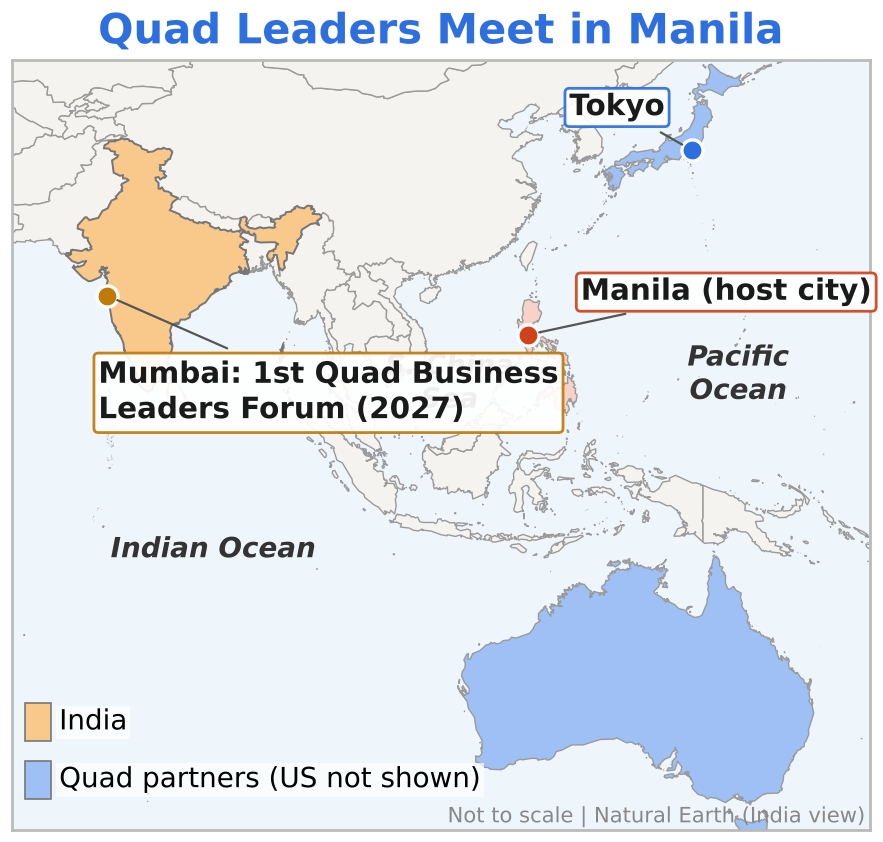
Leaders of India, the US, Japan and Australia met in Manila for the first Quad summit since 2024. They agreed to watch the seas together, fund trusted AI, guard against cyber attacks and secure critical minerals. The Quad Leaders' Meeting was held in Manila on the sidelines of the East Asia Summit, with PM Modi, US President Trump, Japan's PM Sanae Takaichi and Australia's PM Anthony Albanese. They launched an Indo-Pacific Maritime Surveillance Collaboration; patrol aircraft (P-8 and P-3C) of all four will fly together in an exercise in 2027 for the first time. A Quad AI Accelerator was announced, with the US pledging over US$85 million. The first Quad Business Leaders' Forum will be held in Mumbai in early 2027. The joint statement condemned cross-border terrorism and economic coercion through export curbs.
Key facts
Venue: Manila (Philippines); first Quad leaders' meeting since 2024
New: Indo-Pacific Maritime Surveillance Collaboration; joint P-8/P-3C flying in 2027
Quad AI Accelerator - US pledge above US$85 million
1st Quad Business Leaders' Forum: Mumbai, early 2027
30th Malabar naval exercise was held recently near Japan
Way forward
Turn announcements into time-bound projects, link Quad maritime awareness with India's IFC-IOR, and diversify mineral supply chains with partners.
Concept
Quad (Quadrilateral Security Dialogue): started 2007, revived 2017 in Manila; not a military alliance but a platform for a free, open, rules-based Indo-Pacific. Malabar: began in 1992 as an India-US naval exercise; Japan became a regular member in 2015 and Australia joined in 2020. Critical minerals: minerals like lithium, cobalt and rare earths needed for EVs, solar, chips and defence; supply is concentrated in a few countries. Exam angle: Prelims: Quad members, year of revival, Malabar members. Mains: 'Quad has moved from security to public goods' - examine with maritime, tech and minerals examples.
Indo-Pacific map showing Quad countries, host city Manila, Tokyo and Mumbai — StudyForGS
7. Modi at East Asia Summit: Peace, Seafarers
IRUPSC: Prelims + Mains GS2
Syllabus linkage
GS2 - India and its neighbourhood, regional groupings, Act East Policy. Prelims: EAS and ASEAN members, Nalanda, Lothal; Mains: ASEAN centrality and India.
Context
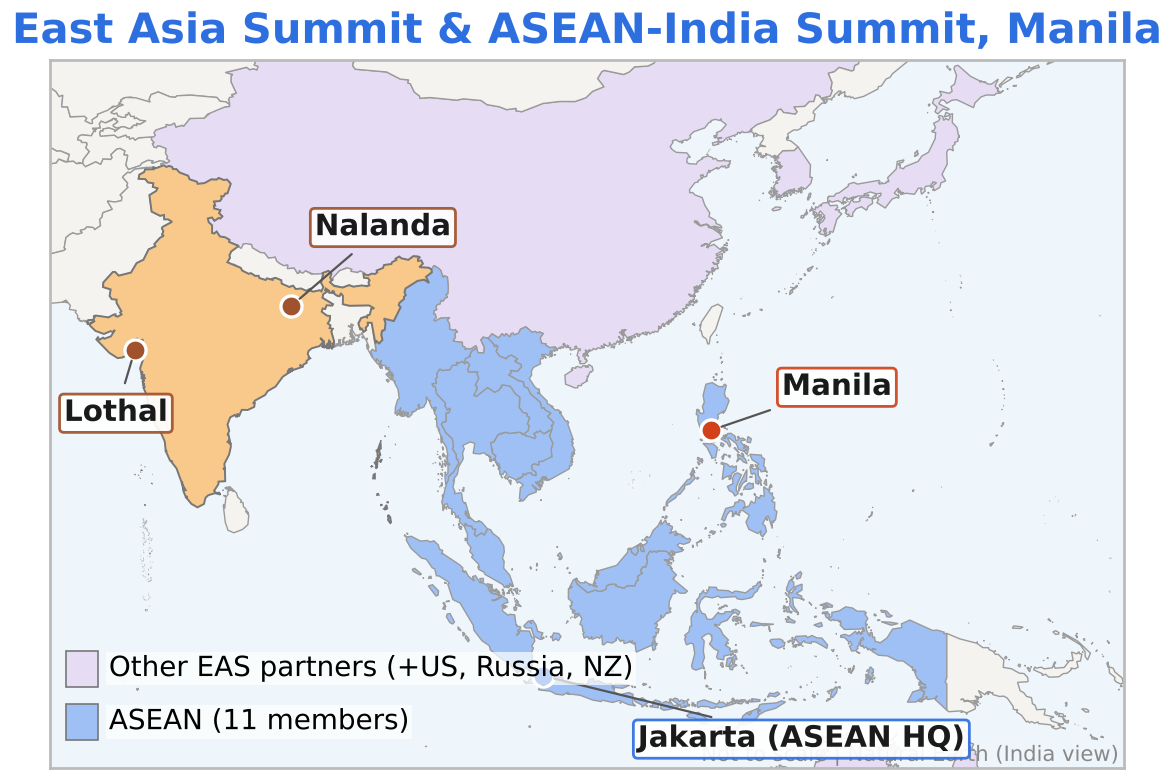
At the East Asia and ASEAN-India summits in Manila, PM Modi said the world needs peace and predictability. India offered new plans on sailor safety, cyber crime, free e-visas and education for Southeast Asia. PM Modi attended the 21st East Asia Summit (EAS) and the 23rd ASEAN-India Summit in Manila. He flagged attacks on ships carrying Indian sailors in the Strait of Hormuz and Black Sea; at least 22 Indians have reportedly been killed since the US-Israel war on Iran began in February 2026. India proposed an EAS seafarers' safety initiative, an ASEAN-India maritime cooperation plan, an EAS cyber crime conference at the National Forensic Sciences University, free e-visas for ASEAN tourists, a joint space hackathon and more Nalanda University scholarships.
Key facts
21st EAS and 23rd ASEAN-India Summit - Manila
Seafarers' safety initiative; joint EAS statement on online scams and cyber crime
Free e-visas proposed for ASEAN tourists; more Nalanda scholarships
EAS University Heads Conclave at Nalanda; Lothal maritime heritage complex showcased
India-ASEAN = nearly one-fourth of world population
Way forward
Uphold UNCLOS and peaceful settlement of sea disputes, and convert summit offers into time-bound projects in trade, connectivity and digital trust.
Concept
East Asia Summit: started 2005 (Kuala Lumpur); 11 ASEAN members + 8 partners (India, China, Japan, South Korea, Australia, New Zealand, US, Russia). India is a founding member. ASEAN: formed 1967 by the Bangkok Declaration; HQ Jakarta; Timor-Leste is the newest (11th) member. Act East Policy (2014): upgraded the 1991 Look East Policy - adds security, connectivity and the Northeast to trade ties. India-ASEAN ties became a Comprehensive Strategic Partnership in 2022. Exam angle: Prelims: EAS membership, ASEAN HQ and founding year, ASEAN's newest member. Mains: role of ASEAN centrality in India's Indo-Pacific vision.
Map of East and Southeast Asia showing ASEAN members, other EAS partners, Manila, Jakarta, Lothal and Nalanda — StudyForGS
8. India-Japan 2+2 Dialogue in Tokyo
IRUPSC: Prelims + Mains GS2
Syllabus linkage
GS2 - Bilateral relations; GS3 - defence cooperation. Prelims: 2+2 format, JIMEX, geography of Japan; Mains: India-Japan Special Strategic and Global Partnership.
Context
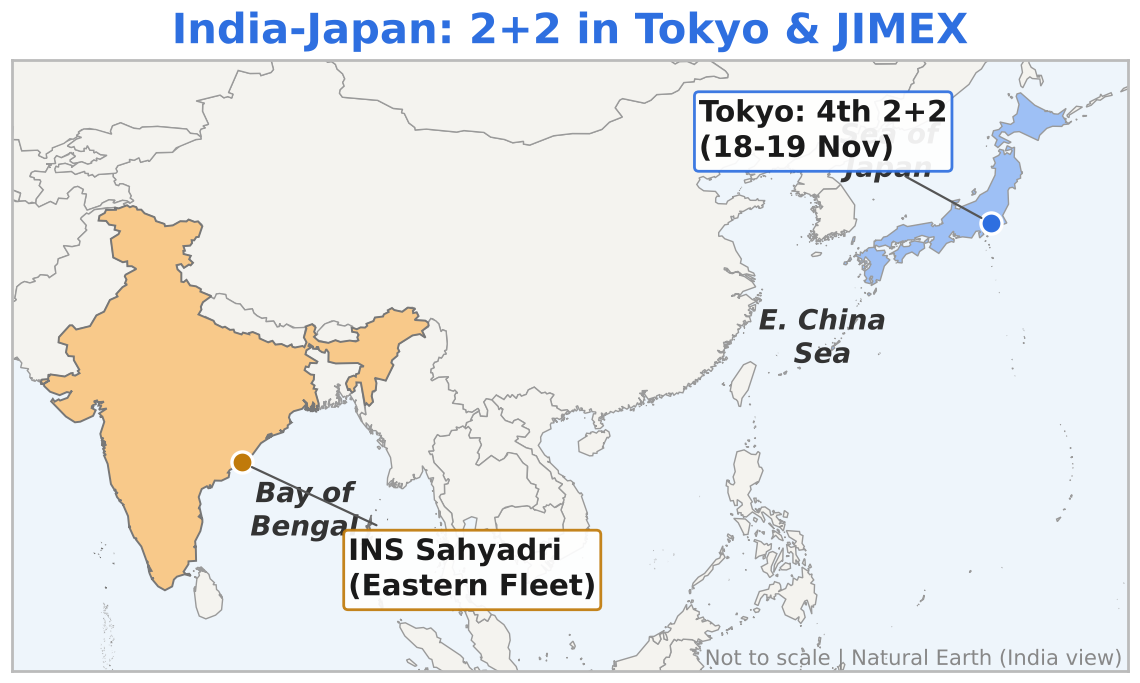
India's Defence and External Affairs Ministers are meeting their Japanese counterparts in Tokyo. Just before this, the two navies held the JIMEX exercise. Defence Minister Rajnath Singh and External Affairs Minister S. Jaishankar are in Tokyo for the 4th India-Japan Foreign and Defence Ministers' (2+2) Dialogue on 18-19 November 2026, with Japan's Defence Minister Shinjiro Koizumi and Foreign Minister Toshimitsu Motegi. The agenda includes defence technology, maritime security, tri-service exercises and defence industry links. Earlier, on 13-14 November, INS Sahyadri and JS Ise held JIMEX 2026 with manoeuvres and cross-deck helicopter landings.
Key facts
4th 2+2 Dialogue: Tokyo, 18-19 Nov 2026
Japan side: Defence Minister Koizumi, Foreign Minister Motegi
JIMEX 2026: INS Sahyadri + JS Ise, 13-14 Nov
Ties: 'Special Strategic and Global Partnership' (since 2014)
Japan: Hokkaido, Honshu, Shikoku, Kyushu; Mt Fuji 3,776 m; on the Pacific Ring of Fire
Way forward
Push joint defence manufacturing, bigger tri-service drills and Japan-backed projects in India's Northeast and Andaman and Nicobar Islands.
Concept
2+2 Dialogue: joint meeting of the foreign and defence ministers of two countries. India holds it with the US, Japan, Australia, Russia and a few others. JIMEX: Japan-India Maritime Exercise, started in 2012. Pacific Ring of Fire: horseshoe-shaped belt around the Pacific with most of the world's earthquakes and volcanoes, due to plate subduction. Exam angle: Prelims: India's 2+2 partners, JIMEX participants, Japan's islands and seas (Sea of Japan, Sea of Okhotsk, East China Sea). Mains: Japan's role in India's infrastructure (bullet train) and Indo-Pacific security.
Map of India and Japan marking the 2+2 dialogue in Tokyo and the base of INS Sahyadri — StudyForGS
9. US Closes Cloud Loophole on AI Chips
IRUPSC: Prelims + Mains GS3
Syllabus linkage
GS2 - Effect of policies of developed countries on India's interests; GS3 - science and technology, semiconductors. Prelims: export controls, Wassenaar; Mains: tech geopolitics.
Context
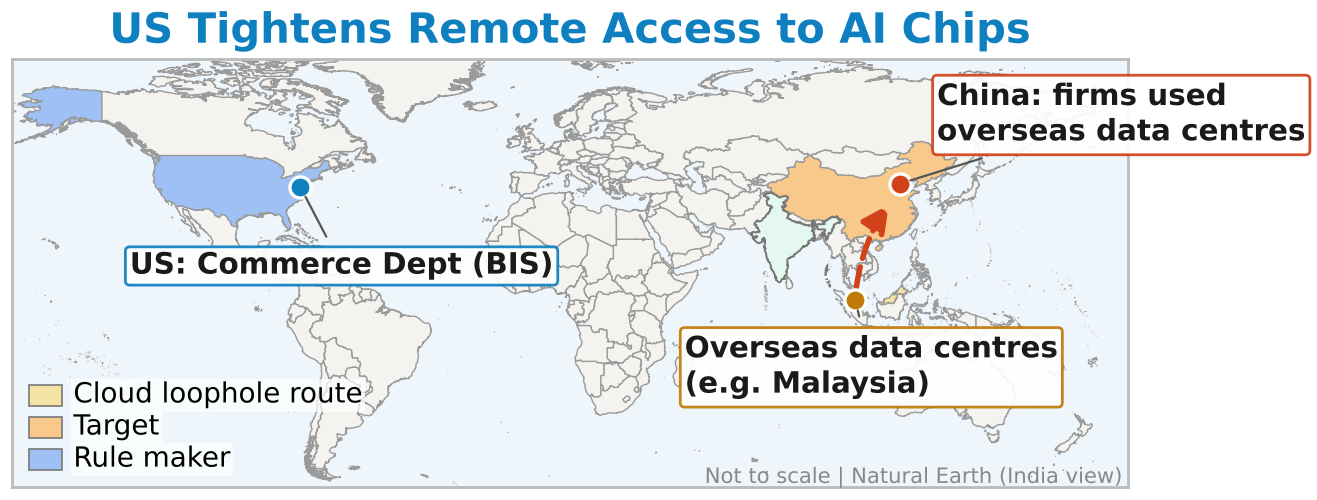
The US already stopped selling top AI chips to China. Chinese firms were still renting them through data centres in other countries. A new US rule now blocks this remote access too, and China has protested. The US Commerce Department's Bureau of Industry and Security (BIS) issued a rule restricting remote access to advanced AI chips and servers. Since October 2022, US firms have needed a licence to sell advanced chips to China, but Chinese companies could still use them through overseas data centres, for example in Malaysia. The rule came amid a probe into Singapore-based Megaspeed. China criticised the restrictions.
Key facts
Issued by: US Bureau of Industry and Security (BIS)
Targets: 'cloud loophole' - renting chips via overseas data centres
Base controls on advanced chip sales to China in place since October 2022
Probe centred on Singapore-based Megaspeed operating in Malaysia
China says the curbs are unfair restrictions
Way forward
India should build trusted compute at home, speed up chip fabs under the India Semiconductor Mission and keep clean compliance to attract global data centres.
Concept
Export controls: government rules that limit the sale of sensitive goods or technology abroad for security reasons. Wassenaar Arrangement: multilateral export-control regime for conventional arms and dual-use goods; India joined in 2017. IndiaAI Mission (2024, about Rs 10,372 crore): builds public GPU compute capacity in India so start-ups and researchers can access AI chips. Exam angle: Prelims: India's membership of export-control regimes (MTCR 2016, Wassenaar 2017, Australia Group 2018; not NSG). Mains: how US-China tech rivalry creates risks and openings for India's semiconductor mission.
World map showing the US, China and the overseas data-centre route through Malaysia and Singapore — StudyForGS
10. Gulf Flare-Up: Bahrain Hit, Indian Crew at Risk
IRUPSC: Prelims + Mains GS2
Syllabus linkage
GS2 - West Asia, Indian diaspora, effect of conflicts on India; GS3 - energy security. Prelims: Hormuz, Bahrain, Fifth Fleet; Mains: protecting Indian seafarers.
Context
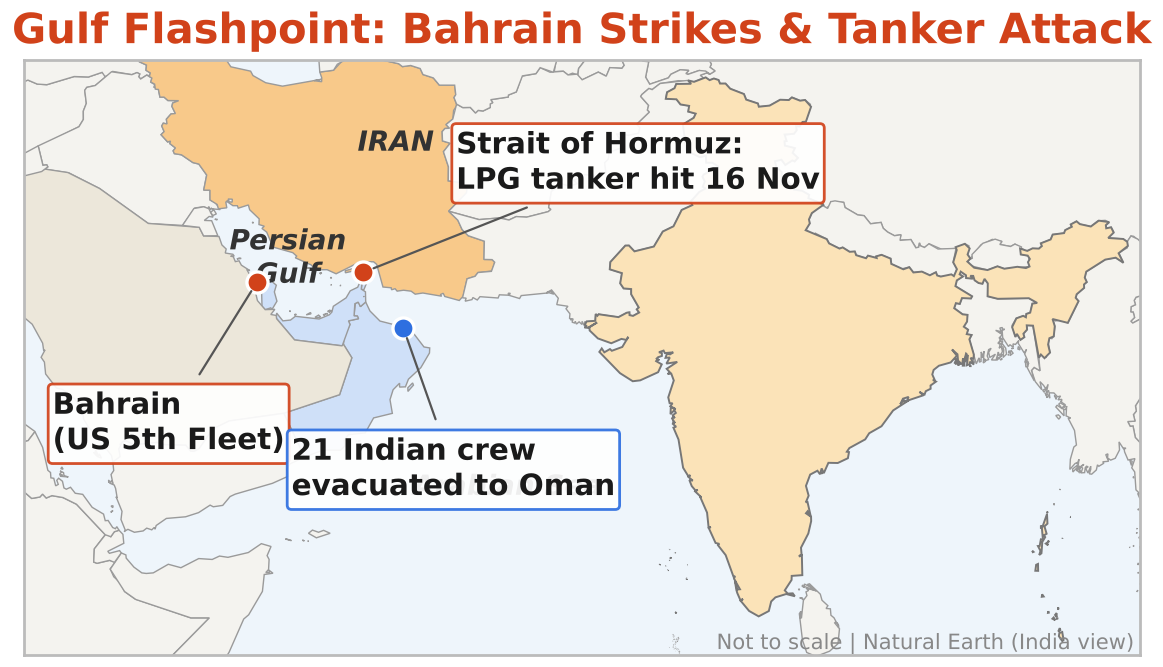
Iran launched drones at a US base in Bahrain and a gas tanker with Indian sailors was attacked in the Strait of Hormuz. India condemned the tanker attack. These events threaten India's energy supply and its sailors. Iran's Revolutionary Guards said they launched drones at a US radar at the Al-Rifaa base in Bahrain; Bahrain said it intercepted several attacks. Iran also called a report about a 'dirty bomb' fabricated. On 16 November, the Panama-flagged LPG tanker MT Tara Gas was attacked in the Strait of Hormuz; of its 24 Indian crew, 21 were evacuated to Oman and one is missing. India condemned the attack. The US-Iran conflict began on 28 February 2026 with US and Israeli strikes on Iran.
Key facts
MT Tara Gas (Panama flag) attacked 16 Nov; 24 Indian crew - 21 evacuated to Oman, one missing
Bahrain hosts the US Navy's Fifth Fleet
War began 28 Feb 2026; a US naval blockade of Iran continues
At least 22 Indian nationals reportedly killed since February
Dirty bomb = normal explosive that spreads radioactive material
Way forward
Naval escort operations, diversified energy sources, strategic LPG reserves and a strong seafarers' welfare and evacuation plan.
Concept
Strait of Hormuz: narrow sea route between Iran and Oman linking the Persian Gulf to the Gulf of Oman and Arabian Sea - a 'chokepoint' (a narrow route many ships must use) for oil and LPG. Flag state: the country where a ship is registered; it has legal responsibility for the ship (UNCLOS). Many ships use 'flags of convenience' like Panama. Gulf Cooperation Council (GCC, 1981): Saudi Arabia, UAE, Qatar, Kuwait, Oman and Bahrain - home to about 9 million Indians. Exam angle: Prelims: map - Hormuz, Bahrain, Gulf of Oman, Chabahar. Mains: 'Seafarer safety is now an energy security issue for India' - discuss with diaspora and LPG imports.
Persian Gulf map showing Bahrain, the Strait of Hormuz, Oman and India — StudyForGS
📜 Asked before in the exam — previous-year question on this topic
UPSC Prelims 2016Which of the following is not a member of 'Gulf Cooperation Council'?
Iran
Saudi Arabia
Oman
Kuwait
Show answer
Answer: (a) Iran The Gulf Cooperation Council, formed in 1981 with its headquarters in Riyadh, is a political and economic union of six Arab monarchies of the Persian Gulf: Saudi Arabia, Kuwait, the United Arab Emirates, Qatar, Bahrain and Oman. Iran, though it has the longest Gulf coastline, is not a member, and Iraq and Yemen are also outside it. Hence option (a). Practise all UPSC Prelims 2016 paper (free) →
Linked because this news is about the same topic. The answer is as per the official key of that year.
11. Rooppur Nuclear Plant Begins Trial Run
IRUPSC: Prelims + Mains GS2
Syllabus linkage
GS2 - India and neighbourhood (Bangladesh); GS3 - nuclear energy. Prelims: Rooppur location, VVER reactors; Mains: India-Russia-Bangladesh nuclear cooperation.
Context
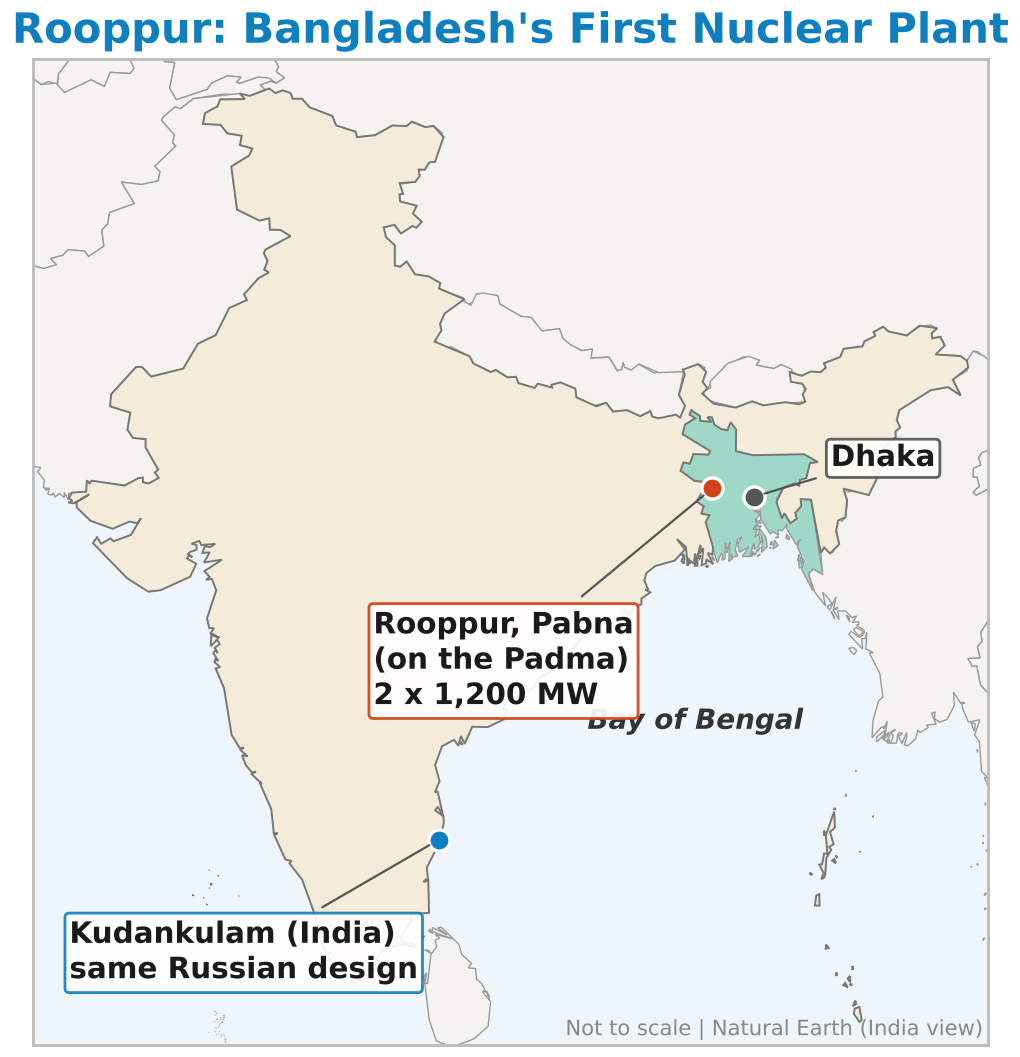
Bangladesh's first nuclear power plant at Rooppur has started trial operations. It is built with Russian help and can supply power to the grid from about December 2026. The Rooppur Nuclear Power Plant at Ishwardi in Pabna district, on the Padma river, has two units of 1,200 MW each, built by Russia's Atomstroyexport. Nuclear fission began on 11 October 2026 and the regulator approved 'power start' on 29 October. Each unit can begin feeding the grid at about 300 MW (30% output), possibly from December 2026. The total cost is about Tk 1.39 trillion.
Key facts
Location: Ishwardi, Pabna (Bangladesh), on the Padma
Capacity: 2 x 1,200 MW (Russian VVER-1200 design)
Fission began: 11 Oct 2026; power start approved: 29 Oct 2026
Operator: Nuclear Power Plant Company Bangladesh Ltd
India, Russia and Bangladesh signed an MoU in 2018 for Indian firms to help in the project
Way forward
India can offer training, supplies and grid links, while the region builds strong nuclear safety and waste-handling systems.
Concept
VVER: Russian pressurised water reactor design; India's Kudankulam plant (Tamil Nadu) uses the same family. Nuclear fission: splitting heavy atoms like uranium-235 to release heat, which makes steam to run turbines. IAEA (1957, Vienna): UN-linked body that promotes peaceful nuclear energy and checks safeguards. Exam angle: Prelims: Rooppur location and partner country; Kudankulam reactor type. Mains: India as a partner in third-country nuclear projects and energy diplomacy in South Asia.
Map of India and Bangladesh marking the Rooppur plant, Dhaka and Kudankulam — StudyForGS
12. Naturopathy Day Focuses on Obesity
HEALTHUPSC: Prelims + Mains GS2
Syllabus linkage
GS2 - Health, AYUSH; GS1 - Gandhi's ideas. Prelims: day, venue, NIN Pune, BNYS; Mains: role of traditional systems in preventive care.
Context
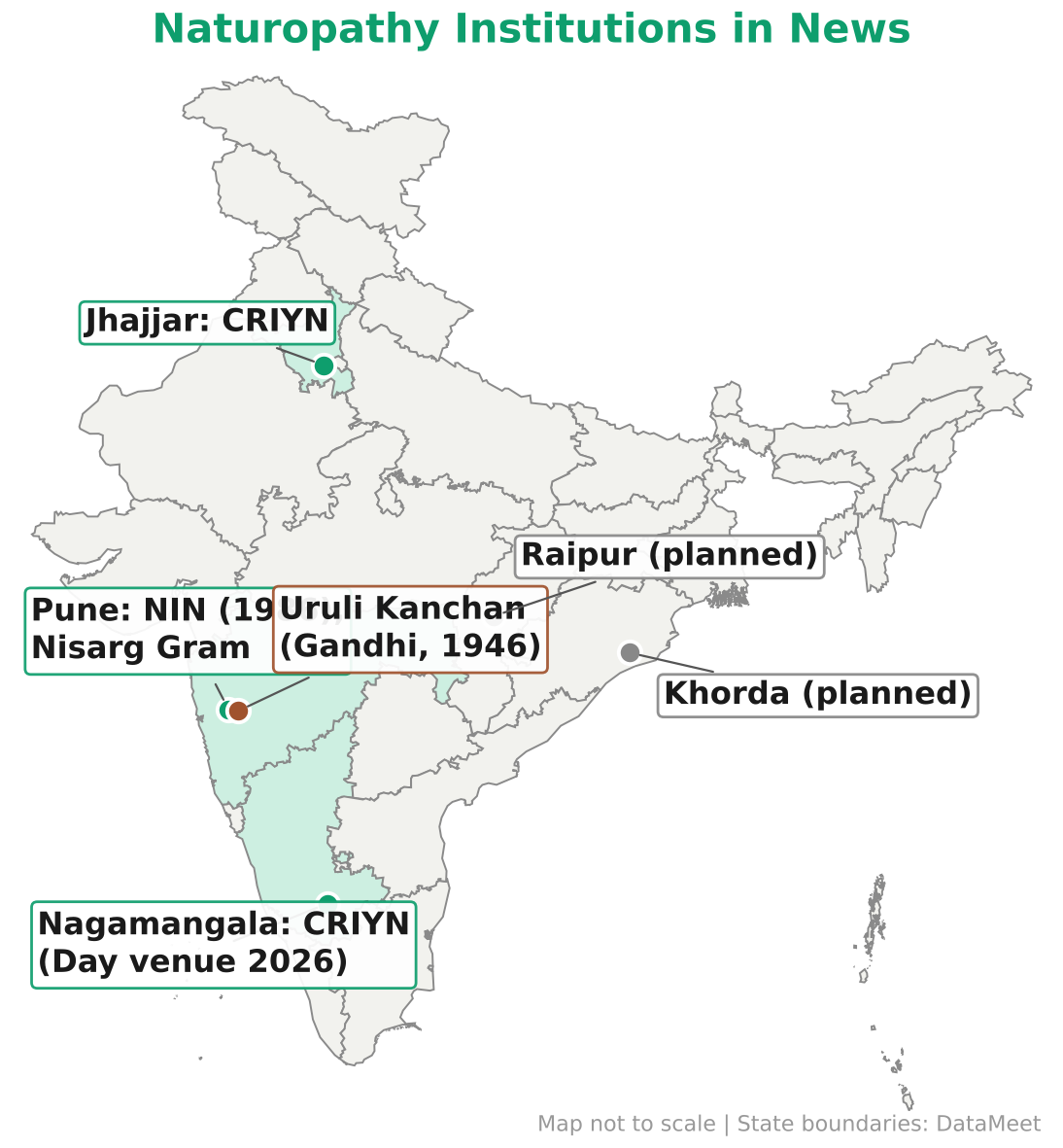
India marked the 9th National Naturopathy Day on 18 November, linked to Mahatma Gandhi. This year's focus is preventing obesity through diet, fasting, yoga and natural living. The 9th National Naturopathy Day was observed on 18 November 2026 at the Central Research Institute of Yoga and Naturopathy (CRIYN), Nagamangala, Karnataka, with the theme 'Prakrutik Chikitsa, Swasth Bharat'. The day marks 18 November 1945, when Gandhi became Lifetime Chairman of the All India Nature Cure Foundation Trust, Pune. It has been observed since 2018. Naturopathy is a drug-free system using diet, fasting, water, mud, sunlight and air.
Key facts
9th National Naturopathy Day: 18 Nov 2026; venue CRIYN Nagamangala; focus on obesity
Origin: Gandhi's 1945 chairmanship of nature cure trust, Pune; observed since 2018
NIN Pune (est. 1986) - Nisarg Gram campus with 250-bed hospital and 100 BNYS seats
CRIYNs at Jhajjar and Nagamangala; two more planned at Khorda and Raipur
Foreign patients under Ayush: 1.83 lakh (2020) -> 6.44 lakh (2024); Ayush Visa since July 2023
Way forward
Build evidence through good trials, set national standards for education and practice, and use naturopathy alongside, not instead of, proven treatment.
Concept
Naturopathy: based on 'Panchabhuta' (five elements) and the body's power to heal itself; paired with yoga for lifestyle diseases. Ministry of Ayush: full ministry since 2014. NCISM Act and NCH Act (2020) regulate Ayurveda, Unani, Siddha, Sowa-Rigpa and Homoeopathy - but yoga and naturopathy have no national statutory commission. Drugs and Magic Remedies (Objectionable Advertisements) Act, 1954: bans ads claiming to cure listed diseases. Exam angle: Prelims: date and Gandhi link, NIN location, which systems NCISM covers. Mains: integrating Ayush with modern medicine - evidence, regulation and patient safety.
India map marking naturopathy institutions at Pune, Uruli Kanchan, Nagamangala, Jhajjar and planned sites at Khorda and Raipur — StudyForGS
13. ICMR Report: Antibiotics Losing Power
HEALTHUPSC: Prelims + Mains GS2
Syllabus linkage
GS2 - Health; GS3 - biotechnology. Prelims: AMR, ICMR AMRSN, awareness week; Mains: One Health approach to AMR.
Context
A new ICMR report shows common antibiotics are failing against more bacteria, and the problem is spreading even to smaller hospitals. It comes as World AMR Awareness Week starts on 18 November. The ICMR's Antimicrobial Resistance Research and Surveillance Network (AMRSN) Annual Report 2025 found falling effectiveness of antibiotics. E. coli was the most common disease-causing bacterium found (24.4% of samples), and only 9% of E. coli samples responded to ciprofloxacin, a common antibiotic. Resistance is also spreading from big hospitals to smaller ones. World AMR Awareness Week is observed every year from 18 to 24 November.
Key facts
Report: ICMR AMRSN Annual Report 2025
E. coli = most common pathogen (24.4%)
Only 9% of E. coli samples susceptible to ciprofloxacin
Resistance spreading to smaller hospitals
World AMR Awareness Week: 18-24 November (led by WHO, FAO, UNEP, WOAH)
Way forward
Strict prescription rules, better hospital infection control, curbs on antibiotics in animal farming and funding for new antibiotics and diagnostics.
Concept
Antimicrobial resistance (AMR): when bacteria, viruses, fungi or parasites stop responding to medicines, so infections become harder to treat. One Health: human, animal and environmental health are linked - antibiotic use in poultry and leaking pharma waste also drive AMR. National Action Plan on AMR (2017) and the 'Red Line' campaign (2016): medicines with a red vertical line should be taken only on prescription. Exam angle: Prelims: what the red line on medicine packs means; AMR week dates; ICMR network. Mains: why AMR is a 'silent pandemic' and what India must do across hospitals, farms and pharma.
Flow diagram of how antibiotic resistance builds up, from overuse to drugs failing — StudyForGS
14. Malaria Down 80%: Last Mile Ahead
HEALTHUPSC: Prelims + Mains GS2
Syllabus linkage
GS2 - Health, government programmes. Prelims: malaria parasite and vector, elimination target; Mains: last-mile challenges in disease elimination.
Context
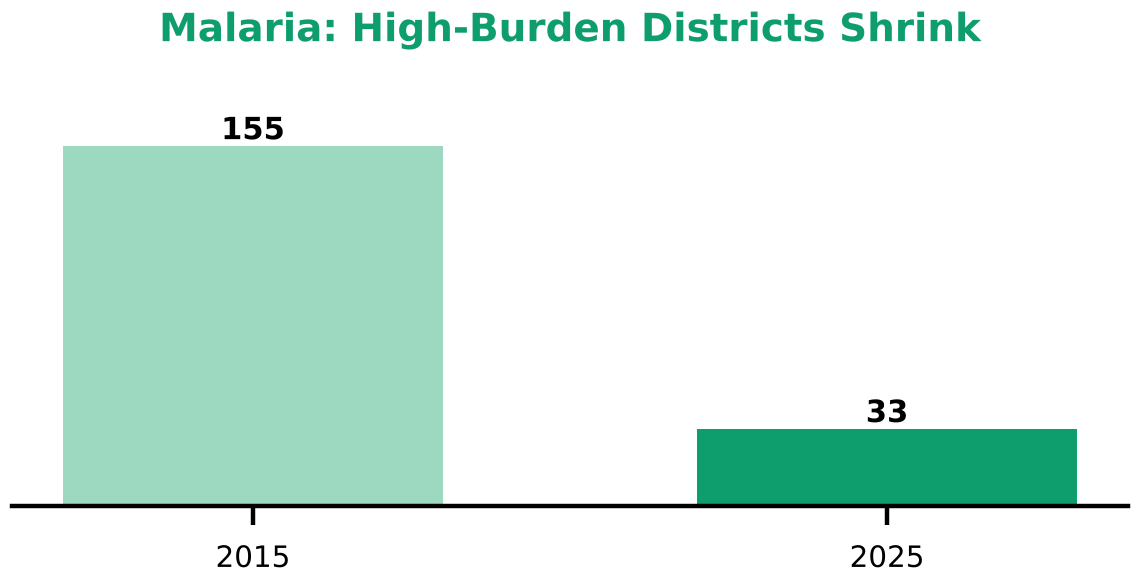
The President praised India's progress in controlling malaria. Cases and deaths have fallen by nearly 80% in ten years, but a few districts still carry most of the burden. President Droupadi Murmu hailed India's progress in malaria control. Health Ministry data show malaria cases and deaths fell by nearly 80% between 2015 and 2025. High-burden districts fell from 155 to 33, but these 33 districts in nine States/UTs still had 64% of cases and 54% of deaths in 2025. India aims to eliminate malaria by 2030.
Key facts
Cases and deaths: down nearly 80% (2015-2025)
High-burden districts: 155 -> 33
33 districts = 64% of cases, 54% of deaths in 2025
160 districts had zero local (indigenous) cases in 2022-2025
Target: malaria-free India by 2030; India left WHO's High Burden to High Impact group in 2024
Way forward
Focus on the 33 high-burden districts with bed nets, quick tests, tribal outreach and border coordination with neighbours.
Concept
Malaria: caused by the Plasmodium parasite (mainly P. falciparum and P. vivax), spread by the bite of infected female Anopheles mosquitoes. National Framework for Malaria Elimination (2016): plan to reach zero indigenous cases by 2027 and eliminate malaria by 2030. Strategy 'Test, Treat and Track': test every fever case, give full treatment, and track each case to stop local spread. Exam angle: Prelims: vector and parasite, NFME year, elimination target. Mains: why forest, tribal and border areas make the 'last mile' hardest.
Bar chart: malaria high-burden districts fell from 155 in 2015 to 33 in 2025 — StudyForGS
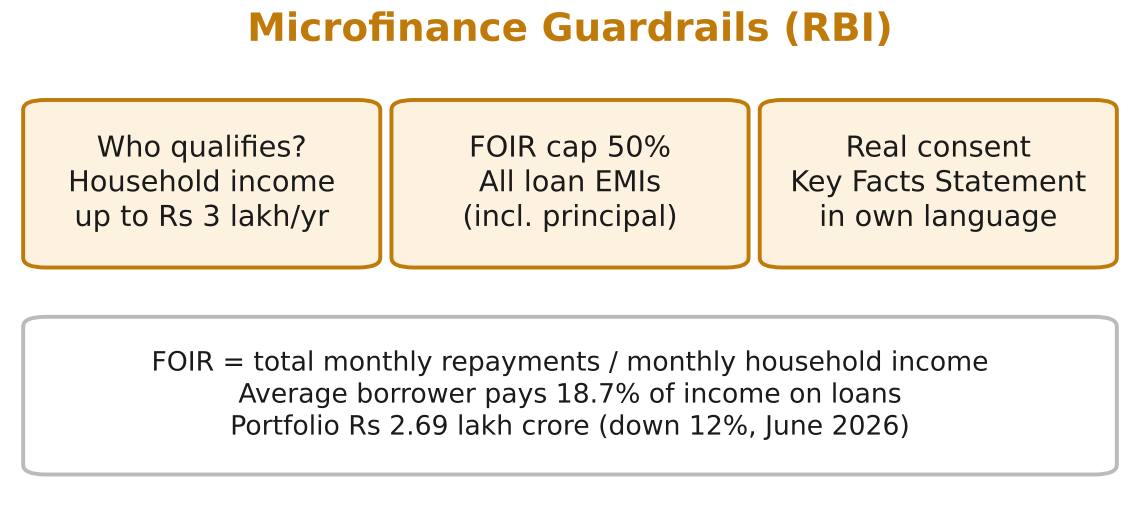
Microfinance gives small loans to poor households, mostly women. The RBI says some borrowers are taking too many loans and signing papers they do not understand, so lenders must check incomes properly and get real consent. The RBI refused the industry's request to leave out principal repayments while calculating FOIR (Fixed-Obligation-to-Income Ratio), saying it would hide real household debt. The average microfinance borrower already spends 18.7% of monthly income on loan repayments. The RBI warned against 'pseudo-consent' (signing without understanding) and wants the Key Facts Statement explained in the borrower's language. The sector shrank for two years; the portfolio fell 12% to Rs 2.69 lakh crore by June 2026, though early-stage delinquency fell to 1.9% from 6.1%.
Key facts
Eligibility: household income up to Rs 3 lakh a year (rule of 2022)
FOIR cap: 50% of household income for all loan repayments
Portfolio: Rs 2.69 lakh crore (June 2026), down 12%; 7.15 crore active loans
New RBI rules on advertising and selling financial products apply from 1 Jan 2027
Way forward
Better income assessment, full credit-bureau reporting, borrower education and stronger checks on recovery agents.
Concept
Microfinance: small, usually collateral-free loans, often given to women through joint-liability groups. Self-Regulatory Organisation (SRO): an industry body recognised by RBI to set and check standards; MFIN and Sa-Dhan are the two for microfinance. Key Facts Statement (KFS): a simple standard sheet showing the loan's total cost, interest rate (APR) and charges. Exam angle: Prelims: FOIR meaning, income cap, SROs, KFS. Mains: 'Financial inclusion must not become financial exclusion through debt traps' - discuss.
Diagram of RBI microfinance rules: income cap, 50% FOIR cap and genuine consent — StudyForGS
16. Horticulture Output Hits Record
ECONOMYUPSC: Prelims + Mains GS3
Syllabus linkage
GS3 - Agriculture, cropping patterns, food processing. Prelims: advance estimates, top crops; Mains: horticulture for farm income and nutrition.
Context
India grew a record amount of fruits and vegetables in 2025-26, about 4.36% more than the year before. Potato output jumped the most. The Agriculture Ministry released the Third Advance Estimates for 2025-26. Total horticulture output is 386.92 million tonnes, up 4.36% from 370.74 million tonnes in 2024-25. Vegetables rose to 227.27 million tonnes and fruits to 123.07 million tonnes. Potato output jumped nearly 12% to 65.57 million tonnes. Total horticulture area dipped slightly, to 29.72 million hectares.
Area: 29.72 million ha (down from 30.14 million ha)
Horticulture output now exceeds foodgrain output
Way forward
Invest in cold storage, food processing and farm-to-market links so that higher output means higher income, not price crashes.
Concept
Advance Estimates: early government estimates of crop output, revised several times (first, second, third) before the final figures. Mission for Integrated Development of Horticulture (MIDH, 2014-15): central scheme for fruits, vegetables, flowers, spices, bamboo and more. Operation Greens (2018): aims to stabilise prices of tomato, onion and potato (TOP), later extended to more perishables. Exam angle: Prelims: India's rank in fruits and vegetables (2nd after China), TOP crops, MIDH. Mains: post-harvest losses and cold-chain gaps that limit farmers' gains from record output.
Bar chart comparing horticulture, vegetable, fruit, potato and tomato output in 2024-25 and 2025-26 — StudyForGS
17. Solar Power: 62x Growth in 12 Years
ECONOMYUPSC: Prelims + Mains GS3
Syllabus linkage
GS3 - Infrastructure (energy), climate commitments, Make in India. Prelims: schemes, ISA, solar parks; Mains: energy transition challenges.
Context
India's solar power capacity has grown from under 3 GW in 2014 to about 175 GW now. Solar is now the biggest part of India's clean energy, but making solar cells at home and storing power are still weak spots. A government backgrounder after the Bharat Renewable Energy Summit (2-5 November 2026) reviewed a decade of solar growth. Installed solar capacity rose from 2.82 GW (2014) to about 175 GW (31 October 2026). Non-fossil capacity was 308 GW by September 2026. India added 37 GW in calendar 2025, more than the US. But module-making capacity (192 GW) is far bigger than solar cell capacity (about 31 GW), and polysilicon and wafers are mostly imported.
Key facts
Solar: 2.82 GW (2014) -> about 175 GW (Oct 2026)
Record 55.29 GW non-fossil addition in FY 2025-26
Tariff fell from about Rs 18/unit (2010) to Rs 1.99/unit (2020)
PM Surya Ghar (2024): about 65 lakh homes solarised of 1 crore target
PM Surya Sarovar Yojana (2026): 5,000 MW floating solar with storage
Way forward
Build battery and pumped storage, expand the Green Energy Corridor, and scale cell, wafer and polysilicon manufacturing.
Concept
National Solar Mission (2010): one of eight missions under the National Action Plan on Climate Change (2008). International Solar Alliance: launched by India and France at COP21 (Paris, 2015); HQ Gurugram - first treaty-based intergovernmental body headquartered in India. ALMM (Approved List of Models and Manufacturers): list of approved solar modules (and from June 2026, cells) - pushes domestic manufacturing. Exam angle: Prelims: ISA HQ and founders, PM-KUSUM components, largest solar park (Bhadla, Rajasthan). Mains: storage, transmission and Great Indian Bustard concerns in India's solar expansion.
Bar chart: India's solar capacity rose from 2.82 GW in 2014 to 175 GW in October 2026 — StudyForGS
18. Cyclone Akvan Heads for Andhra Coast
ENVIRONMENTUPSC: Prelims + Mains GS1/GS3
Syllabus linkage
GS1 - Important geophysical phenomena (cyclones); GS3 - disaster management. Prelims: IMD categories, naming; Mains: preparedness on the east coast.
Context
A strong cyclone named Akvan is moving across the Bay of Bengal towards Andhra Pradesh. It is the third cyclone to hit the State in about three weeks. Cyclone Akvan is expected to become a Very Severe Cyclonic Storm and cross the Andhra Pradesh and Yanam coast between Nellore and Tuni around noon on 20 November, with winds of 120-130 km/h gusting to 145 km/h. Heavy rain is forecast for Andhra Pradesh, Odisha, Tamil Nadu (including Chennai) and Puducherry. Odisha has put 74 rescue teams on alert. Akvan follows Cyclone Arnab (28 October) and Cyclone Murasu (2-3 November).
Key facts
Landfall expected: between Nellore and Tuni, about noon 20 Nov
Winds 120-130 km/h, gusting to 145 km/h
Third cyclone in about three weeks after Arnab and Murasu
Odisha: 74 rescue teams on alert
Yanam (part of Puducherry UT) lies on the Andhra coast
Way forward
Early evacuation, strong cyclone shelters, protection of mangroves and quick restoration of power and crops after landfall.
Concept
IMD categories (wind speed): Cyclonic Storm 62-88 km/h; Severe 89-117; Very Severe 118-166; Extremely Severe 167-221; Super Cyclone 222 and above. Names are chosen from a list made by the WMO/ESCAP Panel of 13 countries (including India); IMD New Delhi is the Regional Specialised Meteorological Centre that names Indian Ocean storms. The Bay of Bengal gets more cyclones than the Arabian Sea because of warmer water, low-pressure systems coming from the Pacific and its funnel-like shape. Exam angle: Prelims: IMD wind categories, who names cyclones, why the east coast is more prone. Mains: lessons from Odisha's 'zero casualty' cyclone model.
Map of the Andhra Pradesh coast showing the expected track of Cyclone Akvan, Nellore, Tuni, Yanam and Chennai — StudyForGS
19. COP31 in Antalya: India Wants Finance
ENVIRONMENTUPSC: Prelims + Mains GS3
Syllabus linkage
GS3 - Environment, international climate agreements. Prelims: COP31 host, Article 9.1, IBCA; Mains: climate finance and equity.
Context
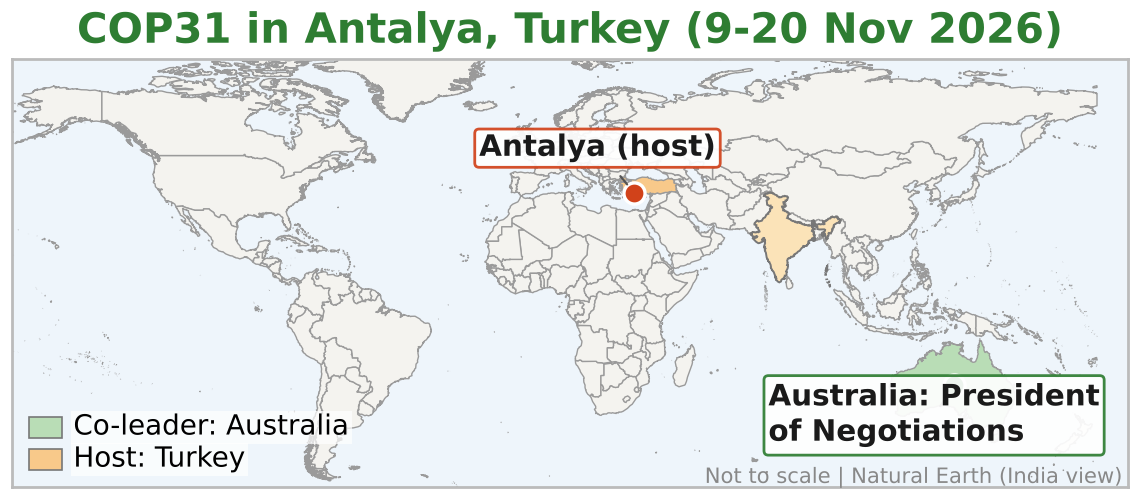
The world's yearly climate summit, COP31, is being held in Turkey. India says rich countries must provide climate money and that rules for developing countries should stay voluntary. COP31 is being held in Antalya, Turkey, from 9 to 20 November 2026; Turkey hosts and Australia's Chris Bowen is President of Negotiations. Environment Minister Bhupender Yadav is seeking a formal Climate Finance Work Programme, saying funding is a developed-country duty under Article 9.1 of the Paris Agreement. India wants adaptation indicators to be voluntary and opposes new top-down emission rules. It also called for deeper cooperation with Small Island Developing States (SIDS) on coasts and oceans.
Key facts
COP31: Antalya, Turkey, 9-20 Nov 2026; Turkey hosts, Australia leads negotiations
UNEP: developing countries need US$305 billion a year for adaptation by 2035
International public adaptation finance was only US$28-32 billion in 2024
India works with G77+China, LMDC and BASIC groups
India and the International Big Cat Alliance linked big-cat habitats to carbon storage
Way forward
Push for predictable, grant-based finance, protect India's development space and showcase solutions like solar and Mission LiFE.
Concept
Article 9.1 of the Paris Agreement: developed countries 'shall provide' financial resources to help developing countries. CBDR-RC (Common But Differentiated Responsibilities and Respective Capabilities): all countries must act, but rich countries that polluted more must do more. International Big Cat Alliance (IBCA): launched by India in 2023 for seven big cats - tiger, lion, leopard, snow leopard, cheetah, jaguar and puma. Exam angle: Prelims: COP31 venue, Article 9.1, IBCA's seven cats, BASIC members (Brazil, South Africa, India, China). Mains: 'Climate finance is the test of climate justice' - discuss.
World map showing COP31 host Turkey (Antalya), co-leader Australia and India — StudyForGS
20. Silent Valley Adds New Butterflies
ENVIRONMENTUPSC: Prelims + Mains GS3
Syllabus linkage
GS3 - Biodiversity and conservation; GS1 - geography of Western Ghats. Prelims: Silent Valley facts; Mains: people's movements and conservation.
Context
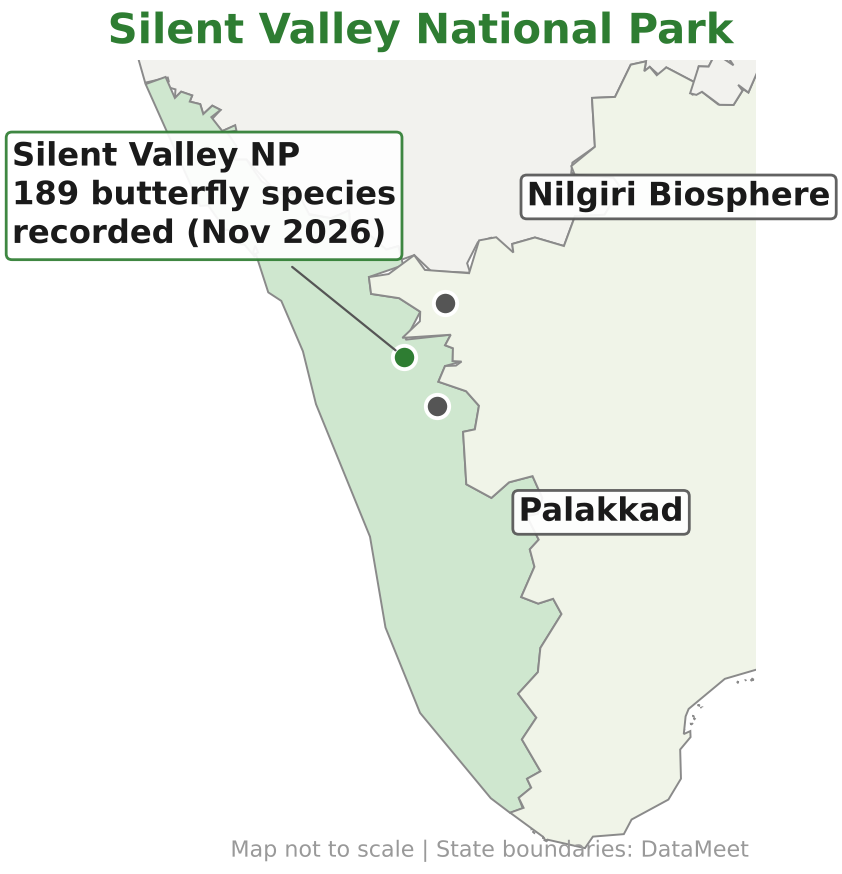
A butterfly survey in Kerala's Silent Valley National Park counted 189 species and added three new species to the park's list. This shows the forest is still rich and healthy. A butterfly survey in Silent Valley National Park from 13 to 15 November recorded 189 species. The park's butterfly checklist rose from 205 to 208 species, and 18 of the species are found only in the Western Ghats (endemic). Silent Valley lies in Palakkad district of Kerala and is part of the Nilgiri Biosphere Reserve.
Key facts
Survey 13-15 Nov 2026: 189 butterfly species recorded
Park checklist: 205 -> 208 species
18 species endemic to the Western Ghats
Location: Palakkad district, Kerala; core of Nilgiri Biosphere Reserve
Kunthipuzha river flows through the valley
Way forward
Continue regular citizen-science surveys and protect buffer forests from fragmentation and climate stress.
Concept
Save Silent Valley Movement (1970s-80s): people's campaign that stopped a hydroelectric dam on the Kunthipuzha; the area became a National Park in the 1980s. Endemic species: found naturally in only one place. The Western Ghats are one of the world's biodiversity hotspots and a UNESCO World Heritage Site (2012). Butterflies are 'indicator species' - their numbers quickly show the health of an ecosystem. Exam angle: Prelims: Silent Valley's district, river, flagship species (lion-tailed macaque), Nilgiri Biosphere (India's first, 1986). Mains: role of citizen science and people's movements in conservation.
Kerala map marking Silent Valley National Park, Palakkad and the Nilgiri Biosphere — StudyForGS
21. Lothal and Nalanda in India's Diplomacy
ART & CULTUREUPSC: Prelims + Mains GS1
Syllabus linkage
GS1 - Indian culture, Harappan civilisation, ancient education; GS2 - soft power. Prelims: Lothal and Nalanda facts; Mains: heritage as diplomacy.
Context
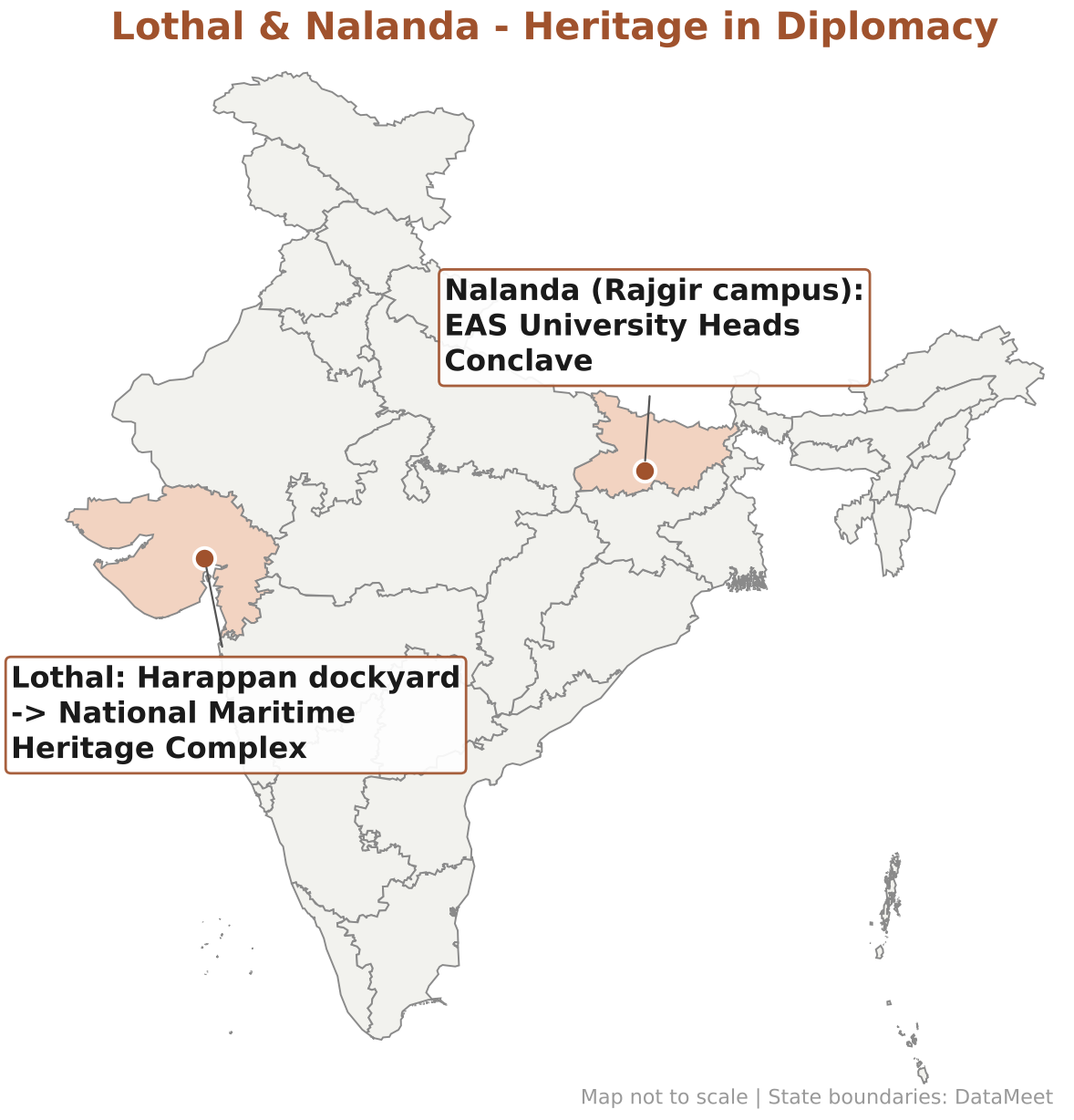
At the summits in Manila, India highlighted its shared history with Southeast Asia. It showcased the ancient port of Lothal and announced a university leaders' meet at Nalanda. PM Modi stressed India's civilisational links with Southeast Asia. India said the National Maritime Heritage Complex (NMHC) being built at Lothal in Gujarat will showcase its sea-trade history and regional links. An East Asia Summit University Heads Conclave will be held at Nalanda, and more scholarships will be given to ASEAN students at Nalanda University.
Key facts
Lothal: Harappan port town in Gujarat near the Bhogava river and Gulf of Khambhat
Lothal has the world's earliest known dockyard (about 2400 BCE)
NMHC at Lothal: maritime museum complex under the Ministry of Ports, Shipping and Waterways
Ancient Nalanda: founded in the 5th century CE under Gupta ruler Kumaragupta I; destroyed by Bakhtiyar Khilji (about 1193)
Ancient Nalanda ruins: UNESCO World Heritage Site (2016); new campus near Rajgir opened in 2024
Way forward
Link heritage sites with Buddhist and maritime tourism circuits and student exchanges with ASEAN.
Concept
Harappan (Indus Valley) Civilisation: Bronze Age urban culture (about 2600-1900 BCE) with planned towns, drains and trade with Mesopotamia. Nalanda Mahavihara: a great Buddhist centre of learning visited by Chinese pilgrim Xuanzang (Hiuen Tsang) in the 7th century. Nalanda University Act, 2010: re-established Nalanda as an international university backed by East Asia Summit countries. Exam angle: Prelims: Lothal's state and feature (dockyard), Nalanda's founder and destroyer, Xuanzang. Mains: using cultural heritage as soft power in Act East.
India map marking Lothal in Gujarat and Nalanda in Bihar — StudyForGS
22. Voyager 1 Reaches One Light-Day
SCI-TECHUPSC: Prelims + Mains GS3
Syllabus linkage
GS3 - Space technology, achievements in science. Prelims: heliosphere terms, RTG, Voyager facts; Mains: value of long-duration space missions.
Context
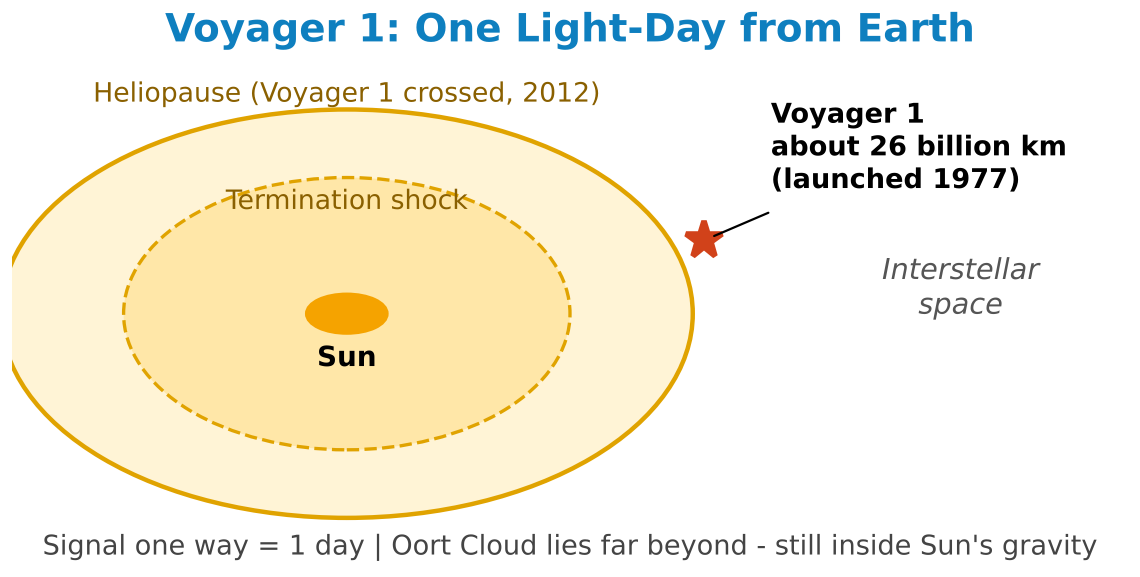
NASA's Voyager 1, launched in 1977, is now so far away that its radio signals take a full day to reach Earth. It is the farthest human-made object ever. On 18 November 2026, Voyager 1 reached about one light-day (about 26 billion km) from Earth. Launched in 1977 along with Voyager 2, it travels at about 61,000 km/h and has been the farthest human-made object since 17 February 1998. It crossed the heliopause into interstellar space in 2012. It runs on a radioisotope power source, and only two of its ten instruments still work.
Key facts
One light-day = about 26 billion km
Launched 1977; speed about 61,000 km/h
Farthest human-made object since 17 Feb 1998
Crossed heliopause (entered interstellar space) in 2012
Cameras switched off in 1990; 2 of 10 instruments still on
Way forward
Use Voyager's lessons for India's future deep-space plans and build long-life power and communication systems.
Concept
Light-day: distance light travels in one day; a message to Voyager takes a day and the reply takes another day. Heliosphere: bubble of solar wind around the Sun. Termination shock = where solar wind slows suddenly; heliopause = edge where interstellar space begins. The Oort Cloud lies far beyond, still under the Sun's gravity. RTG (radioisotope thermoelectric generator): makes electricity from heat of decaying plutonium-238 - used where sunlight is too weak. Exam angle: Prelims: order - solar wind, termination shock, heliopause, Oort Cloud; what powers Voyager. Mains: how deep-space missions help basic science.
Diagram of the Sun, termination shock, heliopause and Voyager 1's position in interstellar space — StudyForGS
23. China's LineShine Stays World's Fastest
SCI-TECHUPSC: Prelims + Mains GS3
Syllabus linkage
GS3 - IT, computers, indigenisation of technology. Prelims: TOP500, India's supercomputers, NSM; Mains: compute capacity and tech self-reliance.
Context
The new world ranking of supercomputers keeps China's LineShine at number one. India's best machine, Shakti Cloud, ranks 35th. The November 2026 TOP500 list, released at the SC26 conference in Chicago, kept China's LineShine at No. 1. It first took the top spot in June 2026 by replacing the US's El Capitan. LineShine performs up to 2.198 quintillion calculations per second using Chinese-made processors and the Kylin operating system, and is used for weather and ocean research. Only 27 new systems entered the list. India's highest-ranked system is Shakti Cloud at No. 35.
Key facts
No. 1: LineShine (China) - about 2.2 exaflops, uses about 42 MW
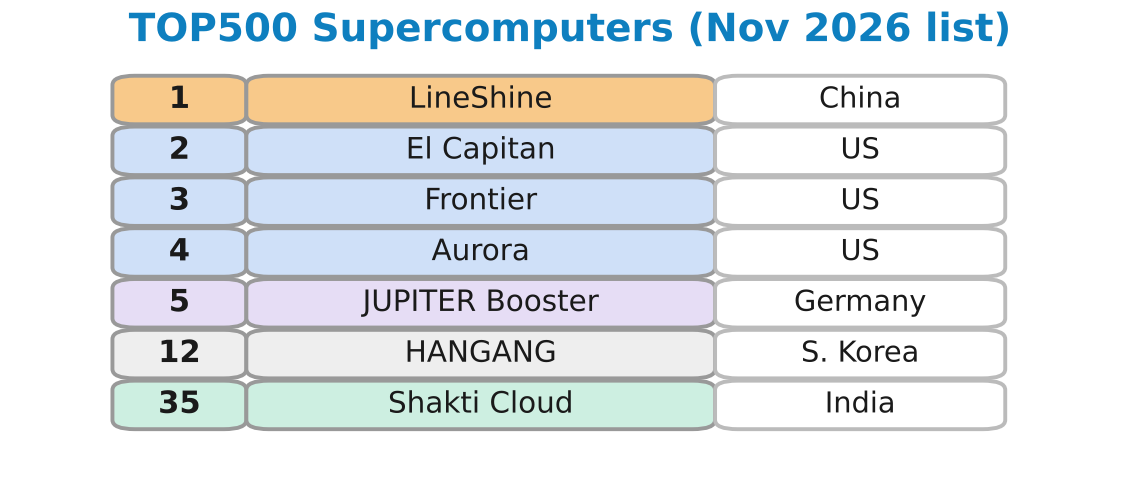
Top 5: LineShine, El Capitan, Frontier, Aurora (US), JUPITER Booster (Germany)
Highest new entry: HANGANG (South Korea) at No. 12
India's best: Shakti Cloud at No. 35
Only 27 new entrants - lowest turnover so far
Way forward
Expand indigenous processors and exascale plans under NSM and the IndiaAI Mission, with shared access for researchers.
Concept
Exascale computing: a machine doing at least 10 to the power 18 (one quintillion) calculations per second. TOP500: twice-yearly ranking (June and November) of the world's 500 fastest supercomputers, based on the LINPACK benchmark. National Supercomputing Mission (2015): India's programme with C-DAC and IISc to build and network supercomputers (PARAM series). Exam angle: Prelims: what TOP500 measures, India's supercomputing mission and PARAM machines. Mains: compute power as a strategic asset in the AI age.
Table of the top supercomputers in the November 2026 TOP500 list and India's Shakti Cloud rank — StudyForGS
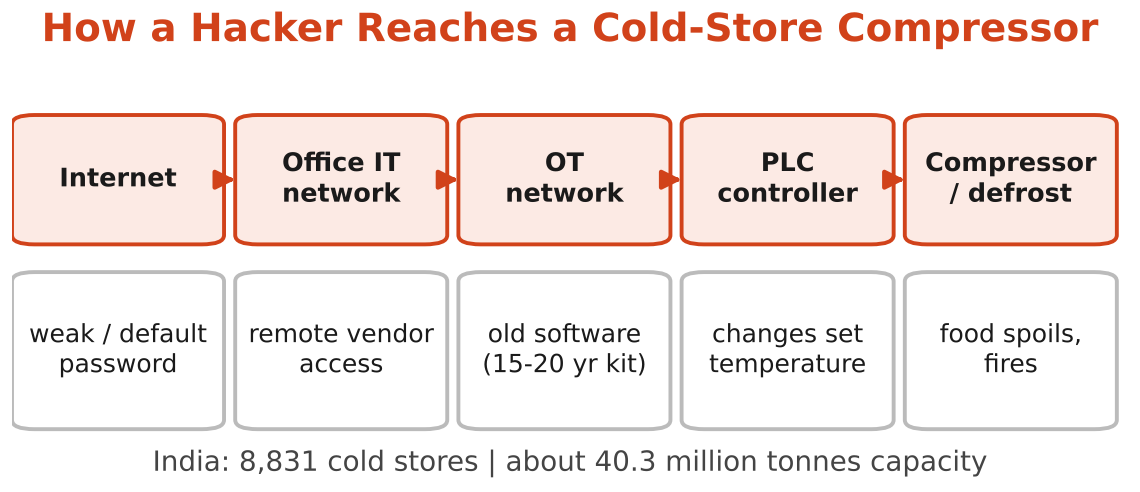
Hackers in Europe took control of supermarket fridges and cold stores, spoiling food and even causing fires. Experts say India's growing cold-chain network also needs cyber protection. On 11-12 October 2026, hackers took over refrigeration systems at about 700 retail sites in France, raising temperatures to spoil food and causing at least 15 fires; a second wave hit stores in eight European countries in November. France blamed a unit linked to Iran's Revolutionary Guards, which Iran denies. India has 8,831 cold-storage facilities with about 40.3 million tonnes capacity. India's 2025 cold-chain engineering guidelines encourage internet monitoring but do not set detailed cyber rules.
Key facts
France: about 700 sites hit, 15+ fires (Oct 2026); 2nd wave in 8 countries (Nov)
Even France's blood service sites were affected - alarms saved blood stocks
India: 8,831 cold stores, about 40.3 million tonnes capacity
Riskiest in India: retail chains, dairy chilling, vaccine and pharma storage
Old potato cold stores are safer - mostly offline and manually controlled
Way forward
Write cyber rules into cold-chain standards, keep controllers off the open internet, use multi-factor login and independent temperature alarms.
Concept
PLC (Programmable Logic Controller): small industrial computer that runs machines like compressors and fans using sensor data. IT vs OT: Information Technology handles data (email, accounts); Operational Technology controls physical machines. Attacks often jump from IT to OT. CERT-In: national agency for cyber incidents under MeitY (IT Act, 2000, Section 70B); its May 2026 blueprint lists OT as a priority. Exam angle: Prelims: CERT-In's parent ministry and legal basis, meaning of PLC and IoT. Mains: 'Cyber attacks can now cause physical harm' - discuss with food and health supply chains.
Flow diagram of how a hacker moves from the internet through office and OT networks to a cold-store compressor — StudyForGS
25. Call for a National Space Security Doctrine
DEFENCEUPSC: Prelims + Mains GS3
Syllabus linkage
GS3 - Space technology, security challenges, defence. Prelims: Mission Shakti, DSA, Outer Space Treaty; Mains: weaponisation of space and India's response.
Context
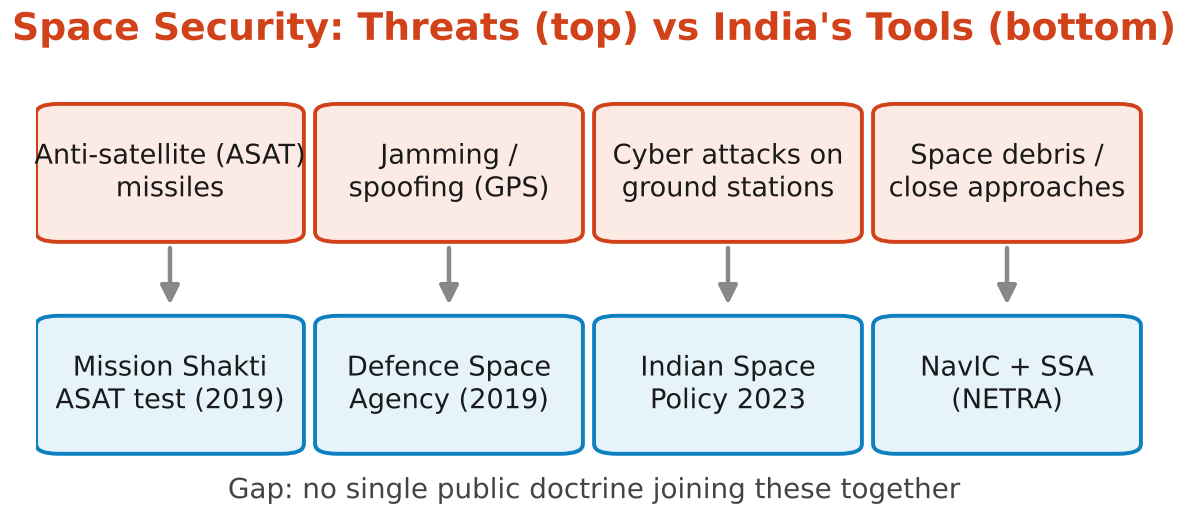
Satellites now run banking, navigation and the military. An editorial says India needs one clear, written plan (doctrine) on how it will protect its space assets. An editorial argued that India needs a comprehensive space security doctrine. India's satellites support communication, weather, navigation (NavIC) and defence, but face threats like anti-satellite missiles, jamming, cyber attacks and space debris. India has many building blocks - the Mission Shakti test, the Defence Space Agency and the Indian Space Policy 2023 - but no single public document joining them together.
Key facts
Mission Shakti (27 March 2019): India shot down its own satellite with an anti-satellite missile
Defence Space Agency (2019): tri-service body for military space
Indian Space Policy 2023 opened space to private firms via IN-SPACe
NETRA: ISRO project for tracking space debris (space situational awareness)
Outer Space Treaty (1967): bans nuclear weapons in orbit; India is a party
Way forward
Publish a doctrine, raise space situational awareness capacity, protect ground stations from cyber attack and back global norms against debris-creating tests.
Concept
Space doctrine: a public statement of how a country will use, protect and, if needed, defend its space assets - it guides budgets, forces and diplomacy. Kessler syndrome: chain reaction where debris collisions create more debris, making some orbits unusable. IN-SPACe: single-window body under the Department of Space that authorises and promotes private space activities. Exam angle: Prelims: Mission Shakti year, Outer Space Treaty, DSA. Mains: 'Space is the new frontier of warfare' - India's needs in doctrine, deterrence and diplomacy.
Diagram comparing space threats (ASAT, jamming, cyber, debris) with India's tools (Mission Shakti, DSA, Space Policy, NavIC) — StudyForGS
26. Ex Sahayata Setu: Joint Disaster Drill
DEFENCEUPSC: Prelims + Mains GS3
Syllabus linkage
GS3 - Disaster management, role of armed forces; GS2 - HADR diplomacy. Prelims: exercise name, venue, NDMA; Mains: India as first responder in the Indian Ocean.
Context
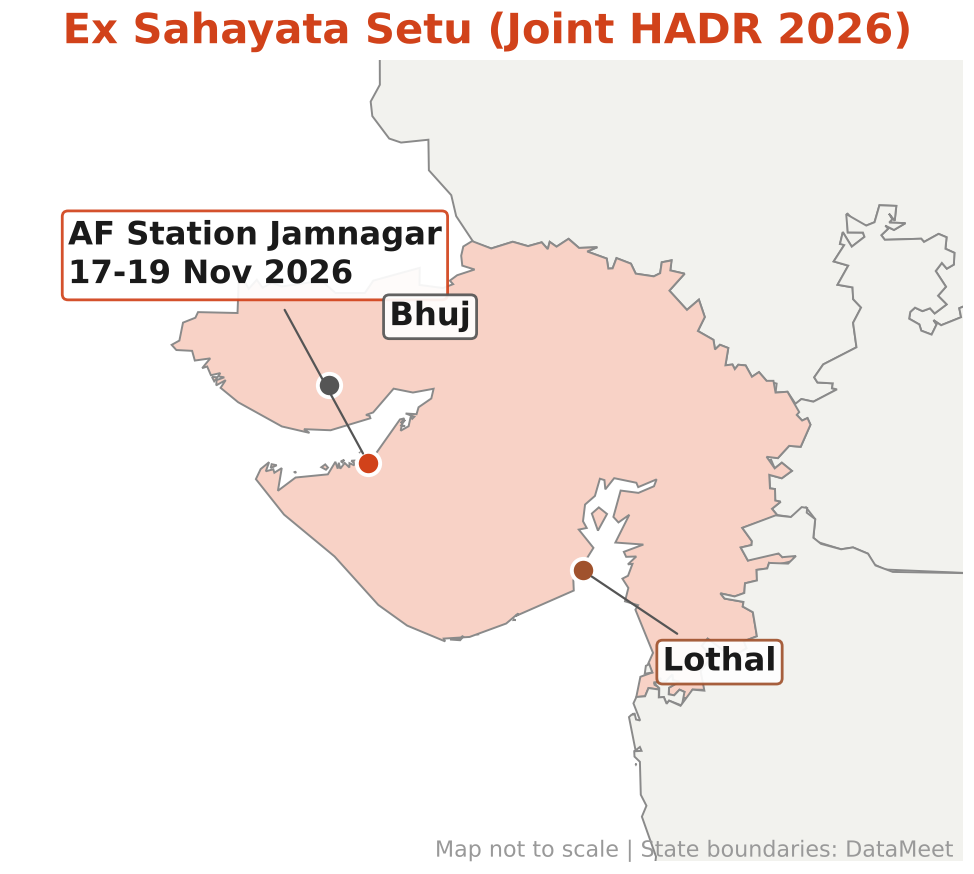
India's armed forces, Coast Guard and disaster agencies, along with friendly countries, are practising how to respond together to big disasters. The drill is being held at Jamnagar in Gujarat. The Annual Joint Humanitarian Assistance and Disaster Relief (HADR) Exercise 2026 (AJHE-26), named Sahayata Setu, is being held at Air Force Station Jamnagar, Gujarat, from 17 to 19 November. The Indian Air Force is the host. The Army, Navy, Coast Guard and NDMA are taking part along with partner countries linked to IORA, BIMSTEC and the Quad. Scenarios include cyclones, earthquakes, floods and chemical emergencies.
Key facts
Name: Sahayata Setu (AJHE-26); venue AF Station Jamnagar; 17-19 Nov 2026
Host service: Indian Air Force (hosting rotates among services)
Scenarios: cyclone, earthquake, flood, chemical emergency
Previous edition AJHE-23 'Chakravat' was hosted by the Navy in Goa
Way forward
Standardise procedures with partners, pre-position relief stocks and include civil agencies and NGOs in drills.
Concept
HADR (Humanitarian Assistance and Disaster Relief): help given to people after disasters, often using military planes and ships. NDMA: National Disaster Management Authority, chaired by the Prime Minister, set up under the Disaster Management Act, 2005. SAGAR (Security and Growth for All in the Region, 2015) / MAHASAGAR: India's vision of being a first responder in the Indian Ocean. Exam angle: Prelims: NDMA chair and Act, exercise name and venue. Mains: India's HADR role (e.g., Operation Brahma in Myanmar 2025) as soft power.
Gujarat map marking Air Force Station Jamnagar, Bhuj and Lothal — StudyForGS
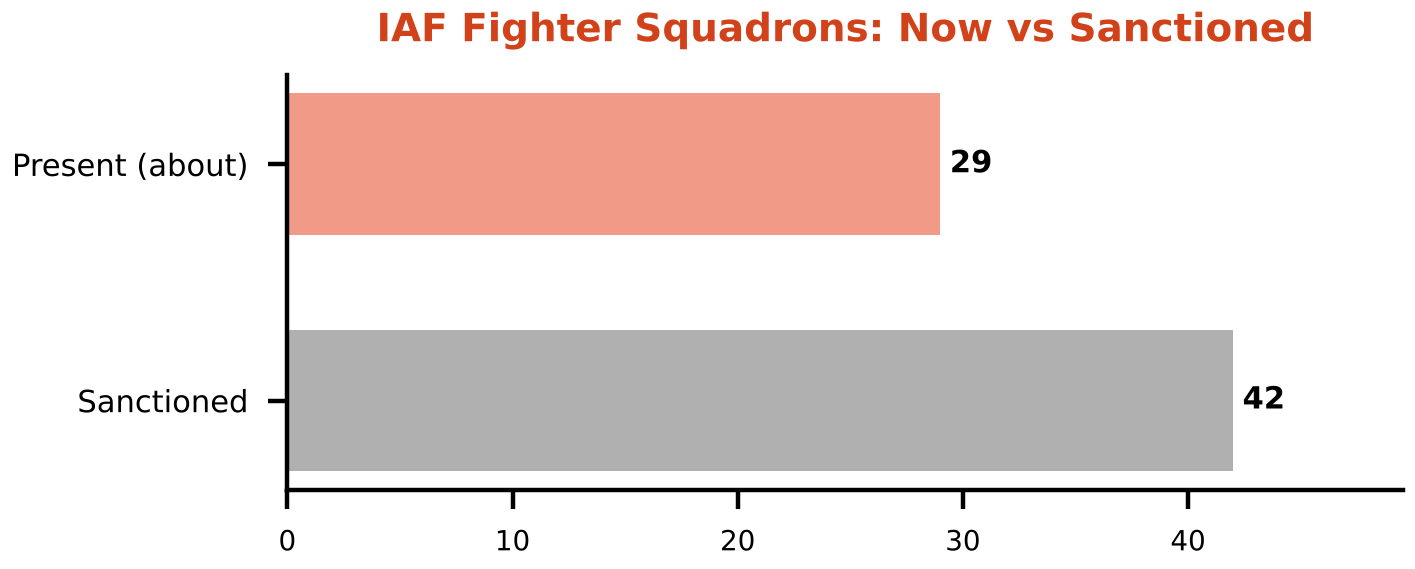
The Air Force chief said the first squadron of the improved Tejas Mk-1A fighter jet should be ready by March 2027. The IAF badly needs more fighters as it has far fewer squadrons than sanctioned. Air Chief Marshal Ashutosh Dixit said at National Security Summit 3.0 in New Delhi that the IAF aims to induct its first Tejas Mk-1A squadron by March 2027, the end of this financial year. He said earlier development problems have been fixed. The IAF has about 29 fighter squadrons against a sanctioned strength of 42. Tejas Mk-2 is expected to roll out in 2027 and the AMCA programme is continuing. Separately, a Chennai firm unveiled 'Vajra Sind', a handheld anti-drone jammer.
Key facts
First Tejas Mk-1A squadron target: March 2027
IAF squadrons: about 29 vs 42 sanctioned
Tejas made by HAL; designed by ADA (DRDO)
Tejas Mk-2 rollout expected 2027; AMCA (5th-generation fighter) under development
Secure engine supplies, add private production lines, and speed up Mk-2 and AMCA to close the squadron gap.
Concept
Tejas: India's indigenous Light Combat Aircraft (LCA); Mk-1A adds AESA radar, electronic warfare suite and better weapons. Squadron: basic IAF unit of about 16-18 aircraft; fewer squadrons means weaker readiness for a two-front threat. AMCA (Advanced Medium Combat Aircraft): planned stealth fighter by ADA, to be built with private industry partners. Exam angle: Prelims: who makes and designs Tejas, sanctioned squadron strength. Mains: delays in indigenous defence projects - causes (engines, supply chain) and fixes.
Bar chart: IAF has about 29 fighter squadrons against 42 sanctioned — StudyForGS
Data point of the day
about 175 GW (31 Oct 2026)
India's solar capacity Up about 62 times from 2.82 GW in 2014; solar is now the largest share of India's renewable capacity.
Prelims rapid-fire
World AMR Week: World AMR Awareness Week is observed from 18 to 24 November every year to promote careful use of antibiotics.
Ganga estuary: An IIT Kharagpur study found a 37.76% fall in the metal Pollution Load Index of the Ganga-Hooghly estuary, linked to the post-2014 Namami Gange period (published in GeoHealth).
Census 2027: A brief listing of 287 religion options on the Census self-enumeration portal raised questions; Master Trainers for the population enumeration phase are being trained in Guwahati (17-20 Nov).
IN-SPACe: IN-SPACe picked SpacePixxel, KaleidEO and Azista to build high-resolution 3D human-settlement layers of Indian cities with Rs 1.46 crore seed funding.
Export duty: Export duty on diesel raised by Rs 2.5 to Rs 14 per litre and on ATF by Rs 1.5 to Rs 12.5 per litre for the coming fortnight; petrol export duty stays nil.
MCL IPO: Mahanadi Coalfields (Coal India subsidiary, Odisha) set a price band of Rs 129-136 for an offer for sale of about 10% stake (about Rs 9,000 crore), open 19-23 Nov.
Coconut meet: The 62nd session of the International Coconut Community is being held in Kochi (17-20 Nov); the ICC is headquartered in Jakarta.
Karmayogi Sankalpa: The Cabinet Secretary launched Karmayogi Sankalpa on iGOT, where civil servants record a leadership pledge; target 25,000 pledges by 25 December (Good Governance Day).
Mission Sankalp: UIDAI and Assam launched a school drive for mandatory, free Aadhaar biometric updates of children at ages 5 and 15, running till 16 December.
Badminton: P.V. Sindhu rose to world No. 5 in BWF women's singles - her first top-five ranking since November 2022; Lakshya Sen is 11th in men's singles.
Mains practice question
Q. Examine the shift from self-identification to medical certification under the Transgender Persons (Protection of Rights) Amendment Act, 2026 in the light of the NALSA judgment and Articles 14, 19 and 21. (250 words)
Hint / approach
Start with NALSA 2014 and the 2019 Act; explain the 2026 changes (medical board, prescribed categories, DM certificate); balance the government's reasons (targeted welfare, uniformity) with concerns (dignity, privacy, ICD-11, no appeal mechanism); conclude with an independent appeal and separating identity from welfare checks.
📌 One-line revision: Remember: the Quad was revived in Manila in 2017 and met there again as its first summit since 2024; NALSA 2014 gave self-identification, the 2026 amendment added a medical board; malaria elimination target is 2030.