India–Nepal summit brings a Banbasa ICP and Dharchula–Darchula bridge to Uttarakhand's border; Science City for Srinagar (Garhwal); HPV drive crosses 1 crore doses
Tuesday, 24 November 2026 · IST · Uttarakhand + National · 9 items · 2 MCQs
Nepal PM Balendra Shah's New Delhi visit produced 8 MoUs and 6 projects, two of them on Uttarakhand's Mahakali border (Banbasa ICP, Dharchula–Darchula bridge), while CM Dhami announced a Science City for Srinagar (Garhwal) and an honorarium hike for 70,000+ frontline workers from 1 December. Nationally, the HPV campaign crossed 1 crore doses (Uttarakhand 90.17%), COP31 at Antalya closed without a fossil-fuel consensus, and India's ethanol blending reached 19.99% in ESY 2025-26.
Today at a glance — things to remember
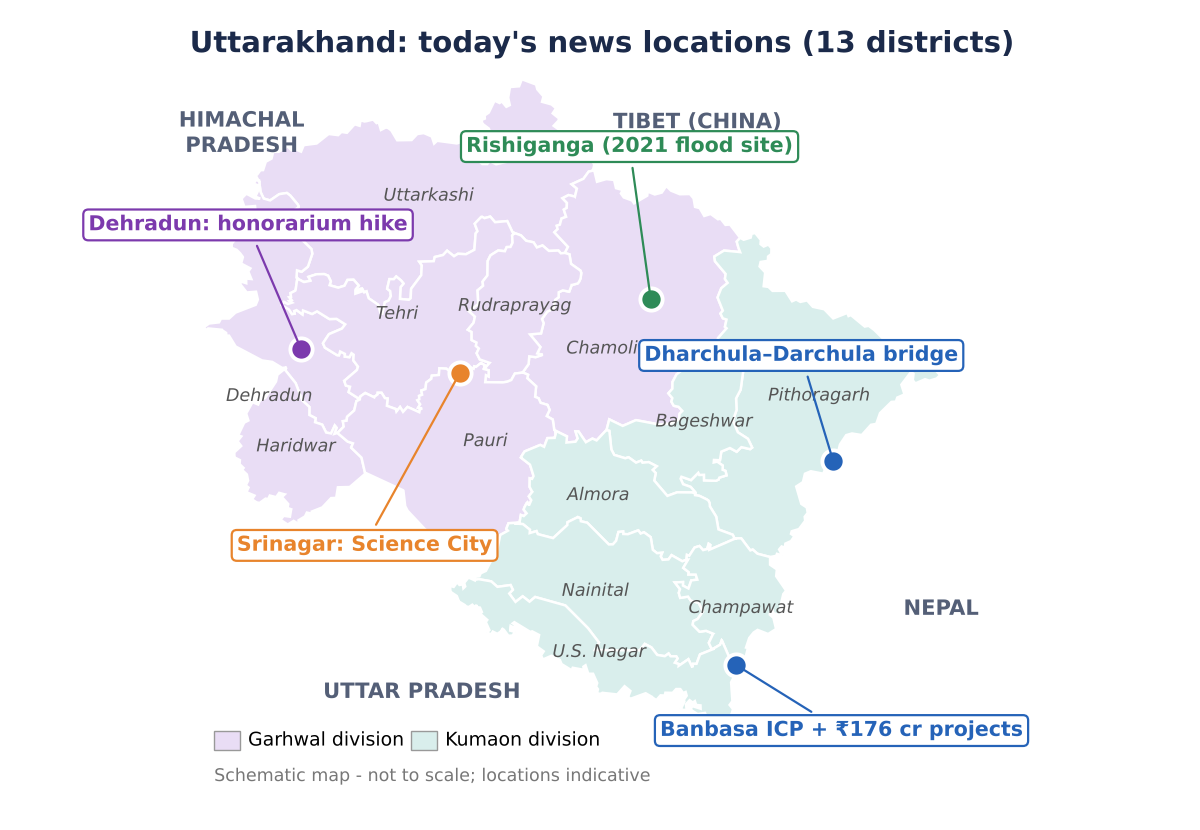
Banbasa (Champawat): foundation of new Integrated Check Post on India–Nepal border.
Dharchula–Darchula motorable bridge over the Mahakali inaugurated.
India–Nepal: 8 MoUs, 6 projects, package of NPR 240 billion.
Science City for Srinagar (Garhwal), to be developed with UCOST.
Honorarium hike for 70,000+ Anganwadi, ASHA & Bhojan Mata workers from 1 Dec 2026.
Uttarakhand's small-hydro potential 1,664 MW — 4th in India.
COP31 (Antalya) ends without fossil-fuel consensus; India 28th in CCPI 2027.
PUC validity for new BS-VI private vehicles now 3 years.
Ethanol blending hits 19.99% in ESY 2025-26; grain share 73.52%.
Detailed notes
1. India–Nepal summit: Banbasa ICP and Dharchula–Darchula bridge put Uttarakhand's border on the connectivity map
UTTARAKHANDUKPSC: Prelims + Mains (IR & Geography — Uttarakhand)
Syllabus linkage
GS — India and its neighbours; border geography of Uttarakhand (Champawat, Pithoragarh). Prelims: Mahakali river, ICPs, India–Nepal projects.
Context
Nepal PM Balendra Shah held talks with PM Narendra Modi in New Delhi on 23 Nov 2026 during his 22–23 Nov visit — his first bilateral visit abroad since taking office in March 2026. 8 MoUs were signed and 6 projects advanced; two directly touch Uttarakhand.
Key facts
Foundation stone for a new Integrated Check Post (ICP) at Banbasa (Champawat); ICP at Dodhara Chandani also progressing.
New motorable bridge Dharchula (India)–Darchula (Nepal) inaugurated (Pithoragarh).
Other projects: Saryu–Kamala Express (Ayodhya–Janakpur), foundation of 669 MW Lower Arun HEP, Phase II Motihari–Amlekhgunj pipeline, petroleum terminal at Jhapa.
MoUs include ISRO satellite communication via the South Asia Satellite, police training, good governance and traditional medicine; package of NPR 240 billion (~USD 1.62 billion).
Same day, CM Pushkar Singh Dhami launched projects worth ₹176 crore at Banbasa, adding that the border dry port will soon be dedicated.
Way forward
Fast-track the Banbasa ICP and dry port alongside Vibrant Villages works; build joint flood-warning on the Mahakali–Sharda.
Concept
The Mahakali (Kali) river marks the India–Nepal boundary along Uttarakhand under the Treaty of Sugauli (1816). Uttarakhand borders Nepal (Pithoragarh, Champawat, Udham Singh Nagar) and China (Tibet). India–Nepal Treaty of Peace and Friendship, 1950; Mahakali Treaty, 1996 (Pancheshwar).
Uttarakhand district map with Garhwal and Kumaon divisions shaded, marking Banbasa ICP, Dharchula bridge, Srinagar Science City, Dehradun and the Rishiganga site — StudyForGS
2. Science City for Srinagar (Garhwal) announced at Baikunth Chaturdashi Mela
Uttarakhand fairs & festivals, state S&T institutions, hill infrastructure. Prelims: Panch Prayag, Kamleshwar temple, UCOST.
Context
On 23 Nov 2026 CM Dhami inaugurated the Baikunth Chaturdashi Fair & Development Exhibition at Srinagar (Pauri Garhwal), announcing a Science City to be developed with UCOST and a Srinagar–Dehradun helicopter service soon.
Key facts
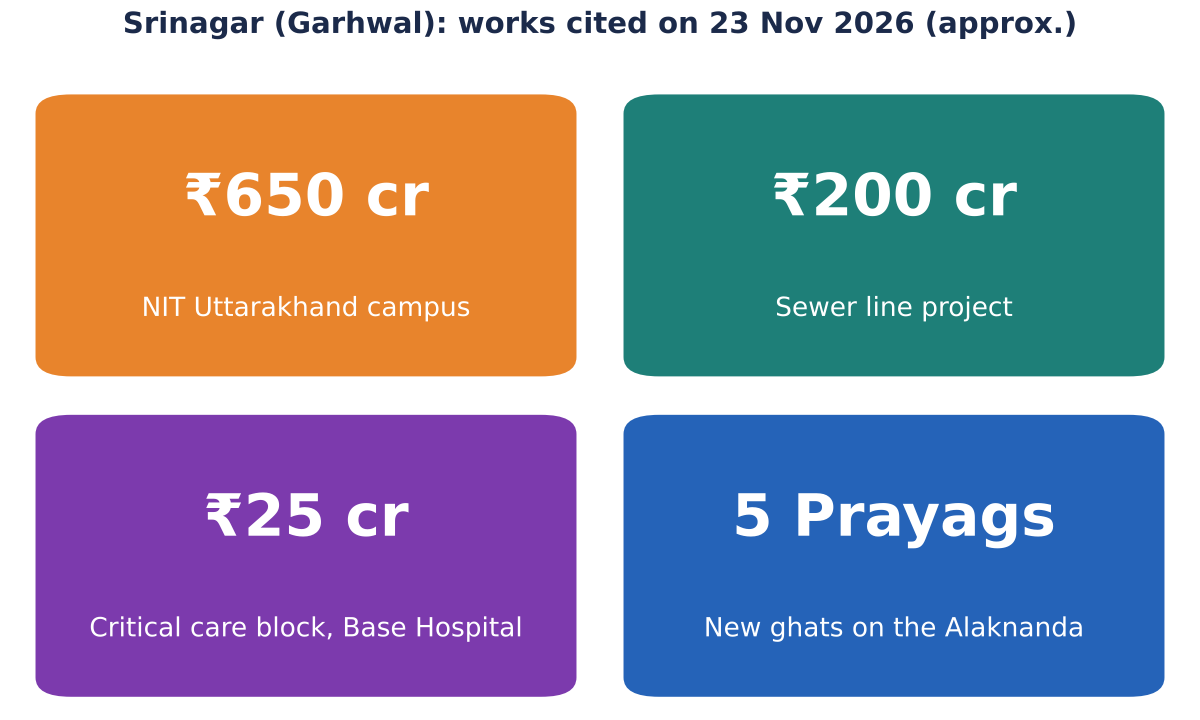
NIT Uttarakhand campus worth about ₹650 crore under way at Srinagar.
Sewer line project of about ₹200 crore; critical care block at Base Hospital (~₹25 crore).
Ghats at Vishnuprayag, Nandprayag, Karnaprayag, Rudraprayag, Devprayag; modern ghats near Dhari Devi temple.
Kotdwar–Pauri–Srinagar road being widened to two lanes; Rishikesh–Karnaprayag rail line progressing.
Way forward
Link the Science City with NIT and HNB Garhwal University for hill STEM outreach; keep construction eco-sensitive in the Alaknanda valley.
Concept
Baikunth Chaturdashi (Kartik Shukla Chaturdashi) fair is held at Kamleshwar Mahadev temple, Srinagar, known for the night-long 'khada diya' vigil. Panch Prayag on the Alaknanda: Vishnuprayag (Dhauliganga), Nandprayag (Nandakini), Karnaprayag (Pindar), Rudraprayag (Mandakini), Devprayag (Bhagirathi → Ganga). UCOST = Uttarakhand State Council for Science & Technology.
Stat tiles for Srinagar projects: NIT campus about 650 crore rupees, sewer line about 200 crore, critical care block about 25 crore, ghats at five Prayags — StudyForGS
📜 Asked before in the exam — previous-year question on this topic
BPSC Prelims 2025 (71st CCE)Which of the following is the place of confluence of the Alaknanda and Bhagirathi?
Welfare of frontline women workers; nutrition, health and mid-day meal delivery in Uttarakhand. Prelims: scheme–ministry linkages.
Context
On 23 Nov 2026 CM Dhami confirmed that the honorarium of Anganwadi workers & helpers, ASHA workers and Bhojan Mata workers will rise from 1 December 2026. The hike was first announced on 9 Nov (State Foundation Day) at Bhararisain, Gairsain.
Key facts
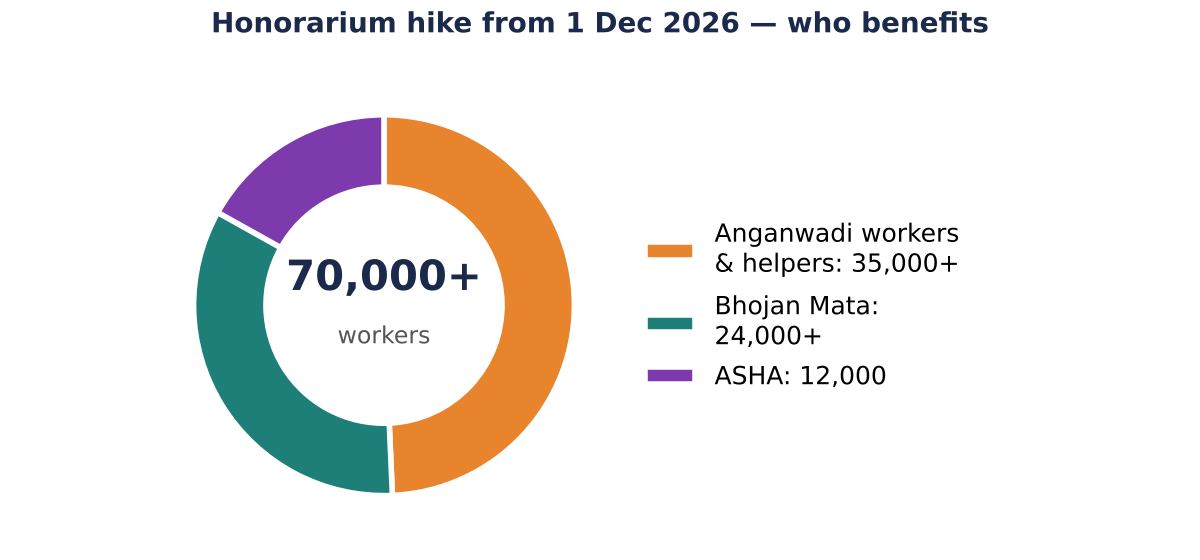
Beneficiaries: over 35,000 Anganwadi workers/helpers, 12,000 ASHAs and over 24,000 Bhojan Matas — 70,000+ in all.
Unions met the CM at Dehradun on 22 Nov; role-wise amounts are yet to be notified.
Most beneficiaries are women serving remote hill hamlets.
Way forward
Notify revised rates quickly and index them to inflation; tie them to better Poshan and mid-day meal outcomes in remote blocks.
Concept
Anganwadi services run under Saksham Anganwadi & Poshan 2.0 (Ministry of Women & Child Development); ASHA under the National Health Mission (NRHM launched 2005); Bhojan Mata cook meals under PM POSHAN. Uttarakhand was formed on 9 Nov 2000 as the 27th state; Gairsain (Bhararisain) is the summer capital.
Donut chart of beneficiaries: about 35,000 Anganwadi workers and helpers, 24,000 Bhojan Matas and 12,000 ASHA workers — StudyForGS
4. Small Hydro scheme: Uttarakhand holds India's 4th-largest small-hydro potential
Energy resources of Uttarakhand, renewable energy schemes, Himalayan hazards. Prelims: SHP size classes, CFA rates.
Context
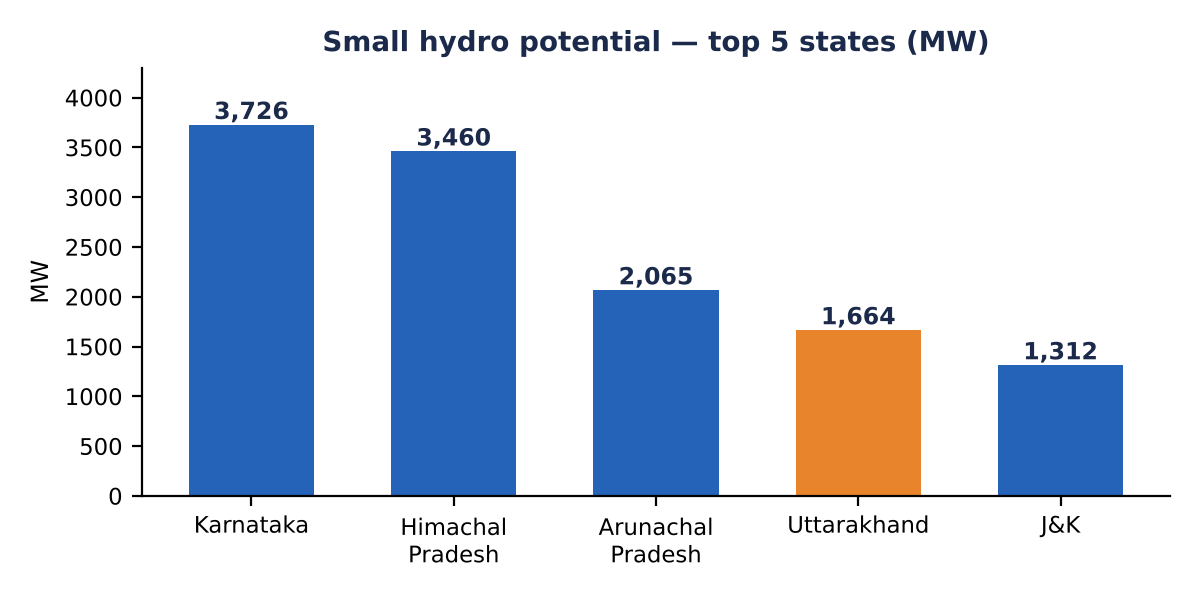
A Union backgrounder (22 Nov 2026) on the Small Hydro Power (SHP) Development Scheme, FY 2026-27 to 2030-31, puts Uttarakhand's SHP potential at 1,664 MW — 4th in India.
Key facts
Outlay ₹2,584.60 crore; target about 1,500 MW of new capacity; around ₹15,000 crore investment expected.
Small hydro = up to 25 MW (Ministry of New & Renewable Energy); bigger projects fall under the Ministry of Power.
National potential about 21,134 MW at 7,133 sites; only about a quarter harnessed.
Central aid: NE states and international border districts — ₹3.6 crore/MW or 30% (cap ₹30 crore); others ₹2.4 crore/MW or 20% (cap ₹20 crore).
Way forward
Prefer run-of-river SHPs with GLOF/debris-flow safety audits; promote community micro-hydel for remote villages.
Concept
Size classes: micro ≤100 kW, mini 101 kW–2 MW, small 2–25 MW. On 7 Feb 2021 the Rishiganga flood (Chamoli) destroyed the 13.2 MW Rishiganga project and hit Tapovan–Vishnugad. Top SHP states: Karnataka, Himachal, Arunachal, Uttarakhand.
Bar chart of small hydro potential: Karnataka 3,726 MW, Himachal Pradesh 3,460 MW, Arunachal Pradesh 2,065 MW, Uttarakhand 1,664 MW, Jammu and Kashmir 1,312 MW — StudyForGS
Health policy, women's health, immunisation; Uttarakhand health indicators. Prelims: HPV, WHO 90-70-90.
Context
The Union Health Ministry said on 21 Nov 2026 that over 1 crore single-dose HPV vaccinations were given to 14-year-old girls in under nine months since the February 2026 launch — nearly 87% of the annual target.
Key facts
Target cohort about 1.2 crore girls (RGI 2021 projections); free, voluntary and with parental consent.
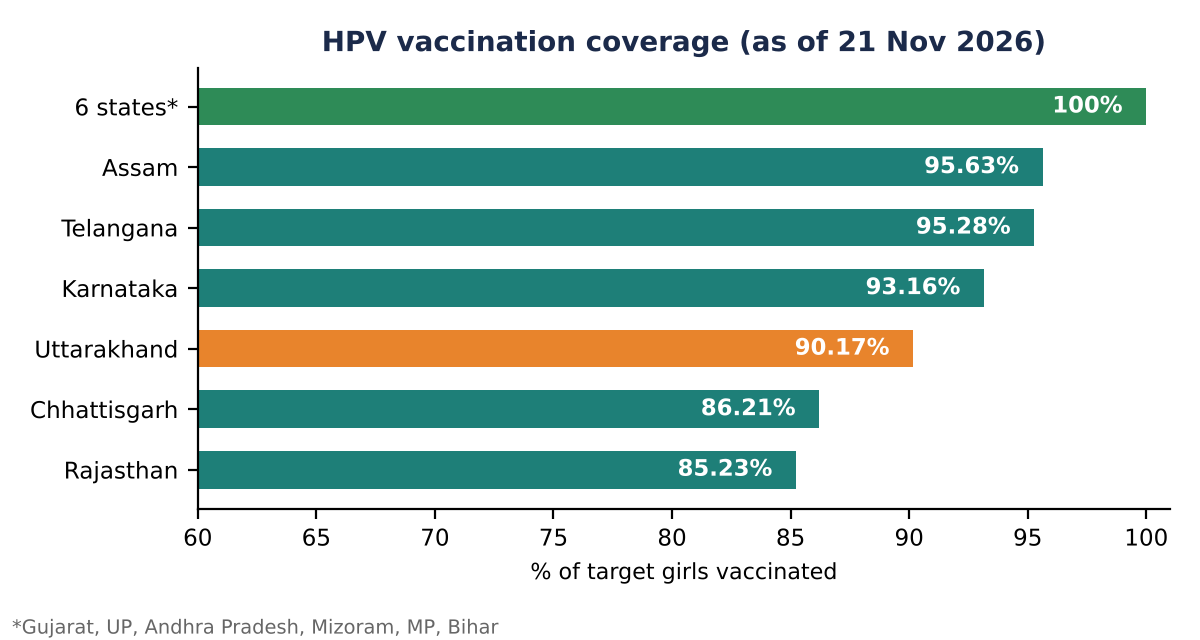
Uttarakhand 90.17% — behind Assam (95.63%), Telangana (95.28%) and Karnataka (93.16%) but ahead of Chhattisgarh (86.21%).
Largest numbers: UP 29.33 lakh+, Bihar 13.70 lakh+, Gujarat 7.75 lakh+.
Way forward
Close last-mile gaps in hill blocks through school sessions and U-WIN tracking; pair with adult cervical screening.
Concept
HPV (Human Papillomavirus) causes most cervical cancer. WHO elimination targets 90-70-90 by 2030: 90% girls vaccinated by 15, 70% women screened, 90% treated. India's Universal Immunisation Programme began in 1985.
Horizontal bar chart of HPV coverage: six states at 100 percent, Assam 95.63, Telangana 95.28, Karnataka 93.16, Uttarakhand 90.17, Chhattisgarh 86.21, Rajasthan 85.23 — StudyForGS
6. COP31 at Antalya ends without fossil-fuel consensus; India slips to 28th in CCPI 2027
COP31 at Antalya, Türkiye (9–20 Nov 2026) closed after overtime without an overarching consensus on fossil-fuel language. The Climate Change Performance Index (CCPI) 2027, released at COP31, ranked India 28th.
Key facts
Adopted a standalone Climate Finance Work Programme, pushed by India and developing countries.
Separate agenda items on tripling adaptation finance and climate-related trade measures were dropped.
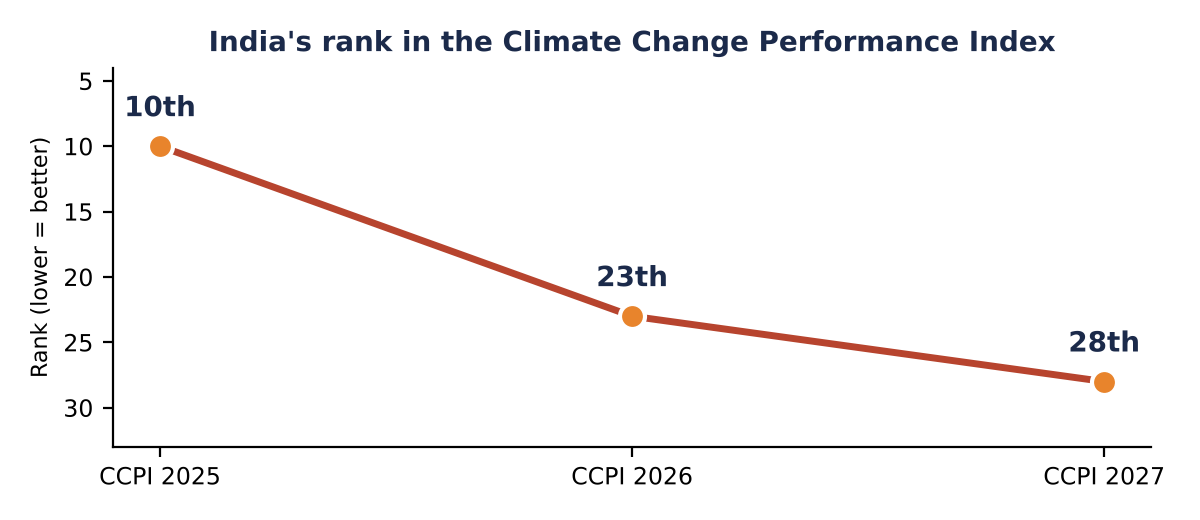
CCPI 2027 (Germanwatch & NewClimate Institute; 64 countries + EU): India 28th, score 60.85 ('medium'), down from 23rd (2026) and 10th (2025).
Denmark is the top-ranked country; Saudi Arabia, Russia and the USA are at the bottom (65th–67th).
Way forward
Push for predictable public adaptation finance; speed up renewables plus storage to reverse the CCPI slide.
Concept
UNFCCC opened for signature at Rio, 1992; Paris Agreement 2015 — Art. 9.1 obliges developed countries to provide finance. COP29 (Baku) set USD 300 bn/yr by 2035. India's NDC: 45% cut in emission intensity of GDP by 2030 (2005 base); net zero by 2070.
Line chart of India's CCPI rank: 10th in CCPI 2025, 23rd in CCPI 2026 and 28th in CCPI 2027 — StudyForGS
7. Parliament stays unprorogued for a record 100+ days after the Monsoon Session
Parliament was adjourned sine die on 13 Aug 2026 but has not been prorogued; by 23 Nov 2026 the gap crossed 100 days, the longest unprorogued spell on record. The Winter Session is expected in early December.
Key facts
Adjournment sine die is by the Presiding Officers; prorogation is ordered by the President under Art. 85(2)(a).
Art. 85(1): the gap between two sessions cannot exceed six months.
Bills pending in the Houses do not lapse on prorogation (Art. 107(3)); they lapse on dissolution of the Lok Sabha (Art. 107(5)), with exceptions.
NCRWC (2002) suggested at least 120 sitting days a year for the Lok Sabha and 100 for the Rajya Sabha.
Way forward
Adopt a fixed parliamentary calendar and a statutory minimum of sitting days to strengthen executive accountability.
Concept
The President summons and prorogues the Houses and can dissolve the Lok Sabha (Art. 85). Three customary sessions: Budget, Monsoon, Winter. Lok Sabha term: 5 years (Art. 83(2)). Uttarakhand Assembly: 70 seats.
📜 Asked before in the exam — previous-year question on this topic
UPSC Prelims 2024With reference to the Indian Parliament, consider the following statements: 1. A bill pending in the Lok Sabha lapses on its dissolution. 2. A bill passed by the Lok Sabha and pending in the Rajya Sabha lapses on the dissolution of the Lok Sabha. 3. A bill in regard to which the President of India notified his/her intention to summon the Houses to a joint sitting lapses on the dissolution of the Lok Sabha. Which of the statements given above is/are correct?
1 only
1 and 2
2 and 3
3 only
Show answer
Answer: (b) 1 and 2 Statements 1 and 2 are correct. When the Lok Sabha is dissolved, a bill pending in the Lok Sabha lapses, whether it started there or came from the Rajya Sabha, and so does a bill passed by the Lok Sabha but pending in the Rajya Sabha. A bill pending in the Rajya Sabha that the Lok Sabha has not passed does not lapse. Under Article 108(5), a bill for which the President has notified a joint sitting before dissolution also does not lapse. Practise all UPSC Prelims 2024 paper (free) →
Linked because this news is about the same topic. The answer is as per the official key of that year.
8. PUC certificate validity rationalised: 3 years for newer BS-VI private vehicles
The Ministry of Road Transport & Highways notified the Central Motor Vehicles (Sixteenth Amendment) Rules, 2026 (reported 19 Nov 2026) under the Motor Vehicles Act, 1988, linking PUC validity to emission norm and vehicle age.
Key facts
BS-I/II/III: 3 months; BS-IV: 6 months.
BS-VI private vehicles up to 6 years: 3 years; BS-VI transport vehicles: 2 years.
BS-VI vehicles over 6 to 10 years: 1 year; over 10 years: 6 months.
Renewal within 10 days before expiry counts from the old expiry date; existing certificates switch at first renewal.
Way forward
Link PUC data with VAHAN in real time; add remote-sensing checks in hill towns that see Char Dham traffic surges.
Concept
Bharat Stage (BS) norms follow Euro norms; India leapfrogged from BS-IV to BS-VI on 1 April 2020. The Central Motor Vehicles Rules, 1989 are framed under the MV Act, 1988 (amended 2019).
9. India's first indigenous H5N1 bird-flu vaccine for poultry
Union Agriculture Minister Shivraj Singh Chouhan dedicated India's first indigenous inactivated H5N1 vaccine for chickens, developed by ICAR-NIHSAD, Bhopal, on 20 Nov 2026.
Key facts
Developed against clade 2.3.2.1a of H5N1 avian influenza.
Gives protection for up to 6 months; meant for layer and breeder flocks.
ICAR-NIHSAD = National Institute of High Security Animal Diseases, Bhopal.
Way forward
Vaccinate under strict surveillance so infection is not masked; strengthen One Health links between animal and human health agencies.
Concept
H5N1 is a highly pathogenic avian influenza (HPAI) and zoonotic. An inactivated vaccine uses killed virus. ICAR was set up on 16 July 1929; it works under DARE, Ministry of Agriculture & Farmers Welfare.
Data point of the day
19.99%
Ethanol blending in petrol, Ethanol Supply Year 2025-26 1,134.36 crore litres blended (provisional, to 31 Oct 2026) against a requirement of 1,050 crore litres. Grain-based ethanol supplied 73.52% (maize nearly 46%), sugar-based 26.48%; about 32.45 lakh tonnes of sugar diverted. The 20% target (E20) is effectively met.
Prelims rapid-fire
Lower Arun HEP (Nepal) — 669 MW; foundation laid on 23 Nov 2026.
Saryu–Kamala Express links Ayodhya (UP) with Janakpur (Nepal).
Gurpurab today (24 Nov) — birth of Guru Nanak Dev (1469, Talwandi).
Igas Bagwal (Budhi Diwali) fell on 20 Nov 2026 — Kartik Shukla Ekadashi.
Devprayag: Alaknanda + Bhagirathi form the Ganga.
Qaumi Ekta Week: 19–25 November.
Practice MCQs — UKPSC Prelims pattern
Q1. Consider the following pairs (Prayag – river joining the Alaknanda):
1. Nandprayag – Nandakini
2. Karnaprayag – Mandakini
3. Rudraprayag – Pindar
4. Vishnuprayag – Dhauliganga
How many of the above pairs are correctly matched?
Only one
Only two
Only three
All four
Show answer
Answer: b Pairs 1 and 4 are correct. The Pindar joins at Karnaprayag and the Mandakini at Rudraprayag, so pairs 2 and 3 are wrong.
Q2. Which of the following India–Nepal projects advanced on 23 November 2026 directly link Uttarakhand with Nepal?
1. Integrated Check Post at Banbasa
2. Dharchula–Darchula motorable bridge
3. Petroleum terminal at Jhapa
Select the correct answer:
1 only
1 and 2 only
2 and 3 only
1, 2 and 3
Show answer
Answer: b Banbasa (Champawat) and Dharchula (Pithoragarh) are on Uttarakhand's Mahakali border. Jhapa is in eastern Nepal, linked to the Siliguri–Jhapa pipeline, not Uttarakhand.
Mains practice question
Q. Cross-border infrastructure such as Integrated Check Posts and bridges on the Mahakali can turn Uttarakhand's border districts from peripheries into gateways. Discuss, with challenges. (150 words)
Hint / approach
Use the Banbasa ICP and Dharchula–Darchula bridge; trade, tourism and pilgrimage, the open border, Vibrant Villages, palayan; challenges — floods, Kalapani dispute sensitivities, security, fragile terrain; way forward.
📌 One-line revision: Banbasa ICP + Dharchula–Darchula bridge (Mahakali) | Science City @ Srinagar (UCOST) | Honorarium hike from 1 Dec | UK small hydro 1,664 MW (4th) | HPV: UK 90.17% | CCPI: India 28th | Ethanol 19.99%