Wednesday, 4 November 2026 · IST · National & International · 12 items · 2 MCQs
The IndiaAI Mission released three indigenous foundation models, while the Union Cabinet took up a ₹2,800-crore capex scheme for lithium and nickel processing. On the external front, India set out its COP31 priorities, the Ganga Water Treaty with Bangladesh nears its 12 December expiry, and Democrats won both Houses in the US midterms.
Today at a glance — things to remember
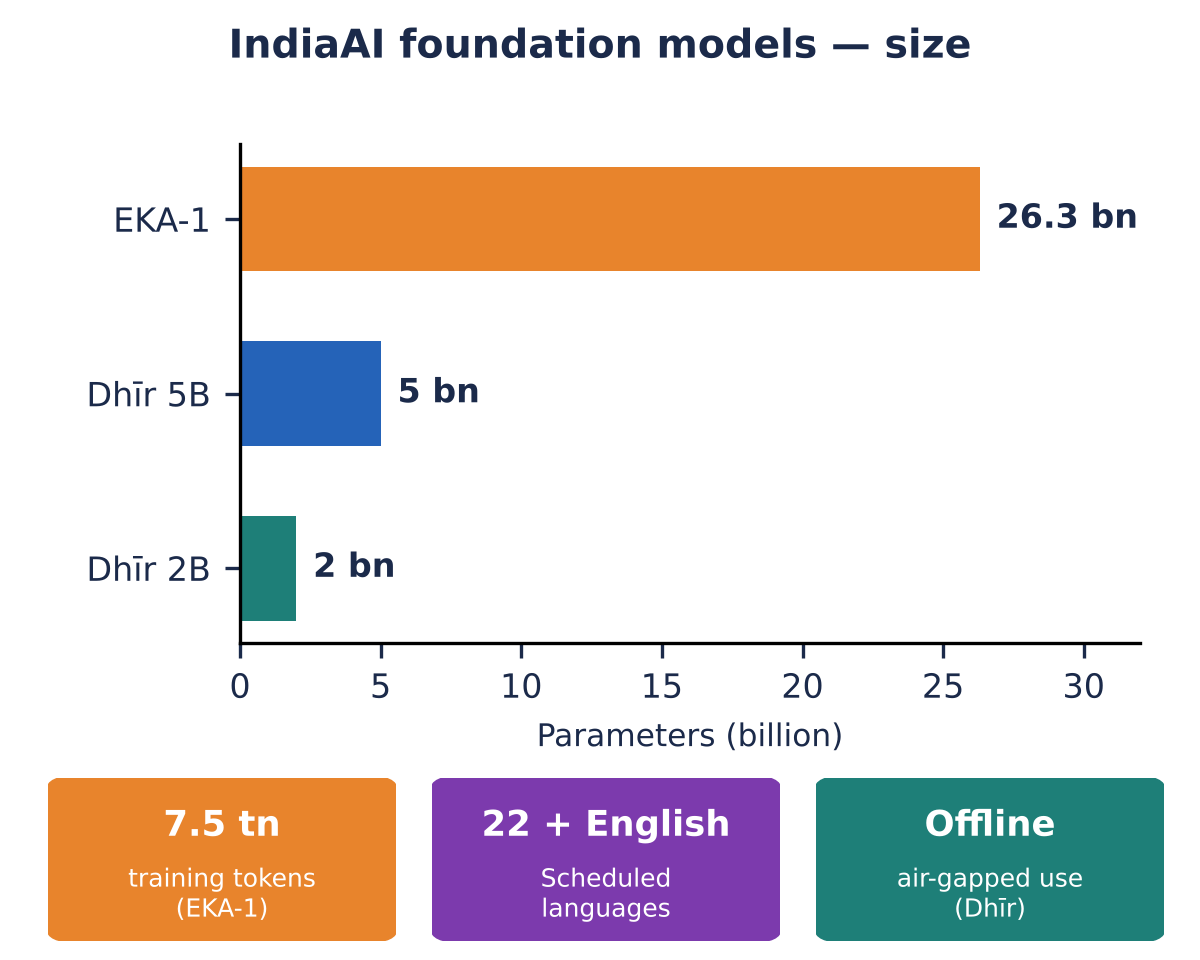
IndiaAI released EKA-1 (26.3 bn parameters, 22 languages) and Dhīr 2B/5B.
On 3 Nov 2026, the IndiaAI Mission released three home-grown foundation models — EKA-1 by Soket Labs and Dhīr 2B and Dhīr 5B by ZenteiQ — a step towards sovereign AI.
Key facts
EKA-1: 26.3 billion parameters, trained on about 7.5 trillion tokens; an open, sparse hybrid model for maths, code, reasoning and agentic use.
Supports all 22 Scheduled languages (8th Schedule) plus English.
Dhīr 2B/5B: compact, offline-capable models for document-grounded automation; deployable in air-gapped settings (defence, government, industry, education).
MeitY Secretary S. Krishnan called it a step towards a strong and strategic AI ecosystem, with uses in cybersecurity.
IndiaAI Mission: approved March 2024, outlay ₹10,371.92 crore, 7 pillars incl. Compute, Innovation Centre, AIKosh datasets.
Way forward
Scale GPU access and Indic datasets via AIKosh, set safety benchmarks, and drive public-sector adoption so sovereign models become commercially viable.
Concept
Foundation model: a large AI model pre-trained on broad data and adaptable to many tasks. Parameters = learned weights; tokens = text units used in training. Sparse models (e.g., Mixture-of-Experts) activate only part of the network per query, cutting compute cost.
Bar chart comparing parameter size of EKA-1 (26.3 billion), Dhīr 5B (5 billion) and Dhīr 2B (2 billion), with stat tiles for 7.5 trillion training tokens and 22 Scheduled languages. — StudyForGS
2. ₹2,800-crore capex scheme for lithium and nickel processing on Cabinet agenda
ECONOMYUPSC: Prelims + Mains GS3 (Economy & Mineral Security)
Syllabus linkage
GS3: Economy — industrial policy, mineral security, energy transition | Prelims: NCMM, critical minerals list
Context
The Union Cabinet was slated to consider on 4 Nov 2026 a ₹2,800 crore scheme of capital-expenditure support for domestic plants that turn lithium and nickel ores into battery-grade compounds; India has very limited processing capacity today.
Key facts
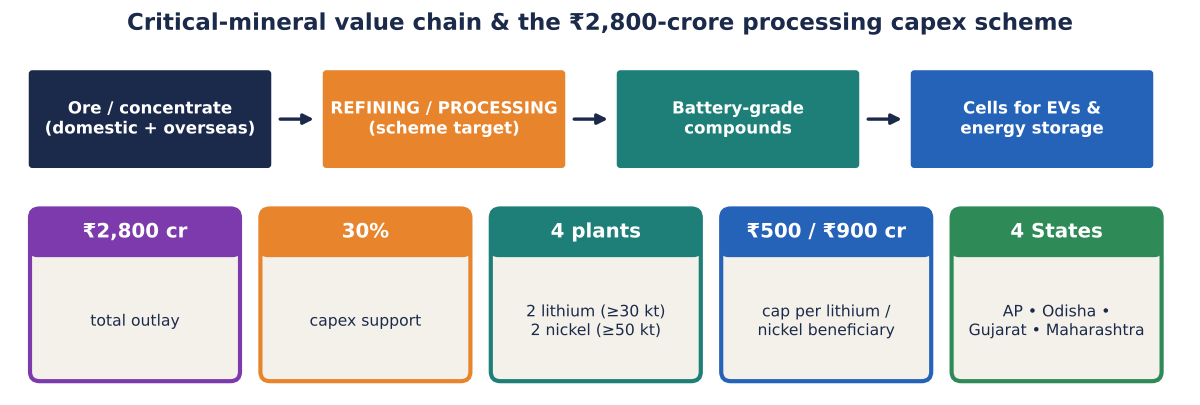
30% capex subsidy on eligible investment; caps of ₹500 crore per lithium and ₹900 crore per nickel beneficiary.
Up to 4 plants: 2 lithium (min 30 kt each) + 2 nickel (min 50 kt each); cobalt as a nickel by-product.
Processing parks in Andhra Pradesh, Odisha, Gujarat, Maharashtra (Maharashtra–lithium, Odisha–nickel focus).
Builds on National Critical Mineral Mission (Jan 2025, govt outlay ₹16,300 crore) and the ₹1,500 crore recycling incentive scheme.
India is fully import-dependent for several inputs incl. lithium, nickel, cobalt.
Way forward
Pair capex support with assured feedstock (KABIL overseas assets), offtake from EV and storage makers, and strict environmental norms for refining.
Concept
Critical minerals: minerals vital for the economy and security whose supply is at risk; India's 2023 list has 30 minerals. Mid-stream processing (refining) — dominated by China — is the key bottleneck between mining and battery-cell making.
Flowchart of the critical-mineral value chain from ore to refining to battery cells, with stat tiles showing ₹2,800 crore outlay, 30% capex support, 4 plants and per-beneficiary caps of ₹500 crore and ₹900 crore. — StudyForGS
3. RBI eases forex reporting for freelancers and small service exporters
GS3: Economy — external sector, ease of doing business | Prelims: FEMA, EDF, IDPMS
Context
Via the FEMA (Export and Import of Goods and Services) (Second Amendment) Regulations, 2026, notified on 2 Nov 2026 (effective 1 Oct 2026), RBI cut paperwork for individual and small service exporters and importers.
Key facts
New definition: 'resident individual' = a resident natural person.
Resident individuals exporting services are deemed to have filed the EDF once they give the bank payment details — relief for freelancers and consultants.
Other service exporters: deemed EDF filing for inward remittance up to ₹10 lakh.
Service imports: bank reporting in IDPMS (within 5 working days) only for non-individual importers above ₹10 lakh.
Amends the principal regulations notified on 13 Jan 2026.
Way forward
Extend single-window digital reporting to goods-exporting MSMEs and align it with GST and customs data to end duplication.
Concept
FEMA, 1999 replaced FERA, 1973 — a shift from 'regulation' to 'management' of forex; violations are civil, not criminal. IDPMS/EDPMS = import/export data monitoring systems; AD = Authorised Dealer bank.
GS3: Security; GS2: India–US ties | Prelims: military exercises, HADR
Context
The 5th edition of India–US tri-service exercise Tiger Triumph opened on 2 Nov 2026 at the Maritime Warfare Centre, Visakhapatnam, held this year as a Tabletop Exercise (TTX) focused on HADR.
Key facts
Series began in 2019 as the first India–US tri-service exercise.
Indian side: Army, Navy, Air Force, Special Forces of all three services and NDRF (joining for the first time).
US side: Army, Navy, Marine Corps, Air Force plus space, cyber, medical and EOD specialists.
Opened by R Adm Vishal Bishnoi (FOC, Eastern Fleet) and R Adm Joaquin Martinez de Pinillos (Vice Cdr, US Pacific Fleet).
Focus: joint planning, Combined Joint All-Domain Operations, cyber and space synchronisation.
Way forward
Institutionalise civil-military HADR coordination (with NDRF) for Bay of Bengal cyclones and deepen interoperability under LEMOA, COMCASA, BECA.
Concept
HADR = Humanitarian Assistance and Disaster Relief. Other India–US exercises: Yudh Abhyas (Army), Vajra Prahar (Special Forces), Cope India (Air Force), Malabar (Navy, with Japan and Australia).
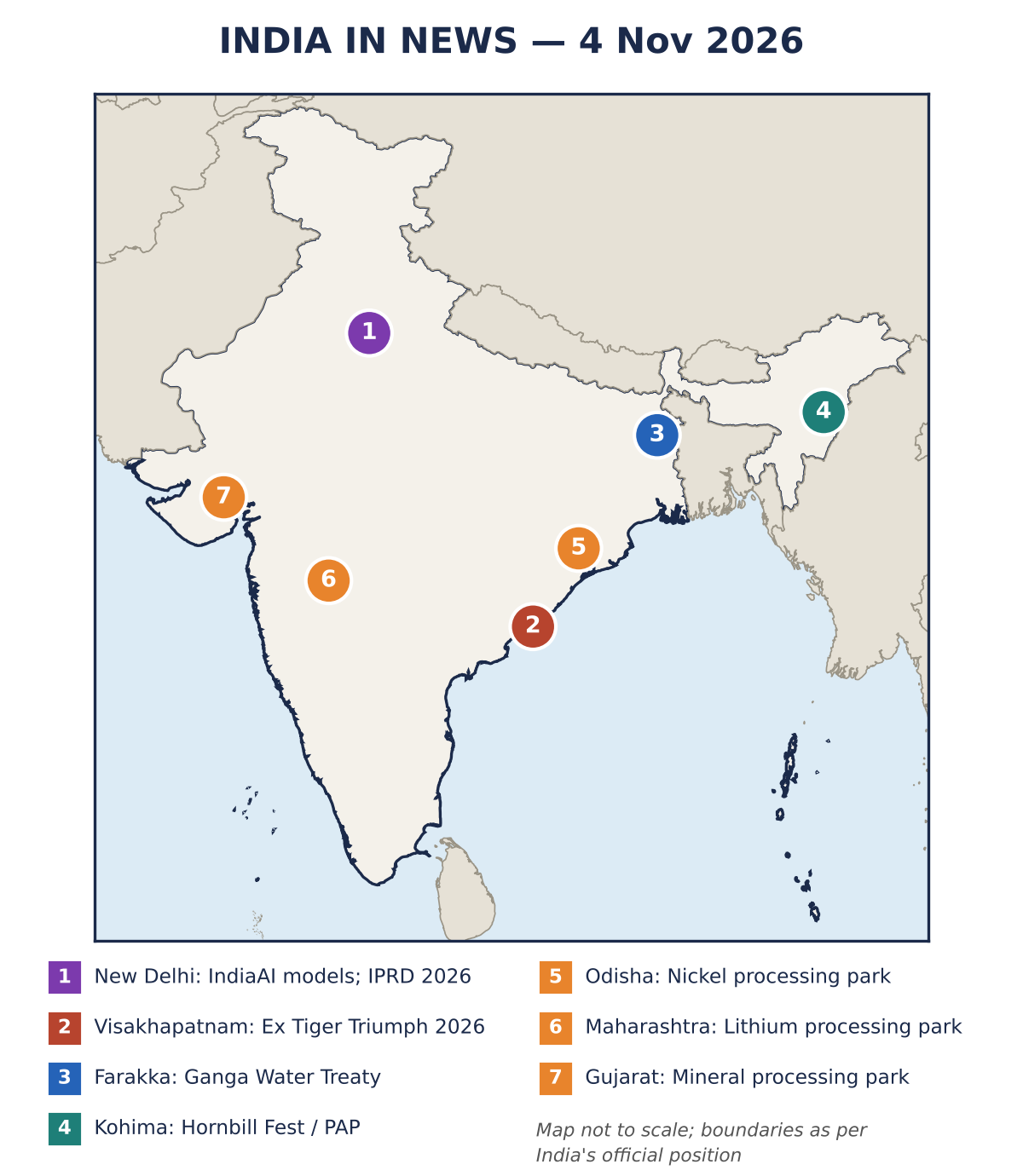
India in News locator map with numbered pins: 1 New Delhi (IndiaAI models, Indo-Pacific Regional Dialogue), 2 Visakhapatnam (Tiger Triumph 2026), 3 Farakka Barrage (Ganga Water Treaty), 4 Kohima (Hornbill Festival, PAP), 5 Odisha, 6 Maharashtra and 7 Gujarat (critical-mineral processing parks). Boundaries as per India's official position. — StudyForGS
5. COP31 (Antalya): India to push predictable climate finance and equitable transition
GS3: Environment — climate negotiations; GS2: international bodies | Prelims: UNFCCC, Paris Agreement articles
Context
Ahead of COP31 (9–20 Nov 2026, Antalya, Türkiye), Environment Minister Bhupender Yadav on 3 Nov set out India's priorities: finance, technology, adaptation and a Party-driven process.
Key facts
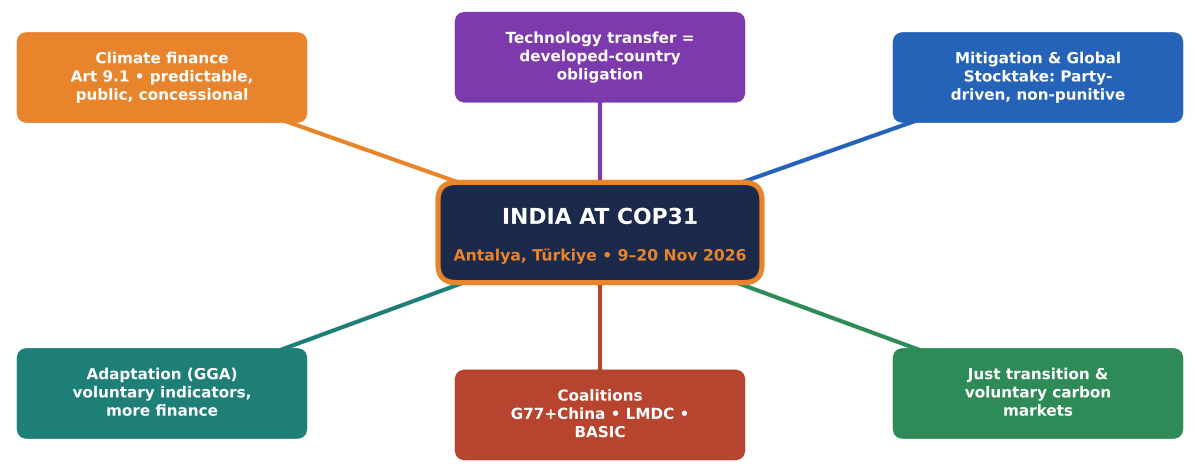
Seeks a decision launching a Climate Finance Work Programme; developed nations must honour Article 9.1 — finance predictable, largely public, concessional, not debt-creating.
Opposes new top-down targets; NDCs stay nationally determined; Global Stocktake to be non-punitive.
Global Goal on Adaptation indicators to be voluntary, not a condition for finance; continue the Just Transition Work Programme.
'Technology transfer is an obligation of developed countries' — Yadav; India to work via G77+China, LMDC, BASIC.
Split presidency: Türkiye (Murat Kurum) hosts; Australia (Chris Bowen) leads negotiations; Leaders' Summit 11–12 Nov.
Way forward
Build Global South coalitions to operationalise the finance goal, and showcase domestic action (LiFE, ISA, IBCA) to strengthen India's negotiating credibility.
Concept
CBDR-RC — UNFCCC (1992) principle. Article 9.1: developed countries 'shall provide' finance. NCQG (COP29, Baku): USD 300 bn/yr by 2035. GGA is under Article 7 of the Paris Agreement.
Mind-map of India's COP31 priorities around a central node 'India at COP31, Antalya, 9–20 Nov 2026': climate finance (Article 9.1), mitigation and Global Stocktake, adaptation (GGA), just transition, technology transfer, carbon markets and coalitions (G77+China, LMDC, BASIC). — StudyForGS
6. Draft Drugs Rules amendment: a qualified person must sign off every drug batch
HEALTHUPSC: Prelims + Mains GS2 (Health)
Syllabus linkage
GS2: Health — regulation of pharmaceuticals; GS3: industry quality | Prelims: Drugs Rules, 1945, GMP
Context
On 3 Nov 2026, the Union Health Ministry proposed amendments to the Drugs Rules, 1945, requiring manufacturers to formally authorise a 'suitably qualified and experienced person' for batch release.
Key facts
Batch release = final check of quality parameters and documents before a batch reaches the market.
Prescribed batch-release records for every batch and a standard Batch Release Certificate format.
Licence applicants must designate the authorised person — ensuring accountability and traceability.
Current licences list technical staff for manufacture/testing but not who authorises release.
Objections and suggestions invited before final notification.
Way forward
Back it with digital track-and-trace, more drug inspectors and time-bound enforcement of revised Schedule M for MSME pharma units.
Concept
Drugs and Cosmetics Act, 1940 and Drugs Rules, 1945 govern drug import, manufacture and sale; CDSCO, headed by the DCGI, is the central regulator. Revised Schedule M (2023) aligns Indian GMP with WHO-GMP.
7. US FDA tentatively clears Dr. Reddy's generic lenacapavir — a US$40-a-year HIV prevention shot
GS2: Health — access to medicines; GS3: pharma, IPR | Prelims: PrEP, voluntary licence
Context
On 2 Nov 2026, the US FDA granted tentative approval to Indian firm Dr. Reddy's Laboratories for the first generic injectable lenacapavir, a twice-yearly HIV prevention (PrEP) shot.
Key facts
Price: US$40 per person per year for 120 low- and middle-income countries under Gilead's voluntary licence.
Originator approved for prevention in June 2025; generic cleared about 16 months later via the 505(b)(2) route with priority review.
First generic supplies expected by end-2026, wider access in 2027.
India: a CDSCO expert panel (Aug 2026) recommended waiving local Phase-3 trials for generic PrEP use.
India has about 2.54 million people living with HIV (2023).
Way forward
Fast-track domestic approval, add long-acting PrEP to NACP for high-risk groups and scale testing to confirm HIV-negative status before use.
Concept
PrEP = Pre-Exposure Prophylaxis. Tentative approval is given while patents still bar US sale but permits procurement by US programmes such as PEPFAR. Voluntary licence (by patent holder) vs compulsory licence (Sec 84, Patents Act 1970; TRIPS).
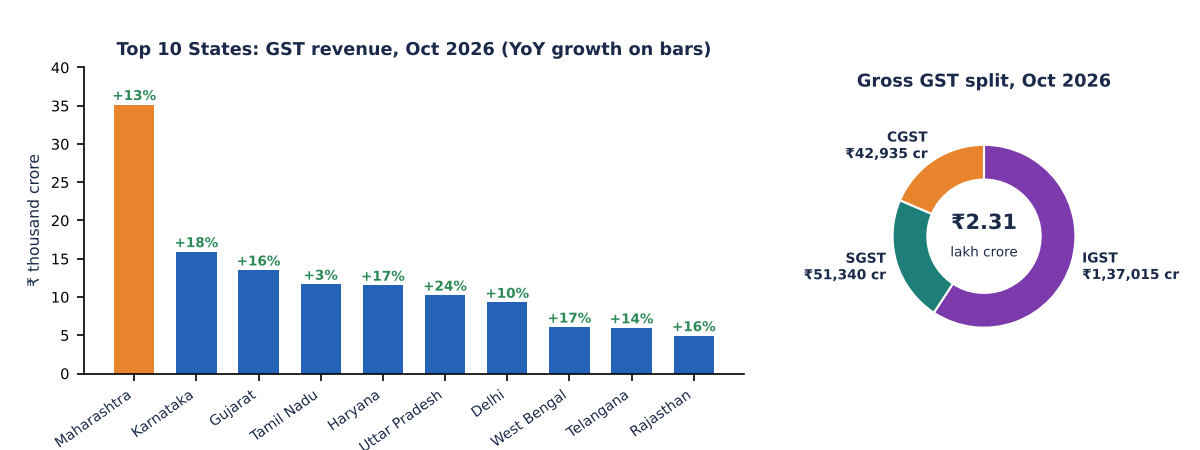
8. Data point: Gross GST mop-up at ₹2.31 lakh crore in October 2026 (+22.9%)
Provisional official data released on 1 Nov 2026 show gross GST of ₹2,31,290 crore in October 2026, up 22.9% year-on-year — the second-highest monthly collection since GST began in July 2017.
Key facts
Net GST (after refunds of ₹27,934 crore): ₹2,03,356 crore, up 25.6%.
Top state Maharashtra ₹35,150 crore; fastest large-state growth Assam +47%.
Way forward
Sustain buoyancy through compliance tools (e-invoicing, analytics) while watching that import-led growth does not mask softer domestic demand.
Concept
GST: 101st Constitutional Amendment Act, 2016; Article 279A — GST Council chaired by the Union Finance Minister. IGST is levied on inter-state supplies and imports and apportioned between Centre and States.
Two-panel chart: bar chart of October 2026 GST revenue for the top 10 states led by Maharashtra (₹35,150 crore), and a donut chart splitting gross GST of ₹2,31,290 crore into IGST, SGST and CGST. — StudyForGS
9. Ganga Water Treaty nears 12 December expiry; MEA says talks run through a 'structured mechanism'
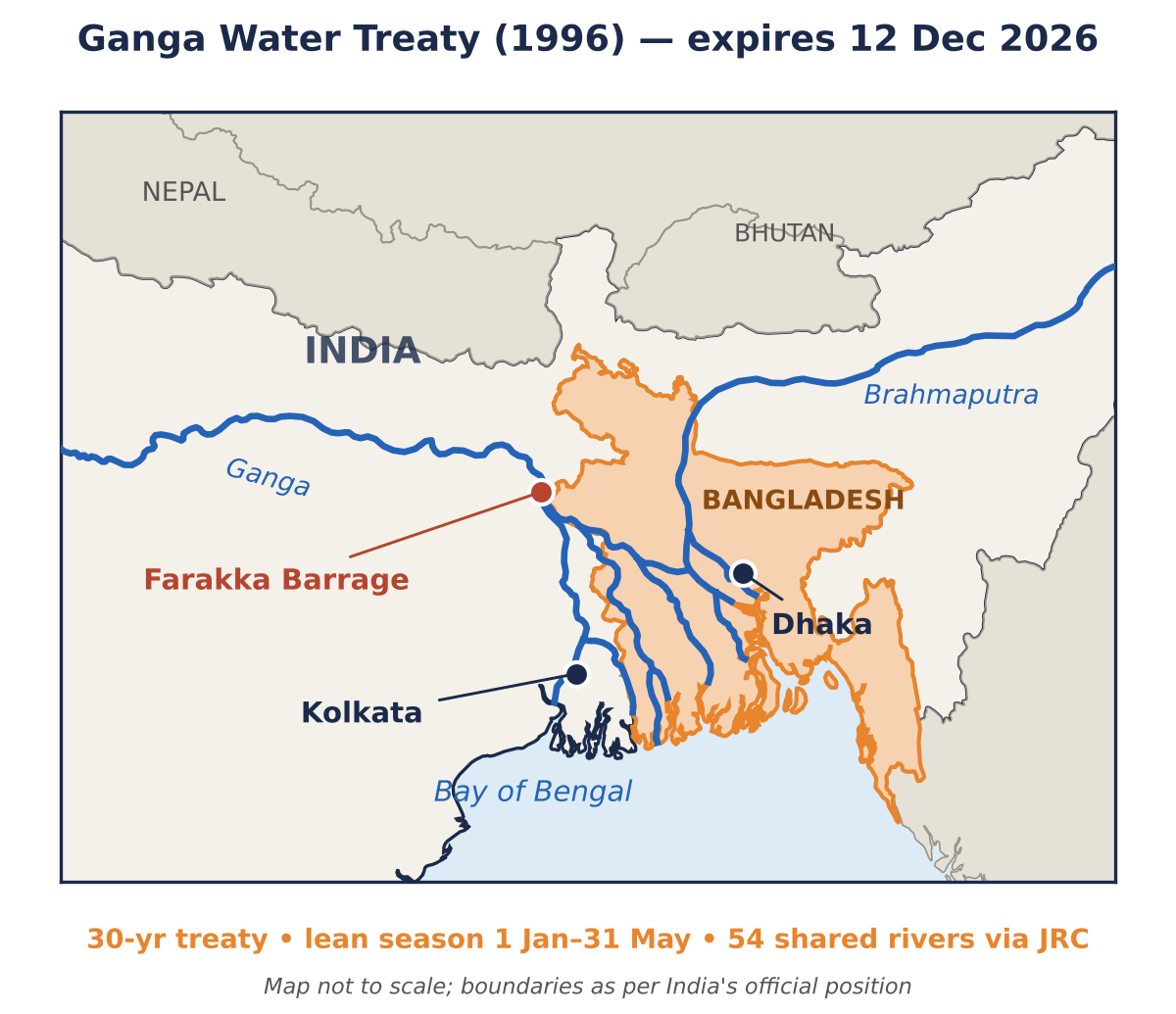
With the 1996 Ganga Water Treaty expiring on 12 Dec 2026, MEA spokesperson Randhir Jaiswal said talks continue through the Joint Rivers Commission (JRC), a 'structured mechanism', with no update on renewal.
Key facts
Signed 12 Dec 1996 by PMs H.D. Deve Gowda and Sheikh Hasina; 30-year term; renewal by mutual consent (Article XII).
Governs sharing of lean-season Ganga flows at the Farakka Barrage (West Bengal).
India and Bangladesh share 54 rivers; the JRC (set up 1972) handles them all.
Bangladesh's Water Resources Minister wants a new or revised treaty before 12 Dec with a guaranteed share.
A parliamentary panel (Aug 2026) urged early talks; Teesta sharing pact remains unsigned.
Way forward
Agree an interim extension to avoid a legal vacuum, then move to a basin-wide, data-sharing framework that factors climate-driven flow changes and West Bengal's concerns.
Concept
Lean season = 1 Jan–31 May (shared in 10-day periods). Farakka Barrage (1975) diverts water into the Bhagirathi-Hooghly to keep Kolkata port navigable. The Ganga is called Padma in Bangladesh.
Regional map of India and Bangladesh showing the Ganga and Brahmaputra rivers, the Farakka Barrage in West Bengal, Kolkata and Dhaka, with a fact box on the 1996 treaty expiring on 12 December 2026. Boundaries as per India's official position. — StudyForGS
10. US midterms: Democrats win control of both House and Senate
IRUPSC: Prelims + Mains GS2 (IR — Developed Countries)
Syllabus linkage
GS2: Effect of policies of developed countries on India | Prelims: US Congress structure
Context
In the 3 Nov 2026 US midterm elections, Democrats won the House of Representatives and flipped the Senate — a setback for President Donald Trump, who acknowledged the Iran conflict played a part.
Key facts
Midterms elect all 435 House seats and about one-third of the 100-member Senate.
Trump said he would veto bills he finds unacceptable — signalling divided government.
Election-day poll: about 6 in 10 voters called military action against Iran the 'wrong decision'.
Congress controls appropriations and trade law; the Senate ratifies treaties by a two-thirds majority.
For India: oversight of tariffs, the India–US interim trade agreement, defence sales and H-1B rules may shift.
Way forward
Broaden bipartisan engagement with Congress (India Caucus) to insulate trade, technology and defence ties from US domestic churn.
Concept
US Congress is bicameral; the Senate approves treaties (2/3) and confirms appointments; the House originates revenue bills. A presidential veto can be overridden by two-thirds of both Houses.
11. Indo-Pacific Regional Dialogue 2026 under way in New Delhi (3–5 November)
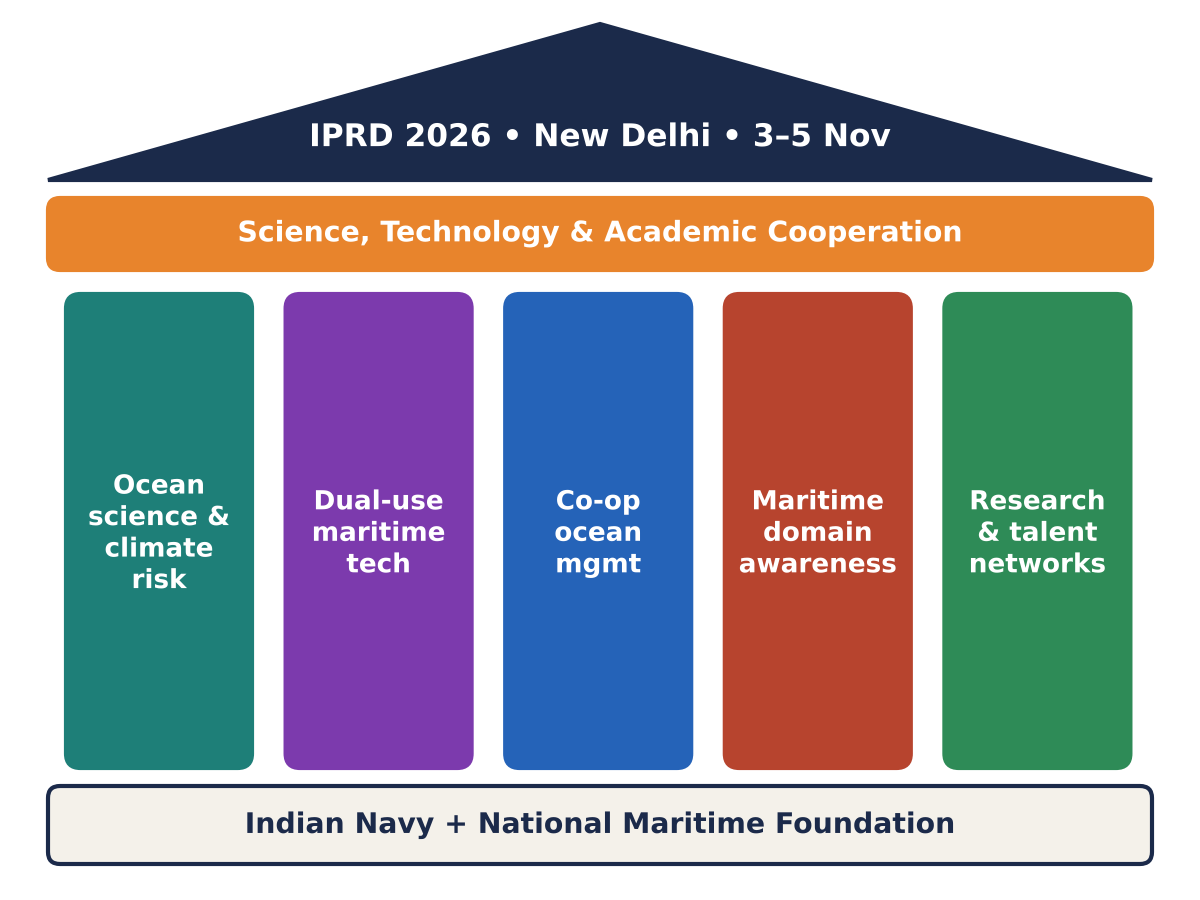
The Indian Navy's apex international conference, IPRD 2026, organised with the National Maritime Foundation (NMF), is being held in New Delhi on 3–5 Nov on the theme 'Science, Technology and Academic Cooperation in the Indo-Pacific'.
Key facts
Five focus areas: ocean science and climate-risk preparedness; dual-use maritime technologies; cooperative ocean management; maritime domain awareness and critical-infrastructure protection; research and talent networks.
IPRD first held in 2018; NMF is the Navy's knowledge partner.
Links to India's IPOI (2019, 7 pillars) and the MAHASAGAR vision (2025).
Complements regional MDA through the IFC-IOR, Gurugram (2018).
Way forward
Turn dialogue into joint ocean-research projects, shared MDA data and capacity-building for Indian Ocean littoral states.
Concept
IPOI (Indo-Pacific Oceans Initiative) was launched at the East Asia Summit, Bangkok, 2019. MAHASAGAR = Mutual and Holistic Advancement for Security and Growth Across Regions (March 2025, Mauritius), extending SAGAR (2015).
Pillar diagram of IPRD 2026 under the theme 'Science, Technology and Academic Cooperation in the Indo-Pacific', showing five focus areas: ocean science and climate risk, dual-use maritime technology, cooperative ocean management, maritime domain awareness, and research and talent networks. — StudyForGS
12. Ahead of Hornbill Festival, Nagaland renews push to scrap the Protected Area Permit regime
With the Hornbill Festival (1–10 Dec) approaching, Nagaland is pressing the Centre to withdraw the Protected Area Permit (PAP) regime that requires foreigners to obtain special permission to visit, citing its impact on tourism.
Key facts
PAP is issued under the Foreigners (Protected Areas) Order, 1958.
PAP relaxation for Manipur, Mizoram, Nagaland (in force since 2011) was withdrawn by the MHA in Dec 2024, citing security.
The Nagaland Assembly unanimously urged the Centre to withdraw PAP (Sept 2026).
Festival-only relaxations still exclude nationals of Afghanistan, China, Pakistan, who need MHA clearance.
Festival venue: Kisama Heritage Village near Kohima; opens on Statehood Day (1 Dec).
Way forward
Replace the blanket PAP with a risk-based e-permit or registration system that balances border security with tourism and local livelihoods.
Concept
Inner Line Permit (ILP) — for Indian citizens, under the Bengal Eastern Frontier Regulation, 1873. PAP/RAP — for foreigners. Nagaland became a State on 1 Dec 1963 (13th Amendment, Article 371A).
Data point of the day
₹2.31 lakh crore (+22.9% YoY)
Gross GST collection, October 2026 Second-highest month since July 2017; import GST grew 42.2% against 15.8% for domestic revenue.
Prelims rapid-fire
IPRD 2026 theme: 'Science, Technology and Academic Cooperation in the Indo-Pacific'.
NCMM approved in Jan 2025 with a government outlay of ₹16,300 crore.
UNCCD COP17 (Ulaanbaatar): India reiterated restoring 26 million ha of degraded land by 2030.
CBD COP17 venue: Yerevan, Armenia; India backed the Cali Fund for DSI benefit-sharing.
Hornbill Festival — 'Festival of Festivals' — held at Kisama, Nagaland.
Farakka Barrage lies on the Ganga in Murshidabad district, West Bengal.
Practice MCQs — UPSC Prelims pattern
Q1. With reference to the India–Bangladesh Ganga Water Treaty, consider the following statements: 1. It was signed in 1996 for a period of 30 years. 2. It governs the sharing of Ganga waters at the Farakka Barrage during the lean season. 3. The Teesta water-sharing agreement was signed as a protocol to this treaty. Which of the statements given above are correct?
1 and 2 only
2 and 3 only
1 and 3 only
1, 2 and 3
Show answer
Answer: A The treaty was signed on 12 Dec 1996 for 30 years and covers lean-season (1 Jan–31 May) flows at Farakka. The Teesta agreement has never been signed, so statement 3 is wrong.
Q2. Consider the following pairs: 1. EKA-1 — foundation model supporting all 22 Scheduled languages. 2. Tiger Triumph — India–US tri-service exercise. 3. COP31 — Belém, Brazil. How many of the above pairs are correctly matched?
Only one
Only two
All three
None
Show answer
Answer: B Pairs 1 and 2 are correct. COP31 is in Antalya, Türkiye (9–20 Nov 2026); Belém, Brazil hosted COP30 in 2025.
Mains practice question
Q. India's energy transition depends as much on mineral processing as on mining. Examine the significance of capital-expenditure support for critical-mineral refining and the challenges in building a domestic mid-stream value chain. (250 words, 15 marks)
Hint / approach
Intro: China's dominance of refining, India's import dependence. Body: ₹2,800 crore scheme (30% capex, 4 plants), NCMM, recycling scheme; challenges — feedstock security, technology, water and pollution, cost competitiveness, skilled workforce. Way forward: KABIL assets, offtake deals, R&D, green refining norms.
📌 One-line revision: AI: EKA-1 (26.3B, 22 languages) | Minerals: ₹2,800 crore, 30% capex | GST Oct: ₹2.31 lakh crore | Ganga Treaty ends 12 Dec 2026 | COP31 Antalya 9–20 Nov | Tiger Triumph: 5th, Vizag.