Tuesday, 3 November 2026 · IST · National & International · 11 items · 2 MCQs
The Defence Ministry signed ₹53,866-crore contracts with GRSE and Goa Shipyard for eight Next Generation Corvettes, while the PM set a goal of adding 500 GW more non-fossil capacity in 10–11 years. The Supreme Court allowed certified green crackers in Delhi-NCR only on 7–8 November and ordered bonded labourers to get aid within 7 days, as Delhi moved to GRAP Stage II and the Centre notified 15-day grievance rules under VB-G RAM G.
Today at a glance — things to remember
MoD signs ₹53,866-cr deal for 8 Next-Gen Corvettes – GRSE 5, GSL 3.
PM: India to add 500 GW more non-fossil capacity in 10–11 years.
SC permits certified green crackers in Delhi-NCR on 7–8 Nov only.
SC: rescued bonded labourers to get aid within 7 days of release certificate.
VB-G RAM G grievance rules notified – 15-day resolution deadline.
GRAP Stage II in Delhi-NCR as AQI touches 327 ('Very Poor').
Manufacturing PMI eases to 54.7 in October; export orders at 6-month high.
FRROs to come up in all State capitals by 2027.
Maiden BIMSTEC Maritime Security Exercise ends at Sri Vijaya Puram.
NSA Doval in Hanoi – India–Vietnam to deepen defence ties.
Detailed notes
1. MoD inks ₹53,866-crore deal for 8 Next Generation Corvettes
On 2 Nov 2026 the Ministry of Defence signed contracts worth ₹53,866.50 crore for eight Next Generation Corvettes (NGC) for the Navy, within a week of CCS clearance.
Key facts
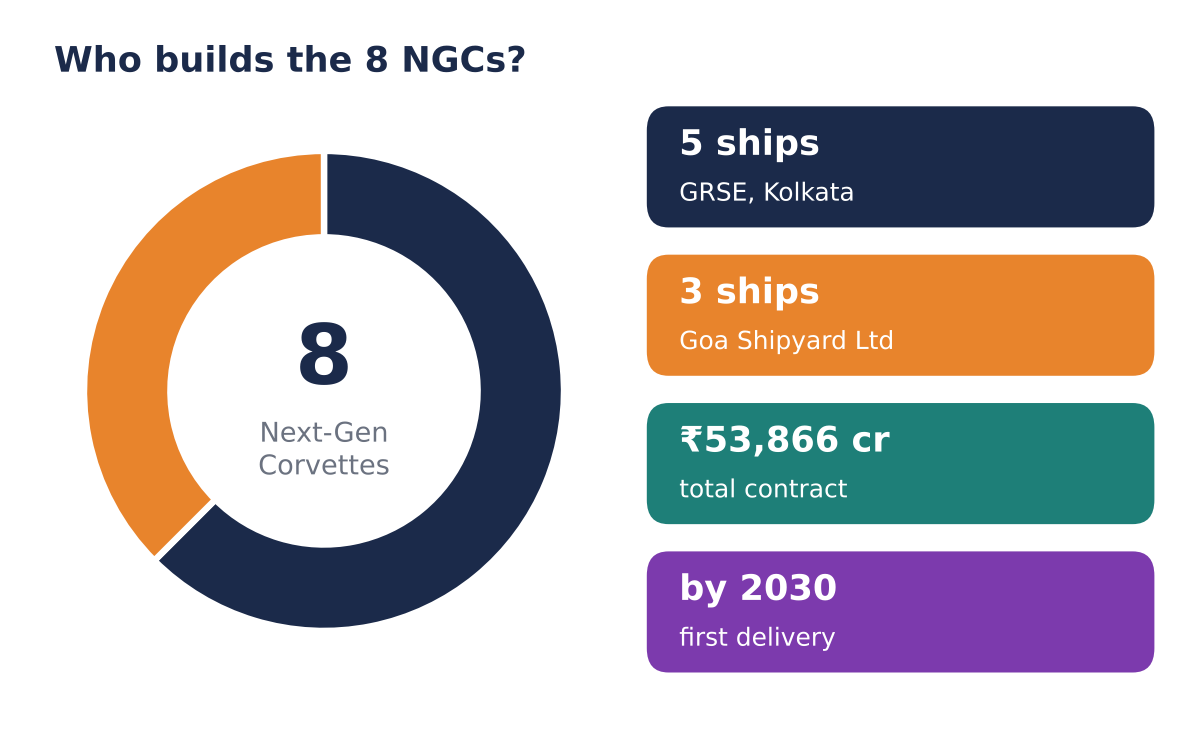
GRSE, Kolkata builds 5 ships and Goa Shipyard Ltd builds 3; GRSE was the lowest bidder (L1) in May 2025.
Multi-role stealth ships for anti-surface & anti-submarine warfare, coastal defence and littoral combat; replace ageing single-role missile corvettes.
First Navy in-house design of this class awarded to DPSUs via competitive bidding – not nomination or foreign licence.
About ₹6,733 crore per ship; first delivery by 2030; ~72 lakh person-days in yards and 460 lakh in MSMEs over 10 years.
Way forward
Keep delivery timelines tight, raise indigenous weapon-sensor content and pull private yards into the vendor chain.
Concept
Corvette – smallest ocean-going warship class (below frigate & destroyer). CCS is chaired by the PM; DAP-2020 gives top priority to 'Buy (Indian-IDDM)'.
Donut chart showing the split of 8 Next Generation Corvettes: 5 by GRSE Kolkata and 3 by Goa Shipyard, total ₹53,866 crore, about ₹6,733 crore per ship, first delivery by 2030. — StudyForGS
2. PM: India to add 500 GW more non-fossil capacity in 10–11 years
Opening the Bharat Renewable Energy Summit & Expo 2026 at Bharat Mandapam, held with the 9th ISA Assembly (2–5 Nov), the PM said clean energy cushioned India from the West Asia crisis.
Key facts
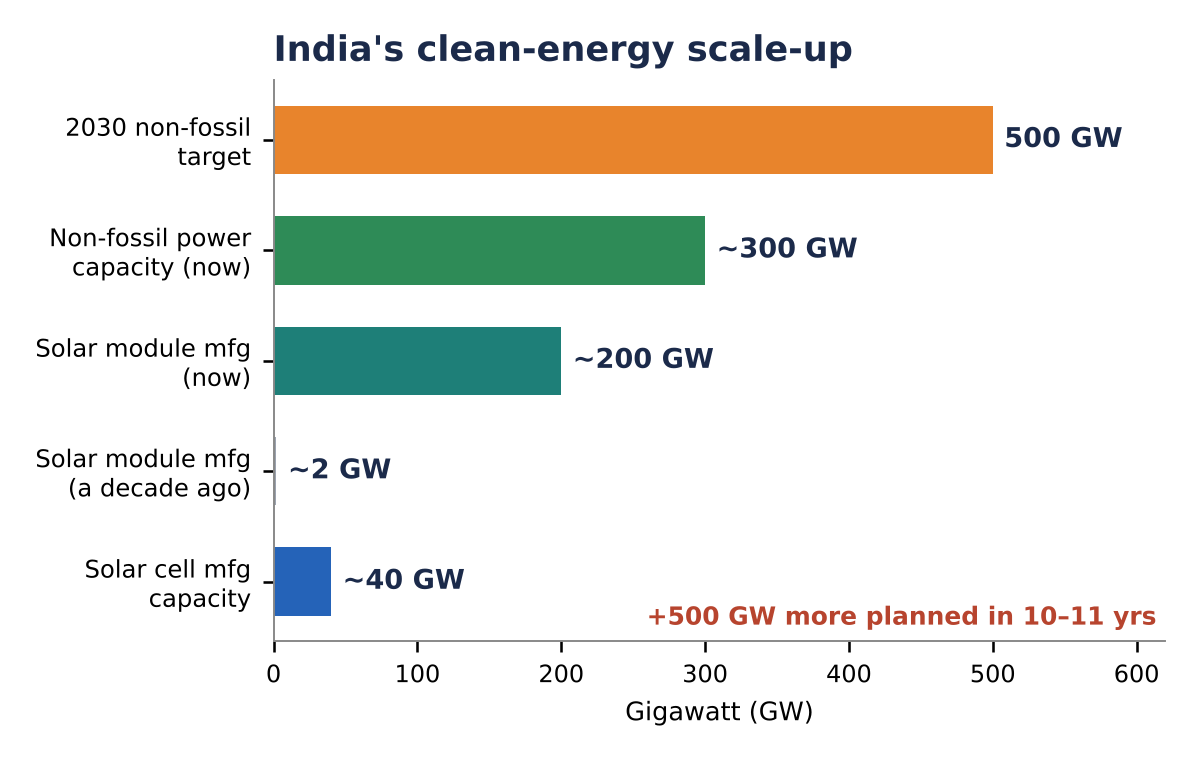
India has ~300 GW non-fossil capacity towards the 500 GW by 2030 goal (COP-26); 50% non-fossil share met in 2025, 5 years early.
Solar module manufacturing rose from ~2 GW to 200+ GW in a decade; solar cell capacity is ~40 GW.
Investment opportunity of ₹20 lakh crore (~US$220 bn) by 2030; ₹15 lakh crore invested in the last decade.
PM Surya Ghar: 65 lakh+ homes (target 1 crore); PM-KUSUM: 30 lakh+ farmers; US$200 mn Africa Solar Facility proposed.
Way forward
Pair new capacity with storage, the next phase of green energy corridors (~₹2 lakh crore) and cell-wafer self-reliance.
Concept
ISA – launched by India & France at COP-21 Paris (2015); HQ Gurugram. Panchamrit (COP-26) – Net Zero by 2070.
Bar chart of India's clean-energy numbers: about 300 GW non-fossil capacity versus the 500 GW 2030 target, solar module manufacturing up from about 2 GW to over 200 GW, and solar cell capacity of about 40 GW. — StudyForGS
3. FM: Capex push to continue till private investment picks up
ECONOMYUPSC: Prelims + Mains GS3 (Indian Economy)
Syllabus linkage
GS3 – Budgeting, investment models, growth; Prelims – capital vs revenue expenditure, FPI.
Context
On 2 Nov 2026, FM Nirmala Sitharaman said the Centre will sustain public capex until private investment expands capacity, while fiscal prudence remains non-negotiable.
Key facts
Budget 2026-27 capex is ₹12.2 lakh crore; FM cited its multiplier effect over five years.
India needs more equity capital for 7%+ growth; GST and banks show 'no fragility'.
FPIs sold ~₹1.6 lakh crore of equities in FY27 (till Oct) but turned net buyers in the last two weeks.
Banking committee under ex-CVC S.N. Patel to report by April 2027; AI-training centres planned in every district.
Way forward
Crowd-in private capex via PLI, GST reforms and ease of doing business, while staying on the fiscal glide path.
Concept
Capital expenditure creates assets or cuts liabilities and has a higher multiplier than revenue spending. Crowding-in vs crowding-out; FRBM Act, 2003.
4. Siang Upper Multipurpose Project: Arunachal CM offers dialogue
GS3 – Infrastructure, environment vs development; GS2 – tribal rights; Prelims – Siang/Brahmaputra, Adi tribe.
Context
After violent protests in East Siang (23–24 Oct), CM Pema Khandu wrote to protesters promising dialogue, transparency and public consultation on the proposed ~11,000-MW SUMP.
Key facts
Proposed 11,000–11,200 MW project on the Siang (Yarlung Tsangpo) – would be India's largest hydropower project.
Present work is limited to surveys for a Pre-Feasibility Report (PFR); an NHPC office was torched on 23 Oct 2026.
Seen as a strategic buffer against China's mega dam on the Yarlung Tsangpo (Medog) upstream.
Protesters, mainly Adi groups, want PFR surveys and central forces withdrawn; fear displacement and loss of land.
Way forward
Free, prior and informed consent, credible EIA and social-impact studies and benefit-sharing can reconcile security with livelihoods.
Concept
The Brahmaputra enters India as the Siang; joins the Dibang & Lohit near Sadiya. Article 371H – special provision for Arunachal Pradesh.
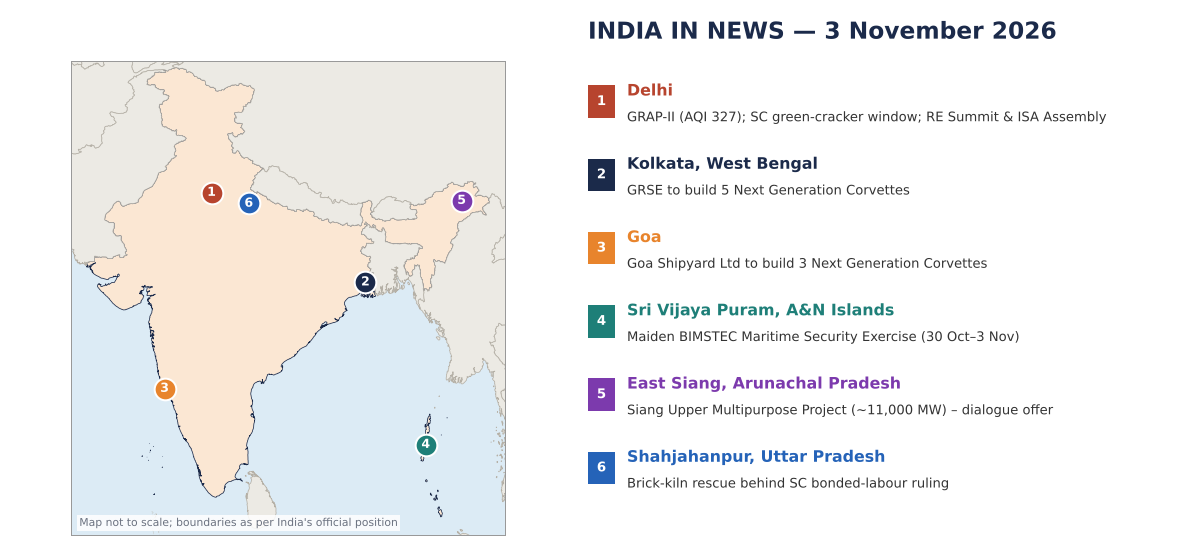
India in News locator map with numbered pins: 1 Delhi (GRAP-II, green-cracker order, clean-energy summit), 2 Kolkata (GRSE), 3 Goa (Goa Shipyard), 4 Sri Vijaya Puram (BIMSTEC maritime exercise), 5 East Siang, Arunachal Pradesh (Siang project), 6 Shahjahanpur, Uttar Pradesh (bonded labour case). Boundaries as per India's official position. — StudyForGS
5. Delhi-NCR invokes GRAP Stage II as AQI turns 'Very Poor'
CAQM invoked GRAP Stage II on 2 Nov 2026 as Delhi's AQI hit 327, up from 117 (31 Oct) and 261 (1 Nov) within three days.
Key facts
Stage II curbs: ban on coal & firewood, limits on diesel generators, higher parking fees, more mechanised sweeping & sprinkling.
IMD/IITM forecasts AQI to stay 'Very Poor'; calm weather and farm fires add to the load.
GRAP stages: I Poor (201–300), II Very Poor (301–400), III Severe (401–450), IV Severe+ (>450).
Way forward
Shift from episodic GRAP to year-round airshed action – clean transport, dust control and crop-residue solutions.
Concept
CAQM – statutory body under the CAQM Act, 2021 for NCR and adjoining areas. National AQI (2014) tracks 8 pollutants incl. PM2.5, PM10, NO2, SO2, CO, O3, NH3, Pb.
6. Maiden BIMSTEC Maritime Security Exercise concludes in Andamans
India hosted the first BIMSTEC Maritime Security Exercise at Sri Vijaya Puram from 30 Oct to 3 Nov 2026, as announced by the PM at the 6th BIMSTEC Summit, Bangkok (April 2025).
Key facts
Hosted by the Andaman & Nicobar Command – India's only tri-service command; theme 'Shared Seas, Shared Security and Shared Prosperity'.
3-day tabletop + 2-day harbour phase; ships incl. SLNS Gajabahu (Sri Lanka) and UMS King Aung Zeya (Myanmar).
Focus: maritime domain awareness, HADR, maritime crime, terrorism and oil-spill response in the Bay of Bengal.
Anchored in the Delhi Declaration of the 1st BIMSTEC Home Ministers' Meeting (13 Oct 2026).
Way forward
Make it an annual drill and link it with IFC-IOR information sharing for a secure Bay of Bengal.
Concept
BIMSTEC (1997, Bangkok Declaration; Secretariat Dhaka) – 7 members: Bangladesh, Bhutan, India, Myanmar, Nepal, Sri Lanka, Thailand; Charter in force 2024.
7. SC allows certified green crackers in Delhi-NCR on 7–8 November
GS2 – Judiciary, Fundamental Rights; GS3 – pollution; Prelims – Art 21 & 25, CSIR-NEERI, PESO.
Context
A bench of Justices M.M. Sundresh and P.B. Varale relaxed the blanket ban for Deepavali: certified green crackers may be sold and burst on 7–8 Nov 2026; the full ban returns from 9 Nov.
Key facts
Bursting only 6–7 am and 8–10 pm; no online sale; sales only at district-designated points.
Only CSIR-NEERI-approved products with QR codes and PESO licence; barium and conventional 'laris' stay banned.
300-m cracker-free zones near hospitals, schools and silence zones; CPCB to file daily AQI reports; next hearing 16 Dec.
Court: blanket ban fostered an illegal market; Art 25 is subject to the Art 21 right to a healthy environment.
Way forward
Hard enforcement and health-AQI data should decide whether calibrated relaxation or a ban works better.
Concept
Green crackers (CSIR-NEERI) cut emissions by about 30% and use no barium; types SWAS, SAFAL, STAR. Case: Arjun Gopal v. Union of India (petition of 2015).
8. SC: Rescued bonded labourers must get aid within 7 days
SOCIETYUPSC: Prelims + Mains GS2 (Vulnerable Sections & Fundamental Rights)
Syllabus linkage
GS2 – Vulnerable sections, Fundamental Rights; GS1 – social issues; Prelims – Art 23, BLSA Act 1976.
Context
In Surendra Manjhi v. Union of India (2 Nov 2026), Justices Vikram Nath and Aparesh Kumar Singh held that delay in rehabilitation amounts to denial and set nationwide timelines.
Key facts
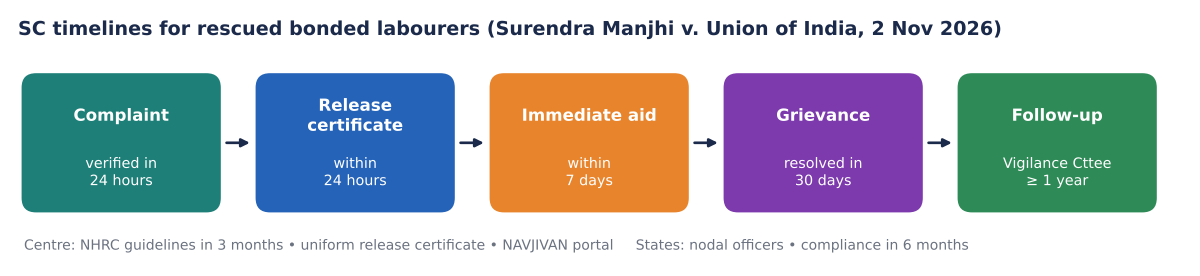
Immediate aid ordinarily within 7 days of the release certificate; complaints verified and certificates issued within 24 hours.
Aid cannot be withheld over inter-State disputes or pending criminal cases; duty under Arts 21 & 23 continues after release.
Centre: guidelines with NHRC in 3 months, a uniform release certificate and an effective NAVJIVAN portal.
States: nodal officers, active Vigilance Committees; grievances settled in 30 days; case arose from a Shahjahanpur (UP) brick-kiln rescue (2019).
Way forward
Assure district rehabilitation funds, convergence with welfare schemes and one-year follow-up to stop re-bondage.
Concept
Article 23 bans begar and forced labour. Bonded Labour System (Abolition) Act, 1976; Central Sector Scheme for Rehabilitation (2016) gives ₹1–3 lakh aid. Bandhua Mukti Morcha (1984).
Flowchart of Supreme Court timelines for bonded labourers: complaint verified within 24 hours, release certificate within 24 hours, immediate aid within 7 days, grievances resolved within 30 days, and District Vigilance Committee follow-up for at least one year. — StudyForGS
9. Centre notifies VB-G RAM G Grievance Redressal Rules, 2026
The Ministry of Rural Development notified the VB-G RAM G Grievance Redressal Rules, 2026 on 2 Nov 2026, fixing a 15-day deadline for complaints under the rural job guarantee law.
Key facts
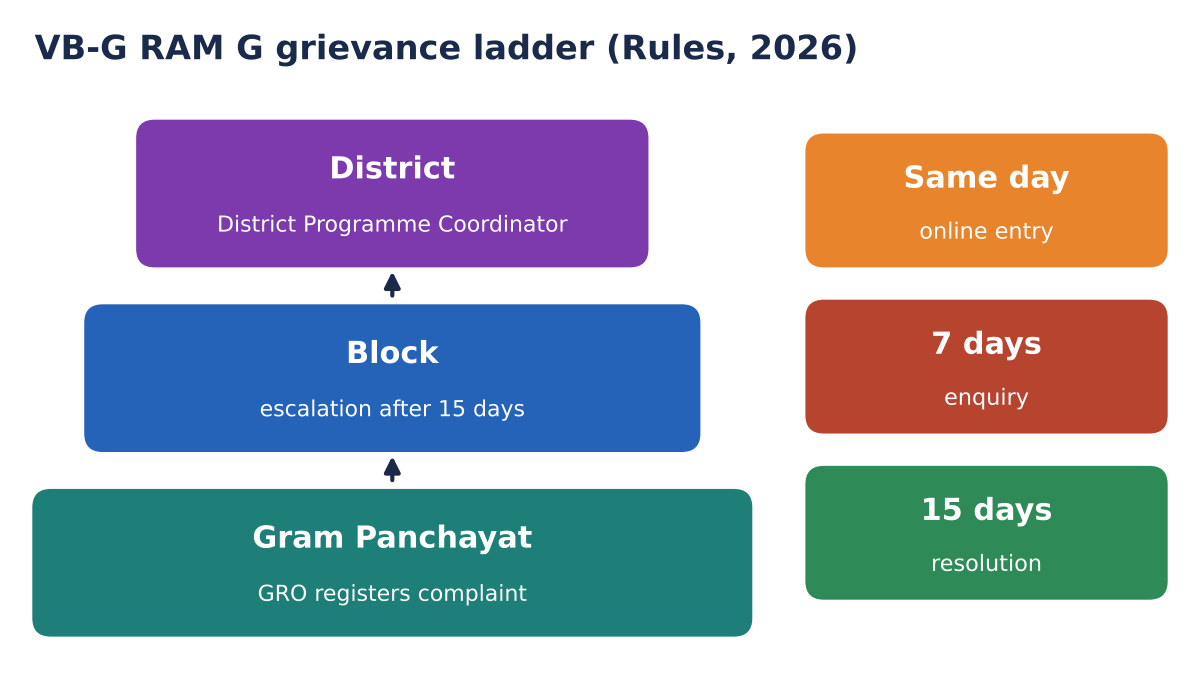
Three tiers: Gram Panchayat → Block → District; unresolved cases escalate after 15 days.
Physical complaints go on the digital platform the same day; enquiry within 7 working days.
No grievance can be refused for format, language or procedural defects; appeals under Schedule I of the Act.
Critics say some key provisions of the draft were dropped from the final rules.
Way forward
Independent ombudspersons, regular social audits and real-time MIS can make the 15-day clock enforceable.
Concept
VB-G RAM G Act, 2025 (Viksit Bharat – Guarantee for Rozgar and Ajeevika Mission (Gramin)) replaced MGNREGA, 2005; guarantees 125 days of wage work per rural household.
Tier diagram of the VB-G RAM G grievance mechanism: Gram Panchayat, then Block, then District level, with escalation after 15 days, same-day registration and enquiry within 7 working days. — StudyForGS
10. MHA to set up FRROs in all State capitals by 2027
The Ministry of Home Affairs said on 2 Nov 2026 that Foreigners Regional Registration Offices (FRROs) will come up in all State capitals by 2027 under the Immigration and Foreigners Act, 2025.
Key facts
5 new FRROs since 2025: Jaipur, Chandigarh, Guwahati, Aizawl, Amaravati; notified next: Kohima, Agartala, Bhubaneswar.
FRROs handle registration, residential permits, visa extension/conversion, protected-area permits and exit permits.
The 2025 Act merged four laws: Passport (Entry into India) Act 1920, Registration of Foreigners Act 1939, Foreigners Act 1946, Immigration (Carriers' Liability) Act 2000.
Way forward
Scale up e-FRRO services and integrate data with State police to track overstay and illegal migration.
Concept
Citizenship, naturalisation & aliens – Union List (Entry 17); Article 11 lets Parliament regulate citizenship. Bureau of Immigration (MHA) runs immigration check posts.
11. NSA Doval in Hanoi: India–Vietnam to deepen defence cooperation
IRUPSC: Prelims + Mains GS2 (International Relations)
Syllabus linkage
GS2 – Bilateral relations, Act East Policy; Prelims – Vietnam, South China Sea.
Context
NSA Ajit Doval met Vietnam's Deputy PM and Defence Minister Gen. Phan Van Giang in Hanoi on 2 Nov 2026; both sides agreed to further deepen defence engagement.
Key facts
Ties raised to an Enhanced Comprehensive Strategic Partnership in May 2026 during President To Lam's India visit.
Progress reviewed on the Joint Vision on Defence Partnership towards 2030; links Viksit Bharat 2047 with Vietnam Vision 2045.
4th India–Vietnam Security Dialogue held in New Delhi (Oct 2026) – counter-terror, cyber, maritime security; held every two years under a 2016 MoU.
Way forward
Expand defence co-production, maritime domain awareness and connectivity with ASEAN.
Concept
Act East Policy (2014) upgraded Look East (1991); focus on Commerce, Culture, Connectivity. Vietnam joined ASEAN in 1995.
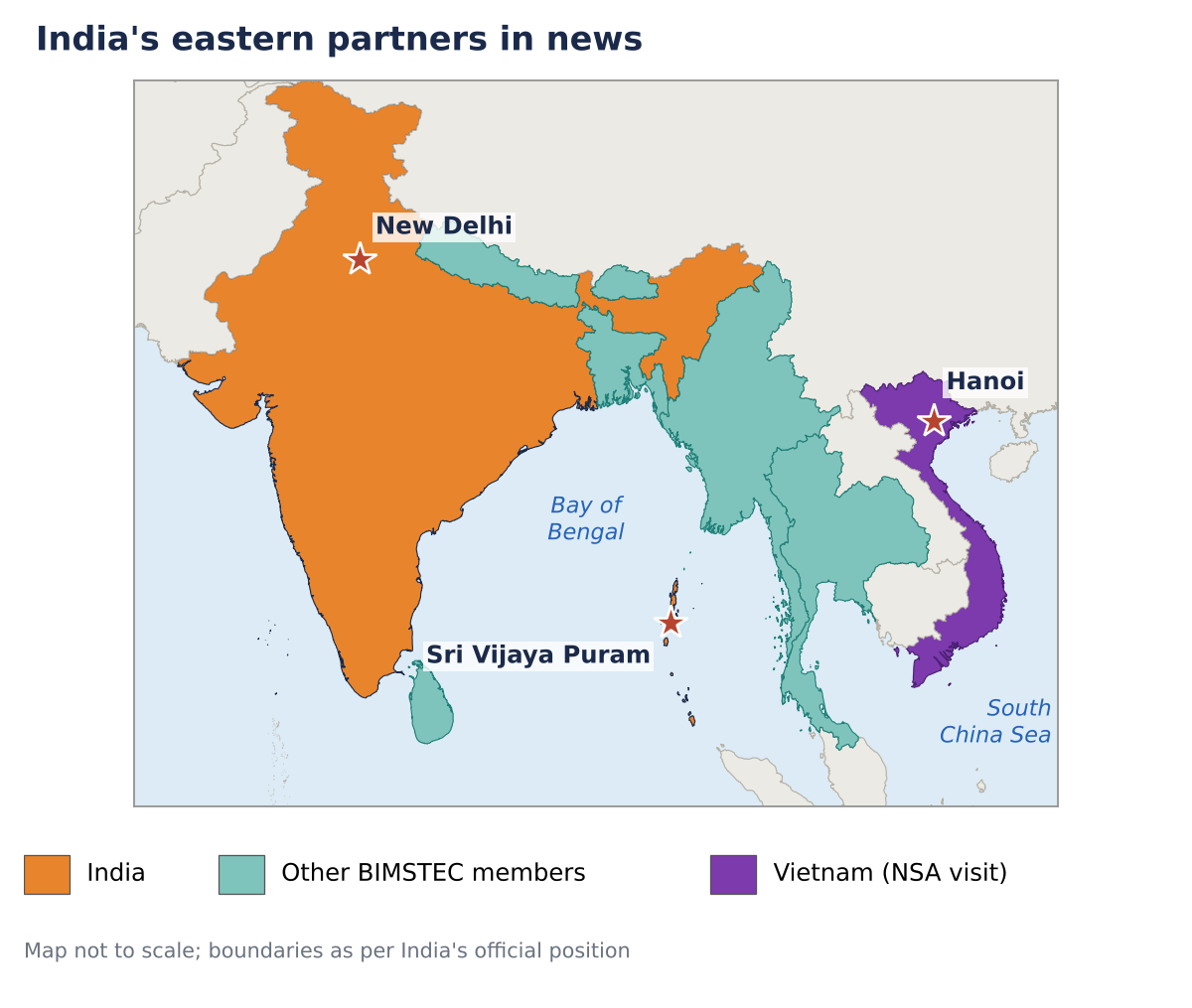
Regional map of South and South-East Asia highlighting India, the other BIMSTEC members and Vietnam, with markers for New Delhi, Hanoi and Sri Vijaya Puram (BIMSTEC maritime exercise). Boundaries as per India's official position. — StudyForGS
Data point of the day
54.7
Manufacturing PMI (October 2026) Down from 55.1 in September but well above the 50 mark (expansion). New export orders hit a 6-month high; input-cost inflation was the lowest since Feb 2026 and output-price rise at a near 4-year low.
Prelims rapid-fire
3 November – International Day for Biosphere Reserves (UNESCO); India has 18 BRs, 13 in the UNESCO World Network.
Manisha Bhanwala – India's first woman World Champion in wrestling (Senior Worlds, Astana, 2026).
EPFO marked its 74th Foundation Day (1 Nov); launched services on WhatsApp and auto-settlement of inoperative accounts up to ₹1,000.
Dinesh V. Ganvir – 55th Director General of the Geological Survey of India (Ministry of Mines).
2 November – International Day to End Impunity for Crimes against Journalists; 2026 theme 'Threats Evolve. Impunity Endures.'
Operation Cactus (3 Nov 1988) – Indian forces foiled a coup attempt in the Maldives.
Practice MCQs — UPSC Prelims pattern
Q1. With reference to bonded labour in India, consider the following statements: 1. Article 23 of the Constitution prohibits begar and other similar forms of forced labour. 2. The Bonded Labour System (Abolition) Act was enacted in 1976. 3. Vigilance Committees at district and sub-divisional levels are constituted under this Act. Which of the statements given above are correct?
1 only
1 and 2 only
2 and 3 only
1, 2 and 3
Show answer
Answer: D All three are correct: Article 23 bans begar and forced labour; the BLSA Act, 1976 abolished bonded labour and provides for Vigilance Committees at district and sub-divisional levels.
Q2. Which of the following countries are members of BIMSTEC? 1. Bhutan 2. Maldives 3. Myanmar 4. Nepal 5. Indonesia. Select the correct answer using the code given below.
1, 3 and 4 only
1, 2, 3 and 4 only
2, 4 and 5 only
1, 3, 4 and 5 only
Show answer
Answer: A BIMSTEC has 7 members: Bangladesh, Bhutan, India, Myanmar, Nepal, Sri Lanka and Thailand. Maldives and Indonesia are not members.
Mains practice question
Q. Public capital expenditure has been the mainstay of India's growth while private investment has lagged. Critically examine the 'crowding-in' effect of public capex and suggest measures to revive private investment without compromising fiscal prudence. (250 words, 15 marks)
📌 One-line revision: Corvettes ₹53,866 cr (GRSE 5 + GSL 3) | +500 GW clean power in 10–11 yrs | Green crackers only 7–8 Nov | Bonded-labour aid in 7 days | VB-G RAM G grievances in 15 days | PMI 54.7