Wednesday, 30 September 2026 · IST · National & International · 11 items · 2 MCQs
The Centre has cut customs duty on crude and refined edible oils ahead of the festive season, while RBI data show net FDI of US$ 7.35 bn in July 2026, a five-year monthly high. The Supreme Court called ~10x mark-ups on cancer drugs 'broad daylight dacoity', and India issued its first PRAMAAN forest-certification certificates.
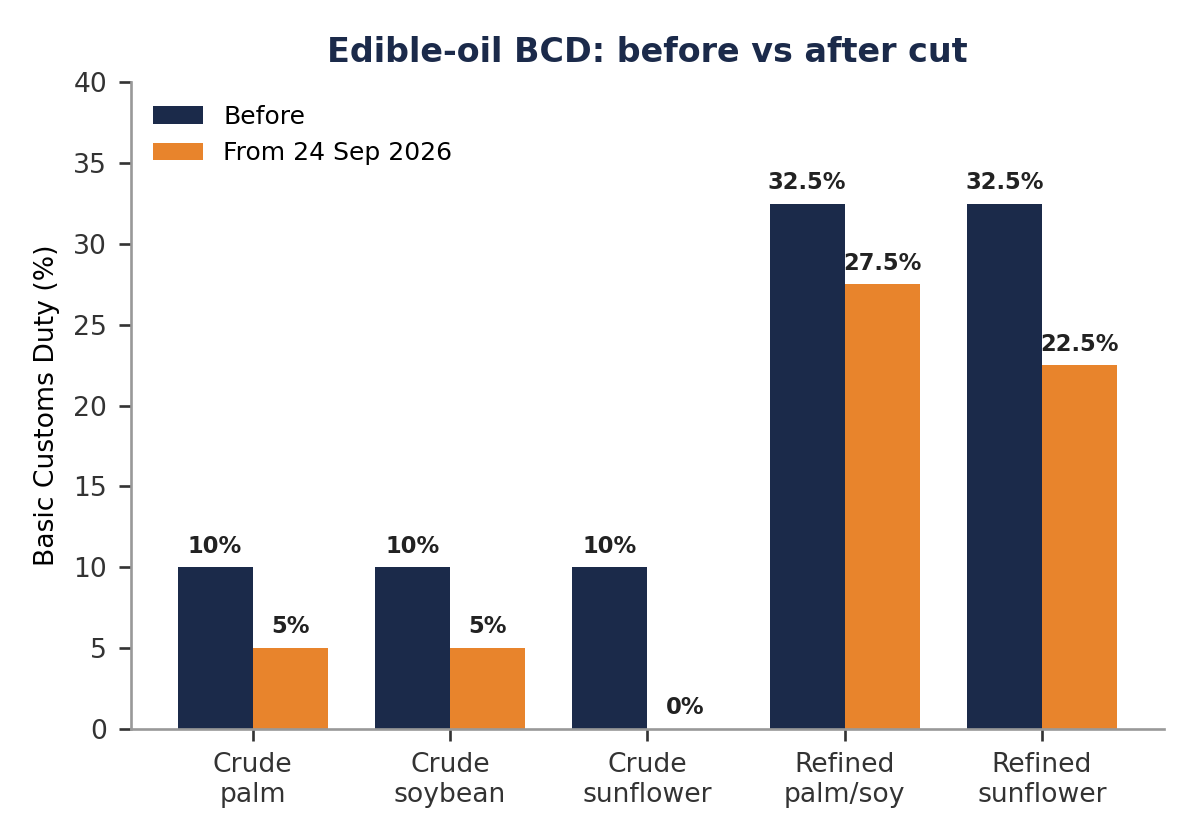
Effective 24 September 2026, the Centre cut the Basic Customs Duty (BCD) on crude and refined edible oils to cool prices, which have risen nearly 20% year-on-year, before the Sept–Nov festive demand peak.
India imports nearly two-thirds of its vegetable-oil needs — mainly from Indonesia, Malaysia, Argentina, Russia and Ukraine.
Way forward
Balance consumer relief with farmers' interest — retain a wide crude–refined duty gap and accelerate the National Mission on Edible Oils–Oilseeds.
Concept
Differential duty (low on crude, high on refined) protects domestic refining value-addition. NMEO-Oilseeds (2024–31) targets self-reliance; NMEO-Oil Palm (2021) focuses on the North-East and A&N Islands.
Grouped bar chart comparing old and new basic customs duty on crude palm, crude soybean, crude sunflower, refined palm/soy and refined sunflower oil. — StudyForGS
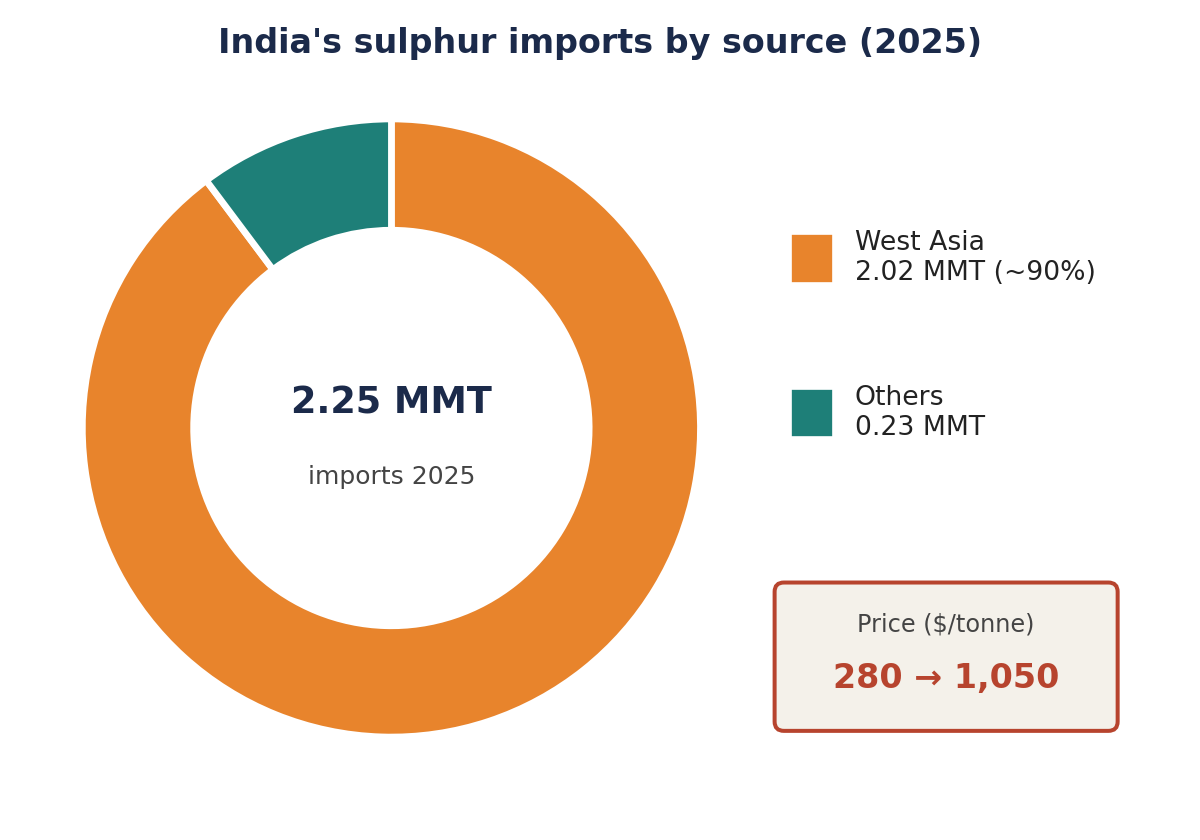
Conflicts in Russia–Ukraine and West Asia have hit oil & gas output — the main source of sulphur — pushing prices from about $280/tonne (July 2025) to over $1,050/tonne (July 2026).
Key facts
About 92% of global sulphur is a by-product of oil & gas processing.
India imported 2.25 MMT in 2025, of which ~90% (2.02 MMT) came from West Asia; import bill rose ~2.5x to $638 million.
Russia has curbed sulphur exports and China has restricted sulphuric-acid exports.
Sulphuric acid converts rock phosphate into DAP & SSP; nickel processing for EV batteries adds to global demand.
Way forward
Diversify suppliers, build strategic buffer stocks, raise sulphur recovery from refineries & smelters, and factor input costs into NBS rates.
Concept
Nutrient Based Subsidy (NBS, 2010) covers P&K fertilisers. Sulphur is a secondary nutrient; widespread soil S-deficiency led to sulphur-coated urea (Urea Gold).
Donut chart showing India's 2025 sulphur imports of 2.25 million tonnes, about 90 percent from West Asia, with price rise from 280 to 1,050 dollars per tonne. — StudyForGS
3. BioE3 push: ₹75-crore grant for India's PLA bio-plastic R&D facility
Balrampur Chini Mills (BCML) received a ₹75 crore grant through BIRAC under the BioE3 policy for a 100 tonne-per-annum PLA and co-polymer R&D facility at Kumbhi, Uttar Pradesh.
Key facts
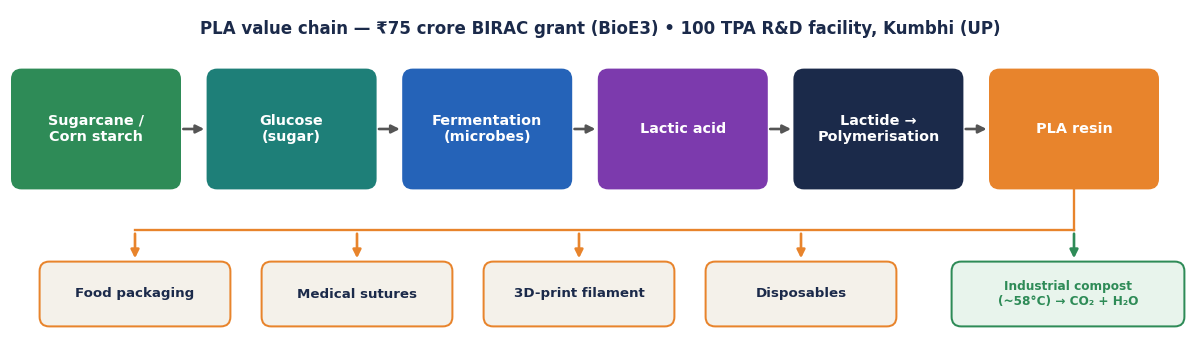
Polylactic Acid (PLA) is a bio-based, compostable thermoplastic made from corn starch or sugarcane.
Uses: food packaging, medical sutures, 3D-printing filaments and disposables.
Complements BCML's planned commercial plant, pitched as India's first integrated PLA facility.
Way forward
Scale up industrial composting, frame clear bioplastic labelling/certification norms and align with the Plastic Waste Management Rules.
Concept
BioE3 (2024) = Biotechnology for Economy, Environment & Employment. BIRAC is a not-for-profit PSU under the Department of Biotechnology. PLA degrades mainly under industrial composting (~58°C), not in open soil.
Flowchart of polylactic acid production from sugarcane or corn through fermentation, lactic acid, lactide and polymerisation to PLA products and composting. — StudyForGS
4. Japan urges India to fast-track UNICORN naval stealth-mast project
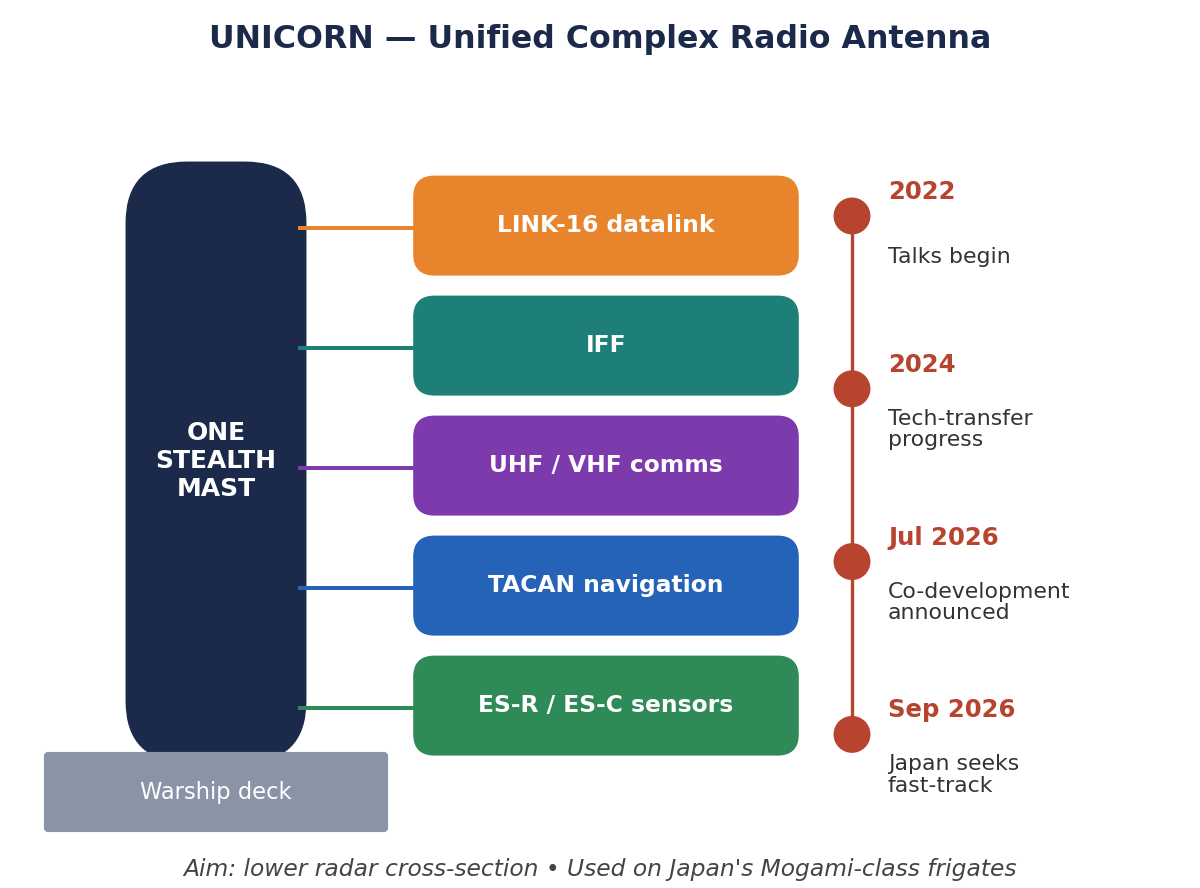
Japan has asked India to speed up internal approvals for UNICORN, announced during PM Sanae Takaichi's India visit in July 2026 — the first-ever India–Japan defence co-development project.
Key facts
UNICORN = Unified Complex Radio Antenna: a single integrated mast housing many antennas (LINK-16, IFF, UHF, TACAN) to cut radar cross-section.
Fitted on Japan's Mogami-class frigates; Japanese partners include NEC and Yokohama Rubber.
Indian Navy plans a UNICORN derivative for its next-generation warships.
Japan cites China's military spending and Russia–North Korea cooperation as drivers.
Way forward
Clear approvals quickly, secure real technology transfer and Make in India content, and dovetail with the 2+2 dialogue and Quad maritime agenda.
Concept
India–Japan Special Strategic & Global Partnership (2014); logistics pact ACSA (2020); exercises JIMEX (navy), Dharma Guardian (army), Malabar (Quad navies).
Fact-sheet schematic of the UNICORN integrated mast showing the antennas it combines and key project milestones from 2022 to 2026. — StudyForGS
5. India's first PRAMAAN certificates for sustainable forestry issued
Union Environment Minister Bhupender Yadav handed over the first certificates under PRAMAAN, the Indian Forest & Wood Certification Scheme (IFWCS), to promote deforestation-free timber sourcing.
Key facts
Recipients: Andhra Pradesh Forest Development Corporation (33,000 ha of plantations) and an Odisha bamboo farmer.
Scheme launched by MoEFCC in December 2023; operated by IIFM, Bhopal.
Three streams: Forest Management, Trees Outside Forests and Chain of Custody.
Audits by bodies accredited by NABCB (under the Quality Council of India); standard linked to the National Working Plan Code 2023.
Way forward
Seek international mutual recognition so exporters can meet norms such as the EU Deforestation Regulation, and extend coverage to SHGs and tribal agroforestry.
Concept
Forest certification = third-party verification of sustainable forest management. PRAMAAN = Programme for Recognition and Accreditation of sustainable Management practices for Agroforestry And Natural forestry resources.
6. Study: degraded ancient grasslands never regrow the same way
A study in PNAS covering 742 plant species across Indian, Australian and Brazilian savannas and US prairies found that old-growth grasslands, once degraded, do not return to their original composition even after a century.
Key facts
Secondary grasslands host taller, resource-acquisitive species instead of slow-growing, deep-rooted ancient flora.
Altered soil nutrients and pH block the return of original species.
Grasslands store about one-third of terrestrial carbon, mostly below ground.
Warns against labelling grasslands as 'wastelands' for plantations or solar parks.
Way forward
Protect intact old-growth grasslands first, revise wasteland classifications, and restore with native species under India's land-restoration pledge.
Concept
Old-growth grassland = ancient, stable ecosystem, not an early stage of forest succession. Indian examples: Banni (Gujarat), Shola grasslands (W. Ghats), Terai, Deccan plateau — habitat of the Great Indian Bustard. India's restoration target: 26 Mha by 2030.
7. Supreme Court flags steep mark-ups on essential and cancer drugs
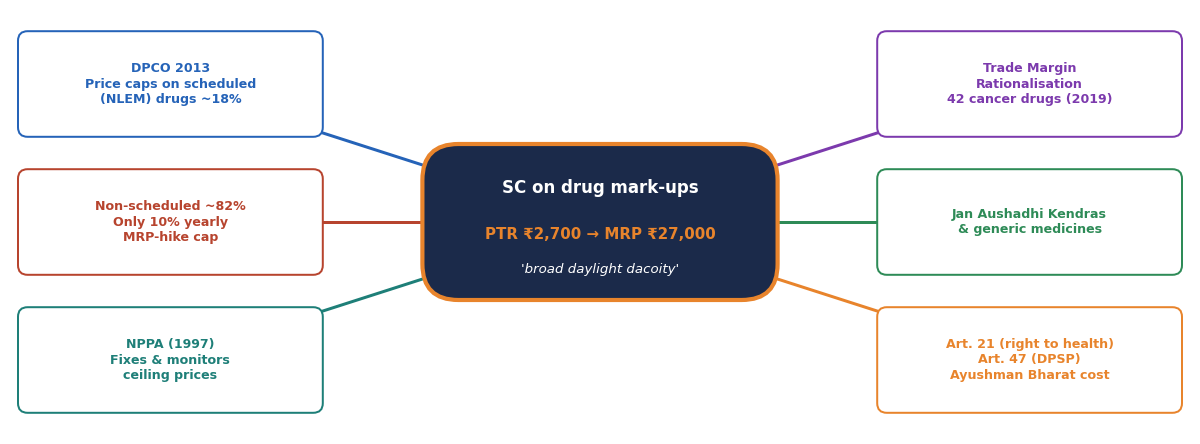
Hearing Kishan Chand Jain v. Union of India, a Bench of Justices Vikram Nath and Sandeep Mehta called MRPs far above trade prices 'broad daylight dacoity', flagging the burden on patients and on Ayushman Bharat.
Key facts
A cancer drug with a price-to-retailer of ~₹2,700 carried an MRP of ₹27,000 — a ~10x (900%) mark-up.
DPCO 2013 caps only scheduled (NLEM) drugs — about 18% of medicines; ~82% non-scheduled drugs face only a 10% annual MRP-hike cap.
A non-scheduled statin cost ~₹214/strip vs ~₹70 for a price-controlled combination.
Court also flagged private hospitals forcing purchases from in-house pharmacies; Centre cited Jan Aushadhi Kendras.
Way forward
Extend Trade Margin Rationalisation (applied to 42 anti-cancer drugs in 2019) to more non-scheduled drugs, scale up Jan Aushadhi and mandate transparent hospital-pharmacy pricing.
Concept
NPPA (1997) fixes and monitors prices under the DPCO, issued under the Essential Commodities Act, 1955. NLEM 2022 lists 384 medicines. Right to health is read into Article 21; Article 47 (DPSP) — duty to improve public health.
Mind-map of India's drug price regulation showing DPCO 2013, NPPA, NLEM, trade margin rationalisation, Jan Aushadhi and constitutional linkages, centred on the Supreme Court's mark-up concern. — StudyForGS
8. India attends SCO meeting in Islamabad under Pakistan's chairship
An Indian delegation led by a Joint Secretary attended an SCO planning meeting in Islamabad. Pakistan holds the SCO chair from 1 September 2026 to 31 August 2027 and will host the grouping's top summit in 2027.
Key facts
India attends all SCO meetings despite minimal ties with Pakistan; EAM visited Islamabad for the SCO Heads of Government meet (Oct 2024).
SCO has 10 members: China, Russia, India, Pakistan, Iran, Belarus (2024), Kazakhstan, Kyrgyzstan, Tajikistan, Uzbekistan.
India–Pakistan frictions resurfaced at the UNGA over Kashmir; Türkiye is seeking a closer SCO role.
EAM S. Jaishankar: with the US and China in competitive mode, nations must de-risk and diversify partnerships.
Way forward
Use SCO for counter-terrorism (RATS) and Central Asian connectivity while insisting on zero tolerance for cross-border terrorism.
Concept
SCO founded 2001 (from the Shanghai Five, 1996); Secretariat Beijing; RATS HQ Tashkent. India & Pakistan became full members in 2017; India chaired SCO in 2023.
9. Literacy for All: India at 81.1% as ULLAS nears its target
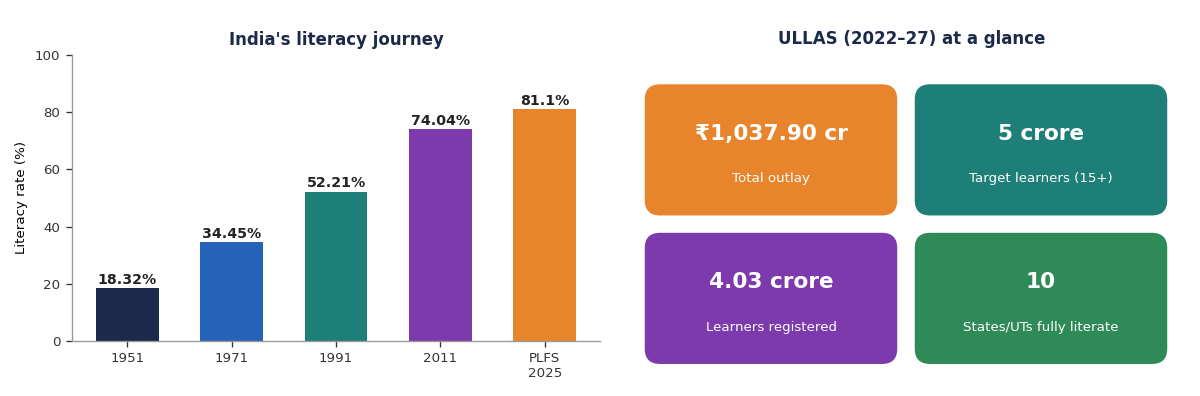
Official data show literacy rising from 18.32% (1951 Census) to 74.04% (2011) and 81.1% (PLFS 2025); 10 States/UTs have been declared fully literate under ULLAS during 2024–26.
PLFS 2025: urban 89%, rural 77.4%; rural female literacy only 70.3% — the key gap.
NIPUN Bharat (2021) targets foundational literacy & numeracy by 2026–27; higher-education GER ~30% vs NEP goal of 50% by 2035.
Way forward
Focus on rural women and SC/ST pockets; bundle literacy with digital & financial literacy and skilling for Viksit Bharat @2047.
Concept
Literate (Census) = a person aged 7+ who can read & write with understanding in any language. Article 21A (86th Amendment, 2002) — free & compulsory education for 6–14; SDG 4 — quality education.
Bar chart of India's literacy rate from 1951 to 2025 alongside stat tiles for ULLAS outlay, target learners, registrations and fully literate States and UTs. — StudyForGS
10. WEF Travel & Tourism Development Index 2026: India climbs to 31st
REPORTCOMMON: Prelims + Mains GS3
Syllabus linkage
GS3 — Services sector, infrastructure, employment; Prelims: indices and their publishers.
Context
The biennial TTDI 2026 of the World Economic Forum ranks India 31st of 110 economies, a gain of about nine places over the previous edition; Japan tops the list.
Key facts
Top 5: Japan, USA, Spain, Australia, France.
India's strengths: price competitiveness, cultural & natural resources, well-distributed demand; among top 10 for World Heritage cultural sites.
Weak spots: workforce skills, environmental sustainability and tourism-infrastructure quality.
101 of 110 economies improved their scores between 2024 and 2026.
Way forward
Skill the hospitality workforce, develop Swadesh Darshan 2.0 destinations sustainably and improve last-mile connectivity.
Concept
TTDI is biennial and succeeded the Travel & Tourism Competitiveness Index (TTCI) from 2021. Tourism is a labour-intensive service — key for employment and forex earnings.
11. Status of Policing in India Report 2026: digital-fraud victims left stranded
The Status of Policing in India Report (SPIR) 2026, a survey of 8,306 people across 16 States, finds most victims of digital financial fraud recover little or nothing.
Key facts
72% of victims recovered no money; only 51% filed a formal complaint.
27% of those with registered complaints reported paying bribes; bribe-payers recovered money about 3x more often.
Poor victims were 4x more likely to pay bribes; 42% found case registration difficult.
Official crime data: cybercrime cases rose 17.9% — 86,420 (2023) → 1,01,928 (2024).
Way forward
Enforce time-bound bank–police coordination and refunds, professionalise cyber cells and expand awareness among high-exposure users.
Concept
Police and Public Order are State List subjects (Seventh Schedule). I4C (under MHA) runs the 1930 helpline and the national cybercrime reporting portal; offences under IT Act, 2000 (Sec. 43, 66).
Data point of the day
US$ 7.35 bn
Net FDI inflows into India, July 2026 Highest monthly net FDI in 5 years, up 64% from $4.5 bn in July 2025. Gross inflows $14.6 bn. April–July FY27 net FDI $13.4 bn vs $9.7 bn a year ago (+38%). Mauritius, UAE and US ≈ 70% of equity inflows; communication, financial and computer services led.
Prelims rapid-fire
Pashudhan Bima Portal — Launched by the Dept. of Animal Husbandry & Dairying for digital livestock insurance under the National Livestock Mission; in Hindi, English + 11 regional languages.
KAZIND 2026 — India–Kazakhstan joint military exercise at Oskemen, Kazakhstan (28 Sep–11 Oct 2026); focus on counter-terrorism and drone (UAS) ops.
Begonia rajvikramanii — New begonia species from Rosemala forests, Kollam (Kerala) in the Western Ghats; grows on wet rocky cliffs.
Modhera Sun Temple — Built under Solanki king Bhimadeva I (early 11th century) in Mehsana, Gujarat; Maru-Gurjara style with Surya Kund.
Bodhana Sivanandan — Became the youngest-ever Woman Grandmaster (age 11) at the 46th Chess Olympiad, Samarkand.
Blue bond — Sagarmala Finance Corporation launched a ₹600 crore, 10-year blue bond to fund port & maritime projects.
Practice MCQs — UPSC Prelims pattern
Q1. With reference to Polylactic Acid (PLA), consider the following statements: 1. It is produced by fermentation of plant-derived sugars followed by polymerisation. 2. It readily biodegrades in open soil and seawater within a few weeks. 3. BIRAC, which funds bio-innovation, functions under the Department of Biotechnology. Which of the statements given above are correct?
1 and 2 only
1 and 3 only
2 and 3 only
1, 2 and 3
Show answer
Answer: B PLA is made by fermenting sugars into lactic acid and polymerising it (1 correct). It degrades mainly under industrial composting conditions (~58°C), not quickly in soil or seawater (2 wrong). BIRAC is a PSU under the Department of Biotechnology (3 correct).
Q2. Consider the following statements about the Shanghai Cooperation Organisation (SCO): 1. Belarus is its most recent full member. 2. Its Regional Anti-Terrorist Structure (RATS) is headquartered in Tashkent. 3. India has never held the SCO chairmanship. Which of the statements given above are correct?
1 only
1 and 2 only
2 and 3 only
1, 2 and 3
Show answer
Answer: B Belarus joined in 2024 as the 10th member (1 correct). RATS is based in Tashkent (2 correct). India chaired the SCO in 2023 and hosted a virtual summit (3 wrong).
Mains practice question
Q. Unregulated trade margins on non-scheduled medicines undermine the right to health. Critically examine India's drug price regulation framework and suggest reforms. (250 words, GS2)