Thursday, 1 October 2026 · IST · National & International · 12 items · 2 MCQs
The Union Cabinet approved PM-DHARA (Green Energy Corridor Phase-III, ₹1,86,405 crore) to evacuate 135 GW of renewable power and hiked Rabi MSPs for 2027-28, with the biggest boost for oilseeds and pulses. Gross GST for September 2026 rose 14.7% to ₹2.03 lakh crore, while UPSC marked its centenary and the new Bankers' Books Evidence Act, 2026 came into force.
Today at a glance — things to remember
PM-DHARA: ₹1,86,405 cr for 135 GW RE evacuation + 50 GWh BESS by FY33
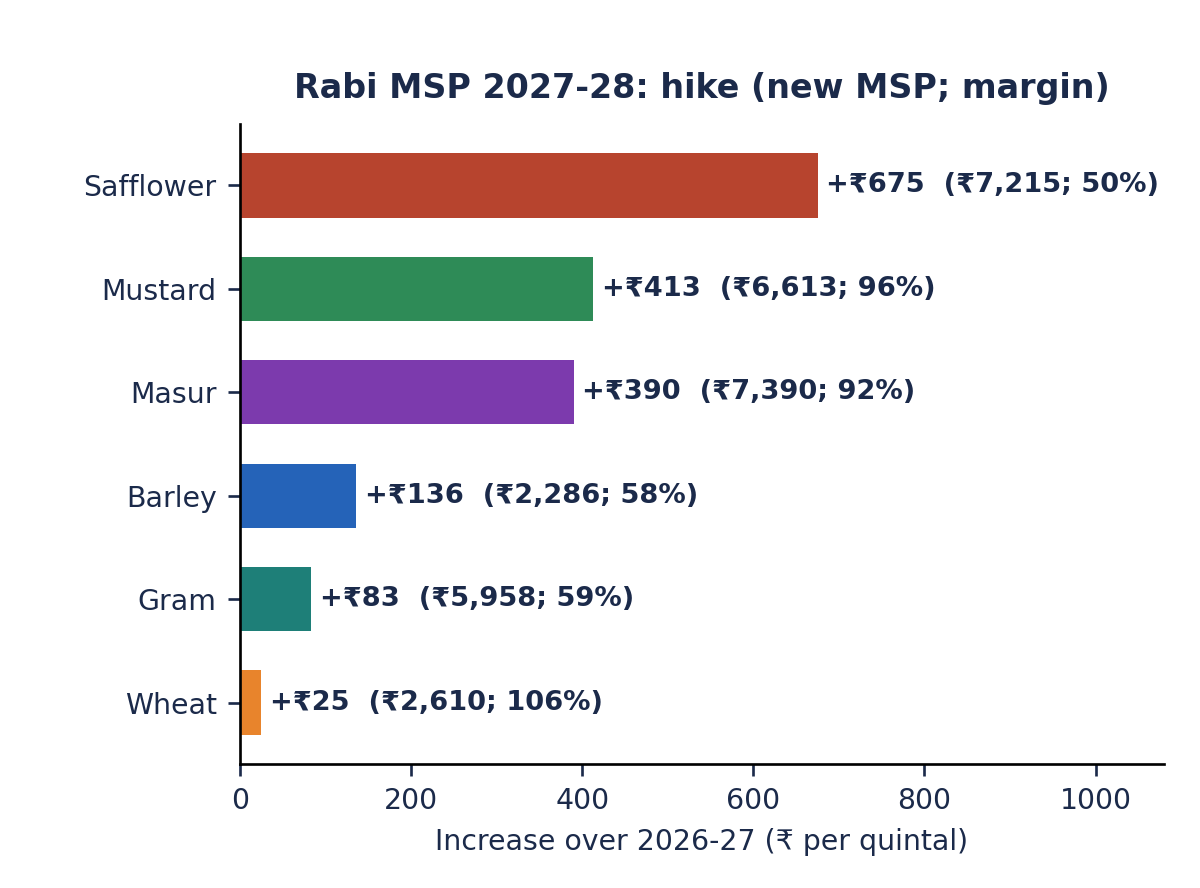
Wheat MSP for RMS 2027-28: ₹2,610/qtl (+₹25)
Highest MSP hike: Safflower +₹675 to ₹7,215/qtl
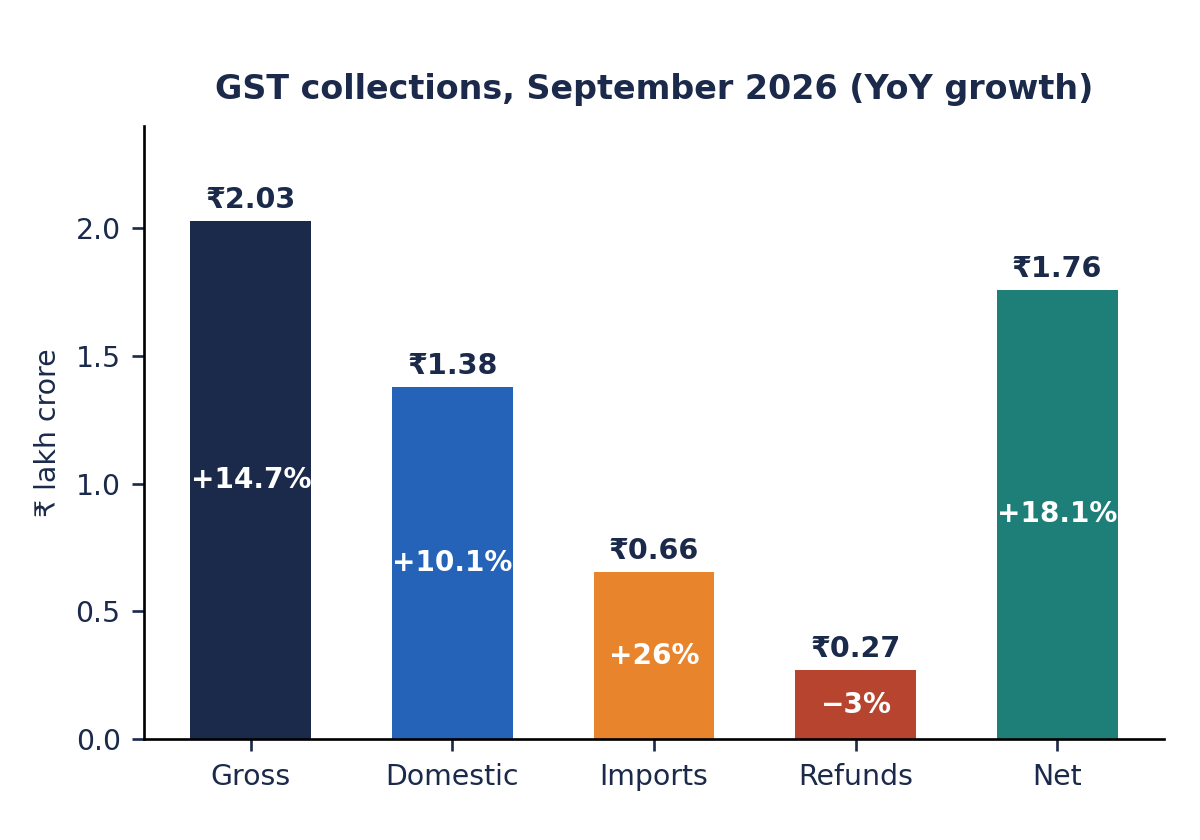
Gross GST Sept 2026: ₹2.03 lakh cr, +14.7%
UPSC centenary: PSC set up on 1 Oct 1926
Bankers' Books Evidence Act, 2026 replaces the 1891 law
Extradition Portal launched under PRAHAAR CT strategy
50 million Indian children lack school sanitation (JMP)
India's UNESCO Tentative List rises to 78 sites
Amit Shah meets Odisha & Chhattisgarh on Mahanadi dispute
Detailed notes
1. PM-DHARA: ₹1.86 lakh crore Green Energy Corridor Phase-III to evacuate 135 GW
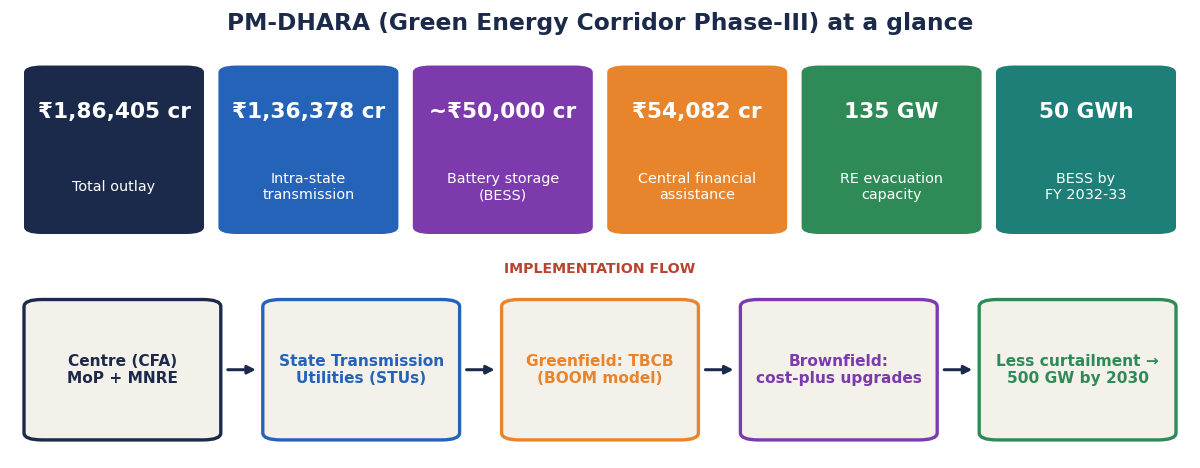
The Union Cabinet on 30 Sept 2026 approved PM-DHARA (Developing Harmonised & Accelerated Renewable Energy Access), i.e. Green Energy Corridor Phase-III, with an outlay of ₹1,86,405 crore to fix intra-state grid bottlenecks.
Key facts
₹1,36,378 crore for Intra-State Transmission System (InSTS) + ~₹50,000 crore for Battery Energy Storage Systems (BESS).
Central Financial Assistance: ₹54,082 crore; targets 135 GW RE evacuation and 50 GWh BESS by FY 2032-33.
Greenfield lines via Tariff-Based Competitive Bidding (TBCB) on BOOM model; brownfield upgrades on cost-plus basis.
Executed by State Transmission Utilities (STUs); aims to cut RE curtailment caused by weak state grids.
Way forward
Fast-track Right-of-Way clearances, link storage to tariffs and repair DISCOM finances to keep the 500 GW non-fossil by 2030 goal on track.
Concept
Green Energy Corridor: GEC-I (2015, InSTS + ISTS) and GEC-II (2022, 7 states). ISTS = inter-state grid (CTU), InSTS = intra-state grid (STU). BESS stores surplus solar for the evening peak.
Infographic of PM-DHARA: total outlay ₹1,86,405 crore split into ₹1,36,378 crore for intra-state transmission and about ₹50,000 crore for battery storage, with targets of 135 GW evacuation and 50 GWh storage by FY 2032-33, and the implementation flow from Centre to State Transmission Utilities. — StudyForGS
2. Rabi MSP 2027-28: oilseeds and pulses get the biggest boost, wheat up ₹25
The Cabinet on 30 Sept 2026 raised the MSP of all 6 rabi crops for Rabi Marketing Season (RMS) 2027-28, deliberately tilting towards oilseeds and pulses to push crop diversification.
Key facts
Wheat ₹2,610/qtl (+₹25), highest margin over cost at 106%.
Margins over cost: mustard 96%, masur 92%, gram 59%, barley 58%, safflower 50% – all above the 1.5x norm.
Way forward
Pair higher MSPs with assured procurement of pulses and oilseeds (PM-AASHA) so that prices actually reach farmers and edible-oil imports fall.
Concept
MSP is fixed for 22 mandated crops on the advice of CACP (attached office of the Agriculture Ministry) and approved by the CCEA; since Budget 2018-19, MSP is at least 1.5 times the A2+FL cost.
Bar chart of absolute MSP increases for Rabi Marketing Season 2027-28: safflower ₹675, rapeseed-mustard ₹413, masur ₹390, barley ₹136, gram ₹83 and wheat ₹25 per quintal, with margin over cost labelled for each crop. — StudyForGS
3. PRAHAAR counter-terror strategy: new Extradition Portal, push for police-station-level response
DEFENCECOMMON: Prelims + Mains GS3
Syllabus linkage
GS3 – Internal security, terrorism, role of external state/non-state actors; Prelims – UAPA, NIA, extradition
Context
At a national conference on PRAHAAR – India's first National Counter-Terrorism Policy & Strategy (released Feb 2026) – Home Minister Amit Shah on 28 Sept 2026 launched an Extradition Portal and sought an automated CT response down to every police station.
Key facts
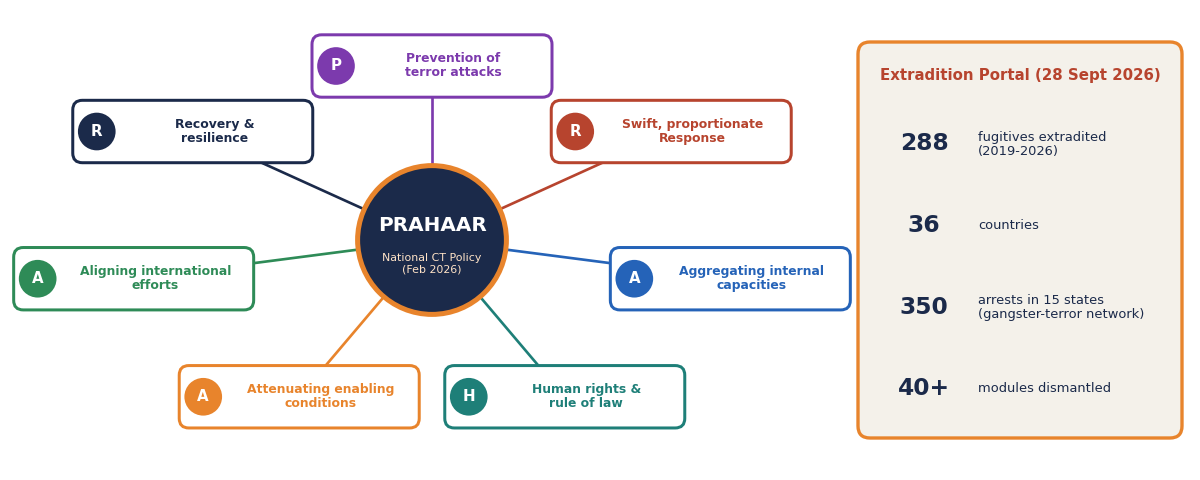
7 pillars: Prevention, Response, Aggregating capacities, Human rights & rule of law, Attenuating enabling conditions, Aligning global efforts, Recovery & resilience.
Extradition Portal links MHA, MEA, CBI and state police to bring back fugitives faster.
288 fugitives extradited from 36 countries during 2019-2026.
Cross-border gangster-terror network: 40+ modules busted, 100+ FIRs, 350 arrests in 15 states.
Way forward
Convert PRAHAAR into a 10-year roadmap, widen extradition/MLAT treaties and use real-time data fusion (NATGRID) for prevention.
Concept
UAPA 1967 (individuals can be designated terrorists since 2019 amendment); NIA Act 2008; Extradition Act 1962 (MEA is the central authority); 'terrorist act' defined in Sec 113, BNS 2023.
Mind map with PRAHAAR at the centre and its seven pillars around it — Prevention, Response, Aggregating capacities, Human rights and rule of law, Attenuating enabling conditions, Aligning international efforts, Recovery and resilience — plus a box on the Extradition Portal statistics. — StudyForGS
4. PRAMAAN: first national forest-certification certificates handed over
The first certificates under PRAMAAN, the brand of the Indian Forest & Wood Certification Scheme (IFWCS), were handed over on 29 Sept 2026, covering sustainable management of 33,000+ hectares of forest.
Key facts
IFWCS launched by MoEFCC in 2023; operated through IIFM, Bhopal.
Certifies Forest Management, Trees Outside Forests (ToF) and Chain of Custody of wood products.
Voluntary, market-based tool; helps exporters meet legality norms such as the EU Deforestation Regulation (EUDR).
Way forward
Extend certification to JFM committees and agroforestry farmers so that a green premium reaches local communities.
Concept
Sustainable Forest Management = meeting present needs without degrading forests; global analogues are FSC and PEFC; India's forest + tree cover is about one-fourth of its area (ISFR).
5. GST mop-up crosses ₹2 lakh crore in September 2026, up 14.7%
ECONOMYCOMMON: Prelims + Mains GS3
Syllabus linkage
GS3 – Indian economy, mobilisation of resources, indirect taxes; Prelims – GST Council, IGST
Context
Official data released on 1 Oct 2026 show gross GST for September 2026 at ₹2.03 lakh crore, up 14.7% year-on-year, led by a sharp jump in import-linked collections.
Sustain buoyancy after rate rationalisation by speeding up refunds, fully operationalising the GST Appellate Tribunal and curbing fake invoicing.
Concept
GST via the 101st Constitutional Amendment (2016); Art 279A creates the GST Council. GST 2.0 (from 22 Sept 2025) has two main slabs, 5% and 18%, plus 40% for sin/luxury goods; imports attract IGST.
Bar chart of September 2026 GST collections in lakh crore rupees: gross 2.03 (+14.7%), domestic 1.38 (+10.1%), imports 0.66 (+26%), refunds 0.27 (−3%) and net 1.76 (+18.1%). — StudyForGS
6. UPSC turns 100: PM releases coin, stamp and landmark-judgements book
POLITYCOMMON: Prelims + Mains GS2
Syllabus linkage
GS2 – Constitutional bodies, civil services; Prelims – Arts 315-323, Lee Commission, GoI Acts
Context
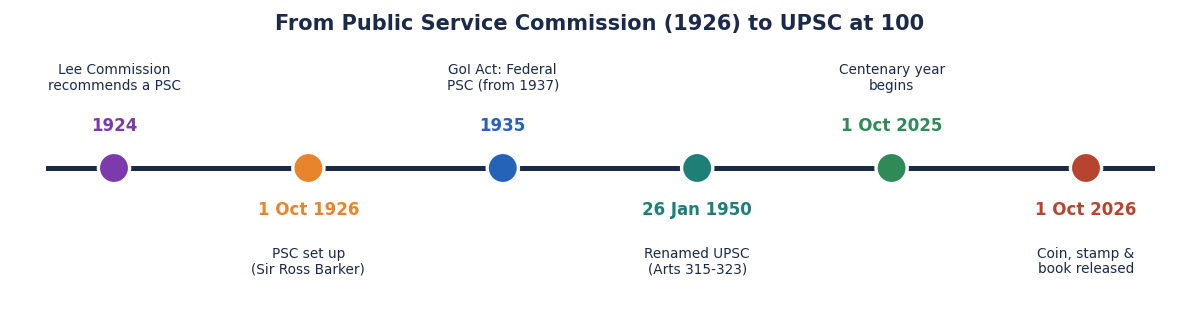
PM Narendra Modi attended the UPSC centenary finale at Bharat Mandapam, New Delhi on 1 Oct 2026 – exactly 100 years after the Public Service Commission was set up on 1 Oct 1926.
Key facts
Released a commemorative coin, postage stamp and the book '100 Landmark Judgements' on PSC policies.
1926 PSC set up on the Lee Commission (1924) advice; first chairman Sir Ross Barker.
GoI Act 1935 created the Federal PSC; it became UPSC on 26 Jan 1950.
Chairman Dr Ajay Kumar stressed 'Trust, Transparency and Technology'.
Way forward
Shorten the exam cycle, harden exam security with technology and keep the merit system insulated to preserve public trust.
Concept
Part XIV, Arts 315-323: members appointed by the President, term 6 years or age 65; removal under Art 317 (SC inquiry for misbehaviour); functions in Art 320; annual report under Art 323.
Timeline of the Union Public Service Commission: Lee Commission 1924, Public Service Commission set up on 1 October 1926, Federal PSC under GoI Act 1935, renamed UPSC on 26 January 1950, centenary year from 1 October 2025 and centenary celebration on 1 October 2026. — StudyForGS
7. Bankers' Books Evidence Act, 2026 in force, replacing the 1891 colonial law
POLITYCOMMON: Prelims + Mains GS2
Syllabus linkage
GS2 – Government policies, judiciary; GS3 – banking; Prelims – new criminal laws, e-evidence
Context
The Bankers' Books Evidence Act, 2026 came into force on 1 Oct 2026, replacing the 135-year-old 1891 Act with a technology-neutral framework for proving bank records in courts.
Key facts
'Bankers' books' now include records in any data-storage form, including electronic/digital.
Certified copies admissible without originals if correctly derived and with no tampering.
Bank officers need not testify where the bank is not a party – only on court order for special cause.
Centre may extend the Act to other financial-sector entities by notification; recognises digital and electronic signatures.
Way forward
Harmonise with BSA 2023 e-evidence rules and the DPDP Act 2023, and train courts and bank staff on digital record integrity.
Concept
Part of decolonising laws: BNS, BNSS and BSA 2023 replaced the IPC, CrPC and Evidence Act 1872 from 1 July 2024; electronic records need a certificate under Sec 63, BSA.
8. Centre steps in on Mahanadi water dispute between Odisha and Chhattisgarh
POLITYCOMMON: Prelims + Mains GS2
Syllabus linkage
GS2 – Federalism, inter-state relations, dispute redressal; GS1 – river systems
Context
Home Minister Amit Shah on 1 Oct 2026 chaired a meeting with Odisha and Chhattisgarh on the long-running Mahanadi dispute; both states have agreed to accept Central Water Commission (CWC) decisions.
Key facts
Mahanadi rises near Sihawa (Dhamtari, Chhattisgarh) and drains into the Bay of Bengal in Odisha.
Odisha objects to upstream barrages in Chhattisgarh reducing lean-season flows to Hirakud dam.
Mahanadi Water Disputes Tribunal was constituted in March 2018 under the ISRWD Act 1956.
Officials of both states met on 31 Aug 2026 to explore an amicable settlement.
Way forward
A negotiated deal backed by basin-level data, joint flow monitoring and guaranteed lean-season releases can end the tribunal delay.
Concept
Art 262 lets Parliament bar courts from inter-state water disputes; Entry 17, State List (water) is subject to Entry 56, Union List (inter-state rivers); River Boards Act 1956.
9. Modi-Trump phone call reaffirms India-US Comprehensive Global Strategic Partnership
IRCOMMON: Prelims + Mains GS2
Syllabus linkage
GS2 – Bilateral relations, effect of policies of developed countries on India's interests
Context
PM Modi and US President Donald Trump spoke on 30 Sept 2026, reviewing cooperation in trade, defence, energy and critical technologies and agreeing to maintain close engagement.
Key facts
Leaders also discussed regional developments and global peace and security.
Comes as Commerce Minister Piyush Goyal negotiates a bilateral trade agreement with USTR Jamieson Greer.
India seeks tariffs no higher than competitors; friction persists over Russian oil imports.
Possible meetings at the ASEAN summit (Nov) and G20 summit (Dec, USA).
Way forward
Close an early-tranche trade deal, protect energy security and shield the tech-defence pillar (TRUST initiative) from tariff swings.
Concept
Ties upgraded to Comprehensive Global Strategic Partnership in 2020; foundational pacts LEMOA (2016), COMCASA (2018), BECA (2020); both are Quad members.
10. Jaishankar warns of a 'major food crisis' as conflicts choke supply chains
IRCOMMON: Prelims + Mains GS2/GS3
Syllabus linkage
GS2 – Global groupings, Global South; GS3 – food security, supply chains
Context
EAM S. Jaishankar, speaking in New York on 28 Sept 2026, warned that the world could face a 'major food crisis', calling the mix of security and oil-supply shocks an 'aggravated crisis'.
Key facts
Ukraine war and the Iran-Gulf conflict are disrupting Black Sea grain and shipping routes.
Fertiliser supply hit by disruptions in West Asia and Russia; energy markets 'very tight'.
Global South faces costlier food, freight and fertiliser plus weaker capital flows; a possible Super El Niño adds risk.
Way forward
Use the G20/BRICS voice for Global South food security, diversify fertiliser sourcing and build strategic grain-fertiliser buffers.
Concept
FAO's 4 pillars of food security: availability, access, utilisation, stability. NFSA 2013 covers up to 75% rural and 50% urban population. Strait of Hormuz is a key energy-fertiliser chokepoint.
11. WHO-UNICEF report: 50 million Indian children lack sanitation at school
REPORTCOMMON: Prelims + Mains GS2
Syllabus linkage
GS2 – Education, health, issues of vulnerable sections; Prelims – JMP, SDG 4.a and 6
Context
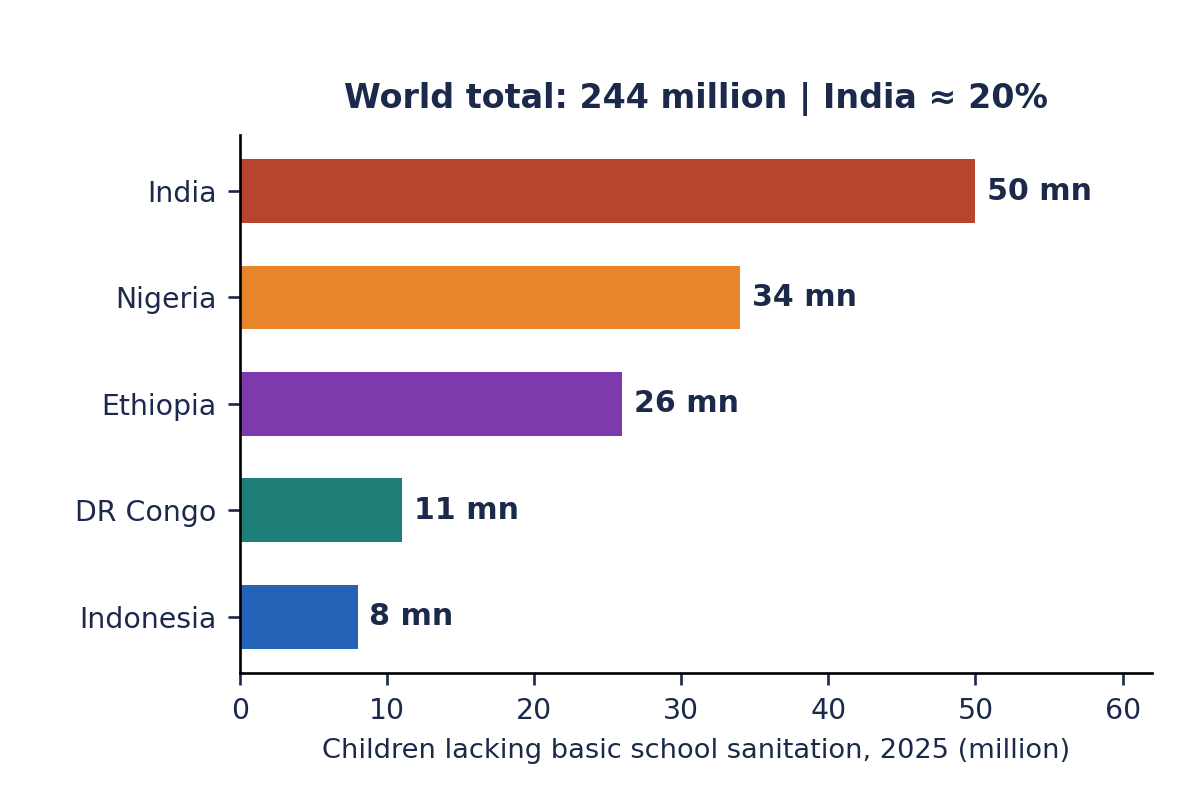
The WHO-UNICEF Joint Monitoring Programme (JMP) report on WASH in Schools 2015-2025 shows 50 million Indian children lacked basic sanitation at school in 2025 – the highest for any country.
Key facts
Globally 244 million children lacked school sanitation; India's share is about 20%.
India: 12 million lack drinking water and 20 million lack hygiene services at school.
Others: Nigeria 34 mn, Ethiopia 26 mn, DR Congo 11 mn, Indonesia 8 mn.
India cut schools without sanitation by 14%, but the world is off-track for universal school WASH by 2030.
Way forward
Converge Samagra Shiksha, Swachh Bharat Mission and Jal Jeevan Mission for functional, gender-separate toilets with O&M funds.
Concept
SDG 4.a – child-, disability- and gender-sensitive school facilities; SDG 6.2 – sanitation and hygiene for all; Swachh Vidyalaya Abhiyan (2014); RTE Act 2009 mandates separate toilets for girls.
Horizontal bar chart of children lacking basic sanitation at school in 2025, in millions: India 50, Nigeria 34, Ethiopia 26, DR Congo 11, Indonesia 8, against a global total of 244 million. — StudyForGS
12. Five new sites on India's UNESCO Tentative List; total rises to 78
SOCIETYPRELIMS: GS1 Art & Culture
Syllabus linkage
GS1 – Indian heritage, art forms, architecture; Prelims – World Heritage process
Context
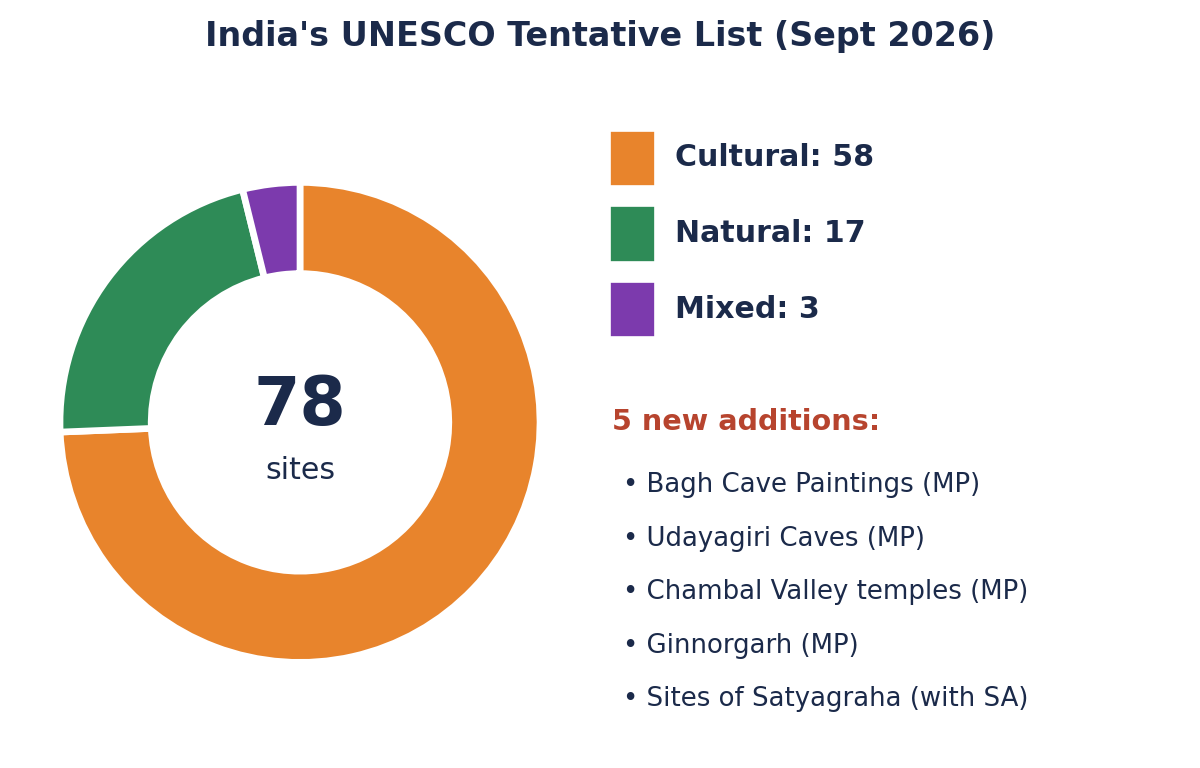
India added 5 new properties to its UNESCO Tentative List on 29-30 Sept 2026, taking the list to 78 – 58 cultural, 17 natural and 3 mixed.
Key facts
Bagh Cave Paintings (MP) – Buddhist rock-cut caves with murals akin to Ajanta.
Group of Temples of the Chambal Valley (MP) and Ginnorgarh (MP) hill fort.
Sites of Satyagraha – a transnational serial proposal with South Africa on Gandhi's struggles.
Way forward
Build strong site-management plans and community buy-in before nomination; a site must be on the Tentative List at least 1 year before nomination.
Concept
World Heritage Convention, 1972; ASI is India's nodal agency; inscription by the World Heritage Committee on Outstanding Universal Value using 10 criteria.
Donut chart of India's UNESCO Tentative List of 78 properties: 58 cultural, 17 natural and 3 mixed, with the five new additions listed. — StudyForGS
Data point of the day
₹2.03 lakh crore
Gross GST collection – September 2026 +14.7% YoY; net GST ₹1.76 lakh crore (+18.1%); imports +26%
Prelims rapid-fire
PM-DHARA full form: Developing Harmonised & Accelerated Renewable Energy Access
Mahanadi Water Disputes Tribunal set up: March 2018
International Day of Older Persons: 1 October
Gandhi Jayanti (2 Oct) – also International Day of Non-Violence
Practice MCQs — UPSC Prelims pattern
Q1. With reference to the Minimum Support Prices announced for Rabi Marketing Season 2027-28, consider the following statements: 1. Safflower received the highest absolute increase. 2. The margin over cost of production for wheat exceeds 100%. 3. MSPs are recommended by NITI Aayog. Which of the statements given above are correct?
1 only
1 and 2 only
2 and 3 only
1, 2 and 3
Show answer
Answer: B Safflower got +₹675/qtl and wheat's margin is 106%. MSPs are recommended by the CACP, not NITI Aayog, so statement 3 is wrong.
Q2. The first Public Service Commission in India, set up on 1 October 1926, was established on the recommendation of which of the following?
Islington Commission
Lee Commission
Simon Commission
Aitchison Commission
Show answer
Answer: B The Lee Commission (1924) recommended a PSC, set up on 1 Oct 1926 with Sir Ross Barker as chairman; the GoI Act 1935 later created the Federal PSC.
Mains practice question
Q. "Transmission, not generation, has become the binding constraint on India's energy transition." Discuss in the light of the PM-DHARA scheme. (15 marks, 250 words)
Hint / approach
Intro: 500 GW non-fossil by 2030 and RE curtailment. Body: grid gaps in InSTS, storage deficit, RoW and DISCOM issues; PM-DHARA's 135 GW / 50 GWh / ₹1,86,405 crore design, TBCB-BOOM model. Conclude with storage-linked tariffs and state capacity.
📌 One-line revision: PM-DHARA = 135 GW + 50 GWh by FY33 | Wheat MSP ₹2,610 | GST Sept ₹2.03 lakh cr (+14.7%) | PSC 1 Oct 1926 | UNESCO Tentative List 78