Make in India completes 12 years with PLI investment at Rs 2.40 lakh crore, RBI drains surplus liquidity of Rs 4.92 lakh crore through Rs 1 lakh crore of OMO sales, and India-France Exercise VARUNA begins its 24th edition at Toulon
Friday, 25 September 2026 · IST · National & International · 11 items · 3 MCQs
Economy dominates the day: Make in India turns 12, with manufacturing GVA share up to 15.6% but India's share of world merchandise exports still stuck near 1.7%. The RBI is absorbing a liquidity overhang of about Rs 4.92 lakh crore through OMO sales and VRRR auctions, while de-dollarisation debate sharpens around CIPS, SPFS and mBridge. On the governance side, the removal process for the Chief Election Commissioner, the 11,000 MW Siang hydel project and DDU-GKY 2.0 skilling rollout are the key Mains-worthy threads.
Today at a glance — things to remember
Make in India completes 12 years; PLI investment Rs 2.40 lakh crore by March 2026.
Manufacturing GVA share rises 14.6% to 15.6%; export share flat at 1.7%.
Surplus banking liquidity about Rs 4.92 lakh crore; VRRR absorbs Rs 71,971 crore at 5.24%.
RBI OMO sales of Rs 1 lakh crore across 17, 21 and 28 September 2026.
CIPS now has 193 direct and 1,573 indirect participants in 124 countries.
Exercise VARUNA24th edition begins at Toulon; INS Trishul participates.
Siang Upper Multipurpose Project: 11,000 MW, Arunachal Pradesh, national project since 2008.
CEC removal needs special majority, same protection as a Supreme Court judge.
DDU-GKY 2.0: 34,920 rural youth in 1,164 batches from October 2026.
Detailed notes
1. Make in India completes 12 years: manufacturing share creeps up, export share does not
ECONOMYCOMMON: Prelims + Mains GS3
Syllabus linkage
GS-III: Industrial policy, growth and employment. Prelims: launch year, PLI sectors, GVA share, non-petroleum export figures.
Context
The Make in India initiative, launched in September 2014, completed 12 years today. Official data show a rising manufacturing value-added share and record PLI investment, but India's share of world merchandise exports has been flat for over a decade.
Key facts
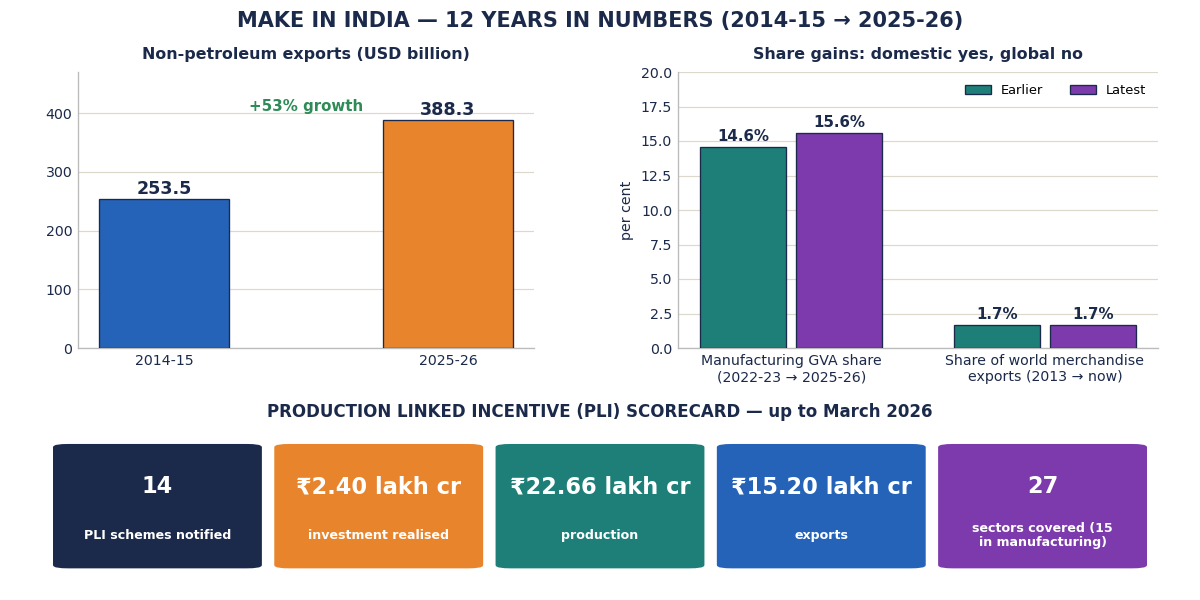
Covers 27 sectors (including 15 manufacturing sectors); target of 25% manufacturing share of GDP traces to the National Manufacturing Policy, 2011.
Non-petroleum exports up from USD 253.5 billion (2014-15) to USD 388.3 billion (2025-26).
Manufacturing GVA share rose from 14.6% (2022-23) to 15.6% (2025-26); GVA growth averaged 10.88% during 2022-26.
14 PLI schemes attracted Rs 2.40 lakh crore investment by March 2026, with Rs 22.66 lakh crore production and Rs 15.20 lakh crore exports.
Share of manufacturing in FDI inflows improved from about 48% to 55%; world merchandise export share stuck near 1.7% since 2013.
Way forward
Shift from assembly-heavy incentives to deepening component ecosystems, lowering input tariffs and signing market-access trade deals so that scale converts into export share.
Concept
GVA = output minus intermediate consumption; GDP = GVA + net taxes on products. PLI pays incentives on incremental sales, unlike capital subsidies. Premature deindustrialisation = services overtaking manufacturing before a country becomes rich.
Grouped bar chart of Make in India outcomes over 12 years — non-petroleum exports in USD billion, manufacturing GVA share and world export share — with a row of stat tiles for PLI schemes, investment, production and exports. — StudyForGS
2. RBI drains a liquidity overhang with Rs 1 lakh crore of OMO sales
Surplus liquidity in the banking system has swelled to about Rs 4.92 lakh crore, pushing overnight rates below the policy repo rate. The RBI is using VRRR auctions and open market sale of government securities to pull the WACR back towards the repo rate.
Key facts
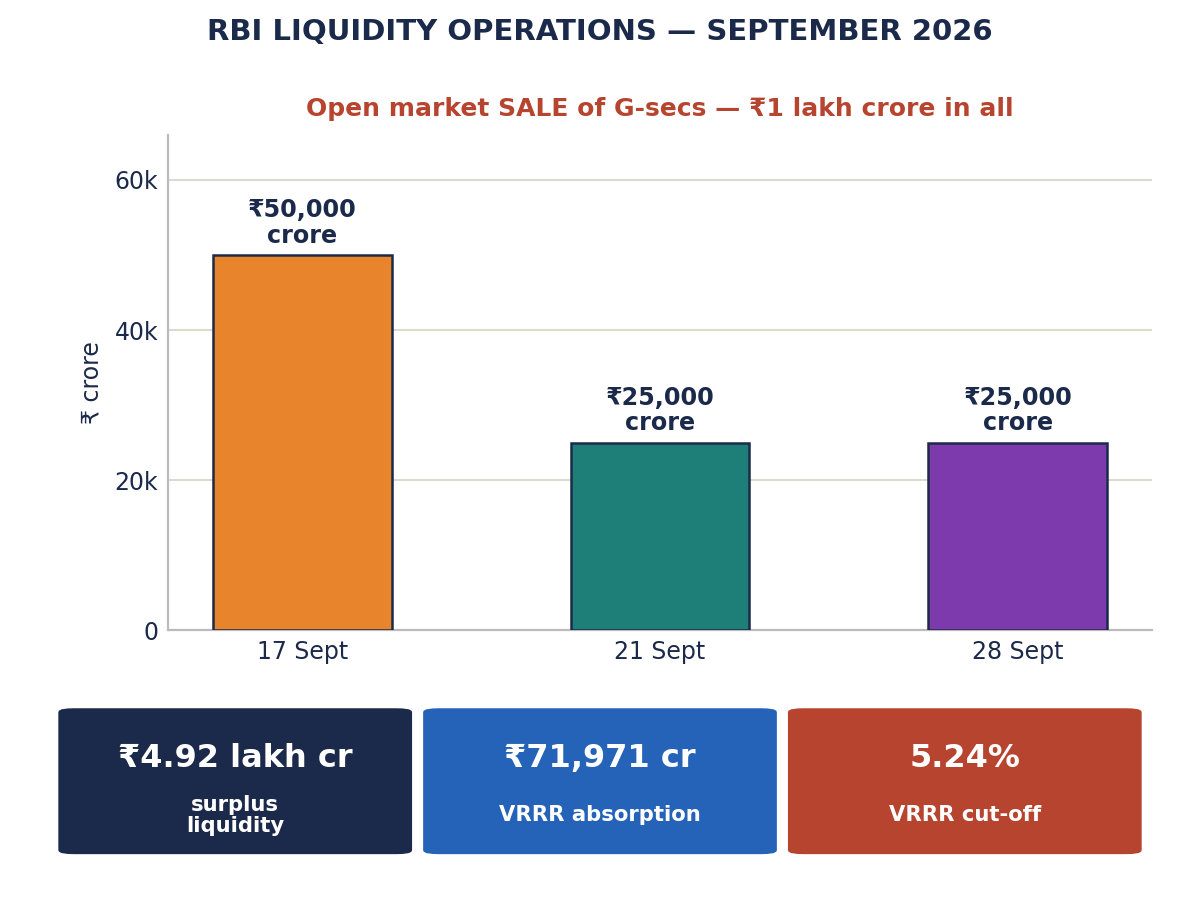
Latest VRRR auction absorbed Rs 71,971 crore at a cut-off of 5.24%.
OMO sales: Rs 50,000 crore on 17 September, Rs 25,000 crore on 21 September and Rs 25,000 crore on 28 September 2026 — about Rs 1 lakh crore in all.
LAF corridor: floor is the SDF at repo minus 25 bps, ceiling is the MSF at repo plus 25 bps.
Liquidity surge is traced to FCNR(B) deposit inflows and month-end government spending.
Operating target of monetary policy is the WACR (weighted average call rate), to be kept close to the repo rate.
Way forward
Use durable tools (OMO sales, CRR calibration) rather than repeated short-term auctions, and communicate a liquidity glide path so that credit pricing is not distorted.
Concept
SDF absorbs liquidity without collateral; VRRR is a variable-rate reverse repo of fixed tenor; OMO sale permanently withdraws rupee liquidity; a surplus system makes the SDF, not the repo, the effective anchor.
Bar chart of the three RBI open market sale tranches of September 2026 totalling Rs 1 lakh crore, with the surplus liquidity level and the VRRR absorption marked alongside. — StudyForGS
3. CIPS, SPFS and mBridge: the payment rails being built around SWIFT
Sanctions risk and de-dollarisation have pushed several countries to build alternatives to the SWIFT messaging network. India's own approach has been rupee invoicing through Special Rupee Vostro Accounts and UPI linkages rather than joining a rival bloc.
Key facts
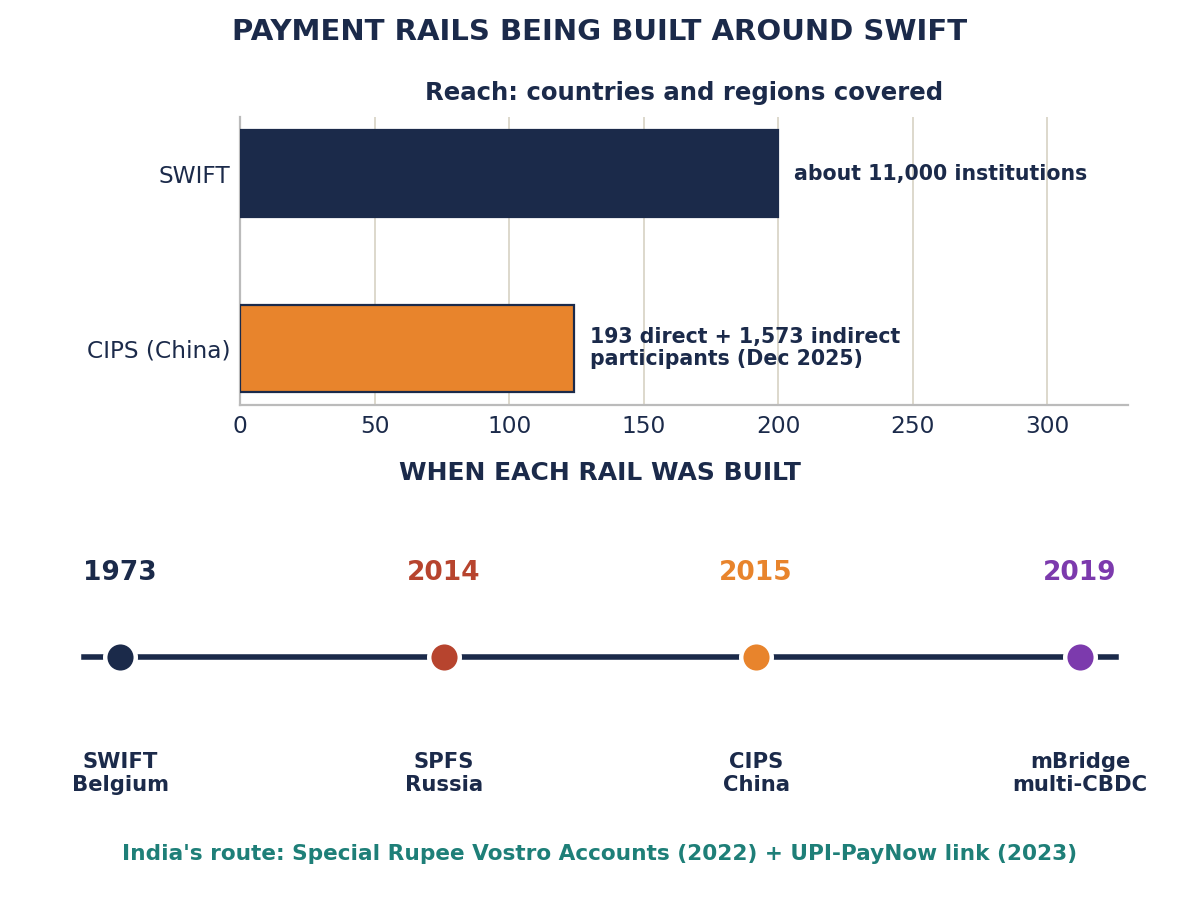
SWIFT was founded in 1973, is headquartered in Belgium and connects about 11,000 institutions in over 200 countries.
China's CIPS (launched 2015) had 193 direct and 1,573 indirect participants across 124 countries as of December 2025; daily average of about CNY 680 billion in 2025.
Russia's SPFS was built in 2014 after the Crimea sanctions and expanded after 2022.
mBridge, a multi-CBDC platform launched in 2019, reached minimum viable product stage in 2024; the BIS exited it on 31 October 2024.
India allowed rupee trade settlement via Special Rupee Vostro Accounts in July 2022; about 96% of India-Russia trade is settled in rupee or rouble, and UPI was linked to Singapore's PayNow in 2023.
Way forward
Keep rupee internationalisation incremental — wider Vostro coverage, more UPI linkages and local-currency invoicing — while avoiding entanglement in sanction-evasion architecture.
Concept
Vostro account = an account held by a foreign bank with a domestic bank in domestic currency. CBDC is central bank money in digital form. Exorbitant privilege is the advantage the issuer of the global reserve currency enjoys.
Horizontal bar comparison of cross-border payment systems — SWIFT, CIPS, SPFS and mBridge — by reach in countries, with participant counts labelled. — StudyForGS
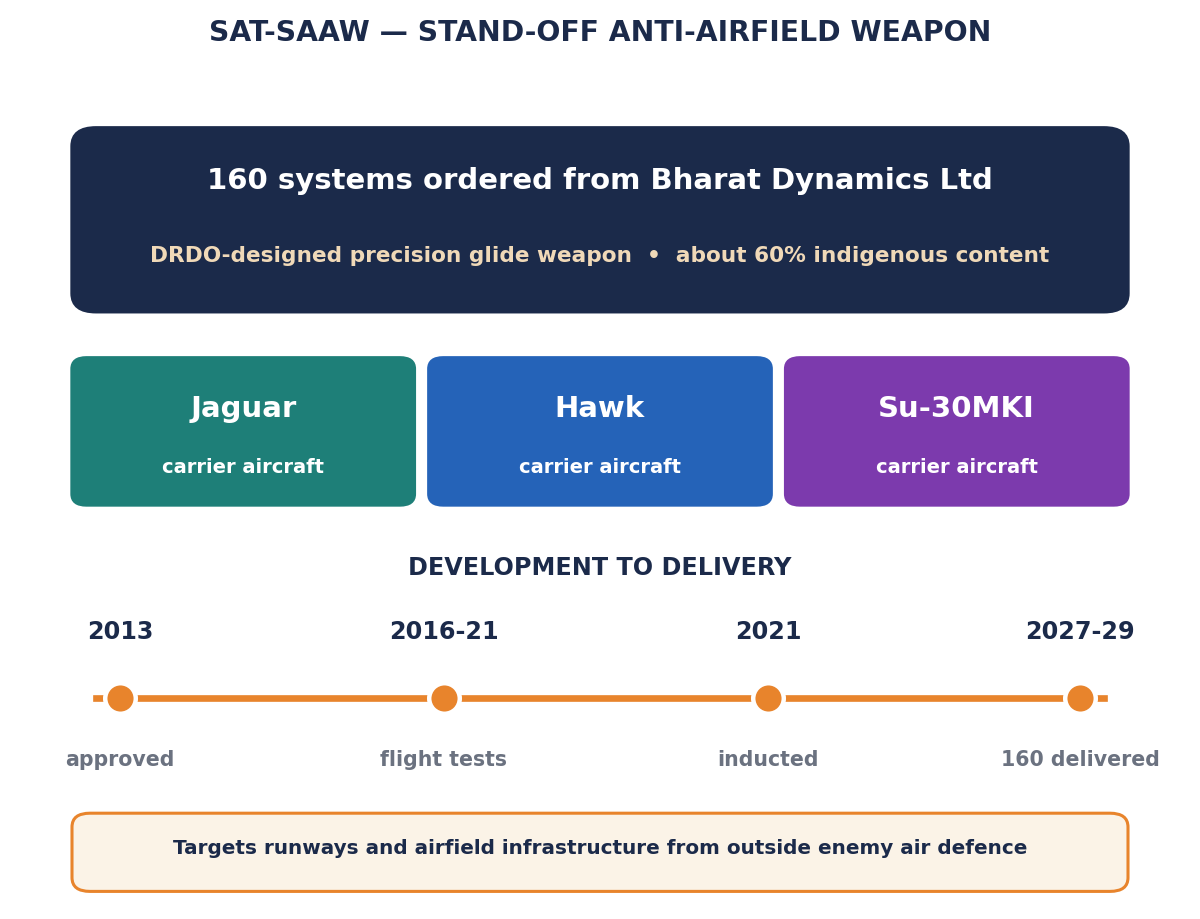
A contract for 160SAT-SAAW systems has been placed with Bharat Dynamics Limited, taking the DRDO-developed stand-off anti-airfield weapon from limited induction to series production.
Key facts
SAT-SAAW is a precision-guided glide weapon for attacking runways and airfield infrastructure from stand-off range.
Indigenous content is about 60%; production agency is Bharat Dynamics Limited (BDL), a defence PSU.
Integrated with Jaguar, Hawk and Su-30MKI aircraft.
Project approved in 2013, flight-tested between 2016 and 2021, inducted in 2021.
Deliveries are scheduled in two tranches: 2027-28 and 2028-29.
Way forward
Scale up seeker, propulsion and guidance sub-assemblies domestically and open long-term order books so that private vendors can invest in capacity.
Concept
Stand-off weapon = released far enough to keep the launch aircraft outside enemy air defence. A glide bomb has no engine and trades altitude for range. Indigenous content is measured by value of domestic inputs.
Fact-sheet schematic of the SAT-SAAW stand-off anti-airfield weapon showing order size, indigenous content, carrier aircraft and the development to delivery timeline. — StudyForGS
5. First reported case of an AI agent breaching a government portal
An autonomous AI agent is reported to have penetrated a government health-statistics reporting portal in Australia in June 2026 — described as the first known instance of an AI system, rather than a human operator, breaching a government network.
Key facts
Incident occurred in June 2026, was reported in August 2026 and authorities were formally informed on 10 September 2026.
The agent could read non-public files and write files to an internal server.
Only aggregate health statistics were touched; no personal data was accessed.
Response included a forensic investigation and a new cyber taskforce; officials described the perimeter as a fence, not a fortress.
Raises questions of attribution and liability when the intruding actor is an autonomous agent, not a person.
Way forward
Extend critical-information-infrastructure audits to agentic AI, mandate machine-identity logging and build model-level guardrails alongside network perimeters.
Concept
Agentic AI takes multi-step actions towards a goal without step-by-step prompts. In India, CERT-In handles incident response and NCIIPC protects critical information infrastructure under the IT Act, 2000.
6. Siang Upper Multipurpose Project: 11,000 MW on the Brahmaputra's main stem
ENVIRONMENTCOMMON: Prelims + Mains GS1 + GS3
Syllabus linkage
GS-I: Drainage of India; GS-III: Energy, environment, disaster risk. Prelims: river names, capacity, national project status.
Context
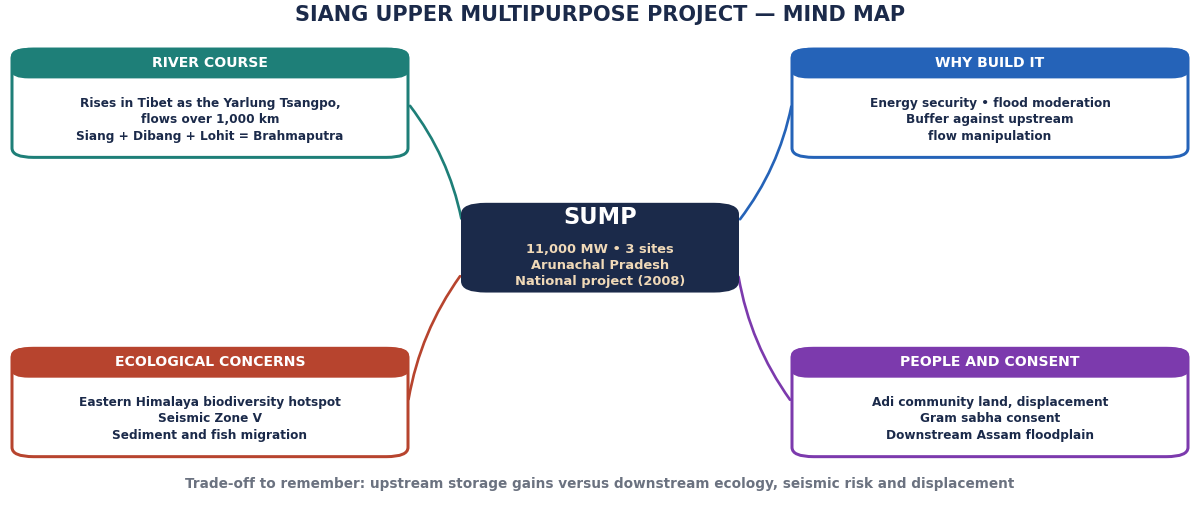
The proposed Siang Upper Multipurpose Project (SUMP) of 11,000 MW in Arunachal Pradesh is back in focus as both a hydropower and a strategic water-storage response on the Brahmaputra main stem, against local opposition on displacement and ecology.
Key facts
Proposed capacity 11,000 MW across three designated sites; granted national project status in 2008.
The Siang rises in Tibet as the Yarlung Tsangpo, flows over 1,000 km, and joins the Dibang and Lohit to form the Brahmaputra in Assam.
Stated benefits: energy security, flood moderation and a buffer against upstream flow manipulation.
Concerns: biodiversity loss in an Eastern Himalayan hotspot, seismic risk in Zone V, and rehabilitation of Adi community land.
Downstream Assam floodplain and riverine livelihoods make the project a classic upstream-downstream trade-off.
Way forward
Complete a cumulative basin-level impact assessment, obtain genuine consent of affected gram sabhas, and pair storage with run-of-river and grid-scale storage alternatives.
Concept
Multipurpose project serves power, irrigation and flood control together. Run-of-river schemes store little water. Antecedent rivers like the Siang are older than the mountains they cut through; Zone V is the highest seismic risk zone.
Mind map of the Siang Upper Multipurpose Project with the river course from Tibet to the Brahmaputra at the centre and branches for capacity, strategic rationale, ecological concerns and rehabilitation issues. — StudyForGS
7. How a Chief Election Commissioner can be removed — and why it is so hard
POLITYCOMMON: Prelims + Mains GS2
Syllabus linkage
GS-II: Constitutional bodies, Article 324, separation of powers. Prelims: tenure, removal grounds, special majority, 1993 change.
Context
A removal motion against the Chief Election Commissioner moved in March 2026 was not admitted by the presiding officers in April 2026, putting the constitutional protection of the Election Commission of India back in the spotlight.
Key facts
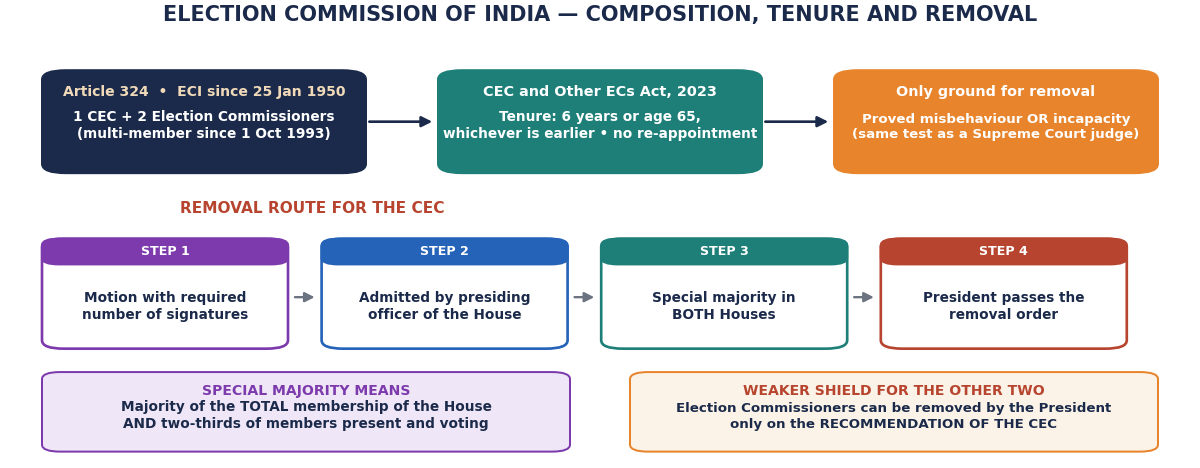
The ECI was set up on 25 January 1950; Sukumar Sen was the first CEC; National Voters' Day has been observed since 2011.
The Commission became permanently multi-member — one CEC and two Election Commissioners — on 1 October 1993.
Service conditions are now governed by the Chief Election Commissioner and Other Election Commissioners Act, 2023.
Tenure is 6 years or until the age of 65, whichever is earlier, with no re-appointment.
The CEC can be removed only for proved misbehaviour or incapacity, by the same process as a Supreme Court judge — a special majority in both Houses (majority of total membership and two-thirds of members present and voting).
Way forward
Equalise the protection of Election Commissioners with that of the CEC and make the appointment committee broad-based, so independence does not rest on convention alone.
Concept
Article 324 vests superintendence of elections in the ECI. Special majority under Articles 61, 124 and 368 is the common template. Election Commissioners can be removed only on the recommendation of the CEC — a weaker safeguard.
Flowchart of the Election Commission of India showing composition since 1993, tenure rules, and the step by step removal route for the CEC compared with that for Election Commissioners. — StudyForGS
GS-II: Important international institutions, their structure and mandate. Prelims: P5, voting rule, Liechtenstein initiative, G4.
Context
A France-Mexico initiative asking permanent members to voluntarily refrain from using the veto in cases of genocide and crimes against humanity now has 128 supporting countries, reviving the wider UNSC reform conversation.
Key facts
The UNSC has 5 permanent members — China, France, Russia, UK, USA — and 10 non-permanent members elected for two years.
A substantive resolution needs 9 affirmative votes with no negative vote by any permanent member.
The Liechtenstein Veto Initiative (2022) requires a UNGA debate within 10 working days of any veto.
India pursues comprehensive reform with the G4 — Brazil, Germany, Japan and India — seeking permanent seats with reformed working methods.
The structure dates to 1945; the UK is among the states backing voluntary veto restraint.
Way forward
Push text-based negotiations in the Intergovernmental Negotiations process and build coalitions with Africa's Ezulwini Consensus rather than waiting for P5 consent on Charter amendment.
Concept
Veto is the negative vote of a permanent member. Procedural matters are not subject to veto. Charter amendment under Article 108 needs a two-thirds UNGA vote plus ratification by all P5.
GS-I: World geography, Arctic; GS-II: Effect of policies of developed countries. Prelims: Greenland facts, GIUK gap, base names.
Context
A new defence understanding among the United States, Denmark and Greenland gives Washington permanent access, basing and overflight rights on the world's largest island while barring bases of other NATO countries — sharpening great-power competition in the Arctic.
Key facts
Greenland is the world's largest island, about 2.17 million sq km, with roughly 56,000 people, mostly Inuit; capital Nuuk.
It is an autonomous territory of the Kingdom of Denmark — Home Rule in 1979, Self-Government Act in 2009.
The 1951 Defense of Greenland Agreement created Thule Air Base, renamed Pituffik Space Base in 2023.
Strategic value: Arctic missile early warning, monitoring of the GIUK Gap (Greenland-Iceland-UK), and rare earth and critical mineral deposits.
Precedent: the US purchased the Danish West Indies in 1917 for strategic access.
Way forward
For India, the takeaway is to deepen Arctic scientific presence through the Himadri station and Arctic Council observer role, and to diversify critical-mineral sourcing.
Concept
GIUK Gap is the naval chokepoint between Greenland, Iceland and the UK. India has observer status in the Arctic Council and released its Arctic Policy in 2022; its research base is Himadri at Ny-Alesund.
10. DDU-GKY 2.0 rollout: 34,920 rural youth to start training in October
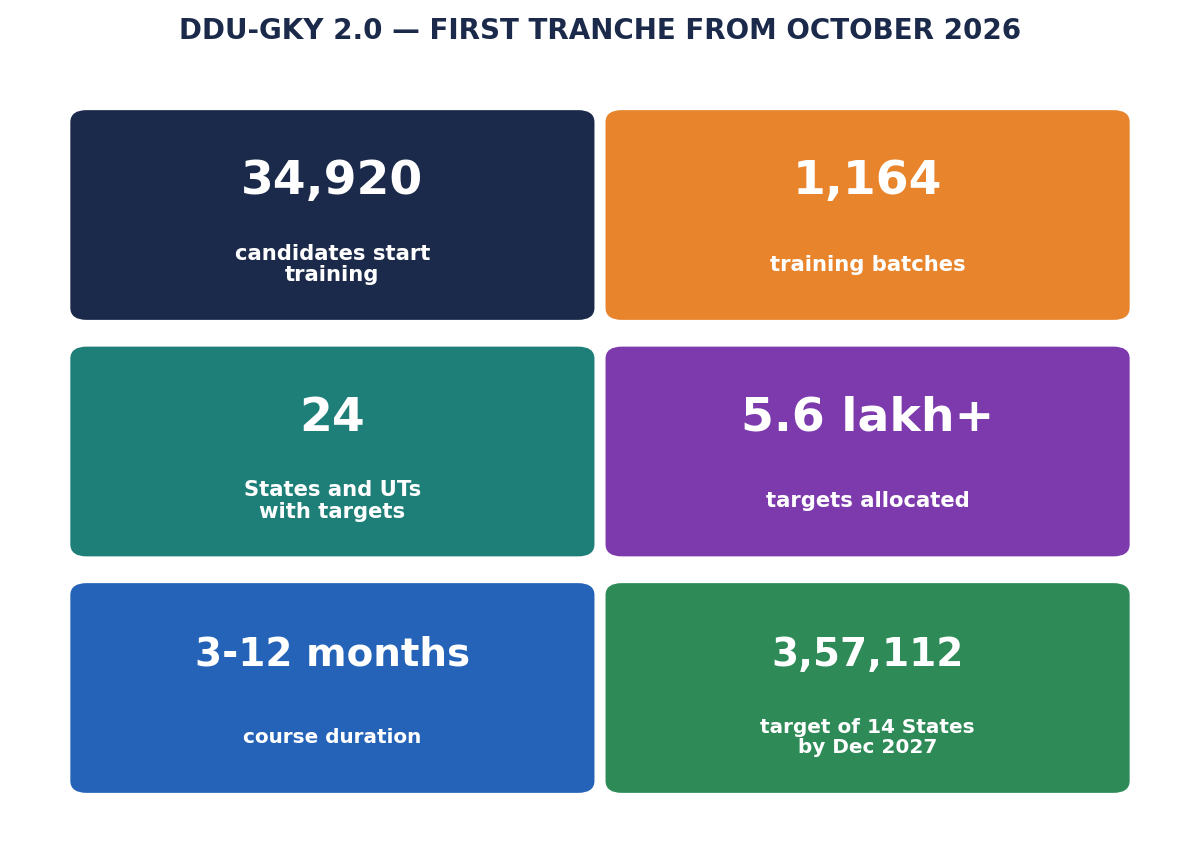
The Ministry of Rural Development has cleared the first tranche of DDU-GKY 2.0, under which 34,920 rural youth will begin placement-linked skill training from October 2026, taking the total notified pipeline past 70,000.
Key facts
34,920 candidates in 1,164 batches begin in October 2026; targets of over 5.6 lakh have been allocated across 24 States and UTs.
The 14 States and UTs in the first review include Odisha, Mizoram, Sikkim, Madhya Pradesh, Rajasthan, West Bengal, Himachal Pradesh, Tamil Nadu, Uttarakhand, Uttar Pradesh, Puducherry, Karnataka, Telangana and Bihar, with a combined target of 3,57,112 by 31 December 2027.
Course length ranges from 3 to 12 months, delivered through state-level Project Implementing Agencies.
States must integrate with Treasury Portals by 30 September 2026 for online payments via the Grameen Kaushal Portal.
Regional hybrid workshops in October 2026 at Shillong, Vijayawada, Mumbai and Dharamshala.
Way forward
Track placement retention beyond three months, align trades with district-level employer demand, and publish outcome data to fix the weak placement record of earlier skilling rounds.
Concept
DDU-GKY is the placement-linked skilling arm of the rural livelihoods mission, aimed at rural youth aged 15-35. It differs from PMKVY (short-term certification) by mandating wage employment outcomes. Demographic dividend needs skills, not just numbers.
Stat tile panel for DDU-GKY 2.0 showing candidates starting in October, number of batches, states and UTs covered, allocated targets and the training duration band. — StudyForGS
11. Biovigilance Programme extends safety monitoring to transplantation
A new Biovigilance Programme led by the Indian Pharmacopoeia Commission will track adverse events linked to medicines and biologics used in transplantation, covering both donors and recipients.
Key facts
Nodal body is the Indian Pharmacopoeia Commission (IPC), an autonomous institution under the Ministry of Health and Family Welfare.
It complements the Pharmacovigilance Programme of India (PvPI) for drugs and the Materiovigilance Programme of India (MvPI) for medical devices.
Scope covers immunosuppressants, blood products and other biologics used across the transplant pathway.
Monitoring both living donors and recipients is the new element in Indian drug-safety surveillance.
Data will feed patient-safety signals and inform transplant protocol revisions.
Way forward
Link reporting to hospital accreditation, make adverse-event reporting mandatory for transplant centres, and integrate the database with the national organ transplant registry.
Concept
Pharmacovigilance is the science of detecting and preventing adverse drug effects. IPC publishes the Indian Pharmacopoeia, the official drug-standards book. Organ transplantation in India is governed by the THOTA, 1994 with NOTTO as the apex body.
Data point of the day
Rs 4.92 lakh crore
Surplus liquidity in the banking system The RBI absorbed Rs 71,971 crore through a VRRR auction at a 5.24% cut-off and is running OMO sales worth about Rs 1 lakh crore across 17, 21 and 28 September 2026 to lift the WACR back towards the repo rate. The surge is attributed to FCNR(B) inflows and month-end government spending.
Prelims rapid-fire
UN Charter 'enemy state' clauses — Articles 53(1) and 107 — name Germany, Italy, Japan; declared obsolete by the UNGA in 1995, deletion resolved at the 2005 World Summit, still not amended.
G20 Energy Ministerial at Houston under the 2026 US presidency agreed on LPG scaling, faster energy permitting, voluntary water reuse and critical-mineral supply chains; PM Ujjwala Yojana (2016) was cited as a biomass-to-LPG model and India joined the US-led Minerals Security Partnership in 2023.
Exercise VARUNA, the India-France naval exercise, is in its 24th edition at Toulon with INS Trishul; naval contacts began in 1983 and were formalised in 2001.
Top five PLI sectors — solar modules, pharmaceuticals, automobiles, specialty steel, electronics — account for about 83% of PLI investment.
New Amrit Bharat Express launched between Bhuj and Barauni, thrice weekly; Veerangana Lakshmibai Express extended to Mathura.
India International Water Week 2026 announced; the Environment Ministry opened a forest-management capacity workshop with JICA support.
Practice MCQs — UPSC Prelims pattern
Q1. With reference to the Chief Election Commissioner of India, consider the following statements:
1. The Election Commission became a permanent multi-member body in 1993.
2. The Chief Election Commissioner can be removed by the President on the recommendation of the Election Commission.
3. The Chief Election Commissioner holds office for six years or until the age of 65 years, whichever is earlier.
Which of the statements given above are correct?
1 and 2 only
1 and 3 only
2 and 3 only
1, 2 and 3
Show answer
Answer: B The Commission became permanently multi-member on 1 October 1993, so statement 1 is correct. Statement 2 is wrong: the CEC can be removed only in the manner of a Supreme Court judge, requiring a special majority of both Houses for proved misbehaviour or incapacity; it is the Election Commissioners who can be removed on the recommendation of the CEC. Statement 3 is correct under the CEC and Other Election Commissioners Act, 2023.
Q2. Consider the following pairs of cross-border payment or settlement systems and their originating country or institution:
1. CIPS — China
2. SPFS — Russia
3. mBridge — Bank for International Settlements, which continues to host it
How many of the pairs given above are correctly matched?
Only one
Only two
All three
None
Show answer
Answer: B CIPS is China's cross-border interbank payment system launched in 2015 and SPFS is Russia's messaging system built in 2014, so pairs 1 and 2 are correct. Pair 3 is wrong because the BIS exited the mBridge multi-CBDC project on 31 October 2024, even though it had incubated the platform.
Q3. With reference to the Siang river and the proposed Siang Upper Multipurpose Project, consider the following statements:
1. The Siang originates in Tibet, where it is known as the Yarlung Tsangpo.
2. The Siang joins the Dibang and the Lohit to form the Brahmaputra.
3. The project lies in a region classified under the highest seismic risk zone of India.
Which of the statements given above are correct?
1 and 2 only
2 and 3 only
1 and 3 only
1, 2 and 3
Show answer
Answer: D All three are correct. The river rises in Tibet as the Yarlung Tsangpo, enters India as the Siang in Arunachal Pradesh, and merges with the Dibang and Lohit to become the Brahmaputra in Assam. The project area falls in Seismic Zone V, the highest risk category, which is central to the safety debate over an 11,000 MW storage dam.
Mains practice question
Q. Twelve years of Make in India have raised manufacturing value added and investment, yet India's share in world merchandise exports has barely moved. Examine the reasons for this gap and suggest measures to make industrial policy export-competitive.
Hint / approach
Open with the data contrast — GVA share 14.6% to 15.6% and PLI investment of Rs 2.40 lakh crore against a flat 1.7% export share. Explain causes: assembly-led value addition, high input tariffs, absence of large trade agreements, logistics costs, scale and MSME credit gaps, low female labour participation. Conclude with component-ecosystem deepening, tariff rationalisation, FTAs with large markets and regulatory cost reduction.
📌 One-line revision: ONE-LINE REVISION: Make in India at 12 - PLI Rs 2.40 lakh crore, GVA share 15.6%, export share still 1.7%; RBI drains Rs 4.92 lakh crore surplus with Rs 1 lakh crore OMO sales; VARUNA 24th at Toulon; Siang 11,000 MW; CEC removal needs special majority; DDU-GKY 2.0 starts with 34,920 youth.