Monday, 28 September 2026 · IST · National & International · 12 items · 2 MCQs
India notified its first four mega ports under the Indian Ports Act, 2025, while DRDO moved its 30-kW laser counter-drone weapon towards mass production. At UNGA-81, Russia backed India and Brazil for permanent UNSC seats, and the PM said Census 2027 phase-1 has recorded 32 crore+ families. OECD raised India's FY27 growth forecast to 7.1% and India rose to 31st in the WEF tourism index.
Today at a glance — things to remember
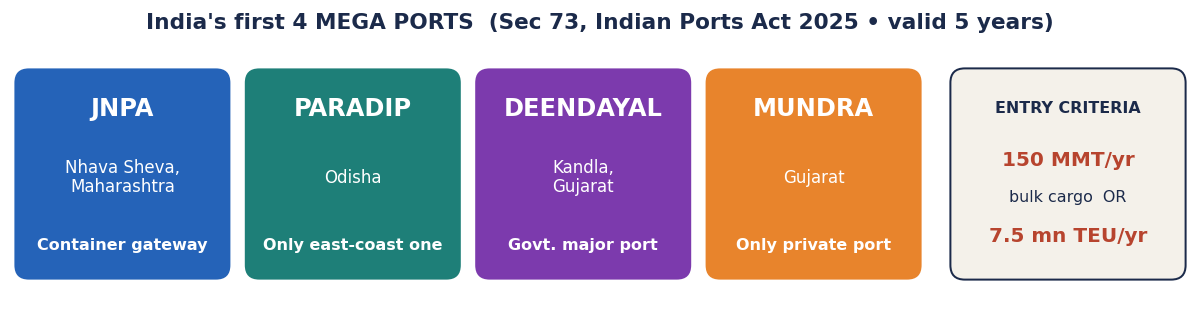
JNPA, Paradip, Deendayal & Mundra = India's first mega ports (Sec 73, Ports Act 2025).
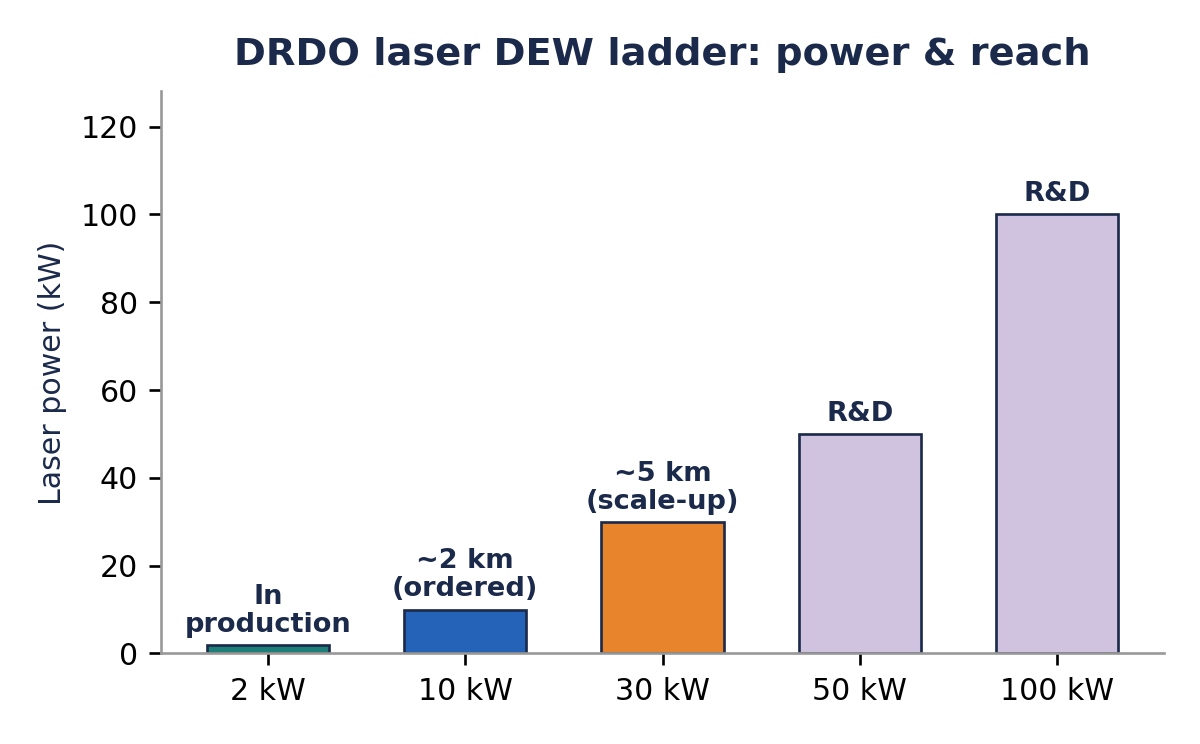
DRDO 30-kW laser DEW: hits drones up to ~5 km; industry partner in 6 months.
TDB gives ₹200 crore to Agnikul for fully reusable Agnibaan (TRL-4 → TRL-8).
IIT Delhi builds India's first indigenous micro-GPU on a Spartan-7 FPGA.
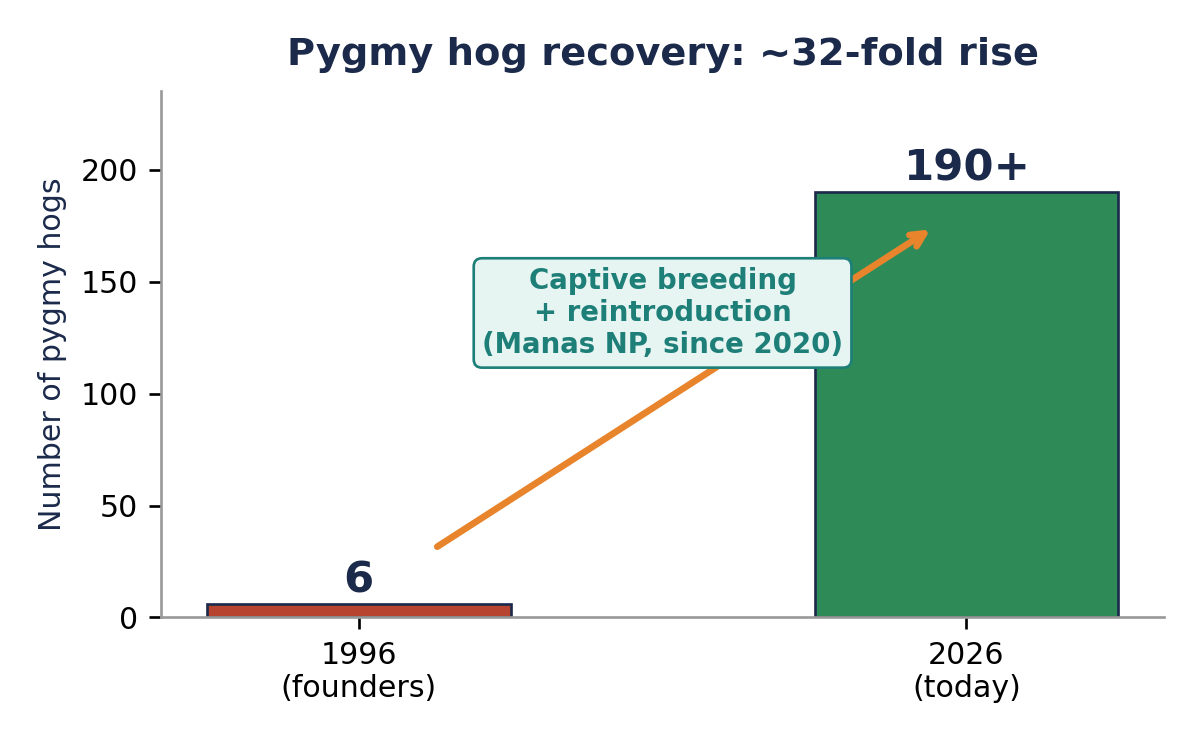
Pygmy hog count up from 6 (1996) to 190+; only wild home Manas NP.
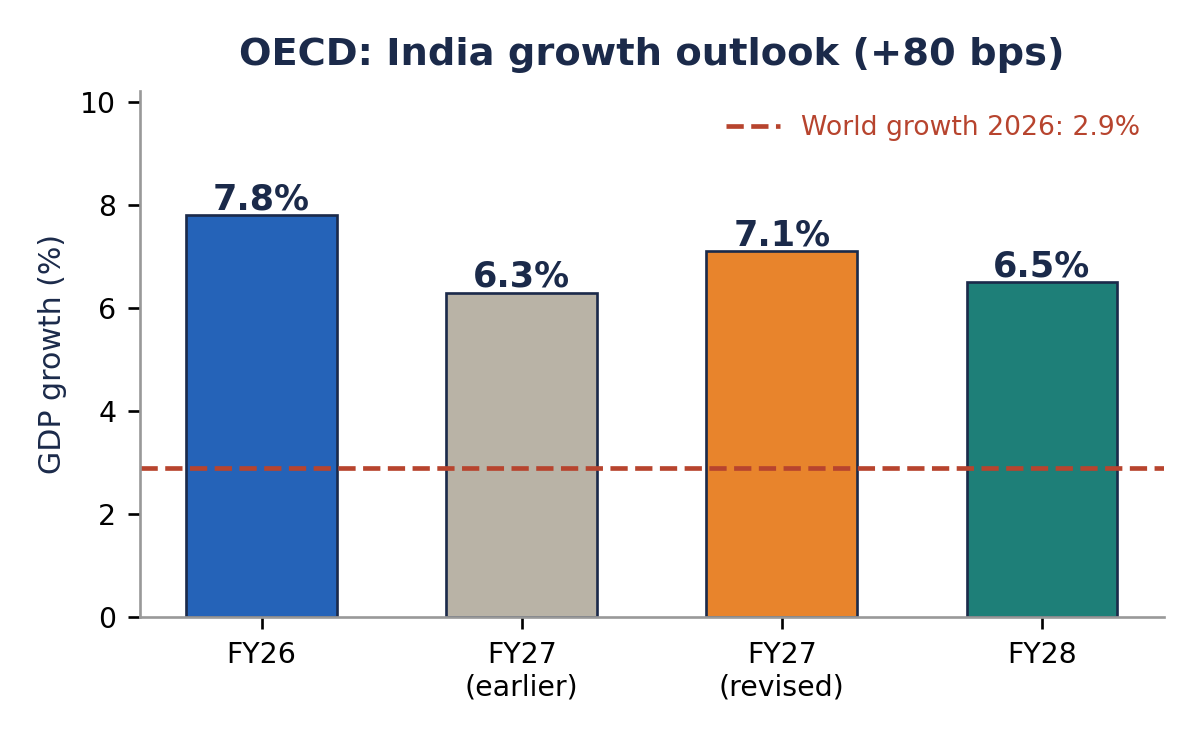
OECD lifts India FY27 GDP forecast to 7.1% (+80 bps); FY28 6.5%.
India 31st (up 9) in WEF TTDI 2026; Japan tops, 110 economies.
Census 2027 phase-1: 32 crore+ families recorded; first fully digital census.
Russia backs India & Brazil for permanent UNSC seats at UNGA-81.
1. DRDO's 30-kW laser weapon moves towards mass production
DEFENCECOMMON: Prelims + Mains GS3
Syllabus linkage
GS3 – Security challenges; indigenisation of technology. Prelims: Directed Energy Weapons (DEW), counter-drone systems.
Context
DRDO is set to pick a domestic industry partner within six months to mass-produce its 30-kW-class laser directed-energy weapon, built to defeat drone swarms at low cost per shot.
Key facts
Engagement range up to ~5 km; truck-mounted mobile platform.
Targets drone swarms, fixed-wing UAVs and surveillance sensors; trials completed in August 2025.
2-kW system already in production (BEL & private firms); 10-kW (~2 km) units ordered.
R&D under way on 50-kW and 100-kW variants.
Way forward
Integrate lasers into Project Sudarshan Chakra's layered air defence; secure high-power fibre lasers and beam-control optics domestically.
Concept
DEW: destroys targets with focused electromagnetic energy (laser/microwave) – near-zero cost per shot, speed-of-light engagement, but hit by rain, dust & fog.
Bar chart of DRDO laser weapon power classes (2, 10, 30 kW in service or scale-up; 50 and 100 kW in R&D) with reach labels of about 2 km for 10 kW and 5 km for 30 kW. — StudyForGS
2. ₹200 crore push for fully reusable 'Agnibaan' rocket
SCI-TECHCOMMON: Prelims + Mains GS3
Syllabus linkage
GS3 – Space technology; private sector in space. Prelims: RLV, TRL scale, RDI Fund.
Context
The Technology Development Board (TDB) under DST signed an agreement on 25 Sept 2026 giving ₹200 crore to Chennai start-up Agnikul Cosmos for a fully reusable Agnibaan launch vehicle.
Key facts
Funding via Optionally Convertible Debentures under the RDI Fund.
Aim: move tech from TRL-4 to TRL-8 – beyond first-stage recovery to full-system reuse.
Semi-cryogenic propulsion with deep throttling & restart; controlled descent & recovery.
Agnikul earlier built Agnilet – a single-piece 3D-printed engine.
Way forward
Pair patient capital with IN-SPACe authorisation and assured launch demand so start-ups can scale reusable launch.
Concept
TRL (Technology Readiness Level): 9-point scale – TRL-1 basic principles to TRL-9 mission-proven system. Reusability cuts cost/kg and space debris.
3. IIT Delhi unveils India's first indigenous micro-GPU
Researchers at IIT Delhi built the first working, indigenously designed micro-GPU from an Indian university, a small step towards cutting GPU import dependence.
Key facts
Written entirely in RTL (Register Transfer Level) with a custom floating-point engine.
Prototyped on a Spartan-7 FPGA; led by Prof. Jayadeva & Prof. Kaushik Saha.
Roadmap: 8–16 core vector GPU and a 65 nm ASIC proof-of-concept.
Way forward
Link such designs to India Semiconductor Mission fabs and DLI scheme support to reach tape-out and market.
Concept
GPU = many simple cores for parallel maths (graphics, AI). FPGA is re-programmable hardware for testing; ASIC is a fixed, mass-produced chip.
4. Centre notifies India's first four 'mega ports'
ECONOMYCOMMON: Prelims + Mains GS3
Syllabus linkage
GS3 – Infrastructure: ports; logistics. Prelims: Indian Ports Act, 2025, major ports & their states.
Context
The Ministry of Ports, Shipping & Waterways notified (25 Sept 2026) JNPA, Paradip, Deendayal (Kandla) and Mundra as mega ports under Section 73 of the Indian Ports Act, 2025.
Key facts
Criteria: 150 MMT/yr cargo (bulk) or 7.5 million TEUs/yr (container).
Status valid for 5 years, subject to periodic review.
Mundra (Gujarat) is the only private port; Paradip (Odisha) the only east-coast one.
Status based on cargo volume, not ownership.
Way forward
Prioritise deep-draft berths, rail-road last-mile links and PM Gati Shakti integration to become global transhipment hubs.
Concept
TEU = Twenty-foot Equivalent Unit (standard container). Indian Ports Act, 2025 replaced the colonial Indian Ports Act, 1908. Links: Sagarmala, Maritime Amrit Kaal Vision 2047.
Stat-tile graphic of the four mega ports (JNPA, Paradip, Deendayal, Mundra) with their states and the 150 MMT / 7.5 million TEU criteria. — StudyForGS
In the 138th Mann Ki Baat (27 Sept 2026), the PM hailed Assam's Pygmy Hog Conservation Programme, which has lifted numbers from just 6 in 1996 to over 190.
Key facts
World's smallest wild pig; India's only endemic wild suid.
Programme began in 1995; since 2020, six groups reintroduced into Manas NP.
Only viable wild population: Manas National Park (Assam).
Threats: grassland burning and conversion to tea estates.
Way forward
Protect tall wet grasslands as habitat, not wasteland; replicate captive-breeding + reintroduction for other grassland species.
Concept
Pygmy hog: IUCN – Endangered; Schedule I, Wild Life (Protection) Act. Manas = Tiger, Elephant & Biosphere Reserve + UNESCO World Heritage Site.
Bar chart showing pygmy hog numbers rising from 6 founder animals in 1996 to more than 190 in 2026. — StudyForGS
6. NTPC–EDF 50:50 JV to build pumped storage & clean power
NTPC and EDF Power Solutions India (arm of France's EDF) formed a 50:50 joint venture on 25 Sept 2026 for low-carbon projects in India and neighbouring countries.
The OECD's Interim Economic Outlook (Sept 2026) raised India's FY27 GDP growth forecast by 80 bps to 7.1%, citing resilient domestic demand and policies that cushioned households from high energy prices.
Key facts
FY26: 7.8% → FY27: 7.1% (from 6.3%) → FY28: 6.5%.
Inflation seen at 4.7% (FY27) and 4.2% (FY28).
World growth: 2.9% (2026) and 3.0% (2027).
Risk: West Asia conflict, weaker purchasing power in H2 2026.
Way forward
Keep fiscal consolidation on track while shielding the vulnerable; build energy-import resilience via storage and renewables.
Concept
OECD: Paris-based, 38 members; India is not a member but a Key Partner. 1 bps = 0.01%, so 80 bps = 0.8 percentage point.
Bar chart of OECD India GDP growth: FY26 7.8%, FY27 7.1% (revised up from 6.3%), FY28 6.5%, with a world growth line of 2.9%. — StudyForGS
8. India jumps 9 places to 31st in WEF tourism index
REPORTCOMMON: Prelims + Mains GS3
Syllabus linkage
GS3 – Services sector, employment. Prelims: reports & indices and their publishers.
Context
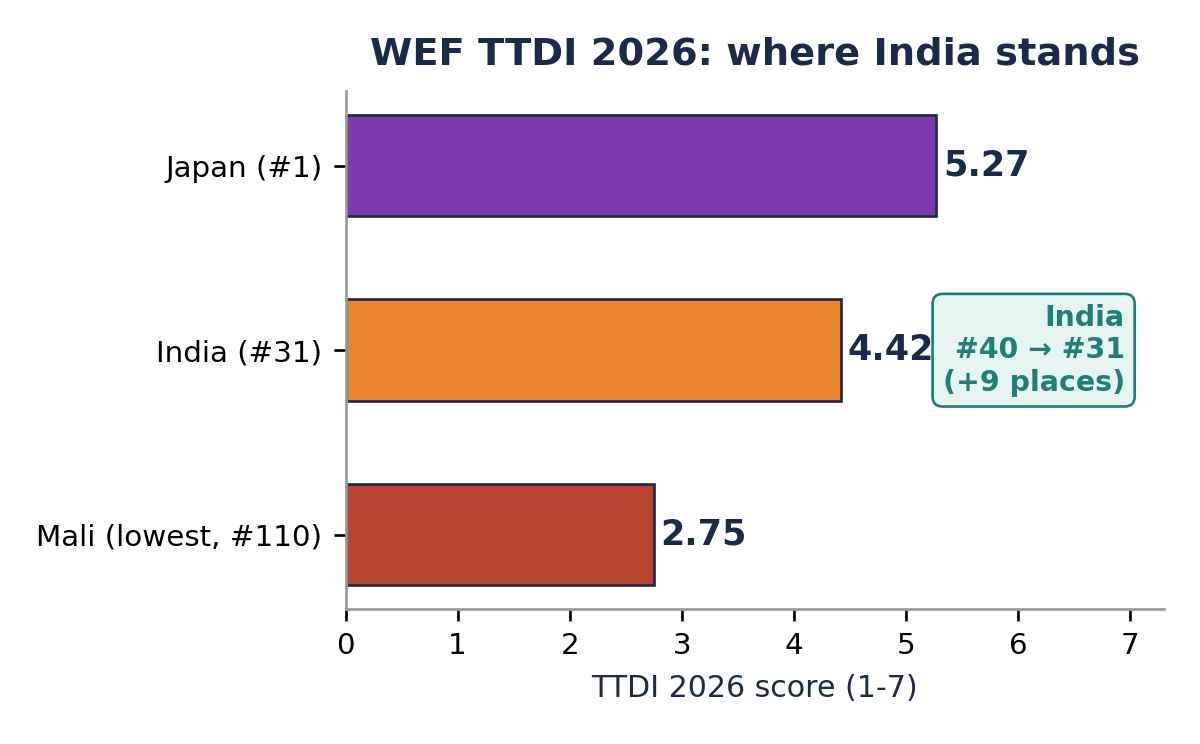
In the World Economic Forum's Travel & Tourism Development Index (TTDI) 2026, released around World Tourism Day (27 Sept), India rose nine places to 31st with a score of 4.42.
Key facts
10th edition; covers 110 economies (119 in 2025).
Top 5: Japan (5.27), USA, Spain, Australia, France; lowest Mali (2.75).
India's strengths: low travel costs, cultural & natural resources.
World Tourism Day 2026 theme centred on digital & AI in tourism.
Way forward
Fix weak pillars – tourist services infrastructure, safety and hygiene – and push Swadesh Darshan 2.0 destination-led circuits.
Concept
TTDI (biennial, by WEF, Geneva) replaced the Travel & Tourism Competitiveness Index in 2022; it measures factors enabling sustainable, resilient tourism.
Horizontal bar chart comparing TTDI 2026 scores: Japan 5.27 (rank 1), India 4.42 (rank 31) and Mali 2.75 (lowest), plus India's rank moving from 40 to 31. — StudyForGS
9. Census 2027: phase-1 nears completion, 32 crore+ families recorded
POLITYCOMMON: Prelims + Mains GS2
Syllabus linkage
GS2 – Government policies; GS1 – Population. Prelims: Census Act, 1948, Seventh Schedule, RGI.
Context
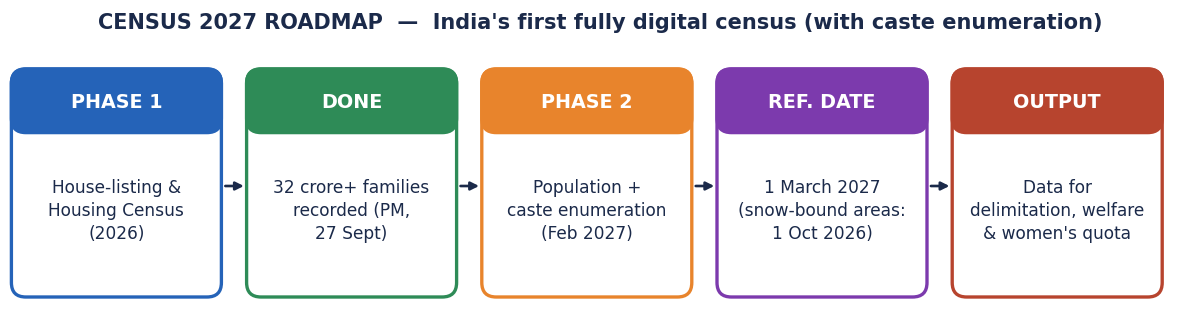
In Mann Ki Baat (27 Sept) the PM said the House-listing & Housing Census phase is almost complete in all States, with data of over 32 crore families recorded, and urged full public participation.
Key facts
India's first fully digital census; self-enumeration in 16 languages.
Caste enumeration included (Cabinet approval 30 April 2025).
Population Enumeration: Feb 2027 (snow-bound areas: Sept 2026).
Ensure data privacy, timely release and use of caste data for evidence-based welfare; prepare for delimitation and women's reservation linkages.
Concept
Census = Union List (Entry 69), conducted by Registrar General & Census Commissioner (MHA) under the Census Act, 1948. Last census: 2011; reference date 1 March 2027.
Flowchart of Census 2027: phase 1 house-listing (2026, 32 crore+ families), revision round, phase 2 population enumeration with caste (Feb 2027), reference date 1 March 2027, and digital data release. — StudyForGS
10. UNGA-81: Russia backs India & Brazil for permanent UNSC seats
IRCOMMON: Prelims + Mains GS2
Syllabus linkage
GS2 – International institutions; India & the world. Prelims: UNSC composition, G4, veto.
Context
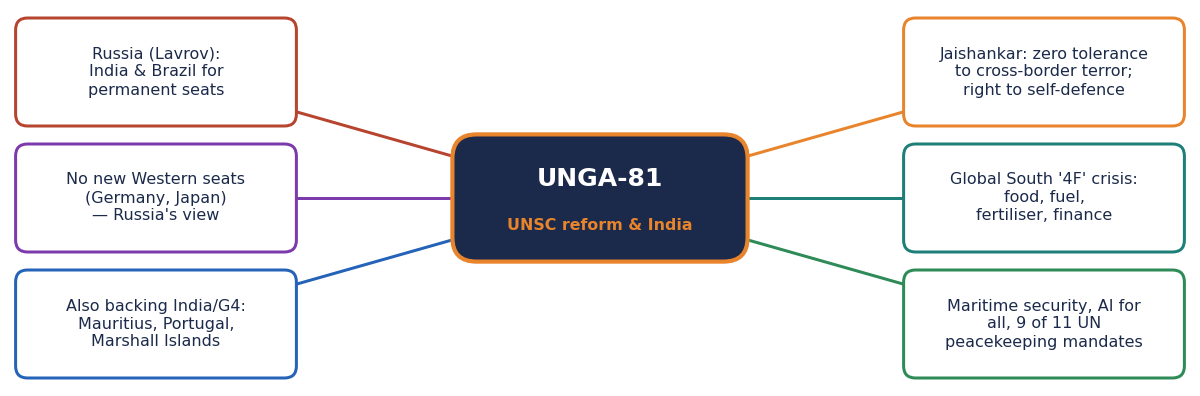
Addressing UNGA-81 (26 Sept), Russian FM Sergey Lavrov said Moscow supports Brazil's and India's candidatures for permanent seats, while EAM S. Jaishankar pressed reformed multilateralism and zero tolerance for terrorism.
Key facts
Lavrov: more seats for Asia, Africa, Latin America; no extra Western seats (named Germany, Japan).
Mauritius, Portugal and Marshall Islands also voiced support for India / G4.
Jaishankar flagged the Global South's '4F' crisis – food, fuel, fertiliser, finance.
India active in 9 of 11 UN peacekeeping mandates; attacks on seafarers condemned.
Way forward
Convert bilateral backing into text-based Inter-Governmental Negotiations (IGN); build African Union (Ezulwini) and L.69 coalitions.
Concept
UNSC: 15 members – 5 permanent (P5) with veto + 10 non-permanent elected for 2 years. Charter amendment needs 2/3 of UNGA + all P5 (Art. 108). G4 = India, Brazil, Germany, Japan.
Mind-map of UNGA-81 takeaways for India: Russia's UNSC backing, support from Mauritius, Portugal and Marshall Islands, Jaishankar's messages on terrorism, 4F crisis, maritime security, AI and reformed multilateralism. — StudyForGS
11. India hosts 2nd Quad-at-Sea Ship Observer Mission
Indian Coast Guard Ship Shaunak sailed from Chennai (25 Sept 2026) for Australia with six sea-riders from all four Quad nations aboard, launching the Quad-at-Sea Ship Observer Mission.
Key facts
Members: India, USA, Japan, Australia; aim – coast-guard interoperability.
1st mission (2025) was aboard US Coast Guard Cutter Stratton.
India chosen as 2026 host at Quad FMs' meeting, New Delhi (26 May 2026).
Reflects India's MAHASAGAR vision for a free, open, rules-based Indo-Pacific.
Way forward
Expand to IUU fishing, HADR and maritime domain awareness sharing via IFC-IOR with smaller littoral states.
Concept
MAHASAGAR = Mutual and Holistic Advancement for Security and Growth Across Regions (2025, successor to SAGAR, 2015). Indian Coast Guard: est. 1977/78, under MoD.
12. Tarang Shakti 2026: operational phase begins at Jodhpur
The IAF's multinational air exercise Tarang Shakti 2026, themed 'Power in Partnership', moved into its operational phase at Air Force Station Jodhpur (Rajasthan) on 28 Sept 2026.
Key facts
2nd edition (1st in 2024); runs 26 Sept – 12 Oct 2026.
Foreign air forces incl. Australia, USA, UAE, France, Germany, Sri Lanka, Bangladesh; many observers.
Use such exercises to showcase Tejas and indigenous systems for defence exports and deepen interoperability with Indo-Pacific partners.
Concept
BVR = Beyond Visual Range combat. Other IAF exercises: Garuda (France), Cope India (USA), Red Flag (USA, host), Pitch Black (Australia, host).
Data point of the day
7.1%
OECD forecast: India GDP growth, FY 2026-27 Raised by 80 bps from 6.3%; highest among major forecasters. FY28 seen at 6.5%, inflation 4.7% in FY27.
Prelims rapid-fire
Yudh Abhyas 2026 (22nd, India–USA Army) concludes 28 Sept – held at Auli & Mahajan Field Firing Range.
SAT-SAAW: MoD–BDL contract of ₹810.79 crore for 160 smart anti-airfield weapons for the IAF.
Asian Games 2026 (Aichi-Nagoya): India's men's kabaddi beat Iran 40–34 for a 9th title; women won 37–34.
Sawan Barwal: marathon silver – India's first Asiad marathon medal since 1982, with a national record.
28 Sept: World Rabies Day (Louis Pasteur's death anniversary) and Bhagat Singh's birth anniversary (1907).
28 Sept: International Day for Universal Access to Information – proclaimed by UNESCO (2015), UNGA (2019).
Practice MCQs — UPSC Prelims pattern
Q1. With reference to the 'mega ports' recently notified in India, consider the following statements: 1. They were notified under the Indian Ports Act, 2025. 2. All four notified mega ports are located on the west coast. 3. Mega port status is granted permanently once notified. Which of the statements given above is/are correct?
1 only
1 and 2 only
2 and 3 only
1, 2 and 3
Show answer
Answer: A Only 1 is correct. Paradip (Odisha) is on the east coast, so 2 is wrong; status is valid for 5 years with periodic review, so 3 is wrong.
Q2. The only viable wild population of the pygmy hog, recently in news, is found in which of the following protected areas?
Kaziranga National Park
Manas National Park
Dudhwa National Park
Jaldapara National Park
Show answer
Answer: B The pygmy hog survives in the wild only in Manas National Park, Assam, where captive-bred groups have been reintroduced since 2020.
Mains practice question
Q. Growing support for India's permanent membership has not translated into UNSC reform. Examine the obstacles to reform and suggest a strategy for India. (15 marks, 250 words)
Hint / approach
Intro: UNSC's 1945 structure vs today's realities; recent backing at UNGA-81. Body: obstacles – Art. 108 (P5 ratification), Uniting for Consensus, P5 veto politics, Ezulwini Consensus, stalled IGN. Strategy – text-based negotiations, AU/L.69 coalitions, Global South leadership, peacekeeping record. Conclude with reformed multilateralism.