ADB lifts India's FY27 growth forecast to 7%, Supreme Court says no criminal consequence for refusing to sing the national song, and the India-New Zealand FTA gets an entry-into-force date
Wednesday, 23 September 2026 · IST · National & International · 10 items · 2 MCQs
Growth optimism returned to the headlines as a multilateral lender raised India's FY27 GDP forecast to 7% on the back of 7.8% Q1 growth, while the RBI kept mopping up surplus liquidity through a variable rate reverse repo auction. On the constitutional side, the Supreme Court drew a firm line between respecting a national symbol and compelling its recitation, and also questioned machine-generated electoral roll notices in Delhi. Trade, water and clean energy supplied the rest of the day: the India-New Zealand FTA enters into force on 20 October 2026, a global water assessment flagged deepening groundwater stress in India, and canal-top solar emerged as a land-free renewable option worth about 131 GW.
Today at a glance — things to remember
Multilateral lender raises India's FY27 GDP growth forecast to 7.0% from 6.6%
Q1 FY27 growth came in at 7.8%; retail inflation seen at 5.0% this year
RBI absorbs ₹71,971 crore through a variable rate reverse repo auction
Exercise Nomadic Elephant 2026: India and Mongolia train at Pithoragarh till 3 October
Supreme Court: no criminal consequence for a conscientious refusal to sing the national song
Supreme Court faults 'mechanically issued' electoral roll notices to 33 lakh Delhi voters
India-New Zealand FTA enters into force on 20 October 2026 with 100% duty-free access
Visegrad Group backs India's UN Security Council permanent membership bid
Global water assessment: 34% of India's monitored groundwater stations below normal in 2025
Canal-top solar potential pegged at about 131 GW, needing no additional land
Detailed notes
1. Growth forecast for FY27 raised to 7% on strong first-quarter momentum
ECONOMYCOMMON: Prelims + Mains GS3
Syllabus linkage
GS3 - Indian Economy: growth, mobilisation of resources. Prelims: ADB, Asian Development Outlook, fiscal year vs calendar year forecasts, GDP vs GVA.
Context
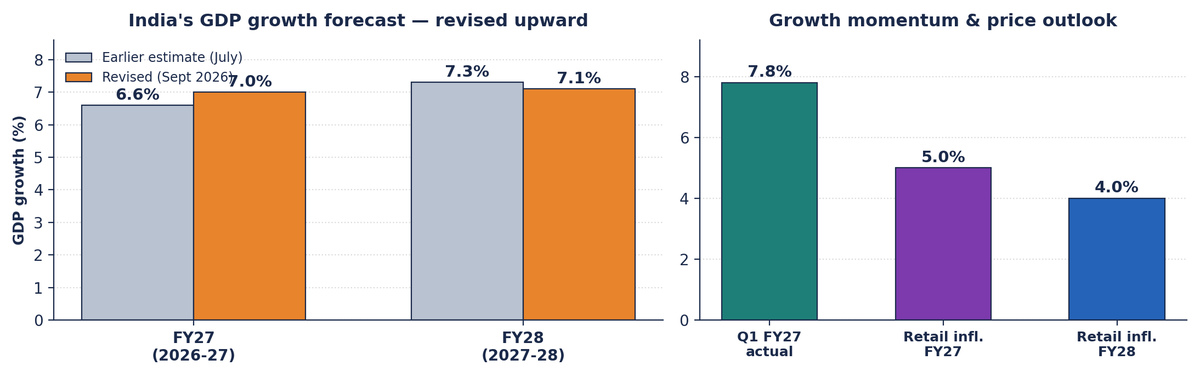
The Asian Development Bank (ADB), in its Asian Development Outlook (ADO) September 2026, raised India's growth forecast for FY27 (2026-27) to 7.0%, up from the 6.6% projected in July. The revision follows a first quarter that beat expectations.
Key facts
FY27 GDP growth revised up by 0.4 percentage points to 7.0%; FY28 trimmed to 7.1% from 7.3%.
Q1 FY27 real GDP grew 7.8% year-on-year, the trigger for the upgrade.
Retail inflation projected at 5.0% for FY27 (down from 5.2%) and 4.0% for FY28.
Drivers cited: robust investment demand, resilient consumption, strong manufacturing and services, and sustained capital inflows.
ADB is a regional development bank headquartered in Manila, Philippines, established in 1966; India is a founding member and among its largest borrowers.
Way forward
Sustaining 7%-plus growth needs private capex to broaden beyond a few sectors and export demand to hold up against global tariff turbulence.
Concept
Real GDP is output valued at constant prices; nominal GDP at current prices. GDP at market prices = GVA at basic prices + product taxes - product subsidies. A fiscal year in India runs 1 April to 31 March, so FY27 means 2026-27.
Grouped bar chart comparing India's earlier July GDP growth forecasts for FY27 and FY28 with the revised September 2026 forecasts, alongside a bar chart of Q1 FY27 actual growth and retail inflation projections. — StudyForGS
2. RBI absorbs ₹71,971 crore of surplus liquidity through VRRR auction
ECONOMYCOMMON: Prelims + Mains GS3
Syllabus linkage
GS3 - Indian Economy: monetary policy, banking. Prelims: LAF, repo and reverse repo, VRRR and VRR, call money rate, SDF and MSF.
Context
The Reserve Bank of India absorbed ₹71,971 crore against a notified amount of ₹75,000 crore in a Variable Rate Reverse Repo (VRRR) auction, continuing its effort to drain surplus banking-system liquidity.
Key facts
Under a VRRR, banks park surplus funds with the RBI for a fixed tenor and the rate is discovered through auction, not fixed in advance.
It is a liquidity absorption tool under the Liquidity Adjustment Facility (LAF); VRR (Variable Rate Repo) does the opposite by injecting liquidity.
Objective: pull the weighted average call rate (WACR) closer to the repo rate, since excess liquidity pushes overnight rates below the policy rate.
Undersubscription (₹71,971 crore against ₹75,000 crore) signals banks prefer to keep funds deployable rather than lock them in.
The RBI's operating target of monetary policy is the WACR in the overnight segment.
Way forward
Calibrated absorption keeps transmission intact without starving credit; the test is doing it without spiking short-term rates around tax and festival outflows.
Concept
LAF lets banks borrow (repo) or park (reverse repo) overnight funds with the RBI. The corridor has MSF as the ceiling, repo rate in the middle and SDF as the floor. SDF needs no collateral.
3. Canal-top solar offers a land-free path to about 131 GW of clean power
SCI-TECHCOMMON: Prelims + Mains GS3
Syllabus linkage
GS3 - Science and Technology, renewable energy, conservation. Prelims: solar photovoltaics, bifacial modules, floating solar, PM Surya Sarovar Yojana.
Context
With land acquisition the biggest brake on utility-scale solar, canal-top photovoltaics (CTPV) is being revisited. Mounting panels over irrigation canals generates power and cuts evaporation at the same time.
Key facts
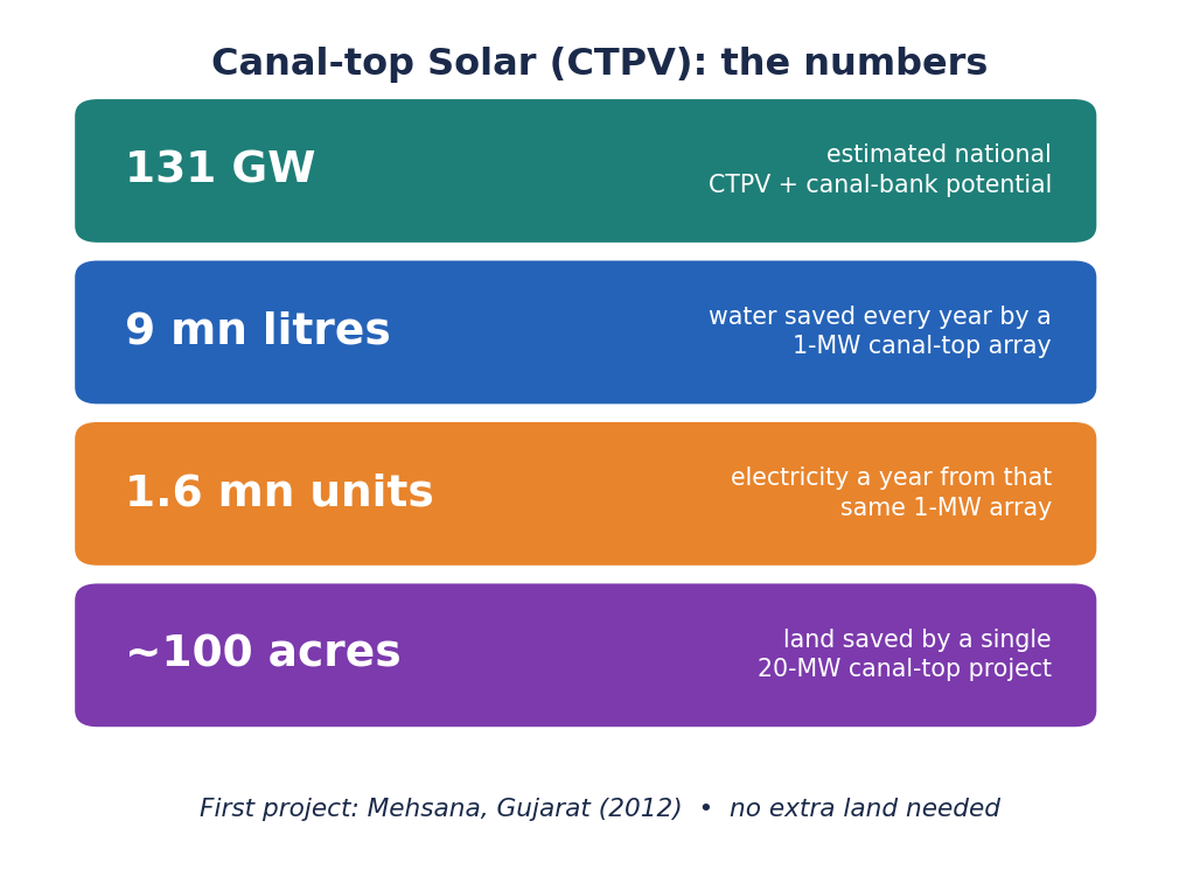
A 2024 assessment pegs India's combined canal-top plus canal-bank potential at about 131 GW.
India's first canal-top solar plant came up at Mehsana, Gujarat, in 2012 on the Narmada canal network.
A 1-MW canal-top array there saves roughly 9 million litres of water a year and generates about 1.6 million units of electricity annually.
A 20-MW project in Punjab avoided the use of roughly 100 acres of land.
High-potential States: Uttar Pradesh, Bihar, Karnataka, Andhra Pradesh and Punjab. For canals wider than 30 m, vertical bifacial panels along banks are suggested.
PM Surya Sarovar Yojana (PM-SSY) targets 5,000 MW of floating solar and is expected to extend support to canal-top projects.
Way forward
Viability gap funding and standardised structural designs are needed because elevated mounting makes CTPV costlier per MW than ground-mounted solar.
Concept
India's non-fossil capacity target and the National Solar Mission under NAPCC drive solar deployment. Bifacial modules capture light on both faces; evaporation suppression is the co-benefit that distinguishes CTPV from ordinary ground-mounted solar.
Stacked stat tiles showing canal-top solar figures: 131 GW national potential, 9 million litres of water saved a year per MW, 1.6 million units generated, and about 100 acres of land saved by a 20-MW project. — StudyForGS
4. Global water assessment flags deepening groundwater stress in India
ENVIRONMENTCOMMON: Prelims + Mains GS3
Syllabus linkage
GS3 - Environment: conservation, climate change, water resources. Prelims: WMO, terrestrial water storage, glacier mass balance, river discharge.
Context
The World Meteorological Organization (WMO) released the State of Global Water Resources 2025 report on 17 September 2026. It records an erratic global water cycle, a fourth straight year of glacier loss, and groundwater that is not recovering even where rivers ran full.
Key facts
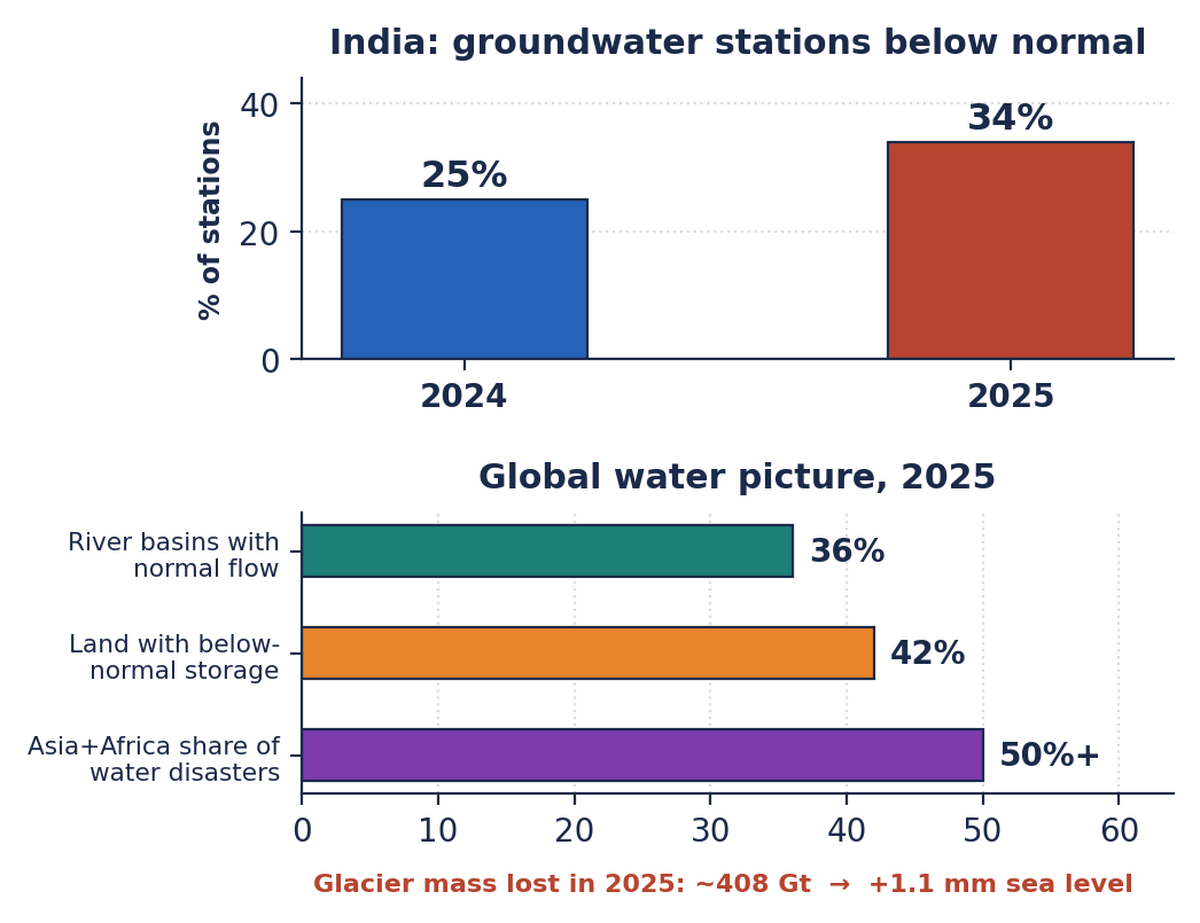
2025 was among the driest years in 35 years for river discharge: only 36% of global river-basin area saw normal flows.
42% of global land area recorded below-normal terrestrial water storage in 2025, continuing a decline since 2014-16.
All major glaciated regions lost mass for the fourth consecutive year; 2025 loss was about 408 gigatonnes, adding roughly 1.1 mm to sea level.
India: 34% of monitored groundwater stations were below or much-below normal in 2025, up from 25% in 2024.
Deficits persisted 2022-2025, especially in north-western India, with over-abstraction the key driver; deep reserves did not recover despite above-normal discharge in the Ganga, Godavari, Krishna and Indus.
Asia and Africa together account for over 50% of recorded water-related extreme events and over 80% of associated deaths in the previous five years.
Way forward
Aquifer-level participatory management, crop realignment in over-drawn belts and real-time monitoring must replace the assumption that a good monsoon automatically refills deep aquifers.
Concept
Terrestrial water storage is all water held on and under land, tracked by gravimetric satellites. Glacier mass balance is accumulation minus ablation. WMO is a UN specialised agency headquartered in Geneva, established in 1950.
Bar chart showing the share of India's monitored groundwater stations below normal rising from 25 percent in 2024 to 34 percent in 2025, with a horizontal bar chart of global 2025 water indicators. — StudyForGS
5. Punjab's groundwater extraction touches 156.87% of what recharges
ENVIRONMENTCOMMON: Prelims + Mains GS3
Syllabus linkage
GS3 - Agriculture and environment: cropping patterns, irrigation, subsidies. Prelims: Central Ground Water Board, stage of extraction, over-exploited blocks.
Context
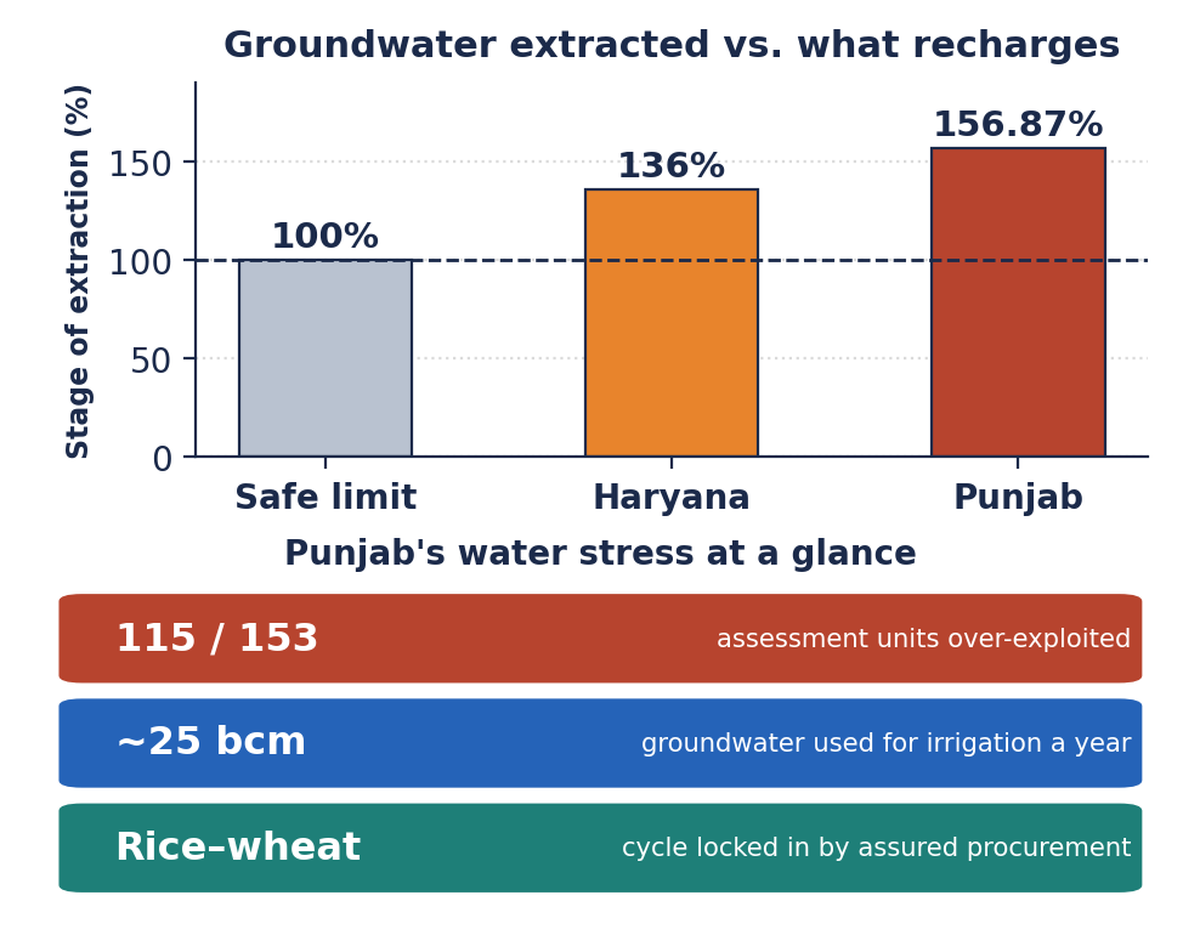
A Central Ground Water Board assessment places Punjab's stage of groundwater extraction at 156.87% of the annual extractable resource, and the crisis is now visibly widening the wealth gap between small and large farmers.
Key facts
115 of 153 assessment units in Punjab are classified over-exploited; irrigation consumes roughly 25 billion cubic metres a year.
Drivers: subsidised electricity that makes pumping nearly free, and assured procurement of paddy that locks in the rice-wheat cycle.
As water tables fall, smallholders must buy water from larger landowners with deeper bores, transferring wealth upward.
Pani Bachao, Paisa Kamao pays farmers cash for unused pumping units, but enrolment has stayed low.
Crop Diversification Programme under PM-RKVY and the State's water regulation framework are the other policy levers in play.
Way forward
Shift the subsidy from extraction to access: pay for water saved, collectivise irrigation assets, and make sure benefits reach tenant cultivators, not only pump owners.
Concept
Stage of extraction = (annual groundwater extraction / annual extractable resource) x 100. Above 100% a unit is over-exploited; 90-100% is critical and 70-90%semi-critical. Groundwater is a State subject but regulated through CGWA under the Environment (Protection) Act, 1986.
Bar chart comparing the safe 100 percent extraction limit with Haryana at 136 percent and Punjab at 156.87 percent, plus stat tiles on over-exploited units and irrigation water use. — StudyForGS
6. Exercise Nomadic Elephant 2026: India and Mongolia train at Pithoragarh
DEFENCECOMMON: Prelims + Mains GS3
Syllabus linkage
GS3 - Security: defence exercises and interoperability. GS2 - India and its neighbourhood, extended neighbourhood. Prelims: bilateral exercise names and partner countries.
Context
The 18th edition of Exercise Nomadic Elephant, the India-Mongolia joint military exercise, began on 21 September 2026 at the Foreign Training Node, Pithoragarh, Uttarakhand, and runs until 3 October 2026.
Key facts
A platoon-level bilateral exercise with 45 personnel from each side, held alternately in India and Mongolia.
The previous edition was held in Ulaanbaatar in May-June 2025.
Focus: counter-insurgency operations in semi-urban and mountainous terrain, and operations under a UN mandate.
Drills include cordon and search, room intervention, special heliborne operations, cyber security, and drone and counter-drone employment.
Mongolia is a landlocked Central Asian partner; India's engagement spans energy, mining, culture and Buddhist diplomacy.
Way forward
Small-format exercises like this build interoperability cheaply; the value lies in carrying the drone and counter-drone lessons into India's own border formations.
Concept
Remember India's bilateral exercise pairings for Prelims: Nomadic Elephant with Mongolia, Garuda Shakti with Indonesia, Mitra Shakti with Sri Lanka, Yudh Abhyas with the USA, and Dharma Guardian with Japan.
7. No criminal consequence for a conscientious refusal to sing the national song
POLITYCOMMON: Prelims + Mains GS2
Syllabus linkage
GS2 - Indian Constitution: fundamental rights, fundamental duties, judiciary. Prelims: Articles 25, 26, 51A(a); national song vs national anthem.
Context
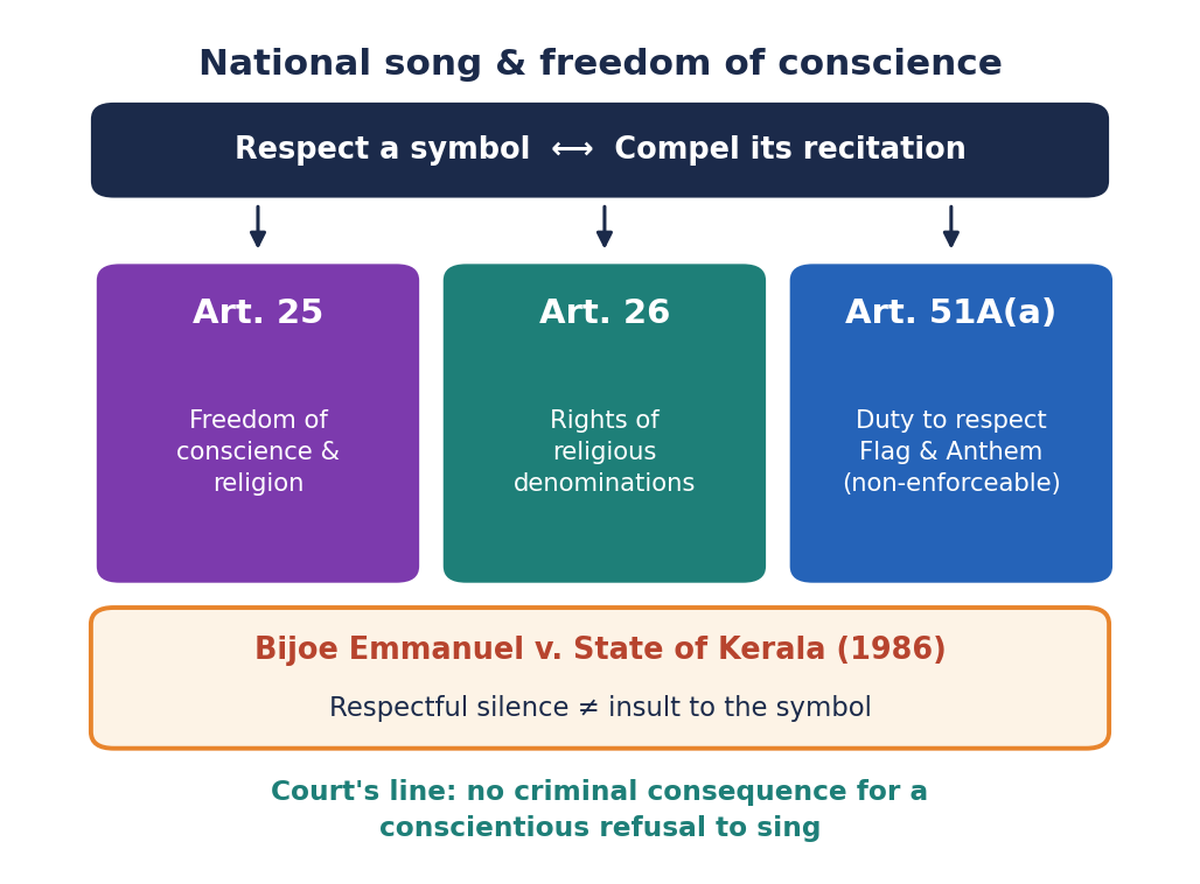
Hearing a petition against the compulsory singing of Vande Mataram, a three-judge Bench of the Supreme Court told the Centre it expects no criminal consequence for a person who declines on religious or conscientious grounds, and sought the government's formal position.
Key facts
The challenge is to the Prevention of Insults to National Honour (Amendment) Act, 2026 and Union Home Ministry circulars issued in January and July 2026.
The petitioner is the Carnatic vocalist T.M. Krishna; the Bench was headed by CJI Surya Kant.
The Court leaned on Bijoe Emmanuel v. State of Kerala (1986), which protected students who stood respectfully but did not sing the national anthem.
Core reasoning: nobody can be made to infract Articles 25 and 26 and then face criminal prosecution for it.
Vande Mataram, from Bankim Chandra Chatterjee's Anandamath, was adopted as the national song on 24 January 1950, with equal status to the national anthem but no separate legal penalty attached historically.
Separately, the Karnataka Governor has asked the State to reconsider a 8 September order limiting the rendition to two stanzas, raising a Centre-State question over national symbols.
Way forward
Fundamental duties are meant to inspire, not to prosecute; the workable line is to encourage participation while keeping respectful silence outside the reach of penal law.
Concept
Article 25 gives freedom of conscience and free profession, practice and propagation of religion, subject to public order, morality and health. Article 51A(a), a fundamental duty, is non-justiciable and was inserted by the 42nd Amendment, 1976 on the Swaran Singh Committee's recommendation.
Pillar diagram showing the tension between respecting a national symbol and compelling its recitation, resting on Articles 25, 26 and 51A(a), with the Bijoe Emmanuel 1986 precedent below. — StudyForGS
8. Creating an offence is a legislative function, not an executive one
POLITYCOMMON: Prelims + Mains GS2
Syllabus linkage
GS2 - Separation of powers, delegated legislation, fundamental rights. Prelims: Article 20(1), ex post facto laws, excessive delegation doctrine.
Context
In Shiv Pratap Singh v. State of U.P. and a connected matter, the Supreme Court held that the Uttar Pradesh Gangsters Act definition of a gangster was constitutionally infirm because it left the content of the offence to executive discretion.
Key facts
The Court found the definition rested on the executive's ipse dixit, offending Article 20(1), which bars conviction except for violation of a law in force at the time of the act.
Core principle: creating an offence and prescribing punishment is an exclusively legislative function and cannot be delegated through rule-making.
The judgment revisits the distinction between act-based punishment (what a person did) and status-based punishment (what a person is labelled).
This is a classic application of the doctrine of excessive delegation: the legislature must lay down the essential legislative policy itself.
Article 20 also guarantees protection against double jeopardy (20(2)) and self-incrimination (20(3)), and is non-derogable even during an Emergency under Article 359.
Way forward
State special-security statutes need legislative redrafting with tight definitions, rather than relying on administrative labelling that courts will keep striking down.
Concept
Article 20(1) embodies the principle of nullum crimen sine lege (no crime without law) and bars ex post facto criminal laws and enhanced retrospective penalties. Delegated legislation is permissible for detail, never for essential policy.
9. India-New Zealand FTA to enter into force on 20 October 2026
IRCOMMON: Prelims + Mains GS2 & GS3
Syllabus linkage
GS2 - Bilateral agreements affecting India's interests. GS3 - Effects of liberalisation, external sector. Prelims: FTA vs CEPA vs customs union, tariff lines, TRQ, rules of origin.
Context
The India-New Zealand Free Trade Agreement, concluded in 2026, will enter into force on 20 October 2026, giving Indian exporters immediate duty-free access to the New Zealand market.
Key facts
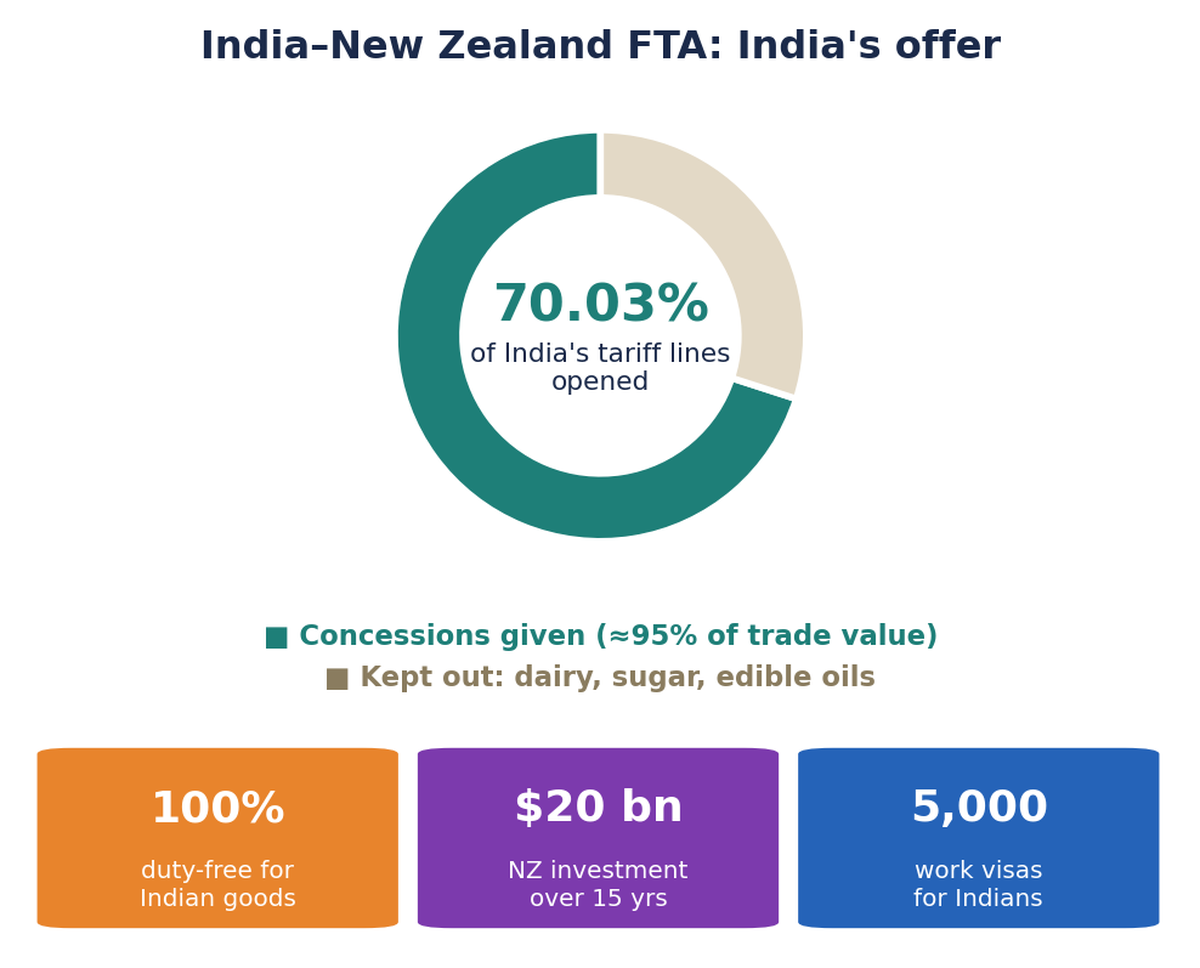
New Zealand gives 100% duty-free access to Indian exports from day one.
India offers concessions on 70.03% of its tariff lines, covering roughly 95% of bilateral trade value; the remaining 29.97% stays protected.
Excluded or shielded: dairy, select agricultural items, sugar and edible oils. Tariff Rate Quotas and Minimum Import Prices apply to apples, kiwifruit and Manuka honey.
New Zealand has committed to facilitate US$20 billion of investment over 15 years.
Mobility: a dedicated quota of 5,000 temporary employment visas for skilled Indians and 1,000 working-holiday visas a year; post-study work rights of 3 years for STEM graduates and 4 years for doctoral scholars.
Gainers: textiles, leather, footwear, pharmaceuticals and engineering goods.
Way forward
The gain now depends on utilisation: exporters need help with rules-of-origin paperwork and standards compliance, which is where past FTAs have leaked value.
Concept
An FTA removes tariffs between members but each keeps its own external tariff; a customs union adds a common external tariff. Rules of origin stop trade deflection, where goods route through the lowest-tariff member. A TRQ allows a set quantity at low duty, with higher duty beyond it.
Donut chart showing India opening 70.03 percent of its tariff lines under the New Zealand FTA, with stat tiles for 100 percent duty-free access, 20 billion dollars of investment and 5,000 work visas. — StudyForGS
10. Visegrad Group backs India's UN Security Council bid as reform push intensifies
IRCOMMON: Prelims + Mains GS2
Syllabus linkage
GS2 - Important international institutions, groupings and agreements involving India. Prelims: V4 members, UNSC composition and elections, UNGA sessions.
Context
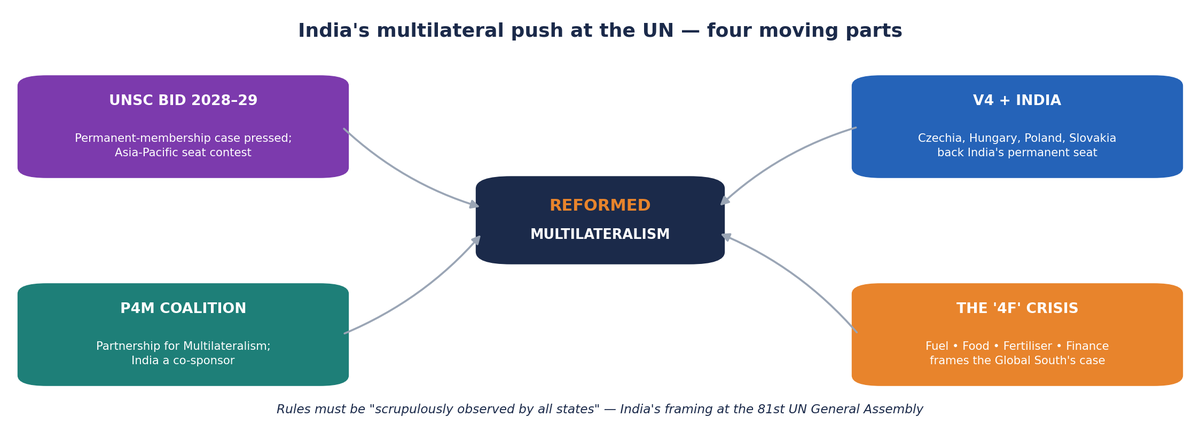
On the margins of the 81st UN General Assembly, the Visegrad Group (V4) backed India's bid for permanent membership of the UN Security Council at the first V4-India Foreign Ministers' Meeting, while India also co-sponsored a coalition pressing for reformed multilateralism.
Key facts
V4 members: Czechia, Hungary, Poland and Slovakia. Formed on 15 February 1991 at Visegrad, Hungary; all four joined the EU in 2004.
The V4 is an informal intergovernmental platform, not supranational: decisions by consensus, a rotating annual presidency, and V4+ formats for third countries.
India is pressing a UNSC non-permanent seat candidature for 2028-29 as well; Tajikistan has also entered the Asia-Pacific contest.
India joined the Partnership for Multilateralism (P4M) as a co-sponsor alongside Australia, Brazil, Barbados and Kenya.
India framed today's disruption through the '4F' crisis - Fuel, Food, Fertiliser and Finance - and argued that international rules must be scrupulously observed by all states.
UNSC has 15 members: 5 permanent with veto and 10 non-permanent elected for two-year terms by the UNGA under Article 23 of the UN Charter.
Way forward
Endorsements are cheap; the binding constraint is Charter amendment under Article 108, which needs two-thirds of the UNGA plus ratification by all five permanent members.
Concept
India seeks reform through the G4 (India, Brazil, Germany, Japan), opposed by the Uniting for Consensus (Coffee Club) group led by Italy, Pakistan, South Korea and others. Reform requires amending the UN Charter under Article 108.
Mind-map with reformed multilateralism at the centre, linked to India's UNSC bid for 2028-29, the P4M coalition, V4 support and the 4F crisis of fuel, food, fertiliser and finance. — StudyForGS
Data point of the day
7.0%
India's GDP growth forecast for FY27 (2026-27) Revised up from 6.6% after Q1 FY27 growth of 7.8%; FY28 trimmed to 7.1% and retail inflation seen at 5.0% this year.
Prelims rapid-fire
Delhi electoral rolls: the Supreme Court called notices sent to over 33 lakh voters in the Special Intensive Revision 'mechanically issued'; disposal deadline is 29 October.
Mining 'squatting': the Mines Secretary flagged miners holding allotted blocks without starting work, and signalled a large scheme for domestic nickel and lithium processing.
SEBI settled Adani-group adjudication proceedings for about ₹1.5 crore across five entities, without admission or denial of the allegations.
Outer Space Treaty, 1967: opened for signature on 27 January 1967; Article II bars national appropriation of celestial bodies, but says little on commercial mining rights.
Drug-free target: the Union Home Minister set 31 December 2029 to uproot the drug trade, shifting enforcement from seizures to network dismantlement and financial investigation.
Trichophyton indotineae, a terbinafine-resistant dermatophyte first flagged in India, is spreading globally, making ringworm (tinea) harder to treat.
Practice MCQs — UPSC Prelims pattern
Q1. With reference to the Variable Rate Reverse Repo (VRRR) conducted by the Reserve Bank of India, consider the following statements:
1. It is used to inject liquidity into the banking system.
2. The interest rate under it is determined through an auction rather than being fixed in advance.
3. It operates under the Liquidity Adjustment Facility.
Which of the statements given above is/are correct?
1 and 2 only
2 and 3 only
1 and 3 only
1, 2 and 3
Show answer
Answer: B A VRRR absorbs liquidity rather than injecting it, so statement 1 is wrong. The rate is discovered through auction and the facility sits under the Liquidity Adjustment Facility, so statements 2 and 3 are correct. Liquidity injection through an auction-determined rate is done by the Variable Rate Repo (VRR).
Q2. The Visegrad Group (V4), which recently held its first Foreign Ministers' Meeting with India, comprises which of the following countries?
Austria, Czechia, Hungary and Slovenia
Czechia, Hungary, Poland and Slovakia
Croatia, Hungary, Poland and Romania
Estonia, Latvia, Lithuania and Poland
Show answer
Answer: B The V4 was formed in 1991 at Visegrad, Hungary, originally by Poland, Hungary and Czechoslovakia. After the Czech-Slovak split in 1993 it became a four-member grouping of Czechia, Hungary, Poland and Slovakia, all of which joined the EU in 2004.
Mains practice question
Q. Punjab now extracts more groundwater than it recharges, yet the crisis hurts small farmers far more than large ones. Examine the causes of this inequality and suggest a welfare-consistent policy response that protects farm incomes while making further extraction unattractive. (250 words, 15 marks)
Hint / approach
Open with the 156.87% stage of extraction and 115 of 153 over-exploited units. Explain the mechanism: free power plus assured procurement locks in the rice-wheat cycle; falling water tables raise the capital needed for deeper bores, so smallholders end up buying water from large landowners. Then move to solutions - pay for water saved rather than power consumed, redirect part of the electricity subsidy to smallholders, collectivise irrigation assets, strengthen procurement for alternative crops, and route benefits to tenant cultivators. Close with the constitutional point that groundwater is a State subject regulated through central environmental law.
📌 One-line revision: Remember today by five numbers: 7.0% FY27 growth, ₹71,971 crore absorbed via VRRR, 156.87% groundwater extraction in Punjab, 70.03% of tariff lines opened to New Zealand, and 131 GW of canal-top solar potential.