Tuesday, 22 September 2026 · IST · National & International · 10 items · 2 MCQs
Defence indigenisation dominates the day: the 1,000 km KAL one-way attack drone was tested at Pokhran and HAL delivered Tejas trainers, the first HTT-40s and Dhruv NG helicopters. On the economy, Moody's raised India's FY27 growth forecast to 7% even as core sector growth eased to 4.8% in August. Governance themes include the UCC push (Art. 44), Ayurveda Day on 23 September, the ₹4,000 crore Bhutan Line of Credit and the UN Gender Snapshot 2026.
Today at a glance — things to remember
KAL — India's first indigenous 1,000 km one-way attack drone tested at Pokhran.
HAL delivered 2 Tejas trainers, 3 HTT-40 (of 70) and 4 Dhruv NG helicopters.
Moody's raised FY27 GDP forecast to 7% (from 6%); Q1 FY27 growth 7.8%.
Core sector grew 4.8% in Aug 2026; cement 12.5%, electricity 11.6%.
Swachhata Hi Seva 2026: 17 Sept–2 Oct, theme 'Swachhata Mein Sahbhag'.
Noida-based private firm IG Defence has tested KAL, billed as India's first indigenous long-range one-way attack (OWA) drone, at the Pokhran Field Firing Range, Rajasthan; the trials were reported on 21–22 September 2026.
Key facts
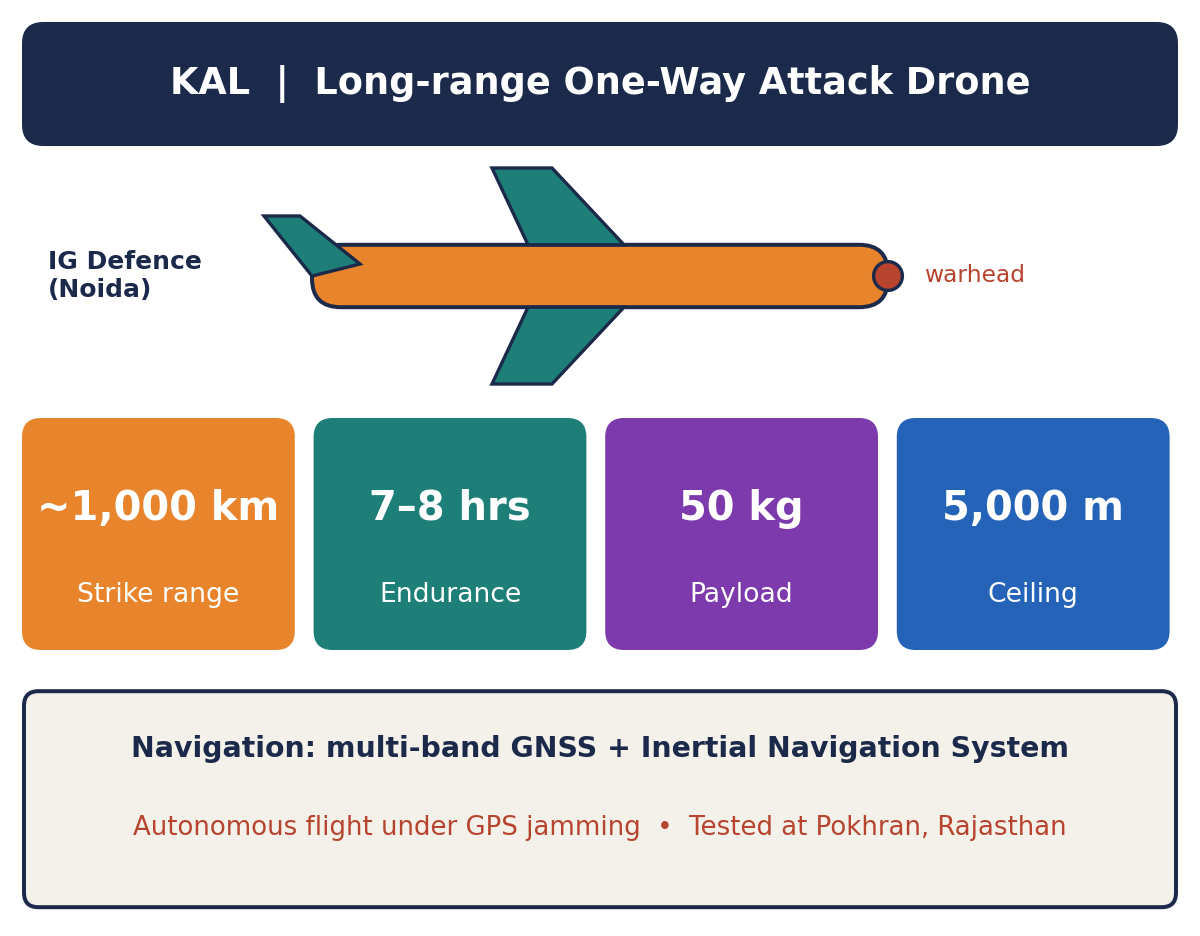
Strike range of about 1,000 km; endurance 7–8 hours; payload 50 kg; ceiling up to 5,000 m.
Navigation by multi-band GNSS plus an Inertial Navigation System (INS), enabling autonomous flight even under GPS jamming.
Class: loitering munition / kamikaze drone — it is expended on the target, unlike a reusable UCAV.
OWA drones have been decisive in the Russia–Ukraine and West Asia conflicts as a low-cost alternative to cruise missiles.
Way forward
Fast-track user trials and induction, secure a domestic supply of engines, seekers and chips, and build counter-drone layers in parallel.
Concept
Loitering munition = drone–missile hybrid that 'loiters' over an area before striking. INS uses accelerometers and gyroscopes, independent of satellites. Links: iDEX, Positive Indigenisation Lists, DAP-2020.
Fact-sheet schematic of the KAL one-way attack drone showing range 1,000 km, endurance 7-8 hours, payload 50 kg, ceiling 5,000 m and GNSS plus INS navigation. — StudyForGS
2. HAL hands over Tejas trainers, first HTT-40s and Dhruv NG helicopters
At a ceremony in Bengaluru (18 September 2026) attended by Defence Minister Rajnath Singh and Civil Aviation Minister K. Rammohan Naidu, HAL delivered trainer aircraft to the IAF and civil helicopters to Pawan Hans Ltd.
Key facts
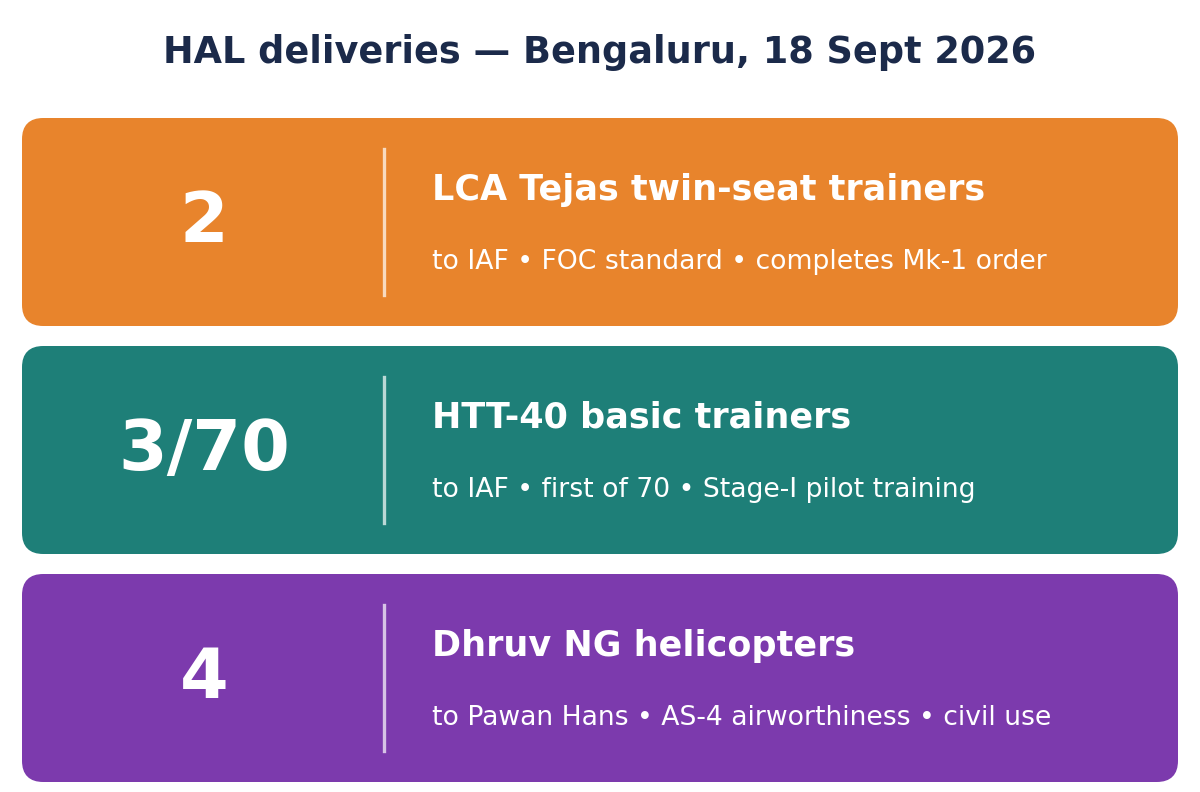
2 LCA Tejas twin-seat trainers (FOC standard) handed to the IAF, completing the Mk-1 trainer order.
3 HTT-40 basic trainers — first of a 70-aircraft order; they will augment the Pilatus PC-7 Mk II fleet for stage-I (basic) training.
4 Dhruv NG helicopters to Pawan Hans — India's first indigenous civil helicopter meeting the AS-4 airworthiness standard.
Marks a shift from licence-production to indigenous design across the aviation ecosystem.
Way forward
Stabilise production rates (engines, avionics supply chains) and use civil variants like Dhruv NG to build export and MRO markets.
Concept
HAL — Maharatna PSU under the Ministry of Defence, HQ Bengaluru. FOC (Final Operational Clearance) follows IOC. Pilot training: Stage-I basic, Stage-II intermediate, Stage-III advanced jet.
Stat-tile row showing HAL deliveries on 18 September 2026: 2 Tejas twin-seat trainers, 3 HTT-40 basic trainers out of 70 ordered, and 4 Dhruv NG civil helicopters. — StudyForGS
3. Moody's lifts India's FY27 growth forecast to 7% after a strong Q1
ECONOMYCOMMON: Prelims + Mains GS3
Syllabus linkage
GS-III: Growth, development and mobilisation of resources. Prelims: credit rating agencies, sovereign rating grades, inflation targeting.
Context
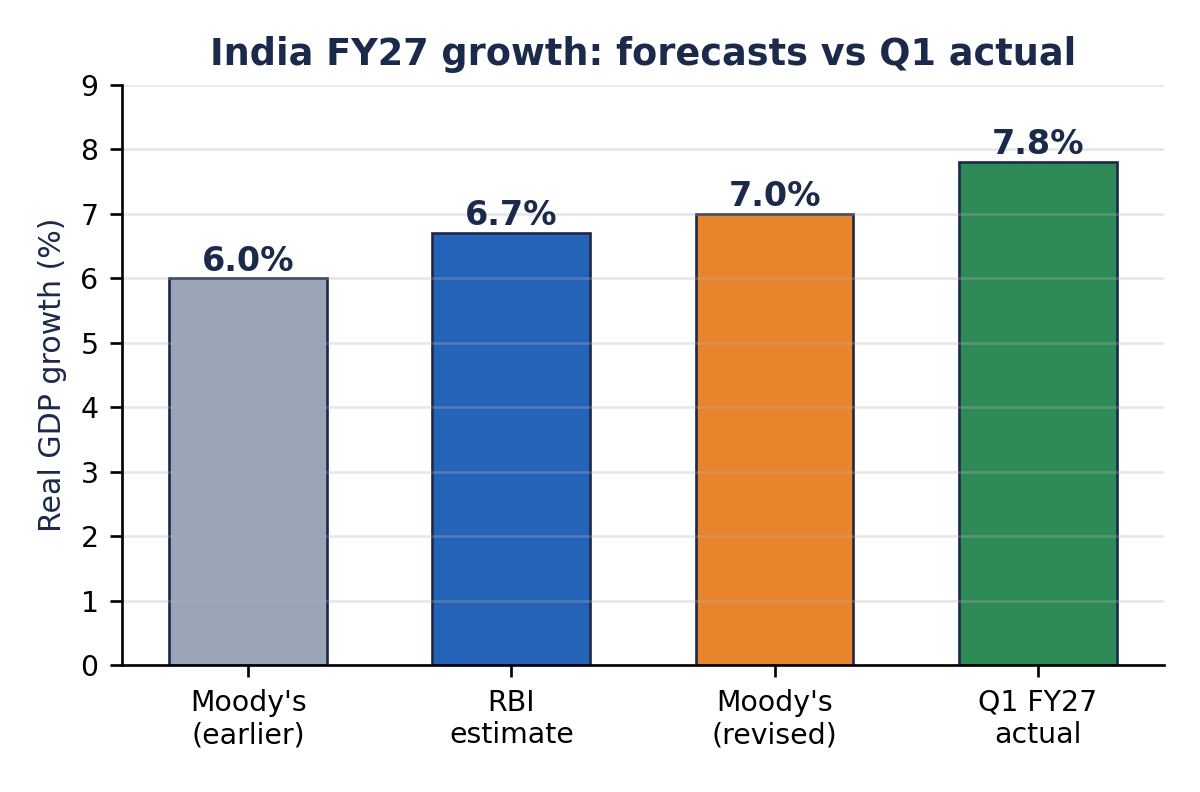
On 18 September 2026, Moody's Ratings raised India's FY27 real GDP growth forecast to 7% from 6%, after Q1 FY27 (April–June) GDP grew 7.8%, citing resilient private consumption and investment.
Key facts
Q1 growth was led by manufacturing and services; calendar-year H1 2026 growth estimated at 8.2%.
FY27 inflation projected at 4.8% — inside RBI's 2–6% band but above the 4% target.
Moody's forecast is now above RBI's own FY27 estimate of 6.7%.
Sovereign rating retained at Baa3 (stable) — the lowest investment grade.
Risks flagged: energy prices and food inflation amid West Asia tensions.
Way forward
Sustain public capex and private investment, manage food supply shocks, and keep fiscal consolidation on track to argue for a rating upgrade.
Concept
Big Three CRAs: Moody's, S&P, Fitch. Moody's investment grade ends at Baa3 (S&P/Fitch: BBB-). Flexible Inflation Targeting: 4% ±2% under Section 45ZA, RBI Act, 1934.
Bar chart comparing India FY27 growth numbers: Moody's earlier forecast 6%, RBI estimate 6.7%, Moody's revised forecast 7%, and actual Q1 FY27 growth 7.8%. — StudyForGS
4. Swachhata Hi Seva 2026: legacy dumpsites turn into parks and forests
ENVIRONMENTCOMMON: Prelims + Mains GS3
Syllabus linkage
GS-III: Environment — pollution and waste management. GS-II: Urban local bodies. Prelims: biomining, SWM Rules 2026, Miyawaki method.
Context
The Swachhata Hi Seva (SHS) 2026 fortnight (17 Sept–2 Oct; theme 'Swachhata Mein Sahbhag; Swachh Bharat, Viksit Bharat') spotlights legacy-dumpsite remediation under SBM-Urban 2.0, with models from Gorakhpur, Delhi, Nagpur and Raichur.
Key facts
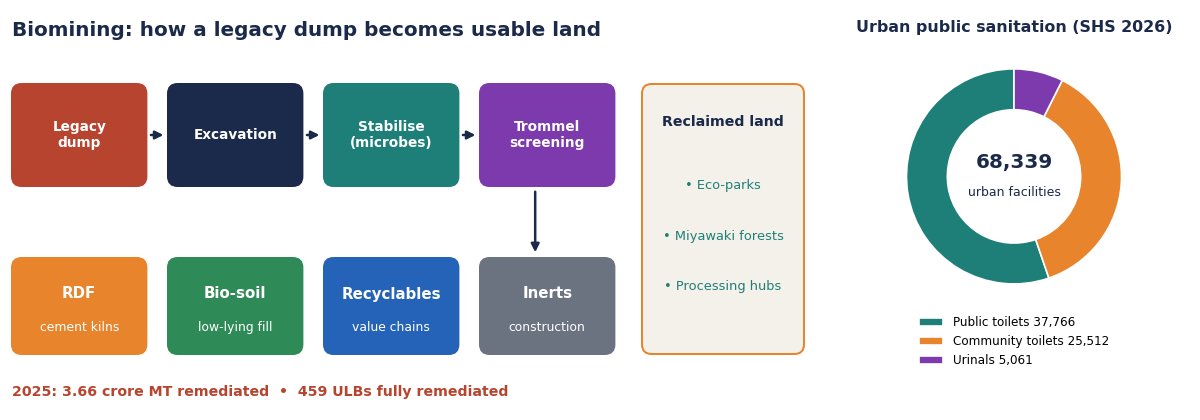
3.66 crore MT legacy waste remediated in 2025; 459 ULBs in 29 States achieved complete remediation.
Bhalswa (Delhi): 99.07 lakh MT cleared by 31 July 2026; Gorakhpur: 40-acre site became the Kachre Se Kanchan Rapti Eco Park.
Raichur (Yakalaspura): ~22 acres reclaimed; Miyawaki forest planted on 5 June 2026.
Dumpsite Remediation Accelerator Programme (DRAP) launched November 2025; SWM Rules, 2026 in force from 1 April 2026.
Urban India has 68,339 public sanitation facilities, incl. 37,766 public toilets.
Way forward
Stop fresh unsegregated inflow, secure RDF offtake by cement kilns, publish third-party verified site data and integrate waste pickers with social security.
Concept
74th Amendment — 12th Schedule, Entry 6: solid waste management is a municipal function (Art. 243W). Biomining = excavation + stabilisation + trommel screening into RDF, bio-soil, recyclables, inerts. Almitra Patel case led to the MSW Rules, 2000.
Flowchart of the biomining process from legacy dump to excavation, stabilisation, trommel screening and four output streams (RDF, bio-soil, recyclables, inerts), with a donut chart of 68,339 urban public sanitation facilities split into public toilets, community toilets and urinals. — StudyForGS
5. Leopardus tilcayo: first new living wild cat species described in over 100 years
ENVIRONMENTCOMMON: Prelims + Mains GS3
Syllabus linkage
GS-III: Biodiversity and conservation. Prelims: species in news, cloud forests, taxonomy.
Context
A peer-reviewed study (published 17–18 September 2026) described Leopardus tilcayo ('Tilcayo'), a small tiger cat from Bolivia's Yungas cloud forests on the eastern Andean slopes.
Key facts
Body length about 46 cm, weight ~1.4 kg — smaller than a house cat; light-brown coat with dark rosettes.
Lineage split from other tiger cats about 1.4 million years ago; genetics show tiger cats are five distinct species.
A new subspecies, Leopardus tigrinus antisuyo, was also identified in Peru's Yungas.
Camera traps suggest nocturnal habits; diet includes small rodents.
Way forward
Map its range quickly and protect Yungas habitat from deforestation — newly described species are often already threatened before assessment.
Concept
Leopardus = small Neotropical cats (ocelot, margay, oncilla). Cloud forest = tropical montane forest with persistent low cloud. India's small cats in news: rusty-spotted cat (world's smallest wild cat), fishing cat (State animal of West Bengal).
6. Core sector growth eases to 4.8% in August; cement and electricity lead
ECONOMYCOMMON: Prelims + Mains GS3
Syllabus linkage
GS-III: Indian economy — industrial growth, infrastructure. Prelims: Index of Eight Core Industries (ICI), IIP.
Context
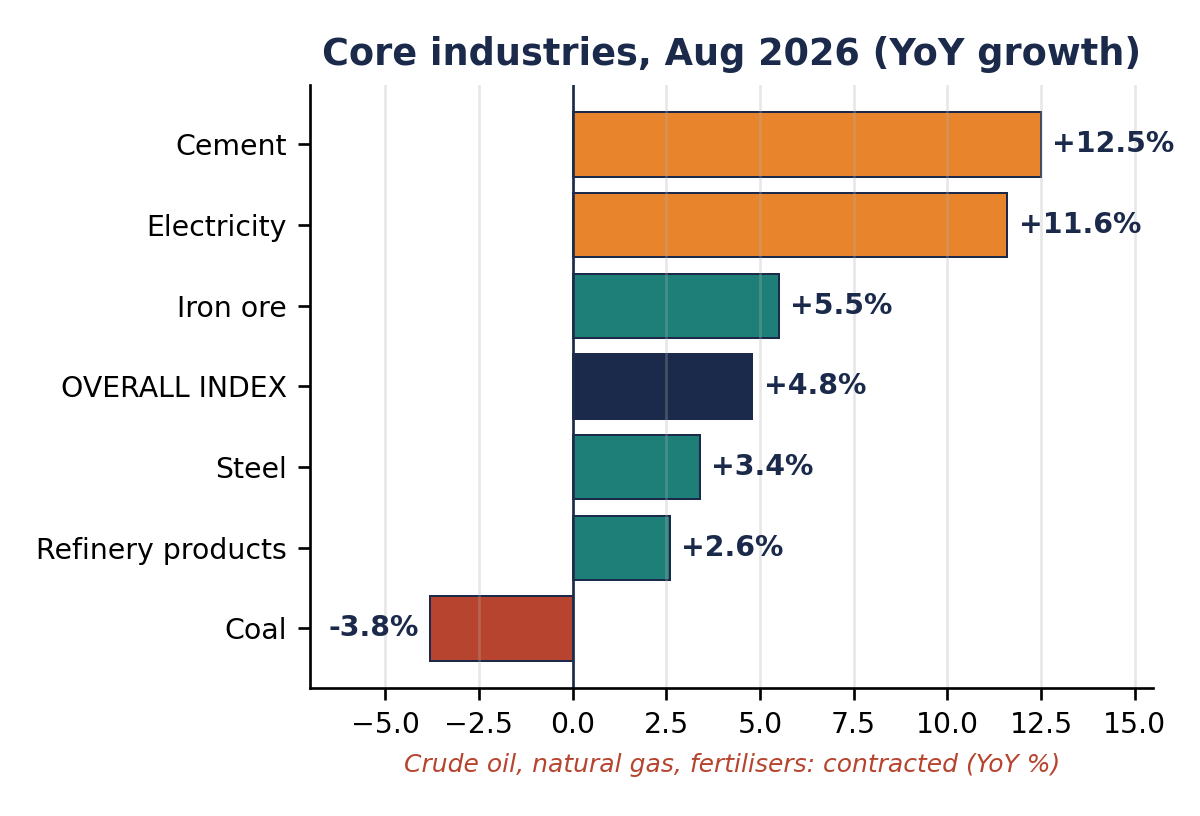
Official data released on 21 September 2026 show the Index of Eight Core Industries grew 4.8% in August 2026, easing from 5.0% in July — a three-month low.
Key facts
Cement +12.5% and electricity +11.6% (a 27-month high) led growth.
Iron ore +5.5%, steel +3.4%, refinery products +2.6%; coal −3.8%.
Crude oil, natural gas and fertilisers contracted year-on-year.
Cumulative April–August 2026: 4.3%, against 2.4% a year ago.
Way forward
Revive coal and hydrocarbon output and watch fertiliser production ahead of the rabi sowing season.
Concept
ICI is compiled by the Office of the Economic Adviser, DPIIT (Ministry of Commerce & Industry); the eight industries (coal, crude oil, natural gas, refinery products, fertilisers, steel, cement, electricity) are a leading indicator for the IIP, released by NSO (MoSPI).
Horizontal bar chart of year-on-year growth of core industries in August 2026: cement 12.5%, electricity 11.6%, iron ore 5.5%, overall index 4.8%, steel 3.4%, refinery products 2.6%, coal minus 3.8%. — StudyForGS
7. 11th Ayurveda Day on 23 September: 'Ayurveda for a Healthier Tomorrow'
HEALTHCOMMON: Prelims + Mains GS2
Syllabus linkage
GS-II: Health, government schemes. GS-I: Indian knowledge systems. Prelims: AYUSH systems, National Ayush Mission, WHO-GCTM, ICD-11 TM2.
Context
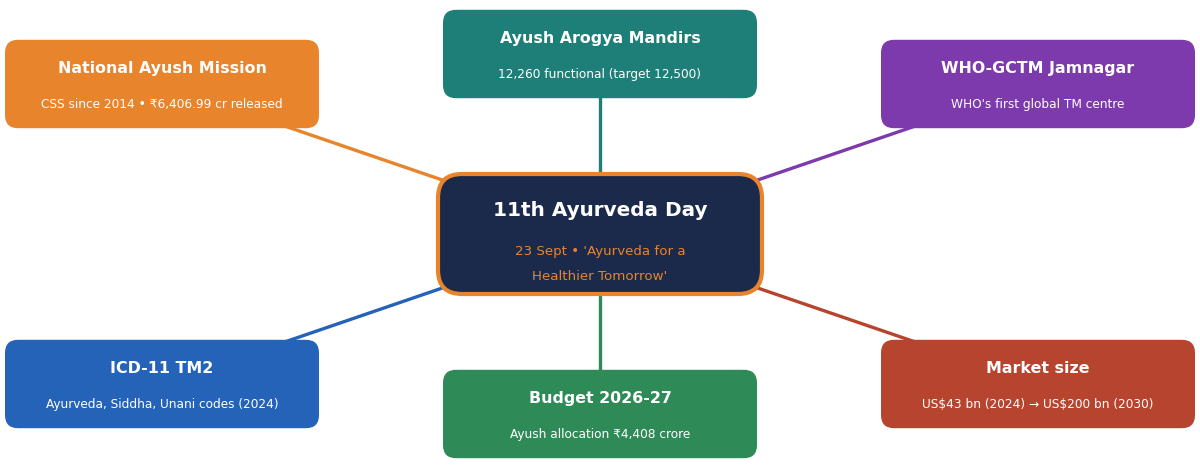
The Ministry of Ayush marks the 11th Ayurveda Day on 23 September 2026 with the theme 'Ayurveda for a Healthier Tomorrow' — 9,700+ activities across 30 States/UTs. Since a 23 March 2025 gazette, the Day falls on a fixed date instead of Dhanteras.
Key facts
National Ayush Mission (NAM): CSS since 2014; central releases ₹6,406.99 crore (2014-15 to 2025-26); funding 60:40, 90:10 for NE/Himalayan States.
ICD-11 TM2 module (launched in New Delhi, 10 January 2024) codes Ayurveda, Siddha and Unani diagnoses.
WHO-GCTM, Jamnagar — WHO's first global outposted traditional medicine centre; Budget 2026-27 Ayush allocation ₹4,408 crore.
Ayush market grew to US$43 billion (2024); target US$200 billion by 2030.
Way forward
Back integration with multi-centre clinical trials, pharmacovigilance and heavy-metal testing, and publish health-outcome data, not just counts.
Concept
Tridosha — Vata, Pitta, Kapha. Brihat Trayi — Charaka Samhita, Sushruta Samhita, Ashtanga Hridaya. Ministry of AYUSH formed November 2014; NCISM Act, 2020 regulates ISM education; ITRA Jamnagar is an Institute of National Importance.
Mind-map of India's Ayush ecosystem around Ayurveda Day 2026, with branches for National Ayush Mission, Ayush Arogya Mandirs, WHO-GCTM Jamnagar, ICD-11 TM2 coding, Budget 2026-27 and market size. — StudyForGS
8. UCC push: Uniform Civil Code targeted in all 21 NDA-ruled States by 2029
POLITYCOMMON: Prelims + Mains GS2
Syllabus linkage
GS-II: Constitution — DPSPs, secularism, federalism. GS-I: Women and society. Prelims: Art. 44, Art. 25, Goa Civil Code, Art. 254(2).
Context
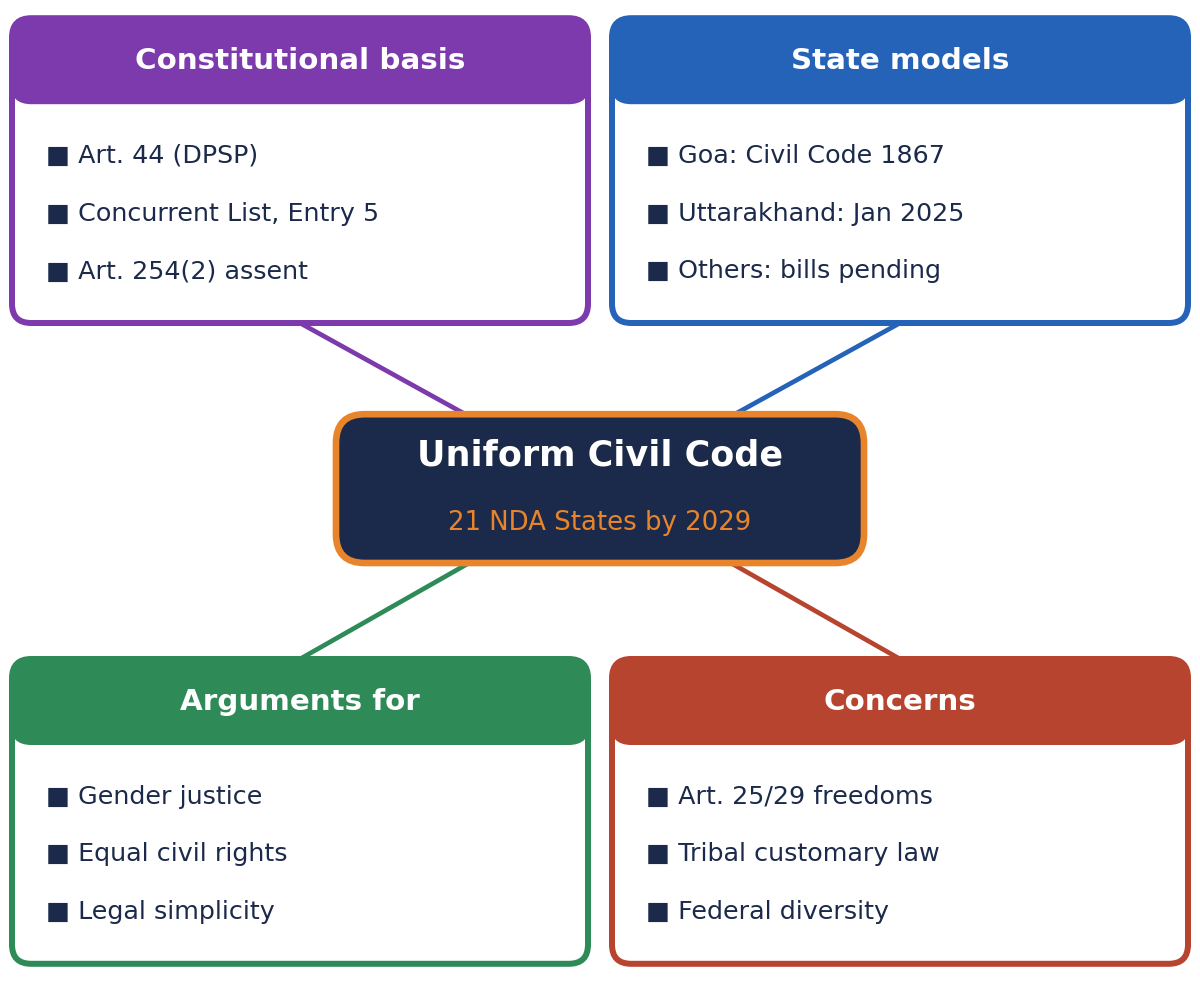
Union Home Minister Amit Shah said (13 September 2026) that a Uniform Civil Code will be introduced in all 21 BJP-NDA-ruled States before 2029; a month-long 'Seva Sankalp Abhiyan' (17 Sept–17 Oct) is publicising it.
Key facts
Uttarakhand became the first State after independence to operationalise a UCC (January 2025).
Goa already follows the Portuguese Civil Code, 1867 — a pre-existing uniform family law.
Personal-law bills of some States (e.g. Assam, Gujarat, Madhya Pradesh) are reported to be awaiting Presidential assent.
Tribal customary laws are generally kept outside State UCCs, citing Fifth/Sixth Schedule protections.
Key cases: Shah Bano (1985), Sarla Mudgal (1995), Shayara Bano (2017) — the Court flagged non-implementation of Art. 44.
Way forward
Wide consultation and a gender-just rather than merely uniform code; note the 21st Law Commission (2018) found a UCC 'neither necessary nor desirable' at that stage.
Concept
Article 44 (DPSP, Part IV): the State shall endeavour to secure a UCC. Marriage, divorce, succession fall in Concurrent List, Entry 5 — a State law repugnant to a central law needs Presidential assent under Art. 254(2).
Mind-map of the Uniform Civil Code debate: constitutional basis (Article 44, Concurrent List Entry 5, Article 254(2)), State models (Goa, Uttarakhand), arguments for and concerns against. — StudyForGS
9. India–Bhutan: ₹4,000 crore Line of Credit for energy; Punatsangchhu-II inaugurated
IRCOMMON: Prelims + Mains GS2
Syllabus linkage
GS-II: India and its neighbourhood. GS-III: Energy. Prelims: Bhutan hydro projects, Gelephu, cross-border rail links.
Context
During External Affairs Minister S. Jaishankar's visit to Bhutan (16–18 September 2026), both sides welcomed a concessional ₹4,000 crore Line of Credit for Bhutan's energy sector and launched several projects.
Key facts
Punatsangchhu-II (1,020 MW) inaugurated with its tariff protocol; dam work on Punatsangchhu-I (1,200 MW) resumed.
Connectivity: Gelephu–Kokrajhar and Samtse–Banarhat rail links; immigration check-post at Hatisar (Assam).
UPI payments enabled for Bhutanese nationals in India; ICCR scholarships doubled.
Also: a 65-bed mother-and-child hospital at Mongar and 54 electric vehicles handed over.
Way forward
Complete delayed hydro projects on time and link Gelephu Mindfulness City with India's North-East to anchor Bhutan's growth and counter China's outreach.
Concept
India–Bhutan Friendship Treaty (1949, revised 2007). Earlier India-backed hydro projects: Chukha, Kurichhu, Tala, Mangdechhu. Bhutan is among the largest recipients of Indian development assistance.
10. UN Gender Snapshot 2026: full gender equality still 171 years away
REPORTCOMMON: Prelims + Mains GS1/GS2
Syllabus linkage
GS-I: Women's issues. GS-II: International institutions; vulnerable sections. Prelims: SDG 5, UN Women, women's reservation.
Context
'Progress on the SDGs: The Gender Snapshot 2026' by UN Women and UN DESA, released on 17 September 2026 ahead of UNGA-81, warns of a rollback of institutions built for women's equality.
Key facts
1 in 3 gender-equality institutions lost power in two years; ~1 in 4 faced budget cuts.
At the current pace, full gender equality is 171 years away; no SDG-5 indicator is on track for 2030.
6 in 7 countries are led by men; women are only 6% of global corporate CEOs; 8 in 10 finance ministers are men.
India: women hold 74 of 543 Lok Sabha seats (13.6%); the 106th Amendment (2023) reserves one-third seats after delimitation.
Way forward
Protect gender budgeting and national women's machinery, operationalise women's reservation, and fund women's rights organisations.
Concept
SDG 5 = Gender Equality. UN Women created in 2010. India's Gender Budget Statement since 2005-06. Nari Shakti Vandan Adhiniyam = 106th CAA; inserted Articles 330A and 332A.
Data point of the day
4.8%
Core sector growth, August 2026 Down from 5.0% in July (three-month low); April–August 2026 cumulative 4.3% vs 2.4% a year ago.
Prelims rapid-fire
SLINEX-26 — 13th India–Sri Lanka naval exercise at Visakhapatnam (17–21 Sept) with INS Kavaratti, INS Jyoti and SLNS Sindurala.
UNGA-81 — EAM S. Jaishankar leads India's delegation; address to the General Debate on 26 September 2026.
Forex reserves — $780.782 bn (week ended 11 Sept), down $4.924 bn from the record $785.706 bn.
Oscars 2027 — Marathi thriller Gondhal (dir. Santosh Davakhar) is India's entry for Best International Feature.
Asian Wushu — India to host the 11th Asian Senior Wushu Championships in 2028, for the first time.
Tulu — Karnataka Cabinet (18 Sept) approved Tulu as an additional official language in Dakshina Kannada and Udupi.
Practice MCQs — UPSC Prelims pattern
Q1. With reference to the Index of Eight Core Industries (ICI), consider the following statements: 1. It is released by the Office of the Economic Adviser, DPIIT. 2. Fertilisers are one of the eight core industries. 3. Cement is not covered by the index. Which of the statements given above is/are correct?
1 only
1 and 2 only
2 and 3 only
1, 2 and 3
Show answer
Answer: B ICI is compiled by the Office of the Economic Adviser, DPIIT. Its eight industries are coal, crude oil, natural gas, refinery products, fertilisers, steel, cement and electricity — so cement is covered (it grew 12.5% in August 2026). Statement 3 is wrong.
Q2. Consider the following statements: 1. Ayurveda Day is now observed every year on 23 September. 2. The WHO Global Centre for Traditional Medicine is located at Jamnagar. 3. The ICD-11 Traditional Medicine Module 2 covers Ayurveda, Siddha and Unani. How many of the above statements are correct?
Only one
Only two
All three
None
Show answer
Answer: C A 23 March 2025 gazette fixed Ayurveda Day on 23 September; WHO-GCTM is at Jamnagar, Gujarat; ICD-11 TM2 (launched 10 January 2024, New Delhi) codes Ayurveda, Siddha and Unani. All three are correct.
Mains practice question
Q. "A Uniform Civil Code must aim at gender justice rather than mere uniformity." Examine in the light of recent State-level UCC initiatives. (15 marks, 250 words)