Monday, 21 September 2026 · IST · National & International · 11 items · 2 MCQs
Foreign portfolio investors have withdrawn ₹20,974 crore from Indian equities so far in September, taking 2026 outflows to ₹2.45 lakh crore as US rates and $100+ crude bite. The newly signed US Sanctioning Russia and Iran Act of 2026 allows tariffs of up to 100% on top buyers of Russian energy, a direct risk for India. At home, the Supreme Court asked the Law Commission to frame a uniform law on court deposits, while SIR Phase-3 deletions, the Tata Sons board dispute and Nepal's post-flood outreach round off the day.
Today at a glance — things to remember
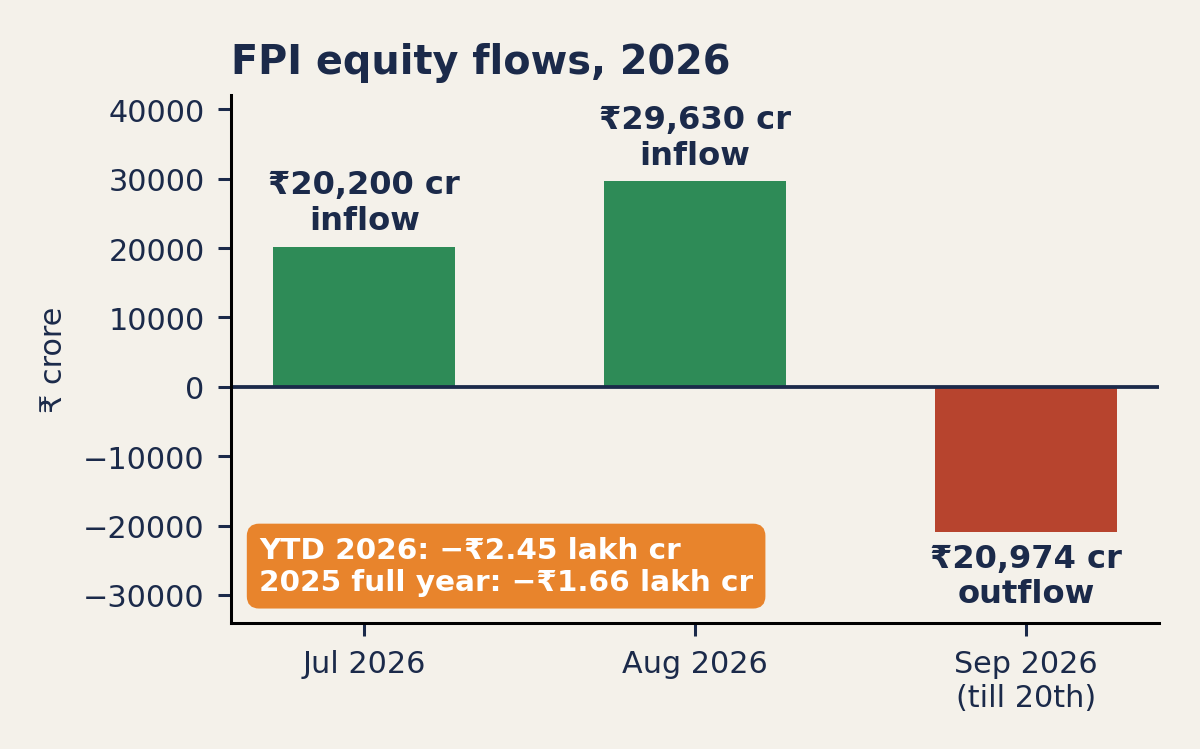
FPIs sold ₹20,974 cr of equities in Sept; 2026 YTD outflow ₹2.45 lakh cr (2025: ₹1.66 lakh cr).
CPI inflation rose to 4.82% in Aug (July 4.45%); food inflation 5.95%.
US Sanctioning Russia and Iran Act, 2026 signed on 18 Sept; tariffs up to 100% on top-5 buyers of Russian energy.
Russia still India's No.1 crude supplier in Aug at ~2.1 mbpd (>40% share).
SC (Narasimha–Aradhe bench): a court deposit is not payment; Law Commission to examine a uniform deposit law.
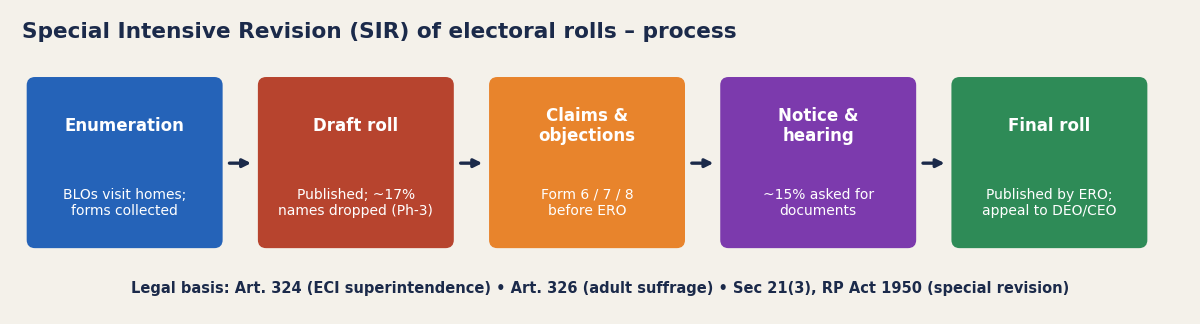
SIR Phase-3 (12 States + 2 UTs): about 17% names dropped from draft rolls; ~15% more served notices.
Tata Trusts (~66% of Tata Sons) call N. Chandrasekaran's reappointment void under Article 121 of AoA.
Nepal FM Swarnim Wagle in Delhi (17-19 Sept) seeks help after 26 Aug Bhote Koshi floods.
5 baby orangutans (CITES Appendix I) found in Balasore, Odisha; shifted to Nandankanan.
Anant Nag gets Dadasaheb Phalke Award at 72nd National Film Awards, Ekta Nagar (22 Sept).
Detailed notes
1. FPIs pull ₹20,974 crore from equities in September; 2026 outflow crosses ₹2.45 lakh crore
ECONOMYCOMMON: Prelims + Mains GS3
Syllabus linkage
GS3 – Indian economy, mobilisation of resources, external sector. Prelims: FPI vs FDI, FAR/VRR routes, rupee depreciation.
Context
After net inflows in July and August, foreign portfolio investors turned net sellers in September (data up to 20 Sept), reversing the brief recovery.
Key facts
Sept outflow ₹20,974 cr; July inflow ₹20,200 cr, Aug inflow ₹29,630 cr.
Debt also hit: FAR ₹10,296 cr, VRR ₹1,817 cr, general route ₹1,068 cr withdrawn.
Drivers: higher US rates/bond yields, Brent above $100/bbl (Hormuz tension), rupee at record lows.
Way forward
Deepen domestic institutional (DII/SIP) flows, keep macro-stability (fiscal discipline, forex buffers) and push FDI over volatile 'hot money'.
Concept
FPI = investment below 10% of a listed company's equity (regulated by SEBI); ≥10% is treated as FDI. VRR lets FPIs invest in debt if they retain a set share for a minimum period; FAR allows unlimited foreign holding in specified G-Secs.
Bar chart of FPI equity flows in 2026: July inflow ₹20,200 crore, August inflow ₹29,630 crore, September outflow ₹20,974 crore; with 2025 full-year outflow ₹1.66 lakh crore versus 2026 YTD ₹2.45 lakh crore. — StudyForGS
2. Rare-earth magnets: India's gap lies in the midstream, not in reserves
SCI-TECHCOMMON: Prelims + Mains GS3
Syllabus linkage
GS3 – Industrial policy, science & technology, critical minerals. Prelims: NdFeB magnets, monazite, National Critical Mineral Mission.
Context
Official industry data put India's magnet market at only about ₹750 crore, yet imports are several times larger – showing the statistical system cannot track where magnets enter the economy, as China's April 2025 export curbs keep supplies tight.
Key facts
Neodymium-Iron-Boron (NdFeB) magnets power EV motors, wind turbines, drones, electronics.
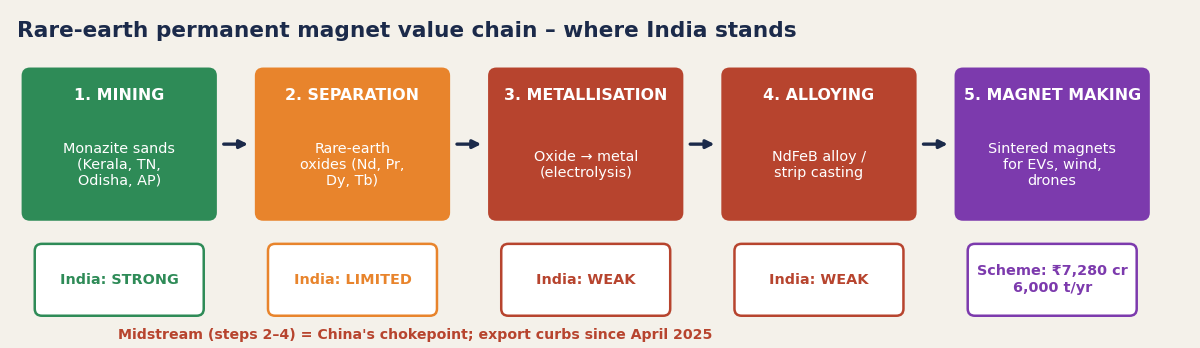
India has reserves in coastal monazite sands (Kerala, TN, Odisha, AP) – the weak link is separation, metallisation, alloying.
China dominates the midstream processing stage where global concentration is highest.
Proposal: an Integrated Techno-Economic Mapping (ITEM) framework linking engineering and economic data across the chain.
Way forward
Map the full value chain, fund midstream plants, secure offtake via PLI-type support and tie up with partners under Mineral Security Partnership/Quad.
Concept
Rare Earth Elements = 17 elements (15 lanthanides + scandium + yttrium). National Critical Mineral Mission launched in 2025; in Nov 2025 the Cabinet approved a ₹7,280 crore scheme for 6,000 tonnes/yr of sintered rare-earth permanent magnets. IREL handles monazite processing.
Flow diagram of the rare-earth magnet value chain in five stages – mining of monazite, separation into oxides, metallisation, alloying, and magnet making – with India's position strong at mining and weak in the midstream stages. — StudyForGS
3. Tata Trusts call Chandrasekaran's reappointment 'void' – a corporate governance test
ECONOMYCOMMON: Prelims + Mains GS3
Syllabus linkage
GS3 – Corporate governance, investment models. Prelims: Articles of Association, casting vote, Core Investment Company (CIC).
Context
The Tata Sons board on 17 Sept gave N. Chandrasekaran another 5-year term; on 20 Sept Tata Trusts said the resolution is void ab initio because their two nominee directors were split.
Key facts
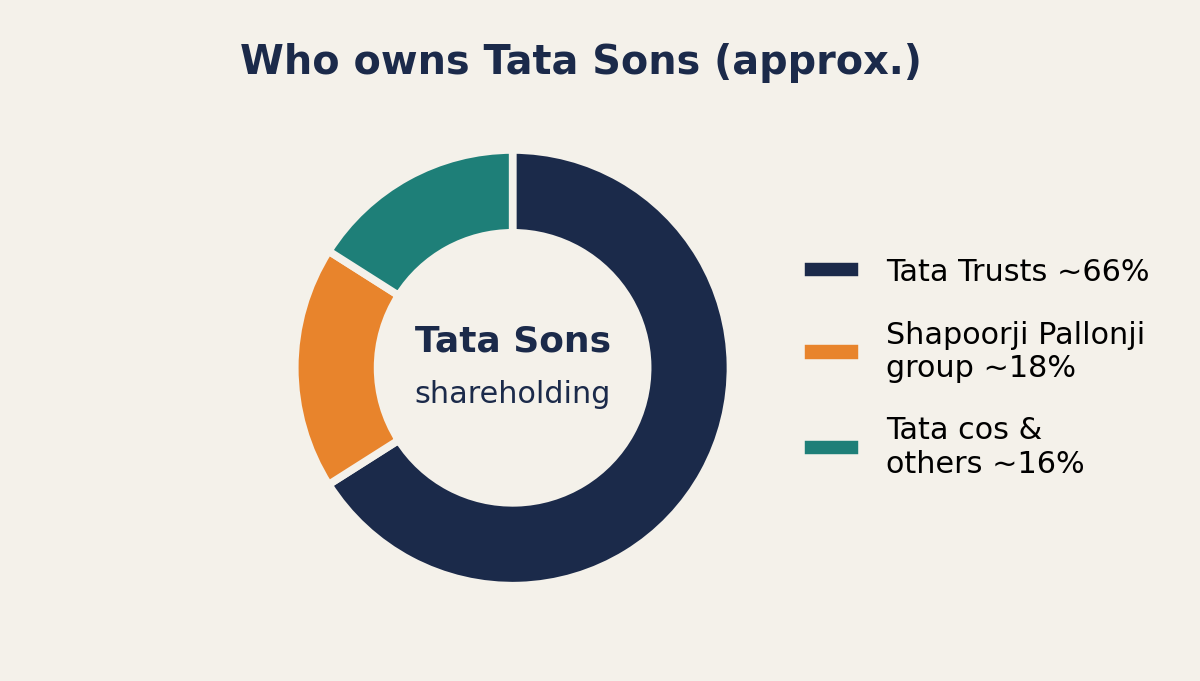
Trusts own about 66% of Tata Sons; Article 104B lets them nominate one-third of directors while holding ≥40%.
Article 121: key decisions need affirmative vote of a majority of Trust nominees.
Nominees split 1-1: Noel Tata against, Venu Srinivasan for; Trusts say a chairman's casting vote cannot fill this gap.
Linked row over a Tata Sons listing, which RBI's upper-layer NBFC rules for large CICs make mandatory.
Way forward
Resolve through the board/NCLT within the Companies Act, 2013 framework; clearer AoA drafting and independent directors reduce promoter–trust deadlocks.
Concept
Articles of Association = company's internal rulebook (Sec 5, Companies Act 2013). Casting vote = chair's extra vote only when votes are equal. RBI's Scale-Based Regulation puts large CICs in the upper layer, which must list within 3 years.
Donut chart of Tata Sons shareholding: Tata Trusts about 66 percent, Shapoorji Pallonji group about 18 percent, Tata group companies and others about 16 percent. — StudyForGS
4. Five baby orangutans found in Odisha expose urban wildlife-trafficking networks
Five orangutans aged 1-2 years were found on 8 Sept in a casuarina forest in Bhograi block, Balasore, about 2,000 km from their native range; they are under quarantine at Nandankanan Zoological Park.
Key facts
Probe by Odisha Forest Dept and Wildlife Crime Control Bureau (WCCB) into illegal import.
All 3 orangutan species are Critically Endangered (IUCN) and in CITES Appendix I.
Black-market price up to ₹20 lakh per animal; 2 baby orangutans were seized on the Assam-Mizoram border in 2022.
Studies show urban demand hubs, not only source forests, reshape trafficking routes; India's key route is the India-Myanmar border.
Way forward
Enforce the Living Animal Species (Reporting & Registration) Rules for exotic pets, strengthen border/port screening and intelligence sharing via SAWEN/Interpol.
Concept
CITES (1973; India party since 1976): Appendix I = trade banned except in exceptional cases; II = regulated trade; III = listed at a country's request. Wild Life (Protection) Amendment Act, 2022 added Schedule IV for CITES species. WCCB set up in 2007.
5. US Sanctioning Russia and Iran Act signed – up to 100% tariffs threaten India's oil diplomacy
IRCOMMON: Prelims + Mains GS2 & GS3
Syllabus linkage
GS2 – Effect of policies of developed countries on India's interests; GS3 – Energy security. Prelims: secondary sanctions, CAATSA, Strait of Hormuz.
Context
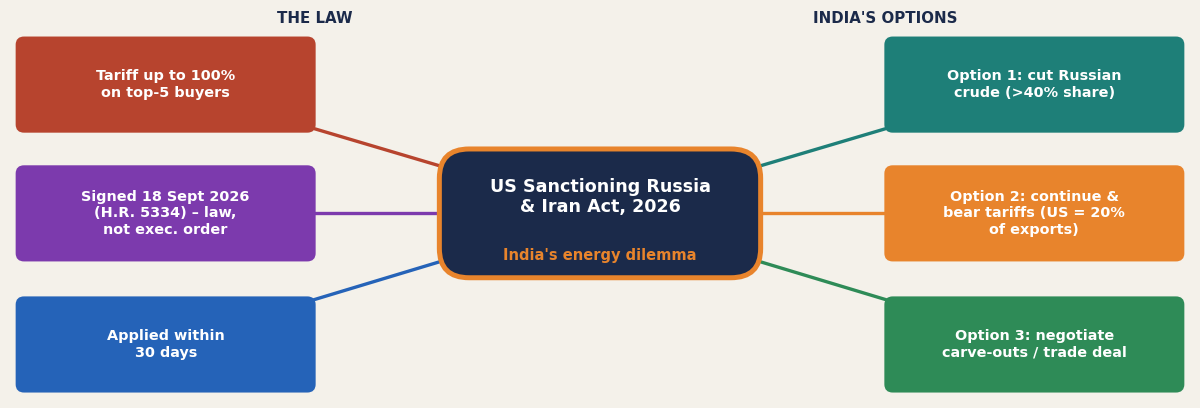
The US President signed the Sanctioning Russia and Iran Act of 2026 (H.R. 5334) on 18 Sept. Being a law of Congress, it is more durable than the earlier 50% tariffs imposed by executive order.
Key facts
Allows duties of up to 100% on goods from the top-5 buyers of Russian crude or gas; to be applied within 30 days.
Russia supplied ~2.1 mbpd to India in Aug 2026 (down from 2.6 mbpd in June-July) – still >40% of imports.
US takes about 20% of India's goods exports; MSME exporters most exposed.
India's stance: will keep importing from commercially viable sources.
Way forward
Diversify crude basket (UAE, Saudi, Venezuela, Africa), build SPR capacity, negotiate carve-outs in the India-US trade deal and cushion MSMEs.
Concept
Secondary sanctions penalise third countries dealing with a sanctioned state. Strategic autonomy = India's policy of issue-based alignment. India's Strategic Petroleum Reserves (ISPRL): Visakhapatnam, Mangaluru, Padur – 5.33 MMT.
Mind-map of the US Sanctioning Russia and Iran Act 2026 and India: the law in the centre with branches for tariff up to 100 percent, Russian oil share above 40 percent, US as 20 percent export market, and India's three options – cut Russian imports, continue and bear tariffs, or negotiate. — StudyForGS
6. SC: a court deposit is not payment – asks Law Commission to frame a uniform deposit law
POLITYCOMMON: Prelims + Mains GS2
Syllabus linkage
GS2 – Judiciary, judicial reforms, arbitration. Prelims: Order XXI Rule 1 CPC, Law Commission (non-statutory), Sec 36 Arbitration Act.
Context
In National Seeds Corporation v. National Agro Seed Corporation (18 Sept), a bench of Justices P.S. Narasimha and Alok Aradhe held that depositing an arbitral award amount in court does not stop interest unless the award-holder can withdraw it unconditionally.
Key facts
Interest liability ceases only on payment per Order XXI Rule 1, CPC.
Found wide inconsistency across courts in deposit %, banks, instruments and interest accounting.
Recommended a statutory framework; copy sent to Law Commission, RBI Governor, Finance & Law Secretaries.
Model cited: US Court Registry Investment System – a pooled, unified investment platform.
Way forward
A single court-deposit law with a pooled, transparent investment window would protect the time value of money and cut satellite litigation on interest.
Concept
Law Commission = executive body set up by govt order for 3-year terms (1st post-independence in 1955, chair M.C. Setalvad). Sec 36(2)-(3), Arbitration & Conciliation Act, 1996: stay of award may be conditional on deposit.
7. SIR Phase-3: about 17% names dropped from draft rolls in 12 States and 2 UTs
POLITYCOMMON: Prelims + Mains GS2
Syllabus linkage
GS2 – Elections, ECI, Representation of People Acts. Prelims: Article 324, 326, Sec 21 RP Act 1950, BLO.
Context
Draft rolls after the third phase of the Special Intensive Revision show deletions of about 17%, with another ~15% of electors served notices for documents; the Opposition alleges exclusion, the ECI says it is cleaning rolls for the first time in 22 years.
Key facts
Phase-3 covers 12 States + 2 UTs; earlier two phases removed about 13% of names.
Reasons cited by ECI: deaths, shifted, duplicate, untraceable electors.
Excluded persons can file Form 6 / claims before the ERO during the claims-and-objections window.
Way forward
Ensure due process – door-to-door verification, accessible documents list, and a presumption of inclusion for long-time electors to protect universal adult franchise.
Concept
Art 324 – ECI's superintendence of rolls; Art 326 – adult suffrage (18 yrs, 61st Amendment 1988). Sec 21(3), RP Act 1950 empowers ECI to order a special revision of rolls. Roll is prepared by the ERO.
Flowchart of the Special Intensive Revision process: enumeration by BLOs, publication of draft roll, claims and objections, notices and hearing by ERO, and publication of final roll, with constitutional basis Articles 324 and 326. — StudyForGS
8. Nepal's Finance Minister in Delhi seeks help for post-flood reconstruction
IRCOMMON: Prelims + Mains GS2
Syllabus linkage
GS2 – India and its neighbourhood. Prelims: Bhote Koshi / Sun Koshi, 1950 Treaty, Neighbourhood First.
Context
Swarnim Wagle made Nepal's first high-level visit (17-19 Sept) after the 26 August Bhote Koshi floods, meeting Nirmala Sitharaman and S. Jaishankar on reconstruction and economic cooperation.
Key facts
Floods killed 1,388 people; property loss ~$4.75 bn across three districts.
Reconstruction estimated at $4.7-5 bn over 3-5 years.
After the 2015 earthquake, India gave a $250 mn grant + $750 mn LoC.
Pending: revision of the 2009 Trade Treaty, overflight/air-entry routes for Pokhara & Bhairahawa airports.
Way forward
Offer grant-heavy aid, fast-track hydropower and connectivity projects and settle the air-route issue to build trust under Neighbourhood First.
Concept
India-Nepal Treaty of Peace and Friendship, 1950 allows open border and national treatment. Kosi Treaty (1954), Gandak (1959), Mahakali Treaty (1996) govern shared rivers. Bhote Koshi flows into the Sun Koshi, a Kosi tributary.
9. Tamil Nadu launches a salt-reduction strategy to curb hypertension
HEALTHCOMMON: Prelims + Mains GS2
Syllabus linkage
GS2 – Health, NCDs, public policy. Prelims: WHO salt limit (below 5 g/day), hypertension, low-sodium salt.
Context
Tamil Nadu plans urine-sample surveys, gradual salt cuts in public kitchens and a low-sodium salt study, making salt reduction a frontline tool against hypertension.
Key facts
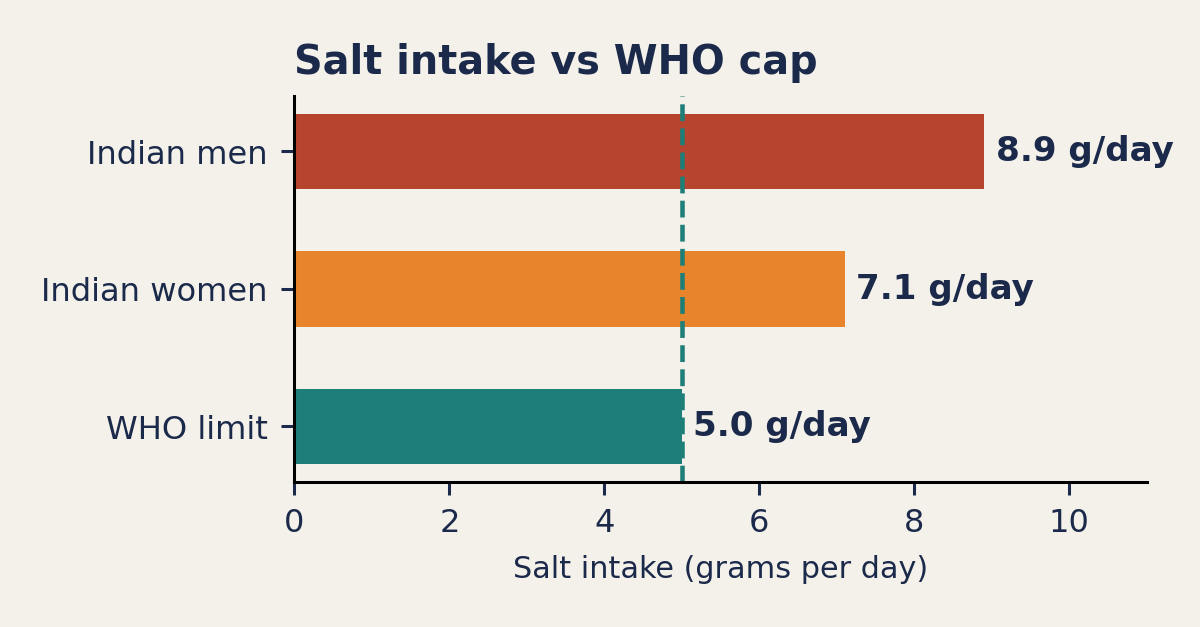
Average Indian intake: 8.9 g/day (men), 7.1 g/day (women) vs WHO cap of 5 g.
Excess sodium → water retention → higher blood volume → raised arterial pressure (the 'silent killer').
Four levers: measurement, reformulation, awareness, screening with doorstep drug delivery.
Way forward
Scale up nationally with front-of-pack labelling, sodium targets for packaged foods and linking with NP-NCD screening.
Concept
WHO global target: 30% relative cut in mean salt intake by 2025 (world off-track). TN's Makkalai Thedi Maruthuvam (2021) delivers NCD drugs at home. Hypertension = BP ≥140/90 mmHg.
Bar chart comparing daily salt intake: Indian men 8.9 grams, Indian women 7.1 grams, against the WHO recommended maximum of 5 grams. — StudyForGS
10. Community cadres: 30 lakh+ village workers powering last-mile delivery
SOCIETYCOMMON: Prelims + Mains GS2
Syllabus linkage
GS2 – Welfare schemes, SHGs, role of civil society. Prelims: DAY-NRLM, Krishi Sakhi, ASHA, SVEP.
Context
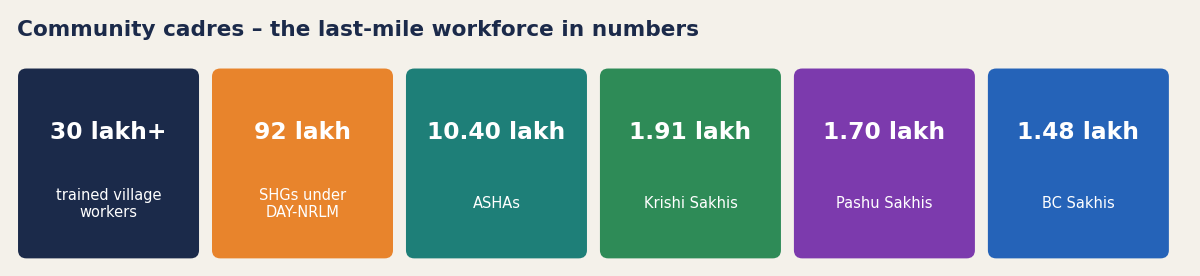
An official explainer (20-21 Sept) highlights over 30 lakh trained village-level workers – from Krishi Sakhis to ASHAs – as the backbone of rural service delivery.
Key facts
9 lakh+ Community Resource Persons; 92 lakh SHGs under DAY-NRLM cover 10 crore+ households.
₹13.41 lakh crore bank credit to SHGs since 2013-14; 4.32 lakh enterprises under SVEP.
Concern: paid by honoraria/incentives; 45th Indian Labour Conference (2013) call for minimum wages largely unmet.
Way forward
Recognise cadres as skilled workers with fixed pay, social security under the Labour Codes, and curb mission creep from multiple departments.
Concept
Lineage: Kudumbashree (Kerala, 1998), SERP/Velugu (AP) → SGSY (1999) → NRLM (2011) → DAY-NRLM. ASHA began with NRHM (2005); Anganwadi with ICDS (1975).
Stat-tile row of community cadre numbers: 30 lakh plus trained village workers, 10.40 lakh ASHAs, 1.91 lakh Krishi Sakhis, 1.70 lakh Pashu Sakhis, 1.48 lakh BC Sakhis, and 92 lakh SHGs. — StudyForGS
11. 72nd National Film Awards at Ekta Nagar; Anant Nag gets Dadasaheb Phalke Award
SOCIETYCOMMON: Prelims + Mains GS1
Syllabus linkage
GS1 – Art & culture, Indian cinema. Prelims: Swarna Kamal/Rajat Kamal, Phalke Award (1969), first recipient Devika Rani.
Context
The awards for films certified in 2024 will be presented on 22 Sept at Ekta Nagar, Gujarat – the first time the ceremony moves out of Delhi.
Key facts
Dadasaheb Phalke Award 2024: Anant Nag – 300+ films in six languages; debut in Ankur (Hindi); known for Malgudi Days.
Best Feature Film: Article 370; Best Actor shared by Mammootty and Kartik Aaryan.
Ravi Raj Murmu's Angen – first Santhali film honoured (Best Debut, Non-Feature).
Prize money: Swarna Kamal ₹3 lakh, Rajat Kamal ₹2 lakh; presented by the President.
Way forward
Rotate venues across States, cut the certification-to-award lag and keep jury selection transparent to protect credibility.
Concept
National Film Awards instituted in 1954 (first for 1953 films) on the Film Enquiry Committee (1949); run by Ministry of I&B. Raja Harishchandra (1913) – first Indian feature film by Dadasaheb Phalke.
Data point of the day
4.82%
CPI (retail) inflation, August 2026 Up from 4.45% in July; food inflation 5.95% (rural 6.13%, urban 5.64%). Above RBI's 4% target but inside the 2-6% band; repo rate at 5.25% means the real policy rate is near zero.
Prelims rapid-fire
Dadasaheb Phalke Award instituted: 1969; first recipient Devika Rani
CITES Appendix I: Species threatened with extinction – commercial trade banned
FPI vs FDI threshold: 10% of equity of a listed company
Rare-earth elements: 17 = 15 lanthanides + Sc + Y
Article 326: Elections on basis of adult suffrage (18 yrs)
WHO daily salt limit: Less than 5 g (about 1 teaspoon)
Practice MCQs — UPSC Prelims pattern
Q1. With reference to foreign investment in India, consider the following statements:
1. An investment of less than 10% of the post-issue paid-up equity of a listed Indian company is treated as Foreign Portfolio Investment.
2. The Voluntary Retention Route (VRR) is meant for FPI investment in equity shares only.
3. Under the Fully Accessible Route (FAR), non-residents can invest in specified government securities without investment limits.
Which of the statements given above are correct?
1 and 2 only
2 and 3 only
1 and 3 only
1, 2 and 3
Show answer
Answer: C Statement 1 is correct – below 10% is FPI. Statement 2 is wrong – VRR is for debt investment. Statement 3 is correct – FAR (2020) removes limits on specified G-Secs.
Q2. Consider the following pairs:
1. Orangutan – Native to Borneo and Sumatra
2. CITES Appendix I – Trade permitted without any permits
3. Wildlife Crime Control Bureau – Statutory body under the Wild Life (Protection) Act, 1972
How many of the pairs given above are correctly matched?
Only one
Only two
All three
None
Show answer
Answer: B Pair 1 is correct. Pair 2 is wrong – Appendix I bans commercial trade and needs both export and import permits for exceptional trade. Pair 3 is correct – WCCB was set up in 2007 under the WPA, 1972.
Mains practice question
Q. Unilateral secondary sanctions by major powers are testing India's 'strategic autonomy' in energy security. Critically examine India's options in the light of the US Sanctioning Russia and Iran Act, 2026. (15 marks, 250 words)
Hint / approach
Intro: law signed 18 Sept, tariffs up to 100%. Body: dependence on Russian crude (>40%), US as 20% export market, MSME risk; options – diversify, negotiate, SPR, rupee trade; WTO angle. Conclude: multi-alignment with calibrated hedging.
📌 One-line revision: ₹20,974 cr FPI exit | CPI 4.82% | US sanctions law, tariffs up to 100% | SC: deposit ≠ payment | SIR-3 ~17% deletions | Tata Art. 121 | Phalke: Anant Nag