Wednesday, 25 November 2026 · IST · Uttar Pradesh + National · 9 items · 2 MCQs
Today's UP news is led by land purchase for expanding the Defence Industrial Corridor to Sambhal and Shahjahanpur and the winter speed cap on the Yamuna Expressway. Because today's UP coverage is thin, this edition adds this week's key UP decisions — the Ayodhya–Janakpur train, the panchayat ordinance and the 18 Nov cabinet — plus two national items (RBI digital-payment safeguards, World Landslide Forum).
Today at a glance — things to remember
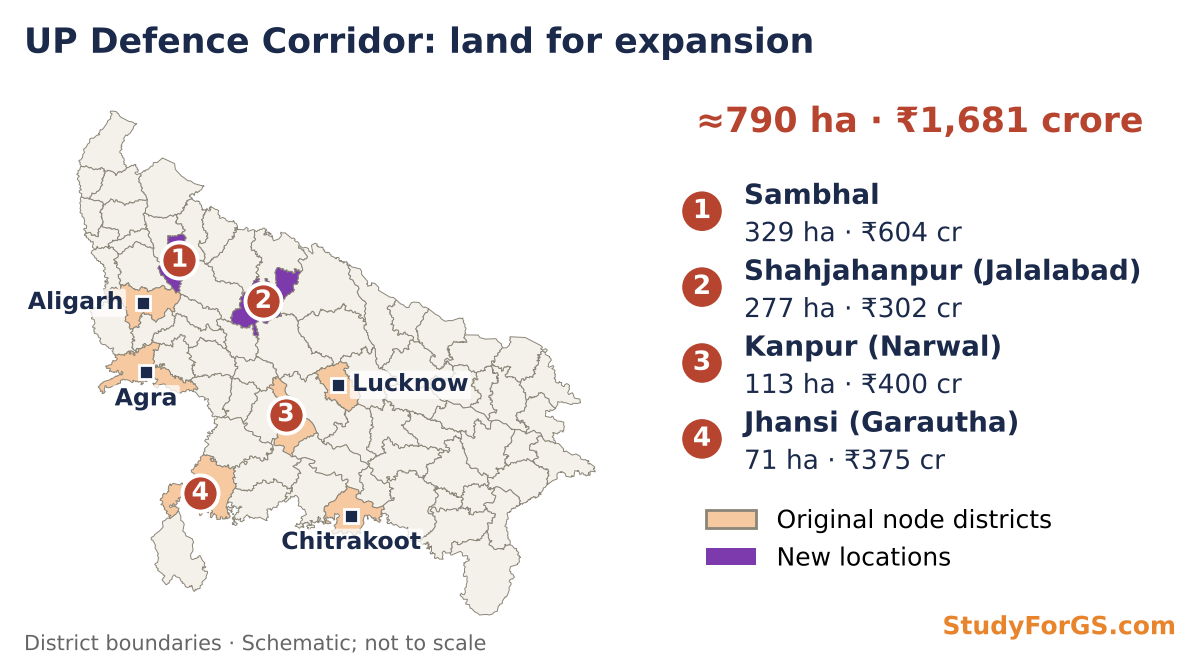
UP Defence Corridor: ≈790 ha at Kanpur, Jhansi, Shahjahanpur and Sambhal for ₹1,681 crore
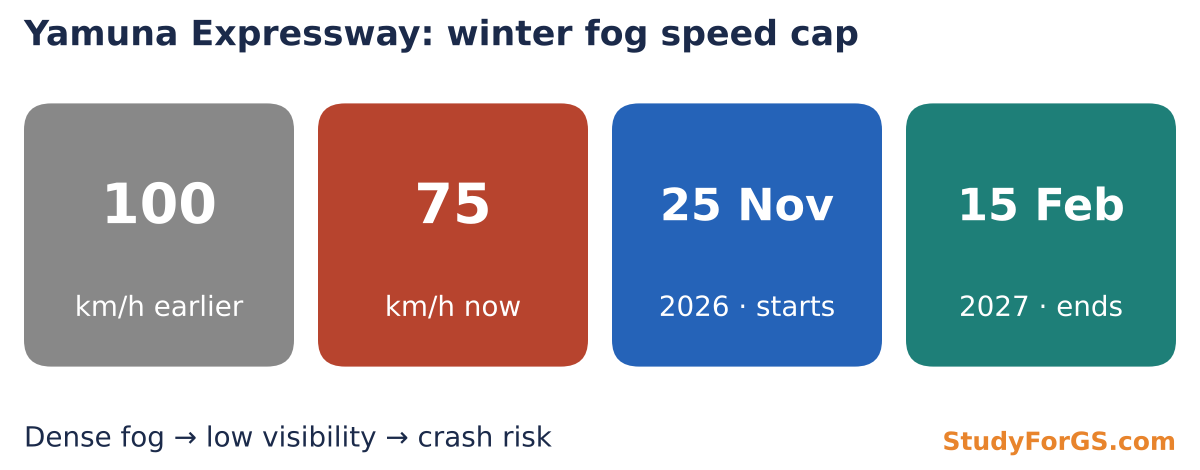
Yamuna Expressway: max speed 75 km/h from 25 Nov 2026 to 15 Feb 2027
GS-III: Defence production, industrial corridors, land acquisition · GS-VI: UP industrial development
Context
Reported today (25 Nov 2026): the state will buy about 790 hectares at a cost of ₹1,681 crore to expand the UP Defence Industrial Corridor, as defence companies seek more land.
Key facts
Kanpur (Narwal): 113 ha, ₹400 crore · Jhansi (Garautha tehsil): 71 ha, ₹375 crore
Shahjahanpur (Jalalabad): 277 ha, ₹302 crore · Sambhal: 329 ha, ₹604 crore (largest share)
The UPEIDA board has agreed to ₹775 crore for the Kanpur and Jhansi proposals
New land is meant for units making defence equipment, missiles, ammunition, aerospace products and defence electronics; Sambhal has proposals from more than 12 companies
Way forward
Extends defence manufacturing beyond the six original nodes into Rohilkhand (Sambhal, Shahjahanpur) — supports Atmanirbhar Bharat in defence and more balanced regional industrialisation in UP.
Concept
The UP Defence Industrial Corridor was announced in the Union Budget 2018-19 (along with one in Tamil Nadu); its six nodes are Lucknow, Kanpur, Jhansi, Agra, Aligarh and Chitrakoot; nodal agency: UPEIDA.
Map of Uttar Pradesh districts highlighting the six Defence Corridor node districts and marking four land-purchase sites: Kanpur (Narwal), Jhansi (Garautha), Shahjahanpur (Jalalabad) and Sambhal, with area and cost. — StudyForGS
2. Fog season: Yamuna Expressway speed cap cut to 75 km/h from today
GS-II: Governance & public safety · GS-III: Infrastructure, disaster management (fog as a hazard)
Context
To cut fog-related crashes, the maximum speed on the Yamuna Expressway has been lowered for the winter, effective today.
Key facts
Maximum speed reduced from 100 km/h to 75 km/h
Period: 25 November 2026 to 15 February 2027
Concessionaire JP Infratech Ltd told to put extra safety measures in place and submit a compliance report
Reason: dense fog cuts visibility, especially early morning and at night; other UP expressways also run winter speed caps with a road-safety awareness drive
Way forward
Fog is a recurring winter hazard on the Indo-Gangetic plain; seasonal speed caps plus enforcement are low-cost tools to save lives on high-speed corridors.
Concept
Yamuna Expressway (about 165 km) links Greater Noida and Agra; it opened in 2012 and is overseen by the Yamuna Expressway Industrial Development Authority (YEIDA).
Four stat tiles: earlier maximum 100 km/h, new maximum 75 km/h, cap starts 25 Nov 2026, cap ends 15 Feb 2027. — StudyForGS
GS-II: India and its neighbourhood · GS-I/GS-VI: Religious tourism, UP's border with Nepal
Context
On 23 Nov 2026, PM Modi and Nepal PM Balendra Shah virtually flagged off a weekly train between Ayodhya and Janakpur during Shah's visit to New Delhi.
Key facts
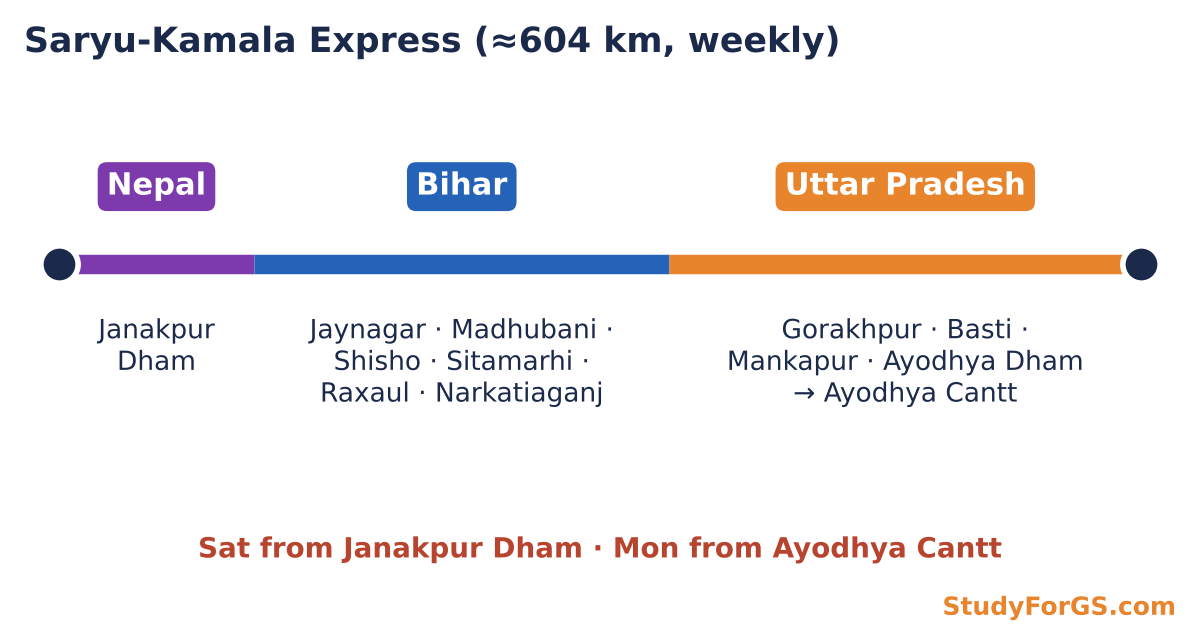
Saryu-Kamala Express: Janakpur Dham (Nepal) ⇄ Ayodhya Cantt, about 604 km, weekly (Saturday from Janakpur Dham, Monday from Ayodhya Cantt)
UP stops: Gorakhpur, Basti, Mankapur, Ayodhya Dham; Bihar stops include Jaynagar, Sitamarhi, Raxaul, Narkatiaganj
Package of ₹15,000 crore (NPR 24,000 crore): ₹3,500 crore grant + ₹11,500 crore line of credit
Foundation stone of 669 MW Lower Arun hydro project; transit access via Kandla, and Paradip once infrastructure is ready
Both sides to explore similar links for Buddhist and Shiv-Shakti religious-tourism circuits
Way forward
Puts Ayodhya at the centre of a Ramayana circuit across the border — boosts pilgrimage tourism in eastern UP (Gorakhpur–Basti belt) and people-to-people ties with Nepal.
Concept
Janakpur (Madhesh Province, Nepal) is revered as the birthplace of Sita. UP shares the Nepal border along 7 districts: Pilibhit, Lakhimpur Kheri, Bahraich, Shravasti, Balrampur, Siddharthnagar and Maharajganj.
Route schematic of the Saryu-Kamala Express from Janakpur Dham in Nepal through Bihar stops to Gorakhpur, Basti, Mankapur, Ayodhya Dham and Ayodhya Cantt in Uttar Pradesh. — StudyForGS
4. Panchayat polls deferred: ordinance extends gram panchayat administrators by six months
GS-II: Panchayati Raj, ordinance power of Governor · GS-V: UP Panchayati Raj system
Context
This week (cabinet of 18 Nov 2026): with the administrators' term due to end on 26 Nov 2026, the state cleared an ordinance to keep them in office.
Key facts
UP Panchayati Raj (Amendment) Ordinance, 2026 under Article 213; amends Section 12 of the UP Panchayat Raj Act, 1947
Administrators (former gram pradhans) stay for six months or until the UP State Local Rural Bodies Dedicated Backward Classes Commission reports — whichever is earlier
Reason given: the OBC reservation process is incomplete
The Allahabad High Court had earlier directed the state to hold the elections within three months
Way forward
Tests the balance between the constitutional five-year term of panchayats and the Supreme Court's 'triple test' for OBC quotas; prolonged administrator rule weakens grassroots democracy.
Concept
Article 243E: a panchayat's term is five years and elections must be completed before it ends; Article 243K: State Election Commission conducts panchayat polls; Article 213: Governor's ordinance power when the legislature is not in session.
5. UP Cabinet: ₹281.03 crore Deep Tech U-Hub at IIT Kanpur's Noida campus, cooperative college and policy amendments
GS-III: Innovation ecosystem, cooperatives, renewable energy, tourism · GS-VI: UP economy and state policies
Context
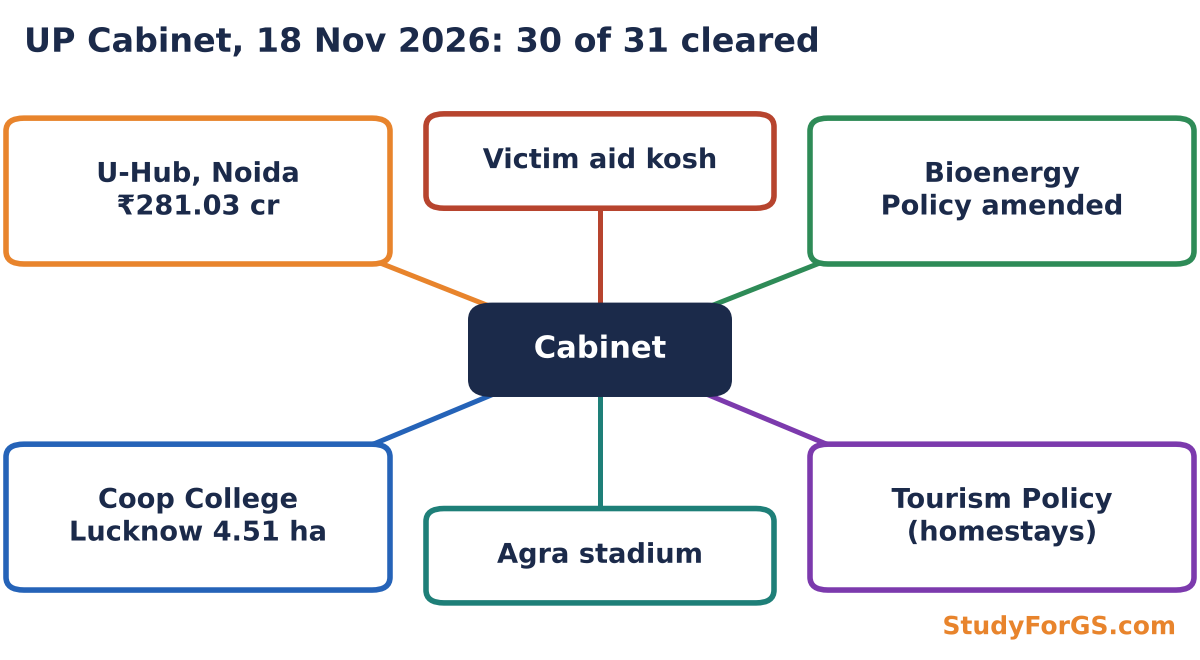
This week (18 Nov 2026): the cabinet chaired by CM Yogi Adityanath approved 30 of 31 proposals.
Key facts
Deep Tech U-Hub building at IIT Kanpur's Noida campus: ₹281.03 crore, EPC mode, 24 months; ₹100 crore for 2026-27; no central share; to run as a Section 8 company
State Cooperative College, Lucknow: 4.51 ha at Rahman Khera given free; to be affiliated with Tribhuvan Sahkari University (Gujarat)
Rani Lakshmibai Mahila Evam Bal Samman Kosh rules revised to align victim compensation with the NALSA 2018 scheme
Bioenergy Policy-2022 and Tourism Policy-2022 amended — tourism change backs homestays, farm stays and B&B units
Agra: 2.476 ha in Uganpura (Bah) moved free to the Sports Department for a stadium
Way forward
Combines a deep-tech innovation base in NCR with cooperative skilling and rural tourism — a mix aimed at UP's goal of a much larger state economy.
Concept
A Section 8 company (Companies Act, 2013) is a not-for-profit company that uses its income only to promote its objects (science, education, charity etc.). Tribhuvan Sahkari University at Anand is India's first national cooperative university.
Mind-map of UP Cabinet decisions of 18 Nov 2026: Deep Tech U-Hub, Rani Lakshmibai Kosh rules, Bioenergy Policy amendment, State Cooperative College, Agra stadium land, Tourism Policy amendment. — StudyForGS
6. Modified UDAN: UP signs on to 80:20 viability-gap funding with Centre and AAI
GS-III: Infrastructure (airports), centre–state cooperation · GS-VI: UP connectivity
Context
Also cleared by the 18 Nov 2026 cabinet: a tripartite MoU between the Centre, Uttar Pradesh and the Airports Authority of India for the Modified Regional Connectivity Scheme.
Key facts
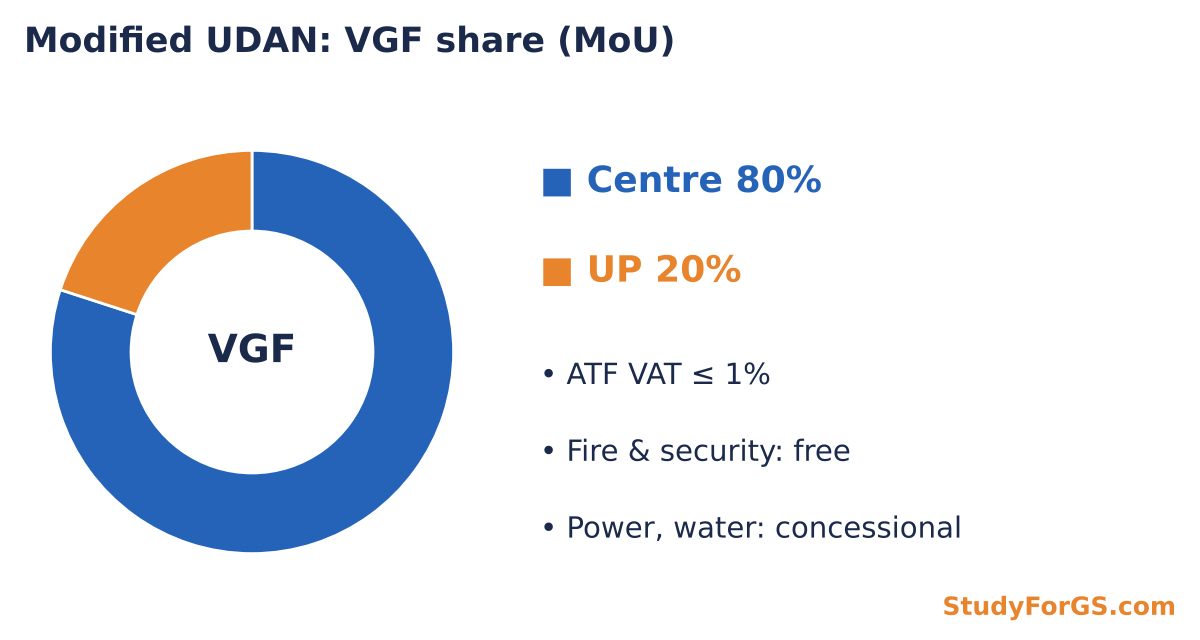
Viability Gap Funding (VGF): Centre 80%, state 20%
State to cut VAT on ATF at regional connectivity airports to 1% or below
Fire-fighting and security services free; electricity, water and utilities at concessional rates
State to facilitate land and connectivity infrastructure; Director, Civil Aviation, UP authorised to sign
Way forward
Cheaper fuel and lower operating costs make small-city routes viable — important for UP, which has many smaller airports under regional connectivity.
Concept
UDAN (Ude Desh ka Aam Nagrik) is the Regional Connectivity Scheme of the Ministry of Civil Aviation, launched in 2016; AAI is its implementing agency; VGF bridges the gap between airline cost and capped fares.
Donut chart of the VGF share under Modified UDAN — Centre 80 percent, Uttar Pradesh 20 percent — with the state's support measures listed. — StudyForGS
7. 35 solar plants in 25 districts for food processing units; 18 projects worth about ₹1,000 crore cleared
GS-III: Food processing industry, solar energy, MSMEs · GS-VI: UP agriculture-linked industry
Context
This week (17-18 Nov 2026): the Horticulture and Food Processing department approved solar plants for processing units along with new investment projects.
Key facts
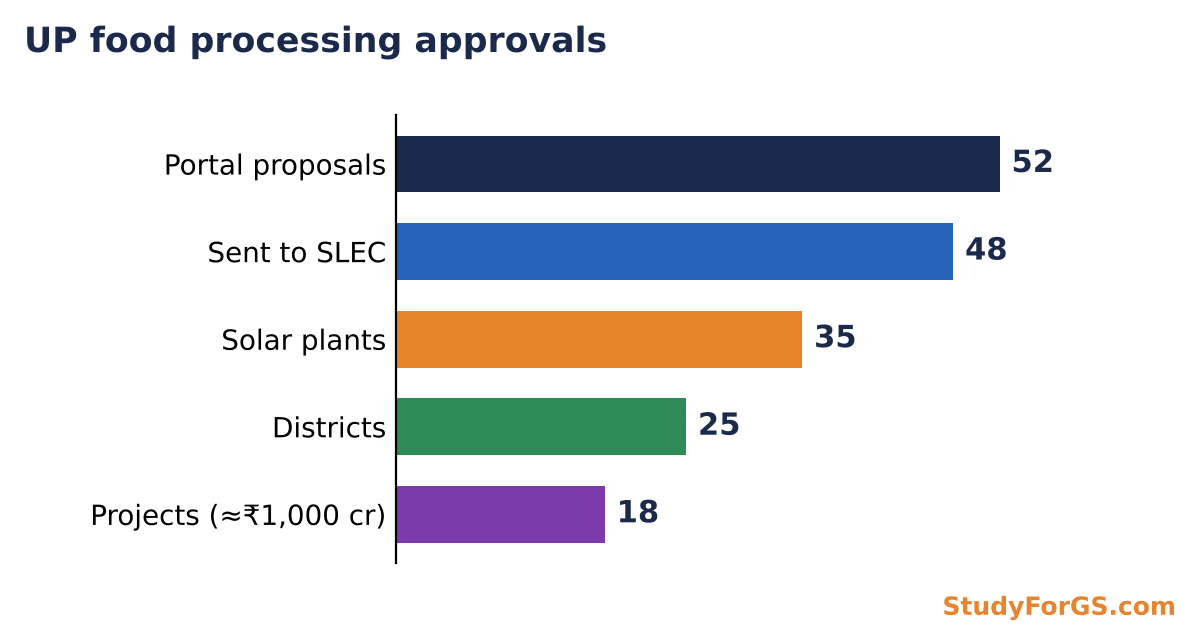
35 solar plants for food processing units across 25 districts
18 investment projects worth about ₹1,000 crore to move ahead
52 new proposals on the online portal by 16 Nov; 48 recommended to the State Level Empowered Committee (SLEC)
Units include bakery, biscuits, flour, spices, dairy and namkeen; districts include Kanpur Nagar, Bareilly, Pilibhit, Prayagraj, Varanasi, Shahjahanpur and Fatehpur
Way forward
Solar power lowers energy costs for small processors, adds value to farm produce near the farm gate and creates rural jobs.
Concept
Food processing links agriculture and industry: it reduces post-harvest losses and raises farm incomes; UP is India's largest producer of milk, sugarcane and potatoes.
Bar chart: 52 proposals on the portal, 48 sent to SLEC, 35 solar plants, 25 districts covered, 18 investment projects worth about ₹1,000 crore. — StudyForGS
8. RBI draft safeguards: 'Stop Switch' to block all digital debits, Trusted Person approvals
GS-III: Banking regulation, digital payments, cyber fraud
Context
On 23 Nov 2026 the Reserve Bank of India issued draft directions to give customers more control over digital payments and curb fraud.
Key facts
Stop Switch: customer can disable all customer-initiated future debits in one step; incoming credits unaffected
Trusted Person Mechanism: a nominated person aged 18+ approves transactions above the customer's threshold within one hour; 24-hour cooling period before activation
Customer-set limits per transaction, per beneficiary and per day; digital channels off by default for new accounts until the customer consents
Changes to the definition of bank negligence from 1 January 2027; other safeguards from 1 July 2027
Way forward
Shifts fraud protection from after-the-loss refunds to customer-controlled prevention — vital as UPI and mobile banking spread to rural and elderly users.
Concept
The RBI was set up on 1 April 1935 under the RBI Act, 1934 and nationalised in 1949; it regulates banks under the Banking Regulation Act, 1949 and payment systems under the Payment and Settlement Systems Act, 2007.
9. India hosts the 7th World Landslide Forum for the first time, in Faridabad
The 7th World Landslide Forum (WLF7) runs from 23 to 27 Nov 2026 at Amrita Vishwa Vidyapeetham's Faridabad campus (Delhi-NCR).
Key facts
Held under the International Consortium on Landslides (ICL); first time in India
India is the fifth host country after Japan, Italy, China and Slovenia
Theme: 'Landslide Science and Practice for Safe and Resilient Communities'
Over 1,900 authors from 75+ countries and regions; partners include GSI, NDMA, DST, NIDM and ISRO
Way forward
Himalayan and Western Ghats states face rising landslide risk with extreme rainfall; shared early-warning science and mapping can cut losses.
Concept
About 12.6% of India's land area (around 0.42 million sq km) is landslide-prone (GSI estimate); the NDMA, chaired by the Prime Minister, was set up under the Disaster Management Act, 2005.
Data point of the day
₹1,681 cr
Land purchase for UP Defence Corridor expansion about 790 ha at four sites; Sambhal alone 329 ha / ₹604 crore
Prelims rapid-fire
Syed Modi International badminton (BWF Super 300) began in Lucknow on 24 Nov 2026
Yamuna Expressway concessionaire JP Infratech Ltd asked to submit a safety compliance report
Deep Tech U-Hub (IIT Kanpur, Noida campus) will operate as a Section 8 company
State Cooperative College, Lucknow, to be affiliated with Tribhuvan Sahkari University (Gujarat)
Agra: 2.476 ha in Uganpura, Bah constituency, transferred for a sports stadium
UP borders Nepal along 7 districts — from Pilibhit in the west to Maharajganj in the east
Practice MCQs — UPPSC Prelims pattern
Q1. With reference to the Uttar Pradesh Defence Industrial Corridor, consider the following statements: 1. It was announced in the Union Budget 2018-19. 2. Its nodal agency is the Uttar Pradesh State Industrial Development Authority (UPSIDA). 3. Jhansi and Chitrakoot are among its original nodes. Which of the statements given above is/are correct?
1 and 2 only
1 and 3 only
2 and 3 only
1, 2 and 3
Show answer
Answer: b Statement 1 is correct (Union Budget 2018-19). Statement 2 is wrong — the nodal agency is UPEIDA, not UPSIDA. Statement 3 is correct — the six nodes are Lucknow, Kanpur, Jhansi, Agra, Aligarh and Chitrakoot.
Q2. The Uttar Pradesh Panchayati Raj (Amendment) Ordinance, 2026 was approved by the state cabinet under which Article of the Constitution of India?
Article 123
Article 243E
Article 213
Article 356
Show answer
Answer: c Article 213 gives the Governor power to promulgate ordinances when the state legislature is not in session. Article 123 is the President's ordinance power, Article 243E fixes the five-year term of panchayats, and Article 356 deals with President's Rule.
Mains practice question
Q. The expansion of the Uttar Pradesh Defence Industrial Corridor to new locations such as Sambhal and Shahjahanpur reflects the state's push for defence manufacturing. Discuss its potential for industrialisation and balanced regional development in Uttar Pradesh, and the challenges involved. (UPPSC GS-VI, 200 words)
Hint / approach
Intro: corridor (Budget 2018-19, six nodes, UPEIDA) + today's ≈790 ha / ₹1,681 crore expansion. Body: Atmanirbhar Bharat in defence, MSME supply chains, jobs in Bundelkhand and Rohilkhand, link with expressways and airports. Challenges: land acquisition, slow conversion of MoUs into units, skills, R&D. Way forward: skilling with IIT Kanpur/U-Hub, single-window clearances, anchor units. Conclude on balanced growth.
📌 One-line revision: Defence Corridor ≈790 ha/₹1,681 cr (Sambhal 329 ha) · Yamuna Expressway 75 km/h till 15 Feb 2027 · Saryu-Kamala Express ≈604 km · Panchayat ordinance under Art. 213 · U-Hub ₹281.03 cr · UDAN VGF 80:20 · 35 solar plants/25 districts.