Daily Current Affairs for Uttar Pradesh PSC (UPPCS)
UPPSC Current Affairs — 20 November 2026
Lucknow AI City plan, UP Cabinet's 30 decisions (Deep Tech U-Hub, Modified UDAN, Panchayat ordinance) and Varanasi's two-lane Ganga route for Dev Deepawali
Friday, 20 November 2026 · IST · Uttar Pradesh + National · 11 items · 2 MCQs
Uttar Pradesh is planning a 258.59-acre AI City in Lucknow's Vrindavan Yojana, a day after the state Cabinet cleared 30 of 31 proposals including a ₹281.03 crore Deep Tech U-Hub at IIT Kanpur's Noida campus and a Modified UDAN tripartite MoU. Varanasi is creating a 7.5-km two-lane boat route on the Ganga for Dev Deepawali (24 November), while nationally the EPFO board approved a Systematic Withdrawal Plan for retiring members.
Today at a glance — things to remember
Lucknow plans a 258.59-acre AI City in Vrindavan Yojana, ~60% for AI research.
PM to honour 52 AITT 2026 toppers (6 from UP) at the 5th National Skill Convocation, Lucknow.
Varanasi creates a 7.5-km two-lane Ganga boat route (Namo–Assi Ghat) for Dev Deepawali, 24 Nov.
UP Cabinet clears 30 of 31 proposals incl. a ₹281.03 crore Deep Tech U-Hub at IIT Kanpur Noida.
Modified UDAN MoU: VGF 80% Centre, 20% UP; ATF VAT ≤1% at RCS airports.
Bioenergy & Tourism Policies-2022 amended: CBG from paddy straw/press mud; budget hotels of 6–49 rooms.
Ordinance extends gram panchayat administrators by up to 6 months; Rani Lakshmibai Samman Kosh Rules, 2026.
The state is planning a dedicated Artificial Intelligence City in the IT City area of Lucknow's Vrindavan Yojana; the project is still at proposal stage.
Key facts
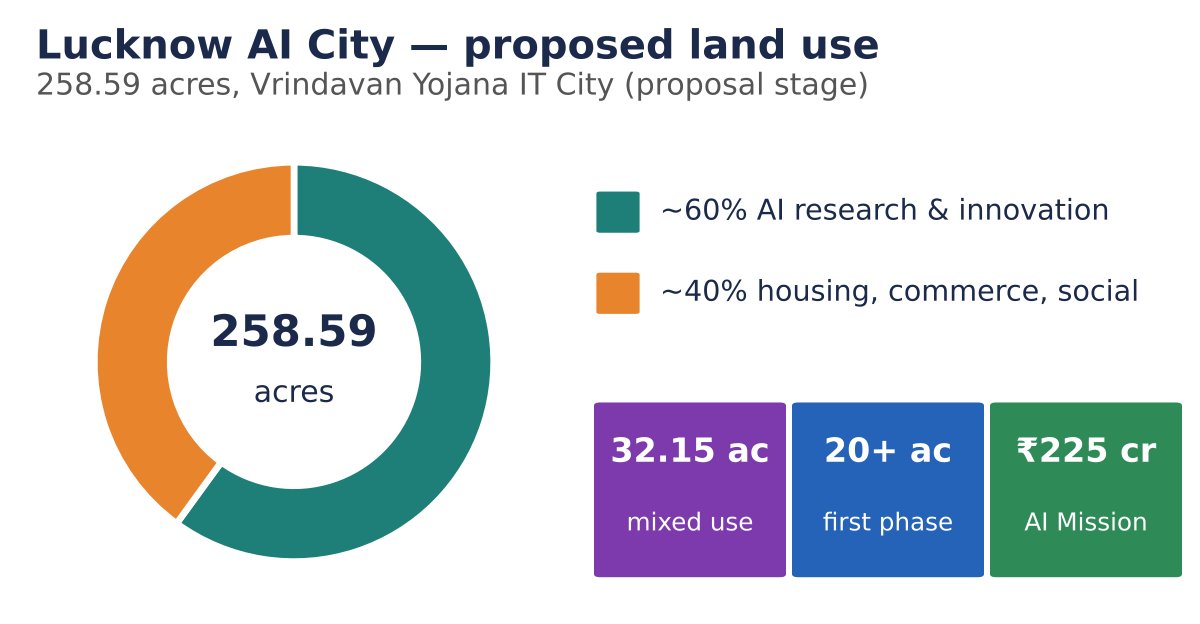
Total area 258.59 acres in Vrindavan Yojana IT City, Lucknow; 32.15 acres earmarked for a convention centre, IT and mixed use.
First phase over 20 acres: office tower, AI & deep-tech incubation centre, high-performance computing, AI testing centres and simulation labs.
Land plan: ~60% for AI research & innovation, ~40% for residential, commercial and social infrastructure; likely two phases on PPP model.
Power: 400 kV supply through three 220 kV grid stations; linked to the state's ₹225 crore AI Mission and the target of 50 AI startups in 5 years.
Way forward
Positions Lucknow as a tech hub beyond Noida-NCR, spreading high-skill jobs across the state; delivery depends on investor interest under PPP and on assured power and connectivity.
Concept
Public-Private Partnership (PPP): the government provides land and trunk infrastructure while private partners build and operate facilities, sharing risk and return.
Donut chart of the proposed Lucknow AI City land use: about 60 percent for AI research and innovation and 40 percent for residential, commercial and social infrastructure, with key numbers 258.59 acres, 32.15 acres mixed use and a first phase above 20 acres. — StudyForGS
2. Lucknow to host 5th National Skill Convocation; PM to honour 52 ITI toppers
UTTAR PRADESHUPPSC: Prelims + Mains GS-II/GS-III
Syllabus linkage
GS-II: Welfare schemes, education & skilling | GS-III: Employment and human resource development
Context
The 5th National Skill Convocation (Kaushal Deekshant Samaroh) 2026, organised by the Directorate General of Training, will be held at Indira Gandhi Pratishthan, Lucknow, on 21 November.
Key facts
PM to honour 52 meritorious trainees who topped the All India Trade Test (AITT) 2026; 6 trainees from UP (3 CTS + 3 CITS).
About 5,650 trainees and staff from UP's ITIs, the UP Skill Development Mission and the NSTIs at Kanpur and Lucknow to take part.
Short films on PM-SETU will be screened — the ₹60,000 crore scheme to upgrade 1,000 government ITIs in hub-and-spoke clusters.
Organiser: Directorate General of Training (DGT) under the Ministry of Skill Development & Entrepreneurship.
Way forward
Gives social recognition to vocational skills; for UP, with the country's largest youth population, industry-linked ITIs are central to converting demographic dividend into jobs.
Concept
CTS (Craftsmen Training Scheme) trains ITI students in trades; CITS (Craft Instructor Training Scheme) trains the instructors who teach them.
3. Varanasi splits the Ganga into two boat lanes for Dev Deepawali
GS-I: Indian culture, fairs & festivals | GS-III: Disaster management (crowd safety) | GS-V: UP culture & tourism
Context
Ahead of Dev Deepawali on Kartik Purnima (24 November 2026), Varanasi police are introducing a first-of-its-kind two-way lane system for boats on the Ganga.
Key facts
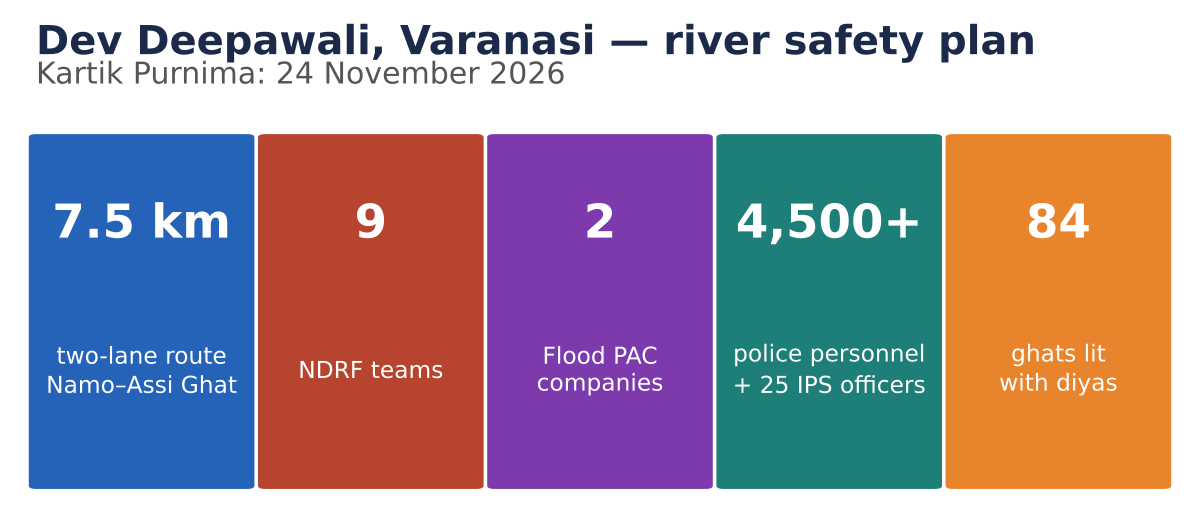
A 7.5-km 'river expressway' from Namo Ghat to Assi Ghat, divided with floating jetties and water pendulums, with fixed U-turn points.
Safety: 9 NDRF teams, 2 companies of Flood PAC, Water Police, a water ambulance, floating rescue stations and drone surveillance.
Mandatory life jackets; minors barred from operating boats; over 4,500 police personnel and 25 IPS officers on duty.
Dev Deepawali ("Diwali of the gods") falls on Kartik Purnima, 15 days after Diwali; marks Shiva's victory over Tripurasura (Tripurari Purnima); lakhs of diyas on the 84 ghats.
Way forward
Applies road-traffic logic to river crowd management — a replicable model for Prayagraj, Ayodhya and other riverfront festivals where boat collisions and overcrowding are key risks.
Concept
Dev Deepawali also coincides with Guru Nanak Jayanti; it closes the Ganga Mahotsav that begins on Prabodhini Ekadashi.
Stat tiles for the Varanasi Dev Deepawali safety plan: 7.5 km two-lane boat route from Namo Ghat to Assi Ghat, 9 NDRF teams, 2 Flood PAC companies, over 4,500 police and 25 IPS officers, festival on 24 November 2026. — StudyForGS
4. UP Cabinet clears 30 of 31 proposals; ₹281.03 crore Deep Tech U-Hub at IIT Kanpur's Noida campus
GS-III: S&T, startups and innovation | GS-VI: UP's economy and industrial development
Context
At the Cabinet meeting chaired by CM Yogi Adityanath on 18 November, 30 of the 31 proposals were approved; the headline decision is a building for the Deep Tech U-Hub at IIT Kanpur's Noida campus.
Key facts
Project cost ₹281.03 crore, built in EPC mode with a 24-month completion target.
₹100 crore provided in FY 2026-27 (₹30 crore capital + ₹70 crore revenue); the Centre will not contribute — fully state-funded.
The U-Hub will run as a registered Section 8 (not-for-profit) company, giving startups mentorship and technical support.
Same meeting also cleared a State Cooperative College in Lucknow and land for a stadium in Agra (see Rapid-Fire).
Way forward
Links academic research with entrepreneurship in the Noida cluster; together with the AI City plan it signals UP's bid to build a deep-tech ecosystem rather than only manufacturing.
Concept
EPC (Engineering, Procurement and Construction): one contractor designs, procures and builds the asset for a fixed price and time; the owner bears no construction-management role.
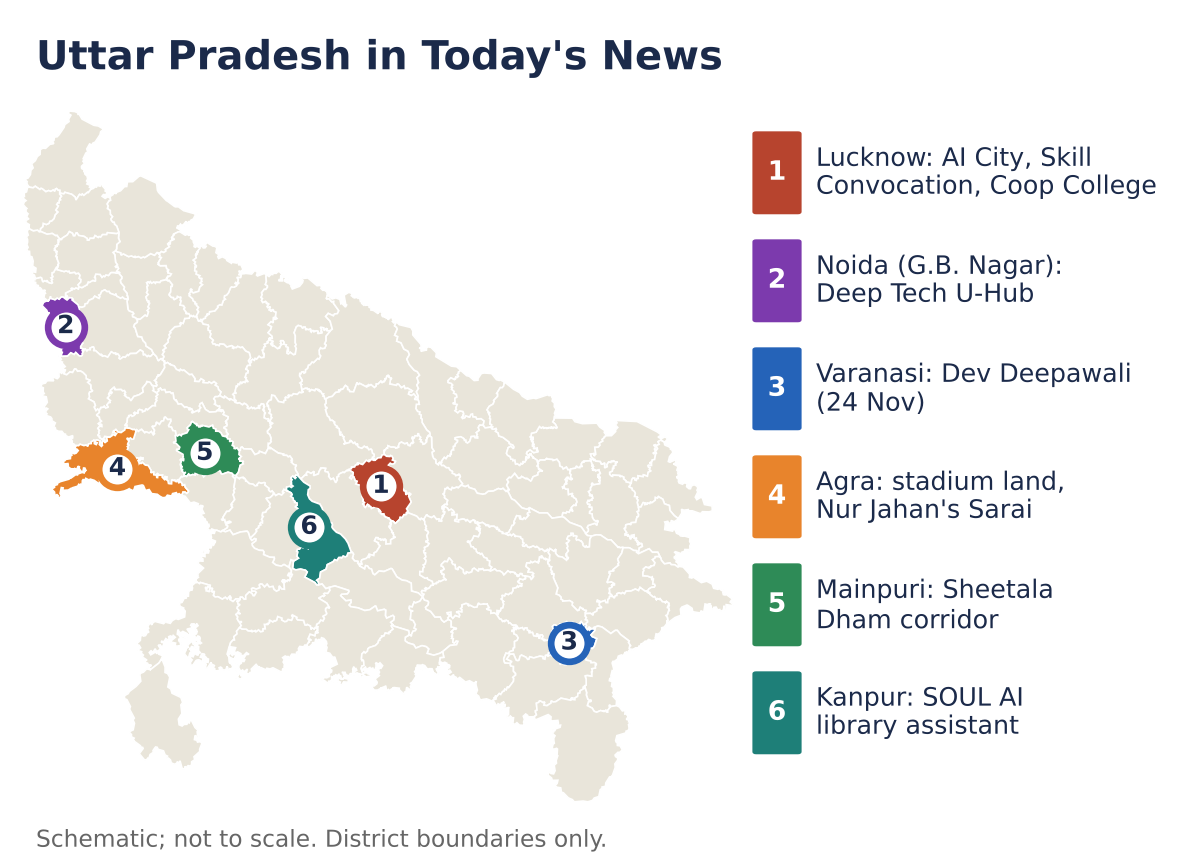
Map of Uttar Pradesh district boundaries highlighting the districts in today's news: Gautam Buddha Nagar (Deep Tech U-Hub, Noida), Lucknow (AI City, skill convocation, cooperative college), Agra (stadium, Nur Jahan's Sarai), Varanasi (Dev Deepawali), Mainpuri (Sheetala Dham corridor) and Kanpur Nagar (SOUL AI library). — StudyForGS
5. Modified UDAN: Centre–UP–AAI tripartite MoU with 80:20 VGF sharing
The Cabinet approved a tripartite MoU between the Centre, the UP government and the Airports Authority of India for the next phase of the Modified Regional Connectivity Scheme.
Key facts
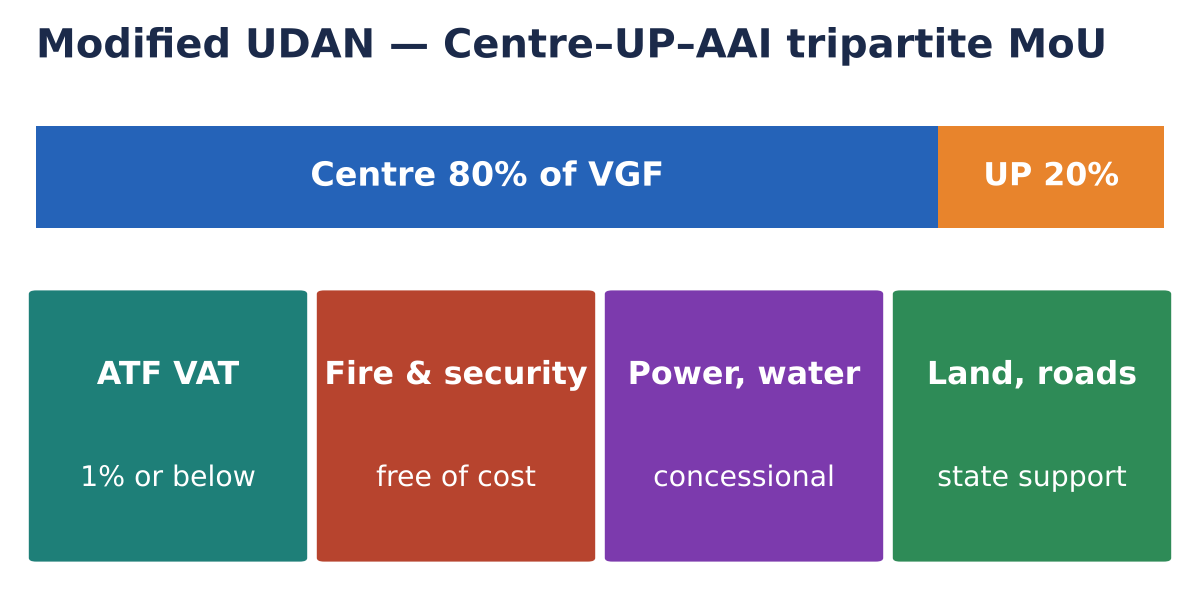
Viability Gap Funding (VGF): Centre 80%, UP 20%.
VAT on ATF at regional-connectivity airports cut to 1% or below.
Fire-fighting and security free of cost; electricity, water and utilities at concessional rates; state to help with land and access roads.
Director, Civil Aviation, UP authorised to sign; aim — link smaller cities with religious, heritage and tourism destinations.
Way forward
Lower operating costs make thin regional routes viable for airlines; it complements UP's religious-tourism circuit (Ayodhya, Varanasi, Prayagraj, Mathura) and the new tourism-policy incentives.
Concept
UDAN (Ude Desh ka Aam Nagrik), launched in 2016, caps fares on regional routes; VGF covers the gap between an operator's cost and the capped fare revenue.
Diagram of the Modified UDAN tripartite MoU: a bar showing viability gap funding split 80 percent Centre and 20 percent Uttar Pradesh, with four incentive pillars — ATF VAT at 1 percent or below, free fire and security services, concessional utilities, and land and access support. — StudyForGS
6. Bioenergy Policy-2022 and Tourism Policy-2022 amended to widen incentives
The Cabinet amended two 2022 state policies to attract private investment in bioenergy plants and small tourism businesses.
Key facts
Bioenergy Policy-2022 now folds in the Centre's SASCI guidelines and the Model Compressed Biogas (CBG) Policy of the Ministry of Petroleum & Natural Gas.
Feedstock mapped district-wise: CBG from paddy straw and press mud (sugar mills); bio-coal from maize, bajra, jowar, pulse, oilseed and cotton residue.
Tourism Policy-2022: incentives extended to budget hotels of 6–49 rooms, homestays, farm tourism and cultural experience centres.
Also covers regional food trails, traditional food experiences and highway rest stops.
Way forward
Turning stubble and press mud into fuel tackles air pollution and adds farm income, while small-format tourism incentives spread visitor spending beyond big hotels.
Concept
Press mud is the solid residue left after filtering sugarcane juice in sugar mills — UP, India's top cane producer, generates it in large volumes.
7. Panchayat administrators' tenure extended by ordinance; new Rani Lakshmibai victim-compensation rules
GS-II: Local self-government, vulnerable sections | GS-V: UP's governance and panchayati raj
Context
The Cabinet approved the draft UP Panchayati Raj (Amendment) Ordinance, 2026, and the UP Rani Lakshmibai Mahila Evam Bal Samman Kosh Rules, 2026.
Key facts
Ordinance amends the UP Panchayati Raj Act, 1947 to let administrators run gram panchayats for up to six more months.
Reason: the OBC reservation report for panchayats is pending, so elections may come only after the 2027 Assembly polls.
Samman Kosh Rules, 2026 replace the 2015 framework and align with the NALSA Compensation Scheme for Women Victims/Survivors of Sexual Assault and Other Crimes, 2018.
Aim: faster financial, medical and legal help to women and children affected by sexual offences and other serious crimes.
Way forward
Extended administrator rule raises questions about Article 243E's mandate of elections before a panchayat's term ends; the victim fund strengthens restorative justice for survivors.
Concept
Article 243E: a panchayat's term is five years and fresh elections must be completed before expiry; a dissolved panchayat must be re-elected within six months. Article 213 lets the Governor promulgate ordinances when the legislature is not in session.
8. UP Urban Development Vision 2047: urbanisation from 24.5% to 60%
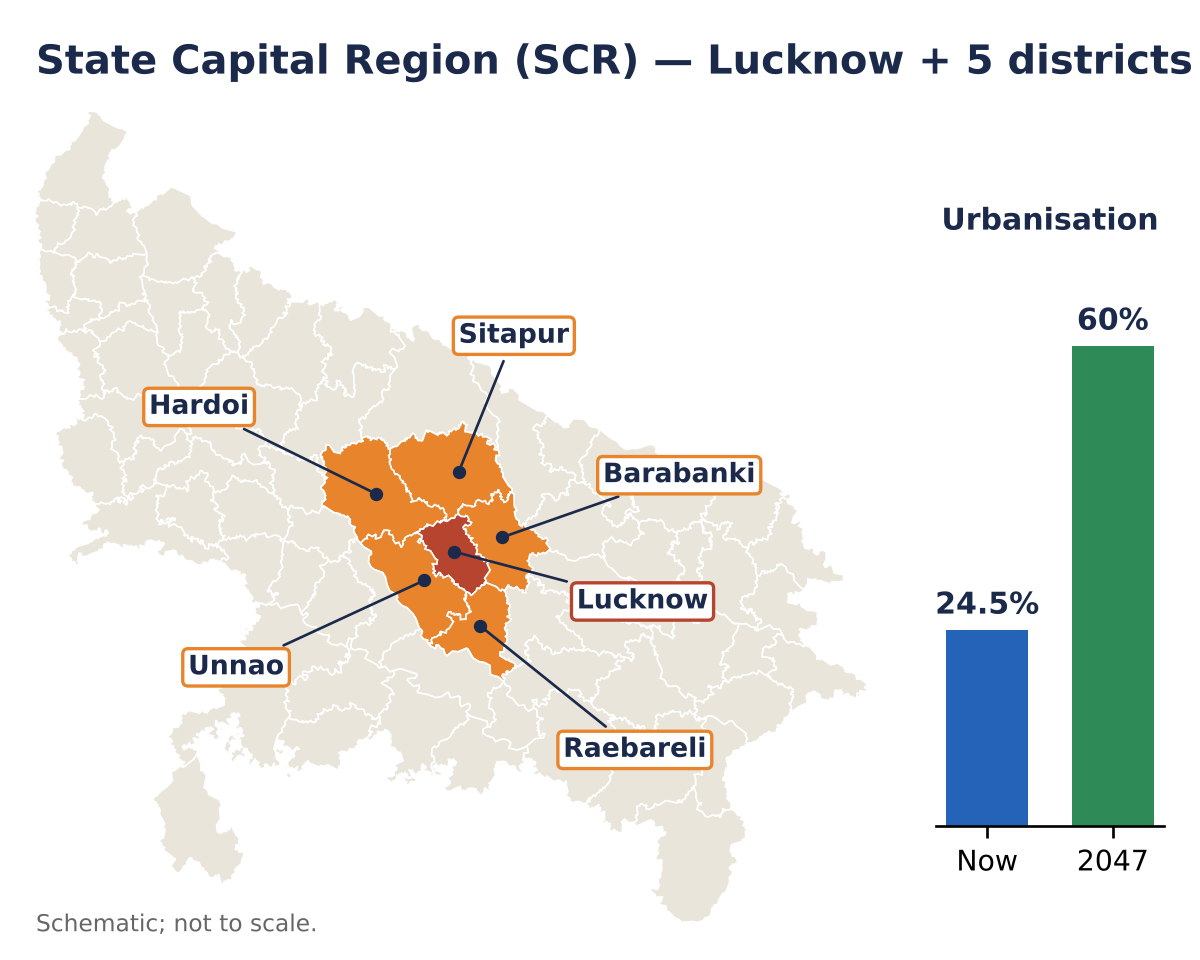
The state has prepared an urban development roadmap for 2047 targeting 60% urbanisation, six regional economic centres and Lucknow as a model metropolitan city.
Key facts
Raise urbanisation from ~24.5% to 60% by 2047, in step with the $6 trillion economy goal; three UP cities to reach global top-100 standards.
State Capital Region (SCR): Lucknow + Sitapur, Unnao, Hardoi, Barabanki and Raebareli for multi-modal connectivity and planned townships.
GIS-based master plans and land banks through Town Planning Schemes; at least one Urban Development Authority in each of 75 districts.
Proposed high-speed rail corridors: Delhi–Lucknow–Prayagraj–Varanasi and Lucknow–Ayodhya.
Way forward
Planned regional growth can ease pressure on NCR and spread jobs to eastern UP, but needs municipal finance, affordable housing and strong urban local bodies to avoid unplanned sprawl.
Concept
The SCR is created under the UP State Capital Region and Other Area Development Authority Act, 2024 — modelled on the NCR idea of planning a capital with its hinterland.
Map of Uttar Pradesh district boundaries highlighting the six State Capital Region districts — Lucknow, Sitapur, Unnao, Hardoi, Barabanki and Raebareli — with an inset bar showing urbanisation rising from about 24.5 percent to a 60 percent target by 2047. — StudyForGS
9. UP leads the country in PM Surya Ghar rooftop solar installations
GS-III: Energy, renewable energy, employment | GS-VI: UP's energy sector
Context
Official data show Uttar Pradesh has become the leading state under PM Surya Ghar: Muft Bijli Yojana, with its rooftop-solar value chain now supporting thousands of local vendors.
Key facts
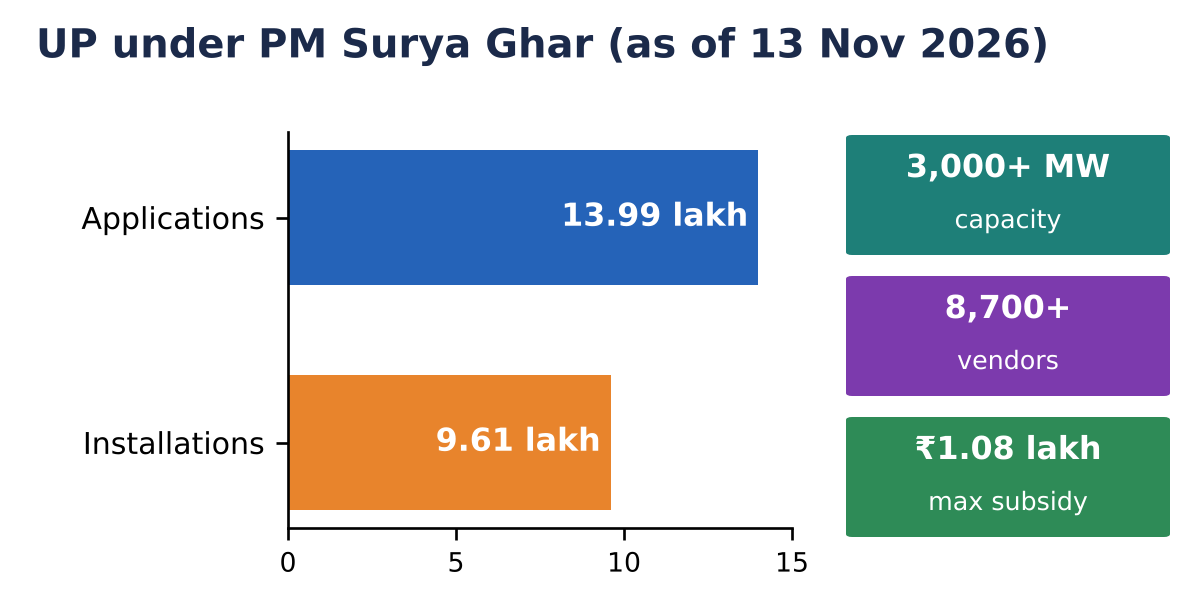
As of 13 Nov 2026: 13,99,734 applications and 9,60,586 installations — highest of any state.
Rooftop capacity above 3,000 MW; a network of 8,700+ empanelled vendors; about 1 lakh jobs.
Combined Centre + state subsidy up to ₹1.08 lakh per eligible household; implementing agency UPNEDA with the DISCOMs.
Lucknow was the first district in India to cross 88,000 rooftop installations (April 2026).
Way forward
Distributed solar cuts household bills and DISCOM losses and creates MSME jobs; grid integration and battery storage (UPPTCL has earmarked land for 1,065 MW) are the next bottlenecks.
Concept
PM Surya Ghar: Muft Bijli Yojana (Feb 2024) aims at rooftop solar for 1 crore households with up to 300 units of free electricity a month.
Bar chart of Uttar Pradesh under PM Surya Ghar as of 13 November 2026: 13.99 lakh applications against 9.61 lakh installations, with tiles for over 3,000 MW capacity, 8,700 plus vendors and subsidy up to 1.08 lakh rupees. — StudyForGS
📜 Asked before in the exam — previous-year question on this topic
UPSC Prelims 2025Consider the following statements about 'PM Surya Ghar Muft Bijli Yojana': I. It targets installation of one crore solar rooftop panels in the residential sector. II. The Ministry of New and Renewable Energy aims to impart training on installation, operation, maintenance and repairs of solar rooftop systems at grassroot levels. III. It aims to create more than three lakhs skilled manpower through fresh skilling, and up-skilling, under scheme component of capacity building. Which of the statements given above are correct?
I and II only
I and III only
II and III only
I, II and III
Show answer
Answer: (d) I, II and III PM Surya Ghar Muft Bijli Yojana, launched in February 2024, aims to install rooftop solar in one crore households in the residential sector with up to 300 units of free electricity a month. MNRE provides grassroots training on installation, operation, maintenance and repair. Its capacity-building component targets more than three lakh skilled workers through fresh skilling and up-skilling. All three statements are correct. Practise all UPSC Prelims 2025 paper (free) →
Linked because this news is about the same topic. The answer is as per the official key of that year.
GS-II: Social security | GS-III: Labour reforms, financial inclusion
Context
The 240th meeting of the EPFO's Central Board of Trustees, chaired by Labour Minister Mansukh Mandaviya in New Delhi on 19 November, approved major withdrawal reforms.
Key facts
Systematic Withdrawal Plan (SWP): retiring members can take PF savings in monthly, quarterly or half-yearly instalments instead of a lump sum.
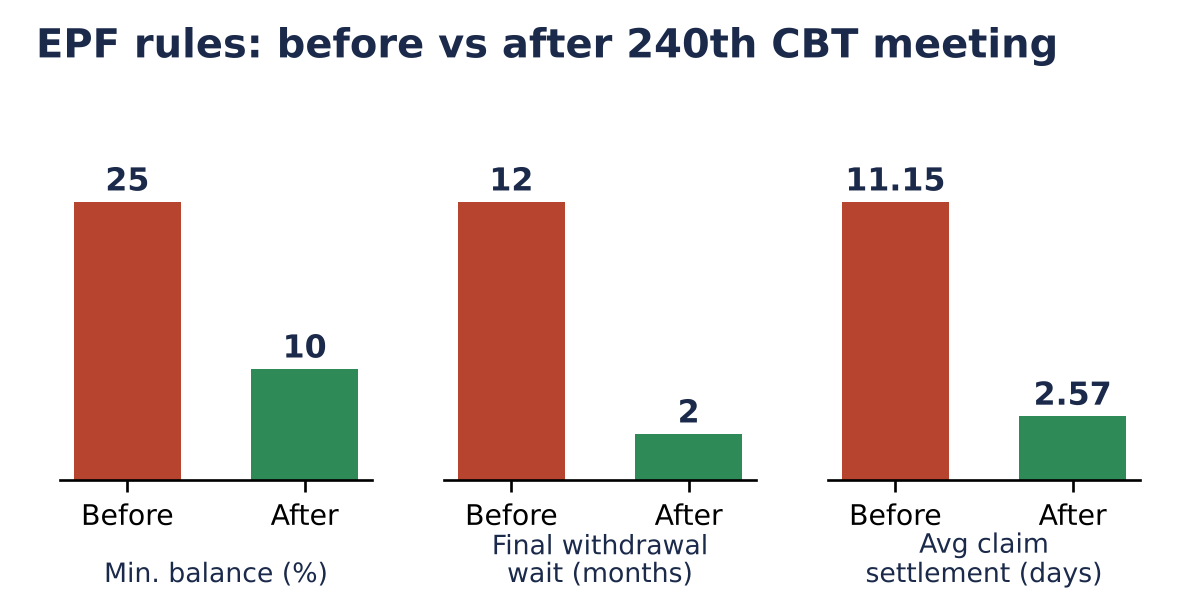
Minimum balance to be retained cut from 25% to 10%; waiting period for final withdrawal after unemployment cut from 12 months to 2 months.
On a member's death, the nominee can withdraw the balance or continue the payouts.
Average claim settlement time has fallen from 11.15 days to 2.57 days.
Way forward
SWP turns PF into a pension-like income stream, guarding retirees against spending the corpus at once; liquidity gains must be balanced against old-age security.
Concept
EPFO is a statutory body under the Employees' Provident Funds and Miscellaneous Provisions Act, 1952; the CBT is its apex body, chaired by the Union Labour Minister.
Grouped bar chart comparing EPF rules before and after the 240th CBT meeting: minimum balance 25 percent to 10 percent, final withdrawal wait 12 months to 2 months, and average claim settlement 11.15 days to 2.57 days. — StudyForGS
11. India–Japan deepen defence ties at fourth 2+2 Ministerial in Tokyo
NATIONALUPPSC: Prelims + Mains GS-II
Syllabus linkage
GS-II: India and its neighbourhood / bilateral relations | GS-III: Defence
Context
The defence and foreign ministers of India and Japan met for the fourth 2+2 Ministerial Dialogue in Tokyo on 19 November.
Key facts
Both sides agreed that Japanese forces will conduct live-fire training in India.
They welcomed Malabar 2026 (multilateral naval) and JAIMEX26 (India–Japan maritime exercise), both held in Japan this month.
Focus on defence equipment and technology cooperation and a free, open Indo-Pacific.
Separately, HARIMAU SHAKTI–VI (India–Malaysia army exercise, 240 personnel, counter-terror drills) began in Malaysia.
Way forward
Live-fire training on Indian soil marks a new level of operational trust and strengthens the Quad-linked maritime partnership.
Concept
A 2+2 dialogue brings together the foreign and defence ministers of two countries; India holds such dialogues with the US, Japan, Australia and Russia among others.
Data point of the day
9,60,586
UP rooftop solar installations under PM Surya Ghar As of 13 Nov 2026 — the highest of any state, from 13,99,734 applications.
Prelims rapid-fire
State Cooperative College, Lucknow: 4.51 ha at Rahman Khera; to be affiliated to Tribhuvan Sahkari University (Gujarat); courses in AI, cybercrime, banking.
Agra stadium: 2.476 ha at Uganpura gram panchayat (Bah constituency) transferred free to the Sports Department.
Nur Jahan's Sarai near Ram Bagh, Agra: ASI begins conservation with an initial budget of ₹60 lakh.
Maa Sheetala Dham corridor, Mainpuri: state approves ₹32.61 crore.
CSJMU, Kanpur launches SOUL AI, a smart library assistant at its central library.
Census 2027 in UP: self-enumeration 16–30 Nov 2026; house-to-house enumeration 1 Dec 2026 – 4 Jan 2027.
Practice MCQs — UPPSC Prelims pattern
Q1. The Deep Tech U-Hub approved by the Uttar Pradesh Cabinet on 18 November 2026 will be built at:
IIT (BHU), Varanasi
IIT Kanpur's Noida campus
IIIT Lucknow
Vrindavan Yojana IT City, Lucknow
Show answer
Answer: B The ₹281.03 crore U-Hub building will come up at IIT Kanpur's Noida campus in EPC mode within 24 months, fully state-funded. Trap: Vrindavan Yojana (Lucknow) is the site of the separate AI City proposal.
Q2. Consider the following about the Modified UDAN tripartite MoU approved by UP: 1. The Centre bears 80% of viability gap funding. 2. VAT on ATF at regional-connectivity airports will be 1% or below. 3. The Airports Authority of India is not a party to the MoU. Which of the statements given above is/are correct?
1 and 2 only
2 and 3 only
1 and 3 only
1, 2 and 3
Show answer
Answer: A VGF is shared 80:20 (Centre:UP) and ATF VAT is cut to 1% or below. Statement 3 is wrong — the MoU is tripartite among the Centre, UP and AAI.
Mains practice question
Q. Uttar Pradesh aims to raise its urbanisation from about 24.5% to 60% by 2047. Discuss the opportunities and challenges of this target and the role of regional planning bodies such as the State Capital Region. (125 words)
Hint / approach
Intro: current urbanisation, $6 trillion goal. Body: opportunities (agglomeration, jobs, services, SCR + six regional centres, GIS master plans, HSR corridors); challenges (municipal finance, land, housing, eastern-UP lag, environment, weak ULBs under the 74th Amendment). Conclude: balanced, inclusive and climate-resilient urban growth.
📌 One-line revision: AI City = 258.59 acres, Vrindavan Yojana (Lucknow) | U-Hub = ₹281.03 cr, IIT Kanpur Noida | Modified UDAN VGF = 80:20 | Dev Deepawali = 24 Nov, 7.5-km Namo–Assi lane | EPFO SWP: min balance 25%→10%.