Saturday, 19 September 2026 · IST · Uttarakhand + National · 12 items · 2 MCQs
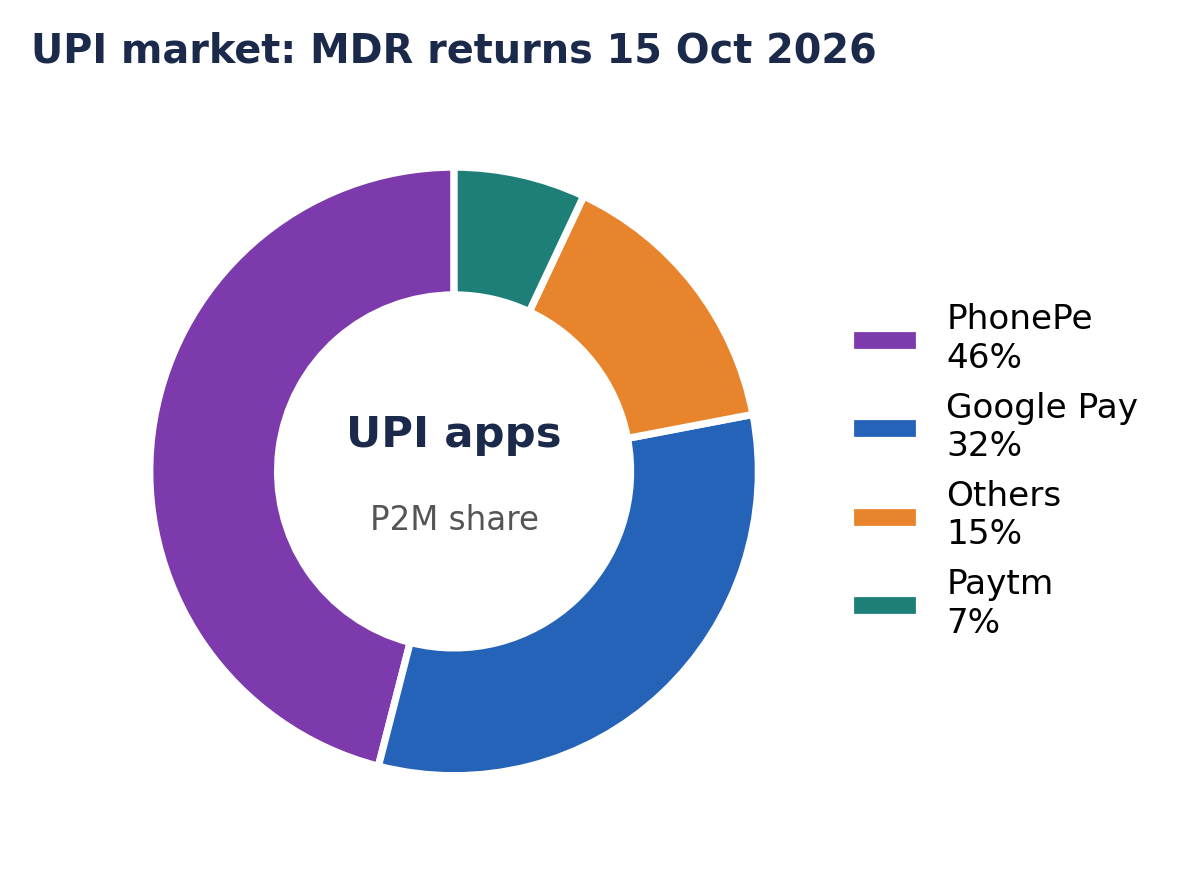
Uttarakhand's top story is the push on youth and digital access — a new DBT scheme to fund tablets for Class 10 & 12 government-school students, unveiled at the CM Yuva Vidyarthi Manthan-2026, even as the state becomes India's sixth fully literate state. Nationally, the Union government signalled Uniform Civil Code rollout across 21 NDA-ruled states by 2029, the Merchant Discount Rate returns on high-value UPI payments from 15 October 2026, and the Western Dedicated Freight Corridor went fully operational.
Today at a glance — things to remember
CM Yuva Vidyarthi Manthan-2026: DBT scheme for tablets to Class 10 & 12 govt-school students
Uttarakhand is India's 6th fully literate state under ULLAS (95% adult-literacy bar)
Revised Homestay policy adds Community-Based Tourism to fight palayan (migration)
UCC to be rolled out across 21 NDA-ruled states by 2029
MDR returns on UPI above ₹2,000 from 15 October 2026 (97.5% txns stay free)
Western Dedicated Freight Corridor (1,506 km) fully operational
US House bill threatens up to 100% tariff on India over Russian oil
Stem-cell therapy for autism restricted to approved trials only
Sanjukta Parasor becomes first woman IG of CRPF's CoBRA
Detailed notes
1. CM Yuva Vidyarthi Manthan-2026: DBT scheme to fund tablets for govt-school students
UTTARAKHANDUKPSC: Prelims + Mains (Polity, Governance & Society — Uttarakhand)
Syllabus linkage
UK GS – Governance & social-sector schemes of Uttarakhand; e-governance & digital inclusion; Prelims: state scheme names, DBT.
Context
At the Chief Minister Yuva Vidyarthi Manthan-2026 in Dehradun (18 Sept), the state announced a Direct Benefit Transfer (DBT) scheme to help Class 10 and Class 12 government-school students buy tablets, and the CM addressed 140 competition winners.
Key facts
Event: CM Yuva Vidyarthi Manthan-2026, held in Dehradun on 18 September 2026.
New DBT scheme to fund tablets for Class 10 & 12 government-school students.
CM coined “In-G” (Indian Generation) for today's youth in place of “Gen Z”.
UK GS – Pilgrimage tourism, crowd & disaster management, hill economy; Prelims: location of the four Dhams, registration mechanism.
Context
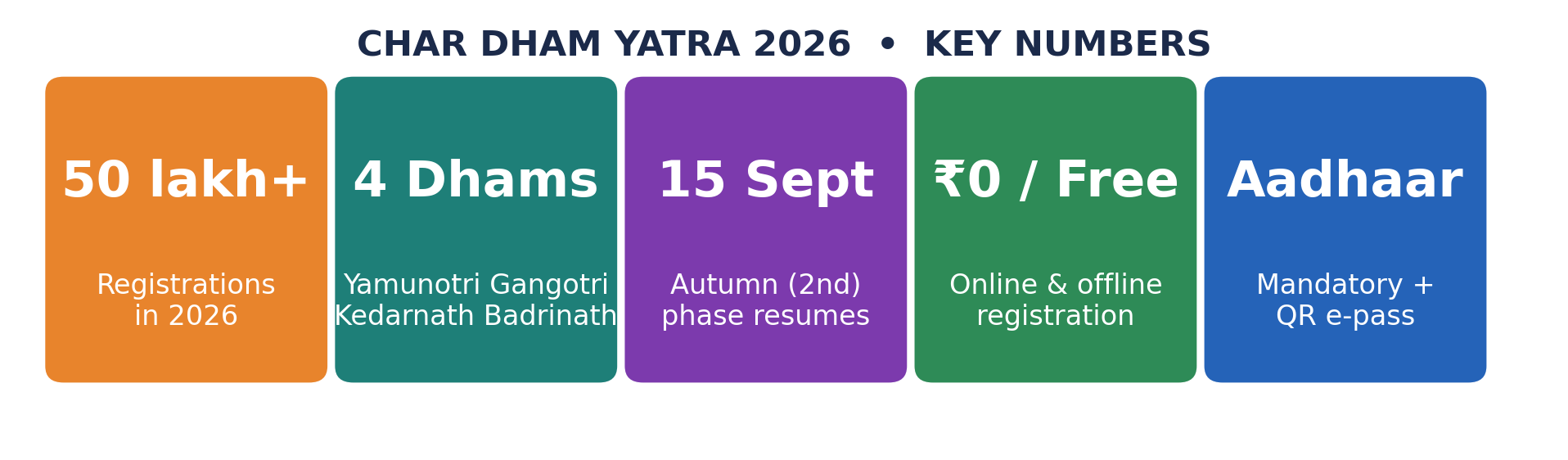
The Char Dham Yatra 2026 has crossed 50 lakh pilgrim registrations, and the autumn (second) leg of the pilgrimage season has resumed after the monsoon slowdown.
Key facts
Registrations in 2026 crossed 50 lakh (5 million).
Four shrines: Yamunotri, Gangotri, Kedarnath, Badrinath.
Registration is free; Aadhaar mandatory, with QR-code e-pass verification.
Extra counters: 30 in Rishikesh, 20 in Haridwar; daily darshan caps enforced.
“Yatrimitras” posted at checkpoints for QR scanning.
Way forward
Carrying-capacity caps plus real-time crowd analytics are vital to prevent stampedes and ecological stress in fragile shrines.
Concept
Carrying capacity — the maximum footfall an eco-fragile site can bear without degradation — anchors Himalayan pilgrimage management.
4. Revised Homestay policy adds Community-Based Tourism to curb palayan
UTTARAKHANDUKPSC: Prelims + Mains (Economy & Hill Development — Uttarakhand)
Syllabus linkage
UK GS – Tourism policy, rural livelihoods, reverse migration (palayan); Prelims: Deen Dayal Upadhyaya Homestay Scheme details.
Context
Uttarakhand has revised its Pandit Deen Dayal Upadhyaya Homestay Scheme, introducing a Community-Based Tourism framework for the first time to spread benefits and check migration.
Key facts
Scheme: Pandit Deen Dayal Upadhyaya Homestay (from 2015), now revised.
New Community-Based Tourism Unit: 8–10 homestays across 1–6 villages.
Room cap raised from 6 to 8 rooms; up to 24 beds per property.
Over 5,000 active homestays operate statewide.
Aimed at reverse migration (palayan roktham) and hill self-employment.
Way forward
Clustered homestays can build village-scale tourism value chains, but need quality grading and market linkage to compete.
Concept
Palayan (out-migration) from Uttarakhand's hills is a core state issue; the Mukhyamantri Palayan Roktham Yojana and homestays target reverse migration.
5. Uniform Civil Code: Uttarakhand model to expand across NDA states
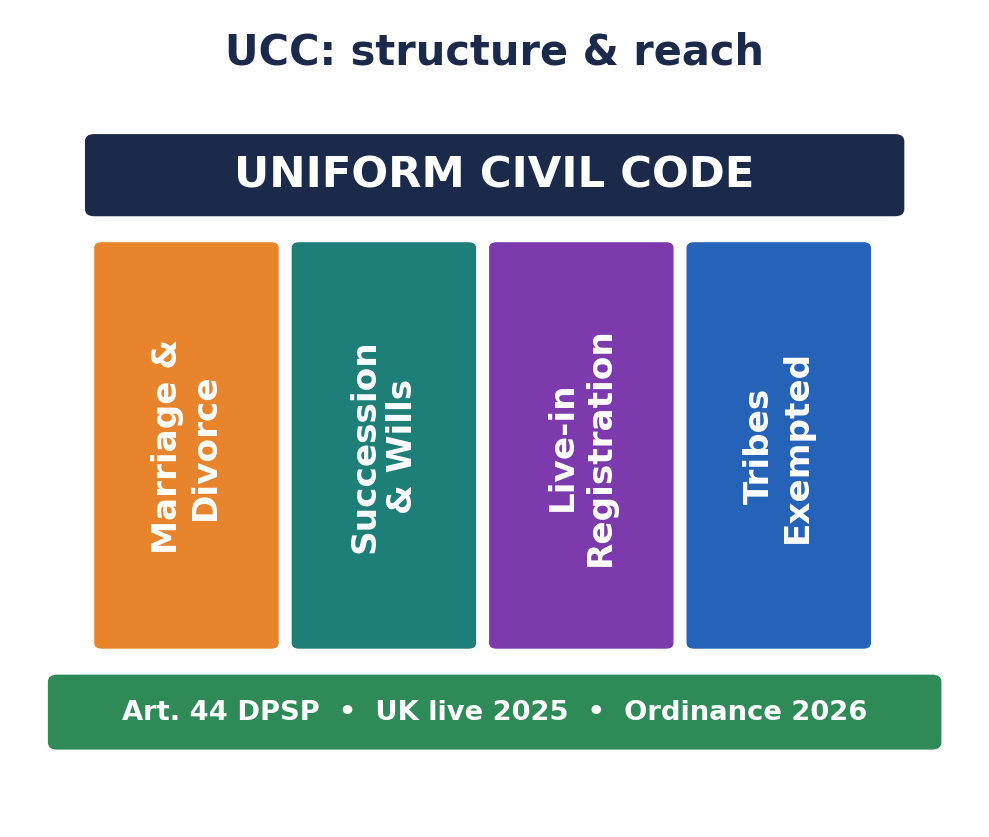
The Union government indicated the Uniform Civil Code will be rolled out across 21 NDA-ruled states by 2029, using Uttarakhand — operational since 2025 — as the template.
Key facts
UCC targeted for 21 NDA-ruled states by 2029.
Uttarakhand operational since 2025; Amendment Ordinance 2026 in force.
Covers marriage, divorce, succession and live-in relationship registration.
Enacted UCCs exempt Scheduled Tribes.
Way forward
Balancing uniformity with Article 25 (freedom of religion) and tribal autonomy under the Sixth Schedule remains the key legal test.
Concept
DPSPs (Part IV) guide policy but are not enforceable; Article 44 urges a UCC — in tension with Articles 25 and 29.
Pillar diagram of the Uniform Civil Code: roof labelled UCC over pillars for marriage & divorce, succession & wills, live-in registration, and tribal exemption. — StudyForGS
6. Gross Environment Product: Uttarakhand's green-GDP model in focus
UK GS – Himalayan ecology, ecosystem services, green accounting; Prelims: GEP components, India's first-mover status.
Context
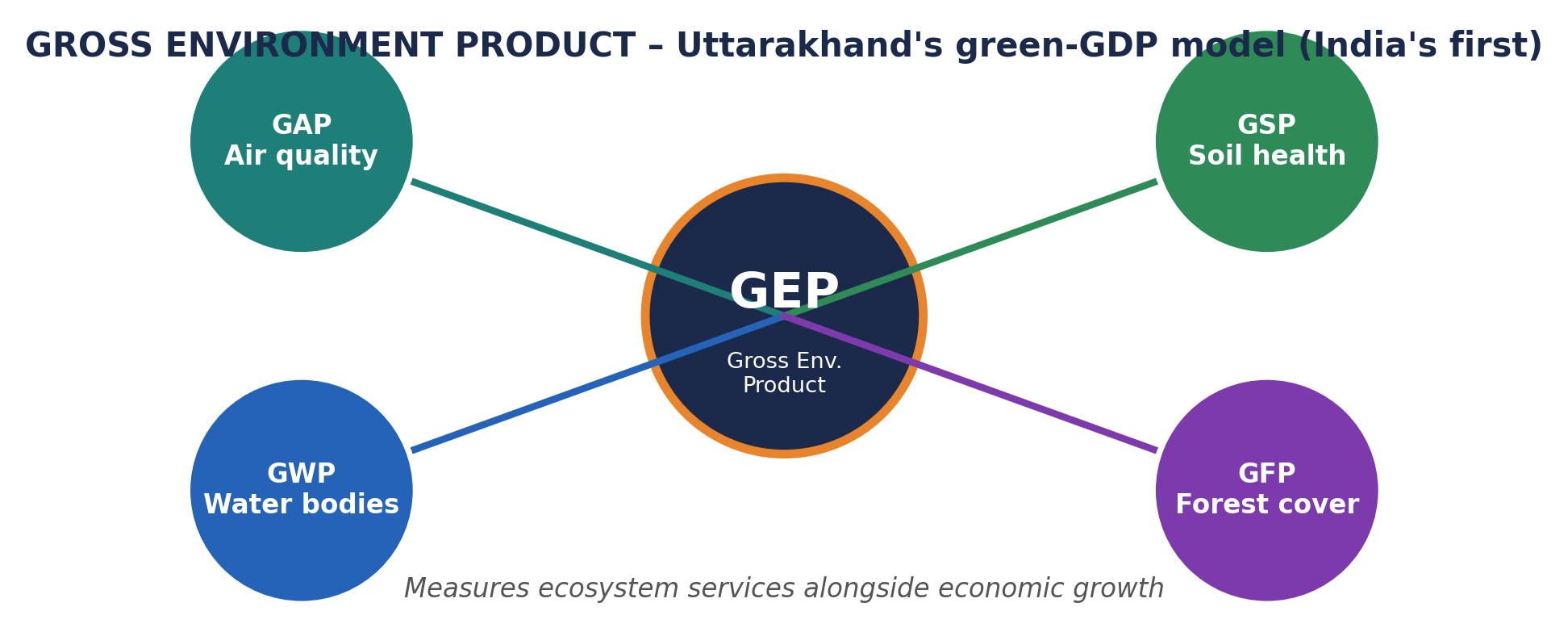
Uttarakhand's Gross Environment Product (GEP) — India's first ecosystem-services accounting framework — continues to shape the state's green-growth narrative.
Key facts
GEP = value of ecosystem services, alongside conventional GDP.
Uttarakhand is India's first state to adopt GEP.
Four components: air (GAP), water (GWP), soil (GSP), forest (GFP).
Recognises the Himalayas as a water tower and carbon sink.
Supports demand for green bonus / GST-style ecological compensation.
Way forward
Formal GEP metrics could underpin payments-for-ecosystem-services and a stronger case for central green transfers to hill states.
Concept
Green GDP adjusts output for environmental depletion; GEP goes further by valuing positive ecosystem services — relevant to Himalayan states.
Mind-map of Gross Environment Product with a central GEP node linked to four components: GAP air quality, GWP water bodies, GSP soil health, GFP forest cover. — StudyForGS
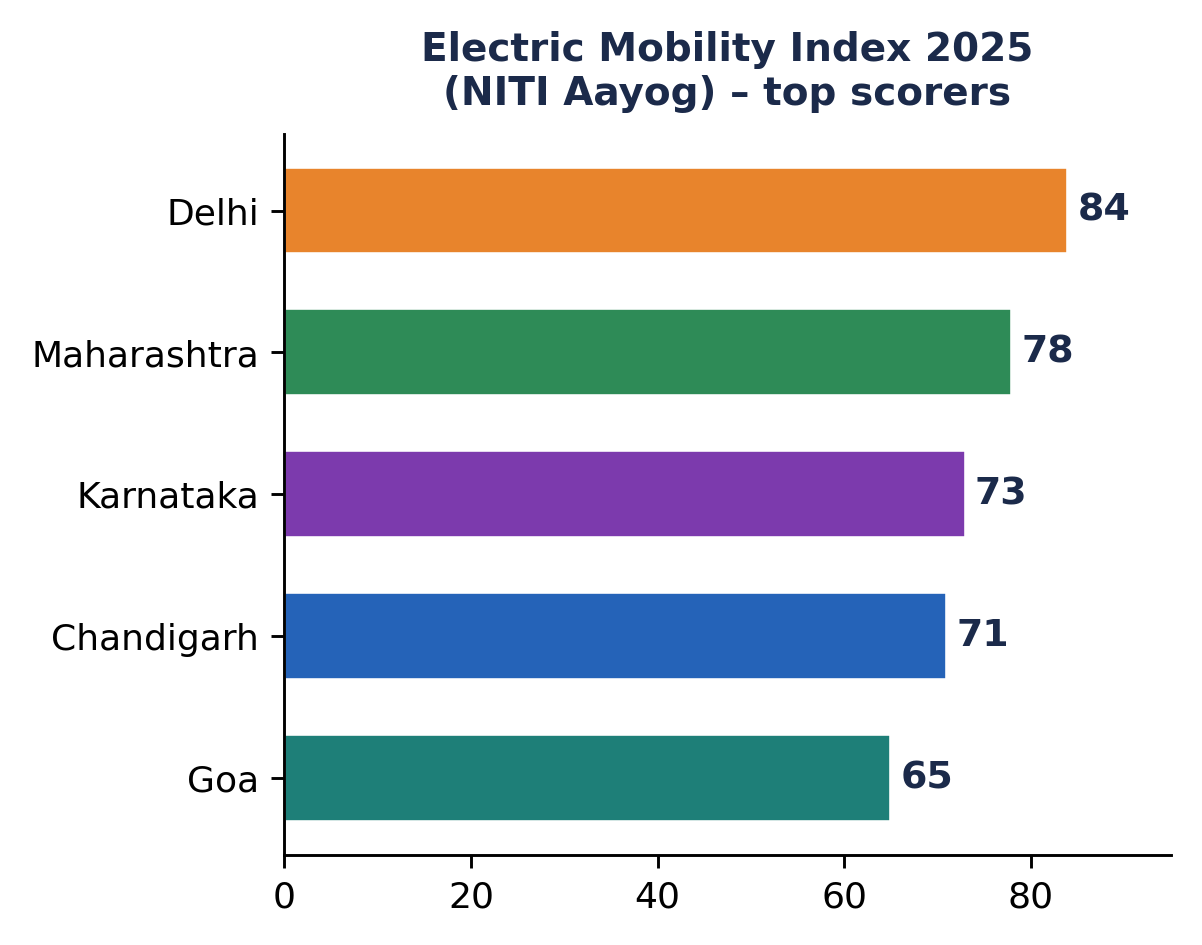
7. NITI Aayog's India Electric Mobility Index 2025: Delhi tops the states
India's Western Dedicated Freight Corridor (WDFC) is now fully operational, completing a 2,843-km dedicated freight backbone with the Eastern DFC.
Key facts
WDFC: 1,506 km (Dadri to JNPT); with EDFC 1,337 km = 2,843 km total.
Daily trains rose from 247 (2023-24) to 443 (Aug 2026); WDFC at 88% capacity.
India's logistics cost: ~7.97% of GDP (2023-24).
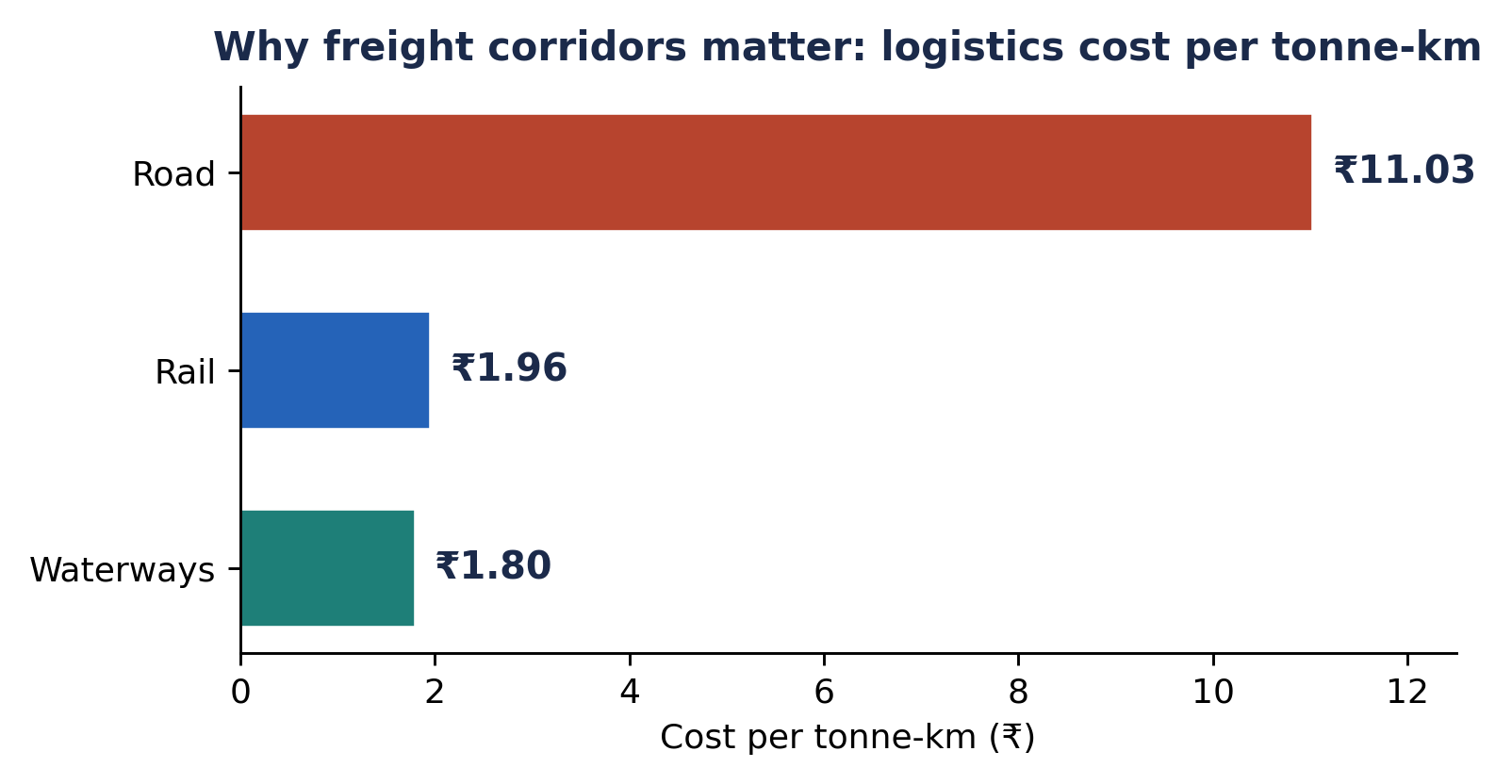
Freight cost per tonne-km: ₹1.96 rail vs ₹11.03 road.
Aligned with PM GatiShakti and Sagarmala.
Way forward
Shifting freight from road to rail cuts logistics cost and emissions — central to India's competitiveness and net-zero goals.
Concept
Dedicated Freight Corridors are freight-only rail lines that decongest mixed traffic and speed up goods movement.
Horizontal bar chart of logistics cost per tonne-km — waterways ₹1.80, rail ₹1.96, road ₹11.03 — showing why freight corridors matter. — StudyForGS
10. US House bill threatens up to 100% tariff on India over Russian oil
IRUKPSC: Prelims + Mains (International Relations)
Syllabus linkage
India GS – India-US ties, energy security, sanctions; Prelims: shadow fleet, price cap.
Context
The US House passed legislation targeting Russian energy that authorises the US President to impose tariffs of up to 100% on India for its purchases of Russian oil.
Key facts
Bill authorises tariffs of up to 100% on India over Russian oil imports.
Targets Russia's “shadow fleet” of ageing, opaquely-owned tankers.
India GS – Biotechnology, health regulation, ethics; Prelims: ICMR/DBT guidelines, regulatory bodies.
Context
The Health Ministry has advised that stem-cell therapy for Autism Spectrum Disorder (ASD) be confined to approved clinical trials, following a Supreme Court judgment.
Key facts
Advisory (16 Sept): stem-cell therapy for ASD only within approved trials.
Triggered by a Supreme Court judgment (30 Jan 2026).
Basis: National Guidelines for Stem Cell Research, 2017 (ICMR & DBT).
ICMR: evidence does not support stem-cell therapy over behavioural therapies for ASD.
Aims to curb unproven, costly treatments.
Way forward
Evidence-based regulation protects vulnerable patients while keeping legitimate research pathways open.
Concept
Stem cells can differentiate into many cell types; unregulated clinical use raises safety and ethics concerns — hence ICMR/DBT oversight.
12. Sanjukta Parasor becomes first woman IG of CRPF's CoBRA
DEFENCEUKPSC: Prelims + Mains (Internal Security)
Syllabus linkage
India GS – Internal security, CAPFs, LWE; Prelims: CoBRA, CRPF, women in forces.
Context
Sanjukta Parasor has become the first woman Inspector General of CoBRA, the CRPF's specialised jungle-warfare force.
Key facts
First woman IG of CoBRA (Commando Battalion for Resolute Action).
2006-batch IPS, Assam-Meghalaya cadre; the “Iron Lady of Assam”.
CoBRA is a 10-battalion jungle-warfare unit raised in 2008.
Specialises in anti-Left-Wing Extremism (LWE) operations.
Marks growing women's leadership in central armed police forces.
Way forward
Greater representation of women in command roles strengthens both capability and institutional legitimacy of the forces.
Concept
CoBRA, under the CRPF, is India's dedicated guerrilla-warfare unit for LWE-affected zones.
Data point of the day
₹1.11 lakh crore
Uttarakhand Budget, FY 2026-27 Cleared by the state cabinet (25 Feb 2026) — about a 10% rise over the previous year, with continued thrust on infrastructure, tourism and hill development.
Prelims rapid-fire
ULLAS = Nav Bharat Saaksharta Karyakram (New India Literacy Programme).
Uttarakhand's four Dhams: Yamunotri, Gangotri, Kedarnath, Badrinath.
GEP components: air (GAP), water (GWP), soil (GSP), forest (GFP).
UPI MDR of 0.4% applies on P2M above ₹2,000 from 15 Oct 2026.
WDFC runs Dadri → JNPT, length 1,506 km.
CoBRA (raised 2008) is the CRPF's jungle-warfare, anti-LWE force.
Practice MCQs — UKPSC Prelims pattern
Q1. With reference to the Uniform Civil Code (UCC) in India, consider the following statements: 1. The Directive Principle urging the State to secure a UCC is contained in Article 44. 2. Uttarakhand was the first state to make a UCC operational. 3. The enacted state UCCs apply uniformly to Scheduled Tribes as well. Which of the statements given above are correct?
1 and 2 only
2 and 3 only
1 and 3 only
1, 2 and 3
Show answer
Answer: A Article 44 (DPSP) urges a UCC (St.1 correct). Uttarakhand made a UCC operational first (St.2 correct). Enacted UCCs exempt Scheduled Tribes, so St.3 is wrong.
Q2. Consider the following statements about the Char Dham Yatra: 1. The four Dhams are Yamunotri, Gangotri, Kedarnath and Badrinath. 2. Registration for the yatra requires a paid fee and Aadhaar. Which of the statements is/are correct?
1 only
2 only
Both 1 and 2
Neither 1 nor 2
Show answer
Answer: A The four Dhams are correctly listed (St.1). Registration is free (though Aadhaar is mandatory), so St.2 is wrong.
Mains practice question
Q. “Reverse migration (palayan roktham) in Uttarakhand's hills depends less on subsidies and more on building rural livelihood ecosystems.” Critically examine with reference to the state's homestay and tourism policy.
Hint / approach
Discuss drivers of palayan (jobs, health, education, connectivity); assess Deen Dayal Upadhyaya Homestay Scheme, Community-Based Tourism, Mukhyamantri Palayan Roktham Yojana; argue that clustered, market-linked livelihoods matter more than one-off grants.
📌 One-line revision: Remember today: Uttarakhand → DBT tablets for Class 10 & 12, 6th fully literate state (ULLAS), Char Dham 50 lakh+, revised Homestay policy; National → UCC for 21 states by 2029, UPI MDR from 15 Oct, WDFC operational.