Monday, 7 September 2026 · IST · Uttarakhand + National · 10 items · 2 MCQs
Uttarakhand dominates today's digest with a study mapping 219 hanging glaciers in the Alaknanda basin and fresh monsoon-driven landslide alerts, alongside the state's GEP green-accounting push and UCC rollout. Nationally, the RBI held the repo rate at 5.25% while raising FY27 growth to 6.7%, the GDP base year shifted to 2022-23, and ISRO's GSLV-F17 successfully launched the EOS-05 satellite.
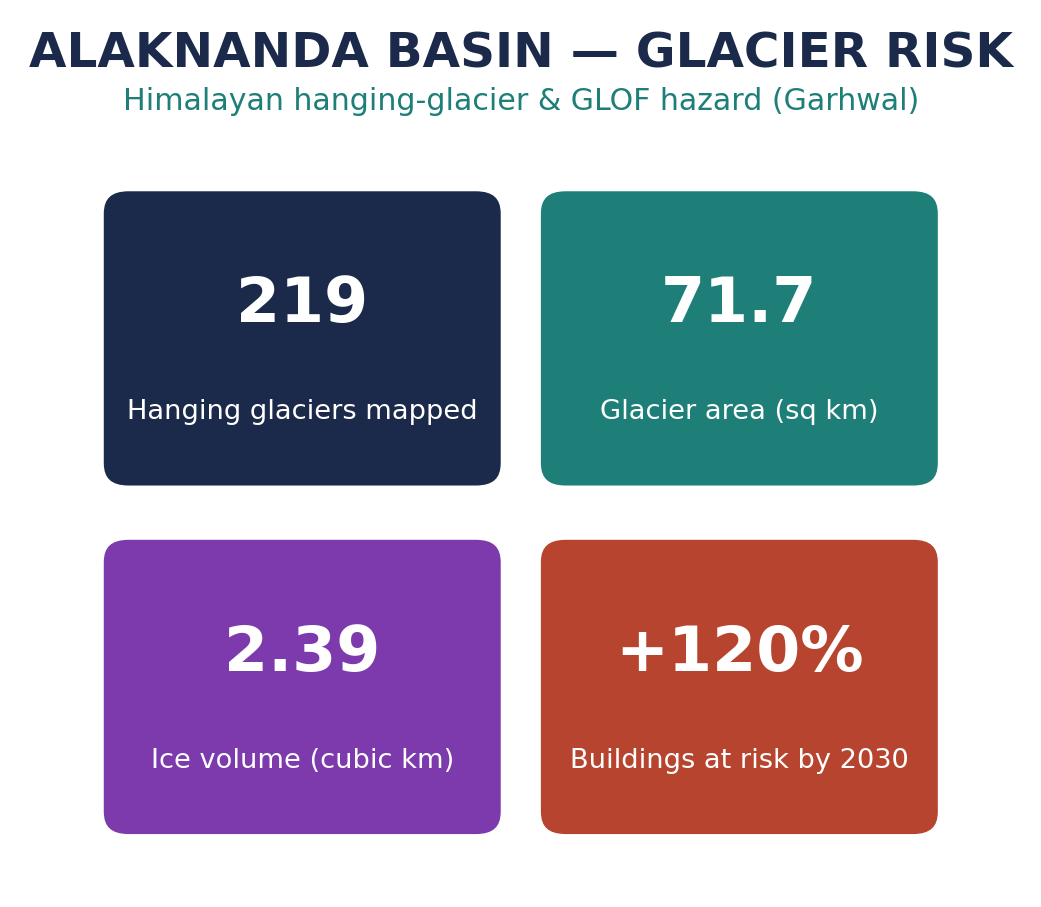
A recent scientific study inventoried 219 hanging glaciers in the Alaknanda basin of the Garhwal Himalaya, warning that thawing permafrost is loosening ice anchored to steep cliffs and raising the risk of ice-rock avalanches and Glacial Lake Outburst Floods (GLOF).
Key facts
Total glacier area 71.7 sq km; ice volume 2.39 cubic km; one-third of unstable ice in the Badrinath–Mana sector.
Buildings at risk projected to rise 120% by 2030 (vs 2000); population in vulnerable zones up 17%.
Recalls the February 2021 Chamoli disaster (Rishiganga valley) that killed 200+ with no prior monitoring.
NH-7 (Badrinath highway) and pilgrim sites Badrinath, Kedarnath, Joshimath lie in the risk zone.
Install GLOF early-warning sensors, restrict construction in eco-fragile zones, and adopt the monitored-evacuation model (as in Blatten, Switzerland, 2025).
Concept
GLOF: sudden release of water from a glacial lake. Permafrost: permanently frozen ground that acts as 'freeze-glue' anchoring mountain ice.
Stat tiles: 219 hanging glaciers, 71.7 sq km area, 2.39 cubic km ice, +120% buildings at risk by 2030. — StudyForGS
2. Uttarakhand on High Alert as Monsoon Fury Triggers Landslides; SDRF Steps Up
Disaster management in Uttarakhand; Char Dham route management; role of SDRF/USDMA.
Context
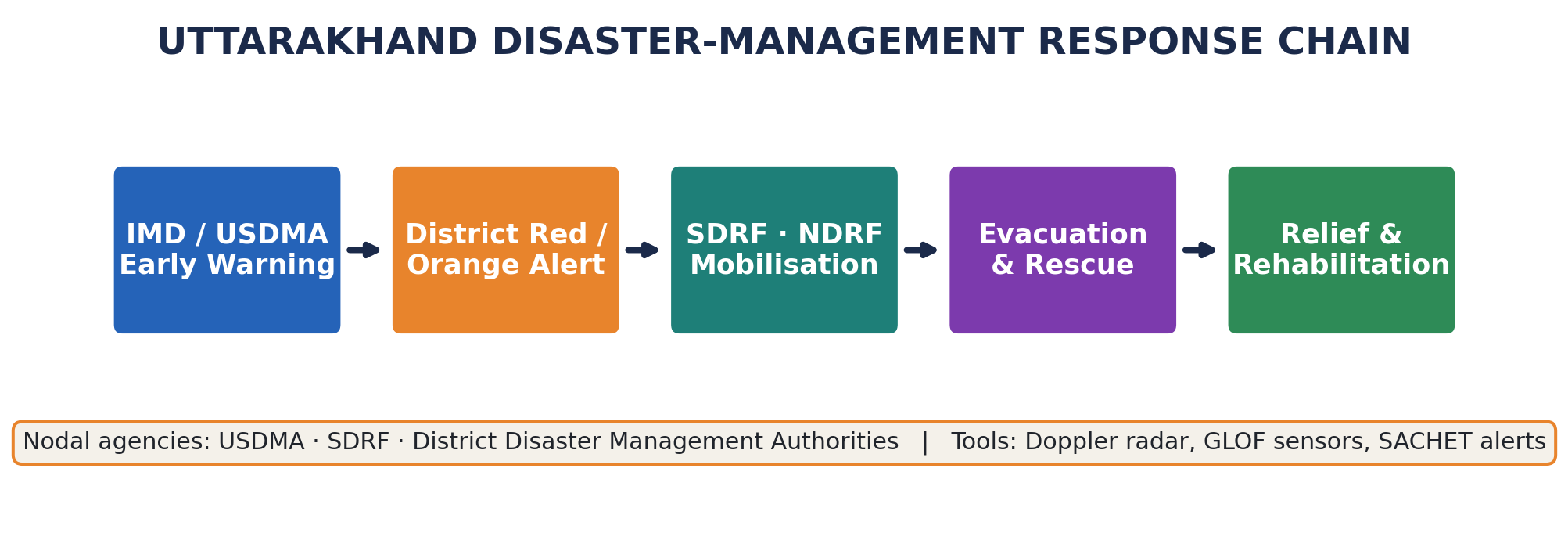
Intense late-monsoon spells have brought cloudbursts, flash floods and landslides across hill districts, blocking Char Dham routes and prompting red/orange alerts, as the state activates its disaster-response chain from early warning to relief.
Key facts
IMD red alerts issued for multiple hill districts; schools shut and pilgrim movement regulated.
SDRF, NDRF and district authorities mobilised; SACHET alerts and control rooms activated.
Landslides recurrently block the Rishikesh–Badrinath (NH-7) and Sonprayag–Kedarnath stretches.
State pushing a 'disaster-resilient' Char Dham Yatra model after heavy-rain casualties in 2026.
Way forward
Strengthen slope stabilisation on highways, expand Doppler-radar and GLOF-sensor coverage, and enforce carrying-capacity limits on the Yatra.
Concept
USDMA: Uttarakhand State Disaster Management Authority. SDRF: State Disaster Response Force, the first responder in hill emergencies.
Green GDP, natural-capital accounting; Uttarakhand-specific green initiatives.
Context
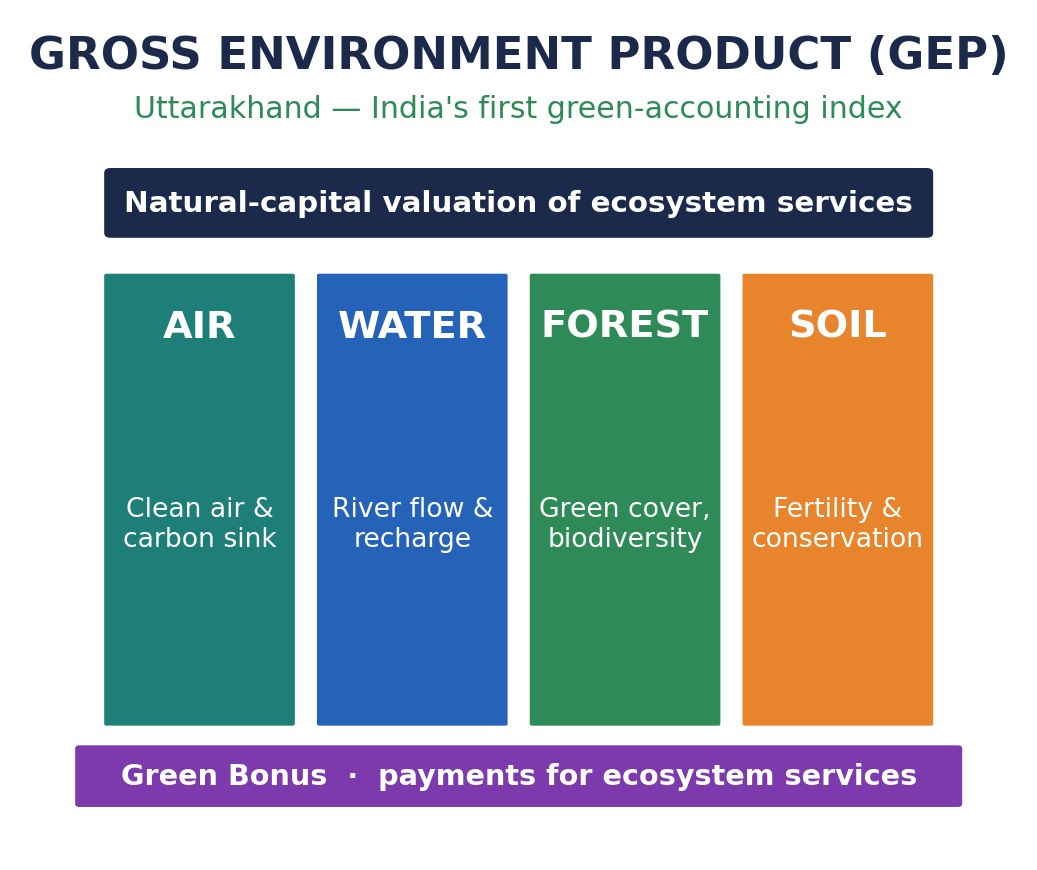
Uttarakhand pioneered Gross Environment Product (GEP) — India's first index to measure the economic value of ecosystem services — and continues to link it with policy and its demand for a Green Bonus for Himalayan states.
Key facts
GEP values four natural assets: air, water, forest and soil.
Uttarakhand is the first Indian state to launch a GEP framework, complementing GSDP with an ecological measure.
Underpins the state's demand for a 'Green Bonus' / payments for ecosystem services from the Centre.
Aligns with the concept of Green GDP and natural-capital accounting.
Way forward
Institutionalise annual GEP reporting, tie forest/water conservation to fiscal transfers, and mainstream payments for ecosystem services.
Concept
Ecosystem services: benefits people derive from nature (clean air, water, pollination). Green GDP: GDP adjusted for environmental costs.
Four pillars — Air, Water, Forest, Soil — under a roof labelled natural-capital valuation, on a Green Bonus base. — StudyForGS
4. Uniform Civil Code: Uttarakhand's Rollout and 2026 Amendment in the Spotlight
UCC & Article 44 (DPSP); Uttarakhand as first state to implement UCC.
Context
Uttarakhand — the first state to implement a Uniform Civil Code (UCC) — refined its rules through the UCC (Amendment) Ordinance 2026, keeping the code and its registration portal in active operation.
Key facts
UCC covers marriage, divorce, succession and live-in registration; tribal communities are exempted.
Backed by Article 44 of the Constitution (Directive Principles of State Policy).
A dedicated online portal handles registrations and grievances.
The 2026 amendment eased procedural and registration provisions.
Way forward
Ensure smooth digital registration, safeguard privacy, and build public awareness while other states study the template.
Concept
Article 44 (DPSP): the State shall endeavour to secure a Uniform Civil Code. DPSP: non-justiciable guidelines for governance.
5. Supreme Court Nudges States to Raise District Judges' Retirement Age to 62
POLITYUKPSC: Prelims + Mains (Polity & Judiciary)
Syllabus linkage
Judiciary, district courts, pendency; Prelims: subordinate courts (Articles 233–237).
Context
Citing 5.18 crore pending cases in district courts, the Supreme Court directed states to raise the retirement age of judicial officers from 60 to 62 years, with a suitability check at 60.
Key facts
Bench led by CJI Surya Kant; states to decide in two weeks, amend rules in two months.
Seven states have already agreed; Uttarakhand is among those yet to commit.
Court called the financial-burden objection 'negligible' (citing a 1992 precedent).
Suitability assessment to follow the Madras High Court model.
Way forward
States should amend service rules promptly and pair it with faster recruitment to cut pendency.
Concept
District judiciary: the subordinate courts at district level, the backbone of access to justice under Articles 233–237 of the Constitution.
6. GDP Base Year Shifts to 2022-23; WPI Replaced by Producer Price Index
ECONOMYUKPSC: Prelims + Mains (Economy & National Income)
Syllabus linkage
National income accounting, GDP, price indices (WPI, PPI, CPI).
Context
The official statistics agency released National Accounts Statistics 2026 with a new base year of 2022-23, and moved from the Wholesale Price Index (WPI) to a Producer Price Index (PPI) for deflating GDP.
Key facts
New base year: 2022-23 (from 2011-12).
PPI replaces WPI; a new Banking Services Price Index (BkSPI) — India's first — is introduced.
IIP item coverage widened; 60 statements including revised estimates released.
Aligns India's statistics with international standards.
Way forward
Ensure back-series continuity and transparent methodology so revised growth numbers stay comparable.
Concept
PPI: measures the average change in producers' selling prices. Base year: the reference year for constant-price (real) GDP.
7. RBI Holds Repo Rate at 5.25%, Raises FY27 Growth View to 6.7%
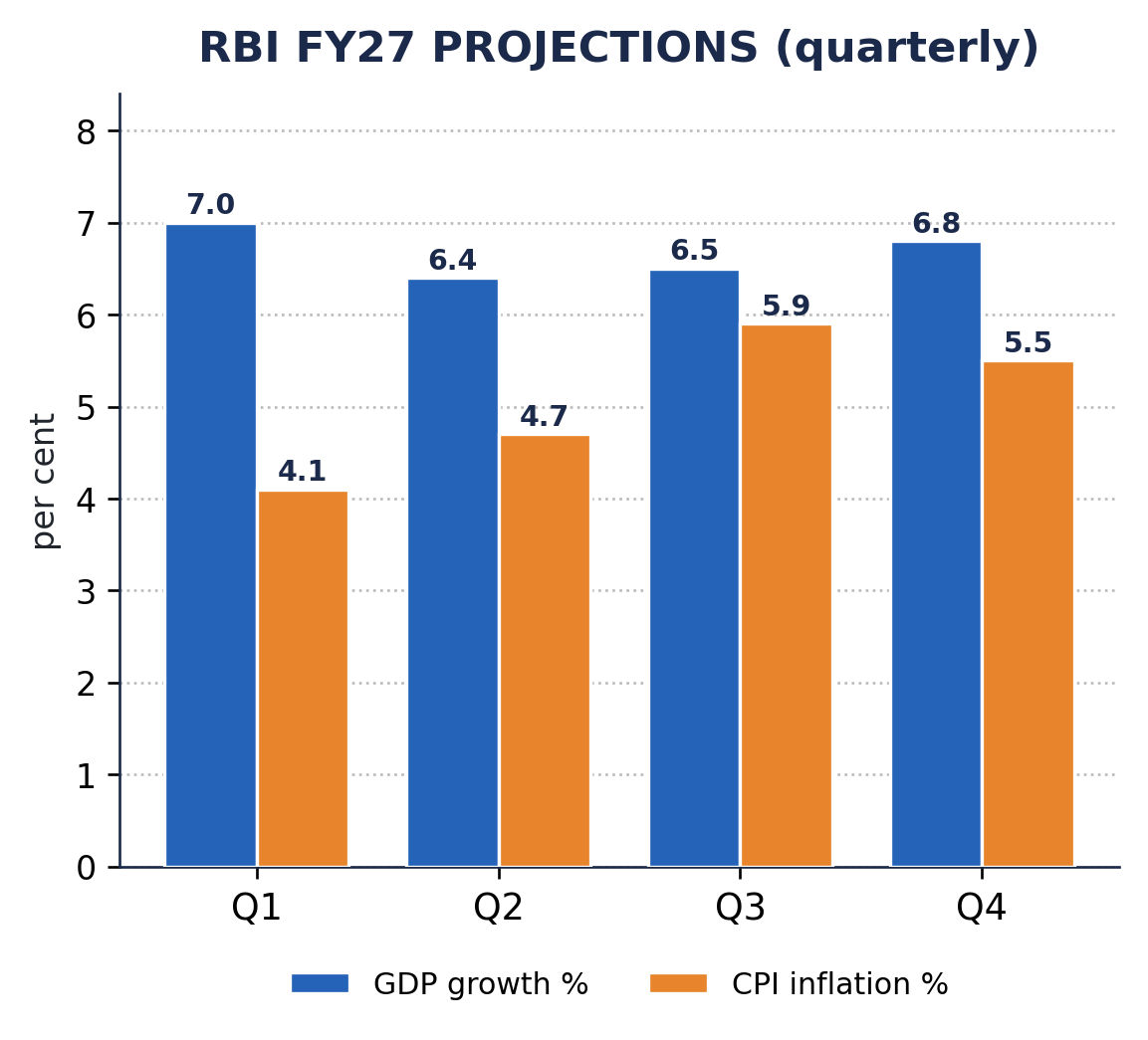
In its August 2026 review, the Monetary Policy Committee (MPC) kept the repo rate at 5.25% with a neutral stance, nudging up the growth forecast while trimming the inflation projection.
Space technology, ISRO launch vehicles, satellites & applications.
Context
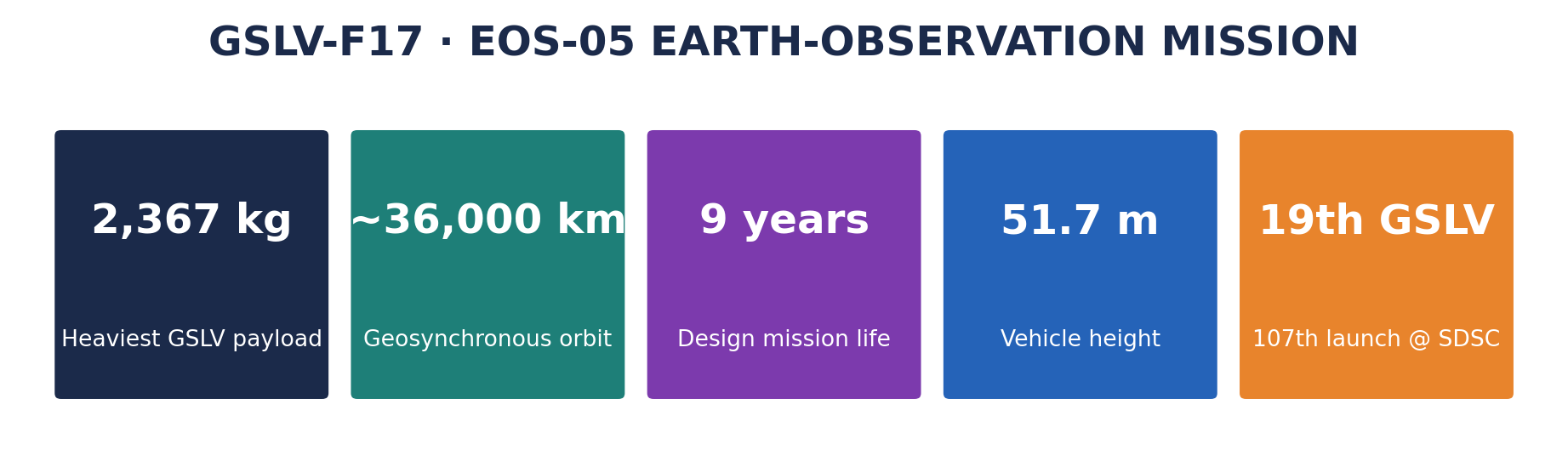
ISRO placed the 2,367 kg EOS-05 — its heaviest GSLV payload — into a geosynchronous transfer orbit aboard GSLV-F17, ending an eight-month launch hiatus.
Climate change, Paris Agreement, carbon removal, global environmental governance.
Context
A UN environment report concluded that the 1.5°C Paris goal will be breached 'in the next few years', with warming already near 1.4°C, and floated large-scale carbon dioxide removal (CDR) as a fallback.
Key facts
Current warming ~1.4°C; on present policies, 2.6°C by 2100.
Fallback: cap overshoot near 1.8°C, then remove carbon to bring temperatures down.
CDR methods: afforestation, BECCS, direct air capture (DAC), enhanced weathering.
Warns of AMOC weakening and near-total coral bleaching at 1.5°C.
Way forward
Deep, immediate emission cuts remain primary; CDR must not become an excuse for delay ('moral hazard').
Concept
CDR: removing CO2 from the atmosphere. AMOC: Atlantic Meridional Overturning Circulation, a key ocean-current system.
10. India–China Hold First Corps Commander Talks in Arunachal's Eastern Sector
IRUKPSC: Prelims + Mains (International Relations & Security)
India and China held their first Corps Commander-level meeting in Arunachal Pradesh, focusing on de-escalation along the eastern sector of the Line of Actual Control (LAC).
Key facts
Talks aimed at easing border tensions in the eastern (Arunachal) sector.
Part of continued military-diplomatic engagement on the LAC.
Complements ongoing disengagement discussions across sectors.
China claims Arunachal as 'South Tibet'; India firmly rejects this.
Way forward
Sustain military-diplomatic channels, complete disengagement, and restore border tranquillity per past agreements.
Concept
LAC: the de facto boundary between India and China. Corps Commander talks: a senior military-level mechanism to manage border standoffs.
Data point of the day
₹1.11 lakh crore
Uttarakhand State Budget, FY 2026-27 Roughly a 10% increase over the previous fiscal; 28 cabinet proposals were cleared alongside — including an Advanced Apple Nursery scheme, a Honey Production Policy 2026 and a treated-water reuse policy.
Prelims rapid-fire
Winter Corbett-region tourism festivals promote off-season Kumaon tourism and 'Vocal for Local'.
The 16th National Meet of State Biodiversity Boards was held in Chandigarh.
The National Biodiversity Authority crossed ₹200-crore cumulative Access & Benefit-Sharing disbursement.
India's U-20 men's football team qualified for the AFC U-20 Asian Cup after 20 years.
The IAF Sarang helicopter display team performed at the El Alamein Airshow, Egypt.
Tamil Nadu began Phase-3 underwater archaeology at Poompuhar.
Practice MCQs — UKPSC Prelims pattern
Q1. Consider the following about Gross Environment Product (GEP): (1) Uttarakhand was the first Indian state to launch a GEP index. (2) GEP measures the value of air, water, forest and soil. (3) GEP replaces Gross State Domestic Product (GSDP). Which of the above is/are correct?
1 and 2 only
2 and 3 only
1 and 3 only
1, 2 and 3
Show answer
Answer: A GEP complements — it does not replace — GSDP; it is an ecological measure valuing ecosystem services across air, water, forest and soil. Hence statement 3 is incorrect.
Q2. With reference to the RBI's August 2026 monetary policy, which statement is correct?
Repo rate was raised to 5.50%
Repo rate was kept at 5.25% with a neutral stance
FY27 GDP growth was cut to 6.0%
The CPI inflation target was scrapped
Show answer
Answer: B The MPC held the repo rate at 5.25% (neutral stance), raised FY27 GDP to 6.7% and trimmed CPI to 5.0%; the 4% (±2%) inflation target remains in force.
Mains practice question
Q. The Himalayan state of Uttarakhand faces a rising frequency of GLOF and cloudburst-driven disasters. Discuss the structural and ecological factors behind this, and suggest a disaster-resilient development model for the state. (250 words)
Hint / approach
Cover permafrost thaw and hanging glaciers (219 in the Alaknanda basin), unregulated construction on fragile slopes, and Char Dham pressure; then link solutions — GLOF early-warning sensors, carrying-capacity limits, eco-sensitive zoning and GEP-based green planning.
📌 One-line revision: Remember: 219 hanging glaciers in the Alaknanda basin; GEP values air-water-forest-soil; RBI repo held at 5.25% with FY27 GDP at 6.7%; EOS-05 (2,367 kg) launched on GSLV-F17; UCC — Uttarakhand is the first state.