Daily Current Affairs for Madhya Pradesh PSC (MPPSC)
MPPSC Current Affairs — 7 September 2026
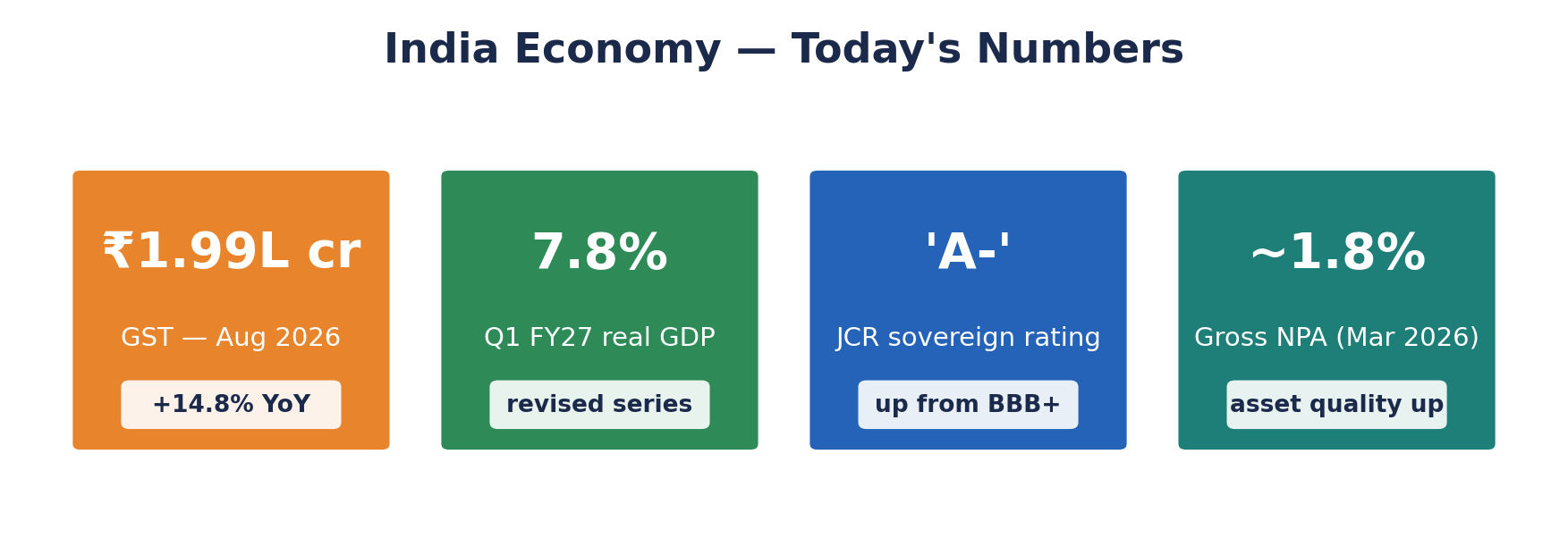
MP Cabinet clears ~Rs 41,000 crore development-and-jobs package; India's GST touches Rs 1.99 lakh crore in August and Japan's JCR upgrades India's rating to 'A-' after 35 years.
Monday, 7 September 2026 · IST · Madhya Pradesh + National · 11 items · 2 MCQs
Madhya Pradesh dominates today's board: the Mohan Yadav Cabinet's Rs 41,000 crore package, the new 'Kavach' farmer-credit scheme, an NGT crackdown on Bhopal's Bhoj Wetland, and the Rs 4,892/quintal soybean MSP for the 'Soybean State'. Nationally, GST rose 14.8% to Rs 1.99 lakh crore, Japan's JCR lifted India to 'A-', the Supreme Court expanded RBI's power over co-operative banks, and the Cabinet cleared the 'Samudra Manthan' offshore exploration scheme.
Today at a glance — things to remember
MP Cabinet approves ~Rs 41,000 crore for infrastructure, welfare and jobs
New 'Kavach' scheme restores cooperative credit for ~5,000 MP farmers
NGT orders removal of illegal structures at Bhopal's Bhoj Wetland (Ramsar)
Soybean MSP set at Rs 4,892/quintal; MP is India's top soybean producer
Cheetah to be shifted from Kuno to Gandhi Sagar Sanctuary on Sept 17
MP gives Rs 304 crore laptop incentive to 1.21 lakh meritorious students
GST collection Rs 1.99 lakh crore in Aug 2026, up 14.8% year-on-year
Japan's JCR upgrades India to 'A-', first rating rise in 35 years
Supreme Court: RBI can supersede multi-state co-op bank boards beyond 6 months
Prelims: MP state schemes & institutions | Mains GS-III: MP economy, infrastructure, employment; GS-II: state governance
Context
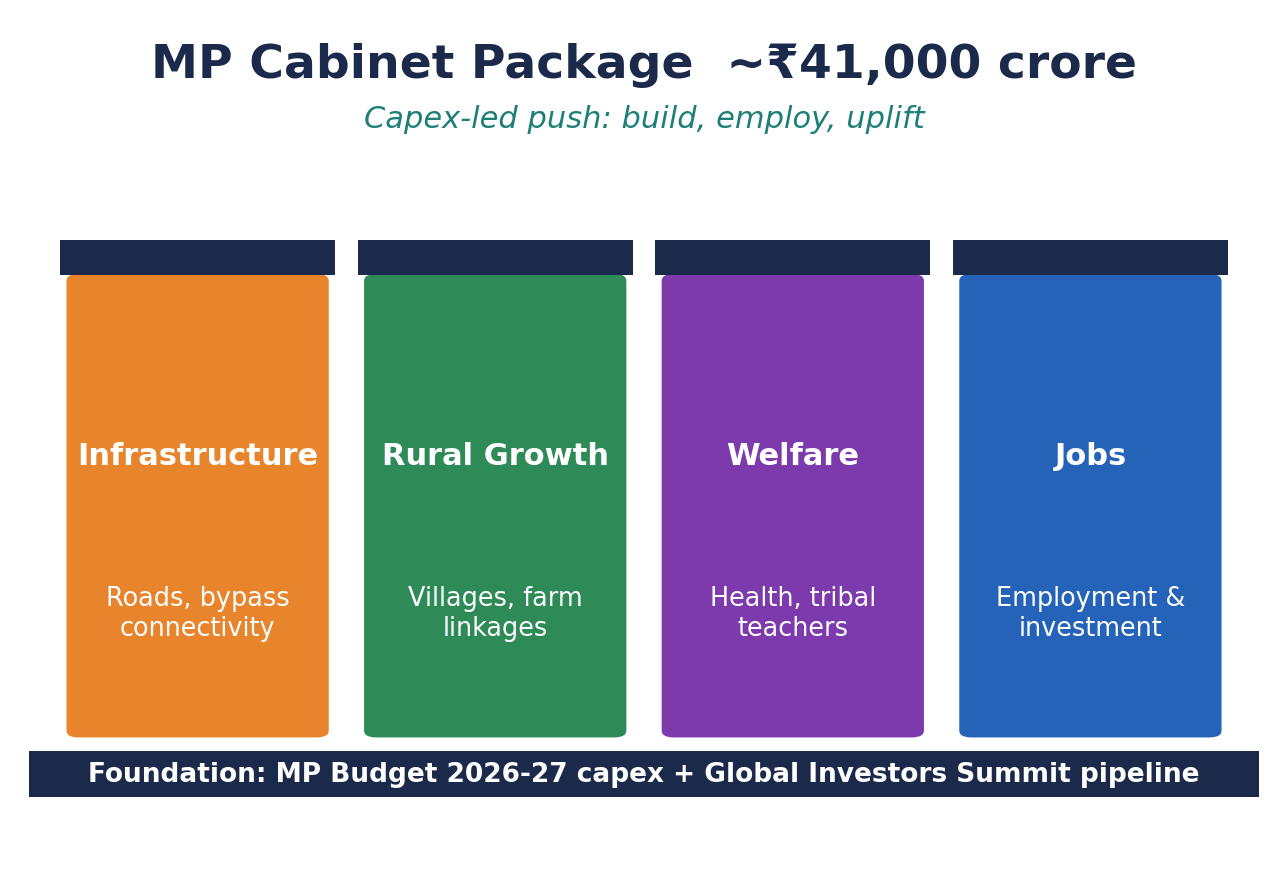
The Mohan Yadav Cabinet approved a package of roughly Rs 41,000 crore aimed at infrastructure, rural growth, welfare and job creation, signalling a capex-led push ahead of the investment cycle.
Key facts
Total outlay of about Rs 41,000 crore spread across infrastructure, welfare and employment.
Includes a large road-and-connectivity component (~Rs 4,600 crore class of works) to upgrade state highways.
Aligned with the MP Budget 2026-27 capex thrust and the Global Investors Summit investment pipeline.
Approved a revised Bhopal Western Bypass and restructuring of RGPV (technical university).
Way forward
Timely tendering and monitoring via the state's project-management units will decide whether the capex converts into jobs.
Concept
Capital expenditure (capex) has a higher fiscal multiplier than revenue spending; state capex complements the Centre's 50-year interest-free loan scheme for states.
Four-pillar diagram of the Rs 41,000 crore MP package: infrastructure, rural growth, welfare and jobs. — StudyForGS
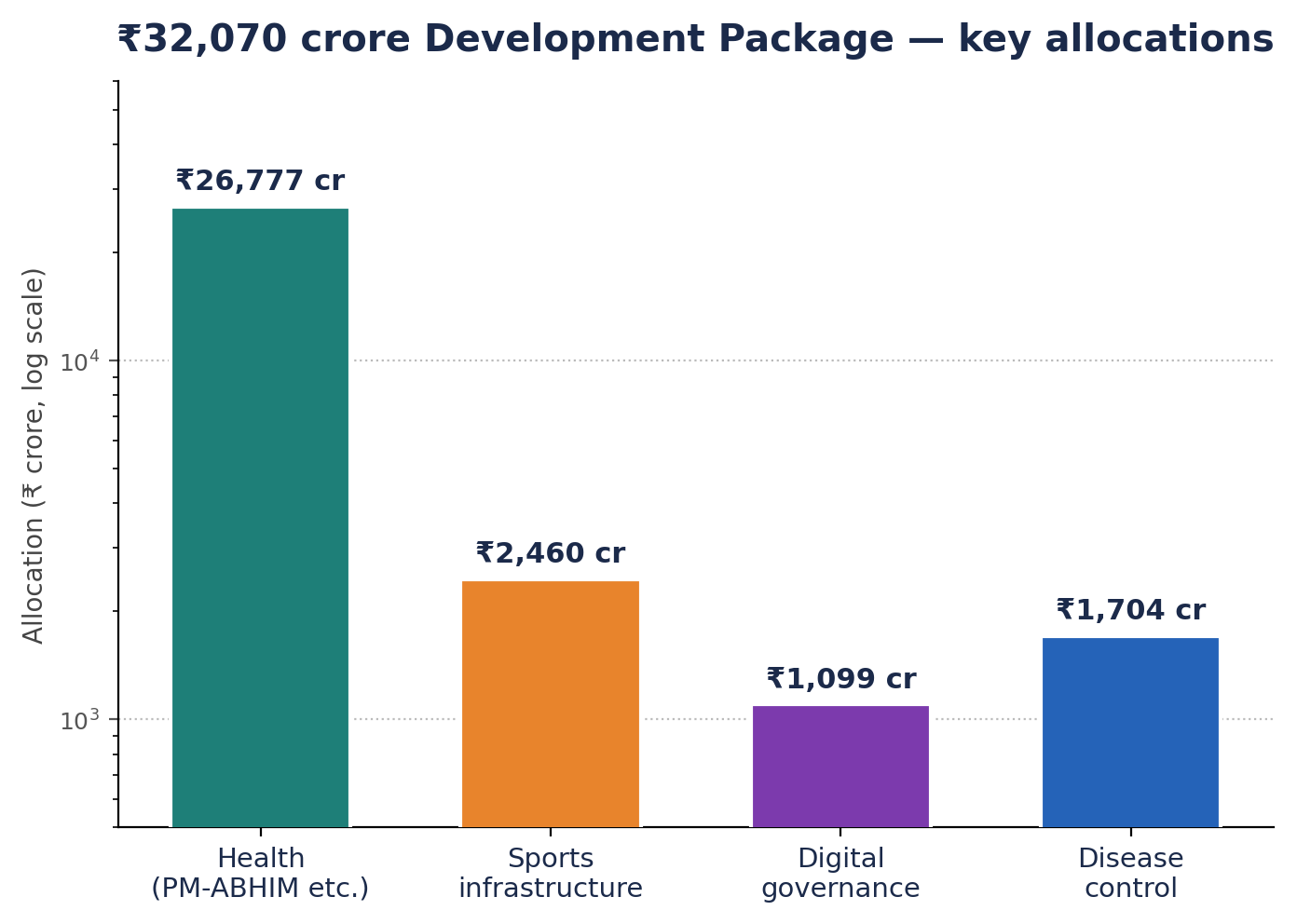
Alongside a Rs 32,070 crore development package, the Cabinet cleared the new 'Kavach' scheme to bring back into the formal credit fold about 5,000 farmers whose cooperative loan accounts were flagged for irregularities.
Key facts
Kavach: state gives Rs 25 crore one-time equity support; Apex & District Co-op Banks add a Rs 50 crore relief fund.
Restores farmers' eligibility for cooperative loans and linked welfare benefits.
Package split: Health Rs 26,777 cr, Sports Rs 2,460 cr, Digital governance Rs 1,099 cr, Disease control Rs 1,704 cr.
Also cleared a 4th time-bound pay scale for long-serving Tribal Affairs Dept teachers.
Way forward
Ring-fencing genuine borrowers from wilful defaulters and digitising PACS records can prevent repeat irregularities.
Concept
PACS (Primary Agricultural Credit Societies) are the ground-level tier of India's 3-tier short-term cooperative credit structure under NABARD refinance.
Bar chart of the Rs 32,070 crore MP package showing health, sports, digital and disease-control allocations. — StudyForGS
3. NGT cracks down on Bhopal's Bhoj Wetland (Ramsar site)
The National Green Tribunal (NGT) ordered removal within 3 months of illegal constructions in the wetland, buffer and impact zones of Bhopal's Bhoj Wetland, flagging serious threats to the Ramsar-listed lake system.
Key facts
Bhoj Wetland (Upper & Lower Lakes) is a Ramsar site since 2002, the lifeline of Bhopal, the 'City of Lakes'.
NGT directed removal of encroachments from wetland, buffer zone and impact area within 3 months.
The Upper Lake (Bada Talab) was built in the 11th century by Raja Bhoj of Dhar.
Wetlands are governed by the Wetlands (Conservation & Management) Rules, 2017.
Way forward
A demarcated wetland boundary with GIS mapping and a statutory Wetland Authority can balance conservation with the city's water security.
Concept
The Ramsar Convention (1971) protects 'Wetlands of International Importance'; 'wise use' is its core principle. India has 90+ Ramsar sites.
4. Soybean MSP fixed at Rs 4,892/quintal — MP the 'Soybean State'
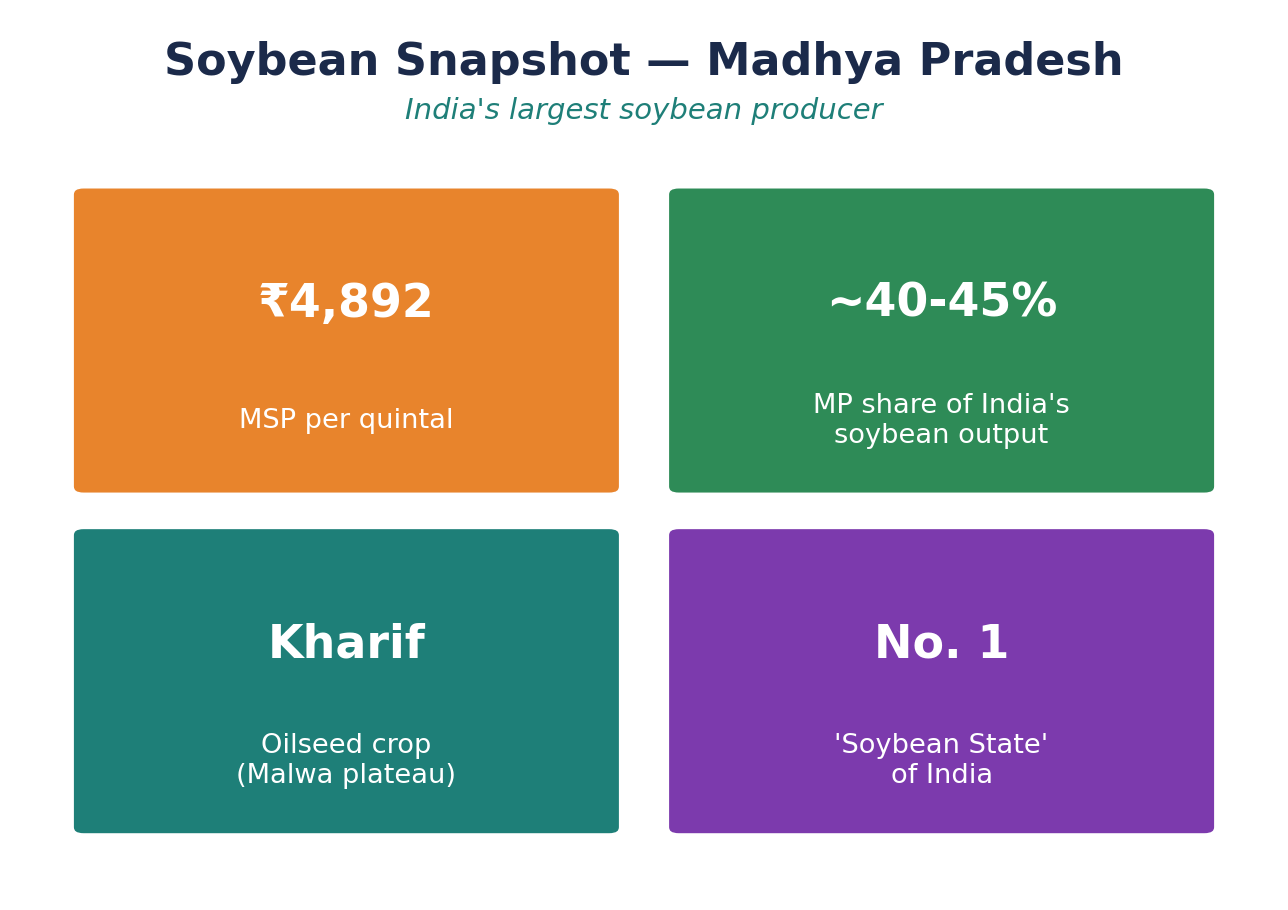
With the kharif crop nearing market, the soybean MSP has been fixed at Rs 4,892 per quintal, a critical support for Madhya Pradesh, India's largest soybean producer and the country's original 'Soybean State'.
Key facts
Soybean MSP for the season set at Rs 4,892/quintal; state procurement to open in the coming weeks.
MP contributes the largest share of India's soybean output (~40-45%), centred on the Malwa plateau.
Soybean is a kharif oilseed; MP also leads in gram/pulses and is a top wheat (incl. Sharbati) grower.
A Bhavantar-style price-deficiency support is used when mandi prices slip below MSP.
Way forward
Better warehousing, oil-milling clusters and export links can raise farmers' realisation beyond bare MSP.
Concept
MSP is recommended by the CACP and approved by the CCEA; oilseeds are strategic for cutting India's large edible-oil import bill.
Prelims: Project Cheetah, national parks, MP wildlife | Mains GS-III: species reintroduction, habitat management
Context
A female cheetah is set to be shifted from Kuno National Park to the Gandhi Sagar Wildlife Sanctuary on September 17, opening a planned second home for cheetahs under Project Cheetah and reinforcing MP's 'Cheetah State' tag.
Key facts
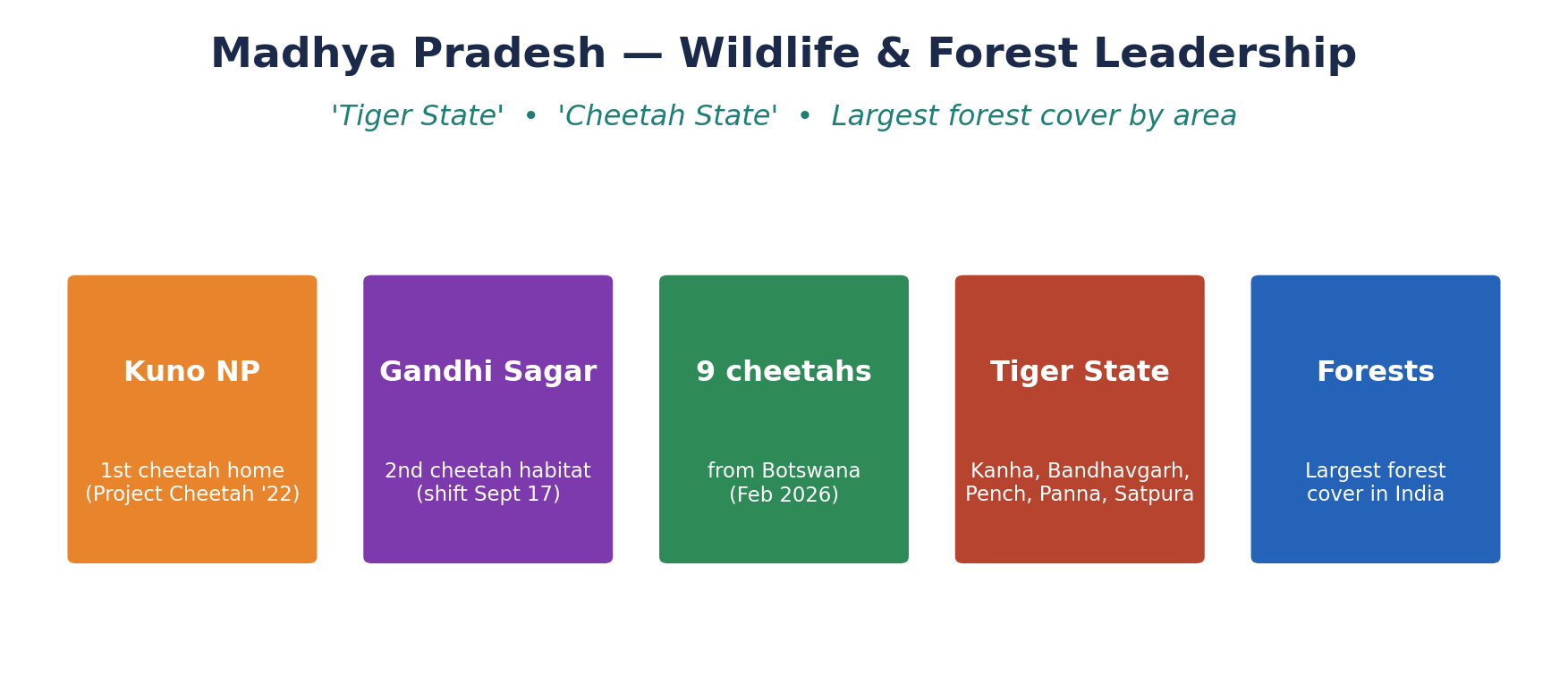
Relocation to Gandhi Sagar (Mandsaur-Neemuch) creates a second cheetah habitat besides Kuno.
Project Cheetah (from 2022) is the world's first intercontinental large-carnivore translocation.
In Feb 2026 Kuno received 9 cheetahs (6 female, 3 male) from Botswana; cubs have been born in India.
MP is the 'Tiger State' and 'Cheetah State', with the largest forest cover by area in India.
Way forward
Building a robust prey base and reducing leopard conflict at Gandhi Sagar is key before large-scale release.
Concept
The cheetah (Acinonyx jubatus) is IUCN 'Vulnerable'; the Asiatic cheetah went extinct in India by 1952, prompting African cheetah reintroduction.
Wildlife fact schematic of MP: Tiger State, Project Cheetah at Kuno and Gandhi Sagar, largest forest cover, key reserves. — StudyForGS
6. MP gives Rs 304 crore laptop incentive to 1.21 lakh meritorious students
Prelims: MP student welfare schemes | Mains GS-II: education access, human capital; GS-III: digital inclusion
Context
Chief Minister Mohan Yadav transferred over Rs 304 crore to 1.21 lakh meritorious Class-12 students as a laptop incentive, extending the state's push on digital access and merit reward.
Key facts
Rs 304 crore transferred directly to 1.21 lakh students scoring high marks in Class 12.
Each eligible student receives Rs 25,000 to buy a laptop, via Direct Benefit Transfer (DBT).
Part of MP's education-incentive suite alongside scooty and scholarship schemes.
Complements the state's focus on digital literacy and human-capital formation.
Way forward
Pairing hardware with affordable connectivity and skilling content would deepen the scheme's learning impact.
Concept
DBT routes benefits through JAM (Jan Dhan-Aadhaar-Mobile), cutting leakage; human capital is central to a state's growth potential.
7. GST collection Rs 1.99 lakh crore in August, up 14.8%
Japan Credit Rating Agency (JCR) upgraded India's sovereign rating one notch from 'BBB+' to 'A-', India's first sovereign upgrade in roughly 35 years, citing strong growth and improving bank asset quality.
Key facts
Rating raised from BBB+ to A-; JCR projects India's GDP growth above 6% for 2026-27.
Gross NPA ratio noted to have fallen to about 1.8% by March 2026.
'A-' moves India firmly into the investment-grade 'A' band, lowering perceived risk.
Better ratings can cut overseas borrowing costs and draw more foreign capital.
Way forward
Sustained fiscal consolidation and export competitiveness will be needed to convert the upgrade into cheaper capital.
Concept
Sovereign ratings gauge default risk; the big three global agencies are S&P, Moody's and Fitch, with JCR a leading Japanese agency.
9. Supreme Court expands RBI power over co-operative bank boards
The Supreme Court held that the RBI can supersede the board of a multi-state co-operative bank beyond the six-month cap, strengthening the regulator's hand in protecting depositors.
Key facts
Court allowed board supersession beyond six months for multi-state co-operative banks.
Flows from the Banking Regulation (Amendment) Act, 2020 bringing co-op banks under RBI.
Aims to protect depositors and financial stability in weak cooperative banks.
Co-operatives are a State subject; the 97th Constitutional Amendment (2011) added Part IX-B.
Way forward
Clear timelines and depositor-protection audits can balance regulatory power with cooperative autonomy.
Concept
Article 43-B (DPSP) promotes cooperative societies; dual control of urban co-op banks (RBI + Registrar) has long been a governance challenge.
10. India-China hold Corps Commander talks in Arunachal
IRMPPSC: Prelims + Mains GS-II (International Relations)
India and China held their first Corps Commander-level meeting on the eastern sector at Wacha-Damai in Arunachal Pradesh, continuing efforts to stabilise the Line of Actual Control (LAC).
Key facts
First Corps Commander-level talks in the eastern sector, at Wacha-Damai, Arunachal Pradesh.
Part of a broader push to de-escalate along the LAC after recent disengagement steps.
China claims Arunachal as 'South Tibet'; India firmly rejects the claim.
Border peace is guided by mechanisms like WMCC and Special Representatives dialogue.
Way forward
Restoring patrolling protocols and buffer-zone clarity is essential to prevent fresh friction points.
Concept
The LAC (not a demarcated boundary) separates Indian- and Chinese-controlled areas in three sectors: western, middle and eastern.
ECONOMYMPPSC: Prelims + Mains GS-III (Economy, Energy & Environment)
Syllabus linkage
Prelims: mineral/energy schemes, EEZ | Mains GS-III: energy security, blue economy
Context
The Union Cabinet cleared the 'Samudra Manthan' National Offshore Exploration Scheme, Phase-I, with an outlay of about Rs 84,084 crore to map hydrocarbon and mineral resources in India's offshore zones.
Key facts
Samudra Manthan Phase-I outlay ~Rs 84,084 crore for offshore hydrocarbon and mineral exploration.
Targets resources within India's Exclusive Economic Zone (EEZ) and continental shelf.
Advances energy security and the Blue Economy agenda; cuts import dependence.
Complements Deep Ocean Mission and offshore mineral auction reforms.
Way forward
Environmental safeguards and credible seismic data will be vital to attract private and foreign explorers.
Concept
The EEZ extends 200 nautical miles from the baseline under UNCLOS, giving India rights over living and non-living resources.
Data point of the day
Rs 4.38 lakh crore
MP Budget 2026-27 outlay A record women-centric budget: Rs 1.27 lakh crore for women's schemes, of which Rs 23,800 crore is earmarked for the flagship Ladli Behna Yojana. No new taxes were levied.
Prelims rapid-fire
MP Budget 2026-27 size: Rs 4.38 lakh crore; no new taxes.
Ladli Behna Yojana allocation in MP Budget: Rs 23,800 crore.
IMD issued heavy-rain and strong-wind warnings for MP, UP and Bihar.
28th Western Zonal Council meeting was chaired by Home Minister Amit Shah.
Indian Railways approved Rs 170 crore for Kavach 4.0 over 712 route-km (Moradabad).
UNGA adopted the 'Correct the Map' resolution favouring the Equal Earth projection.
Practice MCQs — MPPSC Prelims pattern
Q1. With reference to Project Cheetah, consider the following statements:
1. Kuno National Park is located in Madhya Pradesh.
2. Gandhi Sagar Wildlife Sanctuary is being developed as a second cheetah habitat.
3. The cheetahs introduced under the project are of the Asiatic sub-species.
Which of the statements given above are correct?
1 and 2 only
2 and 3 only
1 and 3 only
1, 2 and 3
Show answer
Answer: A Kuno (MP) hosts Project Cheetah and Gandhi Sagar is the planned second home, so 1 and 2 are correct. The cheetahs are African cheetahs (from Namibia, South Africa, Botswana), not the extinct Asiatic sub-species, so 3 is wrong.
Q2. Which of the following is/are correct about the Goods and Services Tax (GST) in India?
1. It is a destination-based consumption tax.
2. The GST Council is a constitutional body under Article 279A.
3. IGST is levied on intra-state supply of goods and services.
Select the correct answer:
1 and 2 only
2 and 3 only
1 and 3 only
1, 2 and 3
Show answer
Answer: A GST is destination-based (1 correct) and the GST Council is established under Article 279A (2 correct). IGST applies to inter-state supply, not intra-state (CGST+SGST apply intra-state), so 3 is wrong.
Mains practice question
Q. Madhya Pradesh's identity rests on being India's 'Tiger State', 'Cheetah State' and 'Soybean State'. Discuss how the state can convert this ecological and agricultural leadership into sustainable livelihoods, while safeguarding its forests and water resources. (250 words)
Hint / approach
Link Project Cheetah/Kuno-Gandhi Sagar and tiger reserves to eco-tourism jobs; connect soybean MSP, Bhavantar and food-processing clusters; weave in Narmada/wetland (Bhoj) conservation and PESA-based tribal participation. Balance conservation with livelihood.