Bihar's first e-Cabinet clears ₹1,794.32 crore Ganga water for Patna and a six-fold Gram Kachahari grant; Constitution Day; ₹11,000 crore equipment-manufacturing scheme
Thursday, 26 November 2026 · IST · Bihar + National · 10 items · 2 MCQs
Bihar's cabinet met as a paperless e-Cabinet for the first time on 25 November 2026 and cleared 34 proposals — Ganga-water supply for 75 Patna wards, a six-fold Gram Kachahari grant, 1,294.37 acres for three industrial areas and free coaching for BC/EBC students in all 38 districts. Nationally, India marks Constitution Day, the Union Cabinet approved a ₹11,000 crore CIE manufacturing scheme, six urea plants were cleared, and Exercise Suryakiran XX began in Nepal.
Today at a glance — things to remember
Bihar's first paperless e-Cabinet (25 Nov 2026) cleared 34 proposals.
₹1,794.32 crore Ganga-water project for 75 Patna wards under AMRUT 2.0.
Gram Kachahari grant: ₹4,000 → ₹24,000 a year from 1 April 2027.
1,294.37 acres for industry in Nalanda, Samastipur, Sheikhpura (₹706.52 crore).
Free coaching for BC/EBC aspirants at 38 centres, ₹31.97 crore a year.
Rajgir Mahotsav in Nalanda: 26–28 November 2026.
Constitution Day: Constitution adopted on 26 November 1949.
Union Cabinet: ₹11,000 crore scheme for construction & infrastructure equipment.
Six brownfield urea plants of 12.7 LMT each under NIPU-2026 (~₹54,000 crore).
Forex reserves US$ 737.78 bn at end-September 2026 (RBI).
Detailed notes
1. Bihar's first paperless e-Cabinet clears ₹1,794.32 crore Ganga-water supply for 75 Patna wards
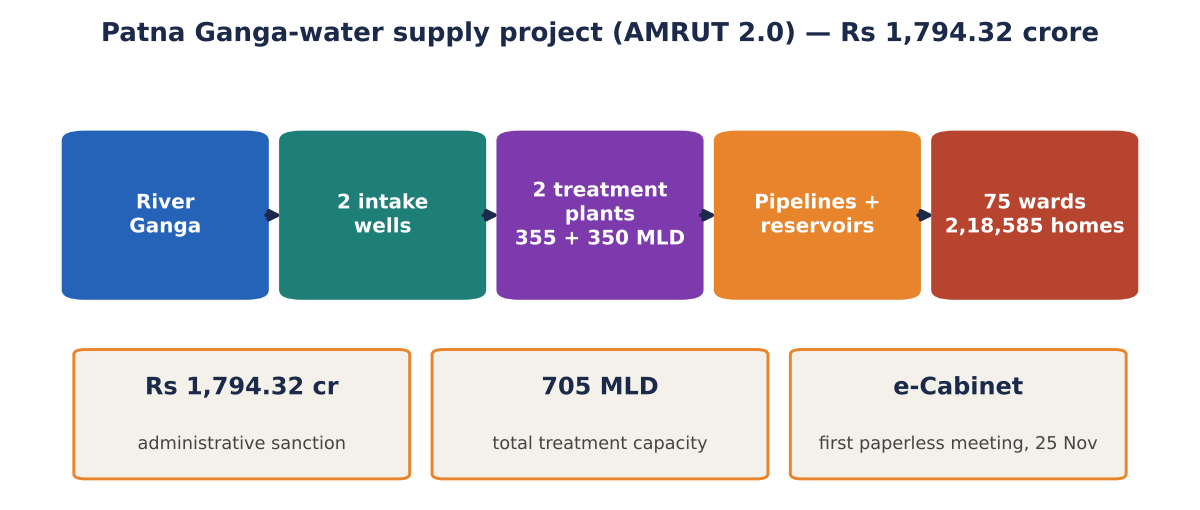
On 25 November 2026 the Bihar cabinet chaired by Chief Minister Samrat Choudhary met for the first time as a paperless e-Cabinet and cleared 34 proposals. The largest was administrative sanction of ₹1,794.32 crore for a Ganga-water supply project for Patna under AMRUT 2.0.
Key facts
Coverage: 75 wards of Patna; about 2,18,585 households to get treated Ganga water.
Components: two intake wells on the Ganga, two water treatment plants of 355 MLD and 350 MLD, pipelines and reservoirs.
e-Cabinet: the cabinet process goes fully digital and paperless from 25 November 2026.
Same meeting: 64 posts created in the Critical Care Medicine department of IGIMS, Patna.
Way forward
Shifting Patna from groundwater to Ganga surface water eases aquifer depletion and arsenic risk; timely completion, metering and proper O&M by the urban local body are key.
Concept
AMRUT 2.0 (Atal Mission for Rejuvenation and Urban Transformation) was launched on 1 October 2021 by the Ministry of Housing and Urban Affairs to provide tap-water supply in all statutory towns; the first AMRUT began in June 2015. MLD = million litres per day.
Flowchart of the Patna Ganga-water project: River Ganga to 2 intake wells to 2 treatment plants of 355 and 350 MLD to pipelines and reservoirs to 75 wards and 2,18,585 homes, with tiles for Rs 1,794.32 crore, 705 MLD and the first e-Cabinet. — StudyForGS
2. Gram Kachahari grant raised six-fold: ₹4,000 to ₹24,000 a year
Mains GS-II: Indian polity — local self-government, Bihar governance; Prelims: Panchayati Raj, Bihar-specific institutions
Context
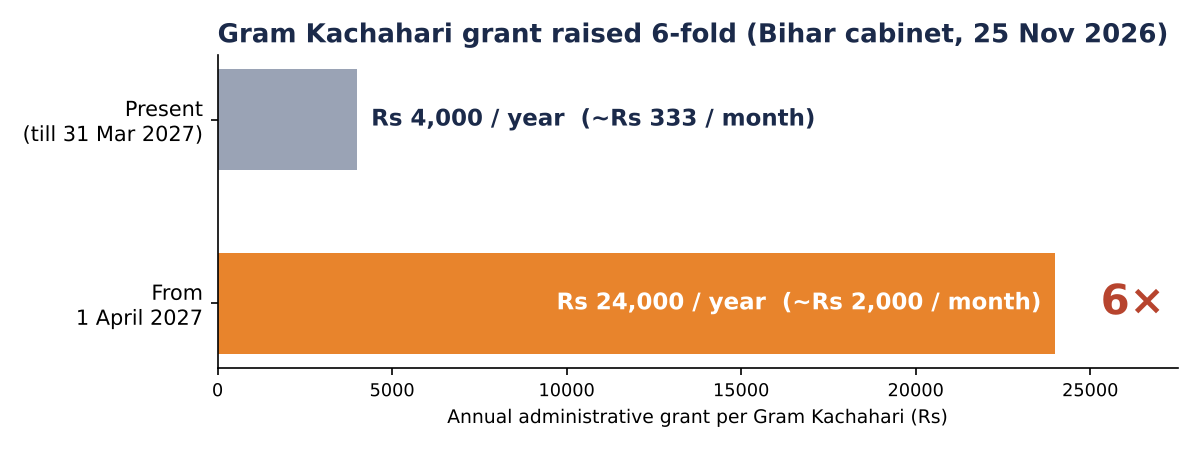
The Bihar cabinet on 25 November 2026 raised the annual administrative grant of every Gram Kachahari (village court) from ₹4,000 to ₹24,000 — a six-fold increase, effective 1 April 2027.
Key facts
Monthly support rises from about ₹333 to about ₹2,000 per Gram Kachahari.
Effective date: 1 April 2027 (financial year 2027-28).
Gram Kachaharis settle minor civil and criminal disputes at village level, easing the load on regular courts.
Way forward
Higher funds must be matched with training of Sarpanches and Panches, support from Nyaya Mitras and digitised case records so that quick, cheap local justice actually reaches villagers.
Concept
Gram Kachahari is a village-level judicial body under the Bihar Panchayat Raj Act, 2006, headed by an elected Sarpanch. It reflects Article 40 (organisation of village panchayats, DPSP) and Article 39A (equal justice and free legal aid). Panchayats got constitutional status through the 73rd Amendment, 1992 (Part IX, Eleventh Schedule).
Horizontal bar chart: annual administrative grant per Gram Kachahari rises from Rs 4,000 (about Rs 333 a month) to Rs 24,000 (about Rs 2,000 a month) from 1 April 2027, a 6-fold increase. — StudyForGS
3. ₹706.52 crore for 1,294.37 acres: three industrial areas to expand in Nalanda, Samastipur and Sheikhpura
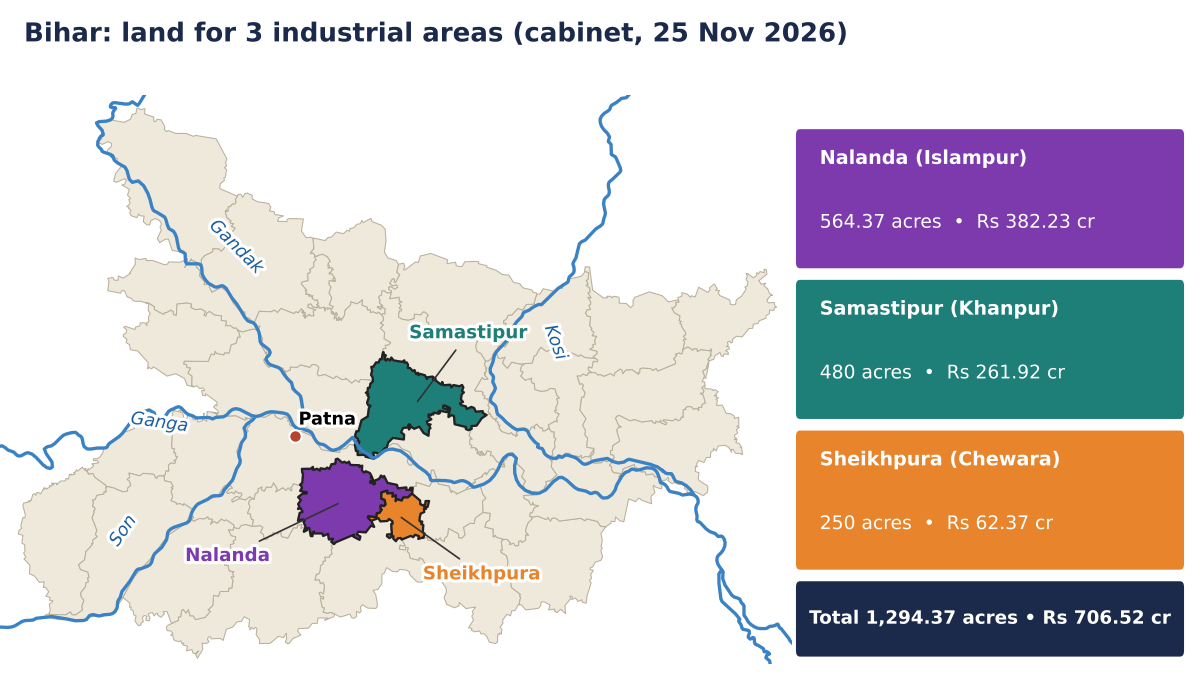
To build a land bank for investors, the cabinet on 25 November 2026 approved land acquisition of 1,294.37 acres in three districts at ₹706.52 crore. It also approved constitution of a Bihar Economic Advisory Council and an image campaign ahead of Bihar Business Connect 2027.
Key facts
Nalanda (Islampur): 564.37 acres, ₹382.23 crore.
Samastipur (Khanpur): 480 acres, ₹261.92 crore.
Sheikhpura (Chewara): 250 acres, ₹62.37 crore.
Bihar Business Connect 2027 will be organised by the Industries Department in February 2027.
Way forward
Ready land with roads, power and water is the biggest pull for manufacturing; fair compensation, quick possession and plug-and-play sheds will decide whether the land bank turns into jobs.
Concept
BIADA (Bihar Industrial Area Development Authority), set up under the BIADA Act, 1974, develops and allots industrial land in Bihar. Acquisition follows the RFCTLARR Act, 2013 (Right to Fair Compensation and Transparency in Land Acquisition, Rehabilitation and Resettlement).
Map of Bihar's districts with Nalanda, Samastipur and Sheikhpura highlighted, the Ganga, Gandak, Son and Kosi rivers and Patna marked, plus a side panel: Nalanda (Islampur) 564.37 acres Rs 382.23 crore, Samastipur (Khanpur) 480 acres Rs 261.92 crore, Sheikhpura (Chewara) 250 acres Rs 62.37 crore; total 1,294.37 acres, Rs 706.52 crore. — StudyForGS
4. Free coaching for BC/EBC aspirants in all 38 districts — ₹31.97 crore a year
Mains GS-II: welfare schemes for vulnerable sections, Bihar governance; Prelims: Bihar schemes, caste survey data
Context
The cabinet on 25 November 2026 approved free pre-examination training for students of Backward Classes (BC) and Extremely Backward Classes (EBC) at 38 centres — one in every district — at an annual cost of ₹31.97 crore.
Key facts
Exams covered: UPSC, BPSC, SSC, banking and railway recruitment examinations.
Cost ₹31.97 crore per year; one centre in each of Bihar's 38 districts.
BC & EBC Welfare Department also gets 17 new posts (8 Secretariat Assistants + 9 Senior Secretariat Assistants).
Way forward
District-level centres cut the cost of moving to Patna or Delhi; good faculty, regular mock tests and tracking of final selections will decide real outcomes.
Concept
Bihar's caste-based survey (results released 2 October 2023) put EBCs at 36.01% and BCs at 27.12% of the state's population. Constitutional basis: Articles 15(4) and 16(4) (special provisions and reservation) and Article 46 (DPSP — educational and economic interests of weaker sections). Bihar has 38 districts in 9 divisions.
5. Rajgir Mahotsav 2026 begins today in Nalanda (26–28 November)
Mains GS-I: Indian culture and Bihar's heritage, Buddhism; Prelims: festivals and heritage sites of Bihar
Context
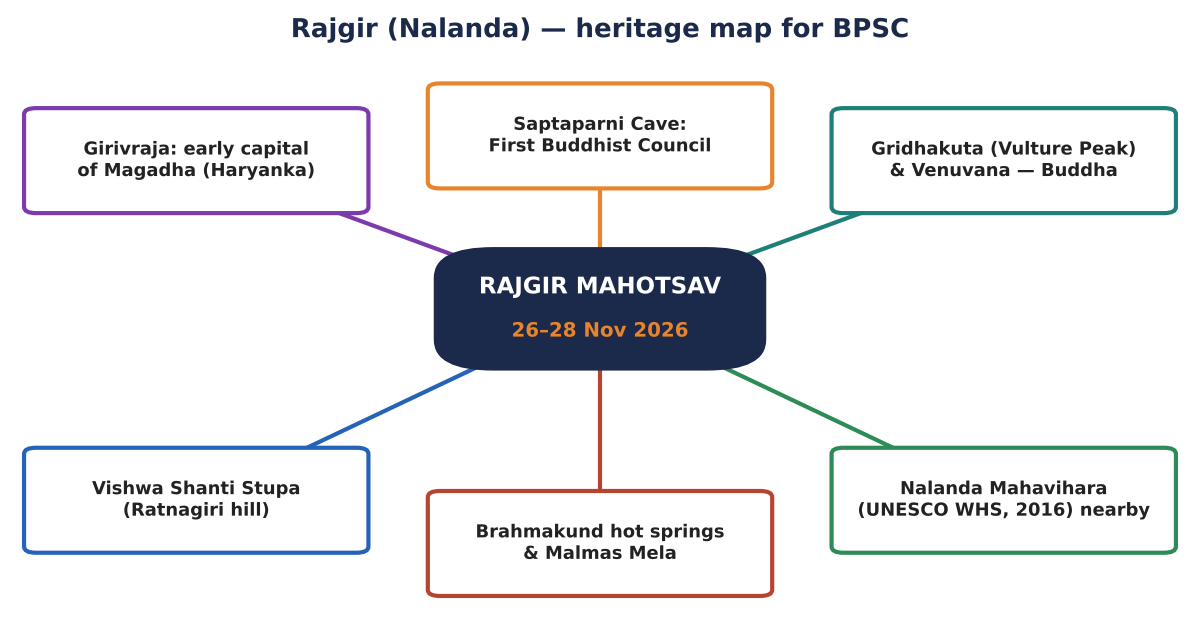
The three-day Rajgir Mahotsav opens on 26 November 2026 in Rajgir (Nalanda district) and runs till 28 November. It is organised by the Nalanda district administration.
Key facts
Cultural evenings with national-level artists and performances by local artists.
Fairs: Gramshree Mela, food (vyanjan) mela and agriculture mela.
Sports and contests: dangal (wrestling), kabaddi, karate, cricket, and a tanga and palki decoration contest.
Way forward
Linking the festival with the Buddhist circuit, Nalanda University and Rajgir's sports infrastructure can lengthen tourist stays and raise local incomes.
Concept
Rajgir (ancient Rajagriha/Girivraja) was the early capital of Magadha under Bimbisara (Haryanka dynasty). The First Buddhist Council was held at Saptaparni Cave under Ajatashatru, presided over by Mahakassapa. The Vishwa Shanti Stupa stands on Ratnagiri hill; nearby Nalanda Mahavihara became a UNESCO World Heritage Site in 2016.
Mind-map with Rajgir Mahotsav 26–28 Nov 2026 at the centre, linked to Girivraja as Magadha's early capital, Saptaparni Cave (First Buddhist Council), Gridhakuta and Venuvana, Vishwa Shanti Stupa on Ratnagiri hill, Brahmakund hot springs and Malmas Mela, and nearby Nalanda Mahavihara (UNESCO 2016). — StudyForGS
6. Constitution Day: 77 years since India adopted its Constitution — and Bihar's role in making it
Mains GS-II: Indian Constitution — making, features; GS-I: Bihar's contribution to the national movement; Prelims: Constituent Assembly
Context
26 November is observed as Samvidhan Divas (Constitution Day); the Constituent Assembly adopted the Constitution on 26 November 1949, so 2026 marks the 77th anniversary. Across Bihar, schools and Amrit Sarovar sites are marking the day with collective reading of the Preamble.
Key facts
Observed as Constitution Day since 2015 (125th birth anniversary year of Dr B.R. Ambedkar); earlier marked as National Law Day.
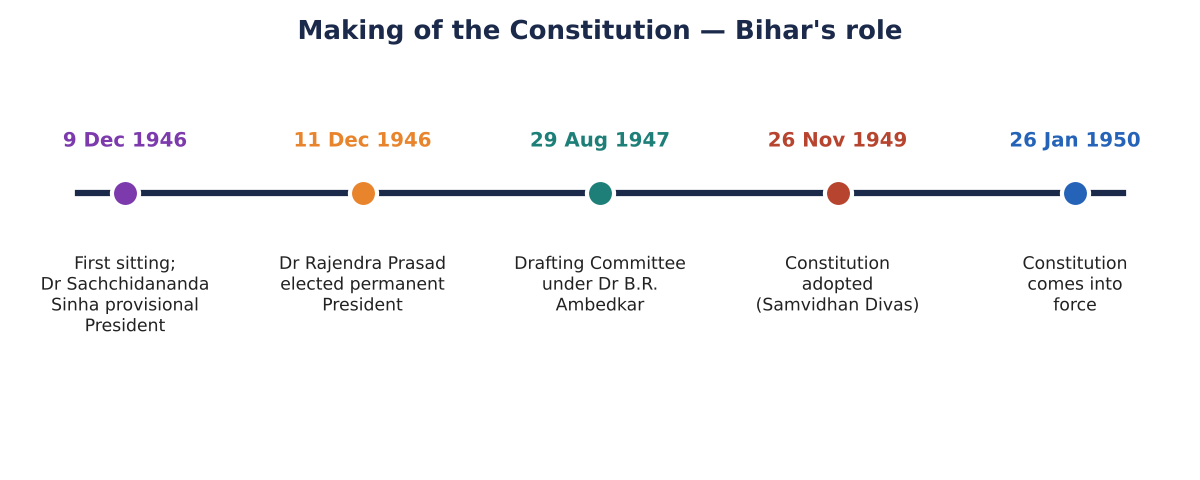
Dr Sachchidananda Sinha of Bihar presided over the first sitting on 9 December 1946 as provisional President.
Dr Rajendra Prasad (Ziradei, Siwan) was elected permanent President on 11 December 1946; he later became India's first President.
Drafting Committee formed on 29 August 1947 under Dr B.R. Ambedkar; the Constitution came into force on 26 January 1950.
Way forward
Beyond ceremonies, constitutional literacy — rights, duties (Article 51A) and how institutions work — must reach villages; Preamble reading at Amrit Sarovars with Jeevika Didis is one such outreach.
Concept
The original Constitution had a Preamble, 395 Articles, 22 Parts and 8 Schedules and took 2 years, 11 months, 18 days. The Preamble was amended only once — by the 42nd Amendment (1976), which added 'Socialist', 'Secular' and 'Integrity'. 26 January was chosen because Purna Swaraj was celebrated on 26 January 1930.
Timeline of the Constitution's making: 9 Dec 1946 first sitting with Dr Sachchidananda Sinha as provisional President; 11 Dec 1946 Dr Rajendra Prasad elected permanent President; 29 Aug 1947 Drafting Committee under Dr B.R. Ambedkar; 26 Nov 1949 Constitution adopted; 26 Jan 1950 Constitution comes into force. — StudyForGS
7. ₹11,000 crore scheme to make construction and infrastructure equipment in India
Mains GS-II: Indian economy — industrial policy, Make in India; Prelims: government schemes
Context
The Union Cabinet on 25 November 2026 approved the Scheme for Enhancement of Construction and Infrastructure Equipment (CIE) Manufacturing Ecosystem with an outlay of ₹11,000 crore, to be run by the Ministry of Heavy Industries.
Key facts
India's CIE industry is the world's third largest after China and the USA; market about ₹97,500 crore (FY 2024-25), projected about ₹2,28,100 crore by FY 2029-30.
Duration 8 years from FY 2026-27: 2-year gestation, 5-year incentive period (FY 2028-29 to 2032-33) and a final settlement year.
Also supports a dedicated CIE testing facility in the country.
Way forward
Local manufacture of heavy equipment cuts imports for highways, ports, metros and mining; Bihar's expressway and bridge pipeline is a direct user, so local supplier and service networks should be built in.
Concept
PLI (Production Linked Incentive) schemes, begun in 2020, pay incentives on incremental sales over a base year. Make in India was launched on 25 September 2014; capital goods are a key segment for building domestic manufacturing depth.
📜 Asked before in the exam — previous-year question on this topic
BPSC Prelims 2023 (69th CCE)Consider the following statements about the Production-Linked Incentive (PLI) scheme: 1. The scheme offers a production-linked incentive to boost domestic manufacturing and attract large investments in mobile phone manufacturing and specified electronic components. 2. The scheme has two categories of applicants, namely, global companies and domestic companies. 3. The scheme shall extend an average incentive of around 8% on net incremental sales (over base year) of goods manufactured in India and covered under the target segment, to eligible companies, for a period of six years. 4. The target segment under PLI shall include (i) laptops, (ii) tablets, (iii) all- in-one PCs, (iv) servers and (v) Ultra-Small Form Factor (USFF). Which of the above statements are incorrect?
Mains GS-II: Indian economy — agriculture, fertiliser security; Prelims: fertiliser policy, locations of plants
Context
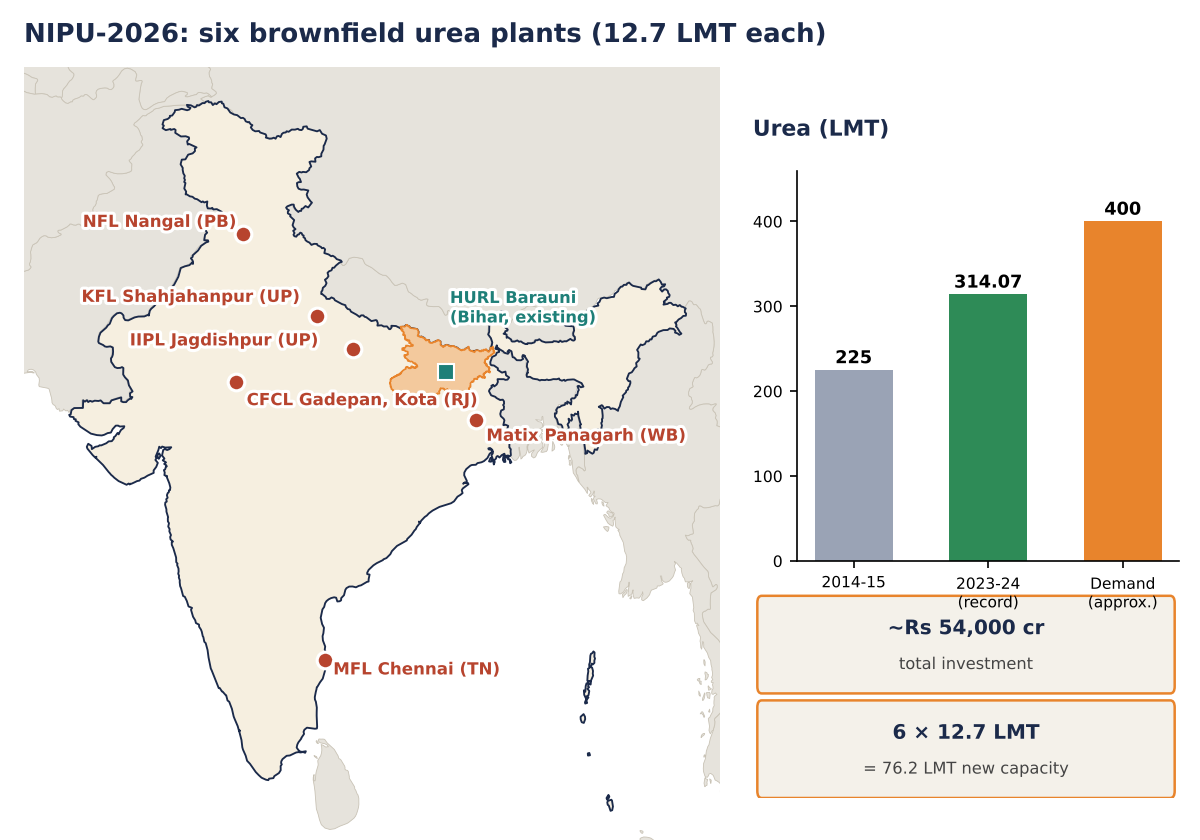
The Centre on 25 November 2026 approved six brownfield urea plants under the National Investment Policy for Urea (NIPU)-2026, each of 12.7 lakh metric tonnes (LMT) a year, with total investment of about ₹54,000 crore across public, private and cooperative sectors.
Key facts
Plants: MFL Chennai (Tamil Nadu), NFL Nangal (Punjab), KFL Shahjahanpur and IIPL Jagdishpur (Uttar Pradesh), Matix Panagarh (West Bengal), CFCL Gadepan, Kota (Rajasthan).
Annual urea demand about 400 LMT; domestic output rose from 225 LMT (2014-15) to a record 314.07 LMT (2023-24).
NIPU-2026 itself was approved by the Union Cabinet in July 2026.
Bihar link: HURL Barauni (Begusarai) is an existing gas-based urea plant of 12.7 LMT a year.
Way forward
Six large units will narrow the import gap, but balanced fertiliser use — soil-health-card based dosing, nano urea and organic inputs — must go with it to protect soils.
Concept
Urea contains about 46% nitrogen and is sold at a statutorily fixed MRP; the difference is paid as subsidy. 100% neem-coated urea was made mandatory in 2015 to curb diversion. Fertiliser policy lies with the Department of Fertilizers, Ministry of Chemicals & Fertilizers.
Map of India (official boundary) marking the six approved brownfield urea plants — Nangal, Shahjahanpur, Jagdishpur, Gadepan (Kota), Panagarh and Chennai — and the existing HURL Barauni plant in Bihar, with a bar chart of urea production 225 LMT (2014-15) and 314.07 LMT (2023-24) against demand of about 400 LMT, total investment about Rs 54,000 crore. — StudyForGS
9. First region-specific antivenom developed against Northeast pit vipers
Mains GS-II: role of science & technology in health; Prelims: biotechnology, public health
Context
Scientists led by Prof. Ashis K. Mukherjee at the Institute of Advanced Study in Science and Technology (IASST), Guwahati — an autonomous institute of the Department of Science & Technology — have developed an experimental bivalent antivenom against two Northeast pit vipers.
Key facts
Targets: red-tailed bamboo pit viper (Trimeresurus erythrurus) and Pope's pit viper (T. popeiorum); venom from Mizoram, also tested on venom from Meghalaya.
In preclinical (mouse) tests it neutralised these venoms better than India's commercial polyvalent antivenom.
Stage: experimental — not yet available for routine treatment.
Way forward
Region-specific antivenoms, clinical trials and better reporting of snakebite cases can cut deaths in areas where the standard serum works poorly.
Concept
India's polyvalent antivenom covers the 'Big Four' — Indian (spectacled) cobra, common krait, Russell's viper and saw-scaled viper. Antivenom is produced by immunising horses with small doses of venom and purifying the antibodies. India launched a National Action Plan for Prevention and Control of Snakebite Envenoming (NAP-SE) in 2024.
10. Exercise Suryakiran XX: Indian and Nepal armies train together at Saljhandi
Mains: India's relations with neighbours, border management (Bihar–Nepal border); Prelims: military exercises
Context
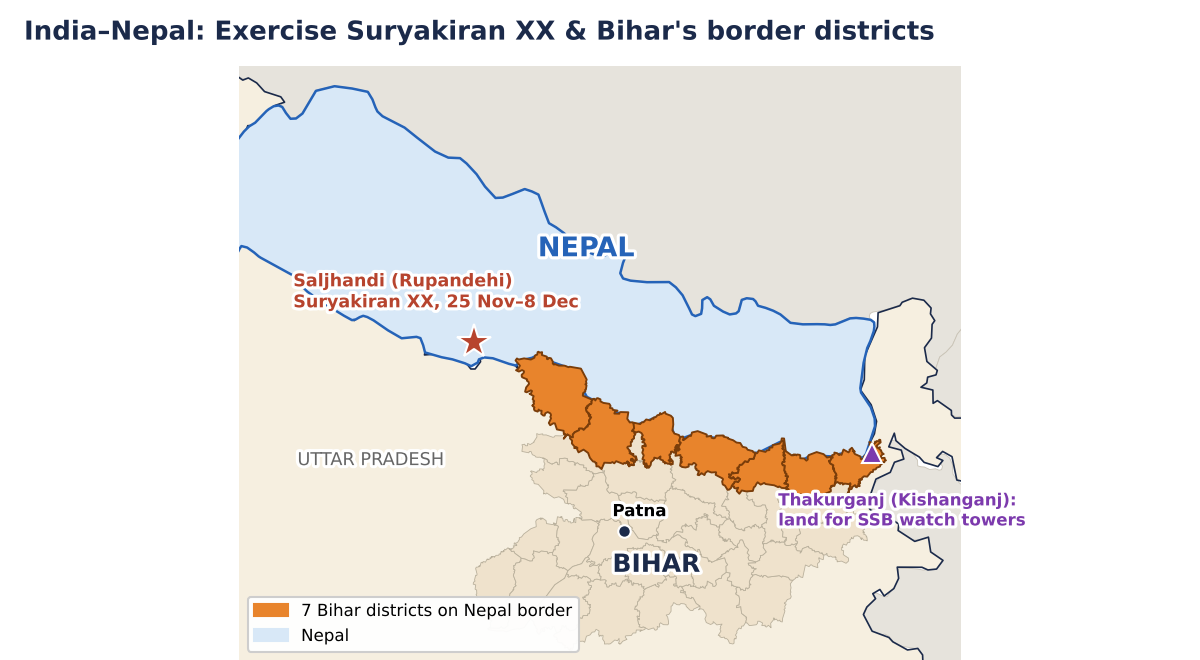
The 20th edition of the India–Nepal joint military exercise Suryakiran began on 25 November 2026 at the Nepal Army Battle School, Saljhandi (Rupandehi district) and will run till 8 December 2026.
Key facts
Indian Army: 334 personnel of the Kumaon Regiment; Nepal Army: an equal number from the Shri Jwala Dal Battalion.
Focus: counter-insurgency and counter-terrorism in difficult terrain, plus disaster response and humanitarian assistance.
Held annually, alternately in India and Nepal; the 19th edition (2025) was at Pithoragarh, Uttarakhand.
Bihar link: the state cabinet (25 Nov) transferred land at Thakurganj (Kishanganj) to the Union Home Ministry for SSB watch towers of its 19th and 41st battalions.
Way forward
Regular joint training builds trust along the open border; Bihar's border districts gain from closer India–Nepal coordination against smuggling, trafficking and during floods.
Concept
India and Nepal share an open border of about 1,751 km, guarded on the Indian side by the Sashastra Seema Bal (SSB) under the Ministry of Home Affairs. Bihar's 7 border districts: West Champaran, East Champaran, Sitamarhi, Madhubani, Supaul, Araria, Kishanganj. The open border rests on the India–Nepal Treaty of Peace and Friendship, 1950.
Map of Bihar, eastern Uttar Pradesh and Nepal showing Saljhandi in Rupandehi district (venue of Suryakiran XX, 25 Nov–8 Dec), Bihar's seven districts bordering Nepal highlighted in saffron, Thakurganj in Kishanganj marked for SSB watch towers, and Patna. — StudyForGS
Data point of the day
US$ 737.78 bn
India's foreign exchange reserves, end-September 2026 Up from US$ 691.11 bn at end-March 2026 (RBI's 47th half-yearly report on forex reserves, released 25 Nov 2026); gold holdings 880.52 tonnes, about 14.38% of reserves.
Prelims rapid-fire
Bihar's first paperless e-Cabinet meeting: 25 Nov 2026; 34 proposals cleared.
Bihar Business Connect 2027: Industries Department, February 2027.
IGIMS Patna: 64 posts created in Critical Care Medicine.
RBI: gold holdings 880.52 tonnes at end-Sep 2026, about 14.38% of forex reserves.
India's construction & infrastructure equipment industry: world's 3rd largest after China and the USA.
Suryakiran: 19th edition (2025) at Pithoragarh; 20th at Saljhandi, Nepal (25 Nov–8 Dec 2026).
Practice MCQs — BPSC Prelims pattern
Q1. Consider the following statements regarding the Constituent Assembly of India: 1. Dr Sachchidananda Sinha presided over its first sitting as provisional President. 2. Dr Rajendra Prasad was elected its permanent President on 11 December 1946. 3. The Constitution was adopted by the Assembly on 26 January 1950. Which of the statements given above is/are correct?
1 only
1 and 2 only
2 and 3 only
1, 2 and 3
Show answer
Answer: b Statements 1 and 2 are correct. Statement 3 is wrong: the Constitution was adopted on 26 November 1949 (Constitution Day) and came into force on 26 January 1950.
Q2. As per the Bihar cabinet decision of 25 November 2026, the annual administrative grant to each Gram Kachahari from 1 April 2027 will be:
₹12,000
₹20,000
₹24,000
₹40,000
Show answer
Answer: c The grant was raised six-fold, from ₹4,000 to ₹24,000 a year, effective 1 April 2027. Gram Kachaharis function under the Bihar Panchayat Raj Act, 2006.
Mains practice question
Q. Availability of land is often cited as the biggest constraint on industrialisation in Bihar. In the light of the state's recent decision to acquire land for three industrial areas, discuss the challenges and suggest measures to make Bihar an attractive investment destination.
Hint / approach
Intro: 1,294.37 acres in Nalanda, Samastipur, Sheikhpura (₹706.52 crore). Body: high population density and small holdings, fair compensation under RFCTLARR Act, 2013, role of BIADA, power/logistics (expressways, ports via the Ganga waterway), skilled labour, single-window clearance. Conclude with land bank + plug-and-play parks + Bihar Business Connect 2027 outreach.
📌 One-line revision: Bihar e-Cabinet (25 Nov): ₹1,794.32 cr Ganga water for 75 Patna wards • Gram Kachahari ₹4,000 → ₹24,000 • 1,294.37 acres for industry • 38 BC/EBC coaching centres • Constitution adopted 26 Nov 1949 • ₹11,000 cr CIE scheme • 6 urea plants • Suryakiran XX • forex US$ 737.78 bn.