Thursday, 5 November 2026 · IST · National & International · 11 items · 2 MCQs
The Union Cabinet approved a package for grid-scale energy storage (92 GWh), lithium-nickel processing, statistical modernisation (VISTAR), Fast Track Special Courts till 2031 and a two-year extension for 75% of Agniveers. The Supreme Court referred its 2003 two-child-norm ruling to a larger bench citing a TFR of 1.9, while India held its first Defence Dialogue with Canada and prepares for Nepal PM Balen Shah's maiden bilateral visit.
Today at a glance — things to remember
Cabinet: ₹14,500 cr VGF for 92 GWh grid-scale storage (FY27–FY31)
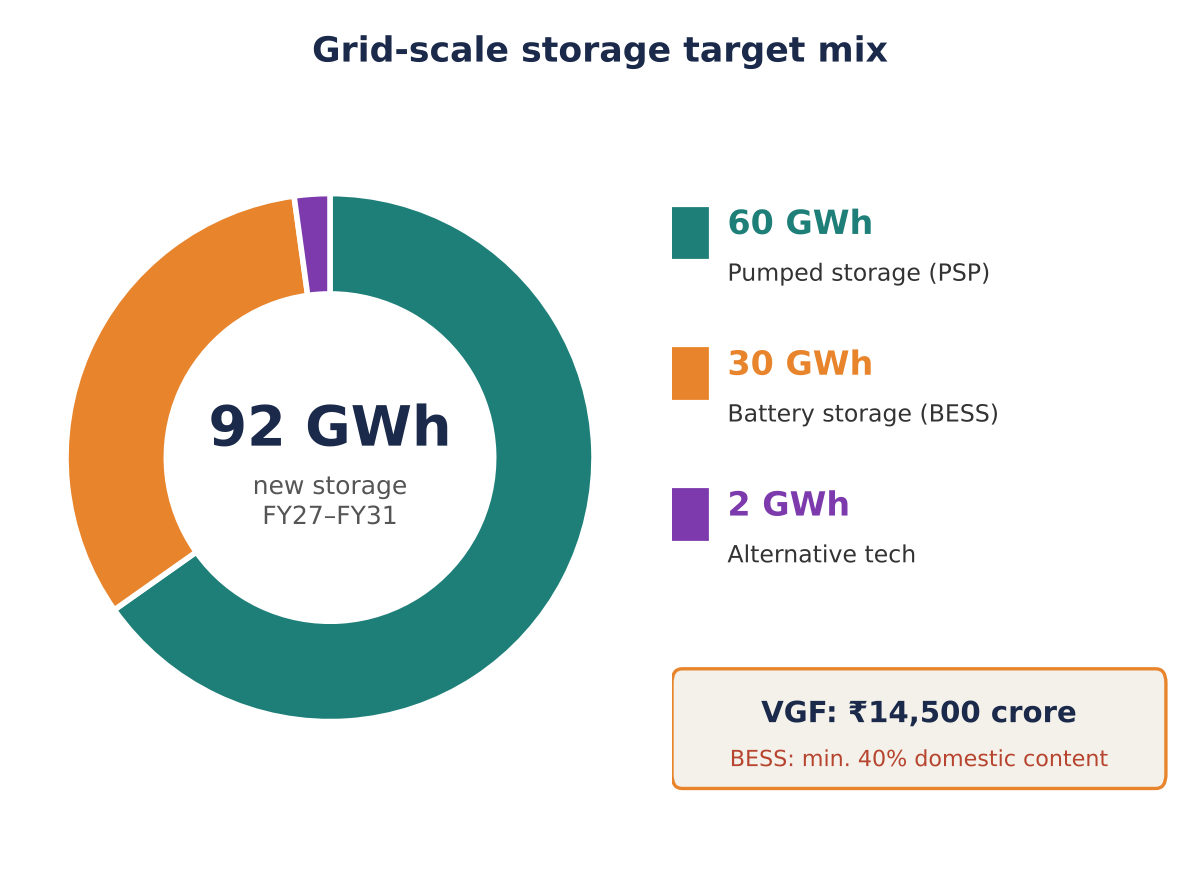
On 4 November 2026 the Union Cabinet approved a Viability Gap Funding (VGF) scheme of ₹14,500 crore to add 92 GWh of new grid-scale storage between FY 2026-27 and FY 2030-31, to firm up renewable power.
Expected investment of about ₹97,600 crore; capacity awarded by tariff-based competitive bidding
Minimum 40% Domestic Content Requirement for BESS projects
New capacity ≈ 170% of current grid-scale storage; need is 411 GWh by 2031-32
Way forward
Pair VGF with storage-friendly tariffs, faster PSP clearances and a domestic cell-manufacturing base to avoid import dependence.
Concept
VGF = one-time capital grant that bridges the gap between project cost and commercial viability. Pumped storage pumps water uphill in surplus hours and generates in peak hours — the cheapest long-duration storage.
Donut chart of the 92 GWh storage target: 60 GWh pumped storage, 30 GWh battery storage, 2 GWh alternative technologies, with ₹14,500 crore VGF. — StudyForGS
2. ₹2,814 crore capex-support scheme for domestic lithium and nickel processing
GS3 – Industrial policy; Mineral resources; Energy security. Prelims: critical minerals, NCMM, MMDR Act
Context
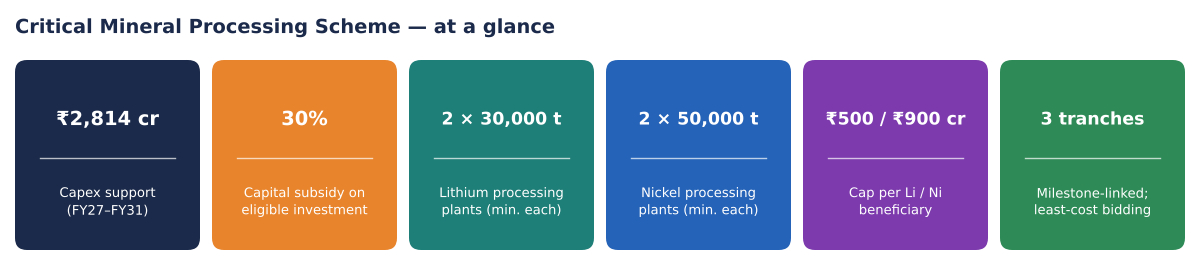
The Cabinet approved a five-year (FY27–FY31) scheme of ₹2,814 crore to build plants that convert lithium and nickel ores and intermediates into high-purity compounds for EVs, batteries, electronics and defence.
Key facts
30% capital subsidy on eligible investment, paid in three milestone tranches
Target: 2 lithium plants (≥30,000 t each) and 2 nickel plants (≥50,000 t each)
Caps: ₹500 cr per lithium and ₹900 cr per nickel beneficiary
Two-stage selection: technical check, then least-cost bidding; cobalt as nickel by-product
Way forward
Secure overseas ore supply (KABIL-type assets), build refining skills and link plants to battery PLI demand.
Concept
Midstream processing is the chokepoint of critical-mineral chains. The National Critical Mineral Mission (2025) covers exploration to recycling; 24 critical minerals sit in Part D, First Schedule of the MMDR Act, 1957.
Stat tiles for the critical mineral processing scheme: ₹2,814 crore outlay, 30% capex subsidy, two lithium plants of 30,000 t, two nickel plants of 50,000 t, caps of ₹500 and ₹900 crore, FY27–FY31. — StudyForGS
3. VISTAR: ₹4,371 crore plan to overhaul India's official statistical system
GS3 – Indian economy: data, planning; GS2 – Governance. Prelims: MoSPI, NSO, Economic Census
Context
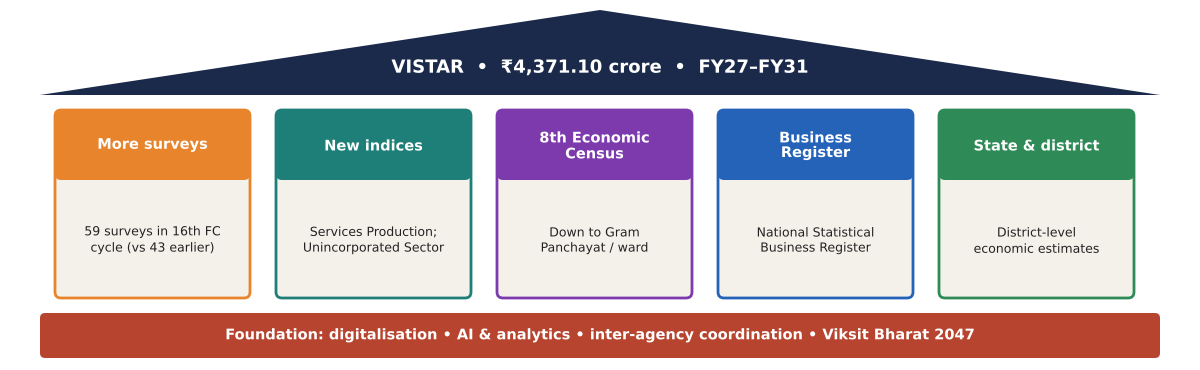
The Cabinet approved VISTAR – Viksit Bharat Initiative for Statistical Transformation, Analytics & Research with ₹4,371.10 crore for FY27–FY31, using digitalisation and AI to modernise official data.
Key facts
59 surveys proposed in the 16th Finance Commission cycle (vs 43 earlier)
New indicators: Headline Index of Services Production, Index of Unincorporated Sector Enterprises
Eighth Economic Census down to Gram Panchayat and ward level
A National Statistical Business Register; support for district-level economic estimates
Way forward
Ensure statutory autonomy for the statistical system, timely release calendars and open microdata to rebuild trust.
Concept
NSO was formed in 2019 by merging CSO and NSSO under MoSPI. The Economic Census counts all non-farm establishments; the 7th was held in 2019-20. The National Statistical Commission (2005) followed the Rangarajan Commission.
Pillar diagram of VISTAR (₹4,371.10 crore, FY27–FY31) with five pillars: more surveys (59 vs 43), new indices, 8th Economic Census, National Statistical Business Register, and state and district statistics, on a base of digitalisation and AI. — StudyForGS
4. Agnipath tweak: two-year 'second tour' for 75% of Agniveers, then regular service
DEFENCECOMMON: Prelims + Mains GS3 (Security)
Syllabus linkage
GS3 – Security forces and their mandate; GS2 – Government policies. Prelims: Agnipath, Seva Nidhi
Context
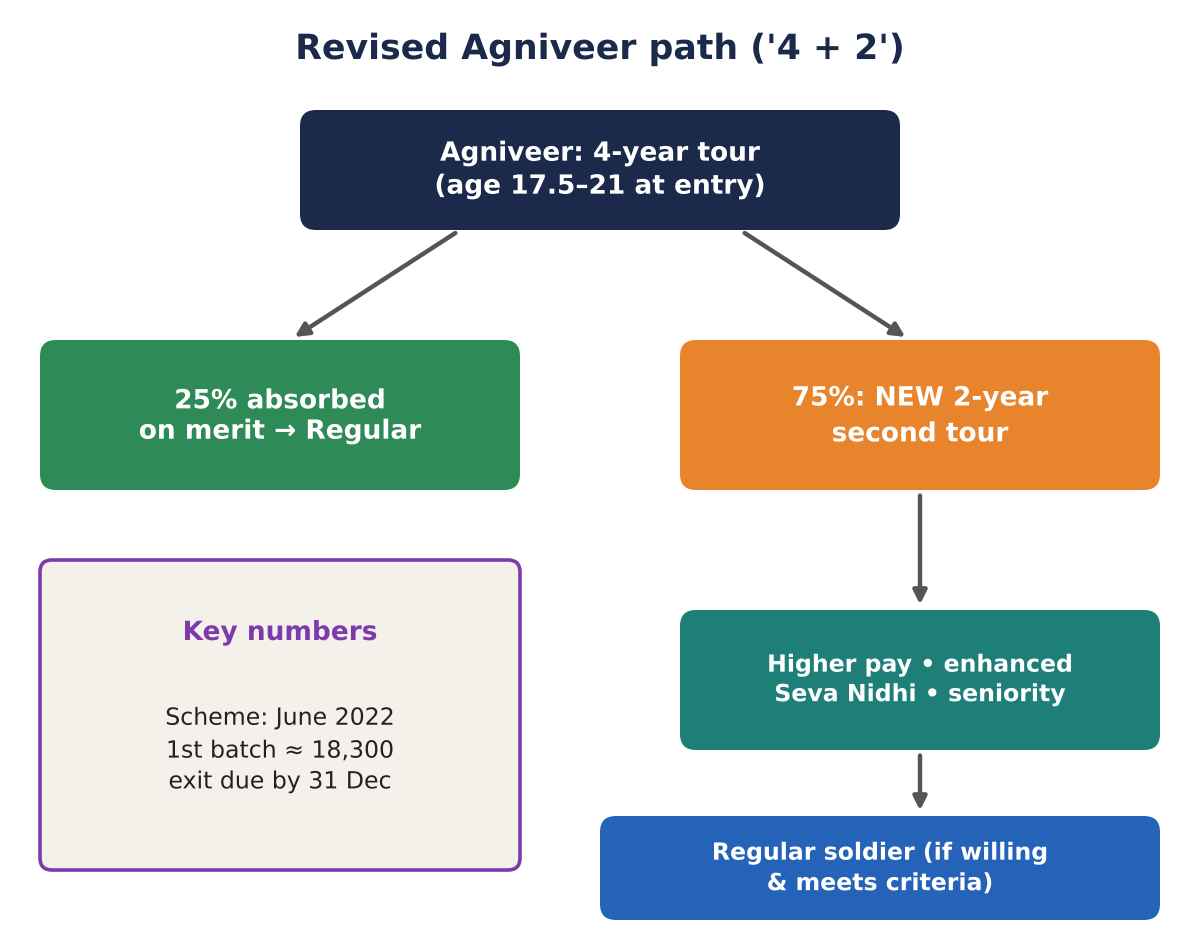
The Cabinet approved an additional two-year engagement for the 75% of Agniveers not retained after the four-year term, just weeks before the first batch of about 18,300 was due to exit by 31 December.
Key facts
Earlier rule: only 25% absorbed on merit after 4 years; scheme launched June 2022
After the extra 2 years, willing Agniveers who meet criteria to be enrolled as regular soldiers
Second period brings higher pay, an enhanced Seva Nidhi and seniority benefits
CDS: the 25% absorbed at 4 years stay senior to those absorbed after the extension
Way forward
Balance youthful profile with experience; publish clear selection criteria and expand lateral absorption in CAPFs and states.
Concept
Agnipath recruits personnel below officer rank for 4 years (age 17.5–21). Seva Nidhi is a tax-free exit corpus built from matched contributions. Aims: lower average age and pension bill.
Flowchart of the revised Agniveer career path: 4-year tour, 25% absorbed into regular service on merit, 75% get a 2-year second tour with higher pay and enhanced Seva Nidhi, then enrolment as regular soldiers subject to willingness and criteria. — StudyForGS
5. Cyclone Murasu crosses Andhra coast, weakens into depression over Telangana
GS1 – Cyclones; GS3 – Disaster management. Prelims: cyclone naming, IMD, Bay of Bengal
Context
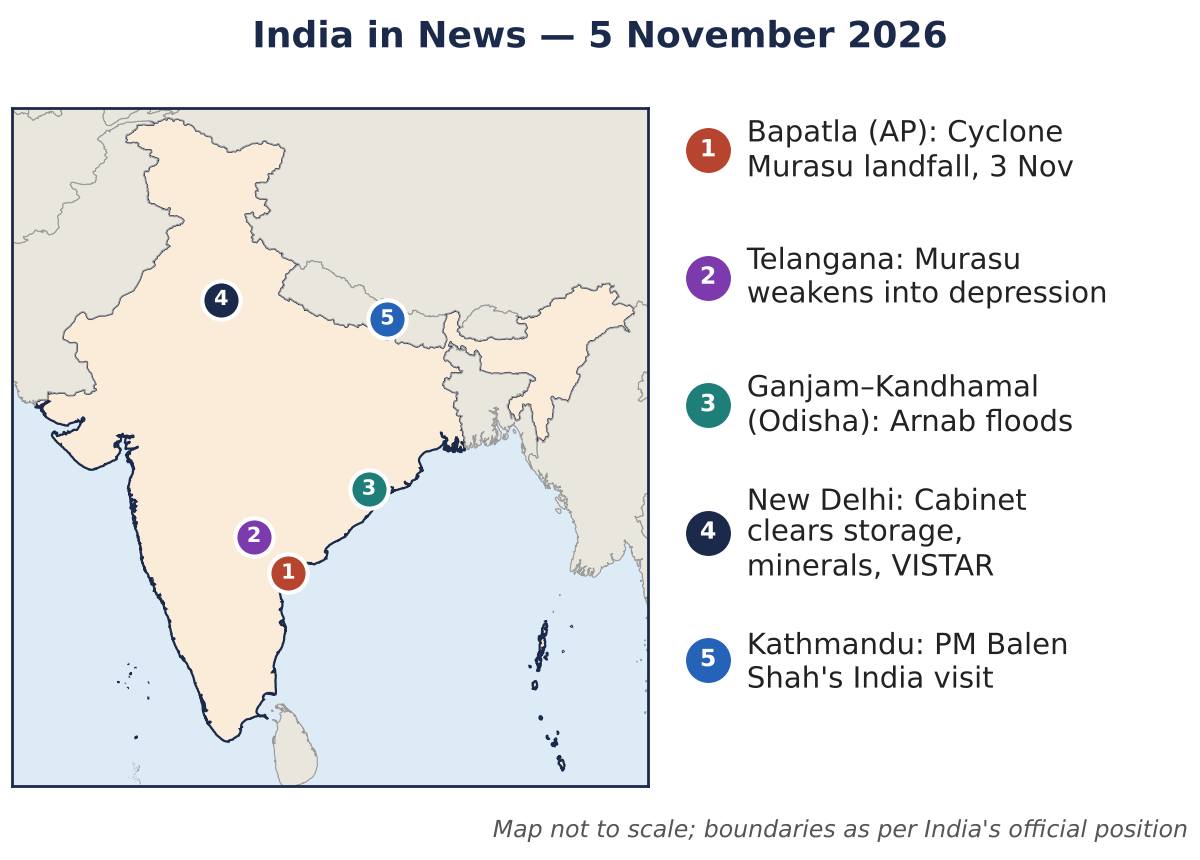
Severe cyclonic storm Murasu made landfall near Bapatla (Andhra Pradesh) on 3 November with winds of 100–110 km/h, gusting to 120 km/h, and has now weakened into a depression over Telangana.
Key facts
Second Bay of Bengal cyclone in a week after Cyclone Arnab (landfall 28 October)
Arnab caused floods and landslides in Ganjam and Kandhamal (Odisha)
Name Murasu ('war drum' in Tamil) was contributed by India
Schools shut and evacuations across Andhra Pradesh, Tamil Nadu and Odisha
Way forward
Scale up impact-based forecasting, cyclone shelters and mangrove shelterbelts under the National Cyclone Risk Mitigation Project.
Concept
North Indian Ocean cyclones are named from a list of 169 names (2020) given by 13 member countries of the WMO/ESCAP Panel on Tropical Cyclones; IMD, New Delhi is the RSMC that assigns them.
India in News locator map with numbered pins: 1 Bapatla (Cyclone Murasu landfall), 2 Telangana (depression), 3 Ganjam–Kandhamal in Odisha (Cyclone Arnab floods), 4 New Delhi (Cabinet decisions), 5 Kathmandu (Nepal PM visit). Boundaries as per India's official position. — StudyForGS
6. SC: two-child norm for panchayat polls has 'lost relevance'; Javed (2003) sent to larger bench
POLITYCOMMON: Prelims + Mains GS2 (Polity, Local Govt)
Syllabus linkage
GS2 – Fundamental Rights; Local bodies; GS1 – Population. Prelims: Art 21, Art 243F, TFR
Context
A bench of Justices P.S. Narasimha and Alok Aradhe set aside a sarpanch's disqualification under the Maharashtra Village Panchayat Act, 1959 for a third child, and asked a larger bench to reconsider Javed v. State of Haryana (2003).
Key facts
Javed (2003): a 3-judge bench upheld Haryana's two-child bar, finding no Art 14 violation
India's TFR fell from 3 (2003) to 1.9 now — below replacement level 2.1
Court: such laws infringe reproductive autonomy under Article 21
Provision examined: Section 14(1)(j-1), applicable from 13 September 2000
Way forward
States should review coercive population laws; shift to incentives, ageing-society planning and women's health.
Concept
Art 243F lets State legislatures prescribe disqualifications for panchayat membership. TFR = average children per woman; 2.1 is the replacement level. Reproductive choice was recognised under Art 21 in Suchita Srivastava (2009).
7. Fast Track Special Courts scheme extended to 2031; courts raised from 779 to 850
GS2 – Judiciary; Mechanisms for protection of vulnerable sections. Prelims: Nirbhaya Fund, POCSO, CSS
Context
The Cabinet continued the centrally sponsored Fast Track Special Courts (FTSC) scheme for rape and POCSO cases from 1 April 2026 to 31 March 2031, expanding it from 779 to 850 courts.
Key facts
Total outlay ₹3,788.04 crore
Central share ₹2,353.15 crore from the Nirbhaya Fund; States/UTs ₹1,434.89 crore
850 courts include exclusive POCSO courts
Scheme began 2 October 2019 following the Criminal Law (Amendment) Act, 2018
Way forward
Fill judicial and forensic-lab vacancies, ensure child-friendly courtrooms and track disposal-time targets.
Concept
POCSO Act, 2012 is gender-neutral and mandates special courts. The Nirbhaya Fund (2013) is a non-lapsable corpus for women's safety. Justice delivery is in the Concurrent List (Entry 11A).
8. Centre weighs narrowing Section 79 'safe harbour' for algorithm-driven social media
GS2 – Govt policies; GS3 – Challenges to internal security via communication networks. Prelims: IT Act, 2000, intermediary
Context
MeitY has begun preliminary talks on whether Section 79 immunity under the IT Act, 2000 should cover only 'mere conduit' intermediaries, not platforms whose algorithms rank and recommend content.
Key facts
Rationale: such platforms are 'no longer passive carriers'; concern over minors' exposure
Also proposed: users may directly seek removal of deepfakes and non-consensual intimate images
Any change needs an amendment to the IT Act by Parliament, after stakeholder consultation
No decision yet — discussions are preliminary
Way forward
Calibrate liability to algorithmic amplification, with transparency audits, while protecting free speech under Art 19(1)(a).
Concept
Safe harbour shields intermediaries from liability for third-party content if they observe due diligence. Shreya Singhal (2015) read 'actual knowledge' as a court order or government notification. Due diligence is detailed in the IT Rules, 2021.
9. Bharatiya Vayuyan Niyam, 2026 notified; replaces Aircraft Rules, 1937 from 1 January 2027
The Civil Aviation Ministry notified the Bharatiya Vayuyan Niyam, 2026, a modern rulebook that will replace the nearly nine-decade-old Aircraft Rules, 1937 from 1 January 2027.
Key facts
Covers registration, airworthiness, design approvals, maintenance and personnel licensing
Flight and duty time limits for pilots and cabin crew to curb fatigue
Fare transparency: airlines must show base fare, taxes, fees and refund rules
Also covers aerodrome licensing; tariffs stay under DGCA oversight
Way forward
Align fully with ICAO SARPs, build DGCA capacity and use digital licensing to cut compliance time.
Concept
The Bharatiya Vayuyan Adhiniyam, 2024 replaced the Aircraft Act, 1934; these Niyam are its subordinate rules. ICAO (Montreal) was set up under the Chicago Convention, 1944.
10. India and Canada hold inaugural Defence Dialogue; industry and R&D top priorities
IRCOMMON: Prelims + Mains GS2 (IR)
Syllabus linkage
GS2 – Bilateral relations; Effect of policies of developed countries on India. Prelims: G7, Indo-Pacific
Context
India and Canada held their first Defence Dialogue virtually on 3 November 2026, carrying forward the Modi–Carney joint statement of 2 March 2026 to expand defence and strategic ties.
Key facts
Co-chairs: Amit Telang (JS, International Cooperation, MoD) and Scott Millar (ADM Policy, Canada's DND)
Priorities: defence industrial cooperation, military-technical ties and defence R&D
Sides exchanged views on strategic outlooks and discussed specific deliverables
Marks continued normalisation of ties after the 2023-24 diplomatic downturn
Way forward
Institutionalise the dialogue annually; explore critical minerals, Indo-Pacific maritime cooperation and co-development.
Concept
Canada is a G7 member and has an Indo-Pacific Strategy (2022). It hosts one of the largest Indian diasporas; Canada is also a key source of uranium and potash for India.
11. India–Nepal: big-ticket projects and old disputes ahead of PM Balen Shah's first bilateral visit
GS2 – India and its neighbourhood; GS3 – Energy. Prelims: ICPs, Mahakali Treaty, 1950 Treaty
Context
India and Nepal have stepped up engagement ahead of PM Balen Shah's maiden bilateral visit — his first foreign bilateral trip — expected in the second half of November for about three days.
Key facts
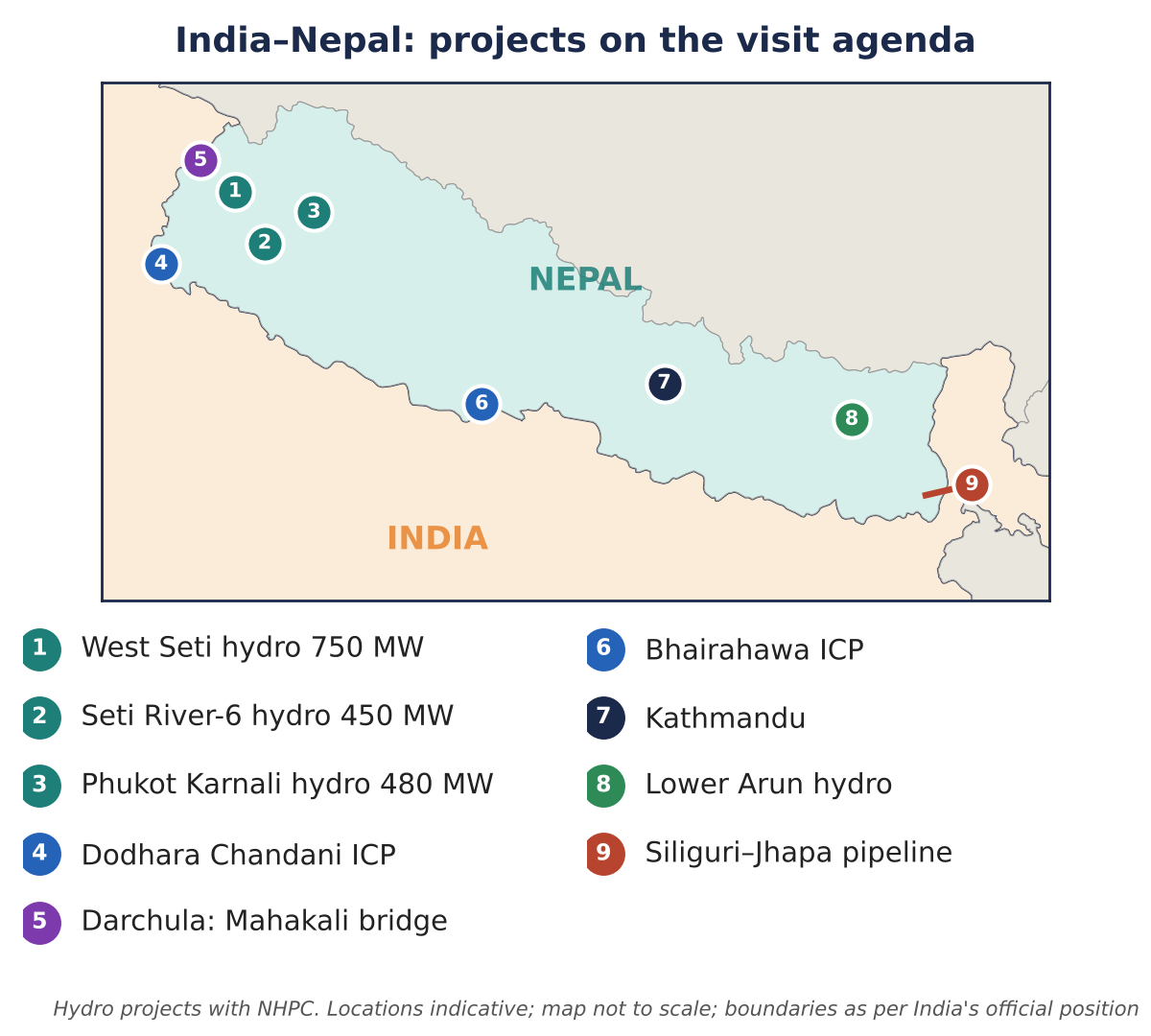
Likely inaugurations: Bhairahawa ICP, Nepal Police Academy (Panauti), Mahakali bridge
Hydro with NHPC: West Seti 750 MW, Phukot Karnali 480 MW, Seti River-6 450 MW
Thorny issues: boundary, Pancheshwar, extra air-entry points, trade imbalance
Way forward
Deliver projects on time, deepen cross-border power trade, and handle the boundary issue through dialogue.
Concept
1950 Treaty of Peace and Friendship underpins open borders. Mahakali Treaty (1996) covers Pancheshwar. Motihari–Amlekhganj (2019) was South Asia's first cross-border petroleum pipeline.
Map of India and Nepal marking projects on the visit agenda: West Seti, Seti River-6 and Phukot Karnali hydro in far-west Nepal, Dodhara Chandani ICP, Darchula Mahakali bridge, Bhairahawa ICP, Kathmandu, Lower Arun hydro and the Siliguri–Jhapa pipeline. Boundaries as per India's official position. — StudyForGS
Data point of the day
55.8
India Services PMI — October 2026 Up from 55.2 in September — a four-month high; Composite PMI 56.2 (from 55.9). Input-cost inflation slowest since August 2020, but hiring cooled to a four-month low and export orders grew at the slowest pace since February 2023. Above 50 = expansion.
Prelims rapid-fire
QS Asia University Rankings 2027: IIT Delhi 66th (best in India); 325 Indian institutions ranked; Univ. of Hong Kong No. 1
Swachh Bharat Mission (Grameen) Phase II extended to March 2028
US midterms (3 Nov): Democrats won control of both House and Senate
Petition against Section 16 of the CEC & ECs Act, 2023 (immunity for CEC/ECs) pending in SC
Bhutan set a Guinness record by erecting 108 stupas in nine hours
Nirmala Lakshman won a Sharjah book award for 'The Tamils'
Practice MCQs — UPSC Prelims pattern
Q1. With reference to the grid-scale energy storage scheme approved on 4 November 2026, consider the following statements: 1. It provides Viability Gap Funding for 92 GWh of storage. 2. Battery storage forms the largest share of the targeted capacity. 3. BESS projects must meet a minimum 40% domestic content requirement. Which of the statements given above are correct?
1 and 2 only
1 and 3 only
2 and 3 only
1, 2 and 3
Show answer
Answer: B The 92 GWh target is led by 60 GWh pumped storage, not batteries (30 GWh); so statement 2 is wrong. The 40% DCR applies to BESS.
Q2. Which Article of the Constitution empowers State Legislatures to prescribe disqualifications for membership of Panchayats, such as the two-child norm?
Article 243D
Article 243F
Article 243K
Article 243G
Show answer
Answer: B Art 243F deals with disqualifications; 243D = reservation of seats, 243K = State Election Commission, 243G = powers and functions of Panchayats.
Mains practice question
Q. Energy storage is the missing link in India's renewable transition. Examine the significance of the 92 GWh storage VGF scheme and the challenges in scaling pumped-storage and battery storage. (GS3, 15 marks, 250 words)
Hint / approach
Intro: RE intermittency and the 411 GWh by 2031-32 need. Body: scheme design (₹14,500 cr, 60/30/2 GWh mix, 40% DCR), benefits (grid stability, RTC power); challenges (land/forest clearances for PSP, cell imports, tariffs). Conclude with manufacturing and market reforms.