Rubio begins India visit as trade deal nears; SC declares internet access a fundamental right for children; RBI tightens overseas-investment checks as rupee slides
Tuesday, 20 October 2026 · IST · National & International · 9 items · 2 MCQs
US Secretary of State Marco Rubio began a three-day India visit (20-22 Oct) with talks with EAM S. Jaishankar in Mumbai, as both sides say the bilateral trade deal is close. The Supreme Court held that internet access is a fundamental right (Art. 21 r/w 19(1)(a)) even for children and ordered a National Hash & URL List Database against CSEAM, while the RBI stepped up scrutiny of overseas direct investment with the rupee near ₹95/$.
Today at a glance — things to remember
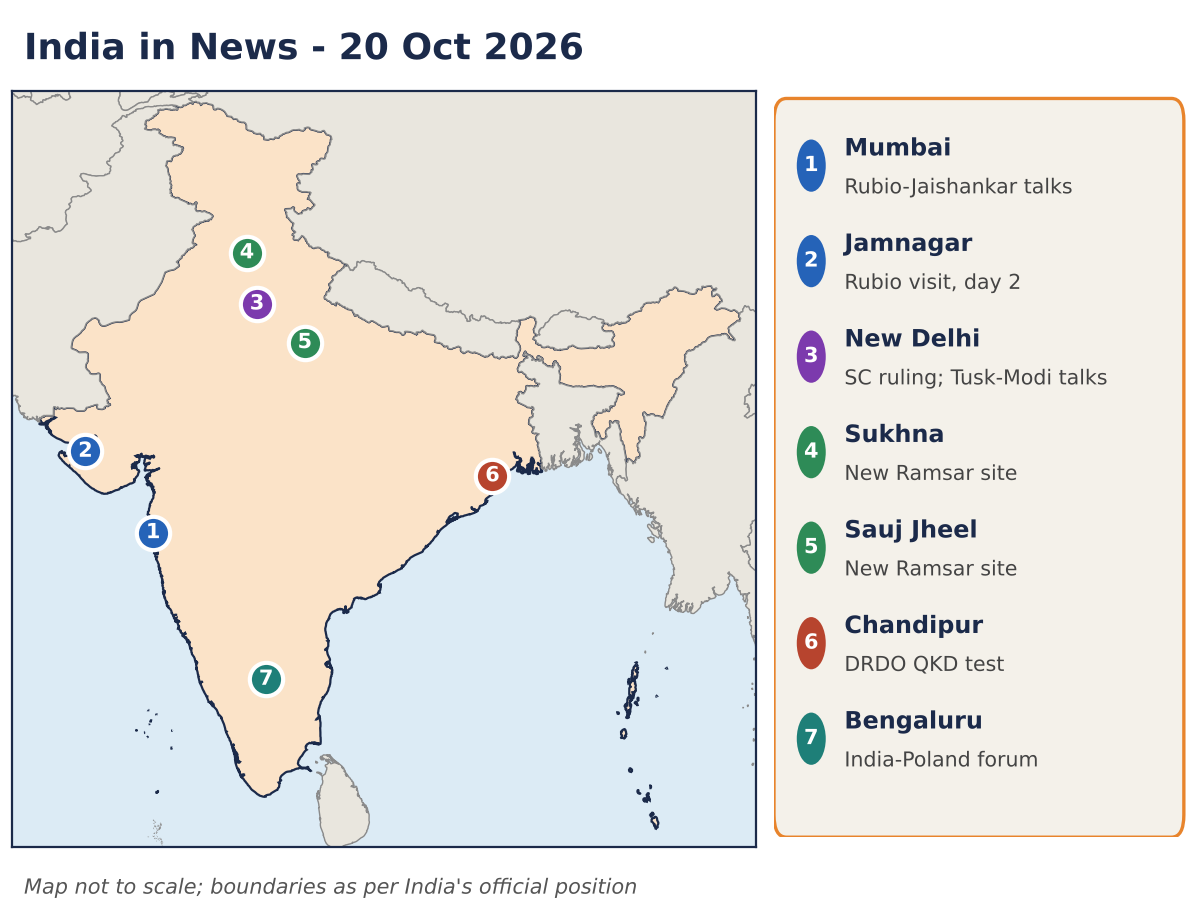
Rubio in India 20-22 Oct: Mumbai talks with Jaishankar, then Jamnagar
SC: internet access = fundamental right for all, incl. children (Art. 21 + 19(1)(a))
SC orders National Hash & URL List Database; next hearing 10 Dec 2026
RBI checklist for ODI above US$1 bn; rupee closed at 94.91/$ on 19 Oct
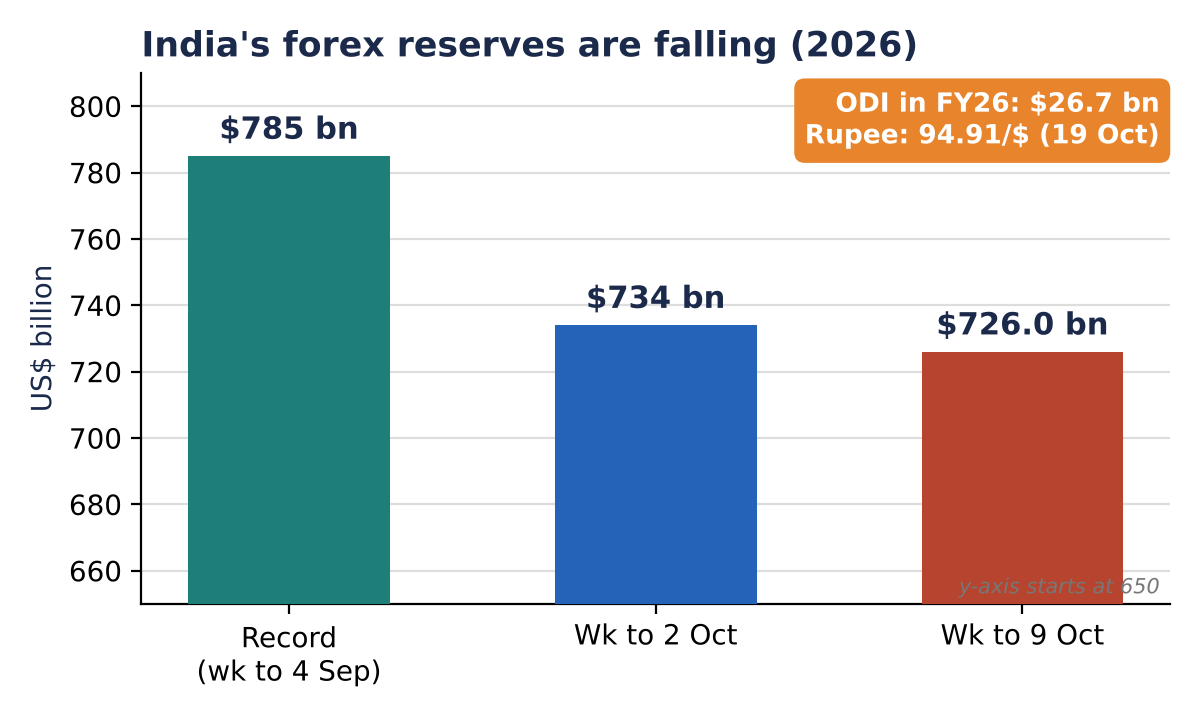
Forex reserves $726.0 bn (week to 9 Oct), down from record $785 bn
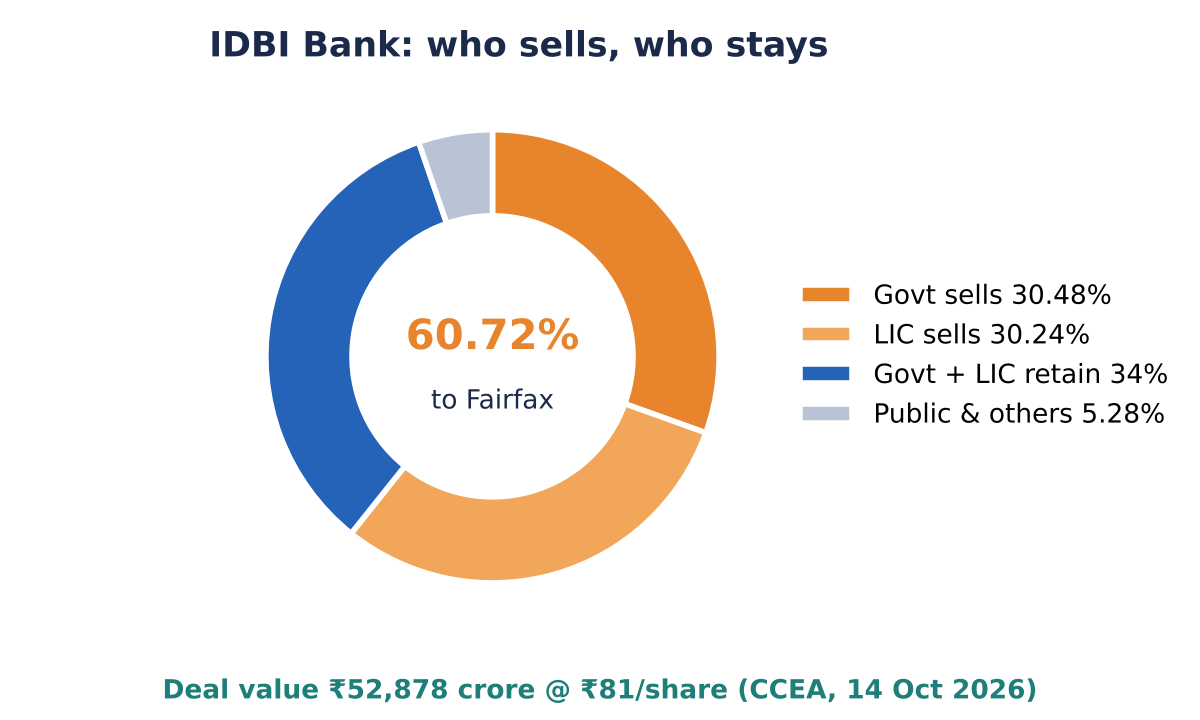
CCEA clears 60.72% IDBI Bank stake sale to Fairfax for ₹52,878 cr
DRDO tests Quantum Key Distribution on live military network at Chandipur
Sukhna (Chandigarh) & Sauj Jheel (UP) take Ramsar count to 103
GHI 2026: India 100th of 122, score 24.1 (serious); wasting 19.0%
1. RBI tightens scrutiny of overseas investments as rupee slides
ECONOMYCOMMON: Prelims + Mains GS3
Syllabus linkage
GS3: Indian Economy - external sector, BoP, exchange rate. Prelims: ODI vs FDI, LRS, forex reserves, FEMA.
Context
The RBI has sent banks a standardised checklist to vet large Overseas Direct Investment (ODI) deals, as the rupee stays weak amid capital outflows and high crude prices. No new curbs have been imposed.
Key facts
Covers ODI above US$1 billion or above 4x the investor's net worth; banks must check valuations, premiums, share-swap ratios
ODI hit US$26.7 bn in FY26 (almost double two years earlier); ~US$22.7 bn in Apr-Aug 2026
Rupee closed at 94.91/$ on 19 Oct; record low 96.97 (May 2026); down 5%+ in 2026
Forex reserves $726.0 bn (week to 9 Oct) vs record $785 bn (week to 4 Sep)
Individuals capped at US$250,000/year under the LRS
Way forward
Pair prudential vetting with steps to attract stable FDI, deepen hedging markets and cut the oil-import bill, rather than blunt capital controls.
Concept
ODI = Indian entity's investment in a foreign entity, governed by FEMA (Overseas Investment) Rules, 2022. LRS (2004) lets resident individuals remit abroad. A falling rupee raises imported inflation but helps exports.
Bar chart of India's forex reserves: record $785 bn (week to 4 Sep 2026), $734 bn (week to 2 Oct) and $726.0 bn (week to 9 Oct), with ODI of $26.7 bn in FY26 — StudyForGS
2. IDBI Bank privatisation: 60.72% stake to Fairfax for ₹52,878 crore
ECONOMYCOMMON: Prelims + Mains GS3
Syllabus linkage
GS3: Banking reforms, disinvestment, mobilisation of resources. Prelims: strategic sale, DIPAM, promoter limits in banks.
Context
The CCEA (14 Oct) cleared the strategic sale of IDBI Bank to a unit of Fairfax Financial Holdings (Toronto, led by Prem Watsa); DIPAM expects closure by end-FY27 after RBI clearance.
Key facts
Stake sold 60.72%: Govt 30.48% + LIC 30.24% at ₹81/share (fair value ₹75.99)
Govt + LIC to retain 34%; LIC to trim from 19% to 15% within 2 years
Needs RBI 'fit and proper' test, CCI nod and an open offer (unless SEBI waives)
Promoter cap in banks 26% - Fairfax gets up to 15 years to comply; 5-year lock-in
Fairfax's CSB Bank stake to be merged or exited within 2 years
Way forward
Ensure a smooth RBI vetting, protect depositor and employee interests, and use proceeds to strengthen public finances; template for future PSB sales.
Concept
Strategic disinvestment = sale of a controlling stake with management control, unlike minority sale. LIC took majority control of IDBI Bank in 2019. DIPAM works under the Ministry of Finance.
Two donut charts of IDBI Bank shareholding: before the deal Government 30.48% and LIC 30.24% sold to Fairfax; after the deal Fairfax 60.72%, Government plus LIC 34%, others 5.28% — StudyForGS
3. DRDO tests Quantum Key Distribution on a live military network
DRDO successfully tested an indigenous QKD platform on the live network of the Proof and Experimental Establishment, Chandipur (Odisha), securing real-time telemetry from artillery and armoured weapon trials.
Key facts
Developed under DRDO's Microelectronic Devices, Computational Systems & Cyber Security cluster
Production partner: Taqbit Labs, a Bengaluru start-up
QKD detects any eavesdropping - interception disturbs the quantum state
Builds on fibre-based QKD military field trials completed in July 2026
Related: DRDO's ADRDE (Agra) flew a High-Altitude Platform to 21 km
Way forward
Scale to multi-hop quantum networks, integrate with satellite QKD, and develop post-quantum cryptography standards for defence and banking.
Concept
QKD shares encryption keys using quantum properties (no-cloning theorem, superposition) - security rests on physics, not maths. National Quantum Mission (2023) runs 2023-24 to 2030-31.
4. Sukhna and Sauj Jheel take India's Ramsar sites to 103
ENVIRONMENTCOMMON: Prelims + Mains GS3
Syllabus linkage
GS3: Conservation, wetlands. GS1: geography of water bodies. Prelims: Ramsar sites, flyways, IUCN status of species.
Context
Two wetlands - Sukhna (Chandigarh) and Sauj Jheel (Uttar Pradesh) - were designated Wetlands of International Importance (announced 15 Oct), raising India's tally to 103.
Key facts
Sukhna: reservoir at the base of the Outer Himalayas (Shivaliks); borders Sukhna Wildlife Sanctuary
Sukhna hosts common pochard (Vulnerable), Pallas's fish eagle and black pond turtle (Endangered)
Sauj Jheel: shallow lake in the Ganga floodplain, near Saman Bird Sanctuary; 30,000+ waterbirds
Sauj supports sarus crane and greater spotted eagle
Both lie on the Central Asian Flyway
Way forward
Notify both under the Wetlands (Conservation and Management) Rules, 2017, control siltation and agri-runoff, and use Amrit Dharohar for community stewardship.
Concept
Ramsar Convention: signed 2 Feb 1971 at Ramsar (Iran); in force for India 1 Feb 1982; 9 criteria for designation; Montreux Record lists threatened sites. World Wetlands Day: 2 Feb.
India in News locator map with numbered pins: 1 Mumbai, 2 Jamnagar, 3 New Delhi, 4 Sukhna Wetland Chandigarh, 5 Sauj Jheel Uttar Pradesh, 6 Chandipur Odisha, 7 Bengaluru; boundaries as per India's official position — StudyForGS
5. Global Hunger Index 2026: India ranked 100th of 122
REPORTCOMMON: Prelims + Mains GS2/GS3
Syllabus linkage
GS2: Issues relating to poverty and hunger, health. GS3: Food security. Prelims: GHI indicators and publishers.
Context
The GHI 2026 (theme: 'No Security without Food Security') places India 100th of 122 with a score of 24.1, in the 'serious' band where it has stayed since 2012.
Key facts
Child wasting rose to 19.0% (from 16.9%) - highest in South Asia
Child stunting 29.3% - moved from 'very high' to 'high' category
Global score 18.1 (moderate); Ministry of WCD contests the methodology
Way forward
Target wasting via POSHAN 2.0, Poshan Tracker data, diet diversity and WASH, while engaging on index methodology with better national survey data.
Concept
GHI published by Concern Worldwide (Ireland), Welthungerhilfe (Germany) and Helvetas; 4 indicators - undernourishment, stunting, wasting, child mortality; 100-point scale (0 = no hunger).
6. SC: Internet access a fundamental right, including for children
POLITYCOMMON: Prelims + Mains GS2
Syllabus linkage
GS2: Fundamental Rights, judiciary, child rights, IT governance. GS3: cyber security. Prelims: Art. 19(1)(a), 21, POCSO, IT Act.
Context
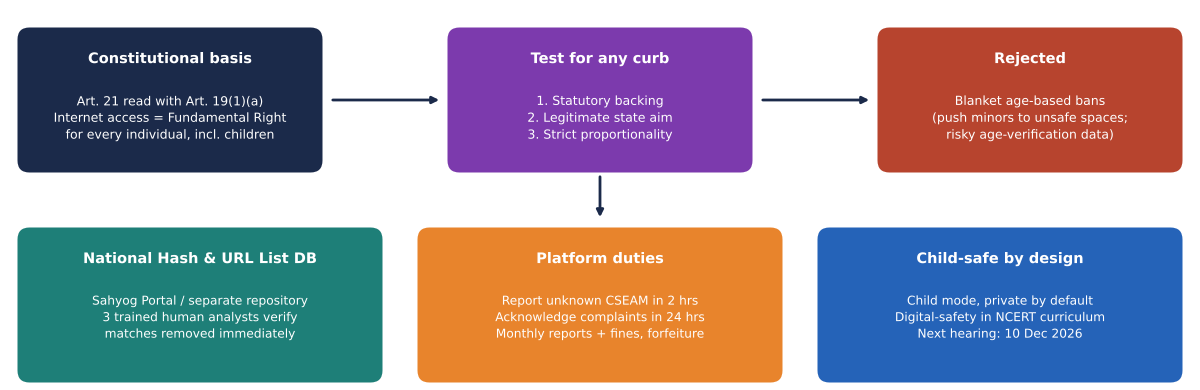
A bench of Justices J.B. Pardiwala and K. Vinod Chandran (order of 15 Oct, 136 pages) held that the right to access the internet is a fundamental right under Art. 21 r/w 19(1)(a) and rejected blanket age-based bans for children.
Key facts
Arose from Just Rights for Children Alliance applications after the 23 Sep 2024 CSEAM verdict
Centre to set up a National Hash & URL List Database (in Sahyog Portal or separately); 3 human analysts verify entries
Intermediaries: report unknown-origin CSEAM within 2 hours; acknowledge complaints in 24 hours
Child mode, private-by-default accounts; forfeiture of paywalled CSEAM revenue; exemplary fines
Curbs must pass legality, legitimate aim, proportionality; next hearing 10 Dec 2026
Way forward
MeitY to frame enforceable child-safety rules under the IT Act, operationalise the hash database, and add digital safety to the NCERT curriculum.
Concept
Precedents: Anuradha Bhasin (2020) - online speech/trade protected under 19(1)(a) & 19(1)(g); Cricket Assn. of Bengal (1995) - right to receive information; Faheema Shirin (Kerala HC, 2019). Reasonable restrictions: Art. 19(2).
Flowchart of the Supreme Court ruling: constitutional basis Article 21 with 19(1)(a), proportionality test, and three pillars of directions - National Hash and URL List Database, platform duties with 2-hour and 24-hour timelines, and child mode with digital-safety education — StudyForGS
7. Rubio in India: trade deal 'very close', energy and defence on table
IRCOMMON: Prelims + Mains GS2
Syllabus linkage
GS2: India and its neighbourhood/major powers, bilateral agreements, effect of policies of developed countries. Prelims: Quad, CAATSA-type waivers.
Context
US Secretary of State Marco Rubio began a three-day visit (20-22 Oct) - his second this year - with talks with EAM S. Jaishankar in Mumbai, before travelling to Jamnagar (Gujarat).
Key facts
Agenda: trade deal, energy, defence, critical & emerging tech, West Asia crisis
Trade talks since early 2025; Rubio: 'very close', Jaishankar: nearing 'landing point'
US recently suspended some sanctions on Russia and five big oil buyers, including India
Wreath at the 26/11 Taj memorial (6 US nationals among victims); event for 250 years of US independence
Frictions: punitive tariffs, H-1B fee hike, green-card processing curbs on IT firms
Way forward
Close a balanced first tranche of the trade deal, de-link energy choices from sanctions pressure, and deepen iCET/TRUST-style tech cooperation.
Concept
India-US ties = Comprehensive Global Strategic Partnership (2020). Indian refineries are configured for medium-sour crude; US supplies are mainly light grades needing blending - hence energy diversification limits.
8. Polish PM Tusk's India visit to deepen strategic partnership
IRCOMMON: Prelims + Mains GS2
Syllabus linkage
GS2: Bilateral relations, India-EU, Central Europe. Prelims: Baltic Sea and its littoral states, Łukasiewicz network.
Context
Polish PM Donald Tusk begins a three-day visit on 21 Oct, with talks with PM Modi in New Delhi on 22 Oct - his first India visit as PM in 16 years (last: 2010).
Key facts
Focus: defence manufacturing, trade, space, emerging tech, Russia-Ukraine, India-EU ties
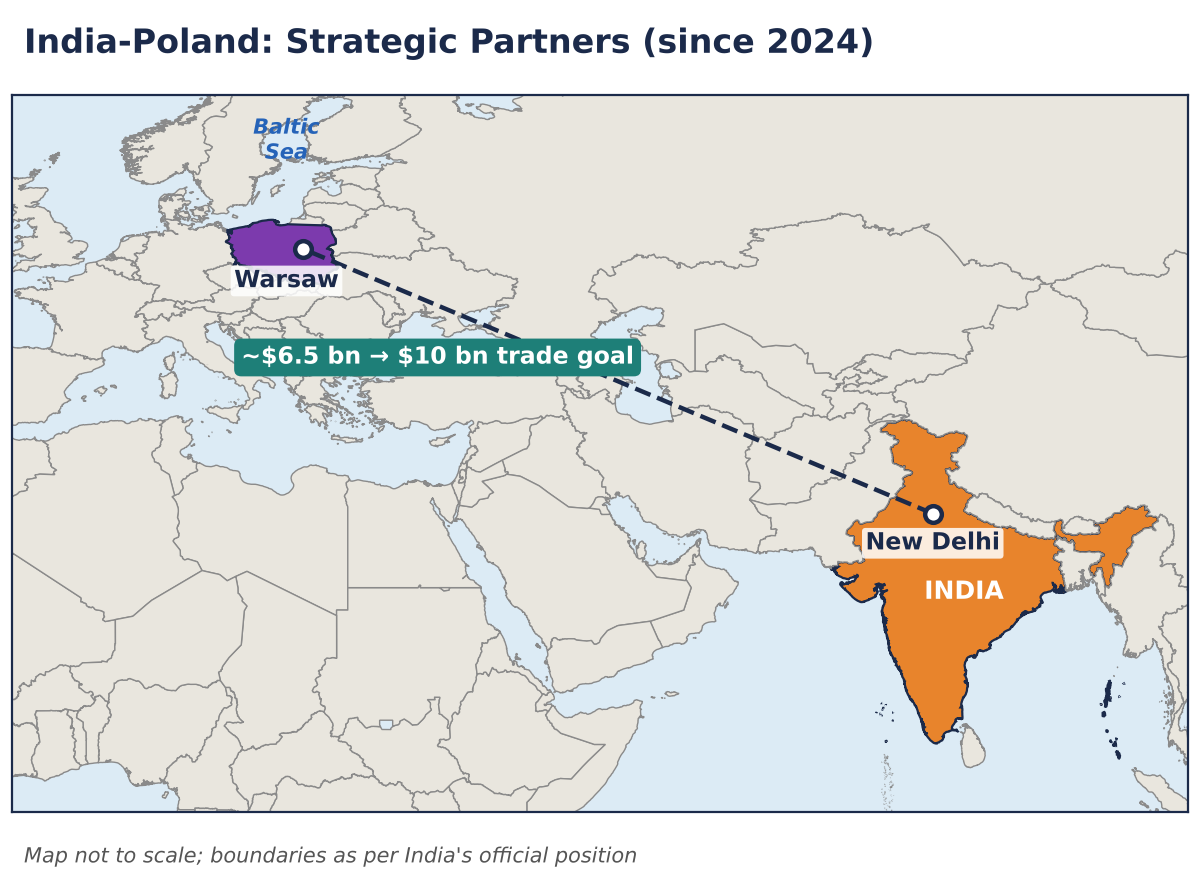
Poland aims to lift trade from ~$6.5 bn to $10 bn; business forums in Delhi (22 Oct) and Bengaluru (23 Oct)
Ties raised to Strategic Partnership in Aug 2024 - first Indian PM visit in 45 years
A five-year action plan covers defence, trade and technology
Poland seeks links of its Łukasiewicz Research Network with CSIR and IITs
Way forward
Use Poland as a gateway to Central Europe, co-produce defence systems under Make in India, and push the India-EU FTA implementation.
Concept
Poland: EU & NATO member, on the Baltic Sea (world's largest brackish water body, shared by 9 countries). WWII link: Jam Saheb of Nawanagar (Jamnagar) sheltered Polish refugee children.
Map from Europe to South Asia highlighting India and Poland, with the Baltic Sea marked and a link line showing New Delhi to Warsaw; Indian boundaries as per India's official position — StudyForGS
9. NSAP continued till 2030-31 as PM Samajik Sahayata Yojana
SOCIETYCOMMON: Prelims + Mains GS2
Syllabus linkage
GS2: Welfare schemes for vulnerable sections, social security, DPSPs. Prelims: NSAP sub-schemes, RPwD Act 2016.
Context
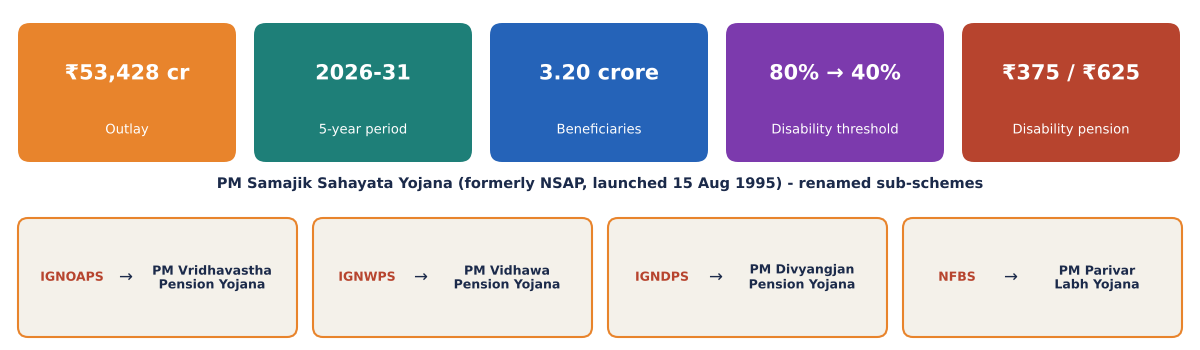
The Union Cabinet approved continuing the National Social Assistance Programme for 2026-27 to 2030-31 with an outlay of ₹53,428 crore, renaming it and widening disability pensions.
Covers ~3.20 crore beneficiaries in all 36 States/UTs; 100% central assistance
Way forward
Index pension amounts to inflation, ensure DBT and Aadhaar-seeded payments reach the last mile, and issue guidelines within the 3-month deadline.
Concept
NSAP launched 15 Aug 1995; reflects Art. 41 (DPSP - public assistance in old age, sickness, disablement). RPwD Act, 2016 sets 40% benchmark disability and 25% higher aid.
Stat tiles for the renamed PM Samajik Sahayata Yojana: outlay Rs 53,428 crore, period 2026-27 to 2030-31, 3.20 crore beneficiaries, disability threshold 40%, and the five renamed sub-schemes — StudyForGS
Data point of the day
5.54%
CPI inflation, September 2026 (base 2024=100) Up from 4.83% in August; food inflation 7.74%, rural 6.08%, urban 4.88%; onion up 108%. Above the RBI's 4% target - the MPC raised the repo rate to 5.50% ('calibrated tightening') on 7 Oct; minutes due 21 Oct.
Prelims rapid-fire
US midterm elections on 3 Nov 2026: all 435 House seats and 35 of 100 Senate seats
Ustad Bismillah Khan Yuva Puraskar (2024 & 2025) conferred on 106 young artists; given by Sangeet Natak Akademi (est. 2006, age up to 40, ₹25,000)
DRDO's ADRDE, Agra flew an indigenous High-Altitude Platform to 21 km; held ~20 km for 30+ minutes
Baltic Sea: world's largest brackish water body; linked to the North Sea via the Danish straits
RBI policy rates: Repo 5.50%, SDF 5.25%, MSF/Bank Rate 5.75%; next MPC 2-4 Dec 2026
PETA India seeks withdrawal of draft PCA (Laboratory Animals) Rules, 2026; PETA founded 1980
Practice MCQs — UPSC Prelims pattern
Q1. With reference to the Ramsar Convention, consider the following statements: 1. It was signed at Ramsar in Iran in 1971. 2. It entered into force for India in 1982. 3. Sukhna Wetland, recently designated a Ramsar site, is located in Haryana. How many of the above statements are correct?
Only one
Only two
All three
None
Show answer
Answer: B Statements 1 and 2 are correct (signed 2 Feb 1971; in force for India 1 Feb 1982). Sukhna is in the UT of Chandigarh, not Haryana. India now has 103 Ramsar sites.
Q2. Which of the following is NOT one of the four indicators used to compute the Global Hunger Index?
Undernourishment
Child wasting
Maternal mortality ratio
Under-five mortality rate
Show answer
Answer: C GHI uses undernourishment, child stunting, child wasting and under-five mortality. Maternal mortality is not an indicator. India ranks 100th of 122 in GHI 2026.
Mains practice question
Q. "Protecting children online must not come at the cost of their right to be online." In the light of the Supreme Court's recent recognition of internet access as a fundamental right, discuss how India can balance digital access with child safety. (250 words, 15 marks)
Hint / approach
Intro: Art. 21 + 19(1)(a) ruling. Body: why blanket bans fail (privacy, proportionality, digital divide); tools - hash database, child mode, platform liability under IT Act/POCSO, digital literacy. Conclude: safety-by-design, not exclusion.