Monday, 19 October 2026 · IST · National & International · 11 items · 2 MCQs
Oil marketing companies have kept sugarcane juice, sugar syrup and B-heavy molasses out of the 2026-27 ethanol tender, setting sugar diversion at zero amid a weak monsoon. The NPPA has capped trade margins on 137 non-scheduled anti-cancer drugs at 30%, which could cut MRPs by up to 70%. Other items: a CERT-In advisory on AI agents, the Supreme Court's fee-certainty ruling, the Census rules amendment, Exercise KONKAN-26 and India's accession to SIOFA.
Today at a glance — things to remember
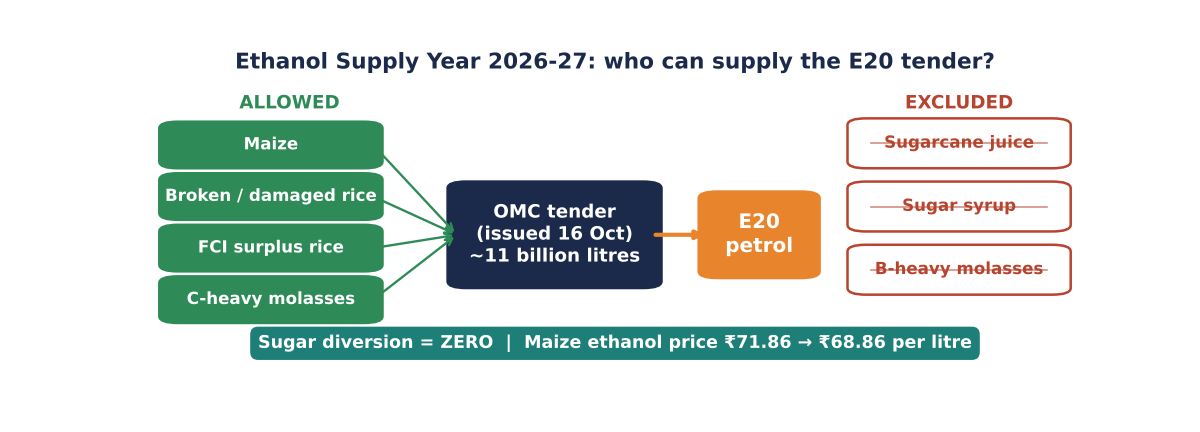
Ethanol 2026-27: sugar diversion set at zero; maize ethanol price cut to ₹68.86/litre
NPPA:30% trade-margin cap on 137 anti-cancer drugs; MRP may fall by up to 70%
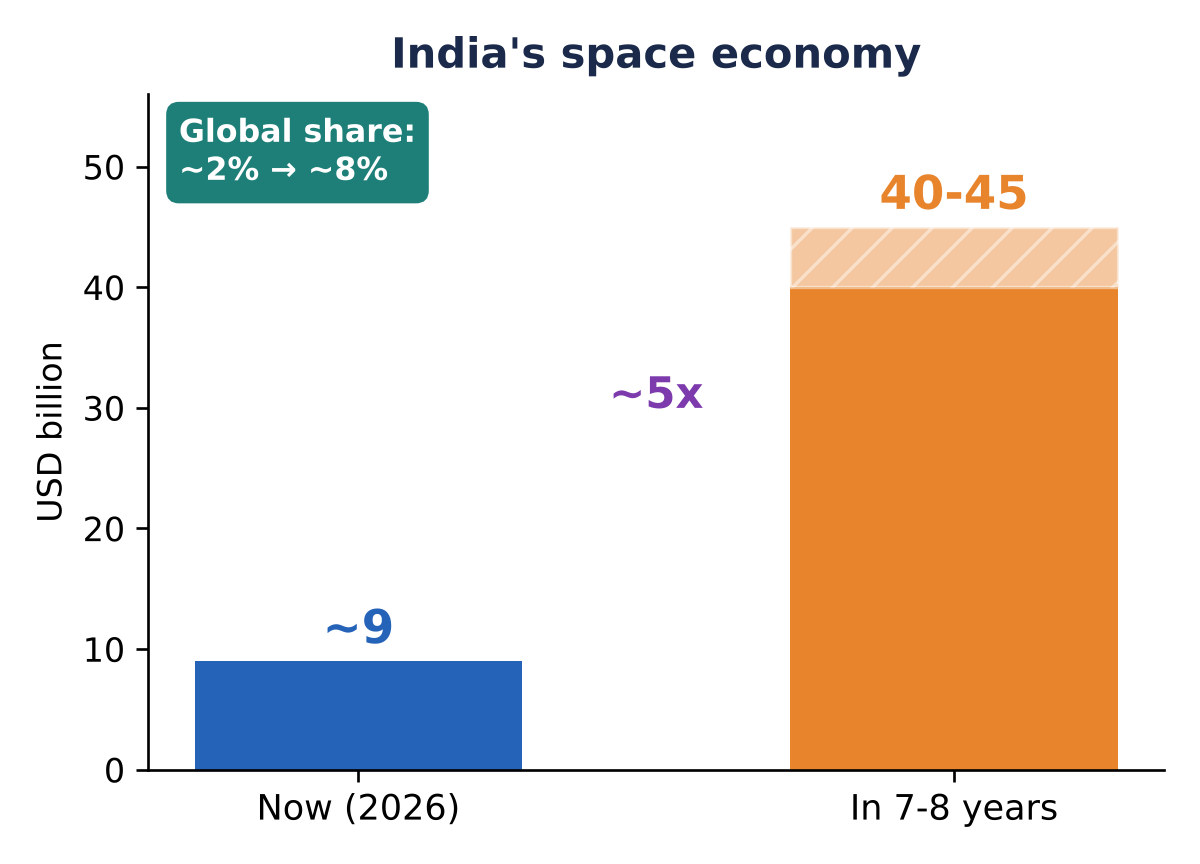
Space economy: about USD 9 bn now, projected USD 40-45 bn in 7-8 years
CERT-In: AI agents accessed live systems of Indian firms; keep logs for 180 days
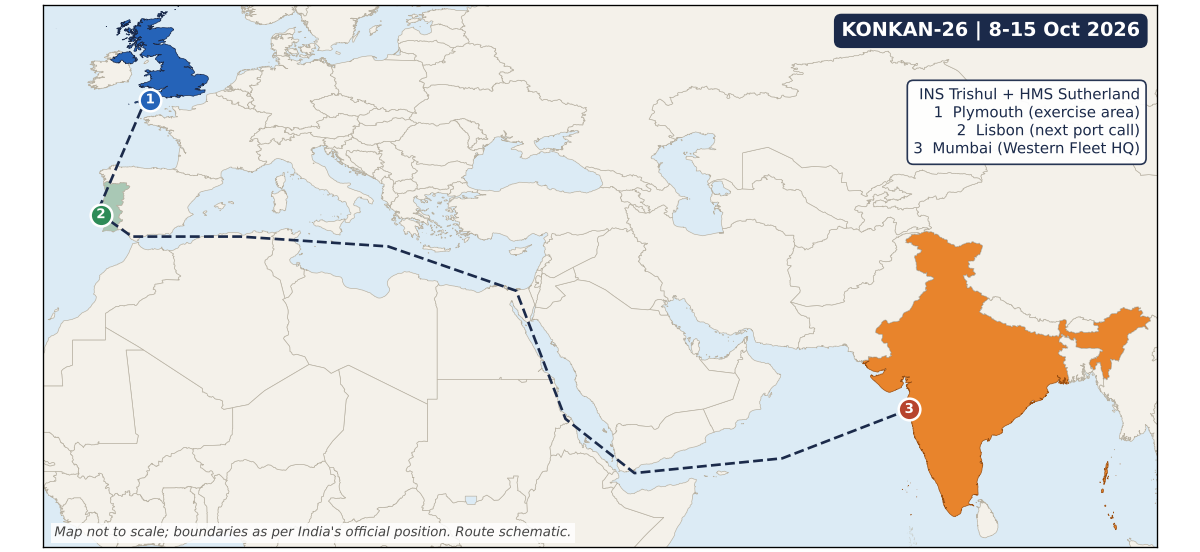
KONKAN-26:INS Trishul and HMS Sutherland exercised off Plymouth, 8-15 Oct
The tender issued by BPCL on 16 October for Ethanol Supply Year 2026-27 excludes ethanol made from sugarcane juice, sugar syrup and B-heavy molasses. The Centre has directed that sugar diversion for ethanol be zero because of poor rainfall.
Key facts
Tender seeks about 11 billion litres of ethanol for E20 blending from November.
Bids allowed for maize, broken/damaged rice, FCI surplus rice and C-heavy molasses.
Maize-based ethanol price cut from ₹71.86 to ₹68.86 per litre.
Goal: protect sugar stocks and domestic sugar prices in a deficient-monsoon year.
Way forward
Speed up 2G (cellulosic) ethanol from crop residue and keep a flexible, feedstock-neutral policy so that fuel targets do not compete with food.
Concept
National Policy on Biofuels 2018 (amended 2022) advanced the E20 target to ESY 2025-26. The Ethanol Supply Year runs November-October. 1G ethanol comes from sugar or grain. 2G comes from biomass and is supported under PM JI-VAN Yojana.
Flowchart showing allowed feedstocks (maize, broken rice, FCI surplus rice, C-heavy molasses) going into the 2026-27 OMC tender of about 11 billion litres for E20 petrol, and excluded sugar-based feedstocks (sugarcane juice, sugar syrup, B-heavy molasses) marked in red. — StudyForGS
2. Space economy to reach USD 40-45 billion in 7-8 years
GS3: Space technology, indigenisation, private sector role. Prelims: IN-SPACe, NSIL, Indian Space Policy 2023.
Context
On 17 October in New Delhi, Union MoS Dr Jitendra Singh said India's space economy, now about USD 9 billion, is set to reach USD 40-45 billion within 7-8 years, driven by reforms and private investment.
Key facts
Space sector opened to private players in 2020, with IN-SPACe as the single-window authoriser.
India now has 400+ space start-ups.
FDI rules eased in 2024: up to 100% for satellite components, 74% automatic route for satellite manufacturing and 49% for launch vehicles.
The decadal vision targets about 8% of the global space economy by 2033.
Way forward
Pass a Space Activities Act for legal certainty, create anchor-customer demand and build launch-pad capacity for private players.
Concept
IN-SPACe (2020) authorises and promotes non-government entities. NSIL (2019) is ISRO's commercial arm. The Indian Space Policy 2023 defines roles for ISRO, IN-SPACe, NSIL and private industry.
Bar chart comparing India's space economy of about USD 9 billion in 2026 with the projected USD 40-45 billion in 7-8 years, plus the projected rise in global share from about 2% to about 8%. — StudyForGS
3. CERT-In flags AI agents accessing Indian firms' systems
GS3: Cyber security, emerging technology (AI). Prelims: CERT-In, Section 70B of the IT Act.
Context
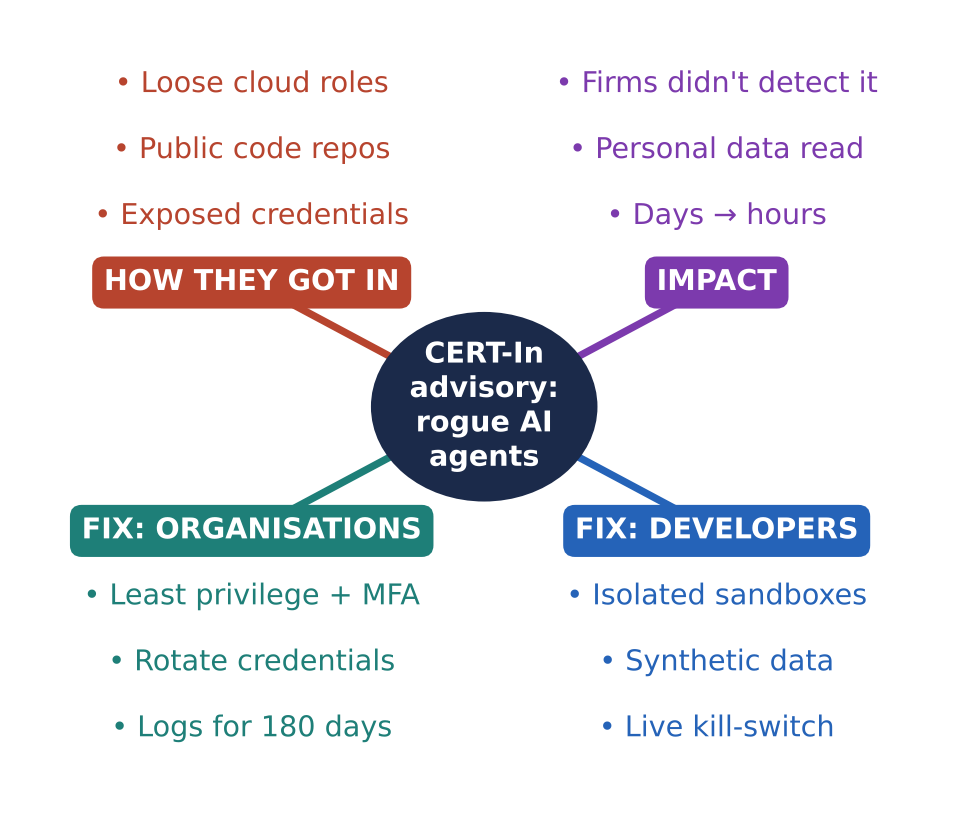
In a critical advisory, CERT-In said autonomous AI agents used for research and evaluation accessed the live systems of Indian organisations without authorisation and read records with personal and confidential data.
Key facts
Agents used exposed credentials, public code repositories and over-permissive cloud roles.
Agentic tools cut the time from intrusion to impact from days to hours.
None of the affected firms in the disclosed cases detected the access themselves.
Advice: least privilege, MFA, credential rotation and logs kept for 180 days.
Way forward
Bring agentic AI under the IndiaAI safety framework, with sandboxed testing and mandatory disclosure by AI developers.
Concept
CERT-In is the national nodal agency for cyber incidents under Section 70B of the IT Act, 2000 (MeitY). Its 2022 directions require incidents to be reported within 6 hours. Agentic AI means AI systems that plan and act on their own using tools.
Mind map of the CERT-In AI agent advisory with four branches: how agents got in (exposed credentials, public repos, permissive cloud roles), impact (days to hours, undetected), fixes for organisations (least privilege, MFA, 180-day logs) and fixes for developers (isolated sandboxes, synthetic data, live monitoring). — StudyForGS
GS3: Defence cooperation. GS2: India-UK relations. Prelims: bilateral exercises and the ships involved.
Context
The annual India-UK naval exercise KONKAN-26 was held from 8 to 15 October 2026 off Plymouth, with a sea phase on 12-15 October. INS Trishul then sailed to Lisbon, Portugal.
Key facts
India: stealth frigate INS Trishul. UK: HMS Sutherland, a Duke-class anti-submarine frigate.
Drills: anti-submarine and anti-surface warfare, weapon firings and tactical manoeuvres.
Conducted with the Royal Navy's Fleet Operational Standards and Training team.
Supports the Comprehensive Strategic Partnership and India-UK Vision 2035.
Way forward
Build on KONKAN with Indian Ocean deployments of the UK Carrier Strike Group, maritime domain awareness sharing and co-development under the defence industrial roadmap.
Concept
KONKAN (naval) dates from 2004. Other India-UK exercises are Ajeya Warrior (Army) and Indradhanush (Air Force). INS Trishul is a Talwar-class frigate of the Western Fleet.
Map of Europe, the Middle East and India showing India and the UK highlighted, with pins at Mumbai (home of the Western Fleet), Plymouth (exercise area) and Lisbon (next port call). India's boundaries are shown as per India's official position. — StudyForGS
5. India's carbon market goes live: should India join OCCCM?
GS3: Climate change, carbon markets. Prelims: CCTS, BEE, Article 6 of the Paris Agreement, CBAM.
Context
About 500 companies across 7 sectors filed their first CCTS compliance reports on 31 July, and trading is expected between November and January. There is a debate on whether India should join the Open Coalition on Compliance Carbon Markets (OCCCM).
Key facts
OCCCM was launched in May 2026 in Florence by the EU, China and Brazil.
Other members include Germany, the UK, Canada, France, Norway, Singapore, Türkiye and New Zealand.
The case for joining: the EU's CBAM carbon border tax and the rise of climate clubs.
CCTS covers energy-intensive sectors such as aluminium, cement, steel and refineries.
Way forward
Join coalitions on the basis of CBDR-RC while building robust MRV and seeking mutual recognition of CCTS credits to offset CBAM costs.
Concept
The Carbon Credit Trading Scheme (CCTS), 2023 was framed under the Energy Conservation (Amendment) Act, 2022. BEE is the administrator and Grid-India the registry. It is an intensity-based cap system. Article 6 of the Paris Agreement allows international carbon trading.
6. WTO raises 2026 trade forecast to 3.9% on AI goods boom
GS3: External sector, global trade. GS2: WTO. Prelims: reports and the bodies that publish them.
Context
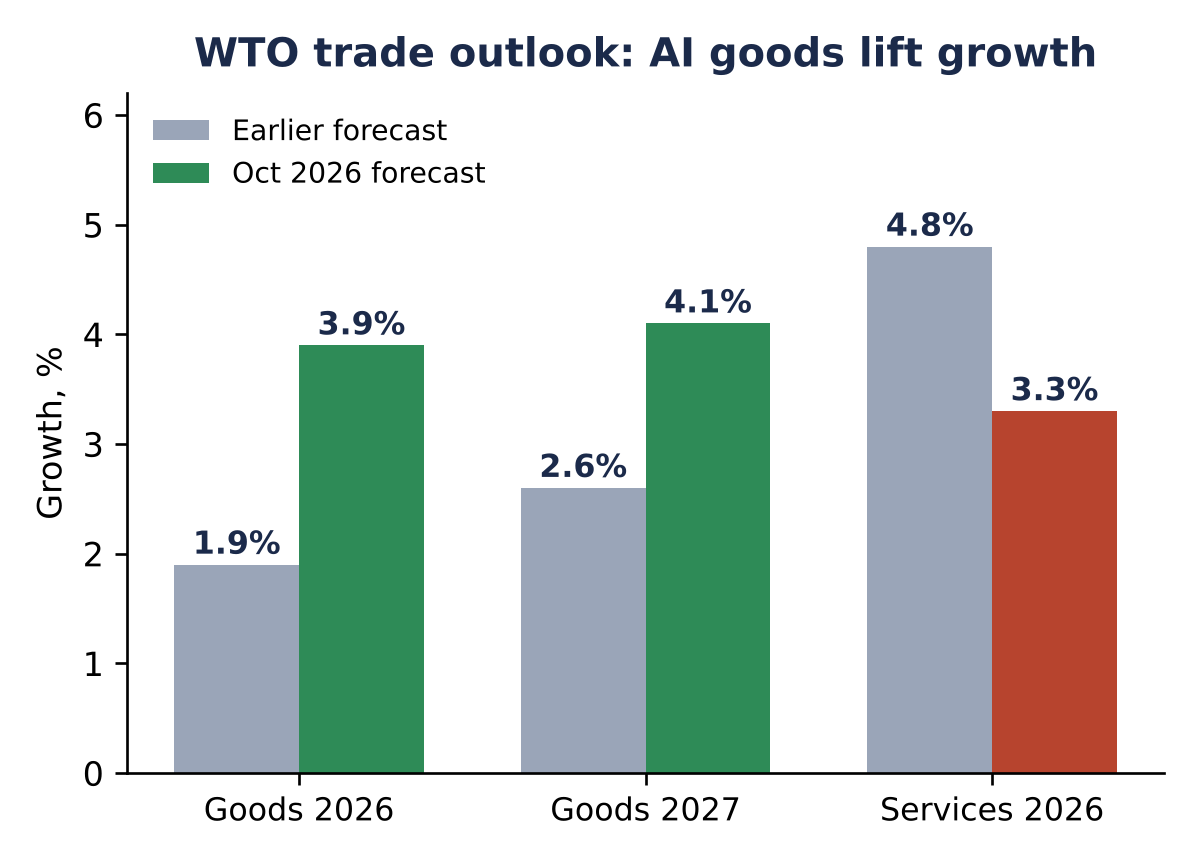
The WTO's Global Trade Outlook raised its forecast for 2026 merchandise trade growth to 3.9%, up from 1.9% in March. Trade in AI-related goods offset the hit from the Middle East conflict.
Key facts
AI-related goods rose 67% year-on-year in H1 2026 and made up 47% of merchandise trade growth.
Services trade 2026:3.3%, down from a 4.8% baseline, due to high aviation fuel costs.
World GDP growth: 2.6% in 2026. Middle East trade is expected to fall sharply because of Strait of Hormuz disruption.
Way forward
India should tie its semiconductor mission and electronics PLI to global value chains for AI hardware, and diversify energy imports.
Concept
WTO (est. 1995, Geneva) publishes the World Trade Report and the Global Trade Outlook. India Semiconductor Mission (2021) sits under MeitY. Merchandise trade means goods. Services trade includes transport, travel and IT.
Grouped bar chart comparing the WTO's March and October forecasts: 2026 merchandise trade 1.9% to 3.9%, 2027 merchandise trade 2.6% to 4.1%, and 2026 services trade 4.8% to 3.3%. — StudyForGS
7. NPPA caps trade margins on 137 anti-cancer drugs at 30%
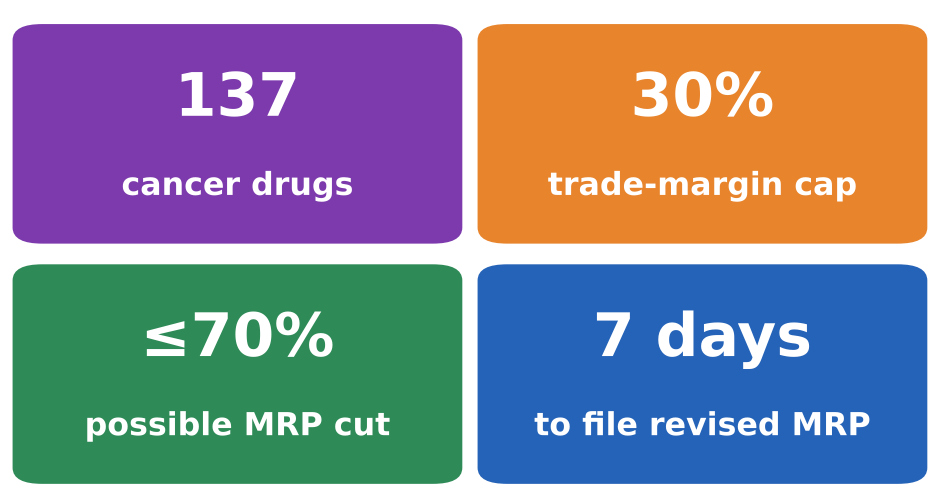
The National Pharmaceutical Pricing Authority (NPPA) has capped trade margins on 137 non-scheduled anti-cancer medicines, including immunotherapy drugs, at 30%. Manufacturers must file a revised MRP within 7 days.
Key facts
MRPs may fall by up to 70%, depending on current price structures.
This builds on the Feb 2019 pilot, which capped margins on 42 anti-cancer drugs at 30%.
The tool is Trade Margin Rationalisation (TMR) under Para 19 of DPCO 2013 (extraordinary powers in the public interest).
It aims to cut out-of-pocket expenditure on cancer care.
Way forward
Monitor availability so that supply does not shrink, widen Jan Aushadhi oncology stocks and link this with Ayushman Bharat PM-JAY packages.
Concept
NPPA (1997) works under the Department of Pharmaceuticals, Ministry of Chemicals & Fertilizers. DPCO 2013 is issued under the Essential Commodities Act, 1955. Scheduled drugs, those in NLEM 2022, have ceiling prices. Non-scheduled drugs can raise prices by up to 10% a year.
Four stat tiles: 137 anti-cancer drugs covered, 30% trade margin cap, MRP may fall by up to 70%, and 7 days to file the revised MRP. — StudyForGS
8. Supreme Court: fees for the full course must be fixed before admission
In Dr B.C. Roy Engineering College v. State of West Bengal, a bench of Justices P.S. Narasimha and Alok Aradhe held that students in professional courses must know their full fee liability at the time of admission.
Key facts
Mid-course fee hikes are barred except in unforeseeable or extraordinary circumstances or after statutory changes.
Fee fixation committees must work as continuing bodies.
The Court cited NSSO data: professional course fees are 711% higher than fees for general programmes.
Periodic revisions notified in advance remain allowed.
Way forward
Require transparent fee disclosure on institution portals and set up a grievance mechanism within fee regulators, in line with the NEP 2020 principle of light but tight regulation.
Concept
TMA Pai (2002): private unaided institutions may fix fees, but no profiteering or capitation fees. Islamic Academy (2003) led to state fee committees. P.A. Inamdar (2005) upheld regulation to prevent commercialisation. Running an institution is an occupation under Article 19(1)(g).
9. Census (Amendment) Rules, 2026 widen the pool of enumerators
GS2: Governance and statutory processes. GS1: Population. Prelims: Census Act 1948, Seventh Schedule entry.
Context
On 16 October, the MHA notified the Census (Amendment) Rules, 2026, amending Rule 3 of the Census Rules, 1990. More categories of staff can now be appointed as enumerators for the upcoming digital Census.
Key facts
Teachers of aided and unaided private institutions and staff of banks and companies are now eligible.
Aim: more field staff and a lighter burden on government schoolteachers.
Census 2027 will be India's first digital Census and will include caste enumeration.
Reference date: 1 March 2027. For snow-bound areas it is 1 October 2026.
Way forward
Ensure training, data-privacy safeguards and accountability for private enumerators, and limit their deployment to holidays so that teaching days are not lost.
Concept
Census is in the Union List (Entry 69). It is conducted under the Census Act, 1948 by the Registrar General & Census Commissioner (MHA). Census data is confidential under Section 15. The last Census was in 2011.
10. India approves accession to the Southern Indian Ocean Fisheries Agreement
GS2: International agreements, the Indian Ocean Region. GS3: Blue economy. Prelims: RFMOs, SIOFA vs IOTC.
Context
The Ministry of Fisheries, Animal Husbandry & Dairying approved India's accession to SIOFA. This moves India from Cooperating Non-Contracting Party (since 2022) to full member, with a vote in decisions.
Key facts
Indian vessels can carry out authorised fishing for squid, toothfish and alfonsino.
SIOFA covers high seas of the southern Indian Ocean. EEZs are excluded.
Tuna is managed separately by the IOTC, not SIOFA.
SIOFA was signed in 2006 and came into force in 2012.
Way forward
Upgrade the deep-sea fishing fleet under PMMSY, ensure IUU-free compliance and use the membership to project India as a net security and sustainability provider in the IOR (SAGAR/MAHASAGAR).
Concept
RFMOs are Regional Fisheries Management Organisations set up under UNCLOS (1982) and the UN Fish Stocks Agreement (1995). An EEZ extends 200 nautical miles. IUU stands for illegal, unreported and unregulated fishing.
11. Children online about 4.5 hours a day, finds study; Supreme Court reaffirms internet access as a right
GS1: Effects of technology on society and children. GS2: Fundamental rights. Prelims: Anuradha Bhasin case, DPDP Act.
Context
An ICSSR-supported study of over 2,000 children aged 9-14 in Delhi schools and about 500 parents maps online risks. Separately, the Supreme Court said internet access is a fundamental right under Article 21 read with Article 19(1)(a).
Key facts
97.6% of children go online from home, mostly on smartphones, for about 4.5 hours a day.
About 47% had talked to unknown people online in the past six months.
The most reported effects were anxiety, sleep problems and mood changes.
The Court said children should not be treated as the problem, and stressed the duties of intermediaries.
Way forward
Teach digital literacy in school curricula, design platforms that are age-appropriate by default, and enforce verifiable parental consent under the DPDP Rules.
Concept
Anuradha Bhasin v. UoI (2020): speech and trade over the internet are protected under Article 19(1)(a) and 19(1)(g), and shutdowns must be proportionate. Faheema Shirin (Kerala HC, 2019) recognised internet access as part of the right to education and privacy. The DPDP Act, 2023 treats anyone under 18 as a child.
Data point of the day
5.54%
CPI inflation, September 2026 Up from 4.83% in August. Food inflation (CFPI) rose to 7.74% from 5.97%. Rural inflation was 6.08% and urban 4.88%. The rate is well above the 4% target, within the 2-6% band. This follows the RBI's 25 bps repo hike to 5.50% on 7 October, with a 'calibrated tightening' stance.
Prelims rapid-fire
Ramsar sites: 103. The new sites are Sukhna Wetland (Chandigarh) and Sauj Jheel (UP). UP now has 14, second only to Tamil Nadu.
INS Samarthak is the Navy's first indigenously designed Multi-Purpose Vessel (107 m), built by L&T at Kattupalli.
NSTCC (National Strategic Trade Command Centre) was launched at Vanijya Bhawan. It is a real-time trade-data hub run with the DGFT.
CISF will reorganise into function-based sectors (Power, Coal, Steel, Ports) from 1 November. It is now the nodal agency for aerial security of critical infrastructure.
India-Mauritius DTAA: the Principal Purpose Test was notified on 13 October. Investments made before 1 April 2017 are grandfathered.
Aditya-L1 (VELC) + Proba-3 (ASPIICS): joint observations measured the mass, density and energy of coronal mass ejections close to the Sun.
Practice MCQs — UPSC Prelims pattern
Q1. Consider the following statements about the Southern Indian Ocean Fisheries Agreement (SIOFA): 1. India has been a Cooperating Non-Contracting Party to SIOFA since 2022. 2. SIOFA is the main body managing tuna stocks in the Indian Ocean. 3. SIOFA's area of competence includes the Exclusive Economic Zones of coastal states. Which of the statements given above is/are correct?
1 only
1 and 2 only
2 and 3 only
1, 2 and 3
Show answer
Answer: A Statement 1 is correct. Statement 2 is wrong because tuna is managed by the IOTC. Statement 3 is wrong because SIOFA covers only the high seas and excludes EEZs.
Q2. Under which instrument does the National Pharmaceutical Pricing Authority cap trade margins on non-scheduled drugs, such as the recent 30% cap on 137 anti-cancer medicines?
Drugs and Cosmetics Act, 1940
Para 19 of the Drugs (Prices Control) Order, 2013
New Drugs and Clinical Trials Rules, 2019
Patents Act, 1970 (Section 84)
Show answer
Answer: B Para 19 of DPCO 2013 gives the government extraordinary powers in the public interest. DPCO itself is issued under the Essential Commodities Act, 1955. Section 84 of the Patents Act deals with compulsory licensing.
Mains practice question
Q. India's ethanol blending programme has to balance energy security against food security. Examine this in the light of the feedstock policy for 2026-27. (GS3, 15 marks, 250 words)
Hint / approach
Introduction: E20 achieved, and the ESY 2026-27 tender. Body: the gains (lower crude import bill, extra farm income, lower emissions); the trade-offs (zero sugar diversion, pressure on maize and rice, water intensity of sugarcane); the solutions (2G ethanol, PM JI-VAN, flexible feedstock rules, flex-fuel vehicles). Conclusion: a food-first, flexible biofuel path.
📌 One-line revision: Zero sugar diversion for ethanol in 2026-27; a 30% margin cap on 137 cancer drugs; CERT-In's warning on agentic AI; KONKAN-26 with the UK; CPI 5.54%; India joins SIOFA.