Semicon 2.0 unveiled with a ₹1,27,500 crore outlay, the US Federal Reserve raises rates for the first time in three years, and six states sign the Kishau Multipurpose Project agreement on the Tons river.
Saturday, 19 September 2026 · IST · National & International · 12 items · 2 MCQs
India's semiconductor push entered its second phase as Semicon 2.0 was unveiled with a ₹1,27,500 crore outlay built around six pillars. Globally, the US Federal Reserve raised its policy rate by 25 basis points to 3.75–4.00%, its first hike in three years, tightening the external environment for emerging markets. At home, six Yamuna-basin states signed the long-pending Kishau Multipurpose Project agreement, retail inflation climbed to 4.82% in August, and the Election Commission froze the Trinamool Congress name and symbol ahead of the October bypolls.
Today at a glance — things to remember
Semicon 2.0 unveiled: ₹1,27,500 crore outlay for India Semiconductor Mission Phase-II.
US Federal Reserve raises rates 25 bps to 3.75–4.00% — its first hike in three years.
Six states sign the Kishau Multipurpose Project agreement on the Tons river.
Retail inflation (CPI) rises to 4.82% in August 2026; food inflation at 5.95%.
ECI freezes the Trinamool Congress name and symbol under Paragraph 15 of the Symbols Order.
Jan Aushadhi basket widens to 2,110 medicines plus 315 surgicals and devices.
New Zealand's Parliament clears legislation giving effect to the India–New Zealand FTA.
India ranks No. 1 for business climate among 41 global markets in a Swedish survey.
India's first soil carbon credit payments: ₹2.9 crore to 2,550 farmers.
India-born cheetah KGP-12 delivers four cubs at Kuno; population rises to 56.
Detailed notes
1. Semicon 2.0: India Semiconductor Mission enters Phase-II
SCI-TECHUPSC: Prelims + Mains (Science & Technology / Indian Economy)
Syllabus linkage
GS-III — Science & Technology: indigenisation of technology; Economy: industrial policy, manufacturing. Prelims: India Semiconductor Mission, SEMICON India, outlay figures, the six pillars.
Context
India's flagship chip programme moved into its second phase, unveiled at the SEMICON India gathering. Phase-II widens the mission from fabrication alone to the whole semiconductor value chain, from design to talent.
Key facts
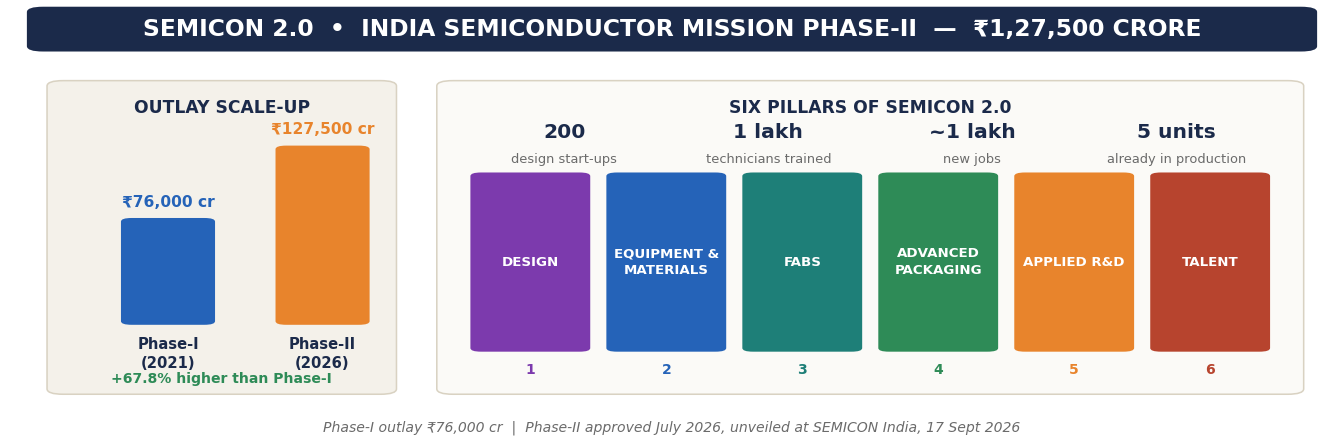
Semicon 2.0 carries an outlay of ₹1,27,500 crore (about USD 13.5 billion), against ₹76,000 crore in Phase-I — a 67.8% increase.
Cabinet approval came in July 2026; the programme was unveiled on 17 September 2026.
Built on six pillars: design, equipment and materials, fabs, advanced packaging, applied R&D, and talent.
Targets: 200 semiconductor design start-ups, training of 1 lakh technicians and roughly 1 lakh new jobs.
Five units approved under Phase-I are already in commercial production.
Way forward
Phase-II must convert announced commitments into operating capacity — securing critical materials, ATMP ecosystems and a deep design talent pool are the binding constraints, not capital.
Concept
Semiconductor value chain = design → fabrication (fab) → ATMP/OSAT (Assembly, Testing, Marking, Packaging) → application. Fabless firms design but do not manufacture; foundries manufacture for others. Link with Make in India, PLI schemes and the National Deep Tech Start-up Policy.
Full-width schematic comparing the Semicon Phase-I outlay of ₹76,000 crore with the Phase-II outlay of ₹1,27,500 crore, alongside the six pillars of Semicon 2.0 and its headline targets. — StudyForGS
2. US Fed raises rates 25 bps — first hike in three years
GS-III — Indian Economy: monetary policy, capital flows, exchange rate management. Prelims: federal funds rate, basis points, policy transmission channels.
Context
The US Federal Reserve lifted its benchmark policy rate for the first time since 2023, reversing an easing cycle and signalling a firmer stance against inflation that has stayed above target.
Key facts
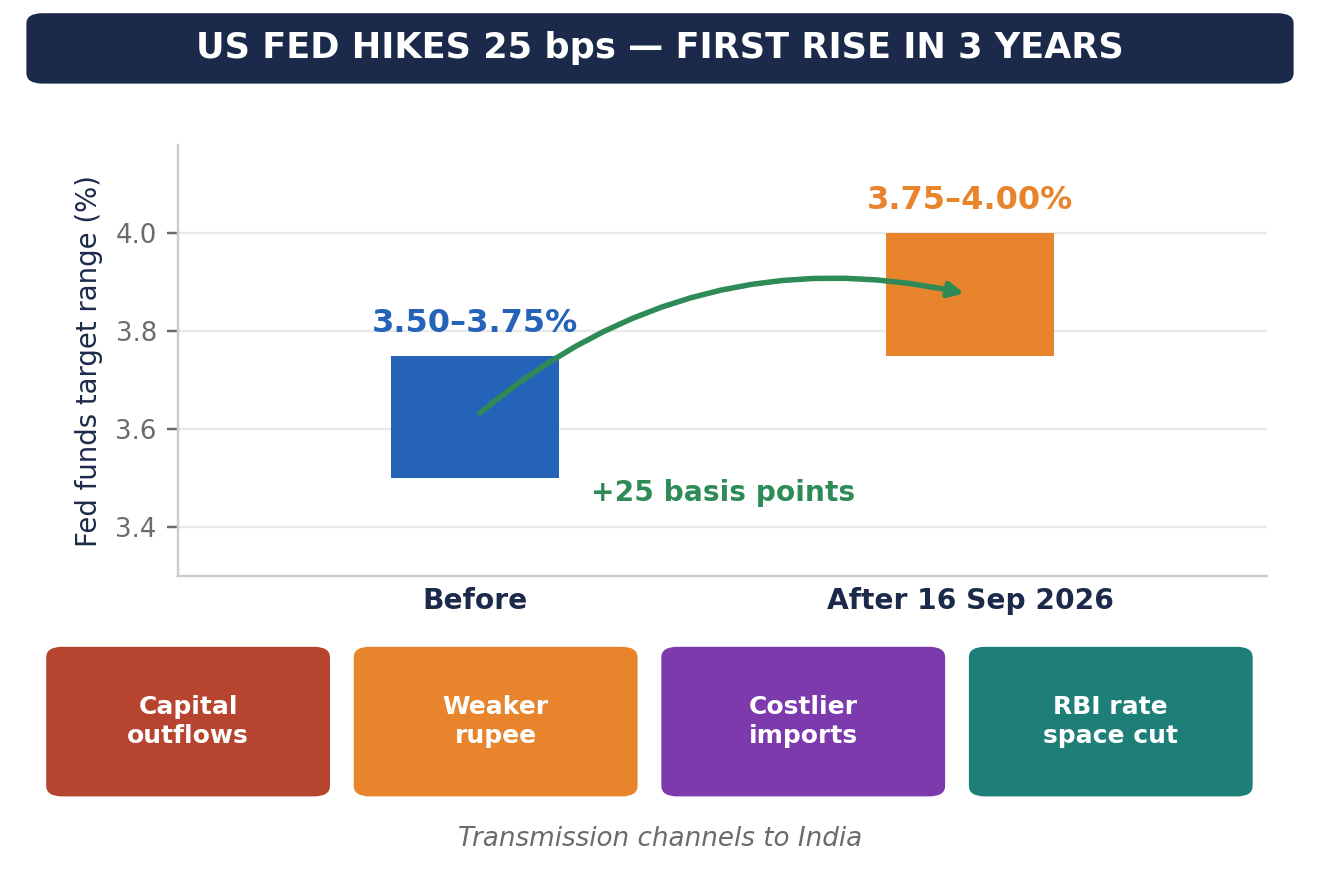
The federal funds target range was raised by 25 basis points to 3.75–4.00% on 16 September 2026.
It is the first increase in three years, decided by a unanimous vote.
Fed Chair Kevin Warsh committed to a timelier return to the 2% inflation target.
Projections point to growth easing from about 2.3% to 2.1%, unemployment near 4.1%, and inflation falling to 2.0% by 2029.
US inflation was last below the 2% target in February 2021.
Way forward
India must guard against imported tightening — a deeper forex buffer, calibrated RBI communication and steady FDI (rather than volatile portfolio flows) reduce the spillover.
Concept
Basis point = one-hundredth of a percentage point. A US rate rise narrows the interest rate differential, triggering capital outflows, rupee depreciation and costlier imports — the impossible trinity limits how far the RBI can simultaneously hold the exchange rate, keep capital mobile and run an independent monetary policy.
Chart showing the US federal funds target range moving from 3.50–3.75% to 3.75–4.00% after the 16 September 2026 decision, with the four transmission channels to India. — StudyForGS
3. Deep-sea mining: India's nodule ambition meets an ecological gap
GS-III — Science & Technology: developments and applications; Environment: marine biodiversity, conservation. Prelims: Deep Ocean Mission, MATSYA-6000, polymetallic nodules, International Seabed Authority.
Context
India's deep-ocean programme is advancing towards crewed exploration of the seabed even as the global rulebook for commercial extraction remains unwritten, sharpening the tension between critical-mineral security and ecological caution.
Key facts
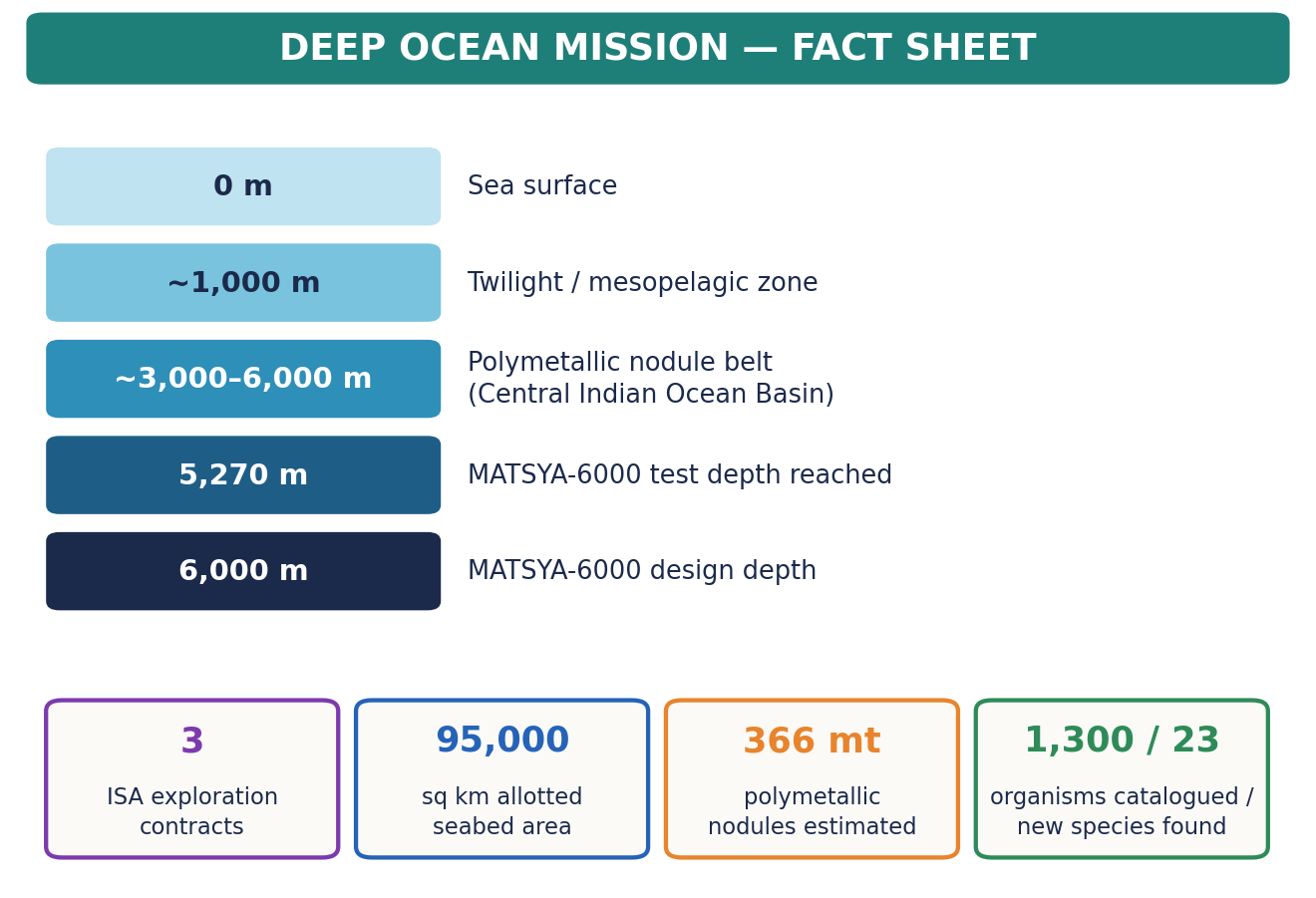
Polymetallic nodules lie at depths of 3,000–6,000 metres on the abyssal seabed.
India holds three exploration contracts with the International Seabed Authority, covering about 95,000 sq km.
Estimated resource: about 366 million tonnes of polymetallic nodules.
The indigenous submersible MATSYA-6000 has been tested to about 5,270 metres against a design depth of 6,000 metres.
The ISA's exploitation code — the rulebook for commercial mining — remains unadopted.
Way forward
Sequence exploration ahead of extraction: mandatory ecological baselines, a precautionary pause until the exploitation code is finalised, and investment in recycling to reduce primary demand.
Concept
Polymetallic (manganese) nodules are potato-sized concretions of manganese, nickel, cobalt and copper on the abyssal plain. The International Seabed Authority, created under UNCLOS (1982), administers the deep seabed as the common heritage of mankind. India was the world's first Pioneer Investor (1987).
Fact sheet with a depth ladder from the sea surface to 6,000 metres showing the polymetallic nodule belt and MATSYA-6000 depths, plus tiles for contracts, area, resource estimate and species catalogued. — StudyForGS
4. India's first soil carbon payments reach smallholder farmers
Farmers in the north-western plains received India's first payouts for carbon stored in their soil, turning climate-friendly field practices into a direct income stream rather than a compliance burden.
Key facts
₹2.9 crore was distributed to 2,550 smallholder farmers in Punjab and Haryana on 17 September 2026.
Average payment worked out to about ₹11,478 per farmer.
About 50,000 carbon credits were verified for practices adopted between 2019 and 2022.
Credited practices: Direct Seeded Rice (DSR), reduced tillage and crop-residue management.
Co-benefits reported: roughly 45 billion litres of water saved and over 2 lakh tonnes of residue retained on fields.
Way forward
Scale needs a credible national MRV (measurement, reporting and verification) architecture and aggregation through FPOs, so that price discovery and permanence risk do not fall on individual farmers.
Concept
Soil organic carbon sequestration stores atmospheric CO2 in soil, improving fertility and water retention. A carbon credit equals one tonne of CO2-equivalent avoided or removed. Link with the Carbon Credit Trading Scheme, Article 6 of the Paris Agreement and the National Mission for Sustainable Agriculture.
5. HAL completes Tejas trainer deliveries, hands Dhruv NG to civil operator
GS-III — Security: indigenisation of defence technology, defence industrial base. Prelims: Tejas twin-seater trainer, Dhruv NG helicopter, Pawan Hans.
Context
The domestic aerospace manufacturer closed out a key trainer order for the Air Force and, separately, moved an indigenous helicopter platform into civil aviation service — two markers of a widening indigenous production base.
Key facts
Deliveries of the Tejas twin-seater trainer variant to the Indian Air Force have been completed.
Four Dhruv Next Generation (NG) helicopters were inducted into Pawan Hans Ltd. for civil operations.
The Dhruv NG is a 5.5-tonne class light helicopter that is civil-certified.
Tejas is India's indigenous Light Combat Aircraft (LCA), developed with DRDO's ADA.
Way forward
Sustaining indigenisation now depends on engine supply security, a reliable component vendor base and faster certification cycles for civil variants.
Concept
Defence indigenisation is measured through the positive indigenisation lists, Defence Acquisition Procedure (DAP) 2020 categories such as Buy (Indian-IDDM), and the iDEX ecosystem for start-ups. Civil certification of a military-origin platform widens the order book and lowers unit cost.
6. Retail inflation climbs to 4.82% in August 2026
GS-III — Indian Economy: inflation, monetary policy framework. Prelims: CPI (Combined), base year, RBI tolerance band, flexible inflation targeting.
Context
Official data released for August showed consumer price inflation firming for a fourth straight month, driven mainly by food, though it stayed inside the tolerance band.
Key facts
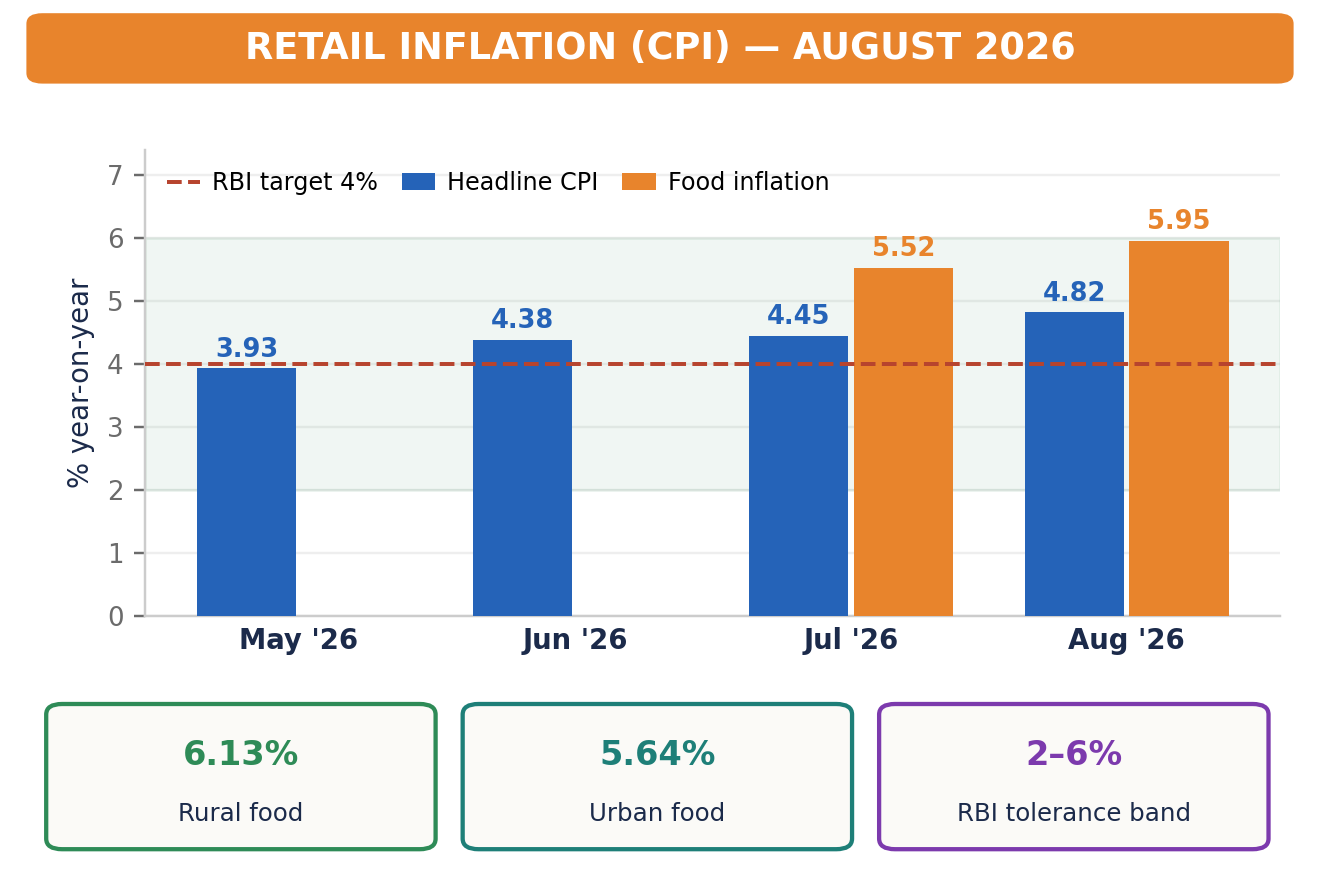
Headline CPI inflation was 4.82% in August 2026, up from 4.45% in July.
Food inflation rose to 5.95% from 5.52% — 6.13% rural and 5.64% urban.
The reading sits above the 4% medium-term target but within the 2–6% tolerance band.
Sharp gainers: ginger (+73.82%), onion (+48.27%) and garlic (+43.60%); tomato (-31.09%) and potato (-13.14%) fell.
Inflation has risen steadily from 3.93% in May through 4.38% in June and 4.45% in July.
Way forward
With food the main driver, supply-side action — buffer stocking, cold chains and horticulture productivity — will do more than rate action, which must also weigh the tighter external environment.
Concept
India follows flexible inflation targeting under the amended RBI Act, 1934: a 4% CPI target with a +/- 2% band, set by the government in consultation with the RBI and implemented by the six-member Monetary Policy Committee. CPI (Combined) is compiled by the National Statistics Office.
Bar chart of headline CPI inflation from May to August 2026 with food inflation for July and August, the 4% RBI target line and the 2-6% tolerance band. — StudyForGS
7. Six states sign the Kishau Multipurpose Project agreement
GS-II — Polity: inter-state relations, cooperative federalism, river water sharing. GS-III — Infrastructure: irrigation and energy. Prelims: Tons river, Yamuna basin, concrete gravity dam, environmental flow.
Context
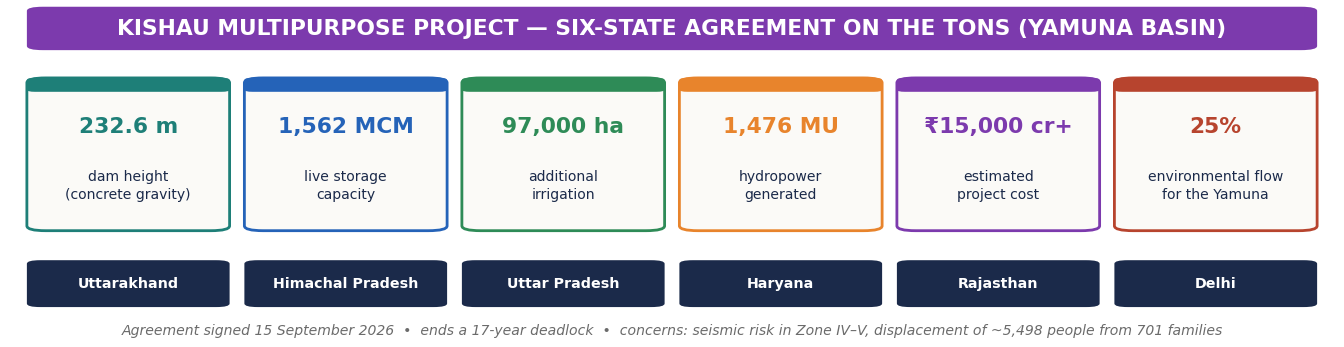
Six Yamuna-basin states signed an agreement for a large storage dam on the Tons, ending a deadlock of nearly two decades over cost sharing and water allocation.
Key facts
The agreement was signed on 15 September 2026, ending a 17-year deadlock.
Signatories: Uttarakhand, Himachal Pradesh, Uttar Pradesh, Haryana, Rajasthan and Delhi.
Site: the Tons river, the largest tributary of the Yamuna, on the Uttarakhand–Himachal Pradesh border.
A concrete gravity dam of 232.6 metres — among India's tallest — with storage of 1,562 million cubic metres (MCM).
Benefits: irrigation for 97,000 hectares, 1,476 million units of hydropower and a 25% environmental flow for the Yamuna.
Way forward
At an estimated ₹15,000–15,624 crore, with about 5,498 people from 701 families to be displaced, a fresh seismic and cumulative-impact assessment and an updated rehabilitation package must precede construction.
Concept
Environmental flow (e-flow) is the minimum river flow needed to sustain aquatic ecosystems. Inter-state river disputes fall under Article 262 and the Inter-State River Water Disputes Act, 1956; the River Boards Act, 1956 permits advisory boards. A concrete gravity dam resists water pressure by its own weight.
Full-width stat-tile strip for the Kishau Multipurpose Project showing dam height, storage, irrigation, hydropower, cost and environmental flow, with the six signatory states below. — StudyForGS
8. ECI freezes Trinamool Congress name and symbol before bypolls
GS-II — Polity: Election Commission of India, powers and functions; statutory and constitutional bodies. Prelims: Election Symbols (Reservation and Allotment) Order 1968, Article 324, Section 29A of the RP Act 1951.
Context
Faced with rival claims to the same party from two groups, the poll body issued an interim order freezing the party's registered name and reserved symbol, a remedy it has used in earlier splits.
Key facts
The interim order was issued on 17 September 2026 under Paragraph 15 of the Election Symbols (Reservation and Allotment) Order, 1968.
Neither group may use the name All India Trinamool Congress or the reserved 'Flowers & Grass' symbol.
Rival groups are led by Mamata Banerjee and Arup Roy.
The freeze precedes bypolls in Rejinagar and Nandigram scheduled for 6 October 2026.
Under Para 15 the primary test is majority support among elected legislators (MPs and MLAs), with verified affidavits used when membership records are contested.
Way forward
Both groups must file three alternative names and symbols; a time-bound, evidence-based procedure with published criteria would make such freezes the exception rather than a default holding action.
Concept
The ECI is a constitutional body under Article 324. Party registration flows from Section 29A of the Representation of the People Act, 1951, while symbol allotment is governed by the Symbols Order, 1968 — a subordinate legislation, upheld in Sadiq Ali v. ECI (1972). Distinguish reserved symbols (recognised parties) from free symbols.
9. Jan Aushadhi basket expands well beyond medicines
HEALTHUPSC: Prelims + Mains (Governance & Social Justice — health)
Syllabus linkage
GS-II — Governance: welfare schemes, issues relating to health; Social Justice: vulnerable sections. Prelims: PMBJP, PMBI, Jan Aushadhi Kendras, sub-baskets.
Context
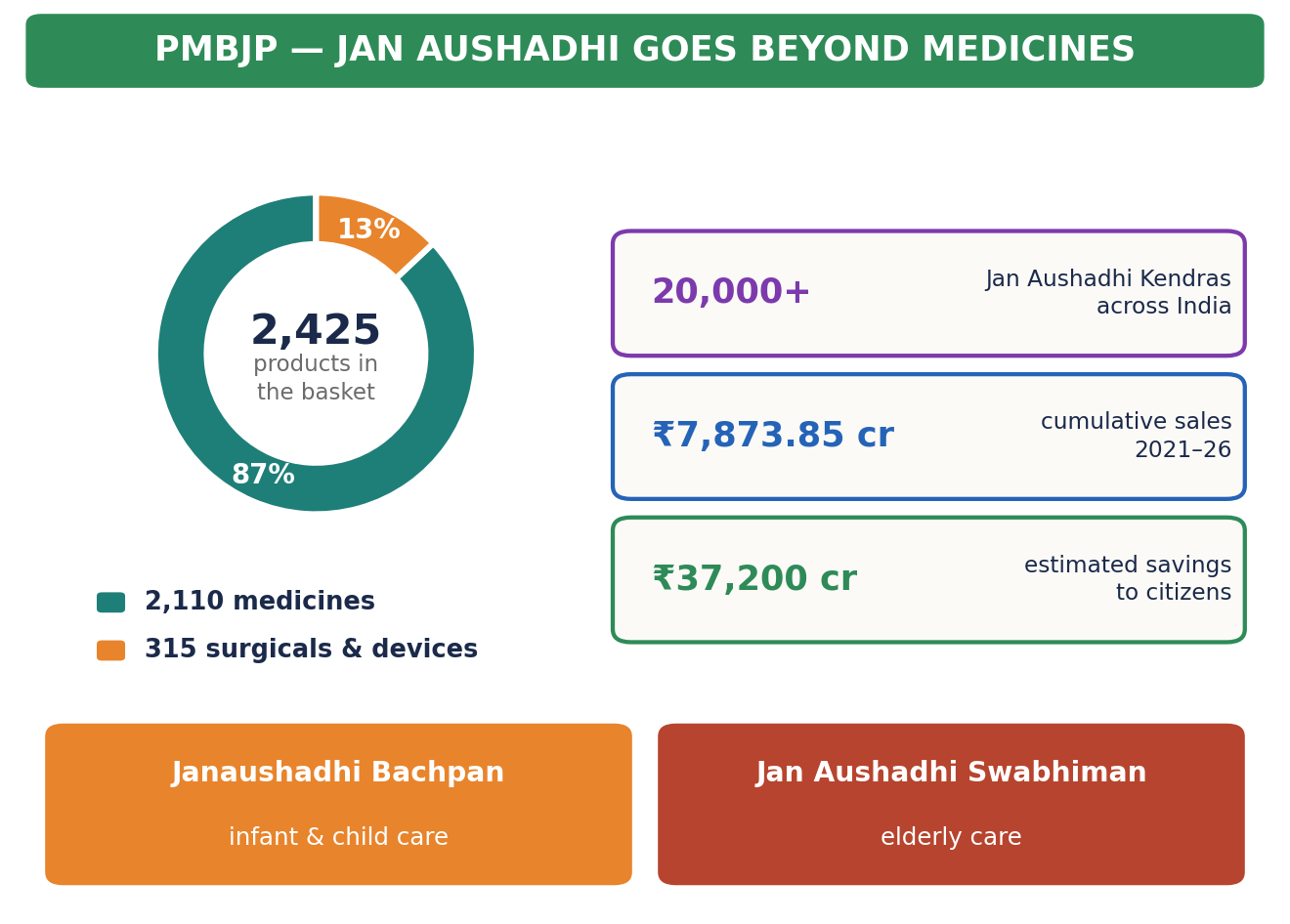
The generic medicine programme widened its range from drugs alone to surgicals, consumables and devices — baby wipes at ₹45 for 20, nebulisers at ₹937.50 and glucometer strips at ₹500 for 25 — with sub-baskets for infants and the elderly.
Key facts
Pradhan Mantri Bhartiya Janaushadhi Pariyojana (PMBJP) now runs over 20,000 Jan Aushadhi Kendras nationwide.
The basket covers 2,110 medicines plus 315 surgicals, consumables and devices.
Sales between 2021 and 2026 touched ₹7,873.85 crore, with estimated citizen savings of about ₹37,200 crore.
Two sub-baskets: Janaushadhi Bachpan (infant and child care) and Jan Aushadhi Swabhiman (elderly care).
Implementing agency: the Pharmaceuticals & Medical Devices Bureau of India (PMBI).
Way forward
Quality assurance at scale — batch testing, prescriber confidence and last-mile availability in aspirational districts — will decide whether savings translate into better health outcomes.
Concept
Generic medicines are bioequivalent to branded drugs but sold under the chemical name. Out-of-pocket expenditure is a major driver of catastrophic health expenditure in India. Link with Ayushman Bharat PM-JAY, the National Health Policy 2017 and price control through the NPPA.
Donut chart splitting the Jan Aushadhi basket into 2,110 medicines and 315 surgicals and devices, with stat tiles for kendras, sales and citizen savings and the two sub-baskets. — StudyForGS
10. Global report puts forests at the centre of food security
GS-III — Environment: conservation, forest resources; Food security and farm livelihoods. Prelims: forest foods, minor forest produce, agroforestry.
Context
A global assessment released this month argues that food obtained from forests is systematically missing from national statistics, leaving a large share of nutrition and rural income invisible to policy.
Key facts
The report was released on 15 September 2026 by the UN food and agriculture body.
Over 5 billion people depend on forests for livelihoods; more than 50,000 wild species are used for food or medicine.
In parts of Africa up to 80% of daily protein comes from wild meat; in the Amazon about 44% of food consumed is forest-sourced.
Global forest loss averaged 10.9 million hectares per decade to 2025.
India's instruments: Forest Rights Act, 2006, MSP for Minor Forest Produce, Van Dhan Vikas Kendras and the National Agroforestry Policy, 2014.
Way forward
With forest resources supplying up to 20% of rural incomes in some regions, forest foods must enter nutrition surveys and dietary guidelines, backed by stronger community forest resource rights.
Concept
Minor Forest Produce (MFP) includes all non-timber forest produce of plant origin. Under Section 3(1)(c) of the Forest Rights Act, 2006, forest dwellers have the right to collect, use and dispose of MFP. Agroforestry integrates trees with crops or livestock on the same land.
11. India-born cheetah delivers four cubs; Kuno population rises to 56
ENVIRONMENTUPSC: Prelims + Mains (Environment & Ecology — species reintroduction)
Syllabus linkage
GS-III — Environment: conservation, biodiversity, species reintroduction. Prelims: Project Cheetah, Kuno National Park, Gandhi Sagar Wildlife Sanctuary, IUCN status.
Context
A female cheetah born in India gave birth to four cubs a day after the reintroduction programme completed four years, a marker that the translocated population is beginning to breed naturally in Indian conditions.
Key facts
The India-born female KGP-12 delivered four cubs on 17 September 2026.
The total cheetah population rose from 52 to 56 — 49 at Kuno National Park and 3 at Gandhi Sagar Wildlife Sanctuary.
Project Cheetah was launched on 17 September 2022 with 8 cheetahs from Namibia, followed by 12 from South Africa in February 2023.
The cheetah was declared extinct in India in 1952; this is the world's first intercontinental translocation of a large carnivore.
Kuno National Park lies in the Sheopur district of Madhya Pradesh, in the Chambal region.
Way forward
Long-term success depends on establishing a metapopulation across multiple sites with adequate prey density and genuine prey-base restoration, rather than counting births alone.
Concept
Reintroduction returns a species to its historical range. The African cheetah (Acinonyx jubatus) is listed Vulnerable on the IUCN Red List and in CITES Appendix I. Cheetah is a flagship species for restoring open forest and grassland ecosystems, which India's forest classification has long under-protected.
12. New Zealand clears legislation to give effect to the India FTA
IRUPSC: Prelims + Mains (International Relations; Indian Economy — external sector)
Syllabus linkage
GS-II — International Relations: bilateral agreements affecting India's interests. GS-III — Economy: effects of liberalisation, trade agreements. Prelims: FTA, tariff lines, rules of origin.
Context
The partner country's legislature passed the enabling law required to bring the bilateral free trade agreement into force, clearing a key procedural hurdle for market access.
Key facts
New Zealand's Parliament passed the enabling legislation for the India–New Zealand Free Trade Agreement.
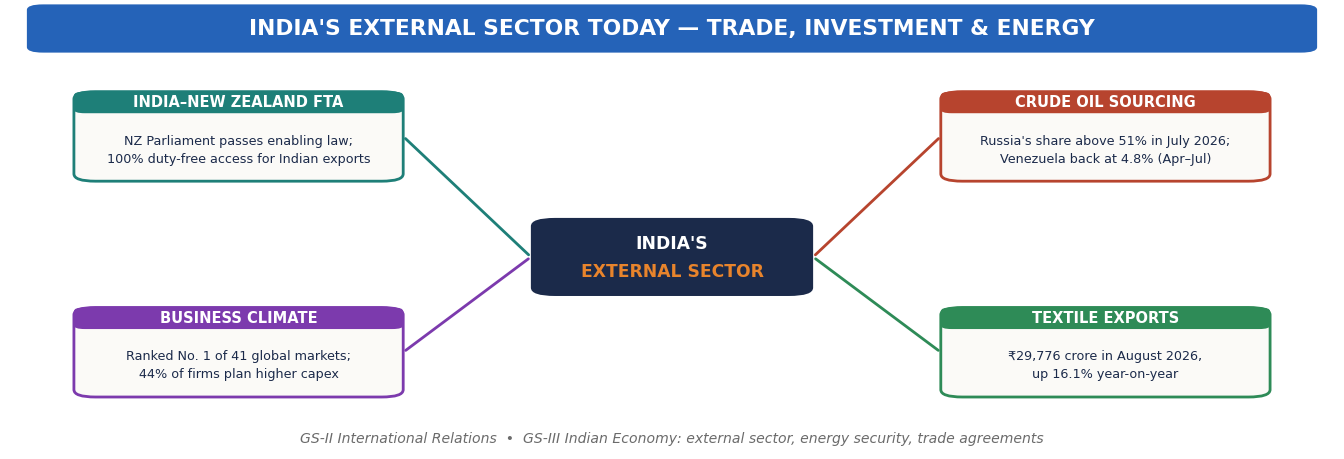
The agreement provides duty-free access for 100% of Indian exports to New Zealand.
Entry into force follows completion of domestic ratification procedures on both sides.
It sits alongside India's wider trade push — textile exports alone were ₹29,776 crore in August 2026, up 16.1% year-on-year.
India also ranked No. 1 among 41 global markets on business climate in an international survey released this week.
Way forward
Utilisation, not signature, is the test: exporter awareness, simplified rules-of-origin certification and non-tariff barrier resolution determine whether preferential access is actually used.
Concept
An FTA eliminates tariffs on substantially all trade between members while each keeps its own external tariff — unlike a customs union (common external tariff). Rules of origin prevent trade deflection. Permitted under GATT Article XXIV and the Enabling Clause.
Full-width mind map of India's external sector linking the India-New Zealand FTA, the top business-climate ranking, crude oil sourcing shares and textile export growth. — StudyForGS
Data point of the day
4.82%
Retail inflation (CPI), August 2026 Up from 4.45% in July 2026. Food inflation at 5.95% (rural 6.13%, urban 5.64%). Above the 4% medium-term target but inside the 2–6% tolerance band.
Prelims rapid-fire
OneTag — launched by NHAI with NPCI on the Rajmargyatra app, it allows FASTag bank portability without replacing the physical tag; a six-month cooling-off applies between port requests.
Global Business Climate Survey 2026 — India ranked No. 1 among 41 global markets; 73% of surveyed Swedish firms rated India's operating climate good or very good.
Census Town — criteria unchanged since 1981: population 5,000+, 75% of male workers in non-agricultural activity and density of 400 persons per sq km.
Himalayan Monal — state bird of Uttarakhand; a new study found birds in noisy tourism zones calling at higher frequencies, an example of acoustic masking.
Marathi film 'Gondhal' — selected as India's official entry for the Oscars 2027 Best International Feature category.
CORE Programme — a tri-services and civil-bureaucracy training initiative at the Manekshaw Centre, New Delhi, covering multi-domain conflict, AI, non-kinetic warfare and cyber deterrence.
Practice MCQs — UPSC Prelims pattern
Q1. With reference to polymetallic nodules found on the deep seabed, consider the following statements:
1. They occur mainly at depths of 3,000 to 6,000 metres.
2. They are a source of manganese, nickel, cobalt and copper.
3. The International Seabed Authority has already adopted a code governing their commercial exploitation.
Which of the statements given above is/are correct?
1 and 2 only
2 and 3 only
1 and 3 only
1, 2 and 3
Show answer
Answer: A Statements 1 and 2 are correct — nodules lie at 3,000–6,000 metres and contain manganese, nickel, cobalt and copper. Statement 3 is incorrect: the ISA's exploitation code remains unadopted, which is precisely why commercial deep-sea mining is contested.
Q2. The Election Symbols (Reservation and Allotment) Order, 1968 is best described as:
A constitutional provision inserted by the Fifty-second Amendment
A subordinate legislation issued by the Election Commission under Article 324
A statute enacted by Parliament under Article 327
A judicial direction issued by the Supreme Court under Article 142
Show answer
Answer: B The Symbols Order is subordinate legislation made by the Election Commission in exercise of its powers under Article 324, read with the Representation of the People Act, 1951 and the Conduct of Elections Rules. Its validity was upheld in Sadiq Ali v. Election Commission of India (1972). Paragraph 15 governs disputes between rival factions.
Mains practice question
Q. India's semiconductor mission has moved from attracting fabrication capacity to building a full value chain. Examine the structural constraints that will determine whether this second phase succeeds, and suggest measures to address them. (250 words, 15 marks)
Hint / approach
Open with the shift from Phase-I (₹76,000 crore, fab-centric) to Semicon 2.0 (₹1,27,500 crore, six pillars). Structure the body around constraints: critical minerals and materials import dependence, ATMP/packaging depth, water and power reliability for fabs, design talent and low R&D intensity, and geopolitical supply-chain risk. For each, give one concrete measure — strategic mineral partnerships, an ATMP cluster policy, dedicated utility infrastructure, university-fab linkages and plurilateral supply-chain arrangements. Conclude that capital is no longer the binding constraint; absorptive capacity is.
📌 One-line revision: Semicon 2.0 ₹1,27,500 cr / six pillars • Fed 25 bps to 3.75–4.00% • Kishau dam 232.6 m on the Tons, six states • CPI 4.82%, food 5.95% • TMC symbol frozen under Para 15 • Jan Aushadhi 2,110 + 315 • India–NZ FTA cleared • Kuno cheetahs now 56.