Semiconductor Mission 2.0 launched with a ₹1,27,500 crore outlay, RBI drains ₹2.25 lakh crore through a VRRR auction, and the UPI merchant discount rate returns for large payments from 15 October 2026.
Friday, 18 September 2026 · IST · National & International · 11 items · 2 MCQs
Today's digest is anchored by three big stories: the formal rollout of India Semiconductor Mission 2.0 at SEMICON India 2026 with a ₹1,27,500 crore twelve-year outlay, the RBI's ₹2.25 lakh crore three-day variable rate reverse repo auction to mop up record surplus liquidity, and the tiered UPI merchant discount rate that takes effect on 15 October 2026. Polity and governance are dominated by the Supreme Court's scrutiny of the Delhi electoral roll revision and the Cabinet's decision to raise the EPFO wage ceiling to ₹25,000. On the external front, a United States bill proposing tariffs of up to 100% on buyers of Russian energy has put India's record 51% dependence on Russian crude under the spotlight.
Today at a glance — things to remember
India Semiconductor Mission 2.0 launched at SEMICON India 2026 - ₹1,27,500 crore ($13.5 bn) over 12 years, built on six pillars.
RBI to absorb ₹2.25 lakh crore through a 3-day variable rate reverse repo auction on 18 September, maturing 21 September.
UPI merchant discount rate of 0.4% returns on merchant payments above ₹2,000 from 15 October 2026; all P2P transfers stay free.
Wholesale price inflation quickened to 9.92% in August 2026 from 9.78% in July, driven by 22.93% fuel and power inflation.
Cabinet raised the EPFO wage ceiling from ₹15,000 to ₹25,000 a month - the first revision since 2014, covering 51 lakh more workers.
Supreme Court gave precedence to the challenge to Delhi's Special Intensive Revision, which affects about 33.96% of enumerated electors.
A United States bill proposes tariffs of up to 100% on countries buying Russian oil and gas; Russia is now 51% of India's crude imports.
India and MERCOSUR signed their first Additional Protocol accepting electronic certificates of origin for paperless trade.
India stayed at rank 131 of 145 on the Global Gender Gap Index 2026 with a parity score of 64.5%.
MISHTI has restored 27,652 hectares of mangroves against a 29,250-hectare target; a Mangrove GIS portal was released in Gujarat.
Detailed notes
1. India Semiconductor Mission 2.0 launched at SEMICON India 2026
SCI-TECHCOMMON: Prelims + Mains GS3
Syllabus linkage
GS3 - Science and Technology, indigenisation of technology, industrial policy. Prelims pointers: ISM outlay, six pillars, ATMP or OSAT vs fabrication, Yashobhoomi venue.
Context
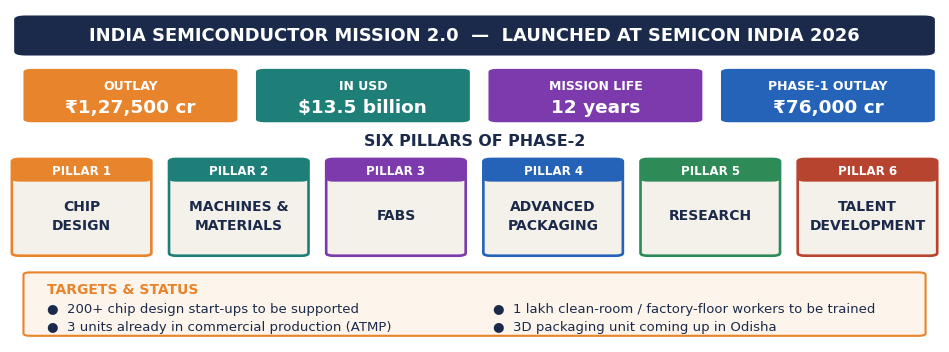
The second phase of the India Semiconductor Mission was formally launched on 17 September 2026 at SEMICON India 2026 in Yashobhoomi, Dwarka, New Delhi. It scales up an ecosystem that began with a five-year, ₹76,000 crore first phase in December 2021.
Key facts
Outlay of ₹1,27,500 crore (about $13.5 billion) spread over 12 years, against ₹76,000 crore over five years in Phase 1.
Built on six pillars: chip design, machines and materials, fabs, advanced packaging, research, and talent development.
Targets 200-plus chip design start-ups and training of one lakh clean-room and factory-floor workers.
Three units are already in commercial production in assembly, testing, marking and packaging; a 3D packaging unit is coming up in Odisha.
Way forward
Convert design strength into fabrication depth by securing equipment supply chains, water and power reliability, and a steady pipeline of packaging engineers.
Concept
A fab manufactures wafers; ATMP or OSAT units assemble, test and package finished chips. India's strategy so far has been packaging-led. Link with Make in India, PLI schemes, critical mineral security and supply chain resilience under GS3 industrial policy.
Infographic of India Semiconductor Mission 2.0 showing the ₹1,27,500 crore and $13.5 billion outlay, a 12-year mission life, the six pillars of Phase 2, and key targets. — StudyForGS
2. UPI merchant discount rate returns for payments above ₹2,000 from 15 October
ECONOMYCOMMON: Prelims + Mains GS3
Syllabus linkage
GS3 - Indian economy, mobilisation of resources, digital payments and financial inclusion. Prelims pointers: MDR, NPCI, TPAP, PSP bank, Payment and Settlement Systems Act 2007.
Context
A tiered merchant discount rate will apply to person-to-merchant UPI transactions above ₹2,000 from 15 October 2026, ending a blanket zero-MDR regime and creating a revenue model for the payments stack without touching small-value payments.
Key facts
Standard rate 0.4%, capped at ₹300 for transactions of ₹75,000 and above.
Essential and thin-margin sectors pay a flat ₹5 per transaction above ₹2,000; capital-market payments attract 0.02%, capped at ₹300.
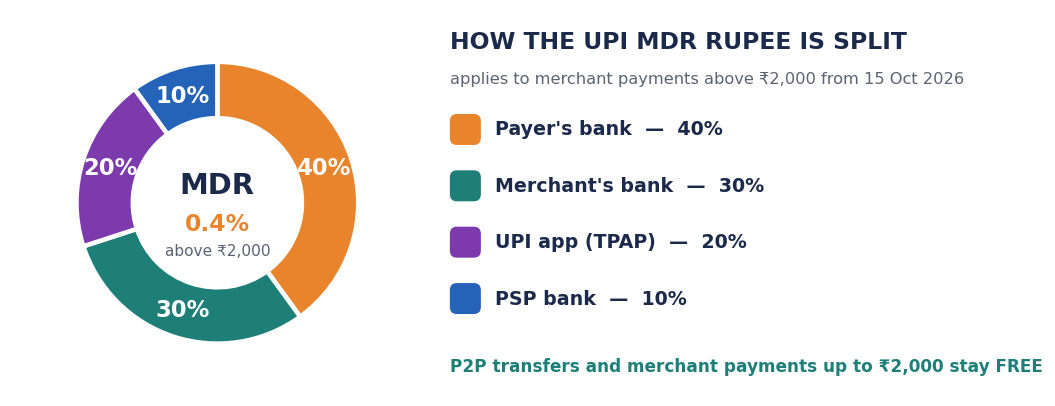
All person-to-person transfers and merchant payments up to ₹2,000 remain free; about 97.5% of UPI transactions by volume are unaffected.
Revenue split: payer's bank 40%, merchant's bank 30%, UPI app or TPAP 20%, payment service provider bank 10%.
A separate 5% pool will fund UPI adoption among small merchants; zero charges up to ₹2,000 are notified under Section 10A of the Payment and Settlement Systems Act, 2007.
Way forward
Publish transparent disclosure norms so merchants can see the charge before accepting a payment, and review the small-merchant support pool annually.
Concept
MDR is the fee a merchant pays on a digital transaction, shared among the banks and apps in the chain. A TPAP is a third-party application provider that rides on a sponsor bank's UPI handle. Compare with interchange fee on cards and link to the financial inclusion and formalisation debates in GS3.
Donut chart showing how the UPI merchant discount rate is shared: payer's bank 40 per cent, merchant's bank 30 per cent, UPI app 20 per cent and payment service provider bank 10 per cent. — StudyForGS
3. Wholesale price inflation hardens to 9.92% in August 2026
ECONOMYCOMMON: Prelims + Mains GS3
Syllabus linkage
GS3 - Indian economy, inflation, growth and development. Prelims pointers: WPI base year 2011-12, WPI vs CPI weights, producer price index, headline vs core inflation.
Context
Official wholesale price data released on 16 September 2026 showed inflation at the factory gate rising for a fifth straight month, in sharp contrast with the near-zero readings of a year earlier. Retail inflation for August stood at 4.82%.
Key facts
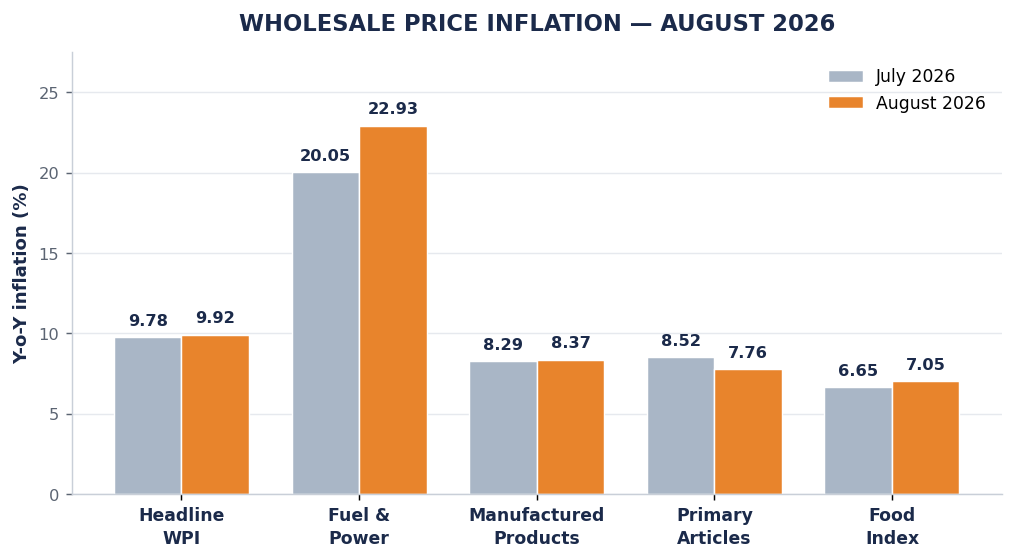
Headline WPI inflation at 9.92% in August 2026, up from 9.78% in July; the all-commodities index rose to 110.8 from 110.0.
Fuel and power was the main driver at 22.93%, up from 20.05%, with mineral oils at 38.48% and crude petroleum at 34.41%.
Manufactured products inflation edged up to 8.37%; primary articles eased to 7.76% from 8.52%.
The food index rose to 7.05% from 6.65%.
Retail CPI inflation was 4.82% in August with food inflation at 5.95%; the unemployment rate stood at 5.0%.
Way forward
Since the surge is concentrated in imported energy, the policy mix should lean on strategic petroleum reserves, diversified sourcing and calibrated excise rather than demand compression.
Concept
WPI measures price change at the wholesale or producer level with base year 2011-12 and, unlike CPI, carries no services and no direct retail margin. A persistent WPI-CPI gap signals that producers are absorbing input costs, compressing margins before the pass-through to consumers.
Grouped bar chart comparing July and August 2026 wholesale price inflation for headline WPI, fuel and power, manufactured products, primary articles and the food index. — StudyForGS
4. Defence Acquisition Council clears ₹1.10 lakh crore of proposals, 98% from Indian industry
DEFENCECOMMON: Prelims + Mains GS3
Syllabus linkage
GS3 - Security, defence procurement, indigenisation and the defence industrial base. Prelims pointers: DAC, Acceptance of Necessity, Buy Indian-IDDM, CBRN, Sarvatra bridge.
Context
The Defence Acquisition Council chaired by the Raksha Mantri granted Acceptance of Necessity to capital acquisition proposals worth about ₹1.10 lakh crore, with almost the entire value routed to domestic manufacturers. Exercise Yudh Abhyas 2026 with the United States is simultaneously under way.
Key facts
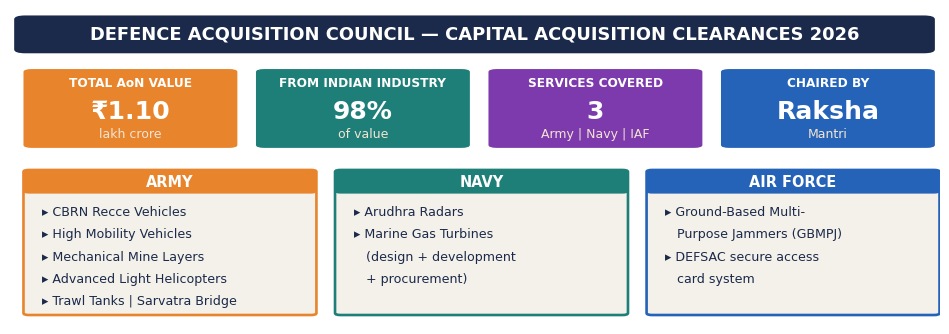
Total Acceptance of Necessity value of about ₹1.10 lakh crore, with around 98% to be sourced from Indian industry.
Army: CBRN reconnaissance vehicles, high mobility vehicles, self-propelled mechanical mine layers, advanced light helicopters, trawl tanks and the Sarvatra bridge system.
Navy: Arudhra radars and the design, development and procurement of marine gas turbines.
Air Force: ground-based multi-purpose jammers and the DEFSAC secure access card system.
Yudh Abhyas 2026, the 22nd India-United States army exercise, runs to 28 September at Auli in Uttarakhand and the Mahajan field firing range in Rajasthan.
Way forward
Acceptance of Necessity is only the first gate; compressing the contract-signature timeline and funding design-stage risk for private vendors will decide whether indigenisation numbers translate into delivered platforms.
Concept
Acceptance of Necessity is the DAC's in-principle approval that starts the procurement clock. The highest priority category is Buy Indian-IDDM, meaning indigenously designed, developed and manufactured. Link to Atmanirbhar Bharat, positive indigenisation lists and defence exports under GS3 security.
Infographic of the Defence Acquisition Council clearances showing the ₹1.10 lakh crore total value, 98 per cent indigenous sourcing, and the equipment approved for the Army, Navy and Air Force. — StudyForGS
5. India rejects the new Pakistan-China Boundary Joint Commission
DEFENCECOMMON: Prelims + Mains GS2 + GS3
Syllabus linkage
GS2 - India and its neighbourhood; GS3 - security challenges in border areas. Prelims pointers: Shaksgam valley, Karakoram range, 1963 Sino-Pakistan agreement, Siachen, CPEC.
Context
India has rejected a newly constituted Pakistan-China Boundary Joint Commission, restating that the whole of Jammu and Kashmir and Ladakh are integral parts of India and that Pakistan has no locus standi to negotiate or transfer Indian territory.
Key facts
India holds the 1963 Sino-Pakistan Boundary Agreement to be illegal and invalid.
Under that agreement Pakistan ceded roughly 5,800 sq km of the Shaksgam valley to China.
The Shaksgam valley lies north of the Karakoram range, between Xinjiang and Pakistan-occupied Gilgit-Baltistan.
Its location is strategically close to the Siachen-Karakoram zone and complements the China-Pakistan Economic Corridor.
Way forward
Sustain the legal record through consistent diplomatic protest, invest in infrastructure and surveillance along the northern glacial frontier, and keep the Siachen posture credible.
Concept
Shaksgam is part of the trans-Karakoram tract. India's claim flows from the Instrument of Accession, 1947, which makes the entire princely state of Jammu and Kashmir Indian territory. Read with Article 1 and the First Schedule of the Constitution.
6. EPFO wage ceiling raised from ₹15,000 to ₹25,000 a month
SOCIETYCOMMON: Prelims + Mains GS2
Syllabus linkage
GS2 - welfare schemes for vulnerable sections, issues relating to social sector and social security. Prelims pointers: EPF Act 1952, EPS-95, wage ceiling, employer-employee contribution.
Context
The Union Cabinet approved an increase in the mandatory wage ceiling for Employees' Provident Fund Organisation coverage, the first such revision in more than a decade, widening formal retirement-savings cover for lower-middle-income salaried workers.
Key facts
Ceiling raised from ₹15,000 to ₹25,000 a month; approved by the Cabinet in September 2026.
This is the first revision since September 2014, when the limit moved from ₹6,500 to ₹15,000.
About 51 lakh additional employees are expected to come under mandatory coverage.
The estimated additional annual outlay for the government is about ₹11,339 crore.
Way forward
Pair the higher ceiling with portability of accounts across employers and faster claim settlement, so that wider coverage does not become wider grievance.
Concept
The wage ceiling is the salary threshold up to which provident fund membership is compulsory. Raising it expands formal social security but also raises the employer's statutory cost. Connect to the four labour codes, the Code on Social Security, 2020, and the informal-to-formal transition debate.
7. Supreme Court fast-tracks the challenge to Delhi's Special Intensive Revision
POLITYCOMMON: Prelims + Mains GS2
Syllabus linkage
GS2 - salient features of the Representation of the People Act, appointment and functioning of constitutional bodies, judicial review. Prelims pointers: Article 324, Article 326, RPA 1950, electoral roll revision.
Context
The Supreme Court granted precedence to a writ petition challenging deletions from the draft electoral roll produced by the Special Intensive Revision in Delhi, after petitioners argued that some categories of removal are undefined and unexplained.
Key facts
More than 47 lakh names were removed from the draft roll and about 33 lakh more electors have received notices.
The disputed logical discrepancies category, not defined by the poll authority, covers 19.33 lakh electors.
Electors facing notices add up to 33,12,919, or about 33.96% of the 97.5 lakh enumerated electors.
Way forward
Publish machine-readable, category-wise reasons for every deletion and allow a time-bound appeal before the roll is finalised, so that purification does not shade into disenfranchisement.
Concept
A Special Intensive Revision is a house-to-house re-enumeration of electors, unlike the routine summary revision. Electoral rolls are prepared under the Representation of the People Act, 1950, while the conduct of elections is governed by the Act of 1951. Free and fair elections are part of the basic structure.
8. United States bill proposes up to 100% tariffs on buyers of Russian energy
IRCOMMON: Prelims + Mains GS2 + GS3
Syllabus linkage
GS2 - bilateral and global groupings affecting India's interests; GS3 - energy security, external sector. Prelims pointers: secondary sanctions, shadow fleet, Urals crude, strategic autonomy.
Context
The United States House has passed an amendment to a Russia and Iran sanctions bill that would authorise tariffs of up to 100% on countries continuing to import Russian oil and gas, aimed at the top five importers by volume.
Key facts
The bill targets Russia's energy sector, listed individuals and the shadow fleet of tankers.
Exemptions are offered to countries that sharply cut purchases or whose imports are under 15% of Russia's total exports.
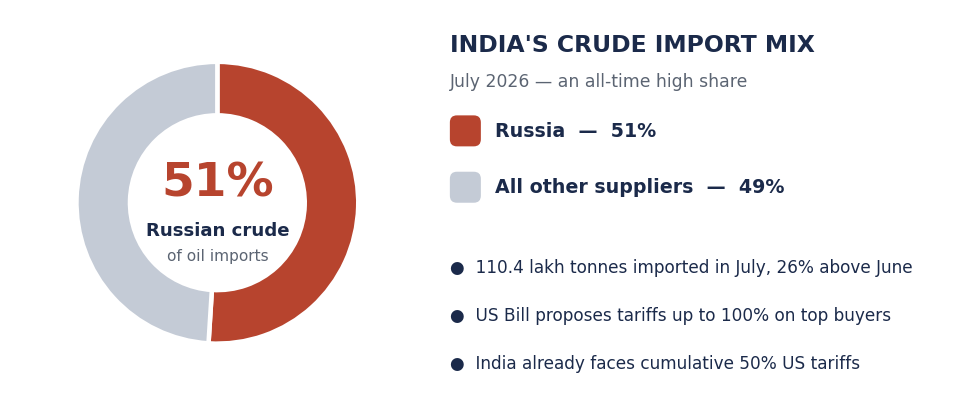
Russia's share of India's crude imports touched an all-time high of over 51% in July 2026.
India imported about 110.4 lakh tonnes of Russian crude in July, roughly 26% higher than in June.
India already faces cumulative United States tariffs of 50%; the bill also preserves a discretionary presidential waiver.
Way forward
Diversify both the crude basket and export destinations, deepen rupee-settlement and insurance capacity for energy trade, and negotiate a carve-out while keeping the sourcing decision sovereign.
Concept
Secondary sanctions punish third countries for trading with a sanctioned state, as distinct from primary sanctions on the target itself. This is the classic case of weaponised interdependence. Link to strategic autonomy, the energy trilemma and India's multi-alignment in GS2.
Donut chart showing Russian crude at 51 per cent of India's oil imports in July 2026, with a note that a United States bill proposes tariffs of up to 100 per cent on top buyers. — StudyForGS
9. India and MERCOSUR sign first Additional Protocol for electronic certificates of origin
IRCOMMON: Prelims + Mains GS2
Syllabus linkage
GS2 - bilateral, regional and global groupings and agreements involving India. Prelims pointers: MERCOSUR members, preferential trade agreement, rules of origin, certificate of origin.
Context
India signed its first Additional Protocol with the MERCOSUR bloc to accept electronic certificates of origin, a trade-facilitation step that runs alongside talks to widen the existing preferential trade agreement. Separately, India co-chaired the 9th ASEAN-India agriculture ministers' meeting.
Key facts
The protocol gives electronic certificates of origin the same legal validity as paper certificates, enabling paperless trade.
MERCOSUR is a South American customs union whose founding members are Argentina, Brazil, Paraguay and Uruguay.
The wider negotiation to expand the India-MERCOSUR preferential trade agreement is targeted for completion within a year, covering tariffs and digital cooperation.
At the 9th ASEAN-India agriculture ministers' meeting, co-chaired with the Philippines, India noted bilateral trade of $128 billion in FY 2025-26.
Way forward
Use the digital certificate as the template for other partners, and pair it with mutual recognition of standards so that Indian exporters gain time as well as paper savings.
Concept
A certificate of origin proves where goods were produced and decides whether a preferential tariff applies under rules of origin. A preferential trade agreement cuts duties on a limited list of goods, unlike a free trade agreement covering substantially all trade. Link to trade facilitation under the WTO framework.
10. India stays at rank 131 of 145 on the Global Gender Gap Index 2026
REPORTCOMMON: Prelims + Mains GS1 + GS2
Syllabus linkage
GS1 - role of women and women's organisations; GS2 - issues relating to development and management of the social sector. Prelims pointers: four sub-indices, publisher, index started 2006.
Context
The 2026 edition of the Global Gender Gap Index, released in mid-September, left India's rank unchanged while its overall parity score improved marginally. The index measures gaps rather than levels, so a rich country can still score poorly.
Key facts
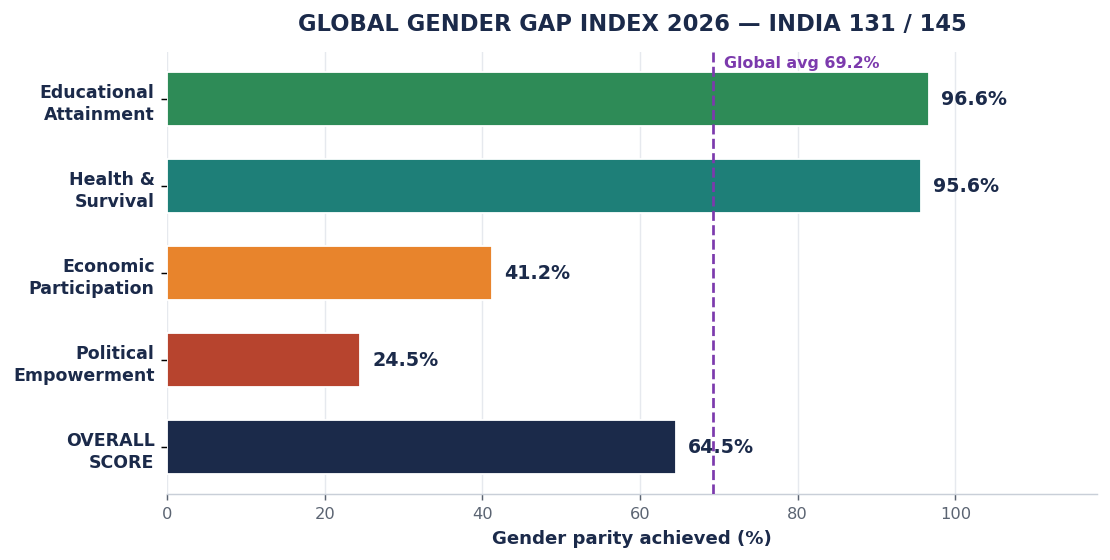
India is ranked 131 out of 145 countries with a parity score of 64.5%, below the global average of 69.2%.
Sub-index scores: educational attainment 96.6%, health and survival 95.6%, economic participation 41.2%, political empowerment 24.5%.
India's best sub-index rank is 67th, in political empowerment.
Iceland tops the index with about 93% of its gap closed, followed by Finland, Norway, Namibia and the United Kingdom.
Parity in professional and technical roles in India nearly doubled from 26.6% in 2006 to 49.9% in 2026, but female labour force participation is 44.1%.
Way forward
The binding constraint is economic participation, so childcare infrastructure, safe transport, and formal-sector hiring incentives will move the number faster than further gains in enrolment.
Concept
The index measures relative gaps between women and men, not absolute development, and is scored from 0 to 1. Distinguish it from the Gender Inequality Index and the Gender Development Index of the Human Development Report. Link with Article 15(3), Article 39(d) and Article 42.
Horizontal bar chart of India's Global Gender Gap Index 2026 sub-index scores, showing educational attainment and health near parity but economic participation and political empowerment far behind the global average line. — StudyForGS
11. Mangrove GIS portal released as MISHTI nears its restoration target
ENVIRONMENTCOMMON: Prelims + Mains GS3
Syllabus linkage
GS3 - conservation, environmental pollution and degradation, ecosystem services. Prelims pointers: MISHTI full form, blue carbon, Biodiversity Heritage Site, Biological Diversity Act 2002.
Context
At a workshop on mangrove conservation in Bhuj, Kachchh, the Union Environment Minister released a Mangrove GIS portal and an atlas of Gujarat's mangroves, and set out a model of scientific, community-led restoration.
Key facts
MISHTI stands for Mangrove Initiative for Shoreline Habitats and Tangible Incomes, announced in the 2023-24 Budget.
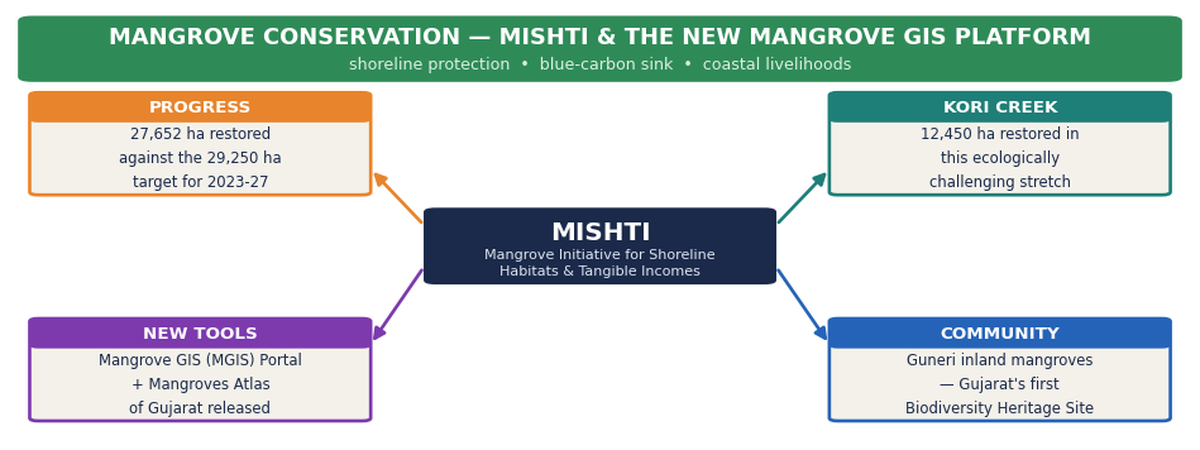
27,652 hectares have been restored against a target of 29,250 hectares for the 2023-27 period.
12,450 hectares of that restoration is in the ecologically difficult Kori Creek stretch.
The new Mangrove GIS (MGIS) portal, a Mangroves Atlas of Gujarat and a coffee-table book on Kachchh mangroves were released.
Guneri in Kachchh, home to rare inland mangroves, was declared Gujarat's first Biodiversity Heritage Site in January 2025.
Way forward
Tie restoration payments to survival rates measured on the GIS platform after three years, not to saplings planted, and route benefits through biodiversity management committees.
Concept
Mangroves are blue carbon ecosystems that store carbon in waterlogged soil, buffer storm surge and serve as fish nurseries. A Biodiversity Heritage Site is notified by a state under Section 37 of the Biological Diversity Act, 2002, on the advice of the state biodiversity board.
Mind map of the MISHTI mangrove programme showing restoration progress of 27,652 hectares against a 29,250 hectare target, the Kori Creek achievement, the new Mangrove GIS portal and the Guneri community site. — StudyForGS
Data point of the day
₹2,25,000 crore
RBI absorbs ₹2.25 lakh crore in a single VRRR auction A 3-day variable rate reverse repo (VRRR) auction is being conducted on 18 September 2026, maturing on 21 September 2026, to drain surplus liquidity from the banking system and stop the overnight call rate from sliding well below the policy repo rate. A VRRR absorbs liquidity, while a VRR injects it. Earlier in September the central bank had mopped up as much as ₹6.02 lakh crore in a single round as the system surplus touched record highs. This is liquidity management, not a change in the policy stance.
Prelims rapid-fire
18 September is observed as International Equal Pay Day, established by UN General Assembly resolution in 2019, and also as World Bamboo Day.
Gegeneophis chandgadi, a new caecilian amphibian, was described from Kolhapur district in Maharashtra, taking India's amphibian count to 458 species.
The Asian Games 2026 open at Aichi-Nagoya, Japan, from 19 September to 4 October, with India sending 508 athletes across 37 sports.
West Bengal has cleared a new DRDO missile testing range at Junput, Purba Medinipur, about 70 km from Chandipur.
Dhiraj Bommadevara became the first Indian male recurve archer to win an individual Archery World Cup Final title, beating Japan's Junya Nakanishi 6-5.
The Colombo Security Conclave table-top exercise concluded at Visakhapatnam; its members are India, Sri Lanka, Maldives, Mauritius, Bangladesh and Seychelles.
Practice MCQs — UPSC Prelims pattern
Q1. With reference to the Variable Rate Reverse Repo (VRRR) auction, consider the following statements:
1. It is used by the central bank to absorb surplus liquidity from the banking system.
2. The rate in a VRRR auction is fixed in advance and is always equal to the policy repo rate.
3. It changes the monetary policy stance whenever it is conducted.
Which of the statements given above is or are correct?
1 only
1 and 2 only
2 and 3 only
1, 2 and 3
Show answer
Answer: A A VRRR absorbs liquidity, so 1 is correct. The rate is discovered by auction, not fixed, so 2 is wrong. It is a liquidity operation and does not alter the policy stance, so 3 is wrong.
Q2. The Shaksgam valley, sometimes seen in the news, is best described as:
A valley in eastern Arunachal Pradesh drained by the Lohit river
A tract north of the Karakoram range that Pakistan purported to cede to China in 1963
A cold desert plateau in Himachal Pradesh adjoining the Spiti valley
A wetland complex in the Sundarbans delta shared with Bangladesh
Show answer
Answer: B The Shaksgam valley, about 5,800 sq km, lies north of the Karakoram range between Xinjiang and Pakistan-occupied Gilgit-Baltistan. India treats the 1963 agreement as illegal and invalid.
Mains practice question
Q. India's record dependence on discounted Russian crude has strengthened its energy budget but exposed its exports to secondary sanctions. Critically examine how India can reconcile affordable energy with market access, and suggest an institutional mechanism for managing sanctions risk. (250 words, 15 marks)
Hint / approach
Frame the trade-off with the 51% import share and the 50% cumulative tariff. Build the body on three axes: crude-basket diversification and strategic reserves, export-market diversification, and payment and insurance resilience. Close with a single coordinating sanctions-risk office, since the problem today is institutional fragmentation.
📌 One-line revision: Remember today as: Semiconductor Mission 2.0 at ₹1,27,500 crore over 12 years, VRRR of ₹2.25 lakh crore, UPI MDR 0.4% above ₹2,000 from 15 October, WPI 9.92%, EPFO ceiling ₹25,000, and Gender Gap rank 131 of 145.