Saturday, 12 September 2026 · IST · National & International · 9 items · 2 MCQs
India's chairship year peaks as the 18th BRICS Leaders' Summit opens at Bharat Mandapam on 12-13 September 2026 with the New Delhi Declaration as its main outcome. On the science and economy front, ISRO successfully hot-tested the CE20 cryogenic engine at an uprated 220 kN thrust for LVM3, while foreign exchange reserves surged to an all-time high of USD 785.7 billion. Governance news is led by new e-commerce rules against dark patterns and misleading discounts, and the launch of DILRMP 3.0 with a 14-digit Bhu-Aadhaar for every land parcel.
Today at a glance — things to remember
18th BRICS Summit opens at Bharat Mandapam, New Delhi (12-13 Sept).
ISRO hot-tests the CE20 cryogenic engine at 220 kN for LVM3.
Forex reserves hit a record USD 785.7 billion; India is now 4th largest.
E-Commerce Amendment Rules, 2026 notified - effective 1 January 2027.
DILRMP 3.0 launched with the 14-digit Bhu-Aadhaar (ULPIN).
State of India's Environment 2026: extreme weather on 99% of days.
Yudh Abhyas 2026 (India-US) runs 9-28 Sept at Bikaner and Auli.
Odisha signs MoUs worth Rs 2,10,500 crore across 14 projects.
Bankers' Books Evidence Act, 2026 takes effect 1 October 2026.
BharatNet: Rs 1,684 crore pact with Jharkhand for 4,395 GPs.
GS-III: Science & Technology - Space (indigenisation, launch vehicles). Prelims: CE20 engine, LVM3, C32 stage, gas-generator vs staged-combustion cycle.
Context
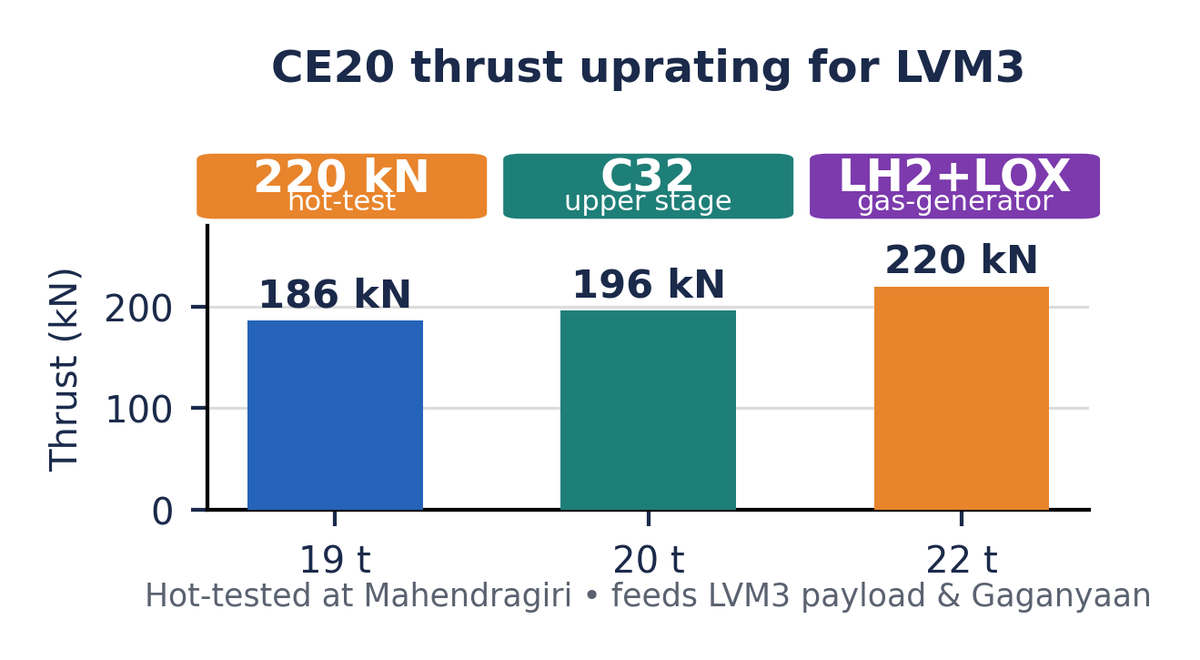
ISRO has successfully completed a ground hot test of its indigenous CE20 cryogenic engine at an uprated thrust level of 220 kN, a step that directly raises the payload capacity of the LVM3 heavy-lift launcher.
Key facts
Test conducted at the ISRO Propulsion Complex, Mahendragiri (Tamil Nadu); engine qualified for the new C32 cryogenic upper stage.
CE20 is India's first indigenously designed cryogenic engine using the gas-generator cycle; propellants are liquid hydrogen (LH2) + liquid oxygen (LOX).
Thrust raised in stages: 19 tonne (186 kN) to 20 tonne (196 kN) to 22 tonne (220 kN).
Uprating lifts LVM3 payload to Geosynchronous Transfer Orbit (GTO) beyond the current ~4 tonne class.
Feeds directly into the Gaganyaan human spaceflight programme and future commercial heavy launches.
Way forward
Sustained uprating plus a semi-cryogenic SCE-200 stage is the cheapest route to a Next Generation Launch Vehicle (NGLV) and a larger share of the global launch market.
Concept
Cryogenic engines burn propellants stored below -183 degC (LOX) and -253 degC (LH2), giving the highest specific impulse (Isp) of any chemical engine - critical for upper stages. Only a handful of nations master this technology.
Bar chart of CE20 engine thrust uprating from 186 kN to 220 kN with LVM3 payload gain and stat tiles. — StudyForGS
2. Record forex, weak citations: India's research volume-impact paradox
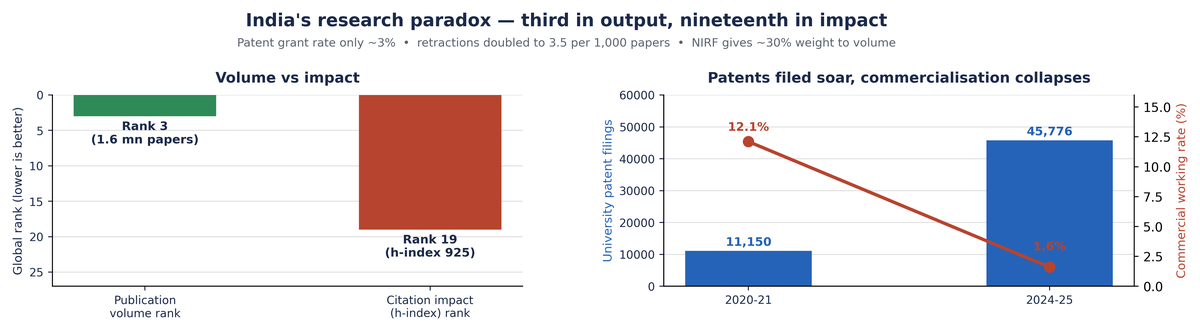
New analysis of India's research output shows the country is now third globally in publication volume but continues to lag badly on citation impact, patent grant rates and commercialisation - a classic quantity-versus-quality gap.
Key facts
India produced about 1.6 million internationally indexed research papers (2020-2025), ranking 3rd in the world by volume.
Aggregate h-index of 925 places India 19th globally, against the United States' 3,213.
University patent filings jumped from 11,150 (2020-21) to 45,776 (2024-25), but the grant rate is only about 3%.
Commercial working rate of granted patents collapsed from 12.1% (2022-23) to 1.6% (2024-25).
India is 3rd in retractions (rate doubled to 3.5 per 1,000 papers); NIRF gives about 30% weightage to volume.
Way forward
Shift ranking and funding incentives from counting outputs to field-weighted citation impact, replication and technology transfer, and strengthen research-integrity offices in universities.
Concept
h-index: a researcher/nation has index h if h papers have at least h citations each. Working of a patent (Section 146, Patents Act, 1970) requires patentees to file Form 27 annually on commercial use - a key indicator of innovation actually reaching markets.
Grouped bar chart comparing India's publication rank versus h-index rank, and patent filings versus grant and commercial working rates. — StudyForGS
3. Centre tightens e-commerce rules: prior price, dark-pattern audits
ECONOMYCOMMON: Prelims + Mains GS3 + GS2
Syllabus linkage
GS-III: Indian Economy - consumer markets, digital economy regulation. GS-II: Statutory bodies (CCPA). Prelims: Consumer Protection Act 2019, dark patterns, CCPA.
Context
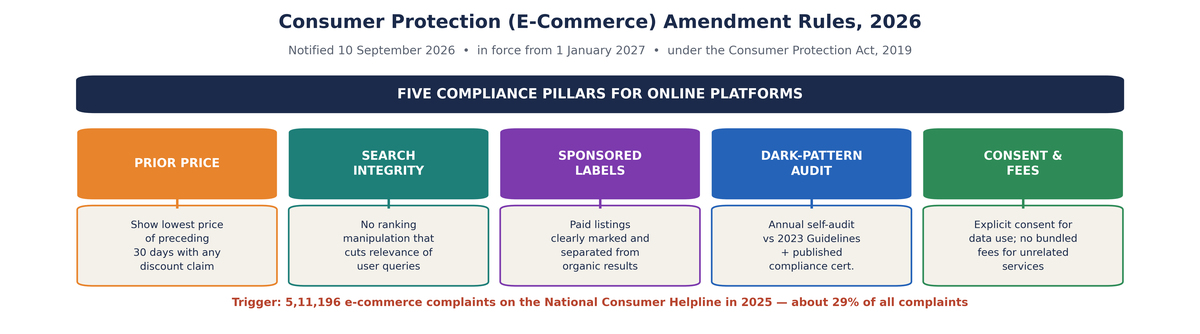
The Department of Consumer Affairs has notified the Consumer Protection (E-Commerce) Amendment Rules, 2026, overhauling the 2020 Rules to curb misleading discounts, manipulated search rankings and dark patterns on online platforms.
Key facts
Notified on 10 September 2026; comes into force from 1 January 2027.
Platforms must show a 'prior price' - defined as the lowest price offered in the preceding 30 days - alongside any discount claim.
Sponsored listings must be clearly labelled and separated from organic results; search rankings cannot be manipulated to reduce relevance.
Mandatory annual self-audit for compliance with the Dark Patterns Guidelines, 2023, plus a published compliance certificate.
National Consumer Helpline logged about 5,11,196 e-commerce complaints in 2025 - roughly 29% of all complaints.
Way forward
Pair disclosure mandates with algorithmic audit capacity in the CCPA, and align with the Digital Personal Data Protection Act, 2023 on consent for consumer data use.
Concept
Dark patterns are deceptive interface designs (false urgency, basket sneaking, drip pricing, confirm-shaming) that nudge consumers into unintended choices. The Central Consumer Protection Authority (CCPA) is a statutory regulator under the Consumer Protection Act, 2019.
Five-pillar flowchart of the Consumer Protection E-Commerce Amendment Rules 2026 showing prior price, search integrity, dark-pattern audits, consent and fee bundling. — StudyForGS
4. Exercise Yudh Abhyas 2026 underway across desert and Himalayan theatres
The 22nd edition of Exercise Yudh Abhyas, the annual India-United States bilateral army exercise, is being held in India across two very different terrains - the Thar desert and the high-altitude Himalaya.
Key facts
Dates: 9 to 28 September 2026; venues Bikaner (Rajasthan) and Auli (Uttarakhand).
22nd edition; the 2025 edition was held in Alaska, United States - the exercise alternates between the two countries.
Aligned to a United Nations Chapter VII peace-enforcement mandate, focusing on integrated battle groups and joint sub-conventional operations.
Drills cover desert mechanised warfare, high-altitude acclimatised operations, drone and counter-drone action and combat medical care.
Other India-US exercises: Vajra Prahar, Tiger Triumph, Cope India and Malabar.
Way forward
Convert exercise-level interoperability into logistics and ISR sharing under LEMOA, COMCASA and BECA, while retaining India's strategic autonomy in defence procurement.
Concept
Interoperability is the ability of forces of different nations to operate together using common procedures, communications and logistics. Chapter VII of the UN Charter permits the Security Council to authorise the use of force to restore international peace.
5. State of India's Environment 2026: extreme weather on 99% of days
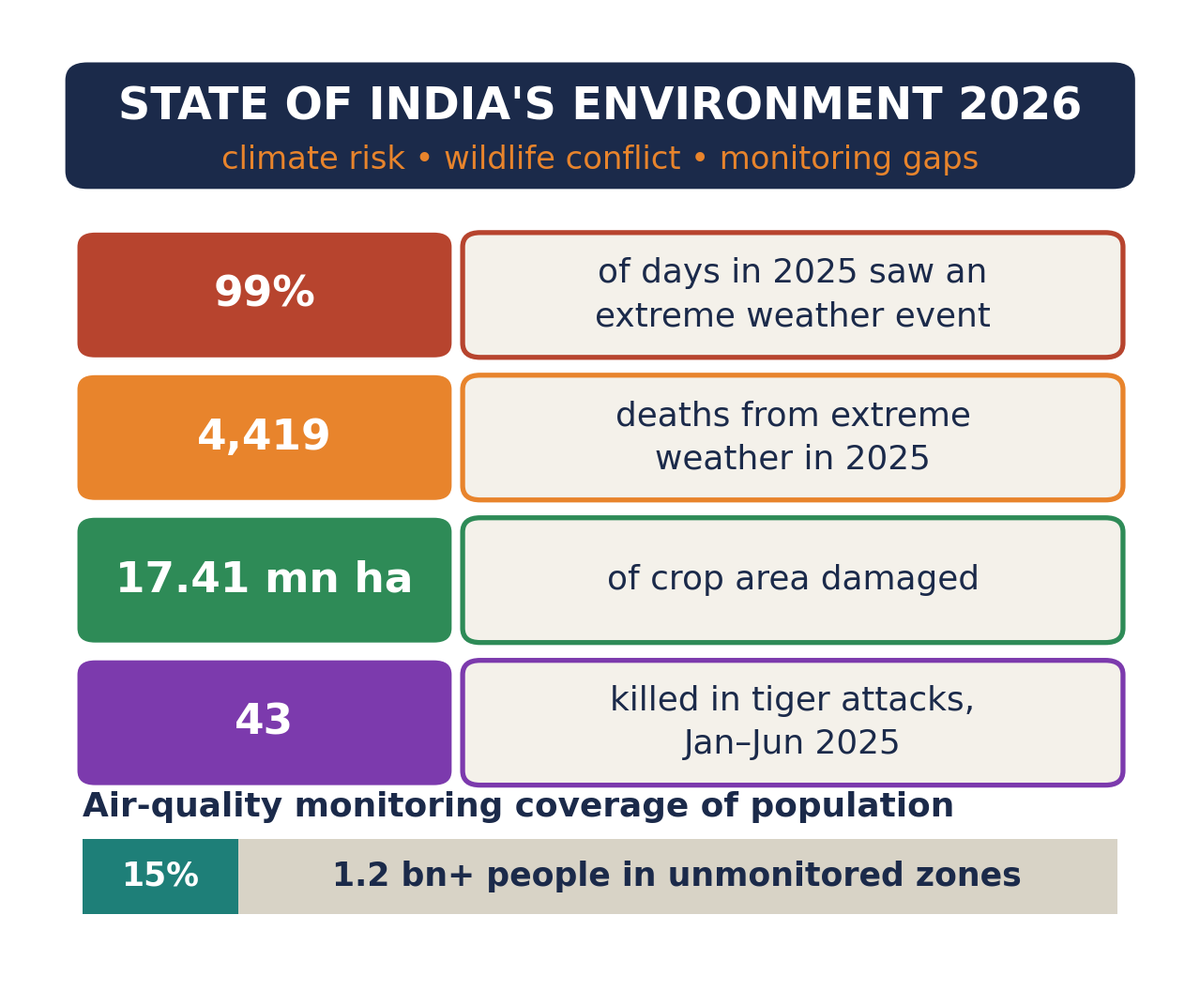
The annual State of India's Environment 2026 assessment finds that India recorded extreme weather events on 99% of days in 2025, alongside worsening human-wildlife conflict and severe gaps in air-quality monitoring.
Key facts
Extreme weather on 99% of days in 2025, causing 4,419 deaths and damaging 17.41 million hectares of crop area.
At least 43 people were killed in tiger attacks near reserves between January and June 2025, linked to habitat saturation and prey decline.
Only about 15% of India's population (around 200 million) lives near a functioning air-quality monitoring station; over 1.2 billion live in effectively unmonitored zones.
Report flags encroached floodplains and inadequate urban drainage as multipliers of flood risk under intensifying rainfall.
Recommends a shift from post-disaster relief to climate-resilient planning and nature-based solutions such as wetland restoration.
Way forward
Expand continuous ambient air-quality monitoring beyond NCAP cities, mainstream local disaster risk reduction plans, and fund ecosystem-based adaptation at panchayat level.
Concept
Extreme weather event: a weather occurrence rare for a place and time of year, usually above the 90th/below the 10th percentile. Nature-based Solutions (NbS): actions to protect and restore ecosystems that simultaneously deliver human well-being and biodiversity benefits.
Fact-sheet schematic of State of India's Environment 2026 showing extreme weather days, deaths, crop area affected, tiger conflict deaths and air-monitoring coverage gap. — StudyForGS
GS-III: Indian Economy - investment, infrastructure, industrial policy; data centres and energy transition. Prelims: FDI routes, coal-to-chemicals.
Context
The Government of Odisha has signed memoranda of understanding covering an indicative Rs 2,10,500 crore (about USD 25 billion) across 14 projects, spanning AI data centres, ports, energy and chemicals.
Key facts
Partners: the Adani Group and Abu Dhabi's International Holding Company (IHC); total indicative outlay Rs 2,10,500 crore.
Largest components: an AI Data Centre Hub (Rs 50,000 crore) and a Coal-to-Chemicals Complex (Rs 40,000 crore).
Portfolio spans ports, renewable energy, metals and digital infrastructure.
Signals a shift of hyperscale data-centre capacity to eastern India, drawn by power availability and coastal cable landing access.
MoUs are indicative commitments, not committed capital expenditure - conversion to ground investment is the real test.
Way forward
Track MoU-to-commissioning conversion ratios, secure water and renewable power for data centres, and ensure rehabilitation and resettlement safeguards for land-intensive projects.
Concept
Coal-to-chemicals converts coal into methanol, ammonia and olefins via gasification, reducing import dependence but raising carbon intensity unless paired with carbon capture. Hyperscale data centre: a facility above roughly 5,000 servers designed for elastic cloud/AI workloads.
7. 18th BRICS Summit opens in New Delhi under India's chairship
IRCOMMON: Prelims + Mains GS2
Syllabus linkage
GS-II: International Relations - groupings and agreements involving India; global governance reform. Prelims: BRICS membership, NDB, CRA, chairship sequence.
Context
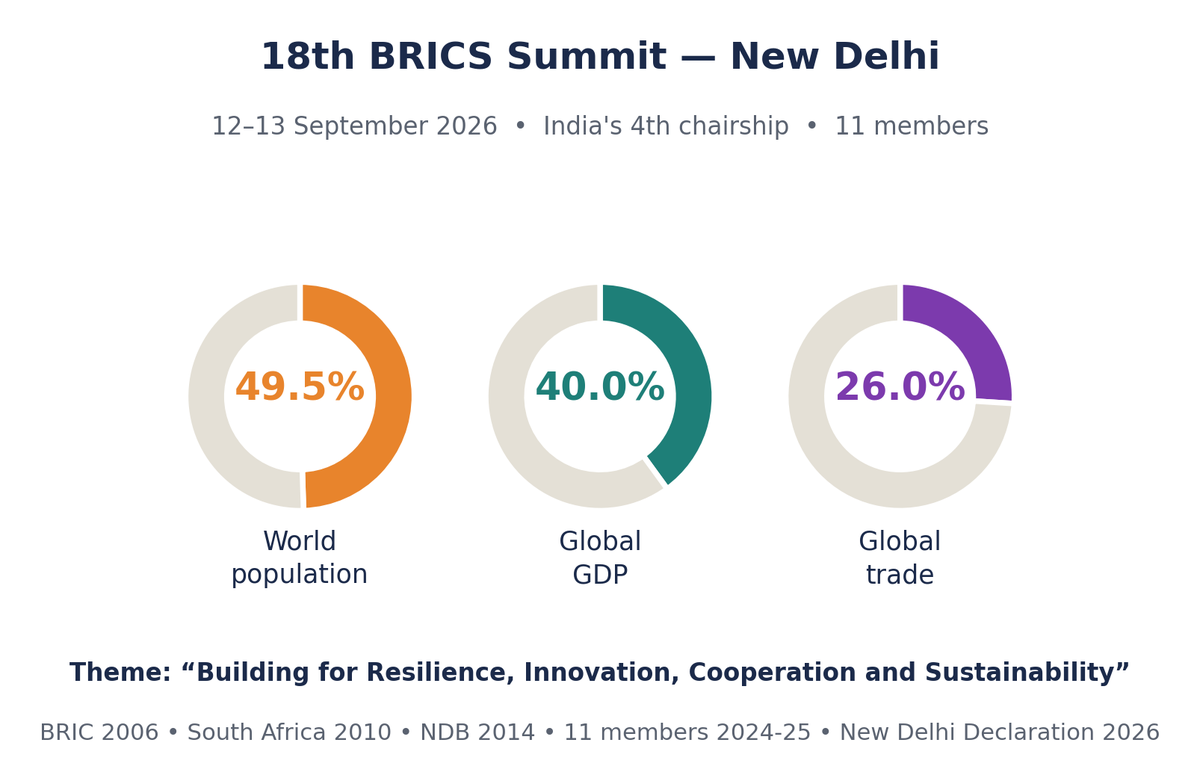
India is hosting the 18th BRICS Leaders' Summit at Bharat Mandapam, New Delhi on 12-13 September 2026, its fourth chairship, in the grouping's 20th anniversary year.
Key facts
Theme: 'Building for Resilience, Innovation, Cooperation and Sustainability'; chaired by Prime Minister Narendra Modi.
BRICS now has 11 full members - BRICS plus Egypt, Ethiopia, Iran, UAE, Indonesia and Saudi Arabia - plus partner countries.
Members account for about 49.5% of world population, 40% of global GDP and 26% of global trade.
The New Delhi Declaration is the principal outcome document; day two opens to partner countries on inclusive global growth.
India assumed the chair on 1 January 2026, succeeding Brazil; new cooperation platforms launched in agriculture, health and MSMEs/startups.
Way forward
Use the chairship to push UN Security Council and IMF quota reform, scale local-currency settlement pragmatically, and keep BRICS a non-Western rather than anti-Western platform.
Concept
BRICS began as BRIC (2006), with South Africa joining in 2010. Institutions: the New Development Bank (NDB, 2014, Shanghai) and the Contingent Reserve Arrangement (CRA, USD 100 billion). Decisions are by consensus; the chair rotates annually.
Donut charts showing BRICS share of world population, global GDP and global trade, with a members timeline strip. — StudyForGS
8. DILRMP 3.0 launched: Bhu-Aadhaar for every land parcel by 2031
POLITYCOMMON: Prelims + Mains GS2 + GS3
Syllabus linkage
GS-II: Governance - e-governance, service delivery, transparency. GS-III: Land reforms, agricultural credit. Prelims: ULPIN, NAKSHA, PFMS, Department of Land Resources.
Context
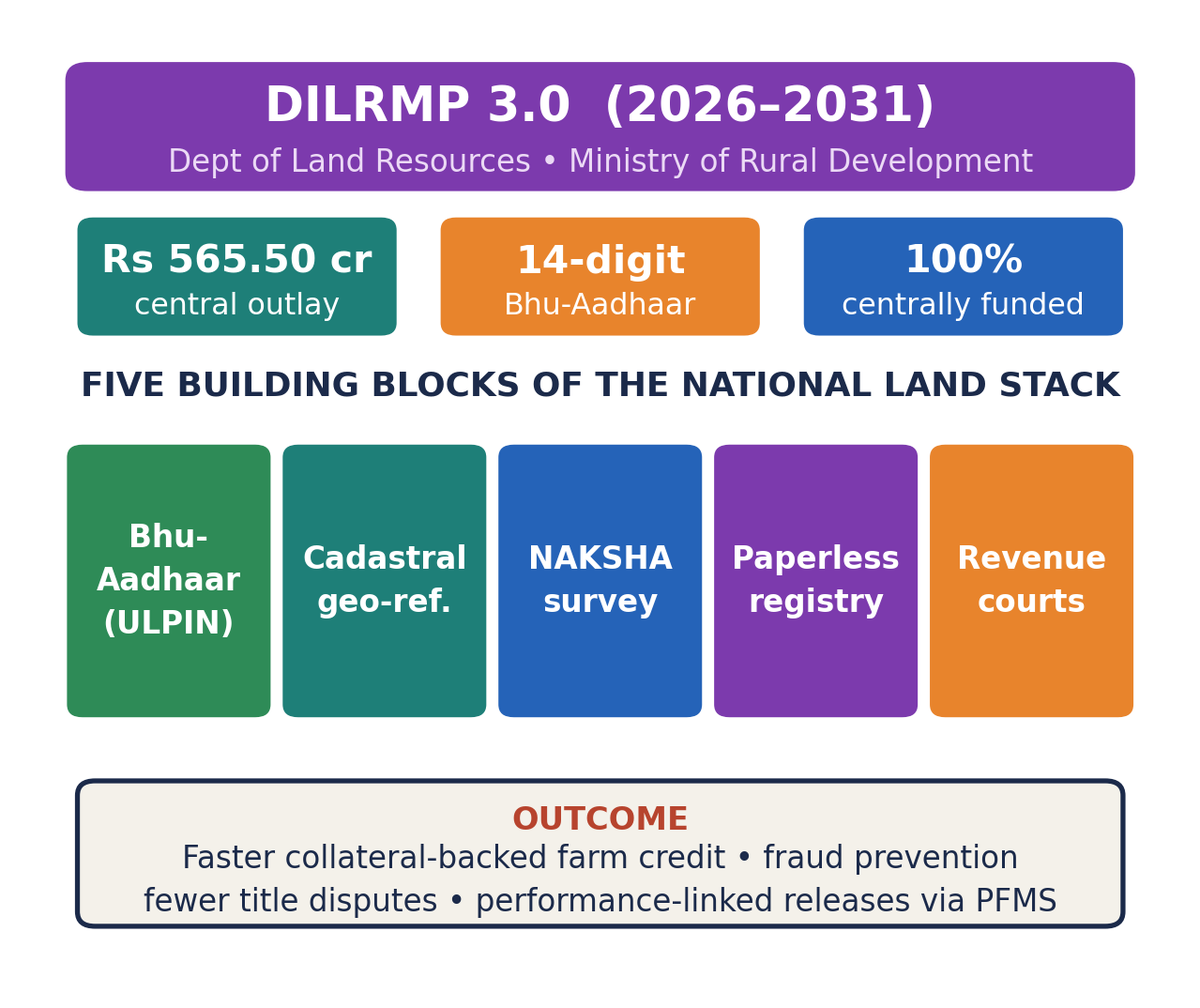
The Union Government has launched the Digital India Land Records Modernisation Programme (DILRMP) 3.0 for 2026-2031, aiming to give every land parcel a unique digital identity and build a GIS-based national land stack.
Key facts
Implemented by the Department of Land Resources, Ministry of Rural Development; outlay about Rs 565.50 crore for 2026-2031.
Bhu-Aadhaar is a 14-digit Unique Land Parcel Identification Number (ULPIN) to be assigned to every parcel.
Components: cadastral map georeferencing, scaling of NAKSHA (urban survey), paperless registration, Urban Property Cards and integrated revenue courts.
100% centrally funded, with performance-linked fund releases through the Public Financial Management System (PFMS).
Move from presumptive to conclusive land titling with a state-backed indemnity fund, and integrate the land stack with Agri Stack and PM-KISAN beneficiary verification.
Concept
India follows presumptive titling - registration records a transaction, not guaranteed ownership. Conclusive titling (Torrens system) guarantees title with state indemnity. Cadastral maps record parcel boundaries for revenue and ownership.
Pillar diagram of DILRMP 3.0 showing Bhu-Aadhaar ULPIN, georeferencing, NAKSHA, paperless registration and revenue court integration with outlay stat tiles. — StudyForGS
9. Unrecognised political parties: Rs 1,700 crore, no de-registration power
POLITYCOMMON: Prelims + Mains GS2
Syllabus linkage
GS-II: Polity - Election Commission, political parties, electoral reforms, transparency in political funding. Prelims: Section 29A RPA 1951, Section 80GGC IT Act.
Context
Scrutiny of Registered Unrecognised Political Parties (RUPPs) has revealed large donation inflows with negligible electoral activity, exposing a structural gap in the Election Commission's regulatory powers.
Key facts
Six Gujarat-based RUPPs reportedly received about Rs 1,700 crore in FY 2023-24 while fielding only 15 candidates in the 2024 Lok Sabha elections.
Over 2,800 RUPPs are registered; only around 750 contested in 2024 - roughly 70% are electorally inactive.
Only about 26-27% of RUPPs file their annual audit reports on time.
Registration is under Section 29A, Representation of the People Act, 1951; Section 80GGC, Income Tax Act allows 100% deduction on donations to parties.
In Indian National Congress vs Institute of Social Welfare (2002), the Supreme Court held the ECI has no statutory power to de-register a party except in narrow cases.
Way forward
Amend Section 29A to allow de-registration after 10 consecutive years of non-participation, mandate digital audit filing, and cap cash donations to curb shell-party money laundering.
Concept
Recognised party (national/state) gets a reserved symbol, free broadcast time and more star campaigners under the Election Symbols (Reservation and Allotment) Order, 1968. RUPPs are registered under Section 29A but do not meet recognition thresholds.
Data point of the day
USD 785.7 billion
India's Foreign Exchange Reserves - record high Reserves rose by a record USD 44.9 billion in the week ended 4 September 2026 to an all-time high of USD 785.7 billion, lifting India to the 4th largest reserve holder globally after China, Japan and Switzerland. Foreign Currency Assets stood at USD 648.2 billion (up USD 47.5 billion) while gold reserves slipped to USD 113.8 billion. A large part of the surge came through deposit and borrowing-linked inflows, which carry future repayment obligations - so headline reserves overstate the unencumbered buffer.
Prelims rapid-fire
Bankers' Books Evidence Act, 2026 takes effect 1 October 2026 (assent 13 August 2026) - digital, cloud-hosted and virtual banking records become admissible evidence, replacing the 1891 framework.
BharatNet: Digital Bharat Nidhi signs a Rs 1,684 crore pact with Jharkhand covering 4,395 Gram Panchayats and 26,777 villages; DBN replaced the USOF under the Telecommunications Act, 2023.
Schizopygopsis waddellii - a Tibetan snowtrout (family Cyprinidae) recorded in India for the first time from Pangkang Teng Tso Lake, Tawang, Arunachal Pradesh (about 12,800 ft).
Acharya Vinoba Bhave (11 Sept 1895 - 15 Nov 1982) - 'National Teacher of India', first individual Satyagrahi (1940), led the Bhoodan movement; wrote Geetai.
79th WHO South-East Asia Regional Committee (Dili, Timor-Leste) adopted the Dili Declaration on Human Resources for Health; India recognised for sustaining maternal and neonatal tetanus elimination.
PMMSY: fish production up from 141.64 to 197.75 lakh tonnes; fisheries exports up from Rs 46,663 crore to Rs 73,890 crore; Rs 2,500 crore allocated in Budget 2026-27.
Practice MCQs — UPSC Prelims pattern
Q1. With reference to the CE20 engine recently in the news, consider the following statements:
1. It is an indigenously developed cryogenic engine operating on the staged-combustion cycle.
2. It uses liquid hydrogen and liquid oxygen as propellants.
3. It powers the upper stage of the LVM3 launch vehicle.
Which of the statements given above is/are correct?
1 and 2 only
2 and 3 only
1 and 3 only
1, 2 and 3
Show answer
Answer: B CE20 uses the gas-generator cycle, not staged combustion - so statement 1 is incorrect. It burns LH2 + LOX and powers the cryogenic upper stage (C25/C32) of LVM3, so statements 2 and 3 are correct.
Q2. Consider the following statements regarding Registered Unrecognised Political Parties (RUPPs) in India:
1. They are registered with the Election Commission under Section 29A of the Representation of the People Act, 1951.
2. The Election Commission has express statutory power to de-register a party that fails to contest elections for ten years.
3. Donations made to registered political parties can qualify for deduction under Section 80GGC of the Income Tax Act.
Which of the statements given above are correct?
1 and 2 only
1 and 3 only
2 and 3 only
1, 2 and 3
Show answer
Answer: B Registration is under Section 29A, RPA 1951 (1 correct) and Section 80GGC allows deduction on donations (3 correct). Following Indian National Congress vs Institute of Social Welfare (2002), the ECI has no general power of de-registration - so statement 2 is incorrect.
Mains practice question
Q. India today ranks among the top three nations in research publication volume, yet remains far down the global ladder on citation impact and patent commercialisation. Examine the structural causes of this volume-impact paradox and suggest reforms in evaluation, funding and technology transfer to close the gap. (250 words, 15 marks)
Hint / approach
Anchor with data - 1.6 million indexed papers (2020-25), rank 3 but h-index 925, rank 19; patent grant rate 3%, commercial working 1.6%. Causes: volume-weighted incentives (NIRF ~30%), weak industry-academia linkage, publish-or-perish driving retractions (3.5 per 1,000), low GERD (~0.65% of GDP). Reforms: field-weighted citation impact in rankings, ANRF mission-mode funding, university technology transfer offices, research-integrity offices. Conclude with Viksit Bharat 2047.
📌 One-line revision: 18th BRICS Summit at Bharat Mandapam | CE20 hot-tested at 220 kN | Forex reserves at a record USD 785.7 billion | E-commerce Rules amended (prior price = lowest in 30 days, effective 1 Jan 2027) | DILRMP 3.0 rolls out the 14-digit Bhu-Aadhaar.