Friday, 11 September 2026 · IST · National & International · 12 items · 2 MCQs
India closes its fourth BRICS chairship with the 18th Leaders' Summit at Bharat Mandapam on 12-13 September, while the Department of Consumer Affairs notifies e-commerce amendment rules mandating 30-day price history, sponsored-listing labels and dark-pattern audits from 1 January 2027. In polity, the Home Ministry has proposed a new Chapter K under Article 371 for an elected body in Ladakh, even as a Tribal Affairs memorandum reopens the Gram Sabha consent question under the Forest Rights Act. Forex reserves touched a record $740.80 billion and the Defence Acquisition Council cleared ₹1.10 lakh crore of acquisitions with 98% Indian sourcing.
Today at a glance — things to remember
18th BRICS Summit at Bharat Mandapam, New Delhi, on 12-13 September 2026.
India's fourth BRICS chairship; theme 'Building for Resilience, Innovation, Cooperation and Sustainability'.
E-commerce Amendment Rules, 2026 notified on 10 September; effective 1 January 2027.
Discounts must now show the lowest price of the preceding 30 days.
MHA proposes new 'Chapter K' under Article 371 for an elected body in Ladakh.
Tribal Affairs memorandum: 'no provision' in FRA for Gram Sabha consent at Stage-II.
Forex reserves at a record $740.80 billion; FCA $600.67 billion.
DAC clears about ₹1.10 lakh crore of acquisitions, 98% from Indian industry.
PMMSY at six years: fish output 197.75 lakh tonnes, exports ₹73,890 crore.
CosmoCube proposes a lunar far-side hunt for the 21-cm cosmic dark ages signal.
Detailed notes
1. Centre Notifies Consumer Protection (E-Commerce) Amendment Rules, 2026
GS-III: Indian Economy — regulation of markets, digital commerce; GS-II: Governance, statutory bodies. Prelims pointers: Consumer Protection Act, 2019; CCPA; dark patterns; National Consumer Helpline.
Context
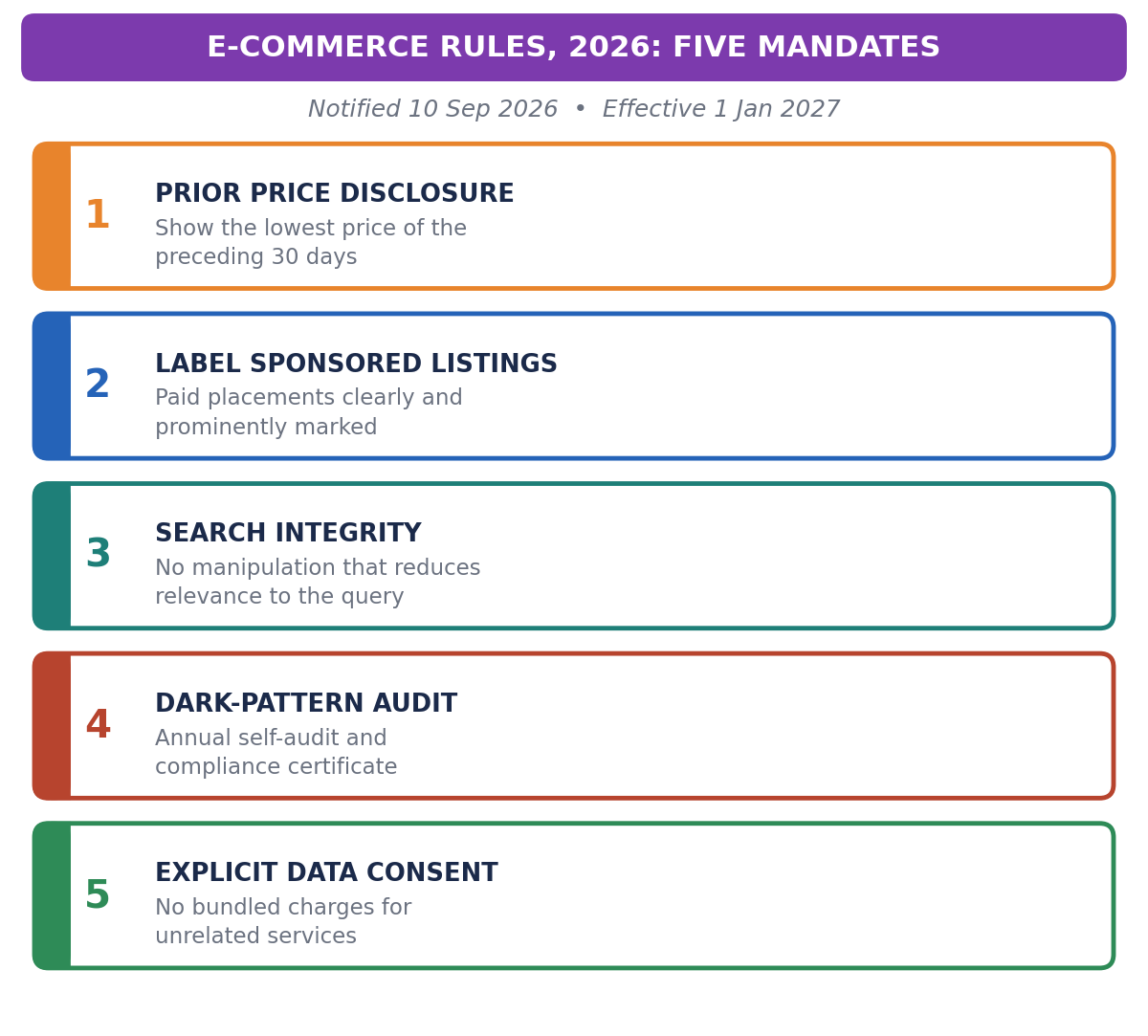
The Department of Consumer Affairs has notified the Consumer Protection (E-Commerce) Amendment Rules, 2026, amending the 2020 Rules. Notified on 10 September 2026, they take effect from 1 January 2027 and target discount illusions, opaque search rankings and dark patterns.
Key facts
Notified 10 September 2026; effective 1 January 2027; amends the Consumer Protection (E-Commerce) Rules, 2020 framed under the Consumer Protection Act, 2019.
Any discount claim must disclose the lowest price at which the item was offered in the preceding 30 days (prior price disclosure).
Sponsored or paid listings must be clearly and prominently labelled; manipulation of search results that reduces relevance to the consumer's query is barred.
Platforms must comply with the 2023 Dark Patterns Guidelines, conduct an annual self-audit and display a compliance certificate; bundled charges for unrelated services are prohibited.
Explicit consent is mandatory before using consumer personal data; integration with the National Consumer Helpline is compulsory.
The National Consumer Helpline logged 17,71,622 grievances in 2025, of which about 29% concerned e-commerce.
Way forward
Disclosure norms must be backed by swift CCPA enforcement and independent third-party audits, so that compliance is substantive rather than cosmetic.
Concept
Dark patterns are deceptive interface designs — false urgency, basket sneaking, drip pricing, confirm-shaming, subscription traps — that push consumers into unintended choices. The Central Consumer Protection Authority (CCPA), created under Section 10 of the Consumer Protection Act, 2019, regulates unfair trade practices and misleading advertisements.
Five-pillar diagram of the Consumer Protection (E-Commerce) Amendment Rules, 2026: prior price disclosure, sponsored-listing labelling, search integrity, dark-pattern audit and data consent. — StudyForGS
2. PM Matsya Sampada Yojana Completes Six Years; Fish Output at 197.75 Lakh Tonnes
GS-III: Economy — allied sectors, food processing, blue economy; government schemes. Prelims pointers: PMMSY, PM-MKSSY, FFPOs, Biofloc, RAS, SDG-14.
Context
The Pradhan Mantri Matsya Sampada Yojana (PMMSY) completed six years on 10 September 2026. Government data show fisheries emerging as one of the fastest-growing allied sectors, with production and exports both up sharply since 2019-20.
Key facts
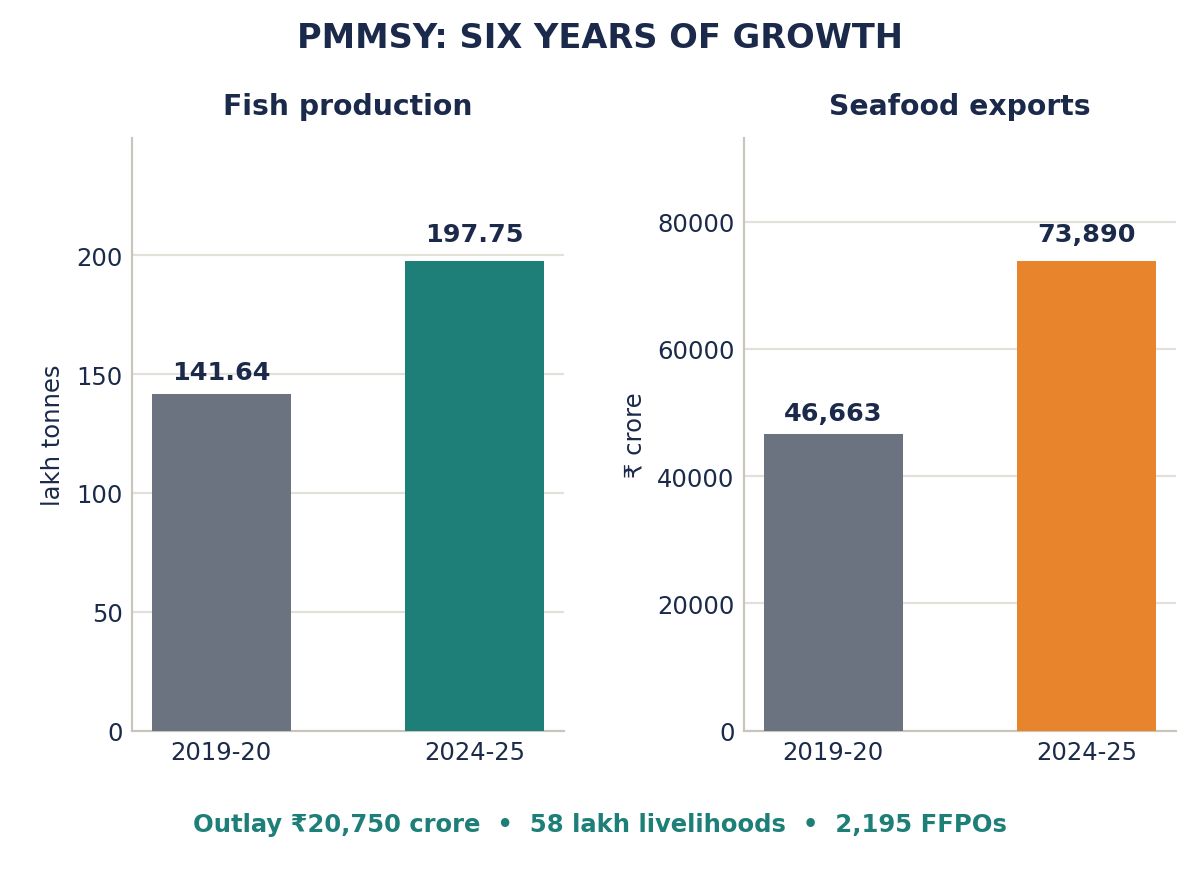
Launched in September 2020 with a total outlay of ₹20,750 crore; the 2026-27 allocation is ₹2,500 crore.
Fish production rose from 141.64 lakh tonnes (2019-20) to 197.75 lakh tonnes (2024-25).
Seafood exports climbed from ₹46,663 crore to ₹73,890 crore over the same period.
About 58 lakh people supported with employment; 2,195 Fish Farmer Producer Organisations (FFPOs) formed.
The National Fisheries Digital Platform crossed 37 lakh registrations as on 8 September 2026.
Sub-scheme PM-MKSSY drives formalisation and institutional credit; 100 climate-resilient coastal villages identified; Biofloc and Recirculatory Aquaculture Systems (RAS) promoted.
Way forward
Shift the next phase from production volume to value addition, cold-chain density and traceability, so that export earnings and fisher incomes rise together.
Concept
Blue Economy = sustainable use of ocean resources for growth, livelihoods and ocean health. India is the world's second-largest fish producer; the sector aligns with SDG-14 (Life Below Water). Biofloc recycles waste nitrogen into microbial protein; RAS reuses water in closed tanks.
Grouped bar chart comparing fish production in lakh tonnes and seafood exports in rupees crore between 2019-20 and 2024-25 under PMMSY. — StudyForGS
3. DAC Clears ₹1.10 Lakh Crore Acquisitions; 98% to Come From Indian Industry
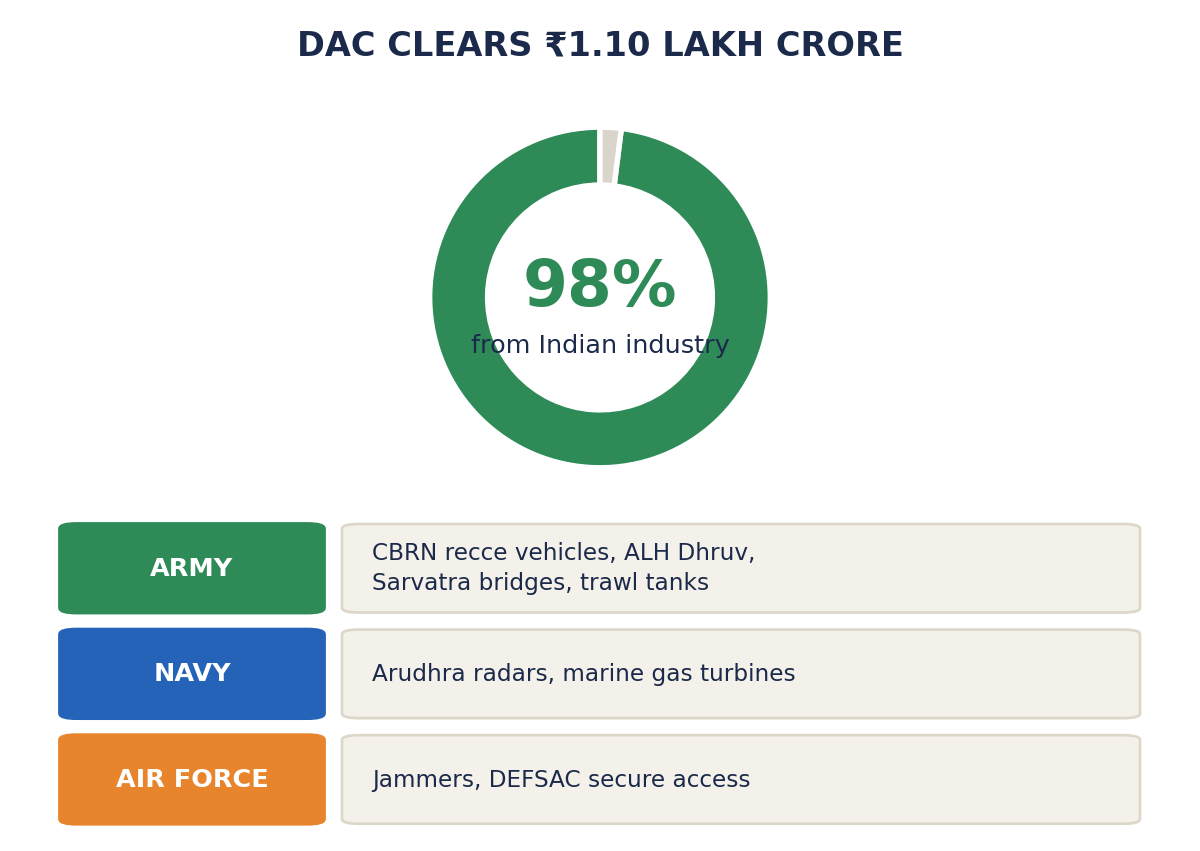
The Defence Acquisition Council (DAC), chaired by the Defence Minister, accorded Acceptance of Necessity (AoN) to capital acquisition proposals worth about ₹1.10 lakh crore at its meeting in New Delhi on 7 September 2026.
Key facts
Total AoN value about ₹1.10 lakh crore; roughly 98% of the procurement is to be sourced from Indian industry.
Navy: Arudhra radars and marine gas turbines for warship propulsion.
Air Force: fighter and transport aircraft enhancements, Ground-Based Multi-Purpose Jammers and DEFSAC secure access cards.
AoN is in-principle administrative approval — the first formal step, preceding the Request for Proposal and contract negotiation stages.
Way forward
Convert AoNs into signed contracts within predictable timelines and deepen the MSME-led component base, so indigenisation is measured by delivery rather than by approval value.
Concept
The DAC is the apex body for capital acquisitions in the Ministry of Defence, chaired by the Defence Minister. Procurement follows the Defence Acquisition Procedure (DAP), 2020, whose most preferred category is Buy (Indian-IDDM) — Indigenously Designed, Developed and Manufactured. CBRN stands for Chemical, Biological, Radiological and Nuclear.
Donut chart showing the indigenous versus other share of the ₹1.10 lakh crore DAC approvals, with service-wise acquisition highlights. — StudyForGS
4. CosmoCube: A Suitcase-Sized Lunar Radio Telescope to Listen to the Cosmic Dark Ages
GS-III: Science & Technology — space, awareness in new technology. Prelims pointers: 21-cm hydrogen line, cosmic dark ages, radio-quiet far side of the Moon.
Context
Astronomers have detailed CosmoCube, a proposed suitcase-sized satellite that would orbit the Moon and use its far side as a shield against terrestrial radio noise, in order to detect the faint 21-centimetre signal from the universe's cosmic dark ages.
Key facts
Target: the 21-cm (1420 MHz) hydrogen line emitted more than 13.5 billion years ago, before the first stars lit up.
The Moon's far side is the quietest radio location in near-Earth space because the lunar body blocks terrestrial transmissions.
The spacecraft would get roughly 40 minutes of shielding in each 2-hour orbit.
Proposed mission life of about two years, yielding an estimated 1,000 hours of usable data; launch is projected to be about five years away.
Payload is CubeSat-class — low cost, low mass, standardised — making deep-space radio cosmology affordable.
Way forward
Protecting the lunar far side as a radio-quiet zone through international agreement is now as important as building the instruments that will use it.
Concept
The cosmic dark ages is the era after recombination and before the first stars, when the universe held mostly neutral hydrogen. The 21-cm line arises from the hyperfine 'spin-flip' transition of neutral hydrogen and is redshifted to low radio frequencies — the only practical probe of that era.
5. Mercury Has Shrunk About 23 km — 30% More Than Earlier Estimates
A new analysis of tectonic features on Mercury finds the planet's diameter has contracted by about 23 kilometres since its formation — roughly 30% more shrinkage than earlier estimates — as its outsized iron core continues to cool.
Key facts
Diameter contraction of about 23 km (≈14 miles) over roughly 4.5 billion years.
Cause: cooling and contraction of Mercury's disproportionately large iron core, which occupies about 85% of the planet's radius.
Evidence comes from lobate scarps — cliff-like thrust faults created as the crust crumpled over the shrinking interior.
Earlier data came from Mariner 10 (1970s) and MESSENGER (2010s); the ESA-JAXA BepiColombo mission is to enter Mercury orbit in November 2026.
Mercury is the smallest planet, closest to the Sun, has only a thin exosphere and a weak global magnetic field.
Way forward
BepiColombo's orbital survey should settle the contraction budget and refine models of how small rocky planets lose heat.
Concept
Lobate scarps are compressional thrust-fault landforms unique in scale to Mercury, formed by global contraction as the interior cools. Contrast with Earth's plate tectonics: Mercury is a one-plate (stagnant-lid) planet.
6. Aravalli Green Wall in Focus as Land Degradation Debate Sharpens
GS-III: Environment — conservation, desertification, ecological restoration. Prelims pointers: Aravalli Green Wall Project, UNCCD, Bonn Challenge, Land Degradation Neutrality, Great Green Wall.
Context
The Aravalli Green Wall Project is back in exam-relevant focus as land degradation and desertification data are debated. The project seeks to raise a green buffer along India's oldest fold mountain range to blunt the eastward march of the Thar.
Key facts
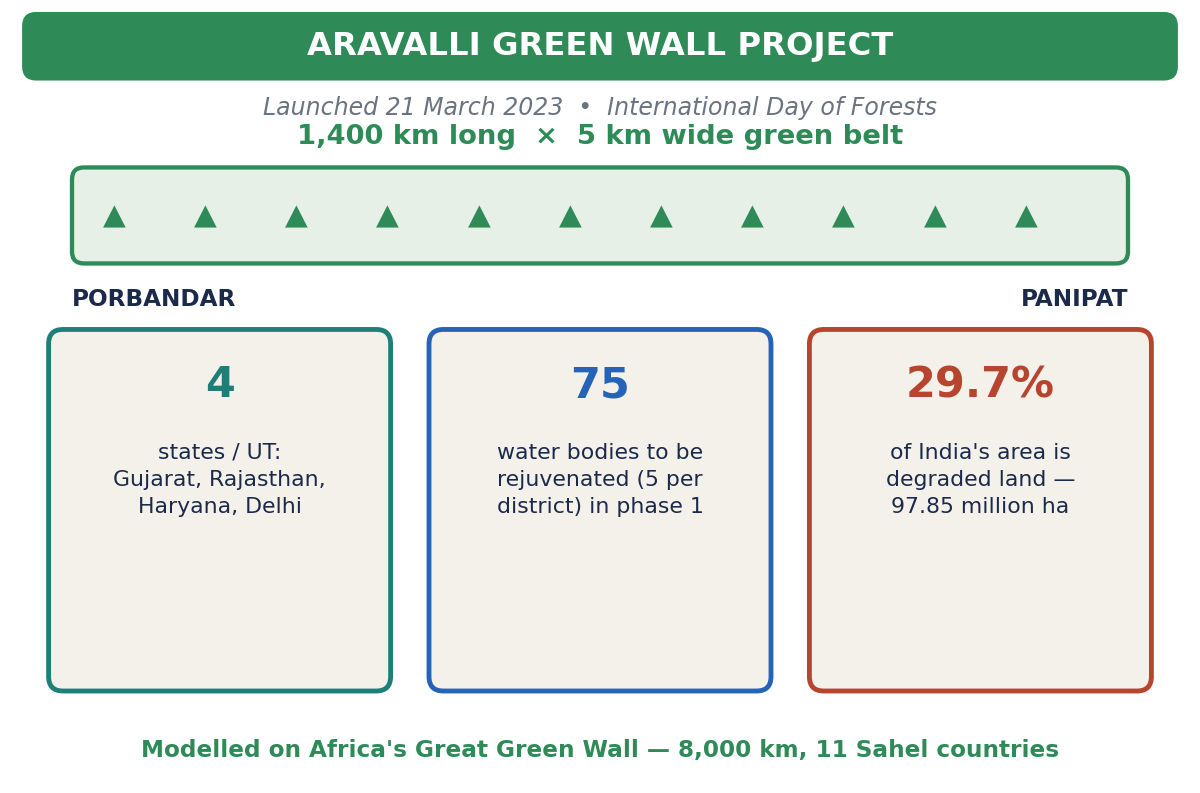
Launched on 21 March 2023 (International Day of Forests) by the Union Environment Ministry.
Envisages a green belt 1,400 km long and 5 km wide, running broadly from Porbandar to Panipat.
Covers four states/UT — Gujarat, Rajasthan, Haryana and Delhi.
First-phase target includes rejuvenation of 75 water bodies, at five per district in the Aravalli landscape.
Modelled on Africa's Great Green Wall — about 8,000 km across 11 Sahel countries, aiming to restore 100 million hectares.
Space-agency mapping shows about 97.85 million hectares — 29.7% of India's geographical area — under degradation (2018-19).
Way forward
Anchor plantations in native Aravalli species and community stewardship rather than survival-rate targets alone, and close the regulatory gap on illegal mining in the range.
Concept
Desertification is land degradation in arid, semi-arid and dry sub-humid areas. The UNCCD (1994) is the parent convention; Land Degradation Neutrality (LDN) is SDG target 15.3. India has pledged to restore 26 million hectares of degraded land by 2030 under the Bonn Challenge.
Fact-sheet schematic of the Aravalli Green Wall Project showing its 1,400 km length, 5 km width, four states covered and India's land degradation share. — StudyForGS
7. Dwarf Lilyturf Recorded in India for the First Time, From Arunachal Pradesh
GS-III: Environment — biodiversity, species records. Prelims pointers: Eastern Himalaya biodiversity hotspot, Asparagaceae, new record versus new species.
Context
Botanists have reported Ophiopogon japonicus — the dwarf lilyturf or mondo grass — from West Kameng district, Arunachal Pradesh, the first confirmed record of the species in India.
Key facts
Species: Ophiopogon japonicus, family Asparagaceae; common names dwarf lilyturf, mondo grass.
Recorded at about 2,185 metres elevation in West Kameng district, Arunachal Pradesh.
Native range so far known: China, Japan, Korea and Nepal — India is a new distribution record.
Its tuberous roots, called Maidong, are used in traditional East Asian medicine for anti-inflammatory properties.
The find reinforces the Eastern Himalaya as one of the world's biodiversity hotspots and an under-surveyed floristic region.
Way forward
Scale up systematic floristic surveys of the Eastern Himalaya and digitise herbarium records so new distribution data feed conservation planning quickly.
Concept
A new record means a species already known to science is reported from a new geography; a new species is one described for the first time. India hosts four biodiversity hotspots: the Himalaya, Indo-Burma, Western Ghats-Sri Lanka and Sundaland (Nicobar Islands).
8. New Delhi Hosts the 18th BRICS Summit on 12-13 September; India Chairs for the Fourth Time
IRUPSC: Prelims + Mains (International Relations)
Syllabus linkage
GS-II: International Relations — groupings and agreements involving India, bilateral and global institutions; GS-III: Economy — trade and finance. Prelims pointers: BRICS members and partners, New Development Bank, Contingent Reserve Arrangement.
Context
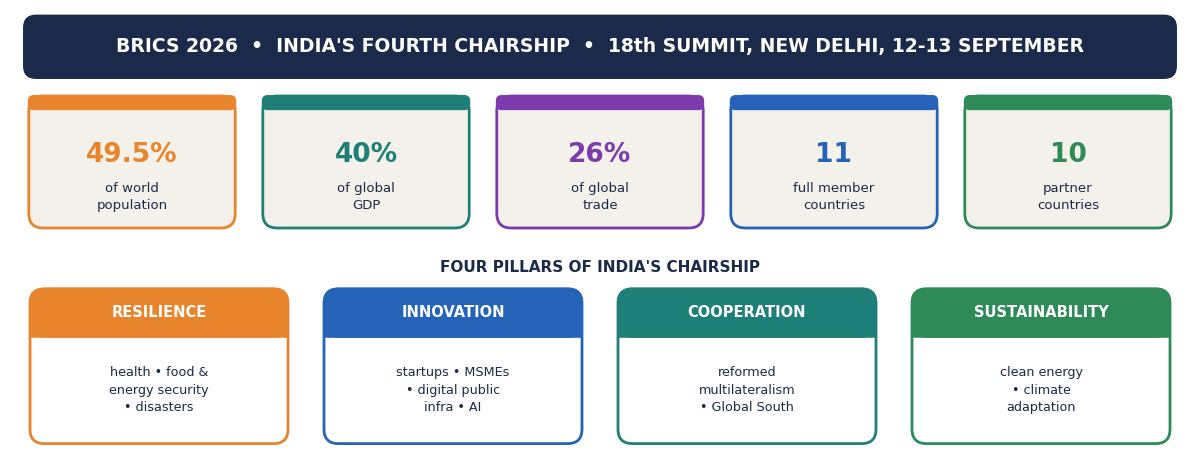
India hosts the 18th BRICS Leaders' Summit at Bharat Mandapam, New Delhi on 12-13 September 2026, closing a chairship year themed 'Building for Resilience, Innovation, Cooperation and Sustainability'. It is the first full summit of the expanded eleven-member grouping under an Indian chair.
Key facts
18th BRICS Summit, Bharat Mandapam, New Delhi, 12-13 September 2026; theme 'Building for Resilience, Innovation, Cooperation and Sustainability'.
India assumed the rotating chairship on 1 January 2026 — its fourth time, after 2012, 2016 and 2021; over 350 meetings were held through the year.
Eleven full members: Brazil, Russia, India, China, South Africa, Egypt, Ethiopia, Iran, Saudi Arabia, UAE and Indonesia; plus ten partner countries added in 2025.
The bloc accounts for about 49.5% of world population, 40% of global GDP and 26% of global trade.
Four pillars: Resilience (health, food and energy security, disaster management), Innovation (startups, MSMEs, digital public infrastructure, AI), Cooperation (reformed multilateralism) and Sustainability (clean energy, climate adaptation).
New chairship initiatives include BRICS AGRIN (agricultural inputs network), BRICS CONNECT (employment and skills), an MSME cooperation portal, a startup innovation fund and a Global Value Chains Action Plan (2026-2030).
Way forward
India's value-add lies in keeping BRICS an agenda of development delivery and reformed multilateralism rather than a bloc defined by confrontation.
Concept
The acronym BRIC was coined in 2001 by economist Jim O'Neill; the first leaders' summit was held in 2009 at Yekaterinburg, and South Africa joined in 2010. Institutional arms: the New Development Bank (2014, headquartered in Shanghai) and the Contingent Reserve Arrangement (CRA), a currency-swap safety net. BRICS is a key platform for Global South representation and reform of the UN Security Council, IMF and World Bank.
Full-width BRICS snapshot showing the bloc's share of world population, GDP and trade as stat tiles, alongside the four pillars of India's 2026 chairship. — StudyForGS
9. MHA Proposes a New 'Chapter K' Under Article 371 for Ladakh
POLITYUPSC: Prelims + Mains (Polity & Governance)
Syllabus linkage
GS-II: Polity — federalism, special constitutional provisions, Union Territories, devolution. Prelims pointers: Articles 371 to 371-J, Article 240, Sixth Schedule, LAHDC.
Context
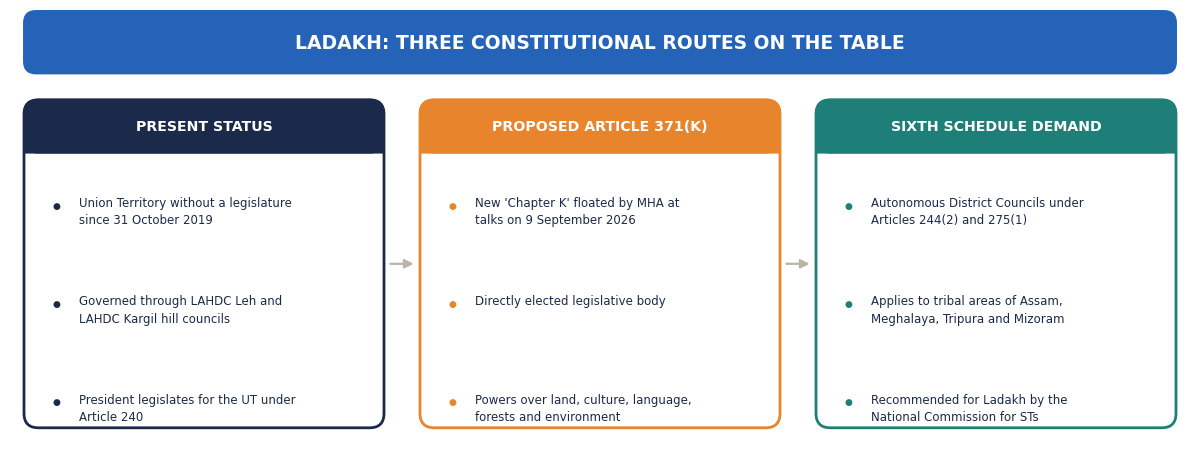
At talks on 9 September 2026, the Ministry of Home Affairs proposed inserting a new 'Chapter K' under Article 371 to create a directly elected legislative body for Ladakh with protected powers over land, culture and environment — an alternative to the long-standing demands for statehood and Sixth Schedule status.
Key facts
Proposal tabled at the 9 September 2026 round of Centre-Ladakh talks; envisages a directly elected legislative body.
Proposed subjects for the body: land, culture, language, forests, environment and natural resources — matters otherwise handled for UTs under Article 240.
Ladakh has been a Union Territory without a legislature since 31 October 2019, following the reorganisation of Jammu and Kashmir.
Present governance runs through two hill councils — LAHDC Leh and LAHDC Kargil — whose powers are limited.
The National Commission for Scheduled Tribes had earlier recommended extending the Sixth Schedule to Ladakh.
Applying an Article 371-type protection to a Union Territory would be a constitutional departure, since such provisions have so far applied to states.
Way forward
Whatever the constitutional route, the test is enforceable safeguards on land and jobs plus a real legislative mandate — form must follow substance, and talks must stay time-bound.
Concept
Articles 371 to 371-J carry special provisions for states such as Maharashtra, Gujarat, Nagaland, Assam, Manipur, Sikkim, Mizoram, Arunachal Pradesh, Goa, Karnataka and Andhra Pradesh — an example of asymmetric federalism. The Sixth Schedule (Articles 244(2) and 275(1)) provides Autonomous District Councils in tribal areas of Assam, Meghalaya, Tripura and Mizoram.
Comparison schematic of the proposed Article 371(K) route for Ladakh against the Sixth Schedule and full statehood, listing powers and constitutional basis for each. — StudyForGS
10. Tribal Affairs Ministry: 'No Provision' in Forest Rights Act for Gram Sabha Consent at Stage-II
GS-II: Governance — welfare schemes for vulnerable sections, statutory rights; GS-III: Environment — forest conservation. Prelims pointers: Forest Rights Act 2006, Section 4(5), Niyamgiri judgment, PESA 1996, FCA 1980.
Context
A memorandum of the Ministry of Tribal Affairs dated 31 August 2026 states that the Forest Rights Act, 2006 contains 'no provision' requiring Gram Sabha consent at the Stage-II stage of forest clearance. Forest-rights groups say this reverses a settled safeguard.
Key facts
Memorandum dated 31 August 2026 holds that Gram Sabha consent is not statutorily required at Stage-II forest clearance.
About 3,05,945 hectares of forest land were approved for non-forest use between 2008-09 and 2022-23.
A 2009 circular of the environment ministry had made Gram Sabha consent and FRA settlement a precondition for diversion.
Section 4(5) of the FRA bars eviction of forest dwellers until the process of recognition and verification of rights is complete.
The Supreme Court's Niyamgiri judgment (2013) upheld the authority of Gram Sabhas to decide on the religious and cultural rights of forest dwellers — the basis of the free, prior and informed consent principle.
Forest clearance under the Forest (Conservation) Act, 1980 runs in two stages — in-principle (Stage-I) and final (Stage-II).
Way forward
A single, unambiguous inter-ministerial protocol — clearly stating when consent is required and how it is recorded — would reduce litigation and protect both tribal rights and project timelines.
Concept
The Forest Rights Act, 2006 recognises Individual Forest Rights (IFR), Community Rights (CR) and Community Forest Resource (CFR) rights, seeking to undo the 'historical injustice' to forest-dwelling Scheduled Tribes and Other Traditional Forest Dwellers. The Gram Sabha is the authority that initiates the determination of rights. PESA, 1996 extends Panchayat provisions to Fifth Schedule areas.
11. Six Gujarat-Based Unrecognised Parties Reported ₹1,700 Crore in Donations in 2023-24
GS-II: Polity — Representation of the People Act, Election Commission, transparency in political funding. Prelims pointers: Section 29A and 29C RPA 1951, Section 13A Income Tax Act, Election Symbols Order 1968.
Context
Analysis of contribution reports shows that six Gujarat-based Registered Unrecognised Political Parties (RUPPs) declared about ₹1,700 crore in donations in 2023-24 — more than every nationally recognised party barring one — while contesting very few seats.
Key facts
Six Gujarat-based RUPPs reported roughly ₹1,700 crore in donations for 2023-24.
RUPPs are registered with the Election Commission under Section 29A of the Representation of the People Act, 1951, but have not met the vote/seat thresholds for recognition.
They enjoy income-tax exemption under Section 13A of the Income Tax Act, subject to filing contribution reports.
Section 29C of the RPA requires parties to report contributions above ₹20,000.
Recognition as a national or state party is governed by the Election Symbols (Reservation and Allotment) Order, 1968.
The Election Commission has been delisting dormant RUPPs that neither contest elections nor file mandatory returns.
Way forward
Mandatory audit of RUPP accounts by empanelled auditors and automatic scrutiny where donations are disproportionate to electoral activity would close an obvious loophole.
Concept
A Registered Unrecognised Political Party is one registered with the ECI but lacking recognised national or state status, and hence without a reserved symbol. The Election Commission of India is a constitutional body under Article 324; political funding transparency has been debated through the Law Commission's 255th Report and the Supreme Court's 2024 electoral bonds verdict.
12. 9th Rashtriya Poshan Maah Under Way as Protein Myths Draw Expert Pushback
GS-II: Social Justice — issues relating to health, nutrition, welfare schemes for women and children. Prelims pointers: Poshan Abhiyaan, Mission Poshan 2.0, PMMVY, ICMR-NIN protein norm.
Context
The 9th Rashtriya Poshan Maah is being observed through 1-30 September 2026 under Mission Poshan 2.0. Alongside it, nutrition scientists have pushed back on social-media-driven protein anxiety, pointing to national dietary norms.
Key facts
9th Rashtriya Poshan Maah, 1-30 September 2026, run by the Ministry of Women and Child Development under Mission Poshan 2.0.
National Nutrition Week was observed from 1 to 7 September.
Pradhan Mantri Matru Vandana Yojana (PMMVY), launched on 1 January 2017, marks a decade of operation.
ICMR-NIN recommends about 0.83 g of protein per kg of body weight per day — roughly 50 g for a 60-kg adult.
Experts note that a mixed plant-based diet supplies all nine essential amino acids, and that supplements are unnecessary for healthy adults.
The concern flagged is social media substituting professional dietary guidance, especially among young adults.
Way forward
Pair Poshan Maah outreach with verified nutrition messaging on the same digital platforms where misinformation spreads, and strengthen food-based dietary diversity over supplementation.
Concept
POSHAN Abhiyaan was launched in 2018 to reduce stunting, undernutrition, anaemia and low birth weight; it was merged into Mission Poshan 2.0. India faces a double burden of malnutrition — undernutrition alongside rising obesity. Key NFHS-5 markers: stunting 35.5%, wasting 19.3%, underweight 32.1% among under-fives.
Data point of the day
$740.80 billion (week ended 28 August 2026)
India's Foreign Exchange Reserves — All-Time High Reserves rose $11.47 billion in a single week. Components: Foreign Currency Assets $600.67 billion, gold $116.41 billion, SDRs $18.81 billion and IMF reserve position $4.914 billion. For context, retail inflation (CPI) stood at 4.45% in July 2026 with food inflation at 5.52%, inside the RBI's 2-6% tolerance band around the 4% target. Reserves cover roughly 11 months of imports.
Prelims rapid-fire
Bharat Mandapam, New Delhi — venue of the 18th BRICS Summit, 12-13 September 2026.
New Development Bank — BRICS bank set up in 2014, headquartered in Shanghai.
21-cm line — hyperfine spin-flip transition of neutral hydrogen that CosmoCube will hunt from the Moon's far side.
Aravalli Green Wall — 1,400 km × 5 km belt from Porbandar to Panipat, launched 21 March 2023.
Ophiopogon japonicus — family Asparagaceae; first Indian record at 2,185 m in West Kameng, Arunachal Pradesh.
AoN (Acceptance of Necessity) — first formal approval stage under the Defence Acquisition Procedure, 2020.
Practice MCQs — UPSC Prelims pattern
Q1. With reference to BRICS, consider the following statements:
1. India is chairing BRICS in 2026 for the fourth time.
2. The New Development Bank is headquartered in Shanghai.
3. Indonesia is a partner country of BRICS and not a full member.
Which of the statements given above are correct?
1 and 2 only
2 and 3 only
1 and 3 only
1, 2 and 3
Show answer
Answer: A India assumed the chairship on 1 January 2026 — its fourth, after 2012, 2016 and 2021, so statement 1 is correct. The New Development Bank, established in 2014, is headquartered in Shanghai, so statement 2 is correct. Indonesia is a full member of the expanded eleven-member grouping, not a partner country, so statement 3 is incorrect.
Q2. Consider the following statements:
1. The Sixth Schedule provides for Autonomous District Councils in tribal areas of Assam, Meghalaya, Tripura and Mizoram.
2. Ladakh is at present covered under the Sixth Schedule of the Constitution.
3. Article 240 empowers the President to make regulations for certain Union Territories.
Which of the statements given above is/are correct?
1 only
1 and 3 only
2 and 3 only
1, 2 and 3
Show answer
Answer: B Statements 1 and 3 are correct. Ladakh is not covered by the Sixth Schedule; it is a Union Territory without a legislature, and the demand for Sixth Schedule status is precisely what the proposed Chapter K under Article 371 seeks to address, so statement 2 is incorrect.
Mains practice question
Q. The Forest Rights Act, 2006 was enacted to undo a 'historical injustice', yet the question of Gram Sabha consent in the diversion of forest land remains unsettled. Critically examine. (250 words, 15 marks)
Hint / approach
Open with the objects of the FRA and Section 4(5); trace the 2009 circular and the Supreme Court's 2013 Niyamgiri ruling on free, prior and informed consent; use the 3,05,945 hectares diverted between 2008-09 and 2022-23 as evidence of scale; weigh developmental and infrastructure needs against PESA-style self-governance; conclude with an institutional fix — a single inter-ministerial protocol and verifiable Gram Sabha records.
📌 One-line revision: 12-13 September 2026: New Delhi hosts the 18th BRICS Summit under India's fourth chairship — theme 'Building for Resilience, Innovation, Cooperation and Sustainability'; eleven members, 49.5% of world population, 40% of global GDP.