Thursday, 10 September 2026 · IST · National & International · 10 items · 2 MCQs
Oil prices crossed the $100 mark for the first time since July 2024, pushing estimated fuel under-recoveries sharply higher just as equity mutual fund inflows jumped 19 per cent in August. On the governance side, the Home Ministry placed a proposed Article 371(K) for Ladakh before the Leh Apex Body and the Kargil Democratic Alliance, while the Supreme Court signalled that the marital rape exception is for Parliament to settle. Diplomacy stayed busy with the Aga Khan V's India visit and final preparations for the 18th BRICS Summit at Bharat Mandapam.
Today at a glance — things to remember
Brent crude touches $101.55/bbl — above $100 for the first time since July 2024.
Indian crude basket at $108.91/bbl; estimated under-recovery ₹23 a litre on diesel.
Equity mutual fund inflows rise 19% to ₹29,328.62 crore in August 2026.
MHA proposes a new Article 371(K) giving Ladakh an elected law-making body.
Supreme Court: removing the marital rape exception is for the legislature to decide.
Census 2027 advanced in Uttar Pradesh, Punjab, Uttarakhand and Goa.
18th BRICS Summit opens at Bharat Mandapam, New Delhi on 12-13 September.
Prince Rahim Aga Khan V meets the External Affairs Minister on day two of his India visit.
UK recognises India's Carbon Credit Trading Scheme under its 2027 CBAM.
Medical colleges up 121.71% and MBBS seats up 177.45% since 2014, India tells WHO SEARO.
Detailed notes
1. Brent crude tops $100 a barrel as West Asia tensions bite
ECONOMYCOMMON: Prelims + Mains GS3
Syllabus linkage
GS3 — Indian Economy: resource mobilisation, inflation, energy security. Prelims pointers: Brent, WTI, Indian crude basket, under-recovery, OPEC+, Strategic Petroleum Reserve.
Context
Crude oil moved above the psychologically important $100 mark for the first time since July 2024 as strikes and counter-strikes around the Strait of Hormuz raised supply risk. India, which imports the overwhelming share of the crude it consumes, faces an immediate fiscal and inflation problem.
Key facts
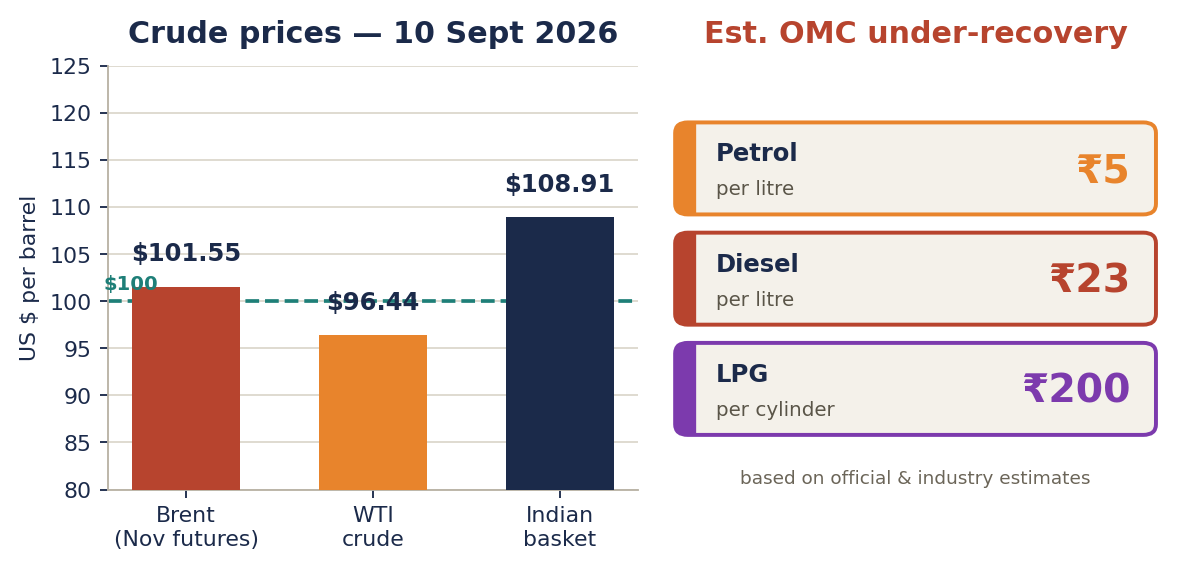
Brent November futures at $101.55 a barrel; WTI at $96.44; the Indian basket touched $108.91 a barrel on 8 September 2026.
Estimated oil marketing company under-recovery: ₹5 a litre on petrol, ₹23 a litre on diesel and ₹200 a cylinder on LPG.
India's diesel exports ran at about 1,20,000 barrels a day in August 2026.
The rupee weakened 25 paise to 95.33 against the US dollar in early trade on 10 September, adding to the import bill.
The Indian basket is a trade-weighted average of Oman, Dubai (sour) and Brent (sweet) crude — the benchmark used for domestic pricing.
Way forward
Deepen the Strategic Petroleum Reserve, accelerate rupee-denominated crude settlement and diversify sourcing beyond West Asia while pushing ethanol blending and electric mobility to structurally cut import dependence.
Concept
Under-recovery is the gap between the cost of supplying a fuel and the price at which it is actually sold — distinct from a subsidy, which is a budgeted transfer. Higher crude widens the Current Account Deficit (CAD) and feeds imported inflation through the WPI fuel-and-power group.
Bar chart of Brent, WTI and Indian basket crude prices on 10 September 2026 alongside stat tiles showing estimated under-recovery of ₹5 a litre on petrol, ₹23 a litre on diesel and ₹200 a cylinder on LPG. — StudyForGS
2. Equity mutual fund inflows jump 19% to a four-month high in August
ECONOMYCOMMON: Prelims + Mains GS3
Syllabus linkage
GS3 — mobilisation of resources, capital markets, financial intermediation. Prelims pointers: AUM, SIP, ETF, flexicap, debt fund, SEBI.
Context
Monthly mutual fund data released on 10 September 2026 showed equity schemes pulling in their largest monthly flow in four months, even as debt funds saw a sharp reversal — a picture of household savings continuing to shift into market-linked instruments.
Key facts
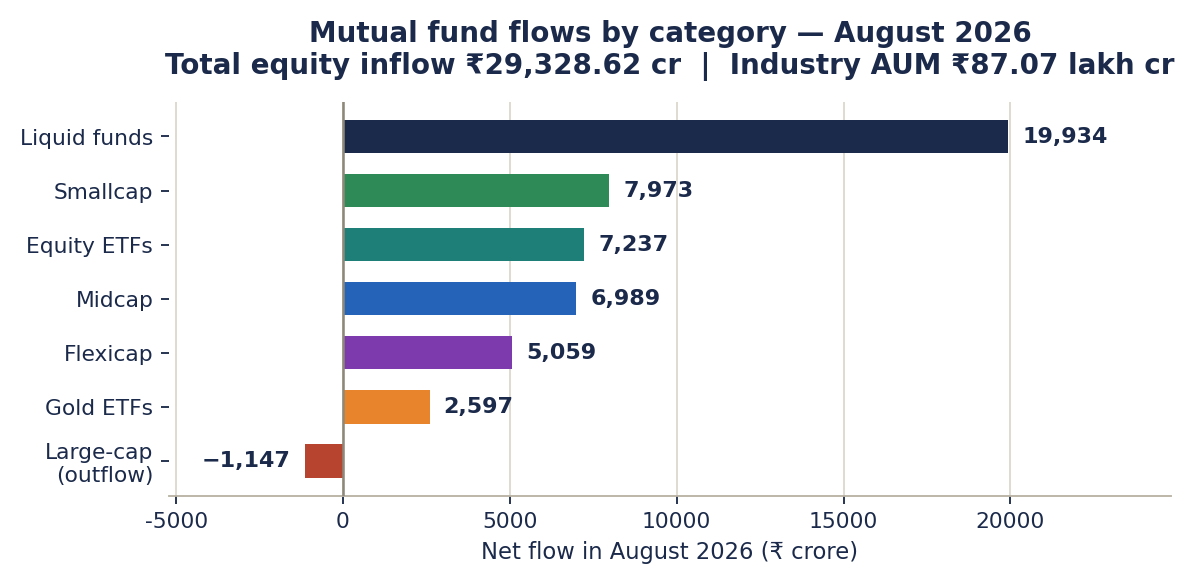
Equity net inflow ₹29,328.62 crore in August 2026, up about 19% from ₹24,697 crore in July — the highest in four months.
Industry assets under management reached ₹87.07 lakh crore at end-August, up over 1% month on month; total industry net inflow was ₹41,353 crore.
Debt funds saw an outflow of ₹8,127 crore, against an inflow of about ₹1.88 lakh crore in July.
Category leaders: smallcap ₹7,973 crore, midcap ₹6,989 crore, flexicap ₹5,059 crore; large-cap saw an outflow of ₹1,147 crore.
Net SIP inflows crossed a record ₹2 lakh crore in FY26, the anchor of retail participation.
Way forward
Sustain investor protection through tighter risk disclosure in smallcap and midcap schemes, widen distribution into tier-2 and tier-3 towns, and use rising domestic flows as a buffer against volatile foreign portfolio investment.
Concept
A mutual fund pools savings into a professionally managed portfolio regulated by SEBI under the SEBI (Mutual Funds) Regulations, 1996. AUM measures the total market value managed; a Systematic Investment Plan (SIP) enforces rupee-cost averaging. Rising domestic institutional flows reduce the market's dependence on FPI money.
Horizontal bar chart of net mutual fund flows by category in August 2026, from a ₹1,147 crore outflow in large-cap funds to a ₹19,934 crore inflow into liquid funds. — StudyForGS
3. ORV Sagar Manthan launched — India's first advanced indigenous ocean research vessel
SCI-TECHCOMMON: Prelims + Mains GS3
Syllabus linkage
GS3 — Science and Technology: indigenisation, developments in new technology; GS1 geography (oceanography). Prelims pointers: Deep Ocean Mission, Ministry of Earth Sciences, bathymetry, ROV, AUV.
Context
India's first advanced indigenously built Ocean Research Vessel (ORV) was launched at a Kolkata shipyard on 9 September 2026. The ship is designed to work in extreme ocean environments including the Southern Ocean, ending long dependence on chartered foreign research vessels.
Key facts
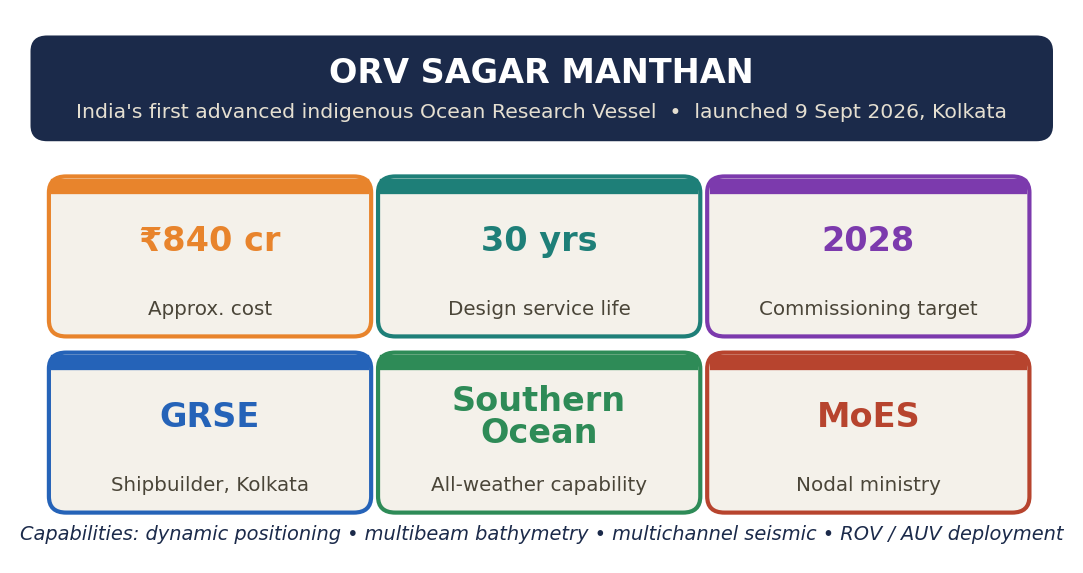
Built by Garden Reach Shipbuilders and Engineers (GRSE), Kolkata at a cost of about ₹840 crore for the Ministry of Earth Sciences.
Designed service life of 30 years; commissioning expected in 2028.
Timeline: contract July 2024, first steel cut 29 November 2024, keel laid 8 April 2026.
Capabilities include dynamic positioning, multibeam bathymetry, multichannel seismic survey, sub-bottom profiling and ROV/AUV deployment.
Supports the Deep Ocean Mission, approved with an outlay of about ₹4,077 crore, which also covers the manned submersible Matsya-6000.
Way forward
Pair the vessel with a trained oceanographic research cadre and open ship time to university consortia, so that hull capability translates into peer-reviewed science and usable blue-economy data.
Concept
The blue economy is the sustainable use of ocean resources for growth, livelihoods and ocean-ecosystem health. India's Exclusive Economic Zone extends 200 nautical miles under UNCLOS 1982, and polymetallic-nodule exploration in the Central Indian Ocean Basin is licensed by the International Seabed Authority.
Fact-sheet schematic of ORV Sagar Manthan with stat tiles for ₹840 crore cost, 30-year service life, 2028 commissioning, GRSE as shipbuilder, Southern Ocean capability and the Ministry of Earth Sciences as nodal ministry. — StudyForGS
4. India and Sri Lanka sign three defence pacts on a landmark Colombo visit
DEFENCECOMMON: Prelims + Mains GS2 + GS3
Syllabus linkage
GS2 — India and its neighbourhood; GS3 — security, defence indigenisation. Prelims pointers: L70 gun, Bharat Electronics Ltd, Palk Strait, Bailey bridge, NCC.
Context
India's Defence Minister visited Colombo from 7 to 9 September 2026 — the first visit by an Indian Defence Minister to Sri Lanka in nearly four decades. Three memoranda of understanding were signed, alongside reconstruction assistance after Cyclone Ditwah.
Key facts
The three MoUs cover upgradation of L70 anti-aircraft guns, NCC-to-NCC youth exchange, and National Defence College academic collaboration.
The L70 is a 40 mm air-defence gun licence-manufactured in India; India gifted 24 guns between 2000 and 2006, of which 18 have been serviced.
Upgrades will be carried out by Bharat Electronics Limited (BEL) under Government of India grant funding.
India has committed about ₹3,750 crore in reconstruction aid after Cyclone Ditwah; three Bailey bridges were inaugurated virtually.
The visit followed the Defence Acquisition Council clearing about ₹1.10 lakh crore in proposals on 7 September 2026, with roughly 98% sourced from Indian industry.
Way forward
Institutionalise the gains through a standing maritime security dialogue, a joint fisheries mechanism for the Palk Strait, and follow-through on defence-industrial supply so that goodwill converts into durable strategic depth.
Concept
India's Neighbourhood First policy and its self-description as a net security provider and first responder in the Indian Ocean Region frame this engagement. Sri Lanka sits astride the Indian Ocean sea lanes of communication, making its strategic alignment central to India's maritime security calculus.
5. Open waste burning in Indian cities runs about three times higher in winter
ENVIRONMENTCOMMON: Prelims + Mains GS3
Syllabus linkage
GS3 — environmental pollution and degradation, urbanisation; GS2 — urban local governance. Prelims pointers: NCAP, non-attainment city, PM2.5, Solid Waste Management Rules 2016.
Context
Two working papers published on 10 September 2026 measured open waste burning across 11 polluted Indian cities, 10 of them non-attainment cities under the National Clean Air Programme. The findings tie winter air pollution to a municipal service failure rather than to farm fires alone.
Key facts
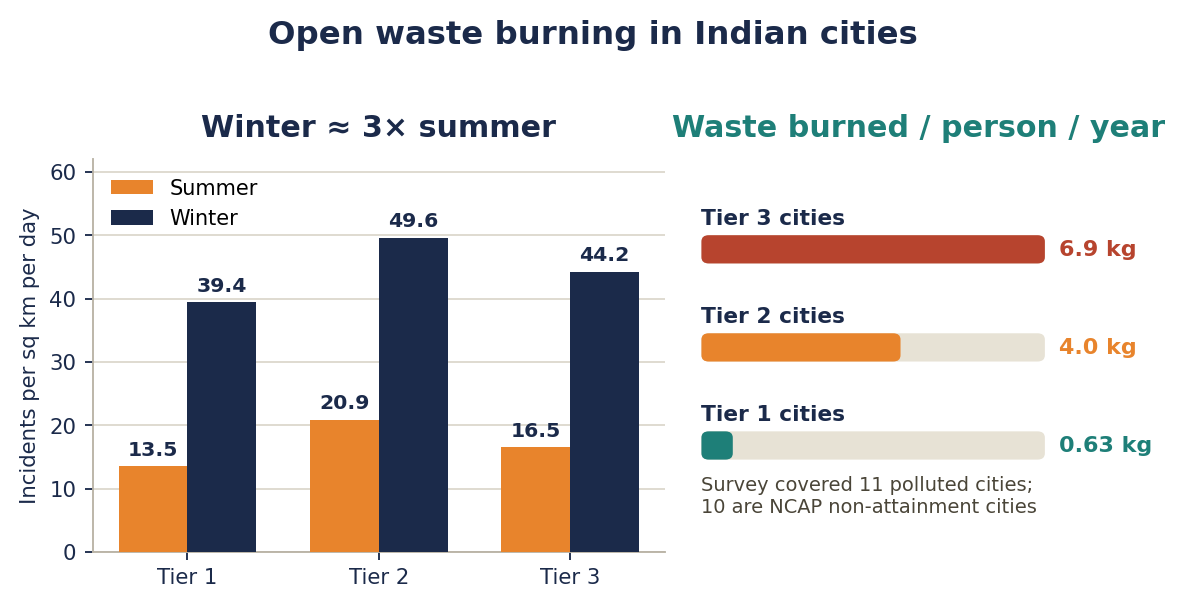
Burning incidents are about three times higher in winter than in summer across all city tiers.
Winter incidence ranges from 39.4 to 49.6 incidents per sq km per day; it reaches about 84 incidents per sq km per day in low-income areas of tier-2 cities.
Tier-2 cities burn about 20.9 tonnes a day in summer, rising to 41 tonnes a day in winter.
Per-capita waste burned each year: 6.9 kg in tier-3, 4 kg in tier-2 and 0.63 kg in tier-1 cities.
Annual per-capita PM2.5 from open waste burning: 0.09 kg (tier-3), 0.05 kg (tier-2), 0.008 kg (tier-1); plastics and paper form about one quarter of the burned material.
Way forward
Fund doorstep segregated collection in low-income wards, enforce the Solid Waste Management Rules, 2016 through ward-level accountability, and treat winter waste burning as a measurable NCAP target rather than a residual category.
Concept
The National Clean Air Programme (NCAP), launched in 2019, targets particulate reduction in non-attainment cities — cities that failed the National Ambient Air Quality Standards for five consecutive years. PM2.5 is particulate matter of diameter 2.5 micrometres or less, small enough to enter the bloodstream through the alveoli.
Grouped bar chart comparing summer and winter open waste burning incidents per square kilometre per day across tier-1, tier-2 and tier-3 cities, with a companion bar showing per-capita waste burned each year. — StudyForGS
6. UK recognises India's Carbon Credit Trading Scheme under its CBAM
ENVIRONMENTCOMMON: Prelims + Mains GS2 + GS3
Syllabus linkage
GS3 — environment, conservation, climate change; GS2 — effect of policies of developed countries on India's interests. Prelims pointers: CBAM, CCTS, Carbon Credit Certificate, Bureau of Energy Efficiency, CBDR-RC.
Context
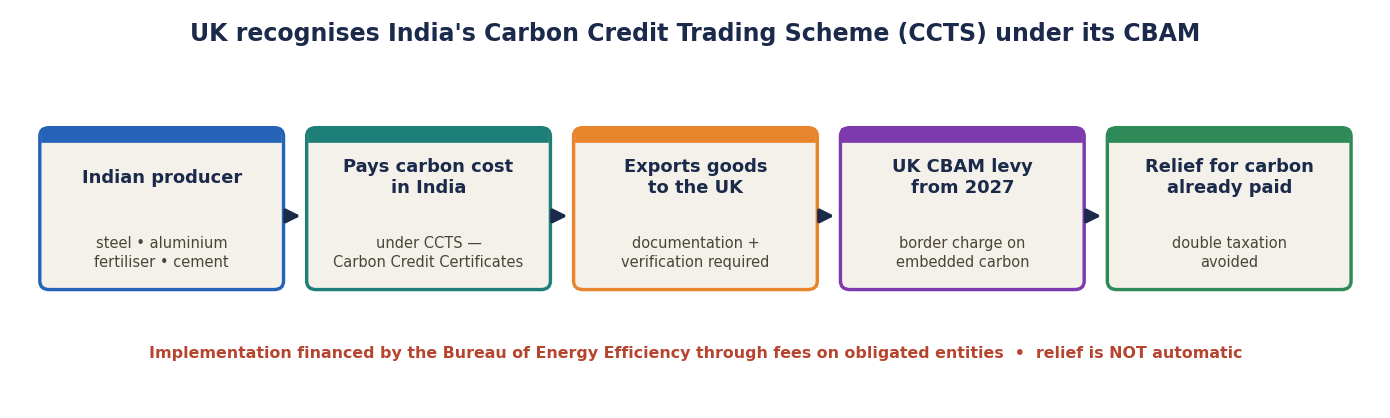
On 9 September 2026 the United Kingdom agreed to recognise India's Carbon Credit Trading Scheme (CCTS) under the UK Carbon Border Adjustment Mechanism, which starts in 2027. Indian exporters in covered sectors can claim relief for carbon costs already paid at home, avoiding double taxation.
Key facts
The UK CBAM begins in 2027 and covers steel, aluminium, fertilisers and cement.
India's CCTS operates through Carbon Credit Certificates issued to obligated entities against emission-intensity targets.
Implementation of the CCTS is financed by the Bureau of Energy Efficiency through fees levied on obligated entities.
Relief is not automatic — exporters must furnish documentation and verification of the carbon price already paid in India.
The move follows the India-UK Comprehensive Economic and Trade Agreement, and is the first such recognition of India's carbon market by a CBAM jurisdiction.
Way forward
Use this precedent to seek equivalence from the European Union as well, strengthen measurement, reporting and verification capacity in MSME exporters, and press the CBDR-RC case in multilateral climate forums.
Concept
A Carbon Border Adjustment Mechanism charges imports for their embedded carbon so that domestic producers facing a carbon price are not undercut — the stated aim is to prevent carbon leakage. Developing countries argue it conflicts with Common But Differentiated Responsibilities and Respective Capabilities (CBDR-RC) under the UNFCCC and the Paris Agreement.
Five-step flowchart showing an Indian producer paying a carbon cost under the CCTS, exporting to the UK, facing the UK CBAM levy from 2027, and receiving relief for the carbon price already paid so double taxation is avoided. — StudyForGS
7. Home Ministry proposes a new Article 371(K) for Ladakh
POLITYCOMMON: Prelims + Mains GS2
Syllabus linkage
GS2 — Indian Constitution: federal structure, special provisions for States and Union Territories. Prelims pointers: Article 371, Article 240, Sixth Schedule, Union Territory.
Context
At a meeting in Delhi on 10 September 2026 with the Leh Apex Body (LAB) and the Kargil Democratic Alliance (KDA), the Ministry of Home Affairs placed a proposal to insert a new clause — Article 371(K) — creating a directly elected body for Ladakh with limited legislative powers.
Key facts
Article 371 currently runs from clause A to clause J and covers 12 States; a clause K for a Union Territory would be a first.
Proposed legislative competence covers land, culture, language, forest, environment and natural resources, to operate concurrently with regulations made under Article 240.
The model is drawn from Article 371A (Nagaland) and Article 371G (Mizoram), which protect customary law and land ownership.
The Ladakh administration described it as a sui generis model; LAB representatives objected that no draft text was shared at the meeting.
Background: the 24 September 2025 Leh violence in which four people died in police firing, with about 80 criminal cases still pending.
Way forward
Share a draft text with both bodies, and address the gaps the proposal leaves open on financial autonomy, budgetary powers, executive authority and control over police and public order — the questions on which any autonomy arrangement is ultimately judged.
Concept
Article 371 and its clauses are special provisions — not exceptions to the Constitution but constitutionally sanctioned asymmetry, upheld as part of India's asymmetric federalism. Article 240 empowers the President to make regulations for certain Union Territories, including Ladakh after the Jammu and Kashmir Reorganisation Act, 2019.
8. Supreme Court: removing the marital rape exception is for the legislature
Hearing an appeal against a 2022 Karnataka High Court ruling that had allowed a husband to be prosecuted for rape, a Supreme Court bench observed on 9 and 10 September 2026 that the onus of removing the marital rape exception lies on the legislature, not the court.
Key facts
The matter is before a bench of the Chief Justice of India and Justice Joymalya Bagchi.
Exception 2 to Section 375 of the Indian Penal Code exempted non-consensual intercourse by a husband where the wife was aged 15 or above.
Section 63 of the Bharatiya Nyaya Sanhita retains the exception but raises the threshold to 18 years.
The Justice J.S. Verma Committee (2013), set up after the December 2012 Delhi case, had recommended removal of the exception.
The petitioner wife was represented by Senior Advocate Indira Jaising; the Union was represented by the Solicitor General.
Way forward
Parliament should settle the question through a considered amendment that balances bodily autonomy under Article 21 with concerns about evidentiary standards, rather than leaving a criminal-law question to be resolved case by case.
Concept
Judicial restraint holds that courts should not enter the legislature's policy domain, especially in defining crimes — a corollary of the separation of powers in the basic structure doctrine. Against it stands the argument that the exception violates Article 14 (equality) and Article 21 (dignity and bodily autonomy).
9. India readies the 18th BRICS Summit at Bharat Mandapam
IRCOMMON: Prelims + Mains GS2
Syllabus linkage
GS2 — bilateral, regional and global groupings and agreements involving India. Prelims pointers: BRICS members, New Development Bank, Contingent Reserve Arrangement, chairship.
Context
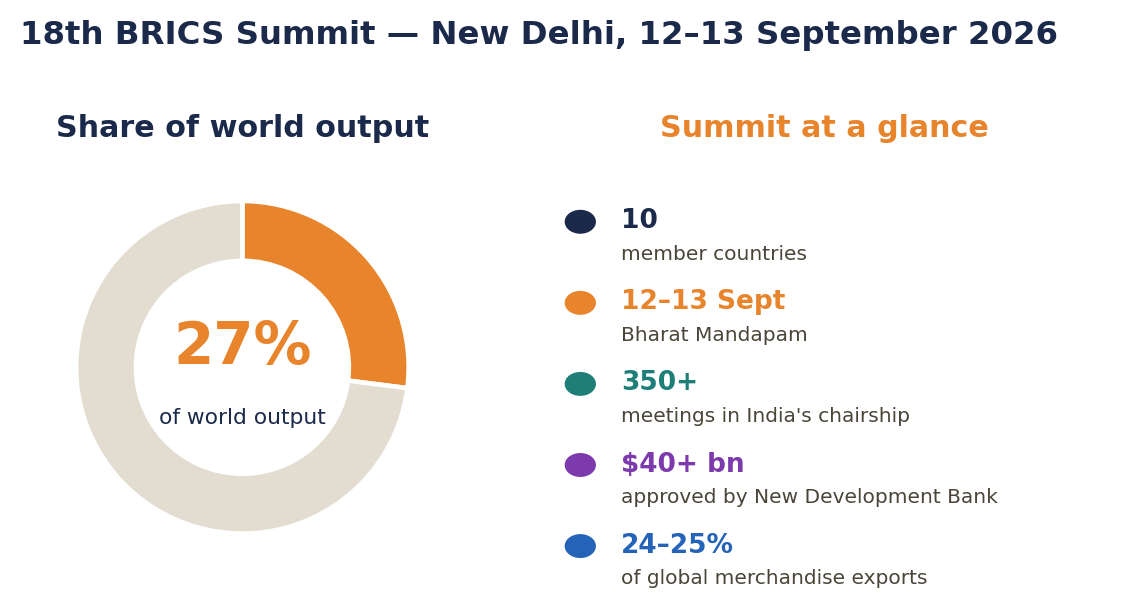
India, holding the BRICS chairship, hosts the 18th BRICS Summit at Bharat Mandapam, New Delhi on 12 and 13 September 2026 under the theme Building for Resilience, Innovation, Cooperation and Sustainability, with the emphasis Humanity First.
Key facts
BRICS now has 10 members: Brazil, Russia, India, China, South Africa, Egypt, Ethiopia, Indonesia, Iran and the UAE.
The four summit pillars are Resilience, Innovation, Cooperation and Sustainability; over 350 meetings were held during India's year-long chairship.
The bloc accounts for about 27% of world output, 24-25% of global merchandise exports and 22% of FDI inflows.
The New Development Bank, headquartered in Shanghai, has approved over $40 billion in financing since inception.
Day one holds a closed session on Inclusive Global Governance and Strengthening Multilateralism; day two opens to partner and outreach countries.
Way forward
Use the chairship to push concrete deliverables — reform of international financial institutions, local-currency trade settlement and a working digital public infrastructure track — rather than communiqué language alone.
Concept
BRICS is a plurilateral grouping without a treaty or permanent secretariat, chaired on rotation. Its financial architecture rests on the New Development Bank and the Contingent Reserve Arrangement. For India it is an instrument of multi-alignment — engaging the Global South while retaining Western partnerships.
Donut chart showing BRICS accounting for 27 per cent of world output, alongside summit facts: 10 member countries, 12-13 September dates, 350-plus chairship meetings and over 40 billion dollars approved by the New Development Bank. — StudyForGS
10. India reports a 177% rise in MBBS seats to the WHO South-East Asia Regional Committee
HEALTHCOMMON: Prelims + Mains GS2
Syllabus linkage
GS2 — issues relating to health, human resources, and important international institutions. Prelims pointers: WHO SEARO, Regional Committee, eSanjeevani, ABHA, National Medical Commission.
Context
At the 79th Session of the WHO Regional Committee for South-East Asia in Dili, Timor-Leste, India's Health Minister set out the scale of medical workforce expansion since 2014. The WHO Director-General met the minister on 10 September 2026.
Key facts
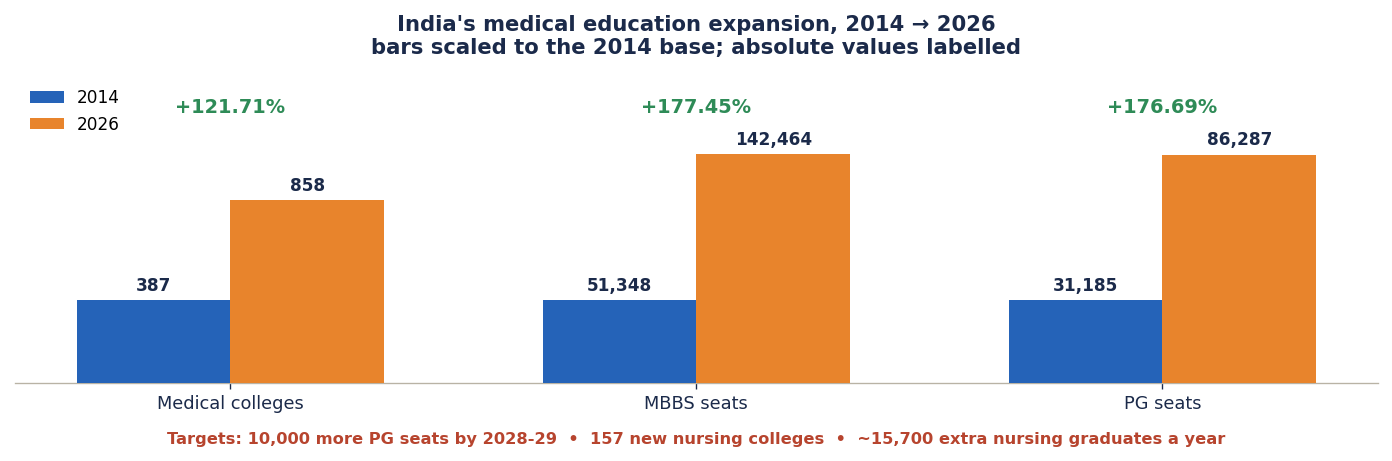
Medical colleges rose from 387 to 858, an increase of 121.71%.
MBBS seats rose from 51,348 to 1,42,464, an increase of 177.45%.
Postgraduate seats rose from 31,185 to 86,287, an increase of 176.69%.
Targets announced: 10,000 additional PG seats by 2028-29, 157 new nursing colleges adding about 15,700 nursing graduates a year, and 1,00,000 allied healthcare professionals over five years.
Digital health enablers cited were eSanjeevani teleconsultation and ABHA-linked health records.
Way forward
Match seat expansion with faculty recruitment, district-hospital teaching capacity and rural retention incentives, so that numbers on paper become doctors available where the disease burden actually sits.
Concept
The WHO works through six regional offices; India belongs to the South-East Asia Region (SEARO), headquartered in New Delhi. Each region's Regional Committee is its governing body and meets annually. Medical education in India is regulated by the National Medical Commission, which replaced the Medical Council of India in 2020.
Grouped bar chart comparing India's medical colleges, MBBS seats and postgraduate seats in 2014 and 2026, with percentage growth of 121.71, 177.45 and 176.69 marked above each pair. — StudyForGS
Data point of the day
Over $200 billion
Merchandise exports, April-August 2026 Up more than 15% from $183 billion in April-August 2025. The April-July figure alone was $174 billion, a 17% rise year on year. India's stated target is $1 trillion in total exports for FY 2026, supported by trade agreements now covering 38 developed economies — roughly two-thirds of global trade.
Prelims rapid-fire
Exercise Veer Guardian-2026, the second India-Japan bilateral air exercise, runs at Jodhpur from 9 to 22 September 2026 with Tejas, Su-30 MKI and Rafale against JASDF F-2A jets; the 22nd Exercise Yudh Abhyas with the United States began on 9 September in a two-theatre format.
ISRO and the European Space Agency signed a Technical Implementing Plan in Paris on 9 September 2026 for ESA ground-tracking support to Gaganyaan — a three-member, three-day mission to a 400 km orbit — and agreed to widen lunar and Venus cooperation; the Venus Orbiter Mission has an outlay of ₹1,236 crore, 19 payloads and a March 2028 launch target.
Census 2027 has been advanced in Uttar Pradesh, Punjab, Uttarakhand and Goa: self-enumeration 16-30 November 2026, house-to-house enumeration 1 December 2026 to 4 January 2027, and a reference date of 00:00 hours on 5 January 2027. The questionnaire notified on 14 August 2026 has 40 questions.
A new rock-dwelling lichen species, Buellia maharajensis, was described from Mathikettan Shola National Park, Idukki, Kerala at an altitude of 1,351 metres.
The 9th ASEAN-India Ministerial Meeting on Agriculture and Forestry in New Delhi adopted a Medium-Term Plan of Action for 2026-2030; ASEAN-India goods trade stood at $128 billion in FY 2025-26.
PM-SETU cleared ₹735.70 crore for three ITI clusters at Bhiwadi (Rajasthan), Medchal (Telangana) and Meerut (Uttar Pradesh), taking the cumulative sanction to ₹2,171 crore across 9 clusters.
Practice MCQs — UPSC Prelims pattern
Q1. With reference to Article 371 of the Constitution of India, consider the following statements: 1. It contains special provisions running from clause A to clause J. 2. Article 371A relates to Nagaland and protects customary law and land ownership. 3. Article 240 empowers the President to make regulations for certain Union Territories. Which of the statements given above are correct?
1 and 2 only
2 and 3 only
1 and 3 only
1, 2 and 3
Show answer
Answer: D All three are correct. Article 371 currently carries clauses A to J covering 12 States. Article 371A gives Nagaland protection for Naga customary law, procedure and land ownership. Article 240 empowers the President to make regulations for specified Union Territories, including Ladakh. The proposed Article 371(K) would be the first such clause for a Union Territory.
Q2. A Carbon Border Adjustment Mechanism (CBAM), as recently in the news, is best described as:
A domestic cap-and-trade market for power plants within a single country
A charge on imported goods reflecting the carbon emitted in producing them
A concessional climate finance window operated by multilateral development banks
A treaty obligation under the Paris Agreement to submit carbon budgets
Show answer
Answer: B A CBAM levies a charge on imports based on the greenhouse gases embedded in their production, so that domestic producers already paying a carbon price are not undercut by imports from jurisdictions without one. Its stated aim is to prevent carbon leakage. The UK CBAM starts in 2027 and covers steel, aluminium, fertilisers and cement; it has now recognised India's Carbon Credit Trading Scheme, so carbon costs already paid in India can be set off.
Mains practice question
Q. Special constitutional provisions for regions with distinct cultural and ecological identities are often defended as a strength of Indian federalism and criticised as a source of fragmentation. In the light of the proposal to insert a new Article 371(K) for Ladakh, critically examine this debate. (250 words, 15 marks)
Hint / approach
Open by defining asymmetric federalism and listing the existing Article 371 clauses with one example each. Build the supporting case: protection of customary law, land and fragile ecology; conflict de-escalation; the Sixth Schedule and Article 371A precedents. Then the critique: administrative complexity, investment deterrence, demands for replication elsewhere, and the risk of symbolic autonomy without financial or police powers — the gap flagged in the Ladakh proposal itself. Conclude that asymmetry has held the Union together where it came with real fiscal and executive substance, and that the 371(K) draft should be judged on that test.
📌 One-line revision: Crude above $100 with ₹23 a litre diesel under-recovery, a proposed Article 371(K) for Ladakh, and the 18th BRICS Summit at Bharat Mandapam — the three anchors of 10 September 2026.