UK recognises India's carbon credit scheme under its CBAM, the Defence Acquisition Council clears ₹1.10 lakh crore with 98% from Indian industry, and New Delhi readies the 18th BRICS Summit
Wednesday, 9 September 2026 · IST · National & International · 11 items · 2 MCQs
Trade and climate policy converged today as the United Kingdom recognised India's Carbon Credit Trading Scheme as a qualifying carbon price under its Carbon Border Adjustment Mechanism, easing the burden on Indian steel, aluminium, cement and fertiliser exporters. On the security side the Defence Acquisition Council accorded Acceptance of Necessity to proposals worth about ₹1.10 lakh crore with roughly 98% reserved for Indian industry, while the India-Japan air exercise Veer Guardian 2026 opened at Jodhpur. The economy story stayed uncomfortable: the Indian crude basket crossed $100 a barrel and global food prices touched a four-year high just as New Delhi prepares to host the 18th BRICS Summit.
Today at a glance — things to remember
UK Treasury recognises India's CCTS as a qualifying carbon price under UK CBAM, effective today.
Defence Acquisition Council clears about ₹1,10,000 crore of proposals, ~98% from Indian industry.
Indian crude basket at $101.07 a barrel — first time above $100 since May 2026.
FAO Food Price Index for August 2026 at 133.3 points, highest since late 2022.
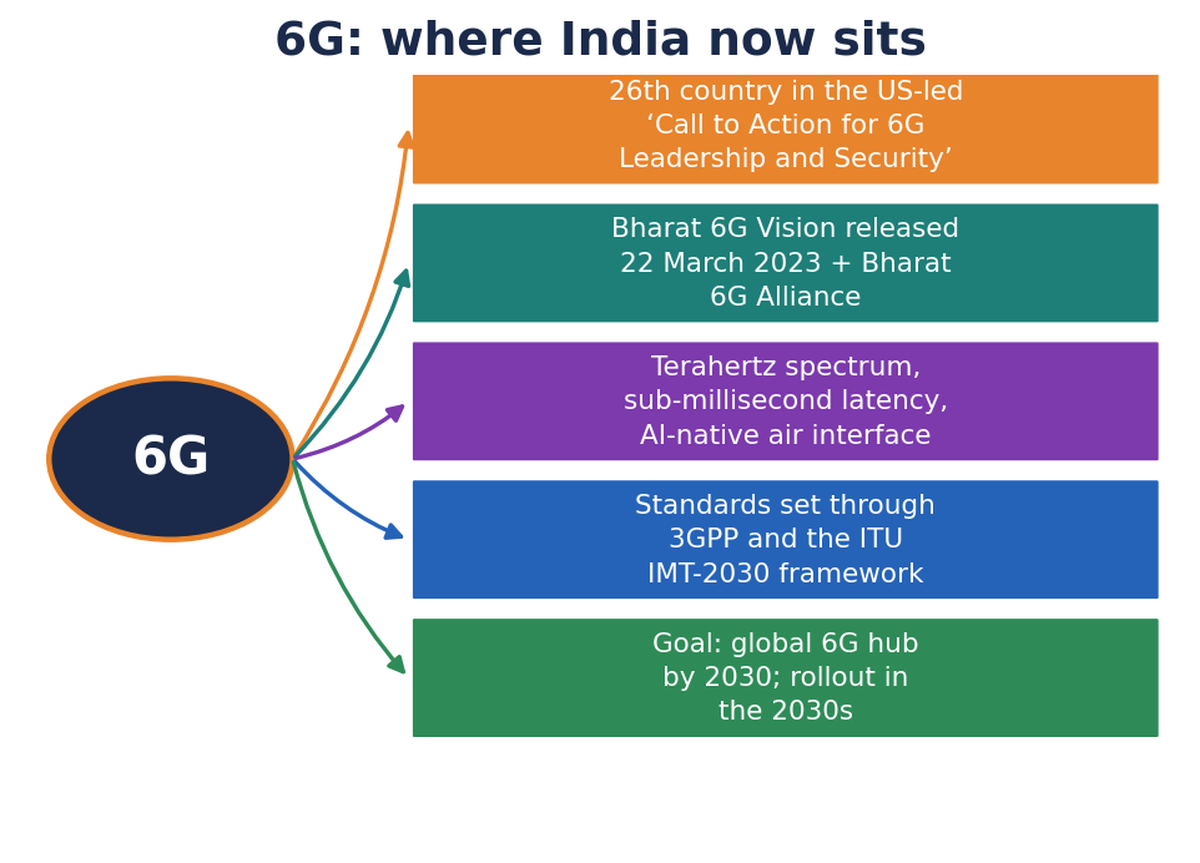
India becomes the 26th country in the US-led 'Call to Action for 6G Leadership and Security'.
NITI Aayog launches PACT and the ZET Marketplace for zero-emission freight trucks.
Finance Ministry secures a $1 billion IFC facility routed through SIDBI for MSME term credit.
18th BRICS Summit to be held at Bharat Mandapam, New Delhi on 12-13 September 2026.
India-Japan air combat exercise Veer Guardian 2026 begins at Air Force Station Jodhpur.
Supreme Court bars appointment of teachers lacking RTE, NCTE or UGC prescribed qualifications.
Detailed notes
1. Indian crude basket tops $100 a barrel; external sector back under watch
ECONOMYCOMMON: Prelims + Mains GS3
Syllabus linkage
GS-3 Indian Economy — Balance of Payments, inflation, energy security; GS-2 effect of West Asian developments on India. Prelims: composition of the Indian Basket, PPAC, definition of current account deficit.
Context
India's crude import basket crossed the $100 per barrel mark on 4 September 2026 for the first time since May 2026, driven by Iran-US tensions and renewed risk to shipping through the Strait of Hormuz. Oil marketing companies are already running negative marketing margins.
Key facts
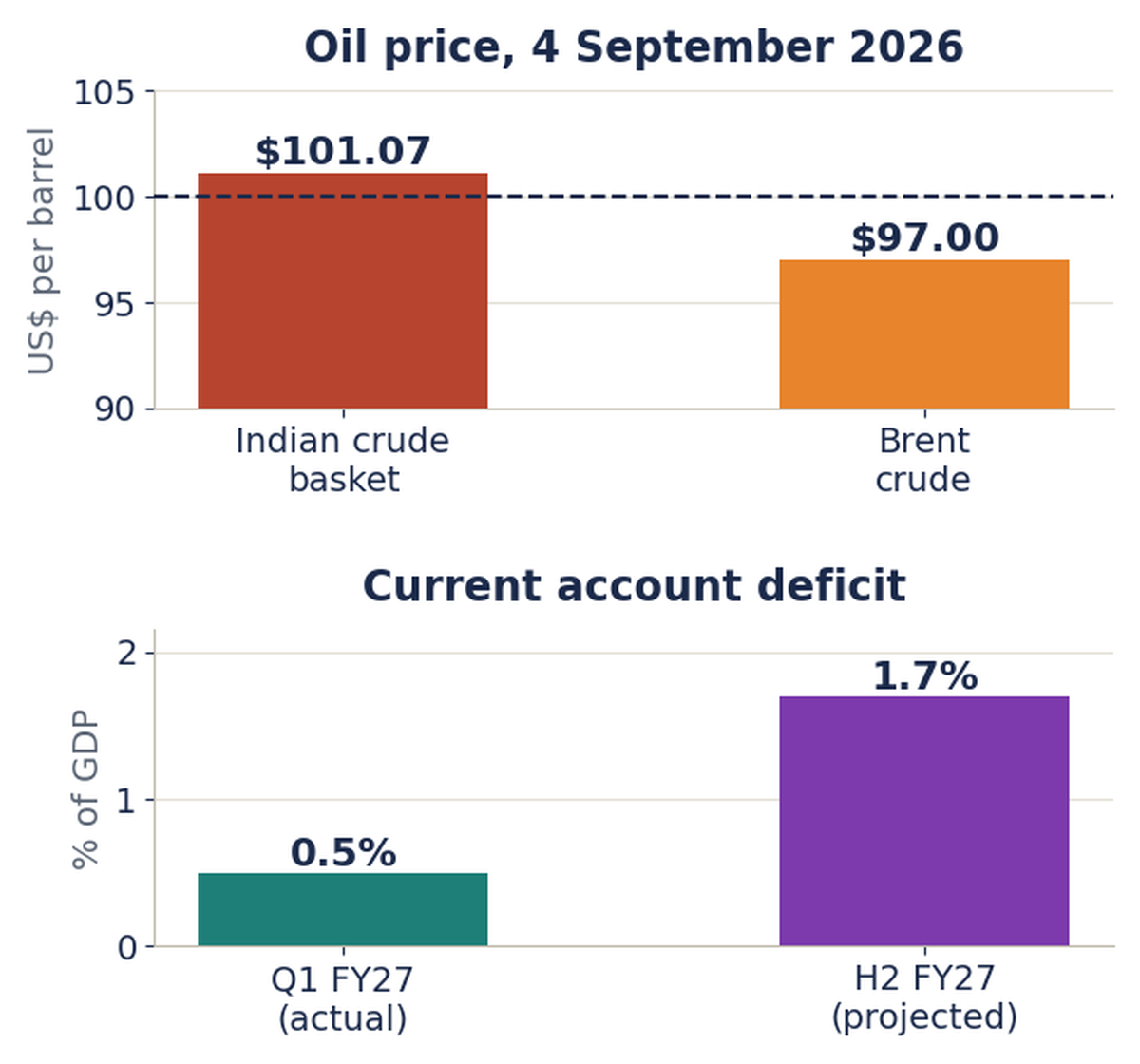
Indian crude basket at $101.07/barrel (4 September 2026); Brent near $97/barrel, a six-week high.
The current account deficit could widen to 1.7% of GDP (about $71 billion) in H2 FY27 if crude stays above $90/barrel.
Q1 FY27 CAD stood at $4.2 billion (0.5% of GDP) on a merchandise trade deficit of $86.1 billion.
Domestic LPG under-recovery is about ₹200 per cylinder; the 19-kg commercial cylinder in Delhi costs ₹2,747.5.
August 2026 fuel consumption fell 2.8% year-on-year to 18.61 million tonnes, even as petrol and diesel sales rose.
Way forward
Diversify sourcing towards Brazil, West Africa and the US, deepen the Strategic Petroleum Reserve, and accelerate ethanol blending and transport electrification to structurally shrink the oil import bill.
Concept
Indian Basket = weighted average of Oman-Dubai (sour) and Brent (sweet) crude in the ratio of India's actual import mix, computed by the Petroleum Planning & Analysis Cell (PPAC) under MoPNG. CAD = trade deficit + net invisibles. Rule of thumb: every $10/barrel rise adds roughly 0.4-0.5% of GDP to the oil import bill and about 30 basis points to headline CPI.
Two stacked panels: the upper panel has bars for the Indian crude basket at 101.07 dollars and Brent at 97 dollars per barrel against a dashed 100 dollar line; the lower panel compares a current account deficit of 0.5 percent of GDP in Q1 FY27 with a projected 1.7 percent for H2 FY27. — StudyForGS
2. Food inflation set to stay elevated; global food price index at a four-year high
ECONOMYCOMMON: Prelims + Mains GS3
Syllabus linkage
GS-3 Indian Economy — inflation and monetary policy; Agriculture — cropping pattern, food security, buffer stocks. Prelims:CPI base year and food weight, FAO Food Price Index, El Nino.
Context
Retail food inflation has climbed back sharply after a benign start to 2026, and the FAO Food Price Index for August 2026 touched its highest level since late 2022. A monsoon deficit and lower kharif acreage now threaten the festive-season price line.
Key facts
CPI headline inflation was 4.45% in July 2026 — a 19-month high; food inflation 5.52%, up from just 2.13% in January 2026.
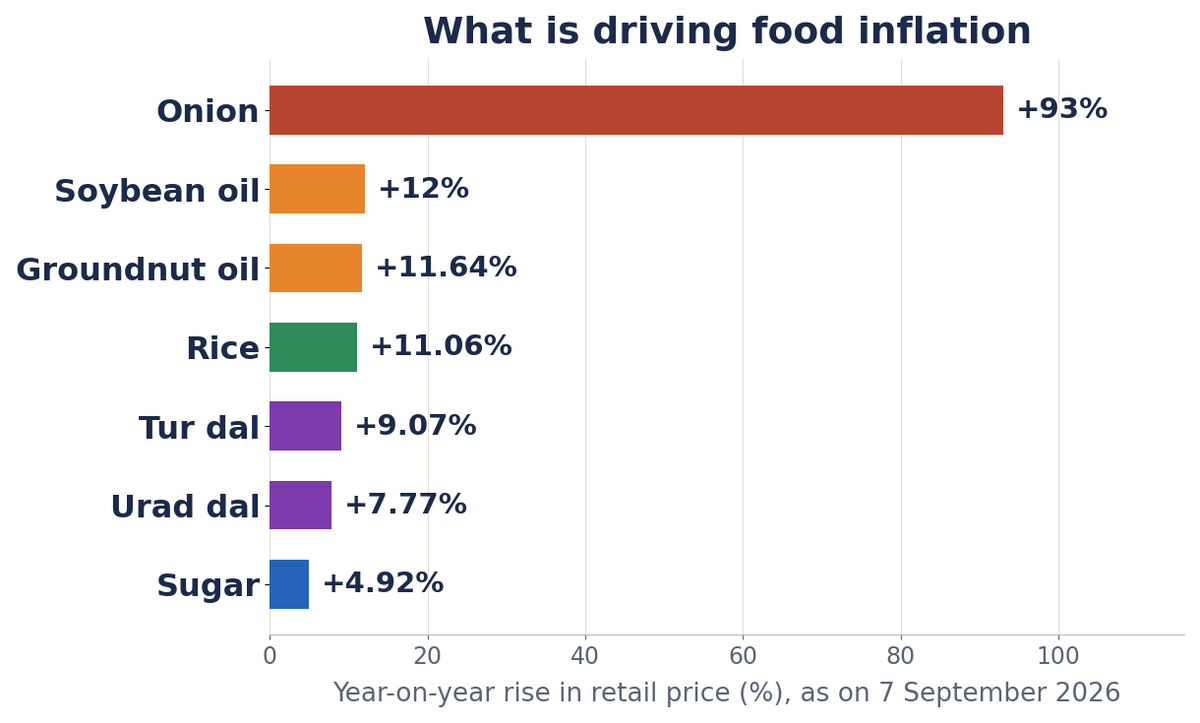
Year-on-year retail rises as on 7 September 2026: onion +93%, soybean oil +12%, groundnut oil +11.64%, rice +11.06%, tur dal +9.07%, sugar +4.92%.
FAO Food Price Index, August 2026 = 133.3 points, up 1.9% over July — sugar +11.9%, cereals +2.2%, vegetable oils +0.6%.
FAO cut its 2026 world cereal production forecast to 2.980 billion tonnes, a 2% annual fall — the steepest since 2018.
Southwest monsoon rainfall deficit is about 14% and kharif acreage 1.7% below last year; El Nino is expected to intensify over September-October.
Way forward
Calibrated buffer-stock releases and open market sale, duty rationalisation on edible oils, and investment in cold chains, pulses procurement and climate-resilient seed to break the recurring vegetables-pulses-oils inflation cycle.
Concept
CPI (Combined) is compiled by NSO/MoSPI, base 2012 = 100, with food and beverages weighted 45.86% — which is why food shocks dominate headline prints. RBI's flexible inflation targeting mandate under Section 45ZA, RBI Act 1934 is 4% plus or minus 2%; the MPC has 6 members (3 RBI + 3 external), with the Governor holding a casting vote. The FAO Food Price Index is trade-weighted across five commodity groups, base 2014-2016 = 100.
Horizontal bar chart of year-on-year retail price rise in India as on 7 September 2026: onion 93 percent, soybean oil 12 percent, groundnut oil 11.64 percent, rice 11.06 percent, tur dal 9.07 percent, urad dal 7.77 percent and sugar 4.92 percent. — StudyForGS
3. UK recognises India's Carbon Credit Trading Scheme under its CBAM
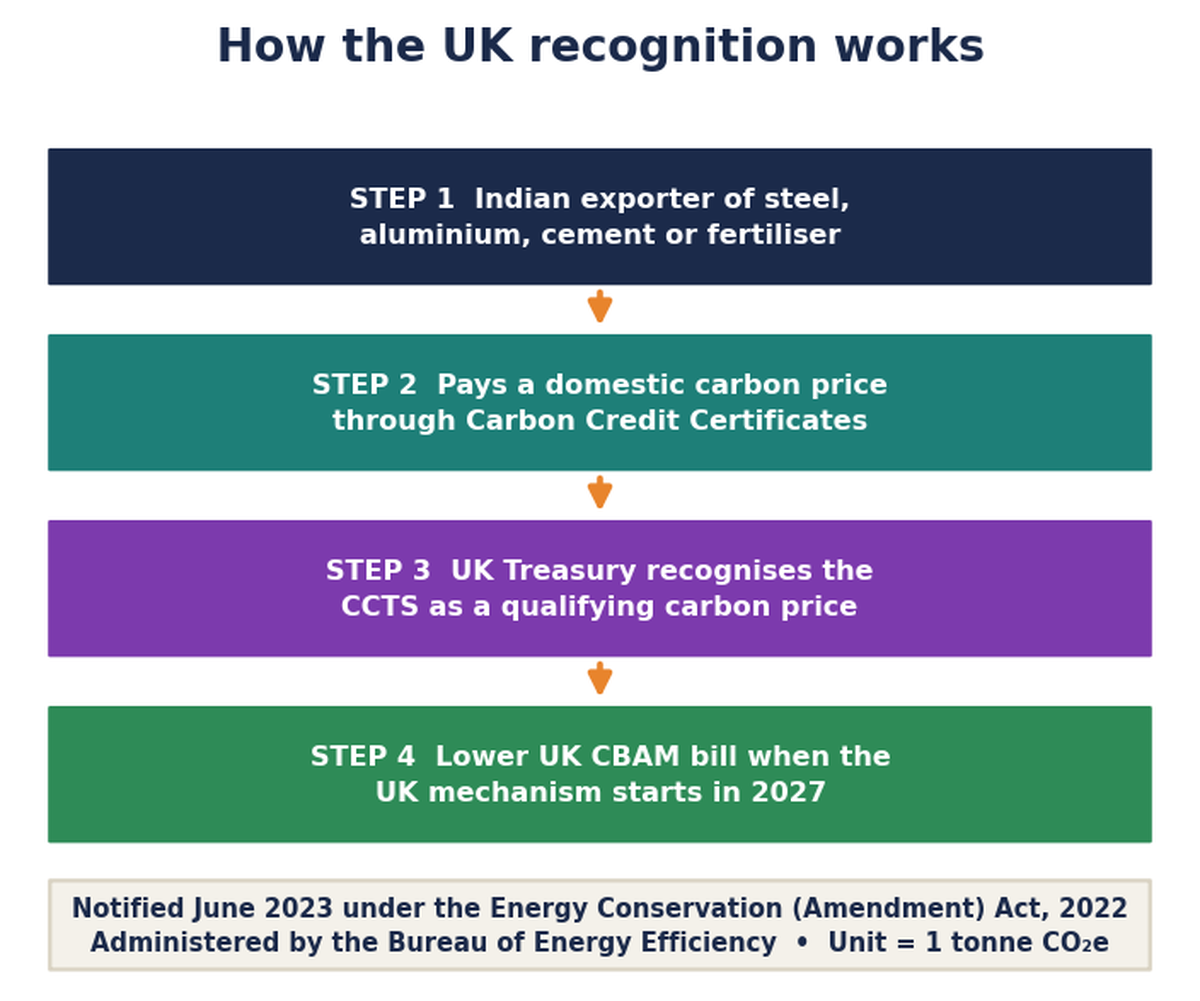
Effective 9 September 2026, HM Treasury has recognised India's Carbon Credit Trading Scheme (CCTS) as a qualifying carbon pricing mechanism under the UK Carbon Border Adjustment Mechanism. Indian exporters can now set off carbon costs already paid at home.
Key facts
Recognition covers Indian exports of steel, aluminium, fertilisers and cement; UK importers must furnish documentation and meet verification requirements to claim the relief.
The UK CBAM takes effect in 2027; the EU CBAM's definitive financial phase began in January 2026.
It builds on the India-UK Comprehensive Economic and Trade Agreement (CETA), signed 15 July 2026; merchandise trade is about $25.1 billion and services trade $35.4 billion (2024-25).
CCTS was notified in June 2023 under the Energy Conservation (Amendment) Act, 2022, administered by the Bureau of Energy Efficiency (BEE); the traded unit is the Carbon Credit Certificate, denominated in tonnes of CO2 equivalent.
Pressure point: India's steel sector accounts for about 12% of national greenhouse gas emissions with emissions intensity roughly 32% above the global average.
Way forward
Seek comparable recognition under the EU CBAM, strengthen measurement, reporting and verification (MRV) capacity, and align the compliance market with the green steel transition so that domestic carbon pricing becomes a trade shield rather than an added cost.
Concept
CBAM is a carbon border tariff designed to prevent carbon leakage — the shifting of emission-intensive production to jurisdictions with weaker carbon prices. CCTS succeeds the Perform, Achieve and Trade (PAT) scheme and its ESCerts under the National Mission for Enhanced Energy Efficiency (NMEEE) of the NAPCC; it combines a compliance mechanism for obligated energy-intensive entities with a voluntary offset mechanism. India has argued that unilateral CBAMs sit uneasily with Common But Differentiated Responsibilities (CBDR-RC) under the UNFCCC, 1992.
Four-step vertical flow schematic: an Indian steel, aluminium, cement or fertiliser exporter pays a domestic carbon price through Carbon Credit Certificates, the UK Treasury recognises the CCTS as a qualifying carbon price, and the exporter's UK CBAM bill falls when the UK mechanism starts in 2027. — StudyForGS
4. Defence Acquisition Council clears ₹1.10 lakh crore, 98% from Indian industry
DEFENCECOMMON: Prelims + Mains GS3
Syllabus linkage
GS-3 Security — defence indigenisation, developing new technology, role of the private sector; GS-2 government policies and interventions. Prelims:DAC, Acceptance of Necessity, DAP 2020 categories, CBRN.
Context
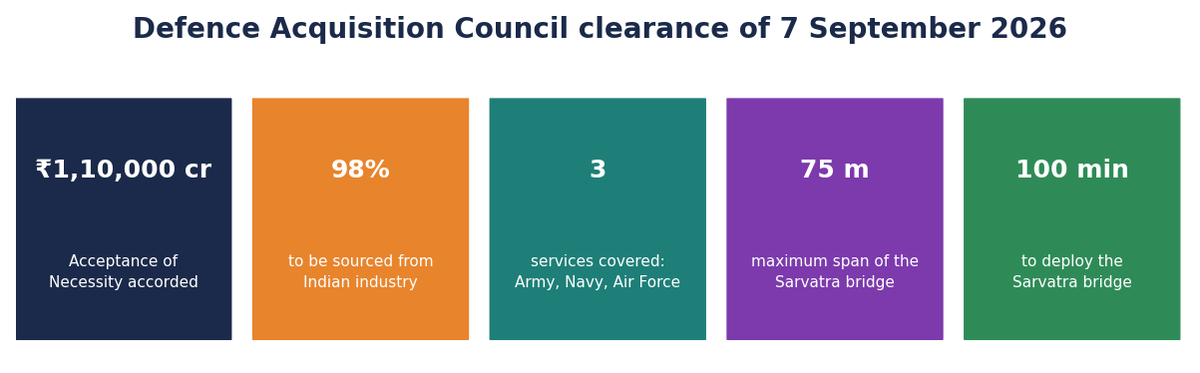
The Defence Acquisition Council, chaired by Defence Minister Rajnath Singh, accorded Acceptance of Necessity (AoN) to capital acquisition proposals worth about ₹1,10,000 crore on 7 September 2026, with roughly 98% of the value to be sourced from Indian industry — among the highest indigenous shares in a single tranche.
Key facts
Army:CBRN Reconnaissance Vehicles (Tracked) Mk-II, High Mobility Vehicles, Self-Propelled Mechanical Mine Layers, Advanced Light Helicopters, Trawl Tanks and the Sarvatra multi-span mobile bridge.
Sarvatra spans up to 75 metres in 15-metre steps and can be deployed in about 100 minutes.
Navy:Arudhra medium-power air surveillance radars, and design and development of indigenous Marine Gas Turbines for warship propulsion — currently an import-dependent segment.
Air Force: fighter, transport and helicopter fleet upgrades, Ground-Based Multi-Purpose Jammers and the DEFSAC secure access card system.
AoN is only the first stage of the procurement cycle under DAP 2020 — it is not a signed contract, and conversion typically takes years.
Way forward
Compress the AoN-to-contract timeline, widen iDEX and MSME participation in the Uttar Pradesh and Tamil Nadu defence corridors, and build test-and-certification infrastructure so that indigenous design capability, not only assembly, deepens.
Concept
The DAC is the apex decision-making body of the Ministry of Defence for capital acquisition, constituted in 2001 on the recommendation of the Group of Ministers report after the Kargil Review Committee; it is chaired by the Raksha Mantri. DAP 2020 ranks categories in descending order of indigenisation: Buy (Indian-IDDM), Buy (Indian), Buy and Make (Indian), Buy (Global - Manufacture in India), Buy (Global). IDDM = Indigenously Designed, Developed and Manufactured. CBRN defence links to the Chemical Weapons Convention, 1993 (OPCW, The Hague) and the Biological Weapons Convention, 1972.
Statistic tile strip summarising the Defence Acquisition Council approvals: about ₹1,10,000 crore of Acceptance of Necessity, roughly 98 percent to be sourced from Indian industry, all three services covered, the Sarvatra bridge spanning up to 75 metres, and deployment in about 100 minutes. — StudyForGS
5. India becomes the 26th country in the 6G 'Call to Action' on secure networks
SCI-TECHCOMMON: Prelims + Mains GS3
Syllabus linkage
GS-3 Science & Technology — awareness in IT and communication, indigenisation of technology. GS-2 effect of policies of developed countries on India's interests. Prelims:Bharat 6G Vision, 3GPP, ITU IMT-2030, TSDSI.
Context
On 8 September 2026 India signed on to the US-led 'Call to Action for 6G Leadership and Security', becoming its 26th participant. The move links the Bharat 6G Mission to a plurilateral bloc shaping next-generation standards and trusted supply chains.
Key facts
The Call to Action was launched in July 2026 by the National Telecommunications and Information Administration (NTIA), US Department of Commerce; signatories include the UK, Germany and Japan.
India's accession was announced around a meeting between US Commerce Secretary Howard Lutnick and Minister of State for Commerce & Industry Jitin Prasada at Chapel Hill, North Carolina, on the sidelines of the G20 Innovation Ministerial.
The US framing traces to a December 2025 Presidential Memorandum, 'Winning the 6G Race', designating 6G as foundational to national security.
6G is expected to begin displacing 5G in the 2030s, using terahertz-band spectrum, sub-millisecond latency and AI-native air interfaces.
India's own track: the Bharat 6G Vision document was released on 22 March 2023, with the Bharat 6G Alliance and a goal of becoming a global 6G hub by 2030.
Way forward
Convert participation into standard-essential patents by funding C-DOT and TSDSI contributions to 3GPP, secure early terahertz spectrum allocation, and build domestic chip-to-tower capability so that India is a rule-maker rather than a rule-taker in 6G.
Concept
Global mobile standardisation runs through 3GPP and the ITU-R IMT-2030 framework; the ITU, headquartered in Geneva and founded in 1865, is the oldest UN specialised agency. India's telecom standards body TSDSI earlier piloted the indigenous 5Gi / Low Mobility Large Cell standard. Domestic law and institutions: the Telecommunications Act, 2023 and C-DOT.
Mind map with 6G at the centre and five branches: the 26-nation Call to Action launched by the US NTIA in July 2026, the Bharat 6G Vision of March 2023 and Bharat 6G Alliance, terahertz spectrum with sub-millisecond latency and AI-native interfaces, standardisation through 3GPP and the ITU IMT-2030 framework, and India's goal of becoming a global 6G hub by 2030. — StudyForGS
6. NITI Aayog launches PACT and ZET Marketplace to electrify road freight
ENVIRONMENTCOMMON: Prelims + Mains GS3
Syllabus linkage
GS-3 Infrastructure — transport and logistics; Environment — climate mitigation and hard-to-abate sectors. GS-2 government interventions. Prelims:e-FAST India, PM E-DRIVE, National Logistics Policy 2022, Panchamrit.
Context
At the 5th e-FAST India Summit in New Delhi on 7 September 2026, NITI Aayog Member Rajiv Gauba launched PACT (Platform for Aggregating Clean Transport) and the ZET (Zero Emission Trucks) Marketplace to push freight electrification.
Key facts
PACT aggregates fragmented freight demand along identified corridors and converts it into deployable e-truck projects; the ZET Marketplace matches OEMs, fleet operators, charge point operators, financiers and technology providers.
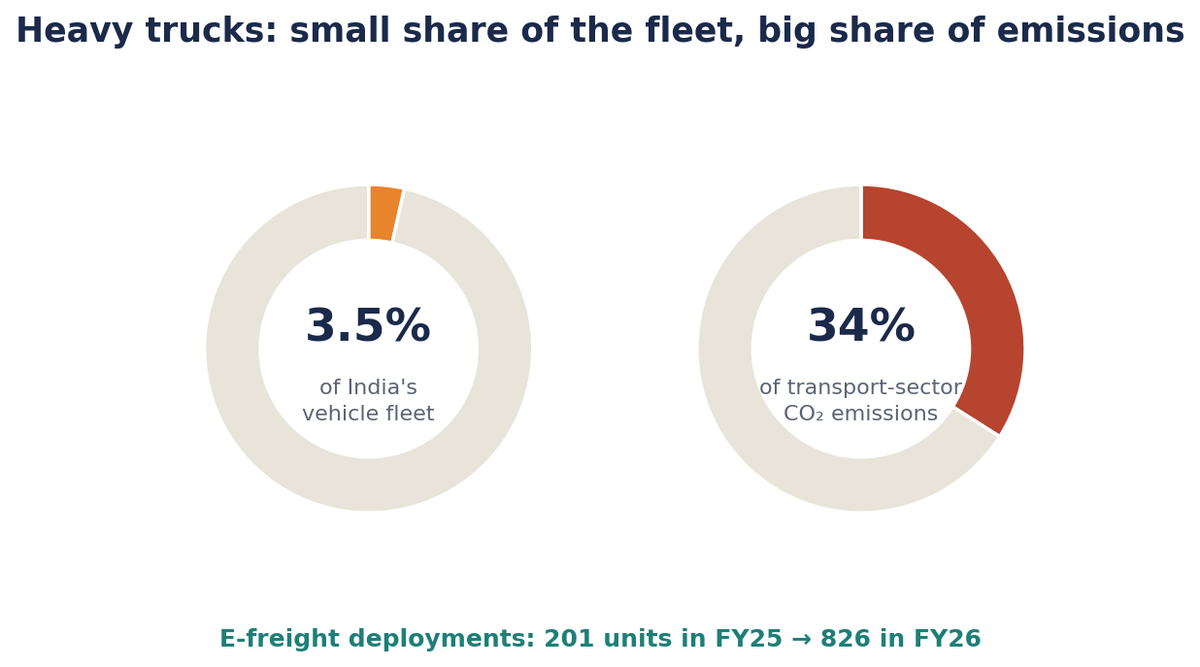
Heavy trucks are only 3-4% of India's vehicle fleet but generate over one-third of transport-sector CO2; about 70% of India's freight moves by road.
E-freight vehicle deployments rose from 201 units in FY25 to 826 in FY26 — more than fourfold; only about 800 heavy-duty electric trucks were sold in 2025.
Barriers flagged: fragmentation of logistics operators, high cost of financing and the absence of corridor-based charging plans; remedies proposed include blended finance and leasing models.
e-FAST India — the Electric Freight Accelerator for Sustainable Transport — was launched by NITI Aayog on 8 September 2022 as India's first national electric-freight platform. PACT and ZET are coordination platforms, not subsidy schemes.
Way forward
Anchor demand aggregation to a few high-density corridors, extend PM E-DRIVE support and battery-as-a-service leasing to close the total cost of ownership gap with diesel, and sequence charging infrastructure under PM GatiShakti.
Concept
The programme serves India's updated Nationally Determined Contributions under the Paris Agreement — cutting the emissions intensity of GDP by 45% from 2005 levels by 2030, reaching 50% of installed power capacity from non-fossil sources by 2030, and net zero by 2070, announced as Panchamrit at COP26, Glasgow (2021) alongside the LiFE mission. It also links to the National Logistics Policy, 2022 and PM GatiShakti. NITI Aayog was constituted on 1 January 2015, replacing the Planning Commission, with the Prime Minister as ex-officio Chairperson.
Two donut charts side by side: the first shows heavy trucks making up about 3.5 percent of India's vehicle fleet, and the second shows the same trucks producing about 34 percent of transport-sector carbon dioxide emissions. — StudyForGS
7. $1 billion IFC facility routed through SIDBI for long-tenure MSME credit
ECONOMYCOMMON: Prelims + Mains GS3
Syllabus linkage
GS-3 Indian Economy — mobilisation of resources, financial inclusion, MSMEs and employment. GS-2 important international institutions. Prelims:World Bank Group arms, SIDBI, revised MSME classification.
Context
The Ministry of Finance has secured a US$1 billion facility from the International Finance Corporation (IFC), routed through SIDBI, to address the MSME sector's structural shortage of long-tenor capital expenditure credit.
Key facts
$500 million has been extended from IFC's own account to SIDBI; the balance $500 million will be syndicated through SIDBI's lender consortium.
Tenure of up to 7 years with a moratorium, aimed at machinery purchase, modernisation, expansion and project finance rather than working capital.
The dollar facility has been swapped into rupees through the RBI's special swap window, insulating SIDBI and borrowers from currency risk.
Target sectors: auto components, engineering goods, electronics, textiles, food processing and logistics, with emphasis on micro enterprises and first-time borrowers.
SIDBI was established under the SIDBI Act, 1989 (operational 2 April 1990), is headquartered at Lucknow, and will both lend directly and refinance MSME loans through NBFCs.
Way forward
Pair cheap long-tenor liquidity with credit-guarantee depth under CGTMSE, faster TReDS adoption for receivables, and cash-flow-based underwriting using GST and Udyam data so that first-time and micro borrowers actually reach the money.
Concept
IFC is the private-sector arm of the World Bank Group (established 1956); the Group's five institutions are IBRD, IDA, IFC, MIGA and ICSID. MSME classification (effective 1 April 2025): Micro — investment up to ₹2.5 crore and turnover up to ₹10 crore; Small — up to ₹25 crore and ₹100 crore; Medium — up to ₹125 crore and ₹500 crore. Related instruments: CGTMSE, PMEGP, RAMP, Udyam Registration and TReDS.
8. New Delhi readies the 18th BRICS Summit; India's bloc trade is an import story
IRCOMMON: Prelims + Mains GS2
Syllabus linkage
GS-2 bilateral, regional and global groupings involving India; effect of policies of other countries on India's interests. GS-3 external sector. Prelims: BRICS expansion, NDB, Contingent Reserve Arrangement.
Context
India, chairing BRICS in 2026, will host the 18th BRICS Leaders' Summit at Bharat Mandapam, New Delhi, on 12-13 September 2026 under the theme 'Building for Resilience, Innovation, Cooperation and Sustainability'. Fresh trade data show how lopsided India's bloc commerce is.
Key facts
This is India's fourth BRICS chairship (after 2012, 2016 and 2021); India hosted over 350 meetings in 25+ cities through the chairship year.
BRICS now has 11 full members — Brazil, Russia, India, China, South Africa, Egypt, Ethiopia, Iran, the UAE, Saudi Arabia and Indonesia — together about 45% of world population and 30% of global nominal GDP.
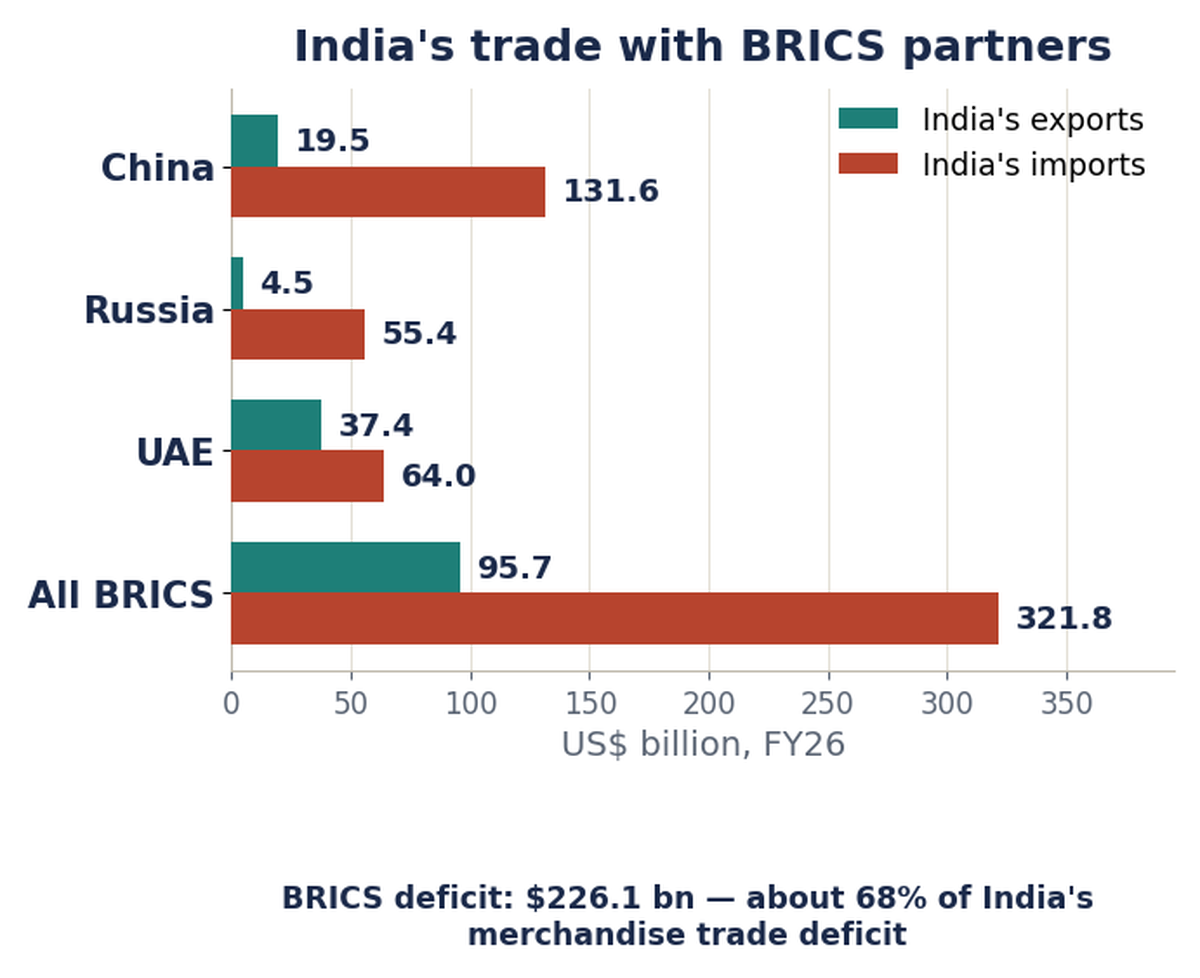
In FY26 BRICS members supplied about 42% of India's merchandise imports but took only 22% of its exports: imports $321.8 billion against exports $95.7 billion, a deficit of $226.1 billion.
That is roughly 68% of India's entire merchandise trade deficit. Country-wise: China -$112.2 billion, Russia -$50.9 billion, UAE -$26.5 billion — together 84% of the BRICS deficit.
India ran a trade surplus with only three BRICS members — Egypt, Ethiopia and Iran. A curtain-raiser BRICS Chief Justices' Forum was held in New Delhi on 4-6 September 2026.
Way forward
Use the chairship to press for market access in agriculture, pharmaceuticals and IT services within the bloc, expand rupee-settled trade selectively, and keep BRICS anchored to development finance rather than currency projects that cut against India's strategic autonomy.
Concept
The term BRIC was coined by Jim O'Neill (2001); the first standalone summit was at Yekaterinburg in 2009, with South Africa joining in 2010. Expansion took effect from 1 January 2024. Institutions: the New Development Bank (NDB), headquartered at Shanghai, agreed at the Fortaleza Summit (2014) with first President K.V. Kamath, and the Contingent Reserve Arrangement (CRA), a $100 billion currency-swap safety net. Chairship rotates alphabetically.
Grouped horizontal bar chart of India's FY26 merchandise trade with major BRICS partners in billion US dollars, showing exports against imports for China at 19.5 versus 131.6, Russia at 4.5 versus 55.4, the UAE at 37.4 versus 64, and the BRICS total at 95.7 versus 321.8. — StudyForGS
9. India-Japan air exercise Veer Guardian 2026 opens at Jodhpur today
DEFENCECOMMON: Prelims + Mains GS2
Syllabus linkage
GS-2 bilateral agreements involving India; India and the Indo-Pacific; groupings such as the QUAD. GS-3 security cooperation. Prelims: India-Japan exercises, ACSA, 2+2 dialogue.
Context
The second edition of Exercise Veer Guardian opens at Air Force Station Jodhpur today and runs to 22 September 2026, bringing Japan Air Self-Defense Force fighters onto Indian soil for air combat training with the Indian Air Force.
Key facts
The first edition was held in Japan at Hyakuri Air Base in January 2023; this is the first time the exercise is hosted in India.
The JASDF contingent has three F-2A fighter aircraft from the 8th Air Wing, Tsuiki Air Base, with about 110 personnel, ferried by two C-2 transport aircraft.
Focus areas: air combat manoeuvring, tactical proficiency, interoperability and operational coordination.
Wider track: agreement in principle on the UNICORN (Unified Complex Radio Antenna) stealth mast for warships, to be co-developed with Bharat Electronics Limited, and Japan's relaxation of defence export restrictions.
Other India-Japan exercises: Dharma Guardian (Army), JIMEX (Navy) and Malabar (with the US and Australia). A 2+2 Foreign and Defence Ministerial Dialogue is expected by end-2026.
Way forward
Convert exercise-level familiarity into co-development and co-production — UNICORN, stealth antennas and engine technology — and operationalise ACSA logistics access to give the partnership Indo-Pacific reach.
Concept
India-Japan ties are a 'Special Strategic and Global Partnership' (elevated 2014). Enabling agreements include the Acquisition and Cross-Servicing Agreement (ACSA), 2020 for reciprocal logistics and the 2+2 dialogue format (first held 2019). Both are QUAD members (revived 2017, at leaders' level since 2021) and partners in the Supply Chain Resilience Initiative with Australia. The Free and Open Indo-Pacific concept traces to Shinzo Abe's 2007 'Confluence of the Two Seas' address to the Indian Parliament.
10. Supreme Court bars appointment of teachers without prescribed qualifications
POLITYCOMMON: Prelims + Mains GS2
Syllabus linkage
GS-2 Polity — judicial review of executive action; Governance and education; Social justice. Prelims:Article 21A, 86th Amendment, RTE Act 2009, NCTE, UGC.
Context
On 8 September 2026 a bench of CJI Surya Kant, Justice Joymalya Bagchi and Justice V. Mohana passed an interim order that no teacher shall be appointed or continued in schools or colleges without the qualifications prescribed under the RTE, NCTE and UGC Acts.
Key facts
The case is Rajesh Chauhan and Another v. Union of India, W.P.(C) No. 1102/2026.
The direction covers both fresh appointments and the continuation of serving teachers who lack the mandated qualifications, in schools and higher education institutions alike.
The underlying petition challenges the constitutional validity of statutory 'provincialisation' schemes that allow teachers and institutional employees to enter substantive government service without open, competitive recruitment.
Minimum teacher qualifications are laid down by the academic authority — the NCTE — under Section 23 of the RTE Act, 2009.
The same bench separately backed the idea of a National Legal Education Commission, observing that legal education needs an expert body, in a petition seeking a four-year LL.B in line with NEP 2020.
Way forward
States should regularise only through transparent, merit-based recruitment, fund bridge training and TET preparation for affected in-service teachers, and avoid mass disruption of schooling while complying with the order.
Concept
Article 21A, inserted by the 86th Constitutional Amendment Act, 2002, makes free and compulsory education for children aged 6 to 14 a fundamental right; Article 45 now covers early childhood care and education below six, and Article 51A(k) places a corresponding duty on parents. On back-door regularisation the leading authority is Secretary, State of Karnataka v. Umadevi (2006). Institutions: NCTE Act, 1993 and UGC Act, 1956.
11. Supreme Court holds Aravalli panel to its 30 November delineation deadline
On 7 September 2026 the Supreme Court declined a six-month extension sought by the high-powered committee it had constituted to scientifically define and delineate the Aravalli Ecosystem Landscape, holding it to a 30 November 2026 deadline.
Key facts
The committee was constituted by the Supreme Court on 25 May 2026; a compliance report was filed on 31 August 2026 and the next hearing is on 2 December 2026.
The exercise covers 64 districts across Gujarat, Rajasthan and Haryana.
The definition must encompass geological features, watershed systems, forests, biodiversity, sacred groves, archaeological sites and traditional pasture lands (orans).
Mining-linked harms under review include silicosis, dust-washing operations, stone crushing and water-intensive activity in a water-scarce belt.
Citizens' groups warn that only about two months remain between report submission and the deadline — too little for scientific review and consultation across the affected districts.
Way forward
Publish the draft delineation for public consultation in all 64 districts, integrate the map with district mineral plans and the Aravalli Green Wall Project, and give orans formal recognition as community-conserved areas.
Concept
The Aravallis are the world's oldest fold mountain range (Proterozoic), running about 692 km from Delhi to Gujarat; the highest peak is Guru Shikhar (1,722 m) at Mount Abu. They act as a barrier to the eastward spread of the Thar Desert and recharge NCR aquifers. Legal architecture: the Aravalli Notification, 1992 under the Environment (Protection) Act, 1986; the Forest (Conservation) Act, 1980; and the T.N. Godavarman (1996) 'dictionary meaning' test for forest. India hosted UNCCD COP14 in 2019 and pledged to restore 26 million hectares of degraded land by 2030.
Data point of the day
$101.07 per barrel
Indian crude oil basket, 4 September 2026 Above $100 for the first time since May 2026. If crude holds above $90/barrel, the current account deficit could widen to 1.7% of GDP (about $71 billion) in H2 FY27, against 0.5% of GDP in Q1 FY27.
Prelims rapid-fire
UNESCO tentative list: four Indian sites added — Rangpur-Sivasagar (Assam), Colonial Penal Settlement (Andaman), Nicobarese Cultural Continuity and the Painted Haveli Towns of Shekhawati (Rajasthan) — taking India's tentative list to 73.
Banking:Coastal Local Area Bank, Vijayawada enters the Second Schedule of the RBI Act, 1934 — the first Local Area Bank to gain scheduled status and the only scheduled bank headquartered in Andhra Pradesh.
Species:Osbeckia ulotricha, family Melastomataceae, described by the Botanical Survey of India from the Agasthyamala Biosphere Reserve in the Western Ghats at 1,200-1,500 m.
Defence industry: a five-year pact signed for indigenous 7.62x39 mm ammunition for AK-203 rifles — ammunition at Kanpur, rifles at Korwa, Amethi; original December 2021 contract was for 6,01,427 rifles.
Literacy:International Literacy Day (8 September) marked its 60th anniversary with the theme 'Literacy for people, the planet and prosperity'; the ULLAS Mela 2026 was held in New Delhi. India's literacy rate rose from 74% (2011) to 80.9% (2023-24).
Finance: the Asian Development Bank signed its first Transaction Advisory Services mandate in India with Madhya Pradesh on 7 September 2026, targeting $1 billion of renewable-energy PPPs anchored by a solar-plus-battery project at Shajapur.
Practice MCQs — UPSC Prelims pattern
Q1. With reference to the Carbon Credit Trading Scheme (CCTS) of India, consider the following statements:
1. It was notified under the Energy Conservation (Amendment) Act, 2022.
2. It is administered by the Bureau of Energy Efficiency.
3. It replaced the Perform, Achieve and Trade (PAT) scheme, whose traded instrument was the Energy Saving Certificate.
Which of the statements given above are correct?
1 and 2 only
2 and 3 only
1 and 3 only
1, 2 and 3
Show answer
Answer: D All three are correct. The CCTS was notified in June 2023 under the Energy Conservation (Amendment) Act, 2022 and is administered by the Bureau of Energy Efficiency, with the National Steering Committee co-chaired by the Ministry of Power and the MoEFCC. It succeeds the PAT scheme, under which Energy Saving Certificates (ESCerts) were traded. The CCTS unit is the Carbon Credit Certificate, denominated in tonnes of CO2 equivalent.
Q2. Consider the following statements about the Defence Acquisition Council (DAC):
1. It is chaired by the Chief of Defence Staff.
2. It was constituted in 2001 following the recommendations of a Group of Ministers set up after the Kargil conflict.
3. Acceptance of Necessity accorded by it amounts to the signing of a procurement contract.
Which of the statements given above is/are correct?
1 only
2 only
2 and 3 only
1 and 3 only
Show answer
Answer: B Only statement 2 is correct. The DAC is chaired by the Defence Minister, not the Chief of Defence Staff, so statement 1 is wrong. It was constituted in 2001 on the recommendation of the Group of Ministers report that followed the Kargil Review Committee, so statement 2 is correct. Acceptance of Necessity is only the first, in-principle stage of the acquisition cycle under DAP 2020 and is not a signed contract, so statement 3 is wrong.
Mains practice question
Q. Carbon border adjustment mechanisms are being justified as climate instruments but function as trade barriers for developing economies. In this light, examine how India's Carbon Credit Trading Scheme can be used as a shield rather than an added cost for Indian exporters. (250 words, 15 marks)
Hint / approach
Open with the UK's recognition of the CCTS from 9 September 2026 and the EU CBAM's definitive phase from January 2026. Body in three parts: (a) why CBAM strains CBDR-RC under the UNFCCC and hits steel, aluminium, cement and fertiliser exports; (b) how the CCTS compliance and offset legs create a domestic carbon price that can be set off abroad; (c) what is missing — MRV credibility, price discovery, MSME coverage, linkage with green steel. Conclude that recognition turns a compliance cost into leverage.
📌 One-line revision: Remember today by five numbers: $101.07/barrel crude, 133.3 FAO food index, ₹1.10 lakh crore DAC clearance at 98% indigenous, 26th country in the 6G Call to Action, and $226.1 billion — India's trade deficit with BRICS.